D. H. FLETCHER (continued 2)
Reading edition
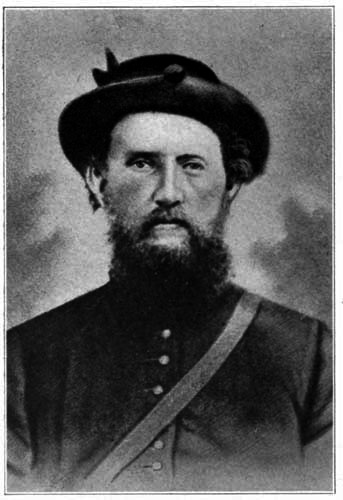
Peter Sheaff
There were fourteen miles of batteries in front of Vicksburg. No landing place existed upon the east side of the river between it and Grand Gulf, twenty-five miles below. The latter place was upon a high bluff and strongly fortified. Hence it was necessary to pass both of these places. It is not surprising therefore, that General Grant deemed it wise to carefully test the practicability of each expedient offered before finally acting upon any. Moreover, it was winter and the active prosecution of an elaborate campaign was not to be thought of. Nevertheless, the press, politicians and people of the North insisted that "something should be done." The scheme of cutting a canal across the peninsula formed by the great bend in the river opposite Vicksburg was a novel one, sounded well to everybody, was approved by Lincoln and Halleck and served to fill in the time. Aside from diverting attention, it had advantages so important that its attempt, after once having been suggested, was unavoidable. It would keep the men busy while waiting for spring and should it succeed, it would prove a happy solution of the problem in a way that would be clear gain. On the other hand, a failure in an effort to run the batteries without first trying it, would have been deemed suicidal; and the authorities might not have been able to have withstood the increasing force of clamor already raised for General Grant's removal. So the project of digging the canal was started while elaborate explorations were also being prosecuted through the bayous and swamps for some other feasible channel or road in case it should fail. While these things were being accomplished, the waiting, as well as the experiences associated with it, were tedious and trying.
We were comfortably housed at Memphis pending the preparations for a general move. In due time General Logan and staff, with our company and other troops of the 17th Corps, took passage upon the steamer Maria Deering and were transported to Lake Providence. All of the 17th Corps, under command of General McPherson, was moved to that place, where a temporary base of supplies was established upon the Commissary boat N. W. Thomas. The operations upon the canal were commenced about the time of our arrival. At the beginning of February, in the hope of facilitating this work by washing out a channel, General Grant caused the levee at Lake Providence to be cut. The water flowed in at a terrific rate and compelled us to move our camp from the south side of the lake. It was difficult to find camping space and the levees were used for that purpose. The rush of waters did not increase the canal channel as expected. There were other difficulties which rendered the canal impracticable; and, during the latter part of April, the project was abandoned. In the meantime, no feasible channel was found elsewhere, so the pioneer corps was set to work to build a corduroy road across the swamps towards Lake St. Joseph southwest of Vicksburg, over which to move the troops. The previous cutting of the levee greatly increased the difficulty of the work by causing a complete inundation of the low lands and swamps to the west for a distance of from fifty to seventy-five miles. This apparent disadvantage was, however, largely compensated for by its advantage in another respect. It formed an impassable barrier at the west and south, insured us against an attack in those directions and relieved us from much picket duty.
At last the time came for making the perilous movement of running the batteries. Transports, veneered with railroad iron and protected upon the outer edges with bales of hay and cotton, were loaded with supplies and started upon their way preceded by a flotilla of gunboats. The risk was considered so grave that all but two boat captains and one crew refused to attempt it. Volunteers were called for. Logan's command was composed of many river men and when the call was made, five times the requisite number volunteered. Many of our company asked to go but Logan said "No, I want you to navigate the horses." So, pending the success of the river movement, we remained at Lake Providence.
It was unnecessary to inform us when the running of the batteries commenced. The roar of the guns, eighty miles away, was distinctly heard by us. It was an anxious time but we soon knew that the movement had been a success. McClernard's Division had previously been started by the improvised road and was at Hard Times, above and nearly opposite Grand Gulf, from whence it was to be transported to a landing upon the east bank of the Mississippi to aid in the capture of the latter place should the gunboats succeed in silencing the guns of the fort.
On the 29th of April Admiral Porter commenced the bombardment and continued it during the day and far into the night without any apparent effect; whereupon the troops were debarked and under cover of night, marched down the levee upon the west side of the river to a safe point below the fort and while the gunboats continued the bombardment, the transports ran the batteries. Nearly all of the boats were more or less disabled. One transport was sunk nearly opposite Grand Gulf, and two were pulled up upon the west bank. Many of the artillery horses were wounded. Major Stalbrand lost a fine horse valued at one thousand dollars.
In the meantime we had marched through the swamps over the corduroy road to Lake St. Joseph and thence to a camp nearly opposite Grand Gulf where it was arranged that we should embark for Bruinsville. A satisfactory landing had been found at the latter place which connected with a road leading to Port Gibson.
The forces landed below Grand Gulf, including the 17th Corps, numbered about twenty thousand. The Confederates forces at Vicksburg, Haines Bluff, Jackson, Port Gibson and Grand Gulf, aggregated about sixty thousand. We were in an enemy's country, practically cut off from retreat as well as from our base of supplies. The only alternative, therefore, was to act quickly and attack the detached forces of the enemy in detail before they could concentrate or be defeated ourselves. Two days' rations were distributed and our forces advanced at once towards Port Gibson. In the meantime, a portion of the Grand Gulf garrison amounting to about eight thousand, had moved in a northeasterly direction in the hope of being re-enforced from Vicksburg so as to successfully dispute our passage. In anticipation of this, Grant had ordered Sherman to make an attack upon Haines Bluff with a view of deceiving Pemberton and holding his forces at Vicksburg. The ruse was successful. Sherman immediately withdrew and rapidly marched his division by the course we had taken to join us. Upon his arrival we had an available force of about thirty-three thousand to strike the forces east of Vicksburg before it would be possible for Pemberton to join them.
The greater portion of the 17th Corps had been transported across the river during the night preceding the movement of our company. Ten of the latter, including our orderly sergeant, James McCorkle and myself, were detailed to cross the river with General Logan. Upon arriving at the landing the Division Surgeon called for an orderly. McCorkle sent me back to camp for another man to fill my place and detailed me to act as orderly for the surgeon. We were unable to obtain transportation and so were compelled to remain there until morning. McCorkle and I slept together. He was in an unusually serious mood, said but little and seemed to want to have me near him. We embarked upon the first boat in the morning and landed about ten miles below Grand Gulf, from whence we rode together to Thompson's Hill where the battle of Port Gibson was in progress. It had been raging for some time and was still being hotly contested. Governor Yates and some of his staff, together with E. B. Washburn, then a member of Congress from the Galena District, were with General Logan. Washburn was instrumental in organizing the 45th Illinois Infantry, known as "The Lead Mine Regiment," which was a part of Logan's Division. A charge was made by the regiment and Washburn took special pride in the prowess of the men. Forgetting the danger of the situation and everything but the enthusiasm of the moment, he rode behind them cheering and swinging his hat like a boy chasing a fire-engine. Yates, on the other hand, tempered his valor with discretion. From morning until late in the afternoon, he found an attractive resting place under the protecting brow of a hill near the general hospital where his presence attracted the attention of the surgeons.
Shortly after one o'clock, James Padgett rode by and said: "Sam, Jim. McCorkle is killed and is lying between our lines and the Rebels." About three o'clock one of Logan's orderlies called out in passing: "Second your Orderly Sergeant is mortally wounded and lies just in the rear of the 45th Illinois." I at once asked permission to go and take him from the field. The main road which I was obliged to follow, was so jammed that it was difficult to proceed except at the slowest pace. The delay was torture. I did not find him until nearly dusk. His body was partially covered with a blanket but his cavalry boots were exposed and I knew from them that it was he. As I drew the blanket from his face he looked at me with a wild, vacant stare. Then an expression of intelligence and tenderness followed and he said: "Sam, you have come at last." He was removed to the hospital and lived until about six o'clock the following evening, retaining consciousness most of the time. After the battle he asked to see his comrades. I notified all that I could find, including Captain Hotaling, and General Logan and staff, to all of whom he bade an affectionate good-bye. He asked how the battle terminated and seemed satisfied when told that we had won.
During the battle McCorkle was acting as orderly for Captain Hotaling. While crossing from one brigade to another, he was struck by the bullet of a sharpshooter stationed in a tree. The bullet, which was large, entered the body at the right of the saber-clasp and, striking the spinal column, was flattened until it was as thin as a sheet of tin and about three inches in diameter.
McCorkle was a general favorite of the company, as just and fair as he was generous and brave, and we all mourned his loss as we would have mourned that of a brother.
The battle lasted from early morning until ten o'clock at night when the rebels retreated, leaving their dead and wounded upon the field. The following day was spent in burying the dead, waiting for the rear-guard and provision-train to come up and in reorganizing for an advance. Any battle of importance necessarily results in confusion and this proved to be no exception to the rule.
Aside from the loss of McCorkle, Clark Pond was fatally, and Jack Elder slightly wounded.
The evacuation of Grand Gulf occurred on the day of the battle and on the following day our company remained at the general hospital and on the next moved to Port Gibson where it encamped about two hours when orders came for an advance. We marched nearly all night in a northeasterly direction and encamped near the Big Black River, remaining there two days. Then another move was made to a point about five miles from Raymond where we encamped for a day. Company A formed the advance guard of Logan's Division in its movement towards Jackson. After having advanced about two miles towards Raymond there began to be signs of trouble. The enemy's videttes appeared. Our men were deployed as skirmishers. The country was more or less wooded and the thick brush served to screen the Confederates whose main body, numbering about five thousand, was not far distant. We were met by volleys from small detachments at every turn in the road. This was continued for about three miles when the enemy came to a final stand. The battle which followed was severe and lasted about five hours. During the skirmishing which preceded it, I had an interesting experience. Our men had dismounted near a group of trees and were endeavoring to locate a detachment of the enemy. Asa Gillette was nearest to me. We were standing behind trees which were close together. Gillette, seeing a man in a fence corner, was endeavoring to point him out to me, and as he did so, our heads nearly touched. At that instant a ball passed between us, punctured my hat-rim in two places and cut away a lock of hair. It was the 12th of May and my twentieth birthday. I have had many since but none has brought me a birthday present so unwelcome as the one then offered.
Our company was assigned to a position upon the right wing of the line of battle which was near to a creek, the banks of which were about ten feet in height and closely fringed with underbrush. A battery and a brigade of infantry were stationed upon our left, both actively engaged. After we had been there about two hours, our horses became very restless when we mounted and moved up the creek. We had advanced but a short distance when balls began to whistle over our heads. We soon discovered that an entire brigade, protected by the wooded banks of the creek had crawled down it and succeeded in almost surrounding us. They were lower than we however, and as they fired, their volleys went above us. We scattered like a flock of quail, retreated about forty rods, rallied and came to a halt. As we did so, we met General Logan with Leggett's Brigade advancing upon the double quick. Logan called out: "Boys, what is the matter?" "A hornet's nest," was the reply. Instantly came the command: "Go in boys and lift them out of that with the cold steel." They did.
After half an hour of severe musketry fire the Confederate line began to waver and then broke into full retreat towards Raymond where they were followed by our men.
The entire battle of Raymond was fought by Logan's Division with that of Carr's looking on ready to help but it was not called upon to do so.
On the night following the battle, we bivouacked near Raymond and early the next morning, at the head of the Division, resumed our march towards Jackson.
While at Raymond, General Grant's son Fred, a small, pale boy about twelve years of age, rode into town upon a black Shetland pony. His father states that he had left him asleep upon a gunboat below Grand Gulf, but the little fellow, hearing the sound of the guns at the battle of Port Gibson and, anxious to see what was being done, had, upon his own initiative, followed the direction of the sound and overtook the army. Where he found the pony can only be surmised. He had, before reaching Raymond, been seen, mounted upon a very large, old and decrepit beast, equipped with a primitive saddle and bridle, which make-shift answered his purpose for the time. The boy displayed the characteristics of his father, in that he was entirely independent, accepted all conditions as he found them, endured hardships and vicissitudes of camp life without a murmur, caused no trouble to anybody, and in this way is said to have gone through the entire campaign and a portion of the Vicksburg siege.
During our march that day we saw nothing of the enemy and at night we bivouacked about six miles from Jackson. There was a deluge of rain during the night and the roads were submerged when we started in the morning. We realized then, if not before, what General Logan meant when he said at Lake Providence, that he "wanted us to navigate the horses."
At a point about three miles from Jackson, our company was ordered upon the right flank. It was necessary to cross a stream and after marching about a mile we were blocked by cross-gullies filled with water. They were impassable and we were forced to return and recross the creek to the main road.
In the meantime, the division had encountered the enemy and was hotly engaged. A short but decisive battle occurred. The Confederates gave way and our men marched into Jackson. Seeing this, we put spurs to our horses and galloped in to find them in full possession of the place and engaged in helping themselves to provisions, tobacco and other desirable things. Tobacco was the one luxury which we could carry and would keep and we secured a supply which lasted us until after the fall of Vicksburg. To many, the tobacco habit may be regarded as inexcusable; but to the soldier upon the march, there are few more consoling things.
We bivouacked a short distance from Jackson and on the morning of the fifteenth started for Vicksburg. On the sixteenth the battle of Champion Hill was fought. Pemberton had marched out from Vicksburg with an army of about twenty-five thousand men to dispute our passage. The battle was bloody but brief and the Confederate loss was great. The engagement commenced about eleven o'clock and in the afternoon was very severe. Our company was assigned to a position upon the extreme right wing near to some heavy timber about twenty rods from where the 124th Illinois made its famous charge. In their pathway was a ditch where the enemy had taken a stand. This was filled with dead and dying Confederates. When our men returned from the charge, each had a prisoner. By night, the enemy was in full retreat and our company bivouacked where it had been stationed during the day.
We had started from Port Gibson with three days' rations in our haversacks and had been fighting and undergoing forced marches over almost impassable roads for sixteen days. Under these conditions, it was necessary to live upon the country. Every planter had corn and a grinding mill driven by mule-power, and these little mills were kept busy by our men. Aside from these, there were cattle, hogs, sheep and poultry, but none of these things could be gotten to be distributed regularly.
On the day of the battle, Orlando Casler, otherwise known as "Lon," who was one of the characters of the company, and nine others, including Ed Baker, had been sent out upon the right flank to forage, while the remainder of the company moved on with the command. We were very hungry and as the evening advanced with nothing edible in sight, had about concluded that it would be necessary to take another hitch in our belts as a substitute for supper, when Lon and his party appeared in a procession as surprising and unique as it was welcome. Casler, who was nothing if not dramatic, was appareled in a full broadcloth dress-suit and silk hat and sat upon the boot of a large family carriage. He had apparently appropriated the dress-suit of some aristocratic giant. Casler was a large man but his clothes were of such colossal proportions that he was compelled to put a wisp of straw under the sweat-band of his hat and a pillow in the front of his trowsers in order to locate his own anatomy. The carriage was drawn by two mules engineered by a colored driver and was filled to the limit of its capacity with smoked hams, shoulders, chickens, turkeys and jars of preserved fruit. Following the carriage was a wagon drawn by a four-mule team and loaded with hams, bacon, about sixty gallons of strained honey and a barrel of coffee. The necessity for these things and the joyousness of their welcome were both manifested by the astonishing rate at which they disappeared.
In the morning we saw the men of Logan's Division who had fought so hard the day before, dig up a ten-acre field of sweet potatoes but recently planted and devour them like ravenous animals. Afterwards, as they marched by us, we stationed a number of men at "Casler's base of supplies," who tossed hams and bacon at them and filled their cups with coffee. We enjoyed it immensely, for it was our opportunity to pay a debt in kind to the 45th Illinois by whom we had been previously remembered in a similar manner. But little was reserved for ourselves and our supply that night was in inverse ratio to our satisfaction.
Then followed the fight at Black River Bridge which was burned by the enemy to prevent our passage. This delayed us one day and prevented the possible capture or dispersion of Pemberton's army. Three temporary bridges were hurriedly built and on the 18th, we resumed our march. On the 19th, we had the satisfaction of taking a place in the semicircle which invested Vicksburg.
At last the long sought goal had been reached. The position for which the Northern army had manouvered for more than a year had been gained. For three weeks we had endured forced marches over nearly impassable roads, had engaged in almost constant skirmishing when not fighting in important battles and had bivouacked in mud and rain without tents or cooking utensils, and this on five days' rations issued at the start. Hungry and worn, we stood between two armies whose combined numbers exceeded ours. Our problem was to capture the one, nearly as large as our own, protected behind seven miles of fortifications, while guarding ourselves against one in our rear that was being rapidly re-enforced.
In securing our position, we had ended a great and successful campaign to begin a siege which, in view of all the adverse conditions, had in it the possibilities of utter defeat. We needed supplies and above all, re-enforcements to complete and strengthen a line twenty-one miles long and to ward off the enemy in the rear. Aside from our hope of immediate re-enforcements, our only assured reliance was in our determination and the ability of our imperial Commander. We knew that we should win.
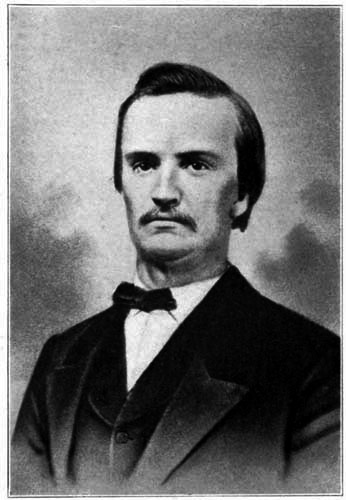
Osborn Shannon
CHAPTER VII.
The Siege of Vicksburg—The Assault—Logan's Headquarters—The "Bull-Pen"—"Boyce's Battery"—Scouting—The Mine—The Surrender— Phelp's Appropriates General Buckner's Capitulation Papers— Significance of the Victory—Credit Due to Grant.
"How we marched together, sound or sick, Sank in the trench o'er the heavy spade— How we charged on the guns, at double-quick, Kept rank for Death to choose and pick— And lay on the bed no fair hands made."
Upon the nineteenth of May Vicksburg was practically invested. Haines Bluff was evacuated and the rebel garrison had entered Vicksburg, thereby opening to our army the possibility of a base of supplies and direct communication with the North. There was much severe fighting during the day, including an assault upon the southern portion of the works, which was repulsed. All of this resulted in giving us better positions and enabled us to determine those of the enemy. By the 22nd, we had succeeded in opening up communication with the North by way of the Yazoo River and in obtaining supplies. Hard-tack and coffee were particularly welcomed. This greatly increased the confidence and enthusiasm of the men and on the same day a grand charge was made. The slaughter on our side was appalling. The enemy was strongly entrenched and our troops were compelled to fall back and to build temporary breast-works. Logan moved his quarters up to the firing-line within about forty rods from what was known to us as Fort Hill, [2] a high point near the middle of the line of the fortifications. His adjutant's quarters were nearly a mile in the rear, so that the shots from the enemy's guns passed over his headquarters and fell within a radius of about forty rods from those in the rear. His adjutant, Major Towne, owing to a prejudice against minnie balls, was disinclined to get closer. Our company, being the escort, was ordered to camp about ten rods south of headquarters. There was a swale between the two positions which grew wider and higher towards the east, and from the crest there was a plain view of Fort Hill. About that time large numbers of men had been recruited by the different regiments as substitutes for skulkers and "bounty jumpers." The natural diffidence of these men had a tendency to keep them away from the front. Many were found by our rear-guard five miles back hidden in negro quarters and cane-brakes. About two hundred were brought to General Logan, who located them upon a hill back of his headquarters and placed a strong guard around them. This enclosure was called the "Bull-Pen." When there was a heavy cannonade, the spent shells and minnie-balls would fall there. These reached our company also and made it quite unpleasant, but the fellows upon the hill were kept busy inventing and practicing new dodging methods.
There were several clowns in our company, the chief of whom was Ben Boyce, a brother of Caleb Boyce, at that time a well known Rochelle merchant. Boyce constructed a formidable battery of two guns made from stalks of sugar-cane, wound with marline and mounted upon small trucks. His gun crew was usually composed of four men. They had a pole about fifteen feet long upon which was tied an old shirt which served as a guidon. Ben wore a paper cap two feet high and carried a field-glass six feet long made from cane. With this instrument he would mount a bale of hay and with all hands at the guns, was ready for action. When the "camp-kettles" from the enemy's mortars commenced to drop, Ben would issue his commands with the gravity of a general and they were followed with a fidelity and heroism equal to any shown upon other parts of the field. His guns were phenomenal. They required only about half the charge used for a Sharp's carbine, but their effectiveness exceeded that of the largest ordnance, for they frequently dismounted the enemy's cannon at Fort Hill and sometimes silenced all his batteries. Ben's battery men were usually Jim Bowers, Martin Klock and Henderson Gordonier. Grand Townsend was one of the invincibles and sometimes volunteers were called upon to lead a forlorn hope. This by-play formed an amusing recreation and frequently served to divert our minds from the more serious and grewsome happenings around us. The fun was by no means devoid of danger but that only served to give zest to its enjoyment.
After the terrific assault and repulse of May 22nd, it became manifest that Vicksburg could not be captured except by a prolonged siege. Pemberton had previously disobeyed the order of Johnson, his superior in command, to evacuate, giving as his reason that he regarded the place as "the most important point in the Confederacy." Johnson was in our rear and Pemberton had reason to believe that the latter would be re-enforced and would exhaust every effort to raise the siege. Under these conditions, it was clear that Pemberton intended to hold the place at any cost.
It was essential that Johnson should be watched; and our company, under command of Lieutenant W. B. Cummins, a section of a battery, the 21st Illinois, Grant's old regiment and some other troops, including the 2nd Iowa Cavalry, was ordered out for this purpose under the command of Colonel Johnson. Our course led past Haines' Bluff, up the Yazoo River to Mechanicsburg and thence along the Black River. A Confederate force was met near Mechanicsburg which was charged and driven off by the Second Iowa Cavalry. We continued our advance north and east and again met them in the evening, when an engagement ensued. The action had barely commenced when the enemy began to run. The fear of our foe seemed to have a reflex action upon our commander who ordered a retreat to Haines' Buff, about forty miles distant.
We returned to Vicksburg, where we were stationed at Logan's hind quarters. During this time I acted as orderly for Dr. Trowbridge who was acting Division Surgeon in the absence of Dr. Goodleak who was sick at the time.
The method employed by our men in planting the mine under Fort Hill was interesting and involved some features which I have not seen in print. It was known to but few outside of Logan's Division. Captain Tressiline, Logan's engineer, known as the "Wild Irishman," planned the work. It was executed with the help of the pioneer corps and infantry detailed for the purpose. The work was commenced at the top of a hill northeast of Fort Hill and was complicated by an intervening sag which had to be taken into account. A platform of heavy timbers about twelve feet wide and sixteen feet long, was built and supported upon strong wheels. Upon the platform was mounted two large wooden guns which were painted black and varnished, each having what appeared to be a ten inch bore. This formidable engine of war, suggestive of the famous wooden-horse at the siege of Troy, was moved ahead of the workmen and served to shield them and their work from the enemy. As the machine was advanced, a trench was dug behind it, ceiled by timbers and covered with the excavated material. When the sag was reached the Rebels could not get their cannon to bear upon the moving structure from any point and small arms were useless. There was a moat at the base of the fort, and when our men reached the sag they tunneled beneath it to plant the mine. This moat proved a boon to us, for it necessitated the running of the tunnel at so low a level that the enemy in counter-mining, missed it. There was lively work at this place. The enemy, being above us, had a great advantage. They not only threw hand-grenades, but rolled heavier explosives over the ramparts. All our men had to send in return was twenty-four pound shells and these had to be thrown by hand. When the fuse chanced to be a little too long, the enemy would cut or pull it out. This was hazardous work and not always successful. Sometimes the fuse was too short. Captain Hotaling had an experience with one of these which exploded prematurely. A piece of it struck him a glancing blow in the breast and he lay, apparently dead, for over two hours.
A few days before the surrender, the mine, containing three hundred kegs of powder, was exploded. The explosion was to be the signal for the grand charge; and in order that all might be ready for it, Grant had previously caused the watches of all the commanding officers to be set by his. The eruption was terrific and blew the top off the hill, but the enemy had anticipated the result by building a second line of works immediately within the other and the breach was not sufficient to permit the passage of enough men to carry them. Our men were unable to hold the positions taken along the line and at night fell back to those formerly occupied. An armistice was declared and the dead were buried where they fell.
A negro in Fort Hill was blown into our lines more frightened than hurt. Grant quotes him as saying, when asked how high he went up: "Dunno, Massa, but 'tink 'bout 'tree mile." The negro remained in service at Logan's quarters and was ultimately sent by him to the then famous showman, P. T. Barnum, for exhibition.
During an armistice upon July 3rd, papers of capitulation were signed by Grant and Pemberton, by which it was agreed that the surrender should take place at ten o'clock upon the following day. Logan's command, being at the center, was among the first of our troops to enter the fort. Our company, as escort for Logan, reported at his headquarters, where we waited for General Grant, his staff and escort to take the advance. Then followed General McPherson, our Corps commander, with staff and escort and General Logan, with staff and escort brought up the rear. We passed into the fortifications and marched directly to the court-house, where General Logan, who was assigned as Post Commander, established a temporary office.
The plight of the Confederates as we marched in appealed to our tenderest sympathies. They were a sorry looking lot. The rank and file were as simple minded as their condition was pathetic. It was one of the provisions of the surrender that the men were to be paroled. The word "parole" was apparently construed by many to mean a reward; for we were frequently asked how soon the "pay-roll" would be ready for them. Some asked: "What are you'ns goin' to do now? We'ns is mighty hungry. Our mules is most all dead and et up."
The Confederate Guard at the Court House had some mule ham and black peas for dinner. This was tasted by some of our boys but they were not enthusiastic in their approval of it, owing, probably to conventional prejudice.
Permission was given us to ride around the town to satisfy our curiosity. Most of the inhabitants were living in caves dug in the clay banks. Many of these were divided into a number of rooms and well furnished.
About four o'clock, as I was going from the Washington Hotel to the Court House, I passed a residence which was swarming with Confederate officers and ladies. There were two vacant lots adjoining in which the officers' horses were tied. Among them was a fine, well bred black horse that took my fancy. Upon him was an elegant English cavalry saddle upon which was strapped a tin telescoping-tube about three inches in diameter and sixteen inches long, such as was used for carrying official papers. It shone in the sun like silver. The horse was the embodiment of beauty and I might have taken him but did not. I rode to the Court House in search of a comrade to accompany me to camp. I had been there but a short time when Henry Phelps of our company appeared riding the horse I had just been admiring. The tin-tube was still upon the saddle. I asked if he was going to camp and he replied, "Yes, come on." His newly found horse proved to be a fast pacer and he rode him at such a speed that I was obliged to put mine upon the run in order to keep up with him. I said: "Hank, what is the use of riding so fast?" He replied: "Some one may want this horse." So we kept up the speed until we reached our lines. That evening I noticed Phelps and Lon Casler examining some papers but paid little attention to it and did not know what they were.
The next morning our company moved into Vicksburg and went into camp. Upon our arrival Phelps was called before Logan who said:
"Phelps, you got a horse yesterday when you were here, didn't you?"
"Yes, sir."
"And what was on him?"
"A saddle and tin case with some papers in it."
"Was that all?"
"Yes, sir."
"And you got all that money, fourteen thousand dollars in greenbacks?"
"No sir, I did not find any money."
The general then turned to a Confederate officer who was present, and said:
"Did you say the money was in the tin case?"
"Yes, sir."
Turning again to Phelps, he said:
"Well Phelps, what was the nature of the papers you got?"
"They were the capitulation papers of the surrender of Vicksburg, signed by Generals Grant and Pemberton."
"You must produce them at once."
Phelps went out, returned with the case and handed it to General Logan who opened it and removed the papers. He found, upon rolling them closely, that they fitted the case and completely filled it. Turning to the officer he told him that he must have been mistaken about where he put the money. Logan then ordered Phelps to produce the horse and saddle, which he did and was then dismissed.
To us, who had fought and striven at the front, it was difficult to realize that Vicksburg had fallen or to conceive the significance of its fall. The coveted position for which we had so long fought and endured, was again an integral part of the Federal Union with all that that fact implied. The heroism, bravery and fortitude of the men who fought and won can never be too strongly commended; but all this would have gone for naught without the commanding genius, the prescience, the broad grasp of military situations and the superb poise and indomitable will of the one regal mind by which it was inspired and directed. General Grant in this campaign executed one of the most daring and brilliant movements known to military history. In opposition to the most revered precedents of military science as well as to the judgment of his foremost general, he deliberately moved his army into an enemy's country beyond a great river, between two strongly fortified positions held by the enemy, severed that army from its base of supplies, placed it between opposing forces outnumbering it two to one, fought them in detail, laid siege to the larger one behind fortifications of almost unprecedented extent and strength, while still warding off the other, fought his way back into communication with his original base and brought the siege to a successful issue. It was the most Napoleonic campaign of the war and the most decisive and far reaching in its direct results and final significance. It secured to us "the most important point in the Confederacy." It insured the segregation of all the Confederate forces west of the Mississippi and the freeing of our western army for the capture of Mobile, Atlanta and Chattanooga. In short, considering all things, it was, of all our victories, the boldest, the greatest, the most audacious and the most prophetic,—the most prophetic, because it foretold the doom of Richmond.
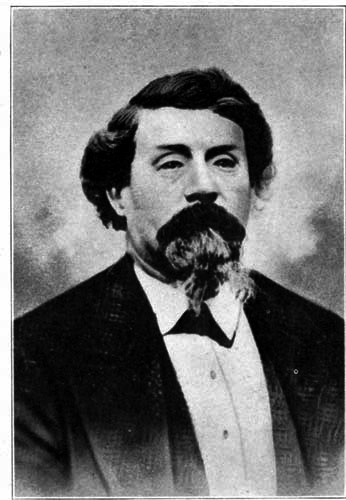
James Bowers
CHAPTER VIII.
Department of the Gulf—New Orleans—How Official Dignity Was Vindicated by a Cat-o'-Nine-Tails—New Iberia—Vermillionville— Chain-Vidette—"Bowers' Charge"—How Ed Baker Won His Spurs— Repulse of Generals Lucas and Franklin—Improvised Cavalry— Death of Crosby—Superior Arms of Confederates—Brilliant Capture of Confederate Detachment—Commended by General Order—Outrage Committed by Banks and Franklin in Confiscating Horses—Cowardly Manner of Its Perpetration—Re-enlistment—Veteran Furlough—Return to the Front.
"Death while we stood with the musket, and death while we stoopt to the spade."—Defense of Lucknow.
The surrender of Vicksburg was quickly followed by the news of the Union victory at Gettysburg which occurred on the same day, and in a short time we heard of the fall of Port Hudson which, with its garrison of 8,000, was given up by its commander three days later upon being assured of the fall of Vicksburg. This left the Union forces in the possession of the Mississippi from its source to its mouth. It began to look like the beginning of the end.
Our company remained at Vicksburg until about the middle of August. A number of our men were sick. Shortly after the beginning of the siege, two of them, Robert McAdams and Smith Wheeler, died of malarial fever. Morgan Haymaker and Leroy Herbert had died before the company left Memphis.
General Grant was about to leave for the Eastern army and our company was ordered to the Department of the Gulf. Upon our arrival we were detailed as an escort to General Ord at New Orleans where we remained for three or four weeks, when we received orders to join our regiment at New Iberia, Louisiana.
At New Orleans, I was detailed as orderly at General Ord's headquarters. He occupied a part of a large plantation mansion in the outskirts of Carlton, Louisiana. While at this place I again had an experience which opened my eyes, not only to the horrors of slavery, but to the brutality of some of our own officers who were only too willing when opportunity offered, to adopt the worst features of that wretched institution when they could be used for their own tyrannical purposes.
The place was very old and bore evidence of opulence and aristocratic antecedents. Surrounding the house was a spacious yard filled with bearing orange trees, some of which were unusually large. It was a charming and delightful spot and suggested the peace and contentment of a real Arcadia.
As I lounged around the place, the thought uppermost in my mind was, how was it possible that a people blessed with such surroundings could cause or in any way tolerate a devastating war, such as was being waged? The answer soon came in concrete form.
In the yard, fronting the house, there were a number of tents occupied by the Adjutant General and his staff. A negro had committed some trifling offense which had aroused the ire of three of the staff officers, one of whom was Major Seward, General Ord's Adjutant General,—who was reputed to have been a nephew of William H. Seward,—and two others whose names I did not know.
While sitting alone beneath a tree, the overseer of the plantation, a creole of the Simon Legree type, with all the diabolical vindictiveness of generations of evil ancestors shining from his malignant reptilian eyes, appeared leading a large, finely formed intelligent looking negro. The man's arms were bound together in front and a strong rope was tied to each arm above the elbow. The overseer led his victim to a large orange tree standing near the Adjutant's tent and proceeded to lash him to the tree with his face towards it. The poor creature was the picture of abject terror and trembled from head to foot. I was about to interfere, when Major Seward and the two other officers came out of their tents with camp-stools in their hands and, with an air of expectancy, silently seated themselves, as if they well understood what was about to occur. I looked on with surprise and wrath. I could not believe my eyes.
The negro's body was bare to the hips, and the overseer bore a peculiar whip with a short thick stalk and a number of heavy braided lashes about two feet in length. The bearer of the whip—a muscular brute—had every appearance of being an adept in its use. Looking around with the air of a stage-manager, to see that his distinguished audience was properly composed, he commenced. The first stroke brought blood and a cry of torture that was sickening. Then followed lash after lash until the wielder of the whip was exhausted and literally spattered with the red drops from his victim. When the negro was about to faint, and it was apparently unsafe to give him another stroke, he was released and led away by his captor, his back dripping and his skin in shreds.
The official defenders of the "honor of the flag" and the keepers of the seals of military justice whose honor had been appeased by the enlightening spectacle, withdrew to their tents in dignified silence and with an apparently satisfied air.
What was the cause of the hellish act or why it was tolerated, I never knew.
Ten or twelve of our men, whose names I have forgotten, were left in the general hospital at New Orleans, where some of them died. We joined our regiment about a week after leaving the latter place. It was located in one of the most charming and beautiful sections of Dixie. Later, it was advanced to Vermillionville, Louisiana, where we were entertained by the music of minnie balls almost constantly until January, 1864. The conditions there were peculiar and called for unusual military methods and constant watchfulness in order to insure camp protection. There were many large corn and cotton-fields which, from neglect, were over-grown with rank weeds from seven to ten feet in height. They made a tangle as thick as a jungle and afforded complete concealment to the enemy. Our system of camp protection was devised and adapted to meet these conditions. Our camp was encircled by a chain-vidette system located at a distance therefrom of about two miles. The men were stationed about twenty rods apart. All were required to move at once in the same general direction to the ends of their respective beats and then to return. This constituted each man a rear-guard for the one in front of him. In the rear of each five or six videttes, about forty rods back, there was stationed a relief or first reserve. About the same distance back of these, in turn, was stationed the second or grand reserve composed of fifteen to twenty-four men who, in turn, were supported by a number of primary reserves, thereby forming an elastic combination, each unit of which was in touch with all of the others, while at the same time it provided for speedy concentration at any threatened point.
The utmost vigilance was necessary and we were compelled to change our lines after dark either by advancing or drawing them in. The wisdom of this precaution was constantly demonstrated, for it became the established custom of the "Johnnies" to give us a dose of "blue pills" each morning as an appetizer. We always expected them and soon found out that the term "southern hospitality," was capable of varied application. Sometimes their attentions were forced upon us to an annoying extent during the entire day. At such times it was not unusual for our men to fire from twenty to forty rounds of ammunition. We were frequently required to shoot so rapidly that our carbines became heated and we were obliged to swab them out with brush and water before the cartridges could be inserted. Sometimes we would call out the reserve, charge upon and drive them off four or five miles which usually settled it for that day.
One day Jim Bowers was Sergeant of the reserve. He had about twenty-five or thirty boys of Company A, who had been nagging him about his lack of courage which they pretended to question. Jim's health was poor but it did not prevent him from being a good soldier and he always kept a supply of courage where he could find it when needed. On the day in question the chaffing annoyed him and he determined to give us an object lesson. The Johnnies had appeared in unusual force. About two hundred were in sight and more in the distance. Bowers at first seemed to think his band too small for so large a force and sent to camp for help. Captain Kelly started with his company but Bowers' aggressiveness got beyond his control and he gave the command to charge. The rebels at first showed fight but soon broke and ran. Ed Baker was one of Bowers' party. He was mounted upon a thoroughbred of great power and endurance. The horse and the man appeared to have been made for each other. Ed was an athlete and every inch a soldier; as manly and lovable as he was heroic and daring. A college graduate, he enlisted as a private with the sole thought of doing his duty. He was regarded as the best educated man in the regiment. There were five lawyers in our company, but Ed outclassed them all. The only thing he did not know and never learned, was when to stop fighting. With his powerful horse, he found no difficulty in overtaking the flying men. He used his sword only. He would ride a man down, capture, pass him back to his comrades and start for another. He rode like a knight of old, keeping constantly ahead of the charging party and upon the heels of the enemy until he out-distanced all of his friends and found himself within a mile of the enemy's lines, nearly sixteen miles from his own camp and facing a body of about twelve hundred Confederates who came out to re-enforce their friends. Then discretion came to his rescue for he realized that he could not capture them all. Turning to retreat, he discovered that there was not a man of his company in sight. He had ridden two miles ahead of them. His sole chance of escape lay in the remaining strength of his horse. It was enough however, and he won. The little party returned to camp with their horses so jaded that several of them never recovered from that day's work. A count showed thirty-five prisoners captured by the little band, a goodly percentage of which was credited to Baker, who, as a reward for his work, was given a commission as Second Lieutenant. The charge was afterwards known as "Bowers' charge"; but Baker was the Sir Lancelot of the day.
Shortly after this incident, two of our generals, Lucas and Franklin, decided to chastise the Confederate Generals, Green and Motaw who had a large force in the vicinity. Our cavalry had shown such high efficiency that they considered that the only factor necessary to success was more cavalry. This they did not have, but it was easy to get. Cavalry was composed of men on horseback. Why not mount the infantry? If not enough, mount more infantry. The reasoning was sounder than the premises but was followed enthusiastically and we were soon able to muster about nine regiments including ours and the Sixth Missouri Cavalry. With this force, we marched out to meet the enemy, our regiment and the Sixth Missouri holding the center of the line upon the main road between Vermillion and Carrion Crow Bayou. As soon as we reached the open prairie, a line of battle was formed facing a corresponding line of the enemy about a mile distant. The Confederates had better guns than we and their shots reached us as we advanced. The wings, composed of mounted infantry, soon began to fall back and to become displaced. They were good men but as little at home on horseback as a lands-man upon a yardarm. They could not manage their horses and were greatly handicapped with their long guns. These gave them a grotesque appearance which would have been ludicrous had the occasion been less grave.
We were soon forced to retreat. The Second and Sixth fell back alternately, forming a line upon each side of the road. In the meantime the enemy began to rush our wings which were about a mile ahead. We were in a sack and the foe was pouring an enfilading fire upon us. We soon reached an open field of about eighty acres which, with the exception of a few rods of rail fence next to the road, was almost surrounded by a high hedge. Some rails were removed and our company marched in and formed upon the south side of the road. It was a hot place. The bullets zipped past our ears like a flight of hornets. Just then the order, "Fours right," was given. I was number three and George Crosby, the next man upon my left, was four. A ball struck his right arm, passed through his body and out through the other arm. His horse came around by the side of mine and I did not know that anything unusual had occurred until Henry Knuppeneau, the next file behind me, cried out: "Fletch, Crosby is killed!" Then we stopped and fought until his body was taken off the field.
About half a mile further back the 132nd New York and a battery came to our support. At the same time it was discovered that infantry was not cavalry. The men comprising the wings were ordered to dismount and the stampede was arrested.
I think that with two more good cavalry regiments, such, for example, as the Fourth Missouri, Tenth Illinois, or the Third Michigan, we could have changed a repulse into a victory and could have driven them to the Texas line. Their arms were superior to ours and they knew it. They would stand off and shoot indefinitely but were afraid to charge, which is the true way to fight with cavalry. Almost any man will fight well in a charge; if not, he is useless as a soldier. Not only is he obliged to go with his horse, but the very dash of the thing acts as a moral support. The horses imbibe the spirit of the men and of each other and the whole becomes an irresistible mass like the rush of a torrent; but the men and horses must be trained until they become a unit. A successful cavalry force cannot be improvised.
All the Confederates whom we met in that section had fine arms. They would throw a ball a mile with great force and accuracy and at three quarters of a mile would often go over our lines, while ours only served to kick up a dust a quarter of a mile ahead of the enemy, who would shout, "A little more powder." I never saw one of their guns to examine it, but understood that they were of French manufacture. We had nothing in our army to compare with them. The Texas men were all armed with these guns which must have been received through Mexico at the instance of Maximillian or his representatives.
The enemy continued to annoy us in about the same way as long as we remained at Vermillionville. A skirmish of half a day or a day was a common occurrence. We remained there until the weather began to get cold and frosty, when, late in the fall of 1863, we moved back about twenty miles to New Iberia, which was a more secure position. Bayou Teche served as a protection upon one side and the Gulf coast was only about four or five miles away with intervening low lying land so interspersed with sloughs as to render it almost impassable for an enemy. So we were free from the constant embarrassment experienced at Vermillionville.
After the commencement of cold weather, there were several hard rains and a snow-storm. We were in need of supplies and Colonel Mudd, with a force which included our company, under Lieutenant J. S. McHenry, started out upon the Abbeville road with a view of gathering a supply of Confederate cattle. After going about nine miles we arrived at a small marshy creek. The Confederates had destroyed the bridge and, as the creek was practically impassable, we set to work to construct a bridge from some plank and stringers that were left and were soon able to cross in single file.
The Colonel left McHenry with sixteen men to guard the bridge and picket the approaching roadways. There was a patch of woods north of the bridge, near which was a large house and some negro quarters. Here we arranged for a sumptuous dinner of sweet-potatoes, roast pork and corn-bread, which was just about to be served, when one of our pickets rode up and said that there was a company of cavalry near the picket-post; that they wore blue overcoats, but he thought that they were Rebels. McHenry left three men to guard the bridge and with the other thirteen, rode out to meet the strangers. When within about twenty rods he asked them what their command was but received no reply. One of the men, Waldo Aulis, who was given to playful remarks, said, "I will just speak to them gently and see if they will answer." With that, he fired at them and wounded a horse. The act seemed to flurry them and they turned and trotted away. McHenry's orders to guard the bridge, precluded him from ordering a charge; but by common impulse we made one—shooting as we went—they returning the fire over their shoulders. After pursuing them about a mile we ran them into a fence corner. They turned, and as they did so, Nick Hotaling and Jack Rhodes wheeled in front of them and called to them to surrender. The remainder of our company was in their rear. Nick rode a Grimsey saddle with a high cantle, and as he passed in front he threw his body, Indian fashion, upon the near side of the horse. This caused the tail of his overcoat to stand up in the air where it invited the fire of the enemy and received several bullet wounds. The fray did not last long however, and they soon surrendered. We captured nineteen men, including one lieutenant. One escaped. The latter was mounted upon a thoroughbred, and during the excitement quietly moved away a short distance and then put spurs to his horse. Chase was given, but our men, having dismounted at the surrender, were unable to overtake him.
During the main chase I captured a prisoner and, while changing revolvers, accidently discharged one and wounded my mare in the shoulder. The wound was not serious however, and that, with the holes through Hotaling's coat-tail, summed up the injury to our little band of thirteen. All things considered, we had reason to believe it to be a lucky number.
Some of the other companies of our regiment thought that because we were so much upon detached service, we were not entitled to the letter "A." After that, however, it was freely conceded to us.
Colonel Mudd and his men soon arrived with the cattle. He was more than pleased with our behavior. General Franklin however was loth to give us any credit, presumably because we were western men. The Colonel told him that he could do as he liked about it, but that if he refused, it would be sought elsewhere. As a result, the following order was issued:
Headquarters, Cavalry Division, In the Field near New Iberia, La., Dec. 5th, 1863.
General Order No. 10.
The Colonel commanding is glad to be able to publish to this command the following communication received today from Major General Franklin, to show that gallant deeds are appreciated:
"The commanding General directs that you publicly express his thanks to Lieutenant McHenry, Co. A, 2nd Ill. Cavalry and the detachment of seventeen men under his command, for their gallant conduct on the 30th Nov. last, in charging and capturing an equal number of the rebel force. Acts of daring of this kind, while they encourage our own troops, demoralize the enemy. Treat them in this way whenever opportunity offers and they will soon abandon a service for which they now have little heart.
"By order of T. J. Lucas, Col. Com'g.
F. W. Emery, A.A.G."
So far as I can remember them, the names of those connected with the incident, in addition to the writer, are as follows: Lieutenant James McHenry, Nicholas Hotaling, Grant Townsend, James L. Padget, William Stilwell, John Elder, John Rhodes, George Burkhardt, Joseph Sheaff, George Hemstock, Waldo Aulis and Calvin Steel. Including the guard at the bridge, there were three or four others, but I have forgotten their names.
We remained at New Iberia until shortly after January 4, 1864, the date of our re-enlistment, when we went to New Orleans. In the early part of February we left there for home upon a veteran furlough.
Twenty-two of our old company veteranized. The new organization however, never seemed like the old one. There was a lack of a certain charm, a lack of unity, a lack of that intimate comradeship that we had known before.
Upon our arrival at New Orleans, Banks and Franklin did a most shameful thing. Our men owned their horses and equipment. Upon entering the service, each had selected the best horse he could get in his neighborhood, and the result was that we, as privates, were better mounted than the eastern officers. Their envy was shown upon all occasions and they made our re-enlistment an excuse for confiscating our horses. They first attempted to take them arbitrarily by allowing each officer to choose; but, when given to understand that they were our private property, an order was issued by Banks or Franklin, I am not certain which, to appraise the horses in the name of the Government and place a U.S. brand upon them. In order to carry it out successfully, the order was, for a time, kept secret. When the time came to take possession, our men were ordered out without arms and with nothing but the bridles upon the horses. We were marched into an alley and thence into a cotton shed with high brick walls. Then two or four were ordered to dismount and lead their horses into another shed where an appraiser was stationed with men having red-hot brands, ready for their repulsive work. Exasperating as it was, our feeling for the branders was one of respect compared to our unspeakable contempt for those who commanded them to do it. The injustice and tyranny of the act was only equaled by the cowardly and brutal manner of its perpetration. During the entire time, a regiment of infantry and a battery of artillery were in line commanding the place.
We never recovered from the moral effect of this dastardly act by which the Government was the greater loser. Before, the horses were scrupulously cared for. At the end of a long march, the men might be hungry but the horses were fed; the men might be tired to exhaustion, but to groom their horses before sleeping was a duty never neglected. It was not uncommon for a soldier to take another horse or a mule and ride four or five miles at night to get forage for the tired one. All this ceased under the new order of things, and neglect and indifference was the rule.
Government vouchers were given to us for our horses; but inasmuch as these were made payable at St. Louis, most of them were cashed by speculators in New Orleans at a modest discount of ten per cent.
It was gratifying to know that the eastern officers who wanted our horses, failed in the end to get them. For some reason, all but a few of the poorer ones, were taken by new recruits.
All of those who veteranized were required to move to the Conley Depot, about three miles north of Canal Street where they waited until they were paid. In a day or two after this, orders were received to march to the boat. Early in the morning, Gilmore's famous Boston Band, composed of one hundred and twenty-five pieces, marched to our quarters and escorted us to the Clay Monument at St. Charles and Canal Streets, where we were addressed by Colonel Marsh of our regiment. When he had finished, General John A. McClernand appeared and bade us good bye and wished us a happy time. The band then escorted us to the boat, played while we were waiting, and closed, as the boat left the dock, with "The Girl I Left Behind Me." We had a most delightful trip and were received by all at home with open arms.
Our home-going was one round of delightful entertainment and generous hospitality. But it was all too short. It seemed to end almost as soon as it began, and our faces were again turned to the front. It did not seem so hard to start however, as when we first enlisted. We had become seasoned, had a definite aim, a justifiable pride in our appearance and record as soldiers, and success in the past gave us confidence in the future. Moreover, there was a strong tie of fraternity which was born of the trying experiences through which we had passed. At the outset it was different. All was new and strange and confusing. We knew nothing of camp duties or methods, had no conception of military discipline, and it was more than two years before we were enabled to fully care for ourselves as soldiers. Our hard-won experience prompted the wish to again go to the front and remain there to the end.
The regiment first assembled at Springfield. Our Colonel, who had formerly lived at St. Louis, where he had a large acquaintance, was very proud of his command and wanted us to visit St. Louis, which we did. Upon our arrival there we were received by a large deputation of citizens who gave a banquet in our honor, at which several of the men of the regiment made telling speeches. War songs were sung and we had a general good time. The entertainment lasted about three days.
From St. Louis we went to New Orleans upon the steamer "Olive-Branch." Upon our arrival, which was in April, we were ordered to Baton Rouge, where we went into camp. Our time there was occupied in infantry drill with old Springfield rifles, until about July, when we received our mounts and were again ready for service.
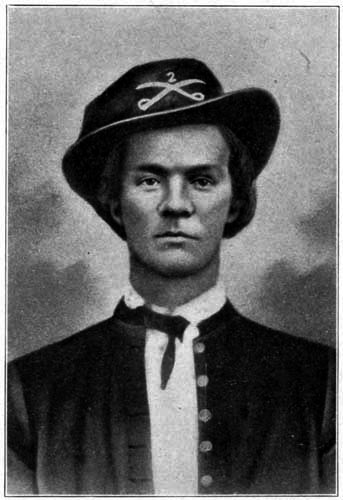
James L. Padgett
CHAPTER IX.
The Red River Expedition—Death of Colonel Mudd—How Colonel Marsh Held the Line—Fighting Guerrillas—"Alton Hell-Hounds"—Their Remedy for Picket Shooting—Incidents at Clinton, Louisiana—Colored Wards and the River Jordan—Dash Upon Liberty, Mississippi—Capture of One Hundred and Four Confederate Officers—Chivalry of the Prisoners and Captors How a Confederate Captain "Made Good."
"The greatest gift a hero leaves his race is to have been a hero. Say we fail! We feed the high traditions of the world And leave our spirit in our children's breast."
—George Eliot.
One of the important and humiliating campaign features of 1864 was the Red River Expedition, which was foredoomed to ignominious failure. It was one of Halleck's favorite projects and was started before Grant received his general command; otherwise, it probably would not have been ordered. Grant, in his "Memoirs," says of it: "I had opposed the movement strenuously but acquiesced because it was the order of my superior (Halleck) at the time."
Another sentence of Grant's indicates the disadvantage at which it placed our army, aside from the great and needless loss of life and property entailed by it. He says: "The services of forty thousand veteran troops, over and above the number required to hold all that was necessary in the Department of the Gulf, were thus paralyzed."
The Second Illinois Cavalry, with the exception of the re-enlisted men, including a part of Company A, was one of the regiments which accompanied this ill advised and ill fated expedition. It was charged at that time, and quite generally believed, that the movement had its inception in commercialism. The enormous profits upon the sale of captured cotton furnished the motive. At a time when there was not enough cotton in the North to make wrapping-twine, and resort was had to twisted strips of Manila paper as a substitute for that commodity, the value of cotton may be imagined. Any general who was in position to connive at this traffic, had a fortune at his command; and it was claimed that Banks was eager for some of the spoils. This charge is not consistent however, with General Grant's statement that Banks "opposed the expedition." Whatever the truth may have been as to that, Banks had another and more trifling weakness which was much in evidence; he was passionately fond of dress-parades. This may have had some influence in bringing about his undoing. It was currently reported at the time that a part of his train was loaded with paper-collars and white gloves. It was soon found however, that there were more vital things required for the welfare of an army than these agreeable accessories.
That portion of our regiment which was involved in the enterprise, started for Alexandria, Louisiana, on February 29, 1864. After a long and trying experience in marching through swamps and cane-brakes, they arrived at that place where a large force of infantry and artillery and a flotilla of twenty-five gunboats had assembled. The plan was to move on to Shreveport, which was what the Confederates did not intend to permit.
The enemy apparently realized his advantage from the outset. But little opposition was made until the expedition had left Alexandria and was well under way. On the eighth of April, at Sabine Cross Roads near Mansfield, the opposition developed; and, according to the statements of those who were in it, the fighting was severe and continuous. The Confederate force, under command of Generals Taylor, Price and Muttal, was concentrated in a well chosen position, while that of Banks was hopelessly scattered. With our thin lines strung out for 30 miles in a swampy country which afforded every advantage of concealment to the Confederates who were familiar with it, it was an easy matter to harass our army and defeat its scattered units in detail. The enemy was strong, determined, and, worst of all, in many cases—invisible. Allowing for the difference of climate, conditions were not unlike those which confronted Napoleon in a part of his Russian campaign with the exception that our commander was entirety lacking in the military skill and resourcefulness of that famous leader. The deplorable tragedies of the Banks enterprise would fill volumes. The failure was not because our men did not fight; it was their fighting which saved them from utter annihilation; but even that was of little avail, except to accentuate instances of heroism. On one occasion, amid a deluge of bullets, a stampede was started, when Colonel Dudley rode up to Colonel Marsh of our regiment and said: "Colonel, can you hold this line for five minutes?" Marsh replied, "I can hold it until I die." Each color-bearer was shot down the instant he raised the flag, until five were killed in succession. Thereupon Colonel Marsh grasped the colors and standing in his stirrups, sang, "Rally 'Round the Flag Boys." It was effectual. The struggle was terrific and at times looked hopeless, but he held the line for an hour and gave our men a chance to retreat in some semblance of order.
Instead of an aggressive campaign as was intended, the whole series of battles were but desperate efforts to cover a retreat.
Of about one hundred and fifty of our men who were in the fight at Sabine Cross Roads, more than one-third were killed, wounded and missing and eighty-six horses were slaughtered. Most of those who were captured, died in those unspeakable Texas prisons of which mention has been made.
One of the tragedies directly chargeable to lack of foresight in an attempt to fight an invisible enemy, was that which resulted in the death of our former Colonel, John J. Mudd and the slaughter of a large number of helpless men. At the outset of the expedition, Colonel Mudd was promoted to the rank of Brigadier General and was on his way to take command of a brigade of cavalry. We were glad of his promotion but sorry to lose him, for he was loved by all. As he rode along the line shaking hands with the boys and bidding them good-bye, some, in order to hide their real feelings, pretended to make light of the matter and simulated a mock-grief; a thing which would not have happened had they foreseen the near future. The General embarked upon a transport loaded with troops; but, with the characteristic lack of foresight of the project, no gun-boat was provided to escort it. Three days later, the transport was surprised by a terrific fire from a masked battery, captured and destroyed. General Mudd was killed and most of the others either killed or captured, and that without any opportunity for defense. Those left behind, received the sad news in silence. As our Colonel, he was loved and revered. He was always in closest sympathy with his men whose welfare was his constant study. His wish was recognized as a command and obeyed with pleasure.
General Sherman's famous aphorism that "War is Hell," has become classic. Indeed, for one who has been through it, it is not possible to realize that it can be anything else; but if there are compensations for such a brutalizing calamity, one of them must be the development and example of such princely characters as that of General John J. Mudd, whose transcendent virtues outlive the sickening horrors amid which they were so uniformly displayed.
While our regiment was stationed at Baton Rouge, the bushwhackers became so bold and aggressive that it was decided to chastise them. Their headquarters were at Clinton, a small town about twenty miles northeast of Baton Rouge. The expedition was commanded by General Lee of Kansas, whose force consisted of our regiment, the Fourth Wisconsin Cavalry and Nimms' Massachusetts Battery. After crossing a deep river, the name of which I have forgotten, we soon arrived at a larger stream where the enemy in considerable force endeavored to prevent our passage. A sharp engagement took place which lasted about an hour, during which the Colonel of the Fourth Wisconsin was killed. His body was sent back to Baton Rouge with a detail from his regiment, a platform having been improvised for the purpose upon one of the caisson carriages of Nimms' Battery.
We succeeded in crossing the stream and soon reached Clinton. The skirmish with the enemy was continued during the entire day. In the evening we moved out of town about two miles and went into camp, the men lying upon their arms. There was every reason to anticipate a night attack and all were prepared for it. George Taylor and myself were stationed as pickets upon the main Clinton Road. There was no moon and the night was still and dark. Our position was in a hollow by the side of a turn-pike. About twelve o'clock our horses began to show signs of uneasiness and soon became quite restless. It was apparent that something unusual was about to happen. We dismounted and took positions upon opposite sides of the pike with our carbines cocked and nerves under tension. Our attention was soon attracted by a peculiar sound; a kind of pat, pat, pat, upon the ground. It seemed to be several rods away and yet it was distinct. We knew that it was somebody or something approaching upon the road. As it came nearer we called "Halt!" but there was no reply and no stop. We then stepped upon the grade and again called "Halt!" It was hard to keep from pulling our triggers. Suddenly, those whom we took to be the enemy, commenced to jabber in a plantation negro dialect. Still we were uncertain, thinking that it might be the enemy attempting to deceive us. We called the corporal of the guard and ordered them to advance one at a time. They proved to be negroes, two men and four women. Others soon followed and the procession continued until morning. It was made up of all ages, shades and conditions. They had evidently cast their lot with us and showed every evidence that they were going to stay.
In the morning when we broke camp, our guests were ready to move with us and they kept closely to the head of the column during the entire day. There were two streams to cross, both nearly deep enough to swim a horse. We crossed our stirrups over the saddles, held up our arms and plunged in in "column of fours." The darkies followed by a common impulse and could not have shown less hesitation had it been the River Jordan. Men and women, boys and girls, all floundered through and shook themselves upon the opposite bank as complacently as if they had reached the promised land.
This was one of many like experiences. It was common for negroes to approach the guards at night, but it was not pleasant to have them do so, in view of the fact that all kinds of strategy were resorted to by the enemy to enable them to either capture or shoot down our pickets. Constant and careful vigilance was necessary to protect us against these things.
We had not been in Baton Rouge long before it become a common practice for the enemy to steal upon out pickets and shoot them. The ground was swampy for several miles along the Clinton road and afforded concealment for roving bands of guerrillas. It was their custom to locate a picket, tie their horses in the swamp, steal as closely to the picket as they could with safety, shoot him and escape. Every precaution was exercised to safeguard the men but without success. Finally our men grew desperate and some of them decided to meet this brutal practice in a like spirit. Company D of our regiment was recruited from Alton. Many were river men and they were all rough fellows; so much so that they had acquired the suggestive name of "The Alton Hell-Hounds." On one occasion when these men were on guard, about the middle of the day, two fellows crawled up and shot at the men on post, slightly wounding one of them. The reserve was called out, a charge made and the sneaks captured. Picket ropes from their own mules were then placed around their necks, thrown over the limb of a tree and made fast. They were then ordered to stand upon the mules which were driven from under them. For two days the bodies were left there as a warning to their associates, when they were cut down and buried. The example was a grewsome one and not pleasant to relate; but it proved effectual, for it practically ended the shooting of our pickets from that time.
Upon a subsequent trip to Clinton, one hundred of our men were dressed in rebel uniforms to act as decoys. They were chosen from "Scott's Nine Hundred," which was a New York regiment, the Fourth Wisconsin and the Second Illinois. They succeeded in getting in with the Confederates and captured a number of prisoners.
Later in the year when it began to get cold, Colonel Marsh, with four hundred men from our regiment and one hundred from the 12th Illinois, started out in the afternoon with Clinton as his apparent destination, but his real objective was elsewhere. We followed the Clinton road until dark and then turned abruptly to the right and swam a stream the crossing of which was generally considered impracticable on account of its steep banks and swift current. The rebels depended entirely upon a ferry to make the passage. We succeeded however, in getting over without accident and kept right on pell-mell. Before realizing it we found ourselves in the midst of a camp of about fifty bushwhackers. William Stilwell who was with the advance, received a shot through the arm. We gave them a volley and passed on. After marching about two hours, a terrible storm burst upon us. We were in a lane fenced with rails. Dismounting, we tied our horses to the fence and hastily constructed what the boys called a "floating-dock." Two rails were laid parallel upon the ground to serve as supports or sills, and upon these were placed cross-rails which were arranged side by side in groups of two or three. Each group was straddled by a number of men who sat upon them back to back in pairs, a poncho being placed over the heads of each pair as a protection. With our feet several inches in water and mud, we remained in this attitude until the storm ceased. At daylight, we fed our horses, ate some hard-tack and resumed our march through woods and blind trails until nearly dark, when we arrived at a plantation where a carriage and team were pressed into service for Stilwell's use. This was about eight miles from Liberty, the County Seat of Amite County, Mississippi, where we expected to surprise and capture a large number of Confederate officers and men.
It was as dark as ink when we came to a long covered bridge on the Port Hudson road, leading over the Amite River to the town. Great care was necessary to prevent an alarm. We succeeded in capturing the bridge guard, passed quietly into the town where we secured the pickets, one by one, without alarm and placed a guard at every outlet. All night the Confederates continued to enter the town where they were captured as soon as they appeared. This continued until we had about two hundred prisoners, of whom more than half were commissioned officers. The prisoners were lodged in the Court House, a brick building two stories high. There were double-doors in front and three windows upon each floor at the sides. In the morning the command started out upon a short raid, leaving Company A, under charge of Lieutenant James J. Tipton, of Company E, to guard the town and prisoners. The latter were in charge of Calvin Steel of our company. All went well until about noon, when a Confederate force of about eight hundred men under command of Colonel Scott, was seen approaching the town. Steel, with three men, was left to guard the prisoners, while the remainder of the company stole out to intercept the enemy. Hiding our horses behind a knoll, we took a position by some abatis, which had been constructed for the defense of the town and waited until the enemy had approached within about ten rods, when we fired. The volley completely staggered the oncomers who had scarcely recovered from their surprise when the remainder of our command returned to our assistance. The Confederates, sighting them, immediately retreated.
In the meantime, Steel passed some anxious moments with his two hundred prisoners. He placed one man at each side to guard the windows, while he, with another, guarded the doors. The men were surging to get out and they could have succeeded had they made a rush, but no one dared meet Steel's ultimatum and take the risk of being first. Steel afterwards told me that it was the most trying and critical position that he had ever held.
That evening Major Hughes arrived from Port Hudson with the Forty-Sixth Illinois and a battery. He took the foot-prisoners back to Port Hudson, while our detachment, under command of Lieutenant James J. Tipton, returned to Baton Rouge with the others. There were one hundred and four of the latter and, what then seemed inexplicable to us, all of them were commissioned officers.
This incident led to one of the most remarkable exhibitions of real chivalry that occurred during the war; and one that did more to make us respect our enemies than any acts of bravery upon the field.
The weather had become intensely cold and the prisoners had only their ordinary clothing. As night came on a severe storm arose which rapidly turned into a blizzard. We had been marching, fighting and undergoing the most trying hardships for forty-eight hours without sleep and with no food except hard-tack, and this was the third night. To stand guard over our prisoners under these conditions, and that in a raging storm, seemed beyond endurance. Besides, we felt that it was our duty to make the prisoners as comfortable as possible. The country was sparsely settled and there seemed to be but little prospect of shelter. At last we came to a building which was large enough to hold the prisoners but not ourselves.
Lieutenant Tipton was a Mason, as were all but four of the prisoners. Tipton spoke to one of the former, Captain Grant, of Shreveport, Louisiana, and frankly told him the situation; stating that he would do all in his power to make them comfortable but that he could not do so and guard them well; that if Grant would give his word "upon the square" that the prisoners would not attempt to escape, they would be given shelter and protection in preference to our own men. Grant consulted with his associates and, as spokesman for them, accepted Tipton's proposal. The men were all quite comfortably housed, while their captors, who had blankets and ponchos, protected themselves outside in the storm as best they could.
In the morning, all of the prisoners were present except the four who were not Masons. Captain Grant was greatly mortified and indignant when he learned of the escape of the four, and offered to go back and bring them in. Tipton could not, under his orders, permit this, but offered to report the matter to his superior at Baton Rouge. Upon arriving at the latter place the report was made and as a result, Captain Grant was passed through our lines, found his men and preferred charges against them. A military court was convened, the offenders tried, reduced to the ranks and given in charge of Captain Grant who brought them under guard into our lines, where he formally surrendered himself and them as prisoners of war.
All the men, including Captain Grant, were sent to the Dry Tortugas. At the instance of Lieutenant Tipton, a subscription was circulated among our men and a purse of eight hundred dollars was raised and presented to them upon their departure as a testimonial from their captors. Nor was Lieutenant Tipton forgotten by his friends, "the enemy," who subsequently indicated their appreciation of his conduct by placing his portrait upon the east wall of St. James Lodge at Baton Rouge.
It would be difficult, if not impossible, to outmatch this incident in the entire history of war. It is not so surprising that the men did not attempt to escape, but that Captain Grant should have been permitted by either side to carry out his proposal, is, so far as I am aware, in direct violation of all military laws and precedents.
When peace was declared, our regiment was stationed at Shreveport, Louisiana, the home of Captain Grant, and our then Colonel, D. B. Bush, occupied a part of Captain Grant's house as his headquarters. I met the Captain there a number of times and had several pleasant conversations with him. He looked sad and broken, but met us with a cordial hand-shake and seemed to accept the situation philosophically and manfully. On one occasion I asked him why it was that we captured so many officers at Liberty. He replied, "Now that the war is over, I can tell you." He then stated that in view of the numerous raids upon Clinton, their cavalry scouts were greatly disconcerted; and in order to decide upon some satisfactory way of meeting conditions, a council, composed of delegations from various cavalry commands within a radius of a hundred miles, was called to meet at Liberty upon the day following the night of our arrival. It was thus evident that our commander at Baton Rouge had been secretly advised of the proposed meeting and had acted accordingly.
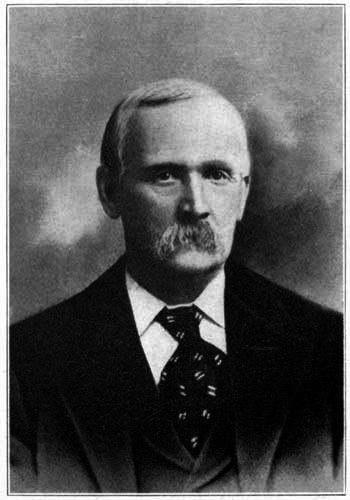
E. C. Chatterton
CHAPTER X.
"Davidson's Sweet Potato Raid"—Southern Alabama—Destruction of Railroads—Oyster Fishing—Mobile Expedition—Barancas—News of Lee's Surrender—Assassination of Lincoln—Fort Blakely—Mobile—Explosion of Magazine—Return to New Orleans—Experience of Daniel Shaw in a Texas Prison—Shreveport—"Salt-Horse" vs. Sumptuousness—Cantankerous Cans—March Into Texas—San Antonio—Mustered Out—Jubilation—War's Aftermath.
"Closed is the bitter but glorious fight: And the day like a conqueror bursts on the night."
—Schiller.
Shortly after the Liberty raid, General Davidson, who was given command of the cavalry at Baton Rouge, organized an expedition for the purpose of destroying railroads in the territory northeast of Baton Rouge and extending in a circuit to Pascagoula Bay, Alabama, about fifty miles south-west from Mobile, in aid of Sherman's movement towards Atlanta. The command comprised the Fourth Wisconsin, Twelfth Illinois, Eighteenth New York, "Scott's Nine Hundred," and the Second Illinois Cavalry. Its course lay through a barren, sparsely settled country more or less covered with scrub and pitch-pine and interspersed with swamps. The streams were swollen and almost impassable and the roads were so bad that the expedition was compelled to abandon a number of its wagons which were burned. Forage was scarce and the men were soon reduced to quarter rations. Owing to the fact that about the only food to be found was sweet-potatoes, the expedition came to be known as "Davidson's sweet-potato raid." There were not more than a dozen shots fired upon the whole trip.
Upon our arrival at Pearl River we camped for the night and during that time ten men succeeded in swimming across with ropes with a view of bridging the stream. A few went beyond to stand guard while pontoons were laid and in an hour the cavalry was crossing. This was followed by the artillery, consisting of Nimm's Massachusetts Battery and a small train. The pontoon bridge was soon removed when our march was resumed towards Pascagoula Bay, where we arrived hungry and worn, with scarcely any food for ourselves or horses. A double-handful of corn was all that could be spared for each horse during twenty-four hours. There was no grazing and no fodder—nothing but water, sand and pine-needles. In this condition we waited for five days until a consignment of grain and rations was received by boat from Lake Port Louisiana.
In the meantime, some oyster-boats and tongs were discovered in a small bayou near the bay, which indicated the presence of oyster-beds. We improved the opportunity. There was always a rush in the early morning for an outfit. The lucky ones were soon able, however, to fill a few gunny-sacks and then give the others a chance. Those who came late would stick poles in the mud at low tide in about seven or eight feet of water and then, holding onto the poles, would go to the bottom and grope around until they found a cluster of shells which would be brought to the surface and handed to another to take to shore. Bunches were sometimes found as large as a bushel-basket. To hungry men, oysters without sauce was a most delightful substitute for nothing; but we longed for the trimmings, especially pepper. A raid upon the country soon furnished us with many strings of home-grown red-peppers. They were hot, but they served the purpose, and after three weeks of short rations we welcomed the combination; but no stretch of a Northern man's imagination was capable of bringing it up to the standard of a Northern Christmas or New Year's dinner—for both of which it had to serve.
About the last of January we embarked for Lake Port Louisiana, from whence we returned to Baton Rouge, where we remained until March, 1865. We then took boat for New Orleans and camped in Carlton until the latter part of March. From New Orleans we went upon the Mobile Expedition by way of Barancas, Florida. I did not go directly with the regiment, having been detailed to the Quartermaster's Department which went upon a later boat. When I arrived at Barancas I found that my company had gone to Fort Blakely. It was considered unsafe for us to follow without an escort, and we were ordered to remain at the former place. While there, we received the news of Lee's surrender. Everybody was elated and appeared to be walking upon air. The guns at the navy-yard belched forth national salutes and these in turn were answered by the battle-ships. All were drunk with joy. About ten o'clock the next day, in the midst of our rejoicing, an officer rode into camp and stopped to speak to the men. A large and joyous group at once gathered to hear more of the good news. The officer spoke in a low tone. The men looked eager but there were no cheers. A hush fell over the crowd. Then words—almost whispered—passed from man to man: "Lincoln has been assassinated!" It was a staggering, benumbing, crushing blow. The men were dazed; they could not talk. Tears were everywhere—tears and silence. The grief of the men was indescribable. But the silence was of short duration. A fool in Company B, apparently in a spirit of bravado, said that he was "glad of it." Instantly the pent up wrath of the men burst out. There was a rush to quarters for arms. An officer, seeing the situation, placed an armed guard around the man. The guard was soon doubled and the offender rushed to a boat at the water front followed by about fifty men with drawn revolvers. The man was taken to Fort McCrea for safety, where he was court-martialed and sent to the Dry Tortugas to be discharged in disgrace. This was only one of numberless instances of a similar nature which occurred at the time.
In a short time we marched across the country to Fort Blakely, from whence we were transported by boat to Mobile and went into camp near the Mobile and Ohio Railroad about four miles east of the town, where we remained for some days. Our regiment was at Columbus, Mississippi. Orders had been sent from there to Colonel Bush to forward the regimental mail and two hundred outfits of clothing. I was acting as clerk to the Regimental Quartermaster and was detailed by the Colonel to take the mail and stores to the regiment. My orders were to report to the Quartermaster in Mobile at three o'clock p.m., for a pass and instructions. In order to provide for the care of my horse, I left camp about ten o'clock and was in the eastern part of the city. My attention was attracted for a moment to an officer who was making his rounds and was being saluted by a guard near by, when a blinding flash occurred which caused my horse to rear so that I stood upon my toes in the stirrups. For an instant my strength seemed to leave me and I almost fell from the horse as he came down. Looking up, I saw an immense blaze which seemed to be a mile high, followed by great rolling cotton-like masses of clouds which flaked off into sheets. Debris of all descriptions, mingled with some human bodies, soon began to drop back to the earth. The Confederate magazine with five hundred tons of ammunition had exploded. It was a wonderful and appalling sight. The depot was blown to pieces, cotton sheds were destroyed and all of the glass in the city was broken. The Battle House, the largest hotel in the city, was wrecked and every dish in it broken. Great fissures and rents were everywhere seen in the streets and walls.
The stores, which I was to have taken away that evening, had been loaded and stood upon the street, but the wagon was overturned and all of the cases crushed.
As I rode along the street I met Captain Fred Pike of the Forty-Sixth Illinois. One of his legs had been cut by falling slate from a roof and he was hopping along by the side of a building. I dismounted and gave him my horse to go to camp.
On the following evening I started to Columbus with the supplies. The regiment had broken camp before my arrival and I met the command at Artesia, twelve miles from Columbus, where I delivered the mail but was obliged to go on to Columbus to turn over the supplies. I then returned to Mobile and there embarked for New Orleans where I was temporarily stationed at regimental headquarters at Carlton, a short distance above the city.
A day or two after my arrival, as I lay in my blankets under an orange tree, I was aroused just before daylight and gradually realized that somebody was shaking me. It proved to be Daniel Shaw, one of our company from Mount Morris, Illinois, who had been captured upon the Red River Expedition, about a year previous and confined in that horrible corral at Tyler, Texas. He hugged me frantically and wept like an hysterical child. It was a long time before he could speak; and then, amid tears and sobs he told a most harrowing and revolting story of the inconceivably brutal treatment to which he had been subjected. The prisoners were confined in an open corral or field without any shelter or protection whatever. Their food consisted of offal and discarded portions from the cattle and sheep slaughtered by their captors, who appropriated the edible parts for their own use. The most was eaten raw or in the form of a stew. The story was too revolting for repetition.