PART II (continued 5)
Reading edition
In a word, every Newgate wretch, every desperate forlorn creature, the most despicable ruined man in the world, has here a fair opportunity put into his hands to begin the world again, and that upon a foot of certain gain and in a method exactly honest, with a reputation that nothing past will have any effect upon; and innumerable people have raised themselves from the worst circumstances in the world—namely, from the cells in Newgate.
But I return to my own story. I was now a planter, and encouraged by a kind benefactor; for, that I might not be wholly taken up with my new plantation, he gave me freely, and without any consideration, my grateful negro, Mouchat. He told me it was a debt due to the affection that poor creature had always had for me; and so indeed it was, for as the fellow would once have been hanged for me, so now, and to his last, he loved me so much that it was apparent he did everything with pleasure that he did for me; and he was so overcome of joy when he heard that he was to be my negro that the people in the plantation really thought it would turn his head, and that the fellow would go distracted.
Besides this, he sent me two servants more, a man and a woman, but these he put to my account, as above. Mouchat and these two fell immediately to work for me, and they began with about two acres of land which had but little timber on it at first, and most of that was cut down by the two carpenters who built my house, or shed rather, for so it should be called.
These two acres I got in good forwardness, and most of it well planted with tobacco; though some of it we were obliged to plant with garden-stuff for food, such as potatoes, carrots, cabbages, peas, beans, &c.
It was a great advantage to me that I had so bountiful a master, who helped me out in every case; for in this very first year I received a terrible blow. For my bill, as I have observed, having been copied and attested in form, and sent to London, my kind friend and custom-house gentleman paid me the money, and the merchant at London, by my good master’s direction, had laid it all out in a sorted cargo of goods for me, such as would have made a man of me all at once; but, to my inexpressible terror and surprise, the ship was lost, and that just at the entrance into the capes; that is to say, the mouth of the bay. Some of the goods were recovered, but spoiled; and, in short, nothing but the nails, tools, and ironwork were good for anything; and though the value of them was pretty considerable in proportion to the rest, yet my loss was irreparably great, and indeed the greatness of the loss to me consisted in its being irreparable.
I was perfectly astonished at the first news of the loss, knowing that I was in debt to my patron, or master, so much that it must be several years before I should recover it; and as he brought me the bad news himself, he perceived my disorder; that is to say, he saw I was in the utmost confusion and a kind of amazement; and so indeed I was, because I was so much in debt. But he spoke cheerfully to me. “Come,” says he, “do not be so discouraged; you may make up this loss.” “No, sir,” says I; “that never can be, for it is my all, and I shall never be out of debt.” “Well, but,” says he, “you have no creditor, however, but me; and now I remember I once told you I would make a man of you, and I will not disappoint you for this disaster.”
I thanked him, and did it with more ceremony and respect than ever, because I thought myself more under the hatches than I was before. But he was as good as his word, for he did not baulk me in the least of anything I wanted; and as I had more ironwork saved out of the ship, in proportion, than I wanted, I supplied him with some part of it, and took up some linen and clothes and other necessaries from him in exchange.
And now I began to increase visibly. I had a large quantity of land cured—that is, freed from timber—and a very good crop of tobacco in view. And I got three servants more and one negro, so that I had five white servants and two negroes, and with this my affairs went very well on.
The first year, indeed, I took my wages, or salary—that is to say, £30 a year—because I wanted it very much; but the second and third year I resolved not to take it on any account whatsoever, but to leave it in my benefactor’s hands to clear off the debt I had contracted.
And now I must impose a short digression on the reader, to note that notwithstanding all the disadvantages of a most wretched education, yet now, when I began to feel myself, as I may say, in the world, and to be arrived to an independent state, and to foresee that I might be something considerable in time; I say, now I found different sentiments of things taking place in my mind. And, first, I had a solid principle of justice and honesty, and a secret horror at things past, when I looked back upon my former life. That original something—I knew not what—that used formerly to check me in the first meannesses of my youth, and used to dictate to me when I was but a child that I was to be a gentleman, continued to operate upon me now in a manner I cannot describe; and I continually remembered the words of the ancient glassmaker to the gentleman that he reproved for swearing, that to be a gentleman was to be an honest man; that without honesty human nature was sunk and degenerated; the gentleman lost all the dignity of his birth, and placed himself even below an honest beggar. These principles, growing upon my mind in the present circumstances I was in, gave me a secret satisfaction that I can give no description of. It was an inexpressible joy to me that I was now like to be, not only a man, but an honest man; and it yielded me a greater pleasure that I was ransomed from being a vagabond, a thief, and a criminal, as I had been from a child, than that I was delivered from slavery and the wretched state of a Virginia sold servant. I had notion enough in my mind of the hardships of the servant, or slave, because I had felt it and worked through it; I remembered it as a state of labour and servitude, hardship and suffering. But the other shocked my very nature, chilled my blood, and turned the very soul within me; the thought of it was like reflections upon hell and the damned spirits; it struck me with horror, it was odious and frightful to look back on, and it gave me a kind of a fit, a convulsion or nervous disorder, that was very uneasy to me.
But to look forward, to reflect how things were changed, how happy I was that I could live by my own endeavours, and was no more under the necessity of being a villain, and of getting my bread at my own hazard and the ruin of honest families—this had in it something more than commonly pleasing and agreeable, and, in particular, it had a pleasure that till then I had known nothing of. It was a sad thing to be under a necessity of doing evil to procure that subsistence which I could not support the want of, to be obliged to run the venture of the gallows rather than the venture of starving, and to be always wicked for fear of want.
I cannot say that I had any serious religious reflections, or that these things proceeded yet from the uneasiness of conscience, but from mere reasonings with myself, and from being arrived to a capacity of making a right judgment of things more than before. Yet I own I had such an abhorrence of the wicked life I had led that I was secretly easy, and had a kind of pleasure in the disaster that was upon me about the ship, and that, though it was a loss, I could not but be glad that those ill-gotten goods was gone, and that I had lost what I had stolen. For I looked on it as none of mine, and that it would be fire in my flax if I should mingle it with what I had now, which was come honestly by, and was, as it were, sent from heaven to lay the foundation of my prosperity, which the other would be only as a moth to consume.
At the same time my thoughts dictated to me, that though this was the foundation of my new life, yet that this was not the superstructure, and that I might still be born for greater things than these; that it was honesty and virtue alone that made men rich and great, and gave them a fame as well as a figure in the world, and that therefore I was to lay my foundation in these, and expect what might follow in time.
To help these thoughts, as I had learned to read and write when I was in Scotland, so I began now to love books, and particularly I had an opportunity of reading some very considerable ones, such as Livy’s Roman History, the history of the Turks, the English History of Speed, and others; the history of the Low Country wars, the history of Gustavus Adolphus, king of Sweden, and the history of the Spaniards’ conquest of Mexico, with several others, some of which I bought at a planter’s house who was lately dead and his goods sold, and others I had borrowed.
I considered my present state of life to be my mere youth, though I was now above thirty years old, because in my youth I had learned nothing; and if my daily business, which was now great, would have permitted, I would have been content to have gone to school. However, fate, that had yet something else in store for me, threw an opportunity into my hand; namely, a clever fellow that came over a transported felon from Bristol, and fell into my hands for a servant. He had led a loose life; that he acknowledged; and being driven to extremities, took to the highway, for which, had he been taken, he would have been hanged. But falling into some low-prized rogueries afterwards, for want of opportunity for worse, was catched, condemned, and transported, and, as he said, was glad he came off so.
He was an excellent scholar, and I, perceiving it, asked him one time if he could give a method how I might learn the Latin tongue. He said, smiling, Yes; he could teach it me in three months, if I would let him have books, or even without books, if he had time. I told him a book would become his hands better than a hoe; and if he could promise to make me but understand Latin enough to read it, and understand other languages by it, I would ease him of the labour which I was now obliged to put him to, especially if I was assured that he was fit to receive that favour of a kind master. In short, I made him to me what my benefactor made me to him, and from him I gained a fund of knowledge infinitely more valuable than the rate of a slave, which was what I had paid for it; but of this hereafter.
With these thoughts I went cheerfully about my work. As I had now five servants, my plantation went on, though gently, yet safely, and increased gradually, though slowly. But the third year, with the assistance of my old benefactor, I purchased two negroes more, so that now I had seven servants; and having cured land sufficient for supply of their food, I was at no difficulty to maintain them; so that my plantation began now to enlarge itself, and as I lived without any personal expense, but was maintained at my old great master’s, as we called him, and at his charge, with £30 a year besides, so all my gains was laid up for increase.
In this posture I went on for twelve years, and was very successful in my plantation, and had gotten, by means of my master’s favour, who now I called my friend, a correspondent in London, with whom I traded, shipped over my tobacco to him, and received European goods in return, such as I wanted to carry on my plantation, and sufficient to sell to others also.
In this interval my good friend and benefactor died, and I was left very disconsolate on account of my loss; for it was indeed a great loss to me. He had been a father to me, and I was like a forsaken stranger without him, though I knew the country, and the trade too, well enough, and had for some time chiefly carried on his whole business for him. Yet I seemed now at a loss; my counsellor and my chief supporter was gone, and I had no confidant to communicate myself to, on all occasions, as formerly; but there was no remedy. I was, however, in a better condition to stand alone than ever. I had a very large plantation, and had near seventy negroes and other servants. In a word, I was grown really rich, considering my first circumstances, that began as I may say with nothing; that is to say, I had nothing of stock, but I had a great beginning, for I had such a man’s friendship and support in my beginning, that indeed I needed no other stock; and if I had had £500 to have begun with, and not the assistance, advice, and countenance of such a man, I had not been in a better condition. But he promised to make a man of me; and so he did, and in one respect I may say I have merited it of him, for I brought his plantation into such order, and the government of his negroes into such a regulation, that if he had given £500 to have had it done, he would have thought his money well bestowed. His work was always in order, going forward to his mind; every thing was in a thriving posture; his servants all loved him, even negroes and all, and yet there was no such thing as a cruel punishment or severities known among them.
In my own plantation it was the same thing. I wrought so upon the reason and the affections of my negroes that they served me cheerfully, and, by consequence, faithfully and diligently; when in my neighbour’s plantation there was not a week hardly passed without such horrible outcries, roarings and yellings of the servants, either under torture or in fear of it, that their negroes would, in discourse with ours, wish themselves dead and gone, as it seems they believed they should after death, into their own country.
If I met with a sullen, stupid fellow, as sometimes it was unavoidable, I always parted with him and sold him off; for I would not keep any that sense of kind usage would not oblige. But I seldom met with such bad ones; for, by talking to them in a plain reasoning way, I found the temper of the roughest of them would break and soften. The sense of their own interest would prevail with them at first or last; and if it had not, the contrary temper was so general among my people that their own fellows and countrymen would be against them, and that served to bring them to reason as soon as any other thing. And this those who think it worth their while will easily find, viz., that having prevailed effectually over one leading man among them to be tractable, and pleased, and grateful, he shall make them all like him, and that in a little while, with more ease than can be imagined.
I was now a planter, and also a student. My pedagogue I mentioned above was very diligent, and proved an extraordinary man indeed. He taught me not only with application, but with admirable judgment in the teaching part; for I have seen it in many instances since that time that every good scholar is not fitted for a schoolmaster, and that the art of teaching is quite different from that of knowing the language taught.
But this man had both, and proved of great use to me, and I found reason, in the worth of the person, to be very kind to him, his circumstances considered. I once took the liberty to ask him how it came to pass that he, who must have had a liberal education and great advantages to have advanced him in the world, should be capable of falling into such miserable circumstances as he was in when he came over. I used some caution in entering upon an inquiry which, as I said, might not be pleasant to him to relate, but that I would make him amends by telling him, that if he desired not to enter into it with me, I would readily excuse him, and would not take it ill at all. This I did because to a man under such afflictions one should always be tender, and not put them upon relating anything of themselves which was grievous to them or which they had rather was concealed.
But he told me that it was true, that to look back upon his past life was indeed renovare dolorem; but that such mortifications were now useful to him, to help forward that repentance which he hoped he was sincerely entered upon; and that though it was with horror he looked back upon misspent time and ill-applied gifts which a bountiful Creator had blessed him with, and spared to him for a better improvement, yet he thought he ought to load himself with as much of the shame as it pleased God to make his lot, since he had already loaded himself with the guilt in a shameless manner, till God, he still hoped in mercy to him, had cut him short and brought him to public disgrace; though he could not say he had been brought to justice, for then he had been sent into eternity in despair, and not been sent to Virginia to repent of the wickedest life that ever man lived. He would have gone on, but I found his speech interrupted by a passionate struggle within, between his grief and his tears.
I took no more notice of it than to tell him that I was sorry I had asked him about it, but that it was my curiosity. When I saw that ignorant, untaught, untractable creatures come into misery and shame, I made no inquiry after their affairs; but when I saw men of parts and learning take such steps, I concluded it must be occasioned by something exceeding wicked. “So, indeed,” said he, “the judge said to me when I begged mercy of him in Latin. He told me that when a man with such learning falls into such crimes he is more inexcusable than other men, because, his learning recommending him, he could not want advantages and had the less temptation to crimes.”
“But, sir,” said he, “I believe my case was what I find is the case of most of the wicked part of the world, viz., that to be reduced to necessity is to be wicked; for necessity is not only the temptation, but is such a temptation as human nature is not empowered to resist. How good, then,” says he, “is that God which takes from you, sir, the temptation, by taking away the necessity!”
I was so sensible of the truth of what he said, knowing it by my own case, that I could not enter any further upon the discourse; but he went on voluntarily. “This, sir,” says he, “I am so sensible of that I think the case I am reduced to much less miserable than the life which I lived before, because I am delivered from the horrid necessity of doing such ill things which was my ruin and disaster then, even for my bread, and am not now obliged to ravish my bread out of the mouths of others by violence and disorder, but am fed, though I am made to earn it by the hard labour of my hands, and I thank God for the difference.” He paused here, but went on thus:—
“How much is the life of a slave in Virginia to be preferred to that of the most prosperous thief in the world! Here I live miserable, but honest; suffer wrong, but do no wrong; my body is punished, but my conscience is not loaded; and as I used to say that I had no leisure to look in, but I would begin when I had some recess, some time to spare, now God has found me leisure to repent.” He run on in this manner a great while, giving thanks, I believe most heartily, for his being delivered from the wretched life he had lived, though his misery were to be tenfold as much as it was.
I was sincerely touched with his discourse on this subject. I had known so much of the real difference of the case that I could not but be affected with it, though till now, I confess, I knew little of the religious part. I had been an offender as well as he, though not altogether in the same degree, but I knew nothing of the penitence; neither had I looked back upon anything as a crime, but as a life dishonourable and not like a gentleman, which run much in my thoughts, as I have several times mentioned.
“Well, but now,” says I, “you talk penitently, and I hope you are sincere; but what would be your case if you were delivered from the miserable condition of a slave sold for money, which you are now in? Should you not, think you, be the same man?”
“Blessed be God,” says he, “that, if I thought I should, I would sincerely pray that I might not be delivered, and that I might for ever be a slave rather than a sinner.”
“Well, but,” says I, “suppose you to be under the same necessity, in the same starving condition, should you not take the same course?”
He replied very sharply, “That shows us the need we have of the petition in the Lord’s prayer, ‘Lead us not into temptation;’ and of Solomon’s or Agar’s prayer, ‘Give me not poverty, lest I steal.’ I should ever beg of God not to be left to such snares as human nature cannot resist. But I have some hope, that I should venture to starve rather than to steal; but I also beg to be delivered from the danger, because I know not my own strength.”
This was honestly spoken, indeed; and there really were such visible tokens of sincerity in all his discourse that I could not suspect him. On some of our discourses on this subject, he pulled out a little dirty paper-book, in which he had wrote down such a prayer in verse as I doubt few Christians in the world could subscribe to; and I cannot but record it, because I never saw anything like it in my life. The lines are as follow:—
“Lord! whatsoever sorrows rack my breast, Till crime removes too, let me find no rest; How dark soe’er my state or sharp my pain, Oh! let not troubles cease and sin remain. For Jesus’ sake remove not my distress, Till free triumphant grace shall repossess The vacant throne from whence my sins depart, And make a willing captive of my heart; Till grace completely shall my soul subdue, Thy conquest full and my subjection true.”
There were more lines on the same subject, but these were the beginning; and these touching me so sensibly, I have remembered them distinctly ever since, and have, I believe, repeated them to myself a thousand times.
I pressed him no more, you may be sure, after an answer so very particular and affecting as this was. It was easy to see the man was a sincere penitent, not sorrowing for the punishment he was suffering under; for his condition was no part of his affliction; he was rather thankful for it, as above; but his concern was a feeling and affecting sense of the wicked and abominable life he had led, the abhorred crimes he had committed both against God and man, and the little sense he had had of the condition he was in, and that even till he came to the place where he now was.
I asked him if he had no reflections of this kind after or before his sentence. He told me Newgate (for the prison at Bristol is called so, it seems, as well as that at London) was a place that seldom made penitents, but often made villains worse, till they learnt to defy God and devil; but that, however, he could look back with this satisfaction, that he could say he was not altogether insensible of it even then; but nothing that amounted to a thorough serious looking up to heaven; that he often indeed looked in, and reflected upon his past misspent life, even before he was in prison, when the intervals of his wicked practices gave some time for reflection, and he would sometimes say to himself, “Whither am I going? to what will all these things bring me at last? and where will they end? Sin and shame follow one another, and I shall certainly come to the gallows. Then,” said he, “I would strike upon my breast, and say, ‘O wicked wretch! when will you repent?’ and would answer myself as often, ‘Never! never! never! except it be in a gaol or at a gibbet.’
“Then,” said he, “I would weep and sigh, and look back a little upon my wretched life, the history of which would make the world amazed; but, alas! the prospect was so dark, and it filled me with so much terror, that I could not bear it. Then I would fly to wine and company for relief; that wine brought on excess, and that company, being always wicked company like yourself, brought on temptation, and then all reflection vanished and I was the same devil as before.”
He spoke this with so much affection that his face was ever smiling when he talked of it, and yet his eyes had tears standing in them at the same time, and all the time; for he had a delightful sorrow, if that be a proper expression, in speaking of it.
This was a strange relation to me, and began to affect me after a manner that I did not understand. I loved to hear him talk of it, and yet it always left a kind of a dead lump behind it upon my heart, which I could give no reason for, nor imagine to what it should tend; I had a heaviness on my soul, without being able to describe it or to say what ailed me.
Well, he went on with his relation. “After this,” says he, “I fell into the hands of a justice for a trifle, a piece of sport in our crime; and I, that for a hundred robberies, as well on the highway as otherwise, the particulars of which would fill a book to give an account of, ought, whenever I was taken, to be hanged in chains, and who, if it had been public, could not have failed of having twenty people come in against me, was privately hurried into a country gaol under a wrong name; tried for a small fact, within benefit of clergy, and in which I was not principally guilty, and by this means obtained the favour of being transported.
“And what think you,” said he, “has most sensibly affected me, and brought on the blessed change that, I hope I may say, God has wrought in my soul? Not the greatness of my crimes, but the wonders of that merciful Providence, which, when it has mercy in store for a man, often brings him into the briers, into sorrow and misery for lesser sins, that men may be led to see how they are spared from the punishment due to them for the greater guilt which they know lies upon them. Do you think that when I received the grant of transportation I could be insensible what a miracle of divine goodness such a thing must be to one who had so many ways deserved to be hanged, and must infallibly have died if my true name had been known, or if the least notice had been given that it was such a notorious wretch as I that was in custody? There began the first motive of repentance; for certainly the goodness of our great Creator in sparing us, when we forfeit our lives to His justice, and His merciful bringing us out of the miseries which we plunge ourselves into, when we have no way to extricate ourselves; His bringing those very miseries to be the means of our deliverance, and working good to us out of evil, when we are working the very evil out of His good; I say, these things are certainly the strongest motives to repentance that are in the world, and the sparing thieves from the gallows certainly makes more penitents than the gallows itself.
“It is true,” continued he, “that the terror of punishment works strongly upon the mind; in view of death men are filled with horror of soul, and immediately they call that repentance which I doubt is too often mistaken, being only a kind of anguish in the soul, which breeds a grief for the punishment that is to be suffered—an amazement founded upon the dreadful view of what is to follow. But the sense of mercy is quite another thing; this seizes all the passions and all the affections, and works a sincere, unfeigned abhorrence of the crime, as a crime, as an offence against our Benefactor, as an act of baseness and ingratitude to Him who has given us life and all the blessings and comforts of life, and who has conquered us by continuing to do us good, when He has been provoked to destroy us.
“This, sir,” says he, “has been the fountain of that repentance which I so much rejoice in; this is the delightful sorrow,” says he, “that I spoke of just now; and this makes smiles sit on my face while tears run from my eyes, a joy that I can no otherwise express than by telling you, sir, that I never lived a happy day since I came to an age of acting in the world till I landed in this country, and worked in your plantation, naked and hungry, weary and faint, oppressed with cold in one season, and heat in the other. Then I began to see into my own ways, and see the difference between the hardships of the body and the torment of the mind. Before I revelled in fulness, and here I struggled with hard fare; then I wallowed in sloth and voluptuous ease; here I laboured till nature sometimes was just sinking under the load; but with this difference in the felicity of either case, namely, that there I had a hell in my soul, was filled with horror and confusion, was a daily terror to myself, and always expected a miserable end; whereas here I had a blessed calm of soul, an emblem and forerunner of heaven, thankful and humble, adoring that mercy that had snatched me out of the jaws of the devil. These took up my thoughts, and made my most weary hours pleasant to me, my labour light, and my heart cheerful. I never lay down on my hard lodging but I praised God with the greatest excess of affection, not only that it was not the condemned hole, and that I was delivered from the death I had deserved, but that it was not Shooter’s Hill; that I was not still a robber, a terror to just and honest men, a plunderer of the innocent and the poor, a thief, and a villain, that ought to be rooted out from the earth for the safety of others; but that I was delivered from the horrid temptation of sinning to support my luxury, and making one vice necessary to another; and this, I bear witness, is sufficient to sweeten the bitterest sorrow, and make any man be thankful for Virginia, or a worse place, if that can be.”
He then entertained me with an opinion of his, that if it were possible for the face of heaven and hell to be disclosed and laid open, and that men could be made capable of seeing distinctly and separately the joys and glory and utmost felicity of one, and the horrors of the other, and to make a judgment of both according to the power of human reasoning, the first would have a stronger and more powerful effect to reform the world than the latter; but this we had further discourses about on many occasions.
If it should be inquired how I was capable of hearing all this, and having no impressions made upon my mind by it, especially when it so many ways suited my own case, and the condition of the former part of my life, I shall answer that presently by myself. However, I took no notice of it to him, for he had quite other notions of me than I had of myself; nor did I, as is usual in such cases, enter into any confidence with him on my own story, only that I took sometimes the occasion to let him know that I did not come over to Virginia in the capacity of a criminal, or that I was not transported; which, considering how many of the inhabitants there were so who then lived in good circumstances, was needful enough to be done.
But as to myself, it was enough that I was in condition now; ’twas no matter to anybody what I had been; and as it was grown pretty much out of memory from what original disaster I came into the country, or that I was ever a servant otherwise than voluntary, and that it was no business of mine to expose myself, so I kept that part close. But for all that, it was impossible for me to conceal the disorder I was in as often as he talked of these things. I had hitherto gone on upon a notion of things founded only in their appearance, as they affected me with good or evil, esteeming the happy and unhappy part of life to be those that gave me ease or sorrow, without regarding, or indeed much understanding, how far those turns of life were influenced by the Giver of Life, or how far they were all directed by a sovereign God that governs the world, and all the creatures he had made.
As I had no education but as you have heard, so I had had no instruction, no knowledge of religion, or indeed of the meaning of it; and though I was now in a kind of search after religion, it was a mere looking, as it were, into the world to see what kind of a thing or place it was, and what had been done in it. But as to Him that made it, there had truly been scarce a creature among all that He had made, with souls in them, that were so entirely without the knowledge of God as I was, and made so little inquiry about it.
But the serious, affectionate discourse of this young man began to have different effects upon me, and I began to say to myself, “This man’s reflections are certainly very just; but what a creature am I, and what have I been doing!—I that never once did this in all my life; that never said so much—’God, I thank Thee for all that I have been saved from, or all that I have been brought to in this world;’ and yet my life has been as full of variety, and I have been as miraculously delivered from dangers and mischiefs, and as many of them, as ever he has. And if it has all been brought to pass by an invisible hand in mercy to me, what have I been doing, and where have I lived, that I only should be the most thoughtless and unthankful of all God’s creatures?”
This, indeed, began to grow upon me, and made me very melancholy; but as to religion, I understood so little about it that if I had resolved upon any such thing as a new course of life, or to set about a religious change, I knew not at which end to begin or what to do about it.
One day it happened that my tutor—for so I always called him—had the Bible in his hand, and was looking in it, as he generally did many times every day, though I knew not for what. Seeing the Bible, I took it out of his hands, and went to look in it, which I had done so little before that I think I might safely say I had never read a chapter in it in all my life. He was talking of the Bible then as a book only, and where he had it, and how he brought it to Virginia, and in some ecstasy he took and kissed it. “This blessed book!” says he; “this was all the treasure I brought out from England with me. And a comfortable treasure it has been to me,” added he; “I would not have been without it in my sorrows for any other treasure in the world;” and so he went on at large.
I, that had no notion of what he meant—only, as I have said above, some young infant thoughts about the works of Providence in the world and its merciful dealings with me—took the book out of his hand and went to look in it; and the book opened at the Acts xxvi. 28, where Felix says to St. Paul, “Almost thou persuadest me to be a Christian.” “I think,” says I, “here’s a line hits me to a tittle, upon the long account you have given of yourself, and I must say them to you, as the governor here said;” and so I read the words to him. He blushed at the text, and returns, “I wish I could answer you in the very words the Apostle returned to him in the next verse: ‘I would thou wert both almost, and altogether such as I am, except these bonds.’”
I was now more than thirty years old by my own account, and as well as it was possible for me to keep a reckoning of my age, who had nobody left that ever knew my beginning; I was, I say, above thirty years old, and had gone through some variety in the world. But as I was perfectly abandoned in my infancy, and utterly without instruction in my youth, so I was entirely ignorant of everything that was worthy the name of religion in the world; and this was the first time that ever any notion of religious things entered into my heart. I was surprised at this man’s talk, and that several ways particularly he talked so feelingly of his past circumstances, and they were so like my own, that every time he made a religious inference from his own condition, and argued from one condition of his to another, it struck into my thoughts like a bullet from a gun that I had certainly as much to be thankful for and to repent of as he had, except only that I had no knowledge of better things to be thankful for, which he had. But in return for that, I was delivered and set up in the world, made a master, and easy, and was in good circumstances, being raised from the very same low, distressed condition as he was in—I mean a sold servant—but that he remained so still; so that, if his sin had been greater than mine, so his distress was still greater.
This article of gratitude struck deep and lay heavy upon my mind. I remembered that I was grateful to the last degree to my old master, who had raised me from my low condition, and that I loved the very name of him, or, as might be said, the very ground he trod on; but I had not so much as once thought of any higher obligation; no, nor so much as, like the Pharisee, had said once, “God, I thank thee,” to Him, for all the influence which His providence must have had in my whole affair.
It occurred to me presently that if none of all these things befall us without the direction of a Divine Power, as my new instructor had told me at large, and that God had ordered everything, the most minute and least transaction of life, insomuch that not a hair of our head shall fall to the ground without His permission; I say, it occurred to me that I had been a most unthankful dog to that Providence that had done so much for me; and the consequence of the reflection was immediately this: how justly may that Power, so disobliged, take away again His wool and His flax, with which I am now clothed, and reduce me to the misery of my first circumstances.
This perplexed me much, and I was very pensive and sad; in which, however, my new instructor was a constant comforter to me, and I learned every day something or other from him; upon which I told him one morning that I thought be must leave off teaching me Latin, and teach me religion. He spoke with a great deal of modesty of his being incapable of informing me of anything that I did not know, and proposed to me to read the Scriptures every day, as the sure and only fund of instruction. I answered that, in the words of the eunuch to St. Philip when the apostle asked him if he understood what he read: “How can I, unless some one guide me?”
We talked frequently upon this subject, and I found so much reason to believe he was a sincere convert that I can speak of him as no other in all I have to say of him. However, I cannot say my thoughts were yet ripened for an operation of that kind. I had some uneasiness about my past life, and I lived now, and had done so before I knew him, a very regular, sober life, always taken up in my business and running into no excesses. But as to commencing penitent, as this man had done, I cannot say I had any convictions upon me sufficient to bring it on, nor had I a fund of religious knowledge to support me in it. So it wore off again gradually, as such things generally do where the first impressions are not deep enough.
In the meantime, as he read over long lectures of his own disasters to me, and applied them all seriously to me, so our discourse was always very solid and weighty, and we had nothing of levity between us, even when we were not concerned in religious discourses. He read history to me; and, where books were wanting, he gave me ideas of those things which had not been recorded by our modern histories, or at least that our number of books would not reach. By these things he raised an unquenchable thirst in me, after seeing something that was doing in the world; and the more because all the world was at that time engaged, more or less, in the great war wherein the French king might be said to be engaged with and against all the powers of Europe.
Now, I looked upon myself as one buried alive in a remote part of the world, where I could see nothing at all, and hear but a little of what was seen, and that little not till at least half a year after it was done, and sometimes a year or more; and, in a word, the old reproach often came in the way—namely, that even this was not yet the life of a gentleman.
It was true that this was much nearer to it than that of a pickpocket, and still nearer than that of a sold slave; but, in short, this would not do, and I could receive no satisfaction in it. I had now a second plantation, a very considerable one, and it went forward very well. I had on it almost a hundred servants already of sundry sorts, and an overseer that I had a great deal of reason to say I might depend upon, and but that I had a third in embryo, and newly begun, I had nothing to hinder me from going where I pleased.
However, I now began to frame my thoughts for a voyage to England, resolving then to act as I should see cause, but with a secret resolution to see more of the world if possible, and realise those things to my mind which I had hitherto only entertained remote ideas of by the help of books.
Accordingly I pushed forward the settlement of my third plantation, in order to bring it to be in a posture either to be let to a tenant or left in trust with an overseer, as I should find occasion.
Had I resolved to leave it to an overseer or steward, no man in the world could have been fit for it like my tutor; but I could not think of parting with him, who was the cause of my desire of travelling, and who I concluded to make my partner in my travels.
END OF VOL. I.
THE LIFE OF COLONEL JACQUE.
It was three years after this before I could get things in order, fit for my leaving the country. In this time I delivered my tutor from his bondage, and would have given him his liberty, but, to my great disappointment, I found that I could not empower him to go for England till his time was expired, according to the certificate of his transportation, which was registered; so I made him one of my overseers, and thereby raised him gradually to a prospect of living in the same manner and by the like steps that my good benefactor raised me, only that I did not assist him to enter upon planting for himself as I was assisted, neither was I upon the spot to do it. But this man’s diligence and honest application, even unassisted, delivered himself, [though not] any farther than, as I say, by making him an overseer, which was only a present ease and deliverance to him from the hard labour and fare which he endured as a servant.
However, in this trust he behaved so faithfully and so diligently that it recommended him in the country; and when I came back I found him in circumstances very different from what I left him in, besides his being my principal manager for near twenty years, as you shall hear in its place.
I mention these things the more at large that, if any unhappy wretch who may have the disaster to fall into such circumstances as these may come to see this account, they may learn the following short lessons from these examples:—
I. That Virginia and a state of transportation may be the happiest place and condition they were ever in for this life, as, by a sincere repentance and a diligent application to the business they are put to, they are effectually delivered from a life of flagrant wickedness and put in a perfect new condition, in which they have no temptation to the crimes they formerly committed, and have a prospect of advantage for the future.
II. That in Virginia the meanest and most despicable creature, after his time of servitude is expired, if he will but apply himself with diligence and industry to the business of the country, is sure (life and health supposed) both of living well and growing rich.
As this is a foundation which the most unfortunate wretch alive is entitled to, a transported felon is, in my opinion, a much happier man than the most prosperous untaken thief in the nation. Nor are those poor young people so much in the wrong as some imagine them to be that go voluntarily over to those countries, and in order to get themselves carried over and placed there, freely bind themselves there, especially if the persons into whose hands they fall do anything honestly by them; for, as it is to be supposed that those poor people knew not what course to take before, or had miscarried in their conduct before, here they are sure to be immediately provided for, and, after the expiration of their time, to be put in a condition to provide for themselves. But I return to my own story, which now begins a new scene.
I was now making provision for my going to England. After having settled my plantation in such hands as was fully to my satisfaction, my first work was to furnish myself with such a stock of goods and money as might be sufficient for my occasions abroad, and particularly might allow me to make large returns to Maryland, for the use and supply of all my plantations. But when I came to look nearer into the voyage, it occurred to me that it would not be prudent to put my cargo all on board the same ship that I went in; so I shipped at several times five hundred hogsheads of tobacco in several ships for England, giving notice to my correspondent in London that I would embark about such a time to come over myself, and ordering him to insure for a considerable sum, proportioned to the value of my cargo.
About two months after this I left the place, and embarked for England in a stout ship, carrying twenty-four guns and about six hundred hogsheads of tobacco, and we left the capes of Virginia on the 1st of August. We had a very sour and rough voyage for the first fortnight, though it was in a season so generally noted for good weather.
After we had been about eleven days at sea, having the wind most part of the time blowing very hard at west, or between the west and north-west, by which we were carried a great way farther to the eastward than they usually go in their course for England, we met with a furious tempest, which held us five days, blowing most of the time excessive hard, and by which we were obliged to run away afore the wind, as the seamen call it, wheresoever it was our lot to go. By this storm our ship was greatly damaged, and some leaks we had, but not so bad that by the diligence of the seamen they were stopped. However, the captain, after having beaten up again as well as he could against the weather, and the sea going very high, at length he resolved to go away for the Bermudas.
I was not seaman enough to understand what the reason of their disputes was, but in their running for the islands it seems they overshot the latitude, and could never reach the islands of Bermudas again. The master and the mate differed to an extremity about this, their reckonings being more than usually wide of one another, the storm having driven them a little out of their knowledge. The master, being a positive man, insulted the mate about it, and threatened to expose him for it when he came to England. The mate was an excellent sea artist and an experienced sailor, but withal a modest man, and though he insisted upon his being right, did it in respectful terms and as it became him. But after several days’ dispute, when the weather came to abate and the heavens to clear up, that they could take their observations and know where they were, it appeared that the mate’s account was right, and the captain was mistaken; for they were then in the latitude of 29 degrees, and quite out of the wake of the Bermudas.
The mate made no indecent use of the discovery at all, and the captain, being convinced, carried it civilly to him, and so the heats were over among them; but the next question was, what they should do next. Some were for going one way, some another; but all agreed that they were not in a condition to go on the direct course for England, unless they could have a southerly or south-west wind, which had not been our fate since we came to sea.
Upon the whole, they resolved by consent to steer away to the Canaries, which was the nearest land they could make except the Cape de Verde Islands, which were too much to the southward for us, if it could be avoided.
Upon this they stood away N.E., and the wind hanging still westerly, or to the northward of the west, we made good way, and in about fifteen days’ sail we made the Pico Teneriffe, being a monstrous hill in one of the Canary Islands. Here we refreshed ourselves, got fresh water and some fresh provisions, and plenty of excellent wine, but no harbour to run into, to take care of the ship, which was leaky and tender, having had so much very bad weather; so we were obliged to do as well as we could, and put to sea again, after riding at the Canaries four days only.
From the Canaries we had tolerable weather and a smooth sea till we came into the soundings—so they call the mouth of the British Channel—and the wind blowing hard at the N. and the N.W. obliged us to keep a larger offing, as the seamen call it, at our entrance into the Channel; when, behold! in the grey of the morning a French cruiser or privateer of twenty-six guns appeared, and crowded after us with all the sail they could make. In short, our captain exchanged a broadside or two with them, which was terrible work to me, for I had never seen such before, the Frenchman’s guns having raked us, and killed and wounded six of our best men.
In short, after a fight long enough to show us that if we would not be taken we must resolve to sink by her side, for there was no room to expect deliverance, and a fight long enough to save the master’s credit, we were taken, and the ship carried away to St. Malo.
I was not much concerned for the loss I had in the ship, because I knew I had sufficient in the world somewhere or other; but as I was effectually stripped of everything I had about me, and even almost my clothes from my back, I was in but a very indifferent condition. But somebody informing the captain of the privateer, that I was a passenger and a merchant, he called for me and inquired into my circumstances, and coming to hear from myself how I had been used, obliged the seamen to give me a coat and hat and a pair of shoes, which they had taken off me, and himself gave me a morning gown of his own to wear while I was in his ship, and, to give him his due, treated me very well.
I had, however, besides my being taken, the mortification to be detained on board the cruiser, and seeing the ship I was in manned with Frenchmen and sent away, as above, for St. Malo; and this was a greater mortification to me afterwards, when, being brought into St. Malo, I heard that our own ship was retaken in her passage to St. Malo by an English man-of-war and carried to Portsmouth.
When our ship was sent away the Rover cruised abroad again in the mouth of the Channel for some time, but met with no purchase. At last they made a sail, which proved to be one of their nation and one of their own trade, from whom they learned, the news having been carried to England that some French privateers lay off and on in the soundings, that three English men-of-war were come out from Plymouth on purpose to cruise in the Channel, and that they would certainly meet with us. Upon this intelligence the Frenchman, a bold, brave fellow, far from shrinking from his work, stands away N.E. for St. George’s Channel, and in the latitude of 48 degrees and a half, unhappily enough, meets with a large and rich English ship, bound home from Jamaica. It was in the grey of the morning, and very clear, when a man on the roundtop cried out, “Au voile, a sail.” I was in hopes indeed it had been the English men-of-war, and by the hurry and clutter they were in to get all ready for a fight, I concluded it was so, and got out of my hammock (for I had no cabin to lie in) that I might see what it was; but I soon found that my hopes were in vain, and it was on the wrong side; for that that being on our larboard bow, the ship lying then northward to make the coast of Ireland, by the time I was turned out I could perceive they had all their sails bent and full, having begun to chase, and making great way. On the other hand, it was evident the ship saw them too, and knew what they were, and, to avoid them, stretched away with all the canvas they could lay on for the coast of Ireland, to run in there for harbour.
Our privateer, it was plain, infinitely outsailed her, running two foot for her one, and towards evening came up with them. Had they been able to have held it but six hours longer they would have got into Limerick River, or somewhere under shore, so that we should not have ventured upon them. But we came up with them, and the captain, when he saw there was no remedy, bravely brought to and prepared to fight. She was a ship of thirty guns, but deep in the sea, cumbered between decks with goods, and could not run out her lower-deck guns, the sea also going pretty high, though at last she ventured to open her gun-room ports and fire with three guns on a side. But her worst fate was, she sailed heavy, being deep loaden, and the Frenchman had run up by her side and poured in his broadside, and was soon ready again. However, as she was well manned too, and that the English sailors bestirred themselves, they gave us their broadsides too very nimbly and heartily, and I found the Frenchman had a great many men killed at the first brush. But the next was worse, for the English ship, though she did not sail so well as the Frenchman, was a bigger ship and strong built, and as we (the French) bore down upon them again, the English run boldly on board us, and laid thwart our hawse, lashing themselves fast to us. Then it was that the English captain run out his lower tier of guns, and indeed tore the Frenchman so, that, had he held it, the privateer would have had the worst of it. But the Frenchman, with admirable readiness, indeed, and courage, the captain appearing everywhere with his sword in his hand, bestirred themselves, and loosing themselves from the English ship, thrusting her off with brooms, and pouring their small shot so thick that the other could not appear upon deck; I say, clearing themselves thus, they came to lie a-broadside of each other, when, by long firing, the English ship was at length disabled, her mizzen-mast and bowsprit shot away, and, which was worst of all, her captain killed; so that, after a fight which held all night—for they fought in the dark—and part of the next day, they were obliged to strike.
I was civilly desired by the French captain to go down into the hold while the fight held, and, besides the civility of it, I found he was not willing I should be upon deck. Perhaps he thought I might have some opportunity to do hurt, though I know not how it could be. However, I was very ready to go down, for I had no mind to be killed, especially by my own friends; so I went down and sat by the surgeon, and had the opportunity to find that, the first broadside the English fired, seven wounded men were brought down to the surgeon, and three-and-thirty more afterwards, that is to say, when the English lay thwart their bow; and after they cleared themselves there were about eleven more; so that they had one-and-fifty men wounded and about two-and-twenty killed. The Englishman had eighteen men killed and wounded, among whom was the captain.
The French captain, however, triumphed in his prize; for it was an exceeding rich ship, having abundance of silver on board. And after the ship was taken and they had plundered all the great cabin afforded, which was very considerable, the mate promised the captain that, if he would give him his liberty, he would discover six thousand pieces of eight to him privately, which none of the men should know of. The captain engaged, and gave it under his hand to set him at liberty as soon as he came on shore. Accordingly, in the night, after all was either turned in, as they call it, or employed on the duty of the watch, the captain and the mate of the prize went on board, and having faithfully discovered the money, which lay in a place made on purpose to conceal it, the captain resolved to let it lie till they arrived, and then he conveyed it on shore for his own use; so that the owners, nor the seamen, ever came to any share of it, which, by the way, was a fraud in the captain. But the mate paid his ransom by the discovery, and the captain gave him his liberty very punctually, as he had promised, and two hundred pieces of eight to carry him to England and to make good his losses.
When he had made this prize, the captain thought of nothing more than how to get safe to France with her, for she was a ship sufficient to enrich all his men and his owners also. The account of her cargo, by the captain’s books, of which I took a copy, was in general:
260 hogsheads of sugar. 187 smaller casks of sugar. 176 barrels of indigo. 28 casks of pimento. 42 bags of cotton wool. 80 cwt. of elephants’ teeth. 60 small casks of rum. 18,000 pieces of eight, besides the six thousand concealed. Several parcels of drugs, tortoise-shell, sweetmeats, called succades, chocolate, lime juice, and other things of considerable value.
This was a terrible loss among the English merchants, and a noble booty for the rogues that took it; but as it was in open war and by fair fighting, as they call it, there was no objection to be made against them, and, to give them their due, they fought bravely for it.
The captain was not so bold as to meeting the English men-of-war before, but he was as wary now; for, having a prize of such value in his hands, he was resolved not to lose her again, if he could help it. So he stood away to the southward, and that so far that I once thought he was resolved to go into the Straits, and home by Marseilles. But having sailed to the latitude of 45 degrees 3 quarters, or thereabouts, he steered away east, into the bottom of the Bay of Biscay, and carried us all into the river of Bordeaux, where, on notice of his arrival with such a prize, his owners or principals came overland to see him, and where they consulted what to do with her. The money they secured, to be sure, and some of the cargo; but the ships sailed afterwards along the coast to St. Malo, taking the opportunity of some French men-of-war which were cruising on the coast to be their convoy as far as Ushant.
Here the captain rewarded and dismissed the English mate, as I have said, who got a passage from thence to Dieppe by sea, and after that into England, by the help of a passport, through Flanders to Ostend. The captain, it seems, the more willingly shipped him off that he might not discover to others what he had discovered to him.
I was now at Bordeaux, in France, and the captain asked me one morning what I intended to do. I did not understand him at first, but he soon gave me to understand that I was now either to be delivered up to the state as an English prisoner, and so be carried to Dinan, in Brittany, or to find means to have myself exchanged, or to pay my ransom, and this ransom he told me at first was three hundred crowns.
I knew not what to do, but desired he would give me time to write to England to my friends; for that I had a cargo of goods sent to them by me from Virginia, but I did not know but it might have fallen into such hands as his were, and if it was, I knew not what would be my fate. He readily granted that; so I wrote by the post, and had the satisfaction, in answer to it, to hear that the ship I was taken in had been retaken, and carried into Portsmouth; which I doubted would have made my new master more strict, and perhaps insolent; but he said nothing of it to me, nor I to him, though, as I afterwards understood, he had advice of it before.
However, this was a help to me, and served to more than pay my ransom to the captain. And my correspondent in London, hearing of my being alive and at Bordeaux, immediately sent me a letter of credit upon an English merchant at Bordeaux for whatever I might have occasion for. As soon as I received this I went to the merchant, who honoured the letter of credit, and told me I should have what money I pleased. But as I, who was before a mere stranger in the place and knew not what course to take, had now, as it were, a friend to communicate my affairs to and consult with, as soon as I told him my case, “Hold,” says he; “if that be your case, I may perhaps find a way to get you off without a ransom.”
There was, it seems, a ship bound home to France from Martinico, taken off Cape Finisterre by an English man-of-war, and a merchant of Rochelle, being a passenger, was taken on board, and brought into Plymouth. This man had made great solicitation by his friends to be exchanged, pleading poverty, and that he was unable to pay any ransom. My friend told me something of it, but not much, only bade me not be too forward to pay any money to the captain, but pretend I could not hear from England. This I did till the captain appeared impatient.
After some time the captain told me I had used him ill; that I had made him expect a ransom, and he had treated me courteously and been at expense to subsist me, and that I held him in suspense, but that, in short, if I did not procure the money, he would send me to Dinan in ten days, to lie there as the king’s prisoner till I should be exchanged. My merchant gave me my cue, and by his direction I answered I was very sensible of his civility, and sorry he should lose what expenses he had been at, but that I found my friends forgot me, and what to do I did not know, and that, rather than impose upon him, I must submit to go to Dinan, or where he thought fit to send me; but that if ever I obtained my liberty, and came into England, I would not fail to reimburse him what expense he had been at for my subsistence; and so, in short, made my case very bad in all my discourse. He shook his head and said little, but the next day entered me in the list of English prisoners to be at the king’s charge, as appointed by the intendant of the place, and to be sent away into Brittany.
I was then out of the captain’s power, and immediately the merchant, with two others who were friends to the merchant prisoner at Plymouth, went to the intendant and gained an order for the exchange, and my friend giving security for my being forthcoming, in case the other was not delivered, I had my liberty immediately, and went home with him to his house.
Thus we bilked the captain of his ransom money. But, however, my friend went to him, and letting him know that I was exchanged by the governor’s order, paid him whatever he could say he was in disburse on my account; and it was not then in the captain’s power to object, or to claim anything for a ransom.
I got passage from hence to Dunkirk on board a French vessel, and having a certificate of an exchanged prisoner from the intendent at Bordeaux, I had a passport given me to go into the Spanish Netherlands, and so whither I pleased.
Accordingly I came to Ghent, in April——, just as the armies were going to take the field. I had no dislike to the business of the army, but I thought I was a little above it now, and had other things to look to; for that, in my opinion, nobody went into the field but those that could not live at home. And yet I resolved to see the manner of it a little too, so, having made an acquaintance with an English officer quartered at Ghent, I told him my intention, and he invited me to go with him, and offered me his protection as a volunteer, that I should quarter with him in his tent, and live as I would, and either carry arms or not, as I saw occasion.
The campaign was none of the hardest that had been, or was like to be; so that I had the diversion of seeing the service, as it was proper to call it, without much hazard. Indeed I did not see any considerable action, for there was not much fighting that campaign. As to the merit of the cause on either side, I knew nothing of it, nor had I suffered any of the disputes about it to enter into my thoughts. The Prince of Orange had been made king of England, and the English troops were all on his side; and I heard a great deal of swearing and damning for King William among the soldiers. But as for fighting, I observed the French beat them several times, and particularly the regiment my friend belonged to was surrounded in a village where they were posted, I knew not upon what occasion, and all taken prisoners. But by great good hap, I, being not in service, and so not in command, was strolled away that day to see the country about; for it was my delight to see the strong towns, and observe the beauty of their fortifications; and while I diverted myself thus, I had the happy deliverance of not being taken by the French for that time.
When I came back I found the enemy possessed of the town, but as I was no soldier they did me no harm, and having my French passport in my pocket, they gave me leave to go to Nieuport, where I took the packet-boat and came over to England, landing at Deal instead of Dover, the weather forcing us into the Downs; and thus my short campaign ended, and this was my second essay at the trade of soldiering.
When I came to London I was very well received by my friend, to whom I had consigned my effects, and I found myself in very good circumstances; for all my goods, which, as above, by several ships, I had consigned to him, came safe to hand; and my overseers that I had left behind had shipped at several times four hundred hogsheads of tobacco to my correspondent in my absence, being the product of my plantation, or part of it, for the time of my being abroad; so that I had above £1000 in my factor’s hands, two hundred hogsheads of tobacco besides left in hand, not sold.
I had nothing to do now but entirely to conceal myself from all that had any knowledge of me before. And this was the easiest thing in the world to do; for I was grown out of everybody’s knowledge, and most of those I had known were grown out of mine. My captain, who went with me, or, rather, who carried me away, I found, by inquiring at the proper place, had been rambling about the world, came to London, fell into his own trade, which he could not forbear, and growing an eminent highwayman, had made his exit at the gallows, after a life of fourteen years’ most exquisite and successful rogueries, the particulars of which would make, as I observed, an admirable history. My other brother Jacque, who I called major, followed the like wicked trade, but was a man of more gallantry and generosity; and having committed innumerable depredations upon mankind, yet had always so much dexterity as to bring himself off, till at length he was laid fast in Newgate, and loaded with irons, and would certainly have gone the same way as the captain, but he was so dexterous a rogue that no gaol, no fetters, would hold him; and he, with two more, found means to knock off their irons, worked their way through the wall of the prison, and let themselves down on the outside in the night. So escaping, they found means to get into France, where he followed the same trade, and with so much success that he grew famous by the name of Anthony, and had the honour, with three of his comrades, whom he had taught the English way of robbing generously, as they called it, without murdering or wounding, or ill-using those they robbed;—I say, he had the honour to be broke upon the wheel at the Greve in Paris.
All these things I found means to be fully informed of, and to have a long account of the particulars of their conduct from some of their comrades who had the good fortune to escape, and who I got the knowledge of without letting them so much as guess at who I was or upon what account I inquired.
I was now at the height of my good fortune. Indeed I was in very good circumstances, and being of a frugal temper from the beginning, I saved things together as they came, and yet lived very well too. Particularly I had the reputation of a very considerable merchant, and one that came over vastly rich from Virginia; and as I frequently bought supplies for my several families and plantations there as they wrote to me for them, so I passed, I say, for a great merchant.
I lived single, indeed, and in lodgings, but I began to be very well known, and though I had subscribed my name only “Jack” to my particular correspondent, yet the French, among whom I lived near a year, as I have said, not understanding what Jack meant, called me Monsieur Jacques and Colonel Jacques, and so gradually Colonel Jacque. So I was called in the certificate of exchanging me with the other prisoner, so that I went so also into Flanders; upon which, and seeing my certificate of exchange, as above, I was called Colonel Jacques in England by my friend who I called correspondent. And thus I passed for a foreigner and a Frenchman, and I was infinitely fond of having everybody take me for a Frenchman; and as I spoke French very well, having learned it by continuing so long among them, so I went constantly to the French church in London, and spoke French upon all occasions as much as I could; and, to complete the appearance of it, I got me a French servant to do my business—I mean as to my merchandise, which only consisted in receiving and disposing of tobacco, of which I had about five hundred to six hundred hogsheads a year from my own plantations, and in supplying my people with necessaries as they wanted them.
In this private condition I continued about two years more, when the devil, owing me a spleen ever since I refused being a thief, paid me home, with my interest, by laying a snare in my way which had almost ruined me.
There dwelt a lady in the house opposite to the house I lodged in, who made an extraordinary figure indeed. She went very well dressed, and was a most beautiful person. She was well-bred, sung admirably fine, and sometimes I could hear her very distinctly, the houses being over against one another, in a narrow court, not much unlike Three King Court in Lombard Street.
This lady put herself so often in my way that I could not in good manners forbear taking notice of her, and giving her the ceremony of my hat when I saw her at her window, or at the door, or when I passed her in the court; so that we became almost acquainted at a distance. Sometimes she also visited at the house I lodged at, and it was generally contrived that I should be introduced when she came, and thus by degrees we became more intimately acquainted, and often conversed together in the family, but always in public, at least for a great while.
I was a mere boy in the affair of love, and knew the least of what belonged to a woman of any man in Europe of my age. The thoughts of a wife, much less of a mistress, had never so much as taken the least hold of my head, and I had been till now as perfectly unacquainted with the sex, and as unconcerned about them, as I was when I was ten years old, and lay in a heap of ashes at the glass-house.
But I know not by what witchcraft in the conversation of this woman, and her singling me out upon several occasions, I began to be ensnared, I knew not how, or to what end; and was on a sudden so embarrassed in my thoughts about her that, like a charm, she had me always in her circle. If she had not been one of the subtlest women on earth, she could never have brought me to have given myself the least trouble about her, but I was drawn in by the magic of a genius capable to deceive a more wary capacity than mine, and it was impossible to resist her.
She attacked me without ceasing, with the fineness of her conduct, and with arts which were impossible to be ineffectual. She was ever, as it were, in my view, often in my company, and yet kept herself so on the reserve, so surrounded continually with obstructions, that for several months after she could perceive I sought an opportunity to speak to her, she rendered it impossible; nor could I ever break in upon her, she kept her guard so well.
This rigid behaviour was the greatest mystery that could be, considering, at the same time, that she never declined my seeing her or conversing with me in public. But she held it on; she took care never to sit next me, that I might slip no paper into her hand or speak softly to her; she kept somebody or other always between, that I could never come up to her; and thus, as if she was resolved really to have nothing to do with me, she held me at the bay several months.
All this while nothing was more certain than that she intended to have me, if she could catch; and it was indeed a kind of a catch, for she managed all by art, and drew me in with the most resolute backwardness, that it was almost impossible not to be deceived by it. On the other hand, she did not appear to be a woman despicable, neither was she poor, or in a condition that should require so much art to draw any man in; but the cheat was really on my side; for she was unhappily told that I was vastly rich, a great merchant, and that she would live like a queen; which I was not at all instrumental in putting upon her, neither did I know that she went upon that motive.
She was too cunning to let me perceive how easy she was to be had; on the contrary, she run all the hazards of bringing me to neglect her entirely that one would think any woman in the world could do. And I have wondered often since how that it was possible it should fail of making me perfectly averse to her; for as I had a perfect indifferency for the whole sex, and never till then entertained any notion of them, they were no more to me than a picture hanging up against a wall.
As we conversed freely together in public, so she took a great many occasions to rally the men, and the weakness they were guilty of in letting the women insult them as they did. She thought if the men had not been fools, marriage had been only treaties of peace between two neighbours, or alliances offensive or defensive, which must necessarily have been carried on sometimes by interviews and personal treaties, but oftener by ambassadors, agents, and emissaries on both sides; but that the women had outwitted us, and brought us upon our knees, and made us whine after them, and lower ourselves, so as we could never pretend to gain our equality again.
I told her I thought it was a decency to the ladies to give them the advantage of denying a little, that they might be courted, and that I should not like a woman the worse for denying me. “I expect it, madam,” says I, “when I wait on you to-morrow;” intimating that I intended it. “You shan’t be deceived, sir,” says she, “for I’ll deny now, before you ask me the question.”
I was dashed so effectually with so malicious, so devilish an answer that I returned with a little sullenness, “I shan’t trespass upon you yet, madam; and I shall be very careful not to offend you when I do.”
“It is the greatest token of your respect, sir,” says she, “that you are able to bestow upon me, and the most agreeable too, except one, which I will not be out of hopes of obtaining of you in a little time.”
“What is in my power to oblige you in, madam,” said I, “you may command me in at any time, especially the way we are talking of.” This I spoke still with a resentment very sincere.
“It is only, sir, that you would promise to hate me with as much sincerity as I will endeavour to make you a suitable return.”
“I granted that request, madam, seven years before you asked it,” said I, “for I heartily hated the whole sex, and scarce know how I came to abate that good disposition in compliment to your conversation; but I assure you that abatement is so little that it does no injury to your proposal.”
“There’s some mystery in that indeed, sir,” said she, “for I desire to assist your aversion to women in a more particular manner, and hoped it should never abate under my management.” We said a thousand ill-natured things after this, but she outdid me, for she had such a stock of bitterness upon her tongue as no woman ever went beyond her, and yet all this while she was the pleasantest and most obliging creature in every part of our conversation that could possibly be, and meant not one word of what she said; no, not a word. But I must confess it no way answered her end, for it really cooled all my thoughts of her, and I, that had lived in so perfect an indifferency to the sex all my days, was easily returned to that condition again, and began to grow very cold and negligent in my usual respects to her upon all occasions.
She soon found she had gone too far with me, and, in short, that she was extremely out in her politics; that she had to do with one that was not listed yet among the whining sort of lovers, and knew not what it was to adore a mistress in order to abuse her; and that it was not with me as it was with the usual sort of men in love, that are warmed by the cold, and rise in their passions as the ladies fall in their returns. On the contrary, she found that it was quite altered. I was civil to her, as before, but not so forward. When I saw her at her chamber-window, I did not throw mine open, as I usually had done, to talk with her. When she sung in the parlour, where I could easily hear it, I did not listen. When she visited at the house where I lodged, I did not always come down; or if I did, I had business which obliged me to go abroad; and yet all this while, when I did come into her company, I was as intimate as ever.
I could easily see that this madded her to the heart, and that she was perplexed to the last degree, for she found that she had all her game to play over again; that so absolute a reservedness, even to rudeness and ill manners, was a little too much; but she was a mere posture-mistress in love, and could put herself into what shapes she pleased.
She was too wise to show a fondness or forwardness that looked like kindness. She knew that was the meanest and last step a woman can take, and lays her under the foot of the man she pretends to. Fondness is not the last favour indeed, but it is the last favour but one that a woman can grant, and lays her almost as low; I mean, it lays her at the mercy of the man she shows it to; but she was not come to that neither. This chameleon put on another colour, turned, on a sudden, the gravest, soberest, majestic madam, so that any one would have thought she was advanced in age in one week from two-and-twenty to fifty, and this she carried on with so much government of herself that it did not in the least look like art; but if it was a representation of nature only, it was so like nature itself that nobody living can be able to distinguish. She sung very often in her parlour, as well by herself as with two young ladies who came often to see her. I could see by their books, and her guitar in her hand, that she was singing; but she never opened the window, as she was wont to do. Upon my coming to my window, she kept her own always shut; or if it was open, she would be sitting at work, and not look up, it may be, once in half-an-hour.
If she saw me by accident all this while, she would smile, and speak as cheerfully as ever; but it was but a word or two, and so make her honours and be gone; so that, in a word, we conversed just as we did after I had been there a week.
She tired me quite out at this work; for though I began the strangeness, indeed, yet I did not design the carrying it on so far. But she held it to the last, just in the same manner as she began it. She came to the house where I lodged as usual, and we were often together, supped together, played at cards together, danced together; for in France I accomplished myself with everything that was needful to make me what I believed myself to be even from a boy—I mean a gentleman. I say, we conversed together, as above, but she was so perfectly another thing to what she used to be in every part of her conversation that it presently occurred to me that her former behaviour was a kind of a rant or fit; that either it was the effect of some extraordinary levity that had come upon her, or that it was done to mimic the coquets of the town, believing it might take with me, who she thought was a Frenchman, and that it was what I loved. But her new gravity was her real natural temper, and indeed it became her so much better, or, as I should say, she acted it so well, that it really brought me back to have, not as much only, but more mind to her than ever I had before.
However, it was a great while before I discovered myself, and I stayed indeed to find out, if possible, whether this change was real or counterfeit; for I could not easily believe it was possible the gay humour she used to appear in could be a counterfeit. It was not, therefore, till a year and almost a quarter that I came to any resolution in my thoughts about her, when, on a mere accident, we came to a little conversation together.
She came to visit at our house as usual, and it happened all the ladies were gone abroad; but, as it fell out, I was in the passage or entry of the house, going towards the stairs, when she knocked at the door; so, stepping back, I opened the door, and she, without any ceremony, came in, and ran forward into the parlour, supposing the women had been there. I went in after her, as I could do no less, because she did not know that the family was abroad.
Upon my coming in she asked for the ladies. I told her I hoped she came to visit me now, for that the ladies were all gone abroad. “Are they?” said she, as if surprised—though I understood afterwards she knew it before, as also that I was at home—and then rises up to be gone. “No, madam,” said I, “pray do not go; when ladies come to visit me, I do not use to tire them of my company so soon.” “That’s as ill-natured,” says she, “as you could possibly talk. Pray don’t pretend I came to visit you. I am satisfied who I came to visit, and satisfied that you know it.” “Yes, madam,” said I; “but if I happen to be all of the family that’s left at home, then you came to visit me.”
COLONEL JACQUE AND THE LADY
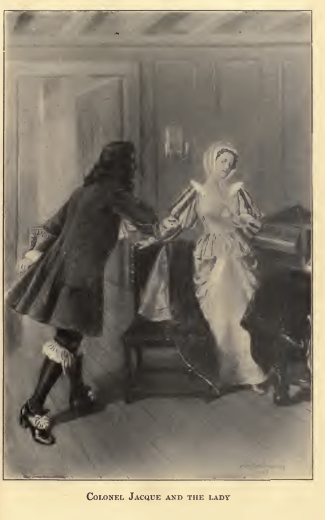
“I never receive visits from those that I hate,” says she.
“You have me there, indeed,” said I; “but you never gave me leave to tell you why I hated you. I hated you because you would never give me an opportunity to tell you I loved you. Sure, you took me for some frightful creature, that you would never come near enough so much as to let me whisper to you that I love you.”
“I never care to hear anything so disagreeable,” says she, “though it be spoken ever so softly.”
We rallied thus for an hour. In short, she showed the abundance of her wit, and I an abundant deficiency of mine; for though three or four times she provoked me to the last degree, so that once I was going to tell her I had enough of her company, and, if she pleased I would wait upon her to the door, yet she had always so much witchcraft on her tongue that she brought herself off again; till, to make the story short, we came at last to talk seriously on both sides about matrimony, and she heard me freely propose it, and answered me directly upon many occasions. For example, she told me I would carry her away to France or to Virginia, and that she could not think of leaving England, her native country. I told her I hoped she did not take me for a kidnapper. (By the way, I did not tell her how I had been kidnapped myself.) She said no; but the consequence of my affairs, which were, it seems, mostly abroad, might oblige me to go, and she could never think of marrying any man that she could not be content to go all over the world with, if he had occasion to go himself. This was handsomely expressed indeed. I made her easy on that point, and thus we began the grand parley; which indeed she drew me into with the utmost art and subtilty, such as was peculiar to herself, but was infinitely her advantage in our treating of marriage; for she made me effectually court her, though at the same time in her design she courted me with the utmost skill, and such skill it was that her design was perfectly impenetrable to the last moment.
In short, we came nearer and nearer every time we met; and after one casual visit more, in which I had the mighty favour of talking with her alone, I then waited on her every day at her own house, or lodgings rather, and so we set about the work to a purpose, and in about a month we gave the world the slip, and were privately married, to avoid ceremony and the public inconveniency of a wedding.