CONTENTS. (continued 4)
Reading edition
"'That may be; but here are a half-dozen men who are ready to swear that they saw you drunk yesterday.'
"'Av it comes to that, can't I bring twiste as manny who will swear that they didn't see me dhrunk yisterday.'
"'What kind of liquor did you drink?'
"'Mighty bad liquor, and ye'd say the same av ye was to thry it.'
"'Was it malt or spirituous liquor?'
"'It was nayther; it was whisky.'
"'Where did you purchase it?'
"'At the Dutchman's.'
"'Where is his store?'
"'On the corner.'
"'What corner?'
"'The corner nearest to where they're buildin' the shtore.'
"'Where is that?'
"Where I was workin'.'
"The Court.—What was O'Neil doing when you found him?
"Officer.—He was lying very drunk in a hole which he had been digging.
"Prisoner.—Be me sowl you're wrong for wonst; I didn't dig the howl; I dug out the dirt and left the howl.
"'Were you ever up before the Court before?'
"'No, nor behind aither; when I want to be again, I'll sind to your honor and let ye know.'
"'If I let you of this time will you keep sober?'
"'Faith I will, unliss the Dutchmin keep betther liquor nor they do now.'
"'You may go.'
"'Thank ye, sir—ye're a gintleman, av there iver was wan.'
"Mr. Timothy O'Neil left the court-room."
Mr. Dropper also proposed to relate the experience of some half a dozen mornings which he had spent in the pursuit of amusement under difficulties, when he had occupied himself in seeing the sights around the Jefferson Market Police Court.
"On one of the mornings which I devoted to visiting the Tombs," said Mr. Dropper, "the class of prisoners varied. Most of them claimed to be from the western of the British Isles. Others said they were born in Cork, Clare, Down, and other counties. A number answered to patronymics to which were prefixed the letter O, and an apostrophe. One party, who called themselves Fardowners, looked brick-bats at another party who occupied a remote corner of the cage, and who claimed to be Connaughtmen. The remainder of the prisoners were Irish.
"An interesting feature in the proceedings of the morning was a case in which Owen Shaughnessy, Patrick Mulholland, Michael O'Shea, Timothy Leahey, Dennis Maroney, Dermot McDermott, Phelim Flannegan, Bridget O'Keefe, Mary McBride, Ellen Dougherty and Bridget Casey were the defendants. As the Judge called out their names, the prisoners severally responded. They were all, as their names would indicate, of Irish birth. The men, evidently long-shoremen and laborers, and the women, servants. Their garments, in some instances, were torn, and in other ways disarranged and soiled. The men, and in one or two instances the women, showed bruises about their faces and hands, indicating their active participation in a recent scrimmage, from the effects of which they had not had the time, or soap and water, to enable them to recover.
"Mr. Gerald O'Grady, who stands at the head of the bar at the Tombs, and who, under adverse circumstances and strong competition, has been enabled, by his talents, to keep up his tariff of fees, from which he has never deviated, appeared as counsel for the prisoners. Mr. O'Grady has never been known to defend a case for less than fifty cents, unless, actuated by feelings of commendable philanthropy, he has volunteered his professional services gratis. It may be reasonably supposed that his success has excited the envy of the 'shysters;' for while they have to sit oftentimes a whole morning beside their respective granite columns at the Tombs, without being called upon to defend a case, Mr. O'Grady's presence in the court-room is in frequent demand. Mr. O'Grady had been retained in this case, I learned, by seven of the defendants, at a certain specified fee for each man, he volunteering his professional services to the ladies without charge. He announced to the Court that he represented the defendants, and that they were ready to have the trial commence.
"'Is Mr. O'Grady your counsel?' the Judge inquired of the defendants.
"'Yes, yer honor,' said one of the parties addressed; 'didn't I pay him five shillings—divil a hap'ny less—for to defind me.'
"'Five shillings?' said Mr. O'Grady, indignantly, 'you mane that as a retainer, of coorse.'
"Defendant.—I mane that's all ye'll get, anny how——
"Counsel (loudly).—Say, sir, it is time for you to know that, as a client, you should addhress the Coort only through your counsel. (To the Court.) Sir, my clients here, paceable citizens, stand ready for to answer, through me, to the diabolical chairges which designin' min have brought against thim, feelin' within their breasts——(Here Mr. O'Grady hit one of his clients a severe blow in his bread-basket).
"Assaulted Client.—Oh! h-h—.
"Counsel (to client).—Keep your mouth shut, why don't you? (To the Court.) Feelin', as I said before, widthin their breasts, the proud consciousness of their entire innocence of anny charges which their accusers could dare for to bring against thim.
"The witnesses were Sergeant Ferrett and Officers Snap, Catcher, O'Grasp, Ketchum, Holder, and Van Knabem.
"Officer Holder stated, in substance, that while patrolling his beat during Thursday night, the inmates of a house, No. 83½ Pacific Place, began to get very disorderly. From the howlings and noises which he heard, he came to the conclusion that there was a wake in the house. Not desiring to stop the disturbance by any violent means, he knocked at the door, with the view of telling them that they were disturbing the public peace, and requesting them to desist. No response was made to his knock. He then put his mouth to the keyhole of the door, and announced to them, as audibly as he could, that unless they desisted, he should have to call other officers and arrest them. No attention was paid to his words. Sergeant Ferrett arrived soon after, and inasmuch as the disturbance continued to increase, they called in the other officers to make a descent on the place, not, however, until they had first endeavored, by their voices, to make the inmates of the house understand the consequence to them, in case they persisted in their unlawful course. Officer Ketchum, who had formerly patrolled the beat, knew of a rear entrance to the house through an alley, and they accordingly entered the house by that way. They found about twenty persons present, men and women, engaged in a promiscuous scrimmage, howling, drinking, and fighting. The orders of the sergeant to cease their disturbance did not avail anything, which decided them to arrest the leading actors in the scene, which they forthwith accomplished, after some considerable resistance on the part of the company. They brought them to the station-house. The remainder of the party subsequently retired or left the place, which was quiet for the rest of the night.
"The remaining officers confirmed the evidence of officer Holder, in such of its particulars as they were acquainted with. All of them were cross-questioned, more or less, by Mr. O'Grady, without, however, eliciting any new facts of material interest.
"Mr. O'Grady introduced, as a witness for the defense, Mrs. Katheleen Hennesy.
"Mrs. Hennesy is a lady of about forty-five years of age, five feet ten inches in height, weighing about two hundred and fifty pounds. She has a florid face. Her dress was remarkable for the extent with which it was ornamented with highly-colored ribbons and laces, gathered in fantastic bows.
"Mr. Blotter, the clerk, administered the usual oath.
"Mrs. Hennesy, having kissed the book, the examination was commenced.
"Mr. O'Grady.—Misthress Hennesy, will you state to the Coort if you're the proprietor of the house No. 83½ Pacific Place.
"Mrs. Hennesy.—Av coorse I am, and divil a hap'ny is there owin' to anny man for what's inside of it.
"Mr. O'G.—What kind of a house do you keep there?
"Mrs. H.—Is it for to prove that the charackther of me house is not good that yer afther axin' the question?
"Mr. O'G.—Misthress Hennesy, could ye make it convanient to thrate this Coort wid becoming respect, by answerin' the questions that I put to ye, for the purpose of establishin' a definse of these ladies and gintlemen, some of whom, I am towld, are inmates of yer house? What kind of a house, I'll ax ye wonst more, do ye keep?
"Mrs. H.—It's a respectable, honest boordin'-house; bad luck to the blackgaird that says it's not.
"Mr. O'G.—Will you plase to state to the Coort the facts of the unfortunate occurrence that thranspired in yer house last night?
"Mrs. H.—For the matther o' that, there's mighty little for to tell; for it was nothin' more nor a wake, barrin' that the corpse come to life widout showin' the civility of first tellin' the mourners that he wasn't dead at all at all, and sayin', 'By yer lave, I'd rather not be, av it's all the same to yez.'
"Mr. O'G.—It's about that, Misthress Hennesy, that his honor is a waitin' for ye to spake of. Now, thin, will ye relate the facts?
"Mrs. H.—Well, plase yer honor, it was yestherday mornin' airly that I heard Timothy Garretty was up stairs in his room, very sick, and like to die. I dhressed myself, and sent for the docther, and went up stairs; and throth Tim was a lyin' there in wan of his fits, wid which he had been often throubled before; and before the docther could come to him, the circulation of his brathin' had stopped entirely. Well, yer honor, Tim had manny frinds in the house, and as he was an owld boordher, we thought to howld a wake over his body. He was laid out, and put into a coffin. At night all of his frinds come into the room, where everything was illegantly arranged for the wake. They had begun to dhrink their whisky, and was enjoyin' themselves in a gintale way, whin Pat Mulholland, he sthruck Mike O'Shea over the eye for somethin' that Mike had said, and wid that Mike's frinds and Pat's frinds got themselves mixed up in a free fight together. At that time, plase yer honor, who should I see arisin' from the coffin but Timothy Garretty himself, and restin' on his hands. By my sowl I was freckened, for I thought it was Tim's apparition that was appearin'. Thin Tim spoke up; 'Bad luck to yez,' says he, 'isn't it a fine thing yez is doin'—havin' the whisky flowin' free, and a free fight, too, and keepin' me a lyin' in this blackgaird box on the broad of me back, widout ever so much as axin' me if I had a mouth on me at all at all?' Wid that somebody who was a strikin' happened to hit Timothy a clout in the eye, which knocked him back into the coffin.
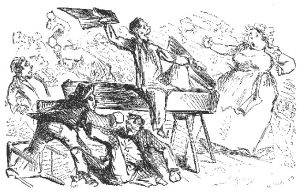
"'Who the divil did that?' sez Tim, as he made a spring from the coffin on to the floor, dhressed all up in his white clothes. 'Show me the man that shtruck me in me eye;' and wid that Tim he commenced a shtrikin' out, and he shtruck Dennis Marony under the but of the lug. Whin they saw Tim out of his coffin, they stopped a fightin', and fell on their knees, and commenced a sayin' their prayers. 'What's the matther wid yez?' says Tim.
"'Are ye not dead?' says Larry O'Brien.
"'Yes, as dead as a nest of live flaze,' says Tim.
"'Then yer alive,' says they.
"'Thry me wid some whisky,' says he; and wid that they got up and give Tim some whisky, which he never dhrank wid a betther grace nor thin. Well, as Tim wasn't dead, they couldn't howld the wake, but they said it would be a pity to lave the whisky to spoil, so they agreed that they'd have the spree just the same. Tim was purty wake from his fit, and so it didn't take long to make him dead dhrunk, whin we laid him in his bed. Afther that, yer honor, they kept on a dhrinkin', and was fightin' in the most frindly way, whin the M.P.s come into the door, and tuck some of thim off to the station-house. I thin shut up the house, and the rest wint to bed.
"Judge.—Mrs. Hennesy, where is Timothy, the corpse?
"'Here, sir,' said a cadaverous-looking Hibernian, 'a little the worse for dyin' widout bein' very dead.'
"Judge.—I think you're good for a few years yet if you take care of yourself. Mr. O'Grady, have your other witnesses anything to testify in addition to what Mrs. Hennesy has stated?
"Mr. O'Grady.—I belave not, yer honer. The material facts of the definse are sufficiently proven by Misthress Hennesy's evidence. Av the Coort plase, I have a few words to say in behalf of me clients here, which, av the Coort will hear me, I will make brief and to the point.
"Judge.—Go on.
"Mr. O'Grady.—Thin, av the Coort plase, I will state that the ground of my definse of these gintlemen and ladies against the unfounded chairge of their disturbin' the public pace, is that the chairge is unthrue in point of fact. Sir, what are the facts? A man dies, and his friends congregate about the corpse to perform their last friendly offices to his remains, in accordance with a custom justified by thradition, ratified by usage, sanctified by antiquity, vilified by these officers of the law when they call it a disturbance of the public quiet, crucified when they burst in the house of mournin' and interfered wid it in the name of the law; and, sir, I shall now proceed to establish a definse, bone fide, with the soundness of which I belave yer honor will be satisfied. Sir, the Constitution guarantees to my clients freedom of conscience; the stairs and sthripes wave proudly over a land in which religious despotism never dare show its repulsive form; and yet these officers dare to say that a custom, which is almost a pairt of the religion of these my clients, is a disturbance of the public pace. Sir, the institutions of our counthry air endangered by such perceedin's. And who was they disturbin'? Wasn't every man and woman and child in Pacific Place of the same nationality of these my clients? Air not their ethnological instincts runnin' in the same channels? Was they disturbed? No! Every man and woman and child there would have admired the devotion of these my clients, to their ancient national thraditions and customs. There they was wan wid another doin' their last friendly offices to their deceased friend in a fraternal fight over his corpse. Sir, what a sublime spectacle for the human mind to contemplate. I wondher that the officers were not thransfixed by the solemnity and moral grandeur of the scene.
"Judge.—Mr. O'Grady, I think that the fact of the dead having come to life, and having been put to bed dead drunk, proves disastrous for your argument, even admitting its soundness.
"Mr. O'Grady.—Thrue it is, yer honor, that the wake was perceedin' without the corpse, as thradition has it, that wonst upon a time Hamlet was played widout the Prince of Denmark; but, yer honor, it was the fault of the corpse, and not of that assembly of mourners. If Timothy Garretty had chosen to have remained a dacintly-behaved corpse, thin the objection which yer honor has raised could not have weighed against me clients here, and I press it now upon yer honor should my clients here be held accountable for the shortcomings of the corpse? I think not, sir.
"Judge.—I think, Mr. O'Grady, you may dispense with further argument, as it would be superfluous. Mrs. Hennesy's house and its inmates have never been complained of before that I am aware of, and in consideration of this fact I'll discharge the prisoners, giving them warning, however, in the future that if they are any of them brought before me again, I shall not deal with them so leniently. You may go.
"The interesting party left the court.
"The business of the court having been quite extended, the Judge cast eyes upon the clock, observing that the hour was already advanced, but as he looked at the list of cases before him, he observed with a seeming satisfaction, that he had now reached the last; he felicitated himself with the idea that in a few moments he would be at liberty to leave the premises, and after finding his way to some neighboring restaurant, partake of his judicial sirloin steak and coffee. He was evidently fatigued, but he put on a good-humored face as he called out:
"'Timothy Mulrooney.'
"'Here, sir,' said a young Milesian, remarkable for nothing in particular; 'here I am, sir:' and Timothy Mulrooney stepped forward to the bar.
"The Judge addressed the prisoner:
"'Timothy,' said he, 'you are charged with disorderly conduct.'
"'Yes sir, he is, and it's me that chairges him wid that same,' spoke up an old woman, dressed in a heavy, blue cloth cloak, and an antiquated cap and bonnet.
"Judge.—Are you the witness?
"Woman.—Av coorse I am, your honor, and it's me pride that I can spake against Tim Mulrooney—the dirty tief of the world that he is (to the prisoner), and I wondher, Tim, that you're not ashamed to howld up yer head before his honor.
"Judge.—Madame, state the facts as they occurred.
"Witness.—Well, place your honor, it was on Friday mornin' or Saturday mornin', I don't know which; but be that as it may, it doesn't make anny difference, because it's about what followed that yer honor wants for to know, when I heard the horn of a fish-cairt in front of my door; sez I to myself, now Michael has come wid the porgies, and—
"Judge.—Who is Michael?
"Witness.—And don't ye know Michael, sure? he is my own child, and a betther-behaved and more dacent boy nor him never sang at a wake; and he can rade and write yer honor, as well as annybody, barrin' that whin he comes to the big words he has to skip them, and guess at what they mane; but that is not his fault, yer honor, for Michael never had any time to go to school, still—
"Judge.—Madame, you shouldn't let your tongue fly off in a tangent in this way. What we desire to know is relative to the charge preferred by you against Timothy Mulrooney, here.
"Witness.—Yes, your worship, I was just comin' to it when ye interrupted me. (To the prisoner)—Ah, you murdbering tief, it's on Blackwell's Island that ye ought to be, instead of bein' here to face his honor in the indacent way that ye'r doing now. (To the Judge)—Well, your honor, it was on Friday mornin' or Saturday mornin', I can't tell which, but be that as it may, it does not make anny difference, because it's about what followed that yer honor wants for to know, when I heard the horn of a fish-cairt in front of me door. Sez I to myself, Michael has come wid the porgies. You see, your honor, Michael owns a fish-cairt, and he sells fish, and what he doesn't sell he brings home for us to ate. He towld me in the morning, that he would thry for to save some of the porgies for dinner. Thin I wint out ov the door, and sure enough it was Michael. 'Michael,' sez I; 'What,' sez he; 'Is it here ye's air?' sez I; 'Sure it is,' sez he; 'Did you save the porgies?' sez I; 'Av coorse I did,' sez he; and wid that he commenced takin' out the fish from the cairt.
"Judge.—What has all this to do with Timothy Mulrooney's offensive conduct? you have not shown as yet that he has done anything wrong.
"Witness.—Yer honor need have no fears but I'll convince yez that a dirtier spalpeen nor him niver was allowed to go unhung among a dacent people. (To the prisoner)—Ah, Tim, ye villain, I wondher that the ship didn't sink wid ye on board when ye left the ould counthry; I'd like to see ye show a receipt wid yer passage-money paid, ye—
"Judge.—Madam, I must insist upon your addressing yourself to the Court; you have no business to speak to the prisoner at all. Although he may have done wrong, yet so long as he is in my presence he shall be protected from the assaults of your tongue.
"Witness (excited).—The assaults of me tongue! Howly St. Pathrick, do ye hear that? Yer honor, I'm a dacint woman wid a family of childher and divil a word was ever spoke against me charackther before.
"Judge.—I said nothing against your character. I want you to confine yourself to what Timothy Mulrooney did to disturb the peace and quiet of your domicile.
"Witness.—I will yer honor. It was on Friday mornin', or Saturday mornin', I don't know which, but be that as it may, it don't make anny difference, because it's about what followed that yer honor wants for to know; ah, yer honor, I have it now—it was Friday mornin'—we was to have porgies for dinner, and not mate, because it was Friday—
"Judge.—All this is worse than nothing; you are taking up the time of the court by your tedious talk, which, so far as I can see, has no bearing whatever on the charge you have seen fit to make against this man Timothy.
"Witness.—Haven't I been trying for the last ten minutes to tell ye, and ye'll not not let me? It's wid a bad grace that yer honor reproves me for not tellin' ye what I know, whin it's yerself that is interruptin' me. Well, yer honer, it was on Friday morning, whin I heard the horn of a fish-cairt in front of my door, sez I to myself, now Michael—
"Judge.—I don't want to hear that story any more. You have told that several times already. State the facts about Timothy. Come down to the time when he commences to figure.
"Witness.—Ah, bad luck to the thratement that I get here. Has any of my illusthrious family the O'Briens ever done annything against yer honer that yez should illthrait me in this way?
"Judge.—Not that I am aware of. Now go on with your evidence.
"Witness.—Well, yer honor, as I was about to tell ye, it was on Friday mornin' whin I heard the horn of a fish-cairt in front of my door. Sez I to myself—now Michael has come wid the porgies.
"Judge (impatiently).—Mrs. O'Brien, I—
"Witness.—Me name's not O'Brien; I'm a married woman, and me name is Flaherty; me name was O'Brien when I was a girl.
"Judge.—Well, then, Mrs. Flaherty, O'Brien, or whatever your name is, I have heard of these porgies and that fish-cart so often that they have grown stale; now tell me what occurred between you and Timothy Mulrooney?
"Witness.—How do I know but ye'll intherrupt me again before I have said five words?
"Judge.—You may rest assured that I will not if you will tell what Tim Mulrooney has done that is contrary to law.
"Witness.—I could tell ye enough to hang him a half-dozen times, if he had as manny necks as that; (to the prisoner) ye know I could, Tim, ye—
"Judge (perspiringly).—Mrs. O'Flaherty—
"Witness.—Flaherty, widout the O, yer honor.
"Judge.—Well, whatever your name is, you must not say anything to the prisoner in this court. Go on now, and if you will tell what he has done I'll not interrupt you.
"Witness.—Now remember yer promise, ye honor. It was on Friday mornin'—
"Judge (despairingly).—You're at it again. I—
"Witness.—Howly mother of Moses! I told yer honor how it would be wid ye; here I haven't said more nor five words before yer at yer owld thricks again.
"Judge (much vexed).—What did Timothy do with your fish?
"Witness.—He didn't do annything wid them that time, barrin' that he saw Michael bring them in the house, and I heard him tell Biddy Mulrooney, his mother, who lives in the next room to me, that he would rather live on praties and bread, as they was a doin', than to ate stinkin' porgies that nobody else would buy; I know the Mulrooneys was jealous.
"Judge.—Did Timothy create any disturbance then?
"Witness.—No, yer honor, he didn't.
"Judge.—Then why did you have him arrested?
"Witness.—It was afther thin that the spalpeen made the disturbance.
"Judge.—When was that?
"Witness.—It was yestherday mornin'.
"Judge.—What did Timothy do?
"Witness.—It wasn't Tim, but his cat.
"Judge.—Then it seems that you have entered a charge against Timothy Mulrooney of disorderly conduct, which, by right, you should have made against Timothy Mulrooney's cat, always provided that cats are amenable to municipal law.
"Witness.—By my sowl, yer honor, ye've got it mixed up again. Now why didn't ye wait until I could tell ye.
"Judge.—Go on; I am reconciled to my fate. As a particular favor, I should like to have you finish within a half hour.
"Witness.—Well, yer honor, as I was tellin' ye, the Mulrooneys was jealous of us because we had fish and they didn't. Yestherday mornin' Michael brought home more porgies (the Judge here heaved a deep sigh) and I laid them on top of a barrel in the passage to wait till I could dress them; what next, yer honor, did I see but Tim Mulrooney's big tom cat on the barrel atin' the fish; I heaved a pratie at the cat and it ran off wid the porgies; just thin I saw Tim Mulrooney laughing at what the cat was doin'; I know the blackgaird had towld the cat to ate the porgies; I called to Michael, and I run toward Tim to bate the tief as he deserved, whin my foot slipped and I furled over on the broad of my back; wid that Tim laughed the more, and Michael run to him, and was about to give him a tap on the sconce, whin Tim struck Michael a blow in his bowels, which quite prostrated him on the floor; with that I ran and got the M.P., who brought the murderin' tief to the station-house.
"Judge.—Well, Mrs. Flaherty, I think, according to your own story, the prisoner acted more in his own defence than any other way.
"Witness.—In his own definse! Bad luck to the tongue that says so. Is—
"Judge (to prisoner).—Timothy Mulrooney, I am by no means sure that your cat did not eat the Flahertys' fish with your connivance. If the cat did so, you did wrong; but for that you are sufficiently punished by your imprisonment last night. I think you might have been less hasty in striking Michael. Is Michael in court?
"Mrs. Flaherty.—He is. Stand up, Michael, before his honor.
"Mrs. Flaherty, Michael and Timothy were standing together in a row.
"Judge.—Now I am going to insure perfect harmony in your house for six months to come; I shall bind each of you over in the sum of $200 to keep the peace.
"This was almost too great a humiliation for the blood of the O'Briens to bear; but there was no alternative. Mrs. O'Brien Flaherty satisfied herself as well as she could by looking screw-drivers at the Judge; Michael appeared demure, and Timothy appeared jolly. The bonds were given, and the interesting trio left the court.
"The Judge rose from his chair, and made a bee line for breakfast."
During the various narrations which were given during the evening, Mr. Quackenbush remained seated in the corner, saying nothing and doing as much. His eyes were partially closed, and an occasional sigh was all that escaped him.
When Mr. Dropper concluded the reading of his contributions, it was moved that Mr. Quackenbush open his mouth, and say something, under the penalty of having it pried open with the poker.
This caused Mr. Quackenbush to open his eyes; and, after various preliminary hems and coughs, he announced that there was a certain rule of evidence which gave a witness the right to refuse to say anything tending to criminate himself. He should avail himself of that rule. Having said these words, Mr. Quackenbush rolled over on the floor, drew himself into double bow knot, and was soon snoring against noise.
In the meantime Mr. Spout had taken the floor, and stated that he had on one occasion been over at the Essex Market Police Court. He was there the involuntary witness of the trial of a case, which might account for the non-communicative disposition manifested on the present occasion by Mr. Quackenbush. During the proceedings, the justice called out the name of R. Percy De Laney Blobb; and in response to the call a tall individual arose and came forward. "I thought I recognized in the individual in question," continued Mr. Spout, "a person whom I had seen before, and I was not mistaken. He was wild, and disposed to regale the assembled company with a numerous collection of songs, which he had at his tongue's end. His dress was much disarranged.
"The evidence of the officer who had arrested the tall gentleman, went to show that he had offended against the laws, by disturbing the rest and quiet of an unappreciative neighborhood, by bawling forth at midnight most unmelodious yells, which, when he was apprehended, he assured the officer were capital imitations of Sontag, Grisi, and Grisi's new baby. When arrested the individual was in a plebeian state of drunkenness—not so much so but that he could sing, as he called it, and could talk after an original fashion of his own. His ideas were slightly confused; he informed the officer that he had been to hear Louisa Crown sing the Pyne Diamonds, and that he met a friend who took him to a billiard shop to see a clam race; that he and his friend bet the whisky on the result; that he drunk for both, and that they had passed the remainder of the evening in a 'magnorious manner,' singing 'Storm Columbus,' 'Yankee Boodles,' and the 'Scar Strangled Bladder.'
"The officer had taken him to the lock-up, where he had finished the night singing 'Good Old Daniel,' whistling the 'Prima Donna Waltz,' and playing an imaginary piano-solo on the floor, in which attempt he had worn off some of his finger-nails. When he was before the court he had not yet recovered his normal condition. He was still musically obstinate, and refused to answer any questions of the Judge, or make any remarks, except in scraps of songs, which he sang in a low voice, mixing up the tunes in a most perplexing manner. Being possessed of an excellent memory, and having a large assortment of melodies at his command, his answers were sometimes more amusing than relevant. The Judge proceeded to interrogate him somewhat as follows:
"Judge.—What is your name, sir?
"Prisoner.—'My name is Robert Kidd, as I sailed'—
"Indignant Officer.—He lies, your honor. Last night he said his name was Blobb.
"Judge.—Where do you live?
"Prisoner.—'Erin, Erin is my home.'
"Knowing Officer.—He isn't an Irishman, Judge; he's a Connecticut Yankee, and lives in East Broadway.
"Prisoner.—'That's eight times to-day you have kissed me before.'
"Officer.—Please, your honor, he's an octagonal liar, I didn't.
"Judge.—Where did you get your liquor?
"Prisoner.—'Way down south in Cedar street; rinctum'—
"Judge (to officer).—What's that he says?
"Attentive Officer.—At Ringtown's in Cedar street.
"Judge.—What number in Cedar street?
"Prisoner.—'Forty horses in the stable.'
"Officious Officer.—Ringtown's, No. 40 Cedar street, your honor.
"Prisoner.—(Voluntary remark, sotto voce.) 'A jay bird sat on a hickory limb—he winked at me and I winked at him.'
"Indignant Officer.—Who're you winkin' at?
"Prisoner.—'Nelly Bly, shuts her eye.'
"Officer.—You'd better shut your mouth.
"Judge.—What have you got to say, prisoner?
"Prisoner.—'Hear me, Norma.'
"Officer.—Well, go on, go on.
"Prisoner.—'O blame not the bard.'
"Judge.—Nobody to blame but yourself.
"Prisoner.—'Did you ever hear tell of Kate Kearney?'
"Knowing Officer.—Keeps a place in Mott street, your honor.
"Prisoner.—'O! O! O! O! O! Sally is the gal for me.'
"Judge (to officer).—Who is Sally? Some disreputable female I suppose.
"Officer.—She went up to the Island to-day, sir.
"Prisoner.—'O tell me, where is Fancy bred.'
"Judge.—I don't know anything about your fancy bread, if you have anything to say, go on.
"Prisoner.—'We'll all go bobbing around.'
"The Judge here became indignant, and demanded if he had a friend to become bail for him, to which query the prisoner hiccuped out,
"I'll never, never find—a better friend than old dog Tray.'
"Judge.—Can't take him, he is not responsible.
"Prisoner.—'I give thee all, I can no more.'
"Judge.—It won't do, sir, I shall fine you $10.
"Prisoner.—'That's the way the money goes—pop goes the weasel.'
"Indignant Officer.—I'll pop you over the head presently.
"Prisoner.—'There's whisky in the jug.'
"Officer.—You'll be there, too, shortly.
"Judge.—If you can't pay you must go to jail.
"Prisoner.—'Give me a cot in the valley I love.'
"Judge.—Very well, sir, I'll do it. Tombs, ten days.
"Prisoner.—'I dreamt that I dwelt in marble halls.'
"The officer was about removing the individual below, when I came to the rescue, and informed the Judge that the prisoner was a friend of mine, that this was the first occasion in which he had ever manifested such eccentricities, and if he would let him off from the punishment this time, I would take him to his home and see that he never disturbed the city by his yells in the future.
"The prisoner turned his eyes upon me, and again broke out:
"'Good news from home, good news for me'——
"'Mr. Blobb,' said the Judge, 'if I let you off this time, will you cease going on these drunken sprees?'
"Prisoner.—'I'll touch not, taste not, handle not, whate'er intoxicates.'
"Judge.—I hope that when we meet again it will be under more favorable auspices to yourself——
"Prisoner (interrupting).—'Meet me by moonlight alone, and I will tell thee.'
"Judge (resuming).—For you're in a bad plight now to appear among the ladies.
"Prisoner.—'Oh! I'm the boy for bewitching them.'
"Judge.—Not when you're drunk, I imagine.
"Prisoner.—'A man's a man, for a' o' that.'
"Judge.—You may go, sir. Good day.
"Prisoner.—'Oh, give to me that better word that comes from the heart, Good bye.'
"I managed to get my friend, Mr. Blobb, out of the court-room, and subsequently, with some difficulty, I succeeded in putting him to bed in my apartment, where I kept him for twenty-four hours, until he had recovered from his temporary aberration. He has since that time been in a normal state, except that he appears melancholy at times. He is well enough, however,——
"To be here this evening," said Quackenbush, interrupting; "for know ye that Mr. R. Percy Delancy Blobb is now before you in the person of myself, and I am here to-night to ask forgiveness, which, if you don't give to me, I shall take immediate measures to expel you all from the club."
It was immediately voted that Mr. Quackenbush be forgiven, on condition that he would disclose the facts which led to his being found a prisoner in the Essex Market Police Court.
This, Mr. Quackenbush said he would do and do it now, and after finding room for a glass of ginger-wine, proceeded to narrate his experience.
He stated, substantially, that the whole difficulty grew out of a love affair. He had become deeply infatuated with an unknown and beautiful blonde. He had often met her in the street, in theatres, and concert-rooms, and his intense admiration ripened into a deep love. He was unable to learn who she was until a fortnight previously, when he found a friend who was well acquainted with her, and who undertook to bring about an introduction. Things wore a brighter aspect then. The sun was more brilliant; the moon shed a less melancholy light; lager bier tasted better; oysters appeared fatter; peanuts seemed always roasted just enough, and, in fact, he felt quite satisfied with life, and the world generally, and resolved to postpone indefinitely a purpose he had entertained of buying three cents' worth of arsenic. But a day or two before the scene in the Police Court in which he figured, he found himself in a stage, and directly opposite was the identical object of his admiration and affection. He hitched from one side on his seat to the other; put one leg on the other, and then reversed them; looked out of the window, and then at her; scratched his ears; pulled up his collar; brushed the dust from his pantaloons; put his hands in his pockets; pulled them out, and did many ridiculous things which he would not have done had she not been present. She stopped the stage on one of the avenues, and handed him a five-franc piece to pay the driver. The driver, as usual, gave change in small pieces. He counted it to see that it was all right; found it to be so, and informed her of the fact. The streets being very muddy, he resolved to do the genteel in the way of assisting her out of the vehicle; made his exit; put one foot six inches into a mud-hole, and the other on the edge of the curb-stone; lifted the lady to the sidewalk in safety, at the expense of bursting off two suspender-buttons, and his vest-buckle, a slip down causing his nose to fall against the tire, his knees into the mud, his shoulder against the stage-steps, and caving in his hat. But all this didn't trouble him in the least, as he expected to be more than remunerated by an approving smile on the part of the lady. He turned his face towards her, and found her engaged in counting the change, which he had pronounced to be all right, as if she suspected that he would be guilty of cheating her out of a stray sixpence, and thus hazard his chances for salvation. The effect of the disappointment, on him, was frightful. He felt a sickening sensation; stopped at the nearest whisky-shop, and imbibed; went to another, and took a nip; proceeded to a third, and smiled; reached a fourth, and took a horn; entered a fifth, and drank, and so on, ad libitum. At last he reached Niblo's; saw a flaming poster announcing that Louisa Pyne was to sing in the "Crown Diamonds;" bought a ticket; took several drinks and a seat. His ears had become unusually critical. Thought he could beat Harrison singing, and to satisfy himself, he rose up, and commenced to slaughter a piece, which Harrison had just executed. There was an evident want of appreciation of his abilities, for he was hustled out in double-quick time. He then went to a bar-room, and called for something to drink, which deliberate act was the last circumstance he remembered, previous to recognizing Mr. Spout in his room in the afternoon of the following day, when he inquired of that gentleman if he wouldn't be so kind as to prevent the nigger boy from striking him on the head with a poker, as he thought he had done it long enough.
A vote of forgiveness to Mr. Quackenbush was carried, after which the entire club went to sleep.
"Murder most foul, as in the best it is; But this most foul, strange, and unnatural."
A FEW days after the events recorded in the last chapter, a new trick was invented to obtain under, false pretences, the money of the public. A number of needy and seedy individuals having been told that in England several of the most distinguished literary men in that country had given a few theatrical exhibitions with great success, conceived the plan of exhibiting, in a similar manner, in the city of New York, a number of authors, artists and other celebrities, admitting the public at twenty-five cents per head. That it might look less like a humbug, and by way of hiding, as far as possible, the swindle which was only too transparent, after all, it was announced that the living poets and painters would be shown all alive in secure cages, undergoing a periodical stirring-up by the keeper, and being benevolently fed in the presence of the spectators afterward.
Preparations had been made to secure the services of the biggest authors, the most notorious painters, the largest sized sculptors, the most melodious poets, and the most sanguinary editors the country could produce. The anxious world expected nothing less than to see the author of "Thanatopsis" appear as Hamlet in black-tights and a slouched hat—and he who invented "Evangeline" and "Hiawatha" come on as the Ghost with a pasteboard helmet and a horse-hair beard. Who should be Laertes but he who "skulped" the Greek Slave, or what editor could play "the king" like the democratic conductor of the Tribune? who, in assuming the crown, was to doff the white hat, "positively for one night only?" The Queen of Denmark would of course be represented by the architect of "Uncle Tom's Cabin," whose familiarity with courts and royalty would enable her to invest the character with life-like interest. The public had made up its mind to be content with no Ophelia except Ruth Hall, for no one else could play the crazy scenes so admirably. But alas for the expectations of the misguided public—the illustrious individuals aforesaid would not come, and consequently the public were compelled to witness the consummation of the dreadful tragedy, by authors whose works they had never heard of; painters whose productions were unknown to the world, and editors whom a close investigation resolved into obscure scribblers.
To this literary exhibition Overdale, Wagstaff, and John Spout resolved to go—Overdale to give the necessary explanations, Wagstaff to make a transcript of his friend's valuable remarks, and John Spout (himself an amateur artist) to see the celebrated men of his own profession, whose contributions to art had been so persistently kept out of sight.
The performance was to take place in the Academy of Music, a building designed and completed by a diabolically ingenious architect, who endeavored to construct a theatre in such a manner that one half the audience could not hear, and the other half could not see, and who succeeded to admiration.
Our friends obtained seats in that part of the house where they could see, though it was not possible to hear a word.
After a great many preliminary flourishes and false starts by the members of the orchestra, they set off as nearly together as they could, in obedience to the frantic gestures of the leader, who flourished his fiddle-bow with as much energy and vindictiveness as if he had been insanely endeavoring to kill mosquitoes with it, in forty different directions at once.
Finally the curtain went up amid the uproarious applause of the assembled multitude, interrupted only by a small boy in the gallery, who hissed like a whole flock of enraged wild-geese, having been stationed there especially for the performance of this sibilant duty by an avenging washerwoman, to whom one of the amateurs owed four and sixpence; his dissenting voice was, however, soon hushed by the police, who put him out, and didn't give him his money back, after which the exhibition proceeded.
To give a full description of one half of the ridiculous performances indulged in by these deluded persons—to tell of the new readings which they gave, and the old readings which they didn't give—to relate how carefully they avoided the traps, and with what commendable caution they kept away from the footlights—to give an idea of the bedlamitish ingenuity they had displayed in the selection of wardrobe, how each one had put on the most inappropriate articles imaginable, and how they could not have been more incongruously attired if they had been all dressed in sheep's grey breeches and straw hats—to dilate upon the disasters which befell the said wardrobe, how the tunics caught in the wings, and the shoulder-cloaks got singed by the side-lights; how the ladies' trains were in everybody's way, and their feathers in everybody's eyes—how, in their confusion, when they painted their faces, they put the wrong colors in the wrong places, and some of them went on with white cheeks, chalked lips, and eyebrows colored a bright vermilion—how the gilt crowns got bent and battered until they looked like ancient milk-pans with the bottoms melted out—how the flannel ermine on the regal calico robes got greasy, and looked like tripe—how the wax pearls melted and the glass ones broke—how the "supes" painted their whiskers uneven, and got their wigs on wrong side before—how some of them couldn't get their armor on at all, but how one enterprising individual, having succeeded to his satisfaction, came on to deliver a message, with his sandals in his hand, his helmet on one foot, his breast-plate on the other, and his leg-pieces strapped on his shoulders—to tell how the Ghost got chilly and played the last scene in an overcoat, and proved that he was a substantial Native American Ghost, by making two extemporaneous speeches, in excellent English, to the audience—to do full justice to the miscellaneous assortment of legs, then and there congregated, and relate how some were bow-legs, and some were shingle-legs, some were broomstick-legs, some were wiry legs, and some were shoulder-of-mutton legs—to give an accurate relation of the various expedients resorted to, to remedy the most noticeable defects in those legs, and state that some were padded on the sides, and some at the ankles, and how, in not a few instances, the padding slipped away from its original position, thereby putting the calves on the shins, and causing the knees to resemble deformed india-rubber foot-balls—and to give a reliable history of the unheard-of antics indulged in by the said fantastic legs, after their symmetry had been perfected by the means just written—how some went crooked, some sideways, and some wouldn't go at all; how some minced with short steps, like a racking pony, and others stepped along as if they had seven-league boots on; how some moved with convulsive hitches, as if they were clockwork legs, and the springs were out of order; how some worked spasmodically up and down in the same place, and didn't get along at all, as if they were legs which had struck for higher wages; and how others dashed ahead, as if they did not intend to stop until they had transported their bewildered proprietors out of sight of the audience, as if they were machine legs, with the steam turned on, and weights on the safety-valve; how some went on the stage and wouldn't go off, and how others went off and wouldn't go on, until they were coaxed on by their agonized owners, a long time after the cue came—to tell how the red fire burned green, and the blue fire would not burn at all—how the call-boy got tipsy, and was not forthcoming—how the property-man fell over the sheet-iron thunder, and stuck his head into a pot of red paint, which made him look like a modern edition of Charles the First with his head cut off—how the grave-diggers got into the grave and couldn't get out—how Hamlet and Laertes could hardly get in at all; and how, when they did get in, they made the gravel fly—how the wrong men came on at the wrong time, and how, as a general thing, the right men didn't ever come on—how Guildenstern spoke Ophelia's lines, how Horatio tried to speak one of Hamlet's speeches, and danced a frantic hornpipe with rage because he couldn't think how it began, and how Polonius couldn't speak at all, and so went home—how nobody could remember what Shakspeare said, and so everybody said what Shakspeare didn't say, and hadn't said, and wouldn't have said, under any circumstances—how some of the men swore, and some of the women wanted to, but postponed it, and how the butchery proceeded, with many mishaps and multitudinous mistakes, and how the audience applauded, and cheered, and laughed at the dismal tragedy, evidently considering it the liveliest farce of the season, are facts, falsehoods, and circumstances, both real and supposititious, which could not be compressed within the limits of a single volume.
Hamlet was personated by an aspiring youth, whose physical dimensions were not up to the army standard, and who couldn't have gathered fruit from a currant-bush without high-heeled boots on; while the lady who represented his mother would have been compelled to stoop in order to pick pippins from the tallest apple-tree that ever grew. By the side of her illustrious son, she looked perfectly capable of taking him up in her arms, giving him his dinner after the usual maternal fashion, and afterwards disposing of him in the trundle-bed, to complete his infant slumbers.
Overdale explained that they had tried to get a bigger Hamlet, but that, upon the whole, he thought the little fellow would "speak his piece" pretty well, taking into consideration the fact, that in the dying groans, he was supposed to have no superior.
Wagstaff was totally ignorant of the plot, and as from the obfuscation of the performers, no one could have formed the slightest idea of what they were all talking about, he seemed in no very fair way to find out anything about it.
The peculiar rendition of the story of the King of Denmark was so uncertain, that even John Spout found it exceedingly difficult to tell where they were or how they would come out, or what they intended to do next. He was a little uncertain whether the queen would finally subdue Hamlet, or Hamlet succeed in thrashing the queen. In the closet scene, especially, the battle was conducted with such varying success that it was impossible to bet, with any kind of certainty, on the result, or to prognosticate, with reliability, whether Hamlet would knock his mother down with a chair, and damage her maternal countenance with the heels of his boots, or whether the old lady would succeed in her design, which was evidently to conquer her rebellious offspring, and give him a good spanking. Neither could he tell whether Laertes would kill Horatio, Hamlet, or the Second Grave-digger, who stood behind the wing, with his hands in his pockets, and his breeches in his boots. He was also a little undecided as to which was Polonius, and which was the king, and when the player queen came on, he thought it was only Ophelia, with a different-colored petticoat on. John swore the Ghost looked as if he hadn't had any dinner, and said he was perfectly certain his ghostship had been refreshing his invisible bowels with a mug of ale, behind the scenes, because when he came on the last time, with the broomstick in his hand, he could see the foam on his whiskers.
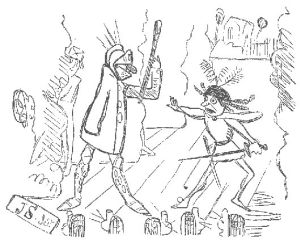
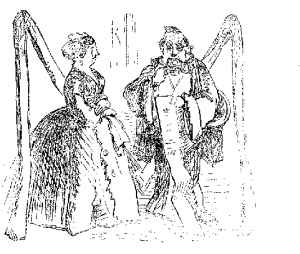
One of the richest and most incomprehensible scenes ever witnessed on the modern stage was the final one between Hamlet and the Ghost, who, finding the weather chilly, had done his best to mitigate his sufferings by putting on an overcoat. Hamlet, trying to look fierce, holding his sword at arm's length, performing a kind of original fancy-dance, as he followed the spiritual remains of his ghostly father across the stage—Hamlet, the mortal, being about the size of a mutton-ham, while his father, the immortal, supposed to be exceedingly ethereal, was tall enough and stout enough for a professional coal-heaver, instead of an amateur ghost—the intangible spirit, moreover, having one hand in his overcoat pocket, to keep his fingers warm, while in the other he flourished a short broomstick, as if to keep his degenerate scion at a respectful distance, were so ludicrous, that John Spout seized Wagstaff's book, and produced the sketch to be found at the beginning of this chapter.
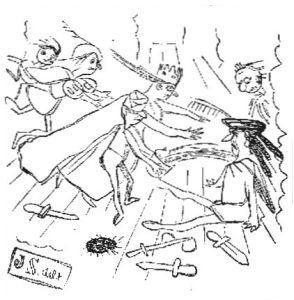
And in the last death-scene Hamlet really won such honors as were never before accorded to mortal tragedian; being by this time a little doubtful whom to kill, he made an end of the entire company in rotation. First, he stabbed the King, who rolled over once or twice, and died with his legs so tangled up in the Queen's train that she had to expire in a hard knot; then he stabbed Laertes, who died cross-legged; then he stabbed Osric; and not content with this, he tripped up his heels and stood on his stomach, till he died in an agony of indigestion; then he tried to stick Horatio, but only succeeded in knocking his wig off; and then, turning up stage, made extensive preparations for terminating his own existence.
First, as everybody was dead, and everybody's legs were lying round loose, he had to lay them out of the way carefully, so as not to interfere with the comfort of the corpses; then he picked up all the swords and laid them cautiously in a corner, so that the points shouldn't stick in him when he fell; then he looked up at the curtain to see that he was clear of that, then he looked down at the traps to see that he was clear of them, and having at last arranged everything to his satisfaction, he proceeded to go systematically through his dying agonies, to the great satisfaction of the audience. Suffice it to say, that when the spasms were ended, and he had finally become a "cold corpus," his black tights were very dirty and had holes in the knees.
When the curtain went down Hamlet was too exhausted to get up, and instantly everybody rushed to the rescue; those he had slaughtered but a few minutes before, forgot their mortal wounds, and hastened to the murderer with something to drink. The King rushed up with a pewter mug of beer; Horatio presented the brandy-bottle; the Ghost handed him a glass of gin and sugar; the Queen gave him the little end of a Bologna sausage and a piece of cheese; the stage carpenter, in his bewilderment, could think of nothing but the glue-pot; the property man hastened to his aid with a tin cup full of rose-pink, and a plate-full of property apple-dumplings (ingeniously but deceptively constructed out of canvas and bran), while an insane scene-shifter first deluged him with water, and then offered him the bucket to dry himself with.
John Spout, who had been behind the curtain, and witnessed this last performance, immediately came out, borrowed Wagstaff's notebook, and left therein his pictorial reminiscence of this scene as follows:
Overdale had been profuse in his explanations of the many curious scenes, and Wagstaff had noted down his words carefully in his memorandum-book. Once when the Ghost tripped and fell through the scenery, caving in the side of a brick house, and kicking his spiritual heels through the belfry of a church in the background, Overdale said that this was Ophelia, who had been taken suddenly crazy, and in her frenzy had imagined it necessary to hasten to the nearest grocery for a bar of soap to saw her leg off with. Polonius, he explained, was Horatio, and Hamlet was a little boy who run on errands for the cook of the palace, by which culinary appellation he designated the Queen of Denmark. He said the plot of the piece was, that the king wanted to marry the cook, but her relatives objected to the alliance, because his majesty hadn't got shirts enough for a change.
All of which was carefully written down by Wagstaff, with divers alterations, emendations, additions, and extemporaneous illustrations, by John Spout.
This last-named individual asserts to the present time that he cannot tell who were the most humbugged—the people who paid their money, and laughed at the play under the impression that it was a farce, or the unfortunates who performed the play, laboring under the hallucination that they were acting tragedy.
All were, however, satisfied, that it was a kink of the Elephant's tail, which he has not yet uncurled in any city of America—save Gotham.

"Black spirits and white, Red spirits and grey, Mingle, mingle"——
MR. Remington Dropper had a great respect for upper tendom; was almost inclined to admit, without question, its claims to the worship of the vulgar masses, and confessed that when he saw one whom he took to be a leader of fashion coming, he felt an involuntary movement of his right hand towards his hat. He admitted that he had, by this manner of doing indiscriminate homage to well-dressed people, on several occasions taken off his hat to notorious horse-jockeys, faro-dealers, and gamblers.
"However," said John Spout, "if you want to go to a grand fancy dress ball, where you will meet all 'the world,' as these try-to-be-fashionable people call those who have scraped together dollars enough to entitle them to their royal notice, I can very easily get you an invitation. Mrs. Throughby Daylight, whose husband made a fortune by selling patent medicine, and thereby purged himself of poverty and plebeianism together, gives, in a short time, a grand fantasquerade, which is intended to be the most consolidated fancy dress jam of the season. Do you want to go?"
"Go," replied Dropper, "how can I go? I don't know Mrs. Throughby Daylight, or Mr. Throughby Daylight, or any of the Daylights, so that Daylight is all moonshine."
"Dropper," was the response, "you're young; I excuse that, for you can't help it; but you're also green, which I cannot forgive; your verdancy is particularly noticeable when you revive the absolute absurdity of supposing that it is necessary to be acquainted with a lady before you are invited to attend her parties. That antiquated idea has been long since exploded. Why, my dear sir, it is no more necessary that you should have ever previously heard of a woman whose 'jam' you receive an invitation to attend, than it is probable she knows who you are, or where the devil you come from."
Dropper was bewildered.
"It is a positive fact," continued Spout. "Why, bless your innocent eyes, a woman of fashion no more knows the names of the individuals who attend her grand party, than she knows who took tea last night with the man in the moon. She merely orders music and provisions, makes out a list of a few persons she must have, has her rooms actually measured, allows eight inches square to a guest; thus having estimated the number that can crowd into her house, she multiplies it by two, which gives the amount of invitations to be issued, after which she leaves the rest to Brown. Brown takes the list; Brown finds the required number of guests. Brown invites whom he pleases; Brown fills the house with people, and Brown, and only Brown, knows who they are, where they came from, or how the deuce they got their invitations."
Dropper, still more bewildered, inquired who Brown was.
"Brown," explained John Spout, "is the Magnus Apollo of fashionable society—he is the sexton of Graceless Chapel, and no one can be decently married, or fashionably buried without his assistance. He has a wedding face and a funeral face, but never forgets himself and cries over the bride or laughs at the mourners; he is great as a sexton, but it is only in his character of master of ceremonies at a party, that he rises into positive sublimity—he is the consoler of aspiring unfashionables, who have got plenty of money, and want to cut a swell, but don't know how to begin. He is the furnisher of raw material on short notice, for fashionable parties of all dimensions; his genius is equal to any emergency, though, as the latest fashion is to invite three times as many people as can get into the house at any one time, Brown is often put to his trumps. Mrs. Codde Fishe last week wanted to give a party, and, of course, called on Brown. Brown measured the parlors; they would only hold 1728, even by putting the chairs down cellar, and turning the piano up endways. Mrs. Codde Fishe was in despair. Mrs. P. Nutt had received 1800 at her party the night before, and if she couldn't have 2000 she would be ruined. Brown's genius saved her. 'Mrs. F.,' said he, 'though we must invite 2000 people, and though we must have 2000 people in the house, they need not be all there at one time, and they need not all stay.'
"'Certainly not,' said Mrs. Fishe.
"'I'll manage it,' said the indefatigable Brown—and Brown did manage it. He got 272 retail drygoods clerks, whom there didn't anybody know, dressed them in white gloves and the required fixens, so they looked almost as well as men. Well, sir, if you'll believe it, Brown had his 272 clerks arrive at the door, eleven at a time, in hired hackney-coaches, announced them, by high-flown names, to the hostess, had them march in single file through the parlors to the back door, where he had a man waiting to conduct them over the garden-fence by a step-ladder, and so get them out of the way to make room for more.
"Mrs. Lassiz Candee had but 1439 names on her list; she wanted 1800. Brown was summoned. Brown heard the trouble. Brown produced from his pocket a list of names twenty-one yards in length. For a moderate compensation he furnished Mrs. Candee with a yard and a half of literary celebrities, three yards of 'Shanghaes,' five yards and a quarter of polka dancers, and about fourteen feet of foreigners, with beards and moustaches for show-pieces, and to give the thing a 'researcha' look.
"But, not to be too tiresome, Dropper, I am on Brown's list of eligibles, and can get your name added also."
Remington eagerly accepted the offer, and three days after they found on their table two huge envelopes, addressed respectively to "Mr. John Spout," and "Mr. Remington Dropper." Remington, trembling with haste, broke open his at once, and discovered a card about the size of a washboard, on which was a communication to the effect that Mrs. Throughby Daylight requested the pleasure of the company of Mr. Remington Dropper, and that it was to be a fancy dress party, and he was requested to appear in costume, all of which he only discovered by calling John Spout to his assistance, who condescendingly explained everything.
Remington was overjoyed, but in answer to all his anxious inquiries concerning the manner of procuring the invitation, he only elicited from John Spout the mysterious monosyllable, Brown!
"What does it mean by coming 'in costume?' How am I to dress? What shall I put on, and where shall I get it?" inquired he.
John explained. "It means that you are to disguise yourself in an un-Christian attire of some description, making yourself look as unlike a 'human gentleman' as possible—call yourself a 'Gondolier,' a 'Brigand,' a 'Minstrel Boy,' or some other sentimental or romantic name, and cut as big a splurge in your borrowed clothes as possible. If you know anybody who belongs to the theatre, you can easily borrow a rig; if not, you'll have to hire it of a Jew, and give security that you'll bring it back."
For four days Mr. Dropper was in a state of feverish undecision respecting his choice of a character. At the end of that time he was still wavering between a "Turk," a "Monk," and "Jack Sheppard." By John Spout's suggestion he resolved to decide the matter by a throw of the dice, which method made a "Turk" of him for the eventful evening, the "Monk" getting deuce, ace, and a five, "Jack Sheppard" scoring but eleven, while his oriental highness came off victorious, by means of two fours and a six. John Spout was going as a Choctaw Indian, so that he could smoke all the time and no one would find fault and say that he was vulgar.
The wished-for evening arrived, and Remington began to dress at four in the afternoon, so as to be in time. By the assistance of two Irishmen and a black boy he got his dress on at half-past six; and at a quarter to seven he sunk exhausted into a arm-chair, and went to sleep.
John's own toilette was quickly made; he had borrowed his dress from a friend, who attended in person to put it on for him.
When they were ready, the black boy was dispatched for a hack, into which they both got; after experiencing some difficulty from Spout's war club, which got tangled in Remington's trousers, and being a good deal exasperated by Dropper's scimitar which would get between John Spout's legs and interfere with his breech cloth.
At last they approximated the house, and their carriage took its place in the rear of a long line which had formed in front of Mrs. Throughby Daylight's mansion, and anxiously waited for those in front to move out of the way, and give them a chance to get out.
They could hear in the distance the shrill whistle and the voice of the indefatigable Brown, shouting "Room for Mrs. Rosewood's carriage;" "Clear the way for Mrs. Fizgiggle's vehicle;" "Let Mrs. Funk's establishment come up;" and then Brown would disappear into the house, and a faint echo of Brown would be heard from the inside, announcing these visitors as "Mrs. Noseblood," "Mrs. Buzfiggle," and "Mrs. Junk," it being a peculiarity of Brown, that although he might get the names of the guests right the first time, he never announced them at the door without some ludicrous perversion.
Our friends at length attained the entrance, and, having been interrogated by Brown as to who they were, and having told him "a Turk" and "a Choctaw," they were instantly ushered by that individual into the presence of the versicolored crowd, and announced, in a voice of thunder, as "Mr. Squirt" and "Mr. Bucksaw."
As they had come in a carriage and were prepared for immediate conquest, they had no overcoats or hats to dispose of, and were consequently ushered directly into the first of the three parlors, they held a consultation as to which was the hostess; and what the least perilous manner of getting at her, concluded that it was not necessary for a Turk or a Heathen to be so particular about the rules of Christian society, and so they dispensed with the usual entering salute.
Remington Dropper soon found that he was not the only oriental in the room; there were four other Turks, and a great many Moguls, so that he only made up the half dozen, but he consoled himself with the reflection that his turban was the biggest, and that the toes of his slippers turned up higher than any of the rest.
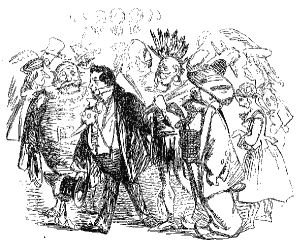
But beside the "malignant and the turbaned Turks," there was a great variety of other unexpected characters on exhibition in Mrs. Daylight's apartments—kings, queens, gipsies, and highwaymen, milkmaids, who not only couldn't milk, but probably couldn't tell a cow from a cod-fish, peasant-girls with jewelry enough on for princesses, and princesses with red faces and feet big enough for peasants, tambourine girls begging for pennies which they couldn't get, and bouquet girls trying to sell flowers from a large assortment, consisting of two geranium leaves and a rose-bud, French grisettes, who couldn't speak French, and Spanish noblemen, who talked most unmistakable down-east Yankee, Highlanders with pasteboard shields and bare knees, army officers who didn't know how to shoulder arms, sailors who couldn't tell the keel from the jib-boom, or swear positively that the tiller wasn't the long-boat, the Queen of Sheba in gold spectacles, robbers, brigands, freebooters, corsairs, bandits, pirates, buccaneers, highwaymen, fillibusters, and smugglers in such quantities, that it might be supposed that our best society is two-thirds made up of these amiable persons. There were three Paul Prys, four Irishmen, and thirteen Yankees, equipped with jackknives and shingles, seven Hamlets, and fourteen Ophelias, one Lear, two Richards, and five Shylocks, eight Macbeths, three Fitz James, and half a dozen Rob Roys, who made a very respectable assortment of Scotchmen; there were also twenty-one monks, quite a regiment; this was considered strange, but the next day, when most of the silver was missing, it was immediately surmised that these reverend gentlemen were thieves, who had obtained surreptitious admission, and carried off the valuables under their priestly robes.
There were also a few ladies, particular friends of the hostess, who appeared, by permission, in no costume more ridiculous than that which they were accustomed to wear daily, but who displayed the usual amount of whalebone developments.
After the band arrived and was stationed in the conservatory out of sight, an attempt was made to get up a dance. Spout introduced Dropper to a princess of his acquaintance, and Dropper, as in duty bound, asked her to waltz, and actually proceeded to carry out his intention.
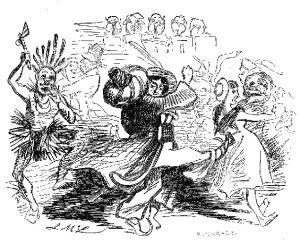
As some sixty other couples attempted the same feat at the same time, and as there wasn't room for any one man to dance without stepping on the heels of his neighbor, the scene instantly assumed a peculiar appearance. Dropper first whisked his partner against a flower girl and upset her basket, then against a Paul Pry, and demolished his horn spectacles, then he tumbled her into the stomach of a Falstaff and rolled him into the window curtains, then he himself stepped on the favorite corn of a tall Hamlet, and pushed his elbows into a Shylock and broke his false hooked nose, and they both concluded their gyrations by upsetting a couple of brigands, and marching deliberately over the prostrate bodies of Helen McGregor and a matchboy in their progress to a sofa, which they finally reached in an exhausted condition; the lady wanted some water, which Remington started to get but didn't come back, inasmuch as he hurt his shins by tumbling over a chair and fell to the floor, carrying with him in his descent a fairy in one hand and a Fitz James in the other. The crowd immediately closed around him, so that he could not rise, and, as he was involuntarily reposing directly upon the hot air register, he was more than half cooked before he got rescued out.
The attempt to dance created also no small amount of confusion among the others, about twenty-five of whom were precipitated into the conservatory and dispersed through the orchestra. King Lear landed with his head in a French horn, and Byron's Corsair was seen to demolish two violins with his hands at precisely the same time he kicked both feet through the bass drum.
Supper came at last, and the guests were fed in installments, as many getting near the tables as could crowd into the rooms. Jellies, creams, fruits, and the more substantial articles of the repast, were devoured, and scattered over the carpets, and over the dresses of the assembled multitude, in about equal quantities. Champagne corks flew, and all the men of whatever nation, trade, or occupation represented in that incongruous assemblage, seemed to understand perfectly well what champagne was. Kings drank with peasants, brigands touched glasses with monks, and Shylock the Jew took a friendly drink with her majesty the Queen of Sheba.
After supper the smash recommenced, and things grew worse, and the characters, by continued exertion and repeated accidents, became so changed in appearance by the mutilation of their fancy dresses, that at three o'clock in the morning, no one could have picked out any one of the remaining guests and told whether he was intended for an Italian brigand or an Irish washerwoman.
Our friends reached home about daylight, tired, draggled, disgusted, and drunk. Neither of them undressed, but both slept on the floor in the remains of their fancy costume, and in all their paint; they didn't get their faces clean for ten days, but Remington Dropper had seen the Elephant in one of his Fifth Avenue aspects, and was content.
[Exeunt Omnes.]—Shakespeare.
A few days after the events recorded in the last chapter, a letter was received at the residence of one of the compilers of these records, superscribed
Q.K. PHILANDER DOESTICKS, P.B.
The communication was signed by John Spout, and the writer, after apologizing for communicating with a perfect stranger, stated his reasons for so doing. It seems from the communication that Mr. Spout was informed by a friend who was in the confidence of the United States Marshal, that Mr. Spout and others were accustomed to meet in a room on Broadway, and that they were strongly suspected of being engaged in the organization of a fillibustering expedition to Nicaragua, and furthermore, that it was the intention of the officious officials of the United States Government to make a descent upon the premises and arrest all who were present on the next regular meeting. Mr. Spout had no difficulty in convincing his friend of the entire misapprehension of the officers. But in the fullness of his modesty the worthy Higholdboy thought that the time was not arrived when it would be prudent to announce to the world the fact of the existence of a scientific association, organized for the purpose of studying the Elephant. Furthermore, he did not like to be arrested, even though he would be acquitted, fearing that contact with stone walls might aggravate a chronic catarrh with which he was afflicted. Under these circumstances, he called a mass meeting of the members of the club, at his private room, where, after a session of fourteen minutes it was unanimously
Resolved, That the Elephant Club cave in for the present, under the pressure of strong necessity.
Resolved, That the landlord of the Club room whistle for the arrearage of rent.
Resolved, That Q.K. Philander Doesticks, P.B., we have every reason to believe, will fully appreciate the high character of the objects of the Elephant Club.
Resolved, That he is hereby authorized to go to the Elephant Club room, secure the records and such other property therein contained, as he may desire.
Resolved, That the said Q.K. Philander Doesticks, P.B., is further authorized to compile the said records for publication, if he thinks the public can be induced to buy the book when it is published; and he is further authorized to reorganize the Club in accordance with the same principles of the old organization, and when the present federal administration goes out of power, the present members will again put on the scientific harness, and gladly co-operate with the club so formed, to secure the ends desired.
In accordance with the request contained, Mr. Doesticks did go to the premises designated, where he found said records, and a variety of articles of furniture in a state of chronic demolition. The records he carried away—the furniture he did not. An examination of the documents satisfied Doesticks that if properly compiled, and published, the work would sell. But feeling himself incompetent to the task of preparation unaided—the work being of a scientific character—he decided to call to his assistance his friend Knight Russ Ockside. In his youth this gentleman had the advantage of being employed in sweeping out the medical college in Thirteenth street, and was once severely injured when young by being hit with a medical book on the head; and these facts it was generally conceded, in accordance with the spirit of modern progression, entitled him to the honorary degree of M.D. The scientific part of the work of compilation was therefore left to Dr. Ockside, who has endeavored to do full justice to the subject. Doesticks has reorganized the Elephant Club, and applications for membership will be received by him at No. 70001, Narrow street.
N.B. Applicants will be particular to bring testimonials as to character.
No persons will be received against whom a shadow of suspicion exists that they are of foreign birth, whilst to be a native would be a permanent bar to their membership.

THE END.
THE MEMOIRS OF REV. SPENCER H. CONE, D.D. PREPARED BY HIS FAMILY 484 pp. 12mo. Bound in Muslin, Printed on fine white paper, Price $1 25 Embellished with a Steel Portrait.
Dr. Cone, late pastor of the First Baptist Church, city of New York, was one of the most remarkable men of the present age, his life was full of romance and incident, as as well as a bright example of Christian virtues; the volume should find a welcome at every fireside, and a place in every family library.
Among the numerous testimonials from all sections of the country, we take pleasure in quoting the following:
NOTICES OF THE PRESS.
"A Biography of a famous preacher and man, written with power and eloquence."—Philadelphia Evening Post.
"Its perusal will be grateful to every person who admires active piety and can appreciate Christian virtues."—Family Journal, Albany.
"Spencer Houghton Cone, one of those good and faithful servants whose career exemplifies the surpassing beauty of a genuine religious life. The work is produced in elegant form, with a superb engraving of Dr. Cone. It deserves a place as a standard of good works and deeds in all families."—N.Y. Daily News.
"Its subject, one of the first men, and leading minds, for years, in our denomination, will ensure it a wide circulation."—Richmond, Va. Herald.
"Mr. Cone's reputation as an eloquent and fervent minister of the Gospel, as a strong, clear, earnest thinker, was acknowledged throughout the Union."—Boston Gazette.
"The book is full of interest, and we are confident will disappoint none who undertake its perusal."—Salem Gazette.
"America has produced but few so popular preachers, his personal influence was unbounded, he was indeed a man of talent, of large attainment in the school of Christ, a brilliant preacher, and a noble-hearted, zealous Christian philanthropist."—Christian Chronicle, Philadelphia.
"The volume is a profoundly interesting life-memorial of one of the most active, earnest, eloquent and sincerely religious spirits of his age and generation. Spencer H. Cone was a very remarkable man, and from a perusal of his life, we are convinced that selfishness and narrow-mindedness had no place in his nature. He appears to us to have been a model of earnestness, sincerity, activity, and intelligence." —New York Evening Mirror.
"The volume is a straightforward simple narrative of the public and private life of Dr. Cone, from his youth up to the period of his death. It will be read with interest by thousands out of the denomination to which Dr. Cone belonged, as well as by thousands of his own denominational friends and admirers."—Christian Secretary, Hartford.
LIVERMORE & RUDD, PUBLISHERS, 310 Broadway, N.Y.
Agents wanted to Canvass every County in the United States, who can make from $5 to $10 a day in selling the above popular work.
Copies sent (post paid), to any part of the country, on receipt of $1.25.
A New Book by the Author of "Our World!" A WORK OF GREAT POWER AND INTEREST. JUSTICE IN THE BY-WAYS. BY F.C. ADAMS. 12mo., Cloth, $1 25.
The Evening Post of June 23d says:
"Shortly will be published a new work, entitled 'Justice in the By-Ways,' from the pen of F.C. Adams, author of the popular anti-slavery novel 'Our World.'
"It presents a life-like picture of that peculiar civilization which of late has so signally blossomed in the ruffianly achievement of Brooks.
"Mr. Adams, the author, formerly editor of the Savannah Georgian, is qualified by a residence of five years among the nullifiers of the Palmetto State to exhibit a correct and graphic likeness of their society and manners."
This is emphatically a work of our age. Its life is its TRUTH. Its breath its FACT. It is history in the guise of fiction, history whose accuracy is attested by public records and State documents. Each character is a living reality. It is a book eminently suggestive of much needed moral reforms. It is not sectional. It hits North and South. It shows the social evils generated by Slavery in the one, and by neglected poverty in the other. It pictures the follies and vices of worn-out Southern chivalry; the crimes of the forsaken wretches in the Five Points; and the sordid sin which luxuriates in our Fifth Avenue palaces. It portrays how those who the world regard as beacons illuminating the paths of virtue, grovel in sensuality—sought and loved for its own sake; whilst the neglected of the world, in their depths of degradation, yet emit some rays—feeble though they be—of a soul within. In fine, it teaches the practical lesson that it would become the great to learn how a true use of their wealth and influence may benefit poor fallen humanity.
LIVERMORE & RUDD, PUBLISHERS, 310 Broadway, N.Y. W.H. Tinson, Stereotyper, 24 Bookman street.
A Work of Unusual Interest and Merit! TO BE PUBLISHED EARLY IN SEPTEMBER, THE PAWNBROKER. OR, THE WAGES OF AVARICE. 12mo., Cloth. Price $1 25.
The Publishers believe that "The Pawnbroker" is not inferior, either in power or interest, to any other work of Fiction that has been yet issued from the American Press; while the local interest it possesses, in consequence of its truthful delineation of New York life, forms one of its many attractive features. It is the production of an American lady, who is endowed with a fine culture, a refined and polished idea of the requirements of Virtue and Civilized Life; together with a clear insight of the human heart, whether bowed down by its own dark depravity, or consoled and elevated by the noble instincts of honor and truthfulness. But this is not all; our authoress is an Artist, and her book will do credit to Modern American Literature.
Her Hero and Heroine are taken from the humblest walks of life; but our interest becomes almost at once, unconsciously enlisted in their welfare, and with intense excitement, pain, and hope, the thread of the narrative which depicts their chequered, trying and varied career, is perused. This effect is produced, without bombast or enervating sentimentality; simply because a story founded upon fact is narrated with becoming dignity, modesty and consummate Literary Art. The characters introduced throughout the work are numerous; but each possesses a peculiar, marked, and distinct individuality.
A writer in the Boston Literary Bulletin says of it:
"I have read the MS. of "The Pawnbroker." Its principal scenes are laid in New York, shifting occasionally to New Orleans. It is written with great force, pathos, and ingenuity; and I have no hesitation in prophesying that it will be ranked with "The Lamplighter" and "The Wide, Wide World." Throughout the work a moral lesson is pointed; and although prolific in pictures of the most exciting nature, probability is never outraged by the introduction of mysterious impossibilities. It cannot fail of meeting with a large sale, and enviable popularity."
LIVERMORE & RUDD, PUBLISHERS, 310 Broadway, N.Y. W.H. Tinson, Stereotyper, 24 Bookman Street.
JUST PUBLISHED. PLU-RI-BUS-TAH: A SONG THAT'S BY NO AUTHOR. BY Q.K. Philander Doesticks, P.B.
This Book contains an unlimited quantity of hits at every body, of which every one must good naturedly take his share, to pay for the privilege of laughing at his neighbors.
EMBELLISHED WITH ONE HUNDRED AND FIFTY-FOUR ILLUSTRATIONS, BY JOHN MCLENAN.
As a History of the Country, this book is invaluable, inasmuch as it notices a great many events not mentioned by Bancroft, Hildreth, or Prescott. As a Novel, it is unapproachable, for it contains several characters unknown to Cooper, Dickens, Marryatt, or Bulwer. As a Mythological Work, it should be immediately secured, as it makes mention of a number of gods and deified worthies hitherto unknown to old Jupiter himself. As a Poem, its claims to consideration can not be denied, as it comprises a great many beauties not discoverable in "The Song of Hiawatha," besides several Indian names which were therein omitted.
12mo, Muslin, Extra Gilt, price $1 00.
LIVERMORE & RUDD, Publishers, 310 Broadway, New York.
Just Published. DOESTICKS' NEW BOOK PLU-RI-BUS-TAH. A SONG THAT'S BY NO AUTHOR. BY Q.K. PHILANDER DOESTICKS, P.B. An elegant 12mo. Price $1.
This volume is enjoying a greater popularity than the Author's first book "Doesticks What He Says," which sold the first five days of publication,
12,773 COPIES.
It contains an unlimited quantity of hits at every body, of which every one must good-naturedly take his share, to pay for the privilege of laughing at his neighbors, and Embellished with one hundred and fifty-four Humorous Illustrations, designed by John McLenan, whose reputation as an Artist is world-wide.
CONTENTS.
Explanation—The Author's Apology—Introduction—The Pipe, and Who Smoked it—Who Came and Where He Came From—Fight Number One—Who Whipped, Who Died, and How Many Run Away—Fight Number Two—How Many Rounds, and Who Couldn't Come to Time—A Free-Love Marriage—The Gathering of the Clans—What They Went to Work at, and How Much They Got a Month—How the Hero Did a Great Many Things, and Who Helped Him—A Single-Handed Game of Brag—What a Woman Did—What the Hero Worshipped—Fight Number Three, with Variations—Matrimonial Endearments—Fight Number Four—A Compromise, and What Came of it—How a Woman got her Spunk Up, and Left the Country—The Consequences—Mother and Child both Doing Well—He Continues His Studies—His Progress—He still Continues His Studies—His Further Progress—Who Died, and What They did with Him—Funereal and Solemn—A Marriage, and What Came of it—Family Jars, and a Departure—Spirit Rappings and Spirit Drinking Mixed—What He Didn't—What His Mother Did, and Where She Went to—Cuffee Triumphant—An Unexpected Smash—Demolition of The Hero.
NOTICES OF THE PRESS.
"We said of Doesticks' first work that it was a quaint teacher of morality and a promoter of good works, we are ready to reiterate in respect to this volume. There is not a vulgarity nor an indecency in its pages, but clothed in unusual garb, the burden of its song is morality, virtue, temperance, economy, patriotism. It rebukes pretension, it scathes deception, it withers arrogance, it exposes emptiness. Chapter IX.—What a Woman Did—is one of the best arguments for national union to be found."—Newark Daily Advertiser.
"'Plu-ri-bus-tah' is a burlesque—broad almost beyond the scope of the imagination."—Charleston, S.C. Standard.
"Doesticks loves to indulge in a merry laugh at the expense of his neighbors, as a good Christian is bound to do."—New York Tribune.
"This is far the cleverest thing that Doesticks has done."—N.Y. Evening Post.
"It overflows with fun, and doctors should recommend it to all their patients who may be troubled with the spleen. Every leaf contains a sketch worthy of Punch."—Boston Traveller.
"It is full of wit, sarcasm and fun. It is longer than Hiawatha, broader than Hudibras, and deeper than Punch."—Philadelphia Sun.
LIVERMORE & RUDD, PUBLISHERS, 310 Broadway, N.Y.
DOESTICKS. Fully Illustrated with fine tinted Engravings, by the most eminent artists. An elegant 12mo. vol. bound in Muslin, gilt extra. $1.
LIVERMORE & RUDD, Publishers, 310 Broadway, N.Y.
A BOOK FROM "DOESTICKS." THE GREAT AMERICAN WIT AND HUMORIST! ORIGINAL VIEWS OF MEN AND THINGS. BY Q.K. PHILANDER DOESTICKS, P.B.
Fully Illustrated by the most eminent Artists, 12mo., bound in muslin, gilt extra, $1.
12,773 copies of this remarkable book, were sold in five days following the day of publication; and from every part of the country the demand still continues.
DOESTICKS: What he Says.
This volume, abounding in mirth-provoking sketches of persons and places, filled with humor, wit, and satire, convulses the reader with laughter from the title-page to the close. In the language of an eminent journalist, who speaks of the book:
"From the first word in the introduction to the last of the narrative, Doesticks' book is a running fire of comicality. In taking up the book, the reader finds himself precisely in the same condition as the man who, after getting into a boat, is borne down a pleasant stream independent of his own volition. He must go on, and he is glad to go on, too."
Contents.
How Doesticks came to think of it; Doesticks satisfies Philander; Doesticks visits Niagara; Doesticks on a Bender; Seeking a Fortune; Railroad Felicities; Sees the Lions; Barnum's Museum; Model Boarding Houses; Potency of Croton Water—or an Aqueous quality hitherto unknown; Modern Witchcraft; City Target Excursion; A New Patent Medicine Operation; Doesticks Running with the "Masheen;" Street Preaching; A Zealous Trio; Disappointed Love; Modern Patent Piety; Church Going in the City; Benevolence run mad; Charitable Cheating; Millerite Jubilee—How they didn't go up; The Great "American Tragedian;" "Side Shows" of the City; New Year's Day in New York Amusement for the Million; A 2:40 Sleigh Ride; Cupid in Cold Weather; Valentine's Day; The Kentucky Tavern; The River Darkies; The Thespian Wigwam; Theatricals again; A Night at the Bowery; Mysterious Secrets of the K.-N.'s; A Midnight Initiation, Philander Fooled; A Diabolical Conspiracy; A Shanghae Infernal Machine; An Evening with the Spiritualists; Rampant Ghostology; Special Express from Dog Paradise; A Canine Ghost; 'Lection Day; "Paddy" versus "Sam;" Police Adventures; Mayor Wood Around; Damphool Defunct; Place of his Exile; Description Thereof—and Exit; Keeping the Maine Law; Theatricals once more; Shakespeare Darkeyized; Macbeth in High Colors; Young America in Long Dresses; Great Excitement is Babydom.
Notices of the Press
The Home Journal (N.P. Willis, Esq., Editor), says:
"Things so copied, so talked of, so pulled out of every pocket to be lent to you, so quoted and so relished and laughed over, as Doesticks' writings never were launched into print."
"This book will 'take,' and is bound to sell."—Boston Post.
"One can read the book again and again, and not tire."—Detroit Daily Advertiser.
"Any mirth-inclined reader will get the book's worth of fun out of four chapters in the work. It is beautifully illustrated."—N.Y. U.S. Journal.
"We can promise our readers a hearty laugh over this book."—New Bedford Mercury.
"The reader is advised to see to his buttons before procuring the volume."—Salem Register.
"No original comic writer has appeared in this country before Mr. Thompson, alias Doesticks; he will, we think, achieve a position as a literary humorist, of which he and his country will have occasion to be proud."—N.Y. Critic.
"We cordially recommend this volume, not only as a successful debut in a new field of literature, but as a quaint teacher of morality, a promoter of good works, and an improver of public taste."—Newark (N.J.) Advertiser.
LIVERMORE & RUDD, Publishers, 310 Broadway, New York.
DOESTICKS' BOOKS. 12mo, Cloth, per Volume, $1 00.
Among the numerous testimonials from the press in all sections of the country, we select the following, proving that the author's productions will be sought for and read by thousands of admirers.
NOTICES OF THE PRESS.
"A humorist and a satirist of a very high order. His blows are aimed with severe accuracy against a vast number of the follies, frailties, and humbugs of the day."—Baltimore American, Md.
"He shows up many of the modern popular humbugs in a very strong light, and handles them most unmercifully."—Dayton (Ohio) Daily Empire.
"Doesticks is a wonder. The same happy spirit seems to pervade the author and the artist—the illustrations of the latter are quite up to anything Cruikshank ever achieved in the same line. If anybody can look at these spiritings of the pencil without a loud laugh, he is certainly out of our list of even grand fellows—but to enter fully into the pleasing features of the work—to laugh over the jokes, to enjoy the home-thrusts of wit and satire, our friends must buy the book itself."—Sunday Mercury, N.Y.
"Doesticks is one of the few immortal names that were not born to die. Doesticks will always be with us. We have only to step into our library, and behold there is the ubiquitous Doesticks! We take him by the hand—we listen to the thoughts that breathe—the quaint philosophy—the piquant illustration! Doesticks all over—Doesticks in every page—in every line! Do you wish to make the acquaintance of Doesticks? Every body does."—New York Railway Journal.
"The illustrations are in admirable keeping with the general tone of these 'unprecedented extravagances,' and will help to introduce Doesticks and his companions to a large circle of acquaintances." —McMakin's Philadelphia Saturday Courier.
"'Doesticks' is irresistibly funny."—P.T. Barnum's Letter to the N.Y. Tribune.
"Renown has made the euphonious name of 'Doesticks' familiar to the ear of all the reading public throughout the length and breadth of the land. Those who would eschew the blues, and drive dull care away, should read Doesticks—what he says."—Lansingburg Gazette, N.Y.
"The 'Doesticks' book is before us. Its inimitable fun sticks to us long after we have shut the book—its rollicking humor comes back to us in gusts."—Boston Chronicle.
"Doesticks is an original genius. His book is just the thing to pick up at odd moments, when time hangs heavy, and the mind seeks to be amused."—Gazette and Democrat, Reading, Pa.
"The essays of the rich, racy, humorous, and original Doesticks will be read by thousands."—New Orleans Bee.
"Doesticks' fun is not of the artificial, spasmodic order, it arises from a keen perception of the humorous side of things."—New York Tribune.
"His blows at humbug are trenchant, and his sympathies are ever with humanity."—Boston Evening Gazette.
"Doesticks comes to us like a full and sparkling goblet, overflowing with the rich and brilliant sayings of an original mind. If you would drive away the 'Blue Devils,' purchase Doesticks, and every sketch you read will be better than any pill for the indigestion."—The Uncle Samuel, Boston.
"What Cruikshanks, Leech, or Gavarni does with the pencil, he accomplishes with the pen."—The N.Y. Dutchman.
"The author is a humorist and a satirist of a very high order. His blows are aimed with severe accuracy against a vast number of the follies, frailties, and humbugs of the day."—American and Commercial Advertiser, Baltimore, Md.
LIVERMORE & RUDD, Publishers, 310 Broadway, New York.
Just Published. A NEW AND IMPROVED EDITION OF THE CHEAPEST AND BEST WORK ON ARCHITECTURE. THE CARPENTER'S ASSISTANT AND RURAL ARCHITECT. Illustrated with upwards of Two Hundred Copper and Electrotype Plates;
Embracing the orders of Architecture, Modern and Practical Stair Building, Plans, Elevations, Grounds, etc., etc., of Cottages, Villas, and Farm Buildings, including Church Edifices.
BY WILLIAM BROWN AND LEWIS E. JOY,
ARCHITECTS.
Twenty-first Thousand—Large Quarto, bound in Leather, $3 50 Do. Do. Bound in Morocco, marble edges, 5 00
OPINIONS OF THE WORK:
[From the Telegraph.]
This is a book which every carpenter and house builder should own.
Mr. Livermore:
Dear Sir,—I have deemed the "Carpenter's Assistant and Rural Architect," by Messrs. Brown and Joy, published by you, as one of the most valuable guides and books of reference in my library, and take an early opportunity to congratulate you on the appearance of a new and improved edition of the work, which I have just purchased.
The Lithographic Plates, comprising designs for church edifices, adds in my opinion a striking feature to the book, and I have no hesitation in averring that it will be sought for by every Architect, Builder, and Carpenter in our country, who wishes to possess the most concise and practical treatise published.
Respectfully yours, SAMUEL PHILLIPS, Architect and Builder, Boston.
From Practical Carpenters and Architects.
We, the undersigned citizens of Worcester, Mass., practical carpenters, are personally acquainted with William Brown, Esq., Architect, and author of a work, entitled the "Carpenter's Assistant and Rural Architect." We have examined that work with attention, and commend it to all who are interested in the study or practice of the art, as a valuable treatise on architecture, and it is eminently practical in its character. We cheerfully recommend it to the patronage of carpenters and the public.
EDWARD LAMB, FREEMAN UPHAM, P.W. TAFT, J.S. WOODWORTH, M.H. MORSE, S.D. HARDING, W.R. BIGELOW, HORATIO N. TOWER.
I have carefully examined the "Carpenter's Assistant and Rural Architect," and believe it to be a work well adapted to meet the wants of the practical workman, being practical in its character, and valuable for the perspicuity of its arrangement, clearness of its designs, and brevity of its explanations.