Chapter LIX · THE SUCCESSORS OF ALEXANDER
Reading edition
Some of the most important histories of Greece, notably those of Mitford and of Grote, have terminated with the death of Alexander; and in point of fact one feels some logic in the contention that Greece as a factor in civilisation disappeared with the close of the Alexandrian epoch. Yet as far as mere chronology goes Greece continued a nation, and in some respects a more closely unified nation than ever before, for a period after the death of Alexander as long as the period of her prominence before that event. It was in the year 500 B.C. that the Ionian cities of Asia Minor revolted against the Persian power, and precipitated that conflict which had for its chief result the bringing of the Greek nation, for the first time, into prominence as a world power. From this memorable date to the death of Alexander in 323 B.C., is a period of 177 years; and, as it happened, another period of exactly the same length intervened between the death of Alexander and the final overthrow of Greece by the Romans, culminating in the destruction of Corinth in the year 146 B.C.
But while equally extended in point of time, how utterly different are these two periods in world-historic import! Into the first of them were crowded the events which have made the name of Greece famous for all time; the second was a mere period of senility, in which a once powerful and still proud people struggled in vain to regain its former status, and finally collapsed utterly under the blows of a superior power. Yet in mere geographical extent the Greece of this later period was far larger than Greece proper of the earlier time, for now it included, in addition to the original Hellas, the territories of Macedonia and Epirus; but this was never an harmonious coalition.
The old Greeks of the classical territory were never reconciled to the domination of their northern neighbours, whom they preferred to consider as barbarians, but they were obliged for much of the time to accept that domination, however unwillingly; for the kings of Macedonia, though their power fluctuated from time to time, always had more or less influence over the entire territory of the new Greece.
The meteoric career of Alexander had been cut short at a time when that hero, though he had accomplished conquests without precedent in history, had not yet entered upon the full prime of manhood. It is known that his ever active brain was teeming with plans for fresh conquests, and it is hardly to be doubted that, had he lived, some of these would have been put into almost immediate execution. What the final result would have been, is one of those problems that must ever puzzle the mind of the thoughtful student of history. Such conjectures are utterly futile; yet one cannot escape them. Would the conqueror of the East have spread his power to the West also, subjugating Europe as he had already subjugated Asia? Would he have gone on throughout another half century, had that stretch of life been granted to him, ruling with a firm hand the wide territories that he had conquered, and holding his mighty empire under one unified government with himself at its summit—or would his mighty ambition presently have overstepped the bounds of reason, and would some reverse have presently dashed him headlong from his pinnacle of power? As to this no man can say, and all moralisings on the subject are but idle dreams.
[323-301 B.C.]
But turning from such visions to the realities, one is presented with an extraordinary picture of a mighty empire, built up by a mere youth, held for the moment, as it were, in the grasp of his hand, and then dashed suddenly into fragments as that hand fell stricken by death. In twelve years the youth Alexander had made himself absolute master of wider territories than were probably ever ruled before by any one man in recorded history; but, almost before the breath of life had left his body, and literally before that body had been laid in the tomb, a strife had begun among the followers of the great captain, which was to lead to almost immediate dismemberment of his empire.
It is one of the surest tests of a great leader of men to be able to gather about him great men as his assistants. Judged by this test Alexander looms large indeed, for he had among his generals, as after events were to prove, a whole company of men, each of whom acknowledged himself subordinate to Alexander, but declined to bow to any lesser power; each of whom, indeed, believed himself worthy to be a king, and determined to make that belief good in practice, now that the great king was no more. Antipater and Craterus, and Antigonus, and Cassander, and Ptolemy, and Eumenes—these are but a few of the leaders among the men who at once began to quarrel about Alexander’s possessions, even to the neglect of the burial of Alexander’s body. It seems that Alexander had foreseen the inevitable faction, for the story was told that on his death-bed, he had been asked to whom he wished his empire to fall, and he had feebly answered, “to the best man!”
There was, indeed, a pretence of preserving the empire for Alexander’s son, borne by Roxane after his death, and given the name of Alexander the Younger; but a score of years is long to wait for a ruler of a newly formed empire, which has within it so many elements of discord as were to be found in the empire of Alexander; and, however sincere a certain number of the leaders may have been, their original intentions of holding the empire for the heir of its founder had vanished from the minds of every one almost before that heir was born. There was indeed a royalist party, which for a time attempted, perhaps in good faith, to uphold the rights of the royal family of Macedonia; but, in the course of the intricate series of revolts and wars in which the entire empire was soon involved, it became difficult, if not impossible, to trace the motives that influenced the various principal actors. But, whatever these motives, the results were very tangible and unmistakable. Alexander’s heir was never destined to reach manhood. Both he and his mother were ruthlessly killed by Cassander. Olympias, the mother of Alexander, who, for a time, took an active part in the contests, evincing qualities which explained many of the traits of her great son, met a like fate.
The work of destruction went on until the royal family of Macedon, which Philip and Alexander had made illustrious, was routed out to its last member, and finally, after some twenty-two years of incessant warfare, the vast empire of Alexander was divided into three chief parts: Macedonia, including Greece proper, under the Antigonidæ, the descendants of Antigonus; the Asiatic kingdom, under the Seleucidæ; and Egypt, under the Ptolemies. The subsequent history of each of these three kingdoms must be considered by itself, but first we must make a brief survey of that great conglomerate struggle through which this dismemberment of the empire of Alexander was brought about.a Of this Niebuhr says:
“The disputes among the generals of Alexander are to me the most confused events in history. I have very often read them attentively, in order to gain a clear insight into them; but, although I have had a tenacious memory from my early youth, I never was able to gain a distinct recollection of the detail of those quarrels and disputes: I always found myself involved in difficulties. And such is the case still; I find it impossible to group the events in such a manner as to afford an easy survey. This confusion arises from the fact that we have to deal with a crowd of men among whom there is not one that stands forth prominently on account of his personal character. The question always is, whether one robber or another is to be master, and it is impossible to take pleasure in any one of them. One is, indeed, better than another, and Ptolemy is, in my opinion, the best: he was a blessing to Egypt, which under him became happy and prosperous, for his government was rational; but still he is morally a man in whom we can take little interest. His personal character leaves us quite indifferent, when we have once formed a notion of him. Eumenes is the only one who is important on account of his personal character; all the rest are imposing through their deeds of arms alone.
“In the earlier history of Greece we like to follow the great men step by step; but all these Macedonians leave us perfectly indifferent; we feel no interest whether the one is defeated or the other; not even the tragic fall of Lysimachus can make an impression upon us; I look upon it with greater indifference than I should feel at a bull-fight, in which a noble animal defends itself against the dogs that are set at it. I could wish that the earth had opened and swallowed up all the Macedonians. Everyone intimately acquainted with ancient history will share this feeling of indifference with me. And when we are under the influence of such a feeling, it is not easy to dwell upon a history like this; it does not impress itself upon our mind.
“It would be most easy to relate the history of the successors of Alexander as minutely as it was given by Trogus Pompeius, and as we still have it in Diodorus; but there would then be before us only a vast chaos. Even where we have ample information, we must advance rapidly.
“Whoever wishes to investigate this history, must study the eighteenth, nineteenth, and twentieth books of Diodorus; but he ought not to forget that there are many gaps in Diodorus. The eighteenth book, in particular is very much mutilated, and some of the gaps are concealed; for the manuscripts of Diodorus were made with the intention to conceal the fact that they are not complete. The student, however, must compare also the Excerpts in Photius from Arrian’s lost work.”g
COUNCIL AT BABYLON AFTER ALEXANDER’S DEATH
[323 B.C.]
The Macedonians passed the night after the king’s death under arms, as if feeling themselves surrounded by enemies. The peaceable inhabitants of Babylon, perhaps with better reason, dreaded lest their wealthy city should become the scene of military tumult and licence. They hardly ventured to creep out of their houses to gather news; lighted no lamps in the evening, but watched for the morning in darkness and silence, eagerly listening, and trembling at every sound they caught. The great officers on whom the care of the state chiefly devolved, probably spent the same interval, together or apart, in no less anxious deliberation. By Hephæstion’s death the number of those who bore the title of somatophylax was reduced to seven: Leonnatus, Lysimachus, Aristonous, Perdiccas, Ptolemy (the reputed son of Lagus, but, according to a report rather widely spread, one of Philip’s bastards, his mother having been the king’s mistress), Pithon, and Peucestas. When Alexander died, they were all in Babylon.
The next day they summoned a council of the other Macedonian officers, some of whom were but little inferior to them in rank and influence, to confer on the great question of the succession. The soldiers wished to take part in it also; and, though forbidden, forced their way into the palace, and filled the avenues of the council hall, so that many witnessed the proceedings. There a mournful object met their eyes, and revived the consciousness of their loss—the vacant throne, on which had been laid the diadem, with the royal robes and armour. The sight called forth a fresh burst of lamentation, which however was hushed into deep silence, when Perdiccas came forward to address the assembly. First he placed the ring, which he had received from Alexander in his last moments, on the throne. “The ring,” he said, “was the royal signet, which Alexander had used for the most important state business; it had been committed to him by the dying king, but he placed it at their disposal. It was however absolutely necessary for their own safety that they should forthwith elect a chief, capable of guarding them against the dangers to which they would be exposed without a head in a hostile land. It was to be hoped that, in a few months, Roxane would give them an heir to the throne. In the meanwhile it was for them to choose, by whom they would be governed.” He had probably hoped that the wish which he so modestly dissembled would have been anticipated by general acclamation. But the meeting waited for advice.
Nearchus had a different plan to propose. He, as we have seen, had married a daughter of Mentor’s widow, Barsine; and Barsine was also the mother of a son by Alexander. He therefore pointed out to the Macedonians “that there was no need to wait for the uncertain issue of Roxane’s pregnancy; there was an heir to the throne already born—Hercules, the son of Barsine: to him the diadem belonged.” But Nearchus was the only man present who had any interest in this choice. The soldiers clashed their spears and shields together, in token of vehement dissent; and Ptolemy gave utterance to their feelings on this point: “Neither Barsine, nor Roxane, could be mother of a prince whom the Macedonians would acknowledge as their sovereign. Was it to be borne, that the conquerors of Asia should become subject to the son of a barbarian captive? It was better that the throne should remain vacant, and that the persons who had formed Alexander’s council of state should continue to have the supreme management of affairs, deciding all questions by a majority of votes.” This motion however gained few partisans; its effect would have been permanently to exclude the royal family from the succession: a step for which few were prepared.
Thus most minds were turned towards the advice of Perdiccas; for there was a clear distinction between Barsine, and Roxane, Alexander’s beloved wife, who was then in the palace, while Mentor’s widow had been left with her son at Pergamus. It was now the right time for some friend of Perdiccas to come forward in his behalf, and Aristonous, perhaps according to previous concert, undertook the task. He observed “that Alexander himself had already decided who was worthiest to command, when, having cast his eyes round all his friends who were at his bedside, he gave his royal signet to Perdiccas. They had only to ratify Alexander’s choice.” Still the assembly was not inclined to invest Perdiccas alone, under any title, with supreme power. The result of the whole deliberation was a sort of compromise between the proposals of Ptolemy and Aristonous. It seems to have been decided, but not without clamorous opposition, that, if Roxane should bear a son, he should succeed to the throne; and that in the meanwhile four guardians should be appointed for the future prince to exercise the royal authority in his name. Perdiccas and Leonnatus were to be regents in Asia, Antipater and Craterus in Europe.
The cavalry—the aristocratical portion of the army—acquiesced in the resolution of their chiefs. But it was very ill received by the whole body of the infantry. No motive appears for their dissatisfaction, except that they had not been consulted on the question, and that they wished to dispose of the crown. Still it is not clear whether they acted quite of their own accord, or were excited to resistance by Meleager, who seems to have been impelled, partly by ambition, and partly by personal enmity to Perdiccas. The accounts remaining of his conduct are contradictory as to details, but agree in representing him as the leader and soul of the opposition. According to some authors, he quitted the council of the officers after bitter invectives against Perdiccas, declaring that the people was the true heir of the monarchy, and alone could rightfully dispose of it, and hastened to instigate the soldiery to insurrection and plunder. According to others, he was deputed to appease their discontent, but took the opportunity to inflame it, and placed himself at their head. We are left equally in doubt whether it was he who first proposed another competitor for the throne, whose name was soon mentioned in the popular assembly.
This was Arrhidæus, a son of Philip, by Philinna, a Thessalian woman, who is commonly described as of low condition. Arrhidæus was either naturally deficient in understanding, or had never recovered from the effects of a potion, said to have been administered to him by Olympias, whom jealousy rendered capable of every crime. It seems that Alexander, either through prudence or compassion, had removed him from Macedonia, though he had not thought him fit to be trusted with any command; and he was now in Babylon. Most probably Meleager, perceiving that whoever should raise such a prince to the throne would reign under his name, was the foremost to recommend him as the sole legitimate heir. To the army Arrhidæus must have been personally indifferent; but he was Philip’s son, without any mixture of barbarian blood, and, which probably weighed more with them, he would be purely their creature. The proposal therefore was agreeable to their pride and their prejudices, which were stronger than their regard for Alexander now, as they had been in his lifetime. After a short pause—perhaps of surprise that a name so seldom heard should have been put forward on such an occasion—all, as if some happy discovery had been made, broke out into loud acclamations in favour of Arrhidæus; and Pithon, who, it seems—having apparently been sent by the council to soothe them—endeavoured to show the folly of their choice, only incurred their resentment. Meleager was deputed to bring the prince into the assembly; and, when he came, they saluted him as king, under the new name of Philip. He immediately proceeded to the palace, accompanied by Meleager, and escorted by the troops. The officers, it seems, were still in council there, and when Arrhidæus appeared, some attempt was made to terminate the affair by discussion. But as the chiefs refused to sanction the choice of the infantry, they soon found themselves threatened with violence, and obliged to retire. Arrhidæus mounted the throne, and was invested with the royal robes.
PERDICCAS, MELEAGER, EUMENES, AND THE PUPPET KING
Perdiccas had ordered the door of the room where Alexander’s body lay to be locked, and prepared to guard it with six hundred chosen men; he was joined by Ptolemy at the head of the royal pages. They were however soon overpowered by superior numbers. The soldiers of the adverse party broke into the chamber; blows were interchanged, Perdiccas himself was attacked with missiles, and blood was beginning to flow, when some of the elder among the assailants interposed, and, taking off their helmets, entreated Perdiccas and his followers to desist from their useless resistance.
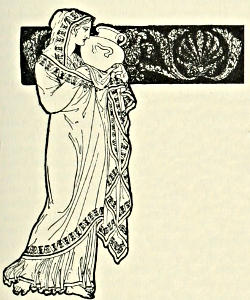
Water Carrier
(After Hope)
Their mediation put an end to this prelude of the long contest which was to take place for Alexander’s remains. But the greater part of the generals, and the whole body of the cavalry, quitted the city, and encamped outside the walls. Perdiccas did not yet accompany them; he hoped, it seems, that some change might happen in the disposition of the multitude, which he might more easily turn to his own advantage, if he stayed. But Meleager, probably apprehending the same thing, and eager to satisfy his hatred, urged the king to give an order for the execution of Perdiccas. This he could not obtain; Arrhidæus was perhaps too timid to strike so great a blow. Meleager therefore was forced to interpret the silence of his royal puppet as consent, and sent an armed band to the house of Perdiccas, with directions to bring him to the palace, or to kill him if he should resist. Perdiccas had only about sixteen of the royal pages with him, when his door was beset. He however appeared on the threshold with a firm countenance, and overawed those who came to arrest him by the severe dignity of his looks and his words. They probably did not think Meleager’s authority a sufficient warrant for the murder of a man of such high rank. When they had withdrawn, he and his attendants mounted their horses, and hastened to the camp of their friends.
One eminent person of their party however remained in the city: Eumenes the Cardian, who had already decided on the course which his own interests required, and on this occasion gave proof of the sagacity and dexterity, which afterwards carried him through so many dangers and even brought him so near to the highest fortune. Eumenes, in his boyhood, had attracted Philip’s notice by his promising talents; he was brought up at the Macedonian court, and was employed by Alexander both as his principal secretary and keeper of the records, and in military commands. He had risen so high in favour with the king, that he could even venture on more than one occasion to quarrel with Hephæstion; but, after the favourite’s death, he laboured, by ingenious contrivances and profuse expense in honour of his memory, to remove all suspicion that he viewed the event with pleasure. In this liberality, he showed the greater self-command, as he was habitually parsimonious.
Such a man was formed for the times which followed Alexander’s death. Eumenes felt that he could only be safe in the strife of parties, as long as he could guard against the jealousy to which a foreigner in high station was exposed among the Macedonians. He remained, as we have observed, in Babylon after the flight of Perdiccas, under the pretext that he had no right to take a part in disputes concerning the succession; secretly however purposing to promote the interests of Perdiccas, as far as he could; for he probably foresaw that this side would finally prevail. He assumed the character of a peace-maker; and his seeming neutrality gave great weight to his mediation. It was seconded by vigorous measures on the part of the seceders. They began to stop the supply of provisions, and to threaten the Great City with famine. Meleager found his condition growing every day more embarrassing. He had been called to account by his own troops for the attempt he had made against the life of Perdiccas, and could only shelter himself under the royal authority. At length the soldiers came in a body to the palace, and demanded that an embassy should be sent to the cavalry, with overtures of peace. Three envoys were accordingly despatched: and it is remarkable, that one of them was a Thessalian, another an Arcadian of Megalopolis; so that probably the third, Perilaus, whose country is not mentioned, was not a Macedonian. The negotiations which followed are reported too obscurely to be described. It is said that the party of Perdiccas refused to treat, until the authors of the quarrel had been given up to them; and that this demand excited a violent tumult in the city, which was only calmed when Arrhidæus, displaying more vigour than he had been believed to possess, offered to resign the crown. Yet it does not appear that this condition was granted.
THE COMPACT
The terms on which the treaty was concluded were, according to the most authentic account, that Arrhidæus should share the empire with Roxane’s child, if it should be a boy; that Antipater should command the forces in Europe; that Craterus should be at the head of affairs in the dominions of Arrhidæus; but that Perdiccas should be invested with the command of the horse-guards, the chiliarchy, before held by Hephæstion, in which Alexander would permit no one to succeed him. This, it seems, was a post which, at the Persian court, had been equivalent to that prime minister, or grand vizier of the whole empire. It was however stipulated that Meleager should be associated with Perdiccas in the regency, though with a subordinate rank. Of Leonnatus we hear no more as a member of the government. The compact was ratified by a solemn reconciliation between the contending parties. The cavalry returned to the city; the phalanx marched out to meet them; Perdiccas and Meleager advanced between the lines to salute each other as friends. The troops on each side followed their example, and were once more united in one body.
It was however impossible, after what had happened, that Perdiccas and Meleager should ever trust each other. Meleager probably relied on the infantry for protection. But Perdiccas had now taken possession of the imbecile king, who was as passive in his hands as he had been in his rival’s, and had resolved to strike the first blow. Before he directly attacked his enemy, he thought it necessary to deprive him of the support which he might find in the army; and he seems to have devised a very subtle plan for this end. He suborned emissaries to complain among the foot-soldiers that by the recent arrangement Meleager had been elevated to an equality with himself—not apparently for the purpose of exciting discontent, or of gaining a party among these troops, but to lead Meleager himself blindfold into a snare. Meleager was soon informed of the language that had been used against him in the camp, and indignantly complained of it to Perdiccas, whom he probably suspected to be its secret author. But Perdiccas was so great a master of dissimulation, that he completely lulled his suspicions. He affected to sympathise deeply with his resentment, and proposed to arrest the agitators. It was agreed between them, the more safely and surely to effect their object, that the whole army should be drawn out in the adjacent plain, under the pretext of a solemn lustration, to be celebrated with the old Macedonian rites, to purify it from the blood shed in the late quarrel. The usage on such occasions was to kill a dog, and to carry its entrails, divided into two parts, to opposite extremities of the field, so that the army might be drawn up between them, the phalanx on one side, the cavalry on the other. Such at least was the order now adopted by the two chiefs.
On the appointed day Perdiccas, with the king at his side, placed himself at the head of the cavalry and the elephants, facing the infantry, which was commanded by Meleager. After a short pause, he ordered them to advance. Meleager’s troops were alarmed at the sight of this movement, for they now observed that the ground was favourable for the operations of the cavalry, and that, if they were attacked, they should not be able to make good their retreat without great loss. But, as they received no orders from their chief, and were quite uncertain as to the design of Perdiccas, they remained motionless, until a very narrow interval was left between the two lines. The king then rode up with a single squadron, and, having been previously instructed by the regent, demanded that the authors of the late dissensions should be given up to punishment; threatening, if they refused, to charge with the whole force of the cavalry and the elephants.
The men were dismayed by the suddenness of the proceeding; and Meleager, who now perceived his own danger, had not sufficient presence of mind to make any attempt at self-defence. Perdiccas took advantage of their consternation, to select about three hundred of those who had most distinguished themselves as his adversary’s partisans, and immediately caused them to be trampled to death by the elephants in the sight of the whole army, and with the apparent consent of the king whose cause they had maintained. After this execution Meleager could have no hope of safety but in flight. He was not arrested on the field, but soon after took refuge in a temple at Babylon, where he was despatched by order of Perdiccas.
THE PARTITION
By this blow the regent’s authority was firmly established, as far as related to the king and the army. A more difficult task remained. He was still surrounded by rivals as ambitious as Meleager, and more formidable from their ability and influence. His next care was to satisfy their pretensions, so as least to weaken himself. A new distribution of the satrapies was settled by general consent, but probably in most points under his direction; in some at least we clearly trace his hand. It was not necessary for any purpose to make a total change; and the general principle adopted seems to have been to retain as many as possible of the satraps appointed by Alexander in their governments. The provinces which lay near the eastern and northeast frontier of the empire, were probably the least coveted, and in these scarcely any alteration was made. There were others from which, as they were more desirable, it might have been more difficult to displace their actual occupants.
The most important part of the new arrangement was that which related to the governments west of the Euphrates. Ptolemy, who was not only honoured on account of his reputed connection with the royal family, but also much beloved for his personal qualities, by the army, had fixed his eyes on Egypt, and obtained it with the adjacent regions of Arabia and Libya. Cleomenes was not removed, but placed under his orders. Laomedon remained in Syria, Philotas in Cilicia, Asander in Caria, Menander in Lydia, and Antigonus in the great province which included Phrygia proper, Lycia, and Pamphylia. But since Lycia and Pamphylia are also said to have been given to Nearchus, we may infer that he held these provinces with a subordinate rank—a suspicion which is confirmed by his subsequent relations with Antigonus. The Hellespontine Phrygia was assigned to Leonnatus—perhaps as a compensation for his share in the regency, or for the sake of removing him from court; and Eumenes, whom Perdiccas regarded as his steady adherent, was rewarded with the title of satrap over Paphlagonia and Cappadocia. But these countries, which Alexander had never subdued, were still to be won by the sword from their native ruler, Ariarathes, who had held them as an hereditary vassal of Persia.
In Europe the government of Macedonia and Greece, together with that of the western countries on the coast of the Adriatic, which might afterwards be annexed to the empire, was to be divided between Antipater and Craterus—a partition in which Perdiccas may have seen a prospect of collision between them likely to promote his ascendency. Thrace, or the whole maritime region to the northeast of Macedonia, a province which had never been reduced to tranquil submission, and where the Odrysians had lately been roused to revolt by their chief Seuthes, was committed to Lysimachus, a warrior of iron frame and unflinching hardihood. There are two other names which might have been looked for in this list. Aristonous might have been expected to occupy a prominent place in it, since he had shown himself a decided partisan of Perdiccas; yet we hear of no provision made for him. Hence it has been conjectured that Perdiccas retained him near his person, as one of his staunchest friends. It was perhaps for a like reason that he entrusted Seleucus—who was destined to act so great a part in the history of the ensuing period—with the chiliarchy which had been assigned to himself—a highly honourable and important post indeed, but one which he might safely part with, as it could add little or nothing to the power he possessed as regent.
ALEXANDER’S POSTHUMOUS PLANS
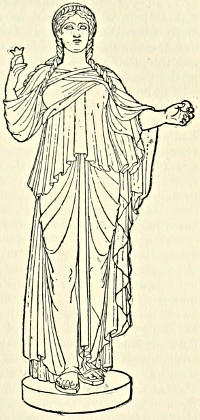
Priestess
(After Hope)
There still remained a question on which he felt it necessary to consult the army, that he might relieve himself from a dangerous responsibility. Papers had been found in Alexander’s cabinet, containing the outlines of some vast projects. It would seem that they might easily have been suppressed; but it was known that they corresponded in part with the instructions which had been given to Craterus, and therefore they could not safely be neglected without the general consent. Some related to the equipment of a great armament—a thousand galleys, it is said, of the largest size—destined for the conquest of Carthage, and of the whole coast of Africa on the Mediterranean as far as the Straits, and those of Spain and the adjacent maritime regions, as far as Sicily: for which end a road was to be made along the African shore. Others were plans for new colonies, to be planted in Asia with Europeans, and in Europe with Asiatics. There were also directions for six new temples to be built in Europe—at Delos, Delphi, Dodona, Dium, Amphipolis, and Cyrrhus—each at the cost of fifteen hundred talents, beside one of extraordinary magnificence to the goddess of Ilium, and for a monument to his father in Macedonia, which was to equal the largest of the Egyptian pyramids in its dimensions.
It must be owned, that there are some points in these schemes which look suspicious, and which, even if they had crossed Alexander’s mind, we should not have expected he would have committed to writing. But the part relating to the temples can scarcely have been fabricated, and was probably contained in the instructions given to Craterus. The plan for an interchange of population between Europe and Asia is also quite conformable to the views which Alexander disclosed in his life-time. This however, and that of the expedition to Africa, could not any longer have entered into any one’s thoughts, and might have been silently dropped. But perhaps Perdiccas apprehended that the sums destined for the other objects might be demanded from him by his colleagues, and therefore deemed it advisable formally to annul the whole by the highest authority. That he forged the project of the expedition, to render the real contents of the papers the less acceptable to the Macedonians, seems a very improbable conjecture. All were laid before a military assembly, and rejected as impracticable or useless.
During the tumultuous scenes which followed Alexander’s death, his body had lain in the palace unburied. There are various reports as to the place selected for its interment. According to one, it was to have been transported to the sanctuary of Ammon. But the more probable is, that it was determined it should be deposited in the sepulchre of his ancestors at Ægæ. And Aristander the soothsayer is said to have declared that it had been revealed to him, the land where it rested was destined to be ever prosperous and secure from invasion: which however was no more than an ancient Greek superstition as to the virtue of a hero’s relics. Orders were now given to construct a funeral car worthy of these precious remains, and the general Arrhidæus was appointed to escort them towards the western coast.b
The description by Diodorus (XVIII, 3) of this funeral pomp is so gorgeous that as a farewell sunset of Alexander’s day it merits insertion here:a
ALEXANDER’S FUNERAL DESCRIBED BY DIODORUS
“First was provided a Coffin of beaten Gold, so wrought by the Hammer as to answer to the Proportion of the Body; it was half fill’d with Aromatick Spices, which serv’d as well to delight the Sense as to preserve the Body from Putrefaction. Over the Coffin was a Cover of Gold, so exactly fitted, as to answer the higher part every way: Over this was thrown a curious Purple Coat embroider’d with Gold, near to which were plac’d the Arms of the Deceas’d, that the whole might represent the Acts of his Life. Then was provided the Chariot, in which the Body was to be convey’d, upon the top of which was rais’d a Triumphant Arch of Gold, set thick and studded over with precious Stones eight Cubits in breadth, and twelve in length: Under this Roof was plac’d a Throne of Gold, join’d to the whole Work, foursquare, on which were carv’d the Heads of Goat-Harts, and to these were fastened Golden Rings of two Hands breadth in the diameter; at which hung, for Show and Pomp, little Coronets of various beautiful Colours, which, like so many Flowers, gave a pleasant Prospect to the Eye. Upon the top of the Arch was a Fringe of Network, where hung large Bells, that the Sound of them might be heard at a great distance.
“On both sides the Arch at the Corners stood an Image of Victory in Gold, bearing a Trophy: A Peristthylium, of Gold supported the Arch-work, the Chapiters of whose Pillars were of Ionian Workmanship: Within the Peristthylium, by a Network of Gold of a finger’s thickness in the Workmanship, hung four Tablets one by another equal to the Dimensions of the Wall, whereupon were portray’d all sorts of living Creatures. At the entrance into the Arch stood Lions in Gold, with their Faces towards them that approach’d to enter. From the middle of every Pillar an Achanthus in Gold, sprouted up in Branches spiring in slender Threads to the very Chapiters: Over the Arch about the middle of the Roof on the outside was spread Purple Carpet in the open Air, on which was plac’d a vast Golden Crown, in form of an Olive Coronet, which by the reflection of the Sun-Beams darted such an amazing Splendor and Brightness, that at a distance it appear’d as a Flash of Lightning. Under the Seats or Bottom of the whole Work ran two Axle-trees, about which mov’d four Persian Wheels, whose spokes and Nathes were over-laid with Gold, but the Felloes were shod with Iron: The Ends of the Axes were of Gold, representing the Heads of Lions, every one holding a Dart in his Mouth. There were four Draught-Trees, to every one of which were fix’d four Courses of Yoaks, and to every Course were bound four Mules, so that the Mules were sixty four in number, the choicest for Strength and Largeness that could be got: Every Mule was adorn’d with a Crown of Gold, and Bells of Gold on either side their Heads; and on their Necks were fitted Rich Collars set and beautified with precious Stones. And suitable to so stately a Show, a vast Company of Workmen and Pioneers (that plain’d the Ways for its Passage) attended it.
“And thus Arrhidæus (who had spent two Years in Preparations) brought the King’s Body from Babylon to Ægypt. Ptolemy, in Honour of the King met the Corps with his Army as far as Syria, where he receiv’d it, and accompany’d it with great Care and Observance: For he had resolv’d not as yet to conduct it to the Temple of Hammon, but to keep the Body in the City which Alexander himself had built, the most Famous almost of any City in the World. To this end he built a Temple in Honour of Alexander in Greatness and Stateliness of Structure becoming the Glory and Majesty of that King; and in this Repository he laid the Body, and honour’d the Exequies of the Dead with Sacrifices and magnificent Shows, agreeable to the State of a Demi-God.”c
ALEXANDER’S HEIRS
[323-321 B.C.]
While such honours were paid to the conqueror’s corpse, two of the living objects of his affection fell victims to the revenge of Roxane and the ambition of Perdiccas. Roxane, with the agent’s concurrence, invited Statira and her sister Drypetis to Babylon by a friendly letter, and when they came she caused them to be assassinated and secretly buried. In the course of time Roxane was delivered of a boy, who was acknowledged as partner of Philip Arrhidæus in the empire, and bore the name Alexander (Ægus).b
Arrhidæus, the Imbecile
The sham government of Arrhidæus was now to commence. He must have been staying with the army. The phalanx no doubt did not believe that Arrhidæus was an idiot, but probably considered him to be a wise ruler who was only calumniated: just as even in Denmark, no one would believe that Christian VII was mad, from fear of wronging the king’s majesty. The king’s madness was in Holstein such a secret that persons at the utmost whispered it to one another, and to believe it appeared to the people like a culpable act; there is something mystic in the belief that such royal aberration is not madness, but profundity of thought. This may have been the feeling of the phalangites.
The cavalry were satisfied, as soon as they had him in their power. Perdiccas was chiliarchus or administrator, and Craterus was to take care of the king’s person, as the queen took care of the person of King George III, while the successor managed the government. Craterus was assigned to him as a kind of tutor, who took care of him, and always kept him in order; this shows how imbecile he must have been. Arrhidæus disappears altogether from history, and he was no more king than his nephew Alexander, the son of Roxane, and is mentioned only as a name. But in order to understand many coins and some inscriptions, we must bear in mind that Arrhidæus assumed the name of Philip.
The satrapies were now distributed afresh.
But before proceeding to the history of the satraps, or governors, we must relate the first of the horrible scenes of that time—viz., the insurrection of the unfortunate Greeks in the ἄνω σατραπεῖαι (323 B.C.)—a term comprising Khorasan in its widest extent, partly the province, properly so called, and partly the whole of Persia, east of the great Median desert. There Alexander had settled the captive Greeks, who had served as mercenaries under Darius, as well as other Greeks from among his own allies; he formed them into military colonies. These people were driven by despair to revolt, probably when they heard the report of the Lamian War; they assembled and determined to force their way to Greece. A Macedonian army under Pithon was sent against them. The fearful demoralisation among the mercenaries became manifest on that occasion; he would probably have been unable to do anything against them, if he had not bribed one of their commanders, who during the engagement deserted his post. Being overpowered, they now capitulated. Pithon had received orders from Perdiccas to put them all to the sword, that they might no longer be troublesome to him. But Pithon had formed a different plan: he wanted to employ those Greeks as a force, with the aid of which he hoped to play a prominent part; he was a Macedonian, and had claims upon the empire which was already beginning to be torn in pieces. Accordingly he spared their lives; but now his Macedonians rebelled against him—here we see the effects of the national hatred existing between the Greeks and Macedonians—for they found that it would be much more advantageous to kill the Greeks and seize the booty they had collected. They therefore made a general massacre among them, and took their property. After this was done, Pithon returned as if he had executed the orders of Perdiccas. It is as if we read a history of Ali Pasha. Soon afterwards, the hostilities among the governors broke out.
The Diadochi
The generals and satraps of Alexander, called in Greek the Diadochi [διάδοχοι, or “successors”], were about twenty in number; none of them was inclined to play a subordinate part, but a great many could not entertain the thought of assuming supreme power. Some of them, therefore, at first kept aloof from the disputes; these were the men who had no great expectations for themselves. The great rupture at the beginning was between Perdiccas on the one hand, and Antipater and Ptolemy on the other.
Perdiccas claimed the supreme power, because Alexander, by giving him his seal-ring, had conveyed it to him; and Antipater claimed it as regent of Macedonia, because he looked upon himself in that capacity as the representative of the nation. He was joined by Ptolemy because he was far off, for if they had been near each other, Antipater and Ptolemy could never have become allies. But as it was, Ptolemy in a distant and inaccessible kingdom considered himself safe, and Antipater could have no inclination to deprive him of his kingdom.
Ptolemy showed himself as a very practical and intelligent man; for he never thought for one moment of making himself master of the whole of Alexander’s empire, while the others were more or less harbouring such notions; but he was satisfied with the enormous prize he had carried off from the lottery, the possession of Egypt; and he only sought such provinces as could be maintained from his own kingdom, that is, Syria, Cyprus, and the countries on the opposite coast of Asia, which formed the monarchy under Philadelphus and Euergetes, who were masters of the opposite coast. This was very natural, as he could not but wish to secure himself on all sides.
Antipater aimed at power, but despised the diadem, still having the feelings of a soldier of Philip. He was already very far advanced in years, being the oldest of the generals; and Philip had had none who surpassed him in ability, and he had honoured him more than any other, as, for example, by the embassy to Athens. We recognise Antipater and Parmenion as the greatest among Philip’s generals. Antipater was a man of the old school, and affected great simplicity. While the other generals appeared in purple chlamydes, he used the common Macedonian garment, and a stick, so that no one could distinguish him from an ordinary Macedonian. Such an affectation, combined with internal rudeness, is very often found in men of a bloodthirsty disposition. Not even Plutarch is able to conceal his cruelty.
Perdiccas was the worst of all. He seems to have been a Macedonian noble. Although we read little of a nobility and the like among the Macedonians, and yet he appears in all circumstances as a person of great pretensions. He was guilty of every license, even the greatest cruelties, without being bloodthirsty like Antipater, who was another Duke of Alva. Perdiccas was a purely oriental and unprincipled character; a man of very moderate talents, to whom nothing was sacred.
He had no friends; Eumenes of Cardia alone was in connection with him, and drew close to him. As Craterus was the most chivalrous and gallant among the Macedonians, so Eumenes was the cleverest, and very much distinguished by his great talents: he would have been a distinguished man at any time. He is the only man of that period (if we except Craterus, who fell early) in whom we can take a personal interest; he was a true Odysseus, inexhaustible in resources. He never sacrificed a friend to his own interests. He always obeyed the dictates of humanity, and whenever in his life there occur actions which would be deplored in better times, still they are praiseworthy in comparison with what others did at the time. Being inexhaustible in counsel, he also had quite different ideas from those of the Macedonians. Had he been a Macedonian, he would unquestionably have gained the inheritance of Alexander, as far as it was possible, and as far as it could be concentrated in one man’s hand. But he was a stranger, a native of Cardia in Chersonesus, and this circumstance placed him in a position among the Macedonians, which prevented his ever rising to the height which he might otherwise have attained.
Eumenes had not risen, like the rest, by his military talents alone, but more especially as a statesman. At the age of twenty he had entered the cabinet of King Philip, and was employed by him for seven years as secretary; he had then, without interruption, been with Alexander until the king’s death, so that for twenty years he had been the organ of the royal government. But he was by no means unfit for the calling, by which men at that time rose to greatness, for he was also a good soldier. Alexander had a horse-guard consisting of two squadrons, and one of them was commanded by Eumenes. If he had been a native of Macedonia, he would unquestionably have eclipsed all others. He afterwards displayed the very greatest talent as a general, which is the more wonderful, as in the time of Alexander he had never commanded an army: he had only acted the part of a looker-on. He was then forty years old, but he was like the men of the revolution who displayed their military skill, although no one had suspected that they possessed any. Eumenes was appointed governor of Cappadocia and Pontus, but had first to conquer them. Perdiccas, feeling that Eumenes was very useful to him, assisted him in his conquests.
The Women Claimants
While Perdiccas was aiding Eumenes, the women of the family of Alexander began a commotion with a view of taking possession of the reins of government. Even during the life-time of Alexander, his sister, Cleopatra, the widow of the Molossian, ambitious like her mother, Olympias, and her whole race, had tried to interfere in the affairs of Macedonia. Even before Alexander’s death, Olympias quarrelled with Antipater, and went to her family in Epirus. Cleopatra now endeavoured to obtain influence with Antipater, but he would not allow her any; it would, however, seem that she acted on the authority of her brother, who wished to prevent Antipater establishing himself too firmly, and therefore allowed her some influence along with Antipater. She seems to have been the spy of her brother. After Alexander’s death, Olympias remained in Epirus for several years, until she unfortunately returned after Antipater’s death. Cleopatra, fearing Antipater, who was master in Macedonia, went to Sardis, where she kept a princely court, which became the centre of the intrigues and endless complications of the time.
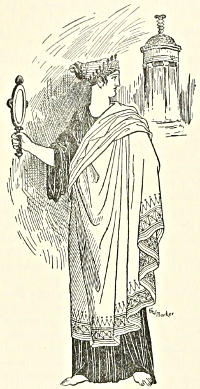
Female Costume
As Queen Elizabeth continued to deceive many by allowing them to believe that they might hope for her hand, so Cleopatra held out hopes to several of the generals, partly because she had no confidence in her own situation, and partly because she expected brilliant results from her marrying one of the commanders. Thus she contrived to keep up a hope especially in the aged Perdiccas. This was a cause of great alarm to Antipater, who endeavoured to counteract the scheme, and to connect Perdiccas with himself by offering him his daughter, Nicæa, in marriage. This double intrigue was quite in the spirit of all the transactions of that time; it has all its meanness and untruth. The result was, that Perdiccas, through these negotiations, was placed in great difficulties. He thought it dangerous to offend Antipater; but the latter was not in earnest, wishing only to put off Perdiccas and to gain time, and thus both negotiations came to nothing.
About the same time there appeared in Asia Minor another daughter of Philip, who is called by some Cyna, and by others Cynane, a Barbaro-Macedonian name. She was a daughter of Audata, an Illyrian woman, for King Philip, according to Macedonian custom, had lived in polygamy, like other barbarian kings. The fate of this Cyna was very tragic. The fact that no one has ever made the last misfortunes of the family of Alexander the subject of a historical tragedy, shows how little the history of that time is known; we have here a most excellent subject for a tragedy, and if Shakespeare had known the fate of that princess and of Olympias, he would unquestionably have seized it as a subject for his muse.
Cyna had been married to the pretender Amyntas, a cousin of Alexander, and she had remained behind in Macedonia with her only daughter, Adeia, who afterwards adopted the Greek name Eurydice, which had also been assumed by her grandmother, the mother of Cyna, whose Illyrian name was Audata; Eurydice was a common name in the family of Philip (his mother also bore it), just as Laudice or Laodice was common in the family of the Syrian dynasty. The names of the Macedonians are very often confounded; it is remarkable, that among the Macedonian princes sometimes even brothers have the same name; two brothers of Antigonus Gonatas, e.g., were called Demetrius.
Cynane was an Amazon character, having accompanied her father on his last expedition, and she educated her daughter in the same way. She went to Asia Minor for the purpose of creating a revolution; she belonged to Antipater’s faction, and it was, no doubt, according to a preconcerted plan with Cleopatra, that Perdiccas caused her to be murdered by his brother Alcetas; she died like a heroine. This made a terrible impression upon the Macedonians, and was the main cause of the fall of Perdiccas.
DEATH OF PERDICCAS
Soon afterwards, hostilities broke out between Perdiccas and Antigonus, the satrap of Phrygia, during which Eumenes declared in favour of Perdiccas. This was followed by a general contest in which Perdiccas was joined by Eumenes alone; all the rest, not only Ptolemy, Antipater, and Antigonus, but also Lysimachus and Craterus, were arrayed against Perdiccas.
Perdiccas, who was under the necessity of undertaking something, in order to maintain himself, now (321) undertook an expedition against Ptolemy, whom he wanted to drive out of Egypt, while Eumenes was defending himself in Asia Minor.
This undertaking, which was indeed very difficult, failed; Ptolemy had very prudently fortified himself behind the Nile, and made excellent preparations for defending himself. The army followed Perdiccas very reluctantly, and after having tried in vain for weeks and months to break through the lines of Ptolemy, a rebellion broke out among his men, and he was murdered by his own troops[41] (321). His power had lasted three years, beginning with the death of Alexander; and during that period he had always carried Arrhidæus with him. Antipater, who had even before gone to Asia Minor, now came forward in the camp. The generals of Perdiccas gladly concluded peace with Ptolemy.
Antipater now assumed the supreme power in the empire, which had been possessed by Perdiccas, and all acquiesced in it, because he was at the greatest distance.
The show-kings were now handed over to Antipater. The unfortunate Philip Arrhidæus was married to Eurydice, the daughter of Cyna—a circumstance which is of interest only in the tragic fate of the house of Philip. Eurydice, on account of her ambition, now endeavoured to throw matters into confusion, but Antipater took her and Arrhidæus, as well as Roxane and her child, to Europe with him, and compelled them, as long as he lived, to be more humble. It may in some respects have been disagreeable to the ambitious Macedonian rulers in Asia, that the members of the royal family were in Macedonia in the hands of Antipater; but at the same time this very circumstance paved the way for their independence.
A new distribution of the satrapies also was then undertaken, which, however, was soon set at nought by Ptolemy, who by force made himself master of Phœnicia and Syria, and expelled the governors of these provinces.
THE FEATS OF EUMENES
[321-301 B.C.]
In the meantime, there had been going on in Asia Minor the war between Eumenes, the satrap of Cappadocia, and Antigonus, the satrap of Phrygia, with the party of Antipater; and in that war Craterus had fallen. He had come to the assistance of Antigonus, but Eumenes gained a brilliant victory over him, and Craterus lost his life. But now a storm was rising against Eumenes: a superior force, for which he was no match, was assembling against him. He was sometimes successful, but he succumbed in the end.
The facts are these. After the death of Perdiccas, Eumenes, together with the other partisans of Perdiccas, especially his brother Alcetas of Pisidia, was declared an outlaw in an assembly of the Macedonian army, which on such occasions represented the nation. Antigonus was commissioned to carry the sentence into effect, and he also received the means necessary for this object—but he employed them for the purpose of establishing for himself a larger dominion.
Eumenes, after having lost a battle in Cappadocia, in the face of Antigonus, shut himself up with five hundred men, in the mountain fortress of Nora in Cappadocia, and disbanded his whole army, in the hope that if circumstances should improve, his soldiers would be drawn towards him as towards a magnet. He sustained the siege for half a year. Then, after having been besieged in vain during the winter, he escaped from the besiegers, having kept them engaged, until he had collected strength in other parts. He fled into Syria, and then to the upper satrapies (which had taken no part in the earlier war) to Antigenes of Susa, and Peucestas of Persia. A second war then broke out between Eumenes and Antigonus.
The death of Antipater, which had taken place in the meantime, had greatly altered all circumstances. He had appointed Polysperchon regent, and the latter called upon Olympias to come forward again. Antigonus, Cassander, and Ptolemy (though the last did not do so actively), declared against him; Polysperchon, on the other hand, put himself in connection with Eumenes, on behalf of Olympias and her grandson, and called upon him to take the family of Alexander under his protection.
Eumenes now appeared in upper Asia with full authority from Olympias. The argyraspidæ and most of Alexander’s veterans were likewise in those parts, for what reason, we know not. They looked upon themselves as a station of invalids, were in the enjoyment of perfect leisure, and lived in the greatest abundance, like the followers of the Normans in England. They were all seigneurs. They had hitherto joined no party, and lived like a nation of Mamelukes, almost in the forms of a republic. Eumenes, provided with the authorisation of Olympias, now applied to them, and gained them over to his side. The satraps also declared themselves in his favour, and he obtained possession of the royal treasures. With these means at his command, Eumenes for years carried on the war on behalf of Olympias and young Alexander. For years he overcame the jealousy of the Macedonian commanders, who hated him as a foreigner, and controlled those old faithless men of the sword. He induced them to quit their merry quarters for the objects he stated to them, to follow him, and to risk their own existence for his personal objects; he guided them all by assuming the appearance that they were all equal, and by erecting a symbolical throne of Alexander.
All the Macedonian world was now divided into two masses, which fought against each other both in Europe and in Asia. Cassander was engaged in Greece against Polysperchon, and Antigonus in Asia against Eumenes, still pretending that he was obliged to carry into effect the decrees of the Macedonian army against Eumenes.
The power of Antigonus, however, increased immensely through the war with which he was commissioned: he not only made himself master of Eumenes’ satrapy of Cappadocia in western Asia, and of other satrapies in Asia Minor, such as Pisidia and Lycia, but he also occupied Media and the intermediate provinces, so that his rule extended from the Hellespont to Persia. He took his headquarters at Ecbatana, whence he made war upon the southern provinces. In order to attack them he had to pass through the desert of Rhei and Kom, which separates Fars and Kerman from Media. Antigonus there undertook the celebrated expedition through the desert, in order to attack the allies in their winter quarters; but the manner in which Eumenes discovered and thwarted his march, is much more brilliant, for he deceived his enemy, and induced him to give up his plan, which could not have failed, and to make his retreat. In the eighth year after Alexander’s death, Antigonus concluded the war against Eumenes, by attacking him with a far superior force. Peucestas had displayed a miserable character, but Antigonus had conducted the war in a most able manner. In the end (316 B.C.), he defeated the allies, and conquered the immense oriental train and their harems, which they carried about with them; and in order to recover these, they concluded peace with Antigonus. This was the price for which the unfortunate Eumenes was delivered up by his own troops, as Charles I was delivered up by the Scotch. Antigonus would willingly have saved him, but he was obliged to sacrifice him to the national hatred of the Macedonians against the Greeks.
THE EMPIRE OF ANTIGONUS
This war established the dominion of Antigonus, who through his victory over Eumenes and the satraps under him, obtained the supremacy over their provinces, and now was in possession of a large empire. He was the first who was courageous enough to drop all hypocrisy, and in 306 B.C. assumed the diadem and the kingly title. No one had as yet ventured to do this, just as Napoleon hesitated for a long time to assume the imperial title. Antigonus was already advanced in years, being of about the same age as Perdiccas, and somewhat younger than Antipater (who was the oldest among the generals) if we take into consideration the age at which he died in 301 B.C. He was one of the old officers of Philip, and a good one too. He was, indeed, like most of them, nothing beyond a soldier, but in ability he was superior to most of them. Among those who contended for the empire (if we except Eumenes the stranger and Craterus who fell early), he and Lysimachus were probably the best. Besides Antipater and his son Cassander, they alone were true generals. Ptolemy distinguished himself only by his skilful defence of Egypt against Perdiccas; subsequently in the war against Antigonus, not much is to be said of him.
In the meantime great changes had taken place in Macedonia. Antipater had been quiet during the latter years: he reigned in the name of Arrhidæus, and of the little son of Alexander, who at his death was not yet seven years old. Heracles was older, but illegitimate, and was regarded as incapable of succeeding his father: he too was in Macedonia with his mother Barsine. Antipater kept the royal family at Pella in a state of splendid captivity, while he himself lived in the greatest simplicity.
[319-317 B.C.]
But when his end was approaching, he made a singular arrangement concerning the regency (319 B.C.). Two of his sons were still alive: the one, Iollas, who was said to have poisoned Alexander, was dead, but Cassander and Philip were still living. Antipater did not give the regency and his power to either of them, but to a petty Epirot prince of the name of Polysperchon or Polyperchon.
POLYSPERCHON VERSUS CASSANDER
This arrangement made Cassander and Polysperchon enemies. As soon as the father had closed his eyes, and Polysperchon had entered upon the administration, Cassander quitted Macedonia, went to Ptolemy in Egypt, assembled troops, and prepared to attack Polysperchon. He was conscious of his own superiority: he was a man who in great difficulties knew how to extricate himself; he was a general who undertook little, but was very cautious in what he did undertake, and a remarkable instrument in taking revenge for Alexander’s cruelty against the Greeks. Antigonus and Ptolemy, as we have already mentioned, joined him; though the latter took no active part in the war, being desirous firmly to establish his own dominion in the interior.
A war now arose which was carried on with the most fearful devastation of unhappy Greece; the ravages were constantly repeated, until the country was brought down so completely, that it was entirely annihilated.
This war between the two pretenders to the crown of Macedonia, and to the guardianship of the unfortunate royal family, however, inflicted even more suffering upon Macedonia than upon poor Greece.
Polysperchon favoured Olympias, with whom he was already connected by his nationality. She was still living among her countrymen in Epirus, whither she had gone even in the reign of Alexander. The fact that Æacides, a petty prince of the Molossians, who had been expelled by her, now supported her, and on this account brought great misery upon his family, shows that national ties were stronger than those arising from family connection. Polysperchon, as we said before, connected himself with Olympias, and called upon her to return to Macedonia, and undertake the government as the guardian of her grandson, Alexander, the son of Roxane. She readily accepted this proposal, and both now formed connections with Eumenes.
The latter obtained from Olympias full power to act as he thought fit, as if he were Lieutenant du Roi, and this induced the argyraspidæ and the satraps of Upper Asia to declare in his favour. Olympias, however, appears still to have remained in Epirus. Eurydice, on the other hand, joined the party of Cassander, and the feud between the two queens became the cause of the civil wars in Macedonia. Polysperchon seems to have had less ambition, and was satisfied with being the first general.
At the same time, however, Polysperchon also endeavoured to secure the assistance of the Greeks, and in the name of the king he issued a proclamation to them in which he declares, in the name of King Philip Arrhidæus, employing the language of hearty sympathy, that the Greeks ought not to impute the harsh cruelties which they had experienced from the generals (Antipater and Craterus) to the king; that he had neither approved nor known of them; that he disapproved of the change in their constitutions, and that they should be restored just as they had been under Philip and Alexander. All the exiled Greeks, moreover, with the exception of a few, were to return. For the purpose of carrying this measure into effect, Polysperchon proceeded to Greece.
[317 B.C.]
Cassander appeared with a few thousand soldiers, whom he had collected in Asia. With this small force he commenced the war elsewhere described, in which he recovered the dominion of his father and a great deal more. When Cassander had established himself there, Polysperchon no longer attacked him, but turned to Peloponnesus, to carry his decrees into effect.
While Polysperchon and Cassander were thus arrayed against each other in Greece, Olympias ruled in Macedonia with a tragic fury. The Macedonians hated and despised her both personally and because she was a foreigner; and she knew this quite well. She remembered that the old national party in Macedonia had regarded Alexander as the son of a foreigner; that on the other hand, the marriage of Philip with Cleopatra, the niece of Attalus, had been hailed with general rejoicings, and that she had been obliged to withdraw with Alexander. She therefore looked upon the real Macedonians as her personal enemies, and the more terrible her natural disposition was, the more she felt irritated, and the more she abandoned herself to acts of infuriated cruelty. The accounts of them are certainly not exaggerated, for we are moving during this period on perfectly historical ground, though it is indeed a barren and exhausted ground, which does not produce a single blossom of poetry. The history of that time is quite authentic, but we may rejoice that we have no very minute accounts of it.
Among the victims of Olympias, we find her step-son, the poor Arrhidæus, and his unfortunate wife Eurydice, the daughter of Cynane. This Cynane was persecuted by her in every way as a mortal enemy, and Eurydice was looked upon by her as the granddaughter of a rival. In early life, Philip had loved Olympias, but afterwards he was shocked at her, and withdrew from her; she had become detestable to him. He lived in wild polygamy, and his mistresses were to her the objects of a truly oriental hatred. Eurydice, the granddaughter of such a rival, was young, lively, and equally ambitious. Olympias cherished against her the hatred of fading age and a malign disposition against the freshness of youth. It must also be borne in mind, that Eurydice’s mother had been married to Amyntas, the champion of the party which drove Olympias from Macedonia. Her mother, Cynane, was a bold woman, and Eurydice was a person of the same character; she wanted to rule in the name of her husband.
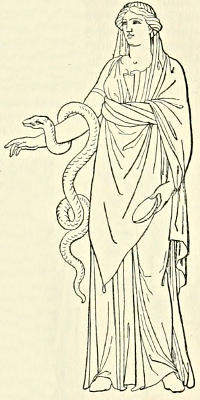
Hygeia
(After Hope)
While Polysperchon was forming a connection with Olympias, Eurydice entered into a relation with Cassander. Olympias seems still to have been staying in Epirus at the time when Polysperchon went to Phocis and thence into Peloponnesus. He took Arrhidæus with him on this expedition, but he must afterwards have sent him back to Pella. Olympias now returned to Macedonia with an army of Epirots and Ætolians, which was opposed by Eurydice and a Macedonian force. Olympias made use of the influence of her own name and of that of her son, for the purpose of gaining over the followers of Eurydice. The Macedonians were extremely untrustworthy, and they seem to have been induced to desert to their opponents not only by bribery, but often by mere caprice; and it is not till the time when the dominion of the Antigonidæ had become established, that this faithlessness ceases. Eurydice and Arrhidæus accordingly being deserted by the Macedonians, fell into the hands of Olympias, who now ordered them to be put to death. Wishing to enjoy their death, she first intended to kill them by hunger, and ordered them to be walled up in a dungeon—and a little food to be given to them. But as this lasted too long, Olympias becoming impatient, and fearing lest a tumult should arise, ordered the dungeon to be broken open and the harmless idiot to be murdered by Thracians. Eurydice was obliged to choose the manner in which she was to die, and died with great firmness. Olympias now put forward her little grandson Alexander with his mother Roxane. In the same manner she raged against the whole house of Antipater, one of whose sons was likewise killed.
[316 B.C.]
But the cruelties of Olympias excited discontent and rebellion among the restless and mutinous Macedonians. When Polysperchon was obliged to retreat from Megalopolis, most of the Greek cities declared for Cassander. Cassander thus gained a firm footing in Greece; and, while Polysperchon retreated, Cassander followed him into Macedonia, where the people declared for him, Pella, Pydna, and Amphipolis alone declaring against him. Olympias, with her grandson Alexander, Roxane, and others, had fled to Pydna. Polysperchon was deserted by his troops, who were bribed by Cassander, and was obliged to flee with a few faithful adherents into Ætolia.
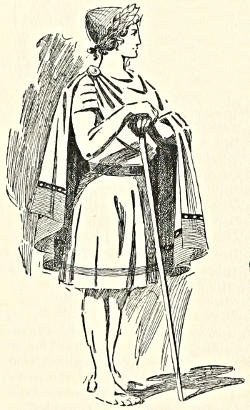
Costume of a Youth of the Upper Classes
Olympias was thus shut up in Pydna; it was situated quite close to the sea, and there was no one inclined to afford her assistance. Eumenes was then in Upper Asia, engaged in the war against Antigonus. If Antigonus, as he himself wished, had become reconciled to Eumenes, the latter would have been able to act as mediator on behalf of Olympias; but, at all events, the assistance from that quarter would have come too late. The party blockaded at Pydna were suffering from the most terrible famine, and Olympias was compelled to surrender. She stipulated for her life, and Cassander promised to spare her, but had no intention of keeping his word. The widows and orphans of those who had been murdered by Olympias brought charges against her before the Macedonians, who again formed a champ de Mars. Olympias did not appear, and was sentenced to death. Afterwards, she declared her willingness to appear before a court of Macedonians; but Cassander ordered her to be executed, saying, that he must obey the will of the nation.g Olympias received warning that she must prepare for death. She put on her royal robes and came forward, leaning on two of her women, to meet the soldiers. Even they were so overpowered by the majesty of her presence, and by the numberless great recollections attached to her name, that they could not bring themselves to execute Cassander’s order. He was obliged to commit the deed of blood to the persons who had accused her, and who were eager enough for revenge to undertake it themselves. She submitted to her fate with unbending firmness, neither shrinking from their swords nor uttering a word unworthy of her birth and fortunes.b
Young Alexander, and his mother, Roxane, were sent to Amphipolis, where, for a time, they were kept in close confinement, and afterwards put to death. Hercules, the son of Barsine, was likewise murdered, and that too by Polysperchon; but when this happened cannot be accurately determined. Polysperchon now disappears from history. His son, Alexander, continued to play a part for some time, but it did not last long.
After the fall of Olympias, all the other places, which had till then held out, opened their gates to Cassander; and he now was king of Macedonia, without having the regal title.
About the same time Antigonus, by his conquest of Eumenes, became master of all Asia, while Lysimachus ruled in Thrace, and Ptolemy in Egypt. We need hardly observe, that Antigonus’ dominion in the most eastern satrapies was merely nominal, or did not exist at all; but, in regard to Babylonia, Persia, and other interior provinces, the case was different, for there he really ruled as master. But none of the princes had yet assumed the kingly title. This was the state of things in 316 B.C.
In the feuds which henceforth arise among the rulers, a younger generation of men already appears on the stage, and they can in no way be compared with the older men who had gone forth from the school of Philip. Seleucus was one of these younger men; he had not yet distinguished himself, but may have become acquainted with war as early as the time of Philip. He was of about the same age as Alexander, and in every sense an enfant de la fortune, who rose only through his extraordinary good fortune. [His realm and his followers, known as the Seleucidæ, will be treated in a later chapter.] Antigonus had conquered for himself an empire by campaigns, labours, and hardships; he lost one eye, and, in the end, his life. Ptolemy had been a companion in arms of Philip, and had greatly distinguished himself under Alexander. Of Cassander we have already spoken; and Lysimachus had been obliged to conquer Thrace, the possession of which he was now enjoying.
It had been given to him to be conquered, for it was not a satrapy, having been under the administration of Antipater. The country had become tributary as early as the time of Philip, but had retained its ancient dynasties. The princes of the Odrysians, though dependent on, and weakened by Philip, still existed; and, in the reign of Alexander, Thrace was always united with Macedonia. But, after his death Perdiccas separated the two countries, for the purpose of weakening Antipater, and changed Thrace into a satrapy, which he gave to Lysimachus, and which Lysimachus subdued.
LYSIMACHUS
It is uncertain whether Lysimachus was a Thessalian or a Macedonian. He was captain of the king’s bodyguard, and very distinguished, especially for his lion-like bravery. When Callisthenes was tortured by Alexander, Lysimachus, on seeing his frightful condition, gave him poison out of compassion—a bold thing to do under a tyrant of Alexander’s temperament. This story shows that Lysimachus was considered as a man of independence of mind, who preserved his free and proud spirit, when Alexander had already become an eastern despot.
He established his empire with small means, and for the greater part of his life he was reasonable enough to be satisfied with his dominion. It was not till his old age that ambition overcame him and carried him away, though, perhaps, not without some deeper motive and the desire to save himself. He once crossed the Danube in the vain attempt to make conquests in the country beyond the river; this may, perhaps, have been only an attempt to keep off the invading nations of the north. He had a difficult problem to solve, to conquer the wild and warlike Thracians, whose country appears to us northern people as a fair southern sort of paradise, but was terrible to the Greeks on account of the severe arctic cold; and the terror was increased by the savage manners of the inhabitants. On the coast, however, there were large and magnificent Greek cities, and the beautiful Chersonesus. We know little of the reign of Lysimachus, and we are not even informed whether he resided at Byzantium or elsewhere. In later times, during the war against Antigonus, his residence seems to have been in Asia, at Sardis or at Ephesus.
CASSANDER IN POWER
[316-307 B.C.]
When Cassander was once in possession of Macedonia, he extirpated the family of Alexander, without a hand being raised in their defence. Aristobulus, who wished to interfere, was delivered up and sacrificed. Hence it is remarkable that he married Thessalonice, the only surviving daughter of Philip; but this may have arisen from the pride of the usurper, or from the hope of thereby establishing his dominion. His government of Macedonia was at the same time a perfect dominion over Greece, with very few exceptions, one of which was Sparta.
Thebes had been restored by Cassander immediately after the conquest of Macedonia (316 B.C.), for, in his hatred of Alexander, he undid all that Alexander had done. By their possession of the Theban territory the Bœotians were so much bound up with the interests of Macedonia, that it became a question as to whether it was prudent to restore Thebes. It is not certain whether they had incurred the suspicion of Cassander. It was a matter of great difficulty to induce the Bœotians to consent to the restoration; in all of the rest of Greece it was regarded as an act of the greatest justice, and it seems to have been a general national consolation.
About the same time Cassander founded Cassandrea, a remarkable proof that he was a man of practical sagacity. Philip had extirpated or sold the Greek population on the Macedonian coast, with the exception of that of Amphipolis and Pydna. One of these destroyed cities was Potidæa, which had at first been a Corinthian colony, but afterwards belonged to Athenian cleruchi. Now, on that site, Cassander assembled, not only many strangers, but all the Greeks, especially those Olynthians who were still surviving from the destruction of their city, and built Cassandrea. On the site of the insignificant town of Therma, he founded Thessalonica, which he called after the name of his wife. This act also shows great practical wisdom. Thessalonica, situated on a fine harbour, and in a fertile district, being now extended, became the chief commercial place in Macedonia, a rank which it has maintained down to the present day. Cassandrea (now Cassandra) soon became great and powerful; it has often been destroyed, but was always restored again; and its situation was so happily chosen, that it naturally always recovered.
This was the condition of Greece at the time when the appearance of Demetrius Poliorcetes, the son of Antigonus (307 B.C.), stirred up everything without doing any good. He had even before been actively engaged in a war against Ptolemy.
The defeat and death of Eumenes put Antigonus in possession of a vast monarchy, extending from the Hellespont as far as India. According to the early invented principle of the balance of power, the others now demanded that he should give up a part of his conquests; they even thought it necessary, for the sake of justice and for the balance of power, that the countries of upper Asia should form a separate state.
Seleucus, the child of fortune, was destined to obtain that empire; a man who was the pet of fortune, but in no way distinguished as a hero or statesman. In the same year (316 B.C.) in which Cassander had conquered Macedonia, and Antigonus, after the conquest of Eumenes, returned from Upper Asia, Antigonus intended to order Seleucus to be arrested at Babylon. But he escaped, and the Chaldeans now foretold Antigonus, that the fate of his family was involved in the affair. It was easy to foretell the beginning, but not the end, for the Seleucidæ did not overthrow Antigonus. Seleucus now went to Ptolemy whom he urged on to wage war against Antigonus.
Thus arose, in 316 B.C., the second or third great internal war among the Macedonian princes—we say the second or third, because the recommencement of the war in 318 B.C. may either be regarded as a continuation of the first or as a second war. In this war, Antigonus fell out with Cassander, and Ptolemy allied himself with Cassander and Lysimachus against Antigonus. Lysimachus, however, was cunning enough to keep aloof as much as he could, and Cassander, too, at first took much less part in it than Ptolemy. In the beginning it was, properly speaking, only Antigonus and Ptolemy that were arrayed against each other.
The war was at first carried on especially in Syria and Cyprus. Ptolemy had taken possession of Cœle-Syria and southern Phœnicia. Antigonus now directed his arms against him, and at first generally with success, so that he made himself master of Syria and a great part of Cyprus; until, in the fourth year of the war, Demetrius Poliorcetes lost the battle of Gaza against Ptolemy, of which we shall speak hereafter.
In the meantime, however, the generals of Antigonus were carrying on a war in Greece against Cassander, from 315 B.C. till the end of 312 B.C. It is worthy of remark that both Antigonus and Ptolemy considered the Greeks of sufficient importance, to endeavour to gain their favour by proclaiming the struggle a war of independence for the Greeks; neither of them, however, had any serious intention of this kind. In the very first year of the war, Antigonus sent Aristodemus of Miletus with a fleet and large sums of money to Greece, probably with no other intention than to make a diversion against Cassander and prevent him from crossing over into Asia.
[312-311 B.C.]
This brought unspeakable misery upon Greece. Each city was too weak, and also but little inclined to defend itself; each threw itself into the arms of the party that happened to be at its gates. Alexander, the son of Polysperchon, had remained in Peloponnesus, establishing himself mainly at Corinth and Sicyon; he now joined Antigonus, from whom he received money and troops. He and Aristodemus also enlisted soldiers in Greece, and the war now broke out, especially in Peloponnesus. Cassander, forcing his way into the peninsula, conquered Cenchreæ, the port of Corinth.
But all on a sudden, Alexander deserted Antigonus, and faithlessly concluded a peace with Cassander in his own name and that of his father. By this means, Aristodemus was driven out of Peloponnesus, and now went to Ætolia, whence he carried on the war against the opposite countries of Peloponnesus, Achaia, and Elis. The watchword always was, “Liberty and Autonomy for Greece;” but the towns were, notwithstanding, treated in a most terrible manner. During the first campaign, the principal scene of operations was Arcadia and Argolis, and in the second, Elis and Achaia. Almost the whole of Achaia was laid waste during this campaign, and Patræ and Ægium were taken. Alexander was then murdered, and Cratesipolis, his widow, keeping possession of Corinth and Sicyon, ruled there almost as an absolute queen.
A Scene in Syria
But Cassander transferred the war into Ætolia; these occurrences rendered the conflict more and more important, and the Acarnanians, therefore, beginning to be apprehensive, threw themselves into the arms of Cassander and the Macedonians. Being now supported by Cassander, they endeavoured to rid themselves of their connection with the Ætolians. The year following saw the commencement of the war of Cassander against Ætolia.
In 312 B.C., Antigonus made great preparations, and under the command of Ptolemy, a son of his sister, sent an army into Greece, more especially into Bœotia, which was exasperated against Cassander, for having been obliged by him to give up the territory of Thebes. In conjunction with them, Ptolemy conquered Chalcis, and wherever they went, they were successful in expelling the garrisons of Cassander, who had no other city in Greece left that sided with him except Athens. But while Antigonus was victorious there, he was losing ground in other parts; and thus he found himself obliged, in 311 B.C., to conclude a peace with his opponents.
[312-308 B.C.]
In Syria, Antigonus had entrusted the supreme command against Ptolemy and Seleucus to his son Demetrius, who was then still a very young man. This Demetrius plays a very prominent part in history. He has the honour of having his life described among the biographies in Plutarch—an honour which we might reasonably grudge Demetrius, for he is a despicable person. We know him, partly from Plutarch’s biographies, and partly from a number of anecdotes in Athenæus, to have been the most unprincipled and most detestable man in existence: the acts of faithlessness which he committed against Alexander, the son of Cassander, are not the only things for which he deserves our detestation. He was also a voluptuary of the vulgarest and most abject description; the lowest crapule was the element in the filth of which he revelled; and he was quite a heartless man, who knew no friendship; the basest creatures, the companions of his lusts, were his only friends. Cassander was, after all, capable of distinguishing persons deserving of respect, as he showed in the selection of Demetrius Phalereus; and so also was Ptolemy; but we know that Demetrius Poliorcetes lived at Athens in intimacy with the most abject and abandoned persons of the time. He also showed towards his soldiers an ingratitude and a heartlessness, which are quite revolting; they were perfectly indifferent to him, and he regarded them only as his tools. They accomplished great things for him, but he always sacrificed them without any scruple, leaving to destruction on the morrow those who had saved his life the day before. In addition to this, he was a gambler, whose dull torpor could be excited only by great changes of fortune, and who staked everything upon a card. He is remarkable for his enormous good fortune: “fortune raised him beyond all conception, and then deserted him, but when he seemed entirely lost, she again held out her hand to him,” says Plutarch, in a verse which he applies to him.
Such a man would deserve no attention at all, were it not that he acted a great part, and that nature had endowed him with great abilities, especially in mechanics, according to the leaning of that age toward the mechanical sciences. In this respect, as in many others, we may compare him with a modern person, the regent Philip of Orleans, who, however, was a far better man. Demetrius was a great inventor in mechanics, and he did much for the improvement of military engineering: this is a merit which he did not unfairly assume, but he is fully entitled to his reputation in this respect. A short time before, a great impulse had been given to mechanics in the affairs of war, and machines of every description were improved. Engines, which for centuries had remained unchanged, were now, partly through the progress of mathematics, and partly through the increased wealth that could be employed upon them, improved in one year, more than they were formerly in the course of centuries.
Demetrius was eighteen years old when Antigonus commissioned him to undertake the command of an army against Ptolemy. The first attempt failed, for at Gaza he was completely defeated, and Ptolemy again took possession of Cœle-Syria. Ptolemy carried on the war in a generous spirit, for, declaring it to be a civil war between Macedonians, he set the prisoners free without ransom, whereby he gained the good will of the Macedonians. Antigonus now undertook the command himself, and Ptolemy again evacuating the towns of Cœle-Syria, ravaged them.
Peace was then concluded, but it lasted only for a short time. Cassander succeeded in inducing Ptolemy, the nephew of Antigonus, who was stationed in Bœotia, as well as another general on the Hellespont, to revolt. Yet Antigonus soon recovered those countries. In the same year Ptolemy took Cyprus and extended his power on the coast of Asia Minor.
In the year following Ptolemy appeared with a fleet in Greece, having until then been the ally of Cassander. It was probably the Bœotians and Peloponnesians that called in his assistance against Polysperchon, and he had a fair opportunity of being able to say that he was coming to avenge the murder of Roxane and Alexander. Cratesipolis surrendered to him her principality of Argos and Sicyon, being unable to maintain those cities any longer; but it was not without difficulty that the mercenaries were prevailed upon to surrender: it was effected only by stratagem. The Peloponnesians afterwards were slow in doing what they had promised, and Ptolemy himself probably did not care much about the conquest. Hence he concluded a treaty with Cassander, whereby he obtained possession of Peloponnesus with the exception of Argos and Sicyon.
[308-306 B.C.]
Antigonus now sent his son Demetrius with a fleet to Greece. No one there was willing to sacrifice himself for Cassander, who had no fleet, so that he was unable to undertake anything against Demetrius. The latter appeared unexpectedly before Piræus: the harbour not being closed, he landed and quickly took Piræus, before the posts could be occupied. He immediately proclaimed that the expedition had been undertaken for the purpose of restoring to Athens her freedom and autonomy, and he was accordingly received with enthusiasm. The Macedonian garrison under Dionysius shut itself up in Munychia, and negotiations were commenced between Demetrius Poliorcetes and the city. Demetrius Phalereus was sent as ambassador down to the camp in Piræus: Demetrius promised the Athenians an amnesty, the city was declared free, and the ancient democratic constitution was restored; but Demetrius Phalereus was sent into exile.
Demetrius Poliorcetes now besieged the Macedonians in Munychia. He would not go to Athens till he had taken that fortress; it was at first blockaded, while the preparations for a siege were going on. While the engines were building, Demetrius marched against Megara, where there was a garrison of Cassander. The town was taken by storm and plundered, and it was only at the urgent request of the Athenian ambassadors, that its inhabitants were saved and not dragged away into slavery. He then returned to Piræus, where he attacked Munychia, until the feeble garrison being exhausted, was obliged, after several days, to surrender, and then departed. The fortifications were razed to the ground, and the place given up to the Athenians. Athens was now free, but Demetrius, for the protection of the Athenians, gave them a garrison of his own troops. After this he stayed for a time at Athens, where he was received with enthusiasm, as elsewhere described.
If Demetrius had remained at Athens, and continued the war against Cassander, he might easily have conquered all Greece; but he was called away by his father Antigonus, because Ptolemy had made himself master of Cyprus. About the month of Hecatombæon, Demetrius sailed to Cyprus; and now, by a brilliant victory of Demetrius over Menelaus, the brother of Ptolemy, near Salamis in Cyprus, Antigonus and Demetrius gained the mastery at sea. Cyprus was reconquered. Menelaus, with all his forces in the island, was obliged to capitulate; and thus the sea far and wide was in the power of Antigonus and his son. But an expedition which the two undertook against Egypt proved a failure.
THE NAME OF KING ASSUMED
[307-305 B.C.]
Until now, none of the princes had assumed the title of king, but after the victory of Salamis, Antigonus took the diadem for himself and his son. Immediately afterwards, Ptolemy, Cassander, Lysimachus, and Seleucus did the same; and the years were now counted from their accession (306 B.C.): these are what are called the Macedonian Eras.
Demetrius now remained absent from Athens for a period of three or nearly four years; during this time the city was left to itself, and a hard time it was. We may easily imagine that Cassander was not idle, and endeavoured to recover Athens, which was of such importance to him. He was in possession of Panactum and Phyle, and inflicted the severest sufferings upon the city. This war must unquestionably be regarded as one of the chief causes of the terrible poverty in which we afterwards find Athens, for there can be no doubt that the whole territory was laid waste during the incursions from Panactum and Phyle. In this war, Demochares was strategus of Athens, and with her resources alone he operated against Cassander for four years in a most able manner, until Demetrius returned.
According to the order observed by Trogus Pompeius—though not according to that of Justin, who has here quite without judgment omitted many things—we now come to the expedition of Demetrius against Rhodes, one year after the unsuccessful undertaking against Egypt.
THE SIEGE OF RHODES
[305-304 B.C.]
The salted and dried fish of the Euxine were articles of great consumption in Egypt, and it was for this trade that Rhodes was the natural entrepôt. The consequence of this was, that the Rhodians and the Ptolemies were natural friends and allies, and that Rhodes would on no account separate itself from Egypt; its whole existence depended upon the commercial advantages, which even the first Ptolemy conceded to them. Rhodes, therefore, was a weak place, in which Demetrius Poliorcetes and Antigonus might attack the Egyptians; and it would have been an immense loss to Egypt, if the two princes had conquered the island, the possession of which was to them of equal importance.
Hostilities commenced by Demetrius capturing the Rhodian merchant vessels, which were sailing to Egypt; the first example in antiquity of neutral vessels being seized upon. The Rhodians paying in equal coin, captured the ships of Antigonus, who now declared this measure to be an act of open hostility; and Demetrius was commissioned to lay siege to Rhodes. While Antigonus was engaged in preparations, the Rhodians, seeing that Ptolemy’s fleet had been defeated, made an attempt to obtain peace; but the terms which were offered to them were such as to prevent their accepting them. Antigonus demanded one hundred hostages, whom he himself was to select, the right freely to use the harbour of Rhodes for his ships of war, and an unconditional alliance against Ptolemy. These terms were rejected by the Rhodians.
Demetrius then landed at Rhodes. His preparations were immense: the determination of the Rhodians to defend themselves manfully could not be doubted, and hence every effort was made to compel them by force. Demetrius appeared with two hundred ships of war, one hundred and seventy transports, and many small vessels; he is said to have embarked no less than forty thousand men, partly sailors and partly soldiers. He assembled his forces at Loryma, opposite to Rhodes, and during his passage across, the sea between Caria and Rhodes was covered with his ships. He landed without opposition, made a harbour for his ships of war, and approached with besieging engines. The whole island was in the meantime overrun, the country was laid waste, and all who had not fled into the city, were led away into slavery.