Chapter VIII
Reading edition
THE HONOURED HERO.
THE HONOURED HERO.
No labour is ever lost that seeks to promote the welfare of men. At the outset there may be difficulties and opposition, but patience and perseverance will in the end bring their reward. And if the warrior rejoices in the number of his victories, the patriot in the extension of his country's liberties, the statesman in the success of his peculiar polity, and the philanthropist in the mitigation of human woes, how much purer and stronger must be the joy of the man who has been the means of saving the lives of his fellow-creatures? Alexander, Emperor of Russia, whose armies had won many a victory on the field of battle, once rescued a man from drowning, and he ever afterwards said that that was the happiest day of his life. As no living individual, perhaps, has saved so many lives, on so many separate and distinct occasions, and under equally perilous circumstances, as our friend, so we may infer that his personal joy was proportionately great. He always did his best to save human life, having made that one of the chief objects of his existence, and he reaped a rich recompense. He says, 'I always thought it as much my duty to try and save the drowning, as it was their duty to try and save themselves; and I always felt myself amply recompensed, and highly satisfied, when I got them out of the water and saw they were all right. Physically, I often felt much exhausted by the efforts I had made, and could eat no food, nor could I take rest, for hours after rescuing the drowning. But I was filled with a pleasure I could not describe; sometimes my feelings found vent in tears, and at other times in loud and hearty laughter; and when questioned as to my feelings, I could only say, "I can't tell you how I feel." I had this thought and feeling running through me, throbbing within me, "I have saved a fellow creature from drowning." And that imparted to me a happiness which no amount of money, and no decorations of honour, could have given me; a happiness which no man can conceive, far less describe, unless he has himself snatched a fellow creature from a watery grave.'
HIS PERSONAL JOY.
Our friend also reaped a rich reward in the gratitude of many whom he had the pleasure of saving. And we have seen that he could receive no higher gratification than this. King Charles, the First, had such an unhappy manner that, even in granting a favour, he often grieved those whom he obliged. And we know that almost as much depends upon the manner of doing a kindness, as upon the act itself. Indeed, in some instances, even a frank and positive refusal will give less pain than an ungracious and grudgingly bestowed favour. Now, we hesitate not to say that, what Mr. Ellerthorpe did, was kindly and generously done. And he always felt that the cheers of the multitude as he bore the rescued to the shore, and the spontaneous thanks of those whom he had saved, surpassed in value any tribute of money which could have been placed in his hands. Wordsworth, referring to the overflowing gratitude which had gone beyond the worth of the trivial favours bestowed, says:
'Alas; the gratitude of men Hath oftener left me mourning.'
THE GRATITUDE OF THOSE WHOM HE RESCUED.
But our friend performed the noblest deeds, and grateful returns were always as pleasant to him as cold water to a thirsty soul. He says, 'I was always well satisfied if they manifested gratitude, but I must confess, that when they never came near me, nor in any way communicated with me, as was the case with some whom I have saved,—for instance, Mr. Leeson and Miss Hill—I was not satisfied. My pleasure at the remembrance of what I did for them is mixed with pain. It may be a weakness of mine, but an ungrateful man is, in my opinion, one of the biggest sinners in the world. I hate ingratitude, and I can affirm, that no rewards I have received from societies and individuals have ever given me half the pleasure that the gratitude of some of those I rescued gave me.'
And can we wonder that he should thus write? Shakespeare says:—
'I hate ingratitude more in a man Than lying, vainness, babbling, drunkenness, Or any taint of vice whose strong corruption Inhabits our frail blood.'
Ingratitude for favours conferred is a most unnatural disposition, and is reproved even by the brute creation; for they manifest a strong instinctive feeling of gratitude towards their benefactors. 'The ox knoweth his owner and the ass his master's crib.' Some time ago, a steamer sunk beneath the surging wave, with upwards of two hundred souls on board. The captain, who was as noble a man as ever steered a vessel, sank with the rest of the passengers and crew. Fortunately, however, he came up again, and seizing a plank, he clung to it until rescued by a vessel that happened to be passing. 'Ah,' said he, on telling the story afterwards, 'If my heart's affection ever clung to anything besides my wife, and my mother, and my child, it was to that plank; it saved my life.' And yet, some forgot our friend, whose skilful hand and brave heart bore them through the foaming waters to land.
HIS SERVICES RECOGNISED BY THE GREAT.
All did not. 'You shall lodge in my heart, and I will never ask you for rent,' said a grateful Irishman to one who had done him a favour. And our friend found a welcome and a home in the warmest affections of many of those whom he rescued. The blessing of many who were literally ready to perish came upon him. W. Turner, whom our friend saved in Burlington Bay, says, 'What a mercy it is that God has provided such a man as Mr. Ellerthorpe, to render assistance when assistance is required at his hands; for he is ever willing at any moment, and at the first call, to risk his life. I question whether there is such another man in the world. He has a good and kind heart, and in his general conduct displays kind feelings towards all and everybody. I hope he will remain long with us, and that at last we shall meet him in heaven, never to part again.' Robert Tether, speaking of his deliverance, says, 'Some one said to me on the occasion, "My boy, you ought ever to remember that man," and I do remember him and will never forget him. If I had but a shilling in the world, John Ellerthorpe should have half of it, if he needed it. I can say that from the time he delivered me I have always liked to see him, and I never think the place is right if I do not see him there. He shall never want if I can help him. May he live long, and always have plenty.' These, and similar expressions of gratitude, recorded on former pages of this work, were more valuable, in our friend's estimation, than stores of gold.
HIS INTERVIEW WITH LORD WENLOCK.
Though Mr. Ellerthorpe never urged his claims to public recognition, yet we rejoice to state that his humane and gallant deeds were not permitted to pass unnoticed and unrewarded. Persons of high distinction, and of great authority in the social world, spoke to him words of greeting, commendation, and encouragement. Lord Wenlock, having had recounted to him some of the incidents recorded in the last chapter, said, 'How pleasant it is, Ellerthorpe, to have the satisfaction, while living, of having done our fellow creatures good.'
Captain Wilson, whose gallant conduct enabled him, during the American War, to re-capture his ship, 'Emile St. Pierre,' from a greatly superior force, and who received, for his valorous deed, a silver tea and coffee service from 170 merchants of Liverpool, and also 2,000 guineas from the owners of the 'Emile St. Pierre,' paid a visit to Hull, and requested to have an interview with Mr. Ellerthorpe. In company with Captain Hurst, he went to the Humber Dock Gates to see him. They shook each others hand for some time; at length, Captain Wilson said, 'I'm glad to see you. I have often heard of your bravery in saving your fellow men from drowning, and I have sometimes wished I could see you; you are what I call a brave, clever fellow. They say I have done a clever action, but I may never do another. But your life has been crowded with deeds of gallantry. Go on and prosper, my good fellow, and may God bless you; and rest assured if I again come near where you are, I shall come and see you.' It must have been a pleasing sight to have seen these two men, of brave hearts and noble deeds, grasp hands in recognition of each others services.
Towards the close of the year 1835 the following statement appeared in the Hull newspapers:—
'We understand some gentlemen are interesting themselves in favour of Ellerthorpe by representing his repeated exertions in the cause of humanity, and sending the particular cases to the Royal Humane Society. We shall be ready to receive any subscriptions for the purpose of rewarding one so highly deserving recompense from his fellow men. Ellerthorpe is married and has two children.'—Nov. 23, 1835.
The appeal to the Royal Humane Society was sent, and Mr. Ellerthorpe received the following response:—
Society's House, January 21st, 1836.
The Secretary of the Royal Humane Society is directed to inform John Ellerthorpe that at an adjourned general court of the Institution, held on the 18th inst., the Honorary Medallion of the Society was unanimously conferred on him for his courage and humanity in saving the lives of nine persons at different times.
John Ellerthorpe, Barrow, near Barton-on-Humber, Lincoln.
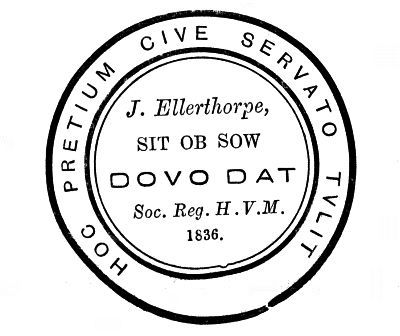
THE MEDALLION OF THE ROYAL HUMANE SOCIETY.
The Medallion bears this inscription:—
ROYAL HUMANE SOCIETY'S THANKS ON VELLUM.
The following testimonial, inscribed on vellum, accompanied the medallion:—