The HERMITAGE
Reading edition
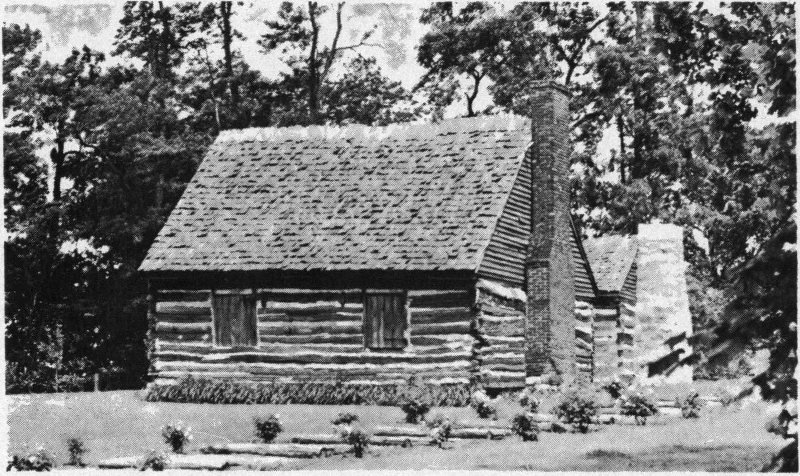
The log cabin located at the northeast corner of the Hermitage grounds is part of the group of log houses which comprised the original Hermitage, where General and Mrs. Jackson resided from 1804 until 1819.
The first home in which Andrew Jackson and Rachel, his wife, lived was at Poplar Grove. This tract of land was bought by Andrew Jackson from Captain John Donelson, brother of Mrs. Jackson, on April 30, 1793, for the sum of one hundred pounds. In the deed its location is described as being “on the south side of Cumberland River in Jones’ Bend ... being the lower end of a survey of 630 acres granted the said John Donelson by patent....”
When the Jacksons returned to Nashville from Natchez in the early autumn of 1791 they made their home with Mrs. Jackson’s mother, Mrs. John Donelson, who lived on the opposite side of the river from Jackson’s property in Jones’ Bend, near the present pike which leads from Nashville to Gallatin. Indian hostilities and the long absences necessitated by Andrew Jackson’s legal business in the courts of both the Cumberland and the Holston settlements, made it impossible for him to leave his bride in the home located outside of the heavily fortified portions of the settlement. Sometime between April 30, 1793, and the spring of 1794, however, a 17 home was built at Poplar Grove and occupied. A letter of Andrew Jackson’s dated May 16, 1794, was headed “Poplar Grove.” Even then Poplar Grove was not safe, for as late as September, 1794, reports to the War Department state that five men were fired upon by the Indians.
On March 7, 1796, Andrew Jackson bought the Hunter’s Hill tract of 640 acres from John Shannon for the sum of $700. The Hunter’s Hill house was located about two miles from the present Hermitage mansion.
A little more than a month and a half after the sale of the Hunter’s Hill property, Andrew Jackson purchased the Hermitage estate. On the twenty-third of August, 1804, he paid Nathaniel Hays $3,400 for the 425-acre tract, “with its appurtenances,” which was to become “The Hermitage.” This reference to appurtenances supports the statement made in later years by Mrs. James K. Polk, wife of the eleventh President of the United States, that the Hermitage of the log cabin period “was not the commodious country house so familiar to devout Democrats in pilgrimages of later years. It was a group of log houses in close proximity to each other. The principal one had been built for a block-house in the days of Indian alarms, afterwards used as a store and, about 1804, converted into a dwelling. It, like all block-houses, was two stories high. Near it were three smaller houses, one story high, with low attics. These were used as lodgings for members of the family or guests.”
Aaron Burr was entertained in these log buildings when he made his famous visits to the Hermitage in 1805 and 1806, and it was to this humble home that General Jackson returned after the Battle of New Orleans (January 8, 1815), which had made him the Conquering Hero and idol of the nation.
Sometime during 1818 the site of the brick mansion was selected and the square house which forms the central portion of the present building was erected. Diligent research by the leading Jackson students of the nation has failed to reveal the exact date or details of the construction of this building. It is generally agreed, however, that it was completed in 1819 and was occupied when President Monroe was a guest at the Hermitage in June, 1819. The Marquis de Lafayette was entertained in this building in 1825, and many other celebrities knew its hospitality. The simple, but commodious 18 home was the center of the 1828 campaign which resulted in electing Andrew Jackson to the presidency of the United States.
In 1831 wings and other improvements were added to the square brick building which had been erected in 1818-1819. At this time the present kitchen and smoke-house were built and the tomb in the garden was erected. Three years later—October 13, 1834—fire destroyed much of the interior and the roof of the building. The present dining-room wing, the kitchen, and out-houses were not burned, however. With the exception of a few large pieces on the second floor, all of the furniture, as well as General Jackson’s valuable papers, clothing, and gifts received after the victory at New Orleans, were saved.
With the rebuilding the gabled roofs on the wings and central portions of the building were changed to their present appearance and the ten rather unattractive columns of the 1831 building gave place to the present stately ones. The interior was also improved. The mansion, as it stands today, was repaired and ready for occupancy by May, 1835. The walls, being sturdily built in the beginning, withstood the fire, making it necessary for only the woodwork and the interiors to be rebuilt.
General Jackson died in 1845 at the age of 78 years, and was buried by the side of his wife in the tomb in the garden.
The Hermitage Farm, of 500 acres, was sold by Andrew Jackson, Jr., in 1856, to the State of Tennessee for the sum of $48,000.
Andrew Jackson, Jr., and his family then left the Hermitage, but, at the invitation and solicitation of Gov. Isham G. Harris, returned in 1860 to become its custodian until further disposition could be made of the property.
The State of Tennessee offered the Hermitage to the United States Government for a branch of West Point Academy, but the Civil War prevented the consummation of the plan.
The family of the adopted son, Andrew Jackson, Jr., remained at the Hermitage during the Civil War.
General George H. Thomas, commandant of the post at Nashville during the Civil War, sent out a detailed guard to protect the place and save it from devastation.
Andrew Jackson, Jr., died at the Hermitage in 1865, leaving his widow, Mrs. Sarah Jackson, and her widowed sister, Mrs. 19 Marion Adams, the sole occupants of the Hermitage. The daughter, Rachel, had married Dr. John M. Lawrence, and all the young men, the sons of Andrew and Sarah Jackson, also those of Mrs. Adams, five in number, joined the Confederate Service. Only one, Col. Andrew Jackson, returned.
The State Legislature allowed Mrs. Sarah Jackson to remain tenant at will, during her life, at the Hermitage. She died in 1888, her sister, Mrs. Adams, having preceded her to the grave. Both are buried in the garden.
Col. Andrew Jackson, III, after serving gallantly as Colonel of Artillery in the Confederate Army, returned, the only surviving soldier of the Hermitage family, a released prisoner from Camp Chase. He remained with his mother during her life and by her will inherited the household furniture, mementoes, and relics of the old hero. Colonel Jackson died in Knoxville, Tenn., December 17, 1906, and was buried in the Hermitage garden by the side of his brother, Capt. Samuel Jackson. Andrew Jackson, IV, son of Colonel and Mrs. Jackson, died in Los Angeles, California, 1953, and is buried in the Hermitage garden. His brother, Albert Marble Jackson, was reputedly lost at sea.
THE LADIES’ HERMITAGE ASSOCIATION
Mrs. Andrew Jackson, III (Amy Rich), conceived the idea of the Ladies’ Hermitage Association. The organizers were Andrew Jackson, III, Mrs. Mary C. Dorris, Mr. and Mrs. William A. Donelson.
On February 19, 1889, Mrs. Rachel J. Lawrence, Mary W. May, Mrs. Mary Hadly Clare, Mrs. E. L. Nicholson, Miss Louise Grundy Lindsley, Mrs. Henry Heiss, and Mrs. Mary C. Dorris applied to the State of Tennessee and were granted a charter incorporating the Ladies’ Hermitage Association. The objects of the Association stated in the charter were to purchase from the State of Tennessee certain land, including the residence and tomb of Andrew Jackson, and to “beautify, preserve, and adorn the same throughout all coming years, in a manner most befitting the memory of that great man, and commensurate with the gratitude of his countrymen.” The General Assembly of the State of Tennessee, on April 5, 1889, conveyed to Trustees for the Ladies’ Hermitage Association 20 twenty-five acres of the Hermitage farm, including the house, tomb, and surrounding buildings.
Dr. and Mrs. J. Berrien Lindsley rendered very efficient service in securing from the State Legislature the original conveyance of twenty-five acres to the Ladies’ Hermitage Association.
The General Assembly of the State of Tennessee (Chapter No. 27, Public Acts of Tennessee, 1923), at the earnest solicitation of the Officers and Directors of the Ladies’ Hermitage Association, conveyed 232⁵/₁₀ acres of the Hermitage farm, located in the Fourth Civil District of Davidson County, Tennessee, to the Board of Trustees for the Ladies’ Hermitage Association, to the end that said Ladies’ Hermitage Association be permitted and encouraged to preserve and beautify same, so as to display the respect, love, and affection which a grateful State and people cherish for their illustrious hero and statesman, Andrew Jackson.
The General Assembly of the State of Tennessee in 1935, by Public Act, conveyed 500 acres of the original Hermitage farm tract to the Board of Trustees to be maintained under the care and custody of the Ladies’ Hermitage Association. The Hermitage farm is now under the supervision of the Ladies’ Hermitage Association for preservation as a perpetual memorial. In 1960 the Association acquired 125 acres adjoining the north boundary as protection against future industrial or housing developments, bringing the total acreage to 625.
The furniture and relics were in the Hermitage at the time of the organization of the Ladies’ Hermitage Association in 1889, and Col. Andrew Jackson gave the Association an option upon them. But failing to raise the necessary money after four years’ trial, the entire collection of relics and furniture was removed in 1893 by the owner, Col. Andrew Jackson, to Cincinnati, where he had them on exhibition for pay. This venture was not a success, so they were returned to Nashville. From this collection and from various members of the family and others, the Association has bought the relics it now owns, that so beautifully adorn the residence where they first were placed.
The Association in its early years put forth untiring efforts to raise the funds necessary to restore the mansion and collect the original furnishings and relics. It inaugurated various enterprises, such as lectures, concerts, balls, etc.
21
President Theodore Roosevelt visited the Hermitage, October 22, 1907, and in a speech then promised government aid. He incorporated the matter in his annual message, and as a result and through the efforts of Senator James B. Frazier and Congressman John W. Gaines, both of whom were trustees, Congress made an appropriation of $5,000 to repair and improve the Hermitage. The present sources of revenue are admission fees, souvenir shop sales, and Association membership dues.
The collection of relics and furniture now in the house is the result of years of effort of the Ladies’ Hermitage Association. It is interesting to note, in this connection, that the Hermitage is the only great National Shrine in this country having original furnishings throughout. All furnishings in the house originally belonged to General Jackson, with the exception of a few articles which, in each case, are noted in the catalogue.
In 1961, the National Park Service of the U. S. Department of the Interior designated the Hermitage as a Registered National Historic Landmark.
For forty-five years following the opening of the Hermitage to the public, Mr. and Mrs. T. L. Baker served as careful and dedicated custodians of the buildings and grounds. They were succeeded by their son, Andrew Jackson Baker, who was born at the Hermitage, and his wife, and it is due to their continued dedication and interest that the Hermitage has maintained its reputation as the nation’s best-kept shrine. Due to ill health, Mr. Baker resigned in 1963.
The present custodian is Steve S. Lawrence.
ANDREW JACKSON CHRONOLOGY BY W. B. MARR
1767 March 5 Born near the line between South Carolina and North Carolina.
1784 Fall Began study of law.
1787 May Admitted to practice law in North Carolina.
1788 August 2 Duel with Colonel Waightstill Avery at Jonesboro.
1788 Spring Appointed public prosecutor for territory south of Ohio River.
1791 August Married Mrs. Rachel Donelson Robards at Natchez, Miss.
1796 January 1 Member first constitutional convention of Tennessee.
1796 Elected representative In Congress from Tennessee.
1797 November 2 Appointed by Governor Sevier Senator from Tennessee, succeeding William Blount, resigned.
1798 June Resigned from Senate.
1798 Elected member of the superior court of law and equity.
1801 Elected major-general of Tennessee militia.
1804 Moved from Hunter’s Hill to log house, original Hermitage.
1804 July 4 Resigned from superior court.
1805-6 Entertained Aaron Burr.
1806 May 30 Duel with Charles Dickinson.
1809 Nephew of Mrs. Jackson adopted, named Andrew Jackson, Jr.
1812 June 5 Offered services of Tennessee Volunteers to the United States Government in the War of 1812.
1813 January 7 Started for New Orleans with Tennessee Militia.
1813 February 15 Arrived at Natchez.
1813 March 25 Started home from Natchez.
1813 April 22 Returned to Hermitage.
1813 September 4 Wounded in affray with Thomas H. and Jesse Benton.
1813 October 11 Started with his command for the Creek War.
1813 November 3 Battle of Talluschatches, Creek War.
1813 November 9 Battle of Talladega, Creek War.
1814 January 22 Battle of Emuckfau, Creek War.
1814 January 24 Battle of Enotocopco, Creek War.
1814 March 27 Battle of the Horseshoe, Creek War.
1814 April 19 Appointed Brigadier-General United States Army.
1814 May 1 Appointed Major-General United States Army, Vice William Henry Harrison, resigned.
1814 August 10 Had treaty with Creeks signed.
1814 September 9 Started first Florida campaign.
1814 December 2 Arrived at New Orleans for the defense of the city.
1814 December 16 Declared martial law in New Orleans.
1814 December 23 First battle in defense of New Orleans.
1815 January 1 Second battle in defense of New Orleans.
1815 January 8 Won battle of New Orleans.
1815 March 5 Caused the arrest of Judge Dominick A. Hall, United States District Judge at New Orleans.
1815 March 13 Abrogated martial law at New Orleans.
1815 March 24 Fined $1,000 by Judge Dominick A. Hall for contempt of court, which Jackson paid the same day, and which was refunded by Congress with interest in 1842.
1815 May 15 Arrived at Nashville from New Orleans.
1817 December 26 Entered upon second Florida campaign.
1818 April 28 Caused the execution of Arbuthnot and Ambrister.
1819 February 8 House of Representatives in Congress sustained Jackson’s conduct in the Florida campaign.
1819 Jan. and Feb. Visited eastern cities.
1819 February Spain ceded Florida to the United States.
1819 Built Brick Hermitage.
1821 Appointed by President Monroe governor of Florida.
1821 May 31 Resigned from the army.
1821 July 17 Took possession of Florida as governor, and it became a territory of the United States.
1821 October Resigned as governor of Florida, and returned to Hermitage.
1822 July 20 Nominated for President by the Legislature of Tennessee.
1823 Offered and declined mission to Mexico.
1823 October Elected to the United States Senate from Tennessee.
1823 Contributed major part of funds for building Presbyterian church in Hermitage neighborhood.
1824 March 4 Nominated for President by the Pennsylvania convention.
1824 November 4 Received plurality of electoral votes for President.
1825 February 9 Defeated for President in the House of Representatives in Congress by John Quincy Adams, who received the vote of thirteen states, Jackson seven, William H. Crawford of Georgia four.
1825 Lafayette visited the Hermitage.
1825 October Resigned from the United States Senate.
1825 October Renominated for President by the Legislature of Tennessee.
1826 or 1827 Communion Sunday, date uncertain, promised Mrs. Jackson to join the church when out of politics.
1828 November Elected President of the United States.
1828 December 22 Death of Mrs. Jackson.
1829 January 17 Left Hermitage for his inauguration.
1829 March 4 Inaugurated President.
1830 April 13 Offered toast: “Our federal union, it must be preserved,” at Jefferson’s birthday dinner.
1830 December 7 Recommended that the Southern Indians be removed to the Indian Territory.
1831 Two wings added to the Hermitage.
1832 July 10 Vetoed bill re-chartering the Bank of the United States.
1832 November Re-elected President of the United States.
1832 December 10 Issued proclamation to nullifiers of South Carolina.
1833 June 26 Harvard College conferred the degree of LL.D.
1833 September 23 Ordered withdrawal of deposits from the Bank of the United States.
1834 Hermitage damaged by fire; repaired. No changes since.
1834 March 28 Censured by Senate by resolution for removing public deposits from the Bank of the United States.
1835 December 29 Treaty with the Cherokee Indians for their removal to Indian Territory.
1835 January 8 Proclaimed the payment in full of national debt of the United States.
1837 January 16 Resolution passed in the Senate expunging the resolution of censure of 1834.
1837 March 4 Issued farewell address to people of the United States.
1839 Became a member of the Presbyterian Church near the Hermitage.
1840 January 18 Visited New Orleans.
1845 June 8 Sunday, at 6 P.M., died.
1845 June 10 Buried by the side of Mrs. Jackson at the Hermitage.
23
The Carriage House
In 1897, Col. Andrew Jackson, from whom most of the relics were purchased, sold to the Association the interesting old coach used by Jackson at the White House for state, ceremonial, and social purposes and for several trips to the Hermitage. The trip to the Hermitage took thirty days’ time. His journeys were a continual ovation.
The skeleton of the phaeton is all that is left of the beautiful vehicle presented to General Jackson by the “Democratic-Republican” citizens of Philadelphia. It was made from timbers taken from the old ship Constitution. The phaeton in which General Jackson rode with Martin Van Buren to the latter’s inauguration was damaged by fire in Cincinnati, where the Jackson relics were stored before being acquired by the Ladies’ Hermitage Association. (Photograph is on wall.)
Stone doorstep in front of carriage house was presented to Col. W. W. Parks by General Jackson. Given to the Ladies’ Hermitage Association by his granddaughters, Misses Annie and Grace Handly.
Display boards on the walls show photostats of the Library of Congress letters of Rachel Jackson, personal accounts of life at the Hermitage taken from letters and histories, and pamphlets relating to the life and times of President Andrew Jackson, presented to the Hermitage by C. Lawrence Winn, great-grandson of Andrew Jackson, Jr.
Anvil, used in shoeing General Jackson’s race horses.
Carpenter’s plane, said to have been used by William McCreary in building the Hermitage. Given by Stanley F. Horn.
The Museum
The brick house now used as a museum, which was restored and built on the original foundation, was formerly used for house servants. This is the only piece of restoration on the grounds, the brick having been made on the Hermitage grounds years ago.
24