A Novel by GEORGE O. SMITH (continued 2)
Reading edition
He was received graciously. Her father was a tall, distinguished man with a dab of gray at the temples and a rather stern face that became completely friendly whenever he smiled, which was very frequently. Carolyn's mother was tall and dark with only a sprinkle of gray; Carolyn's stature seemed natural in that tall family. The brother was not present, which made it completely easy for Farradyne who could not have given any account of his friendship for the unknown Michael.
Mr. Niles mixed a pitcher of martinis and inquired about the spaceman business. Farradyne explained how it was. Mrs. Niles laughed at his story about fish one day and fins the next and said that she thought it couldn't be that bad, really. Farradyne grinned. Mr. Niles observed that a man who can operate a spacer and pay off a mortgage on the craft must not be entirely penniless or without prospects.
Mrs. Niles added, "I suppose it takes money to operate, Mr. Farradyne."
"A fair amount. A spaceman begins to think in large figures so much that he wonders how he can get along on a more humanly reasonable amount. To clear a reasonable standard of living, a rather staggering amount of money comes in one hand and goes out the other. Operating expenses are high, but so are charges."
"But do you land on Mercury often, Mr. Farradyne?"
Farradyne smiled. "Perhaps less frequently in the past than in the future."
"Now, that's sheer flattery," laughed Carolyn.
"Better enjoy it," observed her father with a chuckle. "Charles, you are welcome here any time you land."
"Thank you," smiled Farradyne. "But all things considered, I should think that you'd take a dim view of any man that brought your daughter home wearing a gardenia."
"Gardenia—oh. You mean that it might be—" Mr. Niles laughed. "I think that Carolyn has enough judgement to take up with the right kind of young man, Charles."
"Of course," said Mrs. Niles. "Robert and Michael wouldn't stay friends with the wrong kind."
"So, you see?" laughed Mr. Niles.
"By the way," asked Mrs. Niles, "how is Michael?"
"Quite well, the last time I saw him," said Farradyne, knowing that this was the right thing to say at any time.
"You're sure?"
"Of course."
"I'm very happy to hear it," said Mrs. Niles. "We knew he was with you, but we didn't know how long he stayed."
Farradyne gulped imperceptibly, and hoped that they did not notice. "You did? Then he must have mentioned me."
"Oh, he did. Tell me, Charles, what happened to Michael?"
"Did something happen to him?"
Mr. Niles eyed Farradyne rather pointedly. "Mike took off with you from Mars. He did not land at Denver, Mr. Farradyne. So what happened to Mike Cahill?"
Farradyne gulped, and this time it was a full-throated gulp that left him with his Adam's Apple high in his throat. Carolyn cooed, "Yes, Charles, what happened to Michael Cahill?"
XII
Farradyne felt a muscle-loosening tingle of fear. His thinking mechanism stopped functioning. His mind buzzed with a frenetic insistence that he say something, but being so completely unprepared he could not say anything. And he dimly knew that his long speechlessness was as damning as any story he could have prepared after such a pause. Perhaps he would have been stunned short this way even if he had concocted some story on the offhand chance that someday the question might come up. But it had come like this, from an unexpected quarter and he was both shocked and unprepared.
Then it occurred to him that he need not say anything. The die had been cast and he stood accused, twice; once by the Niles Family and once by his own shocked reaction. He must act for the next moment, because the passed moment was irreparable. Farradyne laughed at his own simplicity—a brief scornful bark.
"What is funny?" asked Mr. Niles.
"It just occurred to me that you people are either innocent or guilty."
"Very sage," commented Niles, drily. "Now, what happened to Cahill?"
Farradyne leaned back, trying to relax. He took a sip of his martini, not that he wanted it, but to see if his hand were still trembling. It wasn't.
He said, "If you knew Cahill and his whereabouts, you also know quite a bit about me. You'll have heard that I was recognized in a bar on Ganymede by a woman named Norma Hannon, who is a love-lotus addict. She hated my guts because her brother was among those present when I had the accident in The Bog. She hung onto me for the emotional ride it gave her. I succeeded in locating the home of her parents and was going to take her home when I met Cahill. He came along. Then during the night, he made a pass at Norma, and she shot him for it. I put his body out through the scuttle port."
"Cahill was always a damned fool," nodded Niles. "He was a dame-crazy idiot and it served him right. Some men prefer money, power, or model railroads, Farradyne. Women are poison."
"I seem to have followed one of them like the little lamb," said Farradyne. "But I was picked up and brought here for a purpose, so let's get down to cases."
"You're a rather quick-on-the-trigger man, aren't you? What gives you to assume that this purpose was anything beyond finding out about Cahill?"
"Because you've tipped your hand," said Farradyne, feeling more at ease. "You could have accomplished the same thing by tipping the police and waiting for the case to be newscast. If Cahill admitted to hellblossom running, it was for a purpose, too, Niles."
"Please. Mister Niles. I'm a bit your senior, Farradyne."
"All right. Mr. Niles. I've learned one thing so far: I can tell a love lotus operator from the rest of the system."
"How?" They all leaned forward eagerly.
"Because it is the real operators that take an amused view of my alleged machinations. They know the facts."
"Very sage. You are a bit brighter than you appeared a moment ago."
"May I ask why you let me cool my heels for almost a month before you hauled me in?" He looked at Carolyn with a wry smile. "I would make a mild bet that you weren't more than a few hundred feet from me all the while."
"You're a blind man, Farradyne," she said.
Mr. Niles smiled knowingly. "There are a lot of unexplained items in your past, Farradyne. We never could be too sure that you were not a Sandman. So we've been checking up on you and for that angle you are clean. Then comes the question of Cahill. It might be that you thought turning in a love-lotus operator would help to smoothe your lot in life, mayhap get you a bit of reward. So we waited. No Cahill. Cahill started to bring you here; he would have turned up either with you or without you. Unless he were dead. You would know the answer."
"No more than I've told you. Cahill came and made me a sort of sidelong offer."
"That much of it rings as true as the other. But there are still holes in your story."
Farradyne nodded. "Let's put it this way: There are ways of getting money and things. I found one way, which is an obvious fact. But I've been told time and again that the first entering wedge to a full confession is a willingness to talk. Do you follow me?"
"I do. But—"
Farradyne smiled. "I don't care to face it. Not in company, Mr. Niles." Farradyne's emphasis on the 'Mister' was heavy with sarcasm.
Niles looked at him piercingly. "You are a bit belligerent and a trifle sure of yourself. Close-mouthed and apparently able to get along. You'll be out on a lonely limb for some time, Farradyne, but we can use you."
"I can use the sugar," said Farradyne.
"Naturally. Anybody can use money. In fact everybody needs money, and so, Farradyne, what visible means of support have you?"
"I've a subcontract. Once each month I'm to lug a load of thorium refines from Pluto to Terra."
"It's a start but it isn't enough."
"I'll pick up more."
Niles leaned back and put the tips of his fingers together pontifically. "One of the hardest jobs in this business is to justify your standard of living. The financial rewards are large and the hours involved are small. It is patent that a man who has not been granted a large inheritance, or perhaps stumbled on a lucrative asteroid, cannot live in a semi-royal manner without having to work in a semi-royal fury. One of the great risks in this business is the accepting of a recruit whose appearance causes discussion. The day when a man can build a fifty thousand dollar home on a five thousand dollar salary without causing more than a raised eyebrow is gone. If a man has a large income, he must appear busy enough to warrant it—or at least provide a reasonable facsimile."
"This I can understand."
"For a job like this," Niles went on, "we prefer the natural-born spaceman, with sand in his shoes or space-dust in his eyes. Because the man with a bad case of wanderlust always looks busy even when he is idling. You seem to be that sort, but we can never tell until it's tried. Unless, of course, you turn out to be woman-crazy."
"I'm a normal-enough male," said Farradyne. "I'll remind you that Cahill was the guy who tried and failed."
"How normal are you? We'd have less liking for a misogynist than for a satyr here."
Farradyne smiled serenely. "I had enough sense to keep my hands off Norma Hannon, but I have enough red blood to come home with Carolyn. That good enough?"
Niles thought a moment. "Could be. Anyway, we'll find out. We'll try it and see. Now, when do you go to Pluto?"
"I've some schoolteachers to haul out there tomorrow."
"Good. Gives you a good background, without much labor. Now, when you land on Terra, you'll not post your ship because you have already contracted for a job. Carolyn will be there on a business trip and will have chartered your ship for a hauling job back to Mercury. During this trip you will get some more details on how you are to operate. This much I will tell you now, Farradyne: you'll be an inbetweener. Advancement may come fast or slow, depending on you. You'll get the details later; as for now, however—" Niles leaned back in his chair and smiled. "Farradyne, you met my daughter in a cocktail lounge and several people heard the two of you planning an evening together. So you will go dancing and dining and from this moment on you will be Charles and I will be Mister Niles and we'll have no nonsense, understand?"
Farradyne nodded.
"Good. Now, let's have another martini while Carolyn dresses for dinner."
Niles poured. Carolyn disappeared. Mrs. Niles leaned forward slightly and asked, "Charles, why did you become a spaceman?"
Farradyne blinked. His impulse was to ask in turn why they had become hellflower operators. He stifled the impulse because there was something strangely odd about this set-up. Her question was quite normal to the background she appeared to fill as matron of a happy, successful family.
The aura of respectability extended far, to include the home and its spacious grounds, so that Farradyne burned with resentment at the social structure whereby he, who had committed no more than a few misdemeanors, should be less cultured, less successful, less poised than this family of low-grade vultures. If anything, the attitude of Mrs. Niles shocked him more than the acts of her husband. Men were the part of the race that played the rough games and ran up the score while women occupied one of two positions: they were either patterned after Farradyne's mother or they were slatterns and sluts who looked as well as acted the part. It offended Farradyne's sense of proportion that Mrs. Niles was gracious and well-bred instead of being loud and cheap.
Farradyne labeled it a form of hypocrisy and yearned to pull the pedestal out from under them and dump them into the mud where they all damn well belonged.
Farradyne matured a bit in those few moments of thinking. He had often wondered why a clever man like Clevis would work at a dangerous, thankless job in complete anonymity when he could have put his efforts into business and probably emerge wealthy and famous. He began to understand the personal gratification that could be his in working to rid the human race of its parasites. In Niles' own words, some men like money and some want power and others build model railroads; neither money nor power were god to Farradyne, who had always been restlessly happy with just enough money and power to exchange for the fun and games to be found in being alive.
Farradyne was just discovering the threshold of a new outlet for his wealth of nervous energy, and he looked forward to it eagerly.
Blandly, he started to outline a semi-humorous tale of his life and adventures to Mrs. Niles, exaggerating his own early fumblings in a casual way. She listened with amused interest, just as any mother might use in hearing the background of a young man who was interested in a daughter.
But in the back of Farradyne's mind was the niggling fear that he would not be able to act the part of convincing suitor to the girl whose background, attitude, and character he detested. He knew that a man can lie in his teeth and play the role of spy convincingly, but he believed that the truth of his feelings would be evident when it came to making love to the enemy.
And then Carolyn came down the stairs in a white strapless evening dress and Farradyne changed his mind. It was going to be extremely easy for him to put his personal attitudes in a small compartment of his mind and slam the door.
"You've got to dress too, Charles," she said in a soft voice. It was low and intimate, unlike a woman of her type.
He nodded and got up.
Carolyn tucked her hand under his elbow and gave a little squeeze; the last image of Norma Hannon's lackluster eyes faded out of his mind and Farradyne became the man his role so urgently demanded.
XIII
In the salon of the Lancaster, Farradyne smiled knowingly. "The plan was to let you investigate the ship while I dressed," he said. "But I gather that you've seen you share of spacers."
"I admit it," she replied. "For that I'm sorry, Charles."
"Well, park yourself somewhere while I get into whites."
She sat down and stretched. "A highball and a cigarette?" she asked.
"The cigarette is easy," he said, handing one to her and flipping his lighter. While she puffed, he went on, "But the highball may be more difficult. I've nothing but White Star Trail aboard."
She nodded at him. "With water," she said. She relaxed into the cushions. Farradyne went and mixed her highball. She sipped it and nodded approvingly. He turned to go.
"Charles?"
He stopped. Carolyn put her glass on the tiny tray and parked her cigarette. She rose and came forward, lifting her hands to put them on his shoulders. He stood woodenly. "Charles," she asked in a soft voice, "Are you unhappy because I am not the girl you hoped I'd be?"
"How many men have you played this role for?" he asked.
Carolyn smiled, a wry smile that twisted her face. "I should slap your face for that," she said. "Because when I tell you the answer you won't believe me."
Caution came to him. He was the rookie hellflower operator, not the young man who has discovered that his girl has been playing games behind his back. He tried to fit himself into her picture and decided that according to her code of loused-up ethics she might possibly be thinking of a future: a pleasant home with rambling roses and a large lawn and a devoted husband and maybe a handful of happy children all creating the solid-citizen facade for dope running, just as her parents were doing. If this were the case, Farradyne must carry roses for his wife in one hand, toys for the kids in the other, and his hip pocket must be filled with hellflowers.
He played it. He relaxed and put his hands on her waist. "I admit to being a bit of a louse," he said, with a brief laugh. "But that's because I'm a bit new at a very rough game."
She leaned forward a bit. "Even rough games have their rules."
"I'll play according to the rules—as soon as I learn them."
She looked up at him. "You know them," she said quietly. "All men and women learn them at home, in school, in church. They're sensible rules and they keep people out of trouble, mostly. If you adhere to the rules, people will have nothing to attract their attention. That's what father was trying to say when he suggested that you provide a visible means of support for yourself. Play by these rules and we'll get along. It's especially important when we must not have people looking in our direction, Charles."
She sighed and leaned against him softly. "You asked me a question. The answer is three. One of them preferred a blonde and they are living quietly and happily on Callisto. The second couldn't have jelled because he was the kind of man who would work eighteen hours a day. Some men are that way and some women like it that way, but not me. The third, Charles, was Michael. Mike didn't last long. Only long enough to prove to me that he was a woman-chaser. The fourth could be you, and maybe there mightn't be a fifth."
"Three men in your life," he said.
She smiled up into his eyes. "Three men in my life—but, Charles, not three men in my bedroom." Carolyn cocked an eyebrow at him knowingly. "The only way the fourth will get in is to make sure there won't be a fifth. So now you know. You can play it from there."
His arms did not slip around the slender waist, but the hands pulled her close to him. He kissed her gently, and for a moment she clung to him with her body. Her response was affectionate but only bordering on passion. Then she leaned back and smiled into his face. "You need a shave," she told him. "So let go of me until you can kiss me without scratching." Then to prove that she didn't really mean it, Carolyn kissed him, briefly, and ended it by rubbing her forehead against his chin.
Farradyne went to his stateroom and showered. He shaved. He dressed carefully in white slacks and shirt and the last remaining holdover from a Victorian period, a dark necktie. He returned to the salon to find Carolyn finished with her highball and cigarette and waiting for him calmly and patiently. She looked him over, then got up and rubbed her cheek against his and cooed pleasantly, but moved away when he tried to kiss her.
She tucked her hand under his elbow and said, "Dinner, man-thing."
Farradyne chuckled. "Dinner," he repeated.
She hugged his arm. He led her down the landing ramp and into her car, and at her direction drove to her choice of a dinner spot. The food was good. Carolyn was a fine dancer with a high sense of rhythm and a graceful body. Farradyne decided that if this were a thankless job that gave no chance for fame and fortune, there were plenty of very pleasant facets to it. Her shoulder rubbed his as he drove her home hours later.
He handed her out of the car and walked to the front door with her. She gave him her key and he opened her door and she walked in, to wait for him just inside. She came into his arms as the door closed behind them and she clung to him, returning his kiss and his embrace; matching his rising fervor with a passion of her own. They parted minutes afterward. Farradyne moved her slightly, settling her body into a more comfortable fit against him.
"It's late," she breathed.
Farradyne chuckled. "With the sun shining like that?"
She kissed him, amused. "It's always like that, silly. You're on Mercury, remember?"
Farradyne held her close and kissed her again. A minute passed before he came up for air. He looked down at her, leaning his head back so that he could see her face without looking cross-eyed. "I'll bet you're a real mush-face in the dark."
Carolyn laughed, and shook her head. "Like all the rest of the women on Mercury, I'm scared to pieces of the dark. But it's late, Charles, and you've just got to go." She hugged his head down so that she could look at her wrist watch on the arm about his neck. "It's five o'clock and you're to take off at nine. Charles, please don't crack up just because of lack of sleep."
"Okay," he said regretfully. "Okay."
She held him close. "It's been a nice evening, Charles. So kiss me good bye, and remember that it won't be long until I see you on Terra."
"It gets dark on Terra," he told her. He tightened his arms and she pressed against him.
Against his lips she murmured, "I might not be afraid of the dark—Charles."
The promise in her last embrace stayed with him. There were only three hours of sleep between the time he left her and the time of awakening to prepare for the take-off, but dreams of Carolyn filled all of them. They were pleasant dreams and unpleasant dreams; he saw Carolyn coming to him with her past renounced, he saw her coming to him as a secret agent who was in the hellish business for the same reason as he was. And he dreamed of her waving him a good-bye with her dark eyes filled with tears as she was taken off to the Titan Penal Colony. He even entertained notions of joining them, justifying himself by thinking that people who fall in with love-lotus addiction were the weaklings of the human race anyway, and could be eradicated to good advantage of the general level. This reasoning he recognized as sophistry.
But be it as it may, Carolyn was an attractive woman, and if her companionship could only be known for a very short time, it was none the less pleasant. It was a rough game they were playing and many people were bound to get hurt. But more people—innocent people—would get hurt if he called it off. So by the time Farradyne and his dreams came to the conclusion that he could afford to take what pleasure out of life this situation offered for the moment and let Tomorrow exact its tribute when Tomorrow came, it was time to get out of his bed and start the pre-flight check-off.
He had work to do. Schoolmarms to haul to Pluto and some refined thorium ore to bring to Terra. He would make no signal this trip; he was still far from being on the inside. Maybe the next. Or the one after that, depending on his progress. But in the meantime, he would be seeing Carolyn Niles on Terra.
Farradyne began his check-up, already anticipating the reunion.
XIV
Farradyne watched them carefully as they came aboard and after he had seen them he breathed a sigh of relief. There was something prim and straitlaced about them all, and they would give him no trouble. It was going to be a breeze.
There were a few whose faces and names correlated; the rest became a confusing background of nonentities, uninteresting and bland. Professor Martin was an elderly gentleman who herded them all into place efficiently, and who knew enough about spacing to handle the job. He took over and left only the running of the Lancaster to Farradyne. There was a Miss Otis who giggled like a fifty year old schoolgirl; a Mrs. Logan who probably had all of the boys in her class drooling; a Miss Tilden who was old enough to be Farradyne's mother and a Miss Carewe who was old enough to be Miss Tilden's mother and who also knew her way around space, apparently. Miss Higginbotham was the she-dragon type and Mr. Hughes was the know-it-all type.
He left them alone. They ran the galley and policed the joint and made the beds, and one of them made a small water-color to hang in the empty space over the tiny bar and Miss Carewe requested an oilcan because she hated squeaky doors.
Beyond that, Farradyne saw little of them. He used his spare time tinkering down in the tiny workshop, or demonstrating how the atomic pile was controlled by the damper rods.
He was happy and free from care, even though the bunch of them took over the more comfortable parts of the ship and left him only the control room above and the lower reaches of the ship, below the salon and the passenger's cabins.
He sat for long hours, thinking idly. He was lulled by the noises of the ship itself; the faint sound of metal on metal, an occasional groan of a plate or the creaking of a point. The moaning cry of a motor winding up to take care of some automatic function and the click and clack of relays and circuit breakers and the peculiar hum of the servodynes that maintained the correct level of pile activity. The muted sibilance of the reaction motor created a threshold level of something like a constant heavy exhalation or the sound of seashore from a distance.
And then a few hours before turnover there came another sound that bothered Farradyne. It was a faint ringing in his ears.
He knew that ringing in the ears can come of too much alcohol, a box on the side of the head, certain diseases—or a change in air pressure. He was healthy, had not been drinking, no one had clipped him; but he had spent a number of years in an environment where the air pressure was damned important—
He sneezed and brought forth a tiny trickle of blood!
He couldn't believe it; any such change in air pressure would make alarms ring like the crack of doom all over the ship and there would be a lot of activity from the air-pressure regulators.
He hurried aloft to the control room, pausing briefly to listen to the snoring along the curved corridor of the passenger's section.
Lamps told him the story in a series of quick appraisals, because of some long-forgotten genius who had insisted that, whenever possible, warning devices should not be fused, should not be turn-offable, should not be destructible. The Lancaster was a fine ship, designed well, but a frontal attack on a panel with metal-cutting tools consists of making the exception to the 'wherever possible' part of the design of warning signals. The ship's bell-system had been opened like a tin can.
But there was another warning system: the pilot-lamp system, which was strung here and there behind the panels and it would have needed a major overhaul to be ruined; the saboteur would have spent all night just opening cans instead of doing his dirty work inside them. Farradyne should have been asleep; then he would not have noticed the blazing lamps, which told him exactly what was amiss in the ship, and where.
They told him the tale in a glance:
The low-pressure center of the ship was down in the pile-bay, and the reason was that one of the little scuttle-doors was open. The pressure in the reaction-mass bay was low, and now that Farradyne had come aloft, opening the upper levels, the pressure here was as low as down in the reaction-mass bay.
As he watched, another one of the scuttle ports swung open and its warning lamp flared into life.
Farradyne went into action. He ripped open the cabinet that held his spacesuit and clawed the thing from its hook. He started down the stairway on a stumbling run, getting into the suit by leaps and jumps and pauses. He realized that he could have moved faster if he stopped to do one thing at a time, but his frantic mind would not permit him to make haste slowly. He stumbled and bounced off walls, and the tanks on his back rapped against his shoulder blades and the helmet cut a divot out of the bridge of his nose.
He had zipped up the airtight closures by the time he reached the little workshop, and he ducked in there to get a weapon of some sort. He reached past the hammer, ignored the obvious chisel because it was not heavy, even though it were sharp, and picked up a fourteen-inch half-round rasp. He hefted it in his gloved hand and it felt about right.
The air-break on the topside was still open, and Farradyne closed it. He fretted at the seconds necessary to equalize the pressure, but used them sensibly to check the workings of the space suit. He also located the cause of the air-leakage; normally the air-break doors were airtight. A sliver of wool or cotton string lay in the rubber gasket and produced a channel for the escape of some of the air into the pile-bay. Farradyne stooped, as anyone will, his attention attracted by this trifle. It was neither wool nor cotton, but a match torn from a giveaway book.
He threw it aside and went in, his attention once more on the important business before him. He ran along the curved corridor—
And there, a figure in a spacesuit was quietly levering one of the control rods out of its slot and preparing to hurl it into the void.
Farradyne understood the whole act in one glance; it was the sort of thing that he would do if sabotage had been his intention. The single scuttleport had been opened first by hand. Then the saboteur had scuttled the stock of spare control rods, and since the Lancaster was reasonably new, there had been quite a batch of them. Furthermore they were long, unwieldly, heavy things that took time to handle. Naturally, this was the first act, because the next act would cause the ship's acceleration to rise. The rise in acceleration would make the rods too heavy to carry and would also cause investigation as soon as people became aware of the increasing pressure.
Then the working rods would be hurled out, leaving the ship heading hell-bent out of the galaxy at about eight gravities of acceleration. The passengers and crew would be helpless.
Maybe two or three rods had been scuttled already. The rest, functioning on the automatic, would be shoved in further to compensate; Farradyne could feel no change in the acceleration pressure. But once the working rods were all the way home, the removal of the next would cause the ship to take off, literally, with the throttle tied down. Farradyne was willing to bet the rest of his life that the safety-valve that furnished the water-mass to the pile was either welded open or damaged in such a way that supply could not be stopped.
Then—and Farradyne had to admire his precautions—the vandal would make his way to the escape hatch, hit the void, and let the helpless passengers go on and on and on.
The saboteur was well prepared. His suit was a high-efficiency job capable of maintaining a man alive for a long time in space. It had a little radio and a small and expensive chemical motor for mild maneuvering. The man had friends, obviously, lying in wait out there ahead, who would pick him up.
A passel of ice-cold-blooded murderers.
Farradyne saw the man through a red haze that clouded up over his eyes. His evaluation of the act was made in a glance, in the bare instant that it took for Farradyne to see the man and then get his feet in motion. He plunged forward with a bellow that hurt his own ears.
The airlessness kept the sound in; the killer was not aware of Farradyne until the heavy file crashed down on the top of his helmet, putting a half-inch dent in the steel.
XV
The man whirled and sent a heavy-gloved hand back against Farradyne's face-glass. Farradyne lifted the file for a second swing and caught the gleam of a heavy knife just as it swung upwards at his face. The blade jabbed at the face-glass and blunted slightly before Farradyne's eyes. The glass crazed, clouding Farradyne's vision.
Farradyne's second swing caught a shoulder-pad and sent the man staggering back; the knife came up again and the gleaming edge sliced space close to Farradyne's arm. The man stumbled and fell, and Farradyne moved forward. The long lever used to handle the radioactive control rod chopped against his shins and cut his feet out from under him; he landed on his face in position to let the other man kick out with heavy spaceboots. The heels rammed Farradyne's helmet hard down into the shoulders and the top of the helmet hit the top of Farradyne's head, stunning him slightly.
The other scrambled forward and landed on Farradyne's back. He pulled up and back on the fittings of Farradyne's helmet until the pilot's spine ached with the tension. Then the man thrust forward and slammed Farradyne's face down on the deck. The safety glass cracked further and there came the thin, high screech of air escaping through a sharp-edged hole.
Farradyne lashed out and around just in time to parry a slash of the knife. Blade met file in a glint of metal-spark and both weapons were shocked out of and gloved hands to go skittering across the deck.
The man left Farradyne to scrabble across the floor after his knife. Farradyne jumped to his feet, took three fast steps and leaped to come down with both feet on the man's back. The other collapsed and Farradyne fell, turning his right wrist painfully underneath him. The other made a kick that caught Farradyne in the side, turning him over. And as Farradyne rolled, his bent hand touched hard metal and he came up out of the roll clutching a heavy pair of spaceman's repair pliers.
He faced the killer, standing again, armed again; spaceman's pliers against assassin's knife. He plunged forward and felt the knife bite against his suit; he swung the pliers as a club and caught the killer's upper arm, then opened the jaws and bit down, twisting and pulling.
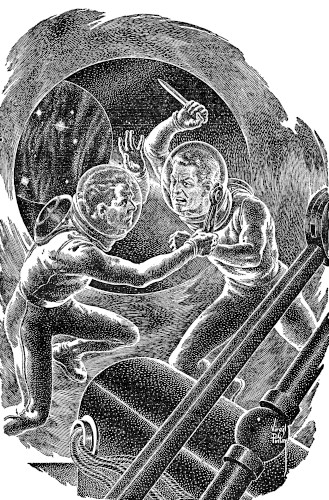
The spaceman's pliers were pitted against the assassin's knife.
A three-cornered patch ripped and came away between the jaws as the heavy outer cloth gave way. The knife came up and bit through Farradyne's suit across the knuckles of the hand that held the pliers. Farradyne kicked, sending the killer staggering, and followed him, probing at the tear to get at the thin inner suit beneath. The other man struggled, hurled Farradyne away; but when Farradyne staggered back, it was with the thin lining between the jaws of the spaceman's pliers. The other's suit ripped and there came a puff of white vapor as the air blew into the void.
The struggling killer stopped as though shocked by an electric current; he stood there stiffly, his hands slowly falling to his sides, limp. Farradyne took a step back, breathing heavily.
He could see, now that his head was not jerking back and forth behind the cracked glass. He peered, in time to watch the froth of blood foam out of Hughes' nose.
Hughes!
Farradyne wondered whether Hughes had cried out in a polytonal voice—
He hauled Hughes into the air-break and slammed the door shut. He valved air into the break and ripped Hughes' suit off. He felt for a pulse and found one fluttering; he turned Hughes on his face and pumped on the ribs in, out, in, out, wondering whether he was wasting his time.
Hughes groaned painfully. His voice echoed and re-echoed in the tiny air break, but Farradyne could not hear more than the groan of a man badly hurt. Hughes stirred and opened one eye halfway. Then he closed it again and moaned under his breath. Farradyne checked the heart and found it beating weakly; the pulse was not fluttering any more, and the breath was coming naturally, even though the man's chest heaved high and dropped low and there was a foghorn sound in the throat as he gasped huge lungfuls of air.
Hughes would give Farradyne no trouble for some time. He carried Hughes to his stateroom and stretched him on the bed. Then he went below and closed the little hatches and reinserted the control rod, wondering again whether missing a few would louse-up his landing.
He went to the control room and replaced the wiring torn out of the audible-alarm panel. The phalanx of warning lamps had winked out, and the clangor of danger did not sound.
Farradyne went back to Hughes' stateroom. "Can you hear me?" he demanded.
Hughes awakened slightly. He looked up, his eyes dim but aware.
"You're a back-biting s.o.b.," snapped Farradyne. "And I'd have let you die if it hadn't occurred to me that you might be good for some information. What makes, Hughes?"
"Wiseacre," came from Hughes' lips in a whisper.
"What's the game, Hughes?"
"I don't know what—you're talking—about."
"I can break all your fingers and slip a hot soldering iron under your armpits until you yelp loud and clear."
"You'd better kill me, then," breathed Hughes. "Because you aren't smart enough to hold me."
"No? Hughes, you're wrong." Farradyne continued to smile as he went into the medicine-bay and came up with an ampule and a hypodermic. He filled the needle deliberately, eyed the dose critically and adjusted the quantity by causing a droplet to ooze out of the needle until the plunger was exactly at the mark.
"This is a fine pain-killer," he said. "Marcoleptine. Know it, Hughes?"
Hughes began to mouth curses. Farradyne paid no more attention to the curses than if Hughes had been delivering benedictions. He caught the man's arm, quelled the resulting struggle easily and locked the arm in a cruel arm-bar between the elbow and the wrist beneath his arm-pit. Farradyne lifted, and Hughes came up from the bed slightly; the arm was both rigid and still because to move might break the arm. Hughes glared; Farradyne put on more pressure.
Then, as deliberately as he had measured out the dose, Farradyne slid the needle into Hughes' elbow, probed briefly for the vein and delivered the shot. He withdrew the needle quickly and swabbed the ooze of blood with cotton dipped in an astringent.
He dropped Hughes on the bed and sat down on the chair beside the bed and relaxed a bit.
"Marcoleptine," he said conversationally, "is a fine pain-killer—and habit-forming as hell. You'll blank out in a few moments, and when you come to it will be about this time tomorrow. You'll see me, because I'll be here with another healthy needle full of the stuff. By the time we get to Pluto, you'll be willing to sell your eyeballs for a jolt, Hughes."
Hughes' eyes were heavy-lidded, but beneath them pure hatred looked out.
"As for the reason you're here, that's easy. I can almost quote the Spaceman's Guide to Diagnosis of Common Ailments. I think it's on Page two forty-four." Farradyne did not really remember, but he wanted to keep a drone of speech running to lull Hughes' mind—and also to help keep himself awake until Hughes blanked out under the marcoleptine. "Coryosis, one of the nine allied infections formerly grouped under the ambiguous term 'Common Cold,' is contagious but not fatal except in severe cases of extreme sensitivity. Treatment consists of isolation of the patient plus frequent intravenous injections of MacDonaldson's Formula 2,Ph-D3;Ra7. Nobody will want to spend much time with you for fear of infection themselves, which would be both hazardous to them and to you because of the danger of reinfection.
"I heard you coughing and sneezing and I came to help and found you in severe pain. Good Old Samaritan Farradyne is going to take care of you and he will also lug you back to Terra. You wouldn't want to stay on Pluto where it's cold even despite the Terraconversion program. There's only one thing more. They'll want to see you even though it's only a peek in through the door, so you've got to look presentable."
Farradyne ran hot water into the lavatory and soaped a cloth. He slapped the hot cloth over Hughes' face and let the soap and water soak in. Then he began to scrub vigorously.
The caked blood came away from Hughes' face easily. And so did dark pigment: makeup. The dark-complected Hughes turned paler; the lines of his face faded as the reinforcing pigment washed away. Schoolteacher Hughes came off on the soapy washcloth.
"Brenner!" exploded Farradyne.
But the man on the bed was out cold. Farradyne cursed his enthusiasm with the marcoleptine, for his questions would fall on deaf ears and torture would hurt only numbed nerves. He would have to wait; but there would be plenty of time to pry certain answers out of Hughes-Brenner.
He left the doped man and went to his own stateroom and to bed. Oddly enough, he fell asleep immediately and slept dreamlessly until it was time to get up.
Warily he faced his passengers over the breakfast table, eyeing them one by one. He explained about Hughes—"heard him moaning in the night and found he had a nice case of coryosis. He's under treatment now and he'll probably be out colder than a mackerel for some time."
There was no response that Farradyne could put down as strange or odd. Either Hughes-Brenner had a confederate that was very cagey and capable of running a good ad lib, or the crook was operating alone. Farradyne felt that it was not impossible for the hellflower gang to have a second operator on his ship to take over if Brenner failed, perhaps unknown even to Brenner. But there was no evidence of such—no more than there had been evidence of Brenner until the disguise was removed—and so Farradyne decided to play cagey too.
He learned only one thing: the difference in attitude between himself and normal people. Where Farradyne would not have accepted a statement of sickness without taking a sample of Brenner's sputum or blood, these people believed it easily and complimented Farradyne on his willingness to help a fellow man. Farradyne carried this even farther by asking Professor Martin about 'Hughes' and his home.
Hughes, according to Professor Martin, taught Ancient History in a school in Des Moines, Iowa, but none of them knew much about him because the teacher had joined them on Mercury not much before they had contracted for this trip.
Farradyne then buttered up the program by suggesting that he take Hughes back home to Terra, because a sick man would not find Pluto a pleasant place. There was relief in their eyes; good and as honest as they were, all of them were happy to be relieved of the responsibility of a sick comrade. Some of them went with him to peek through the door while Farradyne gave Hughes his medicine and they remarked on how pale he looked. He was also weak enough to be convincing and he went back to sleep as soon as the drug took hold.
Farradyne set a photoelectric alarm on the stairway below the passenger's section; but if Hughes-Brenner had any cohorts from the rest of the hellflower outfit aboard, they laid low. Farradyne kept Brenner under dope until Pluto was looming in the sky, and then went to him just before landing.
XVI
Farradyne poised the needle. "Ready for another jolt?" he asked. "Feel the craving yet, Brenner?"
Brenner grunted.
"Say it in that triple-voiced tongue of yours," snapped Farradyne. "Let me hear you sing, Brenner!"
"Go to hell. I don't know what you're talking about."
"No? I'm surprised ... you mean there's something I know that you don't know?" Farradyne loaded the hypodermic with slow deliberation, watching Brenner's eyes to see if there was any sign of longing for the drug. "Maybe I'll know more than I do now, pretty soon. I'm taking you off the dope as soon as we get rid of the customers, so they can't hear you screaming your lungs out for a jolt. You'll talk, all right. Put up the arm, Brenner. Quietly and nicely—or I'll break it off at the arm-pit and shove the needle into the other one."
"You're a devil from hell."
"And you're an angel, ripping out the damper rods to take us to Heaven?" sneered Farradyne. "I owe you the works for that one. You'll get 'em! Feel any craving?"
"No!"
Farradyne waved the needle in front of Brenner's face. "Maybe I should think it over for a bit," he said.
"You wouldn't dare."
"No?"
"Look, Farradyne, no matter how smart you think you are, you won't get anything out of me. And you'll not stop me from leaving this ship when I want to leave."
"Trying to sidelong-urge me into slipping you your slug?" taunted Farradyne.
Brenner held up his arm. "Shoot me the sugar, Farradyne. I could hold out, but you couldn't afford to have me wide awake while we're on Pluto. I know that as well as you do."
"You're not too bad off so far," said Farradyne, slipping the needle into Brenner's arm. "But you're coming along. We'll find out how long your nonchalance lasts after we get rid of the school-folks."
"Just go away and let me sleep."
"Have a nice dream," said Farradyne. "Because your next one will be a wake-mare."
Farradyne waited until the eyelids closed heavily and Brenner's breathing became deep and regular. Then he left him to explain to the rest of the passengers that 'Hughes' was resting easily but that the lack of sunshine on Pluto would impair his recovery-time. Then Farradyne went aloft and into the landing pattern, one wary eye poised for danger.
The Lancaster came down easily, and while the landing was as good as any Farradyne had ever made, he was a jittering wreck from three hours in the chair worrying about a recurrence of the Semiramide affair.
He checked in; the spaceport bus snaked out to meet them as they came trooping down the landing ramp.
"All here?" called the driver.
"All that's coming," replied Farradyne.
"But the roster-count was—"
"Mr. Hughes has an attack of coryosis," offered Professor Martin. "He is going—"
"—to be a bit late, but here I am," said a voice behind them. They whirled to see Hughes-Brenner coming down the ramp, his bag packed, a smile on his face.
Brenner laughed and his voice was hearty. "I kept telling Mr. Farradyne that he was going a bit heavy on the rest-cure. I'm really quite all right." He slapped Farradyne on the shoulder. "Coryosis is not as dangerous as the books say it is," he said. "Certainly it is nothing to keep a good man flat on his back!"
"But—"
"Sleep and isolation did the job," chuckled Brenner. "And now I'll be happy to let any doctor on Pluto look down my throat. I'm a bit pale, I suppose, but I assure you I'm quite well again."
He climbed into the spaceport bus, still thanking Farradyne for the medication that had kept him quiet, and waved back gayly as the bus sped off across the Pluto Spaceport.
Brenner had become 'Hughes' again to his friends, and had disappeared under the protection of a group of people above reproach.
He was a very extraordinary gentleman, Farradyne thought glumly; he had been able to walk off the ship with his eyes bright and his system hale, when he should have been flat on his spine with a brain full of marcoleptine—one of the most completely paralyzing drugs that had ever been synthesized. He had feigned doped slumber and helplessness, then had walked away, knowing that Farradyne had not the legal right to raise a cry against him.
Hughes was a very remarkable fellow.
Farradyne watched the truck bringing out his shipment of refined thorium ore, with a sneer directed at himself. Outpointed and outsmarted—the evidence he had was very meager. Evidence? It was more of a belief than evidence.
What did he have to fit together? A common pattern of love-lotus background. A man who died with a discordant moan. A man who grunted in a polytonal when surprised by a woman, and who could take a paralyzing dose of marcoleptine and then walk out jauntily. An apparent well-to-do family with a proud place in the community, and a girl who worked hand-in-glove with love-lotus operators but who had never had her nose in one of the hellish things.
He sat bolt upright. Could Carolyn be immune to hellflower as Brenner was to marcoleptine? And did she make with three-toned cries when she was surprised?
The thought that he had been avoiding came back again. Obviously, since he himself was susceptible to marcoleptine and women like Norma were susceptible to hellflower perfume, and neither of them could sing a trio unaided, there must be two kinds of people!
XVII
Farradyne wondered how soon the fuss would start once the drums of refined thorium ore went under some hidden beam of ultra violet light. He watched the drums being trundled off and disappearing. He watched and waited until it was evening, but no one came on the double-run to ask him leading questions.
He finally took off about nine o'clock, and made the looping run from New Jersey to Los Angeles in time to get there just about dusk.
He checked into the control Tower at seven o'clock, and went over to the mail-listing window. "Anything for Charles Farradyne?"
"Expecting something?"
"At least one. A payment voucher from Eastern Atomic. Come yet?"
The mail clerk disappeared; came back with one envelope. "Nothing from Eastern Atomic," he said. "But here's a letter for Charles Farradyne, Pilot of ship's registry Six-Eight-Three, a Lancaster Eighty-One. That must be yours."
"It's mine. But keep an eye peeled for a landwire payment voucher, will you? I had to leave Newark before it was ready and the guy at the shipping office said he'd notify the company that the stuff was received at the 'port, and that I'd be in Los Angeles. Okay?"
"Aye-firm."
The letter was from Carolyn; a brief note telling him that she would be ready for the trip on the morning of the fifth. This suited Farradyne; he had been afraid that Carolyn might be waiting at the spaceport for him, and that they'd be taking off before Clevis had a chance to find out about the unwashed drum-ends.
She also suggested in a postscript that she would be in her hotel and free any evening after nine o'clock. Farradyne looked at his watch and decided what to do with the intervening two hours: he was going to buy a love lotus, to check on the question of her immunity.
On this problem Farradyne had to admit a lack of experience. He wandered for some time, entering one florist-shop after another and getting nowhere. He could buy a gardenia for five, but the fifty he offered for a 'Corsage' could only buy something resembling the garland they put on Kentucky Derby Winners.
And then as his two hours were about gone, a seedy-looking character sidled up alongside and said, "Lookin' for somepin', Jack?"
"Who isn't?"
"Might be able to fix y' up, Jack. Got a few?"
Farradyne looked at his watch. "I've got fifteen," he said.
"Won't take that long. Just try the stand in the Essex, and tell 'em Lovejoy sent you to pick up his corsage. Cost ya half a yard, Jack. Got it?"
"Got it."
The character slipped away leaving a faint aroma of decaying cloth and a trace of gardenia, making what Farradyne considered a God-awful mixture. Farradyne did not look to see where he went, but started for the Essex immediately.
The flower-shop attendant was a dark, handsome woman in a low-cut dinner dress. She gave Farradyne a mechanical smile as he entered.
"I'm a friend of Mr. Lovejoy," said Farradyne significantly. "He said he'll be late, and asked me if I'd stop by and pick up his corsage on my way."
"Oh. Of course. Just one moment." She disappeared for a few minutes and came back with a fancy transparent box containing a gardenia—or a love lotus. "That will be five dollars, sir," she said.
Farradyne took a fifty from his wallet and handed it to her. The girl rang up five on the register but put the whole fifty in the till.
A few minutes later, the desk clerk at Carolyn's hotel informed him that Miss Niles was expecting a Mr. Farradyne and he should go right up to Room Seven Twenty-Three.
Carolyn greeted him warmly, took him by the hand and drew him into the room. Once the door was closed she came into his arms and kissed him, not too fervently but very pleasantly, with her body pressing his for a long moment. Then she moved out of his arms and accepted the flower. "Lovely," she breathed.
She opened the box and held the white flower at arms' length, admiring its beauty. Then she held it to her nose and took a deep breath, letting the fragrance fill her lungs.
Farradyne's mind did a flip-flop. First he felt like a louse—and he felt that it was only what she and her kind did to other women, and it was damn well good enough for her. She smiled at him over the edge of the blossom, still breathing in its fragrance.
"Maybe," she said archly, "I shouldn't dare do this."
The badinage was the same as it had been a couple of weeks ago, but at that time both of them knew the blossom was pure gardenia. Now Farradyne knew that it was not, and this knowledge made him wary. He hoped his smile was honest-looking. "You're hooked already," he grinned wolfishly.
Carolyn tucked the blossom in her hair and came into his arms, leaning back to look in his eyes. "I'm not afraid of you, Charles," she said in a low, throaty voice.
"No?"
Carolyn laughed at him and slipped out of his arms. She went to a tiny sideboard and waved an inquiring hand at a bottle of Farradyne's favorite liquor. He nodded. As she mixed their drinks, she said quietly, "Don't disappoint me, Charles."
"How?" he asked, wondering what she was driving at, and feeling that this had nothing to do with hellflowers.
She handed him the highball, and sipped at her own drink. "I think you know that my family is a long way from poverty. And I hope you'll forgive me if I point out that I know I am rather well equipped with physical charms. I also flatter myself that I have a mind large enough to absorb some of the interesting factors of this rather awesome universe."
"I will grant you the truth of all three."
"Thanks," she said, smiling at him over the top of her glass. "But the point is, Charles, that a girl with a bit of money in the top of her stocking—and a brain in her head—wonders whether the gentleman is interested only in the money, or in the shape of her stocking. She'd like to feel that the gentleman in question would still be interested if the shape of the stocking went a bit gauche with age, and the money disappeared."
Farradyne looked at her and wondered. Carolyn was a consummate actress. The hellflower was still in her hair, and Farradyne wanted very much to take his face in his hands and ponder this problem deeply: Carolyn Niles was the daughter of a hellflower operator, and, by all that was holy, at least her parents should have taught her how to recognize a hellflower at ninety paces in a dusky smoke-filled nightclub.
But he knew that he could not take the time to think this out now. He had to reply. He walked across the room and took Carolyn by the shoulders and shook her gently. "Let's leave it just that way," he said. "Sooner or later something will give me away—and then you'll know whether I'm after your body, your money, or your mind." Farradyne kissed her lightly. "Until you know, nothing I say will convince you of anything."
Farradyne still had her shoulders under his palms; Carolyn moved forward into his arms and rested herself against him. She put up her face for his kiss and held herself close against him. Then she said dreamily, "You're a nice sort of guy, Charles, and I'll be very happy to leave it that way. Maybe you'll be the one who stays."
Farradyne recoiled mentally and hoped that this instinctive reaction was not noticed. It was too easy to forget what Carolyn represented, when she went soft and sweet and eager. Inwardly he cursed himself and his all-too-easy ability to forget that this was not a personal conflict.
Then he relaxed and decided that if this was what he had to do to cut the hellblossom ring out of human culture, it was nice work if you could get it. The job would have been much less pleasant if Carolyn Niles had been a gawky, ugly duckling with buck teeth and a pasty complexion.
"Charles," she breathed, "take me out into the dark?"
He laughed lightly. "Whither?"
She leaned far back in his arms, arching her fine body. "I want to go to some dark and smoky gin-mill, and dance among the natives, to the throbbing of tomtoms!"
Farradyne led her towards the door. The hellflower she wore in her hair would do as much to her in a crowded nightery as it would if she were forced to spend the next four hours in a closed telephone booth. He wondered briefly whether he really wanted the damned thing to work; he would much prefer to have her come to him without it—
The he forced himself to remember that she wore this hellflower not because of his frustrated lust, but because he wanted Carolyn, alive and vivid and charming, to change into the lifeless and futureless woman that Norma Hannon was.
Their evening was a repetition of the evening on Mercury, except that on Terra it was dark outside. They danced, and there was a steak dinner at midnight, and there was Carolyn relaxed in his arms in the taxicab on the way back to her hotel.
He took her up to her room and she handed him her key. They went in, and Carolyn came into his arms again, soft and sweet. When he kissed her, her response was deep and passionate in a mature sort of way that Farradyne was not prepared for. It was not the mindless lust he had expected. The woman in his arms was all woman and there could be no mistaking the fact—but there was also the mysterious ability of the woman to know when to call a halt at the proper height of the lovemaking. She smiled a little, and put her hand on his chest.
"It's been wonderful again, Charles," she said quietly.
Farradyne rubbed his chin against the top of her head. Then Carolyn swirled out of his arms. "It's incredibly late again, too," she told him. "I'm going to come aboard your ship at seven tomorrow night so we can take off before the crack of dawn. This much I'll tell you and no more, now."
"But—"
"Easy, sweetheart, easy. Take it slow and lovely. Tomorrow night. Tonight I need my beauty sleep."
He eyed her, saying nothing, and she laughed happily. "Charles, do me a favor. Put this gardenia in the icebox for me. I'd like to wear it for you tomorrow. Please?"
Farradyne nodded. Dumbly he nodded. Had that character bilked him out of fifty dollars for a gardenia by calling it a love lotus? He watched Carolyn put the thing into its plastic box, he watched her tie it up in its original ribbon. She handed it to him, and then came into his arms again for one last caress.
"Go," she told him with a wistful smile after she let him out of her arms. "Go and dream about tomorrow night."
He went, half-propelled by her hands, his reluctance partly honest and partly curious. But he went.
Farradyne walked into his spacer feeling like a man who had put his last dollar on the turn of a card and lost. One moment he was on top of the world with everything going according to plan; the next, his world was kicked out from under him and he was dropped back into the mire of fumbling, helpless ignorance.
When he entered the salon of the Lancaster he stopped short, because the last peg had been pulled out of the creaky ladder of his success.
"What's the matter, Farradyne? Aren't you glad to see me?"
There was plenty the matter and he was not glad to see her. But she sat there as though she had every right to bedevil his life. Her eyes widened a bit and she came up out of her chair and towards him. "Farradyne," she said with more eagerness in her voice than he had ever heard before, "you've brought me a love lotus!"
Norma lifted the flower from its nest in the box, eyed it with relish, and then buried her nose deep in the center of the blossom and inhaled with a deep, shuddering sob. Her eyes closed, then opened slowly to look up at Farradyne from beneath half-closed lids.
Then, oddly, she relaxed. The tension went out of her body and she sank back against the cushions. Now Farradyne could see her face more clearly. Her features had lost their chiseled immobility and her eyes had lost the glassy stare. Her face became alive and mobile, and pleasant color flooded it. Her lips parted slightly and curved into normal lines.
The hand that held the flower lay idly on the seat beside her, the other hand lay palm up on the other side. She looked like a young girl that has just been kissed.
"Thanks, Farradyne," she said softly. She looked up at him with a mixture of impishness and friendliness. "You're a sort of nice guy, Farr—no, Charles. Probably a big lumbering bumble-puppy that doesn't really mean any harm."
Farradyne's mind at first refused to work on any but the single thought: Why didn't it work on Carolyn? Then he wondered whether Norma, so obviously normal now, would react to any gesture of affection, and absently he took a step towards her. He felt once again that flush of pity for her, and anger for the rotten devils who had done this to her; he wanted to comfort her. She had changed visibly from a hardened, lackluster woman whose beauty was stiff and unnatural, to a girl whose loveliness was vivid enough to shine through the hard facade of heavy makeup.
"Norma," he said.
She smiled at him warmly but shook her head. Her arms raised as she tucked the love lotus in the heavy hair over one ear. The gesture slimmed her waist and raised her breasts, and through the triangle of her arms he could see her eyes. They were sultry, but they rejected him as she shook her head slowly.
"No," she said, and Farradyne stopped. "You're a nice sort of idiot, Charles, and I've stopped hating you for the moment, but that doesn't mean that I want you to make love to me." The smell of the love lotus, identical to the heady perfume of a gardenia, permeated the room. Norma breathed it in, lifting her face as she inhaled and closing her eyes. "The smell of this is all I want."
She put her head back, and rested. A smile crossed her face, and Farradyne realized that she had dozed off in an ecstasy of relaxation. He wondered what to do next; his mind was torn between the desire to protect her by letting her sleep off the effects of the love lotus, and the certain knowledge that if he did, Norma would never leave him in time for his meeting with Carolyn Niles tomorrow night. And of the two, the latter was by far the more important.
XVIII
As Farradyne stood wondering what to do, a knuckle-on-metal rap came at the spacelock entrance and he turned to see Howard Clevis coming in. Clevis said nothing, for he had caught sight of Norma. He stopped stock still and looked her over from hair to heels. His face grew bitter and hard, and he turned away from her to face Farradyne.
"Farradyne, this isn't the contact you've managed to make?" The tone was heavy with scorn.
Farradyne shook his head sourly. "She's the one that got me started," he said. "But—"
"You've started," snapped Clevis angrily. "That's a real hellflower she's doping, you know."
"For God's sake listen!" yelled Farradyne.
"You listen to me!" yelled Clevis, louder than Farradyne.
Their voices rang up and down the corridors of the ship and Norma's eyes opened. She looked happily at Farradyne, but when she saw Clevis her eyes clouded.
"Howard," she said quietly.
"Why did you run away, Norma? Your folks—"
She shook her head slowly. "I know," she said. "There's even a reward out for me that Farradyne tried to collect. I couldn't sit around and watch my mother and father eating their hearts out. A son killed and a daughter ruined—both by hellflowers. So here I am again. For their sakes I wish I were dead—but that wouldn't cut the hide of a hellflower operator, would it, Howard?" Farradyne gulped.
Norma went on: "Charles, may I have my old room for the night? I gather that you two would like to talk business."
After she had gone, Farradyne said, "So you know her?"
"I knew her brother rather well," said Clevis quietly, "and I've known Norma for some time. I knew her before—before—" He shook his head as if to shake the thought away. "I gather that she thinks you are a hellflower runner."
"That's right. But what does she think you are?"
"She thinks I'm a stockbroker. A former client of Frank Hannon's. Where did you pick her up?"
Farradyne explained how Norma had announced his connection with the hellflower racket, and how Cahill had been killed; how he had been picked up by Carolyn Niles, and the subsequent sabotage by Edwin Brenner, and all the rest of it. At the end he spread out his hands and said, "This isn't all hard work and good management, Clevis. But here I am. And now I have a couple of questions that I'd like answered."
"Yes?"
"Carolyn Niles wore that hellflower for six or seven hours without turning a corpuscle. Norma Hannon proved that it was no gardenia. There's something fishy here, Clevis. Does medical history indicate any immunes to the love lotus?"
"Some. Not many. A few doctors have even gone so far as to claim that the hellflower is no more dangerous than tobacco."
Farradyne swore. "Not according to Norma Hannon it isn't," he said harshly.
Clevis eyed Farradyne carefully. "You're not a bit soft-headed over Norma Hannon, are you?"
"I doubt it," said Farradyne honestly. "She's a poor kid that got clipped, and it makes my blood boil. I want to bundle her up in my arms and tell her that it'll be all right, and I want to go out and rap a half-dozen scum-brained heads together for what they did to her. Normal, she'd be the kind of woman I could fall in love with, and I'm not denying it. But Norma Hannon is a real blank, and any man that married her would end up by trying to make her normal, and then what? Y'know, if you doped up enough women with hellflowers, the birth-rate would take a decline that would alarm a concrete statue."
"That's a hard thing to think about," nodded Clevis.
"Of course, I've never seen a woman just after she has taken her first sniff, so I don't know how long after it a woman's libido is still capable of being excited. But by the time they get to Norma's state, a love lotus only changes their scar-tissued emotional system to something barely normal whose only desire is to sniff the flower." Farradyne shook his head angrily. After a few moments' thought he went on, "Anyway, you might have a couple of ships follow me day-after-tomorrow morning. We're going out somewhere—destination unknown—to make a rendezvous with someone high-up in the business, I think. And no matter what, Clevis, I think it wise for your fellows to keep on my trail, because at least one faction of their gang is out to clip me hard. Sooner or later they'll be sending someone of large proportions to clobber me and then I'd like to have your gang move in fast."
"There's more to it than that," suggested Clevis.
"Well—"
"Go on."
"All right, I will. Remember the cock-and-bull story that nobody believed?"
"The three people in the control room of the Semiramide?"
"That. Well, Clevis, now I know that there was only one person in the control room."
"Oh? Look, Farradyne, you're not trying—"
"No, I'm not. This came by accident. I've heard the same kind of three-voiced cries—once when Cahill died, once when Brenner caught sight of Norma Hannon in bright sunlight. I've been wondering since whether it might be some sort of concocted language."
"Granting that for a moment, just how would you use such a language?"
Farradyne eyed Clevis thoughtfully before he spoke. "I couldn't," he said. "You'd have to take some statement like 'I've been shot!' and break it down to utter the 'I've' in the upper register, the 'been' in the middle tones, and the 'shot' in the bass region."
"Make talking fast—but difficult."
"Make it impossible," said Farradyne pointedly, "for a human being with normal vocal chords."
"What are you trying to say?"
"Maybe it's another race, Clevis."
"A what?" exploded Clevis.
"Item: Carolyn Niles is immune to hellflower. Item: Brenner is immune to marcoleptine. Correlation: they're both hellflower operators."
"Based on a grunt and a cry and an exclamation ... you're asking a lot of me, although we've spent years following less tangible evidence than this."
"I'll add one more item. Where do hellflowers come from?"
"We don't know."
"But you have combed the system for them?"
"Hell, yes—but there are a lot of places that have never been explored. We can't cover all of them. So what's the next step?"
"Taking off with Carolyn Niles. During the next few days I'm going to startle her, and I hope she grunts in three notes. Then I'll have a nice tie-up."
"How so?"
"She has a hellflower-operator background. She'll have a three-noted cry. And she's immune to the damnable flowers her gang deals in."
"Okay, that's your game, Farradyne. But in the meantime what are you going to do about Norma?"
Farradyne eyed Clevis carefully. "You're going to drive her off in your car," he said. "Because one of the games I'm playing is nosey-nosey with Carolyn Niles, and there's going to be no addict cluttering up my spacer. Norma is a bundle of trouble when she's not relaxed with a snoot full of love lotus. She could louse-up the deal for fair if she stayed."
"But what do I do with her?"
Farradyne shrugged. "Take her to a sanatorium," he said. "That'll keep her out of everybody's hair, especially mine."
Clevis scowled. "I hate to put her in a sanatorium."
"What else can you do?" asked Farradyne, spreading his hands.
"Not much; but I feel that I owe her more than that kind of handling. Those sanatoriums are little better than jails, you know."
"So I've heard. But what can you do for people cursed with a disease that nobody knows how to cure?"
"Segregate 'em," sighed Clevis. "Well, let's see what we can do about carting her out of the ship and into my car. About the ships—you'll be followed at extreme military radar range, Farradyne. I won't be there, but you'll have very hard-boiled company watching you."
They went below and found Norma. She was sleeping, relaxed as a kitten, with one leg drawn up to uncover the other shapely leg. Her hands were outstretched over her head, her breathing regular and normal. The hellflower still cast its heady perfume through the room, and Norma was smiling in her sleep, probably dreaming some completely normal woman-type dream.
Farradyne plucked the flower from her hair. "This I'll need," he said quietly. Clevis nodded.
Farradyne stooped down, but Clevis waved him away. "I'll carry her." The Sandman picked Norma up gently. She sleepily protested, but put her arms around Clevis' neck and let herself be carried from the salon.
Watching from the port, Farradyne saw them leave. They looked like a happy party-couple, leaving after too many cocktails, with the girl dozing on her man's shoulder.
Farradyne grinned sourly and shrugged. Clevis had bought himself a bundle of trouble. When Norma really awakened, she would be without her love lotus and would be back to her former self. She would pick Clevis as a target for the only emotion she could really feel. Norma would hate Clevis for taking her away from the man she could really hate in spades. Redoubled. Farradyne shrugged again and went to bed.
Carolyn came aboard the next evening and her first request was for her "gardenia." She put it in her hair and stood there inviting Farradyne with her eyes. He kissed her briefly and waved her to a seat.
"Tired of me, Charles?"
"I've had no time to get used to you, let alone tired of you," he told her. "But I'm more than a trifle curious about this trip we'll be taking in the morning."
"Why not let it wait until then?"
Farradyne looked at her boldly, made no attempt to hide his careful appraisal of her figure and her face. She accepted his brazen eyeing, although she colored a bit. At last he said, "Let's admit it—there's nothing I'd rather do than spend the night making love. It's one of my favorite indoor sports. It's fun outdoors, too. But there are at least two things against it."
She frowned.
He smiled. "You've made affectionate noises, but also a few statements regarding your previous affections that lead me to believe you would not applaud me if I slung you over one shoulder and carried you down to your stateroom for a spot of seduction. Second, the way to get ahead is to marry the boss' daughter, not make a mistress of her. Gentlemen do not take kindly to daughters' lovers. So we've got to think of something like chess or tiddledy-winks for the next few hours, because I haven't enough ice in these hardened arteries to keep my hands off you otherwise."
She leaned back and laughed. "That's the nicest compliment I've ever had—in a backhanded way," she said.
"Then behave, Carolyn. Turn off the lure unless you really want the man you're luring."
The laugh was still in her voice when she asked, "But how can I behave myself when you've given me a love lotus, Charles?"
Farradyne's mind raced in a tight circle. He cursed his impulse to find out whether Carolyn were immune, because it had now led him into the problem of trying to square it with his role of a young and ambitious man who felt deep regard for her. He parried for time:
"Love lotus?"
"A real one."
"But you—I—you wore it all last night! It can't be."
"It is."
Farradyne felt almost certain that Carolyn did not know of Norma's visit, which had verified the hellflower's potency. "How can you tell?" he asked blankly. "You did not react, and I—"
"I'm immune," she said flatly. "Why did you give it to me, Charles?"
"I bought it for a gardenia, Carolyn. Hell, I can't tell 'em apart."
"It's a genuine love lotus. How much did you pay for it?"
Farradyne almost felt a glow of cheer. He fumbled in his pocket and came up with the cash register receipt. "The usual five dollars," he said.
"Someone must have been trying to start another addict," she said in a hard tone.
He looked at her. "But why did you wear it?" he asked.
"I wore it because I know I'm immune and I wanted to see how you reacted. If it was for the usual reason, I was going to lead you on and then send you packing." She looked up at him shyly. "I didn't want it to be for the usual reason, Charles, but I was confused."
"But how do you tell them apart?"
"That I'll not tell you until tomorrow."
Farradyne shrugged. "Okay," he said, taking the love lotus out of her hair and tossing it down the disposal chute. "So what'll it be? Chess, or tiddledy-winks?"
"Astronomy," she said with a smile. "We can see no stars from where I live on Mercury, you know."
He followed her up to the control room and stood behind her as she peered through the spotting telescope. She leaned back against him and rubbed her cheek against his chin.
"None of that, woman," he said sternly.
She turned in his arms and melted against him. He held her close for a bit and then turned her around again to the telescope. "Remember my creaking blood pressure, Carolyn."
Astronomy is a pleasant hobby. It took Farradyne's mind away from the problem at hand, although the problem was inclined to lean back in his arms frequently while he was readjusting the setting wheels; or to rub his ear with her chin while he squinted through the finder to locate another celestial view.
At midnight, Farradyne showed her to her stateroom—and kissed her good night at the door.
He went to bed congratulating himself that he had succeeded in playing the tender, high-minded, thoughtful lover.
At six a.m., Farradyne checked out for space, still wondering where they were going. Tower signed him off with a few crude remarks about damned yawning people in the morning, and cited himself as a man finishing a hard night's work. Then contact was closed and Farradyne was free of the board.
He had two choices.
He could either wake her up because he wanted to be near her, or he could let her sleep because he did not want to disturb her. He chose the second and went down to the galley and had a heavy breakfast. Afterwards he loafed in the salon, trying to plan his future.
She appeared about ten o'clock and reproached him for not calling her. Then she asked, "Where are we?"
"About a half million miles out," he said after a moment's thought. "But the important thing is that we're on our way but your pilot doesn't know where he's going."
"Can you strike a line between Terra and Polaris at a distance of three hundred million miles?"
"Duck soup," replied Farradyne. "But how fast?"
"Zero with respect to Terra at three hundred million."
"Let's go up and start computing," he suggested. "I'll construct you some grub after we get the first approximation and get the ship on the preliminary correction course."
He led her up to the course computer in the control room, where she added the time of rendezvous to the rest of the figures. He plunked at the keyboard steadily for a minute, then sat back while the calculator machine went through the program of arithmetical operations for which it was designed. He took the punched paper strip from the machine and fed it into the autopilot, and then said, "Now we'll go below and eat."
"You haven't been waiting for me, have you?"
He nodded, hoping that he looked a bit lovesick.
"You shouldn't have."
She led him below and eyed the dirty dishes with womanly amusement. "You're a sweet sort of liar, Charles," she said, turning and coming into his arms.
He returned her kiss, thinking: "these are the dames that try men's souls."
XIX
Carolyn's eyes were fastened on the telescope. There was a tiny signal-pip at extreme range on the long-range radar that controlled the telescope, but the object was still too far away. The range was closing slowly; they would meet somewhere out there three hundred million miles above Terra to the astronomical North.
Farradyne knew his instruments and his attention was therefore free to think of other matters. Very quietly he slipped a long fluorescent lamp from its terminals and stood it carefully on one end beside him. He balanced it exactly, and then took a couple of silent steps toward Carolyn before the tube lost its balance and fell to the floor with an ear-shattering explosion.
Carolyn Niles reacted like a person stabbed with a red-hot spear. Every muscle in her body tensed and she stood there for a full ten seconds as stiff as a figure of concrete, while the shock gripped her. Then, as she realized there was no real danger, Farradyne could see the relaxation of her body taking place, almost inch by inch. Her breasts began to fall in a shuddering exhalation. She made a wordless sound of relief—and her voice was a quavering trill in three lilting tones.
Farradyne's attention snapped into full awareness and he felt the thrill of exultation run through him.
Carolyn relaxed against a brace, holding one hand under her left breast and breathing heavily. "What on earth—?"
"Lamp fell out of its moorings," said Farradyne. "My fault. That's one of the pre-flight check-ups that I didn't have time to take this morning. Stay where you are and I'll clean up this mess of broken glassware."
"Do you mind if I sit down?"
"Park yourself in the pilot's seat," he said. "But be careful. Broken fluorescent tubing can be dangerous."
She nodded, and picked her way through the glass to the pilot's chair. She looked up at him and said, "You don't seem to have been startled at all."
"I had a few millionths of a second to get my nerves in readiness," he said. "I saw it come down." He laughed. "Someone told me once that when a person is excited he reverts to his native tongue."
Her eyes widened and her mouth started to open, but Farradyne went on talking as though he hadn't noticed. "I didn't think your native tongue was Upper Banshee!"
Her eyes half-closed and her mouth snapped from slackness back to self-control. "What did I say?" she asked.
"It sounded like 'I am slain to pieces,' but I don't know Upper Banshee very well."
"You're making fun of me," she complained.
"No, I'm not. Anybody can be scared right out of his skin when something like that happens."
"All right," she said, and her eyes were cold. "So you're not making fun of me. You've been playing a very serious game with me, haven't you?"
Farradyne blinked. "What makes you think—?"
"Let's drop our masks, Charles."
"Masks? Look, Carolyn, I'd better clean up this glass."
"Sweep it up, then. But while you're cleaning up the mess we'll talk seriously."
"About what?" He got a brush from the locker and a square of cardboard from the bottom of a ream of paper, and started to collect the debris.
"What do you know about our language?"
"Damned little," Farradyne said bluntly, all pretense gone. Suddenly he was trembling with rage that wanted release. "Frankly, I've had only a suspicion, up to this moment."
"So I gave it away myself?"
"Yes, damn you—you gave it away!"
"What do you want of me?"
"What do I want of anybody?" he whispered in a voice that was almost lost in cold fury. "I had four brutal years clipped out of my life by a three-voiced party-unknown who wanted to commit suicide bad enough to take thirty-three innocent victims along with her. They blamed it on Hot-Rock Farradyne, the spur-wearing spaceman." His voice came back, and he was half-roaring. "I've seen the results of love lotus! A wrecked personality that might have been a brilliant and gracious woman. I've seen a man plugged through the middle, to die at my feet. And on top of that, I've seen a family prosper and calmly make its place in society by dealing in the stinking things that bring ruin and death! What do I want of you? Your lovely, flawless hide peeled alive and spread out before a fireplace!"
She shrank from him; looked wildly at the stairway and then back into his face as she realized there was not a place in the spacecraft where she could hide.
He sneered at her fear. "I'm not going to commit violence on you," he said. "It would only give you pleasure to know that violence was my last resort." He looked at her closely. "What kind of person are you, anyway?"
Carolyn drew herself together; somehow her self-confidence had returned. "Why take your hatred out on me?" she asked.
"You?" he asked harshly. "Why shouldn't I? How in hell should I know what slinky game you're playing? One of your kind was responsible for the Semiramide affair, but who's to prove it? Am I the character that started tossing the con-rods out of the Lancaster? What was your former boy-friend doing on my ship? Setting me up for another kiss-off? Hell, woman, you'll be asking me next not to take these things personally!"
"You shouldn't. They're the fortunes of war."
Farradyne roared, so loud that his voice echoed and re-echoed up and down the ship: "Fortunes of war be god-damned!"
Then he stopped suddenly and looked at her again. "War?" he asked. "Between who and whom or between what, and where?"
When she did not answer, he sat down and put one hand to his head. Carolyn started to say, "Charles—" but he looked up and said, "Shut the hell up and let me think!"
"But I—"
"You don't want me to think?" snapped Farradyne. "Shut up or I'll slap you shut!"
He had enough evidence to make a shrewd guess if he could only sort out the hodge-podge, and hang the material end to end. Some of it had to do with combined suicide and wanton mass-murder in a wrecked spacecraft. There were the Niles, who probably went to church on Sunday, belonged to the Chamber of Commerce and the Ladies' Aid, and considered running hellflowers a proper business. And daughter Carolyn, who wanted marriage and a bunch of kids to bring up into the same hellish business run so well by their grandfather.
And something important hinged around this triple-toned voice, which now had been proven more than a hasty impression under stress and excitement. Women who were immune to the solar system's most devastating narcotic, and used their immunity to deal in the things with safety, were bringing ruin to other women. It was a form of warfare, and indicated an organization large and well-integrated; capable of outmaneuvering capable men who had dedicated their lives to stamping out the racket—and who died under the juggernaut instead of destroying it.
Well, there it was.
No, there was more to be added. Brenner, who had tried to remove the control rods of the reaction-pile, and who was immune to marcoleptine. That was an odd-shaped piece of the jigsaw puzzle that suddenly dropped into place with a click.
Farradyne tried to put himself in the position of Professor Martin, who might have been a survivor if the Lancaster had foundered. Martin might ask why someone had tried to kill him—just as Farradyne had often asked himself why Party X had tried to kill Farradyne in the Semiramide. The answer was that Martin would have been an innocent victim in the second episode just as Farradyne had been in the first. Party X had wrecked the Semiramide because there was someone aboard with dangerous knowledge!
Farradyne came to one decision: there was a coldly-operating group of persons who were themselves immune to drugs, and who were efficiently undermining the rest of the human race by preying on weakness, lust, and escapist factors that lie somewhere near the surface in the strongest of human characters.
He raised his head and looked at Carolyn Niles.
She faced him squarely and asked, "Have you got it figured out?"
"I think so," he said coldly. "There are a couple of gaps yet which you can fill in."
Carolyn shook her head in a superior manner. "You didn't just discover this thing, you know," she said calmly. "You were shown most of it deliberately."
"Indeed?" His voice was sarcastic.
"We knew that someone high up and undercover had furnished you with a spacecraft and a forged license, hoping that your reputation would establish you as a racketeer. He used you efficiently, and so we merely used you more efficiently. There are two ends to a fishline, Charles, and we caught Howard Clevis on the wrong end of the line, so to speak. We also—"
"You caught Clevis?"
"As soon as we knew who your contact was we pulled him in. So if you're expecting a flight of military spacecraft to come racing up in time to intercept the rendezvous ship out there, forget it. The military is still on the landing blocks at the spaceport."
Farradyne whirled and peered into the radar. The single pip was close and closing the range swiftly, but there was nothing else on the 'scope. It was a huge ship, if the size of the radar response meant anything, and Farradyne peered into the coupled telescope.
Nothing like it could ever have been built in secret anywhere among the habitable planets of the solar system. The size of it was such that the purchase of the metal alone would have created some notice, and the rest of the project would require the resources of a planet to feed it and the men that built it.
Farradyne turned away from the telescope.
"Baby, what a sucker you played me for!" he jeered. "So I was to be your lover, your husband? Together, hand in hand, we go to cement the first interstellar union. The mating of a jackass and a triple-tongued canary, that the fruit of such union will be half-ass and bird-brained! Well, if it's war your gang wants, we'll give it to 'em!"
Farradyne strode across the room toward the controls, and as he came, Carolyn's hand moved swiftly, catching up the microphone and bringing it to her mouth. She cried a singy-songy rhythm into the mike. It reminded Farradyne of an exotic trio chanting a ritual celebration.
He slapped the microphone out of her hand. It hurtled out to the end of its cord and jerked free, crashing against the far wall and leaving the cord-ends dangling open like a raw sore.
He caught her by the hair and lifted her out of the seat and hurled her across the room. She fell and went rolling in a tumble of arms and legs until she came up hard against the wall beside the microphone. She scooped it up and hurled it at Farradyne's head; he caught it in one hand and dropped it to the floor.
He dropped into the seat and hit the levers with both hands. The Lancaster surged upwards, throwing Carolyn back to the floor in a painful heap. The acceleration rose to three gravities and then to four.
"This trick we take," he gloated.
Carolyn moaned; it sounded like attempted laughter.
He looked into the radarscope and saw that despite his four gravities of acceleration the monstrous spacecraft was matching him and closing the range.
XX
Farradyne watched Carolyn uncaringly as she fought herself out of her crumpled position and succeeded in flopping over on her back. She spread-eagled on the floor, and her chest labored a bit with the effort.
"Forget it—Charles—" she said with some difficulty. "You can't—run away from a ship—that can go—faster than light."
"I can try."
"You can't—win."
The radio speaker came alive: "Surrender, Farradyne! Stop and submit or we fire!"
Farradyne fought the controls so that the ship slued sidewise, putting another vector in its course. He twirled the volume knob to zero on the radio with a violent twist of his wrist.
"They're your friends, but they don't mind killing you," he sneered.
"I'm not—afraid to—die."
"I am," grunted Farradyne. "I have some dope that I don't want to die without telling."
His hands danced on the levers and the Lancaster turned end for end and sped back at the huge spacecraft almost on a sideswiping course. Out here intrinsic velocity meant nothing; the only thing that counted was the Lancaster's velocity with respect to the velocity of the enemy spacecraft. He had the advantage of surprise. He could go where he pleased and the other pilot must follow him; and since Farradyne's changes of pace and course would come without warning, each switch would take a few fractions of a second to follow. On land a few fractions of a second mean nothing; in space they mean miles. On land a quartering flight meant closing of the range; in space where the pursuit could not dig a heel into the ground, quartering flight meant adding another vector to the course.
He widened the gap.
On the third pass, Farradyne realized that the interstellar drive of the enemy ship must be some unknown 'all-or-nothing' device, or force field, or something that demanded that ordinary interplanetary maneuvering be done without the superdrive; and that once the gadget was turned on, the enemy ship would dart into the next galactic sector in a wink of the eye.
So long as he could dodge more agilely because of his smaller mass, they could not catch him. They wanted him alive, naturally, and his only danger was in the final escape. Then he would have to dodge the target-seeking missiles they would launch at him under several hundred gravities, capable of turning in midflight if he succeeded in ducking the first pass.
He wished desperately for a cargo of bowling balls or steel castings that he could have strewn in his wake. He cursed his lack of foresight in not having the spare control rods replaced, because a few of them might do the trick.
Farradyne stopped cursing.
Recollection of Brenner and the depredations in the pile-bay had started a train of thought that he followed with growing interest. It was long and it was involved, and it depended upon a large amount of luck, good planning, and ability.
He struggled to the computer and played a long tune on the keys, ignoring the fact that the huge spacecraft had finally lined up on his course from behind and was closing the range.
The Lancaster made one more complex turn as the end of the punched tape entered the autopilot. If Farradyne's computations were correct, the Lancaster's nose was now pointed at Terra. The spaceliner behind made a swinging turn and began to pick up the space it had lost.