"The Heir of Kilfinnan" (continued 5)
Reading edition
“If they attempt to run us on board we will try to secure them, as we did in the Cynthia,” observed the captain. “If we let a few of the Frenchmen come on board, we can quickly dispose of them, and then return the compliment.”
“Ay, ay, sir,” answered the lieutenant; “I will give the order to the men to prepare for boarding. They are ready enough for it.”
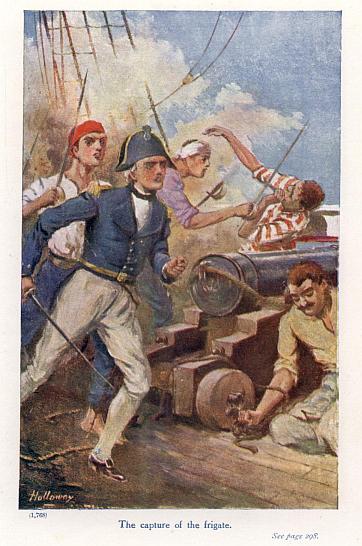
Scarcely had he spoken, when the French frigate, luffing up, ran her bows against the quarter of the Isabel. She was immediately secured there by Davis and others; and now the Frenchmen came rushing over the bows, expecting to make her an easy prize.
“Boarders, repel boarders,” shouted the first lieutenant.
“I will lead you, my men,” cried the captain, springing to the side.
A few Frenchmen who had gained the deck of the Isabel were immediately cut down; and now the English in turn swarmed over the enemy’s bows. In spite of all opposition, they worked their way aft. No power seemed capable of resisting them. Although the Frenchmen for some time stood their ground, they were driven back. Step by step the British blue-jackets fought their way, and numbers sank before the sturdy blows of their cutlasses. Many of the Frenchmen were armed with pistols, by which several of the English were wounded. During this time Davis had ever kept close by the side of his commander. Captain Denham was leading on his men, when suddenly his cutlass dropped from his hand, and he would have fallen had not Davis supported him. At the same moment, a tall Frenchman, with uplifted cutlass, was in the act of bringing it down upon his head, when Davis, bringing his own weapon to the guard, saved his captain, and with a return cut sent the Frenchman reeling backwards.
“On, my lads, on,” shouted the captain, again rising to his feet. “Though I cannot use my sword, you can keep yours going instead.”
The energy with which he spoke was infused into his followers, and pushing onward they drove the Frenchmen before them. The Frenchmen, encouraged by their officers, attempted to rally; but no sooner had they done so, than, led by their gallant captain, the English made another dash forward, and again drove them back. Meantime, the weather had been changing, and the moderate breeze which had hitherto been blowing, was followed by a heavy gale. Although the Isabel was well-nigh dismantled, she was still more than a match for her opponent. In a short time, numbers of the Frenchmen having fallen, an officer was seen to run aft and haul down the French flag. The prize was won. She mounted four more guns than did the Isabel, with a far more numerous crew. The prospect of bad weather made it necessary at once to send a prize crew on board the captured frigate, and to remove the greater part of her own people, so that a few Frenchmen only were left on board. Great was the delight of the crew at finding, from the report of the surgeon, that their captain’s wound was not likely to prove serious, though his arm might be disabled for some time.
The second lieutenant was ordered on board to carry the prize into Plymouth, she having suffered but little damage in her rigging, while her captor was in a far worse condition. Some time was occupied in clearing away the wreck of the topmasts, and once more getting the ship into order. The gale, however, fearfully increased, and the frigate in an almost helpless condition, having lost sight of her prize, was driven towards the coast of Ireland. Happily, the yellow fever had completely disappeared; but Captain Denham had another cause of anxiety, lest his ship might be driven on that rocky shore on which so many a fine vessel has been lost. He anxiously looked out, therefore, for signs of the gale breaking, and that he might be able once more to make sail and beat off shore. His hopes, however, seemed likely to prove vain. The morning dawned, and far away to the east as the eye could stretch, appeared the high land of the Irish coast. He had hoped to have hauled up sufficiently to have weathered Cape Clear. The gale continued till the frigate was close in with the coast. Shipwreck now seemed inevitable, for no other sail could be set to enable her to beat off shore. There was a bay to the south, but that would now afford no shelter, and no other harbour was open to her. It seemed impossible that she could be saved. One only resource remained, to anchor and cut away the masts. Orders were, therefore, given to prepare for this last alternative. The cables were ranged along the deck, and spare anchors got up from below. The dark seas came rolling in with unabated force from the west, while they broke with terrific force on the rocky shore under her lee. The spray dashed over her bows, flying fore and aft as she forced her way gallantly through the seas. The gale still continued with unabated force. Masses of clouds came rushing by overhead, rapidly succeeding each other, while under her lee-bow appeared a long reef of rocks, the dangers of which were well-known to many on board. Still, hopes were entertained that she might be able to weather it. The eyes of the master and other officers, indeed of most on board, were turned now seaward, now to the rocky shore, and now to the reef on the lee beam. There seemed to all but little prospect, unless by a sudden change of wind, of being able to weather the latter.
“She would not stay if we were to attempt to go about,” observed the first lieutenant, “and there is no room to wear, or it might be better if we were upon the other tack, so as to escape yonder threatening reef.”
“We may possibly weather the reef,” observed the master; “but if we were to attempt either to stay or to wear, we should inevitably be driven upon the rocks.”
Several of the best hands were at the helm, watching for the directions of the master. Sometimes, after a slight shift in the wind, hopes were entertained that the reef might be escaped; but then, again, it was found she was making so much leeway that even this slight hope was abandoned. Onward she rushed to her inevitable destruction, it seemed. Meantime, the wounded commander had been lying in his cot. Several times he had desired to be carried on deck, but the surgeon, who sat by his side, entreated him to stop where he was, fearing the excitement would be too great, and that his wounds, which had hitherto been going on favourably, might take a turn for the worse.
“Then send the master to me,” he said, “that I may learn the exact position of the ship.”
The master made his appearance.
“I wish she was in a better position than she is, sir,” he observed; “but we are doing all that men can do to claw off shore, and if we had had our topmasts, there would have been no difficulty about the matter. She makes fearful leeway, and there is an ugly reef ahead, which I do not altogether like; but I have been in as bad a case before and escaped, and I pray Heaven we may get clear this time.”
“Doctor, you must let me go on deck, that I may see the worst. It is torture to lie here below,” exclaimed the wounded captain.
“But the master says, sir, that we have a prospect of hauling off shore, and I again repeat that you would only incur great danger by exposing yourself to the cold wind and spray that you would have to encounter. No, no, sir; stay where you are, and let us hope for the best.”
Many more anxious minutes passed. The master returned to his duty on deck, and the captain, having full confidence in his judgment, would not again send for him.
“Come, doctor, there are many poor fellows want your aid besides me; go and look after them, I entreat you,” he said at length. “They will give me notice in time enough when all hope is gone, or, I trust, I may soon hear that the ship has weathered the reef, and has brought up in the bay.”
Scarcely had he spoken when a loud roar of breakers reached even to where he lay. A cry arose on deck, and the next instant there came a fearful crash. The frigate had struck on the reef. The captain was endeavouring to rise from his cot, when Davis rushed into the cabin.
“It is a bad case, captain!” he exclaimed; “but while I have life, you know I will stay by you. We are not far from the shore, and maybe, if the ship goes to pieces, some plank or timber may carry us there in safety.”
Denham allowed himself to be carried on deck, where Davis secured him to the only portion of the wreck over which the sea did not break. The captain gazed around. The ship had struck upon the much-dreaded reef. Huge seas came rolling in, and, dashing against her with terrific force, had already begun to tear away her upper works, and it was evident she could not long remain in that position without going speedily to pieces. Many of the crew had already been washed away; others were clinging to different parts of the wreck. Some, including the officers, were endeavouring, not far from the captain, to form a raft, on which they hoped to reach the shore. It appeared, however, very doubtful whether they would succeed.
“Let us chance it, sir,” said Davis; “I will haul a grating here, and put you on it. Maybe, we shall be safely washed on shore.”
“No, no, Davis,” answered the captain faintly; “you remember how the brave Dutchman behaved when his ship was sinking. As long as two planks hold together I will stay by the frigate, or till every one has left her. You go, my friend; you are strong and unhurt, and, God protecting you, you may still save your own life.”
“What? leave you, sir? leave you, Captain Denham?” exclaimed Davis. “I have not sailed with you for so many years to act thus at last. We swim or sink together. I have never feared death, and he is not now going to make me do a cowardly act.”
“Well, well, Davis, I fear there is no use urging you. Perhaps, too, we run as little risk here as we should struggling in those boiling seas,” said the captain.
“Right, sir; the frigate is new and strong, and maybe, she will hold together until the gale somewhat abates,” answered the boatswain. “I wish those poor fellows would stay on board with us; it might be the better for them.”
“I would not order them to stay, Davis,” answered the captain. “These seas, if they continue long, must break up the stoutest ship, and it is a fearful thing to have to struggle among floating timbers, washed about round such rocks as these.”
While they were speaking, many of the crew, clinging to spars and planks, were seen drifting towards the shore. Few, however, appeared to reach it. Some, exhausted by their exertions, let go their hold and sank. Others were cast upon the reef, mangled fearfully by the timbers which were thrown upon them. The rest, meantime, continued to work at the raft. The surviving officers then came to the captain, and urged him to allow them to place him upon it, but he remained firm to his resolution.
“No, no,” he answered; “do you leave the ship as you think best; but she was placed under my command, and nothing shall induce me to desert her as long as she holds together.”
Chapter Twenty Two.
Mr Finlayson and the two young ladies stood watching the progress of the labouring frigate.
“Heaven have mercy on them,” exclaimed the Widow O’Neil, extending her clasped hands towards the ship. “See, see, she draws towards the reef! No hope! no hope! She has struck! she has struck!”
The fishwife spoke but too truly. Fearful seas came rolling in, and, meeting with an opposition not hitherto encountered, dashed in huge masses directly over her. In another instant, the foremast, hitherto standing, tottered and fell. Stout as were her timbers, unable to resist such fierce assaults, they were in a brief space burst asunder, and scattered around in the troubled sea. A cry of horror escaped the young ladies as they witnessed the fearful catastrophe.
“Oh, how many brave men are at this moment carried into a watery grave!” exclaimed Lady Sophy.
Nora was silent. A fearful apprehension seized her.
“The last time we heard from Captain Denham, he told us that he was appointed to a frigate!” she exclaimed suddenly. “Oh, suppose that is the ship he commands?”
“Can no one go to the help of those poor men?” asked Mr Finlayson. “Surely there are boats on the coast which might go off to them!”
The fishwife turned as he spoke.
“There are boats, sir, but it would be hard to find the men who would venture off in such a sea as that; but if, as I believe, the wind is falling, there is yet some hope; if it goes down as rapidly as it sometimes does in summer, frail as are our boats, we may be able to reach the frigate.”
The ship was too far off for those on shore to witness the dying struggles of those who were washed into the sea, but yet they could not tear themselves from the spot. Gradually the gale abated, seemingly contented with the mischief it had caused. Still, however, the seas rolled in with fearful force. Suddenly, a thought seemed to seize Widow O’Neil.
“I must go, I must go!” she exclaimed. “If no men are to be found, I, at least, will go off!”
“Why, you would not venture out in such a sea as that?” cried Mr Finlayson, calling after her as she began to descend the cliffs.
“That I will, sir, and go alone if no men will accompany me.”
From the position of the coast in which the cottage was situated, it was easy to launch a boat, although the sea was agitated outside. On reaching her hut, the widow found her brother Shane standing outside it.
“Shane,” she exclaimed, “you promised to stand by me on all occasions, now prove your words. I am resolved to go out to yonder vessel; there may be some alive on board. My heart tells me there are, and we must save them. O stir up some of the other men, and bid them follow us, if they are worthy of the name of men.”
“I would go with you, sister,” answered Shane, “if I could get others to go, but they will not raise a finger to save any on board a king’s ship.”
“But sure, they are our fellow-creatures, brother Shane,” exclaimed the fishwife. “Shame on the cowards if they dare not come, and shame on you, brother, if you will not help me. Listen now; I dreamed last night that he who has been so long away is coming back. It is not the first time I have dreamed it either, and you may say if you will, that this is only another fancy, but my days are numbered, and I know that before I die he will come back; he promised, and Dermot was not the boy to break his word. Come, Shane, come. Look, the sea has gone down, and you and I with your boy Patrick, though he may have less sense than other lads, will go off to the ship.”
The widow’s exhortations made Shane promise to accompany her. Her boat was ill-fitted for the task, yet for some distance they could pull out under shelter of a point which projected north of the cove. As the wind had hauled round somewhat more to the north also, it might be possible to set a sail, and with less difficulty reach the frigate. Patrick was summoned, and with his father and the fishwife, the boat was launched. She was cleared of all superfluous lumber, while Shane lashed under her thwarts several empty casks, which would assist in giving her buoyancy. It was a simple attempt at a life-boat, yet with all these precautions, the old fishing craft was but ill-fitted for the undertaking. The fishwife again and again urged her brother to hasten his work, so eager was she to reach the wreck. At length the boat was ready. The boy was placed at the helm, and the fishwife and her brother took the oars. They pulled boldly out of the cove, and then along the shore for some distance, where the water was rather smoother than further out. Even there, however, the exertion was considerable, and those who looked on from above dreaded every moment to see the frail skiff overturned by the rough seas. Now, however, the head of the boat was turned seaward. Shane and his sister increased their exertions. Often the waters broke on board, when Patrick, steering with one hand, bailed it out with the other; still they continued their course. At length they succeeded in gaining a considerable distance from the shore, when the seas, as is sometimes the case, came with less force, and gradually sank in height. There was only one point where they could approach the wreck. Just within sight was a small bay, or opening in the reef; the seas on every other side were dashing over the frigate, and would have immediately overwhelmed the frail boat. Bravely they rowed on, and they might have put to shame many of the sturdy men who had collected on the shore. Several times those who watched the progress of the boat from the cliff fancied she was overwhelmed. Now she sank into the trough of the sea, and the huge wave seemed about to dash over her. Again rising to the summit of a foam-crested wave, she was tossed for a few seconds ere she plunged into the watery vale below. More than once Shane proposed setting a sail, but the widow declared that her arms were still strong enough to pull the boat, and that it would considerably prolong the time before they could reach the wreck, as it would thus be impossible to make a straight course. She seemed, indeed, endued with super-human strength, for even her brother’s arms began to fail him. Again and again she urged him to renewed exertions, with a voice tremulous with eagerness.
“We shall reach the ship before long—we shall reach the ship,” she kept exclaiming; “row, Shane, row. Oh, brother, if you have ever loved me, do not fail me now.”
Thus they continued rowing on. Not an hour before it would have been impossible for the boat to have made any progress; now, however, by the subsidence of the gale, the undertaking, though difficult and dangerous, was possible. As they drew near, even now several struggling forms were seen in the foaming waters, but ere they could reach them, one after another sank beneath the waves. A few, however were clinging to planks and spars, but the widow refused to go near them; it might have proved the destruction of the boat, had the attempt been made.
“They are floating, and will in time reach the shore,” she said to Shane, “or if the sea goes down still more, we may return to pick them up. There are still some alive on board the ship; even just now, I saw an arm waving. Row on, row on, we may yet be in time—we may yet be in time.”
The larger portion of the wreck had before this, however, been broken up, but the after-part and the starboard side of the quarter-deck remained entire. As the boat approached the wreck, broken planks and timbers continued to be washed away, till but a small portion appeared to remain.
By persevering efforts, the boat, however, drew nearer and nearer, avoiding, though not without difficulty, the masses of wreck which floated by. As the fishwife and her brother looked up, they saw two human beings still clinging to the remaining fragments of the ship; one was waving his hand as if to urge them to greater speed. No other human beings were to be seen on board. A few had just before apparently committed themselves to a raft, and with this support were now approaching the shore. They had, however, passed at some little distance from the boat. Sea after sea rolling in dashed against the wreck, sometimes the spray almost hiding those on board from view. Larger and larger portions continued to give way; every sea which rolled in carried off the timbers or more planks from the sides. The boat was within fifty fathoms or so of the rocks, Shane looking out anxiously for any part of the wreck by which it might be approached with least danger. It seemed scarcely possible for them to get near enough to aid those on board.
“I fear, sister, we shall be too late,” exclaimed Shane; “even now yonder sea which comes in looks as if it were about to tear the remainder of the wreck to fragments.”
With a thundering sound the sea he pointed at broke against the wreck. In an instant the remaining masses of timber gave way, and were dashed forward into the boiling sea.
“Pull on, Shane, pull on,” cried the widow. “I see two men still struggling in the waves; one is supporting the other, and guarding him from the timbers which float around.”
“Which timbers may stave in the boat, and drown us all,” observed Shane.
“No matter, Shane, pull on—pull on; let us not set our lives against those of the brave men who are floating yonder. What matters it after all if we are lost? Death can come but once to any of us.” It is impossible to give the force of those words, uttered, as they were, in the native tongue of the Irish, which she spoke. “Pull on, Shane, pull on,” again she cried. “Boy, steer for those men; see, they are still floating above the waves.”
In spite of the masses of timber, which appeared to be thrown providentially on either side, the boat approached the two men, who still floated above the water.
“Save him, friends; never mind me,” said a voice as they lifted the person he supported, and who, by his uniform appeared to be an officer, into the arms of Shane, he himself holding on to the gunnel of the boat. The officer was quickly placed in the stern-sheets, when Shane helped his companion on board, and then again grasping his oar, pulled the boat safely round before the sea had time to catch her on the beam and overturn her.
The seaman hauled out of the water, the stimulus to exertion having ceased, sank down fainting by the side of his officer. The danger of returning was as great as that which they experienced in approaching the wreck. The spray flew over them, and it seemed that every billowy wave would overwhelm the frail bark. All this time they were watched eagerly by the young ladies and their old friend from the cliff above. On the boat came; now a vast sea threatened her with instant destruction, but the fishwife and her brother, rowing till the stout oars bent with their exertions, urged on their boat and escaped the danger. Nearer and nearer she approached the shore; now a huge roller came thundering up close to her stern, and seemed about to turn her over and over, but it broke just before it reached her, and by vigorous strokes, forced ahead, she escaped its power. In another instant lifted on a foaming sea, she glided forward, arriving high up on the sandy beach of the little cove.
“There are two people in her,” exclaimed Nora, who had been eagerly watching them. “We will go down and help them, for they evidently require assistance.”
“Those two poor fellows must be nearly drowned,” observed Mr Finlayson, as he accompanied the ladies to the hut. “I wish we had a medical man here, but for the want of one, I must take his place and prescribe for them. These fishermen are more likely to kill than to revive them by their rough treatment. Come, I will push ahead and try to save the men before they press the breath out of their bodies.”
In spite, however, of the active movements of the lawyer, the young ladies kept up with him, and they arrived in front of the cottage just as Shane and his son, aided by the widow, were lifting one of the men they had saved out of the boat. She insisted on taking the seaman first, and not till she had carried him up and placed him on her own bed would she help to carry the other. The lawyer, however, arrived in time to aid Shane in carrying up the young officer, for such he appeared to be. As soon as they arrived at the hut, the apparently drowned man was placed by Mr Jamieson’s orders in front of the fire, then, having taken off his coat, he knelt down and gently rubbed his chest. On the arrival of the young ladies, such blankets and clothes as the widow possessed were, by the lawyer’s directions, placed to warm before the fire, that the half-drowned men might be wrapped in them. No sooner, however, did Lady Nora’s eyes fall on the officer’s countenance, than she uttered an agonised cry, and threw herself by his side.
“Oh, it is Captain Denham—it is Captain Denham!” she exclaimed, “and he is dead—he is dead.” Pale and trembling she hung over him.
“No, my dear young lady,” observed the lawyer, “he is still breathing, and I trust that he will soon recover,—I already indeed see signs of returning consciousness.”
While Nora, regardless of all conventionalities, was assisting the lawyer and her cousin in rubbing the captain’s hands and feet, the widow was bending over the inanimate form of the seaman.
“Shane,” she exclaimed, “I told you my boy would come back, and here he is; I feel it, I know it. Oh, Dermot, Dermot, speak to me,” she exclaimed. “Do not die now that you have come as you promised. Surely it is not to break your old mother’s heart that you have just returned to die in her arms?”
Hearing these exclamations, the old lawyer turned round, and went to the side of the widow.
“You will be wiser, my good woman, if you were to place some hot clothes upon his chest, and chafe his hands and feet, instead of calling out in that way. There is no fear about him; he has over-exerted himself, and his immersion in salt water has for the time deprived him of his senses; but stay, I see you have a kettle boiling on the hearth. It is time now to pour some hot whisky and water down his throat. As I left the castle, I took the precaution of putting a flask into my pocket.” Saying this, the kind old man mixed a mug of spirits and water, which he at once applied to the sailor’s lips. It slipped without difficulty down his throat. The effect was almost instantaneous; he opened his eyes and looked around with astonishment.
“Dermot, speak to me, my boy, my own boy,” exclaimed the widow in Irish, as she threw her arms around his neck.
“What does she say?” he asked, in a faint voice.
“Dermot, Dermot, speak to me,” she again exclaimed, but this time she spoke in English.
“That is not my name, good mother,” answered the seaman; “you must be mistaken; I am not your son. I never was in these parts before except once, when I came with my captain, though I have often enough been off the coast with him and others.”
“Not my son—not my son,” ejaculated the widow, gazing at him, and putting back his hair, and again looking at his countenance. “Oh, how have I been deceived, and do you again say that your name is not Dermot O’Neil?” exclaimed the widow, wringing her hands, “and I thought I had brought my boy safe on shore, and that he was to be folded once more in his mother’s arms. Oh, Dermot O’Neil—Dermot O’Neil, why are you thus keeping so long, long away from the mother who loves you more than her own life?”
The young officer, who by this time had been revived by the application of the good lawyer’s remedies, now wildly gazed around him.
“That voice,” he exclaimed, as if to himself; “I believed that she was long ago numbered with the dead, and yet it must be. Oh! mother, mother, I am Dermot O’Neil,” he cried out to her, “your long absent son.”
The widow rushed across the room, and patting aside those who kneeled around him, she threw herself by his side.
“You Dermot, you my son Dermot?” she exclaimed, looking at him. “Oh, how could I for a moment have been deceived?” She bent over him, and pressed many a kiss upon his brow. “Yes, those eyes, I know them now, and those features, too; I cannot again be deceived. No, no, see here is the sign by which I should have known him, even though he had been given back to me as I dreaded, a lifeless corpse. But my Dermot is alive, my Dermot has come back to me.” As she spoke she drew back the sleeve of his shirt, and there upon his arm she exhibited the blood-red cross with which her son had been born.
During this scene, the countenance of Lady Nora exhibited many changes; now a deadly pallor overspread her face, then again the rich blood rushed back from her heart. Still she kneeled by Captain Denham’s side. His strength gradually returned, and supported in the arms of the old fishwife, he sat up. His face was turned away from Nora, and his eyes rested on the features of the former. He took her hand between his.
“Mother,” he whispered, “I have been cruelly deceived. The only letter I received from my native land told me that you were dead, and from henceforth I felt the tie which had bound me to it was severed. Once I returned to it, and my fondest wish was to visit again the cottage where I was born, made sacred to me because it had been your dwelling. I was prevented from carrying out my intention, and from that day to this I have never had the opportunity of returning, but the life you have saved shall be henceforth devoted to watching over you, I have gained fame in my profession, and I prize it, but it is nothing compared to the joy of being restored to you. Oh, mother, I have loved you as a son should his parent who has loved him as you have done me.”
“Dermot, my boy, dear Dermot, I never doubted your love. I have always said that you were true and faithful, and now you have proved it; but, my son, I shall not long require your care. My days are numbered; but I knew that you would come back, and I was not deceived. My prayers were heard in spite of all the threats and curses of Father O’Rourke. Now I have pressed you to my heart once more, and when I have seen you strong and hearty, I shall be content to place my head under the green turf and sleep in peace.”
During this scene Lady Sophy and the lawyer had retired to the further end of the hut. Mr Finlayson had, in the meantime, suggested to Shane, that he might assist the seaman, who was earnestly inquiring for his captain.
“It is all right,” he exclaimed, when told that Captain Denham was doing well. “Heaven be praised that he is saved, when so many fine fellows have lost their lives. We were sadly short-handed on board the frigate, or I do not believe this would have happened; but the gale was cruelly against us. Are we the only ones who have escaped from the wreck?”
“I hope not,” answered Shane. “I saw a raft drifting towards the bay with several people on her, and many more may have been washed on shore on planks and spars.”
“Then we should be up, and go and help them,” exclaimed Ned Davis, endeavouring to haul on his wet jacket. “Are we to let our shipmates perish and lie here idle? It is not what the captain would have thought of; and if he had not been wounded he would have been up now, and looking out to help them.”
This was the first intimation Mr Finlayson had that Captain Denham was wounded.
“Why, that must be looked to,” he observed. “Really, I do not think he can be attended to properly in this hut. We must manage to get a litter of some sort to carry him to the castle.”
This remark was made to Lady Sophy. She appeared to hesitate.
“What will Nora say?” she observed.
“Say! my dear lady! What possible difficulty can there be about the matter,” exclaimed the lawyer.
He might not have interpreted aright the agitation exhibited by Lady Nora on discovering the parentage of the rescued officer.
Chapter Twenty Three.
When, however, Mr Finlayson’s proposition was made to the fishwife, she at first refused to agree to it, declaring that her son would recover as rapidly in the hut as he could in the castle; but on the lawyer’s assuring her that she was mistaken, she consented to let him be removed if he wished it.
“Let me ask him then,” said Mr Finlayson.
For after Ned Davis had vacated the widow’s bed, Captain Denham (for so he must still be called) had been placed on it. In the meantime, knowing that the fresh air would benefit Lady Nora, her cousin had led her to the front of the hut, and made her rest on a bench which was fixed there. Sitting down by her side, she took her hand.
“Nora,” she said, “this is a strange tale we have heard. I can scarcely believe it. What do you think?”
“I know not,” answered Nora faintly. “But can it be possible that he (Captain Denham I mean) whom we have known so long, who is so refined, so high-born in appearance and manners, can be the son of this wild-looking and ignorant fishwife? and yet, Sophy, she claims him as her son, and he does not deny it; and you observed that mark upon his arm; when she saw it, all doubt vanished. Oh, Sophy, help me, guide me, advise me. What can I do? I did not know till now, when I thought him lost and then had him thus suddenly restored to life, how deeply I loved him. I tell you this, dear cousin, but I would not utter it to any other human being; but what can he be to me for the future? My heart, I feel, will break, Sophy.”
“Trials are sent us for our good, Nora,” said her cousin. “Once I might have thought as you do, that unless his birth was high and noble, equal to your own, no man was worthy to become your husband; but, Nora,” and Lady Sophy heaved a deep sigh, “I have learned to prize a true and noble heart; and if such is his, I cannot tell you that I believe you would be right in discarding him on account of his birth. This is not worldly advice; but I again repeat that I believe, if he is what we have all hitherto supposed him, there is not sufficient cause to refuse him as your husband.”
Nora threw herself into her cousin’s arms.
“Oh, thank you, thank you, dear Sophy,” she exclaimed. “You are right. It was a fearful struggle; but I should have died had I been compelled to give him up. I feel how cruel, how wrong I should have been. I know he loves me, and what a bitter feeling it would have caused his noble heart.”
“Then, Nora, let me go in and tell him that we beg he will come to the castle. I am sure, that without your invitation he would not consent to be removed there.”
“Oh, yes, do, do,” exclaimed Lady Nora. “It will be dreadful for him to have to remain here; for his poor mother would certainly not know how to take proper care of him.”
While this conversation was going on, Mr Finlayson had despatched Shane and Ned Davis, who insisted he was now strong enough for anything, followed by Patrick, with all the ropes and spars they could collect, to go along the beach and assist in the rescue of any of the seamen who might still have escaped drowning, and be even now reaching the shore. He himself, meantime, undertook to ascend the cliff, and send the groom back for a litter on which to carry Captain Denham to the castle. At first, when the proposal was made, he declined leaving his mother’s hut, and it was not till her entreaties had been joined to those of Lady Sophy he consented to place himself in their hands.
“You would greatly disappoint my cousin Nora if you refuse to comply with her request,” whispered Lady Sophy.
It is possible that this remark might have settled the question.
“But does she know who I am?” he asked in a low trembling voice.
“Yes, yes,” answered Sophy. “Do you suppose that to a true-hearted girl as she is that would make any real difference? Oh, Captain Denham, ask your own heart. Would you thus be ready to sacrifice any one you loved?”
“May Heaven reward her,” he murmured.
His feelings seemingly overcame him, for he could say no more.
A considerable time elapsed before the arrival of the litter. Meantime Shane and Davis, with their young companion, hastened along the shore. Several other persons having seen the wreck had now collected on the beach. A few, fastening ropes round their waists, bravely rushed into the surf to assist in dragging the floating men on shore. Some, however, it was very clear, were more eager to obtain any articles of value that might be washed up than to save human life. Many were thus employed when Shane and Davis appeared. Several persons were seen clinging to the masses of wreck, which, after having been tossed about for a considerable time in the bay, were now being washed ashore. The glitter upon the jackets of two of them showed that they were officers, and several persons, as they drifted near, rushed into the water to assist them, so it seemed. They brought them safely up the beach, but no sooner were they there, than, instead of rendering them further assistance, they began to rifle their pockets, and to take their watches and the rings from their fingers. Davis caught sight of them as they were thus so eagerly employed, as not to observe his approach. He dashed forward, and with a blow of a broken spar which he had seized, he knocked aside two of the wreckers, and so ably did he wield it, that he put the rest to flight before they could secure their booty. The rescued officers were two midshipmen of the ship, and their first inquiry was for their commander.
“He is all safe, sirs,” exclaimed Davis. “Heaven be praised for it, but he was very nearly gone; however, it will not be long, I hope, before he is well again. It has been sad work; not a third, I fear, of our poor fellows have come on shore.”
“Not so many, I am afraid,” observed one of the midshipmen; “however, now we are safe ourselves, let us try to help others.”
Several of the better disposed of the people now joined themselves to Shane, and prevented the wreckers from continuing their barbarous proceedings. A raft approached near the beach, and though perhaps none on it would have been saved, had they not had assistance, by the aid of the strong body of men who rushed into the water, all were safely landed before it had the opportunity of turning over upon them. Many dead bodies were cast ashore, and they were gradually collected and placed side by side. There were officers and men, and several poor boys, and a few of the marines. The survivors were undecided what to do when Mr Jamieson, who, hearing of the wreck, had come down to the beach, invited them to the vicarage, and the bodies of the drowned were conveyed by his direction to the church. Before the shipwrecked men had proceeded far towards the vicarage, a messenger overtook them, from Mr Finlayson, with a request that they would all come to the castle, to which their captain was now on his way. Every preparation was made for their reception. The medical man of the neighbourhood was also sent for, that he might attend to the captain and others who might have been injured. Fortunately, the surgeon of the frigate had also escaped, and he was at once able to look to the captain’s wound. Lady Nora felt a strange satisfaction at having all those belonging to the frigate thus collected beneath her roof. She had a trial to undergo; it was when at length the Widow O’Neil desired to speak to her.
“Oh, Lady Nora,” exclaimed the old woman, “I have discovered what I little thought of. My bonnie son loves you, lady. It may be presumption on his part, and it makes me feel more and more that I am not worthy to be his mother, but I am, believe me, his true mother. It seems strange that the son of one like me should thus have gained such a name as he has, but there is one thing I would tell you, lady, I know my days are numbered. You will not have the old fishwife as your mother; if I thought so, I would gladly take myself away where you would never see or hear of me more. I would not stand between you and my son for all the world can give. You will not send him from you, lady?”
“Oh, do not speak thus, Mistress O’Neil,” exclaimed Nora, rising from her seat and taking the widow’s hands in hers. “I do not deny that I love your son, for long I have done so, though only this day have I discovered how deeply I loved him. My delight and satisfaction will be to save you from any further toil and trouble. You have ever proved a loving mother to him, and it shall be our united happiness to care for you, and to shield you from all the troubles and hardships to which you have been so long exposed. We will have a suitable house prepared for you and your brave brother Shane and his son, where you may live in comfort without toiling any more on the treacherous ocean.”
“You speak like a true and noble girl,” exclaimed the widow, “and now there is a secret I have got to tell you. If my son had not been restored to me, it should never have passed my lips, but I have long had in my keeping some papers, preserved in an iron case. It has been hidden under the floor of my hut, for I believe there are those who would deprive me of them if they knew where they are. Alas, I could not read them myself, but he who has gone, the father of my boy, bade me carefully keep them. To-morrow, lady, if that good gentleman who is with you, will come with the steward to assist him, I will place the case in his hands. If you had not confessed to me what you have now done, that my son is dear to you, I believe the contents of that box would have caused you much annoyance and pain, but now I feel it will only make you glad.”
Lady Nora would thankfully have obtained more information from Mistress O’Neil, but she either would not or could not give it.
“In a few days I trust, in God’s mercy, my son will have recovered, and then it may be time enough for you to examine the papers in the case,” she answered. It was with difficulty that the old woman could be persuaded to occupy a room in the castle. She consented, however, to do so, when Shane promised to return to the hut and take charge of it till the next day.
The following morning Mr Finlayson set forth accompanied by Mrs O’Neil, for her cottage. Shane was watching for them. The widow sent him for a spade, and some minutes were employed in digging, before the promised box was discovered, so deeply down in the earth had she hid it.
“Ah,” she observed, as her brother was working, “it was Father O’Rourke who had an idea of this case, and I could not tell what use he might make of it, if he ever got hold of it, and he who has gone charged me never to let it pass out of my hands.”
At length an iron case was brought to light, which Mr Finlayson attempted eagerly to open.
“I have never seen the inside of it,” observed the widow, “and I do not know either how to get at it; but don’t look at it here, Mr Finlayson, carry it to the castle, where you may look into it at your leisure.”
Mistress O’Neil having a few arrangements to make before leaving her hut, promised to follow Mr Finlayson to the castle. The lawyer, on his arrival, after examining the case for some time, not unaccustomed to the various devices employed for such purposes, discovered the spring by which it was opened. The whole evening was employed by him in looking over the documents with which it was filled, but he declined for the present to explain their contents to Lady Nora, assuring her that they were somewhat complicated, and that unless he had examined them thoroughly, he might mislead those whom they chiefly concerned. To no one else, indeed, did he divulge their contents for several days; by that time Captain Denham was once more able to appear in public. Several guests had been invited to the castle, Mr Jamieson and his niece being among them. They were all assembled in the drawing-room, when the lawyer, as the captain entered the apartment, went up to him, and in a significant manner, took him by the hand.
“I have to congratulate you, my dear lord, on obtaining a rank of which you are—”
“Do you address me?” exclaimed Captain Denham with surprise. “What, my dear sir, do you mean? You do not intend to mock me!”
“I mean that you are the lawful Earl of Kilfinnan,” answered the lawyer in a positive tone, as if his word had been called in question. “Although the elder members of your family were deprived of the right to assume the title, as long as another branch existed, I have sufficient evidence to prove that in your generation the attainder has been removed. Your father, the husband of the devoted woman whom you have always known as your mother—as she truly is—was, while living in the character of a fisherman, drowned off this coast. He was the grandson of the former Earl.”
Captain Denham, or rather the new Earl of Kilfinnan, cast a glance, beaming with happiness and satisfaction, towards Lady Nora.
“Yes, indeed our kind friend, Mr Finlayson, is not mistaken,” she said, taking his hand, “and though you know full well, my dear lord, that had it been otherwise, I had promised to become your wife, yet I rejoice to know that you can feel yourself with regard to rank in every respect my equal.”
It is not necessary to describe the happy marriage which afterwards took place. The Widow O’Neil enjoyed the comfort and luxuries which had been prepared for her by her affectionate children but for a few months. Her nervous system had received a shock it never recovered, in the exertions she made in rescuing her son, but she had the satisfaction of knowing that she had saved his life, and that he was restored to the position his ancestors had enjoyed. He did not neglect his noble friend, Ned Davis, who continued, as before, his constant attendant, and ultimately, when he gave up the sea and came to live on shore, rose to the rank of his head bailiff. Mr Jamieson and the kind-hearted lawyer both lived to an old age, and soon after her uncle was removed from her, his blind niece was laid to rest in the churchyard by his side.
Father O’Rourke went plotting and scheming on to the end of his days, and if he did not die in the odour of sanctity, having partaken of all the rites of his Church, no qualms of conscience that he had not exactly fulfilled the duties of a missionary of the gospel, seem to have disturbed his last hours.
Finis.
| Preface | | Chapter 1 | | Chapter 2 | | Chapter 3 | | Chapter 4 | | Chapter 5 | | Chapter 6 | | Chapter 7 | | Chapter 8 | | Chapter 9 | | Chapter 10 | | Chapter 11 | | Chapter 12 | | Chapter 13 | | Chapter 14 | | Chapter 15 | | Chapter 16 | | Chapter 17 | | Chapter 18 | | Chapter 19 | | Chapter 20 | | Chapter 21 | | Chapter 22 | | Chapter 23 |