Part 1 — CHAPTER XIX Sultan Sanjar and the Kara-Khitāys
Reading edition
The country of Khwārazm300 was one of the first conquests of the Seljūks. On becoming masters of Khorāsān, the `Irāks, Persia, and Syria, they chose men from among their Turkish slaves whom they placed in charge of the various provinces. The governor thus set over Khwārazm was named Balkategin, who was Tasht-dār, or Grand Ewer-bearer,301 to Sultan Melik Shāh, who exercised paramount authority in that country. He had under him a Turkish slave whom he had purchased, named Nūshtegin, who by his conduct at his master’s court was in such esteem that on the death of Balkategin302 he succeeded to the government of Khwārazm. He became even more powerful than his lord, but, though he is regarded as the first of the dynasty of Khwārazm-Shāhs, he remained loyal to the Seljūks. He bestowed great care in the education of his son Kutb ed-Dīn Mohammad, who succeeded him in A.H. 490 (1097) with the additional title of Khwārazm-Shāh, or emperor of Khwārazm. He was a great patron of letters, and made himself generally beloved in his province.
It was during his tenure of office that the Kara-Khitāys began to make their inroads westwards.
The empire of the Kara-Khitāys had been founded by the last prince of the Kitan or Liao dynasty,303 whose name was Ye-liu Ta-shi.304 On the destruction of that line by the Kin dynasty305 in A.D. 1123, Ye-liu Ta-shi, with a following of some two hundred men, passed into the country lying to the north-west of Shen-si,306 where he was joined by numbers of Turks. He now set out in a westerly direction and carried all before him. He conquered Kāshghar, Yarkand, Khotan, and Turkestān, and at the beginning of A.D. 1124 or 1125 he reached Ki-rh-man.307 Here all his officers assembled and proclaimed him emperor, whereupon he assumed the title of Gūr-Khān, or “Universal Lord.”
Mahmūd, the Uïghūr Khān mentioned above,308 was driven into Transoxiana, which shortly after became tributary to the Kara-Khitāys. Ye-liu Ta-shi, whose dominions reached from the Gobi to the Oxus, and from the mountains of Tibet to Siberia, now fixed his residence at Balāsāghūn.
Towards the end of Kutb ed-Dīn’s rule they advanced so far into Transoxiana that the Grand Ewer-bearer sent an army of 100,000 men to oppose them.309 He, however, suffered a crushing defeat, and the prince of the Kara-Khitāys, after imposing tribute on his vanquished enemies, returned to Kāshghar, which now became his capital.310
Soon after his deliverance from these barbarians Kutb ed-Dīn died,311 and was succeeded by his son Atsiz. For many years the latter remained at the court of Merv, fulfilling the office of Grand Ewer-bearer to Sultan Sanjar; and so great was his influence with the Seljūk prince that he made himself many enemies at court, and on this account he asked permission to proceed to Khwārazm, which was then suffering from anarchy. In spite of the warnings of his ministers, Sanjar allowed Atsiz to depart. As soon as the governor reached his province he rose in open revolt against his master, who was compelled to march against his too powerful vassal.312 But the rebels were no match for the troops of Sanjar, who utterly defeated them.313 The province was restored to obedience, and Sulaymān Shāh, Sanjar’s nephew, was appointed as its governor.314 No sooner had Sanjar reached his capital than Atsiz, collecting the scattered remnants of his army, proceeded to attack Sulaymān Shāh. This latter, with whom Sultan Sanjar had left but a few troops, deeming resistance useless, fled to his uncle, and thus the whole of Khwārazm again fell into the hands of Atsiz.
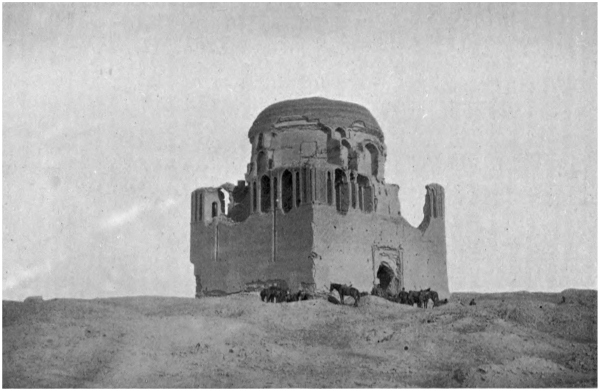
MAUSOLEUM OF SULTAN SANJAR, OLD MERV
In the year A.H. 536 (1141) Ye-liu Ta-shi died without male issue, and the empire of the Kara-Khitāys fell to two princesses in succession,315 the daughter and the sister of the late ruler. It was in this year that Atsiz invited, or rather encouraged, the Kara-Khitāys to push their conquests farther west into Transoxiana. Sanjar, hearing of their advance, crossed the Oxus at the head of 100,000 men to meet them.316 In the battle which ensued, in the valley of Dirgham, Sanjar met with the most crushing defeat which the Moslems had yet endured in their struggles against the infidels in the East.317 Sanjar himself, who had hitherto been invincible, fled to Khorāsān by way of Tirmiz, accompanied by the remnants of his huge army. Transoxiana was now in the entire possession of the Kara-Khitāys, and for the first time a Mohammedan community became subject to the enemies of their faith.318 The Kara-Khitāys, in the same year,319 pushed on as far as Sarakhs, Merv, and Nīshāpūr, but they appear to have retired satisfied with the Oxus as their western boundary. Meanwhile Atsiz took advantage of Sanjar’s fallen fortunes, and began to ravage Khorāsān. The Sultan, however, had mustered forces sufficient to reassert his authority. He marched on the town of Khwārazm and invested it, whereon Atsiz bought him off with rich presents and assurances of good conduct in the future, A.H. 538 (1143).320 This truce was of short duration.
In the year A.H. 541 (1147) Sanjar again attacked Atsiz, but a permanent reconciliation was soon attained.321
In A.H. 551 (1156)322 Atsiz died at the age of sixty-one, and was succeeded by his son Il-Arslān, with whom the independent dynasty of Khwārazm-Shāhs properly begins. Meanwhile the affairs of Sultan Sanjar were going from bad to worse, and the end of the last great Seljūk was as ignoble as his career had been glorious. Strange to say, his ultimate ruin was caused by a Turkish tribe who came of the same stock as the Seljūks themselves.
The domination of the Kara-Khitāys in Transoxiana does not appear to have affected the condition of the dwellers in towns, the peaceful Tājiks, who were even allowed to appoint their own tax-collectors and other officials.323 The only classes who suffered at the hands of the invaders were the Ghuz Turks, who were nomads like the Kara-Khitāys themselves, and occupied all the best pasture-grounds. They now found themselves forced to seek fresh fields. Crossing the Oxus, they obtained permission from Sanjar to settle in Khatlān, Chaghāniyān, and the environs of Balkh.324 They numbered, we are told, 40,000 families, and the tribute imposed upon them was an annual contribution to the royal kitchen of 24,000 sheep. These supplies were carried off as occasion required by an officer of the Household.325 On one occasion the man sent to fetch the sheep was so scrupulous in his choice that the Ghuz took offence and put him to death. The chief butler was thus obliged to supply the royal kitchen from his own flocks. The official complained of this outrage to Kamāj, the governor of Balkh, who immediately reported it to Sultan Sanjar, offering to bring the Ghuz to obedience, and further to extract from them 30,000 sheep for the royal kitchen. With the Sultan’s permission he returned to Balkh and demanded of the Ghuz the sheep that had been withheld; but the herdsmen refused to comply, adding that the Sultan of Merv was their master, not the governor of Balkh. Kamāj, much incensed at the slight put upon his authority, attacked the nomads, but in the first engagement he was utterly put to rout.326 On hearing of this disaster, Sultan Sanjar marched on Balkh at the head of 100,000 men.327 In spite of his vast numerical superiority he suffered a crushing defeat, A.H. 548 (1153), and was taken prisoner.328 Intoxicated by this unlooked-for success, the Ghuz attacked the capital itself. They found the Merv oasis in a state of brilliant prosperity;329 for since the days of Chakir Beg it had never been molested, and, as the author of the Rawzat-us-Safā says,330 “it had slumbered in peace and tranquillity.” The greedy nomads, spurred to madness by the sight of so much wealth, seized all that met their eyes, and then tortured the inhabitants till they revealed their hidden treasures.331 The fallen Sultan, meanwhile, was kept in close confinement,332 but was treated with the respect due to his rank. Having ransacked Merv, the Ghuz laid waste the whole of Khorāsān, so that, says Mīrkhwānd, “not a single spot in that province escaped their destructive hands.” Sanjar remained for about four years in captivity; and while his consort, Turkān Khātūn, who acted as queen-regent, lived, he made no attempt to escape, lest harm should befall her. On her death, in A.H. 551 (1156), he took advantage of a hunting expedition to evade his captors. Gathering a few devoted followers on the other side of the Oxus, he set out for his capital, but on reaching Merv he was so heartbroken at the desolation that met his eyes that he sickened and died.333 The ruins of his splendid mausoleum are the chief glory of ancient Merv. It was built by him during his lifetime; and so great was its solidity that he gave it the name of Dār ul-Ākhirat, “the Abode of Eternity.” Sixty years after his death it was destroyed by Chingiz Khān.