PART I. (continued 2)
Reading edition
Some horses’ heads are large in proportion with the size of collar they require; in such cases, out of compassion for the poor animal over whose head the small collar has to be forced at the risk of injuring his eyes, the collar, which is generally closed, should be made open at the top, to fasten with buckle and strap.
Under ordinary circumstances the open collars are not preferable, as the opening and closing weakens the rim, and is likely to put them out of shape; but as grooms have a fashion of putting the collar on with the rigid hames tightly buckled round it, the whole process of forcing a small closed collar over a beast’s larger head is so repulsive to him that in time he learns to dread the very sight of a collar. The plan of putting on the collar with the hames attached to it should never be permitted.
Saving-Collar, and description of make.—This is generally formed by harness-makers of basil with quilted padding. More serviceable than this will be found the saving-collar cut of single leather, from the soft or belly part of the cow-hide. A breast-strap is placed at the bottom of the collar with a loop and buckle at the end, through which the belly-band of the terret-pad passes to confine the collar.
Every owner of harness should be provided with one or two saving-collars of this description to be used where severe work is expected, on long journeys, or with animals new to harness. They should be open at the top, to fasten there with two buckles and narrow straps, the tightening or lengthening of the latter enabling it to be fitted to the horse’s size. Some care is necessary to observe that the regular collar does not rub the buckles of the saving-collar against the horse’s neck and make a sore.
The saving-collar should be always kept well moistened with grease or oil, and carefully looked to after use, the crusted sweat and dandriff being scraped off it. In the absence of a saving-collar, the collar itself should be watched in the same respect.
The bridles generally in use for harness appear to require little or no improvement.
The Bit must be equally adapted to the horse’s mouth, &c., as for riding (page 38), except that with harness, while to all appearance using the same kind of bit with a pair of horses, the leverage on the mouths can be altered, by placing the billets or buckle-end of the driving-reins high or low in the cheeks of each, according to the animal’s temper, his bearing on it, &c.
In placing the billets in the bit, it should be borne in mind that the more use is made of the curb the more will be taken out of the horse; therefore, when a long journey or severe work has to be done, animals should be driven in snaffle, or the billets should be placed as near as possible to the mouthpiece of the bit.
Experience only can demonstrate the difference in the wear and tear of the general physique, resulting from a judicious arrangement or otherwise of the reins and bit.
Blinkers.—The question of “blinkers or no blinkers” can best be answered by the observation, that if you can find horses that may be depended upon to work safely and steadily without them, they may be dispensed with; but as such animals are rare, blinkers are likely to continue in general use.
Placing crests or ornaments on blinkers, unless the latter are light and well hollowed, and kept extended in front by stiff blinker-straps, is a practice likely to be injurious to the animals’ eyes; in fact, all blinkers, unless light and well hollowed, are dangerous for the eyes, and of course the increased weight of crests and their fastenings aggravates the objection.
Heavy forehead-bands and rosettes, though ornamental, are anything but desirable, as far as the horse himself is concerned.
The Noseband of the harness bridle, like the riding one, can by tightening be made very useful with some descriptions of hard-pulling horses.—See “Noseband,” page 42.
The Breastplate, or head-stall martingal, can be made useful in the same way.—See page 40.
Throat-lash.—See page 43.
Reins.—Saddlers generally suit the reins admirably to the work for which they are intended. A buff hand-piece with pullers is decidedly preferable to plain leather, as its roughness enables the driver to have a much firmer hold of the reins, but will become slippery in wet.
The Bearing-Rein is only used to keep up a horse’s head and give him a showy appearance, therefore no experienced person will use it except with that object, and it is injurious in every other respect.—(See “Broken Knees,” pages 52 and 141.)
Crupper.—This strap is intended to keep the terret-pad and back-band in their proper places, and to restrain the former from running too far forward or pressing on the withers (see “Sore Withers,” page 151); also as a sustainer to the terret-pad against the bearing-rein when the latter is strained into its hook. Grooms have a very improper habit of leaving the whole of the hinder part of the harness suspended in one mass by the crupper-dock on a peg in the wall of the harness-room; this should not be allowed. Let the terret-pad when not in use be always placed across a proper saddle-rack, with the britching and crupper suspended therefrom; or let them, at all events, be put somewhere by themselves.
To put on Harness.—First, while the horse’s head is towards the manger, place the terret-pad loosely across the back—take hold of the tail, and carefully turn down the hair over the end of the flesh; thus grasping and holding the tail and its hair together in the left hand, with the right draw the crupper-dock over it, and adjust the latter to its place at the root of the tail, being careful not to leave a single loose hair under it. Then arrange your terret-pad in the place where it should work by shortening or lengthening the crupper-strap; which done, tighten the belly-band.[24]
Now turn the horse in his stall, and, your collar and hames having been hung up close at hand, slip the wide end of the former by itself over the head.
Leave the collar so, on the narrow part of the neck, till you place your hames within the collar-rim, and fasten them thereto by buckling the top strap over the narrow part or top of the collar: now turn the collar and hames round on the neck in the direction of the side over which the mane hangs.
Put on the bridle and attach driving-reins, temporarily doubling their hand-piece through the terrets. Fasten the horse thus harnessed to the pillar-reins till you are ready to “put to.”
To take off Harness, begin by removing the reins and bridle; then take off the hames by themselves, then the collar, and lastly the terret-pad and crupper.
DRIVING.
In driving, a man should sit up against his work, and be thoroughly propped by his legs and feet, with the left or rein hand held well into his body, in front of or a little below the waist. Nothing looks more ungraceful than to have the reins at arm’s-length, held out at a distance from one’s chest.
A driver should always be seated before any one else in or about the vehicle; and having carefully taken a firm hold of the reins in his left hand before mounting his seat, they should so remain, and never be shifted. But should the driver be either obliged or find it convenient to allow others to be seated first, he will then of necessity have to mount from the off or right side, in which case he will in the first place have to take the reins in his right hand until seated, when he will at once transfer them to their proper position in his left.
The whip should invariably be placed in the socket, or be handed carefully to the driver after he has mounted. To mount with it in hand is highly dangerous; the sight of it over the blinkers, or an accidental touch to an animal when the driver is unprepared, may startle and set off a team—while holding a whip in the act of mounting renders that piece of gymnastics doubly awkward to accomplish. All turns and manœuvres may be effected by the fore-finger (and thumb if necessary) of the right or whip hand, either on the off or the near side rein, according as the direction of the intended movement is towards the right or left.[25] But in driving four-in-hand, unicorns, or tandems, insert the fourth finger of the whip-hand between the lead and wheel reins on the side you want to pull, to turn or direct your horses.
With four-in-hand the general principle is, while allowing only a certain amount of play to the heads of your leaders, to keep your wheelers well in hand, ready for any sudden emergency, bearing in mind that it is only with them, as they are attached to the pole, that you can stop the carriage.
A driver having occasion to raise his right hand for any purpose, should first place the whip transversely under the thumb of the left or rein hand (above, but upon, one of the reins), leaving the other hand at liberty; indeed, the whip should always lie in this transverse position, whether in the right or the left hand, unless when in use for correction. Many horses are very clever at watching the whip over the blinkers, and careless pointing forward with it may keep a high-spirited animal in a continual fret.
To ascertain how each horse is doing his work, judge not only by the test of the willing horse bearing more on your hand; see also how each horse keeps his traces. In whichever case they are slack, you may depend that that horse has no draught upon him; if tight, he is doing his share of the work, or more. A good whip will correct the defaulter so as to avoid annoying the other horse. There is no better criterion of skill in the use of the whip than this.
With the leaders in tandem and four-in-hand, and in low-seated carriages, unless the dash-board be very high, the reins are apt to get under the horses’ tails. In such cases, to avoid a kicking match, no immediate attempt should be made to replace the reins while they are confined; but a very light lash of the whip on the leg will engage the attention of the animal, and while the tail is switched up on the touch of the lash, the reins may be released. Horses should always be kept well in hand, unless that, upon a long and tiresome journey, some consideration may be shown for what they have to go through. Under such circumstances, attention may well be directed to the manner the billets are placed in the bit (page 62).
On the level a fair pace can be maintained, but up hill no merciful man will ever press his beasts. When a heavy load has to be drawn up a sharp short hill, it is not a bad plan to cheat the horse out of the first half of it by going at it with an impetus, suffering the pace to merge into a walk without further pressure as the first impetus declines.
When the ascent is long and gradual, horses should be allowed to walk the whole way, which can always be admitted of on ordinary roads, where the pace is not intended to exceed eight miles an hour, as the speed may be accelerated when the fall of ground is reached, without distressing the animals.
Let a man suppose himself to be obliged to wheel a hand-cart with a heavy burden for a given distance within a given time, on an undulating roadway, and he will soon discover the course he would pursue to effect his object; he would certainly save himself by going very slowly up the hills, and make up the time and distance with most ease by rolling the vehicle at a rapid rate down the declivities. Let the principle of working thus exemplified be always applied to the usage of horses in harness.
An old driving maxim may be added, though not recommended by the metre:—
“Up the hill spare me; Down the hill let me run and bear me; On the level never fear me.”
Or,
“Walk me a mile out and a mile in; Up the hill spur me not, Down the hill I’ll walk or trot; On the plain spare me not; In the stable forget me not.”
I have driven a great deal in my life, and have never met with an accident from driving at a fair trot down a moderate hill, with plenty of road-room, and no turning to be made till after gaining the level, the team being well in hand throughout.
This observation applies equally to any number of horses; but with tandem or four-in-hand the wheelers should be held particularly tight, and the leaders pulled back.
If, in descending a hill, the wheel can be drawn along rough stones without the horses being also brought on them, it is desirable to avail of such a drag.
In such hilly countries as Wales, Devon, &c., the constant use of a skid is indispensable. The uninitiated may not quarrel with me for reminding them of the necessity for keeping always to their own or the left side of the road(the right on the Continent, in America, and other countries). In turning a corner, however, if it be to the left you intend going, before you make your turn get from your proper side of the road a little towards the right, if possible, and from thence make your turn, by which means you will more easily reach the left, or your proper side, of the new route you intend to take, besides being able to see everything that is approaching en the other. To turn a right angle you must have space accordingly, and it is better to make use of that which you see insured to you than to be depending on that which is uncertain.
It is hardly necessary to remark that it is infinitely safer to make your turns at a slow pace than faster. Turning quickly round corners is reckless work, but the faster your pace the more necessary it is to get to the wrong side of the road when turning to the left before you make your turn to the new, or before entering a narrow gateway or passage. When the turn is to the right, you will keep to your own or left side of the road.
Where a narrow gateway has to be entered with four wheels, having brought your vehicle fairly in front of it, place your pole directly over the centre or bolt stone; in the absence of this guide, mark with your eye some object in the centre, and bring your pole right over it. The wheels will take care of themselves, if there is at all room for the carriage.
With single harness the horse is brought direct at the gate, and kept very straight, his hind feet passing over the centre object.
In driving through crowded streets or in a narrow way, especially with vehicles coming rapidly towards you, and every prospect of a collision, take a stronger hold of your horses, and moderate your pace, remembering that, if you cannot avoid grief, the less the impetus the less the crash, if it should come. This result is amusingly exemplified by the stage-coachman’s definition of the difference between the results of road and rail accidents. Coachey says, “If even an upset occur on the road, there you are; but if an accident takes place by rail, where are you?”
Remember to collect your horses well in hand before you alter your course on the road, or to cross it, in order to have them alert and handy for any emergency.
When travelling in damp weather, the roads being sticky, half wet and dry, your horse requires saving and consideration, no matter to what extent the wind may be blowing, if it goes only in the same direction as himself. When the roads are perfectly dry with a light wind blowing against your horse, he travels under the more favourable circumstances.
Neither blinkers nor bit should ever, upon any consideration, be removed from a horse while he is attached to a carriage, whether to feed or for any other purpose. Want of caution in this respect has been a fertile source of most serious accidents.
When a horse falls irretrievably in harness, the driver should avoid leaving his seat till some assistant can go to the animal’s head, who, placing his coat or some soft substance between it and the road, to prevent injury to the eyes, presses one or both knees lightly on the neck, but so as to prevent the beast from rising; which done, the driver can get down from his seat, and, availing of all the aid he can procure, frees all the harness as rapidly as possible, and, running back the carriage from the horse, assists him to rise. To disengage buckles easily in such cases, instead of dragging at the point of the strap in the usual way, force both ends of it to the centre of the buckle, which will cause the tongue to turn back, and so free the strap.
When a fall in harness occurs on slippery pavement such as some of the London streets, or in frosty weather, before the horse is permitted to make any effort to rise, some ashes, dry clay, sand, sawdust, hay or straw, or even any old rug or piece of cloth or carpet, should be so placed as to prevent him from slipping in his ineffectual and distressing endeavours to recover his legs.
Backing.—When a horse takes to backing, and danger is threatened, if you cannot get him forward, and have no assistant to take him by the head, the more rapidly you bring the brute’s head to the point where he aims at bringing his tail the better. It is a bad habit, however, to give an animal, to allow of his being taken by the head when he is obstreperous, and should only be resorted to when quite unavoidable.
Kicking in Harness.—When there is no kicking-strap or other means of restraint available, and an animal seems disposed to persist in kicking, the driver, retaining his seat, should direct some one to hold up one of the fore feet (if he finds a difficulty in doing so, doubling the knee and tying a handkerchief tightly round it) so as to prevent the foot reaching the ground, which done, the driver may help to unharness, while the other assistant takes hold of the horse’s head.
Shying.—See page 88.
Runaways are frequently checked by sawing the mouth. In such cases, retain your presence of mind, determined to stick to the ship to the last; if you have the luck to meet with an ascent, that is your time to get a pull.
A horse that has once run away, especially if, in connection with that feat, he has met with any noisy disaster or breakage, is never, as long as he lives, safe to drive again. It only remains for his owner to use humanity and judgment in disposing of him.
Stubborn horses, or jibbers, in single harness.—On the first appearance of this disposition at starting, the neck should be examined, to discover whether the fit may not have been occasioned by indisposition to work against an ill-fitting or dirty collar, which may have produced abrasion or tenderness of the skin under it (see page 61). If the unpleasantness proceed from innate stubbornness in the brute, and simple means do not succeed in single harness, place him in double harness, beside a well-tempered, good worker, that will drag him away, starting down-hill. In this manner the habit, if not confirmed, will be overcome. In extreme cases, different appliances have been used with varied success in making the beast move on—such as a round pebble, about the size of a hen’s egg, placed in the ear, and secured with a cord tied round the latter, near the tip, or stuffing a glove in each ear. I have also seen coachmen put two or three handfuls of mud into the horse’s mouth, and rub it against his palate with good effect, or tap him with a stick at the back of the fore legs, just under the knee.
Letting a stubborn beast stand for hours in harness in the spot where he has taken the fit, and, when he has become well hungered, placing a feed of corn before him and gradually walking away with it, is a dilatory proceeding sometimes resorted to, but scarcely worth mentioning.
DRAWING.
The size of horses should be in proportion to the weight and size of the vehicle and loads they are intended to move, upon the principle, easily demonstrated by experiment, that weight drags weight. For instance, a horse having to drag a cart up a hill, will do so more easily with the driver on his back than otherwise, as the weight of the man assists the horse against the weight he has to move. The latter part of this argument only refers, however, to short distances, or to starting a draught.
The higher the wheels are, and the closer together, whether they be two or four, the lighter will be the draught. In fact, to render the draught as easy as possible, the axles ought to be on a level with the trace-hooks, or point of traction, or as nearly horizontal as possible with the traces and their place in the leg of the hames. It is self-evident that if a horse has to be pulling up, it is like his having to raise a certain part of the weight of the carriage with every step he moves; and the faster he goes, the more injuriously does this principle operate against him.
The point of the pole-and-chain attachment should be always so elevated from its insertion in the carriage as to be on a level with the rings of the hames through which the pole-chains pass. On the point of the pole should be a revolving steel cross-tree, from eight to ten inches in length, in the ends of which the pole-chains or leathers are inserted. The working of this contrivance will, to any practical man, demonstrate its utility.
In light double harness, I much prefer using swinging-bars instead of one inflexible splinter-bar, unless for very heavy draught. Horses should be placed close to their work. For adjusting the traces to that effect, see page 58.
It should be remembered that the farther forward in a carriage the weight to be drawn is placed, the easier will be the draught on the horse. Thus the weight of one man at the extreme end of the vehicle (like a conductor on an omnibus) has as much effect on the traction as that of two men on or near the driving-seat. The deader the weight, let it be placed as it may, the greater the trial of the horse; therefore inanimate matter is heavier on traction than anything having life.
Vehicles of which the lower carriage and axles are kept braced together by a perch steadying the action of the wheels, are much the easiest on the draught. The Americans are well aware of the advantages of such a construction for encountering the roughness of many of their roads. Not only are all their pleasure carriages, or “buggies,” so constructed, but the waggons have a perch that by an admirable arrangement can be detached, to allow of the carriage being lengthened when required to carry timber or other lading. The perch, being in two pieces, can be coupled by the simple contrivance of a movable iron band and pin, giving a freedom, most desirable in a rough country, to the movement of the lower carriage. This contrivance works well, and might with advantage be applied to our military train-waggons and ambulance-carts. Horses cannot but suffer from the present construction of carriages in general use, where the axles are left unsupported and unbraced to encounter the roughness and inequalities of the road.
Axle-Boxes.—Proper lubrication of the axle-boxes is too often sadly neglected. Even Collinge’s patent will not run freely without periodical aid in proportion to use, and it is no harm to make an occasional examination of the wheels of a carriage when they are lifted off the ground by setters, to see that there is thorough freedom in the working of them, by spinning them round with one’s finger against the spokes. The reapplication of gutta-percha or leather washers is essential, as the amount of friction by work will wear that requisite.
For a few days after the washers are replaced, the boxes should not be screwed too tightly, but subsequently they should be re-tightened. The noise of wheels joggling upon their axles indicates want of screwing up, or of washers.
A round tire is decidedly easier for draught than a flat-edged one.
Carriages, immediately after use, should be cleaned, or at least have water dashed over them, to prevent the mud from drying on the paint, which can scarcely fail to deteriorate it, and give it a premature appearance of wear.
SHOEING.
Some horses are very averse to being shod, through some fright the first time of shoeing, or bad management. It is better to overcome such shyness or vice by gentleness or stratagem than by force of any kind.
Some few animals even require to be cast, or placed under the influence of the painful twitch. Before resorting to any force, however, the following means should be tried in preference to others:—Let whoever is in the habit of riding or exercising the horse mount him when regularly bridled and saddled, the girths being a little looser that if intended for work; ride to the side of the forge, and there let him (his rider still on his back) be shod the first time; on the second visit to the forge, if it be spacious enough, he may be ridden into it for the same purpose.
In shoeing, the smith’s rule ought to be to fit the shoe to the foot, not the foot to the shoe, according to the general practice of those gentry.
In London and all large towns, the best thing a gentleman can do is to contract with a veterinary surgeon for the shoeing as well as the doctoring of his horses.
The night previous to a horse being shod or removed, the groom should stop his feet, to soften them, and enable the farrier to use his drawing-knife properly, and without injury to that instrument.
In shoeing, any undue accumulation of sole may be pared away; judgment must, however, be used in this particular, as the feet of some animals grow more sole than others, and superfluous increase tends to contraction, whereas care must be taken not to weaken the sole of ordinary growth. I am aware that great difference of opinion exists on this subject, but I speak from practical experience of the results of opposite modes of treatment in this particular.
If no shoes were used, the wear and tear of work would provide for the disposal of this accumulation, which, as nature is interfered with by the use of shoes, must be artificially removed.
If the frog be jagged it may be pared even, but the sound parts should not be cut away, and on no account should the smith’s drawing-knife be allowed to divide the bars or returns of the foot—an operation technically called by the trade “opening the heels,” to which fallacious practice farriers are pertinaciously addicted, because, in some one case of dreadfully contracted feet, they may have seen or heard of temporary relief being given by this process, with the natural result, which they ignore, of the remedy proving itself in time worse than the disease.
If farriers are allowed, they will almost invariably drive as many shoe-nails round the inside quarter as the outside. This is a lamentable mistake, especially regarding the fore feet, as the foot being thus nearly all round confined to the shoe, its proper action is interfered with, preventing a possibility of its natural and gradual expansion in action from the toe towards the heel, as the horse lays his foot upon the ground, with all weight, as well as the act of propulsion, pressed on it.
The reason for liberating the inside quarter in preference to the outside is, that the inside, being more under the centre of gravity, will be found to expand and contract more than the outside, as will be proved by the removal and examination of a shoe that has been in use three or four weeks. On observing the part of the shoe that has been next the foot, it will be distinctly perceived that the friction of the inside quarter of the foot has worn a cavity in the portion of the shoe which has been under that quarter of the foot, while the side that has been under the outside quarter bears comparatively little evidence of friction above it.
This being an established fact, it seems desirable that the full number of nails should be driven round the outside quarter, and not more than one or two (for hunting purposes) on the inside from the toe. (Six nails altogether is the cavalry regulation.)
If your horses are not quick wearers on the road, the fore shoes should be removed within two or three weeks after shoeing (care being taken that the clenches of the nails in the hind feet are at the same time properly levelled to the hoof to prevent brushing), and let them be re-shod every five or six weeks.
In all foot ailments, whenever a horse is lame, although the disease may not apparently be in the foot, let the shoe first be carefully removed, and the shoeless foot examined by as competent a farrier as can be procured (in the absence of a veterinary surgeon), by pincers round the nail-holes, gently pressing wall and sole together, by the hammer tapping the sole, and a judicious use of the drawing-knife, to detect the possible seat of disease.
I have known a lame horse to be brought to a reputedly-experienced amateur horse-doctor, the cause of disease being so evidently inflammation of the sheath of the tendon, that the animal was ordered to be treated accordingly—viz., with cold applications; and this not succeeding, firing the leg was resorted to, after which, the weather being suitable, it was thought expedient to let the beast have a run at grass. As a preliminary the shoes were removed, in the course of which operation a bed of gravel was found to have secreted itself in the foot of the supposed diseased leg, and the inflammation occasioned by the gravel having gone up, caused what appeared to be marked disease about the tendon.
Such were the results of neglecting the precautions here recommended.
Brushing, or cutting, is a very tormenting weakness in the horse, whether behind or before, and often highly dangerous in the latter case.
The ordinary practice of farriers under such circumstances is to rasp away the inside quarter of the offending hoof, as well as doubly thickening the shoe under the weakened wall, leaving the toe to extend itself forward. This is a great mistake, yielding only a temporary improvement, not at all tending towards a cure. On the contrary, it would be better to shorten the toes by degrees; and on no account should a rasp be put near the wall of the inside quarter, in order to let it get as strong as possible towards the heel.
I would certainly allow no nails to be driven inside, but let the shoe be fastened round the outer quarter of the foot, the shoe itself being of equal thickness on both quarters as an ordinary shoe; but on putting it on, it should not be suffered to project outside the inside quarter, and the shoes might here be rasped to guard against rough edges, which might injure the pastern of the opposite leg during work.
A strong clip should also be thrown up on the outside quarters of these shoes to catch the wall and effectually prevent them from shifting towards or projecting beyond the inside quarter, which might cause them to come in contact with the opposite pastern-joint while in motion. Until the brushing be somewhat remedied, an india-rubber ring or a bit of leather, and elastic strap round the pastern, will prevent it from receiving present injury. If the above treatment is attended to and persevered in, the probability is that in nine cases out of ten a cure will be effected in course of time.
Corns.—Every horse-owner ought to make himself acquainted with the part of the sole between the frog and the wall on the inside quarter of the fore foot, called the seat of corns (see pages 131 and 140), and every time that a horse is shod or removed, in paring the foot the drawing-knife should be used to clean away this cavity (without weakening the adjacent wall), where the disease originates from undue pressure of the shoe on the inside quarter of that susceptible spot, or from friction of the coffin-bone, on the inside of the sole, above the seat of corn. The shoe ought to rest entirely on the wall of the foot, and not on any part of the sole.
Roughing and Frosting is simply drawing out the old nails about the toes and replacing them with very large sharp-headed ones, called frost-nails. Horse-nails being made purposely of a soft metal, are unfit for frosting, as the heads wear down so quickly. If smiths would steel the heads of frost-nails, they would last much longer. This precaution against slipping, however, is only effectual in slight frosts. In regular frosting, the nails are carried completely round, with the addition of sharp calkins being turned on the heels of all four feet, and sometimes also short spikes or cogs turned down from the toes; but the latter are common only in severe climates, though their use is quite as desirable in England, especially to assist horses in ascending slippery hills, where the cogs on the heels have little or no hold in the ground. Cogs or calkins should be rasped by the smith, to sharpen them, every couple of days.
Although it may be inconvenient and expensive to have horses prepared in frosty weather, it is highly necessary to do so where work is required of them. The very extraordinary exertion that is needed on the part of the animal to keep his feet when unprepared, as well as the fret to his energies, takes a vast deal more out of him in one day’s work than a month’s daily use would do under ordinary circumstances, not to speak of the risk of pecuniary loss from accident.
It is a most pitiable thing to see the poor beasts struggling in their high courage and good temper to do their best, for what I can only call cruel or thoughtless masters, to say nothing of the liability of the animals’ breaking their knees and bringing their riders or drivers to serious trouble, smashing harness and vehicles, &c.
I have always found servants most ingenious in making objections to having their horses prepared for frost, the grand secret being their anxiety to keep them in the stable the whole time the frost lasts, that they may be saved from the trouble of cleaning either them or their caparison, carriages, &c. They will alarm you with the stereotyped objections, “tearing the horses’ feet to pieces,” “driving fresh nail-holes,” “ripping off shoes,” “his feet won’t bear a shoe after,” &c. I never knew an ordinary sound foot to be reduced to such a condition, by simply changing shoes, that a good smith could not fasten a shoe on.
The only tangible objection to calkins to which attention need be drawn is, that during their use, unless the horse is moved about in his stable with great caution in cleaning or otherwise, he is apt to tread with them on the coronet of the opposite foot, which is a very serious affair, inflicting a nasty jagged wound on one of the most sensitive vascular parts of the animal.[26]
The Bar Shoe going all round the foot is intended to protect weak or thrushy heels.
Wide-webbed or Surface Shoes are used with flat-footed, weak-soled horses: leather being often introduced above them to save the soles from being damaged by extraneous substances on the road. Put on with the ordinary shoe, it is said to lessen the jar of the tread.
High-heeled Shoes, when a horse is laid up, properly managed, prove a most effectual palliation and aid in the cure of “clap of the back sinew” (page 143).
These shoes are made with calkins (joined by a light iron bar), which should not be heavy, not more than an inch deep, and gradually reduced by the smith as the disease abates.
Steeling the Toes is necessary with quick wearers on the road; but particular cautions should be given to the smith to work the steel well into the iron, for any protrusion of this hard metal above the iron will occasion tripping, and possibly an irrecoverable fall.
Calking the hind shoes moderately on the outside quarter only, is most essential to the hunter to prevent slipping, and to give him confidence in going at his fences, and on landing. Its advantages can be well understood by any sportsman who has experienced the difference between walking himself a day’s simple shooting over soft slippery ground, or taking a ten-mile walk on a half-wet road, in each case in boots with headed nails, to enable him to have a hold in the ground, and undertaking the same exercises in boots without nails, where one wearies himself with efforts to keep his feet.
I speak as a practical man, having probably come to less grief than most others in hunting, which may be attributed mainly to the particular attention bestowed on the calking of my bearers when I was a hard goer. It seems an unimportant matter, but if looked into will be found to be far otherwise.
Tips, or half-shoes, which cover little more than the toe of a horse, leaving the heels to come in direct contact with the ground, are particularly serviceable in cases where the heels are disposed to contraction, and, from my experience, can be used without injury in any ordinary description of work while the frog is sound.
The quarters of the feet being left by their use without the usual confinement of the shoe, and being pressed to expansion on every movement of the animal, naturally become strong and extended. Tips should become gradually thinner, finishing in a fine edge towards the ends. I have seen ill-made tips calculated to lame any horse, with the ends the thickness of an ordinary shoe (though extending, which is the intention of tips, less than half-way down the foot), as if the smith who made them expected the heels to remain always suspended in mid air.
Slippers.—Regular sportsmen generally carry a spare shoe while hunting; but if a shoe comes off one of the fore feet in the field or on the road, and the rider is not provided with a proper shoe, he should at once dismount and lead his bearer to the nearest forge, where an old shoe most approaching to the size of the foot that can possibly be found should be selected from the heap of cast ones that generally lies by in a forge, and let it be tacked on with three or four nails only, so as to serve the creature to get home, or until the proper shoe can be made.
If a shoe comes off the hind foot, and the distance from home is not above three or four miles, the animal can be led or occasionally ridden that far without injury, especially if the softest side of the road be selected for the track, the hind feet being generally much stronger than the fore.
Travelling.—The day before a long journey, look to your horse’s shoes; see that the clinches are well laid down and the shoes nailed tightly. As a rule, do not have new shoes put on just before a journey, for the least carelessness in fitting or nailing them may occasion more or less lameness; should it be severe, disappointment and delay may result; while if only apparently slight at starting, and the animal endure the pain patiently during its work, the cause being in existence throughout will produce its effects only too palpably when the day’s journey is over. If old shoes are nearly worn, but will last the journey, let them by all means remain on; but directly the work is over, send for any proper smith whose forge is nearest, and have them taken off in the stable. Should the forge not be at hand, the old slippers can of course be tacked on when the horse, having had its rest, is taken to be shod. All shoes, for road-work especially, should be made full long to cover the heels. It should be borne in mind that, as the hoof grows naturally, the shoe is brought forward and thereby exposes the heels.
VICE.
In all cases where active vice, such as rearing, kicking, jibbing, plunging, has to be combated, the work of correction is half done if the horse is well tired in the first instance, or, in vulgar terms, “the fiery edge taken off him,” by half an hour’s rapid loungeing, with his neck well bent, chin into chest, on the softest and most tiring ground that is available. For myself, if I find a horse vicious, I never think of combating him if it can be helped, without having first reduced his vigour a little; and all horsemen who undertake to conquer any seriously bad habits are recommended to consider and adopt this practice, if indeed such is not already their custom.
Kicking, to the horseman, is a matter of very trifling consideration. He may either amuse himself by letting the ebullition expend itself, or it may be stopped by chucking up the horse’s head and increasing the pace.
Kicking in Harness is a different affair, being generally the prelude to disaster, and must be guarded against.—See page 58.
Kicking in the Stable.—Many animals, most gentle in other respects, take inordinate fits of this practice, and generally in the dead of night, as if to make up for their usual quietude on all other occasions; most frequently they resort to the amusement without any apparent cause of irritation whatever. They will do it when alone or when in company; while, were it not for the capped hock and otherwise disfigured legs, as well as the dilapidated stabling behind them, discovered in the morning, you would think that “butter wouldn’t melt in their mouths.” In other cases the habit proceeds from obvious bad temper or spite towards a neighbour. There are many cures proposed for kicking in the stable. One frequently successful is a round log of wood, four or five inches long and about two in diameter, with a staple at one end of it, through which a chain two or three inches long is passed and attached to a strap that buckles round the pastern (just above the coronet) of one hind leg, or a log in this way to each hind leg may be used if necessary. Another means is to pad all parts of the stable that can be reached by the hind feet. In many instances where this plan is adopted, the animal, no longer hearing any noise suggesting to his fancy resistance from behind, will cease kicking altogether, from no other explainable cause. For padding use some pads of hay or oaten straw, covered with coarse canvass, and nailed to all places within reach of his heels. Sometimes, where the habit is supposed to arise from spite towards a neighbour, a change of location will answer. In other cases nothing but arming all parts of the stable within reach with furze bushes, or other prickly repellants, will succeed.
It will be well, in treating this vice, to try the remedies here recommended in rotation; first with the otherwise quiet horse try the log, then the padding, the change of location, and the prickly armour in succession. It is a remarkable fact that horses seldom kick in the stable during daylight; leaving a light in the stable through the night may therefore effect a cure where all else has failed; but as light interferes with sleep, it should be the very last resource.
Rearing is of little consequence in harness, and seldom attempted to any extent; but to the rider it is, in my opinion, the most dangerous of all bad habits to which a brute may be addicted. As I consider it almost impossible for a horseman to cure a practised rearer, my advice to the owner of such a beast would be, instead of risking his life in the endeavour, to get rid of him to some buyer, who will place him where, in the penal servitude of harness, he may perhaps eke out a useful existence. However, should accident place you on a rearer, directly he rises lay hold of the mane with one hand; this, while at once throwing your weight forward where it should be, will enable you also to completely slacken the reins, which is important.
No one need be ashamed to adopt this plan. I have seen the best riders do so.
Vicious rearing may, on its first manifestation, be sometimes checked by a determined and reckless rider giving a well-directed blow on the ear with some bothering missile; but this is a venturesome proceeding, and only in emergency should it be resorted to, as an ill-directed blow is very likely to produce poll-evil, or knock the sight out of an eye.
It is said that a bottle full of water, broken on the ear of a rearing horse, proves an effectual cure; but happily the danger to the rider during such treatment of his bearer, is a strong guarantee against the frequent adoption of this barbarous practice. In many cases lowering one hand with the rein on that side when the horse is just beginning to rise, will have the effect of breaking the rear, the horse being urged forward with the spur the instant his fore legs are down; but if, when he has gained anything like the perpendicular, the rein or head be chucked, or by any misfortune interfered with, the chances are that the brute will walk about on his hind legs like a dancing dog, and most likely finish by falling back on his rider.
A martingal is sometimes found to be a preventive, especially a running one.
Jibbing.—The disposition to this vice is generally called into action, in the first instance, by the fret consequent on the abrasion of the neck by the collar, or by the working of uneven traces (page 57). The use of a saving-collar, and the careful adjustment of the traces, may therefore obviate the propensity.
Sometimes jibbing is the effect of bad handling when starting with a heavy load. Where such a disposition evinces itself, the carriage should be pushed from behind, or another horse placed beside, or, if possible, in front of the jibber, to lead him off.
Shying may proceed from various causes, such as defective sight, nervousness, or tricks; thus it may be the result of either constitutional infirmity or of vice. From whatever cause proceeding, the proper way to manage a shying horse is to turn his head away from the object at which he shies, in riding, pressing the spur to the same side to which his head is turned; thus, if the object he dislikes be on the right, turn his head to the left, and press your left leg, giving him that spur, and vice versa, according to the side on which the object to be avoided is found. If you have to deal with a bad shyer, your time being precious, and you only care to get through your present ride with the least unpleasantness possible, in addition to the above-mentioned means, take him, if necessary, well by the head, the reins in each hand, and saw or job his mouth rather sharply, keeping him in rapid motion till you pass the object.
Operating thus on his mouth severely, if necessary, will engage his attention, and cheat him out of his apprehension for the moment. It is bad horsemanship, and dangerous besides, to force a horse’s head towards an offending object while in motion; but if it is particularly desirable that the animal should become familiarised with anything of which he is shy, let him be brought to a standstill, and coaxed up gradually to it, that he may assure himself of its harmlessness by smelling and feeling it with his nose and lips, if possible. Punishment by whip or spur—what is called “cramming” him up to a thing—is a vile error.
When a horse is found to evince a confirmed objection to passing a particular place, and that he keeps bolting and turning viciously in spite of all ordinary efforts to prevent it, take him at his own fancy, and keep turning and turning him till he is so tired of that game that he will only be too glad to go forward past the objectionable spot. A horse’s sense of smelling is very acute, and sometimes a dead animal in the ditch or field by the side of the road, though unseen, will cause an abrupt and very unseating sort of a shy, with an ordinarily quiet beast of sensitive olfactory nerves.
SELLING.
If the horse you wish to dispose of be a fancy one, either for beauty, action, or disposition, and a fancy price be required, efforts must be made to obtain the fancy customer to suit, and time and attention must be devoted to that object. But if he be of the ordinary useful class, unless a purchaser be found at once, let the owner, directly he has made up his mind to part with him, think of the best market available, whether public auction, a fair, or private sale by commission.
The public auction, with a good description of the animal’s merits, if he has any, is the readiest and least troublesome mode of disposing of all unsuitable property; and from my own experience, I should say that the better plan is to make up one’s mind positively to dispose of such the first time it is put up by the auctioneer, having, of course, placed a reasonable and rather low reserve price on it, and provided that the sale be fairly attended by purchasers; otherwise I should not allow my property to be offered until a more favourable opportunity.
A valuable and fancy animal, if his owner is not pressed to sell, had better be disposed of by full advertisement and private sale at his own stable. It is bad management to exhibit for sale an animal that is out of condition; it always pays to make your horse look as well as possible before he meets the eye of a customer. There is an old and true saying, “no meat sells so well as horse meat”—of course animal flesh is here alluded to.
CAPRICE.[27]
All horsemen know how whimsical horses are, and the best riders feel a certain amount of diffidence, and even awkwardness, on beginning with any new mount, until a more perfect acquaintance is established between man and horse.
A horseman who identifies himself with his steed will sometimes by a mere fluke hit off the means of having his own way with a capricious though perhaps really well-disposed animal, if one only knew the way to manage him.
For instance, a first-class hunter of my own (Baronet), whose excellent performance in the field, where I had seen him tried, induced me to purchase him, soon gave evidence of a peculiarity for which, unknown to me, he had made himself remarkable. No ordinary means could prevail upon him to go through any street of a town except such as he pleased himself, of which he gave me evidence the first day I had occasion to try him in that way, walking on his hind legs directly his will was disputed on the subject, even to the extent of a mere pressure on the rein at the side he was required to turn. In my difficulty, instinct prompted me to drop the reins and gently direct his progress with the point of the whip at the side of his nose, and in this way he went ever after as quiet as a sheep with me. Having discovered his caprice, I was always provided with a handle of a whip or a switch of some kind for his benefit. Riding him one day into Dycer’s, an old acquaintance of his, well aware of his propensity, exclaimed in terms not complimentary to Baronet at my possession of him, and was much amused when I told him my simple method of managing this self-willed gentleman.
The same sort of what I can scarcely help terming “instinct” that has often taught me, and doubtless hundreds of other practical horsemen, to meet the whims of their steeds so as to suit themselves, produced a victory somewhat similar to the foregoing over an animal that, in the presence of a large assemblage interested in his performance, most determinedly refused to trot, though ridden successively by the most skilled nagsmen Dycer’s yard could produce, as well as by Dycer himself.
I proposed to try my hand, and the animal at first start pursued the same uneasy half-canter with me; but perceiving that he seemed particularly desirous to take a drink from a trough that happened to be in the way, I allowed his attention to be distracted by taking as much water as he pleased from it; and then turning him in the opposite direction from that in which he had so obstinately persisted in his own gait, patting and doing all I could to reassure him, dropping the bit-rein altogether, and taking a very light and lengthened hold of the snaffle-rein, I let him move off at his own pace, which, to the surprise of every one present (my own, I admit, included), proved to be a walk, which he immediately changed into a jog-trot all up the yard, winning for me a bet of twenty sovereigns to one from the late Edward Dycer, that the horse could not be made to trot within a quarter of an hour of the rider mounting.
Now, it is only caprice that can account for the likes and dislikes of horses about going lead or wheel in four-in-hand. One horse will not stir till removed from the wheel, and another will be equally unmanageable if assigned the leader’s part, while an exchange of places will perhaps render both animals perfectly tractable.
In double harness it may sometimes be observed that an animal, while working by itself, or with others not faster, will casually show great spirit, but when coupled with another possessing more life and action, it will seem at once subdued from its former liveliness, and go along like a slug, quite out of sorts at finding itself outpaced, &c., while its more sprightly neighbour will exhibit a double ebullition of spirits, as if in reproach to say, “Why can’t you come on?” To prove such cases of whimsicality further, replace the apparent sluggard by coupling with our vivacious steed a more lively and active animal, and you will see the latter in his turn become subdued and “shut up,” in comparison with his previous sprightliness.
Again, although the animal is decidedly gregarious, a horse, from some dislike to its companions or other whim, will absolutely pine and cease to thrive in a stall stabled with others, and be restored to its usual spirits and health on removal to a loose-box. Such animals are generally restless at night, and show great ability in smashing their head-collars.
On the other hand, most horses like company, and will pine away if kept alone.
These things should be studied.
IRISH HUNTERS, AND THE BREEDING OF GOOD HORSES.
Much attention has latterly been attracted to the deterioration in the superior breeds of horses, having reference more to a decline of power and endurance than to diminished swiftness.
There is no reason why our old fame for breeding good horses of every kind should not be maintained. Unrelaxed attention must nevertheless be given to some well-known and established rules respecting breeding, and more marked encouragement might with advantage be in every way afforded to the production and rearing of young animals of a superior and valuable description. We would therefore suggest that prizes for young ones should be more liberally and generally awarded at exhibitions; likewise a careful revision and alteration of many of the present regulations in connection with racing.
The importance of most careful scrutiny in selecting the progenitors of horses can never be overrated; and though in Ireland experience has proved in many instances that a good hunter can be produced from a dam which, in England, would be considered too small, too plain, the blood in both parents has invariably been of the best. The mare, or perhaps her parents, might have been half-starved—no uncommon result of the scarcity of food during many successive years of adversity among the poorer classes in the former country—but her progenitors had been large powerful animals.
As, in the due course of things, it results in time that every denomination of useful horse, excepting, perhaps, the heavy dray and cart horse breeds, is influenced by the characteristics transmitted more particularly to the powerful, enduring, moderately fleet animal properly designated the hunter, it is a subject of deep interest to the community at large to know how the latter should be produced.
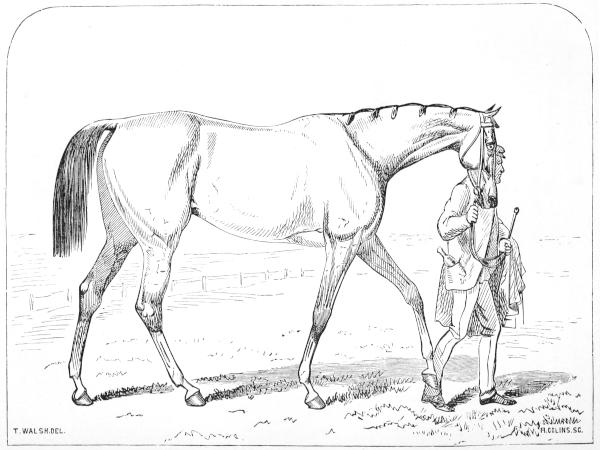
The “Irish hunter” is admitted to possess in a remarkable manner the qualities most desirable in a horse of that or the generally useful class. Hardy, enduring, courageous, strong, short-legged, short-backed, long-sided, tolerably fast, but any deficiency in speed made up for by jumping power; all action, able to jump anything and everything; intuitive lovers of fencing; their sagacity such that you have only to get on their backs and leave the rest to themselves;—under ordinary circumstances it is almost impossible to throw these animals.
THE PROPER FORM
Such is the breeding that I should be inclined to cross with that of the powerful English race-horse as sire, taking blood as nearly pure as possible in both parents, for the purpose of securing valuable stock, which would in time be dispersed over the country, and replace the progeny of those weedy thorough-breds which, in Ireland especially, have done much towards the decline in power and endurance of the present generation of so-called Irish hunters. The parentage might, of course, be reversed between sire and dam.
As to the question of climate, any one really interested in discovering its possible effects might be curious to know what would characterise the produce of a high-bred English racer and Irish huntress foaled and reared in France.
As far as we can judge from the peculiarities of those horses with which we are most familiar, extremes of either heat or cold are unfavourable to the development of size; whereas, under both conditions, a vast amount of endurance seems to be natural.
The Norwegian and the Arab, differing materially in point of swiftness, are both notorious for endurance. The plodding perseverance of the first is well known; while the Arab, ridden at an even gait with a fair weight, will go with impunity a greater distance, at a rate of eighteen to twenty miles an hour, than the best European can do. In sporting language, the Arab can “stay” better than the European.
Arab breeders rarely offer a really high-bred animal for sale under four, and generally five, years of age; hence he cannot receive the education bestowed upon the European racer, who, before he is three, often at less than two, years of age, is taught by the most scientific riders in the world to “go from the post” at very nearly top speed—a species of training that sometimes results in his beating horses which are really superior in every respect except that of being ready at starting, and capable of putting on their best speed at once. Besides, in those hot climates the young animal has not the advantage of a soft elastic turf, so essential to training, nor has he the assistance of proper trainers and jockeys.
It is much to be regretted that the breeders of Arabia cannot be tempted, for almost any price, to part with truly high-bred mares, wisely retaining them to breed for the benefit of their native land.
Warmth of climate seems thus, as instanced in the Arab, to favour swiftness and endurance; though, on the other hand, we may point to the mild, moist, but scarcely warm climate of our islands, as having fostered the production of animals possessing these qualities in the first degree, in addition to size and power beyond those of the Arab.
France has latterly, since the introduction of pure blood, produced some splendid horses; but time must tell whether the perfections of these animals are as lasting as those of others whose early growth may not have been so much forced by a more genial climate. Therefore, as far as we know at present, the climate of England is as favourable as that of any other land to the production and development of perfection in the horse, the specimens of which that she has presented being hitherto unsurpassed.
It would appear that we make a serious mistake in not providing greater encouragement to breeders and purchasers of yearlings and two-years-old of the different descriptions. A decided advantage would, we think, result from competition among these classes at horse-shows, due care being necessarily given to placing them in a situation specially adapted for them, and where they would be free from noise and excitement. Nothing would tend more to incite to the careful breeding of horses among farmers than the possibility of obtaining handsome prizes, and thereby securing the prospect of early remuneration; while the opportunity for market afforded by these exhibitions would present additional inducements to the rearing and purchase of young animals. Having in view the encouragement of a superior breed of horses, it is beginning at the wrong end not to support it, in the first place, by allotting at such meetings the most numerous and valuable prizes to the babies.
Fortunately the ventilation given to this important subject of the deterioration in our horses, more especially in that particular class denominated the Irish hunter, has aroused the interest of the country at large, and already led to more earnest efforts on the part of the landed proprietors and breeders to regain lost ground.
It ought to be borne in mind that the light weights allowed by the present racing laws for Queen’s plates are, as examples for weighting in other races, most pernicious. These grants from the Crown were originally bestowed with the view to encourage the raising of strong thorough-breds, capable of carrying twelve stone sometimes for four or even five mile heats; therefore the present arrangement of weights is positively, however unintentionally, a misapplication of those public funds.
It is probably to the turfmen that the change in the character of steeplechasing is greatly due; they found it their interest gradually to alter the weights and distances, so as to bring profitably into play their second and third rate beaten race-horses. Steeplechases were not intended for these latter, whose perfection is in proportion to their speed. Pace is not the chief desideratum in hunters, to prove the qualities of which steeple or castle chases were instituted; power and endurance are at least as essential: and it is contrary to the law of nature, as well as of mechanics, to combine a maximum of speed with that of power, and vice versa. Either will preponderate to the detriment of the other.
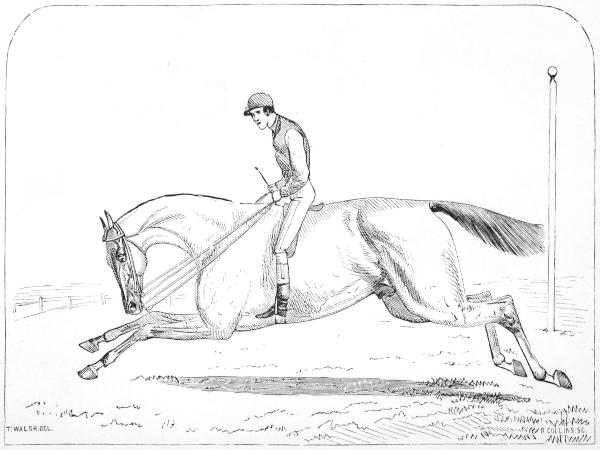
The difficulties, natural and artificial, presented by the general face of the country in Ireland, have no doubt contributed to the development of those qualities which render the Irish hunter so valuable. The style of fence is continually varied; and in the course of a run there will be encountered double ditches, with a narrow or wide bank, single ones, stone walls, brooks, bullfinches, gates, wide drains, and occasionally posts and rails, or iron palings—hurdles being, however, of rare occurrence; but the horse that can master the above impediments to his course will soon find out how to jump a hurdle.
PREPARATORY CANTER
The Irish colt has sometimes also a kind of training not expressly designed for him by his owner; for being not unfrequently left with other animals in a field affording an insufficient supply of grass for them all, he undertakes to prove the truth of the proverb that hunger will break through stone walls, by jumping over if not through one to obtain more or better food.
Transplanted to England, the accomplished Irish hunter often finds himself tested in a manner strange to him; the rate of speed is greater than he has been accustomed to, for the Green Isle has not yet adopted generally the extremely swift pace of hounds now so much in vogue in England, and is thence, as regards the hounds and the horses, in unquestionably the most sportsmanlike condition. It was never intended that hunting should become steeplechasing; and the unnatural pace to which hounds are now forced causes them often to overrun the scent after they have got away; then, when at fault, the entire ruck of the field have an opportunity of coming up, to be, of course, once more distanced, at the repeated sacrifice of the sound principles of hunting, and to the disadvantage of the true breed of hunters.
If breeders of horses would give their full attention to the pursuit, there is no reason why they should not be as successful in producing the best description of every class of this animal, as breeders of sheep and cattle are in their line. By judicious crossing, animals can be secured with any peculiar characteristics that may be desired; and for the encouragement of energy and exertion in this direction, we may remind our readers that there is now so much competition for the possession of first-class horses, that our Continental neighbours constantly outbid us, having learned to value them even more than we do who have been suffering our best sires to be bought up and removed from their native soil to improve the foreign stock. It is not impossible that, circumstances having directed so much attention to this subject, good will in this as in many other cases spring out of evil, and the fostering of valuable breeds of horses will become a more widely-recognised source of emolument than it has been for many years past, regaining, likewise, its proper standing among Britons as a matter of deep national interest and importance.