PART IV. RANGES.
Reading edition
1. What is meant by the range of a piece of artillery?
The distance from the muzzle to the first graze.
2. How may the range of a projectile be extended?
Either by raising the piece to a higher level, or by giving its axis greater elevation within certain limits.
3. Define point-blank range.
The distance from the muzzle of the piece to that point in a shot’s trajectory where it cuts the prolongation of the natural line of sight, a second time.
4. In what does the French definition for point-blank range differ from ours?
It requires that the natural line of sight should be horizontal.
5. What is the British definition for point-blank range?
The distance from the muzzle to the first graze when the axis of the piece is parallel to the plane upon which the carriage stands.
6. Explain by a figure, the position of, and relations existing between the line of sight, the line of fire or axis of the piece, and the trajectory, and also what the point-blank range is.
64]
Fig. 1
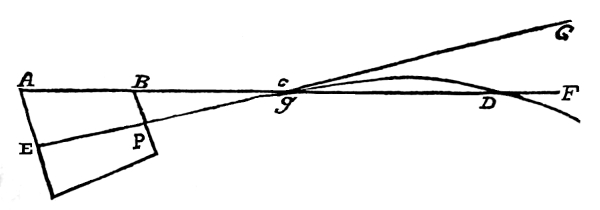
ABcF, the line passing through the highest points of the base ring and swell of the muzzle, or the muzzle-band, is called, the natural line of sight. EPcG, is the axis of the piece or line of fire; the curved line, PgD, described by the projectile, is called the trajectory, and is entirely below the line of fire, in consequence of the action of the force of gravity giving the projectile a downward tendency. The point D is called the point-blank, and its distance from the mouth of the piece, the point-blank range.
7. Mention some of the causes which vary the point-blank range.
The form of the cannon; the weight or force of the charge; the diameter and weight of the projectile; and the inclination of the line of sight to the horizon.
8. Why has the form of the cannon an influence on the point-blank range?
Because as the difference between the diameter of the breech and muzzle become greater, the angle of sight, BcP = GcF (see fig.) increases, and the point-blank D is removed farther off; on the contrary, as the diameters approach to an equality, the point-blank approaches the piece. Within a certain angle, or when there is no angle of sight, as is the case with some old howitzers in which the line of sight is parallel to the axis of the bore, there will be no point-blank, as the trajectory will be constantly below the line of sight.
65]
9. What influence has the charge on the point-blank range?
An increase of the charge determines a more distant point-blank; its diminution produces a contrary effect: but beyond a charge equal to one-third the weight of the ball, the increase of range is inconsiderable, and the force of the recoil becomes very great.
10. How do the diameter and weight of the projectile affect the range?
As the ball increases in size and density, it will overcome with more ease the resistance of the air.
11. Does the inclination of the line of sight to the horizon have much effect on the point-blank range?
Only when this inclination is very considerable. For the ordinary inclination, from 0° to 15°, above or below the horizon, the difference may be wholly neglected.
12. What is the effect on the point-blank range of firing upwards under a large angle?
The action of the weight being nearly directly opposed to the impulsive force, the trajectory becomes compressed and the point-blank distance diminishes. The contrary effect obtains in firing downwards under a similar angle, as the weight and the force then act in nearly the same direction.
66]
13. Why may the point-blank be considered constant for the same calibre?
The dimensions, charges, and weights of projectiles, being constant, and the inclination of the natural line of sight, except in a very few cases, being comprised between 0° and 15°, it follows that for the same calibre, the point-blank may be considered constant, and may serve as a point of reference in firing at different distances.
14. What is the extreme range of a piece of artillery?
The distance from the piece to where the projectile finally rests.
15. For a given velocity what effect has an increase of the angle of lire on the range?
It increases with the angle of fire up to a certain limit, beyond which it diminishes.
16. What angle gives the greatest range in vacuo?
Forty-five degrees.
17. When will this angle give the maximum range in practice?
Only for feeble charges, and very heavy projectiles.
18. How is the angle of greatest range in practice affected by a change in the velocity and size of the projectile?
It seems to diminish as the velocity is increased, and as the ball is reduced. For the musket the angle of maximum range varies from 28° to 30°; and is nearly 42° for mortars.
19. Under what angle is a mortar usually fired?
Under the constant angle of 45°, and the charge is varied according to the range required.
20. What are the advantages of this practice?
Economy of ammunition; the recoil being inconsiderable, the mortar and its bed receive but little strain; the ranges are more uniform, and the effect of a slight error in the angle of fire is less than with any other.
67]
21. Is the mortar ever fired at any other angle than 45°?
Yes; sometimes at 60°.
22. When is the mortar fired under an angle of 60°?
When the battery is situated very near the object assailed, and it is desired that the shells may fall upon the magazines of the besieged. It is evident that projectiles the higher they are thrown up acquire more velocity in falling, besides striking the object more directly and with increased violence.
23. Under what angle are stone-mortars usually fired?
Under an angle of 60°, and sometimes of 75°, that in falling from a great height, the stones may have the maximum force of percussion.
24. Under what angle should grenades be thrown from stone-mortars?
About 33°; otherwise they will be buried in the earth, and their fragments will not be sufficiently destructive.
25. When a gun or howitzer is aimed with the line of metal horizontal, what is the elevation equal to?
The natural angle of sight or dispart.
26. How is the time of flight for siege mortars at an elevation of 45° determined?
It is nearly equal to the square root of the range in feet divided by four.
68]
Ranges of Field Guns and Howitzers.
KIND OF PIECE. Powder. Ball. Elevation Range Remarks.
lbs. deg. min yds.
6-Pounder Field Gun 1.25 Shot. 0 318
“ 1 647 P. B. Range
“ 2 867
“ 3 1138
“ 4 1256
“ 5 1523
1. Sph. case 2 650 Time of flight 2”
“ 2 30 840 do.3”
“ 3 1050 do.4”
12-Pounder Field Gun 2.5 Shot. 0 347
“ 1 662 P. B. Range
“ 1 30 785
“ 2 909
“ 3 1269
“ 4 1455
“ 5 1663
1.5 Sph. case 1 670 Time 2 seconds.
“ 1 45 950 “ 3 “
“ 2 30 1250 “ 4 “
12-Pounder Field Howitzer. 1. Shell. 0 195
“ 1 539
“ 2 640
“ 3 847
“ 4 975
“ 5 1072
0.75 Sph. case 2 15 485 Time 2 seconds.
“ 3 15 715 “ 3 “
“ 3 45 1050 “ 4 “
24-Pounder Field Howitzer. 2. Shell. 0 295
“ 1 516
“ 2 793
“ 3 976
“ 4 1272
“ 5 1322
1.75 Sph. case 2 600 Time 2 seconds.
“ 3 800 “ 3 “
“ 5 30 1050 “ 4 “
2. “ 3 30 880 “ 5 “
32-Pounder Field Howitzer. 2.5 Shell. 0 290
“ 1 531
“ 2 779
“ 3 1029
“ 4 1203
“ 5 1504
2.5 Sph. case. 3 800 Time 2¾ sec’ds.
Mountain Howitzer. 0.5 Shell. 0 170
“ 1 300
“ 2 392
“ 2 30 500 Time 2 seconds.
“ 3 637
“ 4 785 Time 3 seconds.
“ 5 1005
0.5 Sph. case. 0 150
“ 2 30 450 Time 2 seconds.
“ 3 500
“ 4 700 Time 2¾ sec’ds.
“ 4 30 800 Time 3 seconds.
0.5 Canister. 4 to 5° 250
69]
Ranges of Heavy Artillery.
KIND OF PIECE. Powder. Ball. Elevation Range Remarks.
lbs. deg. min yds.
18-Pdr. Siege and Garrison Gun on Barbette Carriage. 4.5 Shot. 1 641
“ 1 30 800 Point-Blank.
“ 2 950
“ 3 1256
“ 4 1450
“ 5 1592
24-Pdr. Siege and Garrison Gun on Siege Carriage. 6. Shot. 0 412
“ 1 842
“ 1 30 953 Point-Blank.
“ 2 1147
“ 3 1417
“ 4 1666
“ 5 1901
8. “ 1 883
“ 2 1170
“ 3 1454
“ 4 1639
“ 5 1834
32-Pdr. Sea-Coast Gun on Barbette Carriage. 6. Shot. 1 45 900
8. “ 1 713
“ 1 30 800
“ 1 35 900
“ 2 1100
“ 3 1433
“ 4 1684
“ 5 1922
10.67 “ 1 780
“ 2 1155
“ 3 1517
70]
KIND OF PIECE. Powder. Ball. Elevation Range Remarks.
lbs. deg. min yds.
42-Pdr. Sea-Coast Gun on Barbette Carriage. 10.5 Shot. 1 775
“ 1 30 860
“ 2 1010
“ 3 1300
“ 4 1600
“ 5 1955
14.5 “ 1 770
“ 2 1128
“ 3 1380
“ 4 1687
“ 5 1915
8-in. Siege Howitzer on Siege Carriage. 4. 45-lb. Shell. 0 251 Time ⅔ sec’ds.
“ 1 435 “ 1⅓ “
“ 2 618 “ 2 “
“ 3 720 “ 3 “
“ 4 992 “ 4 “
“ 5 1241 “ 5 “
“ 12 30 2280
24-Pdr. Iron Howitzer on a Flank Casemate Carriage. 2. 17-lb. Shell. 0 295
“ 1 516
“ 5 1322
1¾ Sph. case. 2 600 Time 2 seconds.
“ 5 30 880 “ 4 “
2. “ 3 30 1050 “ 3 “
8-in. Sea-Coast Howitzer on a Barbette Carriage. 4. 45-lb. Shell. 1 405
“ 2 652
“ 3 875
“ 4 1110
“ 5 1300
6. “ 1 572
“ 2 828
“ 3 947
“ 4 1168
“ 5 1463
8. “ 1 646
“ 2 909
“ 3 1190
“ 4 1532
“ 5 1800
10-in. Sea-Coast Howitzer on Barbette Carriage. 12. 90-lb. Shell. 1 580
“ 2 891 Time 3 sec’ds.
“ 3 1185 “ 4 “
“ 3 30 1300
“ 4 1426 “ 5¼ “
“ 5 1650 “ 6 “
71]
KIND OF PIECE. Powder. Ball. Elevation Range Remarks.
lbs. deg. min yds.
8-in. Columbiad on Barbette Carriage. 10. 65-lb. Shot. 1 932 Axis of gun
“ 2 1116 16 feet above
“ 3 1402 the water.
“ 4 1608
“ 5 1847
“ 6 2010
“ 8 2397 Shot ceased to
“ 10 2834 ricochet on
“ 15 3583 the water.
“ 20 4322
“ 25 4875
“ 27 4481
15. “ 27 30 4812
10. 50-lb. Shell. 1 919
“ 2 1209
“ 3 1409
“ 4 1697
“ 5 1813
“ 6 1985
“ 8 2203
“ 10 2657
“ 15 3556
“ 20 3716
“ 25 4387
“ 27 4171
15. “ 27 30 4468
10-in. Columbiad on Barbette Carriage. 18. 128-lb. Sht. 0 394 Axis of gun
“ 1 752 16 feet above
“ 2 1002 the water.
“ 3 1230
“ 4 1570
“ 5 1814
“ 6 2037 Shot ceased to
“ 8 2519 ricochet on
“ 10 2777 the water.
“ 15 3525
“ 20 4020
“ 25 4304
“ 30 4761
“ 35 5433
20. “ 39 15 5654
12. 100-lb. Shell. 1 800
“ 2 1012
“ 3 1184
“ 4 1443
“ 5 1604
18. “ 0 448
“ 1 747
“ 2 1100
“ 3 1239
“ 4 1611
“ 5 1865
“ 6 2209
“ 8 2489
“ 10 2848
“ 15 3200
“ 20 3885
“ 25 4150
“ 30 4651
“ 35 4828 Time 35 sec’s.
72]
KIND OF PIECE. Powder. Ball. Elevation Range Remarks.
lbs. deg. min yds.
13-in. Sea-Coast Mortar. 20. 200-lb. Shell.. 45 4325 Time 40 sec’s.
10-in. Sea-Coast Mortar. 10. 98-lb. Shell. 45 4250 Time 35 sec’s.
10-in. Siege Mortar. 1. 90-lb. Shell. 45 300 Time 6.5 sec’s.
1.5 “ “ 700 “ 12. “
2. “ “ 1000 “ 14. “
2.5 “ “ 1300 “ 16. “
3. “ “ 1600 “ 18. “
3.5 “ “ 1800 “ 19. “
4. “ “ 2100 “ 21. “
lbs oz
8-in. Siege Mortar. 0 8 45-lb. Shell. 45 209 Time 6.75 sec’s.
1 12 “ “ 376 Time 9. sec’s.
1 0 “ “ 650 Time 11.5 sec’s.
1 4 “ “ 943 Time 14. sec’s.
1 8 “ “ 1318 Time 16.5 sec’s.
1 12 “ “ 1522 Time 18.5 sec’s.
2 0 “ “ 1837 Time 20.5 sec’s.
24-Pounder Coehorn oz
Mortar. 0.5 17-lb. Shell. 45 25
1. “ “ 68
1.5 “ “ 104
1.75 “ “ 143
2. “ “ 165
2.75 “ “ 260
4. “ “ 422
6. “ “ 900
8. “ “ 1200
lbs Stones.
Stone Mortar. 1.5 120 lbs. 60 150
to
250
1 15 6-pdr. 33 50 Fuze 15 sec’s.
shells. to 150
Note.—Fire-balls, according to their size, are fired from mortars of corresponding calibres. With a charge of ONE TWENTY-FIFTH its weight, the ball is thrown 600 to 700 yards.
73]