PREFACE
Reading edition
How to teach a child to read so as to create and preserve the right attitude toward reading is one of the most important problems of the school. That it has not been solved to the joint satisfaction of theorist and of practical teacher is evidenced by the continued discussion of the subject both in speech and in print.
This little primer may not prove to be the last word on primary reading. It is in my opinion the most valuable word that has yet been spoken. For here we have several of the most important desiderata for whose combination all are searching.
The matter is interesting to the persons to whom it is addressed; it is a series of stories about several little children told in conversational form. Its thought units are short but sequential, and its vocabulary is small, each word being presented with interest, and repeated with variety in its relations. As a natural outgrowth of the acquaintance with old words comes the power to decipher new words. The phonic lessons are well graded, and the subject is properly subordinated to thought getting. The appeal made to the primitive, æsthetic enjoyment of the jingle, with simple melody and captivating rhythm, as the phonics are presented, is followed by the gratification of finding them contributory to the ability to read the classic rimes which follow.
That all these values characterize the book is due to the fact that many pedagogic virtues are characteristic of its author. Those who have seen Miss Haliburton teach know that her power to inspire, interest, and develop her pupils is not only due to the fleeting influence of the much talked of “teacher’s personality,” but is largely a transferable ability, due to a gifted woman’s sympathetic insight into the processes of the child mind, illuminated by the scholar’s knowledge of genetic psychology.
An intimate acquaintance with the results attained by those whom the author has instructed in her methods, enhances the approval which her book itself commands.
BRUCE R. PAYNE.
University of Virginia, May 15, 1911.
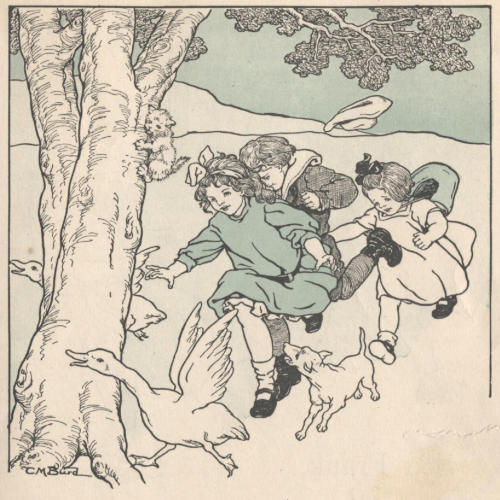
Run.
Run, run.
Now stop.
Stop, stop.
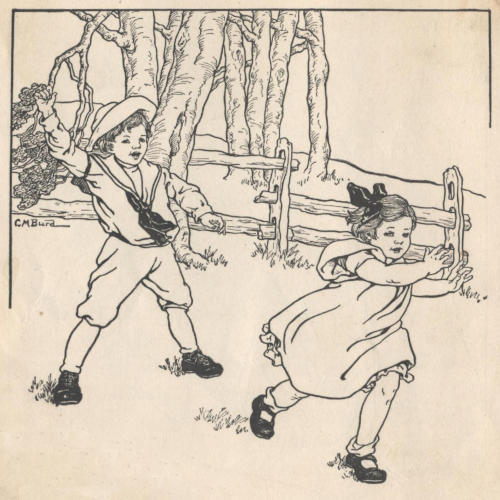
See Frank.
See Alice.
See Alice run.
Run, Alice, run.
Stop, Frank, stop.
I see Alice.
I see Frank.
Do you see Alice?
Do you see Frank?
Now stop.
Stop now, Frank.
Stop, stop, Frank.
See Frank stop.
Now run.
Run, Alice.
See Alice run.
I see Alice run.
Run, Alice, run.
Run R run r
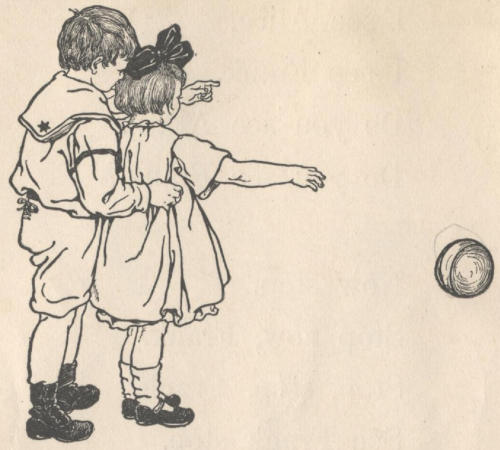
See the ball.
Get the ball.
Get the ball, Alice.
Run, Alice, run.
Get the ball, Frank.
Run, run, Frank.
Now get the ball.
I see Alice.
I see Alice and Frank.
Alice sees the ball.
Frank sees the ball.
Alice and Frank run.
See Alice and Frank run.
Can Alice get the ball?
Can Frank get the ball?
Frank can get the ball.
Get the ball, Alice.
You can get the ball.
Run and get the ball.
You can get the ball now.
Get G get g
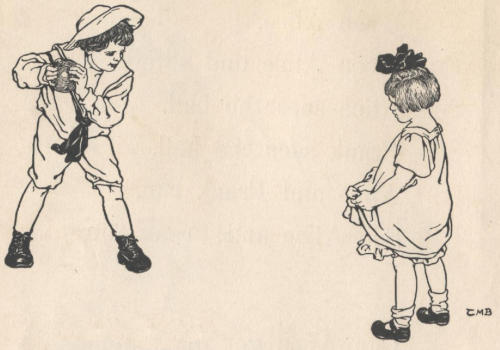
Get the ball.
Get the ball, Frank.
Pitch the ball.
Can you pitch the ball?
I can pitch the ball.
I can pitch the ball to you.
Stop the ball, Alice.
Run and get the ball.
Now you can pitch the ball.
Frank can pitch the ball.
Frank can pitch the ball to Alice.
See Frank pitch the ball.
See Frank pitch the ball to Alice.
Can Alice pitch the ball?
Can Alice pitch the ball to Frank?
Alice said, “Pitch the ball.
Pitch the ball, Frank.
Pitch the ball to me.
Can you pitch the ball to me?”
Frank said, “I can pitch the ball.
I can pitch the ball to you.
See me pitch the ball.”
Pitch P pitch p
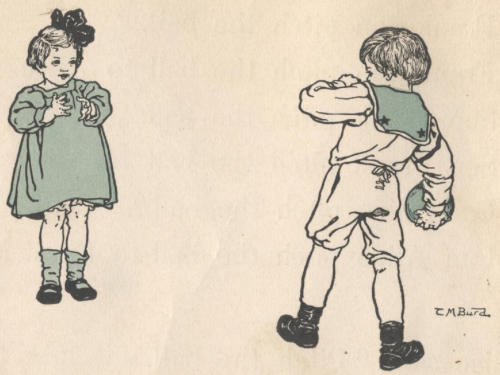
Catch the ball.
Catch it, Alice.
Can you catch it?
Pitch it to me, Frank.
I can catch it.
See me catch the ball.
See me run and catch it.
Run, Alice! Catch the ball!
Did you see Alice run?
Alice can catch a ball.
Did you see Alice catch the ball?
Frank can pitch a ball.
Did you see Frank pitch the ball?
Did you see Frank pitch it to Alice?
Frank said, “Catch the ball.
Can you catch it, Alice?”
Alice said, “Yes.
Yes, Frank, I can run and catch it.
Pitch it to me, Frank.”
Frank said, “Yes, Alice.
Run, Alice, and catch the ball.”
Catch C catch c
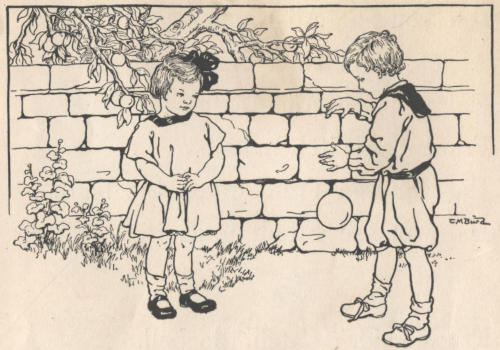
Bounce the ball, Frank.
Can you bounce it?
Pitch the ball to me.
I can bounce it.
I like to bounce a ball.
See me bounce it.
See me catch it.
Bounce, ball, bounce.
I saw Frank get the ball.
I saw him pitch it to Alice.
I saw Alice catch the ball.
I saw Alice run to catch it.
I saw Frank bounce the ball.
I saw Frank bounce it and catch it.
Alice said, “Bounce the ball, Frank.
Can you bounce it?
Pitch it to me, Frank.
I can bounce it.
I like to bounce a ball.”
Frank said, “See me bounce it.
Bounce, ball, bounce.”
Bounce B bounce b
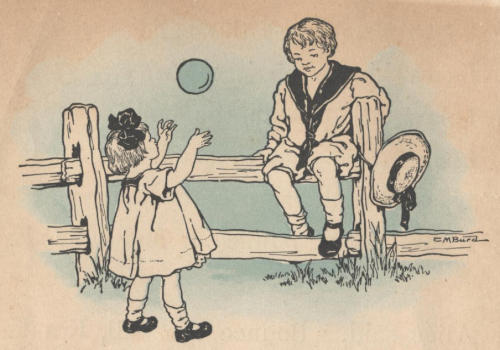
Toss the ball, Frank.
Toss it up, up.
I can toss it up.
I like to toss a ball.
Up, up! See me toss it.
I can catch the ball.
I can run and catch it.
Can you toss it up and catch it?
Have you a ball?
I have a ball.
I saw Frank with a ball.
I saw Alice with a ball.
I saw Alice bounce the ball.
I saw Alice toss the ball.
Alice can toss it up and catch it.
Alice said, “Stop, Frank.
See me toss the ball.
I like to toss a ball.
I can toss it and catch it.
Toss the ball up, Frank.
Toss it up and catch it.”
Toss T toss t
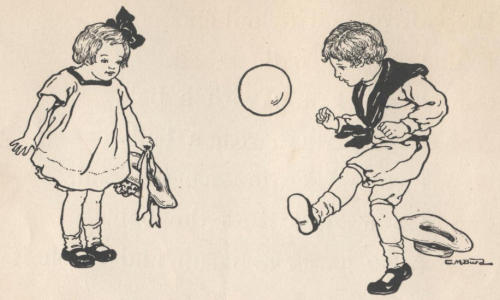
I can kick the ball, Alice.
I like to kick a ball.
I can kick a ball high.
See me kick it high.
See me run and kick it.
Can you kick a ball, Alice?
Do you like to kick a ball?
Run and kick it, Alice.
Kick it high, Alice.
Do you play with a ball?
I like to play with a ball.
Can you kick a ball?
A boy can kick a ball.
A boy can kick a ball high.
Can you pitch a ball?
A boy can pitch a ball.
A boy can pitch a ball high.
Did you see Alice and Frank play?
I saw Alice play with a ball.
I saw Frank play with a ball.
I saw him kick the ball high.
I did not see Alice kick the ball.
Frank said, “Kick the ball high, Alice.”
Kick K kick k
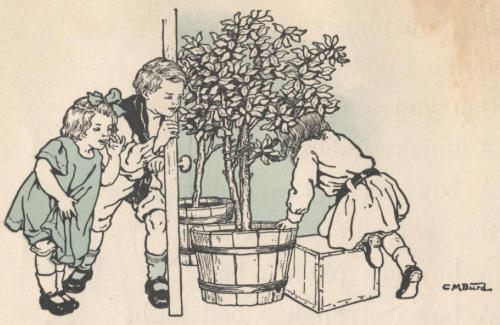
Alice, I see Grace.
Grace did not see me.
I will run and hide.
Will you hide, Alice?
Run, run and hide.
Grace will catch you.
Hide, Alice, hide.
Grace will see you.
Do you play hide?
I play hide.
I like to hide.
Do you like to hide?
Frank and Alice play hide.
Grace plays with them.
Did you see Grace?
Frank saw Grace.
He said, “Alice, I see Grace.
I will run and hide.
Will you hide, Alice?
Run. Grace will see you.
Hide, Alice. Run and hide.”
Hide H hide h
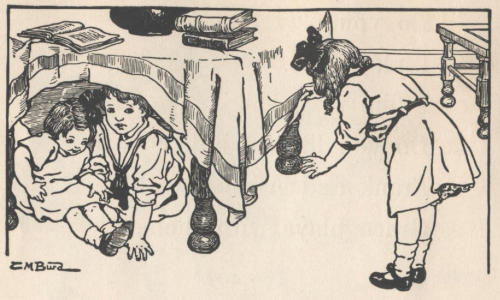
Sister! Sister Grace!
Find me, Sister.
Find Frank. Find me.
Yes, I will find you.
I saw you and Frank run.
I saw you stop.
I can find you and him.
I see you now, Alice.
I have you now, Frank.
I like to play “Hide the ball.”
Do you play “Hide the ball”?
Frank and Alice play it.
Did you see them hide the ball?
I did not see them hide it.
I saw Frank and Alice run and hide.
Frank said, “Find us, Sister Grace.
Can you find us?
Find Alice. Find me, Sister.”
Did Grace find them?
Yes. She said, “I can find you.
I see you, Alice.
I see you and Frank.”
Find F find f
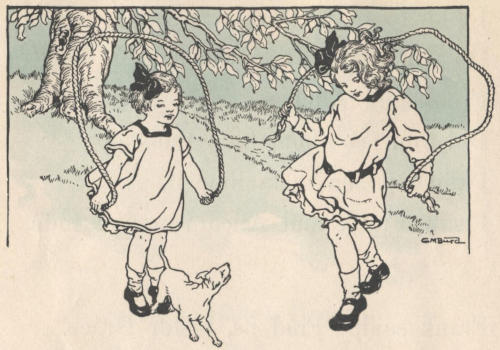
Come and jump, Alice.
Jump the rope with me.
Do you like to jump a rope?
I like to jump a rope.
I can jump high.
You can jump with me.
Come jump, Alice, jump.
Have you a rope?
Do you jump the rope?
Can you jump high?
Can you run and jump?
Grace has a rope.
Has Alice a rope?
Yes, I saw Alice with a rope.
I saw the children jumping a rope.
I saw the children run and jump the rope.
Grace said, “Come jump, Alice.
You can run and jump with me.
Can you not run and jump?
Jump, Alice, jump, jump.”
Jump J jump j
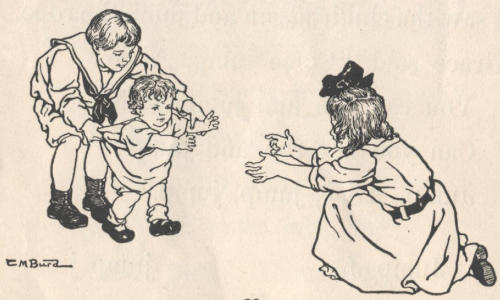
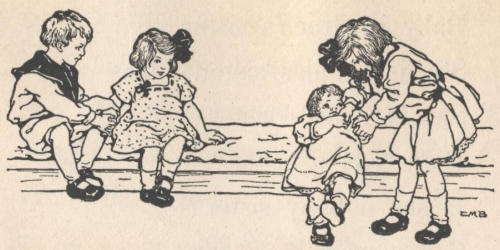
Grace, here comes Baby.
Walk with me, Baby.
She can walk, Grace.
Yes, Frank, she will walk to me.
Come here, Baby.
Come, Baby, come to me.
Walk to Sister Grace.
Walk, Baby. Walk to Grace.
Here she comes to you, Grace.
Grace has you, Baby.
Baby is Grace’s sister.
She is Frank’s sister.
She is Alice’s sister.
Have you a sister?
Is she a baby sister?
Can your baby sister walk?
Do you play with your baby sister?
I saw Baby with Frank.
I saw Baby walk to Grace.
Grace said, “Come to me, Baby.
Walk to your sister.
You can walk to me.
Walk, Baby. Walk to Sister Grace.”
Walk W walk w
Now I have you, Baby.
Come and dance.
You may dance with Baby, Frank.
Will you dance with him, Baby?
Will you dance with Alice?
Will you dance with me?
Dance with your Sister Grace.
I will dance with you.
You can dance, Baby.
Dance, Baby, dance.
Do you like to dance?
Do you like to see a baby dance?
A baby likes to jump and dance.
Can your baby sister dance?
Does she like to dance?
Do you like to dance with her?
Does she like to dance with you?
Did you see Baby dance?
No, I did not see her dance.
Did Baby dance with Grace?
No, she did not dance with Grace.
Grace said, “Come and dance, Baby.
Will you dance with me?
Dance with your Sister Grace.
You can dance, Baby.”
Dance D dance d
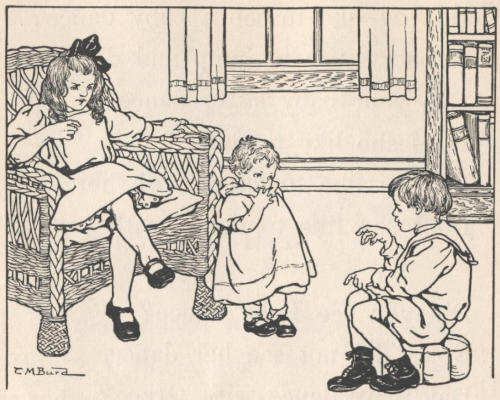
Baby will not dance, Grace.
She will not dance with me.
Sing for her, Grace.
Sing, and Baby will dance.
Grace will sing for us, Baby.
Sing, Grace, sing. Sing for Baby.
Can you sing?
Do you sing for your baby sister?
Does she like to hear you sing?
Will she dance for you?
Alice can sing and dance.
She sings for her baby sister.
Grace and Frank can sing too.
Did you hear Grace sing?
Did you hear her sing for Baby?
Baby likes to hear Grace sing.
Frank said, “Baby will not dance, Grace.
Sing, and she will dance.
Grace will sing for us, Baby.
Sing, Grace, and I will sing too.”
Sing S sing s
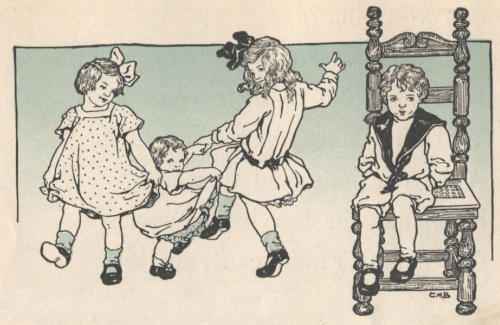
Come here, Frank.
Will you whistle for us?
Baby likes to hear you whistle.
Whistle, and she will dance for us.
Alice and I will dance with her.
Whistle for us to dance, Frank.
Yes, I will whistle, Grace.
Little sister, will you dance for me?
Now dance, little sister.
Can you whistle?
Frank can whistle and dance.
Boys like to whistle.
Frank likes to whistle for Baby.
Baby likes to hear him whistle.
Baby likes to dance for Frank.
She likes to see Frank dance.
Did you see Baby dance for Frank?
Yes, I am glad I saw her dance.
Frank said, “I will whistle.
I am glad Baby will dance for me.”
Grace said, “Whistle for Baby.
Whistle, Frank, whistle for us to dance.
Now see us dance, Frank.”
Whistle Wh whistle wh
do
doing
play
playing
sing
singing
jump
jumping
toss
tossing
kick
kicking
catch
catching
pitch
pitching
dance
dancing
bounce
bouncing
hide
hiding
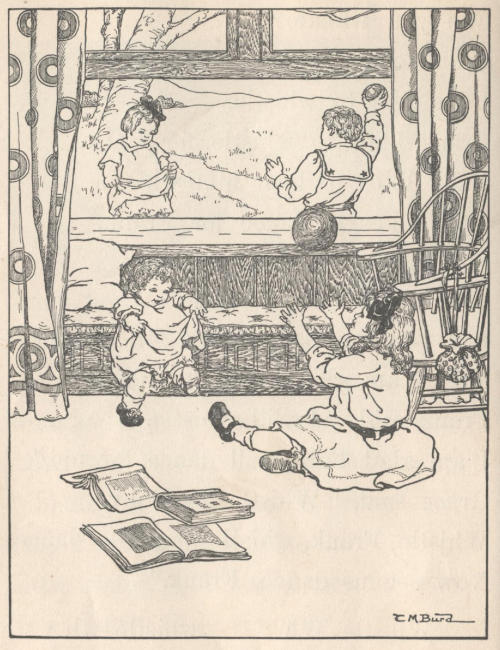
What is Grace doing?
Is she jumping a rope?
No, she is bouncing and tossing my ball.
She is singing for Baby.
Baby is jumping and dancing.
What is Frank doing? Is he hiding?
No, he is playing ball.
Is Frank kicking the ball?
No, he is pitching the ball to Alice.
Did Alice show Baby her hen?
Did she show her the little chicks?
Yes. She said, “Come with me, Baby.
Come and see my hen and chicks.
I will show you my hen.
I will show you the little chicks.
Here comes the hen, now.
She has the chicks with her.
Do you like the chicks, Baby?
I like the little chicks.”
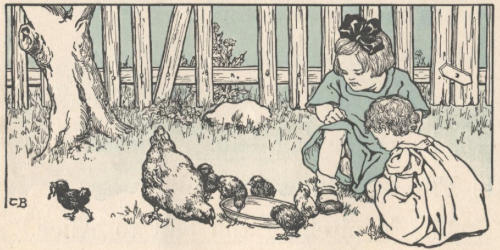
Alice has a white hen.
The white hen has little chicks.
Are the chicks white?
No, the chicks are not white.
Grace has a black hen.
The black hen has chicks, too.
I did not see Grace’s black hen.
Baby likes the little chicks.
I saw Alice show them to Baby.
Alice said, “Come see the chicks, Baby.
I will show them to you.
I will show you my white hen.
Do you like the little chicks, Baby?”
Show Sh show sh
Jet is Grace’s hen.
Jet is a black hen.
She is a mother hen.
She has little children.
Her chicks are her children.
She has a little duck with her chicks.
Grace will show the hen to Baby.
She will show her the little duck.
Grace said, “Come and see Jet’s chicks.
Mother Jet is a black hen.
Her chicks are white.
She has a baby duck with her chicks.
Mother Jet has pretty children.
The chicks and the duck are her children.
I will show you Jet’s children.”
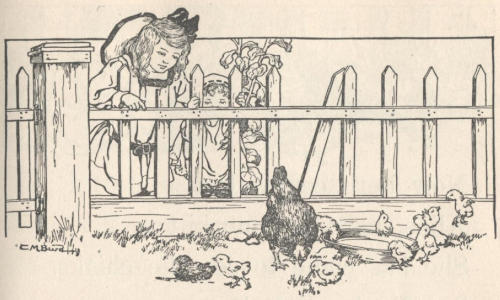
Here is Jet with her children.
The little duck has a name.
Its name is Ducky Bet.
Do you like Ducky Bet?
I will catch Ducky Bet for you, Baby.
I will catch a chick for you, too.
Chick, chick! Come here, little chick!
Chick Ch chick ch
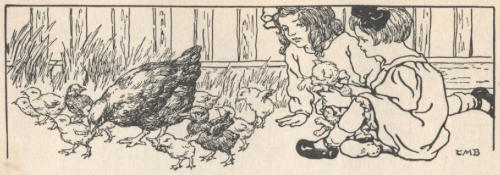
Now here comes Dot.
Alice, here is your kitty.
She has come to see the chicks.
See Ducky Bet, Dot.
The little chicks run to the hen.
Do not run, little chicks.
Dot will not catch you, Ducky.
The chicks do not like you, Dot.
The little duck does not like you.
But I like my little kitty, Dot.
Come to me, you little white kitty.
Alice has a little white kitty.
Her kitty’s name is Dot.
Did you see how white Kitty Dot is?
Baby has a black kitty.
Her kitty’s name is Mink.
You will see how black Mink is.
Baby likes her black kitty.
You did not see Kitty Mink.
But you saw Alice’s white kitty.
Grace said, “Now here comes Dot.
Look, look, Alice! See the chicks run.
The chicks do not like Dot.”
Alice said, “But I like my kitty.”
Now N now n
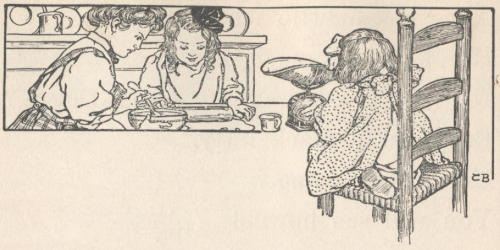
Alice! Alice!
Come here, Alice.
Come see me make a sweet cake.
You can not make a cake, Grace.
Can Grace make a cake, Mother?
I will show her how to do it, Alice.
Show me, too, Mother.
I can make a sweet cake.
May I make a cake, Mother?
Yes, you and Grace may make it.
I will show you how to make it.
I am glad to have you make the cake.
Did you see Grace and Alice?
I saw Grace and Alice with mother.
Mother said, “Your cousin is coming.
I will make a cake for your cousin.
I will show Grace how to make a cake.”
Alice said, “Show me, too, Mother.
I can make a cake.
Grace and I will make it.”
Grace said, “Baby must see the cake.
Show her the cake, Alice.
Does she like sweet cake?”
Alice said, “See the cake, Baby.
It is a sweet, sweet cake.
Do you like sweet cake, Baby?
This cake is for Cousin Max.”
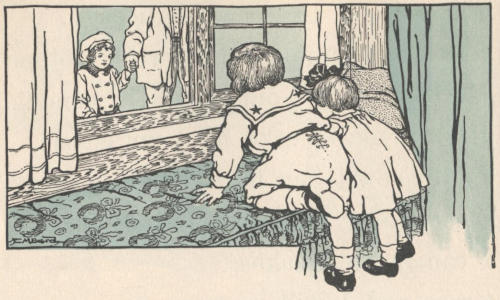
Look, look, Alice!
Here comes Max.
He is with Father.
Let us run and see him.
I am glad Max has come.
How do you do, Max?
I am glad to see you.
I am glad you have come.
Look L look l
Did you see Max?
Max is Frank’s cousin.
He is Grace’s and Alice’s cousin.
He is Baby’s cousin.
He will play with the children.
He has come to live with them.
This is Max’s home now.
I saw Frank run to Max.
Frank is glad Max has come.
Frank said, “Father has come home.
Max has come with Father.
How do you do, Max?
I am glad you are a boy.
I am glad to have a boy here.
I am glad you are to live here.”
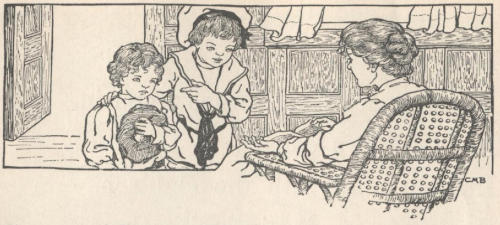
Come with me, Max.
Come and see Mother.
Max, this is Mother.
Mother, here is Max.
He has come to live with us.
Are you not glad, Mother?
Yes, I am glad, Frank.
Come to me, Max.
How do you do, my boy?
I am glad to see you, Max.
I am glad you are to live with us.
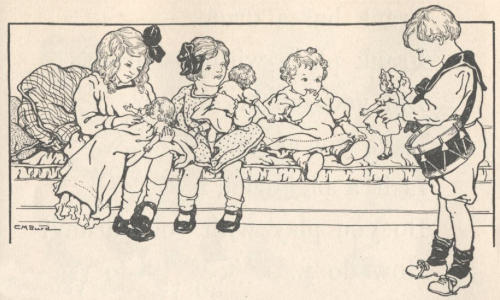
See my drum, Alice.
Did Max give the drum to you, Frank?
Yes, and here is a doll for Baby.
This doll is for you, Baby.
See your pretty little doll.
My doll is a pretty doll, Frank.
See! Grace’s doll is a baby doll.
Did Max give us the dolls, Frank?
Yes, he did, Alice.
This Th this th
Frank has a drum.
Frank plays with his drum.
Did you see his drum?
Have you a drum?
Is it a big drum?
Do you play with your drum?
How do you play with it?
Grace has a big baby doll.
Alice has a big doll, too.
Baby has a little doll.
Have you a doll?
Is it a big doll?
Is it a little doll?
Do you play with your doll?
How do you play with it?
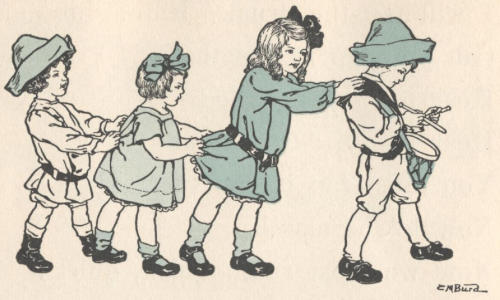
Come and play with my drum, Max.
Do you like to march?
Yes, Frank, I like to march.
Alice! Grace! Come and play.
Look, Mother, look! See us march.
Hear Frank whistle and tap his drum.
Rub-a-dub-dub! Rub-a-dub-dub!
Now Max may tap the drum.
Rub-a-dub-dub! Tap the drum, Max.
I will tap the drum. Rub-a-dub-dub!
Can you tap it like that?
Hear me tap it, Alice.
Hear it say, “Rub-a-dub-dub!”
You must tap it like that, Alice.
Now let us march.
Now we must run. Quick, quick!
Did you see Frank and Max march?
Did you see Alice and Grace march?
Max and Frank ran and ran.
Alice and Grace ran, too.
Frank said, “You must march.
You must run, too.”
Did you see them running?
March M march m
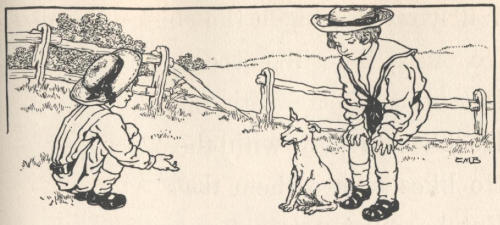
Here, Lad, here, here, here!
Is Lad your dog’s name, Frank?
Yes, that is his name, Max.
Is he a big dog, Frank?
No, he is not a big dog.
I will whistle. Here he comes, Max.
Look at him. See how little he is.
Come here, Lad. Come to me.
Look at him. He will not come.
Get up and go to Max, little dog.
Will your dog catch the chicks, Frank?
No, Max, he will not catch them.
But he will play with the chicks.
He likes to play with them.
He likes to see them run.
But he must not make them run.
My dog can catch rats, Max.
I do not like to see him catch rats.
But he likes to catch them.
I like to see Lad jump.
I will show you how he can jump.
Toss the ball, and he will jump high.
I can make him jump high.
Come and see him jump, Max.
You Y you y
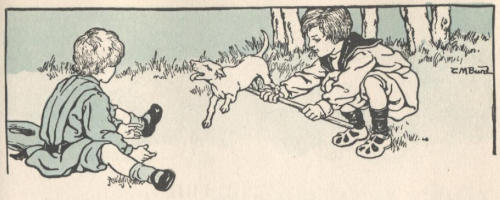
Can you find a stick, Max?
Yes, I see a stick. Here it is.
Give it to me, Max.
Can Lad jump over that stick?
Yes, he can jump over this stick.
I can make him jump over it.
Come, jump over the stick, Lad.
Jump, little dog. Jump quick!
Look, Max. Look quick!
Now you see how my dog can jump.
Quick Qu quick qu
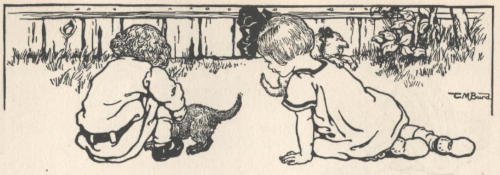
Is this black kitty yours, Alice?
No, that is Baby’s kitty Mink.
See how white my kitty Dot is.
She has not a spot on her.
Can Dot catch rats, Alice?
No, she is too little to catch rats.
But Dot did catch a little bat.
She saw the bat and ran to catch it.
A rat saw Dot, and ran.
Did Dot catch the rat, Alice?
No, but she saw it jump and run.
Then I saw it run and hide.
PHONIC JINGLES
To be read by teacher and sung by pupils.
Phonic Drill
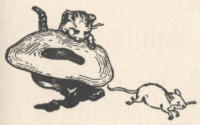
1. The Kitty-cat cat
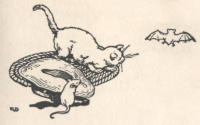
Sat on a mat. mat
She saw a bat. bat
She said, “What’s that? that
Ah, that’s a rat! rat
Pit-pitty-pat!” pat
2. The little rat, rat
So sleek and fat, fat
Who quiet sat sat
Behind a hat, hat
Ran “Pitty-pat” pat
From Kitty-cat. cat
M. S. Willis.
[Audio content is not currently supported on your device.
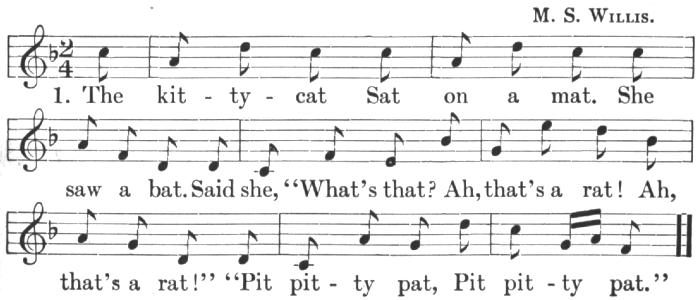
1. The kit-ty-cat Sat on a mat. She saw a bat. Said she, “What’s that? Ah, that’s a rat! Ah, that’s a rat!” “Pit pit-ty pat, Pit pit-ty pat.”
I like rabbits, Max.
I have a white rabbit.
His name is Bun.
Come and see my rabbit, Max.
See how white he is.
Bun has not a spot on him.
Do rabbits like apples, Frank?
Yes, I will give Bun an apple.
Bun, Bun, Bun! Here is an apple.
Apples! Apples! See the apples, Bun.
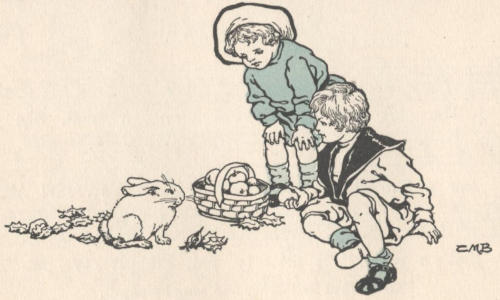
Jump, Bun. Jump for the apple.
He will not jump for the apple.
Can you catch him, Frank?
Yes, you can catch him, too, Max.
I will give him an apple, Frank.
Then I will catch him.
Now I have him, Frank.
How white he is!
My rabbit runs away, Max.
I can not keep him at home.
I will make a pen for him.
Then we can keep him here.
Can you make a pen, Frank?
Yes, I can make a pen for Bun.
Apples A apples a
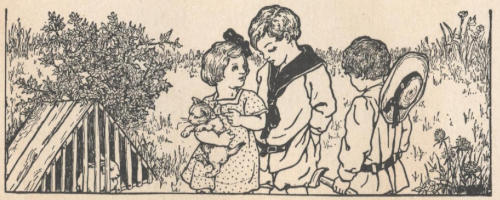
What is that, Frank?
This is a pen for Bun, Alice.
You see he runs away.
Now I can keep him in this pen.
Yes, you can, Frank.
Make a little bed for Dot, Frank.
You and Max can make it.
Yes, I will make the bed, Alice.
Will Dot sleep in a bed, Alice?
Yes, she will sleep in a doll bed.
I will make her sleep in it.
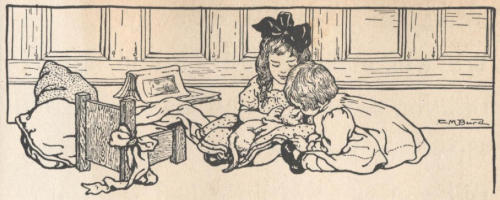
Oh, kitty, kitty, what a black spot!
Where did you get this spot, kitty?
How did you get it?
See this black spot on Dot, Baby.
Alice can not keep her white.
Did you see Dot’s little bed, Baby?
She has a little bed now.
Here is the little bed.
Dot will sleep in the little bed.
Alice will make her sleep in it.
Come, get into your bed now, Dot.
Frank said, “Bun runs away.
We will make a pen for him, Max.”
Did you see Frank and Max catch Bun?
They can keep Bun in the pen now.
Did you see the little bed for Dot?
Did you see Frank and Max make it?
They can make little beds.
Frank said, “Will Dot sleep in a bed?”
Alice said, “Yes, she will sleep in it.
I will make her sleep in a doll bed.”
Grace saw a black spot on Dot.
She said, “Look at this black spot!
Where did you get this spot, kitty?
Alice can not keep you white.
Come and get into your bed, Dot.”
PHONIC JINGLES
Phonic Drill
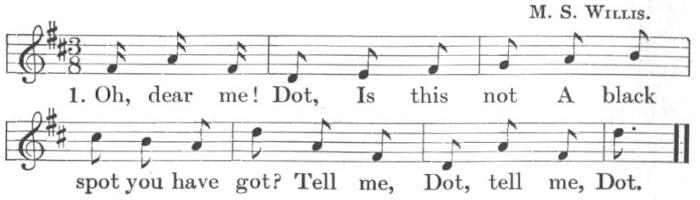
1. Oh, dear me, Dot, Dot
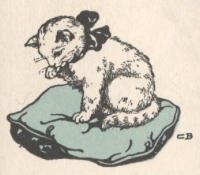
Is this not not
A black spot spot
You have got? got
Tell me, Dot. Dot
2. I love you, Dot. Dot
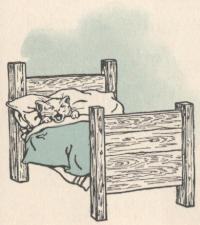
Do I not, not
Little tot? tot
Here’s your cot. cot
Good-by, Dot. Dot
M. S. Willis.
[Audio content is not currently supported on your device.
1. Oh, dear me! Dot, Is this not A black spot you have got? Tell me, Dot, tell me, Dot.
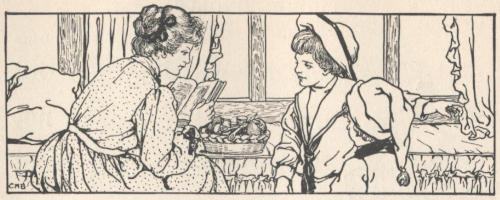
Mother, may we go with Father?
Where is your father going, Frank?
He is going to town, Mother.
May Max and I go with Father?
Yes, you and Max may go.
May Grace and Alice go, Mother?
Yes, they may go with you.
Where is Baby, Mother?
Let Baby go with us, Mother.
Oh no, Frank, I can not let her go.
I will keep Baby here with me.
Where are you going, Frank?
I am going to the barn, Max.
Come and go with me.
We will get the horses for Father.
Father is going to town.
Mother says we may go with him.
Oh, I am glad we are going, Frank.
Are Grace and Alice going with us?
Yes, Mother says they may go, too.
Is Baby going, Frank?
No, Mother will not let Baby go.
She will keep Baby with her.
Now let us run to the barn.
Let us catch the horses for Father.
I catch a horse with an apple.
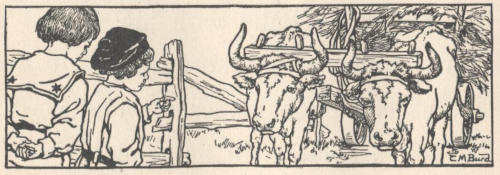
Max, come look at the red oxen.
Oh, how big the red oxen are!
See how they can pull.
Oxen can pull like horses.
Can the oxen run, Frank?
Yes, Max, oxen can run.
But oxen do not like to run.
They like to walk.
I do not like to drive oxen.
I like to drive horses.
Father will show you how to drive, Max.
He will let you drive the horses.
Did you see the children?
They were going through the woods.
They like the pretty woods.
The boys like to drive the horses.
Frank’s father has big horses.
Did you see the big horses?
Do you know how to drive?
Father lets Frank drive the horses.
He lets Max drive the horses, too.
Father knows how to drive the oxen.
Frank said, “Look at the big, red oxen.
Oxen can pull like horses.
But they can not run like horses.”
Oxen O oxen o
Father said, “Do you hear the birds?
Do you hear them sing, Max?
Look for them, as we drive.
Tell me where you see them.
Tell me what you see them doing.
Tell me how they look.
Look up in the trees, Max.
The birds are over us in the trees.”
“You must know the birds, Max.
You must know how they look.
You must know how they sing.
I hear a bird now, children.
Do you know what bird it is?
Do you hear it, Frank?
It is not singing. What is it doing?”
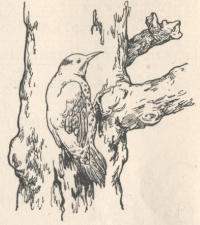
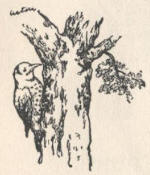
I see the bird up in an apple tree.
Do you see it?
How pretty it is!
Its head is red.
It taps on the tree.
Do you hear it?
“Tap! tap! tap!”
I see the bird with the red head.
There is sap in the tree.
The bird likes the sap in the tree.
It is getting the sap now.
It taps on the tree.
It does this to get the sap.
How does the bird get the sap?
It makes a little hole in the tree, Max.
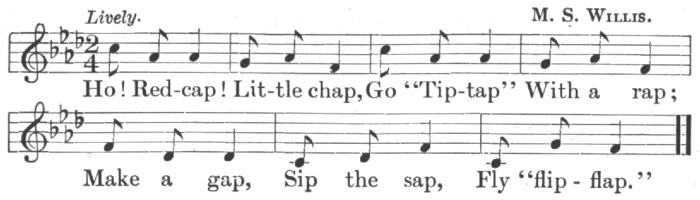
M. S. Willis.
Lively.
[Audio content is not currently supported on your device.
Ho! Red-cap! Lit-tle chap, Go “Tip-tap” With a rap; Make a gap, Sip the sap, Fly “flip-flap.”
PHONIC JINGLES
Phonic Drill
Ho! Red-cap! cap
Little chap, chap
Go “Tip-tap” tap
With a rap. rap
Make a gap, gap
Sip the sap, sap
Fly “flip-flap.” flap
nap
map
lap
clap
sip
lip
flip
slip
tip
rip
trip
skip
hip
chip
whip
ship
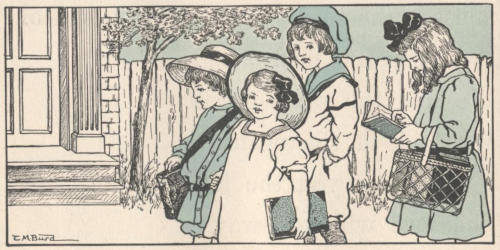
We are going to school, Max.
I am glad you are going with us.
I like to go to school.
I like to write in school. Do you?
Yes, I like to write, Frank.
Is your school in town?
No, we do not go to school in town.
This is the way we go to school.
You see we go through the woods.
We see the birds on the way to school.
We hear the birds sing.
We find the birds’ nests.
We look at the nests.
I will show you the birds’ nests.
Then we will go away.
Come, Alice. Come, Grace.
We are going home now, Max.
Which way are you going, Frank?
We did not come this way.
We came another way, Max.
That way was through the woods.
Did you like the school, Max?
Yes, Frank, I like your school.
I do not like to go to school in town.
I like to go to this school.
I see another bird.
Here it comes.
It comes, hop, hop.
See how it hops.
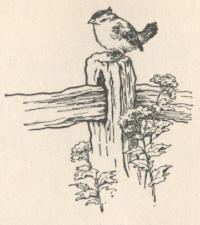
What a little bird!
Its head is not red.
Its head is black.
I hear it saying, “Quit, quit!”
Now it is singing, “Chick-a-dee-dee!”
It is the chickadee you hear singing.
I see the chickadee now, Max.
The chickadee has another name.
Tomtit is another name for chickadee.
Tomtit is saying, “Quit, quit.”
What are they doing to you, Tomtit?
PHONIC JINGLES
Phonic Drill
1. I wonder who hit hit
That little Tomtit. Tom tit
He said, “Quit, quit, quit!” quit
2. Why do you not sit sit
Where you are, Tomtit? Tom tit
You wee, saucy chit! chit
3. And now that you’ve lit, lit
Tomtit, do not flit, flit
But sing us a bit. bit
M. S. Willis.
Lively.
[Audio content is not currently supported on your device.
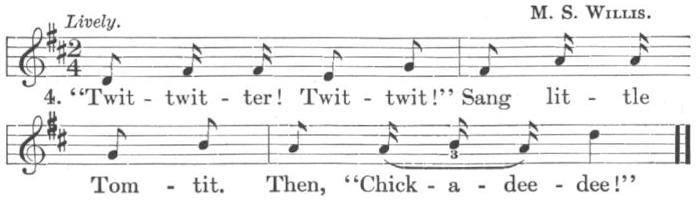
4. “Twit-twit-ter! Twit-twit!” Sang lit-tle Tom-tit. Then, “Chick-a-dee-dee!”
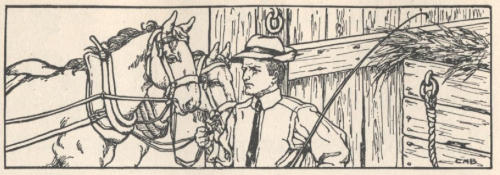
I see Father at the barn.
He has the horses.
The horses are glad to be at home.
The horses and cows live at the barn.
It is home for them.
The pigs sleep here, too, Max.
We keep the little pigs in a pen.
Come this way and see the pigs.
Alice has a greedy, greedy little pig.
I have a pig too.
It I it i
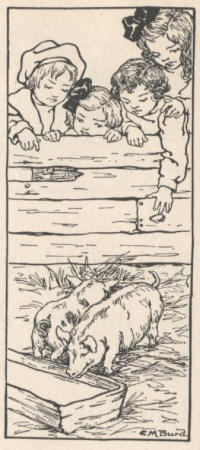
Here is Piggie Wee.
Here is Piggie Wig.
Piggie Wee is Alice’s pig.
Piggie Wig is my pig.
Which is Piggie Wee?
Which is Piggie Wig?
Can you tell, Frank?
Yes, I can tell.
I can tell which is Piggie Wig.
I can tell which is Piggie Wee.
Piggie Wig has a curly tail.
Look at his curly tail, Max.
But Piggie Wee’s tail is not curly.
See how Piggie Wig jumps and dances.
Greedy Piggie Wee goes to bed.
I know the pigs now, Frank.
Your pig has the funny, curly tail.
Alice’s greedy pig says, “Wee! Wee!”
I like your little, greedy pig, Alice.
I like your pig, too, Frank.
I like its curly tail.
I know a funny rime, Max.
It is about little Piggie Wig.
Grace and I write rimes, Max.
We write funny rimes at school.
Mother writes rimes for Alice.
Father writes funny rimes for her.
Father writes funny rimes for us, too.
Write Wr write wr
PHONIC JINGLES
Phonic Drill
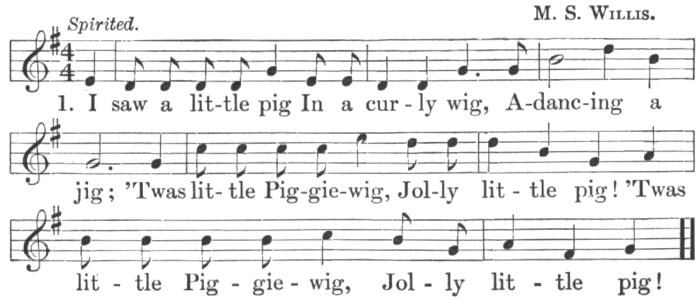
1. I saw a little pig pig
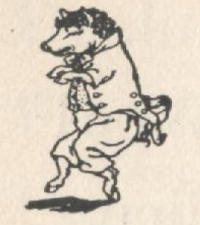
In a curly wig, wig
A-dancing a jig. jig
’Twas little Piggie Wig. Wig
Jolly little pig! pig
2. Dressed in this funny rig, rig
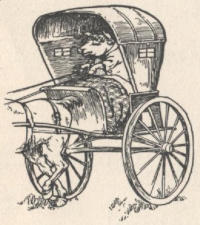
He rode in a gig, gig
Till he grew so big, big
He had to root and dig. dig
Hungry little pig! pig
M. S. Willis.
Spirited.
[Audio content is not currently supported on your device.
1. I saw a lit-tle pig In a cur-ly wig, A-danc-ing a jig; ’Twas lit-tle Pig-gie-wig, Jol-ly lit-tle pig!’Twas lit-tle Pig-gie-wig, Jol-ly lit-tle pig!
Let us go to the pond, Max.
Where is the pond, Frank?
It is over in the woods.
It is a pretty pond.
It is away under the big trees.
Where are Alice and Grace, Frank?
Will they go with us?
Yes, they will go to the pond.
Alice goes to the pond for violets.
We find violets there in the woods.
We get violets for Mother.
Alice! We are going after violets.
Come and go with us.
We are going over to the pond.
Let Lad come with you, Alice.
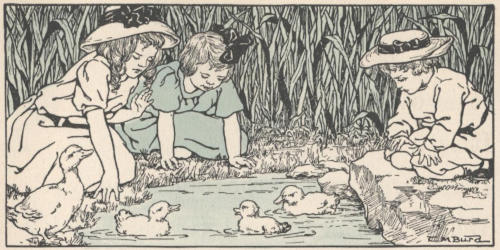
What a pretty day it is, Grace!
And what a pretty pond this is!
Look at the ducks in the water!
See that big duck with the curly tail!
Yes, they are here all day in the water.
They make nests here at the pond.
Do all the ducks lay here, Grace?
No, I have ducks at the barn.
They lay at the barn.
That is where they live.
A big brook runs into this pond.
The brook runs through the woods.
The violets bloom at the brook.
They bloom under the big trees.
The cows come to the brook.
The sheep and lambs come too.
They like the water in the brook.
Do you see where Alice is?
She is going away up the brook.
She finds the violets that bloom there.
She finds the violets under the big trees.
Can you hear what Alice says to us?
She says, “Violets! Violets!
Come see the violets!”
Violets V violets v
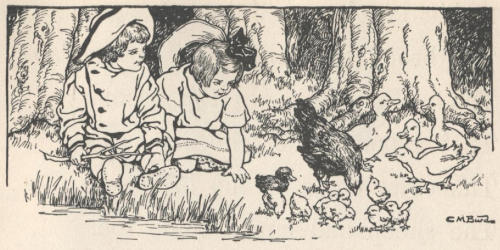
Look at the ducks in the woods.
They are the ducks that live at the barn.
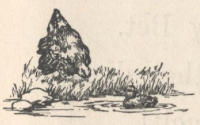
I see my black hen with them.
She has all of her children.
The duck and chicks are Jet’s children.
Don’t you see them running about?
That little duck’s name is Ducky Bet.
Let us go where they are, Max.
How came you here, Mother Jet?
Where are your children going?
The ducks are going to the pond.
Jet does not know where they are going.
Ducky Bet knows where they are going.
The ducks will get into the water.
Ducky Bet may go into the water, too.
She is running after the other ducks.
Let us go back to the pond, Max.
Alice! Alice! Come and look at Jet!
She is running after Ducky Bet.
Bet is running after the other ducks.
Jet says, “Cluck, cluck, cluck!
Come back, baby duck, duck, duck!”
The other ducks say, “Quack, quack!
Ducky Bet, go back, back, back!”
There! Ducky Bet is in the water.
PHONIC JINGLES
Phonic Drill
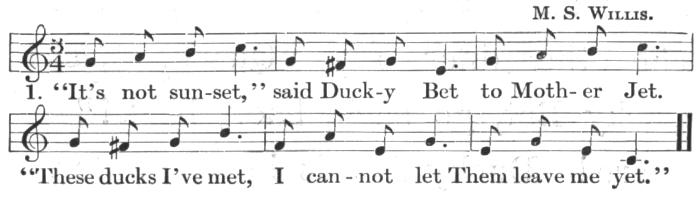
1. “It’s not sunset,” set
Said Ducky Bet Bet
To Mother Jet. Jet
“These ducks I’ve met, met
I can not let let
Them leave me yet.” yet
2. Then Mother Jet Jet
Began to fret. fret
“My little pet,” pet
She said to Bet, Bet
“You must not get get
Your feathers wet.” wet
M. S. Willis.
[Audio content is not currently supported on your device.
1. “It’s not sun-set,” said Duck-y Bet to Moth-er Jet. “These ducks I’ve met, I can-not let Them leave me yet.”
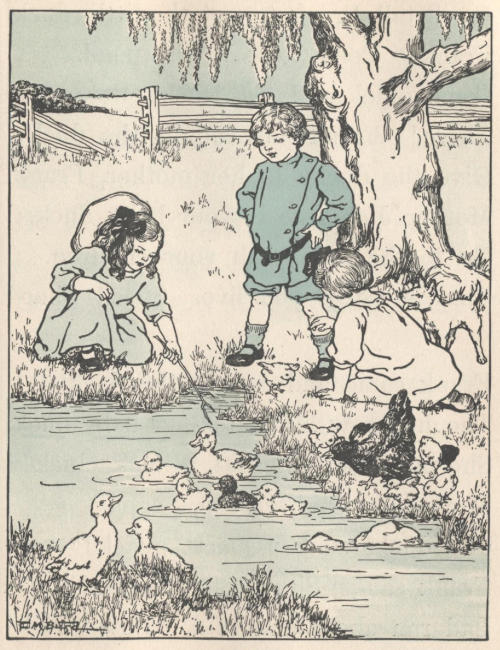
I will tell Frank to get the little duck.
Frank! Come here to the pond.
Come quick and get Ducky Bet.
There! Frank has caught the ducky.
Give the ducky to her mother, Frank.
Mother Jet, here is your baby duck.
Go to the barn with your children.
That is where you live. Shoo! Shoo!
Frank came and caught the ducky.
The hen saw him after her baby duck.
She ran about and said, “Cluck, cluck!”
The chicks said, “Peep, peep!”
The ducks said, “Quack, quack!”
Frank said, “Shoo! Shoo! Shoo!”
Lad ran about and said, “Bow-wow!”
What are you looking for, Frank?
I am looking for frog’s eggs, Max.
The frogs lay eggs in the water.
Oh, do find some of the frog’s eggs!
Find some, and let me see them.
Do frogs lay eggs in nests, Frank?
O Max! Frogs don’t make nests.
Don’t you know that? How funny!
I will show you some frog’s eggs.
I can find them in the pond.
Here are some of them now.
Come and look at the eggs, Max.
Eggs? Well! They are funny eggs!
They are not at all like bird’s eggs.
Eggs E eggs e
Come quick, Max. Look quick!
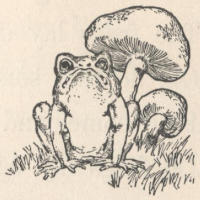
See that little frog.
Don’t you see it?
Watch! It will jump.
Come here, Lad.
Don’t go there.
Pull him back, Max.
See the frog jump into the water.
The boys saw a frog in the brook.
Frank said, “Don’t go there, little dog.
You must not go after the frog, Lad.
Come back, little dog. Come, Lad.”
Lad said, “Bow-wow, Bow-wow!”
This made the frog jump back.
It went “Ker-chog!” into the water.
PHONIC JINGLES
Phonic Drill
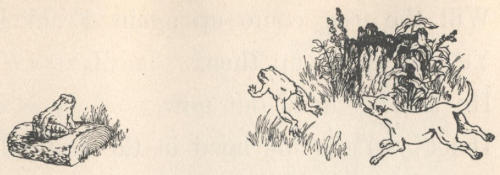
1. A little frog frog
Sat on a log, log
In a thick fog, fog
Beside the bog. bog
2. A little dog dog
Came to the log. log
Frog went “Kerchog!” Ker chog
Into the bog. bog
M. S. Willis.
Slowly.
[Audio content is not currently supported on your device.
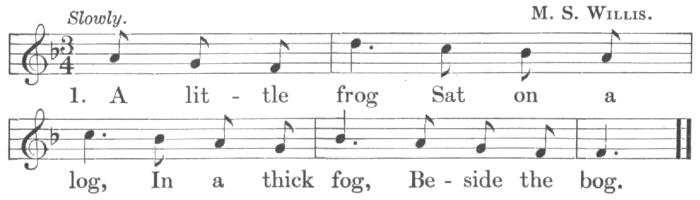
1. A lit-tle frog Sat on a log, In a thick fog, Be-side the bog.
Will the frog come up again, Frank?
Yes, he came up then.
He has his head out now.
Don’t you see his head in the water?
Look! He went under the water.
Now he has come up again.
He is looking at us. Let us hide.
There! Did you see him jump?
He is out of the brook now?
It is time to go home, Max.
Oh no, please don’t go, Grace.
Yes, we must go, Max.
Let us all go through the woods.
We will go to the barn and play.
Yes, Grace, please go to the barn.
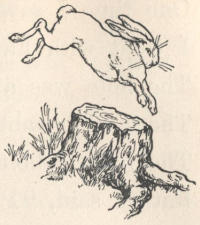
Look at that rabbit.
Where, Frank, where?
Please show me.
Look in the woods.
Oh, I see him now.
Look at him hop.
See his little white tail!
There he goes! See him jump!
That Rabbit is not like Bun, Frank.
No, Max, that rabbit is Bun’s cousin.
Bun’s cousins live here in the woods.
They have homes in the woods.
What is a rabbit’s home like, Frank?
It is a hole under the ground, Max.
Rabbits make the hole in the ground.
One time I saw a rabbit’s home.
I went with Father to see it.
The hole was away under the ground.
The mother rabbit was not in the hole.
The baby rabbits were sleeping there.
Father said, “Pull them out, Frank.
Now look at them.
Then let them go back into the hole.”
Please show me a rabbit’s home, Frank.
Yes, some day I will be glad to, Max.
Thank you, Frank, thank you.
I like to see a rabbit jump. Don’t you?
Yes. I know a rime about a rabbit.
It is a rime that I can sing.
Please sing it for me, Frank.
PHONIC JINGLES
Phonic Drill
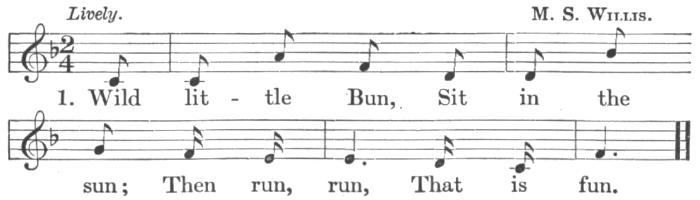
1. Wild little Bun, Bun
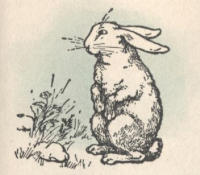
Sit in the sun, sun
Then run, run, run
That is fun. fun
2. There you go “Thump!” Thump
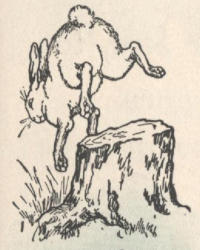
Over the stump, stump
With a bump, bump
As you jump. jump
3. A home you’ve dug. dug
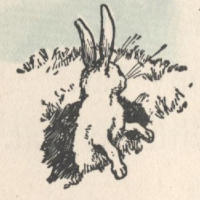
There you’re as snug snug
As a bug bug
In a rug. rug
M. S. Willis.
Lively.
[Audio content is not currently supported on your device.
1. Wild lit-tle Bun, Sit in the sun; Then run, run, That is fun.
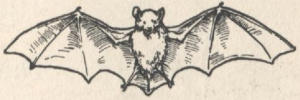
Look, Frank! What bird is that?
That is a bat, Max.
It can fly, Frank.
Yes, a bat can fly.
It can fly like a bird.
A bat can fly as high as a bird, too.
There it goes. Up, up, it goes.
Up U up u
Can you catch the bat, Frank?
Yes, I will catch it with my hat.
Here it is. I caught it with my hat.
It looks like a rat, Frank.
No, it looks like a mouse, Max.
We will show the bat to Father.
Then we will let it fly away again.
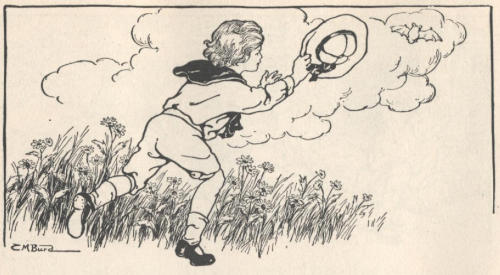
Did you see Frank run after the bat?
I saw him catch it.
The bat was flying when he caught it.
Frank caught the bat under his hat.
He ran after it and said,
“Bat, bat, Come under my hat. And when I bake, I will give you a cake.”
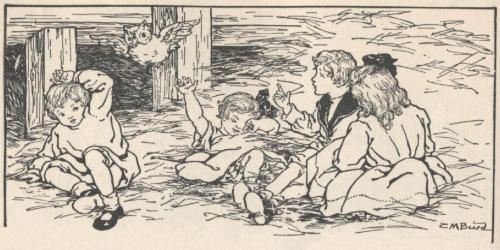
We will run up on the hay.
Then we will jump down again.
Alice, we will pull you up on the hay.
Thank you. Now I will jump down.
Jump down. Jump this way, Grace.
It is your time to jump again, Alice.
Max, look over your head.
What is that? What is that, Frank?
Look out, Max! Run, run, Max!
Do you know what made Max run?
An owl came out of the barn.
It flew down at Max and made him run.
It flew at his head.
Max did not know what it was.
He said, “What is that?”
Then he ran down on the hay.
Frank said, “Look out, Max. Run!”
The owl flew back up on the hay.
Then Frank ran up on the hay.
He caught the owl under his hat.
That was the way he caught the bat.
Grace said, “Let me see the owl, Frank.
Do you know what an owl looks like?
Yes, it looks like a cat.”
Frank said, “Come back, Max.
It is an owl. Come and see it.”
Max went back to look at the owl.
He said, “How that owl made me run!
He does look like a cat, Grace.
I know a rime about an owl.
It is about an owl making a boy run.
It is not about me and this owl.
It is about another owl and another boy.
I will say the rime for you.”
“A little boy went into a barn And lay down on some hay; An owl came out and flew about And the little boy ran away.”
Max ax x
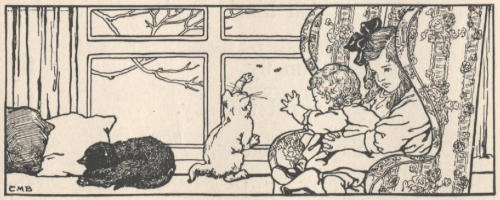
What are you doing, Baby?
Are you watching the kitty cat?
Dot is watching a little fly.
Can you catch the fly, Dot?
Look at little black Mink, sleeping.
Mink will not catch the fly.
Mink is not quick. Dot, be quick.
Run to the window, Dot.
Catch the fly when it comes.
Catch it, Mink! Catch it, Dot!
Catch it, Baby!
M. S. Willis.
With animation.

[Audio content is not currently supported on your device.
1. Ba-by-bye, Here’s a fly. We will watch him, You and I.
PHONIC JINGLES
Phonic Drill
2. My, my, my! my
He is shy. shy
That is why why
He will fly. fly
3. He is sly. sly
You he’ll spy. spy
He is spry. spry
Catch him! Try! try
4. See him fly fly
Toward the sky. sky
Say, “Good-by, by
Little fly!” fly
Come to the window again, Baby.
Look out through the window.
Watch the little chickadee on the ground.
Stop, little bird! Come to the window.
Baby, did you see how he shook his tail?
He shook it and shook it and flew away.
I saw a little bird Come, hop, hop, hop. So I said, “Little bird, Will you stop, stop, stop?” And was going to the window To say, “How do you do?” But he shook his little tail And then away he flew.
hop
top
stop
pop
mop
chop
shop
drop
Baby, Frank caught an owl.
We have a little bat, too, Baby.
The owl was in the barn.
It made Max run. It flew at his head.
It was funny to see Max run.
Frank will show you the owl.
Frank, where are the owl and the bat?
Please show them to Mother and Baby.
Mother, look at the owl.
Look at this bat. It is a little one.
We will show them to Father.
He knows where there is an owl’s nest.
It makes a bed in a hole in a tree.
Baby, look at the little bat.
It looks like a mouse.
Bun has some rabbit cousins.
We saw one as we came home.
The one we saw lives in the woods.
It lives in a hole in the ground.
The little rabbit went hop, hop, hop.
It has a funny, little, white tail.
It did not look much like Bun.
We saw Mother Jet and her children.
We saw all of the other ducks.
Ducky Bet was with the other ducks.
Mother Jet said, “Cluck, cluck, cluck!
Come back, Baby duck, duck, duck!”
duck
luck
cluck
puck
shuck
struck
buck
tuck
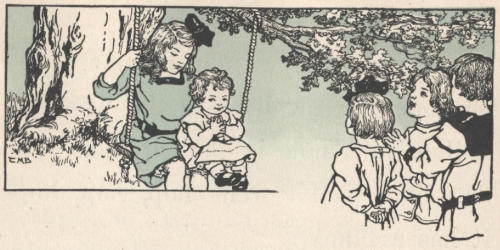
It is so pretty to-day.
Let us go out and swing Baby.
Grace, you may swing with Baby.
Come, Frank. Let us swing them.
Pull, Frank. Pull the swing back.
Now let it go again, Frank.
You may run under the swing, Max.
Don’t you hear the birds singing?
They say, “Sweet! Sweet! Sweet!”
Look up over your head at the birds.
Sing, Baby! Sing, Alice! Sing, boys!
M. S. Willis.

[Audio content is not currently supported on your device.
1. Ba-by, swing, Dear lit-tle thing! Hap-py as a king.
PHONIC JINGLES
Phonic Drill
1. Baby, swing, swing
Dear little thing! thing
Happy as a king. king
2. Birdies, sing. sing
Sing on the wing. wing
Sweetest music bring. bring
3. It is spring. spring
Flower bells, ring. ring
Wide your fragrance fling. fling
4. “Spring, sweet spring!” spring
The children sing, sing
“It is lovely spring.” spring
Father, we caught a bat and an owl.
We caught them as we came home.
Grace says the owl looks like a cat.
The owl does look much like a cat.
Max says the bat looks like a rat.
I say it looks like a mouse.
Which does it look like, Father?
It looks very much like a mouse.
It looks like a rat too, Frank.
Father, tell about the owl and the bat.
Tell about Mr. Owl and Mrs. Bat.
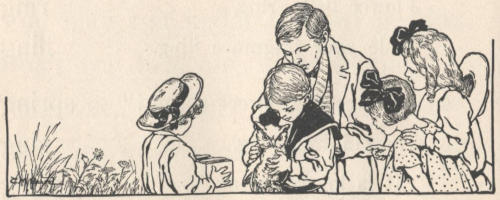
An owl said to a bat,
“Do you know the rat, Mrs. Bat?”
“No, I do not, Mr. Owl,” said the bat.
“Well, you look very much like the rat, Mrs. Bat.”
“Can the rat fly, Mr. Owl?”
“Oh no, a rat can not fly, Mrs. Bat.”
“But, you see, Mr. Owl, I can fly.”
“Do you know the cat, Mr. Owl?” said the bat.
“No, I do not, Mrs. Bat,” said the owl.
“Well, you look very much like the cat, Mr. Owl.”
“Can the cat fly, Mrs. Bat?”
“Oh no, a cat can not fly, Mr. Owl.”
“But you see, Mrs. Bat, I can fly.”
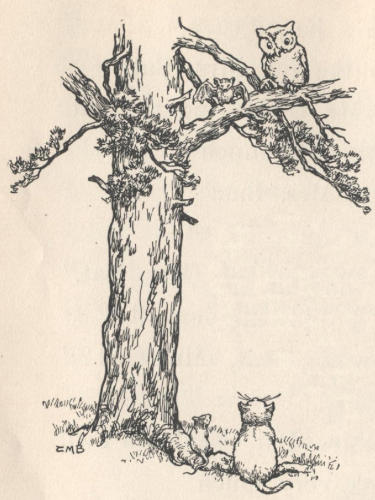
Said the owl to the bat, “What is that?” “That’s the cat,” said the bat. Said the owl to the bat, “Do I look like that cat?” “You do,” said the bat. “Mr. Owl,” said the bat, “What is that?” “That’s the rat, Mrs. Bat.” “Mr. Owl,” said the bat, “Do I look like that rat?” “You do, Mrs. Bat.”
Max, we are going to the orchard.
I know you will like the orchard.
The apple trees are so pretty.
They have flowers now.
The flowers are so sweet, too.
All the birds like the orchard.
I saw a nest there one day.
There were some little eggs in it.
Was it a chickadee’s nest, Alice?
No, it was not a chickadee’s nest.
I saw the bird fly to the nest.
I did not know what bird it was.
Here is the orchard, Max.
Let us get some flowers.
The apple trees have pretty flowers.
The apple flowers are red and white.
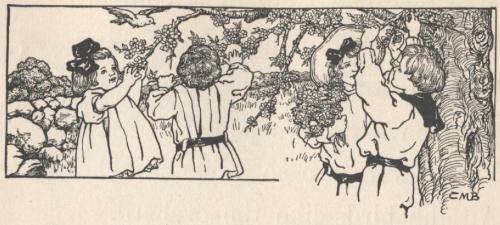
Oh, how pretty the apple trees are!
Look at the bees on the flowers.
Do you know what the bees say?
Down in the flower, Hear me, the bee, Going, “Zee, zee, z-ee!” Out of the flower, I come. Hear me hum, Going, “Zum, zum, z-um!”
Zee Z zee z
The pigs like to come to the orchard.
They like the orchard as much as we do.
They come when there are apples here.
We saw all the pigs here one day.
We made a rime about Piggie Wee.
Tell about Piggie Wee and the bee.
You know how greedy Piggie Wee is.
One day he was in the orchard.
He saw an apple on the ground.
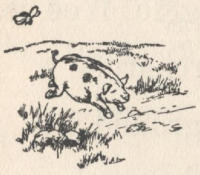
But there was a bee on the apple.
So the greedy pig ran after the bee.
Then the bee flew at Piggie Wee.
The bee made Piggie Wee run.
It flew after him and said, “Zee, zee!”
Piggie ran and said, “Wee, wee, wee!”
PHONIC JINGLES
Phonic Drill
1. Piggie-Wee
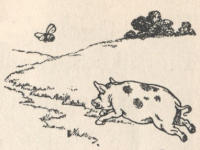
Saw a bee.
“See! See! See!
Here’s a bee bee
Under the tree. tree
I’ll get that bee,” bee
Said Piggie-Wee. Wee
2. Then the bee bee
Said in glee, glee
“Zee! Zee! Zee! Zee
Piggie-Wee!” Wee
This made him flee, flee
And, “Wee! Wee! Wee!” Wee
Cried Piggie-Wee. Wee
M. S. Willis.
[Audio content is not currently supported on your device.
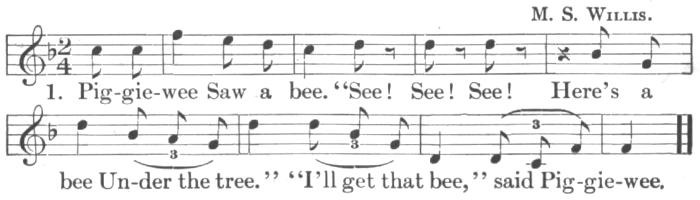
1. Pig-gie-wee Saw a bee. “See! See! See! Here’s a bee Un-der the tree.” “I’ll get that bee,” said Pig-gie-wee.
We will go to the meadow to-day.
We will drive the cows to the meadow.
They all like to go there.
The sheep like the meadow, too.
They will be in the meadow to-day.
The meadow clover has its flowers.
I like to see the clover blooms.
They are sweet, red clover balls.
The bees are in the meadow all day.
They hum over the clover.
They like the sweet clover blooms.
Some of the clover blooms are white.
Some of them are as red as red can be.
I like to see the bees on the clover.
Let us run to the meadow.
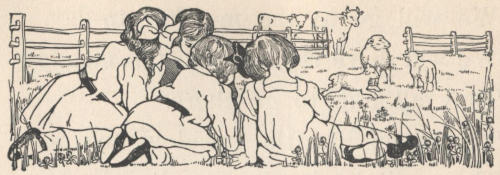
Hear the bees hum, Max.
They go “Zum, zum,” as they hum.
Get down on the ground to see them.
Yes, I see them, Alice.
But I like to watch the lambs.
Watch that little lamb run and play.
Yes, that is my lamb, Max.
The other lamb is Frank’s.
Look at Bossy. Bossy is Grace’s cow.
Bossy has a little bell. Do you see it?
I like to hear Bossy’s bell.
It is time to drive the cows home.
Boys, please find the cows.
I don’t see Bossy. But I hear her bell.
Don’t you hear Bossy’s bell?
Yes, I hear it, Grace.
Bossy’s bell goes “Tinkle, tinkle, tinkle!”
I like to hear Bossy’s little bell.
We will go over the hill to the brook.
Bossy knows where to find water.
She knows where to find the big trees.
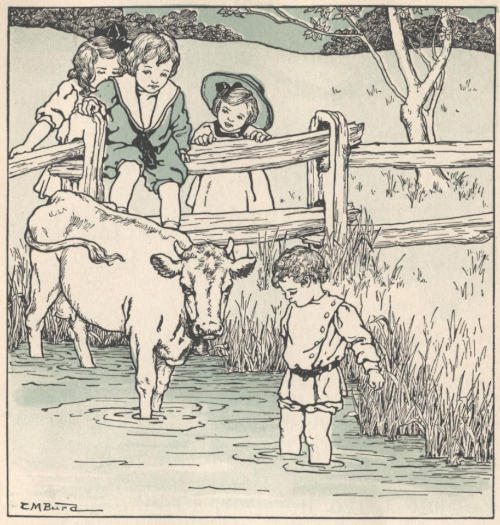
There! I see Bossy in the brook.
Let me drive her out, Frank.
I will go into the brook.
Very well, Max. Drive her out.
Knows Kn knows kn
M. S. Willis.
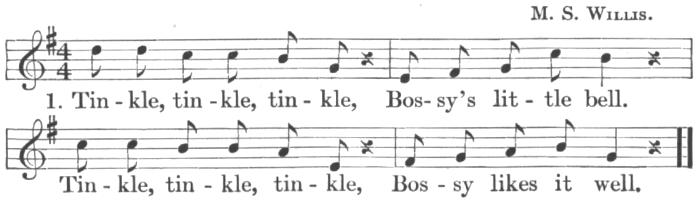
[Audio content is not currently supported on your device.
1. Tin-kle, tin-kle, tin-kle, Bos-sy’s lit-tle bell. Tin-kle, tin-kle, tin-kle, Bos-sy likes it well.
PHONIC JINGLES
Phonic Drill
1. Tinkle, tinkle, tinkle!
Bossy’s little bell. bell
Tinkle, tinkle, tinkle!
Bossy likes it well. well
2. Tinkle, tinkle, tinkle!
Where she is ’twill tell. tell
Tinkle, tinkle, tinkle,
In the shady dell. dell
3. Tinkle, tinkle, tinkle,
Where the green grass grows, grows
Tinkle, tinkle, tinkle,
Where sweet water flows, flows
4. Tinkle, tinkle, tinkle,
Where the soft wind blows, blows
Tinkle, tinkle, tinkle,
All this Bossy knows. knows
Play “Two Little Black Birds,” Baby.
I will show you the birds.
Here are two black birds on a hill.
One is Jack. The other is Jill.
The two black birds will fly away.
Then they will come again.
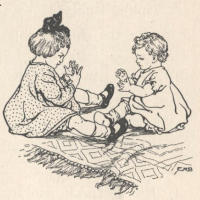
Two little black birds Sat upon a hill. One was Jack. The other was Jill. Fly away, Jack! Fly away, Jill! Come back, Jack! Come back, Jill!
Jack
back
quack
black
pack
lack
rack
track
crack
tack
stack
knack
Let us play “Hickory, dickory, dock.”
O Alice, Baby can not run!
Can she play that she is the mouse?
No, but she can watch us run.
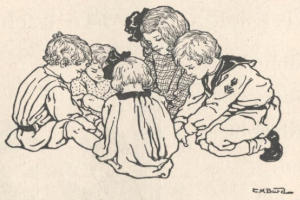
Hickory, dickory, dock, The mouse ran up the clock. The clock struck one. The mouse ran down. Hickory, dickory, dock!
dock
lock
clock
flock
block
rock
cock
shock
stock
knock
mock
sock
Watch us play “Pease-pudding.”
When is the pease-pudding in the pot?
When is it hot? When is it cold?
When is the pease-pudding old?
Max and I keep time like a clock.
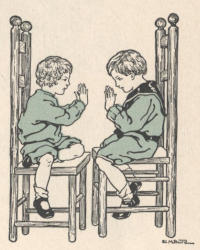
Pease-pudding hot, Pease-pudding cold, Pease-pudding in the pot, Nine days old. Some like it hot. Some like it cold. Some like it in the pot, Nine days old.
cold
told
hold
gold
fold
bold
sold
mold
We will play “Jack and Jill” now.
Alice will be Jill. Max will be Jack.
Jack fell down on his head.
Jill came tumbling after.
Max, come tumbling to the ground.
Then Alice must come tumbling after.
Oh you did it very well. Now sing.
Jack and Jill Went up the hill To get a pail of water. Jack fell down And broke his crown, And Jill came tumbling after.
Jill
hill
mill
fill
still
quill
sill
rill
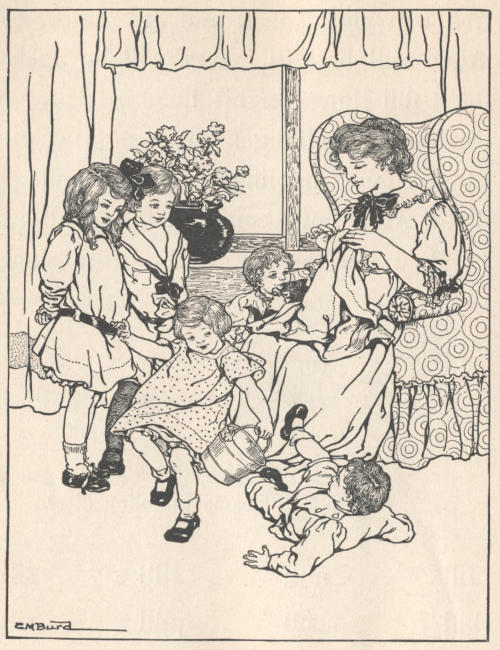
The children are playing “Jack and Jill.”
Alice says, “I must have a pail, Grace.”
Grace says, “Frank will get a pail.
Thank you. Here is the pail, Alice.
Mother says she will sing with us.”
“Thank you, Mother. Thank you.”
Jack, come tumbling down.
Now, Jill, you must come tumbling down.
Frank says, “Sing some other song.
Let us sing about the cunning mouse.
Mink is black all over. Baby loves her.
Do you love Mink very much, Baby?
Well, we will sing a song, Baby.
We will sing about your kitty.”
Thank Th thank th
“I’LL SING A SONG”
Ding-dong, ding-dong! I’ll sing you a song. It’s not very long. It’s about a little mouse. He looked very cunning As I saw him running About my father’s house. Ding-dong, ding-dong! I’ll sing you a song. It’s not very long. It’s about a little kitty. She is black all over, And I know you’ll love her, For she is very pretty.
dong
song
long
strong
wrong
prong
M. S. Willis.
With animation.
[Audio content is not currently supported on your device.
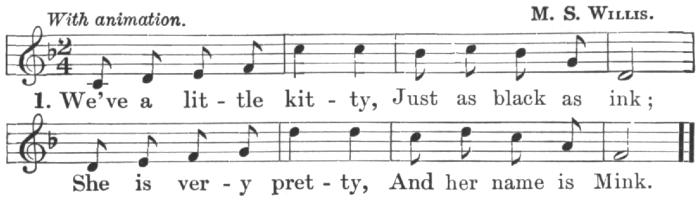
1. We’ve a lit-tle kit-ty, Just as black as ink; She is ver-y pret-ty, And her name is Mink.
PHONIC JINGLES
Phonic Drill
1. We’ve a little kitty
Just as black as ink. ink
She is very pretty,
And her name is Mink. Mink
2. She’s a silly kitty,
See her sit and blink! blink
Isn’t it a pity
She knows how to wink? wink
3. She’s a lazy kitty
Till there’s milk to drink. drink
Then she is so busy
She’s no time to think. think
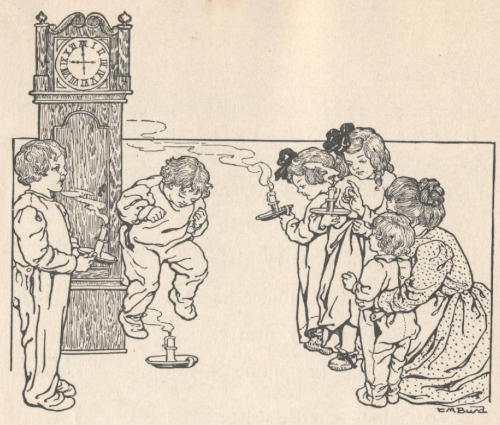
Jack, be nimble! Jack, be quick!
Jack, jump over the candlestick!
Don’t kick the candle over, Max.
The clock has struck bedtime.
Good night, children.
quick
chick
kick
brick
tick
stick
wick
lick
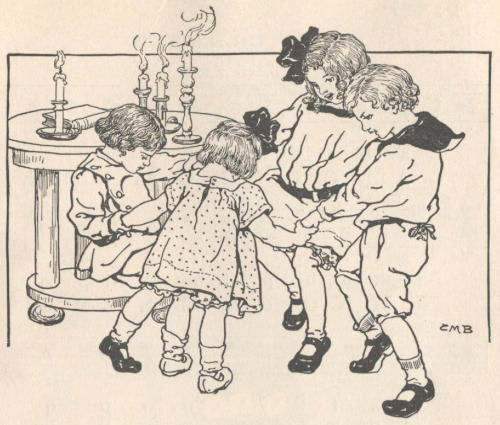
A SONG
Merry have we met And merry have we been. Merry let us part And merry meet again. With a merry ding-dong Happy, gay, and free, With a merry sing-song, Again we’ll happy be.
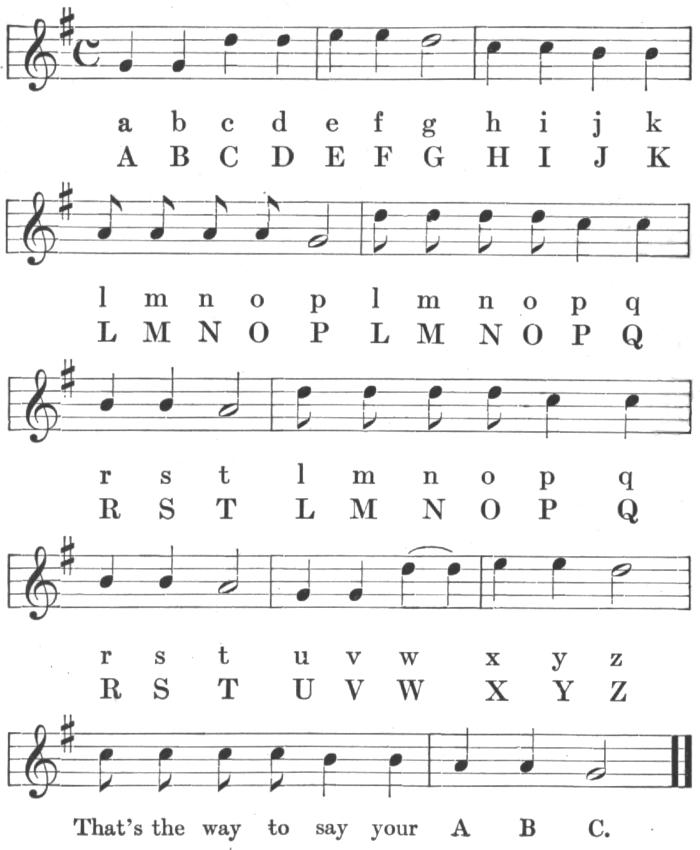
SONG OF THE LETTERS
[Audio content is not currently supported on your device.
a b c d e f g h i j k A B C D E F G H I J K l m n o p l m n o p q L M N O P L M N O P Q r s t l m n o p q R S T L M N O P Q r s t u v w x y z R S T U V W X Y Z That’s the way to say your A B C.