Story 2, Chapter XVIII.
Reading edition
The Denouement.
Refreshed by a draught of wine, I proceeded to prosecute our inquiry. I had not yet lost hope; and with this I succeeded also in cheering my friend. The day was Sunday; and I knew that the Saturday following was the sailing day of the Atlantic steamer. There was then only the Cunard line; and only one steamer every fortnight. Both day and hour were fixed—each alternate Saturday at 12 noon—punctual as the Horse Guards’ clock. At both termini of her long ocean-journey was this punctuality observed; and I knew that a gun proclaimed the exact meridional hour of her departure. To reach New York, then, by 12 o’clock on Saturday, was the object to be aimed at. Was it possible of accomplishment?
Inquiry led me to believe that it was; and hope once more supplanted despair in the bosom of De Hauteroche.
Everything depended upon when we could get a boat to Wheeling: since beyond that the journey would be by stage-coach and rail; and these had fixed and certain arrangements.
When could we start for Wheeling? No one at the hotel could answer this question; and, without loss of time, we proceeded to seek our information at the wharf or landing.
None that day, of course. It was Sunday, and we did not expect it; but we ascertained that a small boat—a very indifferent looking craft—purposed starting for Pittsburg on the morrow. Of course a Pittsburg boat would serve equally well for Wheeling. The hour promised was twelve; and, without further hesitation, we engaged passage.
We needed the refreshment of a hotel; and, having paid our fare, we returned to the Henry House.
Here we were put in possession of a piece of intelligence, unexpected as it was unpleasant. It was to the effect that we need not calculate getting off on the morrow—that there was not the slightest prospect of such a thing; that the captain of the little boat—the Buckeye, she was called—was well known to take several days in starting. We might congratulate ourselves if we were off by Wednesday!
There was an air of probability in all this; and our informants had no motive for deceiving us. Certainly it would have given us great uneasiness—in fact, have destroyed our last hope—had it not been for an idea that entered my head at that moment, and promised to get us clear of such a sad dilemma. I had observed, while aboard, that the Buckeye was a very humble trader—that the money she received, on account of either freight or passengers during a single trip, could not be a very large amount; and that a douceur of 100 dollars would no doubt fix her hour of sailing—as punctually as the Cunard steamer herself.
I communicated my opinion to my friend. He was exactly of the same way of thinking.
The thing was easily arranged. It cost us a second visit to the Buckeye; and, before we retired for the night, we felt quite easy in our minds that the little steamer would take us off at the appointed hour.
And she did: having steamed off from the landing on the stroke of 12 noon, to the astonishment of all Cincinatti!
Wheeling was reached; and then jolting by stage over the cold mountains to Cumberland, we continued on by rail to Baltimore. Thence without delay to the drab city of Philadelphia; and onward to the metropolis of America. We made no inquiries by the way; we did not stop, except for the hours of the different trains: we had but one object in view—to reach New York by 12 noon on Saturday.
It was Saturday morning when we left Philadelphia. We were in the very train designed to reach New York in time—the express—arranged for the sailing of the European steamer. Thank Heaven, we should be in time!
The Fates once more turned against us. Some accident to the engine, occurring near Trenton, delayed us for half an hour; but this being righted, we pressed forward with accelerated speed.
Many a watch was regarded with anxious eyes—for there were many in the train who proposed crossing the Atlantic—but who can tell the agony experienced at this moment by Luis de Hauteroche? I was myself too troubled to speak.
The feeling at length reached its culminating point. The city of New Jersey was in sight: there lay the Cunard steamer at her moorings!
No, she is moving out! See! she has dropped into mid stream! Behold that white puff of smoke! Hark! ’tis the signal gun! She is gone—gone!
No boat may overtake her now—the swiftest would be launched in vain. She will delay for no one—not even for Prince or President. She is the Cunard packet. Her laws are immutable—fixed—inexorable. O God! she is gone!
My friend’s distress exhibited itself in a frantic manner; but there were others, suffering from far less disappointment, who made equal show of their chagrin. This had the effect of drawing away from us that notice we might otherwise have attracted.
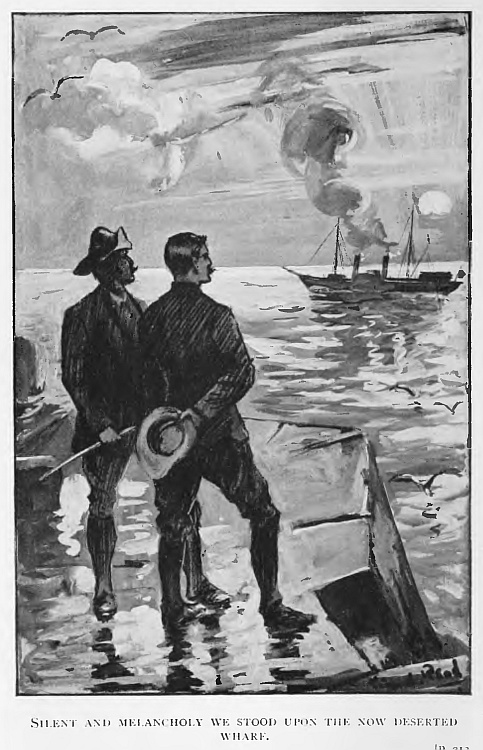
Silent and melancholy we both stood upon the now deserted wharf—gazing upon the black hull, that every minute was growing a more insignificant object to the sight. I shall not attempt to depict the feelings of my companion: I could scarcely analyse my own.
We were turning coldly away to seek some hotel; we had even advanced some paces from the landing, when a singular cry, followed by a confused murmur of voices, as of men in dispute, caused us to look back.
A small knot of sea-faring men stood on a projection of the wharf: they appeared to be employés of the Steam Company; who, after performing the duty of getting the vessel afloat, had lingered to see her out of the bay. One of the men held a telescope levelled to his eye, and directed down the bay: as if following the movements of the steamer. We listened to hear what the men were saying.
“Yes!” exclaimed the man with the telescope, “I told you so—something wrong yonder.”
“Give me the glass, old fellow!” demanded one of his comrades—a rough-looking sailor.
“Yes, give it to Brace, Bill—he’s got a long sight.”
The man surrendered the glass, as requested; and Brace, placing it to his eye, looked silently and steadily through it. I could have heard my companion’s heart heating, had it not been for the thumping of my own. How eagerly we waited for the words of Brace! They came at length—words of gold!
“Ye be right, Bill—there ur somethin’ wrong—there’s a paddle broke—I sees ’em on the wheel-house—yes, that’s it.”
“They’ll put back again!” suggested one.
“Sartin to do,” drawled Brace, “they are putting back—they’re getting the cripple round now as fast as she can come. Now she comes this way. Make ready your ropes, boys—more grog, and plenty o’ keelhaulin’!”
The reaction of feeling produced by these words, in the minds of my companion and myself, cannot be described; and it was sustained by the evidence of our own eyes—for, the moment after, we could make out that it was the steamer’s head that was towards us, and that she was slowly but certainly making up the bay—back to the landing from which she had just taken her departure.
There was something almost astounding in this occurrence. It seemed as if Providence itself had a hand in the event.
We did not allow our excited feelings to hinder us from taking some cautionary steps necessary to the carrying out of our design. There was time enough for us to reach the office of the nearest justice, and arm ourselves with the authority for an arrest; and before the steamer had reached the wharf, we were on the spot with two plainclothes policemen, anxious for action. They scented large game, and consequently a rich reward.
They had soon an opportunity of earning it; for, in a few minutes after, we were aboard, and Monsieur Jacques Despard was in handcuffs!
I was glad that we alighted upon him alone—as it saved a painful scene. The ladies were in their state-room; and knew nothing of the arrest, till after their travelling companion had been carried over the side of the ship!
There was a scene notwithstanding—a scene of surprise and confusion; but explanations followed fast; and the scene ended by all who took part in it becoming imbued with one common feeling—that sense of supreme joy, which one experiences who has just narrowly escaped from some terrible danger.
As yet no injury had accrued. How near all had been to utter ruin!
Of course the passage money was freely forfeited to Messrs Cunard Co; and the family luggage transferred from the steamer to a Broadway hotel.
After a short stay there, another steamer that plies between New York and New Orleans, carried us directly to the latter city—where Monsieur Gardette was good enough to meet us, and deliver up his temporary ward.
Long ere this we had learnt the details of the Despard infamy. They differed, in no essential particular, from what conjecture had suggested to us.
It appeared that it was not the first time Despard had personated young De Hauteroche, to his own advantage, and the latter’s disgrace. He was well aware of the remarkable likeness between them; and with this, as an aid to his swindling designs, he acted with a certainty of success. He had taken pains to possess himself of such points in the family history as were accessible to his inquiries; and it was while prosecuting this branch of his industrie, that the letters had fallen into his hands. Of the use he made of them we know most of the details. As already conjectured, he had started for Saint Louis, on gaining possession of the will and the letter which accompanied it; and, as neither Madame Dardonville nor Olympe had seen Luis de Hauteroche for a considerable period of time, the deception was easy enough. The voyage to France was a deep laid scheme; and the circular letter for 10,000 dollars on a Paris Bank was a bold stroke of swindling. Once there, the villain expected to be the recipient of that money. The plea for the journey was not without plausibility. The Saint Louis rumour was correct: a dead uncle’s property left to the De Hauteroches—a legacy that required to be claimed immediately. Another inducement: his sister Adele and the young Englishman were to meet him there—in Paris. The Englishman was married to Adele, and preferred returning to Europe by the West India steamer! Such had been his story.
The hasty marriage somewhat surprised Madame Dardonville, as well as the design of the European convention. She regarded it as somewhat eccentric; but Luis De Hauteroche was to her, nearest and dearest, and how could she refuse compliance with his proposal? In fine, she made her arrangements, and set forth.
Nothing had been said of the marriage between Luis and Olympe. That was tacitly left for future arrangement. Paris would be the place—if it should ever come off It was doubtful, however, whether it ever would have taken place—even if the steamer had held on her way. Both Madame Dardonville and her daughter had conceived strange imaginings about the projected son-in-law. Something had occurred every day—almost every hour—to excite surprise—even a little degoût. Luis De Hauteroche had much changed—for the worse—had become dissipated, vulgarised—in short, anything but what should have been expected in the son of his father. It was a disappointment—a chagrin.
Poor Luis! Had the steamer gone on, he might have lost part of the fortune, but he was in little danger of losing his wife. Olympe would undoubtedly have forfeited the legacy rather than have yielded herself up to the vulgar counterfeit.
I saw Despard once afterwards—while on a visit to the Louisiana State Prison at Bayou Sara. With his little pile of picked cotton before him, he looked a sorry enough sort of wretch—far different from the ruffled elegant of other days. The forgery had been proved home, and entitled him to his present residence for a lease of not less than ten years!
How very different appeared his counterpart when I last saw him, elegantly attired, living in an elegant mansion with elegant furniture, and waited on by a troop of willing domestics!
And she who gave him all this was by his side—his blooming bride—the lovely Olympe.
End of Despard, the Sportsman.
Story 3.
A Case of Retaliation.
The first action fought by the American army in the valley of Mexico, on 20th August, 1847, was at Contreras. It was an attack upon a fortified camp, in which lay General Valencia with 6000 Mexicans, composed of the remnant of the army beaten by Taylor, on the hills of Bueno Vista. It was styled “The Army of the North;” most of the soldiers composing it being from the northern departments—the hardy miners of Zacatecas and San Luis Potosi,—and they were esteemed “the flower” of the Mexican army.
On the previous day powder enough was burned to have cured the atmosphere for twenty miles around; yet there was nothing done. We held the ground, however, in mud up to our ankles. In this we lay shivering under a cold drizzle until the morning.
By daylight we were at it in earnest. During the night two of our best brigades had crept, unperceived, through the clay “barrancas” close up to the rear of the enemy’s camp, ready to spring.
At daybreak old Riley shouted, “Forward and give them hell?” and before our foes—not expecting us from that quarter—could bring their artillery to bear upon us, we were in the midst of them.
The action lasted just seventeen minutes. At the end of that time we had laid our hands upon thirty of Valencia’s cannon, and taken about a thousand prisoners; and had, moreover, the satisfaction of seeing the rest of them, in their long yellow mantles, disappearing through the fissures of the lava fields, in rapid flight along the road to Mexico.
We followed, of course, but as our cavalry had not been able to cross the Pedregal, and as the enemy were our superiors in retreat, we were soon distanced. As we came down upon the village of San Angel, the occasional blast of a light infantry bugle, with the “crack—crack—cr-r-r-ack” of our rifles in front, told us that we had still some more work to do before entering the halls of the Montezumas. We were, in fact, driving in the light troops of Santa Anna’s main army, lying we knew not where, but somewhere between us and the far famed city.
It is not my intention to give an account of the battle that followed; nor should I have entered into these details of the fight at Contreras, were it not to put the reader in possession of “situations,” and, moreover, to bring to his notice an incident that occurred, during that action, to a friend—the hero of this narrative—whom I will now introduce. I was at the time a Sub., and my friend, Richard L—, was the Captain of my company; young as myself and fully as ardent in pursuit of the red glory of war. We had long known each other, had gone through the campaign together, and, more than once, had stood side by side under the leaden “hail.” I need not say how a juxtaposition of this kind strengthens the ties of friendship.
We had come out of Resaca and Monterey, unscathed. We had passed through Cerro Gordo with “only a scratch.” So far we had been fortunate, as I esteemed it.
Not so my friend; he wished to get a wound for the honour of the thing. He was accommodated at Contreras; for the bullet from an escopette had passed through his left arm below the elbow-joint. It appeared to be only a flesh wound; and as his sword-arm was still safe, he disdained to leave the field until the “day was done.” Binding the wounded limb with a rag from his shirt, and slinging it in his sash, he headed his company in the pursuit. By ten o’clock we had driven the enemy’s skirmishers out of San Angel, and had taken possession of the village. Our Commander-in-Chief was as yet ignorant of the position of the Mexican army; and we halted, to await the necessary reconnaissance.
Notwithstanding the cold of the preceding night, the day had become hot and oppressive. The soldiers, wearied with watching, marching, and the fight, threw themselves down in the dusty streets. Hunger kept many awake, for they had eaten nothing for twenty hours. A few houses were entered, and the tortillas and tasajo were drawn forth; but there is very little to be found, at any time, in the larder of a Mexican house; and the gaol-like doors of most of them were closely barred. The unglazed windows were open; but the massive iron railings of the “reja” defended them from intrusion. From these railings various flags were suspended—French, German, Spanish, and Portuguese—signifying that the inmates were foreigners in the country, and therefore entitled to respect. Where no excuse for such claim existed, a white banner, the emblem of peace, protruded through the bars; and perhaps this was as much respected as the symbols of neutrality.
It was the season when fashion deserts the Alameda of Mexico, and betakes itself to month, cock-fighting, and intriguing, in the romantic pueblos that stud the valley. San Angel is one of these pueblos, and at that moment many of the principal families of the city were domiciled around us. Through the rejas we could catch an occasional glimpse of the occupiers of the dark apartments within.
It is said that, with woman, curiosity is stronger than fear. It appeared to be so in this case. When the inhabitants saw that pillage was not intended, beautiful and stylish women showed themselves in the windows and on the balconies, looking down at us with a timorous yet confiding wonder. This was strange, after the stories of our barbarity, in which they had been so well drilled; but we had become accustomed to the high courage of the Mexican females, and it was a saying amongst us, that “the women were the best men in the country.” Jesting aside, I am satisfied, that had they taken up arms instead of their puny countrymen, we should not have boasted so many easy victories.
Our bivouack lasted about an hour. The reconnaissance having been at length completed, the enemy was discovered in a fortified position around the convent and bridge of Churubusco. Twigg’s division was ordered forward to commence the attack, just as the distant booming of cannon across the lava fields, told us that our right wing, under Worth, had sprung the enemy’s left, at the hacienda of San Antonio, and was driving it along the great national road. Both wings of our army were beautifully converging to a common focus—the pueblo of Churubusco. The brigade to which I was attached, still held the position where it had halted in San Angel. We were to move down to the support of Twigg’s division, as soon as the latter should get fairly engaged. Our place in the line had thrown us in front of a house somewhat retired from the rest, single storied, and, like most of the others, flat roofed, with a low parapet around the top. A large door and two windows fronted the street. One of the windows was open, and knotted to the reja was a small white handkerchief, embroidered along the borders and fringed with fine lace. There was something so delicate, yet striking, in the appeal, that it at once attracted the attention of L— and myself. It would have touched the compassion of a Cossack; and we felt at the moment that we would have protected that house against a general’s order to pillage.
We had seated ourselves on the edge of the banquette, directly in front of the window. A bottle of wine, by some accident, had reached us; and as we quaffed its contents, our eyes constantly wandered upon the open reja. We could see no one. All was dark within; but we could not help thinking that the owner of the kerchief—she who had hurriedly displayed that simple emblem of truce—could not be otherwise than an interesting and lovely creature.
At length the drums beat for Twigg’s division to move forward, and, attracted by the noise, a grey-haired old man appeared at the window. With feelings of disappointment, my friend and I turned our glances upon the street, and for some moments watched the horse artillery as it swept past. When our gaze was again directed to the house, the old man had a companion—the object of our instinctive expectation; yet fairer even than our imagination had portrayed.
The features indicated that she was a Mexican, but the complexion was darker than the half-breed; the Aztec blood predominated. The crimson mantling under the bronze of her cheeks, gave to her countenance that picturelike expression of the mixed races of the western world. The eye, black, with long fringing lash, and a brow upon which the jetty crescent seemed to have been painted. The nose slightly aquiline, curving at the nostril; while luxuriant hair, in broad plaits, fell far below her waist. As she stood on the sill of the low window, we had a full view of her person—from the satin slipper to the reboso that long loosely over her forehead. She was plainly dressed in the style of her country. We saw that she was not of the aristocracy, for, even in this remote region, has Paris fashioned the costume of that order. On the other hand, she was above the class of the “poblanas,” the demoiselles of the showy “naguas” and naked ankles. She was of the middle rank. For some moments my friend and myself gazed in silent wonder upon the fair apparition.
She stood a while, looking out upon the street, scanning the strange uniforms that were grouped before her. At length her eye fell upon us; and as she perceived that my comrade was wounded, she turned towards the old man.
“Look, father, a wounded officer! ah, what a sad thing, poor officer.”
“Yes, it is a captain, shot through the arm.”
“Poor fellow! He is pale—he is weary. I shall give him sweet water; shall I, father?”
“Very well, go, bring it.”
The girl disappeared from the window; and in a few moments she returned with a glass, containing an amber-coloured liquid—the essence of the pine-apple. Making a sign towards L—, the little hand that held the class was thrust through the bars of the rejo into his hand. I rose, and taking the glass, I handed it to my friend. L— bowed to the window, and acknowledging his gratitude in the best Spanish he could muster, he drank off the contents. The glass was then returned; and the young girl took her station as before.
We did not enter into conversation,—neither L— nor myself; but I noticed that the incident had made an impression upon my friend. On the other hand, I observed the eyes of the girl, although at intervals wandering away, always return, and rest upon the features of my comrade.
L— was handsome; besides, he bore upon his person the evidence of a higher quality—courage; the quality that, before all others, will win the heart of a woman.
All at once, the features of the girl changed their expression, and she uttered a scream. Turning towards my friend, I saw the blood dripping through the sash. His wound had reopened.
I threw my arms around him, as several of the soldiers rushed forward; but before we could remove the bandage L— had swooned.
“May I beseech you to open the door?” said I, addressing the young girl and her father.
“Si—si, Señor,” cried they together, hurrying away from the window.
At that moment the rattle of musketry from Coyoacan, and the roar of field artillery, told us that Twigg was engaged. The long roll echoed through the streets, and the soldiers were speedily under arms.
I could stay no longer, for I had now to lead the company; so leaving L— in charge of two of the men, I placed myself at its head. As the “Forward” was given, I neared the great door swing upon its hinges; and looking back as we marched down the street, I saw my friend conducted into the house. I had no fears for his safety, as a regiment was to remain in the village... In ten minutes more I was upon the field of battle, and a red field it was. Of my own small detachment every second soldier “bit the dust” on the plain of Portales. I escaped unhurt, though my regiment was well peppered by our own artillerists from the tête du pont of Churubusco. In two hours we drove the enemy through the garita of San Antonio de Abad. It was a total rout; and we could have entered the city without firing another shot. We halted, however, before the gates—a fatal halt, that afterwards cost us nearly 2,000 men, the flower of our little army. But, as I before observed, I am not writing a history of the campaign.
An armistice followed, and gathering our wounded from the fields around Churubusco, the army retired into the villages. The four divisions occupied respectively the pueblos of Tacubaya, San Angel, Mixcoac, and San Augustin de les Cuevas. San Angel was our destination; and the day after the battle my brigade marched back, and established itself in the village.
I was not long in repairing to the house where I had left my friend. I found him suffering from fever—burning fever. In another day he was delirious; and in a week he had lost his arm; but the fever left him, and he began to recover. During the fortnight that followed, I made frequent visits; but a far more tender solicitude watched over him. Rafaela was by his couch; and the old man—her father—appeared to take a deep interest in his recovery. These, with the servants, were the only inmates of the house.
The treacherous enemy having broken the armistice, the burning of the Palace-castle of Chapultepec followed soon arter. Had we failed in the attempt, not one of us would ever have gone out from the valley of Mexico. But we took the castle, and our crippled forces entered the captured city of the Montezumas, and planted their banners upon the National Palace. I was not among those who marched in. Three days afterwards I was carried in upon a stretcher, with a bullet-hole through my thigh, that kept me within doors for a period of three months.
During my invalid hours, L— was my frequent visitor; he had completely recovered his health, but I noticed that a change had come over him, and his former gaiety was gone.
Fresh troops arrived in Mexico, and to make room, our regiment, hitherto occupying a garrison in the city, was ordered out to its old quarters at San Angel. This was welcome news for my friend, who would now be near the object of his thoughts. For my own part, although once more on my limbs, I did not desire to return to duty in that quarter; and on various pretexts, I was enabled to lengthen out my leave until the treaty of Guadalupe Hidalgo.
Once only I visited Saint Angel. As I entered the house where L— lived, I found him seated in the open patio, under the shade of the orange trees. Rafaela was beside him, and his only hand was held in both of hers. There was no surprise on the part of either, though I was welcomed cordially by both—by her, as being the friend of the man she loved. Yes, she loved him.
“See,” cried L—, rising, and referring to the situation in which I had found them. “All this, my dear H—, in spite of my misfortunes!” and he glanced significantly at his armless sleeve. “Who would not love her?”
The treaty of Guadalupe was at length concluded, and we had orders to prepare for the route homeward. The next day I received a visit from L—.
“Henry,” said he, “I am in a dilemma.”
“Well, Major,” I replied, for L— as well as myself had gained a “step”—“what is it?”
“You know I am in love, and you know with whom. What am I to do with her?”
“Why, marry her, of course. What else?”
“I dare not.”
“Dare not!”
“That is—not now.”
“Why not? Resign your commission, and remain here. You know our regiment is to be disbanded; you cannot do better.”
“Ah! my dear fellow, that is not the thing that hinders me.”
“What then?”
“Should I marry her, and remain, our lives would not be safe one moment after the army had marched. Papers containing threats and ribald jests have, from time to time, been thrust under the door of her house—to the effect that, should she marry ‘el official Americano’—so they are worded—both she and her father will be murdered. You know the feeling that is abroad in regard to those who have shown us hospitality.”
“Why not take her with you, then?”
“Her father, he would suffer.”
“Take him too.”
“That I proposed, but he will not consent. He fears the confiscation of his property, which is considerable. I would not care for that, though my own fortune, as you know, would be small enough to support us. But the old man will go on no terms, and Rafaela will not leave him.”
The old man’s fears in regard to the confiscation were not without good foundation. There was a party in Mexico, while we occupied the city, that had advocated “annexation”—that is, the annexing of the whole country to the United States. This party consisted chiefly of pure Spaniards, “ricos” of the republic, who wanted a government of stability and order. In the houses of these many of our officers visited, receiving those elegant hospitalities that were in general denied us by Mexicans of a more patriotic stamp. Our friends were termed “Ayankeeados,” and were hated by the populace. But they were marked in still higher quarters. Several members of the government, then sitting at Queretaro—among others a noted minister—had written to their agents in the city to note down all those who, by word or act, might show kindness to the American army. Even those ladies who should present themselves at the theatre were to be among the number of the proscribed.
In addition to the Ayankeeados were many families—perhaps not otherwise predisposed to favour us—who by accident had admitted us within their circle—such accident as that which had opened the house and heart of Rafaela to my friend L—. These, too, were under “compromisa” with the rabble. My comrade’s case was undoubtedly what he had termed it—a dilemma.
“You are not disposed to give her up, then?” said I, smiling at my anxious friend, as I put the interrogation.
“I know you are only jesting, Henry. You know me too well for that. No! Rather than give her up, I will stay and risk everything—even life.”
“Come, Major,” said I, “there will be no need for you to risk anything, if you will only follow my advice. It is simply this—come home with your regiment; stay a month or two at New Orleans, until the excitement consequent upon our evacuation cools down. Shave off your moustache, put on plain clothes; come back and marry Rafaela.”
“It is terrible to think of parting with her. Oh!—”
“That may all be; I doubt it not; but what else can you do?”
“Nothing—nothing. You are right. It is certainly the best—the only plan. I will follow it.” And L— left me.
I saw no more of him for three days, when the brigade to which he and I belonged, entered the city on its road homeward. He had detailed his plans to Rafaela, and had bid her, for a time, farewell.
The other three divisions had already marched. Ours was to form the rear-guard, and that night was to be our last in the city of Mexico. I had retired to bed at an early hour, to prepare for our march on the morrow. I was about falling asleep when a loud knock sounded at my door. I rose and opened it. It was L—. I started as the light showed me his face—it was ghastly. His lips were white, his teeth set, and dark rings appeared around his eyes. The eyes themselves glared in their sockets, lit up by some terrible emotion.
“Come!” cried he, in a hoarse and tremulous voice. “Come with me, Henry, I need you.”
“What is it, my dear L—? A quarrel? A duel?”
“No! no! nothing of the sort. Come! come! come! I will show you a sight that will make a wolf of you. Haste! For God’s sake, haste!”
I hurried on my clothes.
“Bring your arms!” cried L—; “you may require them.”
I buckled on my sword and pistol-belt, and followed hastily into the street. We ran down the Calle Correo toward the Alameda. It was the road to the Convent of San Francisco, where our regiment had quartered for the night. As yet I knew not for what I was going. Could the enemy have attacked us? No—all was quiet. The people were in their beds. What could it be? L— had not, and would not, explain; but to my inquiries, continually cried, “Haste—come on!” We reached the convent, and, hastily passing the guard, made for the quarters occupied by my friend. As we entered the room—a large one—I saw five or six females, with about a dozen men, soldiers and officers. All were excited by some unusual occurrence. The females were Mexicans, and their heads were muffled in their rebozos. Some were weeping aloud, others talking in strains of lamentation. Among them I distinguished the face of my friend’s betrothed.
“Dearest Rafaela!” cried L—, throwing his arms around her—“it is my friend. Here, Henry, look here! look at this!”
As he spoke, he raised the rebozo, and gently drew back her long black hair. I saw blood upon her cheeks and shoulders! I looked more closely. It flowed from her ears.
“Her ears! O God! they have been cut off!”
“Ay, ay,” cried L—, hoarsely; and dropping the dark tresses, again threw his arms around the girl, and kissed away the tears that were rolling down her cheeks—while uttering expressions of endearment and consolation.
I turned to the other females; they were all similarly mutilated; some of them even worse, for their foreheads, where the U.S. had been freshly burned upon them, were red and swollen. Excepting Rafaela, they were all of the “poblana” class—the laundresses—the mistresses of the soldiers.
The surgeon was in attendance, and in a short time all was done that could be done for wounds like these.
“Come!” cried L—, addressing those around him, “we are wasting time, and that is precious; it is near midnight. The horses will be ready by this, and the rest will be waiting; come Henry, you will go? You will stand by us?”
“I will, but what do you intend?”
“Do not ask us, my friend, you will see presently.”
“Think, my dear L—,” said I, in a whisper; “do not act rashly.”
“Rashly! there is no rashness about me—you know that. A cowardly act, like this, cannot be revenged too soon. Revenge! what am I talking of? It is not revenge, but justice. The men who could perpetrate this fiendish deed are not fit to live on the earth, and by Heavens! not one of them shall be alive by the morning. Ha, dastards! they thought we were gone; they will find their mistake. Mine be the responsibility,—mine the revenge. Come, friends! come!” And so saying L— led the way, holding his betrothed by the hand. We all followed out of the room, and into the street.
On reaching the Alameda, a group of dark objects was seen among the trees. They were horses and horsemen; there were about thirty of the latter, and enough of the former to mount the party who were with L—. I saw from their size that the horses were of our own troops, with dragoon saddles. In the hurry L— had not thought of saddles for our female companions; but the oversight was of no consequence. Their habitual mode of riding was à la Duchesse de Berri, and in this way they mounted. Before summoning me, L— had organised his band—they were picked men. In the dim light I could see dragoon and infantry uniforms, men in plain clothes, followers of the army, gamblers, teamsters, Texans, desperadoes, ready for just such an adventure. Here and there I could distinguish the long-tailed frock—the undress of the officer. The band, in all, mustered more than forty men.
We rode quietly through the streets, and, issuing from the gate of Nino Perdido, took the road for San Angel. As we proceeded onward I gathered a more minute account of what had transpired at the village. As soon as our division had evacuated it, a mob of thirty or forty ruffians had proceeded to the houses of those whom they termed “Ayankeeados,” and glutted their cowardly vengeance on their unfortunate victims. Some of these had been actually killed in attempting to resist; others had escaped to the Pedregal which runs close to the village; while a few—Rafaela among the number—after submitting to a terrible atrocity, had fled to the city for protection.
On hearing the details of these horrid scenes, I no longer felt a repugnance in accompanying my friend. I felt as he did, that men capable of such deeds were “not fit to live,” and we were proceeding to execute a sentence that was just, though illegal. It was not our intention to punish all; we could not have accomplished this, had we so willed it. By the testimony of the girls, there were five or six who had been the promoters and ringleaders of the whole business. These were well known to one or other of the victims, as in most instances it had been some old grudge for which they had been singled out, as objects of this cowardly vengeance. In Rafaela’s case it was a ruffian who had once aspired to her hand, and had been rejected. Jealousy had moved the fiend to this terrible revenge.
It is three leagues from Mexico to San Angel. The road runs through meadows and fields of magueys. Except the lone pulqueria, at the corner where a cross path leads to the hacienda of Narvarte, there is not a house before reaching the bridge of Coyoacan. Here there is a cluster of buildings—“fabricas”—which, during the stay of our army, had been occupied by a regiment. Before arriving at this point we saw no one; and here, only people who, waked from their sleep by the tread of our horses, had not the curiosity to follow us.
San Angel is a mile further up the hill. Before entering the village we divided into five parties, each to be guided by one of the girls. L—’s vengeance was especially directed towards the ci-devant lover of his betrothed. She herself knowing his residence, was to be our guide.
Proceeding through narrow lanes, we arrived in a suburb of the village, and halted before a house of rather stylish appearance. We had dismounted outside the town, leaving our horses in charge of a guard. It was very dark, and we clustered around the door. One knocked—a voice was heard from within—Rafaela recognised it as that of the ruffian himself. The knock was repeated, and one of the party who spoke the language perfectly, called out:—
“Open the door! Open, Don Pedro!”
“Who is it?” asked the voice.
“Yo,” (I) was the simple reply.
This is generally sufficient to open the door of a Mexican house, and Don Pedro was heard within, moving toward the “Saguan.”
The next moment the great door swung back on its hinges, and the ruffian was dragged forth. He was a swarthy fierce-looking fellow—from what I could see in the dim light—and made a desperate resistance, but he was in the hands of men who soon overpowered and bound him. We did not delay a moment, but hurried back to the place where we had left our horses. As we passed through the streets, men and women were running from house to house, and we heard voices and shots in the distance. On reaching our rendezvous we found our comrades, all of whom had succeeded in making their capture.
There was no time to be lost; there might be troops in the village—though we saw none—but whether or not, there were “leperos” enough to assail us. We did not give them time to muster. Mounting ourselves and our prisoners we rode off at a rapid pace, and were soon beyond the danger of pursuit.
Those who have passed through the gate Nino Perdido will remember that the road leading to San Angel runs, for nearly a mile, in a straight line, and that, for this distance, it is lined on both sides with a double row of large old trees. It is one of the drives (paseos) of Mexico. Where the trees end, the road bends slightly to the south. At this point a cross road strikes off to the pueblito of Piedad, and at the crossing there is a small house, or rather a temple, where the pious wayfarer kneels in his dusty devotions. This little temple, the residence of a hermitical monk, was uninhabited during our occupation of the valley, and, in the actions that resulted in the capture of the city, it had come in for more than its share of hard knocks. A battery had been thrown up beside it, and the counter-battery had bored the walls of the temple with round shot. I never passed this solitary building without admiring its situation. There was no house nearer it than the aforementioned “tinacal” of Narvarte, or the city itself. It stood in the midst of swampy meadows, bordered by broad plats of the green maguey, and this isolation, together with the huge old trees that shadowed and sang over it, gave the spot an air of romantic loneliness.
On arriving under the shadow of the trees, and in front of the lone temple, our party halted by order of their leader. Several of the troopers dismounted, and the prisoners were taken down from their horses. I saw men uncoiling ropes that had hung from their saddle-bows, and I shuddered to think of the use that was about to be made of them.
“Henry,” said L—, riding up to me and speaking in a whisper, “they must not see this.”—He pointed to the girls.—“Take them some distance ahead and wait for us; we will not be long about it, I promise.”
Glad of the excuse to be absent from such a scene, I put spurs to my horse, and rode forward, followed by the females of the party. On reaching the circle near the middle of the paseo I halted.
It was quite dark, and we could see nothing of those we had left behind us. We could hear nothing—nothing but the wind moaning high up among the branches of the tall poplars; but this, with the knowledge I had of what was going on so near me, impressed me with an indescribable feeling of sadness.
L— had kept his promise; he was not long about it.
In less than ten minutes the party came trotting up, chatting gaily as they rode, but their prisoners had been left behind.
As the American army moved down the road to Vera Cruz, many travelling carriages were in its train. In one of these were a girl and a grey-haired old man. Almost constantly during the march a young officer might be seen riding by this carriage, conversing through the windows with its occupants within.
A short time after the return troops landed at New Orleans, a bridal party were seen to enter the old Spanish cathedral; the bridegroom was an officer who had lost an arm. His fame and the reputed beauty of the bride had brought together a large concourse of spectators.
“She loved me,” said L— to me on the morning of this his happiest day; “she loved me in spite of my mutilated limb, and should I cease to love her because she has—no, I see it not; she is to me the same as ever.”
And there were none present who saw it; few were there who knew that under those dark folds of raven hair were the souvenirs of a terrible tragedy.
The Mexican government behaved better to the Ayankeeados than was expected. They did not confiscate the property; and L— is now enjoying his fortune in a snug hacienda, somewhere in the neighbourhood of San Angel.
Story 4.
The Broken Bitt.
Several months after our army had made its fighting entrée into the capital of Mexico, the regiment known as the “Texan Rangers” arrived in that city. (Note. By our army is understood the American forces.) I am not very certain but that their approach, peaceful as it was, created almost as much terror in the minds of the inhabitants, as our sword-in-hand entrance had occasioned three months before. The name “Tejano” in the ears of a Mexican, sounded with a fearful emphasis, as Goth might have done to a Roman, or Cossack to a plain Christian. Many of them thought they would now be called upon to answer for the sins of Santa Anna, for the treason of Santa Fé, the slaughter of the Alamo, and the battue at Goliad. In the midst of this ludicrous consternation, the Texans rode quietly into the piazza, and breaking up into squadrons, filed off to their respective quarters. In a few hours the minds of the Mexicans became once more tranquil. They were not to be plundered, after all!
I shall never forget the appearance of the Texan Rangers as they pulled up in the Plazza—I could not call the movement a halt. If I live, I shall make an attempt to describe it. I say an attempt, for, to do justice to that ragged coup d’oeil is beyond the privilege of the pen. The brush might do it, handled by a Hogarth; and had that excellent artist been in my place, there and then, we might have had a picture that would have drawn laughter so long as paint and canvas stuck together. Here we have no room for details. One point, however, must be noted, as it relates to our subject—the horses—for be it known, the Rangers were mounted men. Instead of the large cavalry horses which the government had put under them some six months before, each ranger now straddled a scraggy mustang, his boot-heel, with its rusty spur raking the ground as he rode along. What had become of the original “mount”? That was the question, which was answered thus:—The regiment had just made its march of several hundred leagues through the enemy’s country, halting at various places. During the halts, the rich haciendados coveting the fine steeds of Kentucky—colossal when compared with their own gingery jennets—offered freely for them. A series of “swops” had been the consequence. The Texan, at a horse trade keen as the edge of his bowie, took anything that could carry a saddle, at the same time receiving a “mighty heap” of dollars to square the exchange. In this way they had brought themselves down to the ill-conditioned nags upon which they made their first appearance in the capital. Strange to say, these grew fat in a trice, although they were constantly on the scout; seldom idle long enough to let their backs get dry. There was no rest for the Rangers. One week riding fifty leagues to capture Santa Anna; the next, after Paredes, or the robbers of the Cerro; the next, on the trail of the Padre Jarauta; and yet, despite this journeying and fatigue, it was observed by every one that the Rangers’ horses, though still only mustangs, became as fat and plump as if they had been standing all the time with their heads in a corn-crib. It was wonderful to see horses thus fattening upon hard work!
Some endeavoured to account for it, by insinuating that they were not the same cattle upon which the regiment was mounted on its arrival—that the “swopping system” was still practised along the road, and frequently with only one party present at the “trade.” There were such insinuations I remember well. Perhaps they were slanders, perhaps not. I leave it a question of inference.
About this time I was told of a splendid mare that was in the possession of one of the Rangers. Of course she was for sale. I wished just then to obtain such an animal; so, drawing three months’ pay (being in all about 300 dollars), I rode over to the Texan quarters—intending, if the mare pleased me, to make a bid.
She was led out, and proved to be worthy of her reputation—a large brown Arabian, with jet black legs and sweeping tail, while her head and neck were graceful as an antelope’s.
While examining her, I noticed a small brand upon her left hind flank. I observed at the same time that some diligence had been used to render the mark “unswearable.” After a little puzzling and adjusting of hair, I made out the letter C.
“What is this?” I asked.
“It er the mark of a hot iron. Yer can see that, kint ye?”
“I can; but this mare is no mustang?”
“Aint a mustang neyther,” responded the Ranger, whittling away at a strop of leather which he held in his hand, and seeming utterly indifferent to everything else.
“Why, then, has she been marked?” I inquired. “It is not usual for Americans to brand their horses, excepting those that belong to the government. Then they’re branded U.S.; this mark is a C.”
“Well, then, stranger, if you must know all about it, the mar’ wur tuk from our people on the grand, by that ar chapparil fox Canales. He burned in that ‘C.’ C stands for Canales, I reckin.”
“That’s true, and for many other names as well. But how did you get her back again?”
“Wagh! we kumd upon Canales an’ his yellerbellies, an’ tuk her from them ag’in, afore the singed bar had done smokin’. Now er yer satisfied?”
I was not. It is true, the story was probable enough. The mare was not Mexican, that was plain. The horse of that country is of a peculiar race, and is as easily distinguished from the English or American Arab, as a sheep is from a goat. Still she bore a Mexican mark, and had been in the possession of some of these people. She might have been, as the Ranger stated, one of our own horses captured and recaptured on the upper line; but I had not observed any such animal with the Texans on their arrival; and as I had heard that the ricos of Mexico had, from time to time, imported blood stock from England and the United States, I feared that she might prove to be one of these. The voice of the Texan interrupted my reflection.
“The critter’s Kaintuck,” continued he—“true Kaintuck. She wur brought down on the Grand, by a lootenant at the breakin’ out o’ this hyar muss. She were at Paler Alter, an’ at Monterey, an’ Bony Yeesty; and at that Hashendy, the time as Dan Drake rid the hundred-mile gallop on Cash Clay’s mar’. Old Kaintuck she er, an’ nothin’ else. They don’t raise such cattle in these hyar diggins, I reckin’. Yee-up, old gal; hold up yer corn-trap; thar’s money bid for ye!”
At the end of this curious monologue, the mare threw up her head and neighed long and loudly.
“Come, my man,” said I, “what’s the meaning of that?”
The neigh was peculiar, and struck me as that of a mare who had been recently separated from her colt.
“She’s a whigherin’ for a hoss, that’s hyar,” answered the Ranger coolly. “They haint been separate a half-an-hour for more ’n a yar, I reckin’. Hev they, Bill?”
“That they haint,” replied the man appealed to, one of a crowd of Texans who had gathered around us.
“They’re in the same kumpny, an’ rid in the same file,” continued the owner of the mare. “She won’t bear that ar leetle hoss out o’ her sight a minit. One o’ the boys hes tuk him out to water. That’s why she whighers, aint it, Bill?”
“’Taint nothin’ else,” replied the confrère.
“But,” said I, “it is strange I did not see this mare when you first came up. I was in the Piazza, and took particular notice of your horses. I think I should have remarked such a fine-looking animal as this.”
“Look hyar, stranger,” answered the Texan, somewhat irritated by this cross-questioning. “I brought this mar’ up the road along with the raygyment. If yer want to buy her, yer kin do it, by givin’ a fair vally for her. If yer don’t, there’s no bones broke, an’ I don’t care a nigger’s dam. If I only take her out to the Palaza, I kin git my axin’ from one o’ these Mexikins in the twinklin’ o’ a goat’s eye. Can’t I, Bill?”
“Yes, siree,” responded Bill.
“Yer say ye didn’t see her when we kum up. That aint nothin’ strange. She war kivered with sweat an’ dust, inch deep; besides, she wur thin then as old bull in enow time. She aint to say fat yit, but she’s improved some, I reckin’. Aint she, Bill?”
“A dog-goned heap,” was the ready response of Bill. I was so taken with the appearance of the beautiful creature, that I determined to run the risk, and purchase her. I might have to give her up again to some gentleman claiming his property; but, thought I, I can easily recover my money, as the Ranger will be glad to pay it back to me, rather than spend his time in the guardhouse.
“How much?” I asked, having made up my mind to buy.
“The zact figger yer want?”
“Yes, the exact figure.”
“Two-fifty: cheap enough, I reckin’. Aint it, Bill?”
“Dog cheap,” was the laconic answer. I offered two hundred. It wouldn’t do. The cunning Ranger saw that I was “bound” to have her, and stood up to his first asking. I raised my bid to two hundred and twenty-five.
“Won’t take a picayune less nor two-fifty. She’s a’mighty cheap at it. She er the finest mar’ in all Mexiko. That’s sartin.”
After a while, I saw that the man was inexorable; and, drawing out my purse, I counted down the required amount. A bill of sale, which was signed by the Ranger, and witnessed by his comrade, Bill, completed the “trade,” and the mare was forthwith transferred to my quarters. Under the nimble brush and comb of my Mexican groom, Vicente, she soon became the most admired piece of horseflesh that made its appearance on the Pasáo.
About ten days after, a party of us (we had nothing to do at the time) came to the resolve to visit Real del Monte, a rich silver-mine in the mountains that skirt the north-east of the valley. A division of our army was stationed there, and some of our old comarados had sent us an “invite” to come up and explore the mines—adding that two or three very hospitable English haciendados lived in that neighbourhood.
We could not resist, and consequently made ready to start. There were eight or ten of us in all, who had asked and obtained leave; and as we intended to include in our excursion the old town of Tezcoco and the pyramids of Teotihuacan—a guerilla neighbourhood—we borrowed a score of dragoons to escort us. I had resolved to try my new purchase upon the road on this occasion.
The morning of our departure arrived, and I was about to throw my leg over the saddle, when I was accosted by a small, spare man, with the salutation—
“Buenas dias, capitan!”
There was nothing in the words strange or unusual, nor, indeed, in the individual who pronounced them; but there was something in the manner of this gentleman that told me at once he had some business with me.
“Well, señor,” I asked, “what is it?”
The stranger hesitated for a moment, and then looking at the mare, replied, “La yegua, capitan.”
“The mare—well, what of her?” I asked, with a beating heart.
“I regret to inform you, captain, that you have purchased a stolen horse;” and the little man bowed politely as he said it.
Had it been an order from the commander-in-chief, placing me under arrest, I should not have been so much vexed at it. I had grown so fond of this animal that I would cheerfully have paid down another two hundred and fifty rather than part with her, and this I saw plainly I would now have to do.
“Stolen!” I echoed involuntarily.
“Yes, captain, it is true.”
“And from whom? From you, sir?”
“No, captain; from Don Miguel Castro.”
“And you?”
“I am his agent—his mayorazgo—nothing more.”
“Don Miguel Castro,” thought I. “Yes—C for Castro—yes, all as he says, no doubt of it. I must give up the mare.”
“Well, my dear sir,” I asked, after a pause, “how am I to know that your statement is true?”
“Here, captain—here is the certificate of Señor Smeeth.” Saying this, the little man handed me a folded document, on opening which I found it to be a bill of sale delivered by the celebrated Joe Smith, of Mexican horse-dealing notoriety, and describing the property to a hair.
“This seems quite correct,” I observed, returning the bill; “but it will be necessary for you to prove this claim before the commander-in-chief; and when that is done I shall deliver you your mare. Adios, caballero!”
So saying, I rode off to overtake my companions, determined, since I must part with the animal, first to have one good ride out of her.
We spent about a week in the mountains, enjoying every amusement that our friends could provide for us. We found the English haciendados worthy of their reputation. What a contrast between the cheer of their Saxon hospitality and the cold welcome of the selfish Iberian! But we approached the limits of our “leave,” and must get back to duty and the city. After a parting and a promise to return, we leaped once more to the saddle, and headed our horses homeward.
It was our intention to have made the journey back in one day, but the stirrup-cup had delayed us at starting; and night—a very dark one at that season—overtook us as we crossed the isthmus between lakes Tezcoco and San Cristobal. The road was deep, miry, and bordered by bottomless zancas of mud and water. The little village of San Cristobal lay by the border of the lake, at some distance; and wheeling out of the road, we approached it, intending to remain there till morning. The pueblito was reached at length, and with the alcalde’s permission, our horses were picketed in the piazza, and ourselves put in possession of an empty cuarto, which, with several millions of fleas, was placed at our disposal. Money was offered freely, but no supper could be had; and when it was not to be procured for money, we had experience enough among these people to know that it was not to be had at all. A dish of frijoles stewed in lard, a tortilla, and a bowl of sour pulque, were all that we could raise; and, after swallowing this, we lit our cigars, spread our blankets both over and under the fleas, and commenced arranging ourselves for the night.
It so happened that I could talk Spanish “like a book,” and, furthermore, that I was the only one in our party who possessed this accomplishment. The alcalde, in consequence, directed all his conversation to me, and, being a sociable old fellow, he had become very fond of me. He had remained with us until a late hour, and during this time I had offered him a havanna, which he had accepted and smoked with much seeming enjoyment. As I was about seizing my blanket to make my “spread” along with the rest, old José Maria—for this was the alcalde’s name—plucked me gently by the sleeve, and whispered in my ear that “su casa” was “a mi disposition” I was about to translate this hospitable proffer according to its usual French and Spanish signification, when it was repeated in a more pressing manner; and as I was not very difficult to coax away from the cuarto, I took José Maria at his word, and followed him across the piazza. On the other side was su casa. We entered it at once, and were welcomed by a felt, buxom-looking old lady, who proved to be Don José’s left rib. Another lady made her appearance shortly after, who was neither so old, nor so fat, nor so buxom as the doña, but whose complexion was very dusky, with a dangerous black eye peeping from under a dark, crescent-shaped eyebrow. This, I was given to understand, was the only fruit of Don José’s wedded life; and not bad-looking fruit either.
The ladies spent but little time in idle phrases of welcome. José snapped his fingers, and in a twinkling, a turkey hash with a large dish of molé, were smoking upon the table. There were other dishes, too—pleasant little entrées, spiced and flavoured with all sorts of chilé.
As I ate my supper with the alcalde and his compact little family, I could not help chuckling at the advantage I had gained over my supperless, and, no doubt, sleepless companions. Neither was my exultation diminished when, near the end of the repast, old José Maria stepped up to an alcove and drew out a quaint, queer old bottle, whose waxen seal conjured up exciting visions of the port of Funchal and the peak of Teneriffe.
I was fortunately enabled, through my cigar-case, to contribute to the evening’s entertainment; and my host and I sat for an hour after the ladies had retired, discussing our wine and tobacco, and talking of the Texan Rangers, of which corps the worthy magistrate had rather a low opinion. It appeared that they had paid the neighbourhood a visit not long before, behaving upon the occasion in no very creditable manner.
It was late, or early if you will, when José inverted the bottle for the last time, and pressing my hand with a “posa V. buena noche!” the Mexican showed me to my chamber. Here I found one of the great and rare luxuries of this land—a couch with clean sheets; and in the “twinkling of a bedpost” I was between the latter, and forgetful of everything.
When I awoke in the morning, I found my comrades in the piazza, making ready to start. It was still only grey dawn, but as they were all sadly flea-bitten, and knew that nothing could be had to eat in San Cristobal, they had made up their minds to ride on, and breakfast at Guadalupe. I was preparing to accompany them, when José whispered in my ear that breakfast would be on the table in five minutes, and I must wait for it. This was a tempting offer. My health was excellent, and half-a-dozen mouthfuls of the fresh morning air had given me a keen appetite.
“If the breakfast,” thought I, “bear any sort of proportion to last night’s supper, it’s worth waiting for; better than we are likely to get at Guadalupe; besides, ‘a bird in the hand,’” etc. I could soon overtake my companions on my fine mare, which had by this time proved herself a first-class roadster.
I placed my lips under the broad brim of Josh’s, and repeated the words, “Con gusto.”
“Esta bueno,” replied José, slipping back into his house.
The next moment my companions had ridden off into the obscure twilight, and I was left alone in the village. None of my friends, I believe, had noticed that I stayed behind; and if they had, it would not have called forth a remark, as I was considered old enough to take care of myself.
My host proved as good as his word; for in five minutes, or less, the breakfast was steaming on the table; nor did it do any discredit to the supper. There were ham and eggs; a ham omelette; a chicken fricase; a dish of chile rilléno; another of chilé Colorado; plenty of good claret, to wash down the peppers; and after that, a cup of the coffee which only Spaniards can make. Then there was a glass of good old Maraschino, and a cigar to “top off with,” and as the morning was now tiptoe, I rose to take my leave. I shook hands with the señora, then with the señorita; and, amidst a shower of benedictions, I walked forth, followed by José Maria himself. My mare stood near the door, ready saddled. I threw the bridle over her neck, and was about to plant my foot in the stirrup, when my host touched me lightly on the left arm, and holding out a small slip of paper, with a sort of apologetic smile, uttered the words, “Sa cuenta chiquita, capitan.” (The small bill, captain.)
“A bill!” I exclaimed, as soon as I had recovered from my astonishment.
“Chiquitita,” (Very, very small) coolly responded José.
I took the “cuenta chiquitita” in my fingers, and opening it, read—“Un peso por cena—un peso por cama—un peso por almuerzo—très pesos por vino:—Suma seis pesos.” (Anglice: Slipper, one dollar—bed, one dollar—breakfast, one dollar—wine, three dollars. Total, six dollars.)
“It’s a joke the old fellow’s playing me,” thought I.
I looked at José, then at the bill; then back at José again, putting on a knowing smile, to show him that I was up to his fun; but after carrying on this dumb show for some moments, I perceived that not a muscle of the Mexican’s face betrayed the slightest motion. His features remained as rigid as the bronze statue of Carlos Quinto that stood in the capital; and, after scanning them fairly, I became satisfied there was no joke either “meant or intended.”
Arriving at this conclusion, my first impulse was to make his “worship” eat the bill, and then leap to my saddle, and show him “clean heels;” but this, I saw on reflection, would be but a shabby reckoning on my part. True I had fared well; but it was vexatious to be thus “chizzled,” and in such a scandalous manner. It could not be mended, however; and mentally promising never again to trust Mexican hospitality, I drew forth my purse, and reluctantly counted out the “seis pesos.” Then both mentally and verbally sending José to a climate hotter than the tropics, I touched my mare’s flank, and left the village in a gallop.
I was so “bitter mad” at the trick played upon me, that I did not draw bridle for a mile or more. After that, checking my fiery animal, I fell into an easy canter, and laughed till I was nearly hoarse. I kept straight on for Guadalupe, expecting to overhaul my friends in the middle of their breakfast.
I had not the slightest intention of showing them the “cuenta chiquitita,” or saying a word about it. No, no; I should have preferred paying it twice over.
With these reflections, occasionally making the woods ring with my laughter, I had reached to within five miles of San Cristobal, when, all at once, my mare uttered a loud neigh, and sprang into a by road. The reins had been thrown loosely upon her neck; and before I could collect them, she was fairly into the new track, and going at top speed! I dragged with all my might upon the bitt—which happened to be a “fool’s fancy,” lightly constructed—when, to my mortification, one of the rings gave way, and the rein came back with a jerk. I had now only one rein. With this I could have brought her up on open ground, but we were running up a narrow lane, and on each side was a treble row of magueys, forming a most fearful-looking chevaux-de-frise!
Had I pulled the mare to either side, she would have certainly tripped up in the magueys, and impaled me on their bayonet-shaped spikes. I could do nothing better than keep my seat, and let her run it out. She would not be long about it, at the rate she was going, for she ran as if on a course, and staked ten to one against the field. At intervals she would throw up her head, and utter that strange wild neigh which I had noticed on first seeing her.
On we went through the tall aloes, the rows of plants looking like a green fringe as we shot past them. We came up to several ranchós. The leperos that lounged about the doors threw up their hats, and shouted “Viva!” The ranchos fell behind. A large house—a hacienda—lay before. I could see beautiful women clustering into the windows as I approached Gilpin and Don Quixote came into my head.
“Good heavens!” thought I. “What will they think of my riding past in this ludicrous style?”
Riding past! I had scarcely given words to the thought, when my mare wheeled sharply to the left—almost flinging me out of my seat—and dashed right into the main gateway of the mansion! Three more springs, and she was in the patio, where, stopping like a shot, she threw up her head, uttered another neigh, and stood looking wildly round, with heaving, smoking flanks. The neigh had scarcely echoed when it was answered from within; and the next moment a half-grown colt came loping through a doorway, and ran up with all the demonstrations of a filial recognition.
I had not time to recover from my surprise when a lovely apparition flashed out of the portale, and came running across the patio. It was a girl—something between a girl, a woman, and, I might add, a goddess.
Without heeding or seeming to notice my presence, she rushed up and flung her arms around the neck of my Arab, which bent its head to receive the embrace. The girl then pressed her lips against the velvet-like muzzle of the animal, all the while muttering exclamations, as—
“Ah! mia yegua buenita! Mora, Morita, digame de donde viene, Morita?” (Ah, my pretty little mare! pretty Mora, little Mora, tell me whence come you, little Mora!)
And the mare replied to all this by a low neighing, turning from one to the other of the two objects that caressed her, and seemingly at a loss to know to which she should give most of her attention.
I sat speechless, looking down at the strange scene—at the beautiful girl—at her shining black hair (a cloth-yard long), as it hung loosely over her white, nude shoulders—at her rounded snowy arms—at her dark flashing eyes—at her cheeks, mounted with the hue of health and beauty—at her small red lips, as, like crushed rosebuds, they were pressed against the smooth skin of the Arab.
“Oh, I am dreaming!” thought I. “I am still between old José’s comfortable sheets. It’s the Teneriffe has done it all, and the cuenta chiquitita is only a joke after all. Ha, ha, ha! I have paid no bill to the worthy alcalde—hospitable old fellow! It’s all a dream—all.”
But at this point of my reflections, several other ladies made their appearance in the portale, and several gentlemen, too, and the great gateway was fast filling up with the pelados who had hooted me as I passed the rancheria. It was no dream, then; I had settled one account, and I was fast becoming sensible that I should shortly be called upon to settle another.
Fortunately the fog caused by old José’s Maraschino had now cleared away, and I began to comprehend how the “camp was pitched.” It was certain that my mare had got home. That was plain enough. It was equally certain that the old gentleman with the white moustache, and dark stern eyebrows, was Don Miguel Castro. These two points were as clear as daylight. It was very evident that I had got myself, or rather the mare had got me, into a most awkward predicament. How was I to get out of it? This was by no means clear.
Should I confess all, and throw myself on their mercy? It was a queer-looking gang by the gateway. They wouldn’t wish better sport than to chuck me into a horse-pond, or string me up to the limb of a tree. No, it would never do to confess. I must account for the broken bridle to save a broken head. I need hardly mention that these were only silent thoughts. But at that moment a plan of escape from my dilemma came into my mind.
By that time the gentlemen, headed by the old don, had descended into the patio and approached the mare, upon whose back I still kept my seat. Hitherto they had exhibited indications of alarm. They supposed at first that a troop of Texan Rangers was at my heels. Becoming satisfied, in consequence of the reports of the rancheros, that I was alone, they now surrounded me with stern, inquiring looks. There was no time to be lost. I must not allow them to speculate on how the bridle came to be broken, or that they were indebted to the mare alone, for my visit. No, that would never do; so, throwing my legs over the croup, I landed upon the pavement with as much deliberation as if I had been dismounting at my own stable-door. Assuming all the sang-froid I could muster, I walked up to the old gentleman in grey, and making him a polite bow, said interrogatively—
“Don Miguel Castro?”
“Si señor,” replied he, in a hurried manner, and, as I fancied, somewhat angrily.
“This is your mare?”
“Si señor,” in the same tone and manner.
“She was lately stolen from you?”
“Si señor,” with the like emphasis.
“By a Texan Ranger?”
“Por un ladron,” (by a robber), replied the Mexican, with an angry look, which I observed was copied by very dark countenances appearing all around me.
“He certainly was not an honest man,” I answered, with a smile. “You have an agent in Mexico,” continued I, “who has claimed this animal in your name?”
“Si señor.”
“I had purchased her from the Texan, who deceived me as to her previous history.”
“I know all that,” was the prompt response.
“I told your agent—not knowing him—that I could not give her up until his claim was made good before the commander-in-chief, or until I could have the honour of an interview with yourself.”
“Bueno!”
“I was passing with a party of friends, and, leaving them, I entered the road leading to your residence, and, as you see, I am here. I should apologise for the manner of my approach. The animal, overjoyed at heading towards her home, made a complete run away with me, and, as you may observe, has broken the bitt-ring.”
There was the least little bit of a white lie in this, but I felt that my life was in extreme danger. The Texans had harried this neighbourhood not a month before—in fact, at the time the mare was stolen. Several men had been killed upon the occasion. The inhabitants were much exasperated in consequence, and would have thought little of making me the victim of retaliatory vengeance, by jerking me up to a tree. I think, therefore, I was rather justified in the slight colouring I gave to my narrative.
Don Miguel stood for some time as if puzzled at what I had said.
“You say, then, the mare is yours?” I resumed, breaking the silence.
“Si señor, esta mia,” was the reply.
“Will you have the goodness to order one of your servants to remove the saddle and bridle?”
This was done as desired.
“May I request you to keep them in safety until I can have an opportunity to send for them?”
“Certainly, sir,” replied the don, brightening up.
“And now, sir, may I ask you to certify that you have recovered your mare, since that will be necessary to enable me to recover my money?”
By this time the don and his party were quite overcome by my rare generosity! The stern looks disappeared; the pelados were driven out of the patio; and in five minutes more I found myself stretching my limbs under the family table, and on the best of terms with the whole household, including the little goddess before mentioned, who proved to be the real owner of the Arab. It was lucky for me that I was not quartered in that vicinity, or she might have become the owner of something that I could less conveniently have parted with. As it was, I came out of the fire of her brilliant eyes almost unhurt, which I may attribute to the insensibility produced by a very choice article of old “Bordeos” that was exhumed from the vaults under Don Miguel’s mansion.
I came off—I can hardly tell how. I remember clambering into a yellow carriage, and rolling along a level road. I remember meeting a party of mounted men, who said they had been sent out to look for me, and then I remember—
Two days afterwards I went to seek the Ranger, and learned, to my chagrin, that he was gone. His company had been ordered down the road, as the escort of a train to Vera Cruz, where they were to be disbanded and sent home. Had I lost my two hundred and fifty dollars? Not so. On my return from Mexico, in June, 1848, I accidentally overhauled my man in the Ranger camp at Encerro. He was without a dollar. The fandangüeras of Jalapa had completely cleared him out; but, to do him justice, he did all in his power to make suitable reparation. Going behind the tents, he returned in a minute or two, leading a large and handsome sorrel, which he delivered over to me with due formality, and with the following wind-up:—
“Thar aint no such hoss doins in this hyar camp. I tell yer, cap, thet thet ar mar’ wa’n’t a suckumstance to this hyar anymal.”
Story 5.
A Turkey Hunt in Texas.
By far the finest game bird in the world, is the wild turkey of America. It exceeds all others in size, in the ratio of two or three to one; and in delicacy of flesh it is not excelled by either partridge, grouse, or pheasant. The domesticated variety is much inferior to the wild, either in bulk of body, or quality of flesh; and in the markets of the United States, a wild turkey of equal weight with a common one, will always command a much higher price—partly from the greater scarcity of the dish, but as much on account of its superior delicacy.
Before proceeding to hunt the wild turkey, some account of the habits of this beautiful bird may not be out of place. He stands—for we speak more particularly of the “gobbler,” or cock—full four feet on his robust red legs: while his wings, which are rather short in proportion to his bulk, have a spread of about five. When of largest size, he weighs forty pounds avoirdupois. His body is finely proportioned, with a small head and tapering neck. In shape, he is far superior to his loose, high shouldered representative of the farm-yard, and more resembles his proud congener, the peacock; while in colour, although not so gaudy as the latter, still is he an hundred times more brilliant than his tame congener, that now for more than three centuries has been reduced to companionship with civilised man, and naturalised in almost every country upon the globe.
The general tints of the wild turkey-gobbler are purple and rich brown; but his close-lying plumes exhibit many other colours, frequently a beautiful violet gleaming upon them, according to the light in which the sun is reflected from their surface. The plumage all over presents a fine metallic lustre, which in most other birds is chiefly conspicuous on the gorget, breast, and shoulders. The neck is not so destitute of downy feathers as in the tame variety—having the skin and wart-like protuberances of a purplish blue colour, while the wattle proceeding from the crown is also furnished with a slight sprinkling of down; and when the bird is excited, either by anger or by amorous propensity, this appendage becomes so elongated as to cover the beak, and hang several inches below it.
The tuft, resembling horse hair, which grows out from the junction of the neck and breast, in a wild turkey-cock of full size, is often nearly a foot in length! but for what purpose the bird has been furnished with this curious “tresa” is one of the mysteries of nature.
The geographical range of this fine bird is longitudinally extensive. Its northern boundary may be regarded as the British possessions, while to the south it is found as far as the Isthmus of Panama. The wild turkey is often spoken of by, not very observant, travellers who have visited South America; but the supposition is, that the birds mentioned by these writers, were some of the larger species of the Cracidae or curraesows.
It is also probable that the beautiful ocellated turkey of Southern Mexico and Central America, may be an inhabitant of the countries south of Panama: as the same circumstances of soil, climate, and vegetation exist there, as in the habitat where it is found.
Latitudinally, the wild turkey was supposed not to extend beyond the line of the Rocky Mountains. This is an error. Although there is no account of its being met with near the Pacific coast of California, yet has it been shot upon the Gila River, which lies westward of the Cordillera.
Throughout all the original United States territory—the great forest-covered tract between the Mississippi and the Atlantic—it was one of the commonest birds in the times of the early settlements; and it is still far from rare, in those parts of the States where large patches of woodland extend between the sparse plantations.
Westward of the Mississippi, on the “timber” prairies—especially those interspersed with copses of pecan and hickory-trees, as also some of the acorn-bearing oaks—wild turkeys may be often encountered in flocks of from eighty to a hundred.
It has hitherto been taken for granted, that only two species of wild turkey (meleagris) existed:—that properly so called, and the ocellated, or “Honduras turkey,” already mentioned Of course, the tallegalla, or “wattled” turkey of Australia, is not taken into account in this enumeration: nor the common barn-yard breed, which has always been regarded as the mere domesticated variety of the meleagris gullipavo.
Discoveries, however, have lately been made by naturalists, which go far to prove that the wild turkey of North America is not only a distinct species from the domestic bird, but that the latter is of itself only distantly related to another species, equally distinct from the wild turkeys of the United States country east of the Mississippi.
That which has been found throughout Mexico—and northward upon the Gila, and the elevated table plains on both sides of the Rio del Norte—in short, throughout the Rocky Mountain district—differs in many respects from the bird of the Alleghanian forests. It is even plausibly proved that our tame turkey could not have descended from the wild species of the Atlantic States—one of the arguments being, that all attempts hitherto made to reduce the latter to the condition of a dunghill fowl—and they have been many—have ended in complete failure.
It is certain that the European breed was not brought from the United States. It was introduced as early as the year 1530, and must therefore have been transported across the Atlantic by the Spaniards—either from Mexico or the West India islands.
The Mexican wild species—if it be a different species—is in some respects more like the tame variety than that of the north-eastern portion of the Continent; and it is more probable, in every way, that the former is the progenitor of the domestic breed.
Another hypothesis is, that on their arrival in the West Indies, the Spaniards found tame turkeys stalking about the huts of the islanders; and that it was from these they obtained the breed, since propagated over the whole civilised world; and that the domesticated variety, as we term it, is not sprung from either of the wild breeds—Mexican or North-American—but is a distinct species in itself.
This hypothesis, or speculation, is not without probability: since the bird of the barn-yard, instead of being an improvement, even in bulk, upon the wild species, is in reality a retrograded and inferior creature.
If the theory be correct, there would be four distinct species of turkey—the American, the Mexican, the ocellated, and the tame—to say nothing of the queer tallegalla, or “wattled” turkey of Australia.
Space does not allow me to dwell long upon the habits of this bird. Suffice it to say that, like all the gallinaceae, the wild turkey is gregarious, and is seen in large flocks or “gangs,” often numbering as many as a hundred. These flocks are differently constituted at different periods of the year.
In October they congregate into large promiscuous assemblages: that is, males, females, and young ones, better than half-grown, grouping together. They seek their food, which consists chiefly of vegetable substances, as berries, seeds, and grasses; but they do not confine themselves to an exclusively vegetable diet, and will greedily devour beetles, grubs, and even tadpoles, young frogs, and lizards.
Like all birds, at this season of the year they are in greatest numbers—the young broods having become fully fledged, and each counting from ten to fifteen in a family. Up to the time that the young are able to take care of themselves, the females keep them apart from the old males, which would otherwise destroy them, by repeatedly pecking them on the skull.
It is only as the autumn advances well into October, that all ages and sexes unite to form the large gangs; and for this reason October is the “turkey month” of the Indians.
Throughout the fall and winter they associate together making long journeys across the country, rarely taking to wing, except when sprung by wolves, foxes, or hunting-dogs, or when it becomes necessary for them to make the passage of a river; for, like all migrating creatures, they do not permit any impediment to interrupt the course on which design or instinct impels them.
When about to effect the crossing of a river, they seek the highest eminence on the nether bank, and remain there sometimes for two or three days before making the attempt. The males at such times gobble most obstreperously, and strut over the ground with all the importance imaginable: as if to inspire the females and the young with courage for the undertaking. Even the females take part in these demonstrations, lowering their wings and spreading their tails, in imitation of their lordly mates.
After this sort of play has been carried on for a considerable time, the whole flock flies up to the highest branches of the adjacent trees; and then, at a signal given by one acting as leader, all fly out over the water—directing their flight toward the opposite bank.
The old and strong birds easily effect the crossing; but the younger and more feeble individuals of the gang frequently fall into the water. Not always, however, to be drowned; as they can swim tolerably well—which they do by spreading their tails, folding their wings close to their bodies, protruding their long necks far above the surface, and alternately plying their feet in strong, rapid strokes.
Sometimes all do not succeed in reaching the bank. A few of the very feeblest, unable to swim with sufficient speed, get carried down by the current, and ultimately perish.
This is the winter life of the wild turkeys, when they become fat, changing their bulk from fifteen or twenty pounds—which, is their average weight—to thirty, and sometimes forty.
On the return of spring—in March—the females coquettishly separate themselves from the males; though the latter continue in flocks, following the former from place to place. Then commences the season of their loves; and though the sexes roost apart, their roosting-places are near each other. At this time the woods become animated by their vociferous calling; and if a female bird utters her note within hearing, it is taken up by scores of males, not with the gobble used by them on other occasions, but with an imitative cry, such as may be heard among their tame congeners of the farm-yard.
This calling is usually heard before the break of day; and as soon as the sun has fairly risen, the males descend from the trees, and commence strutting over the ground, with spread tail and wings, uttering at intervals the “tsut” peculiar to the species.
On such occasions two males meet, and then ensues a fight, ending in the defeat—often even the death—of the weaker. The conqueror is then joined by the female—or, more generally, females—that have been the object of this deadly rivalry; and, during the next month or so, he holds these as his harem, roosting by or near them, and performing the duties of a protector. In time, however, they become shy of him—stealing off to deposit their eggs; which, should he chance to discover them, will be instantly broken by the blows of his paternal beak!
The nest consists of a few dried leaves, collected carelessly on the ground—sometimes among the tops of a fallen tree, sometimes on a dry hillock in a thicket of sumach or bramble, or by the side of a dead log.
As already stated, the wild turkey is still to be found within the limits of the old States of the American Union. It is more common in the Mississippi Valley, where it is still possible to obtain these birds in considerable numbers.
The usual mode of capturing them is by a trap—known as a turkey-trap—a contrivance of the simplest kind.
A square enclosure, of some six or eight feet wide, is constructed—the materials being split pieces of timber—usually the ordinary fence-rail, which is always eight feet in length.
These, resting at right angles on one another, form a rectangular enclosure, which, when carried up to the height of six or seven feet, is covered in by the same sort of rails, laid at regular intervals along the top. Care is taken that the spaces between them be not wide enough to permit the passage of a turkey; and the top rails are also secured by a heavy log, which hinders the bird—strong though he be—from forcing them out of their place. The trap is constructed on the declivity of a hill; and on the lower side, a cut or tunnel is excavated, leading under the bottom rail, inwards. The cut is then continued for a few yards down the slope, when it runs out to the common level of the ground.
This being completed, the trap is ready for work, and only requires baiting.
This is done by laying a train of maize (Indian corn), a hundred yards or so in length—commencing at any point in the woods, and carried along a line until it enters the hollowed way to the enclosure. Inside, a larger quantity of the corn is scattered, lying conspicuously upon the floor of the gigantic cage.
The gang of turkeys, taking their morning stroll, chance to come upon the train of scattered maize. They soon gobble up the few grains sparsely distributed outside; and step by step approach the enclosure. They are not shy of the rude structure; for often have they wandered along the side of a rail-fence, or flopped over it, to commit devastation on the maize-crops of the planter. Even his corn-bins have not deterred them from pilfering his garnered crops. What else can this penn be, but a remote corn-bin in the middle of the woods, with the unhusked maize removed from it, leaving a few scattered grains upon the ground?
The little ravine conducts them under the lowermost rail. They enter without hesitation—without fear; and it is only after they have “gobbled” up the grains that seduced them inside, that they begin to think of continuing their stroll through the forest.
Then, for the first time, does the thought occur to any of them, that they are in a trap. It soon occurs, not only to one, but to all: and a fearful fluttering and screaming takes place, with a confusion of ideas, that prevents the oldest and wisest gobbler of the gang from finding his way out again.
With their eyes elevated far above the level of the excavated trench, they never think of looking downward; and after spending hours, sometimes even days, inside the cunningly-contrived trap, they are at length released by the arrival of the trapper—but only to be transferred to the spit or the market-stall, with the dinner-table as their ultimate destination.
In America, as in England, turkey is the chosen dish of the Christmas dinner-table—in America even more than in England. There, whatever else there may be of nick-nacks, entrées, and hors d’oeuvres, turkey, roast or boiled, holds the prominent place—is the pièce de résistance of the banquet. He is but a poor man indeed in that once great—to be hoped still great—republic, who could not have a turkey for his Christmas dinner.
Upon that most interesting holiday, the humblest artisan in America may dine upon tame turkey; but the greater luxury—the wild bird, with its dark flesh and game flavour—the true meleagris, trapped or taken from his remote forest feeding-ground—smokes only on the table of the citizen who has been more than ordinarily successful in the pursuits of life.
There may the wild turkey be seen, in all the perfection of size, succulence, and savour.
If old Buffon, the charlatan naturalist of France, could have but eaten a slice of the meleagris under such circumstances, he might, perhaps, have conceded to the birds of America some of the good qualities which he has so recklessly denied them.
But the palate of this presumptuous curator of moth-eaten remains, had never been indulged with the delicate flavour of a canvas-back duck, a “reed-bird,” a grouse of the prairies, or a wild turkey trapped amidst the solitudes of an American forest.
He had studied their habits only at second-hand, while their bright hues, their sweet songs, and their many other valuable qualities, he could only deduce, or deny, from the stuffed and damaged skins seen by him in a “royal collection.”
With such superiority of flesh, it is scarcely necessary to say, that there are people who make it their business to procure the wild turkey, and send the bird to market. There are a few men throughout the United States who follow this business as an exclusive calling; but more often the turkey is obtained as part of the game-bag of the regular deer-hunter, and by him sold to the consumer.