Mrs Molesworth (continued 3)
Reading edition
I did as I was bid, and we proceeded down the road till we had reached an unsuspicious distance from the entrance in the wall, sufficiently near the corner which the fly must pass on its way to the station, for it to be easy to attract the driver’s attention without any appearance of collusion. Then they placed Moore in as easy a position as possible; happily the excitement of all that had passed, aided by the stimulus of the brandy and water which Mr Grey had brought with him in a flask, had quite revived the patient, and he declared that the pain was much less severe.
“I am sorry to leave you,” said the older man, as he lifted his hat in farewell, “but—considering everything, primarily of course your own wishes—it cannot be helped.”
“And it will only be for a very few minutes that you will be alone,” added the younger one.
“I do not mind in the least,” I replied. “I only wish, O Mr Grey,”—involuntarily almost the name escaped me, and at its sound he stopped and half moved—“will you not allow us to apologise to you—we shall probably not have another opportunity of doing so—for our unwarrantable, our impertinent—” (at this word I felt, rather than saw, that Moore grew red) “intrusion? I do not know how to express what I feel, nor how to thank you for your kindness.”
“My dear young lady,” replied the hermit, “pray do not take the matter so much to heart. Mr—my friend here, has explained it to me. I cannot see that you personally have anything whatever to reproach yourself with, and as for your brother—why,” and for the first time the cold, almost hard, voice softened, “I know well the love of adventure and—and—” he seemed at a loss to find a word, evidently unwilling to supply so hurting a one as “curiosity”—“and all that sort of thing of young folk. You may rely on us to keep this affair to ourselves, and I trust the doctor’s report will relieve your anxiety.”
Then, for the second time, he lifted his hat, and in another moment both he and his companion had disappeared.
“Moore,” I said, as soon as I was sure that the two were well out of hearing, “Moore, they—he—that poor man has been very, very good about it.”
“Yes,” he agreed, meekly enough at first, “he has. All the same, Reggie, I don’t see that you need have spoken of what I did—it was only a bit of a lark after all—as ‘impertinent’.”
“I did not apply it only to you,” I replied. “I said our. And you needn’t suppose I don’t blame myself. I do, bitterly, and I shall do so as long as I live, for having tried to pry into these poor people’s secret—above all, for having put it into your head to do so.” Here Moore grunted, but he did not attempt any further defence. “You don’t know how I hated being told I was not to blame at all, and not being able to confess that I was.”
“Why weren’t you able?” Moore asked.
“Because of course it would only have made it far worse for the Greys to hear how, after all these years, they are still talked over. And besides that, I should have had to bring in poor Isabel! But for her, I shouldn’t have so much minded telling the other man how inquisitive I had been—only after all, there was really no time to explain.”
“You can tell him in the fly, if you like,” said Moore. I was not sure if he said it to tease me or if he were in earnest. I preferred to think the former, especially as it showed that he could not be in any very great suffering if he were equal to teasing!
“I wish the fly would come,” was the only reply I condescended to make.
“So do I,” began Moore, and his rather plaintive tone made me very sorry for him again.
“Is your foot—” I was just going to ask, when the welcome sound of approaching wheels caught my ears. Our unknown friend had lost no time!
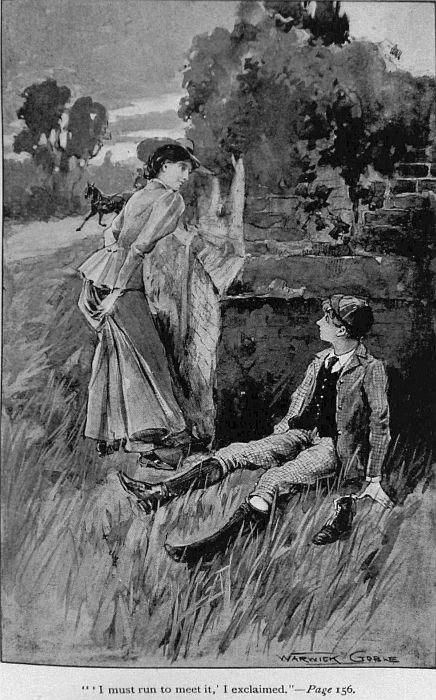
“Here it is,” I exclaimed, “I must run to meet it, Moore.”
I was not a moment too soon. The man was driving quickly, and I inferred that the stranger had not ventured to prevent his doing so, as he doubtless was in hopes of still catching the train he had been ordered for. And the reception of my first call was not encouraging.
“Stop, please,” I cried. “Do stop for a moment.”
“Can’t,” was the reply; “I’m bound to catch the London express. You must send your order to the inn.”
“It’s not an order,” I replied. “Some one, my brother, has had an accident, and is lying on the road,” and I pointed towards the spot. “You must stop in common humanity. We are staying at the Manor-house, Mr Wynyard’s.”
By this time the man had probably found out that I was a lady—possibly even recognised me, as the Scart Bridge flys were sometimes used by the Wynyards for station-work. And in spite of his protest, he had slackened speed a little. This gave the occupant of the vehicle time to put his head out and ask questions—to the driver’s disgust no doubt, little suspecting that his hirer, the principal in the matter of catching the express, had no expectation whatever of doing so.
“What’s the matter?” he inquired.
“The lady says as there’s some one been and hurted hisself down the lane,” began the man. “We can send a man up from Hart’s Cottages,” and he pointed with his whip, “but if we stop, sir—”
“Stop!” was the interruption in imperative tones. “Of course we must,” and he jumped out as he spoke. “Follow us,” he said sharply to the driver, who thereupon proceeded to obey, murmuring some thing to the effect that the train would be gone, but that “it’ll be no fault o’ mine.”
“Nobody said it would be,” my companion called back, and then we walked on the few paces to where Moore was propped up in a half-sitting posture against the wall.
“I was as quick as possible,” said the stranger, though already he hardly seemed such. Circumstances sometimes lead to familiarity so quickly. “Is he all right—the boy; your brother?”
“Yes,” I said. “I don’t think the pain is very bad. I am sure you have been wonderfully quick, and I don’t know how to thank you. And how kind that poor Mr Grey has been!”
I felt my companion glance at me almost sharply.
“I told you,” he said, “that they are the kindest-hearted people possible. But—may I ask why you speak of him as ‘poor Mr Grey’?”
I was surprised, almost startled by the question. I had somehow taken it for granted, not only that this visitor was completely au fait of the Greys’ peculiar position, but that he must be aware that the mystery concerning the Grim House was common talk in the neighbourhood.
“Oh!” I replied, rather lamely, “because, of course, everything about them seems so strange and sad!”
There was no time for him to reply, for we had now reached Moore, and at once set to work to get him into the fly, which drew up at the place where we stopped, the driver, rather snubbed by the very peremptory tone assumed by his “fare,” was much on the alert to obtrude his benevolent instincts.
“Dear, dear!” he exclaimed. “It’s a bad business. I’m afraid there’s bones broke! Did you fall far, sir?” he went on, to Moore, evidently anxious to get all the information he could for the delectation of his cronies at the White Hart, or whatever was the name of the inn. But before Moore replied, our friend in need did so for him.
“You don’t need to fall far to sprain your ankle,” he remarked quickly, “and I hope it is nothing worse than that. A slip on level ground is quite enough sometimes.”
“Yes,” I agreed; “indeed I often wonder that we hold together as we do, considering our complicated bones and joints.”
The driver, imagining himself gifted with great discrimination, evidently thought we were trying to encourage Moore, and took his cue accordingly.
“Young bones ain’t so hard to mend as old ones,” he said philosophically, as he closed the door; “and where shall I drive to if you please?”
“To Mr Wynyard’s—the Manor-house,” I answered promptly, and off we set, this time at a moderate speed, all thought of train-catching eliminated from our conductor’s mind.
Chapter Nine.
“The Misses Grey.”
It was certainly a curious position, and now that my anxiety about Moore had to some extent calmed down, I could scarcely help smiling to myself as we jogged along, at the adventure which my injudiciousness and Moore’s self-will had landed us in.
The road cleared a good deal as we approached our destination. I was able to get a better view of our companion than hitherto, while the shade of the trees had lessened the already waning light. He was young, under thirty, I thought to myself, decidedly pleasing in appearance, if not exactly handsome; but what struck me the most was a shadowy resemblance to some one I had seen, though, try as I might, I could not succeed in remembering to whom. Once or twice I fancied I descried the shadow of an amused smile crossing his own face, but before we stopped at the Manor-house door his expression grew more serious.
“You quite understand,” he began, “and excuse me if it is unnecessary to remind you of it, that your own wish to—to keep all this business to ourselves, is thoroughly agreed to, indeed desired by—Mr Grey and his family?”
“Oh dear, yes,” I replied eagerly, “and I am very thankful for it, but I don’t feel as if we had been grateful enough to him. And—” with a little hesitation, “to yourself.”
He made a slight gesture of deprecation of the latter part of my speech, but I went on—
“If you should be writing to Mr Grey, would you be so kind as to thank him again?”
“Certainly,” he said cordially. “If I don’t write it I will not forget to say it, the next time I see him,” and the rather unguarded inference of his words reminded me that letters were, so far as we knew, unknown at the Grim House.
So I contented myself with another “thank you.” I should have liked to ask our friend’s own name, but my courage failed me, and afterwards I was glad I had not done so; it might have savoured a little of seeking for information which had not been volunteered to us.
The hall-door stood open as we drove up to it, and one or two of the older servants, among them the housekeeper and butler, were looking out anxiously. Their faces cleared when they saw us, but clouded again when I jumped out and hurriedly volunteered some explanation of our late return, of which of course the word “accident” was the first to catch their ears.
“Dear, dear!” said the housekeeper, “what will Master and Miss Isabel say, with all their charges to me and Sims to take good care of you, Miss Fitzmaurice?”
“They will certainly not say it is your fault, or Sims’, Mrs Bence,” I replied; “and after all, I hope it is nothing very bad. We were very lucky to meet this gentleman, otherwise I could not have got my brother home nearly so quickly.”
I indicated by a movement of my head in his direction our friend in need, who was now, with the butler’s assistance, extricating Moore from the fly. Poor boy! he did look rather dilapidated! though both he and I tacitly agreed in trying to make the best of our misfortunes. It would have been impolitic in the highest degree to pile on the agony so as to have led to minute or detailed inquiry on the part of the servants.
By this time the stranger had got Moore on to a comfortable seat in the hall, where of such there was no lack.
“Now,” he said, “I think the best thing I can do is to send you the doctor as quickly as possible, I know where to find him. I should advise you to let your brother stay where he is for a few minutes. Get him a cup of tea, or something to pull him together a little, before you carry him upstairs, and once there, put him to bed as quickly as possible, and just raise the injured foot on a pillow till the doctor sees it.”
He glanced round as if to satisfy himself that he left us in good hands, and then, before I had time to do more than shake hands, he was gone.
“A nice-spoken young gentleman,” said Mrs Bence approvingly, “but I’ve never seen him before. He must be a stranger in these parts. Do you know who he—”
But I interrupted her by a shake of my head.
“I have no idea who he is,” I said. “He did not tell us his name. He has been extremely kind. I am only afraid that by stopping to help us he has lost his train. He was on his way to the station.”
“If it was the evening express for London,” said Sims, taking out his watch—Mrs Bence had gone off in quest of the prescribed cup of tea—“he certainly has, Miss. There is a slower one an hour later; he will be in plenty of time for that.”
This information somewhat consoled me. I said nothing more, nor did Moore. And after a while we got him upstairs and settled in bed as comfortably as was possible under the circumstances.
The poor foot looked in very bad case when we had got it quite free, and Mrs Bence groaned over it in much distress. But when the doctor came our spirits rose again. It proved to be only a sprain, and not a very severe one, though painful. Perfect quiet and minute attention to his orders would do wonders, he assured me, to my great relief.
“You are alone here for the present, I understand,” he said. “Mr and Miss Wynyard are away?”
“Yes,” I replied, “but only for a day or two. I believe they will be back by Saturday.”
“By Saturday,” he repeated. “Ah, well—by Saturday I think you will see great improvement. The swelling will have gone down, I hope. Let me see! How did you say it happened? A fall, was it?”
We had not said anything at all as to how it had happened, but luckily we were not called upon to reply, for Mrs Bence, who was a little deaf, came just then innocently to our aid by some inquiry as to the arrangements for the night. Should she or Sims sit up with Master Moore?
“Oh, no—no need of it,” said the doctor. “He will probably sleep far better if he is left alone. Let him have a hand-bell within reach, and some one near enough to hear if he rings;” whereupon my own maid, who had been dying to be of use, came forward to suggest that she should sleep in a small dressing-room next door, and where she would hear the slightest sound. This was agreed to, then followed repeated directions from the doctor as to liniments and bandages, and then at last I gave in to Mrs Bence’s reiterated entreaties that I would come downstairs and have a bit of dinner—Moore joining his voice to hers, and promising to eat something himself, though he owned that he was not feeling “exactly hungry.”
I was terribly tired if not hungry, and I felt grateful for the unusual tact which made Sims and his underlings leave me alone once the good man had satisfied himself that everything I was in want of was within reach.
I had plenty to think of; not a little to blame myself for, though farther back than the actual events of this strange evening; still more to be very thankful about—how easily my young brother might have been, if not killed, at least terribly injured, crippled perhaps for life, by no greater an accident!
And the thought brought back to my mind again the mystery of the Grim House, made more real, more impressive, so to say, by the further glimpse I had had of its melancholy occupants. In spite of myself and my determination to oust all curiosity concerning them from my mind, the picture of the quartette, at that very moment sitting, probably in silence, around their dining-table, would force itself on to my brain. Could the mysterious secret have had to do with the accident which crippled the younger brother? No; somehow I felt sure it had not been that. The sisters, I remembered Isabel telling me, had referred to it quite simply on the one occasion when they had emerged to offer sympathy at the vicarage. No, the mystery did not lie in that direction. Then the words I had unwillingly overheard recurred to my memory. I had thought I would try to forget them, but this was beyond my power, and next best to doing so, an instinct seemed to tell me, was to remember them accurately; and this, for I had a retentive brain, I found I could easily do.
The mention of our own surname had naturally impressed them much more vividly on me.
“Ernest Fitzmaurice”—who could he be? I had never heard of him, I felt sure. Yet our name was not a commonplace one, and the great Irish family to which we belonged were very clannish, and kept up their knowledge of each other with considerable energy; my father did so, I well knew; some day perhaps I might ask him if he knew of any relative whose first name was Ernest.
“He must be a man of about father’s age,” I reflected, “or even a little older, if he is a contemporary of Mr Grey’s.” But by this time I was feeling very tired, very sleepy, and almost before I had finished eating, I felt that I must go to bed, if I were to be fit to take my share in looking after and cheering poor Moore the next day.
“And I shall have to write home and tell them about it,” I thought to myself. “Oh dear, oh dear! I wish I had never heard of the Grim House. I should like to forget its existence.”
But this was not to be.
I woke the next morning considerably refreshed, and inclined to take a more cheerful view of things. Moore, I was glad to find, had had a fairly good night, all things considered, though his foot and ankle were of course still very inflamed and swollen. Mrs Bence and Maple, however, thought well of it in comparison with what it had been, and so long as he kept it motionless, my brother said that the pain was slight. I was just preparing to begin my letter to mother, when the sound of wheels—I was sitting near the window of the library, which at one side looked to the front—made me stop, my heart beating a little faster than usual from the idea that it might possibly be Isabel and her father returning sooner than we had expected them.
“Oh, no,” I said to myself reassuringly, “of course it will only be the doctor,” though in another moment the sight of the approaching vehicle revived my doubts and fears.
It was the fly again! I drew as near the window as I dared, while avoiding being seen, almost expecting to catch sight of the stranger, our good Samaritan, getting out, for it struck me that he might have had to stay the night after all, and had come up to inquire how Moore was getting on. But no, the driver himself got ponderously down and rang. It was certainly neither the doctor, the Wynyards, nor the stranger! Wild ideas rushed through my mind as to the possibility of its being father, or Jocelyn even, though half an instant’s reflection showed me the absurdity of such a thing. Who could it be? From where I stood, the interior of the carriage was completely hidden from view. I heard the servant cross the hall, and as it were, felt the little colloquy that ensued when the door was opened. Then the driver turned to the fly with the information he had received, and its occupants at last became visible.
They were—words fail me to describe my sensations—none other than the two little old maiden sisters from Grimsthorpe!
My first feeling was one of astonishment, my second of fear! Was our secret known, then? Had Mr Grey broken his promise? But what was his promise—in a moment I recalled his words, “You may rely on us to keep the affair to ourselves;” he had spoken in the plural. Still, what was the meaning then of this visit, which was certain to awaken the gossip and curiosity of the whole small neighbourhood? I felt utterly nonplussed, but I had no time in which to think over things; I was obliged to pull myself together as best I could, for the door was thrown open for the announcement, “The Misses Grey,” and my little-looked-for visitors entered.
They were, at the first glance, curiously like each other, though afterwards I discerned several points of dissimilarity. The elder of the two—for naturally I at once so dubbed her in my own mind as she preceded her sister—had a much stronger face—strong in its very gentleness—though the younger was, or had been, decidedly the prettier. Except as to eyes—I never saw lovelier eyes than those of Miss Grey herself, as she drew near and looked up at me, for though not very tall, I was much taller than they. And with the first glance, all my misgivings as to the purport or unwisdom of their coming vanished.
“Miss—Fitzmaurice,” she began, with a slight, the very slightest, hesitation. “I—we—this is my sister Beatrice—could not rest without hastening to offer our services and sympathy in this—most unfortunate accident, which,” and here her voice grew peculiarly distinct, her words almost emphasised, “which we heard of this morning through the driver of the fly, which fortunately was passing the spot where your brother and you were,” here she glanced at me again in a way which showed that her eyes could be keen as well as kind, and even—I could not feel sure if this was my fancy—not without a touch of humour in their depths. “One of our servants had occasion to visit the village this morning, and brought back the story, and—as I said, hearing that you were alone, we felt we must come to inquire for you ourselves—my brothers uniting with us in—in”—here she repeated the words—“sympathy and offers of service.”
She had held out her hand at the opening of this rather long speech. I had of course taken it, and scarcely conscious of so doing, was still clasping it. And as for the third time she raised her lovely kind eyes to my face, I—it was very unconventional and undignified, and all the rest of it, I know—I burst into tears!
“Oh, Miss Grey!” I exclaimed. “You are far, far too kind. We—we don’t—” how I longed to finish my sentence, “don’t deserve it.” But I dared not, for there flashed over me the remembrance that, if I confessed my own share in our impertinent intrusion, I should implicate Isabel, which I had no right whatever to do, and I stopped short. My tears, I think, standing me in good stead, as they gave a reason for my confusion, and increased the kind woman’s pity. They were genuine enough, too, Heaven knows, for I had been putting considerable restraint on myself to keep them back hitherto, for every sake—Moore’s especially.
I felt Miss Grey’s other hand steal on to the top of mine, already in her clasp.
“My poor child,” she said,—“excuse me for calling you so—do not take things so to heart, unless—unless, indeed, there is fresh cause for your distress?” and now her tone was full of anxiety. “I trust your brother is not worse? No injury to the head, or to the limbs, that did not show perhaps at first?”
I shook my head, and now a silly feeling of wishing to laugh came over me, when I thought of the excellent breakfast I had seen the naughty boy upstairs despatching, and his very comfortable condition, propped up with a story-book, at the present moment. No, my tears were not those of anxiety about him, but of very sincere shame and distress at the trouble we had caused these good kind people, who surely had a right to shut themselves up in their own domain if they chose, without being subjected to inquisitive espionage.
“Oh, no,” I said at last, choking down my hysterical symptoms, “he is going on all right. In himself he is really very well indeed, and I think his foot is improving. But you are standing all this time,” and I drew forward a chair, Miss Beatrice Grey, who looked pale and nervous, having already sunk into a corner of a sofa.
“Jessie,” she now said, speaking for the first time, and addressing her sister, “you are forgetting the liniment.”
“By no means, my dear love,” replied the elder one, “I am just coming to it,” and from the folds of her mantle—a good but old-fashioned affair, as was every part of their attire—she produced a phial, neatly wrapped up, which she carefully unfolded. “This is a very excellent preparation,” she continued, “for external application—external. If Dr Meeke has not called this morning, pray suggest it to him when he does so. He knows it of old, though probably he did not think of it in the present case. We distil it ourselves—my sister and I—not having”—here she coughed a little—that tiny cough was her only sign of nervousness—“as we have not,” she resumed, “too much to do;” and here there came a little murmur about “a quiet country life,” “we amuse ourselves with these sorts of things—distilling, and so on. We take a great interest in herbs, and we have some rare ones.”
She tapped the little bottle as she spoke.
“There are some ingredients in here which are not to be met with every day,” she said, with a funny little tone of self-congratulation, “as Dr Meeke knows!”
I thanked her warmly, of course, promising to ask the doctor to let us make use of her gift at once.
“And is there anything else,” she went on, “that we can be of use in?” While from the sofa there came a little echo of—“Yes, so glad to be of use!”
I considered for a moment. It was so plainly to be seen that these good creatures would feel real pleasure in their offer being literally accepted.
“New milk,” murmured Miss Beatrice, “to keep up his strength. It did wonders for our dear Caryll, long ago, when he—injured his spine. New milk with a spoonful of rum, first thing in the morning on waking.”
Miss Grey—Miss Jessie I feel inclined to call her—turned a little sharply on her younger sister.
“My dear Beatrice,” she exclaimed, “you forget. Everything of that kind of course is at Miss—Fitzmaurice’s command.”
“To be sure,” was the reply. “Still—”
“I’m sure it would be an excellent thing,” I said, as she paused, “but I do not think there is much fear of Moore’s strength failing him, though he has been rather a delicate boy.”
“I hope not,” said Miss Jessie; “I hope not, indeed. Perhaps we felt unduly anxious, for in our case it was not till several days after the accident that the grave injury was discovered.” I suppose my face must have betrayed a little alarm at this, for she hastened to reassure me.
“If Dr Meeke is satisfied, I am sure you may feel so,” she said. “He is really a very competent man. We had no misgiving on that score; it was only hearing of you two young things being here alone, we felt we—must inquire at first hand.”
“You have been most good and kind,” I said. “I shall never be able to thank you—you all,” after a moment’s hesitation, “enough;” and though she said nothing, I felt that she understood the under-sense of my words. I had it on the tip of my tongue to add that I hoped their friend had caught the later train, but a moment’s reflection satisfied me that I must follow their cue, and make no allusion to the secret which their brother and I had agreed to preserve intact.
Then they both rose, saying they had detained me long enough; I must be anxious to rejoin my brother.
“We shall hear how he goes on,” were Miss Jessie’s last words, “as Dr Meeke calls now and then at present. We have a delicate young servant who requires care.”
“Yes,” I said impulsively, “and Mr Caryll Grey—I suppose he is never very strong?”
Both faces brightened perceptibly at the mention of his name.
“His condition does not vary much,” said Miss Grey in her precise way, “and, thank God, he rarely suffers acutely. And what we should be still more thankful for—his nature is a quite wonderfully buoyant one.”
“He is so very, very good,” murmured the other little sister. “Always cheerful, always thinking of others, never of himself, dear fellow.”
She lost her shyness and timidity as she spoke of him. It was really beautiful to see. I felt as I ran upstairs, eager to confide to Moore the details of the wonderful visit, that it was not only Mr Caryll Grey who was “so very, very good,” but that I had indeed been entertaining angels!
Moore was of course intensely interested and excited by my story. I think it deepened, perhaps more even than the punishment he had brought on himself, the lesson he had received. For I heard a murmur as I concluded, in which the words, “caddish thing to do,” were audible enough.
The doctor made his appearance shortly afterwards. He raised his eyebrows in surprise, which he was too discreet to express otherwise, when I related to him the visit from the Grim House, and by no means “pooh-poohed” the use of the medicament the kind woman had brought.
“I remember it,” he said. “And in more than one case of sprain I have known it have a wonderfully good effect. Try it by all means, Miss Fitzmaurice, now that the inflammation has begun to subside; it is just the sort of thing we want, and you may safely continue its use, diluted with water of course, till you have emptied the bottle.”
The next two or three days passed quietly, even monotonously. Moore was very patient, and I think I did my best to help him to be so. It was a relief when my home letter was written, and a still greater one when an answer to it had been received. I meant to tell mother the whole circumstances when I saw her again, by no means exonerating myself where I felt I had been to blame, but to enter into any explanation in a letter would have been out of the question. Besides—and as I arrived at this point in my cogitations a new idea struck me—had I any right to retail what Isabel had told me in confidence, without her permission, and would not the applying for this, risk the betrayal to her of my agreement with Mr Grey?
“Oh dear,” I thought to myself, “what a labyrinth a little indiscretion may involve one in. I see now that I was not justified in telling Moore about Grimsthorpe. It was not faithful to Isabel, but with his being here on the spot and seeing the place for himself, it never struck me before in this light. No doubt he would have heard some gossip about it, but probably not enough to cause much curiosity. I shall really be very glad when we are both safely back at home again, and the whole thing forgotten, so far as ever can be. Moore has had his lesson anyway; I am certain he would never intrude on the Greys again, even if he were here for months. How very discreet those old ladies were! I suppose they have learnt it, poor things.” For that there was a secret, and a very sad one, my recent experiences had in no way led me to doubt. “By the way,” I went on in my own mind, “I wonder how they knew our name?” Then I recalled the little colloquy at the hall-door. “Of course,” I reflected, “they must have asked for the young lady who was staying here, and naturally the footman would speak of me as ‘Miss Fitzmaurice’?” and later I discovered, by a little judicious inquiry through my own maid, that this had in fact been the case. Nor did I make the inquiry solely through curiosity. I had noticed the almost imperceptible hesitation in Miss Jessie’s manner as she addressed me by name, and I could not forget—it was no use pretending to myself that I should ever do so—the mention of “Ernest Fitzmaurice” which I had overheard. “Something to do specially with Jessie,” I had gathered.
“Poor little woman! What may she not have suffered in life, and how brave she seems!” were my last waking thoughts that night.
Chapter Ten.
Change of Scene.
The Wynyards’ return was after all delayed for a day or two, and this, as will be readily understood, I did not regret, as it gave more time for Moore’s progress in convalescence. I had persuaded Mrs Bence and Sims, though not without some difficulty, to join me in keeping back the news of the accident from our hosts till we could tell it to them by word of mouth.
“It would only worry them,” I said, “and do no conceivable good, and they are sure to come back the very first day possible.”
And when they did arrive I felt doubly glad that I had taken this precaution, for Mr Wynyard was looking rather tired and depressed, and Isabel confided to me that the meeting his relative after an interval of a great many years had—as she expressed it—“taken it out of him” considerably, though the business matters which they had met to arrange had all been satisfactorily concluded.
Moore’s misfortune did not strike them very seriously. Mr Wynyard never having had a son of his own, had an almost exaggerated idea of boys’ spirits and love of adventure, and thought it very lucky indeed that Moore had got off with lesser injury than broken bones. He was preoccupied with his own thoughts just at that time, and once satisfied that everything had been done, and that my brother was in a fair way to a speedy recovery, allowed, so to say, the matter to drop, never even inquiring into the details of how it had happened, nor, rather to my surprise, did Isabel, though it was not till long afterwards that she confided to me the real grounds of her apparent lack of curiosity on the subject.
Both she and her father, however, were keenly interested, as indeed could not but have been the case, in my account of the visit I had received from the Misses Grey, and I felt again a peculiar gratitude to the kind-hearted ladies for the discretion and tact which had prevented a word, or even allusion, which I could not with perfect openness repeat to the Wynyards, as to this part of our experiences.
“They are really very good,” said Isabel heartily, when we were all talking it over together. “It is just the same kind way they behaved to the vicarage people, that time I told you of, several yours ago. Does it not make one wish, Regina, that anything could be done for these poor Greys towards removing the cloud that has hung over them for so long?”
“Yes, indeed,” I said heartily, thinking to myself as I spoke that I had a good deal more reason than my friend knew of for endorsing what she said. And then again there seemed to re-echo through my brain the name “Ernest Fitzmaurice.” Was it only a coincidence, or was it possible that there had ever been any connection between these brothers and sisters and a member of our own family? An unhappy connection, no doubt, possibly even a disgraceful secret of some kind, involving one who apparently had not been the sufferer.
And now, I think, my story will best be told by passing over some considerable interval of time with but a few words of notice.
Nothing farther occurred of any special interest during the remainder of our stay at the Manor-house. Moore’s recovery had progressed most satisfactorily by the date of our return home, which was speedily followed, of course, by his going back to school for the remainder of the term, as he was practically perfectly sound again. And after full consideration I decided that I was behaving more honourably and loyally in not relating to any one the details of his accident, or rather of what had led to it. There was no occasion for doing so, in which the boy himself agreed with me, promising me faithfully to consider all that had occurred as a closed chapter in his life.
“It is what the Greys wished,” I said, by way of impressing it upon him more forcibly, “and considering how very kindly and generously they behaved to us, the least we can do is to respect their wishes to the full. You must never speak of it, Moore, to any of your school-fellows.”
He repeated his promise, and I felt satisfied that he would not forget it. He had had a lesson; all the same I was glad to know that he had overheard nothing of the dialogue which had so impressed me myself.
One thing I did, and feeling assured of the entire purity of my motive, I could not feel that I was wrong in this. Not many days after our return home, when I happened to find myself alone with father, I inquired, in as casual a tone as possible of him, if the name “Ernest” was a family one with us.
His manner was completely free from consciousness of any kind, as he replied after a moment or two’s consideration—
“Well, no; I should scarcely call it such, though there have been one or two of the name among us. One, by-the-bye, whose career would scarcely add prestige to the name he bore, whatever it had been!”
“Who was he?” I said, “and what did he do?” speaking as quietly as I could, for I had no wish, naturally, to rouse any curiosity on my father’s part.
“I scarcely know,” he replied. “He was a distant cousin only, and he has long since disappeared. I fancy he was more weak than wicked, a tool in the hands of a thoroughly unprincipled man, but I never heard the details, nor would they be edifying to know. What put it into your head, Regina, to ask about the name? You are not thinking of getting up a family chronicle, are you?”
“Oh dear no,” I said lightly. “I heard the name accidentally quite, and I just wondered if it belonged to any relation of ours;” and there, for the time being, the matter dropped.
The summer and autumn succeeding our visit to Millflowers passed uneventfully. One great disappointment they brought with them, and that was the impossibility of Isabel Wynyard coming to stay with us, as we had hoped might have been the case. I forget the special reasons for this. I think they must have been connected with her father’s being less well than usual, for, looking back to that time as we have often done since, it seems as if the slow failure which ended a few years later in his death had begun to show itself that year. Soon after Christmas, however, Mr Wynyard went to pay a visit to the Percys, and then Isabel came to us. It was of course delightful to me to have her, and to reverse the rôles of our previous time together, for I had now the pleasure—always, I think, a very great one—of acting hostess and cicerone of our pretty neighbourhood—pretty at all seasons, even in midwinter, to my mind at least, in which opinion Isabel cordially agreed.
She had been the sweetest of little hostesses; she was the most charming of guests. Every-thing seemed to come right to her, and everybody liked her. I think she specially loved the filing of a mother in our home, above all a mother who had known hers.
“It must be so delightful, Regina,” she said, a day or two after her arrival, “to have some one you can always appeal to, always consult, like Mrs Fitzmaurice, close at hand,” and she gave a little sigh. “Papa is the dearest of fathers, and since Margaret’s marriage he and I have been, as you know, everything to each other. Still, after all, a man isn’t a woman, and over and over again I long for a mother.”
“But you have your sister?” I said.
“Oh yes, of course,” was the reply. “The best of sisters; but it cannot now be quite the same, no longer living together. She has her own home and separate interests. I shouldn’t feel it right to trouble her about little things. And you can go to your mother for everything. I do so hate responsibility, and now it seems coming upon me more and more since father is less well than he used to be.”
“I don’t think,” I answered, “that I have ever dreaded responsibility very much, perhaps because, so far, I have small experience of it! But I am likely to have to be rather ‘independent’ before long. I don’t think you will envy me, Isabel, when I tell you that this spring I am going up to London for a couple of months to be taken out by a cousin of mother’s, whom I scarcely know, and already feel afraid of.”
Isabel looked up with startled sympathy in her eyes.
“Oh yes, indeed,” she said. “I do pity you, or rather I would pity myself in your place. Why doesn’t your mother take you out herself?”
Here it was my turn to sigh.
“She is not nearly strong enough,” I said, “for anything of the kind. I have always known that something of the sort was before me sooner or later, and I don’t look forward to it in the least.”
“Poor Regina!” said Isabel. “In our different ways I don’t think either you or I would ever care very much for what is called ‘society’—I from cowardice, and you from—oh! from having so many other things that interest you—such a delightful home, where you are made so much of, and country things. My only experience of London has been for quite a short time together, and under Margaret’s wing. But then, Regina, you are much, much stronger-minded than I. I dare say in the end you will really enjoy it.”
“Perhaps,” I allowed. “I certainly should not care to live a very shut-up life, nor would you either, in any extreme. For instance,” I went on, with a little self-consciousness, which, if Isabel perceived, she was clever enough to conceal that she did so, “for instance, we don’t envy those poor little Miss Greys at Grimsthorpe. By-the-bye, you have not told me if you’ve heard anything of them.”
I was not sorry for the opportunity of making this inquiry in an apparently off-hand way. I was really anxious to know about the Grim House people, and yet the feeling of our secret and the great dread of involuntarily breaking my agreement with them, made me almost nervously afraid of any mention of them.
“Yes,” said Isabel, speaking, it seemed to me, more slowly and as it were consideringly than her wont. “Yes, I have been going to tell you ever since I came, but I have got to have a perhaps exaggerated dread of gossiping about them—only, you see, you do already know all I do. Yes, we are more sorry for them than ever. The cripple one, the brother with the angelic face, has been so ill this winter. And the other three’s poor faces have got sadder and sadder, and grimmer and grimmer, Sunday after Sunday.”
“No,” I exclaimed impulsively, “not grimmer; at least not the sisters; for theirs have never been grim. I think their expression is quite sweet.”
“Do you?” said Isabel. “How do—oh, I was forgetting. Of course you saw them quite at close quarters that day they came down on a Good Samaritan visit when Moore hurt his foot I have never managed to see them very distinctly; those old-fashioned bonnets of theirs hide them so. But the elder brother—he is grim enough, at least.”
“Ye-es,” I replied half-dubiously, “I suppose so.” I had lost my nervous feeling by now, and a certain curious spirit of defiance which I have always known to be latent in me, and which, were it not kept in check, might grow into a kind of recklessness, had been aroused by a touch of “dryness” in Isabel’s tone. I felt inclined to disagree with her, to contradict her for the sake of doing so! So “ye-es,” I repeated. “Perhaps so, but there is more in his face than grimness and melancholy. I think there is dormant tenderness too.”
“Dear me!” was Isabel’s comment on this, “what good eyes you must have! I could never have detected all that.”
“I have very good eyes,” I replied, “and, naturally, your talking so much about the Greys sharpened them whenever I had a chance of using them in that quarter.”
“Good eyes, and good ears, too,” I thought to myself, and with the recollection of my eavesdropping, there awoke again the old sensation of shame, bringing with it quick repentance for my manner to Isabel, in which a rather ungenerous wish to remind her that her confidences had been the origin of my curiosity, had been a motive at work. “If she does know anything about what really happened, it is just as well for her to take some of the blame,” I had thought, “and I have been faithful to her.” But as usual, her gentleness still further disarmed me.
“I am afraid,” she said next, “that the poor things have increasing cause for anxiety and distress. Without cross-questioning Dr Meeke, which of course he wouldn’t allow, I could not but gather from him that he is very anxious about the younger brother. He, the lame Mr Grey, has not been at church for weeks past.”
This news saddened me. Surely our escapade had in no way brought fresh trouble to the Grim House, even though indirectly? It might have rendered the elder man still more anxious and uneasy, and diminished what little cheerfulness his sisters and brother had managed to preserve among them. For I had never wavered in my first intuition, that Mr Grey himself was the centre of the mystery, and the words I had overheard had deepened this impression.
I turned to Isabel rather abruptly, as another thought struck me.
“Have they had any more visitors?” I asked. “Have you seen the man of the pocket-book again?”
Isabel shook her head.
“No,” she replied; “I am pretty sure no one but Dr Meeke has crossed their threshold since you were with us. How deadlily dull it must be for them—one day just like another all the year round, excepting the variety the seasons must bring!”
“And added to that,” I said, “this winter, the daily suspense as to what the doctor would say about their brother, who is their darling, I am perfectly certain. Oh, poor people, poor people!”
After this conversation I do not think the Greys were alluded to again during Isabel’s stay with us. She had told me all there was to tell, and even had there been more news, she would probably not have heard it, her father not being at Millflowers. The two or three weeks of her visit passed all too quickly, far too quickly for me, for more reasons than the pleasure of her society. She had scarcely left us when the preparations began for my stay in London, which, to suit our cousin’s—Lady Bretton’s—arrangements, was to be rather earlier than had been originally intended. Mother was a little surprised at my distaste for the idea of it. She knew I was not specially shy, nor constitutionally timid, like dear little Isabel, and I myself could scarcely explain why the prospect had so little attraction for me.
“It is just that I shall feel ‘out of it all,’” I said, “and Lady Bretton will think me stupider than I am, and will wish she hadn’t troubled herself about me! I know it will be like that, mother. I do wish you would give it up, even now.”
But mother, as I have said, could be firm enough when occasion called for it, besides which, I well knew that any appeal to my father would be worse than useless, and only irritate him. So mother ignored my last sentence altogether.
“It is a very bad plan,” she said quietly, “to put your own imaginings into your anticipations of another person’s feelings towards or about you. Nothing is more misleading—it blocks the way to any sympathy between you. I know Regina Bretton very well, otherwise I would not have accepted her proposal. She is the sort of woman who will enjoy your inexperience, as well as”—mother went on, with a little mischief in her tone—“smartening you up generally. She loves being appealed to; then, too, she is your godmother, and really thoroughly kind-hearted.”
The remembrance of this and other reassuring remarks of a similar kind did comfort me a little. Still more so the sight of my godmother’s kind, handsome face when I saw her for the first time coming downstairs to receive me on the afternoon of my arrival at her house. Nothing could have been more affectionate or un-alarming than her manner of welcome.
“I would have gone to the station to meet you,” she said, “but it is often more embarrassing than pleasant, when people are not quite sure of each other by sight. Then I knew, too, that you had your maid with you, and indeed, dear, as regards actual travelling, you are far more experienced than I; you have had so much of it.”
Trifling as was this remark, it helped to put me at my ease; it showed a wish on my hostess’s part to say something pleasant and gratifying. Surely it would be well if there were a little more of this sort of thing among us English people? As a rule, we are so terribly afraid of agreeable impulses, reserving all approach to commendation or admiration till absolutely sure of good grounds for such. Yet the same caution does not hold on the converse side. An air of cold criticism, in itself more discouraging very often than an openly disagreeable remark, is as a rule accepted as correct. May it not be that in this particular people deceive themselves, and at the root of our unattractive reserve and so-called terror of flattering, there often lurks an underlying spirit of reluctance to discern or allow, even to ourselves, the best points of another? Still worse, not impossibly, in many instances some more or less specious touch of jealousy?
I have wandered a little from the case in point, which is scarcely a typical one. On my kind cousin’s part there could have been no conceivable temptation to disparagement of me in any way. Not even of my youth, for its benefits were still practically hers. She had magnificent health, was still as pretty as she had ever been—some indeed said prettier; she was surrounded by friends, many of whom at least—most, let us hope—were attached to her by reason of her own unspoilt, unselfish character, far more than by that of her prosperous and important position.
There was but one blank page in her life. She had no children of her own, though the devotion of the best of husbands, as was hers, scarcely allowed her to realise this one great want.
Still, it was not everybody—by any means far from it—who would have had the kindly tact to receive me as she did, almost from the very first winning my confidence and setting me at my ease, amidst these new surroundings.
It was still quite early in the spring, and I did not feel overwhelmed by the contrast of town life with our almost exceptionally quiet one at home. This I was very glad of, though even in the midst of the season I doubt if my godmother would have allowed any extreme in the way of going out. What she did, she has often said, she liked to enjoy, and her happy nature was ready to do so. She threw herself with hearty interest into the many things which were new to me, though of course not so to her. I scarcely think any girl ever saw all best worth seeing in London under pleasanter auspices than I did.
And so the days and weeks passed on, bringing with them no twinge of home-sickness to me. My letters to mother and to Isabel, some of which, now faded and yellowing, have come into my hands again of late years, tell of a very happy passage in my life.
The time was already approaching for my return home, at least allusions had begun to be made to its probable date, when I one day received a note in an unfamiliar hand. I glanced at the signature as one sometimes does in such a case, before thoroughly mastering the contents.
But at the first moment it only added to my perplexity.
“Payne?” I repeated, “Edith Payne? who can she be?” Then the name of the southern resort where we had spent our last winter abroad caught my eye, also the words—“Rupert specially asks to be remembered to you”—and recalled to me the recollection of the nice boys and their gentle little mother whom we had made friends with. Circumstances had, after all, not tended to keeping up the acquaintanceship hitherto, for the younger brother’s joining Moore at school had been delayed till quite recently, though it was to this having now taken place that I owed the kind little letter and invitation which it contained.
Mrs Payne wrote, hoping that I would at least spend a day with them, if not two or three days; she would be so interested to hear my home news, and Rupert, the incipient novelist, was more than delighted at the idea of meeting me again.
Now, as it happened, and as really does happen in fact as well as in fiction, though people are so fond of saying that coincidences principally exist in story-books, this proposal came just at the right time. When I told my godmother of it, I noticed at first a touch of hesitation in her manner.
“Mrs Payne?” she said. “Not old friends of yours, are they? I don’t remember about them.”
I explained to her when and where we had met, adding that I believed the father was a lawyer of very good standing. Her face cleared.
“Oh yes!” she exclaimed. “I know who they are now, thoroughly good people, a little old-fashioned perhaps. And you think your parents would be quite pleased for you to renew the acquaintance?”
“I’m sure of it,” I said; “but don’t you think it would be enough to go there to luncheon one day? I am so perfectly happy here, I don’t want to go anywhere else.”
“Dear,” was the reply, “I do like to hear you say so. Having you is almost”—and here the tiny shadow that sometimes crept into her eyes was for a moment perceptible—“almost like having a daughter of my own. But as it happens—I know I may be quite frank with you—it would answer rather well for you to go to these good people for a couple of days or so. Say next Friday to the Monday after? Henry and I have a rather special invitation for those days, and though I had not dreamt of mentioning it to you, now that this has turned up, it all seems to fit in, for my husband would like me to go with him to his uncle’s.”
I was of course only too glad to be in no way a difficulty to my hosts, so I wrote at once both to Mrs Payne, suggesting the date named, and to mother, telling her what I had done in the matter. And all came to pass in accordance with our plan. The following Friday found me driving across the park to the rather sombre but stately square where the Paynes had lived for many years.
Chapter Eleven.
Granville Square.
It was to some extent a new phase of London life, even with my small experience of it, to which I was introduced at Granville Square. The Paynes were open, as Lady Bretton had said, to a mild charge of “old-fashionedness” perhaps. Of this, save for my time with my godmother, I might scarcely have been conscious, but as things were, it added a certain interest, almost charm, to my days with them.
From the first I felt thoroughly at home; the whole atmosphere was in many ways home-like to me. For, to begin with, there was no daughter of the house, and the two sons at home on my first arrival were, or at least seemed to me, decidedly my juniors. The younger of them was very distinctly so, for he was the baby of the family, still at a day-school in London, and Rupert, my old acquaintance, though literally about my own age, I looked upon as much younger. In those days I think the feeling was more marked than at present, of girls arriving at maturity more quickly than their young men contemporaries.
There was no other guest at dinner that first night, as my host had taken places at the theatre for Mrs Payne, Rupert and myself. It was part of the rôle in their kindly minds to give me all the entertainment possible, and I fully appreciated it, especially as I had not been often to the play while with the Brettons. The piece they had chosen, I need scarcely say, was unexceptionable in every way, something of a tragedy, as far as I remember, of good if not classical standing, and Mr Payne himself had selected it for my benefit. He was an elderly man, a good deal older than my father, in appearance and bearing at least, but I did not find him nearly as awe-inspiring as Mr Wynyard had seemed to me at first, very probably because in the present case my host was entirely without self-consciousness, or the touch of shyness which is almost inseparable from the kind of life which Isabel’s father had led for so many years.
“If I had to go to law about anything,” I remember thinking to myself, “which I devoutly hope will never be the case, Mr Payne is just the sort of man in whose hands I should feel perfectly safe!”
In his heart, I think Rupert was rather pleased than otherwise to be my only cavalier, though he impressed upon me dutifully, and no doubt sincerely, his regret that the elder brother, Clarence, of whom I could see that the whole family was immensely proud, had not been there to meet me.
“Is he out of London?” I asked, half carelessly, as we were sitting waiting for the curtain to rise, one of the unwritten laws of the Payne household being “always to be in good time at a theatre or a railway station”—or “is he only very busy?”
“He is very busy,” Rupert replied. “I believe he is getting on splendidly, but to-day he is actually in the country on some very pressing affairs. He will be back to-morrow, though; he doesn’t often stay away more than a night at a time; my father can’t spare him.”
“And how are you getting on yourself?” I was beginning; “how about—” at that moment I was interrupted by the rising of the curtain; but when it fell again I repeated my question, and in the intervals I was able to talk to Rupert without seeming to neglect his mother, who was happily engaged on her other side by her neighbour there, proving to be a pleasant acquaintance.
“How about your novels? Have you got any more good plots on hand?”
The form of my question was partly affected by the nature of the drama before us, which foreshadowed, even in the first act, a mysterious secret, handed on through more than one generation of an ancient family.
Rupert coloured a little.
“Good plots!” he repeated. “I have just scores of them. It is not that part of it I am at a loss about. It is my style I am unhappy and dissatisfied with. There is something—I don’t know how to define it—stilted and priggish, I am afraid, that I am painfully conscious of and yet cannot throw off. I have often thought how it would help me to talk my work over with you, if it would not bore you dreadfully. Even to read some of my MS. Could you make up your mind to such a thing?”
I felt flattered, but a little surprised.
“Bore me; it certainly would not,” I replied. “But I am not the very least in the world a literary person.”
“No,” said Rupert eagerly, quite unconscious of anything uncomplimentary in what he was saying. “I know you are not, and that is just what I like. Your feeling—your intuitive perception is so fresh and natural!”
I could scarcely suppress a smile; the dear fellow’s way of expressing himself vivâ voce, though he was quite unconscious of it, certainly laid him open to some extent to the charge of “stiltedness”—“priggish” I could not bear to call him, he was so genuine and really modest; the adjective “quaint” seemed to me to suit him better than any other.
“I should like very much to read some of your stories or sketches,” I said, “or better still, you might read them to me, and then we could discuss them a little as we go on.”
Then, for the time being, our conversation stopped but by the end of the next act—there were only three in all, as far as I remember—my interest in Rupert’s confidences had been increased by that of the drama before us.
“By-the-bye,” I said, almost before the curtain had fallen, “some parts of this play remind me a little of a story in real life you told me something of. And you half promised to tell me more some day.”
I spoke and felt eagerly, for a strange idea had struck me—curiously enough as it may seem to any one unaccustomed to meditate on the vagaries of our brains and memories—for the first time. Was there not a certain amount of resemblance not only between the plot gradually unfolding before us, but between Rupert’s real story, little though I had heard of it, and the real mystery with which I had come in contact, though of the facts connected with it I knew scarcely more?
My companion was flattered by my recollection of his confidences. But yet I saw that he looked a little uncomfortable.
“I know what you are referring to,” he replied. “But—I haven’t anything more to tell you, and I am afraid I can never hope to work up what I know so as to make any practical use of it. They are thinking after all,” he went on a little shamefacedly, “now that I am so much stronger, of my going into my father’s firm—under Clarence of course—and the mere fact of my being in it would bar the way to my benefiting as a writer by any of the strange complications lawyers come across in their work.”
I understood and appreciated his reticence, though it by no means tended—rather the other way indeed—to make an end of the idea that had suggested itself to me.
“It really does seem,” I reflected, as I turned my attention again to the stage, “as if the Grim House business was fated to haunt me! This very play, and the coming across Rupert again, which has recalled his story!—no! it is no use my trying to put it away for good, I wonder how that poor Mr Caryll Grey is?” for, as I said, I had heard nothing more from Isabel on the subject since I had been in London.
Notwithstanding these preoccupations of mind, I thoroughly enjoyed my evening, which Rupert and his mother were pleased and gratified to hear.
“Now,” said Mrs Payne, as we alighted at their own door, “you must get to bed as quickly as possible, my dear! I know it is not very late, but I don’t want you to go back to Lady Bretton looking any less well for your two or three days with us. In the first place, however, come into the dining-room, where we shall find sandwiches or something of the kind,” and she led the way thither, I following.
To my surprise, as she entered, she gave a little cry, not of alarm, but of astonishment and pleasure.
“My dear boy,” she exclaimed, “so you have got back to-night after all! Miss Fitzmaurice,” and she turned to me, “this is my eldest son, Clarence; we did not expect him home till to-morrow.”
I came forward with no very great sensation of interest or curiosity, feeling, indeed, just a little bored at having to talk polite nothings to another stranger, when I was conscious of being rather sleepy and a little dazzled by the sudden light, after the pleasant darkness during the drive home. But no sooner had I caught a glimpse of the man who had risen from his seat on our entrance and was on the point of approaching me with outstretched hand in response to his mother’s introduction, than all my wits and perceptions awoke to their keenest. I could scarcely repress an exclamation of amazement, for there stood before me the unknown whom Moore and I, and indeed Isabel herself, in the first place, had dubbed with so many designations—“the mysterious stranger”—“the man of the pocket-book”—“our good Samaritan,” and so on!
And although Clarence Payne was in some respects more at a disadvantage than I, never having seen me except with a hat on, and, as far as I remember, a veil as well, it was instantly evident that he too recognised me!
“Miss—” he exclaimed, and his mother, thinking he had not caught my name, interrupted him before he had time to repeat it.
“Fitzmaurice,” she interpolated.
“Miss Fitzmaurice,” he resumed, “I am—” then stopped short.
We looked at each other, on both sides waiting for a cue, the young man evidently quite in the dark as to whether I would wish him to appear to recognise me or not, and I, for my part, feeling something of the same nature as regarded him. But we were both too naturally, I think I may say, ingenuous, too young perhaps, to act a part without distinct reason. We gazed at each other for less time by far than it has taken me to describe the little scene, then—and after all I think it was the best ending of it—we both burst out laughing, the half-nervousness which had so culminated melting into real amusement as we caught sight of Mrs Payne’s amazed face.
“My dearest Clarence!” she was beginning.
“What—what in the world—”—“is there to laugh at?” she was doubtless going to have continued, had her son not interrupted her, before even I had time to do so.
“We have met before!” he exclaimed, “though neither of us knew the other’s name;” whereupon Mrs Payne’s expression changed from amazement to perplexity.
“Met before?” she repeated. “How? Where? At some party perhaps?”
He glanced at me as if leaving the unavoidable explanation to me, both as to extent and character.
“No,” I said, replying for him, “it was not at a party,” and then, as there flashed across my mind the extreme probability of Moore and Clarence Payne meeting each other in the future, I felt that candour, up to a certain point, was the wisest and best for all concerned.
“It was when I was staying in the country,” I went on, “not very long ago. My brother slipped and sprained his ankle, and your son, who was passing about the time, very kindly picked us up and took us safely home. It was not at my own home—there it wouldn’t have mattered so much. We have always felt so grateful to you,” I resumed, turning to “the man of the pocket-book.”
Mrs Payne’s mingled feelings were now gathered together in extreme interest, with a strong dash of satisfaction.
“Dear Clarence is always so anxious to help,” she said, “and he always keeps his presence of mind.”
“You make too much of it, Miss Fitzmaurice,” he replied to me. “You have done so all through. The little service I rendered you was literally nothing, though indirectly I hope it may have been of use by obviating delay as to the doctor’s seeing the injury—”
“Very directly, I should say;” and then for no special reason; I do not think my remark was particularly funny; we both laughed again.
By this time I, at least, was feeling quite at my ease, and so I think was my companion.
“So the doctor did come quickly?” he inquired, “and your brother is all right again by this time, I hope?” drawing forward a chair for me to the table, while his mother busied herself with the sandwiches and other things prepared for us, though listening the while with all her ears to these interesting reminiscences of ours.
“Oh dear, yes! It was not a bad affair after all. He was able to go back to school fairly soon, and his ankle seems quite strong now,” I answered, as I helped myself to a biscuit.
“Was it your brother Moore?” Rupert inquired, and by his tone I perceived that he was not altogether pleased at this unexpected discovery of his senior’s previous acquaintance with me.
“Yes,” I answered. “Did your brother—the one at school with him, I mean—never mention the accident?”
“I think not,” said Rupert, at once responding to my little overture. “I should have been sure to remember it, though perhaps it was before Leo’s going to Minchester.”
“Of course it was,” I replied. “I was forgetting how time goes. That is a sign of getting old, isn’t it?” I added lightly, though in point of fact I was not sorry to hear of Moore’s reticence as to the adventure which, except for his agreement with me, he would doubtless have found a highly spiced experience to relate and be listened to by his companions.
“I don’t know,” said Rupert rather gloomily. “We are all getting very old, I suppose. I often feel as if I were ninety, and I don’t think I should much care if I were. Life is not so very entrancing, that I can see.”
His brother glanced at him half-mischievously.
“Speak for yourself, if you please, my dear boy,” he said. “Miss Fitzmaurice does not feel very antique and decrepit, I am quite sure. Nor do I. I think life ‘grows upon one,’ and becomes more and more interesting every new year one has of it.”
“So do I,” I exclaimed eagerly. “I used to dread getting big—I mean leaving off being a child”—and I felt that I blushed a little, as if I were talking egotistically—“but I think being grown-up is very nice after all.”
“Yet there are plenty of sad things too,” said Clarence gently. “Sometimes one feels as if it were scarcely fair that one should have so much and others so terribly little,” and I fancied he sighed a little.
“Dear Clarence,” said his mother, “that is so like you,” and she patted his head.
He was a very good son. I felt that her remarks and manner irritated him a little, but he never showed it, so as to chill or hurt her in the least.
“He is so deeply interested in the poor,” she continued, turning to me, “and in all the wonderful plans on foot now-a-days for improving their condition.”
At this it seemed to me that Clarence Payne got rather red.
“My dear mother,” he said, “you give me credit for far more virtues than I possess. But perhaps Miss Fitzmaurice knows already that all your home-farm poultry turn to swans, whatever they were to start with. I am afraid philanthropic schemes and I haven’t had much to say to each other of late. And after all,” here he spoke more slowly, and I knew that his words were tacitly addressed to me, “I doubt if my greatest sympathy is with the poor. It sounds hard-hearted perhaps, but there are, there must be, miseries which they could not feel in the same way as those of our own classes do,” and again it seemed to me that I caught an almost inaudible sigh. And by one of those “brain-waves,” as I believe it is now the fashion to call them, from that moment I felt convinced that he had been down at the Grim House again, and that troubles were thickening there.
There came another murmur of maternal admiration from Mrs Payne, but her son’s last words had saddened me, and a moment or two later I owned to being tired and sleepy, and we bade each other good-night.
My first waking thoughts the next morning were that something strange and unexpected had happened. For a moment or two the unfamiliar room, with its handsome but heavy furniture, very different from the light chintz-hung quarters, with their pretty little adornments, which my godmother had prepared for me, added to my confusion of mind. Then, bit by bit, the events of the day before unrolled themselves in my memory.
“What can be the matter,” I thought, “with the Greys? For I am perfectly certain that something new or worse is the matter. And how can I find out? And what could I do to help them if I knew? Would it, could it ever be right and honourable to tell what I heard—that name?”
My heart beat faster at the very idea. I felt as if I must confide my perplexities to some one; yet to do so to Clarence Payne would, I knew, be manifestly unfair, unless I could tell him the whole. Still, might there not be a sort of compromise? Under the circumstances, the very strange circumstances, of our both knowing what we did, though he little suspected the possibly vital information I possessed—under the circumstances, surely there would be no breach of etiquette or even of good taste in my asking him if he had been there, and if my intuitions as to some new cause of distress were correct? For before I could even battle out the question with myself thoroughly as to whether anything would justify me in betraying my secret, I must know if the new complications I suspected lay in that direction. And Clarence was my only possible source of information. Isabel knew nothing, I felt sure, and it was not the least use applying to her.
So by the time I was dressed I had arrived at a kind of decision. I would lead the conversation round to our former meeting, on the first possible chance that offered itself of talking privately with the younger Mr Payne; a word from him would be enough to show me my ground. If he at once appeared determined to ignore all reference to the Greys and their affairs, I should, I feared, feel compelled to give up all hope of being of use. But this I did not anticipate. The covert allusions in his remarks the night before, which had at once struck me as more or less intended, made me instinctively certain that no expression of interest in his unfortunate clients on my part would be resented; nay more, that so long as I only mentioned them to himself alone, something of the kind would seem but natural and called for. Then again, perhaps the new trouble, whose existence I so strongly suspected, might be something quite open and unmysterious, concerning the health of the cripple brother or of some other of the family perhaps, which even their confidential lawyers—and such it was impossible to doubt was the Paynes’ relation to them—might allude to, to any one who knew the Grimsthorpe people even by name only.
“It is clear that they are the originals of Rupert’s mysterious family,” I said to myself, “but I will not come within a mile of allusion to them to him. It would not be fair. I don’t believe, to begin with, that he knows anything, and I rather suspect from his manner yesterday that he is frightened at having told me the little he did. No; I can only try my ground with Clarence, no one else,” and my spirits rose as the idea took form in my imagination of my old dreams perhaps coming true—of my acting the good fairy towards these poor people, for nearly a quarter of a century immured in their gloomy dwelling, owing to the evil machinations of—I started at the thought—a member of my own family!
“But if it be so,” I went on, “the more grounds for my trying to help if I can;” and I went down to breakfast feeling quite strung up and prepared to act upon my resolution as quickly as possible, even while realising fully that it might call for some diplomacy, as unless I saw that my motives were likely to be sympathised in by Clarence Payne, I would say and do nothing, in that direction at least.
I was met by disappointment. There was no one in the dining-room but Mrs Payne, who added to her other model qualities that of punctuality and early rising. I was, I suppose, a little late, but she greeted me most cordially.
“We have to be very regular,” she said, “as Mr Payne and my eldest son go off pointedly, though I did want Clarence to give himself a little latitude this morning after his long journey. And Felix, our baby, is due at school at nine o’clock, though he has not very far to go. And Rupert—” she was continuing, but I am afraid I cut her short.
“I am so sorry,” I said. “I could easily have hurried a little if I had known.” And I really was feeling sorry, though not from any sense of penitence, as Mrs Payne evidently supposed.
“Oh! Rupert is not down yet,” she said. “I am afraid he has got into rather lazy ways;” and she went on talking about the improvement in his health, their plans for his future, etc, without discovering that I was not giving my full attention, for my whole mind was running on the chances of a talk with Clarence, and how it was to be managed without letting him himself suspect that anything of the kind was premeditated on my part. I had not realised the difference between town and country life, between busy, and so to say, idle people. At home, or on any country visit, nothing would have been easier, but here I foresaw all sorts of difficulties, and my spirits flagged.
“You’re tired, my dear, I am afraid,” said my kind hostess, but, luckily perhaps, at that moment Rupert made his appearance. He glanced round the room, and I could not help a slight feeling of amusement at the gratification I detected in his face when he saw that his mother and I were alone.
“I may lay my account,” I thought, “to a good morning of literary confidences and aspirations, not to speak of criticism. But after all, I may turn it to some purpose. I don’t want to involve the boy in any way, but I dare say I am adroit enough to find out something from him which may help to guide me a little,” and my greeting of the young fellow was probably proportionally hearty, for his face lightened up still more, and half-way through our meal—for his mother’s breakfast was a thing of the past—he begged her to leave the care of me in his hands.
“I’m sure Miss Fitzmaurice won’t mind,” he said affably. “Will you?” he added, turning to me, to which I replied by a smile, as he expected. “Mother is fidgeting to see the housekeeper; I know her little ways so well, especially as it is Saturday, and father and Clarence, not to speak of Felix, will probably all come home to luncheon, and dinner is pretty sure to be unusually early or unusually late.”
Mrs Payne laughed, but evidently he had hit the mark, for with a word of excuse to me she left us, and Rupert busied himself with pouring out a second cup of coffee for me, and attending scrupulously to all my wants.
I saw an opening to getting a little information, and profited by it.
“What do you generally do on Saturday afternoons?” I said. “Do you go off to cricket matches or football matches, or—oh! I know what you’re going to say, that I shouldn’t jumble up seasons in that sort of way. And I do know better, but I am asking for general information. I don’t suppose you all stay at home doing nothing!”
“Well, to-day, as I happen to know,” he replied importantly, “they have designs upon you in the shape of a Spring Flower Show at the Botanical Gardens. I don’t suppose you’ll care about it, but mother is one of those people who would be miserable if she did not arrange amusement for her guests; so, my dear Miss Fitzmaurice, you will have to make the best of it.”
“I shall like it very much,” I replied. “Which of you will be going? You, I suppose?”
He hesitated.
“Well, no,” he said, “I’m afraid not. I really am rather busy just now, and—that sort of thing is a change for Clarence after his office work. So, as you won’t see much of me for the rest of the day, is it presumptuous of me to hope that will let me go over some of my work with for half-an-hour or so this morning? The library at the back of the house is really a pleasant room for a quiet talk—or, if you keep to your kind proposal of letting me read aloud to you, I should be most grateful.”
Chapter Twelve.
A Flower Show.
Rupert’s proposal was just what I was hoping for. I responded most cordially, feeling half ashamed of my real motive for so doing when I saw the unmistakable gratification in his eyes. So I resolved to do my best—but a small “best” at most—to help him, especially when, on following him to the library, I saw the little preparations he had already made there for my comfort, which he was half anxious, half shy about.
The season was still early enough in the year for the weather to be very uncertain, if indeed in this so-called “temperate” zone of ours it is ever anything else. It was chilly enough to make a little fire acceptable, particularly in the large book-lined room with its heavy furniture and hangings and northern aspect. And to this my young host had seen. The flames danced merrily upwards, and a small table and eminently comfortable leathern arm-chair were drawn up at one side of the hearth.
“Now,” said Rupert, as he stooped for a footstool,—“now, Miss Fitzmaurice, make yourself thoroughly comfortable if you can, so as the better to bear the victimising before you.”
“Nonsense!” I said, laughing. “I don’t feel the least like a victim; still less, however, like a judge! I shall just think you are giving me a pleasant morning’s entertainment. But first, before we settle down, let me make a little tour of the room. New rooms, as well as new places of every kind, interest me,” and I strolled round, glancing up at the shelves, and here and there stopping to read the title of one of the well-bound, mostly venerable-looking volumes.
“It is an ugly old room,” said Rupert. “You see, my people don’t go in for modernising in any way. But still I think there is a charm about these gloomy, stately old London rooms.”
“Of course there is,” I replied, for though the new order of things as to house decoration and so on was in its earliest infancy, on that very account perhaps its crudities were already frequently visible and jarring. “I love a room which you feel has been the same for more than one generation. Whose corner is that?” I went on, as I perceived a neat, not ugly, but very business-like writing-table with chair to match, in a nook facing the book-shelves, and near one of the windows. “Yours?”
“No,” Rupert replied. “That is where Clarence writes when he has to bring work home, as sometimes happens. Mother doesn’t approve of our sitting up in our own rooms. She never has allowed it—she’s afraid of our falling asleep and setting fire to the house, though I don’t see that the risk isn’t pretty much the same downstairs as well as upstairs.”
“Oh, I don’t know that,” I said; “it would take a good deal to make these burn,” and I touched the thick woollen draperies of the window as I spoke. Half unconsciously I had moved a little nearer to the writing-table, and the postmark of a large bluish-coloured envelope caught my eyes, which, as I have said, are, or at least were, in those days very quick. It was that of “Millflowers.” I felt myself blush, though I am quite sure Rupert did not notice it; indeed the room was too dusky for him to have done so, and a feeling of annoyance went through me. “I seem fated to do mean things,” I thought. “Eavesdropping, and now reading what I have no right to see,” though, after all, the word I had noticed did no more than confirm what I was already instinctively convinced of—that the Paynes were the legal advisers of the Grimsthorpe family.
I turned back quickly towards the fireplace.
“How hard your brother must work,” I said, as I settled myself in the roomy chair.
“Yes,” Rupert replied—by this time he was arranging a sheaf or two of papers on the small table—“yes, he does, lately especially, for father’s partner died some months ago, which has given Clarence more to do, but better position too, of course.”
“Oh, indeed,” I replied, while I added to myself, “No doubt, then, he now knows the Grey affairs and secrets, so far as Mr Grey allows them to be known. For I remember Rupert telling me that two were in the mysterious family’s confidence, and that in time to come it might fall to his share to be one of the two.”
“He has some variety in his work, though,” I went on. “At least he seems to travel a good deal.”
“Now and then it happens so,” said Rupert. “This winter he has had some long journeys—some old clients of ours—not able to travel up to town. And I fancy he is rather worried—a member of the family is very ill just now.”
My heart went down. “It must be that poor Caryll,” I thought, with melancholy misgiving.
“Why, it seems nearly as bad as being a doctor,” I said, with assumed carelessness.
“Worse,” replied Rupert impressively. “You see, in nine cases out of ten a doctor doesn’t come in for family secrets as a lawyer does. That is why I shall feel it so tantalising to get hold of materials for such lovely plots.”
I could scarcely help smiling at the boyish emphasis he laid on the adjective.
“Well,” I replied, “you must do your best. Can’t you take a bit here and a bit there, and weave them together in such a way that nobody could possibly recognise the individuals or circumstances that had suggested the story?”
“Yes,” said Rupert doubtfully. “I suppose that is the sort of thing one has to do, though my instinct would rather go with idealising, so to say, or dramatising some history in its entirety.” He stopped, and seemed to be thinking, and I knew by intuition that the subject of his meditations was the Grim House, and the tragedy or tragedies connected with it. But I felt that it would be unjustifiable to lead him on to say more, and after all, I had already found out as much as I had really expected. Clarence Payne had been at Millflowers again, and fresh or additional trouble was brewing there—to himself alone would it be right to apply for details as to this. And gradually my vague plans as to how to set to work concentrated themselves into simplicity. I determined to ask Clarence, without beating about the bush, if or what he could tell me more. And then I must judge for myself—possibly even appeal to him himself to decide for me, if, on my side, I had any right to reveal or even hint at any part of the secret having come into my possession as it had done?
For the moment, courtesy and good-nature demanded that I should put my own preoccupations on one side, and give my best attention to Rupert and his literary ambitions, and I think I succeeded in gratifying him. I dare say it was better for myself not to go on planning and considering over this matter, which seemed to have seized my thoughts and imaginations in an almost inexplicable way from the very first mention of it by Isabel Wynyard at Weissbad.
So the morning passed pleasantly enough. There was nothing in any of Rupert’s stories or sketches to recall the mystery I had come to feel so strangely connected with; I imagine that he kept off any approach to this special subject for his skill on purpose. And between us we worked up one or two slighter things, not, as the event proved, unsuccessfully. Rupert’s first triumph in the literary world was the acceptance by one of the then few serials of good standing of a story we gave our best attention to that morning. Poor boy! how grateful he was, and how delighted when he was able to write to tell me of this, some weeks later!
The day turned out beautifully fine and mild, which I was glad of. For if it had been rainy, Mrs Payne’s project for the afternoon would probably have been given up, or at least would scarcely have helped my private arrangement in the direction I was hoping for.
“We might as well sit in the stiff old drawing-room all the afternoon as in a stuffy tent at a flower show,” I thought to myself, “so far as any opportunity for saying a word that everybody wouldn’t hear is concerned.”
My hostess told me that luncheon would be half-an-hour later than usual, to suit her husband and son’s convenience.
“I am so glad,” she went on, “that it is such a lovely day, quite bright and sunny,” and as she spoke, she drew down a blind with housewifely consideration for the rich old velvet carpet in the drawing-room where I had been writing since released by Rupert. “It will show off some of your pretty things to advantage, my dear, though you must take care to have something in the way of a wrap with you too, as one never knows how the weather may change at this time of year.”
And to tell the truth, my reflections when she joined me had been on similar lines—what should I wear that would be becoming and suitable, and light enough and warm enough all in one? For my apprenticeship to society, under Lady Bretton’s judicious superintendence, had not been thrown away. Nor was I indifferent to the effect I might personally have on Clarence Payne.
“I don’t want him to think me an unfinished school-girl,” I said to myself. “And he has never really seen me in the daytime. Both times he met me at Millflowers it was dusk, and all the better, as I was muffled up like an old woman.”
The result of my cogitations proved satisfactory, as far as my hostess was concerned.
“What a pretty dress!” she exclaimed admiringly, as I came downstairs all ready attired, a few minutes before luncheon-time. “That shade of blue is charming and very uncommon too, and the hat goes so well with it I suppose you always get your things from London even for the country?” Whereupon a little clothes talk followed, in the middle of which the front door opened, and Clarence let himself in with his latch-key.
I looked at him with interest—men, as well as women, sometimes impress one very differently according to even trivial circumstances—such as time of day, different dress, or so on.
Yes, there could be no doubt as to his good looks. Being dark myself, except for the blue Irish eyes, which I own to being a little proud of, I have naturally always had a predilection for fairness in others. Clarence Payne was scarcely perhaps to be described as “fair.” To begin with, notwithstanding his office life, he managed to have a pleasant touch of sunburn, always desirable to my mind in a man. He had bright, rather keen, hazel eyes, and bright hair, one may almost say, to match. The colour of the hair is now a thing of the past, but the keen yet kindly eyes are still unchanged.
Luncheon was not a very long affair that day. We soon found ourselves bowling along, though at a sober pace, in the big landau, somewhat old-fashioned but eminently comfortable, like everything belonging to the Payne household. We were a party of four, my host and hostess, Clarence and myself. But it was not dull. Mr Payne had a real gift for interesting and sympathetic conversation, and, like his elder son, a very decided touch of humour, somewhat wanting, I am afraid, in Rupert, and dear Mrs Payne had an almost equally happy gift or knack—that of never being in the way, for what she perhaps lacked in intellectual power was more than recompensed for by her never-failing fund of intuitive sympathy.
“It is really a pleasure,” said Mr Payne, as we were approaching our destination, “to get thoroughly out of the city by daylight, if but once a week.”