Front matter (continued 2)
Reading edition
"Nothing could be fairer. Let's go!"
The discussion in camp that evening was animated beyond anything the guide had heard. His original estimate of these men as relatively quiet specimens underwent a sharp revision. Mitsuitei's report of the day's activity at his site had, it is true, been delivered quite calmly; but from then on matters grew progressively livelier. This was not caused by opposition to the archaeologist's plans. The others were all in favor of remaining, for their own reasons. However, the question of just what was likely to be found gave rise to much rather barbed comment on Sulewayo's part. "I don't see how you can expect to find any trace of civilized work here," he said flatly at one point. "The animal and plant life of this planet is at a stage of evolution corresponding to something like Earth's Pennsylvanian age, when the amphibians were the highest known forms of life. I'm not saying that there couldn't be such a thing as an intelligent amphibian. But I do say that the normal set of evolutionary forces which, on both Earth and Viridis, produced creatures of the amphibian pattern could have done that or produced an intelligent fish; not both. If the latter ever evolved, it failed; for the amphibians—pardon me, amphibids—are here. To get an intelligent amphibid on this world will—or would, if the sun were to last long enough—require another orogenic period with the accompanying climatic changes. Then you'd stand a considerably higher chance of getting reptiles instead, if the comparative work done on over four hundred planets carries any meaning."
"I don't doubt the value of the work at all. You are very probably correct. It did not occur to me to expect remains of intelligent amphibians. I saw no reason to pre-suppose that anything in the way of artifacts which I might find would necessarily be native to this planet."
"You think there were other visitors from outside the Beta Librae system?"
"The possibility certainly exists. Here we are."
"But for Pete's sake! Do you really expect that they stayed long enough to build a city, or do you think you have the remains of a camp like ours, or what?"
"I don't think anything. It has been suggested that such people did come, and stayed long enough to—"
"And you think you've found them."
"I think nothing, except that I have found, with Rob's help, something which neither his professional knowledge, nor mine, nor even yours, is able to explain; and I think an explanation is desirable. I hope you won't consider me discourteous for pointing out that each time you have tried to accuse me of jumping to conclusions, you have been able to do so only by jumping to some yourself. I might further add that the suggestion that this planet had been stocked with its present supply of life types by visitors from space was advanced by a paleontologist, not by one of my colleagues. I gather he could not understand how life could evolve to the state it shows in the thirty-odd million years that the planet seems to have been solid. I neither support nor deride the idea; I simply want to gather data, in an attempt to explain a much simpler question—why are narrow threads of copper compounds to be found every few feet in the volcanic tuff filling the joints in a certain limestone hill, and why are those threads always nearly horizontal? You and Hans say they are not organic fossils, and I accept your conclusion. Rob says that there is no copper in that rock, detectable with his equipment, except within a few millimeters of the green threads. I say nothing except that I have never seen such a thing before. Under the circumstances, I fail to understand where you get the idea that I think there is a city built by the people who stocked this world thirty million years ago buried under that hill. I know I said 'city' when I first saw it, and I still think I was justified in the opinion; I have now seen evidence which causes me to admit that the vegetation pattern was not caused by artificial structures, and I dismiss the original hypothesis. I still want to dig there, and in accordance with Rob's agreement I am going to dig there, with the assistance of anyone who chooses to help. I know you want to go back to your set of leg bones in the cliff, and have no objection to your doing so. Even I can now see, on the basis of your description, that you are uncovering the fossil of a land animal; and I agree that it is of great importance to get it out intact, if possible. But if I can see the importance and even the nature of your work, why can't you do the same for mine?" The little man was leaning forward and staring intensely into Sulewayo's face by the time he finished this harangue, and Ndomi once more felt a trifle ashamed of himself. Lampert, however, saved him the need of formulating an apology.
"I'm sure Ndomi didn't mean to ridicule your work in any way, Take," he said. "We all realize perfectly that an underground phenomenon which cannot be explained at sight either by geology, paleontology or archaeology is something which requires investigation. I imagine that the best plan will be for String and me to go with you tomorrow, while the others continue their stone-cutting. Hans, just how far along are you, anyway?"
The older paleontologist thought for a moment.
"We don't really know," he said at last. "Of course, we aren't trying to get the individual bones completely free of the matrix; that will take somebody months or years. We're uncovering just enough to determine the extent of the specimen, so we can take it all out in one block—or more, of course, if it's too big. So far we can only guess at how big it is. We've uncovered with certainty two feet, and gone about half a meter along one of the attached legs. They seem to be extending straight back into the cliff, so in effect we're cutting a tunnel beside the thing. Assuming it had two main leg sections, as most of the present animals on both Earth and Viridis appear to have, we're about halfway between knee and hip joint. Of course, it might turn out to be the Viridian equivalent of a horse or chicken. In that case, we're about half way between ankle and knee. We certainly have several feet yet to penetrate before we can outline the whole block, assuming that the specimen is essentially complete. Several days, I would guess."
"Can you use any sort of power apparatus for any of your cuts?"
"I don't like to, on general principles, but—yes, we could, with actually very little risk. If you have some sort of rock saw whose cutting part can get fine control, I'd be willing to use it for parts of the tunnel away from the actual specimen."
"I have. We'll take you up there first thing in the morning, and I'll go down with you and show you how to use it before going on with Take and String."
"Who holds the 'copter in place while you climb down the ladder, give your lesson and come back?" asked the guide.
"Hmph. I forgot about that. All right, I'll break out the machinery and give the lesson right now." He got up and strode to the helicopter. McLaughlin covered him from the fence to the aircraft, but nothing dangerous appeared. The geophysicist disappeared inside, and returned a moment later with a compact metal case under his arm. The guide holstered his weapon as the gate in the fence closed once more....
Actually, the Felodon was miles downstream. It had spent the day in its chosen lair, apparently indifferent to the doings of the men a few hundred yards away. With the coming of darkness—real darkness this time, for the rain clouds cut off both the moonlight and the night glow from the upper atmosphere—it had emerged, hunted, killed and fed as before, apparently unhampered by the lack of light. By midnight it was back in the same lair, paunch distended, as close to sleep as its coldblooded kind ever came.
VI
The rain was still falling when the clouds lightened once more to the rising sun. Lampert was getting used to navigating the canyon by radar, and was an excellent pilot anyway; so he did not have too much trouble in locating the shelf where Sulewayo and Krendall had been working. Getting the men down to it was not particularly difficult, though rather nerve-racking. Krendall went first, unburdened except for his personal equipment. Then he steadied the ladder for Sulewayo who had the cutter strapped across his shoulders. The steadying hand was needed. Climbing down a rope ladder when loaded "top-heavy" can be an extremely awkward bit of activity. Had the pilot above been any less capable, it would probably have been impossible.
The ledge was wet, but fortunately not particularly slippery. The men set their equipment on the ground at the point where their cut entered the crack in the cliff, and without delay set to work. The tunnel was deep enough now to shelter the one actually cutting from the rain, so at first they took turns at this operation.
The cutting machine Lampert had provided was a sort of diamond-toothed chain saw capable of a two-meter extension. Ordinarily it was not the sort of thing a paleontologist would consider using so close to a specimen; but the men were fairly sure by now of the general extent of the thing they were uncovering. Even so, they used the saw only on the side of their tunnel away from the visible remains. They speedily widened the passage enough to permit them both to get inside and work on the face of the exposed material; but they still used hand tools whenever there was any suspicion that a bone might be about to appear. Work proceeded several times as fast as it had the day before.
They tried cutting another tunnel on the opposite side of the fossil, but this proved rather awkward. The creature was close to this side of the crack, and they had to cut limestone as well as the softer tuff. The saw proved capable of handling this—it would have handled granite without trouble—but went a little more slowly. Eventually, however, the two men were working on opposite sides of the fossil, each in a tunnel extending some two meters into the cliff face.
Half a day's work uncovered the leg bones sufficiently to show that Krendall's first idea had been right. There were only the two major joints, each a trifle shorter than the corresponding parts of the human skeleton. The lower leg was single rather than double, however; knee and ankle both consisted of ball-and-socket joints; and with this fact determined the men paused for thought.
"Now why," mused Krendall aloud, "should any sort of creature need that articulation?"
"Could that foot be a hand instead?" asked Sulewayo.
Of course, questions like that should have awaited the results of detailed examination in a laboratory. Equally of course, the two men proceeded to clear one of the "feet" a little more thoroughly in order to find out for themselves. The answer was not helpful, though.
"He might have picked up a twig with it, but he couldn't have held it any more tightly than I can in my toes," was Krendall's verdict. "It's a bigger and flatter foot than ours. But it's a foot—nothing more."
"Maybe a swimming organ on the side?" suggested Sulewayo cautiously.
"Seems doubtful. If that joint evolved for such a purpose, I should think there'd be a corresponding modification in the foot bones, too—say a flattening such as you see in the paddles of some of the Mesozoic sea reptiles of Earth."
"Reasonable."
"But not necessarily right. That I admit. Anything else strike you?"
"Yes, though it makes the joints still more unbelievable."
"What?"
"The foot itself. Unless some rather remarkable distortion has occurred, it had both longitudinal and transverse arches, like yours and mine—which suggests strongly that this thing's ancestors had been walking erect on two legs for some hundreds of thousands of generations." Krendall raised his eyebrows at this, and silently examined the bony structure before them for several minutes.
"I—hadn't—spotted—that," he said slowly. He looked in silence for several more seconds. Then the two men, moved by a single thought, went to the other end of the exposed leg and began to clear the hip joint and pelvic region. They worked almost in silence, understanding each other perfectly, like an experienced surgical team; and gradually the equivalent of a pelvic girdle and lower end of a spinal column were cleared sufficiently to show their general nature.
It was at this point that the helicopter returned; but neither man noticed the fact until McLaughlin had called several times from the open ladder hatch. They climbed silently and thoughtfully up to the flyer; but Mitsuitei's first question started the talk flowing.
It did not end for a long, long time.
Krendall, with difficulty, held interruptions of his more volatile companion.
"There can be only the slightest doubt that this thing we're uncovering walked erect on two legs," he reported. "The feet; the way the pelvis is modified to support internal organs; the fusing of the lowest vertebrae with the pelvic girdle to form a weight carrying foundation—they all point the same way. The only thing hard to understand is the knee and ankle joints. If we had them, it would be virtually impossible for us to hold our legs rigid. Perhaps some really remarkable musculature—"
"Or a cartilage structure which has not been preserved," cut in Sulewayo.
"Or some such thing as that, would explain it. I don't know. The creature is good for several Ph.D. theses just as it lies—and probably an equal number of nervous collapses when we get it out."
"I find myself strongly desirous of seeing its skull," remarked Lampert. Sulewayo glanced at him sharply.
"You, too?" asked the young paleontologist. "I was hoping I was the only one crazy enough to have thought of that." Mitsuitei smiled openly, an almost unheard-of act for him. He said nothing for a moment, but everyone saw him; and even McLaughlin understood the thought. After a sufficiently long pause, he asked a question.
"Have you uncovered enough of this creature's structure to guess at any evolutionary connection—or lack of it—with the amphibids we already know on this world?"
"I'd hate to take any oaths," replied Krendall. "The legs, which we've seen most of, are different in detail; but they at least correspond in general with what we find here. The only really significant point there would be the single shin-bone. In that it resembles Viridian land life in general—these animals don't have the separate tibia and fibula characteristic of the usual run of Earthly land vertebrates. It really proves nothing about what we're all thinking, of course."
"I am tempted to work with you gentlemen tomorrow," muttered the archaeologist.
"Why? Didn't your investigation pan out?"
"It is harder for me to say than for you, so far. To dig a pit, big enough not only to work in but to cover a useful amount of ground, in a driving rain, is quite a job even with Rob's machines—which I would never use were I not sure that there is nothing of importance above the limestone level. I have gotten down to the rock over an area three meters square, which is very good going; but I shall undoubtedly find the pit full of water tomorrow, as we have not yet improvised a really satisfactory drainage system. I cannot—or at least will not—use machines inside the crack in the limestone; so it will be some time before I get down to our mysterious green threads."
"Then it would seem that the best we can do is go on as we have," said Lampert. "The only change might be if one more man were to help at Take's dig. But I don't suppose either Hans or Ndomi would care to leave his own job at the moment, and actually there's not much more to do at the hill which can be done by anyone but Take himself. I'll continue to help him as long as it's a question of moving mud, but after that he'll have to do his own sifting. String is automatically on guard duty at the hill, so there's not much change we can make. Though I must say I haven't seen anything dangerous yet, in that jungle."
"Those animals are like crows," remarked the guide. "We used to have 'em on the farm, back on Earth. They'd be all over a freshly planted field, while no one was around. Come out yelling—they don't move; come out with a gun, and they're gone—unless you'd happened to forget to load it; then they sat and laughed at you. If you're suggesting, Doctor, that I should relax the guard duty and lend a hand with digging, I veto the idea—and not because I'm afraid of getting my hands dirty."
"I won't say I didn't have some such thought, but I accept your ruling," smiled Lampert. There was silence for a moment; then Krendall reverted to the earlier subject.
"You know," he said, "if this thing we've found does turn out to have been intelligent, it will hardly solve any of the existing problems about Viridis."
"Why not?" asked Sulewayo in some surprise.
"We still won't know whether it's native to the planet or not, unless we can establish a relatively complete evolutionary sequence leading to this form. If we do that, the question of speed of evolution here gets worse than ever; if we don't no one will be sure whether or not we ought to look for buried spaceports or send out expeditions to find the planet they might have come from."
"The latter would be something of a waste of time," remarked McLaughlin. "Hunting one planet in the galaxy is like hunting one log of wood on Viridis." No one contradicted this. All had seen the galactic star clouds from outside planetary atmosphere.
"It seems to me, speaking as an amateur in your fields, gentlemen," said Mitsuitei, "that the mere discovery of an intelligent creature in the Viridian fossil deposits would, on the basis of our present knowledge of the mechanisms of evolution, strongly support the idea that this world was stocked from others. I realize that our knowledge may not be sufficient to justify us in that conclusion. But it is certainly not great enough to justify any other."
"You seem to have something there, Take," admitted Krendall. "If this thing does turn out to have room for a brain in its skull, I suppose the next ten conventions of the Interstellar Archaeological Society, or whatever you call it, will be meeting at Emeraude."
"I shouldn't be at all surprised. So far, my profession and yours have not overlapped, due to a considerable factor of difference in the time spans covered. But it is just possible that we would be holding joint meetings, in the event you describe."
"This meeting is changing from discussion to speculation," Lampert said drily. "I would be the last to decry the value of imagination; but actually we are as likely to face the need for entirely new hypotheses as the result of our work here, as to find support for any now in existence. I can speculate with the best of you, but for goodness sake let's not take any speculation too seriously. I don't really believe that some big-headed descendants of Ndomi's fossil are listening in on me right now!"
Even Sulewayo admitted that this was rather unlikely, and the conversation turned to other matters until darkness fell.
No one had trouble sleeping. The loud drumming of the rain on the metal roof meant nothing to field workers with their experience. If anything, the sound was soothing, giving a perpetual reminder that there was a roof. Such protection is not always available, in that line of work....
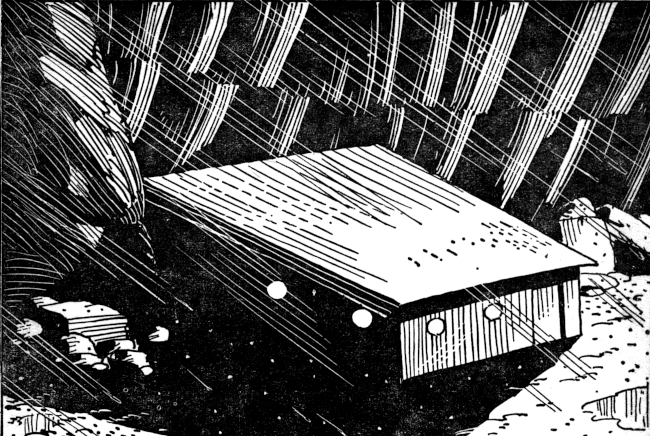
The Felodon seemed to have lost its traveling propensity. Once more it went out into the utter darkness solely to get a meal. It accomplished this as quickly as ever, though its eyes must have been useless and the hiss and rumble of falling water drowned and buried any sounds which would have been useful in tracking. Back in the same lair, full-fed, it drowsed once more.
VII
Mitsuitei had been almost right in his prediction that the pit would be full of water. Only the fact that the land sloped a trifle—they were not right on top of the little hill—had saved it. As it was, several feet of water were in the bottom, and a good deal of mud had washed in from the two sides facing the edges of the crack. The other two, much better braced by deep-reaching roots, had held firm.
After some thought, Lampert used the little robot again. He started it at the bottom of the pit on the downhill side and drove almost horizontally toward the river. The two hundred meters of "neck" permitted the mole to emerge from the slope farther down. When it was withdrawn, a small drain hole was obtained. Several more of these were drilled, and the pit lost its water fairly rapidly.
There was still the problem of getting into the crack itself, which of course would involve digging below the level of the drain holes. Lampert, using the same excavator which had made the pit itself, finally provided a fair solution by digging a set of ditches around the larger hole; and since the opening itself was quite well protected by over-hanging trees, Mitsuitei had only drainage from the surrounding soil to contend with.
Two hours after arriving, therefore, he had a relatively clear working space. The bottom of the pit was limestone, exposed by the complete removal of the overlying soil, some three meters square. Across it ran the crack, a trifle less than a meter wide, still packed with dirt. Everything was muddy—limestone, projecting roots, and Mitsuitei himself. A slender log with branches cut to ten-centimeter stubs leaned against one corner, forming a rough ladder and giving entrance and egress to and from the site.
The machinery which had done the original digging was at one side. Mitsuitei did not expect to need it again. He was now equipped with a hand shovel, and seemed about to use it. Lampert, standing at the edge of the pit, felt the incongruity, but managed not to laugh.
"Are you sure there's nothing I can do down there with you?" he asked.
"I'm afraid not. From now on I want every bit of dirt to pass under my own eyes."
"Are you going to try to throw it all up here as you finish?"
"No. That's the purpose of the extra pit area down here. I can get a long way down the joint, simply heaping the material on the rock. It's damp enough to pile quite steeply, too."
"How far down do you think you can get? The crack's rather narrow to work in, and you have three and a half meters to go before you hit tuff. That's going to be rough shoveling. I still think you could use the machine safely for a little way further, at least."
"No doubt I could, but I'm not going to. There's one thing I might use, though. If you have another of those saws, such as the bonemen are using up on the cliff, I could widen this crack as I go—cut steps, in fact, to help get the mud up to this level when I'm further down."
"That's a good thought, but I don't have any other. If you really get far enough down to need it, though, I could fly up to get it. They were going to shift over to hand labor anyway."
"All right. Of course, it will be some time before I get that deep anyway; maybe I won't need it today." He bent to his work.
"But what do I do?" asked Lampert. "I can't go off to attend to my own projects, because String has to stay here to guard you. I can't get to the site where the others are working because I can't land there. I can't sit in the helicopter and twiddle my thumbs because I'll go crazy before the day is over." Mitsuitei straightened once more, and thought briefly.
"Is there nothing in the geophysical line you could do within sight of this pit?" he asked finally. "The saw and digging machine are not the only apparatus you brought."
"That's true. I brought some seismic gear, though I didn't plan to use it quite like this. I might map the formations under this hill. The information will be usable, I should think, and the joints will give quite a calibrating job. It will keep me busy, anyway."
"Just a minute!" Mitsuitei looked a trifle perturbed. "Does that mean you're going to set off explosives around here? I want the sides of this pit held up by something better than roots, if you do."
Lampert chuckled. "No explosives," he said. "This is a nice little gadget with a robot like the core sampler. It puts out waves of any type desired from any depth down to two hundred fifty meters—a sort of subterranean sonar. You'll never know it's working. The wave amplitude isn't enough to feel." He turned toward the helicopter on the river bank below, and was starting to walk toward it when McLaughlin interrupted. The guide had heard the conversation, and his question was purely rhetorical.
"You weren't planning to walk down to the flyer alone, were you, Doctor?"
"Well, yes, as a matter of fact. After all, I won't be working; I can keep my eyes open as I go. You can see me for the greater part of the journey from here, too."
Rather to his surprise the guide approved this argument, after a moment's thought.
"All right. But please keep your gun in your hand as well as your head on a swivel. I'd prefer to have Dr. Mitsuitei come down with us so we could stay together, but I know how he'd react to the interruption, and I realize you're not a kid. Just be careful."
Lampert promised; and the guide's manner had impressed him to the point where he was almost afraid to make the return journey, after reaching the flyer and packing his new equipment. He was rather surprised to get back to the site without being attacked, and McLaughlin's very evident relief at seeing him did nothing to ease his feelings.
He began to set up the machinery. This consisted of an assembly very similar to the drilling mole—a small delving robot drawing a slender tail behind it, the tail wound on a drum which surrounded the control unit. A dozen smaller cylinders reposed in attached clips.
"The attached borer," Lampert explained to the guide, "goes down to any depth I set, up to two hundred fifty meters. It can produce any of the three normal types of earthquake wave, singly or in any combination, with sufficient intensity to be detected at a range of over two kilometers in reasonably well-conducting rock. The small cylinders are detectors, equipped not only to receive and analyze the wave coming through the ground but to measure electronically their location with respect to each other and the main station. I can use as many of them as I please, up to the full dozen; but they can be planted only a little way below the surface. There exists equipment for getting readings at depths comparable to that of the transmitter, but I don't have it. As it stands, by spotting the receivers carefully I can get a pretty good picture of the formations for a radius of a kilometer and a depth even greater with ten minutes measuring—and ten hours computing."
"How far out do you plan to place these receivers?" the guide asked pointedly.
"Well—I hadn't made a detailed plan of that. I'd rather like to have them in radiating lines of three, the lines spreading about fifteen degrees, and the individual cylinders about two hundred meters apart."
"And just how were you going to place them? I gather that someone has to walk the best part of four kilometers—or do these things fly, in addition to their other abilities?"
"Er—someone walks. I thought perhaps, since you don't like the idea of my going alone through the jungle, that I might stand guard over Take in the pit while you set them out."
"Hmm." The guide did not explode, to Lampert's relief. It had not occurred to the scientist that the job of wandering around a hole in the ground waiting for animals which never came might get a little boring to a man of McLaughlin's background. "Let's go over first and see how Dr. Mitsuitei is getting along. I guess you could stand over him with a gun for half an hour. Of course, the cover runs dangerously close to the pit. Maybe we'd better burn it off to a safer distance—still, I guess that won't be necessary. You can stand out here where it's relatively clear, and see all the approaches to the pit. Something might jump in without your having time to hit it, and you'd at least see it and could get there fast enough to do any shooting necessary."
They approached the hole and looked in. Mitsuitei was working busily. A fair quantity of earth lay spread on the rock, and some two thirds of the length of the crack had been excavated to a depth of perhaps a quarter of a meter. The geophysicist attracted the little man's attention and told him of the plan; Mitsuitei nodded and bent once more to his work.
The Felodon was becoming restless. It could hardly be hungry as yet; but it was on its feet, snarling silently as it had when the helicopter first entered its ken. For perhaps a minute it stood; then, with the same air of determination it had shown days before and scores of kilometers away, it began to thread its way through the underbrush toward the river—and the digging site.
"I'll stand where you suggested, and never take my eyes off the pit," Lampert promised.
"Then I'll come back to find you missing," replied the guide. "You're guarding yourself too, remember. Don't keep your eyes on anything. Keep them moving."
He finished distributing the little cylinders in the various pockets of his outer clothing, and moved off in the direction Lampert had indicated. He looked back frequently, but each time saw the scientist alert. When the underbrush finally cut off the view, he refused to worry too much.
Actually, McLaughlin had gone to considerable pains to make the jungles of Viridis sound more dangerous than they really are. His conscious motive was to make the inexperienced members of the party alert enough for their own safety. It was quite true that a man could be killed in quite a variety of ways in those rain forests. There was a distinct possibility, however, that he also wanted to impress them with the importance of his services.
He did not, therefore, suffer much from anxiety during his walk, though on the other hand he wasted no time. He had, of course, only a rough idea of the distance he had traveled, though he was able to keep his direction with a small impulse-compass tuned to the seismic apparatus and forming part of its regular equipment.
He dropped three of the cylinders at the required intervals, as nearly as he could guess, forcing each a little way into the ground as Lampert had shown him; then he turned at right angles, walked what he hoped was the right distance and started back toward the site, planting equipment as he went. Out again, in again; and the last of the dozen tubes was in the ground.
Mitsuitei's shovel scraped deeper.
Lampert, glancing up and around every few seconds, made minute adjustments to the controls of his seismic apparatus. Its little mole robot had started on its downward trip.
The Felodon lurked thirty yards from the point where Lampert was standing, protected from his sight by the undergrowth and by one of the piles of dirt thrown up by the machine which had dug the pit. It seemed to be looking through the soil at the spot where the man was. The snarl was still on its face, but no muscle moved in its long body. It had been there for minutes without moving; it had frozen similarly when McLaughlin had passed it on his way out. Now it simply stood and waited.
On a cliffside kilometers away, Ndomi Sulewayo gave utterance to the first profanity Krendall had ever heard him use. They were on opposite sides of the block containing the fossil, so neither could see the other. Krendall, naturally, asked what was wrong.
"Don't tell me a bug got through one of these suits!"
"Worse, if possible. I told you this foreleg—" both had been carefully avoiding the use of such words as "arms"—"was sticking out sideways, so that I was afraid we might have cut off part of it in digging the tunnel."
Krendall nodded. "I remember. Did we?"
"I don't know."
"Eh? How come? I should think there'd be no doubt, one way or the other, if you have that much of the limb clear."
"Well, I haven't. I got as far as the bone goes—and right there I run out of tuff and into the limestone. If there's anything more, it's in an entirely different kind of rock, which is a trifle unlikely; but I'm going to have to check the blocks we cut from this part of the tunnel in order to make sure, and I don't look forward to the job at all." Krendall, properly sympathetic, came around to Sulewayo's side to look, and agreed that the search was necessary. The bone the younger man had been clearing ended in a joint of the type they had come to regard as typical of the creature's limbs; and this had occurred almost exactly at the surface they had left when first outlining the block with the saw.
Sulewayo, with a grunt of disgust, dropped his tools and went out into the rain, where the blocks cut from the cliff had been piled; Krendall, nobly sacrificing his personal inclinations, went along with him.
The search lasted for a long time; for a long time, in fact, after it became evident that it was going to be useless, for the chance of a perfect specimen is not easily thrown away. Finally, however, Krendall straightened up with a sigh.
"I guess we'll have to be satisfied with a restoration on one side," he said wearily. "I hope someone fifty years from now doesn't find another and discover that it's a sort of vertebrate fiddler crab, with one fore-limb ending in a paw or claw something like five times the size of the one on the other."
Sulewayo gave a gloomy assent, and the two went back to work in their respective tunnels.
Lampert saw McLaughlin the instant the underbrush made it possible, a fact which the guide later admitted was to the scientist's credit. He had, of course, been eagerly awaiting that return, for the transmitter was down to its first set depth and awaiting only the word that all receivers were in place. He called eagerly the moment the guide came within earshot.
"Everything down?" McLaughlin nodded.
"Everything down, as nearly as I could tell the way you said. How long will the readings take?"
"Only a few minutes. I'll take a couple of calibration shots from ten, fifteen and twenty meters' depth; then ones at fifty, a hundred and so on down as far as the mole will go. The shooting takes practically no time. It's the drilling that will hold us up."
"What then?"
"Well," Lampert smiled, "after that the usual procedure is to pick up the receivers and place them in a similar pattern in a new direction. If the field crew doesn't go on strike, we take the whole circle about the transmitter."
"I was afraid of that," grunted McLaughlin, as he stopped by the machine. "Well, let's go." The two men bent over the controls in a silence broken only by the scraping of Mitsuitei's shovel a dozen meters away. Lampert pressed his shot button, and a light on the panel flashed white momentarily. Below their feet, unfelt, the pulse of sound energy raced outward, echoing from the walls of deepstriking joints, from the boundaries between rocks of differing densities or elastic constants, from the walls of caverns deep in the limestone; some tiny portion of the energy from time to time encountering and affecting one of the tiny receivers McLaughlin had buried.
As each receiver gathered its bit of data, it retransmitted the information to the master unit; and everything was recorded on a single sheet as the milliseconds sped by. Long before a full second had passed, the first of the pulses had damped out as heat energy, and enough had been transmitted for the machine to obtain an adequate averaging record. The light blinked out again. Lampert nodded in satisfaction, and sent the mole downward once more.
"Look, good. Now the next set," he remarked.
As that pulse of seismic energy went forth, the Felodon rose to its full height, almost showing itself over the pile of dirt which was now its sole protection from the view of the men. The snarl on its face seemed to grow fiercer, if that were possible. For just an instant it seemed torn by conflicting desires. But that was for just an instant; any tendency to flee was smothered before it could take full form. There were two men now to worry about, and correspondingly less chance for the opportunity it had been awaiting. But the opportunity came. For just a moment the guide looked down at the panel which was absorbing Lampert's full attention. In that moment a green-and-lavender streak flowed over the heap of soil in a single leap and vanished into the pit. It must have been timed and guided by the mysterious sense McLaughlin had mentioned. It could see none of the men when it leaped, yet it timed the act for the moment none were looking, and landed directly on Mitsuitei.
The little archaeologist never knew what hit him. He died without a sound, and the killer, as though nothing lived anywhere in the neighborhood, settled down to its meal.
In this it must have been disappointed. The chemicals in the clothing designed to repel Viridian insects were equally obnoxious to the carnivore, and it made no serious attempt to get through them. However, not all of the body was protected in this way....
A second pulse went from the buried transmitter, and then a third, each from a point a few meters deeper than the last. Lampert's attention, of course, was centered on his controls. McLaughlin's eyes were once more sweeping restlessly over the surrounding landscape. Both heard the sounds coming from the pit, but neither interpreted them as anything more than the scraping of Mitsuitei's shovel. Neither, of course, considered them consciously. Their attention was finally attracted by something decidedly more noticeable.
The Felodon did not—or could not?—remain at its meal for more than a few moments. Its apparent indifference to the other men changed once more to what seemed like an internal struggle. An observer would have been sure, up to now, that it was using its peculiar sense to avoid the sight of men with guns; but that hypothesis failed now.
As Lampert started the mole robot downward once more, the Felodon leaped out of the pit toward the two men—regardless of the fact that McLaughlin was facing toward it.
VIII
McLaughlin saw the fanged head emerge, and his reflexes took over instantly. A streak of flame passed beside the leaping carnivore, exploding into a white-hot blossom of blazing gas as it contacted the pile of dirt on the far side of the pit. The guide ducked and rolled frantically sideward as another spring carried the creature toward him. Claws raked the air past his shoulder, and he fired again before the roll was complete and without any sort of aim.
Men and beast alike were spattered with white-hot droplets of metal from the seismic recorder as the second shot caught it squarely; and this seemed to be enough for the carnivore. Its next leap was away from the men instead of toward them. A geyser of steam and mud erupted beside it as Lampert finally got his weapon into action, and before the vapor had been beaten down once more by the rain the animal was out of sight behind the undergrowth. Both men sent several shots in the direction of the crackling bushes, but accomplished nothing except the felling of a tree or two and the starting of a bonfire which failed to make any headway against the rain.
Convinced that the Felodon had gone, the men ran to the pit. Lampert did not even take time out to glance at the wreckage of his equipment. There was just enough distance to cover to let each one realize that he had no idea how long the carnivore had been inside, and what the "scraping" sound might have been. Both slowed down as they approached the edge, not relishing what they expected to see. But this did not prove to be what they had expected. McLaughlin's face, already grim, turned gray as he saw that his first shot had not merely missed the animal at which it was aimed.
The bolt had struck the pile of dirt which had been left by the digging machinery at the far lip of the pit, and scattered most of it to the four winds. Perhaps half a ton had slid back into the hole from which it had originally been removed. There was no telling, from above, what the Felodon had done to Mitsuitei. The upper half of the archaeologist's body was buried completely, and the rest so liberally sprinkled with dirt that it was not at once identifiable.
The guide, using language strange even to the widely-traveled Lampert, leaped the three meters downward without bothering to use the ladder, seized a projecting leg and tried to draw the little man clear of the soil. Lampert, equally aware of the possible value of time but feeling that he would do little good with a broken leg, made the descent in the normal manner.
By the time he reached the bottom, McLaughlin had succeeded in dragging Mitsuitei almost completely clear. Lampert started forward to clear the mud from the still hidden face; then he stopped, and his stomach abruptly heaved, as he realized that the face was not hidden.
It was gone.
Mitsuitei had removed the head-gear and gloves from his protective suit for the normal reason—to see and manipulate better. The exposed head and hands had formed the Felodon's hasty meal.
The paleontologists saw the helicopter approaching this time, for they were working outside the tunnel. Between them on the ledge lay a block of stone some five feet long, two high and four wide—over two tons of material, all told, which had been worked out of the hole rather ingeniously by the men. Partial undercuts had been made, rollers worked out of stone by the cutter placed underneath, and the undercutting completed along a plane which sloped slightly upward into the tunnel. Of course the block had run off the rollers once it was out in the open, and the men could no more shift it another centimeter than they could return to Emeraude without the helicopter; but at least it was more or less accessible by air. They were chipping waste rock from the corners when the flyer appeared.
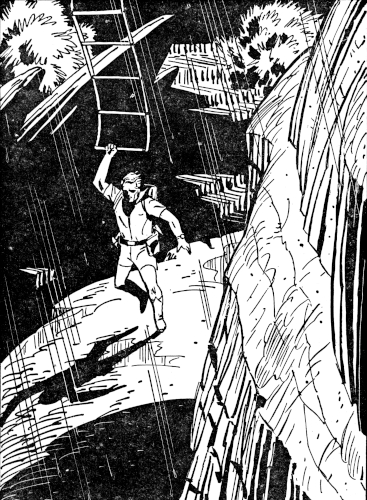
Sulewayo was first up the ladder, unburdened this time. They expected to have further use for the cutter. He noted that Lampert was alone in the machine, and promptly asked the question the geophysicist had been dreading.
"Where's Take? We've found something for him!"
"I'm afraid he won't appreciate it. He was killed a couple of hours ago by a Felodon." The news silenced even Sulewayo, and the expression on his junior's face actually startled Krendall when he climbed through the hatch.
"Ndomi! What in—" Lampert cut in with the same news he had given a moment before. Krendall reacted similarly; then slowly lowered himself into a seat.
He did not ask for details. Both men could see that this was not the time to put such a question to the pilot, though neither realized then the personal responsibility that Lampert felt over the incident. Krendall pulled a small fragment of tuff from his pocket, and looked at it thoughtfully.
Nothing further was said until the helicopter landed once more on the river near the "city." McLaughlin and the bundle which held what was left of Takehiko Mitsuitei were waiting on the bank, and were loaded aboard without a sound.
"It's early. Well take him back to Emeraude tonight, and come back for your work tomorrow," Lampert said, and lifted into the air without waiting for agreement.
"All right," replied Krendall, "as long as we come back. I don't think he'd have wanted us to stop. I'm going to find out about those green threads of his, too." Lampert nodded in approval. He had already formed a similar determination. For half an hour they flew on in silence.
The Felodon, half submerged in swamp water a kilometer downstream from the hill, heard the helicopter hum overhead. It seemed totally disinterested. For just a moment its fanged head pointed upward, then settled back again. There was a burn under its jaw, which had been inflicted by metal spraying from the ruined seismic apparatus. It was more comfortable to keep it under water....
"What was it you found, Ndomi, that you thought Take would want to see?" Lampert broke the long silence.
"It was when we were undercutting to get the block out of the tunnel," Sulewayo answered. "It's just some more of his green threads, in the tuff below the fossil. I brought a chunk of the rock showing them—here." Lampert nodded without taking his main attention from flying.
"Maybe that fossil of yours was intelligent after all, then," he said. "It seems to have died under very similar circumstances to Take—just above a set of those green threads. Maybe it was a member of a party like ours."
"Maybe. It certainly walked erect. The whole body structure shows that. If its brain were large enough and it had some sort of manipulating appendage I'd say it was virtually human—in capacity, that is. It was more of an amphibian anatomically."
"You have the block out in the open. Haven't you been able to study the head and limbs?"
"No, damn it." Krendall took over from his junior. "That was the big disappointment of the whole find. The specimen seems to be perfect except for missing skull and hands. Not a trace of either."
The helicopter wavered slightly in its path, then steadied as Lampert forced his attention back to his job. No one said anything for a long time, but everyone was thinking.
Someone else was thinking too, but wasn't keeping his thoughts to himself. They were being spoken, and virtually dripped with the thinker's fury.
"You sloppy, lazy parasites! I don't mind being stuck with a job and a deadline, even if it's a report that's due in only fifty years and needs about two hundred for a real conclusion. I'd sooner do it all myself than have some of you loose thinkers butting in! But if I'm to give my whole attention to it so I can produce something that won't be laughed at from here to the Magellanic Clouds, how about some of you watching what goes on on this planet? I didn't know those creatures were poking around until they began cutting sensor lines! Thirty, the protective life we've bred on the surface was your idea; why didn't you put it to work?"
The answering words tried to be soothing.
"Thirty was working—"
"Dreaming, you mean!"
"But I put one of the guardians on the job for him; it stopped the digging, didn't it?"
"Sure, after a lot of damage had been done. Do you want to come out in the open and repair my wiring—with those space travelers poking around? If they find you at it, the Council won't just laugh at us; they'll excommunicate us and let this new species of intelligence clean us out. Why did it take so long for the guardian to do anything?"
"Well, I—"
"Well, you were dreaming too, weren't you. Blast it, you're here to do constructive thinking, not just to entertain yourself. Haven't you any self-respect? They actually dug out Sixteen!"
"What difference will that make? He's been dead too long to mind it himself, and anyway his brain and sensor connections were decently burned."
"But they wouldn't have had to dig much deeper to get someone who's not dead, would they, Ninety-Five, my young friend? I suppose when they cut one or two of your sensors you decided it was time to do something. Don't interrupt! I'm talking! This planet is supposed to be a quiet place where people can expect to spend a decent number of centuries at a time thinking, without being disturbed. If you're too young or too lazy or just too stupid to do any real thinking yourself, at least you can devote a little time from your casual amusements to making sure that other people can. Shut up! You'll do some thinking now or find yourself in real trouble! Here's a problem for you to solve, and see that you solve it!
"You will get my sensors repaired, making sure not only that you're not caught at the job by these space travelers but also that they don't realize it's been done. In other words, don't just neatly fill in the hole they made after you've finished, so they can't help knowing they're not the only intelligences on this world. I don't know when they'll be back any better than you do, so you'll have to guess at your own time limit. You can booby-trap your canyon with landslides or anything else to keep yourself from being dug out, but if you fail in either problem and either of us looks likely to be found I personally guarantee you'll be found in the same shape as Sixteen. Now get to work, and let me think. If you think you can get help or sympathy from anyone else on the planet, good luck to you."
A wave of agreement spread along the countless miles of sensor wiring that extended through Viridis' crust, but Twenty-Five didn't feel or hear it. He had already taken the myriad of tendrils that terminated his arms away from the mosaic console that formed the end of the vast bundles of greenish threads coming through the walls of his cave, and had settled back in his lounging chair. That report—only fifty years to have it thought out—his full attention went back to it.