Upland Water.
Reading edition
But there is a daily flow over Teddington weir—excluding the water abstracted by the London water companies—varying during the year on the average as follows:—
Cubic yards.
Jan. 11,800,000
Feb. 5,300,000
March 4,100,000
April 3,250,000
May 4,720,000
June 2,900,000
July 1,760,000
Aug. 1,590,000
Sept. 1,160,000
Oct. 1,900,000
Nov. 3,530,000
Dec. 8,230,000
Average daily flow, 4,186,000 cubic yards.
Below Teddington, numerous small affluents add to this volume of upland water as follows:—
Cubic yards per day.
The River Lea and Essex streams on the north bank 60,000
Streams in the Kent district 500,000
To this must be added a large quantity of spring water rising in the bed of the river and land drainage—quantity uncertain 1,000,000
Sewage effluents discharged at Crossness and Barking 1,176,000
Storm water overflow from London sewers 580,000
Total upland fresh water daily average 7,502,000
This gives an average volume of 7½ million cubic yards of fresh water descending and mingling with the oscillating tidal water of the river and estuary, which slowly pushes the latter down into the North Sea. Taking the high-water volume in the river as above at 180 million cubic yards, the proportion of fresh water from the upland daily flow is 1/24th, and therefore it will take 24 days to change entirely the water in the tidal river.
Mr. W. P. Birch has shown that the combination of fresh water and sewage which enters the river below Teddington remains in the river, oscillating up and down with the tides for 45 days before it finally gets pushed out into the North Sea.
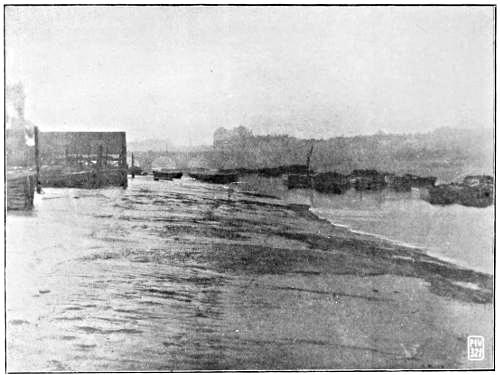
THAMES MUD.
In this way the discharge of effluents at Crossness and Barking passes up and down in front of London for more than a month, and it becomes apparent that the tidal action keeps the river continually saturated with about 45 days’ soilage. It is no wonder, therefore, that the conditions of colour, smell and turbidity of the river below Teddington are so vile as compared with the Upper Thames, especially as to the above sources of filth must be added the tidal current, which is so rapid that it keeps the mud continually in suspension, washing it up at one time, depositing it at another, but never permanently leaving it except in the places unscoured by the upland water, such as docks, backwaters and places out of the main current. It has been acknowledged by all writers that if the upland water should be stopped the Thames would become a stagnant oscillating ditch, because all filth discharged into it would remain in it permanently.
The docks trap a very large proportion of this mud, and it costs at least £60,000 per annum to clean it out. The mud enters with the locking water and with that pumped to make up the basins.