XXXVI
Reading edition
To leave Selby for York, one must needs cross the Ouse bridge, one of thee few places where tolls still survive. Foot-passengers and cyclists are on an equality, paying one penny each.
Level-crossings again have their wicked will of the road, and are indeed its principal features, through Barlby and Riccall. We need some modern Rebeccaites for the abolition of these unpaid-for easements granted to the Railway Companies by an indulgent legislature, composed largely of Railway Directors, for the mingled danger and waste of public time caused by level-crossings over public roads constitute a scandal urgently in need of being removed. Yorkshire people might be recommended to see to it, as their forefathers saw to the abolition of turnpikes, collecting in armed and disguised bands and wrecking and burning the obnoxious gates for great distances. In May 1753 they assembled at Selby at the summons of the public crier’s bell, and proceeded at midnight to demolish all the gates in that neighbourhood. The military were called out to quell these Hampdens. They did not succeed in saving the gates, but shot and captured a number of the “rioters,” who were sent for trial to York Castle.
Riccall, near the confluence of the Ouse and the Derwent, looks an unlikely seaport in these times, now that those rivers and the confluent Foss, a mile or so nearer York, flow soberly in their channels and cease from spreading over the land. Eight hundred years ago, however, things were very different—as indeed they well might be in that tremendous space of time. So different, in fact, that when the invasion of the North, under Tostig and Harald Hardrada, took place in 1066, before that greater invasion in the South by William “the Conqueror,” whose success has overshadowed these operations, the invaders’ fleet sailed up the Humber and the Ouse and blockaded the waterways by anchoring at Riccall. From this base they advanced, defeating Earl Morcar at the battle of Fulford, and seized York; retiring on the approach of English Harold to what the Anglo-Saxon Chronicle calls “Staenfordesbryege,” on Derwent, east of the city. In this we find the original spelling of Stamford Bridge, where the great battle which ended in the utter defeat of the invaders was fought and their leaders, Tostig and the gigantic Norwegian king, both slain. A fortnight later, and the Duke of Normandy had landed at Pevensey, the battle of Hastings had been lost and won, and the victor of Stamford Bridge himself lay dead.
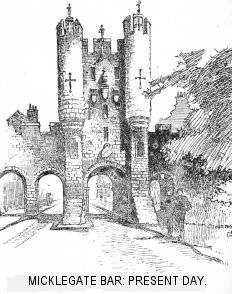
Riccall, and the country between it and York, should therefore be interesting, as the scene of the earlier of these invasions. Aside from the village flows the Ouse, deep in its channel and navigable for barges, than which the Norwegian ships were not much larger; but it could not in these days harbour a fleet, even of these primitive transports. The village itself bears nothing on its face telling of great events, and is of a placid dulness, a character shared by Escrick and Deighton, on the way to York; the road itself gradually becoming an abomination of desolate fields until the village of Gate Fulford is reached. The Great North Road is a businesslike highway. It goes as direct as may be to its destination, and gets there quite regardless of scenery or interest to right or left. Thus, although Escrick Park is reputed to be a demesne of great beauty, and the village of Naburn, lying hidden off the road, is a typical old English village actually boasting a maypole, all the traveller along the road perceives is an unromantic vista of cabbage-fields and other necessary but uninspiring domestic vegetables, through a haze of a particularly beastly kind of black dust peculiar to the last few miles of the way into York. Fulford itself is no fit herald of a cathedral city. A wide street, the terminus of a tramway, a mile-long row of cottages, a would-be Gothic church; here you have it. Before you, by degrees, York unfolds itself, past the military barracks and nondescript, but always disappointing, streets, until, emerging from Fishergate, the ancient city, free from suburban excrescences, opens out, with the grim castle in front, and the Ouse and Skeldergate Bridge to the left. The so-called “London Road” lies away beyond the Ouse, its name referring to the Doncaster, Ferrybridge, Sherburn, and Tadcaster route taken by some of the old-time coaches. By that route York is most romantically entered, across Knavesmire, where York’s martyrs, felons, and traitors were done to death in the old days, and where the racecourse now runs; coming to the walled city through Micklegate, the finest of all the mediæval defensible gateways which are York’s especial glory. By the Selby route, through Gate Fulford and along Fishergate, we seem to slink in by the back door; through Micklegate we follow in the steps of those who have marched with armed hosts at their heels, and have entered with the unquestioned right of conquerors. Thus came the young Duke of York at the head of his victorious army, after the crowning victory of Towton; the first thing to meet his gaze his father’s head, fixed on the topmost turret, and crowned in mockery with a paper crown by the fierce Lancastrians under whose swords he had fallen at the battle of Wakefield, three months before. Filial piety could not in those times rest content with removing the head from its shameful eminence, and so the Duke caused the Earl of Devon and three others among his prisoners to be immediately beheaded and their heads to be placed there instead. Of such, and still more sanguinary, incidents is the ancient city of York composed.
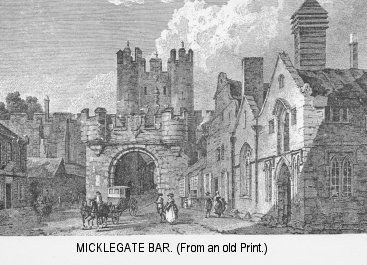
Micklegate, like the other “bars” of York, had its barbican, and equally with them, lost that martial outwork at the dawning of the nineteenth century. Its appearance then and now may with advantage be compared in the old print and the modern drawing, reproduced here, which also serve to show the difference between the road-surface of these times and of a century ago.