FOOTNOTES: (continued 2)
Reading edition
When he came up with old Materne, who commanded all these men, to the number of about two hundred and fifty, he found the old huntsman just preparing to smoke a pipe, his nose as red as a live coal, and his beard bristling with cold like a wild boar.
"Ah! is that you, Jean-Claude?"
"Yes, I've come to shake hands with you."
"All right; but tell me—they seem in no hurry to come—if they should happen to pass another way?"
"No fear of that. They must take this road for the artillery and baggage. Hark! there's the bugle—to boot and saddle!"
"Yes, I saw that before; they are preparing." Then, with a low chuckle:
"You don't know, Jean-Claude, just now, as I was looking towards Grandfontaine, what a droll thing I saw."
"What was that, old boy?"
"I saw four Germans lay hold of the fat Dubreuil, the friend of the Allies; they laid him down on the stone bench at his door, and one tall bony fellow gave him I don't know how many blows with a stout stick over his back. Didn't he bellow, the old rascal! I'll wager he has refused something to his good friends; his old wine of the year 1811, for instance."
Hullin listened no further, for happening to cast a glance down upon the valley, he had just seen a regiment of infantry debouch on the road. Farther off, in the street, the cavalry were advancing, with five or six officers galloping at their head.
"Ah! ha! they are coming now in good earnest," exclaimed the old soldier, whose countenance suddenly assumed an expression of energy and strange enthusiasm.
Then he sprang upon the trench, exclaiming:
"My children, attention!"
As he passed, he caught a glimpse of Riffi, the little tailor of the Charmes, leaning upon a long gun; the little man had made a step in the snow to take aim. Higher up he recognised also the old wood-cutter, Rochart, with his big sabots trimmed with sheepskin; he was taking a hearty draught from his flask, and then slowly raising himself up, with his carbine under his arm, and his cotton cap over his ear.
And that was all; for in order to survey the whole sphere of action, it was necessary for him to climb to the summit of the Donon, where there is a rock.
Lagarmitte followed him, stretching out his long legs as if he were walking on stilts. Ten minutes after, when they had arrived quite out of breath at the top of the rock, they perceived at four thousand odd feet below them the enemy's column of about three thousand men, with long white coats, cloth gaiters, tall shakos, and red moustaches; the young officers with flat cap, riding at regular distances among the troops, caracoling on horseback, sword in hand, and turning round from time to time to call out, in a shrill voice: "Forvertz! Forvertz!" (Forward! Forward!)
And this body bristled with glittering bayonets and advanced at full charge towards the barricades.
Old Materne, his long hawk's nose peering over the branch of a juniper tree, had also observed, with raised eyebrows, the arrival of the Germans. And as he was very clear-sighted, he was able even to distinguish faces among all this crowd; and picked out the one whom he would bring down himself.
In the middle of the column, mounted on a tall bay horse, there came riding straight towards them an old officer with a white wig, three-cornered lace hat, his form enveloped in a yellow mantle, and his breast decorated with orders. When this personage raised his head, the corner of his hat, surmounted by a tuft of black feathers, formed a target. He had long wrinkles in his cheeks, and seemed to be no chicken.
"That's my man!" said the old huntsman to himself, taking aim leisurely.
He cocked his gun, fired, and when he looked, the old officer had disappeared.
Immediately the mountain-side was ablaze with shots the whole length of the entrenchments; but the Germans, without answering, continued to advance towards the entrenchments, gun on shoulder, and keeping the ranks as steadily as if they were on parade.
If the truth must be told, more than one brave mountaineer, the father of a family, when he saw that forest of bayonets which kept on advancing up the mountain, in spite of the shots that were poured on them, began to think that he might perhaps have done better to stay at home in his village than to thrust himself into such an affair. But as the proverb says: "The wine is drawn; it must be drunk!"
Riffi, the little tailor, bethought him of the prudent warning of his wife, Sapience: "Riffi, you will get lamed for life, and that will be a pretty job!"
He promised a superb offering to the chapel of St. Léon if he came back safe and sound from the war; but at the same time he resolved to make good use of his long gun.
Two hundred paces from the barricades the Germans halted and opened a running fire such as had never before been heard on the mountain: it was a regular buzz of shots; balls by hundreds hacked down the branches, made bits of ice leap up in all directions, came crashing down upon the rocks, to the right, to the left, before, behind. They came hissing and whistling through the air at times as thick as a flock of pigeons.
This did not prevent the mountaineers from keeping up their fire, but it could no longer be heard. All the mountain-side was wrapped in a bluish smoke which made it difficult to take aim.
At the end of about ten minutes, the roll of the drum was heard, and all that mass of men began to charge at the abattis, officers as well as others, shouting "Forvertz!"
The ground trembled beneath them.
Materne, drawing himself up to his full height, by the side of the trench, with a voice terrible in its emotion, cried, "Up! Up!"
It was time, for a good number of those Germans, almost all of them students of philosophy, law, or medicine, scarred in skirmishes at Munich, Jena, and elsewhere, and who fought against us because they had been promised that their liberties should be granted them after the downfall of Napoleon; all these intrepid young fellows began to crawl on all-fours over the ice, and attempted to leap into the entrenchments.
But as fast as they climbed up the sides of the mountains, they were stunned with the butt-ends of the guns, and fell back among their ranks like hail.
It was at this juncture that there was witnessed an act of bravery on the part of the old wood-cutter, Rochart. Singlehanded he overthrew more than ten of those sons of old Germany. Seizing them under the arms, he flung them back upon the road. Old Materne had his bayonet reeking with blood. And the little tailor Riffi kept incessantly reloading his great gun, and firing energetically upon the heaving, struggling crowd below; and Joseph Larnette, who unfortunately received a shot in the eye; Hans Baumgarten, who had his shoulder fractured; Daniel Spitz, who lost two fingers by a sword-thrust; and a crowd of others whose names will be honoured and revered from generation to generation, never ceased for one second to load and discharge their guns.
Below, nothing was heard but fearful shouts and cries; and above, nothing was to be seen but bristling bayonets, and men on horseback.
This state of things lasted a good quarter of an hour; no one knew what the Germans intended to do, since they could not clear a passage. Nearly all the students had fallen, and the others, old campaigners, used to honourable retreats, did not throw themselves into the fray with the same ardour.
They began by beating a retreat, slowly; then more quickly. The officers, behind them, struck them with the flat of their swords; shots came whizzing after them, and finally, they fled with as much precipitation as they had advanced in good order.
Materne, standing erect upon his eminence, with fifty others round him, brandished his carbine, laughing heartily.
At the foot of the ascent heaps of the wounded were dragging themselves painfully along. The trampled snow was red with blood. In the midst of the heaps of dead were to be seen two young officers, still alive, but crushed and entangled under the corpses of their horses.
It was a horrible sight! But men are really ferocious; there was not one among the mountaineers who pitied these unfortunates; on the contrary, the more of them they saw, the more rejoiced they were.
The little tailor, Riffi, at this moment, flushed with a noble enthusiasm, let himself slide down the whole length of the steep ascent. He had just perceived, a little to the left, below the barricades, a superb horse, that of the colonel shot by Materne, and which was standing quietly in a corner, safe and sound.
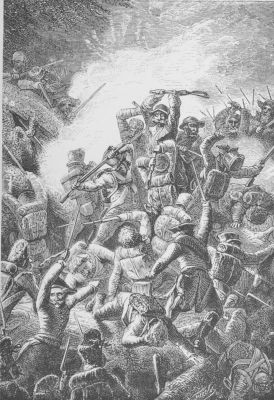
"AS THEY CLIMBED UP THEY WERE BRAINED."
"You shall be mine," said he to himself; "won't Sapience be astonished, that's all!"
All the others envied him. He seized the horse by the bridle, and got upon his back. But judge of the general astonishment, and that of Riffi above all, when the noble animal set off at full gallop towards his friends the Germans.
The little tailor raised his hands to heaven, invoking all the saints.
Materne had half a mind to fire, but he was afraid, as the horse was going at such a furious pace.
They were no sooner in the midst of the enemy's bayonets than Riffi vanished out of sight.
Every one thought he had been massacred; an hour after, however, they saw him passing down the principal street of Grandfontaine with his hands tied behind his back, and corporal schlague behind him with his uplifted cane.
Poor Riffi! he alone was not fated to share in the day's triumph; and his comrades were even led to laugh at his unhappy fate, just as if it had happened to a Kaiserlick.
Such is the nature of men; provided they are happy themselves, the misery of others concerns them but little.