William Le Queux (continued 2)
Reading edition
At times, with a rapid hand, he made an exact reproduction of the original, especially that of chapter xli, verse 23 to the end which, as will be recollected, was given in the dead man’s manuscript as an illustration.
Heedless of the fact that he had had no luncheon, he continued copying the original very carefully and with a sure and expert touch until he had made a complete copy of the original of chapters xl, xli, xlii, xliv, and xlvii, a work which occupied him till nearly four o’clock.
He took no count of time, so wholly engrossed was he in his work. The assistant-keeper entered prior to his departure at four o’clock when the department closed, and began bustling about, hoping that the “dry-as-dust” old fellow, being disturbed, might abandon his work for that day.
But nothing interrupted him in making his rapid copying of those Hebrew characters that had been written before the birth of Christ.
Presently, in sheer despair, the assistant-keeper remarked:
“That’s rather heavy work for you, Professor, isn’t it?”
“No. Not exactly,” was the old man’s quick reply without looking up, “I am about to make a most interesting investigation; therefore, I dare not employ any copyist. He might so easily make mistakes.”
“An investigation!” echoed the younger man. “Why, curiously enough for the past three days we’ve had a man here copying that same book for some mysterious purpose. He finished only yesterday afternoon. But he refused to tell me the reason he was making the copy other than that he, like yourself, was making some investigations. He used the same expression as yourself, curiously enough.”
“Another searcher!” gasped the Professor, laying down his pen, and staring at the speaker. “Another investigator of the original of the Book of Ezekiel! Who was he? What was he like?” demanded the old man quickly, his face blanched in an instant.
“I don’t know who he was, for we’ve never seen him here before. He was an old gentleman, a foreigner evidently—and a scholar, for he wrote the Hebrew characters almost as quickly and accurately as you yourself.”
Professor Arminger Griffin sat back in his chair, his mouth open, staring into space.
Was it possible that some one else besides himself had obtained knowledge of the great secret, and was actively engaged upon investigations!
And the stranger who had copied that very manuscript which he was copying, was an unknown foreigner and a scholar into the bargain!
Was it possible that the secret was already out?
Chapter Nine.
Concerns “The Other Man.”
“What was the stranger like?” asked the Professor eagerly, his thin hand resting upon the ancient parchment he had been so carefully copying.
“A short, stout, elderly man with white pointed beard,” was the assistant-keeper’s reply. “Four days ago he came here, carrying with him a number of references which he turned up in various early Hebrew manuscripts. But it was the one you have there before you which attracted him most. He worked three days upon it, and made a complete and most accurate copy.”
“He didn’t tell you whence he came, or for what purpose he was making the researches?”
“No, for, as you well know, Professor, students seldom do. They are not very communicative, unless they be young,” laughed the official. “But he was a foreigner.”
“Undoubtedly. From the north of Europe, I should say—Norwegian or perhaps Russian, not German, I think. But he spoke most excellent English.”
“A scholar?”
“Without a doubt. He went about his work in that careful methodical manner that at once betrayed the specialist. He concluded his work only yesterday.”
“How was he dressed?”
“Fairly well. He wore a dark-grey suit and a black bow cravat.”
“His searches were confined to Ezekiel?”
“No, not exactly. He copied some references from our earliest manuscript of Deuteronomy—you examined it a few months ago, I remember. The thirty-second chapter seemed to attract him, as he copied it in its entirety.”
“Ah, that’s the Song of Moses,” remarked the Professor. “‘Give ear O ye heavens, and I will speak; and hear O earth, the words of my mouth.’ I wonder what can be his object,” he added thoughtfully.
“He merely told me that he was making an investigation in order to put a remarkable theory to the test.”
Griffin started. A remarkable theory was being put to the test by this stranger! Was it possible that another scholar was in possession of the dead man’s secret, besides himself!
He held his breath. Then, when a few moments later he had recovered himself, he began to make many inquiries concerning the unknown foreigner. But it was already past four o’clock, and the assistant-keeper had his train to catch to his home at Epping. Therefore he declared that he knew no more, and taking the precious manuscript, replaced it with the others and hastily bade the Professor “Good afternoon.”
“Good afternoon,” was the old man’s reply. “I am sorry you are in such a hurry. I’ll return to-morrow.”
Then he struggled into his overcoat, and left the Museum full of vague misgivings.
Already dark outside, the street-lamps were lit, and the steady downpour was unceasing. But he trudged across to the photographer’s, and there obtained the scraps of half-destroyed manuscript, which only a few moments before had been brought back from the studio at Acton.
“We shall have prints ready for you to-morrow evening,” said the manager. “I’ll send them to you, shall I?”
“No, don’t do that,” Griffin said quickly. “I would rather call for them. I’ll be in about this time to-morrow.”
Then placing the packet in his pocket, he walked along Oxford Street in the direction of Tottenham Court Road.
His mind was full of the alarming discovery that another person was investigating the same problem as himself. This meant that the secret was known, and if known to another, what more likely than that the stranger possessed a complete manuscript—a manuscript which gave the context, not only of the curious statement, but of the directions of how the truth could be verified.
Of the latter, he possessed only that one scrap of written manuscript. There must have been other folios, but all were, alas! missing. They had, no doubt, been consumed by the flames before the eyes of the dying man.
He was beside himself with anxiety. It could not have been Diamond himself who had been at the Museum, for the Doctor was not a Hebrew scholar and, besides, he had been told by Frank that the man was badly deformed. Therefore, his deformity would certainly have impressed itself upon the assistant-keeper.
By the “Tube” from Tottenham Court Road Station he travelled to Notting Hill Gate, and turning into Pembridge Gardens, let himself in with his latch-key.
Frank was with Gwen in the drawing-room, and they were taking their tea tête-à-tête when the old man entered. After luncheon he had taken her to a matinée, and the happy pair had only just returned.
“Tell me, Frank,” asked the Professor, almost before he had time to greet him, “did that friend of yours, Diamond, show those papers to any one else besides you, do you think?”
“Certainly not. Why?” inquired the young man in some surprise.
“Oh, nothing,” replied the Professor with slight hesitation. “I—well—I only thought that it would be a little unfair to trouble me if somebody else had already been making any researches.”
“Nobody has seen it save myself, I can assure you. Diamond is a most careful and cautious man,” Frank declared. “He brought them straight over from Paris, and came at once to me.”
“He might possibly have shown them to somebody in Paris,” the elder man suggested.
“I asked him, and he distinctly told me that nobody save myself had set eyes upon them.”
The Professor sank into an armchair, and in silence took the cup of tea which Gwen handed to him.
“You’re tired, dad,” she said. “I see it in your face!”
“A little, dear. I’ve been at the Museum all day.”
“I wish you wouldn’t go to that horrid old place. It always gives you a headache, you know,” said the girl anxiously.
“Ah, my child,” replied the old man with a sigh, “the place holds, for me, much that is interesting in life—in fact all that is interesting, except your own neat little self.”
The girl laughed merrily, declaring that compliments should not be paid to her in the presence of Frank.
But the old man, sighing rather wearily, said:
“Well, Gwen, it’s the truth. I have nothing much to live for, except yourself and my studies. When your dear mother died, the sun of my life was extinguished. And now you have grown up to take her place.”
She and Frank exchanged quick meaning glances.
“I hope always to live near you, dear old dad, even after we’re married,” she said. “I shall never desert you.”
Her father smiled, saying:
“That is what every girl says to her parents before marriage. Few, however, fulfil their promise.”
“Well, dad, don’t let’s talk about parting till the time really comes,” exclaimed his daughter, in an endeavour to change the topic of conversation. Only a moment prior to the Professor’s return she and Frank had been discussing the future, and considering that very point.
“Have you been making researches in the Museum in connection with the burnt papers, Professor?” asked young Farquhar, who, standing in his well-cut suit of blue serge, looked a splendid specimen of the lithe, athletic young Englishman.
“Yes, I have.”
“And the result?”
The Professor shook his head in the negative.
“At present I have failed to discover the slightest title of corroboration of your friend Doctor Diamond’s wonderful theory. The construction which may be placed upon the scrappy statements are many, but none upon which I can yet form any absolute conclusion.”
He made no mention that he had caused photographic negatives of the burnt papers to be secured, or that, within his pocket, there reposed an accurate copy of the accepted original of the Book of Ezekiel.
“You are still in opposition, then, to Diamond’s theory?” asked the young man.
“Of course.”
“But why?”
The Professor drank his tea slowly, and replaced the cup upon the little table.
“Well,” he answered with much deliberation, “because Biblical history is entirely opposed to it. The first Book of Kings relates in detail the building of the temple by Solomon in B.C. 1012, the dimensions of the Porch, the Holy Place, and the Holy of Holies. Within and without the building was conspicuous by the lavish use of gold from Ophir and Parvaim. Above the sacred Ark, which was placed as of old in the Most Holy Place, were made new cherubim, one pair of whose wings met above the Ark and another pair reached to the walls behind them. In the Holy Place, besides the Altar of Incense, which was made of cedar overlaid with gold, there were seven golden candlesticks instead of one, and the table of the shew-bread was replaced by ten golden tables bearing beside the shew-bread the innumerable golden vessels for the service of the sanctuary. Instead of the brazen laver we know that there was a ‘molten sea’ of brass, a masterpiece of Hiram’s skill, for the ablutions of the priests. It was called a ‘sea’ from its great size, being five cubits in height ten in diameter and thirty in circumference, and containing, it is estimated, about sixteen thousand gallons of water. It stood upon twelve oxen, three towards each quarter of the heavens, and all looking outwards. The brim itself, or lip, was wrought ‘like the brim of a cup, with flowers of lilies,’ or curved outwards like a lily or lotus flower. The front of the porch was supported, after the manner of some Egyptian temples, by the two great brazen pillars Jachin and Boaz, eighteen cubits high, with capitols of five cubits more, adorned, as we are told, with lily-work and pomegranates.
“But,” he added, “all this is historical fact. In the temple reposed the most valuable collection of gold and jewels ever gathered together, and the dedication of the House of Jehovah, the God of Israel, was the grandest ceremony ever performed under the Mosaic dispensation. And if you read 1 Kings, viii, and 2 Chronicles, v, you will there learn how, at the ceremony, Jehovah gave the sign of His coming to take possession of His house. Then Solomon built his own house, placing within it the wonderful ‘wealth of Ormuz and Ind,’ and to him came the Queen of Sheba, an event which marked the culminating-point of his glory. The very king who built the glorious temple, and to whom Jehovah had twice given solemn warning in his old age, however, and under the influence of his wives, turned his heart away from God. He served Ashtoreth, the moon-goddess of the Zidonians, and Moloch, the ‘horrid king’ whom the Ammonites worshipped with human sacrifice. Solomon died in B.C. 976, and very shortly after his death the prophecy of Ahijah was fulfilled: his kingdom was rent in twain, and the parts, weakened by the disruption, formed the separate kingdoms of Judah and of Israel.”
“It will be interesting to trace the history of the temple from that date down to the siege of Jerusalem by Nebuchadnezzar,” remarked Frank.
“That occurred about three hundred years after Solomon’s death—at least according to our latest chronologers,” replied the Professor, “and it is in tracing that history that we have many of the points before us negatived most decisively. Let me instance one or two of them.”
“Yes, do, dad,” cried Gwen, greatly interested. “I’m quite excited, over the mysterious affair.”
“Then listen, child,” the old man said. “But, first go and get a Bible from the study.”
And the girl rose to do her father’s bidding.
Chapter Ten.
Fact or Fiction.
“I may perhaps with advantage give you very roughly some historical facts which tend to negative Diamond’s theory,” the Professor said, turning to Farquhar while Gwen was absent.
“That is what I’m most desirous of hearing,” replied the young man. “I can claim no special knowledge like yourself. Indeed, no man in England is more capable of expressing an opinion than you are.”
The Professor passed his hand through his scanty grey hair and smiled. He saw that his wide knowledge impressed this young man whose only thought was a “sensation” in one or other of the Gavin group of publications.
Then, when Gwen had re-entered the room with a Bible in her hand, he said in that slow, deliberate habit of his, the habit of the scholar and deep thinker:
“The theory of this Doctor Diamond is that the treasures of Solomon’s temple were hidden by the priests prior to the taking of Jerusalem by Nebuchadnezzar. Well, that is a bold but quite unsubstantiated assertion. As early after Solomon as the reign of Jeroboam the First, King of Judah, the golden calves, the symbols of the Heliopolitan deity, were set up in the two extremities of the kingdom, and the temple was put to sacrilegious usages. These sins were continued by his successors, until in the reign of Asa, the third King of Judah, the impure orgies of Ashtoreth were suppressed, for ‘having his heart perfect with Jehovah all his days’ the king repaired Shishak’s plunder—the first plunder of the temple, mark you—with ‘rich offerings of gold and of silver.’ Asa made war against the Ethiopians, and on returning to Jerusalem the prophet Azariah, son of Oded, met him and exhorted him and his subjects to be strong heart in hand in seeking God. He gave an affecting description of the former state of Israel: ‘For a long season Israel hath been (or was) without the true God, and without a teaching’ priest, and without law. (2 Chronicles, xv, 3.) His words roused the hearers to a new and more thorough reformation. The idols were removed from all the cities of Judah and Benjamin, and those which had been won from Ephraim. The altar of burnt-offering, which had been polluted by Jeroboam, was renewed, and in the third month of the fifteenth year (B.C. 940) Asa called a great convocation at Jerusalem. Jehoshaphat followed his father’s piety, but the darkest night of Israel’s spiritual declension came with the accession of Ahab, seventh King of Israel, and husband of Jezebel. The service of Baal was established throughout Israel, a grove was made for the orgies of Ashtoreth, and by Jezebel’s orders the prophets of Jehovah were put to death, all except one hundred who were hidden in a cave by Obadiah, the governor of Ahab’s house.”
“But was the temple already plundered?” asked Gwen, seated with her chin resting upon her hand, listening intently.
“We know that it was plundered seriously by Shishak, King of Egypt, who carried off many of its greatest treasures, including the celebrated golden shields of Solomon’s house, which Rehoboam replaced by brass to keep up the display,” was the Professor’s prompt reply. “Recent discoveries at Karnak tell the whole story of the conquest from the Egyptian point of view. The kingdom of Judah, it seems, became for a long time tributary to Shishak, and upon the walls of the great temple at Karnak there are the sculptured representation of the siege and the hieroglyphics ‘Fuda Melchi’—meaning ‘The Kingdom of Judah.’ That was, you will bear in mind, the first spoliation.”
“Were there others?” asked Frank. “I mean others that are authenticated by recent discoveries?”
“Yes, Jehoram reigned in Jerusalem from B.C. 895-892, and after his marriage with Athaliah, daughter of Ahab, the temple was again despoiled, and the daughters of Judah were once more prostituted to the rites of Ashtoreth,” replied Professor Griffin. “Joash, in B.C. 884, repaired the fabric of the temple by public subscription, for he was the inventor of the modern money-box—and there were enough funds left over, we are told, to purchase vessels for the sanctuary. (2 Kings, xii, 4-6; 2 Chronicles, xxiv, 4-14.) This, however, did not last long, for in the reign of Amaziah, ninth King of Judah, Jehoash, King of Israel, defeated him in B.C. 826, took him prisoner and, entering Jerusalem again, reached the temple and conveyed all its treasures to Samaria.
“In the reigns of Jeroboam the Second, Shallam, Menaham and Pekehiah, other vessels and treasures were provided for the temple. Jonathan built the high gate, but his successor, Ahaz, after plunging into all the idolatries of the surrounding nations, making molten images for Baal and sacrificing his children to Moloch in the valley of Hinnom, found himself, according to our best chronologer, Ussher, involved in war. He was therefore compelled to apply for help to Tiglath-pileser, the ‘Tiger-Lord of Asshur,’ King of Assyria, against Syria and Israel, and declaring himself his vassal, sent him all the treasures then left in the temple. Ahaz, we learn from 2 Kings, xvi, 10-18, profaned the temple by dismounting the brazen altar and replacing it by another. Likewise the ‘Great Sea of Solomon,’ too large to be removed at previous despoliations, was dismounted from its supporting oxen, and the lavers from their bases, which were also sent to the King of Assyria, together with the coverings which had been built for the King’s entry to the house, and for the shelter of the worshippers on the Sabbath. The golden vessels of the House of God were cut in pieces and sent with the rest, and the sanctuary itself was shut up. Hezekiah, who came after him in B.C. 726, reopened and restored the Holy Place, though it was now devoid of most of its treasures.
“To trace the history of the Temple through the days of Hoshea, son of Elah, Manasseh and Amon is perhaps unnecessary. Under Josiah, whose reign marks the last dying glory of the earthly kingdom of David, idolatry was put away, the Temple was renovated and the Ark of the Covenant which had been hidden restored to its place. (2 Chronicles, xxxiv, 3-13; xxxv, 3.) During these repairs the high priest Hilkiah found the sacred copy of the book of the law and delivered it to Shaphan, the scribe, who read it before the king. It was afterwards publicly read, and incited a new zeal among the people, and once again was the sanctuary filled with gold and silver vessels. Therefore you will see that by this period there could not have been any of the actual treasures placed by Solomon remaining in the Temple.”
“The Ark of the Covenant was still there,” remarked young Farquhar.
“That is not at all certain,” was the old man’s reply. “Many of the events chronicled in the Old Testament are corroborated by the inscriptions found by Flinders Petrie in Egypt and by Layard at Nineveh. Others are negatived, and our chronology rendered uncertain. Certain it is, however,” he went on, “that in the fourth year of the reign of Jehoiakim, eighteenth King of Judah (B.C. 608-597), Nebuchadnezzar arose, and a few years later advanced to Jerusalem, which he took after a brief siege. The vessels of the sanctuary were carried off to Babylon, where they were dedicated in the temple of Belus. If you turn to 2 Kings, xxiv, 13, you will there read: ‘And he carried out thence all the treasures of the house of the Lord, and the treasures of the king’s house, and cut in pieces all the vessels of gold which Solomon, King of Israel had made in the temple of the Lord, as the Lord had said.’”
“Surely it was Ezekiel who went as one of the prisoners of Nebuchadnezzar to Babylon,” remarked Gwen.
“Yes,” replied her father, “on the second occasion when the Babylonian king attacked the city. But,” he added, “in the reference I have just given you, you will note that the vessels are described as ‘those that Solomon had made.’ Either therefore they had been too massive for removal on the many previous occasions when the temple was plundered or they had been made to replace the ancient originals. The latter is my own theory. Now, as I dare say you will recollect, in B.C. 586, on the tenth day of the fifth month, Ab, Nebuchadnezzar again advanced against the rebellious city of Jerusalem and destroyed it. The two great pillars of the temple porch, Jachin and Boaz, and Solomon’s brazen sea with the twelve bulls supporting it, were broken in pieces and their brass transported to Babylon, together with a great number of captives. And on the third day of the catastrophe, in the nineteenth year of Nebuchadnezzar, the temple and the city were committed to the flames with the palaces of the king and princes, and all the chief houses of Jerusalem, and their walls levelled to the ground.”
“Then that was the actual end of Solomon’s temple,” remarked Frank Farquhar. “Is that authentic?”
“Without a doubt,” said the Professor. “Yet did not Jeremiah comfort the Jews amid all these judgments by contrasting His destruction of the other nations of their present oppressors with His correction of themselves? ‘Fear thou not, O Jacob, my servant, saith Jehovah, for I am with thee; for I will make a full end of all the nations whither I have driven thee; but I will not make a full end of thee, but correct thee in measure; yet will I not leave thee wholly unpunished.’ Surely no words could more fully express the principle of Jehovah’s dealings with the Jews, His own people, in every age.”
“Belshazzar, at his feast in Babylon, put to sacrilegious uses the vessels of the temple, did he not?” asked the young man.
“Yes,” answered Griffin, and addressing Gwen said: “Turn to the fifth chapter of Daniel, dear, and read out the first four verses.”
The girl found the place and read as follows: “Belshazzar, the King, made a great feast to a thousand of his lords, and drank wine before the thousand. Belshazzar, whiles he tasted the wine, commanded to bring the golden and silver vessels which his father Nebuchadnezzar had taken out of the temple which was in Jerusalem; that the King and his princes, his wives and his concubines, might drink therein. Then they brought the golden vessels that were taken out of the temple of the house of God which was at Jerusalem; and the King, and his princes, his wives, and his concubines, drank in them. They drank wine and praised the gods of gold, and of silver, of brass, of iron, of wood, and of stone.”
“And at that moment,” remarked the Professor, “was seen the prophetic handwriting on the wall: ‘Mene, mene, tekel, upharsin,’ being followed by the city’s surprise by Cyrus the Great, and its fall and destruction. Then under Cyrus, the Israelites returned from their captivity, and by his decree another temple was built by Zerubbabel, the prince of Judah, who was leader of the migration. Cyrus caused his treasurer Mithredath to deliver up the vessels which Nebuchadnezzar had carried away from Jerusalem, five thousand four hundred in number, to Zerubbabel to be re-consecrated to the service of Jehovah.”
“Is it to this second temple which our manuscript relates, do you think?” queried Frank. “Or is it to Solomon’s temple?”
“Of the temple of Zerubbabel we have but few particulars,” answered the Professor, “and no description that would enable us to realise its appearance. But there are some dimensions given in the Bible and elsewhere which are extremely interesting as affording points of comparison between it and the temple of Solomon and Herod after it. The first and most authentic are those given in the Book of Ezra (Ezra vi, 3-4) when quoting the decree of Cyrus, wherein it is said: ‘Let the house be builded, the place where they offered sacrifices, and let the foundations thereof be strongly laid; the height thereof three-score cubits, and the breadth thereof three-score cubits, with three rows of great stones and a row of new timber.’ Josephus quotes this passage almost literally, but in doing so enables us with certainty to translate the word here called ‘row’ as storey, as indeed the sense would lead us to infer—for it could apply only to the three storeys of chambers that surrounded Solomon’s, and afterwards Herod’s temple, and with this again we come to the wooden talar which surmounted the temple and formed a fourth storey. It may be remarked that this dimension of sixty cubits in height accords perfectly with the words which Josephus puts into the mouth of Herod when he makes him say that the temple built after the Captivity wanted sixty cubits of the height of that of Solomon. For as he had adopted the height of a hundred and twenty cubits in the Chronicles for that temple, this one remained only sixty. This temple was still standing in Herod’s time, and was repaired by him. Hecataeus mentions that the altar was twenty cubits square and ten high. But he unfortunately does not supply us with the dimensions of the temple itself. Therefore if the priests and Levites and Elders of families were disconsolate at seeing how much more sumptuous the old temple was than the one which on account of their poverty they had just been able to erect, (Ezra, iii, 12-13; Joseph Ast., xi, 4, 2) it certainly was not because it was smaller, as almost every dimension had been increased one-third; but it may have been that the carving and the gold and other ornaments of Solomon’s temple far surpassed this, and the pillars of the portico and the veils may all have been far more splendid, so also probably were the vessels; and all this is what a Jew would mourn over, far more than mere architectural splendour.”
“It is a pity we do not know more about this second temple,” remarked Gwen, in a tone of disappointment and regret.
“For our present purpose its history, down to the taking of Jerusalem by Titus, does not concern us, my dear,” remarked the old scholar, drawing his hand rather wearily over his white brow. “The problem before us evidently has to do with the days of Jehoiakim, prior to the advance of Nebuchadnezzar. Later facts and traditions do not concern us at the moment. I think, however, I have given you an outline of the varied history of the temple and its treasures based upon the very latest readings of Egyptian, Assyrian and other inscriptions, sufficient to show you quite plainly that Solomon’s treasure could not possibly have existed in the reign of Jehoiakim, and that the theory of this friend of yours, Diamond, is utterly and entirely without the foundation of tradition or of ancient legend.”
“Well,” remarked the young man, “such an opinion coming from your mouth is, of course, final, Professor. Yet you must admit that the statement, even as it stands, is full of interest.”
“Full of very cleverly conceived mystery—and mystery is always attractive,” laughed the Professor, looking at him through his big, round, highly magnifying spectacles.
In the statement he had made there was one discrepancy, one that only a scholar would notice. He had purposely withheld one Biblical reference—one which, above all, had caused him to reflect and believe that the writer of the half-burnt screed was correct, that the secret and its key were actually genuine.
But it was his fixed intention to turn Frank Farquhar from further investigation, and to laugh at Doctor Diamond as a fool, ignorant of any knowledge of the history of the Hebrew race.
A silence fell. Gwen Griffin and her lover were both staring straight at the fire without uttering a word.
The old man sat watching the effect of his words upon the pair, and before Frank left, he handed back to him the charred remnants which he had received from the photographer.
But his thoughts were of that other man—the short, white-bearded foreigner, his rival—who was so busy with his researches, the stranger from across the Channel who also held the remarkable secret.
Chapter Eleven.
The Great God Gold.
After dining at the club Frank Farquhar strolled round to Half Moon Street, and throwing himself into an armchair before the fire, gave himself up to reflection.
He was recalling what the Professor had said. It was true that all stories of lost treasure were nowadays received with incredulity, and surely this was the most amazing and most wonderful of them all.
Arminger Griffin, Regius Professor of Hebrew, treated the whole matter as a huge joke. Historical fact was wholly against the suggestion contained in these half-burned scraps which, before his departure from Pembridge Gardens, the Professor had handed back to him. Ah! if they could only reconstruct the context of those disjoined words.
He took a cigar and lit it. But a moment later he tossed it impatiently into the fire. It tasted bitter. The Professor had dashed all his hopes to the ground, for was not his opinion on such a matter final.
As he bade good-night to Gwen in the hall and held her soft hand in his she had whispered to him words of encouragement. “Father is really devoid of any romance,” she declared. “There may be something in the secret after all. Could you not endeavour to find the person who made that remarkable declaration?”
Her suggestion he was now carefully considering.
The stranger who had died in Paris was apparently not the person who made the declaration. The latter was in all probability alive. If so, could he not furnish many more facts than the scrappy information they at present possessed?
Yet what right had Doctor Diamond to the secret—and for the matter of that, what right had he himself?
That the hard-up stranger in Paris feared lest the documents should fall into other hands was shown by his last act of causing them to be burned. Such a course made it appear as though the stranger had no right to the possession of the papers. In all probability he had not!
Gwen’s suggestion, however, appealed to him. Yet to find that one man in the whole world who knew the truth would, he foresaw, be a work fraught with greatest difficulty. The only manner by which he could be approached, if found, would be upon pretence of restoring to him the charred remains of his valuable statement.
The telephone-bell rang, and he rose and answered it. The editor of one of the great daily journals controlled by his brother-in-law, Sir George, spoke from the office in Fleet Street, at that hour of the evening a hive of industry. A question of policy had arisen, and the editor, one of the shining lights of modern journalism, consulted Frank as representative of the proprietor, Sir George being still in Egypt.
Frank, after a brief conversation, left the matter entirely in the editor’s hands, and replacing the receiver walked back from the big roll-top writing-table to the fireplace, where he stood with both arms leaning on the mantelshelf gazing thoughtfully into the blazing coals.
A few moments later his man entered saying:
“A gentleman to see you, sir—Doctor Diamond.”
Frank started. His visitor was the very man of all men he wished most to consult, therefore he gave orders for him to be shown in at once.
“Why, my dear Doctor,” cried the young fellow, as the ugly little old man entered, “this is a real surprise! I thought of running down to Horsford to see you in the morning. Take off your coat and sit down. I want to have a serious chat with you.”
“I got no reply to my two letters, Mr Farquhar,” said the crook-backed little man in explanation of his visit. “So I thought I’d just run up and see how you are progressing with our business.”
Frank helped him off with his shabby frieze coat and, having installed him comfortably by the fire and given him a cigar, replied:
“Well, Doctor, the fact is I did not reply to your letters because I had nothing definite to report. I trust you will not attribute my silence to any want of courtesy. I have been busy over the matter ever since I returned to London.”
“And with what result?” asked the crafty-eyed little man.
“Nothing very satisfactory, I regret to say,” was the young man’s answer. “Yet I am not discouraged. Professor Griffin, before whom I have placed it, gives as his opinion that there is probably, something in the theory, but he will not quite commit himself to any absolute declaration.”
“Is he really competent to judge?” Diamond queried.
“Competent! Why, my dear sir, he’s one of the first Hebrew scholars in the world! He is daily engaged in making researches. History, as we are acquainted with it, may negative the theory advanced in those scraps of typewriting, yet Old Testament history is, as you know, very involved and often very contradictory.”
“Well,” exclaimed the Doctor, “to tell the truth, Mr Farquhar, I’m getting anxious. What I fear is that too many people will get knowledge of it. Then, with the secret out, we shall have others trying to investigate. And with such a gigantic business before us, is it any wonder that I’m becoming impatient?”
“Many a good business is spoilt by being in too great a hurry,” Frank declared. “Remain patient, and leave matters entirely to me,” he added reflectively. “I’ve been wondering whether, if we made diligent and secret inquiry, we might not discover the actual person, whoever he may be, who made the curious declaration. It certainly was not your dead friend.”
The Doctor hesitated. The idea at once commended itself to him.
“No,” he said. “Often when I have recalled all the romantic facts, I have been inclined to suspect that the man who died, although a scholar, had no right to possession of those papers. He intended to make money with them if death had not come so unexpectedly. His very words proved that.”
“Exactly my opinion,” declared Frank. “Now if we could but find out who the mysterious discoverer really is, we might approach him under pretence of handing back to him the remains of the papers.”
“Ah! You still have them safely, eh?” demanded the Doctor.
“Certainly. They are locked in from prying eyes in my desk yonder.”
“May I have them?”
“Of course,” was Frank’s unhesitating reply, though he had no desire to part with them at that juncture. Yet he had, unfortunately, no excuse for keeping them further. He could not say that the Professor held them, as he had given his visitor a solemn promise not to allow the documents out of his possession.
So he rose, unlocked a drawer with the key upon his chain, and handed to the deformed man the packet containing the half-burnt statement.
“Well,” remarked Diamond, as he took the precious documents in his hand, “if you think it a wise course, let us adopt it.”
“Yes, but where are we to commence our search?”
“The stranger said he was a Dane. He came from Copenhagen. Is it not probable,” suggested the Doctor, “that the discoverer was some friend of his residing in that city?”
“More than likely,” Farquhar agreed. “Yes. Let us try Copenhagen. We must first find out who are the professors of Hebrew resident there. I will write to our Copenhagen correspondent to-night and ask for a list. Then, if necessary, I will run over there myself. In this matter we must lay out a decisive line of inquiry and follow it up.”
“Quite so,” exclaimed the hunchback. “Copenhagen must be our starting-point. The initial difficulty, however, as far as I discern, is that we do not know our dead friend’s name. If we did and could trace him, we might discover whether he knew anybody who was a Hebrew scholar.”
“The Danish police would furnish us with names and descriptions of persons lately missing from the capital.”
“So they would, that’s a brilliant idea,” exclaimed the Doctor. “My opinion is that the reason why he refused his name to me, even at the final moment, was because he was wanted by the police, and intended that they should remain in ignorance of his end.”
“If so, it makes our inquiry far easier,” declared Frank. “And suppose we find him?” he asked.
“If we find him,” answered Diamond, looking straight into the eyes of the ambitious man opposite—“if we find him, we will compel him to furnish to us the context of the statement.”
“Compel—eh?” repeated the other, a hard smile playing about the young man’s lips. Diamond was a queer figure and strange persons had always attracted him. Through the ugly little doctor he had gained this remarkable knowledge of an uncanny secret withheld from the world for over two thousand years. He was reflecting what a “boom” the discovery would be for that great daily newspaper of which he was one of the Board of Directors.
“Then you agree that we shall at once turn our attention to Copenhagen—eh?” he asked.
“Certainly—the sooner the better.”
“We have no photograph of your friend—a most unfortunate fact.”
Diamond gave a detailed description of the dead man, and his friend, crossing to his writing-table, wrote it carefully at his dictation.
“I’ve been in Copenhagen several times,” Frank remarked, “so I know that city fairly well. I wonder whether the man we seek is a professor at the University?”
“Our first object is to establish the dead man’s identity.”
“He may have lied, and perhaps was not a Dane after all! He may have been a Norwegian, or even a Swede.”
Diamond raised his deformed shoulders and answered:
“True, as he was so bent upon concealing his identity he may well have lied to me regarding his nationality. Yet we must risk that, don’t you think?”
“But you told me that you were convinced that he was a Scandinavian.”
“Yes. But he might have come from Stockholm, or Gothenburg or Christiania.”
“Our first inquiries must be of the Danish police,” Frank said decisively. “I’ll write to-night to our correspondent in Copenhagen.”
“Would it not be best for you to go there and make inquiries yourself?”
“I may do that. Most probably I shall.”
“Stories of treasure are always attractive,” remarked the Doctor, casting a crafty glance at his young friend. “I hope, Mr Farquhar, you will make no mention in any of your papers regarding it.”
“My dear Doctor, don’t worry yourself about that,” Frank laughed. “Of treasure stories we’ve of late had a perfect glut. For a long time, for instance, I’ve taken a deep interest in the wrecks of vessels known to have contained treasure, the exact location of which are known. As an example, we have the ship Grosvenor now lying off the Pondoland Coast with over a million and a half pounds of treasure in her rotting hold. Then there’s the Ariston, in Marcus Bay, with 800,000 pounds worth; the Birkenhead, on Birkenhead Reef, with a similar amount; the Atlas, near Yarmouth, with 700,000 pounds, the Dorothea, on Tenedos Reef, with 460,000 pounds; the Abercrombie, lying under the Black Rock, with 180,000 pounds; and the Merenstein, on the coast of Yutton Island, with 120,000 pounds. In addition to these there are H.M.S. Chandos with 60,000 pounds in coin in her hold, the troopship Addison with 20,000 pounds in gold, and the Harlem II, lying half covered by sand with her hold full of silver bars. All these and many others are lying in positions perfectly well known, and only await salvage. Why, in one gale off the West African coast in 1802 seven ships were wrecked, all of them containing a vast treasure. Besides, the contents of the vessels I have mentioned have all been verified from their bills of lading still in existence. No, my dear Doctor,” the young man added with a laugh, “had the story been an ordinary one of treasure it would not have interested me in the least, I assure you; and as for publishing any details, why, my dear sir, is it not to my own personal interest to keep the matter as secret as possible? Please do not have any apprehension on that score.”
“I have not,” declared the hunchback; “my great fear, however, is that this professor friend of yours may chatter.”
“He will not. I have impressed upon Griffin the value of silence,” said Frank. “Besides, he is a ‘dry-as-dust,’ silent man, who says nothing, so absorbed is he in his studies in his own particular sphere.”
“Good. Then we will now transfer our attention to Copenhagen.”
“I shall write to-night. Remain patient and wait the reply of the Danish police. I’m open to bet anything that your friend was compelled to make himself scarce from Denmark, and carried with him confidential documents which were not his property and with which he had no right to deal.”
“Then if that really turns out so, it also proves another thing.”
“What’s that?”
“Why, if the documents were to be of any commercial value, they must have contained the actual key to the secret.”
“No doubt. The key was written clearly in those manuscript folios, all of which were burned save one,” was Frank’s reply. “It is the context of that document which we must obtain at all costs and at all hazards. And if the dead man has not lied I’m firmly of opinion that it will be found within the city of Copenhagen.”
Chapter Twelve.
Describes an Important Discovery.
Professor Griffin, for a scholar was a man of unusually rapid action.
He was convinced that another person was following the same course of inquiry as himself. Therefore he determined to act quickly and decisively.
Next day he returned to the British Museum, and after three hours’ work completed the copy of the manuscript. Then he turned his attention to two fragments of the Hebrew manuscript of the Book of Ezekiel, one of the fourth century in the Oriental Room, and the other of the fifth century in the Harleian collection.
While studying these, he recollected that some fragment of early manuscript of Ezekiel had been recently found in the Genisa in Old Cairo by Mr Alder and his companions, and that several of them were in the Bodleian Library at Oxford. Therefore, he searched the catalogue, noted the numbers, and that evening took the train to the university centre, staying the night at the Randolph Hotel.
Next morning he was in consultation with his friend, Professor Cowley, and Number 2611 of the Hebrew manuscript was brought. It proved to be the text of Ezekiel from chapter xiv, 22 to chapter xlvii, 6.
“Ah!” exclaimed Griffin, the instant he glanced at it. “It is too modern, I fear, for it contains the vowel-points.”
“Yes,” answered his friend. “I fear it will be of no value to you, if you seek a very early manuscript.”
Griffin had made no explanation of the reason of his inquiry.
“The oldest manuscript of Ezekiel is, as you know, in the Imperial Library in St. Petersburg,” Professor Cowley remarked. “I have here some photographic reproductions,” and from a portfolio he produced some facsimiles which had been published by the Paleographical Society some years ago. They were splendid reproductions, and to Griffin of most intense interest.
He sat and for a long time examined them most carefully. He made no remark to his friend, but from the expression upon his face after making a pencilled calculation upon the blotting-pad before him, it was evident that his search had not been unrewarded.
The only other actual manuscript in the Bodleian proved to be a parchment fragment of chaps, x, 9 to xiv, 11. But this containing vowel-points and accents on both Mashrahs, was, at a glance, dismissed as comparatively modern, its age being about A.D. 220.
The facsimile of the St. Petersburg manuscript was to him most interesting and from it Griffin made copious notes. Then, that same afternoon, he left for Cambridge, where next day he inspected several early manuscripts in the University Library, and at evening was back again in Pembridge Gardens, where he dined alone with Gwen.
The girl was anxious to ascertain what her father had discovered, but he was most reticent, knowing well that all would be told to Frank Farquhar on the following day.
Suddenly she said:
“Frank has gone abroad, dad.”
“Abroad? Where to?”
“To Copenhagen. He left Victoria at eleven this morning and travels by Flushing, Kiel and Korsor. I saw him off.”
“Copenhagen!” repeated the Professor thoughtfully, and in an instant he recollected that the dead stranger was a Dane, from Copenhagen. What clue was young Farquhar following?
That night he sat alone in his study reading and re-reading the copy of the first manuscript he had consulted in the British Museum, and comparing it most carefully with the extracts he had made from the facsimile of the St. Petersburg codex.
Then he took from a shelf a copy of the Old Testament in Hebrew and English, and compared the Hebrew with the early texts.
“After all,” he remarked aloud to himself, “there is little or no difference in our modern Hebrew text, except that in the older manuscripts the name of the Deity is written larger, in order to render it prominent. Ah! if I could only reconstruct the context!”
From his table he took up a large envelope, and breaking it open, drew forth the whole-plate photographic reproductions of the precious fragments of the dead stranger’s manuscript. These he placed before him beneath his reading-lamp, and studied them long and carefully, especially the scrap of handwriting.
Turning again to the extract he had made from the codex in St. Petersburg he re-examined it. The portion was Ezekiel, ii, 9-10 in Hebrew, the English of which was as follows: “And when I looked, behold an hand was sent unto me; and, lo, a roll of a book was therein. And he spread it before me; and it was written within and without: and there was written therein lamentations, and mourning, and woe.”
These two verses had attracted him at Oxford, and they again riveted his attention. It almost seemed as though he read in them some riddle meaning something tangible, for he was making upon a slip of paper frequent and rapid arithmetical calculations.
At half-past ten Gwen came, and kissing him good-night, urged him to go to bed, but nevertheless he continued his work far into the night, until the fire had burned itself out and he rose cold and tired.
He sighed, for though he had alighted upon something mysterious and hitherto undiscerned in that early text, yet its meaning was altogether uncertain.
Its discovery only served to increase the mystery a hundredfold.
As he lay in bed, two facts caused him apprehension. The first was the existence of the mysterious foreigner who was following the same line of inquiry as himself, and the second was the true reason of Frank Farquhar’s visit to Copenhagen.
That the mysterious foreigner was making active investigations had again been proved by Professor Cowley at Oxford, for he had remarked that only on the previous day those selfsame fragments of Ezekiel had been carefully inspected by a white-bearded man whose description answered in every detail to the man who had searched in the Oriental Room of the British Museum.
“He seemed extremely interested in the text of Ezekiel,” professor Cowley had remarked. “He was a scholar, too, from the north of Europe I should say.”
The mysterious searcher seemed a kind of will-o’-the-wisp, who had taken exactly the same course as himself, only he had progressed a day or so ahead. Was it possible that he held the selfsame knowledge as that contained on the half-destroyed statement?
Next day Griffin again visited the British Museum, in order to make further researches, and on entering, his friend the assistant-keeper exclaimed:
“Oh! Professor! That foreign old gentleman, who is interested in Ezekiel, was here again yesterday afternoon.”
“Here again!” echoed Griffin. “Have you found out who he is?”
“No—except that he is evidently a scholar.”
“What manuscripts did he consult?”
“Only one—the early fragment of Deuteronomy,” was the assistant-keeper’s reply.
“May I see it?”
“Certainly,” and the official gave orders for the precious piece of faded parchment to be brought.
It proved to be a Hebrew manuscript of a portion of the fifth chapter of Deuteronomy beginning at the twenty-third verse, and ending at the thirty-first Griffin who read Hebrew as he did English, glanced through it, and saw that in English, the first verse could be translated as, “And it came to pass, when ye heard the voice out of the midst of the darkness, (for the mountain did burn with fire), that ye came near unto me, even all the heads of your tribes, and your elders; And ye said, ‘Behold the Lord our God hath shewed us His glory and His greatness, and we have heard His voice out of the midst of the fire: we have seen this day that God doth talk with man, and He liveth.’”
As he read rapidly the Hebrew words his face brightened. Something was revealed to him. The stranger was evidently following an exactly similar line to himself, and had, by copying that Biblical fragment, advanced a stage nearer the truth!
“This fragment is published in facsimile, if I remember aright?” he asked the assistant-keeper of manuscripts.
“Yes, by the Paleographical Society. I have a copy if you wish the loan of it.”
And the Professor gladly accepted the loan of the large thin volume of reproductions of the rarest treasures among the Biblical manuscripts.
The researches of the foreigner showed him to be in possession of some additional facts. What were they? Ah! if he could only meet the man whose footsteps he was following, if he could only watch unseen, and note what authorities he was consulting.
For a week he haunted the Museum at all hours, hoping to meet the old man who held possession of the dead man’s secret.
He wrote to Professor Cowley at Oxford, and received a reply stating that the foreigner had been again to the Bodleian on the previous day inspecting the two fragments of early texts of Deuteronomy preserved there.
Griffin lost no time in again going down to Oxford, and next morning early called at the library. He remained there all day, but to his disappointment the mysterious old man did not reappear. He had no doubt left Oxford before the Professor’s arrival.
From those two fragments of Deuteronomy which had so interested the stranger, Griffin could make out nothing. They did not contain anything bearing upon the theory that he had been following. Yet he was told that the stranger had spent five hours in studying them and making certain arithmetical calculations.
He was sitting in the same silent, restful, book-lined room in which the stranger had sat. He was in the same chair, indeed, and before him was the same writing-pad upon which he had written.
The precious fragment was lying upon the pad of red blotting-paper. At his side stood the official who had handed the stranger the piece of crinkled parchment which he had sought.
“Yes,” he was saying, “he made a number of calculations, covering many sheets of paper, and when he left, he said that his work was unfinished, and that he intended to return. But we have not seen him since.”
As Professor Griffin was gazing long and steadily upon that early fragment of Hebrew text, the official, who of course, knew the Professor well, added: “Curiously enough, after he had gone, I found lying on the table a piece of paper on which he had been making his calculations. Here it is,” and he placed before the Professor a piece of crumpled paper bearing upon it what appeared to be a sum of multiplication and addition.
Griffin examined it eagerly, and, used as he was to the arithmetical values of the letters of the Hebrew alphabet—for each letter was a numerical value—he saw instantly that the stranger’s secret had fallen into his hands! He held his breath as the assistant-librarian placed a second scrap of paper before him.
By those two discarded scraps astounding truths had been suddenly revealed to him!
Chapter Thirteen.
Shows a Face in the Night.
To the ordinary observer the sum upon the scrap of paper would have conveyed nothing.
Professor Griffin studied it carefully, however, and mentally submitted it to certain tests.
What was written upon the paper was as follows:
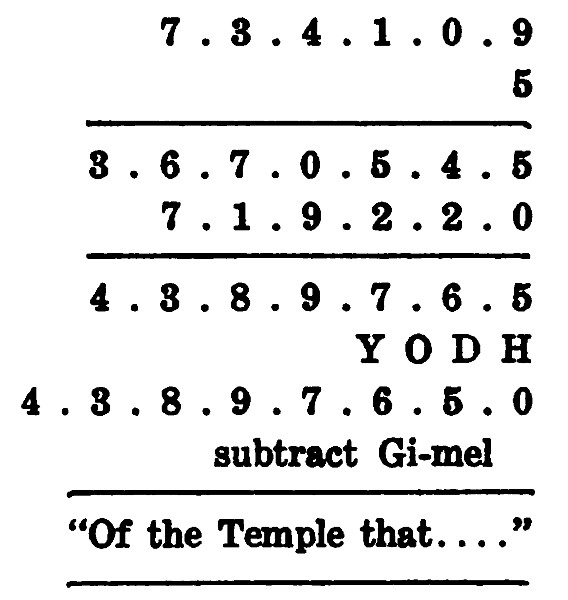
The Professor begged leave to take it with him to London, whereupon the assistant-librarian replied: “It seems very much as though our friend the stranger is applying some numerical cipher to that fragment of Deuteronomy, does it not? Of course, Professor, you may have it—and welcome. I confess I cannot make head or tail of it.”
“Nor I either,” laughed Griffin, blinking through his spectacles. “Yet it interests me, and I thank you very much for it. Apparently this foreigner believes that he has made some discovery. Ah!” he added, “how many cranks there are among Hebrew scholars—more especially the cabalists!”
And in pretence of ignorance of the true meaning of that curious arrangement of figures, the Professor placed the scrap of paper in his breast-pocket, and returned to the Randolph Hotel, where he had tea, afterwards sitting for a long time in the writing-room with the stranger’s discarded calculation spread before him.
In the left-hand corner of the piece of paper was something which puzzled him extremely. In a neat hand were written the figures, 255.19.7. And while awaiting his train, he lit his big briar pipe, and seating himself before the fire, tried to think out what they could mean.
But though he pondered for over an hour he failed to discern their object. They were evidently the stranger’s signature.
He applied the Hebrew equivalents to them, and they were as follows: “Bêth. He. He, A-leph-Teth. Za-yin.” But they conveyed to him absolutely nothing.
Seated alone in the corner of the first-class carriage, he again took out the scrap of paper, and held it before him. That there was a cipher deciphered into the words “of the Temple that,” was apparent.
He started with the ordinary numerical values of the Hebrew alphabet. They were 7.3.4.1.0.9. which meant: Za-yin, Gi-mel, Da-leth, A-leph, the zero, and Teth. These were multiplied by He, which meant 5. Then 719220, meaning certain other letters, were added and multiplied by yodh, or ten. From each number of the total 3, or Gi-mel, was subtracted, and the English translation of the figures that remained was: “of the Temple that—”
To such a man, versed in all the cabalistic ciphers of the ancients, the truth was plain. Extremely involved and ingenious it was, without a doubt, but by careful study of this he would, he saw, be able to find the key being used by the aged man who had in such an uncanny way signed himself “255.19.7.”
He replaced it carefully in his pocket, and lighting his pipe, set back in the carriage to reflect.
Ah! if he could only come across that will-o’-the-wisp who was engaged in the search after the truth. Probably he possessed the context of the burnt document, and could supply the missing portion. But if so, how had it fallen into his hands?
The affair was a problem which daily became more interesting and more extraordinary.
At Westbourne Park Station, when the collector came for his ticket, he fumbled for it in his pocket, but was unable for some time to find it. Then at Paddington he took a taxi-cab home, arriving in time for a late dinner.
Gwen bright and cheerful, sat at the head of the table as was her habit, inquisitive as to her father’s movements and discoveries.
But to her carefully guarded inquiries he remained mute. He had been down to the Bodleian, he said, but that was all. The old man longed to get back to the restful silence of his own study to examine the scrap of paper left by the stranger, and from it to determine the exact key to that very ingenious numerical cipher.
The man who was in search of the same secret as himself was a weird person, to say the least. Both in London and in Oxford, he had come across the aged man’s trail. That he was unknown in England as a scholar was apparent, and that he was a deeply read man and student of Hebrew was equally plain.
He was not a Jew. Both the Library assistants at the British Museum and at the Bodleian had agreed upon that point.
They had declared that he was from the north of Europe. Was he a Dane from Copenhagen, like the dead man who had preferred to be known as Jules Blanc?
Arminger Griffin ate his dinner in impatience carefully avoiding the questions his pretty daughter put to him. Then he ascended to the study, having bidden her good-night. She had received no news of Frank, it seemed. For what reason had the young man so suddenly left for Copenhagen? The question caused him constant apprehension. Could he have discovered any clue to the existence of the context of the document?
More than once during the day he had been half tempted to go himself to Denmark, but the discovery of the aged stranger’s arithmetical calculations induced him to remain in London and watch.
Having switched on the light he crossed the room, and seating himself at the table felt in his pocket for the scribbled calculation. He failed to find it. He was horrified. It had gone!
He must have pulled it from his pocket at Westbourne Park while searching for his ticket. His loss was, indeed, a serious one. In frantic haste he searched all his other pockets, but in vain. The scraps of crumpled paper which contained the key to a portion of the cipher upon which the stranger was working was gone!
He sank into his armchair in despair.
Before his vision rose those mystical figures 255.19.7. written in fire. What was the hidden meaning therein contained?
One line of the sum he recollected: “7.3.4.1.0.9.” multiplied by 5. Mental calculation resulted in the answer of 3670646. There was a sum to add to it. But alas! he could not remember the figures of it.
Therefore the clue, so unexpectedly obtained, was lost.
So he sat alone, his head buried in his hands in deepest despair.
Gwen crept in in silence, but seeing her father’s attitude, crept out again without disturbing him, and read in the drawing-room alone, until it was time to return to her room.
“Shall I ever solve the mystery?” cried the Professor aloud to himself as he paced the room presently. “Misfortune has befallen me! With that fragment deciphered I could by careful study have learned the key and then read what that mysterious searcher has undoubtedly read. Ah! if I could only meet him. Then I would follow and watch his movements. But alas! I am always too late—too late!”
As he sank again into a chair, plunged in the wildest despair, the dark figure of a tall, thick-set, military-looking man of about forty, in a long dark overcoat, passed and repassed the house in the rainy night.
For some time, he had been waiting at Notting Hill Gate Station, almost opposite the end of Pembridge Gardens, glancing at the clock now and then, as though impatiently watching for someone. Then, at last, as if full of determination he had crossed the Bayswater Road, and strolled slowly past Professor Griffin’s house, eyeing its lighted windows with considerable curiosity as he went by.
He continued his walk as far as the end of the road which led into Pembridge Square, and there halted for shelter for a full five minutes beneath the portico of a house. Then he retraced his steps, re-passing the house which had aroused so much interest within him, until he came to the station where he again stood in patience.
The watcher was an active, rather good-looking man, though the reason of his presence there was not at all apparent. To pass the time he bought an evening paper, and stood in the corner reading it, yet in such a position that he could watch everybody who entered or left the Underground Railway Station. There was a slight foreign cast in his features. His keen dark eyes were searching everywhere, while the clothes he wore were the clothes of a man of refined taste.
From time to time there played about his dark face a sinister smile—a smile of triumph. He was evidently not a man to be trifled with, and it seemed very much as though he held the owner of that comfortable house in resentment.
The words he muttered as he stood there pretending to read were, in themselves, sufficient indication of this:
“They thought to trick him—to trick me—but by Jove, they’ll find themselves mistaken!” and his claw-like hand gripped the newspaper until it trembled in his grasp.
He lit a cigarette, and twice crossed the road. Standing at the corner of Pembridge Gardens, he again looked up the street, dark, misty, and deserted on that winter’s night.
“They laugh at us without a doubt,” he muttered to himself. “They laugh, because they think he’s fool enough to give away the secret. Yes, they take him for a blind idiot. Frank Farquhar has gone upon a fool’s errand to Denmark, intending to ‘freeze us out’ of what is justly ours. When he returns, he will find that I have checkmated both him and his friend Griffin, in a manner in which he little expects.”
His countenance was full of craft and cunning; his smile was sufficient index to his character.
Soon after ten o’clock, while standing at the corner of Pembridge Gardens, he suddenly drew back into the shadow, turned upon his heel and crossed the road to the station, in order to avoid notice.
Having gained the opposite pavement, he drew back again into the shadow, and saw a female figure in a short dark skirt, and wearing a handsome white fox boa, hurrying across the road in his direction.
She passed him, and he for the first time caught sight of her pretty face. It was Gwen Griffin.
Apparently she was in a frantic hurry, for she rushed into the booking-office and in her haste to get a ticket, dropped her purse. Then, when she had run down the stairs to the platform, the silent watcher followed leisurely, obtained a ticket for Earl’s Court, but was careful not to gain the platform until the girl had already left.
“I thought the story would alarm her,” he laughed to himself as he stood awaiting the next “Circle” train. “Ah, my fine young fellow, you’ve made a great and a most fatal error!” he added with a dry laugh, as he paced the platform.
Chapter Fourteen.
In which Owen Becomes Anxious.
When just on the point of retiring, the maid had brought Gwen up a telegram from Frank, stating that something serious had occurred, that he had returned to London unexpectedly, and that he was unable to come to the house as he preferred not to meet her father, and urging her to meet him at Earl’s Court Station at a quarter past ten that night.
In greatest alarm, and wondering what could possibly have occurred, the girl had slipped on the first things that had come to her hand and had dashed out to meet her lover.
Before going forth she had taken the maid into her confidence, saying:
“I have to go out, Laura. You need not mention anything to my father. Leave the front door unbolted. I will take the latch-key.”
The dark-eyed girl, with whom Miss Gwen was a great favourite, promised to say nothing, and had let her young mistress quietly out.
Gwen was puzzled why Frank should appoint to meet her at Earl’s Court. If the interview was to be a secret one, why had he not committed a breach of the convenances and asked her to his rooms? She had been there to tea once—in strictest secrecy, of course—but in company with a girl friend.
What untoward circumstances could have arisen to bring Frank back before he reached Copenhagen? He could not have got further than Hamburg, she reflected—if as far.
At Earl’s Court she alighted, and having ascended the stairs in eager expectation, passed through the booking-office into the Earl’s Court Road, expecting her lover to meet her.
But she was disappointed. He was not there. She glanced at the railway dock, and saw that it was already twenty-five minutes past ten. The receipt of the strange message had upset her. She felt that something terrible must have occurred if Frank “preferred” not to face her father. What could it be? She was half frantic with fear and apprehension.
From out the misty night the tall man standing in the shadow on the opposite side of the road was watching her every movement. At the kerb stood a taxi-cab which he had hailed, and now kept waiting. He had remarked to the driver that he expected a lady and would wait until she arrived.
For fully a quarter of an hour he allowed the girl to pace up and down the pavement outside the station, waiting with an impatience that was apparent. That message which she believed to be from Frank had filled her mind with all sorts of grave apprehensions. He would surely never appoint that spot as a meeting place if secrecy were not imperative.
She noticed that there were quiet deserted thoroughfares in the vicinity. There he no doubt intended to walk and explain the situation.
Yet why did he not come, she asked herself. Already he was half an hour late, while she, agitated and anxious, could scarcely contain herself.
Suddenly, however, a tall good-looking man in a dark overcoat stood before her and raised his silk hat. She was about to step aside and pass on when the man begged her pardon, and uttered her name, adding:
“I believe you are expecting my friend, Frank Farquhar?”
“Yes,” she replied. “I—I am.” And she regarded the stranger inquiringly.
“He has sent me, Miss Griffin, as he is unfortunately unable to keep the appointment himself?”
“Sent you—why?” asked the girl, looking him straight in the face.
“He has sent me to tell you that something unexpected has happened,” replied the man.
“What has occurred?” she gasped. “Tell me quickly.”
“Well,” he said with some deliberation. “I do not know whether you are aware that Mr Farquhar was interested in a great and remarkable secret—a secret which he was occupied in investigating?”
“Yes,” she answered quickly. “I know all about it. He told me everything.”
“The contretemps which has occurred is in connection with that,” the stranger said. “He was on his way to Copenhagen, but was compelled to return. He has, I believe, gained the key to some extraordinary cipher or other, and therefore he wishes to see you at once, and in secret. He told me that at present his return to London must be kept confidential, as there are other unscrupulous people most anxious to learn the truth upon which such enormous possibilities depend.”
“He wants me to go to him,” the girl cried. “Where is he then?”
“Not far away,” the man replied. “If you will allow me to escort you, I will do so willingly, Miss Griffin.”
The girl hesitated. She naturally mistrusted strange men. He saw her hesitation, and added:
“I trust you will forgive me for not being with you at the time Frank appointed, but—well, I don’t wish to alarm you unduly, but he was not very well. I was sitting with him.”
“Then he’s ill!” she cried in alarm. “Tell me. Oh! do tell me what has occurred.”
“He will tell you himself,” was the ingenious reply. “But,” he added, as though in afterthought, “I ought to have given you my card.” And he produced one and handed it to her. The name upon it was “William Wetherton, Captain, 12th Lancers.”
“Do relieve my anxiety, Captain Wetherton,” the girl implored. “Tell me what has happened.”
“As I have already said, Farquhar has made a great discovery, and wishes at once to consult you. His indisposition was only temporary—an attack of giddiness,” he added, and he saw that she was wavering. “I’m an old friend of Frank’s,” he went on, “and he consulted me, as soon as the matter of the Hebrew secret came into his hands. Of course, he has very often mentioned you,” he laughed.
He was a well-spoken man, and beneath his smile the girl did not detect his cunning. Her natural caution was overcome by her frantic desire to see Frank, and hear what he had discovered. An instant’s reflection showed her that if he could not meet her it was only natural that he should send his friend Captain Wetherton—a man of whom he had spoken on several occasions. He was stationed at Hounslow, Frank had told her, and they often spent the evening together at the club and some “show” afterwards.
“There’s a ‘taxi’ across the way,” the Captain pointed out. “Let us take it—that is if I may be permitted to be your escort, Miss Griffin?”
“Is it far?”
“Oh, dear no,” he laughed, and raising his hand he called the cab he had already in waiting. The vehicle drew across, and as he entered after her he spoke to the man. He had already given him the address before he had approached her. As he sat by her side, the man’s face changed. In the semi-darkness she could not get a good look at his features, yet his chatter was gentlemanly and good-humoured. From his remarks it was apparent that he had known her lover for a long time, and held him in high esteem.
“As soon as Frank’s telegram arrived, I rushed out,” said the young girl. “It was a great surprise, for I believed him to be on his way to Copenhagen.”
“They’ll probably miss you at home, won’t they?” he asked, with a glance of admiration at the girl’s sweet face.
“Well,” she laughed, “my father doesn’t know I’m out. Laura, the maid, will leave the door unbolted and I’ve got the latch-key.”
The man seated at her side smiled, turning away his head lest she might wonder.
Acquainted as Gwen was with the streets of the West End, she saw that the course taken by the “taxi” was through Brompton Road and Knightsbridge to Hyde Park Corner, then straight up South Audley Street and across one of the squares, Grosvenor Square she believed it to be.
“Why isn’t Frank at his own rooms in Half Moon Street?” she asked with some curiosity.
“Because, having discovered the secret, he is now in fear of his rivals, so is compelled to go into hiding. I, alone, his best friend, know his whereabouts. Quite romantic, isn’t it?” he laughed.
“Quite. Only—well, only—Captain Wetherton, I do wish you would tell me what has really occurred. I feel that you are keeping something from me.”
“I certainly am, Miss Griffin,” was his prompt reply, a reply which contained more meaning than he had intended. “Frank, in sending me to you, made the stipulation that he should have the pleasure of telling you himself. All I can say is that I believe the knowledge of the secret will be the means of bringing to him wealth undreamed of, and a notoriety world-wide.”
He was purposely keeping her engrossed in conversation, in order that they might cross Oxford Street; hoping that in the maze of turnings beyond that main thoroughfare she might lose her bearings.
Suddenly the “taxi” pulled up with a jerk before a closed shop, in a dark, rather unfrequented but seemingly superior street, and the Captain opened the side door with his latch-key, disclosing a flight of red-carpeted stairs.
“Here are my rooms,” Wetherton explained. “Frank has sought refuge with me here. He is upstairs.”
Gwen ascended the stairs quickly to the second floor, where the Captain opened the door with his key, and a moment later she found herself in a large, well-furnished bachelor’s sitting-room where the electric lamps were shaded with yellow silk.
It was evidently the room of a man comfortably off, for the furniture had been chosen with taste, and the pretty knick-knacks and quaint curios upon the table showed the owner of the place to be a man of some refinement.
“Where is he?” inquired the girl, looking around blankly, her cheeks flushed with excitement.
The man turned upon her, and laughed roughly in her face.
She drew back in horror and alarm when, in an instant, she realised how utterly helpless she now was in the stranger’s hands. He had closed the door behind him and pushed back the bolt concealed beneath the heavy portiere.
“He is not here!” she gasped. “You’ve—you’ve lied to me. This is a trick!” she gasped.
“Pray calm yourself, my dear little girl,” he said, coolly lighting a cigarette. “Sit down. I want to have a quiet chat with you.”
“I will not, sir!” she answered, with rising anger. “Allow me, please, to go. I shall tell your friend Mr Farquhar of this disgraceful ruse.”
“You can tell him, my dear girl, whatever you please,” the fellow laughed insolently. “As a matter of fact, your lover does not know me from Adam. So you see it’s quite immaterial.”
“It is not immaterial,” she declared, with a fierce look of resentment: “You shall answer to him for this!”
“Possibly it will be you who will be compelled to answer to him, when he knows that you have accompanied me here alone to my rooms, at eleven at night—eh? What will your lover say to that, I wonder?”
“I have the telegram,” she cried, opening the little bag she carried.
It was not there!
“See,” he laughed. “I have the telegram!” And before her eyes he tossed it into the fire.
She bent to snatch it from the flame, but he seized her white wrist roughly and threw her backward upon the hearthrug. He had extracted the message from her bag as they had sat together in the darkness of the cab.
Struggling to her feet she screamed for help, and fought frantically with the man who had decoyed her there; fought with the fierce strength of a woman defending her dearest possession, her honour.
She saw how the man’s countenance had changed. There was an evil expression there which held her terrified.
She begged mercy from him, begged wildly upon her knees, but he only laughed in her face in triumph. She saw, now that the telegram was destroyed, that this man who had posed as Frank’s friend could make his vile story entirely complete.
She was helpless in the hands of a man whose very face betrayed his vile unscrupulousness.
In the struggle she felt his hot foetid breath upon her cheek. Her blouse of pale blue crêpe-de-chine was ripped right across the breast as she endeavoured to wrench herself from his grasp.
“Ah! Have mercy on me!” she screamed. “Let me go! Let me go! I’ll give you anything—I—I—I’ll be silent even—if you’ll only let me go! Ah! do—if you are a gentleman!”
But the fellow only laughed again, and held her more tightly.
Her bare chest heaved and fell quickly before him. Her breath came and went.
“You think,” he said in a cruel hard voice, “you think your lover will not believe me. But I see upon your flesh a mark—a natural blemish that you cannot efface. Listen to me quietly. Hear me, or else I shall tell him of its existence, and urge him to discover whether or not I have spoken the truth. Perhaps he will then believe me!”
“You brute!” cried the girl in sudden and breathless horror. “You blackguard! you intend to ruin me in Frank’s eyes. Let me go, I say! Let me go.” Again she struggled, trying to get to the window, but with his strong arms encircling her she was helpless as a child, for with a sudden effort he flung her backwards upon the couch, inert and senseless.
Chapter Fifteen.
Reveals the Rivals.
Sir Felix Challas, Baronet the well-known financier and philanthropist, was seated in his cosy library in Berkeley Square, dictating letters to his secretary between the whiffs of his mild after-breakfast cigar. He was a man of middle age, with slight side whiskers, a reddish face, and opulent bearing. In his frock-coat, fancy vest, and striped trousers, and white spats over his boots, he presented the acmé of style as far as dress was concerned. The whole world knew Sir Felix to be something of a dandy, for he had never, for the past ten years or so, been seen without a flower in his buttonhole. Like many another man in London he had amassed great wealth from small beginnings, until he was now a power in the world of finance, and as a philanthropist his name was a household word.
From a small leather shop somewhere in the Mile End Road he had risen to be the controlling factor of several of the greatest financial undertakings in the country; while the house of Challas and Bowen in Austin Friars was known in the City as one of the highest possible standing.
Though he owned that fine house in Berkeley Square, a beautiful domain in Yorkshire which he had purchased from a bankrupt earl, a villa at Cannes, racehorses, motors, and a splendid steam-yacht, he was still a bachelor, and a somewhat lonely man.
The papers mentioned his doings daily, gave his portrait frequently, and recorded with a flourish of trumpets his latest donation to this charity, or to that. Though he made enormous profits in his financial deals, yet he was a staunch churchman, his hand ever in his pocket for the various institutions which approached him. Indeed, if the truth were told, he, like others, had bought his birthday Baronetcy by making a princely donation to the Hospital Fund. This showed him to be a shrewd man, fully alive to the value of judicious advertisement.
In the years gone by he had mixed with many of the shady characters of the complex world of the City, but now, in his opulence, he had apparently cut himself adrift from them all, and prided himself upon his eminent respectability.
As he sat there that winter’s morning, leaning back in his big leather armchair before the fire, he was dictating a letter to the governors of a great orphanage at Bristol, promising to defray the cost of building a much needed wing of the institution.
Then, having done so, he added to his secretary, a rather smug looking man in black:
“And you might also write a paragraph to-day, Stone, and send it to the Press Association. You know what to say—‘magnificent gift,’ and all that sort of thing. They’ll send it out to the newspapers.”
“Yes, Sir Felix,” answered the man, making a note in shorthand.
“Let’s see, what else is there? Ah! The Malms Syndicate! Write saying that I withdraw,” he remarked.
His secretary hesitated.
“But that, Sir Felix, means ruin to all three. They are all poor men.”
“That’s just what I intend,” he answered with a smile. “We shall do that business ourselves, as soon as they are out of it.”
So Mr Stone scribbled rapidly a letter in shorthand, which meant the ruin of three honest men, who, believing in the great financier’s promises, had taken upon themselves liabilities which they could not meet.
Such letters are not infrequent. The great philanthropist, whom the world looked up to as a model man, who did his utmost for the benefit of suffering humanity, and who had been rewarded by his Sovereign, collected his wealth by ways that would often not bear investigation. But being a big man, he was able to do things which a little man would fear to do. For were not Challas and Bowen, with their huge operations and big bank balances, above suspicion?
While dictating another letter, the butler, an elderly and pompous person, entered announcing: “Mr Jannaway, Sir Felix.”
“That will be enough for to-day, Stone,” the red-faced man said to the secretary, who rose at once, and followed the servant out of the room.
Next moment the man who had posed on the previous evening as “Captain Wetherton” entered the room, looking smart and spruce in a well-cut suit of blue serge.
“Well, Jim?” exclaimed the financier anxiously, as he rose to meet his visitor. “I’ve been expecting you all the morning. What news—eh?”
“Oh! It’s all right,” answered the man cheerily, flinging himself into an armchair without invitation, apparently quite at home in Challas’s house.
“Found out anything of interest?” inquired Sir Felix, pushing over the big silver cigar-box that stood upon the smoking-table.
“Well—I hardly know,” he answered hesitatingly. “Where’s the girl?”
“In Charlie’s rooms. I’ve had a devil of a scene with her. She’s obdurate.”
“A day’s confinement there will break her spirit, no doubt,” remarked Sir Felix. “Especially if she believes she’ll lose her lover.”
“I don’t know,” he answered dubiously. “She’s got a mind of her own, I can tell you. She’s a regular little spit-fire.”
The red-faced man laughed.
“Well, Jim,” he said. “You ought to know how to manage women, surely. Did my scheme work well?”
“Excellently. She got your ‘wire,’ and went to Earl’s Court at once. I followed and after a little persuasion she fell into the trap. While she was unconscious, I took the latch-key, and at half-past two let myself and old Erich into the house in Pembridge Gardens.”
“Well—did he find anything?”
“Yes. Griffin has taken photographic copies of the burnt papers, before giving them back into Farquhar’s hands, and from his copies of various early manuscripts of Ezekiel and Deuteronomy it’s quite plain that he is making a very careful and complete study.”
“It seems, then, that Griffin’s intention, is to discover the cipher for himself, and leave the ugly little Doctor out in the cold,” Sir Felix remarked with a snap. “But, Jim, this business is ours and nobody else’s. We must crush anybody and everybody, who attempts in any way to decipher that secret record. When the Dane brought it to me at the Ritz, in Paris, I laughed at the idea. Treasure-hunting was never in my line. But,” he added with a smile, “I took care to have a complete copy of his precious document made before I gave it back to him the next morning, and it is now in the safe over yonder. Like to see it?”
Jim Jannaway, the man who had on the previous night represented himself to be “Captain Wetherton,” the friend of Frank Farquhar, expressed eagerness to see it. Therefore the financier rose, and with the gold master-key upon his watch-chain, opened the heavy steel door, and handed his visitor a typed document bound in a dark green cover—a complete copy of the manuscript which Doctor Diamond had partly burned in that obscure hotel at the Gare du Nord.
The context of the half intelligible sentences was there—the context which Professor Griffin was longing to obtain. And moreover, as the man turned over the pages, reading swiftly, he came across a geometrical figure—a plan marked with numbers and corresponding explanations.
“Who made the discovery?” asked Jim Jannaway, late of His Majesty’s Army and now gambler, card-sharper, and swell-mobsman.
“The devil only knows,” laughed Sir Felix. “He says he did himself. The fellow was hard up and I gave him a hundred francs, but I believed the whole thing to be a huge hoax, until I consulted old Erich and he began to puzzle his brains. Then I saw that there might be something in it. My only fear is that Griffin and his friends may get ahead of us. But you’ve done well, Jim. You always do.”
“I do the dirty work of the firm,” laughed the man addressed, removing his cigar from his lips, “and devilish dirty work it is at times.”
“Well, you can’t complain of the pay. Isn’t it better to live as you are, a gentleman of means, than as I found you five years ago, a ‘crook’ who might be arrested at any moment?”
“I don’t complain at all, my dear fellow. Only—”
“Only what?”
“Well, I really don’t see your object in enticing the girl to Charlie’s rooms. It might be awkward for us.”
Sir Felix laughed, snapping his fingers.
“What? Are you growing afraid?” he asked.
“Not at all, only I can’t see your object.”
“The object is simply to compromise her,” he said grimly. “She’s a confounded pretty girl. I saw her at the theatre with her aunt a week ago, and she was at Lady Ena’s wedding the other day, with her lover, Frank Farquhar. Of that man we must be wary. With his confounded newspapers, he has power,” he added.
“That’s the very reason why I fear we are treading on dangerous ground.”
“Bosh! leave all to me. The girl is in Charlie’s rooms, there let her stay for the present,” answered the man whom the world believed to be a pillar of the church, and a devout philanthropist.
Jim Jannaway saw that this man whom he served—the man who held him in his toils—had some mysterious evil design upon the unfortunate girl. He could not, however, discern exactly what it was. He had ordered him to keep her in that upstairs room, “and break her spirit,” as he put it.
The midnight search of the Professor’s study had revealed that he was in active pursuit of the truth. That meant Sir Felix taking steps to checkmate his efforts. Ever since the first moment it had been known by a chance visit to the hotel while Jules Blanc was lying there dead, that the fragments of the strange document had fallen into Doctor Diamond’s hands, private inquiry agents, employed by Sir Felix, had been silently watching the movements of the deformed Doctor, Frank Farquhar, and his friend, the Professor. All had been reported to the red-faced man sitting there at his ease—the man who controlled financial interests worth millions.
Sir Felix had been convinced by the foreign expert he had consulted that there really was something in the theory of the unknown discovery, and he intended that none should learn the truth except himself. He had Jim Jannaway, the unscrupulous, at his elbow, ready to do any dirty work, or make any risky move which he ordered. In a day Jim could, if he wished, summon up half a dozen of the most dangerous characters in London, pals of his, to assist him, for be it said he always paid well—with Sir Felix’s money, of course.
Against such a combination as Challas and Bowen, though Mr Thomas J. Bowen lived in New York and was seldom in London, no private person could stand. The great firm, with their agents all over the world, gathered confidential information from everywhere, and could plot to crush any one who attempted to carry through a business that was against their interests.
Hence any attempt on the part of Doctor Diamond, or Professor Griffin, to solve the problem in face of the opposition of Sir Felix, was foredoomed to failure, if not to disaster. But alas! both men were in ignorance of the fact that a complete copy of the dead man’s document was in the possession of the man whose hatred of the Jews, his enemies in business, was notorious; and who would therefore go to any length in order to secure, for his own satisfaction, the sacred relics and vessels of Solomon’s Temple—providing they still existed.
Chapter Sixteen.
Owen Learns the Truth.
When the Professor seated himself at the breakfast-table and the news of Miss Gwen’s absence was broken to him by Laura, the parlour-maid, he started up in surprise.
“Miss Gwen went out late last night instead of going to bed, sir, and took the latch-key,” the girl was compelled to admit.
The old man pursed his thin lips. His daughter was not in the habit of going out on midnight escapades.
“Late last night Miss Gwen received a telegram, sir,” the girl added. “It seemed to excite her very much; she dressed at once, and went out.”
The Professor rose from the table without eating, and went to the study to think.
Upon the blotting-pad lay a sheet of ruled manuscript paper. He stared at it in horror as though he saw an apparition, for there upon the paper, scrawled boldly in blue chalk, were the mystic figures:
255.19.7
They danced before his eyes, as he stood staring at them. How came they there, in his own study? What could they mean?
He looked around bewildered. Nothing was out of place—nothing disturbed. Those puzzling figures had been written there by some unseen hand.
During his wakeful hours that long night he had applied Hebrew letters of those numerical values to the array of figures. But the result was chaotic. It was some mystic sign. But what, he could not determine.
He had found them on that scrap of paper cast aside at the Bodleian Library, and now again they appeared in the privacy of his own study, to puzzle and confound him.
Through the next hour he waited, from moment to moment, in the expectation of a telegram from Gwen explaining her absence and assuring him of her safety. But, alas! none came. Therefore, he put on his boots and overcoat and went round to the police-station, where the inspector on duty received him most courteously, and took a minute description of the missing young lady, a statement which, half an hour later, had been received over the telegraph at every police-station throughout the Metropolitan area.
He had taken the precaution to place one of Gwen’s photographs in his pocket, and this he handed to the inspector.
“Well do our very best, Professor, of course,” the officer assured him. “But young ladies are often very erratic, you know. We have hundreds of girls reported missing, but they usually turn up again the next day, or a couple of days later. Their absence is nearly always voluntary, and usually attributable to the one cause, love!”
“But my daughter’s lover is in Denmark,” the Professor protested.
“That is what you have been led to believe,” remarked the inspector with an incredulous smile. “Girls are very cunning, I have two myself, sir.”
“But you will help me, will you not?” urged the old gentleman earnestly.
“No effort shall be spared to discover your daughter, sir,” answered the rosy, clean-shaven man seated at his desk. “I’ll report the matter to our superintendent at once. Do you,” he added, “happen to know what dress she was wearing? I will want a close description of it, also the laundry mark on her underlinen. Your servants will, no doubt, be able to supply the latter. Perhaps I’d better step round with you and see them.”
So the inspector at once accompanied the Professor back to Pembridge Gardens, and there was shown some of the girl’s clothes with the laundry mark upon them. Afterwards he left, leaving the old man in the highest state of apprehension.
He put aside all thought of the inquiry upon which he had been engaged. His sole thought was for the safety of his child.
Meanwhile Jim Jannaway and Sir Felix Challas were still in deep consultation in the privacy of that quiet, sombre study in Berkeley Square.
“Erich left for Paris by the nine o’clock service this morning,” Jim was saying. “He wants to consult some early manuscript in the National Library, he says.”
“He’s a decidedly clever old fossil,” declared the Baronet, knocking the ash off his cigar, “and I’m convinced he’s on the right track. If we can only keep these other people off, mislead them, or put them on a false scent, we shall win.”
“Erich has done that already,” laughed the other. “He’s been down to Oxford and pretended to study certain manuscripts, knowing well that Griffin’s researches must lead him there. By putting Griffin on a false scent he’s simply tangling him up. Oh! yes, I agree, Erich Haupt is a wary old bird.”
“Then he is now making investigations in various quarters with the sole object of misleading Griffin, eh?” laughed Sir Felix. “Really, it’s quite comical.”
“Yes, and he lets drop just sufficient information to excite the curiosity of the officiate of the various libraries and place them on the qui vive. He does that, so that they shall inform Griffin.”
“Excellent!” declared the Baronet. “As soon as he returns from Paris I must see him. I wonder if the secret record really does exist? If it does, then, by Jove! I’ll hold the key to the whole Jewish religion. But one thing is quite evident, my dear Jim, we must crush out all this opposition with a firm, relentless hand. You understand?”
“I quite follow,” remarked the great financier’s unscrupulous “cat’s-paw.”
And they continued the discussion of the present rather insecure situation.
Sir Felix Challas wore his mask with marvellous cleverness. The world—the people who read of him in the newspapers—never suspected that the man whose name so often headed subscription lists for charitable objects, and whose handsome donation was the signal for a hundred others, was an unscrupulous schemer. His had been the hand that, by clever financial juggling in which some other person was always the principal, had brought ruin to thousands of happy homes. He had, indeed, if the truth were told, climbed to the pedestal of notoriety and esteem, over the bodies of the men, both capitalists and workmen, he had, with such innate cunning, contrived to ruin.