Front matter (continued 6)
Reading edition
On a beaucoup parlé du cuisinier. Si nous exposions un peu ce que doit être le Maître d'Hôtel.
LE MAÎTRE D'HÔTEL FRANÇAIS
La plus grande force du Maître d'hôtel Français, je dis Maître d'hôtel Français à dessein, car si le cuisinier Français a su tirer parti des produits de la nature avec un art infini, pour en faire des aliments aimables, agréables, et bienfaisants, le Maître d'hôtel Français seul est susceptible de les faire accepter et désirer. Or voilà pour le Maître d'hôtel le champ qu'il a à explorer. Champ vaste s'il en fût, car deviner avec tact ce qui peut plaire à celui-ci et ne pas plaire à celui-là, est un problème à résoudre selon la nature, le tempérament et la nationalité de celui qu'il doit faire manger. Il doit donc être le conseil, le tentateur, et le metteur en scène. Il faut pour être un maître d'hôtel accompli, mettre de côté, ou de moins ne pas laisser percer le but commercial, tout en étant un commerçant hors ligne (je parle ici du maître d'hôtel public de restaurant, attendu que dans la maison particulière, le commerce n'a rien à voir, ce qui simplifie énormement le rôle du maître d'hôtel. Pour cela il faut être un peu diplomate, et un peu artiste dans l'art de dire, afin de colorer le projet de repas que l'on doit soumettre à son dîneur). Il faut donc agir sur l'imagination pour fair oublier la machine que l'on va alimenter, en un mot masquer le côté matériel de manger. J'ai acquis la certitude qu'un plat savamment préparé par un cuisinier hors ligne peut passer inaperçu, ou inapprécié si le maître d'hôtel, qui devient alors metteur en scène, ne sait pas présenter l'œuvre, de façon à le faire désirer, de sorte que si ce mets est servi par un maître d'hôtel qui n'en comprend pas le caractère, il lui sera impossible de lui donner tout son relief, et alors l'œuvre de cuisinier sera anéanti et passera inaperçu.
Ce maître d'hôtel doit être aussi un observateur et un juge et doit transmettre son appréciation au chef de cuisine, mais pour apprécier il faut savoir, pour savoir il faut aimer son art, le maître d'hôtel doit être un apôtre.
Il doit transmettre les observations qu'il a pu entendre pendant le cours d'un dîner de la part des convives, observations favorables ou défavorables, il doit les transmettre au chef et aviser avec lui. Il doit aussi être en observation, car il arrive le plus souvent que les convives ne disent rien à cause de leur amphitryon mais ne mangent pas avec plaisir et entrain le mets présenté: là encore le maître d'hôtel doit chercher le pourquoi. Il y a aussi dans un déjeuner ou un dîner un rôle très important réservé au maître d'hôtel. La variété agréable des hors-d'œuvre, la salade qui accompagne le rôti, le façon de découper ce rôti avec élégance, de bien disposer ce rôti sur son plat une fois découpé, découper bien et vite, afin d'éviter le réchaud qui sèche. Savoir mettre à point une selle de mouton, avec juste ce qu'il faut de sel sur la partie grasse, qui lui donnera un goût agréable.
Pour découper le maître d'hôtel doit se placer ni trop près ni trop loin des convives, afin que ceux-ci soient intéressés, et voient que tous les détails sont observés avec goût et élégance, de façon à tenter encore les appétits qui n'en peuvent presque plus mais qui renaissent encore un peu aiguillonnés par le désir qu'a su faire naître l'artiste préposé au repas, et qui a su donner encore envie à l'imagination, quand l'estomac commençait à capituler.
Le maître d'hôtel a de plus cette partie de la fin du dîner, le choix d'un bon fromage, les fruits, les soins de température à donner aux vins, la façon de décanter ceux-ci pour leur donner le maximum de bouquet; le maître d'hôtel ne peut-il encore être un tentateur avec la fraise frappée à la Marivaux? ou avec la pêche à la cardinal, qu'accompagne si bien le doux parfum de la framboise, légèrement acidulé d'une cuillerée de jus de groseille. Notre grand Carême qualifiait certains plats le "manger des Dieux." Combien l'expression est heureuse!
Depuis que je suis à Londres j'ai trouvé un nombre incalculable d'inventeurs de ma "pêche à la Cardinal." Il me faudra leur donner la recette un jour que j'en aurai l'occasion.
N'est-ce pas de l'art chez le maître d'hôtel qui tente et charme les convives par ces raffinements, et qui comme un cavalier sur une moture essoufflée sait encore relever son courage et lui faire faire la dernière foulée qui décide de la victoire? Après un bon repas le maître d'hôtel a la grande satisfaction d'avoir donné un peu de bonheur à de pauvres gens riches, qui ne sont pas toujours des heureux.
Et comme l'a dit Brillat Savarin "Le plaisir de la table ne nuit pas aux autres plaisirs." Au contraire, qui sait si indirectement je ne suis pas le papa de bien des Bébés rieurs, ou la cause au moins de certaines aventures que mes jolies clientes n'évoquent qu'en souriant derrière leur éventail?
Joseph Directeur du Savoy Restaurant, Londres, et du Restaurant de Marivaux, Paris.
XLIV
THE SAVOY TO-DAY
After the Houses of Parliament, the Law Courts, the National Gallery, St Paul's and Westminster Abbey, the Savoy Hotel is probably the building that the well-to-do Londoner knows best. He cannot walk or drive down the Strand without his eye being caught by its milk-white frontage on that tumultuous street, and by the stern-faced gilded warrior above the courtyard entrance who leans on a shield that bears an heraldic bird, which I have no doubt is a very noble eagle, but which looks as though it had been plucked. When he comes home from abroad he, if he is looking to the right as he crosses the railway bridge to Charing Cross, sees the garden front of the hotel, with its balconies and many windows, and its flag aflutter, and recalling many good dinners in the past, looks forward to many others in the immediate future.
All the preliminaries to a dinner at the Savoy are pleasantly dignified. The drive into the courtyard, the cessation of noise as the wheels of car or carriage come upon the india-rubber paving under the glazed roof, the cream and dark green marbles of the entrance front, the trellis and flowers outside the Café, all contribute to pleasant anticipation; and once inside the doors, the hall panelled with dark woods, the glimpse through a long window of the light-coloured reading-room, and the progress down a flight of crimson-carpeted stairs, with walls of buff and brown marble on either side, form the first stage of the diner's progress to the restaurant.
Servants in the handsome state livery they wear in the evening—French grey and dark blue—take one's coat and hat, and it always gives me a moment of gratification that I am such an old habitué that it is not considered necessary to give me a ticket. Then if one is a host there is nothing to do except to sit in one of the comfortable chairs in this ante-chamber and to look alternately up the crimson stairs to see whether one's guests are arriving and down another flight of stairs across the great lounge to the crystal screen of great panes framed in gilt metal which is the transparent barrier between the restaurant and its approaches.
The lounge—crimson under foot, with walls light cream in colour, good copies of portraits by British old masters in panels alternating with looking-glass doorways; with pillars of buff marble, veined with brown and having gilt capitals, and bronze amorini and sculptured groups of the Graces as supports for electroliers—is a delightful room, as one realises after dinner when the hour of coffee has come. The band, wearing in the evening their uniform of dark blue, the leader distinguished by a silver sash—in the daytime they are in crimson—are in a corner of the lounge close against the crystal screen that their music may be heard in the restaurant. Arched entrances in the eastern wall lead into the Winter Garden, another great hall with a glazed ceiling, with roses climbing up trellis-work, and with a great recess, up a broad flight of stairs, with pillars of green marble and a gilded fountain against its wall. The salon de verdure, as it is grandiloquently called, is above the new ballroom, the two great apartments occupying the space where the courtyard used to be.
My guests of the particular night I am describing were my friend and old comrade, Pitcher, the editor of Town Topics, and his wife and his pretty daughter. I had determined that they should eat a typical Savoy dinner, and had been at some pains to obtain a really representative feast. Before I went away on my travels in the summer I had interviewed M. Blond, the general manager (who was brought back when he was half-way to Rome two years ago to take up the management of the Savoy), in his sanctum, telling him that when in the autumn I intended to write a couple of chapters concerning the Savoy, I should like to give a dinner including some of the specialities of the cuisine, and that I should like to have something descriptive to say as to such of the dishes of which the Savoy is proud that were not included in my little feast. We took into our conference M. Rouget, the Maître-Chef of the Savoy, who looks the genial, burly, contented person that the head of a great kitchen should be, and we chatted over new dishes and dishes with new names (which are not the same thing), and he gave me some particulars of his kitchens and of the great army of cooks employed in the Savoy, there being as many as two hundred and ten in the brigade.
When, being back again in London, I carried out my intention of asking my editor to dinner, M. Soi, the manager of the restaurant, came into counsel. When I had made up my mind on the important matter whether my dinner should cost twelve-and-six or fifteen-and-six a head, and had stated that I should like the more expensive feast, I added that I hoped that no beef would be included in the menu, for Pitcher had been complaining of preliminary symptoms of gout. M. Soi on the day we were to dine—a Sunday—submitted to me a menu which I duly initialled as approved.
My guest and his wife, looking as young as her pretty daughter, duly arrived to the moment. M. Soi, young and good-looking, with a light moustache—he was under Ritz in various restaurants, and has been at the Grand Hotel in Rome as restaurant manager, going in the summer to the Palace Hotel at St Moritz, before three years ago he came to the Savoy—received us at the entrance, and we were piloted to a table a comfortable distance away from the band, from which the ladies had a full view of the room, full, as it always is, with good-looking people, the softer sex all being in frocks that gave my lady guests plenty to talk about. I gave my guests the menu, which, of course, I had previously seen, to look at, as soon as they had settled down, and I used my eyes to take in my surroundings.
Though I regret the disappearance of the mahogany panelling, which is stowed away somewhere in the hotel, as one regrets the loss of an old friend, the pleasant buff colouring of the present restaurant, with its frieze of raised decoration and the electric light thrown up on to the ceiling and reflected down, which is most comfortable to the eye, make for lightness; and light as distinguished from glare is an aid to good spirits in a restaurant. The balcony of to-day, twice the width of the old balcony, and fitted with a long awning for use on sunshiny days—an awning which cost an almost incredible sum of money—is in request both at lunch and dinner and supper-time; and at lunch it has the supreme advantage of commanding the one great view in Central London, the river and the gardens and the Houses of Parliament grouping into a splendid picture, only spoiled by the blot of the unlovely railway bridge.
This was the menu of the Savoy dinner that M. Soi considered typical:
Délices de Sterlet. Blinis de Sarrasin. Consommé de Terrapine en Tasse. Kapusniack. Suprême de Sole Divine. Diablotin Cancalaise. Filet de Perdreau Bonne Bouche. Croquettes de Marrons. Noisette d'Agneau de Galles Eldorado. Fond d'Artichaut Clamart. Poularde soufflée Savoy. Salade Cornelia. Poire de Paris Tosca. Frivolités. Canapé Esperanza.
—and as the accompanying wine I had ordered some sherry with the caviar, a magnum of Pommery and some Mattoni water.
A most admirable dinner it was, rather long, perhaps, to my taste, but it would have been difficult to get enough distinctive dishes into a shorter menu. The sterlet caviar on the little Russian pancakes made an admirable hors d'œuvre; the consommé was of turtle, but much lighter than the usual turtle soup; the kapusniack is a Russian soup, in which leeks, celery, turnips, onions, mushrooms, pig's ear, crushed tomatoes and cabbage seasoned with vinegar play a part, and it is served with cream stirred into it, and with those little pâtés of which the Russians are so fond when broken into the soup. The sole was garnished with fried oysters covered with bread-crumbs, and the filet de perdreau, which was the supreme triumph of the dinner, consisted of grilled suprêmes of partridges and grilled rashers of bacon dipped in poivrade sauce. The noisettes were the one plain dish of the dinner, but the asparagus ends tucked away in the hearts of artichokes gave it its cachet. The cold chicken filled with a mousse of foie gras was a very noble dish, and tiny mushrooms, formed from some kind of mousse, which apparently grew amidst the truffles, and slices of chicken breast which surrounded the white bird adorned with Pompeiian drawings, were a very happy idea. The nuts soaked in Kummel which we found in the interior of the pears, which were served with a red currant ice, was another happy idea much appreciated by the ladies, and the canapé esperanza proved to be soft roes on toast.
This dinner takes a very high place amongst the many good dinners I have eaten in my time in the Savoy Restaurant. My bill came to £5, 2s.
Some of the Savoy specialities for which there were not room in one dinner menu are huîtres Baltimore, which are oysters grilled with bacon; bortsch Polonaise, homard Miramar, sylphide Savoy, which is a very attractive way of serving lamb sweetbreads; mignonettes d'agneau à la Delhi, soufflés belle de nuit, which is a variant of the soufflé surprise, peaches and strawberry and vanilla ice being used in it; and the noble bécasse à la Soi, an invention of M. Soi, which is the breast of a woodcock served with a most delightful sauce on toast covered with foie gras.
I have mentioned the ballroom which has taken the place of the old courtyard and its fountain, and in which many of the great banquets given at the Savoy are held. It is a fine room, light grey in colour, splendidly spacious, and when lighted up its colour shows off the ladies' dresses to perfection. My only objection to it as a banqueting-room was that the white light, which is admirable for a ballroom, was rather too glary for a dining-room. This has now been obviated by lessening the light when dinners are given in the room. If the Savoy could find some means of shading the lamps with pink or putting on pink glasses to the lamps on the occasion of banquets, it would, I think, please those like myself who think that the best light for a dining-room is a pink one.
I asked M. Blond to give me the menu of any recent Savoy banquet of which the management was especially proud, not that I have not preserved many menus of many great dinners, but that I wished to shift the responsibility of selection on to his shoulders. This is the menu of the banquet and wines he has sent me as being typical of great Savoy feasts:
Caviar de Bélouga. Blinis à la Gouriew. Queue de Bœuf à la Française. Crème Germiny. Filets de Sole à l'Aiglon. Suprême de Volaille à l'Aurore. Côte d'Agneau de Lait au Beurre Noisette. Pommes Lorette. Velouté Forestière. Délice de Strasbourg à la Gelée de Vin du Rhin. Bécassine Double Flambée à l'Armagnac. Perles du Perigord. Cœurs de Laitues Suzette. Asperges Vertes de Paris. Comices Toscane. Soufflé Pont l'Évêque. Corbeilles de Fruits. Wines. Schloss Johannisberg Cabinet, 1893. Veuve Clicquot, 1904. Magnums Pommery and Greno (Nature), 1904. Chât. Haut Brion "Cachet du Château," 1888. Cockburn's 1890 (Bottled 1893). Croft's 1881 (Bottled 1884). Hennessey's 70 year old Cognac.
Many of the dishes included in this great dinner I hope I may meet at a future time at Savoy banquets.
XLV
THE RESTAURANT DES GOURMETS
Dining one wet night in September at the Restaurant des Gourmets in Lisle Street I told the young manager, with whom I chatted, that it must be ten years since I dined there, and that at that time M. Brice was the proprietor. The manager's reply was that fourteen years ago M. Brice sold the restaurant to its present proprietors. I looked up the date of my last visit to the Gourmets when I got home, and found that it was in 1898. It was a queer little place of very eatable food at extraordinarily cheap prices when first I made its acquaintance. It then occupied the ground floor of one of the little houses in Lisle Street, the street in which is the stage door of the Empire Theatre, and Mr George Edwardes' offices at the back of Daly's Theatre. The outside of the restaurant in those days did not look inviting. The woodwork was painted leaden grey, and a yellow curtain hung inside the window to screen the interior from the view of the public. The glass of the door was whitened and "Entrée" written across it in black paint. There were as many little tables, to hold two or four, as could be crammed into the little room; the benches by the wall were covered with black leather, the walls were grey, with wooden pegs all round on which to hang hats and coats, and, here and there, notices on boards "La Pipe est interdite." By the window was a long counter, on which were bowls of salad and stacks of French loaves, and a metal coffee-making machine. By this counter stood a plump Frenchwoman in black with an apron, who shouted orders down a lift, and up the lift came presently in response the dish called for. M. Brice, a little Frenchman with a slight beard and wearing a grey cap, came and sat on a chair by the table and told me who the star guests were amongst the people of all nationalities who filled all the space on the chairs and benches. The chef d'orchestre of the Moore and Burgess Minstrels at St James's Hall was one of the celebrities; another, a gentleman wearing a red tie, was a journalist who contributed articles on Anarchists to the newspapers; there were some Frenchmen who were big men in the greengrocery line, and came over occasionally to Covent Garden; and the greatest celebrity of all was a clean-shaven, prosperous-looking person, the coachman of the Baron Alfred de Rothschild. My bill that evening totalled 2s. 7d., and for this I obtained hors d'œuvre, 2d.; pain, 1d.; potage, pâté d'Italie, 2d.; poisson, 8d. (the expensive dish of my dinner, turbot and caper sauce); gigot haricot, 6d.; an omelette, 4d.; cheese, 2d.; and a pint of claret, of which M. Brice had purchased a supply at the sale of the surplus wines of the Café Royal, which cost me no more than 6d.
The front of the Restaurant des Gourmets to-day stretches across three of the houses in Lisle Street, and it has, besides the ground-floor rooms, quite a spacious restaurant on the first floor, made by throwing the three rooms of the houses into one. Its ground-floor front is painted chocolate colour, and its principal entrance, between two of the houses, is quite imposing, has little Noah's Ark trees and a chasseur in buttons, stationed there to direct visitors to the different rooms and to call taxis. The staircase, with brass edges to the steps and a brass rail, and with walls of white panelling, leads to the restaurant upstairs, and a little pay-desk, with an opening like those in a railway ticket office, faces one at the entrance, and it is here that every visitor pays his bill as he goes out. I looked in at all three downstairs rooms, which are bright with coloured papers on their walls, and found all the tables occupied, before I went upstairs into the larger restaurant. There I found a little table vacant, and sat down at it with grim apprehension that I might have what scanty hair I possess on the top of my head blown off, for just above it was a large electric fan. It was, however, not necessary, the night being cool, to set this going, and I ate my dinner in a calm atmosphere.
The Gourmets has become quite smart since Madame H. Cosson and her son succeeded M. Brice in the proprietorship. The upstairs restaurant is panelled with white woodwork above a green skirting, there are mirrors in the panelling, and the range of windows looking out on to Lisle Street have white lace curtains. There is a table in the middle of the room, and upon it fruits and big-leaved plants and a basket with bunches of grapes hung invitingly along the handle. Two big stands of Austrian bent-wood for hats and coats are placed as sentinels on either side of this table. There is a round-faced clock on the wall to tell the time, and at intervals notices to say that all drinks must be paid for in advance, which means, I suppose, that the Gourmets has not yet obtained a wine and spirit licence. No notice forbidding pipes is now necessary. The waiters in dress clothes and black ties bustle about, and when I had given my order for crème de laitue, cabillaud frit, poulet au riz, sauce suprême, and pudding Gourmets, I looked round at my fellow-guests to see if I could pick out any celebrities. There was no M. Brice this time to act as a "Who's Who in Lisle Street," and most of the people who were dining seemed to me to be young couples. Indeed from the tables in my vicinity a painter could have limned a series of pictures of the various stages of matrimony. At the table next to mine sat a young couple who were still in the holding hands state of love, who were thinking a great deal about each other and very little about their dinner, and who ordered anything that the waiter suggested to them; further on was a couple, each of whom was reading a newspaper, and next to them again a young husband and wife, who had brought out to dinner a pig-tailed little girl of six or seven, whose manners were most admirable, for she bade the waiter "Good-night" when she went away with all the grace of a duchess. Beyond these again was an elderly couple, who sat together at one side of a table, an affectionate Darby and Joan.
My soup when it came tasted rather too strongly of pepper, but the fried cod was excellent. The poulet au riz was all that it should be, and the pudding Gourmets was a simple version of the well-known pudding Diplomate.
Prices have gone up a little at the Gourmets since my first visit there, owing, of course, to the general rise in the price of material. I was charged 3d. for the soup, 6d. for the cod; I had rushed into wild extravagance in ordering chicken, for that cost me 1s. 3d., and the price of the pudding Gourmets was 4d.
XLVI
THE MAXIM RESTAURANT
There may not appear at first blush to be any close connection between Wardour Street, that length of it which lies between Shaftesbury Avenue and Coventry Street, and the pleasant Austrian watering-place of Marienbad; but whenever I traverse the thoroughfare where the wax figures simper in Clarkson's, the wig-maker's, windows, and where the French library at one of the corners always keeps some passers-by in front of it looking at the illustrated papers and post cards, the china figures and the covers of the novels, there rises before me when I come to the Maxim Restaurant a vision of hills covered with pine-woods and of the Café Rubezahl, a castellated building of great red roofs and turrets and spires, high up on the green hill-side, the café at which the late King Edward often drank the good Austrian coffee of an afternoon during his annual August trip to the town of healing waters.
The Rubezahl was, in an indirect manner, the parent of the Restaurant Maxim in Wardour Street, for when the organisers of the Austro-Hungarian Exhibition at Earl's Court cast about for attractions which would be in keeping with the spirit of the exhibition it occurred very naturally to them that an Austrian restaurant where the admirable plain Austrian dishes could be eaten and where the Hungarian wines and the cool beer of Pilsen could be drunk would be a pleasant novelty; and such a restaurant was established opposite to the Welcome Club, and was eminently successful. And to manage this restaurant the son-in-law of the proprietor of the Rubezahl came from the Austrian Highlands, and when King Edward lunched at the restaurant and was given a typical Austrian meal of "cure food" he recognised M. Maximilian Lurion, the manager, and chatted with him concerning Marienbad and the Rubezahl. When Earl's Court had closed its doors for the winter M. Maxim Lurion was not unwilling to stay in London, and he, in conjunction with a British syndicate, thought that a site at the corners of Wardour and Gerrard Streets, which was then in the market, would be a suitable position for a restaurant. A small public-house carrying a licence was included in the purchase, and when everything else on the site was pulled down the business part of the old house of refreshment stood, looking like a saloon of the Wild West, amidst the ruins. When a name had to be found for the new restaurant, the shortened form of M. Lurion's Christian name was chosen, and the building became the Restaurant Maxim. No doubt Maxim's, in Paris, came by its name in a like manner, for Maximilian is a very usual name in central and eastern Europe.
Maxim's has always kept a clean face in a street not remarkable for smartness, and its white exterior, the touches of gilding on the wreaths that embellish its outer walls, its rows of mauresque white-curtained narrow windows on the first floor, its turret domed with silver, the flowers in its green and gold balconies, and the commissionaire in a well-fitting coat who stands by the front door, near the two large menus which set forth what is the dinner of the day, make it a pleasant feature of the street.
When the Maxim was first opened M. Lurion took me over the establishment from garret to basement, and showed me how the coffee is made in Austria, though Austrian coffee never tastes so well in London surroundings as it does under the little trees of the hill-side cafés in Carlsbad or Marienbad, or in one of the open-air restaurants in the Prater of Vienna. The Maxim, however, did not at first fulfil the hopes of its promoters. Whether its name frightened people or whether it was too ambitious in its aims I do not know, but it soon changed hands.
When one evening last summer I went to the Maxim to dine before going to one of the theatres in Shaftesbury Avenue, I found M. Ducker, the present manager, in the entrance hall near the cloak-room where hats and coats are left, and he told me all about the varying fortunes of the restaurant, who are its present proprietors, and of the struggle that was necessary to bring it to its present state of prosperity, for prosperous it now is, there being not a vacant table either on the ground floor or the first floor when I came in. While I talked to M. Ducker a couple, who had finished their dinner, rose from a table by the brass ornamental rail surrounding the oval opening which makes the restaurant on the first floor a balcony to the room below, a waiter slipped a clean cloth on to the table, and in a few seconds it was ready for my occupation. M. Ducker hoped I would have a good dinner, and left me to the care of the maître d'hôtel, and as the waiter covered the table with little dishes containing hors d'œuvres I looked at the menu, at my surroundings, and at the company. This was the menu of the half-crown dinner of the house, the arms of the establishment, three stags' heads on a shield, with a boar's head as a crest, and two stags as supporters, being at the top of the menu card:
Hors d'œuvre à la Russe. Consommé Chiffonnette. Crème Gentilhomme. Suprême de Barbue Niçoise. Carré de Pré-Salé Bourguignonne. Pommes fondantes. Poulet en Casserole. Salade. Glacé Chantilly. Dessert.
In the upper restaurant of the Maxim, where I sat, the walls are papered deep red, with white woodwork and white classic ornamentation. There are mirrors on the walls, and on a large panel the arms of the house are displayed in proper heraldic colours. The cut glass electroliers, some hanging, some fixed to the ceiling, give light both to the upper and lower restaurants. The lower restaurant is panelled and is all white, red-shaded lamps on the tables and some palms making a contrast of colour. Down in the basement is a grill-room. The chairs are of white wood upholstered in green leather, and the carpets are a deep rose in colour. The little string band of the establishment plays in the upper restaurant, its leader, who is a talented violinist, standing close by the brazen railing so that his music shall be as well heard below as it is above.
Every table, as I have written, was occupied this evening in both the stages of the restaurant. There are two circular lines of tables above, one close to the railings, one against the walls, and the people who sat at them belonged to all the various grades of respectable London. At the table by the wall level with mine were a young man and a pretty girl. He was smoking a cigarette, she was drinking a cup of coffee, and they were evidently obtaining their evening's entertainment in listening to the music. At the table beyond them were a little lady whom I include amongst my pleasant acquaintances, her husband and a friend. Four men, in dinner jackets and black ties, were at the table beyond them, and then other couples, young and old, and other little parties of three and four. Here and there were people, like myself, dressed to go to a theatre; but the Maxim is in the land of Bohemia, where there are no customs as to wearing clothes of ceremony. What chiefly struck me as to the diners at the Maxim was that they were all enjoying to the uttermost their half-crown's worth of dinner and music. There were smiling faces at all the tables, and the applause at the conclusion of each item of the band programme was very enthusiastic. The eating of satisfactory food and the drinking of sound wine are not the only dining pleasures that make glad the heart of an epicure, and to be amongst people who are enjoying themselves thoroughly is a delight that cannot be written down on a menu or contained between the covers of a wine list.
To come to the important matter of the dinner I ate at the Maxim, the crème gentilhomme, a thick green soup, flavoured, I fancy, with spinach, was excellent, and there was no fault to find with the fish and its pink accompaniment of tomatoes and shrimps. When I came to the next course a strange thing happened. I had noticed, and appreciated as a special personal compliment, the presence of a jar of caviare amongst the hors d'œuvres; but when, instead of pré-salé mutton, a tender tournedos of beef was put before me, a great fear came upon me that I was eating somebody else's specially ordered dinner, perhaps that of the manager himself. On consideration, when a plump roast chicken was brought me instead of a portion of the bird en casserole, I came to the conclusion that the manager had conspired with the cook to give me more than my half-crown's worth of food, and when a noble bowl of fraises Melba was placed before me instead of the small glacé Chantilly I felt sure that I had been put on the "most-favoured nation" basis. But this overkindness was not needed, for, watching my neighbours, I saw that the mutton they ate looked toothsome; I would just as soon have been served my wing of a chicken from a white-metal casserole as from a plate, and I am quite sure that the temptation to eat too many strawberries and ice brought me near the deadly sin of greediness.
To anyone making a dining tour of the restaurants of London, I commend the Maxim Restaurant as a bright and cheerful place, in a neighbourhood where brightness is not the rule, where good-tempered, pleasant diners appreciate the food and the music they get for their half-crowns.
XLVII
BIRCH'S
No. 15 Cornhill, which dates back to about 1700, is a little slip of a building, old-fashioned in appearance and tall in comparison to its breadth, its ground area being just fifteen feet by thirty. This is Birch's, the famous little pastry-cook's shop, which for years almost unnumbered has supplied the Lord Mayor's Mansion House banquets and the great feasts at the Guildhall.
Its ground floor has an old-fashioned carved front with three windows with little panes, one of ground glass in the centre of each window setting forth that soups, ices and wine are to be obtained within. The woodwork of the front is curiously carved, the carving having reappeared in recent years, when coat after coat of paint was taken off, a section of the various layers being of as many colours as a Neapolitan ice. The double door of the little shop, unusual in shape, also has glass panels. There used to be on the woodwork of the door an old brass plate on which, in letters almost worn out by constant rubbing, the name of the proprietor was given as Birch, late Hornton. But some young bloods one night screwed this off and it has disappeared. Through the glass windows can be seen many wedding cakes, biscuits in tall glass cylinders and a royal crown which was probably part of the table decorations at some great feast.
The little shop has an atmosphere of its own. Directly one goes into it one smells the good scent of turtle soup and Old Madeira, with an added aroma of puff pastry. The shop is divided into two parts by an open screen, and a counter runs its full length. There are old black bottles in glass cupboards, and decanters on shelves, and an old clock. The floor is saw-dusted, and men in white aprons bustle about attending to the wants of the customers. Tray after tray of pastry of all kinds is put on the counter and cleared within a few minutes of their appearance. Dignified City men, plate in hand, jostle each other to get a first chance at the macaroons, to obtain a still smoking bun, or a three-cornered puff fresh from the oven. Plates of sandwiches are put before customers to disappear with great rapidity. Whiskies and sodas, glasses of Old Madeira or Port or East Indian Sherry seem to be the favourite drinks. When a customer has eaten all he wants and drunk all he wants, he tells an amiable lady in black what he has taken, and she, being a lightning calculator, tells him in reply what he has to pay.
The soup-room on the first floor, to which a flight of narrow little steps ascends, has a calmer atmosphere. Here, in a room with walls the paper of which has been turned to a deep amber tint by the London atmosphere, gentlemen sup, sitting down, their plates of turtle soup or oxtail, and drink their wine with dignified composure. There are tall white wedding cakes under glasses in this room also. The servitors in white aprons are busy in the soup-room, though not quite as busy as downstairs amongst the jam puffs.
Up yet another Jacob's ladder of stairs is the ladies' room, which I fancy is used as a chapel of ease for the soup-room, though it is said that rich old widow ladies going quarterly to draw their income from the Bank of England always go into Birch's for a plate of turtle soup and a glass of sherry. Yet one flight of stairs higher is the office of the firm of Messrs Ring and Brymer, who have owned Birch's since 1836. In this room, in old leather-covered books, are wonderful records of hecatombs of baked meats and roasted fowl served at City banquets without end. The two oldest members of the firm have died of late years. These two old gentlemen, Mr Ring and Mr Brymer, who looked like archdeacons in mufti, and had exactly the right dignity for men who provide and control the Lord Mayor's feasts, had both a wonderful memory for banquets that the firm had provided. I happened to mention one day in their presence that a forbear of mine, a banker and brewer, Alderman Newnham, had been Lord Mayor of London, and at once they said that in their books were the details of a feast given by the worthy old gentleman when he was sheriff, and taking down an old volume they showed me how many gallons of turtle soup, the number of sirloins of beef, and the quantity of fair white chickens, orange jellies and plum puddings that the old alderman paid for. It is a very cosy little room in which to lunch, this office of the firm, and the turtle soup, with its great squares of turtle flesh in it, a sole Colbert, a grouse pie, angels on horseback, and a big helping of that wonderful orange jelly, a clouded delicacy that has the flavour of the orange stronger than any other jelly made by any other pastry-cook, and which is a speciality of the house, taste all the better for being eaten in the little room on the walls of which are old Guildhall menus and old pictures of City feasts and portraits of city celebrities, and many letters from the great panjandrums of City companies, giving praise to Messrs Ring and Brymer for the excellence of the banquets supplied by them.
All the preparations for a Guildhall or a Company banquet, except the cooking that goes on in the kitchens of the halls, used to be made in the kitchens below No. 15 Cornhill, and the houses on either side of it, and it used to be one of the free afternoon sights of the City to see the kitchen-men carrying out through the little entrance door the soup and the pastry, the jellies and the cakes for a City banquet. When two great insurance offices squeezed in on either side of the pastry-cook's shop, Messrs Ring and Brymer had to look for other kitchens, and they now have a house in Bunhill Row, where on the top storey there is a great kitchen for the cooking of the soup and other delicacies, and where in the basement the turtles spend their last sad days before being butchered to make a Lord Mayor's holiday. At Bunhill Row there is also a cosy little office with the arms of many of the City companies as its wall ornaments.
Old Tom Birch, who was the second of his line, the son of Lucas Birch who succeeded the Hornton dynasty, was a man of many interests and a great celebrity of the City. His Christian name was Samuel, but he was "Tom" in the mouths of all City men. He was Lord Mayor of London in 1814, the only pastry-cook who has ever attained to that high dignity. He was a great orator, and an enthusiastic supporter of Pitt; he was Lieut.-Colonel of the first regiment of Loyal London Volunteers raised at the time of the French Revolution, and he wrote several comedies which were performed at Covent Garden and Drury Lane. There is still extant a song of the day, which no doubt in its time had a great success in City circles, in which a Frenchman coming to London, and being taken round the sights, is surprised to learn that the colonel of a regiment he sees on parade is old Tom Birch, the pastry-cook; that a governor holding forth to the boys at St Paul's School; that an orator in the Guildhall; and that the author of a comedy at Covent Garden, are all one and the same estimable old Tom.
A Lord Mayor's Guildhall banquet to-day has all the same outward pomp and gorgeousness that it had eighty or a hundred years ago. But a Lord Mayor's banquet, so far as good things to eat and to drink are concerned, is absolutely different to-day from what it was half-a-century ago. This is the menu of the feast that Messrs Ring and Brymer provided on Lord Mayor's day 1913 for the Guildhall banquet. The baron of beef is, of course, just as much a civic dish as is the turtle soup, but the dinner is, on the whole, quite a light one:
Turtle. Clear Turtle. Fillets of Turbot Duglère. Lobster Mousse. Turban of Sweetbread and Truffles. Baron of Beef. Salad. Casserole of Partridge. Cutlets Royale. Tongues. Orange Jelly. Italian Creams. Strawberry Creams. Maids of Honour. Princess Pastry. Ices. Dessert.
The wines for this occasion were: Punch. Sherry—Gonzalez. Hock—Rüdesheim. Champagne—Clicquot, 1904; Bollinger, 1904. Moselle—Scharzberger. Claret—La Rose, 1899. Port—Dow's, 1896. Bénédictine. Grande Chartreuse. Perrier. The cost of the dinner, including wine, came to about two guineas a head.
And now as a contrast I give you the menu of the banquet given in the Guildhall on Lord Mayor's Day, 1837. This was a Royal entertainment. The menu is a yard in length, and it comprises the dishes at the Royal table and the general bill of fare as well. I only give you the dishes served at the Royal table, which form an extraordinary mass of flesh, of fish, fruit, fowl, in season and out of season. The buffet, no doubt, held the dishes for which there was not room on the table. The wines served at this banquet are put down simply as Champagne, Hock, Claret, Burgundy, Madeira, Port, Sherry:
Three Potages. Potage de Tortue à l'Anglaise. Consommé de Volaille. Potage à la Brunoise. Three Plats de Poisson. Turbot bouilli garni aux Merlans frits. Rougets farcis à la Villeroi. Saumon bouilli garni aux Eperlans. Three Relevés. Poulets bouillis, aux Langues de Veau Glacés, garnis de Croustade à la Macédoine. Noix de Veau en Daube décorée à la Bohémienne. Filet de Bœuf à la Sanglier en Chasse. Eight Entremets. Ris d'Agneau piqués à la Turque aux petits Pois. Sauté de filets de Faisans aux Truffes. Pâté chaud aux Bécassines à l'Italienne. Casserole de pieds d'Agneau aux Champignons. Sultanne de filets de Soles à la Hollandaise, garnis aux Ecrevisses. Timbale de Volaille à la Dauphine. Filets de Lièvre confis aux Tomates. Côtelettes de Perdreaux au Suprême. Buffet. Potage à la Turque. Hochepot de Faisan. Tranches de Cabillaud. Eperlans frits. Langue de Bœuf. Jambon à la Jardinière. Bœuf rôti. Mouton rôti. Agneau rôti. Agneau bouilli. Hanche de Venaison. Pierre grillé au Vin de Champagne, Petit Pâtés aux Huîtres. Croquettes. Côtelettes d'Agneau aux Concombres. Dindon rôti aux Truffes à l'Espagnole. SECOND SERVICE. Three Plats de Rôti. Faisans. Bécasses. Cercelles. Three Relevés. Souflet de Vanille. Pommes à la Portugaise. Gaufres à la Flamande. Four Pâtisseries Montées. Vase en Croquante garni de Pâtisserie aux Confitures. Fontaine Grecque, garnie aux petit-choux. Vase de Beurre frais aux Crevettes. Fontaine Royale garnie de Pâtisserie à la Genévoise. Twelve Entremets. Crème d'Ananas garnie. Gelée au Vin de Champagne garnie aux fruits. Homards à la Rémoulade. Mayonnaise de Poulet à l'Aspic. Fanchonettes d'Orange, garnies aux Pistaches. Compôte des Pêches, en petits Panniers. Tartelettes aux Cerises, en Nougat. Petites Coupes d'Amarids à la Chantilly. Culs d'Artichauts en Mayonnaise. Anguille au Beurre de Montpellier. Gelée au Marasquin, décorée. Gâteaux de Pommes en Mosaïque, à la Crème d'Abricot. Buffet. Poulets rôtis. Bécassines rôties. Canards Sauvages rôtis. Tourte aux Pommes. Tourte aux Cerises. Beignets de Pommes. Fondu de Parmesan. Trifle à la Crème. Plum Pudding. Mince Pies.
No wonder our grandfathers mostly died of apoplexy!
XLVIII
A CITY BANQUET
THE MERCERS' HALL
I do not think that of all the dinners I have eaten with various hospitable City Companies in their halls I could select a more representative one than one I ate with the Mercers. That we drank 1884 Pommery at the banquet shows that it did not take place yesterday.
If there was one City Company that I was anxious to dine with it was the Mercers, for most of my forebears had been of the guild. My great-great-uncle, who was Lord Mayor and an M.P., and who fell into unpopularity because he advocated paying the debts of George IV., was a Mercer; my great-uncle was in his turn Master of the Company, and my grandfather, who was a very peppery and litigious old gentleman, has left many pamphlets in which he tried to make it warm for everybody all round because he was not raised to the Court of Assistants when he thought he should have been. I had looked out Mercers' Hall in the Directory, and found its position put down as 4 Ironmonger Lane, Cheapside; so a few minutes before seven o'clock, the hour at which we were bidden to the feast, I found my way from Moorgate Street Station to Ironmonger Lane, and there asked a policeman which was the Mercers' Company Hall. He looked at me a little curiously and pointed to some great gates, with a lamp above them, enshrined in a rather dingy portal. I passed a fountain, of which two cherubs held the jet and three stone cranes contemplated the water in the basin, and found myself in a great pillared space. A servant in a brown livery, of whom I asked my way, pointed to some steps and said something about hurrying up. At the top of the steps a door led me into a passage, on either side of which were sitting gentlemen in dress clothes. I looked at them and they looked at me, and I thought for a second that the Mercers' guests were rather a queer lot; and then the true inwardness of the situation burst on me. I had come in by the waiters' door.
I was soon put right, my hat and coat taken from me, and my card of invitation placed in the hands of a Master of the Ceremonies, who in due time presented me to the Master, to the Senior Warden, and to the House Warden, who stood in a line, arrayed in garments of purple velvet and fur, and received their guests.
The ceremony of introduction over, I was able to look around me and found myself in a drawing-room that took one away from the roar of Cheapside to some old Venetian Palace. The painted ceilings, the many-coloured marbles, the carved wood, the gilding and inlaying make the Mercers' drawing-room as princely a chamber as I have ever seen.
While the guests assembled my host's sons took me away into another room, which, with its long table, might have been a council chamber of some Doge, and here were hung portraits of the most distinguished of the Mercers. Dick Whittington looked down from a gilt frame, and so did Sir Thomas Gresham, and there was Roundell Palmer in his judge's robes. But, preceded by someone in robes carrying a staff of office, the Master was going into the hall, and the guests streamed after him. "It only dates from after the Fire," said my host, as I gazed in admiration at the magnificent proportions of this banqueting-house, the oak almost black with age, relieved by the colours of the banners that hang from the walls, by the portraits of worthies, by some noble painted windows, by the line of escutcheons which run round the room, bearing the arms of the Past-Masters of the Company, and by the carved panels, into all but two of which Grinling Gibbons threw his genius, while the two new ones compare not unfavourably with the old. At the far end of the hall is a musicians' gallery of carved oak. A bronze Laocoon wrestles with his snakes at one side of the hall, and on the other, on a mantel of red marble, a great clock is flanked by two bronzes. Three long tables run up the room to the high table, at the centre of which is the Master's chair, and behind this chair is piled on the sideboard the Company's plate. And some of the plate is magnificent. There are the old silver salt-cellars, there are great silver tankards, gold salvers, and the gold cup given to the Mercers by the Bank of England and the Lee cup and an ornamental tun and waggon, the first of which is valued at £7000 and the second at £10,000.
"Pray, silence for grace," came in the deep bass tones of the toast-master from behind the Master's chair, and then all of us settled down to a contemplation of the menu and to a view of our fellow-guests.
This was the dinner that Messrs Ring and Brymer, who cater for the Mercers, put upon the table:
Tortue. Tortue claire. Consommé printanière. Salade de filets de soles à la russe. Saumon. Sauce homard. Blanchaille. Ortolans en caisse. Mousse de foie gras aux truffes. Ponche à la Romaine. Hanches de venaison. Selles de mouton. Canetons. Poulets de grain. Langues de bœuf. Jambons de Cumberland. Crevettes en serviette. Macédoines de fruits. Gelées aux liqueurs. Meringues à la crème. Bombe glacé. Quenelles au parmesan. Wines. Madeira. Hock. Steinberg, 1883. Sauterne. Château Yquem, 1887. Champagne. Pommery, 1884. Burgundy. Chambertin, 1881. Claret. Château Latour, 1875. Port. 1863.
I always rather dread the length of a City dinner, but in the case of the Mercers a happy compromise seems to have been arrived at, the dinner being important enough to be styled a banquet, and not so long as to be wearying. Messrs Ring and Brymer's cook is to be congratulated, too, for his mousse de foie gras was admirable.
There were some distinguished guests at the high table. At the far end, where the Senior Warden sat, there were little splashes of colour from the ribbons of orders worn round the neck, and the sparkle of stars under the lapels of dress-coats.
The Master had on his right a well-known baronet, and on his left a special correspondent who had just returned from the Far East, where for a time he was a prisoner of war. Next to him was an ex-M.P. and next to him again one of the House of Commons—an Irish Q.C., with clean-shaven, powerful face.
At the long tables sat as proper a set of gentlemen as ever gathered to a feast; but with no special characteristics to distinguish them from any other great assemblage. The snow-white hair of a clergyman told out vividly against the background of old oak, and a miniature volunteer officer's decoration caught my eye as I looked down the table.
The dinner ended, the toast-master's work began again, and first from the gold loving-cup and from two copies of it, the stems of which are said to have been candlesticks used when Queen Elizabeth visited the Company, we drank to each other "across and across the table." The taste of the liquor in the cup was not familiar to me, and when my host told me how it was compounded I was not surprised. It is a mixture of many wines, with a dash of strong beer.
Grace was sung by a quartet in the musicians' gallery, and then the company settled down to listen to speeches interspersed with song. By each guest was placed a little cigar-case, within it two cigars; but these were not to be smoked yet awhile. While we sipped the '63 Port, we listened to an M.P. as he responded for "The Houses of Parliament." Later the Irish Q.C., who spoke for "The Visitors," caught up the ball of fun, and tossed it to and fro, and charming ladies and mere men sang songs and quartets, and my host told me, in the intervals, of the great store of the old Clarets and Ports that the Mercers had in their cellars, which was enough to make a lover of good wine covet his neighbour's goods. And still later, after the cigars had filled the drawing-room with a light grey mist, I went forth, this time down the grand oaken staircase, with its lions clasping escutcheons. I passed into Cheapside with a very lively sense of gratitude to the Mercers in general, and my hospitable host in particular.
XLIX
THE CAVENDISH HOTEL
A GREAT BRITISH WOMAN COOK
Often enough during the past quarter of a century I have heard some hostess say reassuringly to someone whom she had asked to a dinner-party to meet someone else of the first importance: "Mrs Lewis is coming to cook the dinner." That short sentence has meant a great deal, for Mrs Lewis is the most celebrated woman cook that this or probably any other age has produced. I do not even except the great Mrs Glasse. If in England there was a cordon-bleu for women cooks Mrs Lewis would be a Grand Officer of the Order.
She is the proprietress of the Cavendish Hotel, which occupies three houses, 81 to 83 Jermyn Street, and it was to Jermyn Street that I went to make her acquaintance. I waited in the tea-room of the hotel, a room, round the walls of which hangs a line of photographs of some of the great ones of the world, and I wondered what kind of a lady it might be that I was presently going to meet, for though I had tasted Mrs Rosa Lewis's handiwork often enough I had never set eyes on her in the flesh.
Somehow my ideas of a successful petticoated ruler of the kitchen have always been associated with portliness, majesty, black silk, a heavy gold chain and cameo jewellery. I think that a boyish remembrance of my mother's cook in her church-going attire must have left this impression on my mind. But these vague ideas were shattered and sent spinning into space when into the tea-room came a slim, graceful lady with a pretty oval face and charming eyes, and hair just touched with grey. She was wearing a knitted pink silk coat, and one of those long light chains that mere men believe were intended to support muffs. She was arm in arm with one of the prettiest of the young comediennes of to-day, and when she told me that amongst the people she had asked to lunch was an ex-Great Officer of the Household, a young officer of cavalry, and an American editor, I began to feel that at last I was moving in Court circles, and instead of formulating the questions that I intended to ask about cookery began to babble of great houses and coroneted personages just as though I was a newsman getting together my column of society gossip.
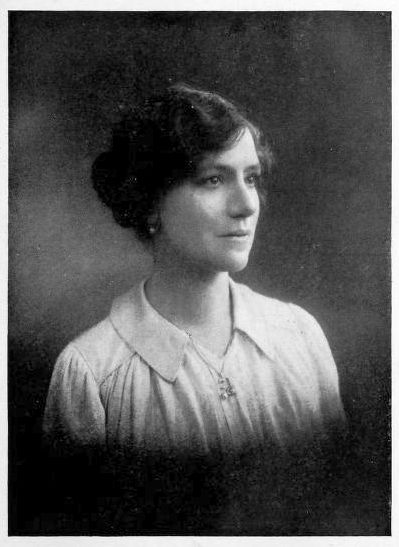
MRS. LEWIS.
But Mrs Lewis brought me back to Jermyn Street and my object in going there by telling me at the lunch-table in the grey dining-room that all the members of her kitchen brigade are girls, that she was going presently to take me down to show me them at work, and that Margaret, who is twenty-six years old, was responsible for the lunch we were going to eat, even to the pommes soufflés, and she further declared her entire belief that it was more satisfactory to have an accomplished woman cook than an accomplished chef in a kitchen; for the women are more resourceful, are less apt to make difficulties, and grumble less at their work, but that, on the other hand, they are as a rule more extravagant than the men cooks, for they do not understand the economic side of kitchen finance.
And very excellent indeed Margaret's handiwork proved to be. Our first dish was of grilled oysters and celery root on thin silver skewers, and then came one of those delicious quail puddings which are one of Mrs Lewis's inventions and for which King Edward had a special liking. There was a whole quail under the paste cover for everyone at table, with a wonderful gravy, to the making of which go all sorts of good things and which when it has soaked into the bottom layer of paste makes that not the least delicate part of the dish. Had not a turn of the conversation taken Mrs Lewis off to a description of how beautiful the twins just born to a member of the aristocracy are, I should have liked to have heard more concerning King Edward's tastes in cookery, for no one, except, perhaps, M. Ménager, who was his Majesty's chef, knew them better than did Mrs Lewis, to whom many an anxious hostess entertaining Royalty for the first time has looked as her sheet-anchor. A turn of the conversation brought up the name of the Duke of Connaught, who, I know, has the same admiration for Mrs Lewis's handiwork that the late King so often expressed. Another appreciative monarch for whose appetite Mrs Lewis has catered is the Kaiser, for she ruled the kitchen at Highcliffe Castle during the Emperor's stay there of three weeks. A personal gift of jewellery marked H.I.M.'s approval.
Mrs Lewis lays it down that three dishes are the right number at any lunch, for she, like all other really great authorities on gastronomy, is opposed to a long menu; but she, as great authorities sometimes do, broke her own rule in giving us, after the quail pie, a dish of chicken wings in bread-crumbs and kidneys before the pears and pancakes, an admirable combination, with which our lunch ended. After lunch Mrs Lewis took the little gathering that had congregated about the lunch-table for coffee down in the lift to her kitchen, a splendidly airy and spacious one, running the full length of the three houses, and with its windows opening out on a courtyard at the back. It is as cheerful and light and as well ventilated a kitchen as I have seen anywhere. The rooms which should be cold for the keeping of provisions are just at the right temperature, the lines of pots and pans shine brilliantly, and bustling about were half-a-dozen girls of all ages, from the light-haired Margaret, head of the kitchen, to a little girl of fourteen, the youngest recruit, all wearing the white caps that men cooks wear, which form a very becoming head-dress. And Mrs Lewis, talking of "my girls," as she calls them, told me that she was a year younger than the youngest of them when she first, with a pig-tail of hair down her back, began to learn the art of cookery in the kitchen of the Comtesse de Paris, and she added that she could show me the character she received from her first place when, as a beginner, she was earning the large sum of a shilling a week. Her second place was with the Duc d'Aumale at Chantilly, and the first kitchen over which she had complete rule was that of the Duc d'Orléans, when he was at Sandhurst. She at one time controlled the kitchen of White's Club, and Mr Astor, both at Hever and in London, puts his kitchens in Mrs Lewis's charge when he gives his great parties.
No cook with her training completed leaves Mrs Lewis's kitchen for another place at less than £100 a year, but her girls are never anxious to go elsewhere, which I can quite understand, for they seemed a very happy family down in that cheerful, airy kitchen.
And presently in the tea-room I gained Mrs Lewis's undivided attention for a minute or two and drew from her some opinions as to the changes in dinners that she had noticed since she first began to rule the roast. One difference is a matter of finance, that people in Victorian days were quite content to pay three guineas a head for a dinner, but that now hostesses bargain that their dinners shall not cost them more than a guinea a head. Dinners have become much shorter, but people in society have a greater knowledge of gastronomy than they used to possess. In past days a small jar of compressed caviare was all that was needed for a dinner-party; nowadays a large bowl or jar of the fresh unpressed caviare is required. People were satisfied at one time with half a stuffed quail, but now a whole roasted quail is the least that can be set before any one person. Again, in times now past, a sliced truffle went a long way, whereas now each individual guest likes to have a whole truffle "as big as your fist" offered her or him.
And, making the most of my opportunity, I asked Mrs Lewis what was the time-table of her day when she went out to cook one of those dinners that have made her so famous. It is a very long day's work. She is at the market at five a.m. to buy her material; at seven her staff is ready to help her in her own kitchen, and she begins with the last dishes of the dinner, preparing the sweets and ices; next she turns to the cleaning and preparation of the vegetables, and then to the materials for the soup and the making of the cold dishes. By one o'clock the meats and birds are all prepared for the cooking, and at six all the things to be cooked at the house where the dinner is to be given are put in hampers and taken over there.
To step for an evening into command of a kitchen, very often over the heads of one or two men cooks, is not always an unmixed pleasure, and Mrs Lewis, who has a very keen sense of humour, told me some of her experiences in some kitchens which will make very amusing reading if ever she writes her reminiscences, as she should do. Sometimes she is asked to build up a tent for some great dinner, which she is ready to do, and she often furnishes it, and ornaments its walls with china and pictures. Sometimes when a host or hostess wishes to entertain many guests to dinner and a ball Mrs Lewis takes a big vacant house and furnishes it for one night, in all the rooms that are seen, as completely as though its owners were still occupying it. "I have made almost as much in the past year out of my gold chairs and my china as I have out of my pots and pans," she told me. She has a little army of devoted waiters who have been at her call for twenty years and who are always ready to serve under her banner.
A menu of one of Mrs Lewis's ball suppers, at Surrey House, may well find a place here. She, I believe, first made the great discovery that young men who have danced an evening through prefer eggs and bacon and Lager beer in the small hours of the morning to pâté de foie gras and champagne:
Chaud. Consommé de Volaille. Cailles Schnitten. Poussin à la Richelieu. Poulet grillé, Pommes soufflées. Froid. Petites Crabes. Homard. Truite au Bleu. Poularde en Gelée. Dindonneaux Hezedia. Canard pressé en Parfait. Bœuf et Agneau à la Mode. Mousse de Jambon en Belle-Veu. Asperges. Fraises du Bois Monte Carlo. Mélange de Fruits. Pâtisserie. Café Noir (à deux heures). Grenouilles à la Lyonnaise. Œufs pochés au Lard. Rognons grillés. Pilsener Lager Beer.
She has cooked dinners for the regiments of the Household Cavalry when they entertained a sovereign; when a good fellow, now dead, kept open-house for all his friends in the club-room during Warwick Races, Mrs Lewis undertook the difficult task of providing the best of lunches for an unknown number, and she has contracted for many of the feasts of the great Government Departments.
Mrs Lewis has the artist's appreciation of a critical judgment of her handiwork, but to cook a dinner for people who cannot understand its excellences is, in her opinion, like "feeding pigs on mushrooms." There is not one iota of jealousy in Mrs Lewis, for when I told her that in my opinion she held, as a woman ruler of the kitchen, a parallel position to that which M. Escoffier holds as a man, she told me how much she admires the great French Maître-Chef, not only as a great cook, but as a great gentleman.
Before I left the Cavendish Hotel Mrs Lewis showed me some of the rooms, and when I was loud in praise of the perfect taste and the happy combination she has achieved of keeping all the charm of the fine old chambers and yet adding to them all the modern conveniences, she laughed, told me that she had been her own architect, added that it was not an expensive education that had enabled her to do all this, and likened herself in her apprentice years to the little girl of fourteen whom we had seen down in the kitchen.
L
THE RÉUNION DES GASTRONOMES
Of clubs formed for the noble purpose of eating good dinners—clubs that have no club-houses—there are very many. Sometimes there is a literary tinge as an excuse for the dinners, sometimes a Bohemian, sometimes a Masonic. But there are two dining clubs that deserve especial recognition in a Gourmet's Guide, for they are clubs of professional gourmets whose business concerns the organisation of good feeding. One of these clubs, which held its annual dinner this year in the new banqueting-room of the Piccadilly Hotel, is the Réunion des Gastronomes. This association consists of proprietors, managing directors and managers of hotels, restaurants and clubs. It holds meetings to discuss and take action in all matters which concern the prosperity and welfare of the gastronomic art, and once a year its members and their guests banquet at one of the hotels or restaurants which are represented by members of the Réunion. I have been fortunate enough to be a guest of late years at many of these banquets, and look back with pleasure to the feasts held at the Hyde Park Hotel, at the Café Royal, at Prince's Restaurant, and other temples of gastronomy.
Two lifts take banqueters down from the entrance hall of the Piccadilly Hotel to the ante-chamber of the new banqueting-room somewhere down in the bowels of the earth. The new rooms are below the grill-room, and the Piccadilly must have almost as much depth below the street level as it has height above it. The ante-room is classic in its ornamentation, is white, or a very light grey, in colour, and its decoration is elaborate. Here, between eight o'clock and half-past eight, some three hundred Gastronomes and their guests assembled, and I received a warm welcome from Mr Louis Mantell, of the National Liberal Club, the hon. secretary of the society, and from Mr J. L. Kerpen, of the Hyde Park Hotel, the president of the society, who was wearing his jewel of office, hung by a gold chain round his neck. Colonel Sir William Carington, the hon. president of the society, was to have taken the chair at the dinner, but a bereavement prevented him from being present, and the president of the year presided in his place. I found pleasant familiar faces all about me. There were, amongst many others, Mr Judah of the Café Royal, M. Soi of the Savoy, M. Kramer of the Carlton, M. Jules from Jermyn Street, M. Gustave from the Lotus Club, Mr George Harvey from the Connaught Rooms, M. Luigi of Romano's, Mr Edwardes, M. Pruger from the Automobile Club, M. Boriani from the Pall Mall, Messrs Harry and Dick Preston up from Brighton, and scores of other pleasant acquaintances. At the half-hour punctually, a young toast-master with a most majestic voice announced that dinner was served, and the three hundred of us made our way next door into the new great banqueting-room that was receiving its gastronomic baptism.
It is a fine spacious room, though its construction is rather curious, for, no doubt owing to exigency of space, the roof of a portion of it is comparatively low, though the major part is quite lofty. It must, however, have admirable ventilation, for at no period during the evening did the room become uncomfortably warm or the atmosphere uncomfortably smoky. The colouring of the walls is of stone with a slight tinge of chrome. Round a portion of the hall runs a gallery with a handsome railing of black and gold, and a double staircase at the end of the room leads up to this gallery. The ceiling is ornamented with fine paintings of gods and goddesses in the clouds; there are large mirrors on one side of the room and, in spite of the different heights of portions of the ceiling, the acoustic properties of the great hall are excellent. An admirable band, the leader of which I think I remember as a solo violinist on the stage, played us in to dinner and made music during dinner, there being loud calls for M. Boriani, the Caruso of the gastronomic world, when a selection from La Bohème was played.
A long table ran the whole length of the room, and smaller ones branched off from it like the prongs of a rake. The tables were decorated with flowers of all shades of crimson and flame colour, and the effect was quite beautiful. This was the menu of the dinner, and the manager of the Piccadilly and the chef were both warmly congratulated on a most admirable feast. Following the menu are the wines which accompanied it:
Caviar Frais d'Astrakan. Blinis. Tortue Claire. Délices de Sole au Coulis d'Ecrevisses. Selle de Chevreuil Grand Veneur. Purée de Marrons. Suprême de Volaille Princesse. Neige au Champagne. Reine des Prés en Cocotte. Salade Trianon. Rocher de Foie Gras à la Gelée au Porto. Vasque de Pêches aux Perles de Lorraine. Corbeille d'Excellence. Croûte Piccadilly. Fruits. Moka. * * * * * Zeltinger Auslese, 1906. Niersteiner Rollaender, 1911. Volnay, 1903. Ernest Irroy and Co., 1906. Giessler and Co., 1906. Bouget Fils, 1906. Château Pontet Clanet, 1895. La Grande Marque (60 years old) Specially selected for the Gastronomes' Dinner. Liqueurs.
The crawfish sauce with the filleted sole was of a most delicate taste; the venison admirable; the volaille princesse a most dainty dish of fowl, and the quail, the "Queen of the Fields," admirably plump little fellows. The foie gras, served in the shape of a circular fort, I did not taste, for I had already dined very well. The vasque de pêches was one of those combinations of fruit and confitures and ice that are now so popular.
With the coffee came the Royal toasts, and then the cigars, and as the smoke curled up and the liqueurs were brought round the musical programme which had been arranged commenced. A gentleman in Highland costume assured us that the joys of lying in bed were greater than the joys of getting up in the morning, and a young lady with a fascinating dimple sang "You Made Me Love You," to the three hundred of us.
"The Guests" was the next toast, to which Dr O'Neill responded, thanking the professors of gastronomy for the patients who so often came by means of gourmandise into the hands of his profession. Then after "Snooky Ookums," by another fascinating lady, who wore a large red feather in her hair, there was a little ceremony which delighted the Gastronomes and their guests very much. It was a presentation of a handsome silver-gilt cup on behalf of the Réunion des Gastronomes to their hon. secretary, Mr Louis Mantell, to whose cheery management of the feasts so much of their success is due. The whole company united in singing "For He's a Jolly Good Fellow," so as to give Mr Mantell time to collect his thoughts before acknowledging his Christmas box in the shape of a cup.
Some good stories from Mr Cooper Mitchell, a little more oratory, though speeches at the Gastronomes' banquet are always kept within the shortest space, and with more songs, a very merry evening ended. If future banquets in the Piccadilly banqueting-hall are all nearly as successful as the first one held there it will become a hall of good will and good fellowship as well as a hall of good cheer.
LI
THE LIGUE DES GOURMANDS
Saint Fortunat has deposed Saint Laurent from his position as Patron Saint of Cooks. Saint Laurent was an impostor in the matter of gourmandise for he owed the proud position he occupied for so many centuries as the Patron of the Chefs to the exceedingly uncomfortable position in which he met his martyrdom. He was broiled on a gridiron. Saint Fortunat not only thoroughly enjoyed good things to eat and drink, but wrote excellent Latin verses in praise of gastronomy, some of which M. Th. Gringoire, the secretary of the Ligue des Gourmands and the editor of the Carnet d'Epicure, a clever Parisian journalist who has settled in London, has translated into flowing French verses. Saint Fortunat was the father-confessor to the Queen-Saint Radegonde and to Saint Agnes, and these two ladies, the first of the cordons-bleus, prepared ragoûts and friandises for the holy man, who thanked them in poetry. He died in the odour of sanctity as Bishop of Poitiers.
The Ligue des Gourmands, which is the association of the great French chefs in London, and whose president is Maître Escoffier, the eminent chef of the Carlton, celebrates the feast day of the Saint, in December, by a banquet in his honour. The dinner in 1913 was the second of the St Fortunat banquets and the fourteenth feast held by the Ligue.
The Ligue has branches pretty well all over the world wherever there are French cooks. If London, under the presidency of M. Escoffier, takes the lead with sixty members, Paris comes a good second with forty-three members, and Marseilles, New York and Montreal tie for third place, with twelve members each. Brussels has a group of six members, and there is a forlorn hope of five devoted French chefs in the heart of the enemy at Berlin. Delhi and Dakar, Constantinople and Ajaccio, Bombay and Gumpoldskirschen, Lowestoft and Lahore, Shanghai and Syracuse, Yokohama and Zurich, and a hundred other towns are advance posts of the Ligue, and wherever there is a group of the leaguers they and their guests eat the St Fortunat dinner, the menu of which is composed by M. Escoffier, and the recettes of the especial dishes in which are sent in advance to the members before the Saint's day. In 1913 the most important dinner of the Ligue next to that held at Gatti's was the one at Paris, where the leaguers dined together at Paillard's and sent congratulations to their brethren in London.
M. Jean Richepin, the great French poet, is bracketed with M. Escoffier in the presidency of the Ligue, and many of the dishes that M. Escoffier has invented for the feasts of the Gourmands are named after celebrities in art and letters. The fraises Sarah Bernhardt, which was the surprise dish of the first dinner of the Ligue, has become a household word in all the restaurants of all the nations. M. Escoffier is no believer in keeping his inventions as secrets de la maison, and his recettes for the dinners of the Ligue are always published both in French and English, in the Carnet d'Epicure, which is the mouthpiece of the Ligue.
In this open-handedness and open-mindedness, M. Escoffier is very wise. I always assure ladies who ask me to obtain for them recipes of various dishes, and remind great chefs when I beg recettes from them, that it is not so much the ingredients of a dish as the hand of the cook that makes a masterpiece. No painstaking amateur, following exactly the directions given by a master of the art, ever reproduces a chef-d'œuvre, any more than an amateur painter, copying the work of some great master of the brush is able to obtain that master's effects.
The dish that M. Escoffier had invented for the Dîner St Fortunat in 1913 was the cochon de lait St Fortunat, with pommes Aigrelettes and sauce groseille au Raifort.
We, the hosts and the guests, began to assemble at eight o'clock in the ante-room half-way up the great staircase on the King William Street side of the Adelaide Gallery. The great cooks are not so selfish as many other banqueters are, for they welcome ladies to their feasts, and very pretty indeed are most of the chefs' wives and daughters, and cousins and aunts, who grace these feasts. No one, unless he knew who the members of the Ligue are, would tell by seeing them as they gathered for their banquet what their profession is. M. Escoffier, the president, with thoughtful eyes and gentle expression, looks, as I have, I know, before said, like an ambassador or some great painter or sculptor. M. Cedard, the King's chef, who is usually at these feasts, but who was absent from this one, looks like an attaché of an embassy; M. Malley, of the Ritz, has the appearance and the aplomb of an officer of Chasseurs à cheval, and so on through the whole list. Some of them, of course, are the plump and rosy gentlemen that artists love to draw presiding over pots and pans, but great cooks are not all run into one mould, either in figure or in intellect. And the guests of the Liguers vary in type, as the Liguers themselves do. I shook hands on Saturday night with distinguished soldiers and their wives, with bon-vivants, with proprietors of restaurants, with representatives of the great champagne firms of Rheims, with journalists and authors who are epicures, with doctors who do not practise themselves in the matter of diet all that they preach to their patients.
The banqueting-room at the Adelaide Gallery holds comfortably one hundred and fifty diners, and we must have been quite that number, for more gourmets wished to make trial of the sucking-pig of the Saint than it was possible to find room for, and though as many tables as possible had been put into the space M. Gringoire had to refuse tickets to would-be diners who had postponed the request until the eleventh hour.
Soon after half-past eight, which is the dinner-hour of the Ligue—for the great chefs like to see the dinners from their kitchens well under way before they change from their professional white clothing into dress clothes—we streamed up the stairs from the ante-room into the banqueting hall—a fine room, with a musicians' gallery occupied for the occasion by an Hungarian orchestra in hussar uniform, and with, for this especial occasion, the French and the English flags draped together at each end of the room. A long table ran the full length of the room, and from it jutted out smaller tables, each presided over by an officer of the Ligue.
When we were seated I could see some faces of well-known chefs whom I had missed in the press downstairs. There were there, besides the names I have already mentioned, M. Aubin, of the Russell Hotel; M. Espezel, of the Union Club; M. Briais, of the Midland Hotel; M. Grunenfelder, of the Grand Hotel; M. Vicario, of the Carlton; M. Müller, of the Hyde Park Hotel; M. Görog, who was one of the four founders of the Ligue; M. Génie, of Prince's Restaurant; M. Ferrario, of Romano's; M. Vinet, who was for many years chef at "The Rag"; Mr Coumeig, chef to the Duchess of Marlborough; and M. Saulnier, sous-chef of the Piccadilly, a rising star. If all these names are not French names, those amongst the chefs of the Ligue who were not born in France have, by adopting the cult of the Haute Cuisine Française, become naturalised Frenchmen in gastronomy.
There are various little ceremonies observed at the dinners of the Gourmands, one of them being that at the commencement of dinner a member of the Ligue rises and reminds his fellow-members that only French wine should be drunk at these banquets. Another little ceremony is that each dish in turn is announced by the toast-master—of course, for this occasion a Frenchman—who rolls his "r's" with fine resonance as in a thunderous voice he tells us what we are going to eat.
This was the menu with Escoffier's signature appended to it:
Crêpes au Caviar frais. Huîtres pimentées. Croûte au Pot à l'Ancienne. Turban de Filets de Sole au gratin. Chapon fin à la Toulousaine. Cochon de Lait Saint-Fortunat. Pommes Aigrelettes. Sauce Groseille au Raifort. Bécassines Rosées. Salade Lorette. Pâté de foie gras. Biscuit glacé Caprice. Mignardises.
The caviar and the little pancakes are always delightful, and the croûte au pot à l'Ancienne, in its delicate plainness, always makes an excellent beginning to a dinner. The gratin with the sole made it a rather drier dish than fish dishes usually are, and I know that this was the criticism passed on it by the president of the Ligue, but it was very excellent to the taste. The chapon, with its rich sauce, was admirably cooked, and served in dishes with at either end heads of fowls admirably reproduced by the sculptors in the kitchen, and then to a triumphal march from the band a little sucking-pig, its crackling golden from the fire, was brought in processionally and shown to the chairman of the feast and the guests in general before it was carried out to be carved. And very admirable the flesh of this piglet and his companions was when brought to table, with round each dish apples in their skins, the top of each apple being cut off to serve as a little lid. A sharp-tasting sauce, in which the flavours of red currant and horse radish mingled, formed an agreeable bitter-sweet. What the various ingredients were that formed the admirable stuffing of the little pigs I do not exactly know, but there were barley and chestnuts amongst them, but, like all good stuffing, one flavour after another chased each other over the palate. M. Escoffier's own criticism on his own creation was that a sucking-pig is more suited for a petit comité than for a large gathering; but, though I quite agreed with him that the right party in numbers to eat a sucking-pig is just that number that one sucking-pig will satisfy, I think it very hard luck if greater numbers were to be prevented by this very fine distinction between a dish for a dinner-table and a dish for a banqueting-table from eating a very great delicacy. The snipe and salad, the pâté de foie gras, served on a great bed of crust, and an admirable ice, finished the banquet. Then came the after-dinner ceremonies and songs, which at these feasts are varied and lively. The toast of "The King" and "The President," with the two National Anthems, was followed by a little discourse in honour of the Patron Saint by the chairman, who coupled the name of the saintly patron of gastronomy with those of his two continuateurs, the great poet and the great chef, and to this speech M. Escoffier replied with great modesty. The toast of "The Ladies" next brought all the male guests to their feet, and then followed the hymn to St Fortunat, sung by a gentleman from the musicians' gallery, with orchestral accompaniment, the guests taking up the refrain:
"Saint Fortunat, honneur à toi, O notre chef! O notre roi! Saint Fortunat!"
If the leaguers were a little slow in picking up the air and paid very little attention to the time, the heartiness with which they chorused the Saint's name made amends for any other shortcomings. "The Ligue," "The Visitors," "The Press"—for whom Mr John Lane, of The Standard, returned thanks—and "The Cuisine and Wines of France" were toasted by various orators, some of whom spoke in English, some in French. And then M. T. Fourie, the chef of the Adelaide Gallery, bearded, and blushing in his white uniform of the kitchen, was called up to the high table that the president of the Ligue and the chairman of the dinner might shake him by the hand and congratulate him on the admirable feast which he had prepared. This is a very pretty little ceremony always observed at these feasts, and a very right one, for at most banquets the chef who has been the cause of so much pleasure to the guests is not asked to come in person to receive the thanks which are so legitimately due to him.
After this ceremony the concert, an Anglo-French one, commenced. Mademoiselle Suzanne Ollier, Miss Marianne Green and Miss Winifred Green, of the Gaiety, Mademoiselle Bianca Briana, and Miss Mabel Martin all sang charmingly, and were presented with bouquets on behalf of the Ligue, and M. Siffre, the president of the Club Gaulois, sang "Margot" quite excellently, without an accompaniment. He was presented with a cabbage stuck on a fork, for the leaguers dearly love their little jokes at their banquets. At last the band played the Père la Victoire march and the National Anthem, and the dinner came to an end.
In gratitude to M. Escoffier, the president, to M. Th. Gringoire, the secretary, and to all the members of the Ligue for being permitted in their company to taste for the first time the sucking-pig of St Fortunat—a dish that will go the round of the globe—let me quote a few words appropriate to the occasion from Charles Lamb's prose Hymn of Praise in honour of roast pig:
"Pig—let me speak his praise—is no less provocative of the appetite than he is satisfactory to the criticalness of the censorious palate. The strong man may batten on him, and the weakling refuseth not his mild juices."
LII
THE CAVOUR RESTAURANT
FOR AULD LANG SYNE
I head this chapter "For Auld Lang Syne," for the future of the Cavour Restaurant has been, since the death of Philippe, who brought the restaurant into celebrity, uncertain. The Cavour has been put up of late years once to public auction and bought in, and there have been rumours without number that this, that and the other actor-manager was going to purchase the building.
In spite of all these rumours, the Cavour still continues in the hands of Mrs Dale, who was manageress under Philippe in old days, and to whom he left the property, just as it used to be in Philippe's time, which is to say that it is one of the best bourgeois French restaurants to be found in London.
Every Londoner knows the white-faced restaurant almost next door to the Alhambra in Leicester Square. It is one of the few restaurants that still retains a bar, though it is nowadays called a buffet, and the three-and-six dinner which is served in the restaurant is still as it used to be, a most excellent meal, unstinted, well cooked, and all its material of excellent quality.
The bar of the buffet has always been a favourite resort of actors, and it was there that I first heard Arthur Roberts tell the story of "The Old Iron Pot," a tale the success of which led to the invention of the game of "Spoof," that masterly feat of bamboozling the guileless which gave amusement in the eighties to all Bohemia and added a new word to the English language. The Old Iron Pot figured largely in a tale which Arthur Roberts never wearied of telling to "Long Jack" Jarvis, another actor. No one ever heard the beginning of the tale, for it was always well in progress when the victim of the harmless pleasantry came on the scene. Arthur was so intent on the story, the other conspirator so immensely interested, that the new-comer was at once interested also, dispensed with all greetings, and tried vainly to understand all the ramifications of the story into which new characters seemed constantly to come, and which all revolved round an old iron pot. Jack Jarvis apparently thoroughly understood the story, occasionally asked questions, and now and then corrected Arthur Roberts as to the relationship of the various characters, and the other listener very soon found himself pretending that he too comprehended all the twists and turns.
Somehow or another, in those days the spirit of harmless practical joking seemed to be in the atmosphere of the Cavour bar. Perhaps it was, because in the days when Leicester Square was a waste ground with the damaged equestrian statue of George the Third in its midst some practical jokers sallied out one night from the little restaurant which occupied the site of the bar, to play the best practical joke of the last century. They painted the statue's horse with red spots, put a fool's cap on the statue's head, and a long birch broom in the hand which should have held a field-marshal's baton.
Philippe was the one and only waiter in those days at the little restaurant which was kept by a Frenchman and his wife. Next door, and extending behind the restaurant, was a tin shanty, where judge and jury entertainment was held and poses plastiques were exhibited. It was a disreputable place, for Brookes, who was its proprietor, and who had been associated with "Baron" Nicholson at the Coal Hole, had not the Baron's wit, though he had the same flow of doubtful oratory.
When the old couple died, and Philippe succeeded to the business, he soon bought up the tin shanty and the ground belonging to it, built the Cavour as it now is, the bar occupying the site of the original restaurant, and made a little garden on the space now occupied by a cinema show.
Of this little garden Philippe was very proud. He liked to be able to go out of his restaurant and pick a bunch of mignonette to give to any lady, and he grew some vegetables and oranges there as well as flowers. He had an eye also to the main chance, for when anyone pointed out to him that he was wasting a valuable site by making a garden of it, he nodded his head, and replied: "The earth he grow more valuable every day."
Philippe, short, grey-haired, with a little close-clipped moustache, always wearing a turned-down collar and a black tie, had a very distinct personality of his own. He was a first-class man of business, was up every morning at five o'clock to go the rounds of the market, riding in one four-wheeled cab, with another one following behind, into which he put his purchases and brought them home with him. He had no love for teetotalers, and he budgeted for the very liberal dinner of the house on the understanding that his customers should drink wine therewith. When he found that some of the guests were drinking only water, he used at once to send a waiter to them or to talk to them himself, and to tell them that he would charge them sixpence extra. After a time he found it entailed less loss of temper to notify this on the bill of fare, and the Cavour menu still bears the legend: "No beers served with this dinner. Dinner without wine, sixpence extra."
The restaurant of the Cavour is a large white room, with a smaller room, also white, running back from it. Access to the big room is obtained from Leicester Square by a narrow corridor decorated with allegorical figures of the various months of the year—awful daubs, whoever it was who painted them. The big room is lighted from above by a sky-light, and there are large globes of electric light in the ceiling. There are many large mirrors let into the walls, and down each side of the room run brass rails for hats and coats. There is oilcloth on the floor, with strips of carpet over it in the gangways. The waiters go to a bar near the entrance door for the wine and other drinkables, which are served out there by Mrs Dale, or by her deputy. Some of the waiters, mostly French, were in the restaurant for many years under Philippe, but there is a new manager now with a curled-up black moustache.
If any of the habitués wish to entertain guests to an elaborate dinner at the Cavour, the custom is to pay five shillings instead of three-and-six, and certain extra dishes are put into the dinner of the day for this price. The ordinary dinner, however, is so good that these additions are hardly needed. This is the menu of a three-and-six dinner I ate at the Cavour this winter. It is served from five to nine, so as to meet the convenience of all the patrons of the restaurant, from the actor who makes a hurried meal before going to the theatre, to the City man who comes in very late after a day of hard work and goes home after his dinner:
Hors d'œuvre variés. Soup. Consommé de Volaille à la Royal. Crème à l'Indienne. Fish. Boiled Turbot au Sauterne. Fried Fillet of Plaice. Grilled Herring. Entrée. Filet Mignon aux Haricots panachés. Calf's Head à la Reine. Roast. Chicken. Quails on Toast Salad. Cheese. Dessert.
There was a fine selection of hors d'œuvre to choose from, and plenty of each, not the one sardine looking lonely in a little dish, the two radishes and the potato salad that so often are the sole representatives of the first course at cheap dining-places. I was given a big plateful of good thick mulligatawny soup, and when I had eaten the very liberal helping of boiled turbot, excellently firm, I felt that I had finished quite a good dinner. However, I summoned up enough appetite to dispose of the little vol au vent put before me, the pastry of which was noticeably excellent, and then attacked a quail, which was quite a good bird, even if it had not those layers of fat which distinguish a "special" quail on a club dinner list from the ordinary one. A scoop from an excellent Stilton cheese ended my repast.