Front matter (continued 2)
Reading edition
Suddenly she shot an arrow more strongly than its fellows, and it fell behind a low wall which guarded a small garden belonging to the chaplain of the prison.
"Go, boy," she said, "you can climb the wall and find the arrow."
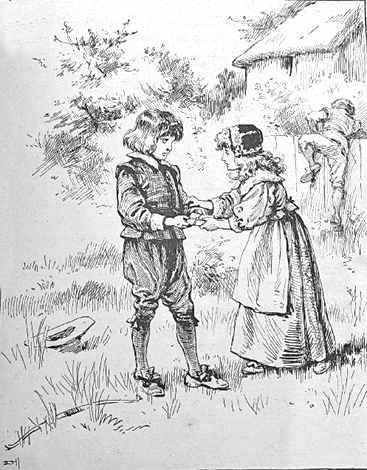
He ran to do her bidding, and was quickly lost to sight behind the wall. There was nobody on all the green but the two children. The little maid turned upon Giles and beckoned him to her side. With an eagerly flushed face he came, quivering all over.
"Giles," she said very solemnly, "do you love me?"
"With all my heart and soul!" he answered with breathless fervour.
"Would you like to do something for me?"
"I would love it, little lady."
"But suppose they killed you dead for it?"
"Let them!" cried Giles, "I would not care one whit!"
"Giles," she said, slipping a letter into his hand which he instantly hid in his doublet, "if you can give this letter to my dear father in the prison, they say he will be able to get out, and his head won't be cut off. But if anybody else finds it, they will kill him, and you too. Boy, do you dare do it?"
"Of course I dare. I would die for you, little lady, or for anybody you loved. I will give him the letter. If they kill me for it afterwards, I shall not mind."
Patricia's little face suddenly quivered all over.
"Boy," she said, "O dear, dear good Giles, I don't want you to be killed—I don't indeed. I love you next best to my father and mother—and the King!"
And she suddenly threw down her bow and clasped her little arms about Giles's neck, and pressed a kiss upon his lips.
Giles walked on air as he went homeward that day. Whatever else betided him his little lady had kissed him: she had given him a share of the love of her little childish heart.
* * * * *
Long years afterwards, when King Charles the Second had been brought triumphantly back to his kingdom, and exiled cavaliers were flocking joyfully to these shores, a beautiful lady, traveling with her husband and parents, stopped their coach at a certain town where a grim fortress dominated the dwellings of the inhabitants, and asked if one Giles Dorman lived within its walls.
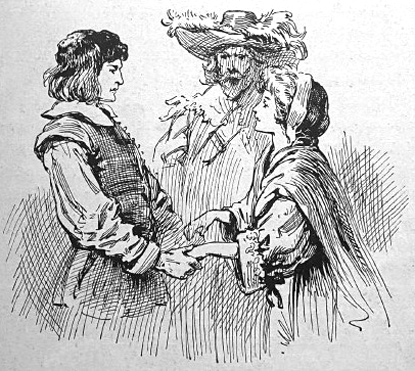
Before long a fine and stalwart man appeared, at sight of whom the young and lovely lady leaped lightly from the coach, and with a little cry of recognition stepped forward with outstretched hands.
"Giles!" she exclaimed, "do you remember me?"
The man's bronzed face flushed from brow to chin. He slightly bent the knee as those soft white hands met his own, and he bowed over them and touched them with his lips.
A fine-looking gray-haired man now stepped up, and laid a hand on Giles's shoulder.
"I must speak the words of thanks my daughter is scarce able to do, and tell you that our errand to-day is to ask whether you will accept the post of steward upon her estate; as she says she knows she will never find anyone to serve her so faithfully and so well as Giles, the jailer's son, of whom she has never ceased to talk in terms of gratitude and praise."
She looked at him with eager eyes. Times had not been very kind to Giles. He had grown up under a cloud of suspicion since the escape of a certain prisoner. His face lighted as though a sunbeam had touched it. The clouds were all rolling away.
"You will come then, Giles?" spoke the lady with kindling eyes.
"I will come with you to the world's end—and be your faithful servant ever. I ask nothing better," said he.
E. Everett-Green.
A Ride for Life
"YOU'RE not afraid?" said father, turning at the door of the hut to give me an anxious backward glance.
"Now, Dad, what should I be afraid of?" I answered, "there's no one near to hurt me, except Deerfoot, and you don't suppose he would harm me?" and I laughed right merrily, for I had known Deerfoot ever since I had been a tiny little girl, and father and mother and George and I had come to live out in the forest.
Now father and I were the only two left, for mother was dead and George had left home the previous day on his way to New York City, where he was to be given a place in our uncle's office.
Father was a little disappointed in George I think, and no one knew how dreadfully I missed my quiet, studious brother. He was slight and delicate and looked little like a farmer's son; but I knew that he had a heart of gold, although he could not bear a farmer's life, and father sometimes laughed at him for a molly-coddle.
On this particular day father had to go a long way off into the forest to superintend the felling of a number of trees, which would afterwards be floated down the river to the city.
"I shall hurry back," he said; "so have the kettle boiling about five o'clock, and take care of yourself, little one."
I had a great deal to do and the morning passed quickly enough, so that I never even guessed it was past dinner time until my healthy appetite warned me. Then I sat down and made a hearty meal, and was just about to clear away the dishes when something happened which startled me very much.
There was a sudden "whir" and a blood-stained arrow came flying through the open door and quivered in the wall behind me.
At first I tried to persuade myself that Dad had come home early and had done it by way of a joke; but the sight of the arrow tipped with a white feather dyed with an unmistakable red, made me turn pale and shudder. Father would never play me a joke like that. I went out to call Deerfoot; but he was nowhere to be seen, and then it occurred to me that I had not seen him all the morning.
What could it mean? I walked about the outbuildings, calling to him, but I was afraid of the sound of my own voice. I opened the stable door, and Hector whinnied with pleasure, and shook his bridle invitingly. But why was Hector bridled, and saddled? Suddenly it occurred to me that some danger really menaced, and this was Deerfoot's warning. In a flash I remembered the tales I had heard as a child of Indian risings, and I remembered father's troubled face that morning. I had laughed at fear then; but now it held me in its grip. I dare not stay in the quiet house, and I led Hector out into the open, sprang upon his back and was off like lightning for the clearing, where I hoped to find father.
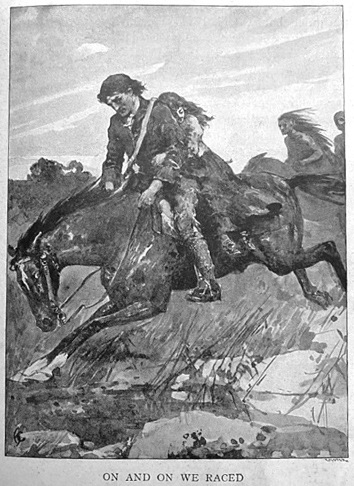
ON AND ON WE RACED
I was only just in time, for I had scarcely got right away when I heard a yell, and, turning in the saddle, I saw a party of howling and maddened Indians riding towards our home.
I waited to see no more, but rode on and on for dear life towards the clearing. I had not gone far when I met father.
"Why, dearie, what's wrong?" he cried. "I was cowing home early, for those red rascals never turned up to-day, and so I only marked the trees I wanted felled."
"Oh, Dad," I gasped, "there's a rising—I know there is—and they're going to murder us!"
I told him briefly all that had happened, and without waiting for comment, father mounted Hector, whilst I clung on behind him, and the good beast was urged to its utmost speed.
A smell of burning and a glare in the sky told us that our home was in flames, and by and by a distant yell of triumph warned us that the Redskins were on our track.
Father said not a word, but by the beating of his heart I knew he had heard. On and on we raced, but the horrid yells, came nearer and nearer—the Indians were gaining on us. Now they were close behind; an arrow whizzed past us, and I closed my eyes, hoping death would come swiftly.
But now an answering yell arose, this time a shout of wild encouragement, and it came from a white man's throat I knew. I still kept my eyes tightly closed and clung to father's belt; but suddenly I felt Hector being wheeled round, I was swung to the ground, and opening my eyes, I saw I was in my brother's arms. He placed me behind a mound, and from there I watched the fierce and terrible fight which took place, and saw our foes completely routed and put to flight by the little band of white men whom George had brought to our rescue.
When it was all over, George told us that at one of his resting places news had been brought of the murder of a family of white people by the Indians, and, fearing for our safety in our lonely home, he had persuaded a party of men to return with him to bring us away until the rising, if rising it proved to be, had subsided.
Well, they had only been just in time, and indeed, if it had not been for Deerfoot's friendly warning to me, both father and I must have perished.
The poor old fellow had been loyal enough towards us, and had tried hard to persuade the chief to spare both us and our home but when he saw that if he persisted in his entreaties he would be suspected of being a traitor to his own people and would probably lose his life at their hands, without benefiting us, he determined to warn us of the danger which threatened us.
As his friends suspected him of some such intention he was watched, and could not, therefore, approach the house closely, though he had managed to let fly the blood-stained arrow, hoping we should read its message aright.
I am glad to say he came to no harm during those troublous times; but lived to serve us faithfully for many a long year.
As for father and George, they were brought very near together in that terrible fight; for father learnt what a brave fellow he had for a son, even though he would not be a farmer.
L. L. Weedon.
A Debt Paid
CAPTAIN AYRES sat in his hot little tent, writing. Outside there was the breathless stillness of a June night in Burmah, and the heavy, soaking, ceaseless rain had given him a touch of fever. For weeks he had been leading his little force from point to point on the track of the dacoits, or robber bands, and he was thoroughly disheartened, for they had never yet had the least chance of a fight.
He was a police officer, and a very brave one, and was particularly anxious to capture one of the head-men of the dacoits, just to make certain that it could be done.
He wrote a little bit, and then stopped, and then wrote again. Outside, the bright camp-fire crackled and sputtered, as the natives squatted round it, and threw on the logs and damp leaves. Nearer still, quite close to the entrance of his tent, he could see, between him and the fire, a curly black head, laid upon a pair of folded arms. Really, there seemed nothing to say—nothing, at least, that would interest his mother, who knew very little indeed about dacoits, and would probably hardly understand what he meant if he wrote about them.
He stretched out his legs, and yawned, and his sword, which was leaning against the table, fell to the ground with a clatter. As it did so, the little brown imp in the doorway rose hastily and almost fell into the tent.
"Master."
Captain Ayres looked round impatiently.
"Boots! you here? You ought to have been asleep hours ago; go away at once."
The little brown face grinned delightedly.
"Me stay by master," he said. "All chaps go to bed. Mangwee keep watch with master."
"No, you don't," said Captain Ayres decidedly. "Mangwee go to bed with all chaps, or he get bamboo stick in the morning."
The little brown face clouded over.
"Master, the dacoits all round. Master keep me, I keep master."
He spoke very earnestly, and pointed vaguely beyond the tent, but Captain Ayres laughed.
"I wish the dacoits would come, old chap," he said; "but there's no fear. Off with you!"
The boy tumbled out of the tent again; and pulled down the curtain as he went, but Captain Ayres had plenty to tell his mother now. His pen flew over the paper.
"In one of our raids on a village last week, I found the prettiest brown boy in the world. His people are dacoits, and he thinks his father has been killed. He knows a funny sort of broken English, and he has devoted himself to me. He was nearly starving when we found him, and I had to carry him eighteen miles into camp. He never leaves me, and I have just had to chivy him off to sleep. He hates bed just as much as Polly and Margey do, but he goes much more obediently. It is such dull work! I wish these dacoits would come, and give us . . ."
He stopped abruptly, for a brown hand crept inside the curtain, and an anxious round face peered after it.
Captain Ayres seized his revolver, and started to his feet, but he dropped it again with an angry laugh.
"Boots, get out of this!"
"Master—dacoits."
"Nonsense!" said Captain Ayres. "Don't you know, boy, that the camp is guarded, and there are outposts all round? If you don't do as I tell you at once, I shall make a prisoner of you."
He looked sternly at the eager face, out of which the eyes shone like stars. He saw a dull look of disappointment fall like a veil over his features, and then the brown shadow seemed to fade into the darker shadow of the tent. Boots had gone.
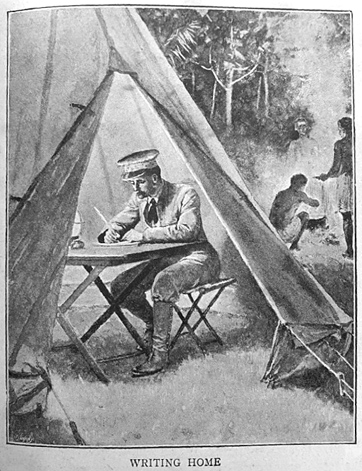
WRITING HOME
Gone for the night, it seemed; but the look in his face haunted the Captain. He picked up his revolver and loaded it, and then he drew his sword nearer, and carefully removed a spot of rust, for when once the rains come in Burmah it is almost impossible to keep steel in perfect order. He felt wide awake, and alert. His neat report—reporting nothing—lay folded on the table; the half-written letter to his mother lay staring at him reproachfully; the deathly silence outside was appalling. He pushed his chair back, lit his pipe, and loosened his sword-belt. He wished some of his comrades had come in, as they intended. He had an old pack of cards in his knapsack, and they might have managed to play dummy whist—anything would have been better than this idle loafing from place to place, with nothing to do.
His watch ticked loudly from the place on the tent pole where it hung. He leant forward and looked at it. A quarter to two—and at that moment a clear sharp cry divided the night, and sent the blood thrilling to his heart—a cry three times repeated, "Master! master! master!"
With his sword on, and his revolver in his hand, he had flung up the mat that formed the doorway in the hut before the echo died away. A dark compact body of police were forming into a square, the sentries and outposts were challenging, a quick rain of shot was pattering on the leaves, and the little camp was alive with the steady tramp of armed men. It was a most successful little fight, and Captain Ayres won the first of his many medals on that night. He took the head-man prisoner single-handed, and many of the dacoits were killed, while many more were conducted by the courageous little force into Mandalay, and were delivered up to justice. But when it was all over, and the day had broken, showing the gloomy details of the fight, Captain Ayres, pale and dishevelled, with his broken wrist tied up in a pocket-handkerchief, wandered over the ground, disconsolate and wretched, looking always for something he could not find.
It was Boots, of course; but no one could find Boots, not though the Captain offered fifty pounds out of his own pocket for the discovery. The small company of English soldiers, with two officers, and a doctor, arrived in the early morning, but Ayres was intractable; he would not sit still for a moment, or eat, or smoke, or behave in the least like a reasonable being.
"I knew Boots' voice," he said huskily, "and I am sure the brutes murdered him. He tried to warn me—he knew his own tribe, you see—but I wouldn't believe him, and he saved the camp at the sacrifice of his own life."
"Perhaps he went off with this tribe," someone suggested.
"I am sure he didn't," said Captain Ayres sharply. "However, we must strike tents and go. Poor Boots!"
And would you like to know where Boots was all the time? He was hidden close in the folds of Captain Ayres' own tent, where they found him lying insensible, with a dark wound on his bare, brown breast. Not a fatal wound, I hasten to tell you unless you should feel unhappy about him; for Boots has grown up into a faithful servant, and has often since then recklessly offered his life in defence of his master. He wears a coat now, because he is a respectable member of society, and also because his medal obliges him to do so.
Captain Ayres had plenty to add to that eventful letter to his mother, but he had not time to do so for nearly a week afterwards. He wrote:—
"Boots has distinguished himself. The dacoits came in the dead of the night, and sneaked past the sentries, and meant to rush the camp, but Boots was one too many for them. They tried to silence him, but he shouted to me, and roused the camp, before they put a spear into him. He is doing well, and has been recommended for a medal, and so am I; but the honour and glory are all to Boots!"
Geraldine R. Glasgow.
The Tale of Prince Tatters
ONCE upon a time, a very long while ago, there was a little boy named Tatters, or at least, folks called him so. Nobody knew his real name, for, several years before, he had been left one winter day outside an old woman's door. The old woman didn't like children. She was very cross at first, but then she said, "He can work for me, if the worst comes to the worst."
This old woman was really a witch: and every day she grew still uglier and crosser, the more black magic she knew. Tatters did all the work, and got nothing but beatings and blame. Whether he did things wrong or right, she beat him just the same.
One day she went to gather various herbs and flowers, and she said, as she locked in Tatters, "I shall be at least two hours. Chop the wood, draw water, and clean the kitchen floor. And don't you touch the plants in the pots—I've told you that before."
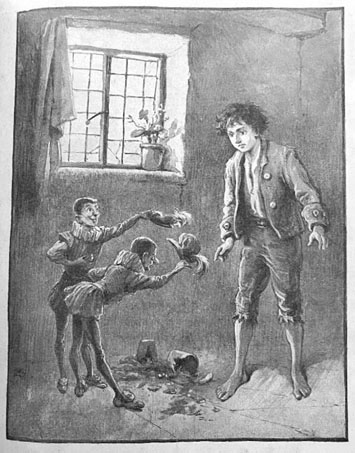
These plants were in the window; one had a yellowish bloom and the other a pale pink blossom, with very sweet perfume. And when poor Tatters had done his work he went and stood by their side. He thought "they're the only nice things in the house," and when he thought that, he cried, and his tears fell on the plants in pots, on the yellow one and the pink and suddenly there was a crack and flash—and oh, what do you think? There stood two little fairy men, in pink and yellow and green, smiling very happily where the plants in the pots had been.
They said, "O, Tatters, you've set us free, and we'll help you now, if we can. Don't be frightened, we're your friends. Our names are Spick and Span. Do you know who you are, Tatters? You really were born a Prince, but you were stolen away from home, nearly nine years since."
Just then there came a tap-tap-tap, the sound of the witch's crutch. She saw the broken flower pots, and screamed "Have you dared to touch?" but before she could say another word, Span blew on her—puff! double-quick, and she found she couldn't speak or move. How she glared at him and Spick! Then they took her crutch, which was really a magic wand, and waved it, and said "Take us straight away to the Farthest Back of Beyond!"
And a beautiful Golden coach drove up, that very minute: and Spick and Span and Tatters immediately got in it. And they rode to Tatters' palace; you can just suppose with what joy the king and queen, his father and mother, welcomed their long lost boy! And Spick and Span went home, to the side of a fairy hill.
But the old witch stayed as they left her: and no doubt she stays there still.
May Byron.
Lost on the Fells
IT was a soft Autumn day—and the dying grass looked yellow on the fells. Beyond, and above them, the mountains rose in great wide sweeps, with misty caps hiding the summits. Down in the village street a woman was standing in the doorway of a small house with a little girl.
"Just take her a bit of a run, Harriet," she said to an elder child, who was standing patiently in the roadway, "but don't tire her, like a good little lass—nor yourself neither—you know your way over the low fell, and you'll be back by tea-time. The washing'll be done by then, and I won't say but what you'll find a cake in the oven."
Harriet took the child's hands, with an air of serious responsibility—she might have been seventy instead of seven—her odd little face, with the wide eyes and puckered forehead, belonged to another race from her mother's round freckled comeliness—her large mouth was always serious, but was sweet and calm.
"It's all right, Mother," she said; "you go right in and do the washing, and Sally and me, we'll have a fine time on the fells."
They were half way down the street, when the mother called them back.
"You won't be late, loves—you know I'm a bit of a fidget!"
Harriet nodded vigorously—she was afraid her voice would not carry so far. And so they turned the corner and were out of sight.
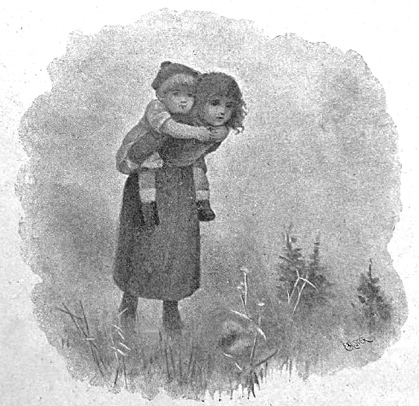
Sally skipped along up the gradual slope, shouting with glee, and Harriet sauntered after her, bathed in the Autumn sunlight, pausing every now and then to eat some blackberries, or to gather a spray of crimson and yellow leaves, which looked like gold against the other faded tints. On and on they went, until they were round the hill on the narrow sheep-walk, with rough stones sticking up out of the grass on either side—the sun had gone behind a cloud, and Harriet looked up suddenly and saw that the soft white mist was creeping down the mountain side, and blotting out every jutting peak and shining slope as it came. It grew so dense about them presently that it felt like a fine, soft rain, and a little wind blew it in the children's faces. Harriet looked up and round her, and shivered. "Come, Sally," she said, "it's very thick up the mountain—we'll run down the way we've come—Mother's got a cake in the oven at home."
Sally came reluctantly, with her hands full of treasures—"Mayn't we go round the other way," she said; "Mother said so."
Again Harriet looked up. The mist was closer now, pursuing them; out of it patches of grey stone shone like gold, telling that the sun was still behind the mist, but round their feet everything was white and shapeless. They started running, but in a few minutes they had to go more slowly, stumbling over crags and stones—leaving the path and creeping back to it again by devious ways. Denser and denser grew the mist, and very dark, but still they hurried on breathlessly.
"We must be nearly home now," said Harriet.
"Nearly home," echoed Sally, "I'se very tired."
Harriet paused abruptly, and knelt down.
"Get on my back, Sally," she said, "your poor little legs are not as long as mine. We'll be home in no time."
She struggled to her feet again and crept slowly on, with the heavy child clinging to her neck. Once or twice, a sort of wild fear took possession of her, and she stopped and called, but her shrill little voice did not carry far, and the thick fog isolated them. On and on she struggled wearily, with the white mist on her hair and eyelashes, panting and distressed, until at last she could go no further. She knew that it was evening, because the mist was no longer white but heavy grey, and when Sally rolled on to the ground, she lay where she had fallen, half asleep, with her cold little legs tucked under her.
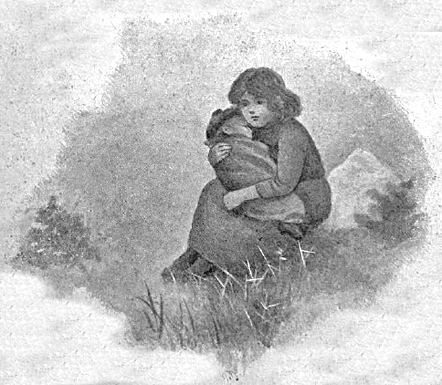
"It's no use," said Harriet, "I've lost the way. It's hours and hours since we began to walk, and there isn't a sound. We'll just have to wait a bit till the fog lifts."
She took off her scanty petticoat and slipped it over Sally's legs, and wrapped her tightly up—then she sat down on the path, with her back against a stone, and took the whimpering child on to her knee, holding her close, so that the damp wind should not strike her. By and bye she sang a sort of crooning song, rocking the child in her tired frozen arms, until she fell asleep, and lay quite still. Perhaps she slept too—she was never quite certain, but suddenly it seemed quite light, and there was a red harvest moon lighting up the heavens, and myriads of stars sparkling on the mountain top like a crown. She was sitting right on the path, just where they had been when the mist came down—here was the blackberry bush—there the jutting rock—they must have wandered all round the mountain and come back again to the starting-point.
Harriet stretched her stiff limbs and staggered to her feet, but Sally would not wake, so presently she gathered her up again, and went slowly down the hill, sobbing and panting under her heavy burden, pausing every few minutes to rest and breathe.
When she got down into the village street, it seemed alive with men. The doors were all wide open, and there were lanterns everywhere. At her Mother's door there was a silent group, with the minister in the midst, and as Harriet pushed her way through they fell back and made a passage to her Mother's side. She was sitting on the step, with her face hidden, and her hair disordered.
"Mother," said Harriet, in a sobbing voice, "we're back safe."
The woman started to her feet, and took them both into her capacious arms. She was trembling so much that she could not speak.
"She hasn't got cold, Mother," said Harriet eagerly, "feel her feet—they are as warm as toast."
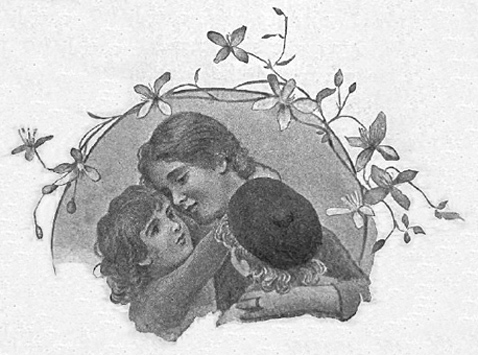
"Oh, my dear, my dear," said her Mother.
"And she hasn't got tired neither," went on Harriet quietly. "I've carried her all the way."
"And you?" said the Minister. He had come to the front, and was beaming on her through a pair of gold-rimmed spectacles.
"I? Oh, I?" said Harriet, staring—"I'm a big girl—there doesn't need no one to mind me—Sally's a baby."
The minister looked from the rosy face cuddled to the woman's bosom—back to the wide uplifted eyes that stared at him out of a thin, cold face.
"Your mother is a happy woman, Harriet," he said. "To tell you the truth, if I hadn't heard it from your own lips, I should hardly have known which was the baby."
"Oh, sir," said Harriet, with a trembling voice.
"Only judging by the size, my dear," he said hastily. "Judging by the spirit, and the heroism of it, there can be no doubt at all."
Geraldine R. Glasgow.
Printed in Bavaria.