Front matter (continued 6)
Reading edition
She shrugged.
"With regret, with impatience, but without tenderness, mon brave. Do you suppose that I cannot see? I am merely an impediment. I hold you back while you long to be off yonder--to escape and leave me here----"
"Zoya----"
She laughed and rose.
"Beware of the fury of the woman scorned, mon vieux. Tell me that you love me, tell me that you hate--but indifference--that, at least, I will not bear!"
There was nothing for it but to mollify her. He put his arm around her and kissed her.
"Hang it all, Zoya! You ought to know me by this time," he muttered. "Desperation and sentiment won't mix. I'm not going to be caught here if I can help it----"
She relaxed a little in his arms.
"Philippe," she murmured, "you know the worst of me. Don't judge me with those terrible accusing eyes of yours. I want to begin--again. Give me my chance to forget. I love you, mon Philippe, since the first----"
She paused, startled, for Rowland had released her suddenly, a warning finger at his lips. And then they heard clearly again a thin voice in the hallway below, a man's voice that they both knew--and the sound of footsteps upon the stairs.
The color had all gone from Zoya's cheeks and she stared helplessly at Rowland.
"Von Stromberg!" he whispered.
He snatched up his cap and vanished out of the window into the darkness upon the roof. Hurriedly he crawled up astride the peak of the dormer window where he lay forward listening.
A loud knock upon the door.
"Where is this sick lady?" said the voice. "I would like to see her----" A pause, and then, "Ah! And so it is you after all, Madame Rochal! This is most extraordinary--most extra-or-din-ary!" He caressed the words as if they were something good to the taste. "You have nothing to say. You are very pale. I have frightened you? I am sorry. Bitte, lie down again upon the bed from which you have arisen and be quite composed. I will not harm you. Why should I? Did you not vote for my wonderful resolution? Ach so!"
The tones of the voice were eloquent--cynical and soft by turns, and Rowland did not need to see the cadaverous, leering face, the air of sardonic condescension, the deep baleful eyes which glared and charmed by their very malignity.
"Ach, you are feeling better, nicht wahr? A swallow of water. So. We will now have a quiet amicable chat. Will you not ask me to sit down? Will you not ask after my wound? I have no wound," he laughed dryly. "Herr Rowland is a bad shot. Danke. But if there is one thing in the world that irks me, it is the climbing of stairs.... Now we will begin. Will you now have the kindness to tell me how you managed to come here...?"
A low murmur scarcely distinguishable in reply.
"Over the roofs? Wounded? There is some negligence here. My men searched." And then more quietly, "You were always resourceful--most resourceful, Madame. Wounded too. That is a pity. I trust not seriously.... That is good. It would be a pity.... Your beautiful neck, in a ball dress. But it is not possible that you could have accomplished this escape alone.... In the storm! ... a desperate venture...."
Rowland heard her murmur again.
"Ach. It is unbelievable. Alone--you, Madame ... so frail--and wounded, too."
"I was hurt and frightened, Excellency," Rowland heard her say as her voice gathered strength. "But it was not difficult."
"Very easy. So. It is a pity I am such a credulous old man, nicht wahr? I am growing old. I am losing my cunning. What a pity!"
"I tell you the truth, Excellency."
"You surprise me. But I am suspicious. It is my trade--to believe in the universality of the lie, which is the basis of all successful intrigue. You will pardon me, Madame, but I do not believe you." And then in a quick concentrated tone, menacing--vicious, "Who helped you across those roofs, Madame? Herr Rowland, nicht wahr?"
"No."
"Herr Rowland----!"
"I did not see him."
"You lie! Answer me."
"Excellency! You are hurting my arm."
"Answer me."
A long silence, then a murmur of pain.
"You shall----"
It was with an effort that Rowland controlled his will to descend ... but he clutched at the tiles and did not move.
"Ach, so----" came the triumphant voice. "It was he----"
"But he has escaped--gone yesterday. I swear it!"
"So--and the black bag? It was here? Answer me!"
"Yes, it was here."
"And Fräulein Korasov----?"
"She, too."
"A nice party--and they have all escaped? Some one shall suffer for this."
Rowland could hear him stamping to and fro, heard his voice at the window, while he peered out and Rowland had even prepared to risk discovery by crawling up to the shelter of the chimneys above, when Von Stromberg turned back into the room again. Rowland heard him call to the man in the corridor who had accompanied him and between them find the loose boarding into the loft. And after a while the malicious voice again.
"So it was there he slept? While these pigs of officers played tag upon the roof tops." And then to the soldier, "Go. Wait below!"
Just above his head, Rowland grinned to himself and breathed more freely. Luck! Sheer luck!
There was silence in the room for a long moment.
"So! Escape--and you have helped to accomplish it. Accessory to treason, Madame. You know the penalty of that."
"Excellency, I had nothing to do with it. I was under the influence of morphine. I slept."
"You do not then know how it was accomplished?"
"No, Excellency----"
A silence and then the quiet tones that were so dangerous.
"It will not pay you to be stubborn, Madame. It is my habit always to find out what I want to know----"
"But if I am ignorant----?" she appealed.
"Who is this Herr Markov who occupies this room? Markov! A name not unfamiliar. Markov!"
She was silent.
"Who is he? Speak!"
"He is--my husband, Excellency."
Rowland heard the thin raucous laugh.
"You lose a lover only to find a husband! A real husband? The long arm of coincidence? Or another lie?"
"The truth----" in a lowered voice. "I had not seen him for years."
"Well, and if--I believe you? Herr Markov helped our birds to escape?"
"We came. What could he do? Give me up to the police after all these years----?"
"But--the others--the black bag----"
A silence, and then----
"Have I not told you, Excellency, that I was sick--sleeping----?"
"You have told me many things. I shall believe what I choose. How much of this did Frau Nisko know?"
"Nothing--except that I had come to him. She did not know how. She believed that I came up the stairs. We all shared the food of two. The others went out into the streets at night and escaped----"
"With the black bag? Impossible. There is not a black suit-case in Germany that we do not know about."
He broke off suddenly and a change came into his voice.
"Come, Madame. You and I have worked together before and you have not found me ungenerous. I will make a bargain with you. Help me to find the black bag and I will give you--say--two hundred thousand marks. Ah, you are tempted? The woman who is tempted falls."
"I know nothing," she murmured.
"Perhaps three hundred thousand will sharpen your intelligence."
He laughed and chose another method.
"How was the money taken from this room?"
"I do not know. At night while I slept."
"Who took it?"
A long silence. And then another change of tone.
"You are young, Madame, and still beautiful. It would be a pity----"
She understood what he meant.
"Excellency!" Her tone was raised now in fear, in horror. "What, Excellency?"
"Death! Tomorrow!" The words fell from his lips sharply. "Will you speak or will you not? On the one hand--what I have promised--on the other--a military trial--a matter of minutes, and then--a stone wall--a volley--and a tumbled heap of soiled clothing upon the ground. Zoya Rochal--the most beautiful woman in Europe. I paint a true portrait. I have seen----"
"Excellency----!"
"You will speak?"
Her voice had sunk to a murmur and Rowland could not distinctly hear but he felt suddenly very ill. She was telling. Zoya was betraying Tanya and Matthias Markov. A sudden fury possessed him. He gripped the tiles in a struggle to control the impulse to murder that was in his heart. But the fever passed. Tanya! He must get word to Markov--a hurdy-gurdy--a donkey--their trail from Munich was wide and long and the expedient that had seemed so certain of success was now doomed to sudden disaster unless he could reach Markov before von Stromberg's men were put upon the track.
Did Zoya know which way the pair had gone? He tried to think. Only Markov and he knew the itinerary--he listened intently.
"I do not know, Excellency," said Zoya in a suppressed voice. "I do not know more. To Switzerland, by the nearest route. A piano-organ, a donkey. You promise?"
"Herr Markov and the Fräulein shall meet with no harm. I give you my word, as Councilor of the Empire. He shall go free. For your sake I will merely send him to Austria and you----" He broke off with a laugh, "You, Madame, shall have the rest of Europe to yourself."
"Thanks, Excellency," she murmured. "And I am free?"
"As the air. Once a day you will report at the Police Headquarters of Munich until further notice."
Rowland heard his footsteps and the sound of the door latch.
"My compliments, Madame Rochal, upon your discretion. I hope that your beautiful neck may not be scarred. I will indeed see that a doctor is sent to you at once. In the meanwhile--au revoir."
The door closed with a bang and Rowland heard the heavy footsteps going down the bare stairs. And in a little while from a perch in the shadow of the dormer window he marked the tall figure with his soldier attendant enter an automobile and drive swiftly away.
Rowland waited a moment, desperate--uncertain--sure only that he must find some means of getting a message over the wire to the luckless Markov and Tanya at Weingarten, where they would have arrived tonight, but in a grim apprehension as to his ability to reach a telegraph office. But there was no time to delay. The moments were precious. In half an hour--perhaps less--Von Stromberg would have instructions wired to his agents in every town between Munich and the Swiss frontier. And so, reckless of his silhouette as he crawled in at the window, he again entered the room. Zoya was standing, facing him, pale, expectant, terrified at the look she saw in his eyes. She caught at his arm but as he strode to the door she seized him again and held him fiercely.
"Where are you going----?"
"Away from here--from the sight of you----"
"You heard----?"
"Yes. You've betrayed us--for money----"
"That is not true, Philippe," she whispered wildly, as she fought to keep his hand from the door knob. "You did not hear what passed----"
"I heard enough----"
"I lied to him,--told him that you had gone. He believes it----"
"But the others. You told----"
"It was merely to gain time. They are far away. We can reach them. It was you that I was thinking of--you--all the time. You--out there on the roof. All that I wanted was for him to go away so that you would not be discovered. I did it to save you----"
"To save me--you!"
"I threw him off his guard. He believes that you are gone. You shall escape now,--I too--we will escape to freedom--in a few days it will be arranged. Herr Markov and the Fräulein will come to no harm even if they are found. He promised. You heard?"
"I've heard enough. Let me go."
He shook himself free of her but she seized him again.
"No--you shall not go. I did what I could to save you. I told him as little ... merely that they had gone upon the road ... that was all. His eyes were burning into my brain, Philippe. He compelled me. He may not find them. And even if he does, he will not harm them. It is only the money of Nemi that he wants. That will satisfy him. Let the money go. What does it matter now? I do not want the money--I only want--you, Philippe. In a few days I will get you passports and we will leave together. Not tonight, Philippe--wait. I will explain----"
"Out of my way----"
He had pulled the door open and thrust her aside. She stumbled and fell to her knees, still clinging to him.
"I will not--let you go. You will be killed. Just a moment. Listen to me, Philippe. I swear to you that you have misunderstood. I did not---- Oh God!"
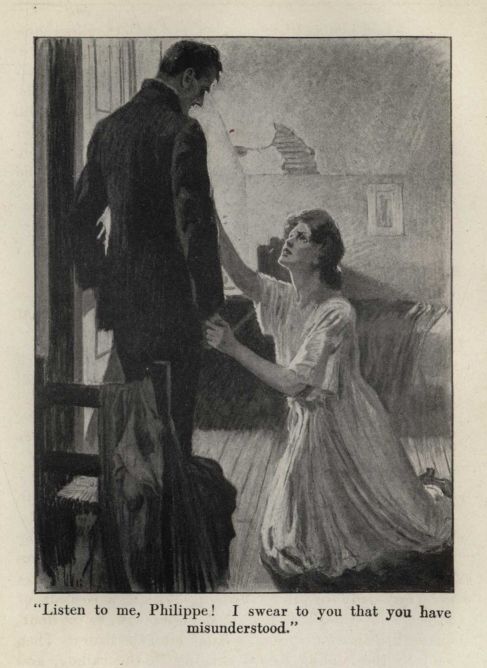
"Listen to me, Philippe! I swear to you that you have misunderstood."
He drew away and she fell prone upon the floor, trying to follow him. His fury had turned to contempt and now to pity. He turned, picked her up in his arms and carried her to the bed, releasing himself gently, for she had no more strength to fight him. And then he left her and went slowly down the stairs.
For a while she lay there motionless, her head buried in her arms. Once her shoulders moved convulsively but she made no sound. Her face when she raised it toward the candle light was haggard, but tearless. Her lips were compressed and she even smiled a little. But her eyes were unusually bright. With an abrupt movement of decision she straightened, and getting up went to the door, where she paused a moment, gazing down the stairs. Then went to the landing below, clinging to the railing, and called Frau Nisko. There was no reply. She crept down to the lower floor and out to the kitchen. There was a woman there by the window fanning herself with a newspaper.
"Where is Frau Nisko?" asked Zoya.
The woman turned a heavy bovine gaze.
"She has gone," she replied.
"Where?"
The woman shrugged.
"Did a man come in here a while ago?"
"A man--yes."
"They talked?"
"Yes--yonder," pointing to the door of the dining room.
"Did they stay there long?"
"Yes."
"Where is he now?"
"I do not know. He went out yonder," pointing to a rear door.
"There is a gate at the rear?"
"Oh, yes."
"Did you hear what they said?"
The woman laughed mirthlessly.
"What business is it of mine?"
"Where has Frau Nisko gone?"
"Have I not said that I did not know?"
She had merely the politeness of cooks and now turned her back resolutely, faced the window and fanned herself again with a view to ending the discussion.
There was nothing for it but to await Frau Nisko's return and so, leaving word that she wished to see the landlady when she returned, slowly Zoya climbed the stairs again and went into her room, where she sat on the bed in deep thought. After awhile she got up and lighting the lamp, searched for her clothing in the drawers of the dressing stand. She took the garments out one by one, examining them and preening them with her fingers. Then, discarding the old wrapper that she wore, she dressed with some care and attention to detail, and then lay down upon the bed and waited.
But when Frau Nisko knocked some moments later, she straightened and questioned rapidly.
"Herr Rowland has gone?"
The woman was somewhat shaken by the events of the evening and more than surprised at Madame Rochal's appearance.
"Yes, God be thanked! He went safely from my house. It has been almost too much. But the Herr General said nothing when he went out. I can't understand----"
"I explained matters to his satisfaction. He will not bother you----"
"You are very kind--but it mystifies me greatly. You are in terror of your life in one moment and then suddenly--all is well. And now you go somewhere----?"
"Frau Nisko," said Zoya, ignoring the question, "you were sent out with a message to the telegraph, nicht wahr?"
"It was at Herr Rowland's orders----"
"What was the message?"
"I didn't understand. It was written in a code."
"He wrote it--here?"
"Down stairs in the dining room. It was dangerous to be there. I told him so. But he did not care."
"What did the message say?"
"It was about the price of some second-hand furniture to be shipped to Weingarten."
"Yes, yes. Where was it sent?"
"To Weingarten----"
"But to whom?"
"To a Herr Liedenthal at the Zweisler Waldhaus----"
"Ah. You are sure of the names?"
"Positive."
"And Herr Rowland, did he tell you where he was going?"
Frau Nisko's amazement had been increasing.
"Did he not tell you, Madame?"
"No. He--he was frightened at the Herr General and has left me. Where did he go?"
"Into danger, I'm afraid. He seemed reckless. He asked if I knew the time of the night-trains for Lindau----"
"Lindau--and you told him?"
"I found out from a lodger upon the second floor who is in the Railway Service. There is but one train. It leaves the Haupt Bahnhof at thirteen minutes past eleven."
Madame Rochal hesitated a moment, and then:
"Frau Nisko," she said, quickly, glancing at her watch, "I have been given my freedom. I am going out. I do not know when I shall return----"
"But Herr Markov----!"
"I will communicate with him."
She glanced around the room and then went quickly down the stair, Frau Nisko following, still bewildered at the turn of events.
"What shall I say to Herr Markov?" she repeated helplessly.
"That I--I am going to seek him," said Zoya.
"And if the Herr General should send?"
"You need not worry. That has been arranged. He believes that you knew nothing of the others. Good by," she finished at the street door. "You shall be rewarded----"
"Im Himmel," muttered Frau Nisko cynically, as she watched the slim figure of Zoya Rochal go swiftly down the street toward the bridge. "And Matthias Markov--he also."
Then she slowly turned and reëntered the house.
CHAPTER XXII
PILGRIMS
It was with trembling limbs and a heavy heart that Tanya had followed Herr Markov carrying the black bag down the stairs of the house in the Schwaiger Strasse, through the rear door to the small street and the stable which sheltered Fra Umberto and the "instrument of torture"--alas! now the instrument of torture no longer, for all its insides had been removed during the early afternoon and hidden in a box under a pile of hay. Herr Markov had sighed as he gazed at the empty case, but there was no time to be lost and after having assured themselves that they had escaped observation, Tanya had unpacked the black valise, transferring its contents to the body of the machine and concealing the luckless bag in a dusty crib under a pile of lumber. Then as they wished to be well beyond the city before sun-down, Markov had hitched Fra Umberto, Tanya had clambered in, sitting on the pile of bank notes and they had silently driven away.
The escape had seemed simplicity itself, and with the passage of the last post of soldiers at the edge of the city Tanya had gathered hope that their perilous venture would be successful. She had tried not to think of Philippe Rowland. She had hoped when their plan was first spoken of, that Rowland was to impersonate Herr Markov, and using his papers make the desperate effort to get through to Switzerland alone with her. But Herr Markov had willed otherwise (and wisely perhaps) and Philippe had been left there--alone with Zoya--sharing a terrible danger, but yet terrible as the danger was, Tanya could not help thinking that she would much have preferred anyone else to have shared it with Philippe than Zoya Rochal.
During the first night of their pilgrimage Tanya had been very miserable. The confined space had cramped her muscles and the jolting of the vehicle seemed to be jarring every nerve in her body, but Herr Markov had evidently deemed it of the utmost importance to cover as many miles away from Munich in the early hours of the evening and night as was possible for man and beast. Occasionally, when the way was clear, he had conversed with her cheerfully, bidding her keep up her courage and asking after her comfort; and to all of his questions she had answered bravely, changing her position as she could and patiently awaiting the hour of her deliverance. And it had come at last toward midnight when Herr Markov had halted the donkey and invited Tanya to get out of her box. The invitation, welcome though it was, had not been easy of acceptance, and it was only with the help of Herr Markov's long arms that she had been able to climb over the sides of her prison and descend.
She had found herself in a dim country lane which led to a small farm-house. With an encouraging show of confidence Herr Markov had led Fra Umberto toward this building and after some difficulty had succeeded in arousing the occupants, an old man and woman, who had stuck their heads out of the windows in some alarm until they learned the identity of the pilgrims and saw Fra Umberto and the hurdy-gurdy, when they had come down and made the visitors welcome. This house, it appeared, was one of the stopping places of the hurdy-gurdy man, the old farmer and his wife, his good friends, for whom in better times he played his whole repertoire in payment of board and lodging. Tanya's presence Herr Markov had glibly explained--his niece, bound to Leutkirch, to visit a sister who was about to be married, and so Tanya had found a bed of which she was in real need and had slept the sleep of utter weariness.
But Herr Markov had called her at daylight and they were now again upon their way. Fra Umberto's legs were short but they moved rapidly and in the by-roads and in thinly settled places the thoughtful Markov invited Tanya to descend which she did gratefully, glad of the chance to loosen the kinks in her cramped muscles. And when she got down, the donkey, relieved of her weight in the vehicle, frisked along at a rate which showed her that they had lost no time.
They went through Landberg, passed the night in another farm-house on the Igling road and by the following afternoon had reached Memmingen.
It was beyond Memmingen upon the road to Weingarten that Tanya, waiting for the darkness to fall so that she could escape from her hiding place, heard Herr Markov exchanging greetings with a traveler afoot. This was not unusual, for Herr Markov, as she had already discovered, carried his politeness all about the world with him, but Tanya, who had been sitting long in her cramped position, had been hoping to be able to get out and walk beside her fellow pilgrim, for whom she had developed the deepest sympathy and appreciation. But this person to whom he had spoken, it seemed, was bound in the same direction as themselves and all immediate chance of escape from her prison was out of the question. She heard the deep boom of Herr Markov's voice and a reply, quiet and muffled as though at a distance.
"A fine evening--yes"--said Markov. "A rare evening indeed which makes one bless God for a life in the open under the stars. You are bound for Weingarten, Father, or beyond?"
"Beyond," replied the quiet voice.
"Ah, yes--to the monastery at Rothenbach, perhaps? No? You will forgive my impertinent curiosity, but the road is my life and those who walk it are my friends and companions. We are sociable people, Father, Fra Umberto and I, and since one of us is denied the privilege of speech, the other of us must needs make up for the deficiency. You will forgive my wagging tongue?"
"It is my mission in life to grant forgiveness," said the other voice solemnly. "It is my trade, Herr Musician."
Tanya understood now--a priest, a holy man, a vagrant monk.
"Then we are much of the same mind," continued Markov, "for I, too, have forgiven much--my trade too," with a deep laugh, "but there is little profit in it."
"Not to the body, but to the soul--it is that alone which is immortal."
The voice came more clearly now and something in its cadences caused Tanya to listen more intently. It was curiously like one that she had once known; but where--when----?
"Aye, immortal----" went on Markov contemplatively, "but to a hurdy-gurdy man the seat of soul is in the stomach. For without food the stomach sickens and thus, the soul. What becomes of your immortality then, holy Father?"
She heard the priest laugh to himself--that laugh!
"Your philosophy and your theology are from the same piece of goods, my son. If it keeps you warm you are wise to wear it." And then in a change of tone, "You came along the Landberg road?"
"Yes, Father."
"You see many people. Has there been much talk about the rising of the Socialist elements in Munich?"
"You've heard----?" There was a pause, and then:
"Merely that a meeting was broken up--that there was shooting, a fire, people were killed and some of them--my friends--wounded. And you, Father--what have you been told?"
"The facts have been suppressed. The newspapers say nothing. You were not questioned by the police when you left Munich?"
"Oh, no. I merely showed my papers. I am well known in these parts. I--I had nothing to do with the disturbance, though my heart is with those who have rebelled--for I, too, am a Revolutionary."
"And since you left Munich--you have not been questioned?"
"No." And then, "You have heard that the police are after those who escaped?"
"Yes," muttered the voice.
No more for the present. And yet to Tanya what she had heard was enough, for the identity of the voice of the man she could not see had slowly come to her and now with a sickening and terrible certitude she knew that Markov's companion of the road was Gregory Hochwald.
The hurdy-gurdy was now an "instrument of torture" indeed, for in it Tanya sat a prisoner, helpless, while along side her, all unconscious of the secret Markov guarded, walked the one man most disposed to take profit from her misfortunes. And with a sense of an impending disaster she heard Markov talk glibly on, every moment, apparently, gaining more confidence in the integrity of his companion. And yet how was she to warn Markov? The least sound, the least motion would betray her presence and reveal the reasons for their flight. She had a morbid desire to peer out and see--to verify the unpleasant testimony of her ears--but there was no way unless she raised the lid of the machine and that, of course, meant discovery. And so she was forced to sit silent and listen to Markov, who with every moment came nearer to dangerous revelations.
"The end must soon come," the false priest was saying. "The world is weary of blood-letting. Germany is beyond reach---beyond help of the Church. I have done what I could, but I am going beyond its borders to Switzerland--to escape its persecutions. I have had enough."
"And I," said Markov; "it is there that I go too with--with my good Fra Umberto."
"The weather threatens again. Where shall you sleep tonight, my son?"
"At the farm-house of some good friends of mine, a mile or so from here. We have had a long day."
"Good friends of yours? Would they mind if I came with you? I have a purse well filled----"
Tanya was aware of Herr Markov's hesitation and the long moment of silence that followed gave her the hope that he would refuse.
"I am not so sure," he said at last doubtfully. "Have you no other plans?"
"None."
"There is an inn just beyond."
"But there are reasons why I do not wish to go to a public hotel. If you could help me in this----"
"But I can't understand----"
"Is it necessary that you should? I will pay you well for this service----"
Hochwald had struck the wrong note. Herr Markov's voice had a tone of dignity when he replied.
"I would require no pay, Father, for a mere act of Christian duty. But there are private considerations----"
"None so grave as my own need----"
"If you will tell me----"
Another long moment of silence. And then:
"I've told you that my need is great. When I also tell you that I am no priest but a fugitive from the police, you will understand. I was one of those who were at the meeting of the Socialists in the Hall in the Schwaiger Strasse----"
"You!"
"One of its leaders. In the confusion I managed to escape, and with the aid of a friend procured these robes. But I am in danger even now, and must avoid public places--which are, of course, subject to frequent inspection."
"What is your name?"
"That need not matter. If you are a Socialist--a Revolutionary Socialist, we are brothers, and I am in need of a place to rest safely."
Markov's voice fell a note as he replied:
"That puts a different color to the matter. I can help you--yes--if I know that what you tell me is true." Fra Umberto suddenly came to a halt--"How should I know," Markov said, "that you are what you claim--that you are not a member of the secret police of the Empire?"
Tanya heard Hochwald's laugh.
"The police! Then why except for the pleasure of your company, Herr Musician, should I be wasting my time talking to you?"
"H--m! You are frank at least, holy Father. Come--a drop of rain. We must get on. At least for tonight you shall have cover--in safety."
He chirped to Fra Umberto and the machine rumbled on again. Tanya, cold with fear of the consequences of this generosity, sat trying to think what she must do. And the result of her meditations was precisely nothing. To rise and denounce him would do her cause no good. And so she did not move, deciding to wait for what was to happen, trusting that the secret of the money which she and Markov shared would keep her companion silent as to her hiding place in the vehicle.
She heard the two men talking again, a repetition of what had been said before, but Herr Markov, in spite of his acceptance of the statements of Gregory Hochwald, gave her enemy no inkling of the truth and presently the piano-organ was driven into a rough road and at last stopped. She heard Markov calling--voices in reply and then his directions to Gregory Hochwald to go into the house while he drove Fra Umberto and the hurdy-gurdy around to the stable. It was there in the dim light of a lamp that Tanya, a very pallid, frightened but beautiful Jack-in-the-Box, pushed up the lid of the machine and emerged, confronting her weary companion with the specter of his mistaken generosity.
"He! That--Hochwald!" he muttered aghast when she told him. "Fräulein, you must be mistaken."
"No, no," she whispered. "I would know his voice among a thousand. My bitterest enemy--the cause of all our troubles."
"But you did not see his face."
"I did not need to see it, Herr Markov. You must believe what I say," she insisted. "It is the truth."
He only stared at her, as at a damage he had done. She could see that he was very tired. Since early morning, with but one period of rest, he had been upon his feet and the lines of weariness in his face and at his eyes were deeply scored.
"What could I do, Fräulein," he murmured. "I did not know and you----! Herr Gott! What a situation!"
"What had you planned?" she asked more gently after a moment.
"To tell him--yonder in the house," he said guiltily, "but I did not dare until I had spoken to you."
"That is impossible, Herr Markov," she said. "We must go on."
"Tonight?"
"Yes. You shall sit and I shall walk----"
"But it is raining----"
"We must go on----"
"But what shall I tell them yonder?"
"Tell them--nothing. Let us go." She had clambered down and stood beside him. He seemed bewildered by the disaster and when she caught his hand he pressed her fingers gently but aimlessly, as though their common misfortune had robbed him of all initiative. Tanya's voice aroused him. "Come," she urged. "We must go on--further."
"There is no one that I know within ten kilometers----"
"I can walk it. Get in, Herr Markov----"
She had caught up the reins of the unfortunate Fra Umberto and was about to turn the wagon when a heavy shadow from the lamp at one side of the door moved across the stable floor.
"I came to see if I----"
The monk paused and stood staring at Tanya in a kind of awe while she dropped the reins of Fra Umberto and started back, her gaze fixed on the black cowl beneath which was a pale smudge that she knew was Gregory Hochwald's face. Herr Markov looked from the one to the other in dismay and then took a pace forward toward the girl.
"You! Tanya!----" said Hochwald, coming slowly forward. "What are you doing here?"
She seemed unable to reply. The missing mustache revealed ugly lines she had never seen. He glanced quickly at the open top of the piano-organ.
"I see. You were---- You heard? You knew that it was I."
"I heard. I beg that you will let us be on our way."
"You were going--where?"
"Further on. Herr Markov has done you a service. Do me another by remaining here."
Hochwald hesitated a moment.
"I seek to do you no harm. Nor could I if I wished. I am at your mercy as you are at mine----"
"I beg your pardon, Herr Hochwald," broke in Markov's deep voice. "The Fräulein is at no man's mercy while she is in my charge."
"A figure of speech," said the other with a smile, "but I do not like to drive the Fräulein forth into the rain. Of course rather than that, I shall go at once--or sleep here with this good donkey in the stable."
Herr Markov and Tanya exchanged quick glances which each read through the gloom. Herr Hochwald asleep within a few yards of the twenty-five millions of Nemi, hidden beneath the blankets in the bottom of the "machine of torture!" It was Tanya who first realized that short of immediate flight nothing but a change in her uncompromising attitude toward Hochwald was possible.
"It--it does not matter. I--I do not fear you, Gregory Hochwald--not now. If you will go to the house I will follow you. Herr Markov can join us when the donkey is fed."
And with a quick glance at Markov she moved toward the door and out into the raining night. Hochwald joined her at once and together they walked toward the lights of the farm-house, leaving Markov alone to attend to the needs of Fra Umberto and hide until the morning the packages of bank notes in the straw of the stable.
Hochwald questioned and she answered frankly, telling him of the manner of her escape which was obvious enough, concealing from him only the secret of the hurdy-gurdy. As to Herr Rowland he was still there in Munich--in great danger.
There were no reproaches on her part--her injury was too deeply seated for that, his venality too surely proven. Nor did Herr Hochwald speak of the events at the Villa Monteori; but Tanya felt that since he had found her and that they must travel on for a way in company, some grounds of mutual agreement or understanding must be found which would disarm her enemy as to the precious freight in the piano-organ. And so when they reached the protection of the portico:
"This situation is none of my choosing, Herr Hochwald," she said. "We are both fugitives from a common enemy--if I denounce you, I denounce myself. But if we are both arrested it is you who will suffer the full extremity----"
"Perhaps----" he broke in quickly. "I don't minimize the danger of my position. In Germany my life hangs by a thread. It is the penalty of my zeal in the cause we both represent."
Contempt and surprise that he should have thought her so dull were what she felt, but she managed to meet his glance calmly, for she had much to gain but still more to lose.
"We need not go into that. We stand or fall together. Tonight we shall protect each other--but tomorrow--we part company."
"As you please," he said slowly. "I will do as you wish. You have suffered much because of me, Princess Samarov, and I because of you----"
"We are enemies--political--personal---- Let there be no misunderstanding."
"But you do misunderstand. You have misjudged me from the first----"
"Enough----"
"Will you hear me out? I will not be long. You do not believe me when I say that the money of Nemi was as safe in my hands as it would have been in yours. I mistrusted Herr Rowland--you did not. I knew that in Germany where I had power and influence, I could safely bring the money through to Russia--with you--and I should have succeeded had it not been for this cursed American who has spoiled all my plans and betrayed me to the Wilhelmstrasse, where my future usefulness in Russia's service is now at an end."
His impudence amazed her but she smiled at him coolly. "And you imprisoned me at Starnberg, subjected me to nameless indignities, swore falsely against me in the committee----"
"To save you from yourself," he broke in. "You are a woman, unwise, impressionable----"
"Thanks. But not so unwise that I can believe in you."
"That is cruel. But what I tell you is the truth. You do not know these people as I do. Do you think that I would dare confide the keeping of the twenty-five millions of francs into the hands of an organization which can be swayed as that one is swayed by the fear of military domination? You saw what happened. One man--Von Stromberg, held their destinies in the hollow of his hand----"
He noticed the slight shrug of her shoulder.
"You may believe my motives what you choose, but I have already written to Russia asking the release of your father. I swear to you that had I succeeded in deceiving the committee as to the whereabouts of the money--had not the American found my hiding place--I should have left Starnberg before morning with you in a machine and have been by this time well upon my way to Russia."
"And I----" she broke in hotly. "They would have believed that I was the thief----"
"What would you have cared, if we had succeeded?"
"We could never have succeeded. Come, Herr Hochwald," she said with an effort at a smile. "We are wasting precious hours of sleep. Let us say no more."
She offered him her hand.
"I am very tired--so tired that I am even willing to forget everything. Tonight at least we are friends. Tomorrow----" and she turned toward the door--"tomorrow it's sauve qui peut--everyone for himself. You understand?"
He caught her fingers and pressed them to his lips.
"Tanya," he whispered, "forgive me----"
"I do--for tonight, Grisha Khodkine."
He looked up with a smile.
"My name--now--for all time--for Russia--and for you."
She closed her eyes as though she feared they might read conviction in the smooth tones of this new insincerity and turned away, just as Herr Markov came around from the stable and reported the donkey safely bedded down for the night, and together they went into the house where arrangements were made for Tanya's comfort. The priest was given a couch in the living room. Herr Markov against their protestations chose a bed in the straw by Fra Umberto. Tanya understood and rewarded him by a bright glance as she went up the stairs.
CHAPTER XXIII
THE PRIEST
Tanya was again called at daylight and after an excellent breakfast they were on their way, Tanya afoot, until they neared the high road when she coolly bade good-bye to Herr Hochwald and without further words entered her prison to be driven all morning steadily towards Weingarten.
"He has gone on," reported Herr Markov after a while.
"That is well. But we must not trust him," she replied, "until we are safe upon the other border of the lake."
"Will you forgive me, Fräulein?" asked Markov.
She raised the lid of her queer carriage and thrust out her hand toward him. "With all my heart, my friend," and then: "Do you think he has any idea of what we carry?"
"I don't Know, but he shall not take it."
"You are armed?"
"Yes. He must keep away from us. Late tonight we will be at the Zweisler Waldhaus near Weingarten. There I am well known--among old friends--you shall see."
"Do you think there will be a message from Munich?" she questioned anxiously.
"I hope so. That we received none at Memmingen was an indication only that all is well with Herr Rowland."
"I pray that may be true," she said earnestly.
A wagon was coming along the road in front of them and so Tanya lowered the lid quickly and was silent.
Herr Hochwald did not approach them all that day. Markov reported his figure in the distance two or three times but it was not until dusk when the lights of Weingarten leaped into view before them that they came upon him suddenly at a turn in the road waiting for them.
"A long day," he muttered. "I am weary. Where do you go tonight?"
Markov halted Fra Umberto and throwing the reins over the donkey's back strode forward determinedly.
"We will come to an agreement here and now, Herr Hochwald," he said with grim politeness. "Our ways hare parted--yonder. The night is fine--your robe heavy. You will sleep quite comfortably under the stars. As for us--whither we go is no concern of yours. Is it understood?"
Hochwald looked up at the tall figure for a moment, then shrugged.
"As you please. Drive on, Herr Musician."
Markov examined the man a moment in silence, and then obeyed, but as they approached Weingarten Herr Markov reported the dark figure a threatening shade in the gloom following at a distance behind them.
But they reached the Waldhaus without further incident. It was an inn, built in a much earlier day, at some distance from the high road and situated at the edge of a thick forest of well-grown pine trees. The proprietor was a compatriot of Herr Markov's, a small man with an expansive smile and a huge paunch upon which the privations of the war had made little impression. When Fra Umberto had been put into a stable and the packages of notes brought into the house and safely hidden in a room up-stairs, Tanya and Markov breathed more freely, for though nothing had been seen of the black cassock of Herr Hochwald for an hour or more, Tanya knew that he could not be far away.
When all their arrangements for the night had been completed, Markov despatched Herr Zweisler to the telegraph office for messages for Herr Liedenthal, the name that he and Rowland had agreed upon when they had arranged their code.
It was midnight before Herr Zweisler returned but he brought the message, which Markov and Tanya eagerly deciphered by the light of the kitchen lamp.
In English it would have read somewhat as follows:
"Three beds at twenty marks, seven chairs at three marks, two washstands, one bureau, forty-one marks, all used but in good condition, bought to-day Munich and will be shipped by Weingarten to Lindenhof when railway facilities permit."
Decoded, this meant: "Pursuit. Leave donkey Weingarten. Am coming Lindenhof."
The hay-cart creaked up hill and down dale all the long night. From time to time Tanya, lying comfortably in concealment, slept uneasily and in her waking moments peered out over the tail board along the gray stretch of road where she had last seen the figure of the monk, a dark blot on the velvety night. Once he had come quite near until he walked only a few paces behind the cart, but Markov had warned him away and at last he had sullenly obeyed. For an hour or more now they had lost sight of him, but with the coming of the dawn, they saw in the distance a market cart like their own and upon its seat with the driver, the figure in black. Herr Hochwald was tireless and persistent.
The message from Rowland had been alarming. "Pursuit!" That meant immediate discovery unless they deserted Fra Umberto and the hurdy-gurdy. It meant discovery perhaps even there at the Waldhaus of the hospitable Herr Zweisler, if any agents of the police had noticed them traveling that day toward Weingarten. The rest of the message was explicit. "Leave donkey Weingarten--Am coming Lindenhof." There was nothing to do, weary as they were, but obey. And so negotiating at once with a neighbor of the inn-keeper, they had managed for a proper consideration to hire the hay-cart in which they were now approaching their destination. Beneath the hay in an old bag that Herr Zweisler had provided were the bank notes of Nemi.
No one had bothered them, at least no one but the threatening figure of the false monk, and Markov seemed fairly confident of dealing with that gentleman when the time came. The owner of their cart was a country lout, too stupid to ask questions, content with a small bundle of five-mark notes which were the excellent compensation for the use of his cart, which was to be returned in a few days.
But as the gray dawn spread over the heavens and from the high hill over which their long road wound, Tanya could see in the distance far below her the pale mist rising from the lake. She had for the first time a feeling that success was within her reach. To hire a boat to sail across to the Swiss shore seemed simplicity itself, for at Arbon or Romanshorn, she would throw herself and her possessions upon the protection of the Swiss authorities until a wire to Shestov or Barthou would bring them to identify her and reclaim the property of the Society of Nemi. But success without the safety of Philippe Rowland was not to be thought of. "Am coming Lindenhof," he had wired. But how? When? The fact of his coming through from Munich by train, covering in a few short hours the distance that she and Herr Markov had taken four weary days to travel, seemed almost unbelievable. And yet Herr Markov was hopeful. He had great confidence in the ingenuity of Herr Rowland and the message had been explicit. "Am coming Lindenhof." And since the code messages had been filed at the Haupt Bahnhof before eleven o'clock last night, Herr Rowland had planned in some way to take the night train from Munich which would reach Lindau in the early morning. The reasoning was sound--too obvious indeed to Tanya, who knew that the excellent Herr Markov could do no less than encourage her in the belief that all would go well. She knew that already Philippe had succeeded in accomplishing the impossible by the very spontaneity of his daring, but to travel openly upon a train from Munich bound for the Swiss border could be nothing less in Tanya's eyes than the wildest desperation which only courted the death he had so far miraculously escaped. She feared for him now--more than ever and regretted painfully, as she had already done many times upon her journey, that she had consented to leave him in danger in Munich, while she had gone on in comparative safety with Herr Markov. And yet success seemed so near. The Swiss shore came out of the mists like a pleasant mirage of a sought for oasis to the thirsty in the desert. An hour more to Lindenhof, an hour upon the water and--safety!
But not without Philippe! As to that she was resolved. The very imminence of their meeting, the chances of failure, the danger of arrest for them all, the joyous meaning of success--all these possibilities conflicting in the turmoil of her thoughts, had tried her endurance to its limit, and her nerves were stretched to the breaking point. But the patient face of Herr Markov was her inspiration. He merely smiled at her calmly and bade her have courage, for he knew that she would still have need of it.
As they approached Lindau the market-cart in which Herr Hochwald rode, drew nearer and Tanya saw him descend and hurry forward to overtake them. Herr Markov stopped the hay-cart and got down upon the ground.
"I've warned you, Herr Hochwald," he said coolly, "that I will have no interference with the affairs of the Fräulein. We offer no impediment to your escape. Go your ways, but leave us in peace."
Hochwald smiled at Tanya who was sitting upright, listening.
"Have I not avoided you?"
"We shall do better alone. Do you go on, Herr Hochwald--or shall we?"
"With your permission we will wait a moment and discuss the matter. Just beyond the hill ahead of us is Bodolz. It is a town upon the railroad and there we will find officials, telegraph officers and soldiers from the Lindau Kaserne who keep guard."
"And what of that. My word against yours. Prison for us all----"
"Perhaps. But not if you act the part of wisdom."
"What do you want?"
"Merely to accompany you across the lake----"
"Impossible----"
"It is very little that I ask of you. Think a moment. Suppose that I should reveal the real meaning of your journey, the actual value of the truck load you haul to market----!"
Markov and Tanya exchanged helpless glances. He knew--had known all the while.
"You see," continued Hochwald easily, "we have indeed come to the parting of the ways. Beyond Bodolz--safety, if I go with you. Refuse me now, Herr Markov, and you will never pass the Bahnhof."
"And when I denounce you----"
Hochwald laughed.
"I shall merely say that I am an agent of the Government who has followed you here from Munich. They may arrest me but His Excellency will forgive me much if I bring him this excellent proof of my fealty." He paused with a shrug and turned to Tanya. "If the Fräulein will deign to advise--Herr Markov is somewhat undetermined."
With a sinking heart Tanya assented, crawling back miserably under the hay. Herr Markov climbed up to his seat and they drove on, Hochwald following boldly some paces in the rear.
At Bodolz, a soldier stood in the middle of the road. And even while Herr Markov was wondering what he should say to him, Herr Hochwald strode forward toward a corporal who stood leaning against the railroad gate smoking a pipe.
"Fodder and farm produce for the abbey at Enzisweiler," he said soberly. "I came up last night."
The soldier nodded, and then inquired, "You've seen nothing of a man driving a donkey hitched to a piano organ?"
"No--nothing."
"Pass, Father."
Markov drove on, across the railroad tracks down the hill. Was there an abbey at Enzisweiler? He didn't know, but he couldn't help admiring the skill with which Herr Hochwald had guided them past a difficulty which might have proved embarrassing.
Below the hill Markov gathered new courage for familiar landmarks were all about him, and there on the border of the lake not half a mile away was their destination.
"I hope that you know where you're going, Herr Markov," said Hochwald with a laugh.
The words of Markov's reply were inaudible to Tanya, but there was a world of meaning in his tone. She lay in concealment while the cart rumbled across more railroad tracks over a rough road and finally came to a stop. At a word from Markov she emerged from her place of concealment and sat up looking around her. She was in a quadrangle or court yard paved with cobbles, the walls and buildings surrounding it in tumbled ruins. But in front of her upon the margin of the lake was a tower, once doubtless the keep of this ancient edifice, which still stood defying the tooth of time and at the present moment showed definite signs of occupancy, for upon a clothes line beside the handsome Gothic portal hung a variety of masculine undergarments, like Schloss Kempelstein itself, in various stages of disrepair. There were fishing-nets in the sunlight on the small jetty and piles of baskets and bottles under the protection of a wooden lean-to against a broken wall. Herr Markov had told Tanya something of Herr Gratz, the eccentric owner of this domain and so she was not unprepared for his greeting.
He emerged from the Gothic doorway almost immediately, an unprepossessing creature, in soiled flannel trousers and undershirt. He had a pointed nose, small eyes deeply set under shaggy gray brows and as he strode forth from the door peering at his visitors, he seemed far from hospitable.
"And what do you want?" he began.
"Food, Ludwig," said Markov.
Herr Gratz halted suddenly at the sound of Markov's voice and stared at him, the ugly shadows in his face lifting magically.
"You, Matthias!"
"The same----"
"But Fra Umberto--and the 'instrument of torture----'"
"Sh----More of that later. For the present--the Fräulein here is weary--a long journey----"
"A Fräulein--and a Priest! Strange companions for Matthias Markov, who has so long forsworn both." He burst into laughter, a dry cackle which indicated disuse.
Herr Markov brought forth the bag from beneath the hay and followed their host into the tower, the lower floor of which served as kitchen and living room.
"If you will go upstairs, Fräulein----" said Herr Markov, "I will bring you food and coffee."
Markov, bag in hand, with the air of a familiar to the premises, already led the way. Hochwald watched him narrowly for a moment.
"Our agreement holds here, Herr Markov," he flung after him, "as well as upon the road." Markov chose to treat the remark with silence, but the millions of Nemi weighed upon him heavily. Though he was not a fighter by nature, the situation perplexed rather than intimidated him. He knew that Hochwald was quite capable of carrying out his threat to reveal their secret to the authorities, and the experience with the guard at Bodolz had convinced him that the slightest sign of trouble here at Lindenhof, the firing of shots, the sound of cries which could be heard upon the highway nearby or upon the lake would mean speedy capture. But he knew also that Herr Hochwald's other plan to reach Switzerland safely with the Fräulein and the money was the one he proposed to carry out unless Markov could prevent it. Hochwald's own safety hung on silence too. So long as they remained in Germany Markov, Tanya, and Hochwald shared a common secret and a common danger, any one of them powerless without the silence and coöperation of the other two. A strange partnership which Markov desired to terminate at the earliest opportunity. But how? To kill, yes, but he didn't believe in killing unless in self-defense. This was not his own quarrel, but his honor demanded the protection of Fräulein Korasov. He would protect her, but the Fräulein was going to make it difficult. She would not embark until Herr Rowland appeared. Suppose that he didn't come--that something had happened! It was of this that Tanya spoke when they reached the upper floor.
"It is eight o'clock, Herr Markov," she said nervously.
"Herr Rowland is doubtless moving cautiously. Do not become alarmed."
"That man.... He frightens me. What do you propose to do?"
"Are you fit to go on?"
"Yes--but not----" She paused and searched his face anxiously. "Do you think that Herr Rowland could have failed?"
He shrugged.
"How can I tell, Fräulein," he replied softly.
CHAPTER XXIV
A NIGHT ADVENTURE
After clasping Frau Nisko warmly by the hand, Rowland left Number 16 Schwaiger Strasse and went out into the darkness of a small street at the rear of the house. The clock on the kitchen wall had told the hour of ten and he realized that he had a little more than an hour to accomplish his purpose of boarding the train for Lindau. It would be suicide to attempt without a passport the purchase of a ticket at the Haupt Bahnhof, and it was with a feeling of great uncertainty as to the result of the project that he made his way across the bridge and in the general direction of the railway station. He knew that any appearance of hesitation in his manner in the streets would lead to questions and arrest and so whistling cheerfully to keep up his courage he went his way along the Sommer Strasse as far as the Schwanthaler Museum (the very one of which he, Prof. Leo Knaus, was curator) when, the Haupt Bahnhof looming in sight, he turned to his left and followed a street which ran parallel to the railroad tracks. Having come this far he felt more encouraged for he was now in a region of breweries and factories where his rough clothes were less conspicuous than in the fashionable region through which he had just passed. He realized that he wasn't very pretty to look at, for there was a six days' growth of beard upon his chin and the dust of the garret had completed the damage to Georg Senf's clothing, begun the other night upon the roofs.
Poor Senf! It was prison for him--and for Weiss and Benz. The hour was not ripe for mutiny in Germany--but there had been signs.... Next winter when the pinch of hunger came....
But this was no time to be thinking of misfortunes of the Munich Committeemen. Prison for a while and then conditional release, with a warning.... His own case was more desperate and required a desperate expedient--to board the eleven-thirteen train without buying a ticket. He went on until he reached the edge of the brewery district where he stopped in a small tobacconist's to buy pipe tobacco and ask questions. The man behind the counter was old and querulous, but Rowland found out what he wished to know--that he had already passed the switches of the freight yards and that the straight double track to Pasing began just here at Friedenheim. Rowland didn't wait to discuss the matter further, for a clock upon the shelf indicated that the hour of eleven was near, and so, leaving the old man staring after him, he went out abruptly and strode rapidly eastward, crossing the tracks and at last coming to a stop in the shadow of an abutment close to the rails.
A train passed going toward the city and another approached him going eastward, but it could scarcely be the time yet. So he waited and watched it pass--(a train of goods-cars)--calculating its speed and figuring on his chances of success. If the speed of the eleven thirteen was no greater than this.... But what if he missed it--or boarded a train for Berlin by mistake? He would have to take that chance. Silence except for the distant rattle of the train that had passed. He glanced around him. There was no one near, no lights, no watchmen--no police. He had chosen well. There was a cinder path beside the track--if for few seconds he could get up as much speed as the train--that was all he needed, that and a good grip on something....
Another train leaving Munich. He could see its lights and hear the rattle of its wheels as it crossed the switches. He had tried to figure the passage of the minutes since he had left the tobacconist's and was sure that the time of departure of the train he wanted had long since passed. This must be it then. He pulled his cap down firmly over his ears and peered out. The exhaust of the locomotive warned him that this was an express, slowly gathering speed, but it was do or die now. A light along the rails--Rowland stepped back in the shadows, an arm over his eyes to protect them from the glare. Then a deafening clank and roar as the engine passed, ever gathering speed. Rowland waited until one car passed--two--then darted out, running furiously and sprang for the step as it passed. A wrench at his arm-pit, a moment of doubt as he clutched at the rail, and then, he lay along the foot board of the old fashioned car, for the moment quite safe. There was no guard in sight but he could not tell how soon one would appear--probably at Pasing, less than five minutes away, and so clutching at the nearest guard rail, he crouched and moved to the rear end of the coach. There was one dark compartment but he did not dare raise his head above the sill to look in, nor had he any intention of entering it. Indeed he had already made his plan, and moving with great caution found an iron ladder between the cars and climbed quickly to the top of the coach, along which he crawled upon hands and knees and finally lay flat with arms and legs extended, bruised and breathless but quite happy. He grinned to himself at the ease with which the thing had been accomplished, and thought of the mess he would have made of himself if he had tried to take liberties of this kind with the Empire State Express or the Manhattan Limited.
At Pasing he heard the call of the guard which reassured him that he had made no mistake. This was the Lindau train, all right, and the Bodensee but eight or ten hours away. If they did not see him--if no one looked up.... He crawled over to the side away from the lights of the platform. The travelers were all intent upon getting into their places and the guards in putting them there, so that the sprawling figure in the gloom above them only a few feet away escaped notice. But Rowland saw and heard. There was a delay of a few moments while the officials waited for a tall man who had gotten down from a machine alongside the platform. Rowland heard his rasping voice, saw the guard salute and take his valise; heard the obsequious "Excellency" of the station agent and then the door of a compartment just below him crashed to and the train moved off into the darkness. There was no mistaking Von Stromberg, and his presence was reasonable enough,--even his departure from Pasing instead of from the Haupt Bahnhof where he might have been recognized by those who could balk his plans. Rowland wondered at his own stupidity in not realizing that the Herr General would go to Lindau rather than entrust so important an affair to a subordinate. And if to Lindau why not on the only train which left for that place tonight? And here he was, the old villain, in the compartment Rowland might have entered, not ten feet from where Rowland lay. Zoya Rochal had said of Rowland that he was never so happy as when he was shooting at somebody and at this moment Rowland confessed to a strong desire to justify the statement. He crawled along the top of the carriage until he reached the ventilator which let into the compartment Von Stromberg had entered, but of course could see nothing. There was an odor of a good cigar, the rattle of a newspaper and then silence. Rowland had seen no one but von Stromberg enter the compartment and since there was no sound of other voices below him Rowland knew that the Herr General was alone.
While Rowland was planning how best to take advantage of this extraordinary situation, the train came to a stop again and he distinctly heard Von Stromberg's voice, the caressing voice that Rowland remembered, giving some orders to the guard.
"In the second compartment of the last car," he said suavely, "you will find a very beautiful lady. You will recognize her by her hair which is as black as a raven's wing. Present my compliments and say that General von Stromberg will be honored if she will share the journey with him."
"Zu befehl, Excellenz," muttered the man and departed toward the rear of the train, running.
Even now, Rowland did not realize just what the message meant and until the guard returned accompanied by a slender woman in dark clothes with a small hat set rakishly upon her head, Rowland didn't know that the beautiful lady with the dark hair was Zoya Rochal. She stood for a moment in the glow of the open door, it seemed looking up directly at the shadow where Rowland was as their glances met. Then he heard Von Stromberg's voice welcoming her.
"Ach, Madame. This is indeed a pleasure. And I had feared that I should be forced to pass this tedious journey with no one but myself for company ... unless an evil conscience.... I pray you to enter and make yourself quite at home. The guard will bring your luggage.... So. Of course I had forgotten that you left Munich so suddenly," and then as she hesitated, his voice more insistent, "Come, Madame, if you please."
Rowland heard her climb the steps, heard the door shut behind her and then the shaken tones of her voice.
"Herr General--how did you know----?"
"Madame, do not pry behind my scenes. It spoils the effect. I know everything. It's my trade. The thing was so much more simple since there is but one train to Lindau. I was notified at Pasing the moment you entered your compartment. You do not object to the smell of tobacco? So. Perhaps you will even condescend to smoke a cigarette with me...."
The train was rumbling on into the darkness again and Rowland for the moment could hear no more. Indeed his ears were filled with one phrase and he could hear no other. "I know everything--I know everything," even the car wheels announced it, the exhaust of the locomotive as the train went up grade. If Von Stromberg was omniscient, he was surely aware of Rowland perched on the car-top just above his head, listening at the ventilator. Something of the terror that Zoya had expressed for the old man's devilish ingenuity came over Rowland at this moment. He had seen something of Von Stromberg's power of will. He wasn't frightened in the physical sense, for fear of that kind clogs the brain, the heart, the muscles,--but the fact of Zoya's presence and the old demon's knowledge of it had given Rowland a new sense of Von Stromberg's skill in divination which anticipated what it could not guess, and guessed what it could not anticipate. In all reason Von Stromberg could have no possible means of knowing that Rowland had "jumped" the train at Friedenheim and was now crouched upon the top listening to this very interesting conversation. Back there in the Schwaiger Strasse Rowland had heard Zoya Rochal swear to the old man that he, Rowland, had escaped from Munich, but Rowland would have felt much more comfortable if Zoya hadn't come. What did her presence mean? Had she found out from Frau Nisko that Rowland had inquired as to the trains for Lindau, and, determined to repair the dreadful damage she had done, had decided to follow Tanya and Markov to the Bodensee and help them in the danger of Von Stromberg's pursuit? Or had she come seeking Rowland, trying in helping him escape to atone for her treachery? Or had her mission some less pleasant purpose?
Whatever her intentions whether good or bad, the fact of her presence alone with Von Stromberg in the railway carriage below him was in itself a threat against Rowland's security. For Zoya knew that he planned to be on this train or she wouldn't have come. And what might not the clever brain of the great Councilor succeed in wheedling from this woman of uncertain quality by persuasion, bribery, or threat during the long night journey that lay before them? Rowland lay flat upon the cartop, his ear near the ventilator, but could hear nothing except the low murmur of their voices. Once he heard Von Stromberg's laugh and then a little later Zoya's. They seemed to be getting on famously for with the odor of the masculine cigar came that of a Russian cigarette. Rowland did not trust her.... Beneath the smooth veneer that she had for years so carefully applied, she had shown him tonight the rough grain beneath--the Tartar grain--and he had scratched it....
Perhaps she would give him away to the old man who would have the train searched. At the next stop, Rowland had half expected it, but when nothing happened he breathed more freely. At least so far she had held her tongue. There was some good in the woman--some loyalty left--loyalty for Rowland at least that had rightfully belonged to Herr Markov, whom she had betrayed. Love--whatever it was that she had for Rowland--whatever it was ... had kept her lips sealed.
As the hours passed and nothing happened, Rowland gained confidence in his luck. Barring new treachery in Zoya Rochal, or some miraculous guess-work from his enemy below, or the searching daylight, he would come through safely to Tanya. And if he didn't get through safely to Tanya, he wouldn't be the only one who went down. It was going to be a "peach" of a "scrap" while it lasted--a "peach," and the old pelican would be one of those to keep him company in the last adventure.
But wasn't there something better than killing a lot of railroad guards (old gentlemen, with white whiskers for the most part with families of grandchildren at home) to say nothing of getting killed one's self? That wouldn't help America much, or France, or even the Society of Nemi. What he had come into Germany for was to save Tanya from Hochwald and bring the money back into Switzerland. He was on his way; and unless some unforeseen disaster had occurred--unless Frau Nisko had failed him, the money and Tanya were already nearing Lindau. With success so near, he couldn't lose--he mustn't.
And then the train stopped at Kaufbeuren. It had been in motion for more than two hours, but the sound of voices was still to be heard in the carriage below. Rowland tried to make out what they said.
"My prisoner, Madame.... Well to submit with a good grace.... I mistrust your generosity ... broken faith.... Manage this affair alone ... pay you well if I succeed. But at Lindau ... the military prison for a few days. I will give especial instructions as to your comfort."
"Not prison, Excellency----"
"For a few days only.... I am sorry. I can't forget your help in this affair. A glass of wine--never travel without it. The ventilator? Permit me."
"Excellency, I can reach quite easily from the seat." Her voice came suddenly very near Rowland's ear. He heard her fingers on the mechanism and as he peered in through the hole in the roof a white object appeared within touch of his fingers--a tiny scrap of paper! He thrust his fingers in carefully and seized it. A message from Zoya before Von Stromberg's very eyes.... But he couldn't understand how....
He waited until the train moved on again and then brought the paper close to the ventilator to read the penciled scrawl.
"Patience," he read. "Before daylight."
That was all. But it was eloquent enough. He lay flat again, puzzled but jubilant. She had been looking for him as she came forward to Von Stromberg's compartment and had seen him crouching in the gloom above. She had guessed what he would do. That was clever of her. The old pelican wasn't the only one who could guess. Rowland suddenly had a sense of doing Zoya a great injustice, a great wrong. He had been brutal with her back there in the room in the Schwaiger Strasse, because he had thought that what she had done was beneath contempt--forgetting her wound, her weariness, and the fear she had for this sardonic old brute who even now was talking of committing her to prison. She could be no less weary now than she had been four hours ago and yet he found her planning to save him and to save those others from the results of her treachery. What was she going to do? Not murder--that would be a Boche vengeance. He couldn't consent to that. But even if he wanted to prevent, what could he do unless he came down and revealed himself and that would make an end of them both.
And so Rowland waited, his ear close to the ventilator, listening. The sounds of their voices, Zoya's laugh, the clink of glasses--was this the weak link in the old man's armor? "Wein, weib----" And after a while he heard no sound of any kind. What was happening? The train was winding laboriously up through a narrow dark valley beside a mountain tarn. From time to time a red glare shot from the furnace doors of the locomotive and then a shower of cinders fell upon him. The air was chill and Rowland shivered with the cold. A glance at the East alarmed him, for the first signs of the coming dawn had appeared. It would not be long before daylight would come and with it discovery of his position by some switchman or station agent. He crouched lower clinging to the ventilator and listened again. A sound, repeated at regular intervals and growing in volume ... a snore, a man's snore. Von Stromberg slept. And then he heard Zoya's voice close at his ear.
"Philippe," it said. "He sleeps. You must come down. But wait a moment. I will see."
He waited breathless and in a moment heard her at the window of the compartment. Then her voice again.
"There is no stop for half an hour yet. You must descend."
"Where is the guard?" he asked.
"In the carriage in front. Descend by the rear and enter. The window is open."
"Good."
With a glance around, Rowland raised his head and slowly slid his body backwards until he found the iron ladder by which he had climbed and descended, waiting a moment at the corner of the car to peer out along the guards and then bending down below the line of windows swung himself along the steps to the window where Zoya was awaiting him and in a moment had tumbled in head first upon the floor beside her. In the dim light of the further corner Von Stromberg lay sprawled helpless, his head back, his mouth open, snoring stentoriously. He was not pretty to look at. But he wasn't in the least formidable. Teeth were missing. He was only senility asleep.
Rowland stared at him a moment in wonder.
"What has happened?" he asked.
"My medicine--the opiate--in his wine glass. He never knew."
"You didn't give him too much?"
"I hope not. There was nothing else to do."
Rowland caught her by the hand.
"Zoya--you're four square. It's fifty-fifty now. Forgive me."
"And you?" she questioned.
"I'm sorry. I'm a beast. We'll beat him now. But the guard----"
"He won't bother us. His Excellency gave orders that he was not to be disturbed. The guard has not dared to look in since. But we'll draw the curtain again."
They stood hand in hand and gazed at the prostrate giant.
"To think that anything like that could frighten one," said Rowland with a grin. "I think I could die happy if I tickled his nose." And then, "How did you know I was there?"
"I didn't until I saw you. I searched at Munich. It was a fearful risk for you to take."
"I had to take it. But I'll confess I didn't know what I was going to do when daylight came--unless I tumbled off. I'm not quite sure that I know now."
"The train stops at Weissenburg. We must get off there--by the opposite door and run for it."
"Are you up to it, Zoya? You've had no sleep--the excitement----"
"I'm no weakling, mon brave."
The daylight filtered slowly through the curtain of the carriage and still Von Stromberg slept. Twice the train stopped and each time, by way of precaution, Rowland crouched in a corner hidden under the traveling rug of His Excellency, At the second station Zoya pulled up the curtain and inquired of the guard the distance yet to be traveled. Herr Graf von Stromberg was asleep and desired on no account to be disturbed even when they reached their destination. If he still slept, the car was to remain in the station. Was this understood? She spoke in tones of authority and the man bowed and said he would repeat the orders. Madame need have no fear that they would not be obeyed.
Zoya's face was pallid and the cold light of the morning was merciless, but she smiled at Rowland and sat calmly beside their sleeping enemy, fully aware of the nature of the sacrifice she had made. Her fate was now bound up with Rowland's, his with hers. Failure now meant the extreme penalty of this man's power for them both--and his power was limitless. But a change had come over her since the scene in the room in the Schwaiger Strasse. She was very quiet, very pale, smiling when he spoke but making few comments and uttering no reproaches. She was like a soul already judged--already condemned and awaiting punishment. Rowland took her hand and held it in his. It was very cold and made no response to his pressure. It seemed that all the good in her, all the bad, all the noble, all the selfish, all indeed that was Zoya Rochal had been fused in the heat of a great emotion, then suddenly chilled with disillusion.
"Zoya," he said softly, "I'm sorry."
She smiled a little. "As you have said, it's fifty-fifty, mon brave. But I am no fool. I am aware of the sacrifice I make--for Her." She laughed aloud. "My sickness has made me weak. My claws are sheathed, mon Philippe. I shall not scratch her. I have paid--have I not?"
"Yes, Zoya--in full----"
She gave a sigh and a little shrug that seemed meant to deny it.
"It is strange. I seem to look upon you now as one who happened a long while since. You belong to a dream of what might have been. You are very young, mon Philippe--also beautiful and brutal as a god----"
"Oh I say, Zoya----"
"I talk across a distance, Philippe--from a dream. You threw me to the floor brutally. I adored you. It was curious. Never in my life before Philippe, I swear it. Not like this. Even with this girl waiting for you yonder, I knew that I had to--I had to save you--to repair the damage and pay my debt--Fifty-fifty, as you say, mon Philippe."
"You've paid already----"
"I have an idea that I shall pay more.... No. You do not know. In the end the woman pays for all--with interest. The balance will yet be on my side of the ledger."
"I'll square it, Zoya,--some way," he muttered.
Her fingers moved in his.
"You may square it now, mon Philippe," she whispered, "for all time. Kiss me.... No ... upon the brow,--a Benedictus.... Voilà! I am forgiven, nicht wahr--cleansed--the new fire burns up the old."
She rose abruptly and peered out through the slit in the curtain.
"Clean--cold--passionless--like the new day," she muttered. "It cannot be long now. You shall succeed----"
"You too--we will cross the lake somehow--to freedom."
"Perhaps--at least I have done what I could, n'est ce pas?" She raised the hand of Von Stromberg and let it drop upon the seat. "He will do," she smiled, "but his snore is like the ride of the Valkyries. No one will dare disturb him. Have you ever been to Lindau?"
"No," he replied, "but it's on an island. Lindenhof is what we want--a village a mile to the west. Do you think you can make it?"
"Three miles from Weissenberg--Yes. I don't seem to be tired."
He looked at her anxiously. Her face was paler even than before in the cool light, but its expression was quite calm and even smiling.
A sudden grinding of the brakes of the train as it drew into a station, while the guards called out its name. Rowland, stumbling over the legs of the prostrate Von Stromberg, rushed to the left hand door, lowered the window and peered out. The train came to a stop.
"Luck! Zoya!" whispered Rowland. "A train of goods cars just opposite. We've got to start at once."
And without further words, he stepped on the seat and swung himself out of the window to the step below. Without a moment's hesitation, Zoya followed, feet first, and Rowland lowered her beside him and after closing the window of the compartment took her hand in his and together they bent forward beneath the goods car, where they paused in a moment of danger while Rowland whispered,
"I will go first. Our clothing--we must not be seen together. Follow when I pause."
And with a slight pressure of the fingers he left her, and crawled out upon the further side. There was but one person in sight--a gate woman, her back turned. Rowland walked a few steps, then paused and Zoya emerged and followed him. He turned into a country road to the southward, walking rapidly until he reached a clump of trees where he waited until Zoya came up with him, when he drew her into the security of the bushes where he bade her sit down a moment to rest while they planned which way to go.
In which direction was Lindenhof? And where Schloss Kempelstein?
CHAPTER XXV
KEMPELSTEIN
"Chère Zoya," said Rowland, in a moment as he smoked a much desired cigarette, "this will not do at all, we must never be seen together in these costumes. You look like the front cover of a fashion magazine and I--like a coal miner up for the air. But we haven't any time to lose. In ten minutes the Sleeping Beauty will roll into the Bahnhof at Lindau waiting for someone to wake him with a kiss. They'll be getting suspicious in fifteen minutes and after that they'll go over this smiling land with a fine-tooth comb. And if there are no teeth out of it, they'll draw something. There's one way."
"What, Philippe--
"A bee-line for the lake----"
"How far is it?"
"Not over a mile or so, I think. You can see the water shimmering through the trees."
"Let's go then----"
"You're not too tired?"
"No. Lead on. I'll follow."
He peered out of their place of concealment and walked in a leisurely way along the road. Behind them at the Railroad Gate the old woman still sat knitting. Both trains had gone. The way to the lake was clear, a country road, little traveled. A fresh breeze had started up and the sun had broken above the low hanging bands of moisture and laid a pretty pattern of the shimmering foliage across his path. The business of escaping seemed absurdly simple--only a few miles of water between himself and freedom.
But the uncertainty about Tanya and Markov made him grave. Had they received his message last night and if so had they heeded it and come on safely to Lindenhof. More "ifs" came suddenly into his mind than he cared to think about. Markov was clever, and with the hurdy-gurdy could have been counted on to reach Schloss Kempelstein without difficulty. But without the hurdy-gurdy, and surrounded by police and soldiers all of whom had been notified of his passage across Bavaria, how would he fare? Was he equal to such an emergency? That was the risk. In a moment Rowland had proof of the thoroughness with which Von Stromberg had done his work, for at the next crossing two provincial policemen awaited his approach, scrutinizing him carefully.
He nodded to them cheerfully and bade them good morning, but they stood in his path and he stopped, rather alarmed at the unexpected turn of events. But he kept his easy poise admirably and his grin disarmed them.
"Your name please?" asked the older man.
"With pleasure," politely, "Leo Knaus."
"You are of the railroad?"
"Assuredly. Do I not look black enough?"
"Quite so. Where do you live?"
"In Kempten."
"Where do you go now?"
Rowland laughed.
"To the lake for a bath. You would like to do the same if you had spent the night upon my locomotive."
Here the younger man broke in, "The man described has gray hair. As you will see, that of Herr Knaus is black."
"Aye, and his skin too," laughed Rowland. And then, "You were looking for someone?"
"A tall man with gray hair and a girl whose hair is reddish brown. You did not see by chance upon the road, a hurdy-gurdy, a piano-organ on wheels, drawn by a small donkey?"
"I am a fireman. There is no time to examine the scenery. But wait----" Rowland took off his cap and scratched his head. "A hurdy-gurdy you say? With a donkey?"
"Yes--yes. You've seen----?"
"I think--I'm sure. Yesterday near Immenstadt--a donkey--a very small donkey?"
"Yes--a small donkey--and a man and woman walking----"
"At dusk last night, where the railroad and the highway ran parallel near the lake of Immenstadt. I am sure. There is no grade there and I was resting--leaning against the side of my coal-box--My engineer, Duveneck----"
"That does not matter--you are sure of what you tell?"
"Positive."
"You will report to the Weissenburg Station when you have had your bath?"
"Assuredly. My engine is there. I go on duty this afternoon."
"Good----"
At this moment Zoya Rochal came up to the group and, staring blankly, passed on.
"Reddish hair," repeated the older man.
"Of course I could not see the color of the woman's hair----"
"We will see to this at once. The telegraph, Nussbaum----"
And off they went, traveling back along the road by which Rowland had come. With a grin he watched them depart on their wild-goose chase. Immenstadt was east, Weingarten west. "And never the twain shall meet----" he quoted cheerfully to himself, aware of the fact that not yet had the net been closed around Markov and Tanya. And he, Rowland, had perhaps widened its mouth by fifty miles or so. But such expedients were dangerous and made the necessity for his disappearance and Zoya's from the immediate neighborhood a matter of great urgency. He went on toward the Lake following Zoya Rochal, compelling his feet to move slowly, while every impulse urged speed. Already the sleeping Von Stromberg must have been discovered and it would not be many minutes before the alarm would go out for Zoya Rochal. Her trim dark figure moved steadily in front of him a hundred yards away, slowly reducing the distance to the water which Rowland could now see at the foot of the lane. There were boats there, he could see them clearly now, boats of all kinds ... Zoya seemed to move more slowly--more painfully ... she was tired out. He hurried forward and passed her. "Courage," he whispered, "we are not suspected. Can you go on?" She was very pale. "Yes--yes--a little faint----"
"Courage," he repeated.
He strode on more rapidly now, passing through a village of small frame houses of the poorer sort, reaching the foot of the lane where there was a jetty, beyond which several sail-boats were anchored. There was an old man on the jetty cleaning some fish which he had taken out of a sail-boat alongside. Rowland lighted a cigarette and approached him leisurely.
"Good luck?" he asked.
The man looked up with the taciturnity of fishermen.
"Fair," he said.
"Any boats to hire?"
The man looked Rowland over from top to toe, his fish-knife suspended in the air.
"You don't think I can pay because I am a workman. I am off for a holiday, my friend. See." And Rowland exhibited a hundred mark note with an air of great pride. The fisherman became more interested at once. But shook his head.
"There is a new law about renting boats to strangers. You must have a pass from the officer commanding at Lindau."
Rowland laughed.
"Strangers! That's pretty good. And me working between Weissenburg and Kempten for ten years."
The fisherman rose and took up his bucket of fish.
"I'm sorry. Your money is as good as anyone else's, but it can't be done."
Rowland looked around him quickly. There was no one in sight upon the shore and only the slender figure of Zoya Rochal slowly approaching him along the jetty. Alongside the raft to which the man had descended to wash his fish was the sail-boat he had used. The breeze was fresh and from the South. The boom swung noisily to and fro. Rowland's mind was working rapidly.
Zoya joined him. "Courage," he whispered. "Go down."
She obeyed him, descending the wooden steps to the lower level. The fisherman looked up indifferently and rose, his fish strung.
"You're sure you don't want to change your mind?" asked Rowland pleasantly.
"No--it is verboten."
"Is this your boat?"
"Yes--but----"
"A hundred marks, Herr Fisherman," said Rowland bringing the money out and holding it before the man's eyes again.
The man dropped his fish and scowled at Rowland.
"Donnerwetter! Have I not said----?"
There was no time to waste. Rowland had put both their necks into a noose which this idiot would draw if they parleyed longer.
"Get in the sail-boat, Zoya," he said coolly and the bewildered fisherman watched her obey. "Your money----"
"My boat----" the man shouted rushing forward. But he got no further for Rowland shoved him violently, tripping him skillfully at the same time and he disappeared into the water.
Zoya was already in the boat and before the fisherman came to the surface Rowland had cast off the bow-line and pushed away from the raft. The fellow rose sputtering and tried to clamber in but found himself looking into the barrel of Rowland's automatic.
"Herr Gott!" the fellow muttered and dropped back into the water.
By this time the sail-boat had swung off from the dock. Rowland hauled in the sheet, pulled up the lug sail, and a quick twist of the tiller sent her on her way.
"Silly fool," said Rowland half to himself. "He's merely out a hundred marks."
The craft heeled over and the foam rushed out from under her counter, bubbling aft in a manner most cheerful to see. But before Rowland had worked clear of the other boats at anchor, he heard a sound behind him and looking over his shoulder saw the drenched figure of his friend the fisherman, rushing along the jetty shouting like a demon. Figures emerged along the shore and stood watching curiously and when the man reached them and told his story there was a good deal of running around and waving of arms, but the thing that interested Rowland most was the fact that while he looked no one ran out on the jetty or toward the row-boats. They may have disliked the taciturn fisherman as Rowland had done or they may have thought that he dreamed.
"There may be a telephone in that dump," grinned Rowland, "but I'll risk a hundred marks on it."
Meanwhile he steered for the open lake, sure that the rule against the use of petrol which applied to motor cars would also apply to power boats. For the present at least they were safe, and skimming along under a quartering breeze which showed no signs of diminishing. Zoya sat rigidly upon the hard bench, her gaze on the town of Lindau, which, separated from the mainland by a bridge, seemed to be slowly rising from the water.
"He is there," she said with a shudder. "Imagine--when he wakes!"
"Pfui! The guard! Poor devil." And then joyously, "Zoya--we've beaten them."
"Yes--the gods are good."
"Do you feel better?"
"Better--yes--but I am very tired."
"Will you lie down yonder and try to rest?"
"Yes, Philippe."
She was very submissive. He covered her with his coat and she thanked him softly. But again he noticed the air of indifference, of restraint, of passive acceptance of the new relationship between them.
The breeze was life-giving and the craft, which bore the name of Elsa seemed as deeply imbued as Rowland with the exigencies of the occasion, for as the breeze freshened she leaped joyously toward the distant shore as though aware of an important mission which had nothing to do with trout or felchen. Rowland steered wide of all other craft, fishermen's boats returning to Lindau, a steamer just leaving the Hafen for Rorschach, and having covered as he thought a sufficient distance from his point of departure swung in again toward the Bavarian shore.
Markov had described Schloss Kempelstein to him--a solitary tower upon the shore of the lake, west of Lindau. There was a small jetty too with boats. Such a place should not be difficult to find. He searched the shore with his gaze and found a tower--much nearer Lindau than he had supposed.
At the sudden change in the motion of the Elsa coming around on the other tack, Zoya Rochal started up and looked at the rapidly approaching shore.
"It seems a pity," she said quietly.
He understood her but answered cheerfully enough.
"We'll come through, Zoya, don't worry."
"It's death, this time, Philippe----"
"Well----" he laughed. "We'll go merrily. There's only one thing I regret."
"What, Philippe?"
"That I didn't tickle His Excellency under the chin."
"I hope he doesn't tickle us under ours, mon vieux," she said rather grimly.
The tower of Schloss Kempelstein grew in height and now the ruined walls surrounding it appeared. There was a sail-boat moored alongside the jetty and one or two smaller boats, drawn up on the shore by the tower. Rowland watched the place eagerly and the Elsa rushed on her bows dipping heavily into the cross seas, drenching them both with foam. Zoya leaned forward, her hands clasped over the gunwale pale, calm, indifferent to her discomfort, her wide weary gaze fixed like Rowland's on the jetty beside the tower. There was an arch which connected the tower with a ruined building alongside and it was in the shadow of this arch that they were both suddenly aware of figures moving,--two men and two women. The Elsa was still too far away for them to distinguish faces but the figures stood for a moment as though in conversation and then seemed to move toward the jetty. Behind the ruin upon what seemed to be a highroad, there were men on horseback, riding in a cloud of dust.