Front matter (continued 3)
Reading edition
Isobel was the next ready. "I wish that I may do nothing to forfeit my fifty pounds," she had written, and her 'wish' followed quickly in the track of Pamela's.
For a wonder Caroline was finished third; but she knew when she started out exactly what she was going to wish. It concerned a little matter that had been fidgeting her careful soul for the last two days. "I wish I may find my silver thimble." Such was Caroline's wish, and it journeyed down after the other two just as Beryl finished writing hers.
Beryl had taken longer because she had had some difficulty in framing her wish, although when finished it seemed quite straightforward enough. "I wish I may never have to go back and live with Aunt Laura again," Beryl had written.
"Hurry up, and throw yours in, Beryl—the clouds are coming over," said Pamela, as she and Caroline and Isobel wandered a few paces away toward the chalk quarry. They were talking casually together when a slight scream from Beryl made them turn hastily round.
Beryl was running swiftly away from the well and toward the gate, which she pushed open, and ran into the lane.
The three other girls quickly followed and soon overtook her.
"Beryl! Wait a minute! Wait for us! What's the matter?" they called as they ran.
Beryl stopped running directly she heard their voices, and came to a standstill. She was looking very pale and scared as they came up to her.
"Whatever is the matter, old girl?" asked Pamela, taking hold of Beryl's arm.
"Oh, Pamela," she said, "I had just thrown my wish in the well, when the bush—the big overhanging bush close above—gave a rustle, and I heard some one laugh—such a horrid laugh—as if some one was hiding there, watching us. I—it gave me such a turn—I just ran—I didn't notice where you were—I just ran for the gate, to get away quickly."
Beryl seemed quite unnerved, and it was in vain that the others tried to persuade her that it was only her imagination.
"Shall we all go back together and make sure," suggested Pamela, not very enthusiastically it must be owned; but the others were certain it would not be wise to do this.
"It might be some horrible old tramp asleep in the hedge," said Isobel. "No. Let's get home—it's getting chilly—and we couldn't do any good really by going back, could we?"
So they all linked arms, and made their way home, where Martha was waiting up for them with a jug of hot milk.
CHAPTER XII
IN WHICH ELIZABETH BAGG PAINTS A PICTURE AND ISOBEL HEARS SOME PLEASANT NEWS
Pamela's friendship with the Bagg family developed rapidly, and she became a frequent visitor to 'Alice Maud Villa'—much to Isobel's amazement; Isobel was more than amazed, she was scandalized.
"I simply can't understand Pamela," confided Isobel to Caroline. "What can she find in those Baggs? Even if Elizabeth Bagg can sketch a bit—it's no excuse; they're not the sort of people Pamela should like to mix with. After all, Tom Bagg is only the village cabman! You can't get away from the fact, can you now? You know what I mean—they're not Pamela's sort somehow—I really am surprised at her taste."
But Isobel never said anything like this to Pamela. There was a certain air about Pamela at times that even Isobel respected, an air which, in the present case, made Isobel feel instinctively that Pamela would not brook any interference with her friendship with Elizabeth Bagg. So Isobel did not criticize openly Pamela's attitude toward the Baggs; but she criticized, and wondered, and was amazed in private to Caroline, whenever she thought fit.
There were two things that Isobel was trying to avoid. One was meeting old Silas Sluff in the garden, and the other was, asking any more questions of Beryl. To avoid old Silas was fairly easy, as he seemed to be trying to keep out of her sight as much as possible. To refrain from questioning Beryl was hard at first, but, although at times intensely curious about some incident or other in connection with Beryl, Isobel remembered that she must be a sport, and managed to keep her tongue quiet. It needed a great effort sometimes, but she succeeded, which must certainly be put down to Isobel's credit.
As far as Pamela was concerned Isobel's approval or disapproval of her friendship with the Baggs never worried her in the least. The matter never even crossed her mind. She spent many happy hours in Elizabeth Bagg's 'studio' watching Elizabeth paint, or finishing a sketch of her own, helped on by valuable hints and suggestions from Elizabeth, who greatly encouraged Pamela in her work; just as Pamela helped Elizabeth by her interest and genuine admiration for Elizabeth's painting.
Sometimes, when they were both at work in the studio, Pamela would begin to argue with Elizabeth over her attitude toward her brother Tom and his views on her painting.
"He's no right to call it 'wasting time,'" Pamela would protest. "He ought to be made to understand what splendid work you are doing—valuable work, too, if I'm not mistaken."
"He doesn't care for pictures at all," Elizabeth would reply. "And it's no good crossing him—he's been very kind to me, you know, and has given me a roof over my head, and food to eat; I only have to buy my own clothes and my painting materials out of the money I earn by teaching; he provides everything else."
"But look what you do for him in return—cooking, washing, cleaning, and last, but by no means least, looking after his six children for him. How you manage to do it all I'm sure I don't know! And yet he doesn't even recognize that the work you love most is done up here—here in your studio—at all odd moments of the day. And he calls this 'wasting time.'" Pamela gave a short laugh. "Oh, it makes me so indignant," she said.
But her arguments were always in vain. Elizabeth would never make the smallest attempt toward making her brother respect her art, but would continue to go on as usual after Pamela had left, smiling quietly to herself at Pamela's enthusiasm and indignation.
"She is very young," Elizabeth would say to herself, and then give a sigh at the remembrance of when she herself was young and enthusiastic and indignant, when she had dreamed of doing great things in the world of art—long before her sister-in-law had died, and she had come to keep house for her brother. Then, when she was young, it had been an invalid mother who had claimed all her attention, so that she had never had time nor opportunities to make friends with young people of her own age—young people who had interests in common with herself. She had painted and drawn in her spare time, and had even had a couple of terms at an art school, in the days before her mother had become a helpless invalid. Then, when her mother had died, it had been Elizabeth's intention to take a room in London by herself and set resolutely to work to earn a living by her painting; but before this plan could be put into execution news came that her aunt (Alice Maud) had met with an accident, and Elizabeth was asked to go and nurse her. She went. Elizabeth planned many things during her life, but other people always seemed to step in and alter the plans—and Elizabeth allowed them to be altered, and drifted into the new plans with little or no resistance. That was Elizabeth's chief failing, her inability to strike out for herself. As far as art was concerned it was a loss, but her relatives had certainly gained in having so willing and conscientious a worker to look after them in their illnesses. For it was always somebody who was ill that sent for Elizabeth. First, her mother, then her aunt, and finally, just when her thoughts were once again free to turn toward the room in London, her sister-in-law had begged her to come and look after her house and the children as she was taken dangerously ill. So Elizabeth came. And when her sister-in-law died she could not find it in her heart to refuse her brother Tom's request to stay with him and look after his six little motherless children.
Elizabeth used sometimes to dream about the wonderful room she had meant to have in London—the room where she liked to imagine that she would have painted pictures that would have brought her fame and wealth. As she grew older she began to doubt whether she ever would have painted pictures good enough or marketable enough even to pay for the rent of the room. She began to regret her want of initiative—after she had met Pamela. She regretted that she had all along allowed her own affairs to drift. Why had she always allowed others to rule her life, she wondered. She had worked hard at her pictures—and then done nothing with them when they were finished. There were scores of them packed one on top of the other on the shelves of a big cupboard in her studio.
Having got permission to look through this pile of pictures one day, Pamela discovered that Elizabeth was decidedly clever at portrait painting; the likenesses of one or two of the village folk, whom Pamela knew by sight, and of Tom Bagg, and of several of the little Baggs, were very well done indeed; and she asked Elizabeth why she did not do more of this kind of work.
"I haven't done any portraits for a long time," was all that Elizabeth replied. "I don't know why."
The discovery of this branch of Elizabeth's skill set Pamela thinking. Apart from his annoying indifference to his sister's talent Tom Bagg was a genial, good-natured, and quite likeable man, Pamela thought. She liked him more particularly after discovering him one evening sitting by the fire in his living-room, smoking, and telling a long fairy story to his children, who were gathered around him listening, enthralled. It was only occasionally that Daddy could be got to tell them a story; but when he chose he could tell a very good story indeed. Perhaps that was one of the reasons why he was so popular at the 'Blue Boar.' Ensconced in a chimney-corner seat in the old-fashioned parlour of the 'Blue Boar,' he would puff away at his pipe, and yarn to a few bosom friends and occasional strangers for an hour at a stretch, much to the amusement of his audience. At home he was just as popular as a story-teller, and the children would listen enchanted to his tales of adventure, of fairies, and of pirates—and when he came to the humorous parts, where he always stopped to chuckle and shake before he told them the joke, the children could hardly contain their impatience, and while he paused aggravatingly to take a pull at his pipe and chuckle again, they would shower eager questions upon him, giving him no peace until he resumed the tale.
Elizabeth Bagg, when she was not upstairs in her studio, would sit in a corner by the fire on these occasions, mending stockings by firelight, and listening to the story, glancing up now and then at the cheerful, ruddy face of the teller, and at the children sitting on the hearth-rug, on the arms of his chair, and on his knees, all listening intently. The story-telling was always done by firelight; directly the gas was lit, it was supper and bedtime.
Pamela was present at more than one of these story-telling evenings. Old Tom Bagg was used to talking before strangers and new-comers, and her presence made no difference to him. He was always polite, and pleased to see Pamela, and never seemed outwardly surprised at her friendship with Elizabeth, though sometimes he would scratch the bald spot on his head and wonder to himself.
The first time Pamela saw the group in the firelit room listening to the story-telling she was struck with an idea, which she afterward communicated to Elizabeth.
"It would make a simply ripping picture—and you're so good at likenesses—I wonder you don't do it," she urged.
And, after a while, Elizabeth Bagg did do it. She set to work up in her studio, and began on a picture of Tom Bagg sitting in a firelit room telling a story to the children around him.
"Get the expression on his face when he's chuckling," said Pamela.
So Elizabeth watched him and caught the chuckling expression and transmitted it to her picture.
"Absolutely," was the delighted Pamela's verdict when she saw it; and her enthusiasm roused Elizabeth to put her best work into the painting, although she had no future plans for it when it was finished. Possibly it would have drifted finally into the cupboard in her studio. Elizabeth, with her tiresome lack of initiative, would have taken no further trouble with the picture after it was done.
But Pamela had a plan for the firelight picture which she did not mention to Elizabeth Bagg, but waited eagerly for the completion of the painting.
Meanwhile Isobel, unable to get Pamela or Beryl to join in having dancing-lessons with her, had at length, much to her own surprise, prevailed on Caroline to come to Madame Clarence's with her twice a week. As Caroline sat over her sewing so much, and had very little exercise, these visits to the Dancing Academy probably did her a great deal of good. Not that she enjoyed dancing; but being persuaded that it was good for her health, she took her lessons regularly and solemnly, just as she would have taken medicine twice daily after meals had she thought she should do so. Although Isobel (to use her own expression) was not 'frightfully keen' on Caroline, yet she found her useful in yet another way besides being a companion to travel with to and from Inchmoor.
When Isobel heard that Sir Henry and Lady Prior and family had returned to the Manor House, she lived for a few days in a state of pleasurable expectation, from which state she was presently transported into one of intense joy. For she discovered that the Manor House Priors actually were connected with her—though very distantly, it must be confessed.
And Caroline was the medium through whom she learnt this eventful piece of news.
Finding that Caroline was the only one of the girls likely to get into immediate touch with Lady Prior, through the bazaar work-party meetings which Caroline had begun to attend, Isobel asked her if she would take the first opportunity of speaking to Lady Prior, and informing her that Isobel Prior, who was staying at Chequertrees, would have liked beyond anything to help at the bazaar only she was afraid she was restricted from doing so by the instructions of Miss Crabingway, who had said that none of the girls staying at Chequertrees were to visit or be visited by any relations whatsoever; and Isobel thought it possible that she might be a relation of Lady Prior's. Of course, Isobel impressed upon Caroline that she was to be sure to say that Miss Crabingway did not know that this restriction of hers might apply in any way to Lady Prior, or she would assuredly not have made such a rule. Then Isobel asked Caroline to explain all about Miss Crabingway's whim, and to make matters quite clear to her ladyship. She also wrote down for Caroline all the facts about the Prior family-tree that she knew, giving her father's full name, and age, and profession, and the names of his various brothers, cousins, uncles, and so on.
All this Caroline faithfully related to Lady Prior in due course, and came back from her first interview with the news that Lady Prior was going to consult Sir Henry about it, and would tell Caroline what he said at the next meeting, as she did not know any of the Christian names of the gentlemen Caroline had mentioned, but was quite amused at Miss Crabingway's queer instructions.
Isobel was somewhat chilled by this news, and wondered to herself whether the 'dowdy-looking' Caroline had prejudiced her case in Lady Prior's eyes.
"Of course, never having seen me she may think I'm something of the same class as the friend I choose to act as my deputy," thought Isobel to herself, and eyed the unconscious Caroline with secret disfavour.
However, Caroline returned from the next bazaar meeting with better news. Sir Henry had informed Lady Prior that Mr Gerald Prior of Lancaster Gate and Ibstone House, Lower Marling, was a third cousin of his, whom he had never seen, though he had heard of him. This put fresh heart into Isobel, and she went to church the following Sunday to see what the Priors looked like—though she took care to keep a safe distance in case any unforeseen accident should happen, and she should meet them. She wondered what the mater would do under the circumstances. But, contemplating that when the six months elapsed she would be free to go and visit these new-found relatives, and be fifty pounds the richer for the waiting, she decided that it was wiser to wait, especially as Lady Prior now knew the circumstances and would understand.
So she gazed on the Prior pew from a distance, and noted with pride the rich and fashionable clothes its occupants wore, and the respect the family seemed to awaken in the other members of the congregation.
Though Isobel did not want to own it, even to herself, she was somewhat disappointed in the facial appearance of her father's third cousin and his family. Sir Henry himself was small and pompous, with sandy hair and moustache, and his broad, pinkish face was plentifully besprinkled with freckles; he wore glasses which were rather troublesome to keep on the flat bridge of his wide, short nose. His eyebrows were invisible from a distance, but his gold watch-chain and the diamond in the gold ring on the little finger of his right hand sparkled and glistened in the sunshine that streamed through the stained-glass windows.
Lady Prior was well preserved and had evidently been pretty in her youth, but now she was inclined to be plump, and had developed a double-chin, and a florid complexion; her mouth was too small for the rest of her features, making her nose look too prominent; her eyes were large and good. The two daughters of the house next claimed Isobel's attention; they were upright, pleasant-looking girls with their mother's features, but their father's colouring—freckles included. Nevertheless there was a certain air about them which Isobel could find no more fitting term for than 'distinguished.' She had learnt from Caroline that there was also a son of the house, but he was not present that morning in church.
Isobel gazed from afar, and then went home to Chequertrees feeling rather out of humour with everything and everybody because of the 'silly whim' of Miss Crabingway's which had cut her off from these desirable relations.
When the girls had almost completed the third month of their stay at Chequertrees Martha reminded them that they would possibly receive a communication from Mr Joseph Sigglesthorne shortly, with whom Miss Crabingway had left instructions concerning the replenishing of the funds of the household. Supplies were running out, Martha said, and she hoped they would hear promptly.
But several days went by and no word came from Mr Sigglesthorne (for the very good reason that he had forgotten all about them).
Then one morning a letter posted in Scotland arrived from Miss Emily Crabingway. It was very brief, and merely instructed Pamela, Beryl, Isobel, and Caroline to go up to London with Martha on the day following the receipt of letter, and deliver the envelope which was enclosed to Mr Joseph Sigglesthorne at his rooms in Fig Tree Court, Temple, E.C.
"What can this mean?" said Pamela, after she had read the letter to Martha.
Martha smiled and shook her head. "Unless it is that Miss Crabingway knows what a forgetful gentleman Mr Sigglesthorne is, and wants to give him a shock by sending you all to remind him," she suggested.
It may as well be stated here that this was not Martha's own idea, but one communicated to her in a recent note from Miss Crabingway.
As this would be the first journey to town that the girls had made since they came to Barrowfield, they were rather excited and pleased, and set about making plans for the morrow's journey in high good spirits; they recalled for each other's benefit their previous meeting with Mr Sigglesthorne. It was decided to lock up the house, as Ellen said rather than stay at home alone all day she would go and visit some friends in the village, who had been begging her to come and see them for a long time, and would meet their train at the station on their return. This matter being satisfactorily arranged, and time-tables consulted, clothes overlooked and holes in gloves mended, the four girls ended the day with another dance in the drawing-room to celebrate their 'one day's release' from Barrowfield, as Isobel put it.
The next day was fine and warm, though a few mackerel clouds high in the sky made it difficult to dissuade Caroline from putting on her goloshes and taking an umbrella. Poor Caroline, her little fads were always being laughed at by the other three! But she took all their remarks very good-naturedly as a rule. Her umbrella she did eventually abandon, reluctantly, but she took a small canvas bag with her, which she said contained her purse and handkerchief, and some knitting to do in the train. But there was more in it than these things; the bulge at the side of the bag was a very tightly-rolled, light-weight mackintosh, and the bulge at the bottom was the much-ridiculed goloshes. Caroline did not explain the bulges, and the girls were too busy with their own affairs by the time she came downstairs with her bag to bother to tease her any more.
And so the four girls and Martha set out to visit Mr Joseph Sigglesthorne.
CHAPTER XIII
MR JOSEPH SIGGLESTHORNE FORGETS THE DATE
The journey to town was accomplished swiftly and comfortably, and was enlivened every now and then by Martha's remarks on the changes that had come over the country they passed through in the train since she was a girl. She made a quaint little figure in her black bonnet, trimmed with jet beads, and her best black cape with the silk fringe round it, and her black serge skirt. Her kindly grey eyes and wrinkled face were alight with interest as she sat beaming and chatting with Beryl and Pamela, while Caroline steadily knitted, and Isobel in the farther corner gazed out of the window. Although she liked Martha well enough, she rather wished that Miss Crabingway had sent the four of them to town alone.
When they arrived at Marylebone station the girls learnt to their surprise that Martha had never been in the tube railway in her life, and was somewhat chary and suspicious of this mode of travelling; however, encouraged by Pamela and Beryl, who each linked hold of one of her arms, she was persuaded to enter the lift, which she mistook at first for the train, until matters were explained to her.
They changed at Charing Cross on to the District Railway and were soon at the Temple Station, and after one or two inquiries at length found themselves walking up Middle Temple Lane en route for Fig Tree Court.
It is not one of the prettiest courts, Fig Tree Court, although it has such a picturesque name. There is no fig-tree growing there now, though if there had been one Mr Sigglesthorne would not have been able to see it, as his windows were so begrimed with dust and dirt that nothing was clearly visible through them. The window-cleaners, if ever he employed them, must surely have charged him three times the usual amount to get his windows clean again. As for Martha, directly she set eyes on them her hands itched to get hold of a wash-leather.
Mr Sigglesthorne lived on the first floor, and they were soon outside the door with his name printed on it in large black letters. Pamela knocked with a double rat-tat. All was silent within for a few moments, then the creak of an inner door and a shuffling step could be heard. The latch clicked and the front door was opened just enough for a hand and arm to be thrust out.
The five visitors stood gazing in silent surprise at the open hand—a hand obviously waiting for something to be placed in its grasp. They stood thus, looking first at the hand and then at each other, and Isobel was just about to laugh outright when a voice behind the door exclaimed impatiently:
"Hurry up, milkman! Half-pint, as usual."
At this Isobel could control herself no longer, but burst out laughing, and the others, unable to resist, joined in as well.
This caused the door to be opened wider, and a very shocked and surprised Mr Joseph Sigglesthorne was revealed, who stared open-mouthed in pained astonishment at the laughing group outside.
Pamela was the first to recover herself. "Oh, Mr Sigglesthorne," she said, "I'm so sorry—please excuse us, but Miss Crabingway told us to come and give you this letter."
"Well, to be sure! But please excuse me—I was so—if I may say so—taken aback for the moment—" stammered Mr Sigglesthorne. "But please to step inside—step inside." He held the door open wide.
The five visitors stepped inside as requested, almost filling up the narrow little passage from which the two rooms of Mr Sigglesthorne's flat opened. Mr Sigglesthorne closed the front door, and led the way to his living-room, begging them all to come in and be seated. He was still rather bewildered by the suddenness of his visitors' appearance, and was thrown into confusion on finding that there was only one chair in the room that was not too rickety to be used. He handed this with great politeness to Pamela, who promptly passed it on to Martha, who was too respectful to think of sitting down till all the others had found seats.
"It's quite all right," said Pamela. "May I sit on this box? Thanks. It'll do splendidly. You sit down, Martha—you'll be tired."
Finally, an old oak chest being cleared of numberless papers and books and brought forward for Isobel and Caroline, and a pile of six big Encyclopædias placed one on top of the other serving as a seat for Beryl, Mr Sigglesthorne sat down on the corner of the coal-scuttle, comforting himself with the thought that things might have been worse—although he wished he had not left his bunch of collars on the mantelshelf. Strange that this should have worried him, for on the whole the mantelshelf was the least untidy part of the room.
Martha's neat and tidy soul positively ached when she looked round Mr Sigglesthorne's living-room. One of the first things she noticed was a big round table in the centre of the room on which were stacked books and papers in a litter of untidiness and confusion; there were several bundles of newspapers, and cardboard boot-boxes without lids, containing a variety of interesting articles from press-cuttings and collar-studs to india-rubber and knots of string. On the top of the highest pile of papers reposed Mr Sigglesthorne's top-hat. The table was so littered that it was impossible to think of it ever being used for any other purpose than that of a home of refuge for old papers. Underneath the table, partly obscured by the faded green table-cloth that hung all aslant, was a Tate sugar-box containing—what? Coal, probably—but Martha could not be quite sure of that. Bookshelves lined the walls, and here again confusion reigned. Hardly a single book stood upright; a few, here and there, made a faint appearance of doing so, but for the most part they had given up the struggle long ago and just sprawled across the shelves anyhow—some upside down, some back to front—separated every few yards by some useful kitchen utensil, such as a toasting-fork, a small hand-brush, a pepper-box, a shovel, a couple of saucepan lids, and so on. There were no books at all on one of the shelves, but a mass of letters and envelopes filled the space. A broken rocking-chair beneath one of the two windows that lighted the room held a box of tools and Mr Sigglesthorne's topcoat, and the desk under the other window supported a tray with the remnants of a chop on a plate, a cup half full of cold coffee, and a tin of condensed milk with a spoon sticking out of it; two inkpots and a blotting-pad, and numerous pens, pencils, notebooks, and stacks of papers occupied the rest of the desk. In the hearth were a pair of old boots, a teapot, and three bundles of firewood.
It looked as if Mr Sigglesthorne was in the habit of placing things down just wherever he happened to be at the moment—which was handy at the time, but caused much confusion and delay in the long run; though it may have added a little variety to his life to find his belongings where he least expected them.
Mr Sigglesthorne, with his Shakespearean forehead shining in a distinguished manner, sat on the coal-scuttle polishing his glasses and gazing nervously round at his guests. His black velvet jacket, minus a button, wanted brushing, and his dark grey trousers were creased and baggy; altogether he looked shabby and unimposing—except for his forehead, which just, as it were, kept his head above water.
"Now, if I may be permitted to see Miss Crabingway's note?" he said. "You must excuse my room being slightly untidy—a bachelor's misfortune, you know, Miss Pamela."
"What a lot of books you have," said Pamela.
"Are you a lawyer?" asked Isobel.
"Heaven forbid!" said Mr Sigglesthorne. "No, miss. But I am rather a—bookworm. Ha! Ha! Yes, that's what I am—a bookworm."
This idea seemed to afford him much private amusement, until putting on his glasses and opening Miss Crabingway's note his eyes fell on the contents, and he at once became grave. It was just as if Miss Crabingway were standing before him, speaking.
"Well, Joseph Sigglesthorne," the note ran, "so you have forgotten, as I knew you would. There is no excuse—I gave you three calendars, which you have not hung on the wall, by the by, but have stowed away out of sight—you've forgotten where."
(This was quite true, as Mr Sigglesthorne realized, as he stroked the back of his head and tried to recall what he had done with the calendars.)
"The money I trusted you with is overdue. Kindly hand the deal box and key to Miss Pamela there, and ask her to take out the notes."
"Ah, yes," said Mr Sigglesthorne aloud, as if Miss Crabingway were indeed in the room waiting for him to apologize. "Very thoughtless of me, I'm sure."
It may be thought remarkable that Mr Sigglesthorne should have remembered where the deal box was. But Mr Sigglesthorne always remembered where he had put money—a peculiarity of his that Miss Crabingway knew well.
And now he was full of remorse at having failed Miss Crabingway in regard to the date—for she had paid him well to remember. Mr Sigglesthorne's clothes and surroundings might have led one to think that he was none too well off, but this idea would have been wrong—with regard to the present, at any rate. Besides Miss Crabingway's money payments, he had lately got some 'research' work—this latter fact he mentioned to his visitors with some pride, and partly to account for the piles of papers abounding everywhere. He left them to think this piece of news over while he retired to another room to fetch the deal box.
While he was gone Martha rolled her eyes upward, and raised her hands in despair.
"How I should like to set to and tidy up a bit for him, poor gentleman," she sighed.
"It's more than I'd like to do," said Isobel. "What a muddle!"
"He'd probably be annoyed if anyone upset his research papers," said Pamela. "But, good gracious! I don't know how he can ever find anything again—once he puts it down."
"He probably doesn't find it again," said Isobel, laughing.
As for Caroline, with whom neatness was almost a passion, she was fairly numbed by the scene before her, and could only sigh deeply and shake her head. Beryl was always shy in strange places, and, whatever her thoughts, she kept silent.
Mr Sigglesthorne shortly returned, and with renewed apologies for forgetting to bring the box down to Barrowfield presented a small deal box and key to Pamela, requesting her to open it. Inside were a number of bank-notes, which she was told to take out and distribute—so much to Martha for housekeeping expenses and so much to herself and each of the other girls for 'pocket money.' Having done this, she signed a receipt and placed it in the box, which Mr Sigglesthorne locked and took away again.
Finding that they did not know the Temple well, Mr Sigglesthorne insisted on putting on his coat and top-hat and coming out with them. Pamela protested that they did not wish to take him away from his research work, but he vowed he would have plenty of time if he returned within half an hour. So he trotted beside them, talking and waving his hand, first on one side and then the other, giving them a very confused idea of the plan of the Temple and its history. But, at any rate, Mr Sigglesthorne enjoyed himself. And when he finally left them in the Strand, with more apologies, Pamela saw him disappear toward the Temple again with a smile on her face that had more of regret in it than amusement; but her regret was evidently not shared by Isobel, who said:
"Well, thank goodness! Now we can get on, and enjoy ourselves."
They did a round of sight-seeing to make the most of the day in town, and had dinner at a restaurant, where Martha, though very nervous, was nevertheless very critical, in her own mind, about the dishes served. She guessed she could make better white sauce than was served at this place, though she was curious to know how the cream pudding was made.
The girls wished they had arranged to end up the day at a theatre, but they had not thought of this in time to let Ellen know, and she would be at Barrowfield station waiting at nine o'clock. So they were obliged to relinquish this idea, with much regret.
As they turned away from the restaurant Pamela suddenly gave a start—stood stock still for a moment, then, bending her head, hurried on. She had caught a glimpse of her father just getting into a bus. The sight of him caused a great wave of longing and home-sickness to rush over her, so that it was all she could do to restrain herself from running back toward him. To her embarrassment she found that her eyes were full of tears. He looked just the same dear old father. She had not realized till now how badly she had wanted to see them all at home again; she knew she had wanted them, but had stifled the longing as much as possible. She wondered how her mother looked—and Michael—and the others. The post-card she received from home each month was crammed full of news—but even so, post-cards are very unsatisfying things.
As her agitation became obvious to her companions, and they inquired what was the matter she was obliged to explain a little.
"I didn't realize how badly I wanted to see my people again—till I saw him," she concluded.
"Well, half the time is up now," said Isobel. "I think it was a very silly restriction of Miss Crabingway's— But there you are! And fifty pounds is not to be sneezed at, is it?"
Much to every one's dismay, except Caroline's, it now began to rain—suddenly and heavily—and a rush was made for the nearest tube station. Caroline hastily donned her mackintosh, and stopping in a doorway slipped on her goloshes, before she ran through the rain to the tube. Her triumph was short-lived, however, because once inside the tube they were under cover all the way until they arrived at Barrowfield station, very sleepy and chilly with sitting still so long in the train.
Ellen was at the station, and she had actually brought umbrellas for them. Secretly, although not an ill-natured girl, Caroline had half-hoped they would have had to tramp home through the rain—then perhaps they wouldn't have teased her another time, she thought.
However, under the umbrellas they walked—the village fly being engaged elsewhere that evening, otherwise Thomas Bagg would have been hired to take them home.
And then Beryl would not have bumped into some one—also under an umbrella—who was coming from the village toward the station.
As a rather high wind was blowing it was necessary to hold an umbrella down close over the top of your head, and so Beryl did not notice anyone coming toward her till her umbrella caught against another umbrella; both umbrellas were lifted for a moment—and in that moment Beryl saw a woman looking at her from under the other umbrella, a woman who frowned and put her forefinger to her lips as if enjoining silence.
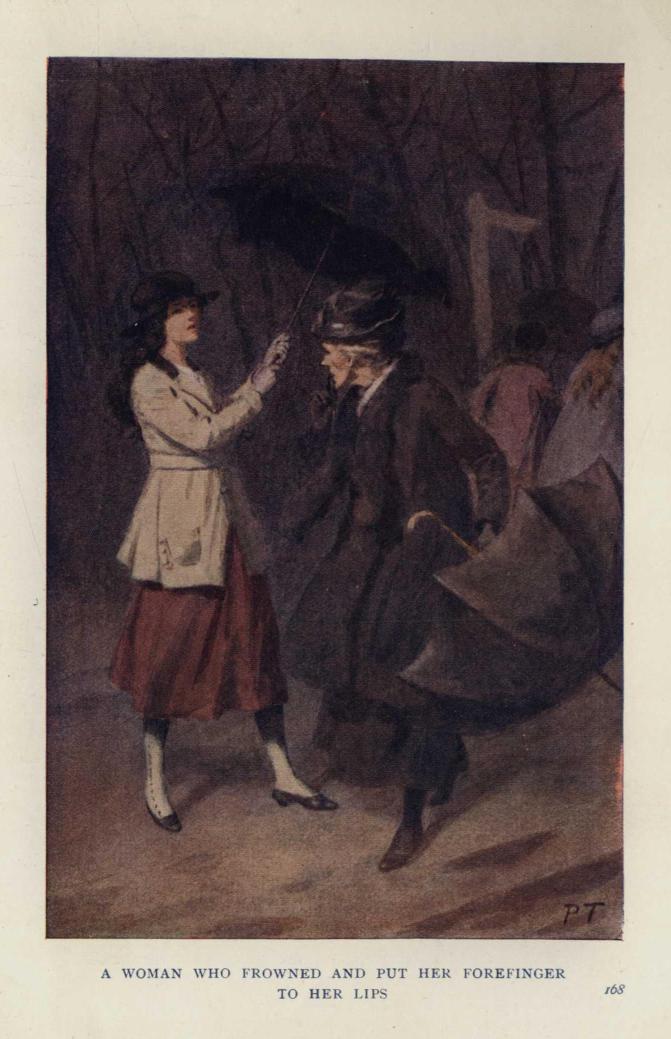
A WOMAN WHO FROWNED AND PUT HER FOREFINGER TO HER LIPS
Beryl stifled a scream and ran quickly forward and joined the others, keeping as close to Pamela as she could till they reached home.
While the woman, with a quick backward glance at the receding group, continued on her way, limping hurriedly up the hill.
CHAPTER XIV
CAROLINE MAKES A DISCOVERY
Pamela was just dropping off to sleep that night when some one tapped on her bedroom door. She roused herself, and called out:
"Who's there?"
"May I come in a minute? It's only I—Caroline," the answer came in a loud whisper.
"Oh—yes—yes—come in," she said, sitting up, only half awake as yet.
Caroline came in, a lighted candle in her hand. She was fully dressed, and had not even untied her hair. She looked a bit scared and puzzled. Closing the door softly behind her she crossed to the side of Pamela's bed.
"I'm sorry to disturb you," she said solemnly, "but I didn't think you'd be in bed yet—I haven't even started to get undressed—I—I don't like the look of my room!"
"Don't like the look of your room! Whatever do you mean, Caroline?" Pamela rubbed her eyes.
"Well, some one's been moving things. There are several things out of their usual places. I—I believe somebody has been in the room while we've been out to-day!"
Pamela was wide awake now.
"Oh, Caroline,—you don't mean burglars? There's nothing missing, is there? Has anything been taken?"
"No. Not so far as I can see," replied Caroline. "But things have been disturbed."
"I'll come in with you and have a look," said Pamela, springing up and hastily donning dressing-gown and slippers. "H'sh. We mustn't wake the others unless it's necessary. They're all so tired."
"I didn't notice anything just at first," said Caroline, as they entered her room.
"I don't notice anything now," remarked Pamela, looking round at the neat and orderly chamber.
"Wait a minute," said Caroline. "Look here—" and she pulled open one of the drawers in her dressing-table.
"Well?" said Pamela, who could see nothing amiss with the contents of the drawer.
"Well!" echoed Caroline rather indignantly, "I never leave my drawers like this. See—these gloves were folded together in that corner—and these ribbons here—and I always keep my handkerchiefs on top of each other at this side—These handkerchiefs are all arranged anyhow. I know I didn't leave them like this! ... And look here—on the mantelpiece—these photo frames have been shifted—and on this chair by the window my brown scarf which I left folded on the seat was on the floor!"
"Oh, come," said Pamela. "That might easily have slid off. The main point is—is there anything missing?"
"Nothing so far," replied Caroline. "But some one has been in here moving my things—I'm certain of it. I know just the way I always leave my belongings. I always put them in the same places and in the same positions."
She seemed so positive that Pamela was silenced. Anyone else but Caroline would probably not have noticed that anything had been disturbed in their room.
"Well—what shall we do?" said Pamela, who really thought that Caroline was under a delusion. She couldn't see anything wrong with the room. "If we wake everybody up we shall only scare them—it isn't as if you'd missed anything. That would be a different matter. I suppose you've searched all over the room? Of course, you've made sure there's no one hiding here now?"
"Oh, yes," said Caroline; but to make doubly sure she and Pamela searched again thoroughly. They looked in the wardrobe, behind the wardrobe, under the bed, behind the chest of drawers, and in and under every likely and unlikely place in the room.
"Have you looked in the soap-dish?" said Pamela, jokingly.
But Caroline did not laugh; she continued her search solemnly. Suddenly an exclamation from her made Pamela wheel round.
"Just fancy that!" said Caroline, still on her knees, after an attempt to look under the chest of drawers—a space of about six inches from the ground. "Look here, Pamela! Here's my silver thimble! The one I couldn't find—under the edge of the carpet beneath this chest of drawers. And I've looked everywhere for it—but here. It must have rolled off the back of the chest, and got wedged under the carpet."
"What luck! The search hasn't been wasted after all then," remarked Pamela, stifling a yawn.
"And it is my wish come true," said Caroline slowly.
"What! About the thimble! Is that what you wished?" cried Pamela.
"Yes," said Caroline. "I didn't know what else to wish—and I couldn't find my silver thimble that my grandmother gave me—so I thought I'd wish about that."
"I see," said Pamela, trying hard not to smile. "Well, your wish has come true. You lucky girl! I only hope the rest of us are as fortunate."
After this Caroline reluctantly agreed to go to bed, and not to bother any further about the things in her room being disturbed until the morning, when Pamela promised to make full inquiries and sift the matter thoroughly. Pamela felt fairly certain in her own mind that no one had been in Caroline's room or she would not have let the matter drop so easily. Both girls being now very tired after their long day in town they soon dropped into their beds and went off to sleep.
Caroline referred to the matter over breakfast in the morning, thereby incurring a great deal of attention and questioning from the others—which made her feel quite important for once in a way. Caroline was one of those people who could not usually attract much attention from others, as she was unable to talk interestingly about things. But this morning she found she was actually being interesting; she liked the sensation, and meant to make the most of it.
While Pamela and Isobel discussed the matter with Caroline, Beryl, who had turned very white, sat silent, her half-finished breakfast pushed on one side; she sat stirring her tea mechanically round and round—only breaking her silence once to ask Caroline if she had missed anything, and seemed relieved on hearing that Caroline had not.
"I suppose nobody else's room was disturbed in any way?" said Pamela, adding, "Mine was all right."
"So was mine," said Isobel.
"And mine," echoed Beryl, quickly.
"Well, we'll just go and ask Ellen if she can throw any light on the matter, shall we?" said Pamela. "She was the only inmate of this house who was not up in London yesterday."
Ellen was very interested, but it did not seem as if she could help to solve the question. She had certainly not been in the room herself; she had left the house at the same time as they did yesterday, and when she and Millicent Jackson—the friend with whom she had spent the day—had come in to fetch the umbrellas to bring to the station in the evening, they had not been upstairs at all. They had let themselves in at the back door, gone straight through to the hall, taken the umbrellas out of the stand, and gone out of the front door. They weren't in the house five minutes, as they were in a hurry to get to the station in time.
"There, Caroline!" said Isobel. "You see nobody could have been in your room. You must have moved the things yourself."
But Caroline shook her head.
"Could anyone have slipped in the back door after you—without you noticing?" she asked Ellen.
"Oh, miss! Well—I never thought of that!" said Ellen, then hesitated. "Of course, they could have, Miss Caroline—but it's most unlikely. If anyone had troubled to do that they would have taken something while they were about it, wouldn't they?"
Caroline shrugged her shoulders.
"All I know is—the things in my room were disturbed," she insisted doggedly. "And I don't like it."
"How could anyone have slipped in without you seeing, Ellen?" inquired Pamela.
"Well, Miss Pamela, to be exact," explained Ellen, "me an' Millicent unlocked the back door and came in, shut the door, and went into the kitchen, where I struck a match and lit the candle that we keep on the dresser here. We didn't bother to light the gas as we was going straight through, and out the front way. Me an' Millicent was talking, interested-like, as we went into the hall, when Millicent says, 'Oh, did you lock the back door again?' And I says, 'Oh, no.' And I went back and locked it.... Then we got the umbrellas and went straight out the front way.... Now, do you think anyone would have got in just in that minute before I locked the back door, Miss Pamela? Now do you, Miss Caroline?"
"It's just possible, of course, but not at all likely," said Pamela. "Thanks very much, Ellen—as nothing has been missed, I really don't see any use in pursuing the matter further, Caroline, do you? ... And it's such a grand morning, let's all go for a good tramp over the hills."
So Pamela dismissed the incident from her mind; and Isobel, putting it down to "one of the bees in old Caroline's bonnet," soon followed suit. Ellen and Martha discussed the matter together, and Ellen repeated her story to Martha several times—each time with more emphasis than the last; and when she next saw Millicent Jackson she mentioned it to her, and they talked of it until the subject was exhausted—then as nothing further happened to make them remember it, they too forgot it. Caroline remembered it as a grievance for a considerable time, then the excitement of the coming bazaar caused it to fade into the background. The only one who did not forget the incident was Beryl, and she had good reason to remember it—as we shall presently see.
After the visit to London a marked change seemed to come over Beryl; always pale and nervous, she appeared to grow even paler and more nervous as the days went by. At times she would emerge from the cloud of depression which seemed so often to envelop her now and join light-heartedly in whatever was going on, but these occasions grew more and more rare.
When Pamela remarked on her paleness one day Beryl put it down to the weather, saying it made her feel tired. Pamela believed her; had she not been so absorbed in Elizabeth Bagg and her work she might have noticed things that would have aroused her suspicions; but she was not suspicious in any way until one evening Beryl, very awkward and hesitating, asked Pamela if she would lend her a sovereign. Pamela did not voice the surprise she showed in her face—surprise because the pocket-money handed over to each of them by Mr Sigglesthorne had been quite generous and sufficient for the few expenses the girls would be likely to incur in Barrowfield during the remainder of their stay. However, she lent the money at once, and willingly, and asked no questions—for which Beryl seemed very grateful.
Feeling a little uneasy about the matter, and wishing to help her if possible, Pamela made several opportunities for Beryl to confide in her if she had wished to do so. But Beryl did not seem to wish to do so.
CHAPTER XV
ABOUT A BAZAAR AND A MEETING IN THE RUINED WINDMILL
The bazaar, for which Caroline had been sewing so perseveringly, was held in the grounds of the Manor House on a beautiful sunny day at the end of May. Caroline spent a blissful afternoon, dressed in a Japanese kimono with chrysanthemums in her hair, surrounded by tea-cosies and cushion-covers and hand-embroidered scarves; and she had quite a brisk sale at her stall, in spite of exorbitant prices.
The spacious lawn below the terraced flower-garden was a delightful picture; the soft, velvety grass and the cool shade under the trees that bordered it making a pleasing background for the dainty kimonoed figures that tripped to and fro among the bamboo stalls with their white umbrella-shaped awnings. As the general public began to make its appearance, the colours in the summer dresses that moved across the lawn became as variegated as the flower-garden itself.
Lady Prior stood on the terrace and looked down with a pleased smile at the animated scene beneath her.
"The village looks forward so eagerly to this each year," she remarked to a friend. "You see, there is absolutely nowhere for them to go as a rule, poor creatures. This is quite an event for them." And she raised her eyebrows and gave a little rippling laugh.
Meanwhile the poor creatures were spending their money as they were able, and the local reporter, who was wandering among the stalls, was mentally calculating how big a sum of money he would be able to announce in next week's Observer as the result of Lady Prior's Annual Bazaar. Most of the village seemed out to enjoy itself at all costs; but now and again one would come across a gloomy individual who looked like an unwilling victim of this annual institution. In some cases, as one little old woman grumbled to Caroline, people came because they had been badgered and worried into promising to attend by one of the industrious members of the committee.
"And there's so much questioning, and reproachful looks, an' cold stares afterward—if you don't come," she grumbled, fingering the various articles on Caroline's stall, "that you come for peace sake.... Though I'd much rather be sittin' at 'ome an' 'aving a cup of tea in peace and quietness and restin' my old bones—it's all very well for young folk to come gallivantin' and spendin' their savings—but when you're old—! ... 'Ow much is this? What is it? Eh? An egg-cosy! ... Oh, give me one of them six-penny 'air-tidies—it'll do for my daughter in London. I ain't got no 'air to speak of myself. But my daughter—her 'air comes out in 'andfulls—you ought to see it! ... You've got nothing else for six-pence, I suppose? No? ... I won't 'ave anything else then."
And the little old woman took the hair-tidy and made her way straight to the gates, apparently making a bee-line for home, having fulfilled her duty.
Caroline was not critical—she took things very much as a matter of course, and did not feel ashamed for the handsomely dressed lady from a neighbouring village who inquired in a loud voice for the stall where the 'pore clothes' were for sale. Caroline did not quite understand at first, until another stall-holder explained that Mrs Lester always purchased a number of garments to distribute among the deserving poor of her parish. The garments Mrs Lester bought looked a bit clumsy, and were made all alike, of rather coarse material, but "she's awfully good to the poor, you know," Caroline was told; and there the matter ended, until she recounted the incident to the others when she got home, and provoked a stormy protest from Pamela against the way in which rich people were 'good to the poor.'
"Why can't they be more tactful," asked Pamela. "Of course I know lots of them are—but I mean people like this Mrs Lester."
"Oh, don't be ridiculous, Pamela," said Isobel, laughing. "What do poor people want with tact? Give them a good meal or a bundle of clothes and they'll pretend to be grateful and satisfied and all that, and directly your back is turned they'll grumble because you haven't given them more. They always want more—they don't want tact!"
Pamela stared for a moment at Isobel, who was reclining gracefully on the sofa, amusement in every line of her face at Pamela's ideas.
"Good gracious, Isobel! I can see a perfectly horrible future in store for you," Pamela said quietly. "You are going to be another Mrs Lester."
"What of it?" laughed Isobel. "As long as I am as rich as she is, there are no horrors for me."
"Anyway, I'm sorry for you," said Pamela earnestly.
"What on earth for?" asked Isobel, slightly nettled.
"Because you'll miss some of the best things in life," replied Pamela.
"Not if I'm rich, I shan't," said Isobel.
Caroline had listened in mild surprise at all this. It had never struck her that there could be anything to object to in Mrs Lester's attitude.
"Do you know," she said, changing the conversation, "I had to pay for the hire of my kimono. I hadn't expected to have to pay after giving my services free, and making so many things for the bazaar. But it all goes to a good cause, I suppose."
Caroline had rather regretted that none of the other three girls had been present at the bazaar in the afternoon, to see how rapidly her tea-cosies had sold; but each of the three had had a different excuse for not coming. Isobel's absence, of course, was a foregone conclusion—she would have loved to go, but could not on account of Miss Crabingway's instructions.
Pamela, as we know, hated bazaars. "Don't ask me to come, Caroline," she had said kindly. "But will you take this donation for 'the cause' and put it in one of the boxes or whatever they have to collect the money in."
Caroline had had hopes that Beryl, at any rate, would not like to refuse to come. But lack of money to spend made Beryl desperate, and, although she was quite resolved in her own mind not to go, she half promised Caroline she would go, if she felt up to it. She even made a feint of preparing to go. Then a sudden imaginary attack of neuralgia made it impossible, and she sent word by Pamela to tell Caroline not to wait, and went and lay down in her bedroom and pulled down the blind. There in her cool and darkened room she listened to Caroline departing, and felt very much ashamed of herself for the story she had made up about neuralgia.
"But I couldn't explain that I had no money—and why," she made excuses to herself. "Oh, it isn't fair!"
About a week after the bazaar Isobel went over to Inchmoor alone one day to Madame Clarence's, a bad toothache compelling Caroline to miss a lesson for the first time. When her dancing-lesson was over Isobel did a little shopping, and then went and had tea in a smart and popular confectioner's, where she could watch all the fashion of the town go by from her seat near the window. Finding that she had missed her usual train back to Barrowfield and that there was a long wait before the next train, she finished her tea leisurely and then started out to walk back home.
She had got about half-way back when a thunderstorm broke suddenly. And there was Isobel in a light cotton dress, and a hat that would be 'absolutely ruined' if it got wet, in the middle of a country lane—a couple of miles from anywhere. She had not paid much attention to the warning clouds overhead, and when the first growl of thunder was heard she looked up startled and hastened her footsteps.
A few minutes later the rain started—great slow thunder-spots at first, and then it came down in torrents. Isobel, casting her eyes hastily around for some place of shelter, saw on the hill-top the ruined windmill. She made for this, and dashed in wet and gasping, and found that although the wind and rain lashed in through the many holes in the ruin, yet it afforded a considerable amount of protection if she chose the right corner to stand in. It was fortunate that she did not remember how Caroline, in spite of her toothache, had come out to the front door to advise her to take an umbrella with her, or she would have felt even more out of temper with the world than she did.
The corner she was crouching in was partly hidden from the doorway by a couple of thick beams of wood which were leaning, like props, from the walls to the ground. The beams and a pile of dust and bricks formed a partial screen, but not sufficient to hide her white frock, if anyone had been present in that deserted spot.
Isobel had been there about five minutes, and the storm showed no signs of abating, when she heard voices and hurrying feet, and the next instant two people dashed in at the doorway.
"Here you are, mother, stand this side—and hold the rug round you this way—it'll protect us a bit," said a deep voice.
"It really is most annoying—the car breaking down like that," said a woman's voice. "Don't go outside, Harry.... Oh, mind!" She gave a little shriek at a flash of lightning.
It was not the lightning nor the crash of thunder that followed that made Isobel's heart thump so madly. The two new-comers—who had not caught sight of her yet, as they were standing with their backs to her—were no others than Lady Prior and her son!
Whatever should she do, thought poor Isobel. She was caught in a trap. If they turned and saw her, as they undoubtedly would do sooner or later, they would probably speak—and then what was she to do? Of course they wouldn't know who she was. Surely Miss Crabingway wouldn't mean her not to speak, under the circumstances. It was so perfectly silly! ... But old ladies were queer creatures sometimes. And only a few weeks more—and then the fifty pounds was hers, and she could do what she liked. Isobel did not want to lose the money just by making some stupid little mistake a week or so before it was due. She thought of her Wishing Well wish.... Of course, she could explain just how this meeting came about, to Miss Crabingway—but would Miss Crabingway understand?—or was she hoping that most of the girls would break one or other of the rules, and so lose the money?
All this flashed through Isobel's mind during the few minutes she waited for the two by the doorway to turn round and discover her. How she wished—wished most fervently—that they would not turn round. For, besides the chief reason, Isobel felt she did not wish them to see her because she must look such 'a sight'—dripping wet, and crumpled, and blown about, and her hat flopping limply.
She gathered from the disjointed conversation that was going on that Lady Prior and her son had been driving home in the motor when the car had broken down in one of the by-lanes about a hundred yards from the mill. The storm had come on while the son was trying to mend matters, and Lady Prior being rather nervous of lightning had been unwilling to stay in the car covered with rugs, and had insisted on getting under a roof of some sort where she felt more protected. She had also insisted on Harry coming with her, and so, covering the motor over, they had brought a rug and taken shelter inside the windmill. Although Harry had thought that they would be just as safe if they had remained in the car, Lady Prior thought otherwise. And so here they were.
Isobel glanced round about to see if there were any possible way of escape; but there appeared to be none. "Now what shall I do when they turn round?" she kept asking herself. Had Beryl been in the same predicament as Isobel all sorts of wild ideas would have been rushing through her brain. Beryl would have thought of things like this: Should she pretend she was a foreigner, and could not understand English? Or, better still, should she pretend she was deaf and dumb? Should she pretend to have fainted—and so escape from having to speak; but this might have had awkward consequences if they insisted on taking her home or to a doctor. Should she pretend to go mad, and tear past them and out of the door?
But these sorts of ideas did not occur to Isobel, who was not used to practising deceptions as Beryl was. What Isobel did do was, after all, the most natural thing. When Lady Prior and Harry turned and caught sight of her, and Lady Prior gave a little shriek (because the lightning had unnerved her), and then broke into exclamations and questions, Isobel, quite unable to control herself, began to cry, her face buried in her hands. ("And now, I simply can't let them see my face," she thought to herself. "My nose always goes so red when I cry.... I must look such an awful fright.... I must keep my face hidden somehow.")
She became aware that Lady Prior was speaking to her in a slightly condescending voice, forbidding her to cry, and telling her not be alarmed at the lightning.
"These country creatures are sometimes so frightfully hysterical during thunderstorms," Isobel heard Lady Prior remark in an undertone to her son. "I suppose she's a girl from one of the villages around here.... There, there, my good girl, don't cry like that—the storm's almost over now."
Lady Prior asked her a few more questions—Where did she come from? Had she far to go home? But receiving no reply she turned to her son, smiled faintly, and shrugged her shoulders.
Isobel sobbed on. Her feelings beggar description. To be talked to in such a tone by Lady Prior! To be mistaken for a dowdy, hysterical village girl by Lady Prior! (But, of course, her wet clothes and flopping hat and streaky hair must look so positively awful that no wonder Lady Prior could not tell what she was nor what she looked like.) Nevertheless, it was the last drop in Isobel's cup of humiliation. Not for anything on earth would she let them see her face now!
Stealthily she watched for her opportunity. Lady Prior and her son had moved away from the door because the rain was lashing in too furiously, and their backs were turned to her again. She edged quietly round the wall, climbed swiftly over the pile of bricks and dust, and made a sudden dash for the door.
Lady Prior gave another little shriek and clutched hold of Harry's arm.
Isobel's action had been so sudden and unexpected that before anyone could stop her she had gained the door and was rushing blindly down the hill in the pouring rain.
Whether Harry was sent after her she did not know. Probably not, as it was still raining, and Lady Prior would think the girl was hysterical beyond control and that it was the best thing to let her run home as quickly as possible.
Isobel reached home just as the storm was over. Do what she would to avoid seeing the other girls she could not escape them. They all three came out into the hall to exclaim over her drenched state and offer their help, but she kept her head down as much as possible so that they should not see she had been crying, and hurried off to her room to change her clothes at once.
She would not look in the glass until she was warm and dry again. She felt she could not stand this last blow to her self-respect. When she did see her reflection she was almost her old self again, and the feeling of humiliation was considerably lightened. She began to feel somewhat virtuous for not breaking Miss Crabingway's rule, and pleased with herself for having got out of the predicament without Lady Prior and Harry suspecting her identity.
CHAPTER XVI
PAMELA'S WISH COMES TRUE
It would be pleasant to be able to record, now that the visit to Chequertrees draws to a close, that the four girls had made considerable progress in the work that they had set themselves to do. But this was not quite the case.
Caroline had certainly done an immense amount of needlework, but she had learnt no dressmaking nor 'cutting out'; her needlework was simply a repetition of work she could already do. And the dancing-lessons she had attended had scarcely improved her ability, or rather inability, for dancing; but they were good exercise for her, and had improved her health. It seemed to Caroline as if she would never be able to learn some of the dances Madame Clarence taught, not even if she attended the Academy for twenty years; she did not know why—simply, she could not grasp them. Sometimes it seemed to Caroline as if her feet were in league against her; her right foot would come forward and point the toe when it ought to have remained stationary and let the left foot point the toe; and her left foot would raise itself up while the right foot gave a hop, just when they both ought to have been gliding gracefully along the polished floor.... But in spite of these annoyances Caroline kept doggedly on with the lessons, and the improvement in her health was more than compensation for her lack of success as a dancer.
Beryl had advanced a great deal in her musical studies. She had had time and opportunity to practise and study her theory; time and opportunity had never been so liberally offered to her before, and now that they were offered she seized them eagerly—and made the most of them. She had even tried to compose a few pieces—a waltz, and a march, and a melody in E flat, a haunting melody which always made her feel 'exaltedly sad' whenever she played it. Beryl thought privately that it was a beautiful tune, but Isobel, who heard it through the door one day, told Caroline that she thought it ought to be called 'Green Apples,' because the treble "sounded like the face one pulls on tasting something sharp and sour." Caroline was puzzled, and pondered over this for a long time, and then went to listen outside the door herself. She heard the tune, and liked it—liked it so much that she went in and asked Beryl to play it again, much to Beryl's confusion and delight. After that it became a regular institution; Caroline would take her needlework into the drawing-room and sit and listen whenever Beryl started to play her melody in E flat. For some reason or other this particular tune appealed to Caroline; it made her feel pleasantly melancholy, and she enjoyed the feeling, and would sit sewing and heaving long sighs at intervals. If Isobel were anywhere within hearing on these occasions she was rendered nearly helpless with stifled laughter. "There's poor old Caroline going in to have some more 'Green Apples,'" she would giggle, and as the tune proceeded would stuff her handkerchief in her mouth and fly up to her room and shut herself in. Although this was only an early attempt at composing, it marked a chapter in Beryl's musical career, and as she advanced her compositions became more numerous and were better finished.
Isobel, who had not taken the question of work seriously, had nevertheless made good progress in her dancing. Naturally a graceful dancer, she had rapidly picked up the new dances at Madame Clarence's, and was now one of Madame's 'show pupils'—to the mutual satisfaction of both of them. It may have been noticed that up to the present time no mention has been made of Isobel taking any photographs with the camera she talked of buying; this was because she did not buy a camera until a fortnight before her stay at Barrowfield came to an end; and then she went and bought one with a definite purpose in view—the purpose of giving a gift of some photographs to Miss Crabingway on her return.
Pamela, though she had given most of her spare time to her sketching, had got through a good deal of reading as well, but not as much as she had meant to. The best of her sketches she intended to take home with her in order to show Michael what she had been doing, and what sort of places she had been seeing, and what she had learnt from Elizabeth Bagg.
There was one thing that all four girls had managed to do, and that was to keep on good terms with each other with rarely an open disagreement. "It'll be so much more comfortable for us all if we can manage to put up with each other—and, after all, it is only for a short time, not for life," Pamela had remarked on one occasion. And so this sensible attitude was adopted by all of them. Whenever the smoothly running wheels of the household got stuck, as they were bound to occasionally, a little lubricating oil from Martha or Ellen, or one or other of the girls, soon set them running easily again. The stay at Chequertrees and the contact of the various temperaments was bound to leave some impression on each of the girls afterward; it was not to be expected that it could radically change them, except in small ways. They had all more or less enjoyed their visit, and it had done them all good, in more ways than one. Martha and Ellen owned to each other in the kitchen one evening that they would certainly miss the young life about the place when the girls had gone.
About a fortnight before the six months came to an end the girls were sitting in the garden one afternoon having tea under the mulberry tree at the end of the lawn, when Beryl made a suggestion.
"I was just wondering," she began hesitatingly, "whether we couldn't do something for Miss Crabingway, as a sort of—well, to show we've had a nice time here in her house."
"What sort of thing?" asked Caroline, her mind running at once to gifts of hand-made tea-cosies and cushions.
"A jolly good idea, Beryl," said Pamela. "It would be nice to show her we'd appreciated the stay here. I know that I, for one, have had a good time. What could we do, now, for Miss Crabingway?"
"When you say 'do something,' do you mean club together and buy her a present?—or do you suggest we decorate the house with evergreens and hang WELCOME HOME in white cotton-wool letters on a red flannel background?" said Isobel, laughing. "Or does 'do something' mean getting up an entertainment for her pleasure, in which case you can put me down for a skirt dance—I've learnt a heavenly new step at Madame Clarence's—you'll see it when you come to Madame's reception next week."
"I suppose you end the lessons the week after next?" said Pamela.
"Yes, last time on Tuesday week," replied Isobel. "Of course it's very unusual to hold dancing-classes all through the summer, as Madame does, but some of the pupils are awfully keen—and she finds that it pays, I suppose. But it's the last time I shall be there—Tuesday week."
"Oh, don't let us talk about last and end," said Beryl. "I wish it needn't end—our stay here."
"Do you really?" said Isobel. "Oh, it hasn't been a bad time on the whole, but I shan't be sorry to get back to town, and the shops and theatres, and, of course, mater and all the rest of it."
"I shan't mind being home again, though I've had a pleasant stay here," remarked Caroline. "I'm sure Pamela is longing to be among her people again."
"Oh, I am," said Pamela fervently. "I can't tell you how much I'm looking forward to seeing them. I've had an awfully jolly time here, though.... And that brings us back to Beryl's suggestion—what can we do for Miss Crabingway? ... I don't know what you all think about it, but I should suggest that we each give her something original—give her something she couldn't buy in a shop in the ordinary way."
"Like—what?" asked Isobel.
"Well, for instance, Caroline could give her a piece of her hand-embroidered needlework."
"I wish we had thought of this earlier," observed Caroline, "I could have been working at something, in odd moments, all these weeks."
"You've still got a whole fortnight left, dear child," said Isobel. "But what can I do for Miss Crabingway? Suggest something, somebody, please! I can't do embroidery, like Caroline; nor draw pictures, like Pamela; nor compose music, like Beryl.... By the way, Beryl, you ought to compose a waltz, and call it 'The Emily Valse,' and dedicate it to Miss Emily Crabingway, you know. She would be charmed, I'm sure."
Beryl flushed quickly, not because she resented Isobel's joke, but because some such idea as Isobel suggested had flitted for a moment through her mind (barring the title of the composition).
"And I'll invent a dance which shall be called 'The Crabingway Glide,' and I'll dance it to your music. There! What do you think of that for an idea?" Isobel laughed.
"Very good indeed," said Pamela.
And then the four girls began to laugh at each other, and with each other, and make all sorts of wild and facetious suggestions, until Martha came to the kitchen window and looked out, wondering what all the laughter was about. But, in spite of all the joking about it, the idea was seriously considered, and arrangements made for each to do her best to give Miss Crabingway something of her own work in appreciation of the visit to Chequertrees.
It was on this occasion that Isobel finally decided to buy her camera without delay and get some really interesting snap-shots of the girls and the house, and have the best photographs enlarged and framed for Miss Crabingway.
"While we're on the subject," said Pamela, "I should like to give something or other to Martha and Ellen, wouldn't you? They've looked after us awfully well—what can we do for them, I wonder?"
They discussed presents for Martha and Ellen, and decided each to make or buy something suitable within the next fortnight.
Pamela went round to see the Baggs after tea. She knew that it was one of the days Elizabeth went over to Inchmoor and that she would not be back home again until seven o'clock, because it was the evening she stayed later to do her housekeeping shopping. But Pamela did not want to see Elizabeth herself. She wanted to see her firelight picture, which she knew was just finished.
The eldest little Bagg girl was setting the table for her father's tea when Pamela arrived at 'Alice Maud Villa.'
"I'm just going up to Elizabeth's room for something," said Pamela, after she had helped to lay the table. Tom Bagg was not in yet, but expected in every minute.
Upstairs in the studio Pamela found Elizabeth's picture—finished. She stood before it for some minutes, regarding it earnestly.
"Yes, it's the best thing she's ever done," she said to herself. "I'm sure it is."
To Pamela's eyes the likenesses were excellent; Tom Bagg, with his ruddy, genial face, sitting in his big arm-chair by the fire, chuckling, and pointing with the stem of his pipe at his absorbed audience of children, a habit of his when emphasizing any particular point in the story. The expressions on the children's faces were delightful. Pamela laughed softly to herself as she looked at them.
Then she went to the door, opened it, and listened. Tom Bagg had just come in, and was inquiring when his tea would be ready.
"I'll wait till he's had it," thought Pamela. "He'll be in an extra good mood then."
She went downstairs and chatted with him while he had his tea, and did her best to put him in as pleasant a mood as possible. She laughed at his jokes longer than they deserved, and encouraged him to talk; he was always happy when talking; and she kept an eye on the children so that they did nothing to annoy him. Frequently she would glance up at the clock, anxious to assure herself that Elizabeth was not due home yet.
At length, when Tom Bagg had finished his tea and had got out his pipe and tobacco pouch, she felt that her opportunity had arrived. She rose, and with rapidly beating heart went upstairs to the studio and fetched the firelight picture down. Without a word she placed it on a chair before the old cabman, who watched her movements with curious surprise. The little Baggs pressed forward and clustered round the picture, gazing in astonishment. For a second or two there was dead silence in the room.
"It's Daddy," said one of the children.
"An' us!" cried another shrilly.
"Your sister painted it," said Pamela to Tom Bagg.
Then they all began to talk at once—all, that is, except old Tom Bagg. Throughout the noisy interlude that followed he remained silent, staring at the picture. Pamela watched his face anxiously.
Presently he scratched the bald spot on the top of his head, and said quietly:
"Well, I'm blowed!"
He had never seen any of Elizabeth's portrait studies before, and was filled with astonishment.
"But it's like me!" he said in surprise, as if that were the last thing to be expected.
"Of course it is," replied Pamela. "It's meant to be." Then she went on to explain how Elizabeth had sat and watched him and the children and then gone away and painted the picture up in her own room. She was longing to talk about Elizabeth's work with all the enthusiasm she felt for it, but she purposely kept her voice as quiet as she could, because she guessed it would be wiser and more effective to let Tom Bagg think he had discovered for himself how clever his sister really was.
Which is precisely what Tom Bagg came to think he had done. He was much taken by his own portrait.
"It's not a bad bit of work, eh?" he asked Pamela.
"It's a decidedly good bit of work—it's splendid," she replied.
The more Tom Bagg looked at the picture the more pleased he became with it.
"No," he said, "it's not at all a bad bit of work."
He stood with his head a little on one side regarding the picture.
And then the front-door latch clicked and Elizabeth Bagg stepped in. She caught sight of the picture immediately, and looked round the room astonished, and annoyed.
"Oh, please forgive me," said Pamela, moving toward her. "I—I simply couldn't help bringing it down..."
"Lizzie," said Tom Bagg, who felt wholeheartedly generous once he was convinced of anything, "this is not at all a bad bit of work. Why didn't you tell me you could paint likenesses?"
He was evidently greatly struck with the painting, and seemed to admire it so genuinely, that any annoyance Elizabeth may have felt faded immediately, and she laughed a little nervously and said she was glad he liked it.
When Pamela had decided to bring the picture down to show to Tom Bagg she had not expected her action to do more than make Tom Bagg realize the talent of his sister, and so make it easier for her to have more time for her painting. Tom Bagg certainly did realize his sister's talent at last; but the matter did not end there; he became so pleased with the picture that the following evening he carried it (without Elizabeth's permission) down to the 'Blue Boar,' where he proudly displayed it to his bosom friends, and any strangers who happened to drop in while he was there, and was much elated by the unanimous praise it received.
Whether you believe the Wishing Well had anything to do with the sequel depends on whether you believe in Wishing Wells or not. Pamela undoubtedly puts it down to the Wishing Well. She had wished that Elizabeth Bagg's work would gain recognition. And it did. It happened that a Mr Alfred Knowles, an influential art connoisseur from London, came into the 'Blue Boar' that evening just when Tom Bagg was showing the picture to a group of men in the bar-parlour. Mr Knowles listened with great interest to Tom Bagg's explanations and remarks, and getting into conversation with the old cabman, questioned him closely about his sister's work. An introduction to Elizabeth Bagg followed, and Mr Knowles was so delighted with her pictures that he purchased several and took them back to town with him; he would have liked to buy the firelight picture, but Tom Bagg seemed so anxious to keep it that Elizabeth decided not to part with it, but promised Mr Knowles that she would have a reproduction made for him as quickly as possible. And so the original picture of Tom Bagg telling stories to his children was hung up over the mantel-piece in the living-room of the little cottage in Long Lane.
Pamela was delighted by the turn events had taken. Had she been able to see into Elizabeth's future she would have been more delighted still. For Elizabeth's pictures were to be seen and admired by Mr Knowles' artistic friends, and she was to get commissions from them for numerous paintings, so that as time went on she was obliged to give up her classes at Inchmoor in order to give all her spare time to her painting at home. And with the money she earned Elizabeth was eventually able to pay for some one to come and do the housework for her brother, and washing and mending, and to help look after the children. For, though Elizabeth achieved in time a small amount of fame, it never altered her decision to stay and look after her brother and his children.
"I couldn't be happy if I left them now," she would say, when tempted with the thought of that wonderful room in London. Instead, she rented a room in Barrowfield, which she turned into a studio, and divided her days between the studio and her brother's house.
As for Tom Bagg, he was bewildered yet gratified with the state of affairs; his respect for Elizabeth increased by leaps and bounds as he saw how highly valued her work became. Gradually he came to wonder if he and the children were a drag on Elizabeth's career, and once he offered her her freedom, and was deeply touched by her decision to stay with him....
And there was to come a day in the future when Pamela and Michael and Elizabeth Bagg were to pay a visit to the Royal Academy to see Elizabeth's latest picture hung....
But all this was to happen some years after Pamela's first visit to Barrowfield was over. Up to the present time Elizabeth's pictures had just been bought by Mr Knowles—which was sufficient for Pamela to be able to announce to three interested girls at Chequertrees that her Wishing Well wish had come true.
CHAPTER XVII
IN WHICH OLD SILAS LAUGHS AND ISOBEL DANCES
Madame Clarence's reception took place a week before the girls' visit to Chequertrees came to an end. As one of Madame's 'show' pupils Isobel was to do a special dance by herself on this occasion; she had been looking forward to this, and had bought a special dress for the dance, made of white silk. She had practised the steps and movements of the dance over and over again before a long mirror in her bedroom, until she could do the dance to her complete satisfaction. Madame was enthusiastic over it, and told Isobel privately that she thought she would be the success of the evening—which pleased Isobel greatly, and made her determine that she would do her best to make Madame's words come true.
In her white silk frock, her pretty fluffy hair dressed becomingly and tied with a soft blue ribbon, she looked very dainty and graceful as she ran down the stairs to the dining-room for Pamela and Beryl to inspect her before she put her cloak on.
Caroline, who, of course, was to dance at Madame's reception also (but not by herself), was "not quite ready yet," she called out to Isobel as the latter passed the bedroom door on her way down. Caroline was to wear a white frock too; but white did not suit Caroline's complexion, and the style of her dress rather emphasized her heavy build and plump arms. However, as Caroline surveyed herself in the mirror she was not so concerned about her frock or complexion as she was with the intricacies of one of the dances she was to take part in that evening. She felt sure she would never remember a certain twist at one point, and a bow, and a turn at another, and she felt very glad that she was not going to dance alone, like Isobel, but only with a crowd of other girls.
Pamela, Beryl, Martha, and Ellen had been invited by Isobel and Caroline to come as their guests to the reception. Each pupil of Madame's could bring two friends with them, and Isobel claiming Pamela and Beryl for her two, Caroline suddenly had the nice idea of inviting Martha and Ellen.
It was arranged that Isobel and Caroline were to go on ahead of their guests, as Madame had expressed a wish that all her pupils would arrive at least half an hour before the visitors were expected, so that everything and every one would be ready to start promptly to time. It was just beginning to get dusk when the two girls were actually ready and waiting for Tom Bagg's cab to arrive so that they could start off. Pamela, Beryl, Martha, and Ellen were to follow on to Inchmoor by the seven o'clock train.
The evening was very warm, and as Tom Bagg drove up to the gate, Isobel, suddenly declaring that she was too hot to put on her cloak, decided to carry it over her arm and wrap it round her in the cab if she felt chilly. Caroline did not care how hot she felt; she put on her cloak and buttoned it up to the neck, telling Isobel she thought she was foolish and that she might not only catch a cold but would get her dress soiled in brushing against the cab door, and so on. But Isobel laughed and asked Caroline if she was going to take her goloshes and umbrella in case it rained between the front door and the cab at the gate. And so, with Pamela and Beryl wishing them both good luck, Isobel and Caroline passed out of the front door and down the garden.
And then a catastrophe happened.
Isobel, who was some way in front of Caroline, was passing a low thick bush half-way along the path to the gate, and had turned to make some laughing remark, and wave her hand to Pamela at the front door, when suddenly a pailful of garden rubbish—mostly weeds with black, wet soil clinging to their roots—came shooting over the bush, and descended in a shower all over Isobel and her pretty white silk frock.
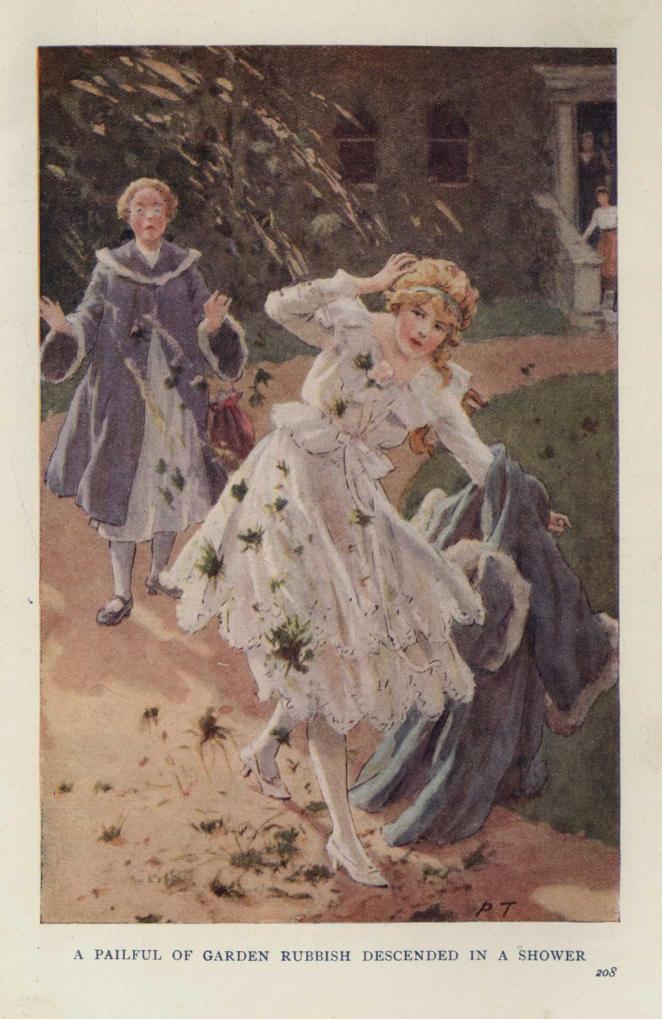
A PAILFUL OF GARDEN RUBBISH DESCENDED IN A SHOWER
Isobel gave a scream, ran a few steps, and then stood stock-still, and gazed down at her frock and the coat on her arm.
"Oh, it's spoilt—it's absolutely spoilt!" she gasped, whipping out her handkerchief and trying in vain to rub off the dirty, smeary marks on her sleeves and skirt. "Oh, Pamela, whatever shall I do? ... But who did it? Who did it?" she cried, lifting her head angrily, and she made a dart round the side of the bush.
But there was no one immediately on the other side. About a dozen yards off, with his back to her, digging methodically away at one of the flowerbeds was old Silas Sluff.
"Oh!" cried Isobel. "It was you, then, was it? How—how dare— Oh, you perfectly horrible creature!"
Silas, being deaf, took no notice, and so she ran forward, stepping recklessly on his flowerbeds, and confronted him, her eyes blazing with anger.
By this time the others had come on the scene. Pamela, Beryl, followed by the dumbfounded Caroline, and presently Martha and Ellen, came running to learn what had happened and what had caused the delay. Poor Isobel certainly looked a woebegone sight, with great smears down her dress and on one cheek, and soil and weeds in her hair. Who would have believed that the soil would have been so sticky and wet—unless old Silas had recently been watering the garden, which he didn't appear to have been doing.
"Look what you've done!" cried Isobel excitedly, pointing to her dress; but as Silas did not look up, but still went on digging, she suddenly seized his spade, jerked it out of his hands, and flung it down on the ground. "Look what you've done!" she repeated.
Old Silas straightened his bent back and looked at the dress in silence.
"You'll have to pay for this, my man!" Isobel raised her voice and spoke loudly and distinctly.
"Eh?" said old Silas, whose deafness appeared to be worse than usual to-day. Then he added, "Who will?"
"You," cried Isobel. "You'll have to pay for a new dress in place of this one you've spoilt."
Here Pamela joined in. After a great deal of difficulty, for the old gardener seemed extraordinarily deaf and stupid, he was made to understand that he was being accused of throwing a pailful of rubbish over Isobel.
"And you did it purposely," added Isobel.
"Oh, Isobel, wait a minute," said Pamela. "Perhaps he didn't know you were passing—perhaps he didn't hear you."
Old Silas was apparently not so deaf after all, for he caught this remark, and looking at Isobel's dress and seeing that his handiwork was even better than he had expected it to be, he decided in his own mind to retire now from this awkward scene in the manner most to his advantage; after all, he thought, there were four, five, six of them as witnesses against him here, and if they complained to Miss Crabingway he might be dismissed—which would not suit him at all.
"'Ere," he said at length, "what's that you sez I done? Eh? Well, I did throw a pail of rubbidge over the 'edge jus' now—I'm not a-goin' to say as 'ow I didn't—but I thrown it on to the rubbidge 'eap.... Where I alwus throw it—all on to the path in a 'eap and then sweep it up afterwuds.... I never 'eard no one comin' along the path—I'm that 'ard of 'earing, yer know.... I never 'eard no one..."
"But it's not usual for you to throw the rubbish over like that without looking, is it?" asked Pamela.
But Silas stoutly maintained that it was, though nobody in the little group around him had seen him do such a thing before to-day. Ellen, in the background, squeezed Martha's arm and winked, whispering in her ear,
"Of course he done it for the purpose. I told you he'd have his revenge on Miss Isobel for saucing him in the garden when she first came here, didn't I now?"
Meanwhile Silas stubbornly held to his point that he thought he was throwing the weeds on the rubbish heap, and that he had not heard Isobel coming past.
"Well, Isobel," said Pamela, "it won't do any good to prolong this argument—and time's flying past. Let's hurry in and see what we can do to the dress—or you must wear one of mine. And, Beryl, will you explain to Tom Bagg and ask him in to wait for twenty minutes—we mustn't be longer than that." Then she turned to Silas. "I think," she said, "that at any rate you might apologize——"
"Apologize! What good will that do! I don't want an apology from him," cried Isobel. "I'm too disgusted with him—besides, I know he did it purposely. He's just telling lies, because he is frightened now at what he's done.... But if the dress is ruined beyond repair he shall pay for it—I don't care what he says.... I'll make him pay, if—if I have to go to law about it." And without waiting for anything further Isobel turned on her heel and marched away into the house, followed by Pamela, who was secretly longing to laugh at old Silas's expression and Isobel's theatrical outburst. In a few moments the group round Silas dispersed.
Silas stood for a while scratching the top of his head and looking at the ground where Isobel had stood, then he picked up his spade and resumed his digging.
Presently he began to chuckle. "I said I'd learn 'er," he told himself. "An' I did learn 'er. Nice and slimy and wet them weeds were—an', after all, I did only throw 'em on a rubbidge 'eap. That's what she is."
Why old Silas had not taken his revenge on Isobel before this it is impossible to say. He had not thought out any clear plan for a long time, but had waited for an idea, and when he had got one he had turned it over in his mind with relish for some time, and then begun to look around for an opportunity—and, at length, to-day he had found one.
While Tom Bagg waited in the hall, and Caroline wandered about asking if she could be of any use, Pamela and Beryl, finding that Isobel's dress could not be remedied unless it was thoroughly washed and ironed, quickly got out a white muslin frock of Pamela's and set to work to make it fit Isobel. Pamela was more Isobel's build than either of the other two girls, and so her dress was not such a bad fit, and with the aid of a needle and cotton, and some safety pins and a pair of scissors, it soon began to look presentable on Isobel. Of course it did not look as pretty on Isobel as her own white silk had done—but it was fortunate that Pamela had even a white muslin frock ready to lend Isobel in this emergency. Martha and Ellen lent a hand, hurrying to and fro, looking for pins and scissors, and helping Isobel to brush the soil out of her hair and re-do it. For although they all knew that Isobel's conduct toward old Silas had been very rude and trying, to say the least of it, yet they all felt sorry for her that he had chosen just this occasion to punish her for her treatment of him so many months ago.