QUEEN ELIZABETH, AND MARY, QUEEN OF SCOTS. A.D. 1533-1603. (continued 2)
Reading edition
Now let it be remembered that these witnesses for her innocence were, with the exception of the faithful Sir James Melville, and perhaps one or two others, no friends of Mary, Queen of Scots, but were the very parties in league with the English cabinet for her overthrow; and as Bothwell was not in this league, but was plotting only for his own scheme of being raised to the throne by marriage with Mary Stuart, these framers of this act of Parliament, exonerating Mary and denouncing Bothwell, were not acting through favor of her; and therefore this strong and overwhelming evidence comes from her very foes.
The following letter is from Mary Stuart to the Pope when she was at last out of the power of Bothwell. This letter is from the collection of Prince Labanoff: “Lettres de Marie Stuart, from the Secret Archives of the Vatican at Rome,”—and will reveal Mary’s feelings on the subject: “Tell to his Holiness,” writes she to her accredited envoy, “the grief we suffered when we were made prisoner by one of our subjects, the Earl of Bothwell, and led as prisoner with the Earl of Huntley the Chancellor, and the nobleman, our Secretary, together to the Castle of Dunbar, and after to the Castle of Edinburgh, where we were detained against our will in the hands of the said Earl of Bothwell, until such time as he had procured a pretended divorce between him and the sister of the said Lord of Huntley, his wife, our near relative; and we were constrained to yield our consent, yet against our will, to him. Therefore your Holiness is supplicated to take order on this, that we are made quit of the said indignity by means of a process at Rome, and commission sent to Scotland, to the bishops and other Catholic judges as your Holiness seemeth best.”
On the other hand, Mr. Froude, the English historian, does not refute this act of Parliament, but as evidence of Mary’s guilt, which he most vehemently declares, cites another act of Parliament, and states the following:—
“The Parliament met on the 15th of December. A series of acts embodying the resolutions of the Council were prepared by the Lords of the Articles,—among them were Huntley and Argyle. The abdication of Lochleven, the coronation of James, and the regency of Murray were successively declared to have been lawful; and lastly, in an act ‘anent the retention of their sovereign Lord’s mother’s person,’ the genuineness of the evidence by which her share in the murder was proved was accepted as beyond doubt or question.
“When the measure was laid before Parliament, Lord Herries, with one or two others, protested, not against the truth of the charges, but ‘against an act which was prejudicial to the honor, power, and estate of the Queen.’ But their objections were overruled. The acts were passed; the last and most important declaring that ‘the taking of arms by the lords and barons, the apprehension of the queen’s person, and generally all other things spoken and done by them to that effect, since the 10th of February last period, were caused by the said queen’s own default.’ It was most certain, from divers her privy letters, written wholly with her own hand, to the Earl of Bothwell, and by her ungodly and dishonorable proceeding to a pretended marriage with him, that she was privy art and part of the device and deed of the murder, and therefore justly deserved whatever had been done to her. Indirect counsel and means had been used to hold back the knowledge of the truth, yet all men were fully persuaded in their hearts of the authors and devisers of the fact. The nobility perceiving the queen so thrall and so blindly affectionate to the tyrant, and perceiving also that both he and she had conspired together such horrible cruelty, they had at length taken up arms to punish them.”
Surely both of these acts of Parliament cannot be trustworthy. Froude refers to Anderson’s Collection as his authority; Miss Strickland, to the register-house, Edinburgh, where the act may be seen in the original Latin. According to one, Mary, Queen of Scots is most clearly proven innocent; according to the other, Mary is most clearly proven guilty. The question therefore rests on the validity of the two acts. The reader may choose between them.
Regarding the famous “Silver-casket Letters,” these two English authorities thus comment. Miss Strickland says: “Several hundreds of Mary Stuart’s genuine letters are now before the public, commencing with those she wrote to her mother in her artless childhood. Not one of these bears the slightest analogy, either in style, sentiment or diction, with the eight suspicious documents she is alleged to have written. But argument is rendered unnecessary by the fact that the discovery of letters so discrepant with anything ever written, ever said or done, by Mary Stuart, rests solely on the testimony of Morton, one of the conspirators in the murder of Darnley. Prince Labanoff, who has devoted his life to the collection and verification of Mary Stuart’s letters, rejects this supposititious series, because, as he briefly observes, ‘there is nothing to prove their authenticity’; while the elder Tytler, who, as a lord of session, or judge, had been accustomed to study and collate evidences in the criminal courts of Scotland, has written two able volumes to expose their fallacies, under the title of ‘A Critical Enquiry into the Evidences.’”
Dr. Henry, the historian of England and Scotland, gave his private and most impartial opinion on this controversy in a letter to William Tytler, printed in “Transactions of Scottish Antiquarian Society,” in these words: “I have been long convinced that the unfortunate Queen Mary was basely betrayed and cruelly oppressed during her life, and calumniated after her death. Many things contributed to involve her in difficulties and dangers on her return to Scotland; her invincible adherence to her religion, her implicit submission to the dictates of her French friends, her having roused the jealousy of Elizabeth by assuming the English arms, the ambition of her brother James, and the faithless, plotting characters of others near her person,—in a word, an invisible political net seemed to have been spread around her, from which it was hardly possible for her to escape. Your efforts, sir, to relieve the memory of a much injured princess from a load of calumny are generous and commendable, and I can assure you they have not been unsuccessful. There is a great and general change in the sentiments of the public on that subject. He would be a bold man who should publish a history of Queen Mary now in the same strain with our two late historians,—Malcolm Laing and Robertson, whose sophistries were rightly estimated by that clear-headed and honest historian, Dr. Henry. Dr. Johnson, a person of a very different way of thinking from either, pronounced a most decided opinion in favor of Mary’s innocence, and expressed his firm conviction ‘that the Silver-casket Letters were spurious, and would never again be brought forward as historic evidences.’”
Regarding these same “Silver-casket Letters,” Froude says: “These letters were found in the celebrated casket with the others to which reference was made in the preceding volume; I accept them as genuine, because, as will be seen, they were submitted to the scrutiny of almost the entire English peerage, and especially to those among the peers who were most interested in discovering them to be forged, and by them admitted to be indisputably in the handwriting of the Queen of Scots; because the letters in the text especially refer to conversations with Lord Huntley, who was then and always one of Mary Stuart’s truest adherents,—conversations which he could have denied had they been false, and which he never did deny; because their contents were confirmed in every particular unfavorable to the queen by a Catholic informant of the Spanish ambassador, who hurried from the spot to London immediately after the final catastrophe for which they prepared the way; and lastly, because there is no ground whatever to doubt the genuineness of the entire set of the casket-letters, except such as arises from the hardy and long-continued but entirely baseless denial of interested or sentimental partisans.”
But in connection with Mr. Froude’s declaration that his faith rests on them because they were submitted to the English Peerage, impartial statement of evidence demands another comparison between these conflicting testimonies upon a different link in the chain of evidence for and against the guilt of Mary Stuart. Randolph was the English ambassador at the court of Scotland, and in some of his letters to Leicester he has revealed the English plotting and connivance in the scheme to ruin Mary, Queen of Scots. Regarding this point Miss Strickland says:—
“In the selfsame letter which records the round of banquets, masks, and princely pleasures, the English Mephistopheles, Randolph, exultingly unfolds to Leicester the items of the black budget prepared with his approval, against the meeting of the Scottish Parliament, by the unscrupulous coalition of traitors who were secretly allied with their sovereign’s husband and his father in a dastardly bond for murder, premeditated in cold blood, and intended to be perpetrated in the presence of their queen; and the crime was to be justified, as such deeds generally are, by slander.
“‘I know now for certain,’ writes he, ‘that this queen repenteth her marriage,—that she hateth him and all his kin. I know that he knoweth himself that he hath a partner in play and game with him. I know that there are practices in hand, contrived between the father and the son, to come by the crown against her will. I know that if it take effect, which is intended, David, with the consent of the king, shall have his throat cut within these ten days. Many thing grieveouser, and worse than these are brought to my ears, yea, of things intended against her own person, which, because I think better to keep secret than to write to Mr. Secretary, I speak not of them, but now to your lordship.’ By one of the secret articles of the atrocious pact to which our worthy ambassador alludes, the life-long imprisonment of Mary was agreed, and her death, in case of her attempting to resist the transfer of the whole power of the crown to the ungrateful consort she had associated in her regality; and to this wrong Cecil, Bedford, and Elizabeth tacitly consented.”
Such was the villanous treachery of Darnley and his father, leagued with the English ministers and malcontents in Scotland, headed by Murray, the plotting half-brother of the queen, against Mary Stuart, who time and again received her inconstant and petulant husband into favor, forgiving his outrageous behavior towards her. But Darnley little knew the schemes of his vile fellow-conspirators. They but used him as a tool, as long as he could avail their purposes, and then blew him up with gunpowder, when they had matured their infamous plans, so that his death should seemingly be the work of his shamefully abused and marvellously forbearing wife.
Miss Strickland further says:—
“A startling light is thrown by a careful collation of the above letters of Randolph to Leicester and Throckmorton on the agency, as well as the incentives, employed in the successive Edinburgh assassinations of Mary Stuart’s faithful and incorruptible minister, David Rizzio, in March, 1566, and that of her husband in February, 1567, which led to the deposition of that unfortunate princess and the transfer of the government of Scotland to the sworn creatures of the English sovereign, a great but diabolical stroke of policy. The cool revelation of our unscrupulous ambassador, that the faithful minister who would not barter his royal mistress’s interests for English gold, ‘would have his throat cut within ten days,’ is sufficient proof of his iniquitous coalition in the murderous confederacy against the first victim of the English cabinet. His hostile expressions regarding Mary’s husband, with whom he was at that very moment enleagued in the secret intrigues for obtaining the signatures of Murray and the banished lords to the bond for the murder of Rizzio, are no less worthy of observation, together with his earnest deprecation of Mary and her husband ever succeeding to the throne of England, and the emphatic desire he expressed to Throckmorton that ‘something may be done to preclude the possibility of such a contingency.’
“This subtle diplomatist first excited and then worked on the natural fears of better men than either himself, Leicester, or Throckmorton, to wink at, if not to sanction, the systematic train of political villany to which David Rizzio, Henry Stuart, and Mary Stuart were the successive victims. After the consummation of these astute schemes of wickedness—when Rizzio and Darnley were festering in their untimely graves, and the more pitiable survivor, Mary Stuart, languishing in her damp, noisome prison-room in Tutbury Castle, her infant son set up as a puppet king, to color the usurpation of the murderers of his father and her defamers, and her realm convulsed with civil strife—‘then,’ observes Sir James Melville, ‘as Nero stood upon a high part of Rome to see the town burning, which he had caused to be set on fire, so Master Randolph delighted to see such fire kindled in Scotland, and by his writings to some in the court of England, glorified himself to have brought it to pass in such sort that it could not be easily slokened (slaked) again.’”
In proof of the importance of this link in the chain of evidence, we will quote Mr. Froude’s own words: “As the vindication of the conduct of the English government proceeds on the assumption of her guilt, so the determination of her innocence will equally be the absolute condemnation of Elizabeth and Elizabeth’s advisers.”
There is only one other point in this evidence for and against the guilt of Mary Stuart, which will be cited. Regarding the famous confessions of Paris, Mr. Froude says:—
“Nicholas Hubert, alias French Paris, was Bothwell’s page. He was taken privately to St. Andrews, where the Regent happened to be, and examined by George Buchanan, Robert Ramsey, Murray’s steward, and John Wood, his confidential secretary. Paris made two depositions: the first not touching Mary Stuart, the second fatally implicating her. This last was read over in his presence. He signed it, and was then executed, that there might be no retraction or contradiction.”
Regarding these confessions, Agnes Strickland says:—
“Nothing can, in fact, afford clearer evidence of Mary’s ignorance of the plot of her husband’s murder than this first confession of Hubert. Malcolm Laing, the most able of all the writers who have adopted the self-interested calumnies of the conspirators against Mary, put forth by their venal organ, Buchanan, and the political agents of Cecil, insists on the authenticity and credibility of this document. It contains, indeed, such strong internal evidences of reality that we fully coincide with him in its being genuine evidence, and for this reason reject the so-called second confession of Nicholas Hubert, or French Paris, as spurious, because one or the other must be false, and the second is palpably a fabrication between Murray and his secretary, Alexander Hay, to bolster up the forged letters and defame the queen. As poor Hubert could not write, it was unlikely he could read the paper to which Murray’s secretary made him put his mark. He had no trial, and though Queen Elizabeth requested he might be sent to London, Murray hanged him, that he might not contradict what had been put forth in his name.”
We mention Agnes Strickland, in these comparisons with the testimony of Froude, because she was also an English writer; and she quotes from the very same authorities, for nearly all of the historians, letters, state papers, and authorities are cited by Miss Strickland which are used by Froude in proof of his statements. We also quote Agnes Strickland because her works are within the reach of every one, and those desiring to investigate the evidences on both sides will find her authorities in the foot-notes of her “English and Scottish Queens,” and in separate lives of Mary Stuart and Elizabeth, in her historical series. It is not the authority of Agnes Strickland as against that of Froude, but the weight of the many authorities and state papers which both refer to, as evidence in proof of the different sides they take upon this perplexing question. Froude pronounces Mary Stuart as probably innocent of all evil intent regarding Rizzio, and exonerates her of any improper conduct with him further than a good-natured condescension towards one in her employ. But if Mary Stuart’s guilt with Bothwell is proven, it is idle to talk of her innocence with Rizzio.
Mary Stuart was rescued from the power of the infamous Bothwell, and he was obliged to flee the country, and died in exile ten years after. But poor abused Mary was not yet free from her enemies. The very men who rescued her from Bothwell were leagued with England, with the ambitious Murray at their head. Their plan was now to get rid of the queen and get hold of the baby prince, that they might in his name get possession of the government. And with this scheme England and Elizabeth were well pleased, forsooth, for by bribes and threats the regent of the baby king could be held in England’s power. As these nefarious schemers planned, so did they execute. Queen Mary was apparently aided by them to escape the power of Bothwell, but so cruelly was she treated that it was but an exchange of jailors. Poor, slandered, persecuted queen, thinking good of every one, she was betrayed on every hand. Husband, father-in-law, half-brother, Scottish ministers, and England’s courtiers, incited by a jealous cousin-queen, all plotted and counter-plotted and wove the web so closely around her that there was no escape. She was betrayed by one party, only to find herself more cruelly betrayed by her supposed deliverers.
To whom could she turn? Elizabeth had treacherously and hypocritically sympathized with her terrible woes. Elizabeth was a woman, and a cousin, and a queen; would she not succor her? and so the confiding heart of Mary, Queen of Scots, thinking no evil of those who professed kindness, fled to England and delivered herself unwittingly into the hands of her very worst foe. The poor fly now was entrapped, and the wily spider prepared her final doom.
The captive Queen of Scots had been transferred from prison to prison, each day more closely confined, each day treated with less respect and greater cruelty. At length Mary, Queen of Scots, was brought to trial and accused of high treason. Mary Stuart had neither advocates, counsel, nor documents; no one was allowed to plead for her, but notwithstanding, for two days, the ablest lawyers in England were held in check by her wit, skill, and marvellous presence of mind. Mary demanded to be heard by Parliament, and to be permitted to see the queen in person. But this was denied her, and sentence of death was passed upon her. It was at this time that Henry III., of France, endeavored to awaken in the heart of James VI., of Scotland, some sentiments of regard for his helpless mother. If the conduct of the King of Scotland shocked the son of Catherine de’ Medici, what severer condemnation of the unnatural treatment of James VI. can be required?
Such is Guizot’s comment upon the treatment of the young Scottish king towards his unfortunate mother, whose pitiable misfortunes roused many princes in Europe to espouse her cause and endeavor to effect her freedom, which efforts in the end proved most disastrous, as they only brought down greater accusations upon her head.
Some writers do declare, however, that James VI., of Scotland, did make some feeble efforts in her behalf, which were quickly made unavailing through the wily cunning of Elizabeth and her scheming ministers.
When her sentence was read to the hapless Queen of Scots, Mary made the sign of the cross and calmly said “that death was welcome, but that she had not expected after having being detained twenty years in prison that her sister Elizabeth would thus dispose of her.” At the same time Mary placed her hand upon a book beside her, and swore a solemn oath that she had never contemplated nor sought the death of Elizabeth.
“That is a popish Bible,” exclaimed the Earl of Kent, rudely; “your oath is of no value.”
“It is a Catholic testament,” said the queen with calm dignity, “and therefore, my lord, as I believe that to be the true version, my oath is the more to be relied on.”
Some writers claim that Elizabeth did not herself sign the death-warrant of Mary, Queen of Scots, but tacitly consenting thereto, her signature was at last forged by one Thomas Harrison, a private and confidential secretary of Sir Francis Walsingham. According to Elizabeth’s secretary, Davison, the warrant had been ready for six weeks when the queen signed it in private, consigning it to the Secretary of State, Davison, “without other orders,” as she afterwards declared. Regarding Harrison’s confession, which did not come to light until twenty years after Mary’s execution, it is stated that a document was found, purporting to be a Star-Chamber investigation, dated 1606. It is a deposition, attested by the signatures of two persons of the names of Mayer and Macaw, affirming, “that the late Thomas Harrison, a private and confidential secretary of the late Sir Francis Walsingham, did voluntarily acknowledge to them that, in conjunction with Thomas Phillipps and Maude, he, by the direction of his master, Sir Francis Walsingham, added to the letters of the late queen of Scotland those passages that were afterwards brought in evidence against her, and for which she was condemned to suffer death; and that he was employed by his said master, Sir Francis Walsingham, to forge Queen Elizabeth’s signature to the death-warrant of the Queen of Scots, which none of her ministers could ever induce her to sign; and that he did this with the knowledge and assent of four of her principal ministers of state.”
Regarding this point, Miss Strickland, in her life of Queen Elizabeth, says: “If she did not sign the warrant for Mary’s execution,—and we have only Davison’s asseveration in proof that she did,—then was her ignorance of the consummation real, her tears and lamentations unaffected, and her indignation against her ministers no grimace.”
But were this the case, why did Elizabeth not clear her own reputation from the stain of this infamous deed by denouncing her unscrupulous ministers who had dared thus tamper with her royal name and royal authority? Miss Strickland claims that she could not, giving the reason in these words: “The position in which her ministers had placed Elizabeth, was the more painful because, unless she could have brought them to a public trial, convicted them of the treasonable crime of procuring her royal signature to be forged, she could not explain the offence of which they had been guilty. The impossibility of proclaiming the whole truth, rendered her passionate protestations of her own innocence not only unsatisfactory, but apparently false and equivocating. While she denied the deed, she was in a manner compelled to act as if it were her own, being unable to inflict condign punishment on the subtle junta who had combined to make unauthorized use of her name for the immolation of the heiress-presumptive of the crown.”
But if Elizabeth was innocent of the death of Mary, Queen of Scots, it seems evident that with her imperious nature, she would have most daringly and publicly resented and punished such audacious villany. Had she in reality desired the death of Mary, and yet refused to sign the warrant, and had her name been forged upon it, this would have given her the very opportunity to clear her own name from infamy and the condemnation of the powers of Europe, which she well knew this execution would call forth; and yet the very end she dared to wish for, if not to command, would have been accomplished, and the blame would rest upon others rather than herself.
That Elizabeth desired the death of Mary all her previous conduct would prove; and if that death was accomplished at last through the crimes of others, unknown to the queen of England, surely she could not have had a better opportunity for proving her own innocence than the denunciation of the treacherous ministers who had committed the crime. That she denounced them it is true; but the strength and manner of those denunciations were more in keeping with the supposition that she was hypocritically screening her own aid and connivance in the treachery, than that they had dared commit so criminal a villany as the forging of her own royal name, and the commission of so grave an offence upon the strength of that forged signature.
At six o’clock on the fatal morning of the 8th of February, 1587, Mary Stuart told her ladies that “she had but two hours to live, and bade them dress her as for a festival.” The particulars of the last toilette have been preserved. “She wore a widow’s dress of black velvet, spangled over with gold, a black satin pourpoint and kirtle, and under these a petticoat of crimson velvet, with a body of the same color, and a white veil of the most delicate texture, of the fashion worn by princesses of the highest rank, thrown over her coif and descending to the ground. She wore a pomander chain, and an Agnus Dei about her neck, and a pair of beads at her girdle, with a cross.”
Mary Stuart had gained the reluctant consent of her inhuman jailers, that her faithful ladies, Jane Kennedy and Elizabeth Curie, should attend her in her last moments. This had been stoutly refused at first, but the eloquent exclamation of the royal captive, “I am cousin to your queen, descended of the blood-royal of Henry VII., a married queen of France, and the anointed queen of Scotland!” at length shamed them into granting this last request.
When the still-beautiful, heroic Mary Stuart entered the hall of death, followed by her faithful attendants, she gazed upon the sable scaffold, the dread block, the gleaming axe, and the revolting executioner, with calm and undaunted courage, manifesting by her majestic and intrepid demeanor, and the angelic sweetness of her countenance, that in spite of calumny and hostile hosts of pitiless foes, Mary, Queen of Scots could face the world and death undismayed.
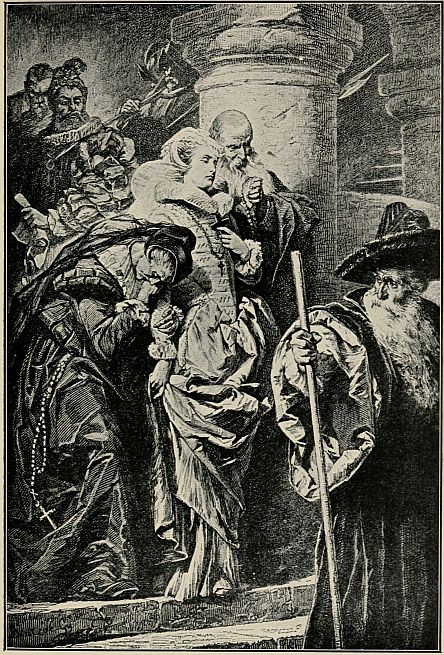
MARY STUART LED TO EXECUTION
Drawing by Gyula Benczur.
“Weep not, my good Melville!” said Mary Stuart to the faithful servant who threw himself in a paroxysm of grief at her feet. “Weep not for me! Thou shouldst rather rejoice that thou shalt now see the end of the long troubles of Mary Stuart; know, Melville, that this world is but vanity and full of sorrows. I am Catholic, thou Protestant, but as there is but one Christ, I charge thee in His name to bear witness that I die firm to my religion, a true Scotchwoman, and true to France. Commend me to my dearest and most sweet son. Tell him I have done nothing to prejudice him in his realm, nor to disparage his dignity, and if he will live in the fear of God, I doubt not he shall do well. Tell him, from my example, never to rely too much on human aid, but to seek that which is from above. If he follow my advice, he shall have the blessing of God in heaven, as I now give him mine on earth.”
As Mary Stuart ascended the steps of the scaffold, Sir Amyas Paulet, her last jailer, tendered his hand to aid her. With queenly courtesy she accepted it, saying: “I thank you, sir; this is the last trouble I shall ever give you.”
When her upper garments had been removed, she remained clothed in her petticoat of crimson velvet, with bodice and sleeves of the same material. As Jane Kennedy drew forth the gold-bordered handkerchief Mary had given her to bind her eyes, the faithful lady could not restrain her weeping. But Mary placed her finger on her lips, saying tenderly: “Hush! I have promised you would make no outcry; weep not, but pray for me.”
When the handkerchief was pinned over the eyes of her loved mistress Jane was forced to retire, and Mary Stuart was left alone upon the scaffold with her executioners. Kneeling on the cushion, the heroic Queen of Scots repeated with unfaltering voice: “In te Domine speravi” (In thee, Lord, have I hoped). As she was blindfolded she was then led by the executioner to the block, upon which she bowed her head without the least hesitation, exclaiming in firm and clear tones, “In manus tuas.” “Into thy hands, O Lord, I commend my spirit,” and the beautiful lips closed forever. At the first blow the agitated executioner missed his aim, and inflicted a deep wound on the side of the skull. No groan nor cry escaped the suffering victim, but the convulsion of her features evinced her terrible pain. At the third blow the “butcher work” was accomplished, and the beautiful head of the hapless Queen of Scots, streaming with blood, was held up to the gaze of the people, as holding aloft this bloody and horrible trophy of his fiendish deed, the executioner cried, “So perish all Queen Elizabeth’s enemies!”
But neither wily ministers, nor plotting knaves, nor jealous hate, nor obedient executioners, could rid Queen Elizabeth of her last great foe, who, in spite of all her schemes, and tears, and imprecations, would soon snatch the royal diadem from her brow, and take the sceptre from her clutching hands, and tear the royal ermine from her tottering form, and close her defiant eyes. The King of Terrors could neither be bribed, nor menaced, nor defeated, though she should cry in tortured agony, “My kingdom for an hour of time!” Steadily this conqueror approached, though she fought desperately to elude his grasp. Far differently did Elizabeth meet her doom from the heroic Queen of Scots. Refusing to go to bed lest she should be deemed dying, Elizabeth commanded that pillows should be piled for her on the floor; and there, writhing in agony of body and terror of mind, she spent her last hours. Now calling upon her chaplain to pray, and then muttering in angry complainings when her ministers requested her to name her successor. At length she was so weak that she could no longer speak, and she ordered by signs that the Archbishop of Canterbury should continue to pray. This the old man did until he was utterly exhausted, the dying queen each time motioning him to proceed, when he endeavored to stop from very weariness. Meanwhile her attendants watched her waning breath, with eager impatience to greet the coming king. But even in death their wily vigilance was overreached by the apparent sleep of their helpless sovereign, and Elizabeth had been dead several hours before it was discovered by her scheming ministers, who were eagerly awaiting the signal announcing her demise, that they might be the first to shout “God save James I.! king of England, Ireland and Scotland!”
Mr. Froude thus ably sums up the salient points in the character and reign of Elizabeth:—
“The years which followed the defeat of the Armada were rich in events of profound national importance. They were years of splendor and triumph. The flag of England became supreme on the seas; English commerce penetrated to the farthest corners of the Old World, and English colonies rooted themselves on the shores of the New. The national intellect, strung by excitement of sixty years, took shape in a literature which is an eternal possession to mankind, while the incipient struggles of the two parties in the Anglican church prepared the way for the conflicts of the coming century, and the second act of the Reformation. The Catholic England with which the century opened, the England of dominant church, and monasteries, and pilgrimages, became the England of progressive intelligence; and the question whether the nation was to pass a second time through the farce of a reconciliation with Rome was answered once and forever by the cannon of Sir Francis Drake. The action before Gravelines of the 30th of July, 1588, decided the largest problems ever submitted in the history of mankind to the arbitrement of force. Beyond and beside the immediate fate of England, it decided that Philip’s revolted provinces should never be reannexed to the Spanish Crown. It broke the back of Spain, sealed the fate of the Duke of Guise, and though it could not prevent the civil war, it assured the ultimate succession of the king of Navarre. In its remoter consequences it determined the fate of the Reformation in Germany; for had Philip been victorious the League must have been immediately triumphant; the power of France would have been on the side of Spain and the Jesuits, and the thirty years’ war would either have never been begun, or would have been brought to a swift conclusion. It furnished James of Scotland with conclusive reasons for remaining a Protestant, and for eschewing forever the forbidden fruit of popery; and thus it secured his tranquil accession to the throne of England when Elizabeth passed away. Finally, it was the sermon which completed the conversion of the English nation, and transformed the Catholics into Anglicans.
“While Parliament was busy with the condition of the people, the concerns of the Church were taken in hand by the queen herself. For Protestantism Elizabeth had never concealed her dislike and contempt. She hated to acknowledge any fellowship in religion either with Scots, Dutch, or Huguenots. She represented herself to foreign ambassadors as a Catholic in everything, except in allegiance to the papacy. Even for the Church of England, of which she was the supreme governor, she affected no particular respect.
“The want of wisdom shown in the persecution of the Nonconformists was demonstrated by the event. Puritanism was a living force in England; Catholicism was a dying superstition. Puritanism had saved Elizabeth’s crown; Catholicism was a hot-bed of disloyalty. She found herself compelled against her will to become the patron of heretics and rebels, in whose objects she had no interest and in whose theology she had no belief. She resented the necessity while she submitted to it, and her vacillations are explained by the reluctance with which each successive step was forced upon her on a road which she detested. It would have been easy for a Protestant to be decided. It would have been easy for a Catholic to be decided. To Elizabeth the speculations of so-called divines were but as ropes of sand and sea-slime leading to the moon, and the doctrines for which they were rending each other to pieces a dream of fools or enthusiasts. Unfortunately her keenness of insight was not combined with any profound concern for serious things. She saw through the forms in which religion presented itself to the world. She had none the more any larger or deeper conviction of her own. She was without the intellectual emotions which give human character its consistency and power.
“Elizabeth could rarely bring herself to sign the death-warrant of a nobleman, yet without compunction she could order Yorkshire peasants to be hung in scores by martial law. She was most remorseless when she ought to have been most forbearing, and lenient when she ought to have been stern.
“Vain as she was of her own sagacity, she never modified a course recommended to her by Burleigh, without injury both to the realm and to herself. The great results of her reign were the fruits of a policy which was not her own, and which she starved and mutilated when energy and completeness were needed.
“The greatest achievement in English history, the ‘breaking the bonds of Rome,’ and the establishment of spiritual independence, was completed without bloodshed under Elizabeth’s auspices, and Elizabeth may have the glory of the work.
“In fighting out her long quarrel with Spain and building her church system out of the broken masonry of popery, her concluding years passed away. The great men who had upheld the throne in the days of her peril dropped one by one into the grave. Walsingham died soon after the defeat of the Armada, ruined in fortune and weary of his ungrateful service. Hunsdon, Knollys, Burleigh, Drake, followed at brief intervals, and their mistress was left by herself, standing as it seemed on the pinnacle of earthly glory, yet in all the loneliness of greatness, and unable to enjoy the honors which Burleigh’s policy had won for her. The first place among the Protestant powers, which had been so often offered her and so often refused, has been forced upon her in spite of herself. She was head of the name, but it gave her no pleasure. She was the last of her race; no Tudor would sit again on the English throne. Her own sad prophecy was fulfilled, and she lived to see those whom she most trusted turning their eyes to the rising sun.
“Old age was coming upon her, bringing with it perhaps a consciousness of failing faculties; and solitary in the midst of splendor, and friendless among the circle of adorers, who swore they lived but in her presence, she grew weary of a life which had ceased to interest her. Sickening of a vague disease, she sought no help from medicine, and finally refused to take food. She could not rest in her bed, but sat silent on cushions, staring into vacancy with fixed and stony eyes, and so at last she died.
“All questions connected with the virgin queen should be rather studied in her actions than in the opinion of the historian who relates them. Opinions are but forms of cloud created by the prevailing currents of the moral air. Actions and words are carved upon eternity.”