Part 3 — FROCKS FOR TO-MORROW.
Reading edition
By "THE LADY DRESSMAKER."
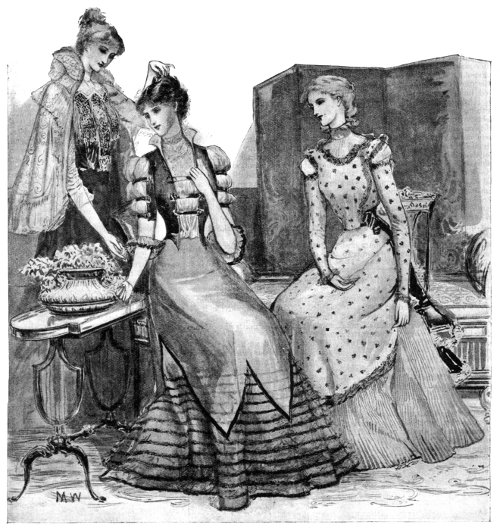
EVENING DRESSES FOR CHRISTMAS FESTIVITIES.
The winter is always distinguished by a rather dowdy style of dress, especially in town, where, for at least three months of the year, the days are so dark and the light so poor at best that everyone says, "It really cannot matter what one puts on in such sombre weather as this." Such is the sentiment expressed by the general public, but, of course, does not apply to those who, having carriages at their disposal, can blossom out like the lilies of King Solomon, and be carried over the mud and through the gloom without let or hindrance. It is only on sunny days during the winter and at Church Parade in Hyde Park that one sees the brighter side of winter dress. Otherwise it only blooms in the shops, at the dressmakers', and at the endless afternoon teas which constitute the main amusement during the winter. One must have at least one nice walking-dress for the winter, in spite of the gloom, for these last-named festive occasions, and one generally needs a cape or mantle as well to wear in turn with our costume or with it as we may require. Besides this, most women have a certain amount of "wearing out" to do of clothes that must put in a second winter. Those wise people who have established a kind of rule for themselves in the purchase of dress get a handsome cape or mantle one year and a handsome gown the next, the latter becoming less visible and important the second year when worn under the new mantle. Both of these should come from first-rate shops, in order to get the full value out of them. Then there are the people who wait for the sales to supply themselves with winter clothes, and say they manage to finish out the last year's stock by this means in the still darker and shorter days before Christmas. I always consider the wearing out of one's winter things a grievous bother which falls most heavily on the shoulders of those who are very careful wearers of their garments. I know people who really are never able to wear out their clothes, and become quite dispirited at the constant sight of them. I know one lady who is able to clothe several others poorer than herself because she takes such good care of what she wears, and things are hardly worn in appearance when she has them repaired and brushed up.
The class which has the most difficulty in clothing themselves so as to present a respectable appearance is composed of these very poor ladies, who are governesses, lady-helps, or companions, and no doubt my readers will have noticed the moving appeals issued by many of the societies and agencies which are interested in procuring work for them. As we are always anxious to find out good works for our women and girls, we commend to them this one, as one of the most blessed both to giver and receiver.
The return to fashion of dresses made from the same material entirely instead of those which have been so long in wear, which consisted of a blouse, more or less handsome, and a skirt, has brought in a necessity for mantles and capes, and so these are really the most fashionable of the out-of-door garments for the winter months. There is no fear, however, of the skirt and jacket disappearing from amongst us, for they have been found too useful to lose their place in our esteem; and the winter jackets are, some of them, very pretty and tight-fitting, with large buttons, and generally of three-quarter length, though there are many quite short ones, but which seem more used for cycling or golf than for real walking or driving.
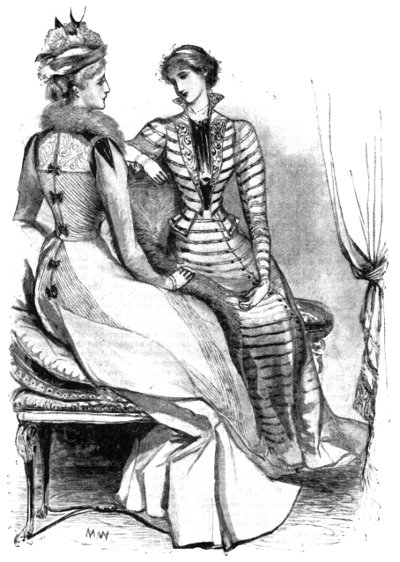
TWO WINTER GOWNS.
One of these costumes with a tight-fitting coat is shown in our illustration of "a gown with braid and fur," which is a very handsome example of the walking-gowns of the winter. The skirt is made with the fashionable tightness, the much-worn shaped flounce, and the braiding is carried down the front on either side in a graceful arabesque design, which is wider and fuller in detail at the top near the waist. The points are braided in the same manner, and the tops of the sleeves. The fronts have revers of mink fur. The dress itself is in dark blue cloth, and the braiding is in black. The hat is of blue velvet, with white and green wings, and blue and green velvet trimmings. This admixture of blue and green seems more popular than ever this winter, and I have frequently seen a blue hat with a bright green velvet choux bow placed in a conspicuous position in front.
The choux and the Louis XII. or true lovers' knot are the two fashionable bows of the season, for hats and bonnets as well as for dress. The first-named seems ubiquitous in evening dress, where black velvet also appears to be most popular as a trimming.
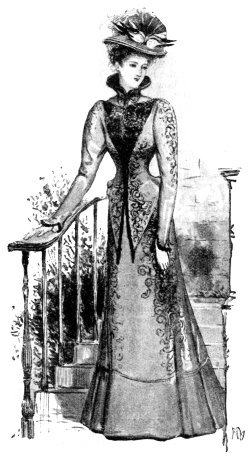
GOWN WITH BRAID AND FUR.
Both velvet and velveteen are much worn, and are suited to the fashions of the day, and the velveteen blouse retains its popularity, but is more dressy and fanciful than it was. In some cases velvet is used for the coat-shaped bodices, with short square tails that are much seen, and these have almost invariably fancy vests or yokes. In most instances, too, these are of finely tucked silk muslin, which, in cream or white, is quite the most popular material for them, in spite of its perishable nature and apparent unseasonableness.
So far as materials are concerned, everything that is clinging and soft is sought after, and even the rustling silks that lined our skirts and gave us such a feeling of opulence have been relinquished in favour of something more clinging. Cashmere and nuns' veiling are used for the lining of day dresses, and China silks for evening ones. For slight people this clinging effect is sometimes trying, but where stout people are concerned the matter becomes worse, and we shall hear of all kinds of cures for obesity in order to wear the new skirts.
Of course, as is usual at this season, many evening dresses for small Christmas festivities are simple, and our illustration shows three of these, which are inexpensive and pretty. The first seated figure to the right wears a pink silk muslin, plain for wearing over the accordion-kilted skirt, and having a small black leaf-like pattern on it for the pointed overskirt; a ruching of rose-coloured silk goes round the latter part of the bodice and sleeves, and the back is finished with a wide band and bow with ends of rose colour. This can, of course, be carried out in any hue, but in white or cream-colour it is very pretty, and there are such numbers of fancy gauzes and nets that a pretty choice can be made which would be more inexpensive than the model we present.
The centre figure wears a dress of mousseline-de-soie of a pale shade of Parma violet, which is trimmed with narrow ribbons, drawn up to form small ruches. These are of a slightly darker violet. The small Eton jacket is of the same shade of violet velvet or satin, with bands of velvet and paste buckles. The standing-up figure wears a dress of jet-embroidered net, with bands of passementerie on the front of the bodice. The evening wrap is of a soft yellow brocade, which is lined with a pale violet, and trimmed with flounces of lace and silk. The collar is edged with white fur, and a bow of chiffon ornaments the neck at the back. In giving these dresses I should observe that, although they seem costly, they can be copied in less expensive materials. Nuns' veiling, China silk, velveteen, taffetas, Russian net, and Brussels net are all in fashion, and all are comparatively so moderate in price as to be attainable by those who have slender purses. This season we also have the embroidered net skirts that were introduced last year, with the improvement that this season the bodice-piece is sold as well. So we have not to make troublesome inquiries and huntings for the material to decorate them. There seems to be a tendency likewise to return to the use of a three-quarter length sleeve, which fits the arm smoothly as far as the elbow and terminates in a frill. The long net and chiffon sleeves are still worn, and I notice that there are some very pretty high net bodices without sleeves, or, at least, with a few folds of satin, which answer the purpose. These will be a novelty if they should be adopted, and will be charming for the evening with all thin materials.
The illustration of two winter gowns shows one of the new skirts and a bodice fastened at the back. The skirt is also fastened there in the newest fashion; the trimming consists of rows of fine black braid, the dress being of fine cloth, of a pervenche blue. The bodice is trimmed with points of velvet, of a darker shade of blue, and the same is used for the bows at the back. The second dress is one of those tucked throughout. It is of a soft satin cloth, of a pale shade of grey. The revers are braided, and there is a front of dark-grey velvet and a high collar, with the lining braided, like the revers. I hope you will notice that this skirt opens on one side, usually the left, and it is finished by a row of tiny buttons, or by a small ruching of ribbon.
A great deal of this ribbon ruching is seen, as well as much piping. Silk braids, very fine and very narrow, in black and white, form a feature of this year's decorations, and silver braids as well. Crystal buttons are more liked than paste or steel ones, and there is a craze for old lace and for mixing fur with it. Black and white are in as much favour as this mixture has always found during the last four years, and the two are constantly mixed in trimmings.
I think I mentioned in my last that the hair was worn low on the neck—certainly far lower than has been the custom for some little time. But I do not find that the knot of hair is quite so low just now. Evidently the idea has not quite "caught on," as the slang phrase has it, and most of the well-dressed heads I have lately seen have had the coil of hair at the back of the head midway down. Perhaps, later on, we shall see more of the low hair dressing than we do now.
Truly the swing of the pendulum has quite carried us away from the neat and ever-becoming black stockings, and the new ones are a study in colour and design. I think the tartan ones will be worn, and will look well; but I cannot say I like the others; nevertheless, that may be because one has grown used to a lack of colour for so long.
So far as boots and shoes are concerned, the most fashionable people wear the American ones with their extremely pointed toes and narrow feet, but it is open to the sensible to wear something more comfortable if they do not mind a loss of style, for we cannot be really smart unless our poor feet be pinched and pointed to the last degree.