HENRY PURCELL: THE PIONEER OF ENGLISH OPERA.
Reading edition
By ELEONORE D'ESTERRE-KEELING.
On the 25th of November, 1680, there appeared in the columns of the London Gazette the following announcement:—
"Josias Priest, who kept a boarding-school of gentlewomen in Leicester Fields, is removed to the great schoolhouse at Chelsey that was Mr. Portman's. There will continue the same masters and others to the improvement of the said school."
Leicester Fields was in 1680 the name of that part of London now known as Leicester Square, and the removal of their school from this central position to the village of Chelsea, at two miles distance, must have made a considerable difference in the lives of the young gentlewomen who had been confided to the care of Mr. Josias Priest. But preparations were just then being made for a great event, and the wily dominie doubtless knew what he was about when he chose the drear month of November for his flitting.
In the great schoolhouse which had been Mr. Portman's there was to be such a Christmas "break-up" as had never been known, and the young gentlewomen of Mr. Priest's establishment had no leisure to lament the gaieties of London life, for their thoughts were fully occupied by the practising of their music and their steps, not to mention such frivolous matters as the trying-on of fancy costumes and the twisting of bright English tresses into the coils which should surmount the dainty heads of maids and matrons of classic Carthage.
The new Chelsea school-master was nothing if not ambitious, and no less a thing would satisfy him than the performance of an original opera by the young gentlewomen of his establishment. To realise the full extent of this ambition one must remember that up to this time (1680) opera was unknown in England. The first opera ever written was Peri's Dafne, and this had been privately performed in Florence in 1597. The same composer's second opera, Eurydice, was the first work of the kind to receive public support, it being performed in 1600, also at Florence. Opera now slowly found its way across Europe, reaching Germany in 1627, when Heinrich Schutz's Dafne was given at Torgau; and arriving at Paris in 1659, in which year La Pastorale, by Robert Cambert, was sung before a public audience. From this time it made rapid strides in the French capital, and Lully's operatic compositions were regarded as masterpieces. England, however, still hung back, not because there was any lack of excellent musicians in the country, but because the sympathy and encouragement which are necessary to the advancement of any art were not forthcoming.
Under the stern rule of the Puritans, music had been rigorously suppressed, and the compositions of our older masters, existing only in precious manuscripts, had been torn up and trampled under foot. The destruction of singing-books was so complete that very few specimens of pre-Commonwealth music now exist, and to add to the general ruin, valuable organs were broken up, the one in Westminster Abbey itself being pulled to pieces and its pipes pawned at the ale-houses for pots of ale.
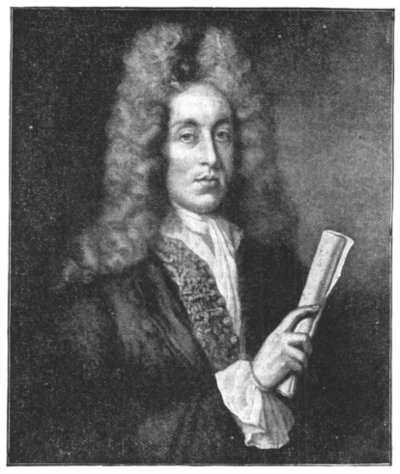
HENRY PURCELL.
Although the work of destruction was being thus drastically carried out by Cromwell's soldiers, the Protector was not himself without a strong love for music, and one of the acts for which musicians owe him gratitude was his rescue of the organ in Magdalen College, Oxford. This beautiful instrument he had privately brought to Hampton Court and placed there in the great gallery, in order that he might listen to the music played on it by his secretary, the poet Milton. After Cromwell's death it was returned to Magdalen College, but eventually it was sold, and it now stands in Tewkesbury Abbey.
The year of Cromwell's death (1658) witnessed the birth of England's greatest composer. In a small back street of Westminster, St. Ann's Lane, Old Pye Street, there was living at this time a clever musician called Henry Purcell. At the Restoration he was made Gentleman of the Chapel Royal, and in this capacity he sang at the coronation of Charles II., when, in order to do honour to the occasion, he, in common with his colleagues, received "four yards of fine scarlet cloth to be made into a gown." He was also elected singing-man of Westminster Abbey, and Master of the Chorister Boys, as well as music-copyist. This last was deemed a very honourable position, and owing to the wholesale destruction of church music-books during the Commonwealth, it was no sinecure; for it must be remembered that in those days there were no cheap editions of printed music, and every composition had to be laboriously transcribed by hand, printed copies being very rare and expensive.
Little is known of the private life of Henry Purcell, senior, beyond the fact that his wife's name was Elizabeth, and that he was the father of the greater Henry Purcell, the child whose birth occurred in the very year in which his father's fortunes began to look up; and in which, by the accession of Charles II., there was given to music an impetus that was significantly foreshadowed by the advent of England's greatest musician.
Beneath the grey walls of Westminster Abbey little Henry passed the first years of his life, the sounds of music constantly in his ears and in his heart, and so well had his sweet baby voice been trained that, at the death of his father, when he was but six years old, he was admitted as a chorister of the Chapel Royal. His father's brother Thomas, also a gifted musician, henceforth took care of the boy and superintended his education with watchful tenderness. His teacher at this time was Captain Cooke, an old man, who had belonged to the chapel of Charles I., and who, on the breaking out of civil war, had turned soldier and fought on the Royalist side. He had won a captain's commission, and now, as a reward for his loyalty, he was appointed by Charles II. Master of the Children of the Royal Chapel. Many of the anthems composed by Purcell, and still in use in our cathedrals, date from this time, and he was only twelve years old when he wrote the ode which he called "The Address of the Children of the Chapel Royal to the King and their Master, Captain Cooke, on his Majesties Birthday, A.D. 1670, composed by Master Purcell, one of the Children of the said Chapel."
At sixteen our composer became a pupil of the famous Dr. John Blow, one of the greatest musicians of this time; and now his genius developed with marvellous rapidity.
Amongst the minor canons of Canterbury Cathedral, there was one John Gostling, the fortunate possessor of a bass voice of extraordinary compass. This man was a great favourite with Charles II., and on one occasion the King, having arranged a pleasure trip in his new yacht, The Fubbs, round the Kentish coast, desired Gostling to join the party "in order to keep up the mirth and good-humour of the company." The boat had not gone very far when a terrible storm arose, and the danger became so imminent that the King and the Duke of York had to work like common sailors to help keep the vessel afloat. They escaped, but the impression made on Gostling was so profound that on his return to London he selected those passages from the Psalms which declare the wonders and terrors of the deep, and gave them to his young friend Purcell to compose, the wonderful anthem "They that go down to the sea in ships" being the result.
It was with reference to this singer that Charles II. made the bon mot, "You may talk as much as you please of your nightingales, but I have a gosling who excels them all!"
In 1680 Dr. Blow resigned his position as organist of Westminster Abbey in favour of his young pupil, and thus at twenty-two years of age, we find Purcell in possession of the most important musical appointment in the kingdom. His fame was already secure, but this year was to put the crown on all his former achievements, and this crown was to be twined for him by English school-girls.
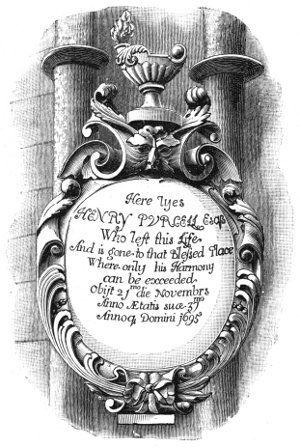
Here lyes HENRY PURCELL Esqr Who left this Life, And is gone to that Blessed Place Where only his Harmony can be exceeded. Obijt 21mo die Novembrs Anno Ætatis suæ 37mo Annoq Domini 1695
In this year Mr. Josias Priest moved his school for young gentlewomen to Chelsea. In this year also he conceived the bold idea of an English opera, and having chosen his subject, the classic history of Dido and Æneas, he had commissioned Nahum Tate, a native of Dublin, who was already known as co-author (with Nicholas Brady) of the metrical version of the Psalms, to prepare the book. The brilliant young organist of Westminster Abbey was engaged to compose the music, and so heartily did he throw himself into the work that an opera was produced which could measure itself against the best existing productions of Italy, France, or Germany.
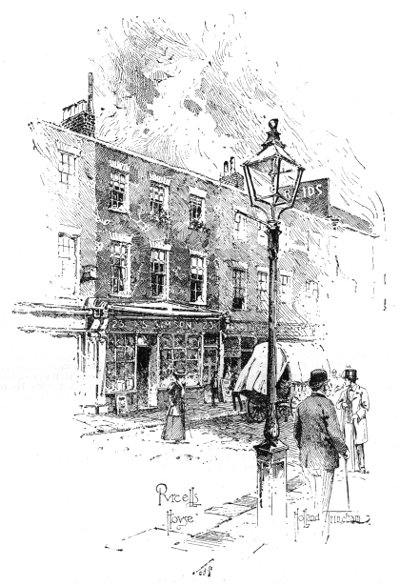
Purcell's House
That the music should have been so surpassingly beautiful is the more surprising when we remember the limitations imposed upon its creator. With the exception of the part of Æneas, which was given to a tenor, all the parts were written in the G, or treble, clef as being the easiest for young gentlewomen; and the orchestral accompaniments were confined to two violins, a viola, bass, and harpsichord.
The composer himself played the harpsichord parts on this first occasion, and the audience seems to have consisted, as is usual in such cases, of the parents and friends of the young performers. The entertainment was pronounced an unqualified success, and it would indeed have been a crabbed auditor who could have remained unmoved while Queen Dido confided the story of her love to her trusty Belinda, or listened to the protestations of the faithless Æneas. Bands of shepherds and shepherdesses, enchanters and sorceresses, varied the solo parts with choral song and dance, and towards the close came that incomparable death-song, the exquisite pathos and beauty of which still strike home to every listener. "Remember me," sings the forsaken and dying queen to her faithful Belinda, "but oh, forget my fate!"
Mr. Fuller Maitland says in connection with this song:—
"It is an inspiration that has never been surpassed for pathos and direct emotional appeal. It was this directness of expression rather than his erudition that raised Purcell to that supreme place among English composers which has never been disputed. The very quality of broad choral effect which has been most admired in Händel's work was that in which Purcell most clearly anticipated him. In actual melodic beauty Purcell's airs are at least on a level with Händel's."
At the close of the performance, the Lady Dorothy Burk, one of the young gentlewomen of Mr. Josias Priest's school, recited an epilogue, written for her by Thomas D'Urfey. It is too long to quote entire, but the following extracts from it may interest our girls of to-day.
"All that we know the Angels do above, I've read, is that they Sing and that they Love. The Vocal part we have to-night perform'd: And if by Love our Hearts not yet are warm'd, Great Providence has still more bounteous been To save us from those grand Deceivers, Men. Here blest with Innocence, and peace of Mind, Not only bred to Virtue, but inclin'd; We flourish and defie all human kind. * * * * We hope to please, but if some Critick here. Fond of his Wit, designs to be severe, Let not his Patience be worn out too soon, And in few years we shall be all in Tune."
Dido and Æneas was not printed until 1840, and even then it was but an imperfect version of the opera that was given to the world. Since 1895—the bi-centenary of the composer's death—the Purcell Society has been issuing a complete edition of the works of the "English Orpheus," and Dido and Æneas has now at last come into its right. During Purcell's lifetime opera was not held in high favour in this country, a fact which is significantly proved by the circumstance that Dido and Æneas had no successor. In the Gentleman's Journal for January, 1691-92, we find this quaint statement: "Experience hath taught us that our English genius will not rellish this perpetuall singing." Henceforward our first opera composer confined himself to incidental music introduced into spoken drama. A poor perversion of The Tempest, by Shadwell, was honoured far too highly by being set to music by him, and only those parts of the music which were associated with Shakespeare's words, such as, "Come unto these yellow sands," and "Full fathom five," have survived.
An adaptation of Beaumont and Fletcher's Dioclesian has fared no better, but it attained the honour of print during its composer's lifetime. It was dedicated to the Duke of Somerset, and was accompanied by an address to his Grace containing the following passage, which is of interest to us to-day, as showing the respective positions of the sister arts at the close of the 17th century.
"Music and Poetry have ever been acknowledged Sisters, which, walking hand in hand, support each other; As Poetry is the harmony of Words, so Musick is that of Notes; and, as Poetry is a Rise above Prose and Oratory, so is Musick the exaltation of Poetry. Both of them may excel apart, but sure they are most excellent when they are joyn'd, because nothing is then wanting to either of their Perfections: for thus they appear like Wit and Beauty in the same Person. Poetry and Painting have arriv'd to their perfection in our own Country. Musick is yet but in its Nonage, a forward Child which gives hope of what it may be hereafter in England when the Masters of it shall find more Encouragement. 'Tis now learning Italian, which is its best Master, and studying a little of the French Air, to give it somewhat more of Gayety and Fashion."
Dioclesian, backed by the Duke of Somerset, was successful. It was performed in 1690, and was said to have "gratify'd the expectation of Court and City, and got the author great reputation."
In the following year Purcell wrote the music to King Arthur, the work which, next to Dido and Æneas, holds the highest rank amongst his secular compositions. The drama had been written by Dryden, but the entire plot had to be so changed, owing to the altered political situation, that the poet, in his preface, after lamenting the destruction of his verse, goes on to say—
"There is nothing better than what I intended than the Musick; which has since arriv'd to a greater perfection in England than ever formerly; especially passing through the artful hands of Mr. Purcell, who has compos'd it with so great a genius, that he has nothing to fear but an ignorant, ill-judging audience."
The immediate success of King Arthur seems to have been great, though it did not long hold the stage. The time for works of this kind was not yet come; in 1770 it was revived at Drury Lane, with a considerable access of popularity. Since that time it has been heard at tolerably frequent intervals, and a masterly performance was given under the direction of Dr. Hans Richter at the Birmingham Festival in October, 1897.
Though Purcell's life only extended over thirty-seven years, he had the composition of odes, on various occasions, for no less than three English sovereigns. In addition to his numerous contributions in honour of Charles II., some of which have been noted here, he wrote for the coronation of James II. the two splendid anthems, "I was glad," and "My Heart is inditing." He also wrote for James an ode beginning, "Why are all the muses mute?" There seems to be something of irony in the fact that he should likewise have been the author of a melody which, according to contemporary writers, did more than anything else to "chase James II. from his three kingdoms," but though Purcell certainly wrote the music ultimately sung to Lilliburlero, it is no less true that he had no knowledge of the use to which his melody would be put. Amongst his minor compositions of this time were a march and a quickstep, and the Irish Viceroy, Lord Wharton, was discriminating enough to recognise that the tune of the latter, wedded to words by himself, in which the king and the Papists were held up to derision, would have an extraordinary effect upon the masses of the people. The event proved that he was right. According to Bishop Burnet, "the impression made on the army was one that cannot be imagined by one that saw it not. The whole army, and at last the people, both in city and country, were singing it perpetually, and perhaps never had so slight a thing so great an effect."
The tune is a bright, gay one, and is now put to a harmless use by being sung to the nursery rhyme—
"There was an old woman went up in a blanket, Seventeen times as high as the moon."
It is also sung by young girls in the south and south-east of Ireland, while reaping in the fields, to the words—
"Lully by lero, Help her along,"
and usually has reference to one of their number who is less nimble than her companions.
James having fled, it was next Purcell's duty to compose an ode in commemoration of the accession of William and Mary. This was performed at the Merchant Taylor's Hall, at a gathering of Yorkshiremen, for which reason it is now known as the "Yorkshire Feast Song."
He wrote odes to St. Cecilia, which were used at the festival of St. Cecilia's Day for several years, the finest of them being the last, the magnificent Te Deum and Jubilate, written in 1694. It was the first work of this kind that had ever been heard in England, and from the date of its composition till 1713 it was performed regularly every year. Then Händel's great Te Deum and Jubilate for the Peace of Utrecht was composed, and was performed alternately with the work of the English musician until 1734, when Händel's Dettingen Te Deum displaced both its predecessors.
In December, 1694, Queen Mary died, and Purcell composed the music for her funeral. There were two new anthems, "Blessed is the man that feareth the Lord," and "Thou knowest, Lord, the secrets of our hearts." We have the testimony of one who was present in the choir on this solemn occasion as to the effect produced by the noble music. "I appeal to all that were present," says this authority, "as well such as understood music, as those that did not, whether they ever heard anything so rapturously fine and solemn, and so heavenly in the operation, which drew tears from all, and yet a plain, natural composition, which shows the power of music, when 'tis rightly fitted and adapted to devotional purposes."
The second anthem, "Thou knowest, Lord," has been sung at every choral funeral in Westminster Abbey and St. Paul's from that day to this, for Dr. Croft, who set the Burial Service to music, abstained from setting these words, declaring that the music left by Purcell was unapproachable.
Only a few months after Queen Mary's death the composer also passed away to "that place where alone his harmony could be excelled," and the solemn strains of the anthem but lately written for the dead Queen were sung by his friends and colleagues as they laid the loved master to his rest beneath the shadow of that organ on which he had so often played.
Dr. Blow, who had stood aside to let the younger musician take his place, now resumed his appointment as organist of Westminster Abbey; and, facing the memorial tablet raised there to Henry Purcell, we may see one placed to the memory of Blow, recording, amongst other tributes to his mind and heart, that he was "the master of the famous Mr. Henry Purcell."
A collection of "Choice Pieces for the Harpsichord," by Purcell, was published by his widow after his death, as well as two books of songs called Orpheus Britannicus. Prefixed to the second of these volumes is an ode from which, in conclusion, I give a short extract.
"Make room, ye happy Natives of the Sky, Room for a Soul—all Love and Harmony; A Soul that rose to such Perfection here, It scarce will be advanced by being there. * * * * Ah, most unworthy! shou'd we leave unsung Such wondrous Goodness in a Life so young. In spight of Practice, he this Truth has shown, That Harmony and Vertue shou'd be one. So true to Nature, and so just to Wit, His Music was the very Sense you Writ. Nor were his Beauties to his Art confin'd; So justly were his Soul and Body join'd, You'd think his Form the Product of his Mind."