Part 3 — SILVER POINT DRAWING.
Reading edition
So light and airy, dainty and delicate, is this delightful process, that it may well be called the fairy queen of the graphic arts. So white is the paper or card on which it is produced, and so beautiful the chemical changes of colour it undergoes when first produced, that no process of reproduction can give more than a faint idea of the beauty of an original silver point drawing.
Many times have I been told, "Oh, I have a silver point drawing by So-and-so," but on nearly every occasion, when inspected, the treasure has turned out to be merely a photographic reproduction, giving, it is true, the form of the original, but without a particle of its colour or daintiness of appearance.
Under these circumstances it will be well to commence by stating what a silver point drawing is, and how to tell an original from a reproduction.
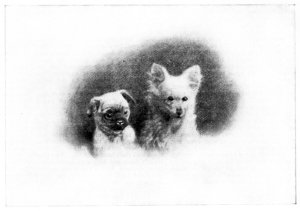
TWO OF THE QUEEN'S PETS.
A silver point is a drawing made with a stylus of pure silver on paper or card specially prepared for the purpose with a coating of chalk or china clay applied under heavy pressure. To tell a real silver point, hold the drawing to the light edgeways. You will then see in bright silver every stroke made by the stylus. Also you will find, when looking at the drawing in the ordinary manner, that its colour varies in different places; looking at one part a faint brown, another blue, another grey; in fact, assuming, where it has been much worked on, the appearance of the surface of a bright silver article which has been for some time exposed to atmospheric influence.
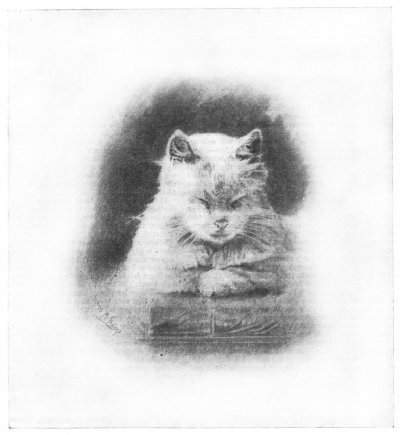
A SLEEPING BEAUTY AT SANDRINGHAM. (By Ernest M. Jessop.)
Before the advent of lead pencils silver point was greatly in vogue with the old masters, and fine examples by some of the greatest of these are to be found in the national collections of England and France. Notable among them are drawings by Raphael, Perugino, Botticelli, Holbein and Albert Durer. The art, which had fallen into disuse, has of late been revived by many eminent artists. The late Sir Frederick Leighton was an ardent devotee of silver point, and has left many beautiful specimens of his own drawing.
Both the Prince and Princess of Wales are great admirers of the art and possess several specimens drawn by my friend Mrs. C. Sainton, R.I., and myself. The Princess, in the scant leisure allowed her by the cares of state, I have reason to believe, practises the art of silver point, as well as that of burnt wood work, a description of which will be given in these pages very shortly.
And now let me give a few hints on how to practise almost the most difficult of all the graphic arts. To begin with the tools. These are very simple. From a jeweller you may procure three pieces of round silver wire a few inches long. They should vary in thickness from that of the thinnest lead in an ordinary pencil to that found in a six B, and may be used similar to the leads in an ordinary pencil case or mounted in wooden handles of the thickness of a lead pencil. You can buy (although only of the largest artists' colourmen) both silver point paper and card; the latter is the best from its non-liability to cockle.
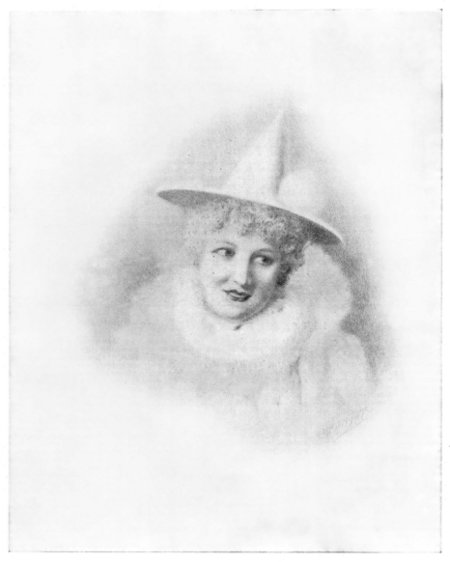
STUDY FROM LIFE IN SILVER POINT.
(By Ernest M. Jessop.)
The silver wires may be sharpened to any point desired on a piece of very fine emery cloth. Two sizes of round and one flat point are those usually used.
As to the card or paper. This, it must be at once understood, is one of the most delicate of substances. Its surface once soiled, it is absolutely useless. No mark of any nature can be erased from it. There is no rubbing out or slurring over to be practised. If you scratch its surface with an erasing knife it alters the colour and the stylus will no longer mark on the scratched surface. The same result occurs from the contact of a hot or greasy hand or the spilling of a spot of water no matter how quickly removed.
For these reasons no silver point can be entirely drawn direct from nature. A fairly finished sketch must first be made; from this it is advisable to take a careful tracing. Through this tracing bore very small holes with a broken etching-needle or small piercer at all the salient points and at short intervals along the outline of your subject. Then lay your tracing on the silver point paper in the position you intend it to occupy, secure it by weights, and with your smallest silver point make a tiny dot through each hole on to the paper. This is the only guide you can make to help you. Now lightly indicate your drawing with fine strokes made diagonally from right to left downwards, always remembering that the silver point cannot be rubbed backwards and forwards the same as a pencil without destroying the surface of the paper. All shadows should be put in very lightly at first, as lights cannot afterwards be added, although they may be taken away where not required. To get your deeper shades you may go over the same places many times with the silver point if you continue to work downwards. Either parallel or diagonally crossed lines may be used to shade. It is as well to avoid all firm hard outlines, as silver point mainly depends for its beauty on its misty and shadowy effects.
As in all classes of art work portraits, after having been fixed from a sketch, should be finished direct from nature. Without using this method you may preserve the features of your model, but soul and character will always be wanting. For land and seascape silver point is peculiarly adapted, as some of the most delicately beautiful aerial effects may be attained by its use. For foliage also, used with a careful knowledge, it is incomparable. To look its best no silver point drawing should occupy more than one-fourth of the paper on which it is drawn, and any attempt to finish square up to a mount or frame must be studiously avoided. In fact, the edges of the drawing should imperceptibly melt away into the paper. In very fine work, such as the face of a baby or young girl, a singularly beautiful effect may be produced by finishing the features through the aid of a magnifying glass, thereby removing all traces of lines, and then in the ordinary manner and with bolder lines adding hair, figure, costume, etc.
One last word on the choice of paper. This is made with two kinds of surface, dull and slightly glazed, like the backs of playing cards. The latter I have found to give the best effect in colour. All drawings after they are completed should be exposed to the atmosphere (but not to dust) for at least a week, it taking some time for them to acquire their beautiful colouring. After the period above mentioned the colour is absolutely permanent.
In framing the edges of the paper should be hermetically sealed to the glass so as to exclude dust.
Frames are always a matter of taste. Personally I have used with the happiest effect a wide flat frame of white enamelled wood with a very narrow pale gold Louis Seize edging to enrich the opening of it. A fine silver point in a well-made frame of this kind is indeed one of those things of beauty which are joys for ever.
Ernest M. Jessop.
⁂ The original drawings from which these illustrations are taken were recently exhibited by desire to H.R.H. the Princess of Wales at Marlborough House, and H.R.H. was pleased to say that she had derived great pleasure from her inspection of them.
(All copyrights of drawings reserved by the artist.)
