ABOUT SOME NORMANDY DAIRIES.
Reading edition
By LADY GEORGINA VERNON.
Soft grey days, with rolling misty clouds, southerly winds crooning pathetic farewells to the departing summer; such is October in Normandy, alternated with brilliant days, flashing golden glory over the myriad tinted orchards, such a strange mixture of grey and gold, of fading pasture and scarlet leaves, early mornings calm and still with every blade of grass heavy with dew, while the burning mid-day glows with summer splendour, and days like these in autumn have a brilliancy and a power of touching one's heart that no summer day possesses; and in Normandy Nature seems to paint her beauties with more lavish hand than in our northern climes. Scarlet and amber, crimson and madder deck each tree and hedge, and even if there are grey days they only seem to bring out more vividly the autumnal glories. October is a busy month for farmer and dairy-man here, because one of the chief industries, that of soft cheese-making, can only be sparingly carried on during the hot summer months; and in October the manufacture of Camemberts especially is at its height.
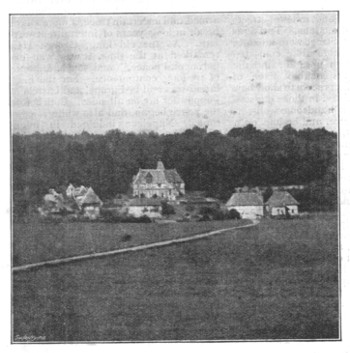
MANOIR-FERME OF S. HYPOLITE, NEAR LISIEUX.
I should strongly advise any one who is interested in dairy-work to make a trip to Normandy during this month, for they could pass a delightful time studying the various methods of soft cheese-making.
This is an industry I have long wished to see carried to greater perfection in England. It is work so eminently suited for women, and could be undertaken by any one with a dairy, of even eight or ten cows, with very little expense. I have lately been making a very careful study of this work, and visiting many of the largest dairies round Lisieux, which is the centre of the Camembert and Pont Evêque cheese factories, and I have been much struck by the simplicity of the process and the slight expense that the plant would cost for the production of these and kindred cheeses.
There are great difficulties in the way of thoroughly mastering the subject, because as a rule the whole process is carried on by "rule of thumb." There are no thermometers, and they boast that they never use one. The very important subject of the heat of the milk at various stages of manufacture, the temperature of the rooms for ripening the cheeses, are carried out by guess-work and feeling, and I think that this is one cause that these cheeses vary so much in different localities. I should strongly urge that any one desirous of becoming an adept at this work should endeavour to get herself taken as a pupil at one of the smaller farms. They will not take pupils at the large manufactories, as it is not worth their while, but at some of the smaller places, I think, if a pupil was willing to pay a premium, she might get taken on. I spoke to one farmer who makes about four hundred to six hundred Camemberts daily in his small dairy, and he thought it was quite a possible plan. An intending pupil should provide herself with two thermometers, one to hang up in the dairy and one to test the heat of the milk. My own feeling inclines me to advise the taking up of the Pont Evêque cheeses more than the Camembert; they are not so difficult to ripen, and I think are more suitable to English taste, and should command a ready sale.
Now if any one feels fired by a spirit of enterprise to take up this interesting work, I could promise her that much pleasure could be derived from such a trip, and if such a one is a cyclist, it could be carried out at a very small cost. The roads in Normandy are splendid, with a surface that even after heavy rains dries quickly, and one can always find little country inns or auberges, where good food and cleanliness can be insured, if not luxury. And I think the most agreeable way of making a cycling tour is not to make any very hard-and-fast rule as to stopping-places, but let it depend on the weather and one's own feelings, as some days a run of forty miles is easily accomplished, and yet on another, with a hot sun and many long côtes to climb, one is sufficiently tired after twenty-five miles to greet with pleasure the little brick-floored cool parlour of the wayside inn, and relish the excellent coffee, even without milk, and the rolls and lovely butter that are always provided.
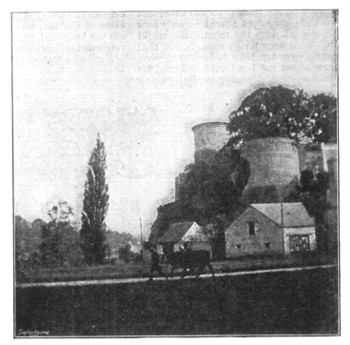
FALAISE.
To reach Lisieux, which I warmly advise as headquarters, a very delightful route for a cyclist is the following:—
Go over to Dieppe by the day boat, reaching about 4 P.M. At the Hotel de Paris prices are very reasonable (which is more than can be said for some of the hotels). Next morning start early, before the heat of the day, and take the road which leads by the station up a long hill and then through a very pleasant country of green fields and high hedges and running streams, past the villages of Longueville, Auffay and Clères, which is twenty-five miles from Dieppe, and where there is a nice little inn. This is the Rouen Road, and if a forty-mile journey is not too long, then Rouen can be reached without difficulty, as the roads are good and there are no long hills, but if a very small village inn is not objected to, I should advise my cyclist to stop at Malaunay (twenty-three miles) at the Hotel de la Poste, where, though one has to pass through the kitchen to one's brick-floored little bedroom, I think the sight of the charming methods carried on in even such a modest French kitchen is quite enough to give one an appetite for dinner, and a desire to possess just such a stove and such shining pots and pans and delightful brown earthenware "marmites." We will then suppose our cyclist elects to rest at Malaunay. Next day again start early, as there is little to see there except a sight which filled me with horror, namely, a "margarine fabrique," specially for export to England; that wide mouth which seems ready to take all that other countries will send, bad or good.
From Malaunay, take the road for Maremme, turn to the right up a long steep hill, and then a pleasant road through woods and valleys brings one to the Seine at Duclair (sixteen miles). Along this district, one first makes acquaintance with the charming black and white cottages thatched with straw, with the top of the roof bound firm by iris planted all along the ridge. When I was there in May, these purple-roofed cottages were most picturesque. I should advise any one who has the time to turn off the main road two miles to Jumièges and visit those grand old ruins which stand in one of the promontories made by the winding Seine. From Duclair a flat road leads to pretty Caudebec (nine miles); here the Hotel de la Marine offers inexpensive comfort.
Make an evening visit to the great cathedral, which seems so out of proportion to the size of the small riverside town, and you will be fortunate if you come in for such a sweet, solemn service as I did this year. There were only a few scattered lamps here and there hung in the great arches, the light barely illuminating the central aisle, but a brilliant light just outside the altar rails brought into full relief a group of maidens, who were pouring forth the sweetest cantique of love and devotion to "Marie, notre Mère;" while far away in the half gloom shone out the never dying lamp opposite the tabernacle, and then, as the hymn died away, the priests' voices rose and fell, and the bell rang at the sanctus, and on the whole congregation came the wonderful peace and quiet of the hour of benediction. And later, as I passed out into the dim silence of the spring evening, I noted how there were rough men from the boats on the river, and gipsy women from a little encampment close by, and white-capped mothers with their children and the wooden sabots clattered down the dark streets, and all was quiet.
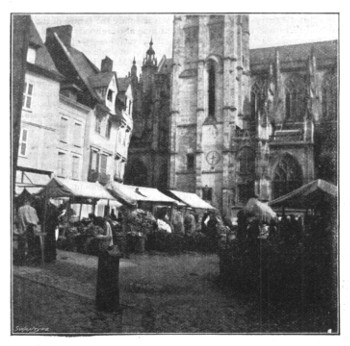
MARKET-PLACE.
If the next day should be the market day, the picturesque confusion of the great square under the shadow of the cathedral, makes a scene not easily forgotten—white tents and big blue umbrellas sheltering piles of red carrots and cartloads of green cabbages, while the stalls are decorated with huge bunches of pale-blue forget-me-nots and sweet white pinks. Here you will make your first acquaintance with a Normandy cheese stall, and I must confess the cheeses one meets at the country markets are not inviting, but to the intending cheese-maker they are most interesting.
There are two routes to choose from by which to reach Lisieux from Caudebec. The shortest is to cross the river by the ferry, and it is only nineteen miles to Pont Audemer, but the prettiest road is by Lillebonne and Quillebœuf, where one takes the ferry, and through a rich pasture country one reaches Pont Audemer, about twenty-two miles. Here the tourist had better rest for refreshment. The remainder of the road to Lisieux, another twenty-two miles, is through rather a hilly country, but there are no very steep hills, and one finishes by a two-mile run down into Lisieux, which lies in a deep valley.
There are several good hotels here, but I can name Hotel d'Espagne as comfortable and reasonable in prices, while the landlord is always ready to give advice as to the best farms to visit and the nearest roads.
When arrived at Lisieux, I advise that all the larger farms and dairies should be visited. I met with the greatest courtesy, and I found none of the extreme reluctance to tell one the secrets which I had been led to expect. On the contrary, I was able to see each step of the various processes of the making of Camembert, Pont Evêque and Livarot. The simplicity of the work of making these soft cheeses is such, that I can only attribute the great difficulty experienced in England to produce Camemberts in perfection to the herbage and the difference of atmosphere. One of the largest makers and exporters of all the various kinds of these cheeses is Monsieur Brière, at Mesnil Guillaume, some four miles from Lisieux. Here, if he will be good enough to show his manufactory, as he did to me, the work can be seen to its greatest perfection—from the first turning of the milk, through the various stages of the drying of the cheeses, to the final business of packing for export. Monsieur Brière in the month of May, which is accounted as la saison morte for Camembert, was sending away one thousand five hundred daily.
He makes also Pont Evêque and every variety of these French cheeses. I should, however, recommend that a visit be paid to one of the farms nearer Pont Evêque, where this is made a speciality.
Pont Evêque lies about thirteen miles from Lisieux. A large quantity of these cheeses are made on small farms and sent en blanc, that is after three or four days, to some of the larger factories, where they are finally salted and dried and packed for export.
A very excellent variety of Camembert is made by Monsieur Chiffeman, but his dairies are not near Lisieux, although he is one of the largest buyers and exporters, and a most kind and courteous adviser I found him as to the best dairies to visit.
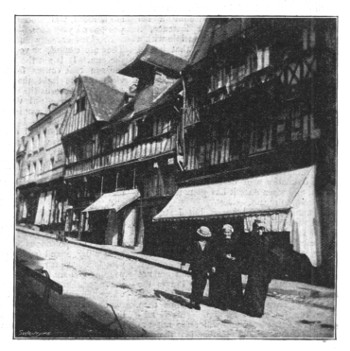
A SUNNY DAY.
The whole neighbourhood of Lisieux is full of interest not only to the would-be cheese-maker but to the lover of architecture. Its quaint, narrow streets and houses, enriched with carving up every beam, and its fine churches, make it one of the gems of Normandy towns, while within easy distance on almost every side may be found delightful specimens of old chateaux and of Manoir-Fermes surrounded by a whole array of picturesque half timbered farm buildings, all so arranged that the master's eye can be upon everything, the whole nestling in rich orchards which are one of the greatest sources of wealth to these proprietors, while herds of the handsome Cotentin cows graze knee-deep in the rich grass—these cows are a breed of which the farmers are justly proud, somewhat resembling large Ayrshires but stronger in make and bone—they consider them better than the Channel Islands breeds for their purposes. I must not omit to mention among other cheeses the Livarot, which really haunts one in market, hotel, and factory, the strong pungent smell being very disagreeable to our English ideas. Livarot is made from skimmed milk, mostly in the smaller dairies, and is eaten by the poorer people. It is not a cheese which could ever find a sale in England. The little town of Livarot lies about twelve miles from Lisieux, and is worth a visit for the sake of its curious old houses.
Charming excursions can also be made from Lisieux to Falaise (27 miles), with its grand castle, the birthplace of William the Conqueror, Caen (28 miles) with its magnificent abbeys, Bayeux (18 miles further) with its fine cathedral and interesting tapestry.
If a longer excursion than I have named can be taken, I should strongly recommend my cyclist to take a run into Brittany, and visit the farms round Rennes, where the Port du Salut cheeses are made. I could not visit these manufactories myself, and I can give little advice on the subject, but I know the roads round Rennes and they are good and it is not very hilly, while the Port du Salut is a cheese which is always sought after in England. It is one of the cheeses known as "Fromages cuits," and for all these the plant required is costly. Another cheese, almost similar, is known as La Providence, or Bricquebec, because it is made at a convent of that name near Cherbourg. I do not know whether the sisters at the convent could be induced to show their "fabrique."
I must not lengthen this article further, except to conduct my intending cyclist home! And I think any one would find the road from Lisieux by Bernay, 20 miles, and on to Evreux, 36 miles, visiting there the celebrated cathedral, and then up straight north to the Seine, one of the prettiest roads. Vernon, 25 miles, is easily reached from Evreux, and few or many days can be happily spent along the ever changing and delightful scenery of the silvery Seine, while here and there one comes upon high chalk cliffs, honey-combed with caves, which are fitted with doors and windows, and which form the dwellings of many families.
From Vernon by le Petit Andelys and Pont de l'Arche to Rouen is about 40 miles, but I would suggest breaking the journey at Pont de l'Arche, where there is a comfortable little inn close to the bridge and an interesting church.
I think no tour in Normandy can be more appropriately finished than by a sojourn at Rouen, that home of all that is most fascinating, in rich, if somewhat over ornate architecture.
I have not, in this article, touched upon the question of Normandy butter, which has become such a formidable competitor with English markets, but to diversify the road to Dieppe, let our cyclist take the road by Gournay through Neuchâtel-en-Bray, and visit on a Tuesday the butter-market. I think when one sees the uniformity of the splendid quality of butter in that market, and the severe scrutiny to which it is subjected by the merchants, one realises partly why Normandy butter has such a high character. Some thousands of pounds of butter change hands there in a day.
Gournay is not only the centre of the butter market, but here also are made the well-known Pommel and Gervais cheeses, of which the process is well taught in some of our own English Dairy Schools—so at the British Dairy School at Reading.
No stranger is allowed to enter any of the factories at Gournay, and the greatest secrecy is observed, but I think that possibly, armed with introductions, one might obtain an entrance, and then I am sure many valuable hints could be got.
I hope anyone who undertakes the little trip I have described will enjoy both the country and the dairies as thoroughly as I did, and come home feeling that they have gained a considerable amount of knowledge and of interest in all dairy matters, besides having their memories stored with happy recollections of many sunny days spent amongst courteous Normandy folk.