Part 6 — ANSWERS TO CORRESPONDENTS.
Reading edition
STUDY AND STUDIO.
Rachel M. Westlake (New Zealand).—Many thanks for your pleasant letter.—1. The joyous keeping of Christmas itself (for which see Chambers’s Book of Days) is responsible for the sending of Christmas cards. Just as we send birthday cards to greet our friends on their birthdays, so we send cards to greet those to whom we cannot personally wish “A happy Christmas.” We do not think there is any ancient origin of the custom.—2. Boys at public schools are “taught so much about the heathen gods and goddesses” because to understand Greek and Latin literature it is necessary to understand mythology. Homer, for instance, cannot be understood without knowing about Zeus, Pallas Athênê, and the other inhabitants of Olympus “who hold the wide heaven.” The whole subject of the value of classical education is far too vast to enter upon here.
St. Patrick.—1. We will consider your request as to the article on “Burnt Wood Work.”—2. We are afraid there is no way of restoring the colour in question; but careful washing will do much to prevent its conversion into green in the first instance.
An Ignorant Musician.—1. There is no royal road to success in reading music at sight. The only way is to practise constantly reading new music. A distinguished professor, whom we know, advises also reading the notes by the eye, without the piano.—2. Both your methods of treating the bass chords are equally correct, but you should beware of consecutive octaves.
If “Country Lass” were to write to Mrs. Sole, Crudwell Rectory, Malmesbury, she might receive help of a practical kind.
A Reader Abroad (New Zealand).—We are glad to tell you something of what we know about Berry Pomeroy Castle. It is said to have been founded by Ralph de la Pomeroie, one of William the Conqueror’s knights, who received from his sovereign fifty-eight manors in all, among them that of Berry, in Devonshire. The castle remained in the possession of the Pomeroy family until the middle of the sixteenth century, when Sir Thomas Pomeroy, who had been a ringleader in the Rising in the West, and had as a punishment for rebellion been deprived of many of his estates, sold it to Lord Seymour. The Seymour family built an imposing structure within the older part of the castle, but never brought it to perfection. A fire, caused by lightning, so injured the building in the early part of the eighteenth century that it was abandoned to decay. Prince, the author of The Worthies of Devon, describes the castle as very magnificent, and so vast “that it was a good day’s work for a servant but to open and shut the casements.” It is now, owing to the luxuriant setting of thick foliage and ivy and its beautiful situation, one of the most picturesque of English ruins; and it is interesting to observe the difference in architecture of its composite parts. We advise you to apply for a photograph to Crauford’s Library, Dartmouth; or Westley’s Library, Torquay.
Ellen.—The sentence, “There is sorrow on the sea,” occurs in a verse of the Bible—Jeremiah xlix. 23.
G. R. and Mary Priscilla Cunningham.—G. R. inquires for a “Practising Society,” and Miss Cunningham writes at the same time to mention one, so we commend our correspondents to each other. The “Honour Bright” Practising Society encourages regular practice, awards prizes, and levies fines. Address, for a copy of rules, the Secretary, Miss Cunningham, 1, Bloemfontein Villas, Dalling Road, Hammersmith, W. We may add for G. R.’s benefit that she will see other Practising Societies mentioned if she scans this column for the past few months, e.g., Mrs. Walker’s, Litlington Rectory, Berwick, Sussex, and Miss Isabella Kent’s, Lay Rectory, Abington, Cambridge.
Opal.—1. Your quotation is not correctly given. The verse—
“It is the little rift within the lute That by and by will make the music mute, And ever widening, slowly silence all,”
will be found in Tennyson’s “Merlin and Vivien,” Idylls of the King.—2. Eugene Field’s poems are published by Scribner’s Sons, New York, and John Lane, London.
Anne Weinhäupt (Innspruck).—1. We have a great many subscribers in Austria, but must not give the exact numbers.—2. A “gooseberry-picker” gathers a very thorny fruit for others to eat, having only the trouble for his share. So a third person who accompanies a pair of lovers for propriety’s sake has all the trouble and none of the pleasure of the expedition. This at least is the explanation we have read of the phrase, “to play goose-berry.” We may add that the expression is seldom used nowadays. Many thanks for your kind letter.
K. K.—Your poems are far above the average of those we receive for criticism. In the first verse of “Only” we should demur to the use of the present tense “ends” for the sake of rhyme, in one instance. The tense should be kept the same throughout one statement. In “Happiness,” “best” and “happiness” do not rhyme. We thoroughly agree with the sentiment of your concluding verse. We can quite understand that your work has found acceptance for publication, but we have our own staff of writers, and should not at present have use for your poems. Many thanks for your good wishes.
“A Dutch Girl.”—As the author you admire is still living, there is no biography published of her. Biographies, as a rule, are not compiled until people are dead. Write to her publishers for any information you desire, and they will give it to you if it is in accordance with her wishes.
Mildred.—You do not give us your address, so all we can advise you to do is to write to the Secretary, Technical Education Board, St. Martin’s Lane, London, W.C., inquiring for the nearest school where you can study “black and white.” As to the length of the time it would take you to learn to illustrate books, all depends on your previous knowledge of drawing and natural capacity.
Winton writes to tell Cherea of an Early Rising Society; secretary, Mrs. Eastes, 2, Church Hill, Walthamstow, Essex.
Pink.—We applaud your courage in wishing to learn Spanish, if your hours of work are from 8 A.M. to 8.30 P.M. The First Spanish Book, by A. M. Bower, is published at 2s. (actual cost, 1s. 6d.). There are also Hossfield’s New Method of Spanish, and Sauer’s Spanish Grammar, published at 3s. and 5s. (4s.) respectively. At any large second-hand book-shop you would probably pick up a Spanish grammar for a few pence.
Mab.—An excellent book on the subject you name is Woman’s Work and Woman’s Culture, edited by Mrs. Josephine Butler, and published by Macmillan, but it is not new. Modern books are, Pursuits of Women, by Frances Power Cobbe; The Duties of Women, by the same author; The Woman Question of Europe, edited by Theodore Stanton; Women in English Life, from Mediæval to Modern Times, by Georgina Hill, 2 vols.
Jeanne Müller (France).—1. We can only advise you to write to some registry office of good standing, saying what you wish to do. Address, Société des Professeurs de Français en Angleterre, 20, Bedford Street, Strand, London, W.C., or the Agency for Foreign Governesses and Home, 3, Colville Houses, Talbot Road, London, N., superintended by M. le pasteur du Pontet de la Harpe, French Parsonage, Bayswater. It would be very wise of you to come to England to perfect your knowledge of English.—2. Apply to any English bookseller, e.g., Messrs. Sotheran, Strand, London, for the books in question.
Hilde (Geneva).—1. We advise you also to write to a good agency; for instance, Association of German Governesses in England, 16, Wyndham Place, Bryanston Square, London, or Miss Hug’s Registry for Foreign Governesses, 21, Baker Street, London, W., or the Army and Navy Auxiliary, Francis Street, Westminster. You might also advertise in the Morning Post. Have you no friends in England? Private inquiry is by far the best way of finding a home on reciprocal terms. Can any reader suggest one?—2. We are willing to tell Sybil that you advise her to eat three oranges a day, and La Petite that you recommend her to place her pressed flowers in cotton wadding to preserve the colour.
A Lover of Music.—As you truly observe, we cannot, without hearing you play, judge as to the chances of your passing an examination. We advise you to write to the Secretary, Trinity College, Mandeville Place, Manchester Square, W., for details as to the standard of proficiency required, etc. The fee is from 10s. 6d. upwards. We commend your perseverance in practising without lessons.
Azzie.—Thanks also for your reply to “Winton.” We know of no cure for the trouble you speak of but time, patience, and attention to the general health.
Midget.—Your writing is too “scratchy,” and looks as though you wrote with the edge of your pen, or too fine a nib. Try to form your letters more accurately. We think it would do you good to practise copying some model of handwriting. Thanks for your information.
Geisha.—You had better consult Mrs. Watson’s articles on “Self-Culture for Girls.” We will certainly criticise anything you send in six months’ time. Have you ever thought of joining an essay club? We occasionally mention such in our columns.
Helen (A Constant Reader).—The inability to talk often arises from shyness and nervousness, or fatigue after a hard day’s work may cause you to relapse into silence. You can do a great deal to overcome the habit by forcing yourself to express your thoughts. You must have many things pass through your mind—recollections of the past, hopes for the future—that people who care for you would be interested to hear; then put them into language. Or take some special book or subject in which you are interested, and talk about it. Do not be discouraged; it is better to be quiet than to talk nonsense; and above all, never try to talk brilliantly. Simple and natural conversation will “come of itself” in time.
Daffodil (Cork).—1. Your version of Wordsworth’s couplet—
“The proud heart flashing through the eyes, At sound of Rob Roy’s name,”
is found in the best edition, Dr. Knight’s, in eight volumes, and in Moxon’s 6-vol. edition. But in the small 1-vol. edition we read—
“And kindle like a fire new stirred, At sound of Rob Roy’s name.”
Poets occasionally change the form of their work, but you can certainly consider the first quoted is the more correct of the two renderings.—2. Your writing is too large and childish for your age. Keep a regular space between your lines; do not make the downstrokes black, and try to reduce it all to a smaller uniform size. Some letters now are much larger than others.
MEDICAL.
Hawthorn.—The various fruit salts, effervescing salines, effervescing citrate of magnesia, etc., are all pleasant modifications of seidlitz powders. You could make one for yourself by mixing together bicarbonate of soda, citric acid, tartaric acid, oxide of magnesia, and sugar. Heat these ingredients carefully in an earthenware pot and stir until the mass assumes a granular appearance. But why make it yourself? You can buy it ready-made cheaply enough. It is only the patent preparations which are expensive, for they have to pay for the stamp and advertisements.
Dark Despair.—We think most probably you did dislocate your jaw. Such an accident always leaves behind it some stiffness and pain on movement, but by exercising the joint these gradually disappear. A small blister over the joint, occasionally, will help to relieve the stiffness. Friction over the joint will also do good. But it is exercise that is most essential and movement to the point of pain, for the object of the movement is to break down adhesion within the joint, and it is these adhesions that cause the pain and stiffness.
Porcupine.—1. Errors of the refraction of the eyes more often cause squint than every other of its causes put together. And very frequently, if the squint is slight or fairly recent, wearing glasses will cure it. If it has gone further than this, an operation is necessary.—2. Go to the dentist at once; your teeth want to be thoroughly overhauled.
A Factory Girl.—Phossy-jaw is a rare disease now, and we cannot recollect ever having seen a case. It used to be fairly common, but the stringent laws relating to match-workers have done much to stop the disease. It is said that the phosphorus affects the jaw through decayed teeth, and that if the teeth are perfect phossy-jaw does not occur.
Alabama.—Decidedly girls can suffer from gout. But recently we saw a girl of seventeen who had typical acute gout in her great toe joint. It certainly is not very common for it to show itself before middle life, but it is not so uncommon as is usually supposed. Gout is far more frequent in England than in any other country, but it is less common than it used to be, possibly because port wine is drunk less than it was formerly. A curious fact in connection with the heredity of gout is, that gout and rheumatism often alternate in families; one generation suffers from gout, the next from rheumatism, the third from gout, etc. But more commonly gout is regularly hereditary. It is considerably more common in men than in women.
A Perplexed Girl.—Most probably your troubles are due to anæmia; the stoutness and puffiness of the face, the flushings and high colour of the cheeks, are very commonly met with in that condition. It by no means follows that because the blood is deficient the cheeks will be pale. The whites of the eyes, the inside of the lips, etc., will be pale in anæmia, but it is almost as frequent to find the face ruddy as pale. We therefore feel pretty confident that anæmia causes your trouble; but whether that condition is simply the ordinary “green-sickness” or due to some other cause we cannot say without examining you. It is unnecessary for us to describe the treatment for anæmia as we have done so, so frequently before.
Inquirer.—There has just been another inquiry into the question of the spread of infectious disease by oysters; and the very question you ask us was discussed at length. Green oysters apparently belong to three classes: firstly, those that are free from disease or from metallic salts—these are perfectly healthy; secondly, those that owe their green colour to salts of copper. It used to be thought that the green colour of some oysters was due to iron salts, but the present inquiry has proved beyond question that copper, and not iron, salts cause the green colour. Thirdly, the most important group of all from the medical standpoint, there are green oysters which owe their colour to some disease of the blood. What disease is not known; nor do we know if eating these oysters would injure the human body. Still, it is safer to avoid eating green oysters at all. A very significant fact is that in no single instance was the typhoid germ found in the oyster; and if by chance the germ did get into the oyster it was speedily destroyed, because it appears that fresh sea-water kills the bacillus altogether. This last fact certainly is rather upsetting to the commonly-held view that oysters can only become infected with typhoid germs by means of sewers; indeed, the whole investigation casts doubt upon the opinion that oysters can convey typhoid fever at all, but it by no means disproves it.
Anxious Inquirer.—Discharge of matter from the ear is a condition which requires very careful treatment, for it is one of those simple, everyday affairs which not uncommonly lead to the most terrible diseases. It is not in itself very dangerous, and if properly treated scarcely ever ends in trouble, but the danger lies in neglect. Discharge from the ear is always a very chronic affair, and though a person may rigorously wash out her ears for a month or so, she begins to doubt whether the syringing does any good. She gets careless, misses a day or so, and eventually gives up treatment altogether. And then may begin, by slow and insidious steps, or suddenly, in the course of a few hours, one of those fearful diseases of which only a physician can conceive the malignancy, diseases which, if unrelieved by prompt surgery, end fatally without fail in a few days. But as we said before, if the discharge from the ears is treated, the dangers of these calamities is practically nothing. The treatment for the condition is to syringe out the ears twice a day with a weak antiseptic. Condy’s fluid diluted with warm water to the tint of pink blotting-paper will do very well. It is also advisable to have your throat examined, for chronic throat trouble is particularly likely to cause chronic discharge from the ears.
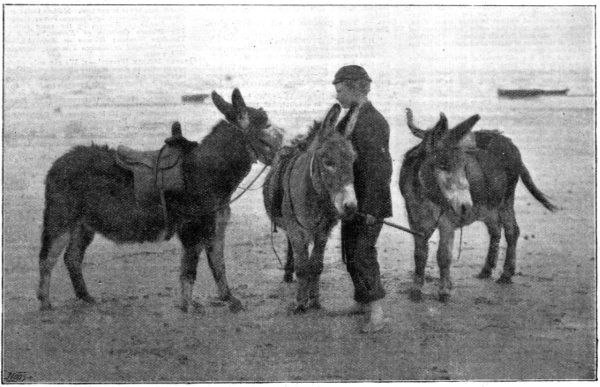
[From photo: By C. Read, Wishaw.
WE FOUR!
[Transcriber’s Note—the following changes have been made to this text:
Page 661: Mondodelphum to Monodelphum—“ally to L. Monodelphum”.
Page 668: kimself to himself—“knew himself to be”.
lone to tone—“a very low tone.”
Page 669: musn’t to mustn’t—“mustn’t think that”.]