DAINTY SCENT SACHET IN SATIN.
Reading edition
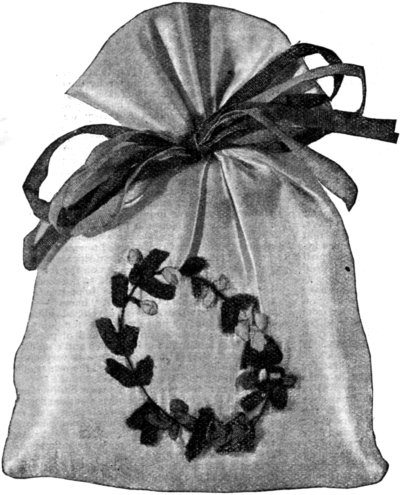
The pretty article here illustrated is no sooner seen than coveted by most of the fair sex, either for their own use or as a tiny present for a friend. White satin of good quality is used for the front of the bag, which is further adorned with a delicate spray of ribbon embroidery arranged in the form of a slightly oblong wreath lightly outlined, around which diminutive flowers and leaves are placed. Pale blue, yellow, or green pongee silk is suitable for the back of bag, which is added when the embroidery has been completed, previous to being filled with wadding containing scent powder, and being closed with strings of the delicate ribbon used for the embroidery.
Materials required.—White satin, pongee silk, each four inches wide and six inches long, three layers of wadding same size, pot pourri or other scent powder, half a yard each of cornflour blue, yellow and leaf-green ribbon, such as is used for ribbon embroidery. A thread of green filoselle is used for the tiny stems and to outline the wreath, which should be worked first.
The design consists of this wreath and two groups of flowers interspersed with green leaves and coloured buds. A pleasing variety may be produced by using green chenille instead of ribbon for some of the leaves. If any reader should find difficulty in copying this particular design, she may substitute any small spray and work it in any kind of embroidery which she finds easier and thinks suitable. The effect of the whole chiefly depends upon delicacy of colour, design and workmanship of whatever kind introduced, and the idea affords scope for endless individual taste and variety.
The ornamentation should not extend more than two inches from the lower edge of the satin, so as to escape the gatherings by which the bag is closed at the top. The simplest way to carry out our design is to copy the wreath’s outline upon the satin with a lead pencil and to work in the flowers and leaves afterwards from the illustration. It is really quite easy to do so in the case of such a tiny spray, and first attempts may be made by drawing it on paper until satisfied that the arrangement has been satisfactorily copied. After that the attempt should be made upon the satin with or without pencil tracing, according the worker’s ability.
To work rosette flower.—Take four inches of yellow ribbon, a single thread of fine sewing silk or cotton, a common fine sewing needle, and a large-eyed ribbon or crewel needle. Draw or imagine a circle the size of a small glove button. With the large-eyed needle draw one end of ribbon through the edge of circle. Take second needle and thread, sew the end in place with one tiny stitch and gather along one edge of ribbon, which should be on right side of satin. Then draw second end of ribbon through to wrong side and draw in the gathering thread very tightly to form a rosette as small as possible. Stitch the centre in place, taking the stitches through the extreme edge of gathers only. Fasten off on wrong side.
To work star, flowers and leaves but few directions are required. Work with large-eyed needle and a short length of ribbon. Draw ribbon through to right side of satin, leaving a short end at wrong side. Lay a bodkin or other flat instrument in front of ribbon; work one stitch over the bodkin and draw it away. Work three more stitches in the same way and finish centre with a large French knot worked with silk or filoselle. The foliage leaves are formed like the star flower petals. The bodkin is used to keep the ribbon flat and untwisted and from being drawn too tightly. It is advisable to fasten off the ends of ribbon on wrong side with needle and thread after each length of ribbon is worked up.
The reeds, which are most effective, consist of a nicely-worked French knot, made of coloured ribbon, on the top of a tiny green stem. These knots may be worked in the usual way, but some workers prefer to make a tied single knot with an inch of ribbon by hand, and then to draw each end through the work with the large-eyed needle.
When the embroidery is completed, lay the satin and silk together to make up the bag, having right side of embroidery inside. Turn down two inches of silk and satin together at the top of bag. Keeping them in this position, run the edges together along sides and bottom. Raise the upper layer of turned-down top and turn it over on opposite side, and you will be pleased to find a neatly-finished hem ready made, as it were, without any further trouble. Next turn the work right side out, lay some scent powder between the layers of wadding, fold them in half crosswise and slip all together into the bag. Next take twelve inches of green, blue, and yellow ribbon, and tie them round the bag about one inch from the top, having first arranged the back and front into artistic folds, if possible, without the assistance of gathering threads, which somewhat detract from the desired effect of immaculate freshness indispensable to work of the highest order.
Last of all, in the centre of embroidered front form a smart, crisply-made bow, using the three ribbons together so as to produce a soft bunch of loops and ends bristling out at each side.
Nothing then remains to be done save to admire the pleasing result of your labour, which, unless I am much mistaken, will greatly exceed your expectations.
There is one more hint I cannot resist giving you. It is this, three-sixteenths of a yard of satin is a small amount and only costs a little money, but it will make ten such scent-bags. What a happy idea for those of you who work for charity, and make their own little birthday gifts! Won’t you try it?
L. E. C. L.
[Transcriber’s Note: the following changes have been made to this text.
Page 626: Challonet to Challoner—“Lucy Challoner”.
Page 627: lettter to letter—“over that letter”.
Page 637: Muchisons to Murchisons—“two Miss Murchisons”.
Page 638: Crossart to Cossart—“Mrs. Cossart beaming”.
Missing word “on” inserted—“going on this”.]