PART VI.
Reading edition
THE ATHLETIC GIRL.
Wanted: A groom, tall, good-looking, steady.
Wanted: A housemaid, neat, respectable, no fringe.
Wanted: A cook, good, plain.
So run certain familiar advertisements. They are cited here as containing the descriptive words which have a particular applicability to the athletic girl, who, to state the general case in regard to her, is tall, good-looking, steady; neat, respectable, with no fringe; good, plain.
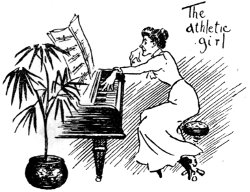
The athletic girl
This fact notwithstanding, the average athletic girl would not make a successful groom; still less would she give satisfaction as a housemaid; and least of all has she in her the makings of a good cook. Some hold that she has in her the makings of a good pianist, but that is a mistake, for she has no adagio. “I call a girl like that a fortist, not a pianist,” was said of her the other day.
Not always, but very often, the athletic girl’s is the prosaic type of mind, concerning which Lowell writes—
“The danger of the prosaic type of mind lies in the stolid sense of superiority which blinds it to everything ideal, to the use of everything that does not serve the practical purposes of life. Do we not remember how the all-observing and all-fathoming Shakespeare has typified this in Bottom the Weaver? Surrounded by all the fairy creations of fancy, he sends one to fetch him the bag of a humble-bee, and can find no better employment for Mustard-seed than to help Cavalero Cobweb scratch his ass’s head between the ears. When Titania, queen of that fair, ideal world, offers him a feast of beauty, he says he has a good stomach to a pottle of hay!”
The athletic girl easily thus runs to prose. Sometimes her prose is very funny. She looked up lately from a novel with the speech—
“There’s one thing I do want to know most awfully, Daddy—how people ‘gnash’ their teeth. Is it anything like this—or this—or this?”
Each question was accompanied by a facial illustration. Daddy is a serious man, but he laughed heartily.
Sometimes, however, Daddy shakes his head. The following is a case in point.
“Do you know, my dear,” he asked, “the difference between a soprano and a contralto?”
“Why, of course, Dad,” was the answer. “The one’s a squeak and the other’s a squawk.”
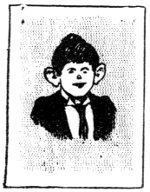
Such a girl has some knowledge, but she lacks some grace. Very often the athletic girl lacks both knowledge and grace. Sometimes, too, she lacks brains. The outward marks by which you shall know her in that case are that she has large ears and a little forehead. There are exceptions to this rule, but they are not many.
Of accomplishments the average athletic girl has few. All the French she knows she puts into a smile, and that smile is the one with which she meets any references to customs of the good old time. It says—
Nous avons changé tout cela.
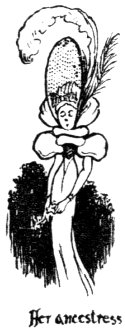
Her ancestress
Twenty years ago this girl was the girl who wished she was a boy. It is one of the changes which time has wrought in her case that she no longer wishes that. She is happy and proud to be a girl of to-day, believing, as she does, that girls and women never had a chance to distinguish themselves in feats of strength till to-day. Remind her of Joan of Arc, and she will reply that that was an isolated case; draw her attention to the passage in Motley’s Rise and Fall of the Dutch Republic, referring to the garrison of Haarlem in 1572, and she will stare. The passage in question runs—
“The garrison at least numbered one thousand pioneers or delvers, three thousand fighting men, and about three hundred fighting women. This last was a most efficient corps, all females of respectable character, armed with sword, musket, and dagger. Their chief, Frau Kenau Hasselaer, was a widow of distinguished family and unblemished character, about forty-seven years of age, who, at the head of her Amazons, participated in many of the most fiercely contested actions of the siege, both within and without the walls.”
Elegance of speech is not, as a rule, a primary characteristic of the athletic girl, and it has been noticed that, while she prefers the use of any name to that of the baptismal or family one, she usually goes to the brute creation for a substitute, selecting—in so far merciful—the names of the pleasantly associated animals commonly called domestic. Thus ass, goose, duck, pig, cart-horse, cow, and—lately at the zenith of its popularity with her—hound, are all of her word-treasure. It is to be expected that she will add to this list in the course of time “barn-fowl,” and some other, and that, when she has exhausted the names belonging to the domestic animals, she will have recourse to those placarded at the Zoo. It does not seem probable that she will ever be guilty of the banality attaching to the use of Christian names alone.
As a letter-writer the average athletic girl does not shine. First, as for her handwriting, it is perhaps best described in some words which Goldsmith gives to Tony Lumpkin—
“Here are such handles and shanks and dashes that one can scarcely know the head from the tail.”
The speed at which she writes, too, is productive of direful blunders of the kind of Dear Madman for “Dear Madam”; and the “burst of speaking,” to use a phrase from Shakespeare, which characterises her vivâ voce manner, has its effect upon her epistolary style. It lacks repose. Another detracting feature of it is connected with the fact that this type of girl affects insensibility just as her ancestresses of a hundred years ago affected sensibility. There is scarce a whit to choose between them in their affectations.
It is not that the athletic girl has no heart. There follows here her description of a parting scene in which she was one of two.
“I made an owl of myself, got the gulps, and could not even say good-bye.”
In other words, the athletic girl broke down.
Books enter little into the life of this girl, yet she—may—belong to a reading society. The following (writer, an athletic girl) bears witness to that fact—
“Our next Shakespeare reading is next Tuesday. Last year I never took part in them, but am going to this year, though I rather hate them. Twelfth Night is the play chosen, and I have been given two rotten parts where I have to say every now and then, ‘Good my lord,’ and ‘Prithee, tell me.’”
The same girl writes—
“I have just read a most frightfully good book, The Prisoner of Zenda. It is simply the thrillingest thing that ever was written.”
In another letter she writes—
“Do you know the poetry of Gordon? An Australian man. All about horses. First-class.”
The margin-note style is in peculiar favour with the athletic girl.
The personal note is one seldom struck by this girl, and the elegiac note is one scarcely ever struck by her. Even when she has a grievance she keeps a high heart. Who but she could write—
“For some extraordinary and unknown reason my head is aching. It is such a novel sensation that I rather like it.”
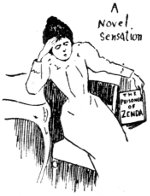
A Novel Sensation
Her letter-endings take their colour from her character, real or assumed. “In haste” is much in favour with her, and I have letters from her ending “Bye, bye!” and “Ta, ta! Yours affec.”
I will close this paper with a true story. In it will be shown how a lady, late an athletic girl, was wooed and—not won.
Her admirer was a widower, with one child. His home overlooked the school of which this lady, young as she was—for she was only six-and-twenty—was head-mistress. The widower, on re-marrying bent, sent in his card on what was called “office day.”
The name on the card was Colonel Hewson. The young head-mistress, whose name was Alice Joyce, read it, and gave the conventional order, “Show him in.”
Alice Joyce had some slight acquaintance with Colonel Hewson, and had also some slight inkling that he admired her. She did not admire him, and would have liked to deny herself to him, but she was not authorised to do this on “office day.” Perhaps he had come to place a pupil. His only child was a boy, but, perhaps, he had girl-relations. “Show him in,” said conscientious Alice Joyce, and Colonel Hewson was shown in.
“I thought you’d be surprised to see me,” he said crisply, on entering.
Alice smiled, and requested him to be seated. Then she left it to him to open the talk, occupying herself with a revolving bookcase, which she gently agitated.
Colonel Hewson was a bronzed man of travel, who, according to rumour, had penetrated into Asiatic jungles, and seen tigers and other undomestic animals eye to eye without blenching. He had, however, never before entered a lady’s school, and a terror the like unto which he had never experienced now held him tongue-tied.
Alice Joyce, good-naturedly racked her brains to think of something that would set him at his ease, and ultimately put the young head-mistress’s stock question—
“Would you like to see our gymnasium?”
Colonel Hewson expressed himself as not unwilling.
The gymnasium was empty, save of apparatuses, of which, movable and immovable, it had a great number. Alice Joyce had considerable skill in showing these off, and handled weights and bars with a facility which impressed her visitor. Up and down the gymnasium they went, swinging dumb-bells. Suddenly Alice Joyce pulled up short—
“As you are so much interested in all this, Colonel Hewson,” she said, “do come and see the girls at it.”
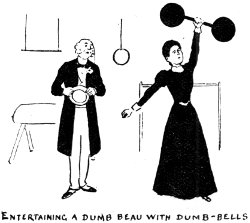
Entertaining a dumb beau with dumb-bells
“Can anyone come?” was asked.
“No, no; only parents and anyone whom I may happen to invite. I shall be pleased to see you, though you’re not a parent.”
Colonel Hewson expressed his deep sense of obligation with a rather blank face, adding, in mild protest, that he regarded himself as a parent. Here was one result of Alice Joyce’s having become a head-mistress. She had come to narrow the meaning of some words. She was startled herself to find that things had come to this pass, and said apologetically—
“When I say ‘parent,’ I mean the person in that relationship to girls—my girls. It is stupid of me, because, of course, there are” (her voice paused on a higher note) “other parents.”
Colonel Hewson’s face remained rather blank, and he put his hand on an iron ring suspended from the roof. Alice Joyce the while had stationed herself beside a trapeze bar. Colonel Hewson in a lady’s gymnasium was not the most valiant man in the world, but he now took heart of grace and proposed marriage to Alice Joyce.
The end of the story is perhaps best told in the words of the heroine—
“Of course I said ‘No’ to him. Really men are very tiresome. Fancy a man’s proposing when you’re showing him the gymnasium!”
CRUSHED
(To be continued.)