HOW TO CONTRIVE AND DECORATE A COFFER OR LINEN PRESS.
Reading edition
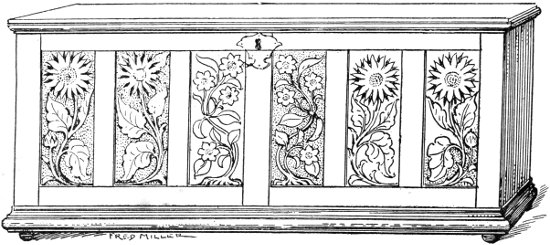
It often happens that one gets an empty case which one feels ought to be turned to account, and yet the thing is to know what to do with it. Here is one suggestion—make it into a linen press. The case for preference should be long rather than square (see the proportions in sketch). You could get a new one made for about 3s. 6d. or 4s.
The panelling is glued and bradded on. The “stiles” (those parts around the panels) should be got out of half-inch white wood and should be planed. So should the portions of the case where the panels are, if you intend to decorate them in any way, but if you get a case made, order it to be planed. Some builder’s moulding forms the plinth at bottom of chest, and a narrower moulding should be nailed on to the edges of the lid if you want to get a finished-looking article, but of course all these adornments can be left out, though at a sacrifice to appearance. We can sit on a three-legged stool, but we prefer a chair. Four casters should be screwed to the bottom of the chest so that it can easily be moved about. These can be purchased at any ironmonger’s.
The mouldings, stiles, top and sides of chest would look well stained brown. Varnish stain can be purchased, but I found that permanganate of potash (Condy’s fluid) put on with a brush stains the wood a nice brown, and it sinks right into it. Buy the potash by the ounce and dissolve it in warm water, and to obtain a deep colour put on a second coat. As it rots the hairs of a brush, use only a cheap one. This when dry can be either varnished with dark oak varnish (buy this by the half-pint at some good oil-shop or decorator’s supply stores) or can have beeswax dissolved in warm turpentine rubbed on and polished by friction. This is the old housewives’ way of polishing, and those who have seen chairs and tables in some country cottage polished in this way will admit that nothing can exceed the brilliance of the polish thus obtainable, as it improves with time, every rubbing you give it increasing the brilliance. If you use varnish you will probably have to give it two coats, as the first one is likely to sink in. Use a flat brush for putting on the varnish and apply it evenly.
As I want to cater for all tastes and pockets, I will give another suggestion which will involve very little outlay, as you can deal with any suitable strong empty case you may have by you. Get some patent size at an oil-shop and melt it to boiling point by putting it in a gallipot and this in boiling water. This saves contaminating the saucepan and keeps the size from burning. Give the case a good coat, and when dry a second one. Now purchase some Japanese gilt leather paper at some good furniture warehouse or decorator’s. It is very tough material, and will require some good strong paste. That known as “cobbler’s paste” (which you can get at a leather-seller’s or of a friendly bootmaker) is the best. It is too thick as it is, but can be thinned with a little boiling water. Put plenty on, as the paper will soak up a good deal, and don’t attempt to stick it down on the wood until the paste has been on some twenty minutes or so.
In cutting the paper the right size, allow of it being turned over the top and bottom edges of the case, and should there be battens on the box (strips of wood to strengthen the case), I should not attempt to paste a long piece of paper the length of the case, but first of all cut strips to cover these battens (be careful to get the paper well pressed into the angles), allowing enough to come a little way on to the case itself. You then cut pieces to fit into the spaces, taking the edges close up to the battens. The end pieces should be put on last, and should be cut just to fit the width but turned inside the top of the box and underneath.
It would be a good plan to line the case with good stout brown paper, previously sizing the wood. The sizing, I may tell you, makes the paper stick well.
If you like to put the mouldings at edge of lid and at bottom, you can do so now, previously staining and varnishing them. Screw them on with long fine screws in preference to nailing.
No end of useful articles can be made by covering them with this Japanese gilt paper. It is to be had in many patterns and with colours introduced in some of them.
A word or two now as to the decorated panels. You will see that they are of an ornamental rather than a natural character, and the designs can be repeated by reversing them, which will save the trouble of drawing fresh ones for each panel. They can be carried out by outlining the design in vandyke brown mixed with a little copal varnish and a little turps to thin the colour, and a background can be floated in transparently, putting more varnish with the colour. The plain wood will then show through the design.
You can of course paint the designs in simple quiet colours, but I think it would look in better taste to treat the panels in one tone of colour. It need not be brown; burnt sienna with a background of raw sienna, Indian red and burnt sienna for background, Prussian blue with a background of that colour and raw sienna to make it green, are some of the combinations that suggest themselves.
Of course you will understand that you must draw out the designs the size you wish to reproduce them and transfer them to the wood before you start the colouring.
The designs would look well carried out in poker work. By that I mean not an ordinary poker heated in a fire, but one of those “pyrographers” sold expressly for the purpose, in which a platinum point is kept red hot by a spray of some inflammable liquid ejected on to it. These instruments cost about 10s. 6d. each, but the most intricate design can be wrought with them, and most excellent decorative effects produced; but I daresay most of the readers of The Girl’s Own Paper interested in art work, are quite familiar with pyrography. It is not to be despised as an art, as those who have seen good work can testify.