Part 1 — THE QUEEN’S AVIARY AT WINDSOR.
Reading edition
By ERNEST M. JESSOP.
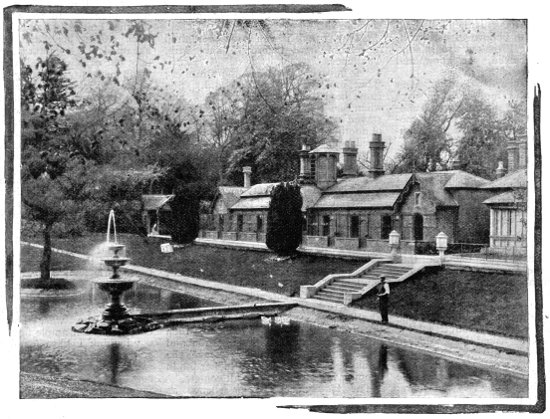
FRONT VIEW OF HER MAJESTY’S AVIARY, WINDSOR.
But few of the many who yearly stroll through the lovely glades of Windsor Park know or think of the infinite variety of bird life contained within its boundaries. Many and wide apart in nature and disposition are its feathered rovers. From the tiny tomtit to the lordly golden eagle, from the motherly white Dorking to the wild turkey of Canada, all make or have made for them their homes or their nests.
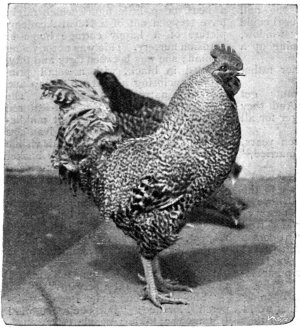
PLYMOUTH ROCKS.
Many years since (in fact, over thirty) signs of the presence of a great depredator were noticed in the more secluded parts of the forest: one day the remains of some luckless rabbits, another a dead or dying lamb. Traps were set, and a strict watch kept for the poacher. Within a very short period was caught a splendid male specimen of the golden eagle. He was promptly housed in a large wooden enclosure near the head keeper’s house, where he has lived and flourished for more than thirty years; his eye as bright, his talons as strong, his spirit as fierce as when he roamed at will the emperor of the air.
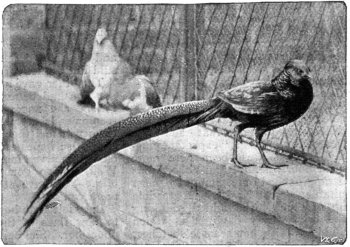
A GOLDEN PHEASANT.
Some four or five years since a comrade was also caught and placed in a similar enclosure beside him, so that, day after day, when sociably inclined, they can exchange harsh-noted confidences. They have so far got used to the presence of their captors as to allow of a man entering their enclosures to sweep them out; but the boldest keeper in the Queen’s employ will not yet venture to touch such fearful wild fowl.
Not very far from the eagles’ domain, one may perchance see a flock of Canadian wild turkeys. These birds (almost as large as our toothsome Christmas friends) are more wild in name than in nature, for instead of haunting trees and coverts to be shot in the manner of pheasants at the proper season, they at present insist on being domesticated and partaking of the head keeper’s hospitality when the members of his household feed the numerous song-birds which gather around the house for their daily meals.
But we must leave the keeper’s house with its fascinating surroundings and make for our proper destination, which is the aviary at Frogmore.
Over the verdant turf and under the wide-spreading trees, mainly following the private road traversed every day by Her Majesty when residing at Windsor, past the kennels with their noisy occupants, past the lovely fruit and flower gardens, just outside of Frogmore House, and beside the beautiful dairy, stands the object of our walk.
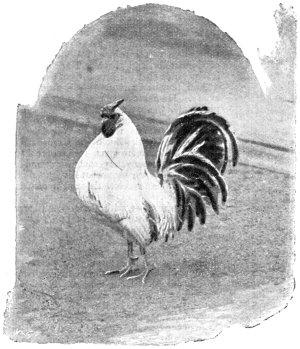
SILVER-PENCILLED HAMBURGH.
Below the level of the road in a gently-sloping grass-grown dell is built the aviary. Originally the site was occupied but by some dilapidated outbuildings. The present construction is entirely due to the designs of the never-forgotten Prince Consort. He it was who saw the capabilities of the site, and with his usual forethought added art to utility.
Although originally designed for the reception of rare and curious birds presented to the Queen, the aviary has for many years past been mainly used as a miniature poultry farm. Now and again may arrive some showy feathered biped from foreign lands to lead a quiet happy life, well tended and cared for; but in the main ducks and chickens, turkeys and pigeons form the bulk of the population. It is a charming, peaceful little scene to gaze upon, this fine summer morning, the fountain and pond with its fat white ducks in the foreground, behind the well-kept terrace with its summer-house at one end, with rustic seat so often occupied by the Royal couple in days gone by, and a background formed by the neat range of brick buildings and spreading trees.
Let us go and interview its keeper. This is a fine stalwart specimen of a retired policeman. Thirty years does Hammond tell us he served in Her Majesty’s household police, and now, in the Indian summer of his days, he quietly lays down the law to turkeys, and takes the smallest of chicks and the most amiable of pigeons into custody. Before the advent of Hammond, the aviary, which was for forty years under feminine supervision, had somewhat declined in usefulness; but, as its new guardian is a practical man as well as a poultry-fancier, the whole of his little domain looks well kept and prosperous.
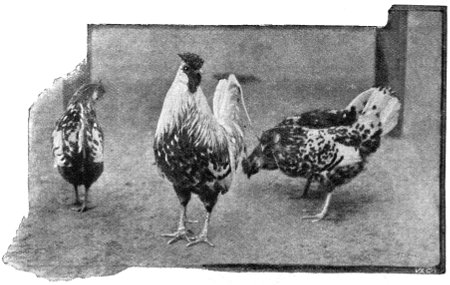
SILVER-SPANGLED HAMBURGHS.
The eighteen pens with brick roost-houses behind, which form the front of the aviary, are mostly occupied by very fine specimens of domestic poultry, the breed of its occupants being indicated by an enamelled iron label affixed to the front of each pen, every breed being kept absolutely separate.
The breeds of poultry kept are too many to describe here; suffice it to say that Hammond thinks his best birds are white Leghorns and black Minorcas. For laying purposes, he prefers a cross between Leghorn and Plymouth Rock; for winter laying, Plymouth Rocks; and for the table, white Dorkings to his mind bear the palm.
The aviary does not supply all the poultry required for the Castle, the first idea being to keep all its pens well stocked with good handsome birds, and to send the surplus to the Castle kitchens. The eggs, ranging between forty and fifty daily, are sent to Windsor Castle, Buckingham Palace, and Osborne House only, the Queen’s other residences procuring their supplies elsewhere. About one hundred birds are required each year for stocking the pens, the remainder bred going, as I before remarked, for table purposes. Here I may mention that the only fowls served at Her Majesty’s own table are white Dorkings.
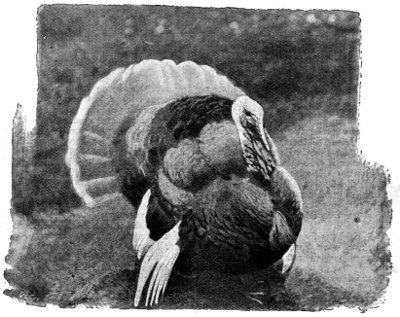
“FIELD-MARSHAL,” THE TURKEY.
After acquiring much useful information on poultry farming, I am taken to the rear of the premises, where breeding operations are mostly carried on. Incubators, I am told, are not in use or desired at Windsor. Every convenience is, of course, provided for the sitting hens, but with seemingly a natural perverseness they occasionally prefer the oddest of nests chosen by themselves to the most comfortable ones provided for them. Here, for instance, in a dark corner is a stout foster-mother of a hen bringing up a handsome family of ducklings in a bushel basket. It was noticed that her own eggs were invariably laid in this receptacle, and so when breeding time came the basket was duly filled up for her accommodation.
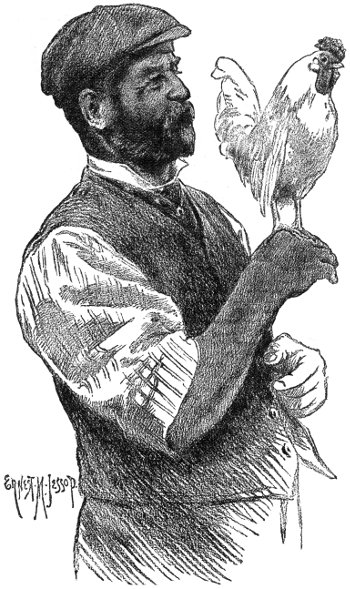
HAMMOND AND HIS BANTAM “TOBY.”
All chickens for the first three weeks of their lives have the run of the pretty old-fashioned garden attached to Hammond’s cottage; but as soon as that age is attained, over-indulgence in horticultural pursuits compels their removal.
In addition to chickens some fifty to sixty Aylesbury ducks are annually reared and fattened for Castle use. Some of these are now wandering about with happy and contented looks, little recking of the use of those succulent peas shooting up so tall and straight in their keeper’s garden. Here, too, in the yard are a few portly Rouen ducks, the female of which breed some time since distinguished herself by laying an egg five ounces in weight; but, remarks Hammond when relating the incident, “she does not often do it.”
In the four pigeon lofts which surmount the roof of the aviary there live at present some forty pigeons mainly of the “Foreign Owl” and “Jacobin” breeds. The youngsters bred and not required for stock purposes go the way of all pigeons—that which leads to pies. At the aviary are also kept some beautiful white doves purchased abroad by H.R.H. Princess Beatrice.
Next I am shown some representatives of the turkey race. These are of a very handsome race known as the Cinnamon turkey. Their native home in Britain is as far north as Caithness; but it is believed the breed was originally brought from the United States or Canada.
The male bird (some three years of age) is of most imposing presence. His colour is a rich chestnut brown, with a black edge to each feather and white wing flights. As he marches to and fro with slow and stately step over a measured track, his prismatic-hued head and neck, combined with his brown and white uniform, irresistibly remind one of the chief hall porter at some stately hotel or theatre.
He is pleased to express his approval of the appearance of my coadjutor with the camera by giving vent to a series of gobbles which sound like the prelude to a solo on the big drum. He then proceeds to disperse the small crowd of humble feathered admirers who have gathered around him, and poses himself for the coming picture.
Sad to relate though, the sharp click of the rapid shutter of the camera quite destroys his self-possession, and he flies for protection behind an old chicken coop, for ever losing caste in the eyes of a small white bantam looking on, who gives vent to his disgust at this craven conduct by a series of ear-piercing challenges.
Some years since, the Queen possessed a beautiful breed of pure white turkeys. Of these there are not any specimens surviving at Windsor, although, as pairs of the birds were given to the Prince of Wales, the Duke of Connaught, and the late Duke of Albany, it is possible that the breed is not extinct.
And now once more to the front of the aviary. Here are a splendid pair of golden pheasants, the male bird as he darts about in the sunshine looking a perfect vision of beauty. He was reared at Windsor from parents bred at the Zoological Gardens. The eggs of his mate are given to a sedate hen to hatch, for greater safety than they would get in the nest of their somewhat frivolous mother, who in her turn receives those of a bantam to take care of.
In the same pen with the golden pheasants lives a pretty little family of buff and white pied pigeons—the property of the Queen’s Indian Secretary.
Near by one may see a small party of ringdoves assuming the most graceful attitudes as they whisper soft nothings to one another in the bright warm sunshine. These pretty creatures are a living reminder of the innate gallantry of the Irish race. During the Queen’s first progress through Ireland after her marriage, as the Royal carriage was slowly passing through a triumphal arch, a pair of ringdoves were gently lowered almost into Her Majesty’s hands. It is from this pair that the pretty little family before mentioned is descended. The doves are great favourites with the Queen, who always relates the history of their origin with special pleasure.
Before leaving, one must have a glance at the Queen’s room, situated in the centre of the aviary, which remains practically the same in appearance as when first fitted under the superintendence of the Prince Consort. It is a very simple but bright apartment of moderate size, with a big bay window overlooking the terrace and fountain.
The walls are papered with a light chintz pattern, and the furniture is framed in light oak and upholstered with a flower pattern cretonne. The principal ornament of the room is a large case of stuffed birds shot by the late Prince Consort. The case is about six feet in height, and has a rustic oak framework. Its occupants are grouse, black cock, and capercailzie. Carved on the frame of the case is “Taymouth, Sep. 8th and 9th, 1842.” All around the walls of the room are other cases of old favourites which in days gone by adorned the pens of the aviary. There is a splendid pied peacock, Amherst pheasants, Indian pigeons, a bantam formerly belonging to the Prince of Wales, and many others. One should also notice the head and claws of a gigantic emu, who in his lifetime was the proud representative of Australia at Windsor. In the corridor leading from the Queen’s room to the garden stands a group of kangaroo rats, a big bustard, a Muscovy duck, and a splendid peacock, once the property of the Earl of Beaconsfield. This last bird was removed to the aviary from Hughenden shortly after the late Earl’s death.
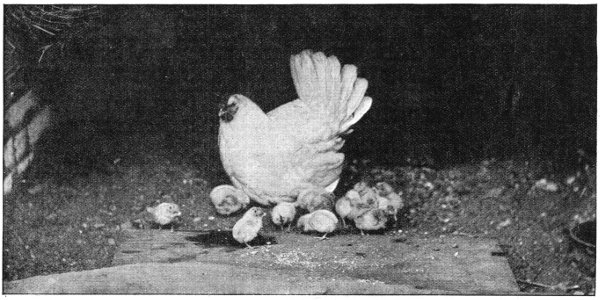
“THE FOSTER-MOTHER.”
Until the last few years, the aviary was a favourite place for the Royal Family to partake of afternoon tea, and here in the Queen’s room is still kept the neat dark blue-and-white Dresden china service which was in ordinary use by Her Majesty. The Queen still drives round the aviary in her daily visit to Frogmore, but rarely alights from her carriage.
Of Royal and distinguished visitors there are many, but not any so regular or so welcome as the children of H.R.H. Princess Beatrice, who seldom allow a day to pass, when staying at Windsor, without “coming to feed the birds”; and right well do those same birds know and welcome the youthful visitors. From the big turkey to the tiny doves, all are on the alert when the sound of carriage wheels is heard, and a universal chorus of approval bursts from the feathered throats as the Royal party distribute their largesse.
The family of the Duke of Connaught also have a special interest in the aviary in the shape of some dozen or so of long-haired white Canadian guinea-pigs (a present from their aunt, the Princess Louise), which live and flourish under Hammond’s fostering care.
And now old Time is fast a-flying, so one must think of taking leave; but I cannot, without great discourtesy, omit a mention of one of the most important characters on the establishment. This is “Toby,” a tiny white bantam cock with a beautiful rose-coloured comb. Throughout the morning he has carefully followed his master’s footsteps, seemingly under the idea that his protection was necessary from the evil designs of journalists and photographers. Too near an approach to the beloved governor was at once resented, while when a halt was called for descriptive purposes, he would stand patiently by with head on one side, crooning his satisfaction with the explanation, and anon darting a sharp look at the man with the note-book as though he would say, “Now, have you got that down?”
So satisfied with our attention is he that at his master’s desire he proceeds to show us a small specimen of his talents. Standing on the ground, with Hammond’s hands linked together before him, a short run is taken and the hands are neatly jumped five or six times in succession.
Other tricks were to follow, but unfortunately Toby’s father just then appeared from behind a coop, followed by a numerous harem. Something cynical with regard to frivolous amusements was evidently said by the newcomers, for without the slightest warning Toby at once proceeded to assault the man with the camera, and, as the bird must weigh a pound and a half, whereas the artist is not more than thirteen stone, we deemed it prudent to say good-bye, and beat a hasty retreat, followed by triumphant crowing from Toby and his sire, who, by the by, gives himself airs on the strength of being a prize-winner at one of the great Norwich shows.