OUR LILY GARDEN.
Reading edition
PRACTICAL AIDS TO THE CULTURE OF LILIES.
By CHARLES PETERS.
A few years ago the culture of the lily received a great impetus from the arrival in England of “the golden-rayed lily of Japan.”
Some bulbs were sent over to us from Japan which were said to be of a very large lily which grows wild upon the Japanese Islands.
Fabulous prices were charged for the bulbs, and of those who had paid through their teeth for these rare bulbs very few obtained any recompense.
The first consignment was a failure, but the gorgeousness of the plant was sufficient inducement to the Japanese growers to send over another batch.
The bulbs rapidly became cheaper, and the lily at once rose to a foremost position amongst garden plants.
The Lilium Auratum, or golden-rayed lily, is perhaps the most popular member of the genus. Its flowers are immense, indeed, it has the largest flowers of all the lilies. Of fine colour, producing many flowers on each stem, of great hardiness and of moderate ease to cultivate, it is not surprising that this lily should have attained its high popularity.
The Lilium Auratum is the most variable of all the lilies. There are eight named varieties. But even these are liable to considerable variation. If you were to plant one hundred bulbs, probably not more than three or four would be absolutely similar.
This extreme variability is very remarkable, when we remember that this lily is a wild flower, but rarely cultivated until recently either in Japan or elsewhere.
Vast numbers of the bulbs of this species are sent over to England from Japan every year, so that the species is by no means difficult to obtain. The bulbs are large, heavy, and if good, they are very compact. They are of a yellowish or purplish colour.
When you buy bulbs of L. Auratum, do not go for the mammoth bulbs. These are very rarely the best, though always the most expensive. Buy small, very heavy bulbs, and purchase them from November to January.
The shoots of L. Auratum begin to show about the middle of March, though this lily, as indeed is every other, is very variable in this respect. The season has a lot to do with it. In a warm rainy year the shoots often appear in February. The time when the bulb was planted and the depth at which it was placed also affect the time at which the lily shows above the soil.
When the shoot has appeared, it grows with great rapidity. We had a specimen in our garden which grew nine feet in twelve weeks! You could almost see it grow!
In connection with the shoots of lilies, there is an important point to notice, which is often overlooked and leads to misconception, unless it is fully appreciated. Lily shoots present extraordinary differences. The shoot of L. Umbellatum or L. Candidum, when it first appears, is like an exceedingly thick head of asparagus. From this many people imagine that if a lily shoot is not thick and solid, it is not going to produce a flower. This opinion is quite wrong. Some lilies, especially L. Speciosum, never start with a thick shoot, but show above ground as a thin lanky growth.
L. Auratum begins as a thin shoot, but it rapidly gains in size and strength if circumstances are favourable.
As in every other particular, L. Auratum is exceedingly variable in the height to which the stem grows. We have had in our garden bulbs from the same source, planted at the same time, in the same soil and position. They have all flowered well, yet some are only thirty inches high, while others tower to the height of nine feet!
The golden-rayed lily does not show its flower-buds until the stem is almost fully grown. The buds are borne on long stalks, each furnished with a single bract. From one to forty buds are produced on each stem.
The leaves of this species are long and linear in the type, but in the variety Platyphyllum they are very broad. There are rarely more than thirty or forty leaves, which are of a deep glossy green.
We have followed the lily to the stage when its buds become apparent. The next chapter in its history is too often one of mishaps. The strain on the plant at this stage must be enormous, and it is no wonder that such a large number of plants die at this time.
The buds develop quickly until they become the size of a large capsicum. Then they change colour, and if the weather is dry, they open in about a week.
Rain at the flowering time is the greatest enemy to this lily.
What a magnificent object is the L. Auratum when in full blossom! How beautiful is the wide open perianth! And what a size! Ten inches across, at the least, and fully a foot when measured from the tips of the petals! How elegantly do the goffered segments curl round at their tips! The brilliant stripe of golden yellow running down each segment, which has given the flower its name, is exceedingly characteristic; and the brownish purple spots, curiously elevated and in places raised into a distinct spine, relieve the pure white of the background.
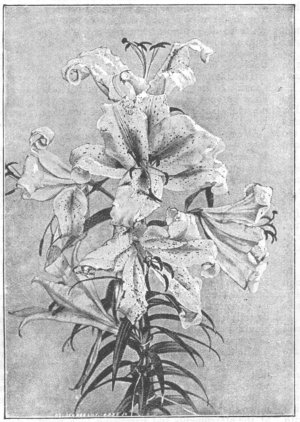
THE GOLDEN-RAYED LILY.
(From photo by Valentine and Sons, Dundee.)
Proceeding from the centre of the flower are the seven greenish threads which constitute the floral organs. Each is armed with a deep brown extremity, the pistil with a trefoil, and the six stamens with crescents!
Name of Variety.Shape of leaves.Shape and colour of ray.Colour of spots.
TypeLinear{Golden, ½ in. wideReddish brown (numerous)
VirginaleLinear{Golden, ½ in. wideGolden yellow (numerous)
WitteiLinear{Golden, ¾ in. wide}Spots absent
PictumLinear{Gold-green, tips red, ¾ in. wide }Blood red (numerous)
Rubro-VittatumLinear{Golden, ½ in. wideBlood red (numerous)
CruentumLinear{Golden, ½ in. wideBlood red (numerous)
PlatyphyllumPalmate{Golden, ½ in. wideBrown (few)
MacranthumPalmate{Golden, ½ in. wideGolden (few)
Alexandrae (hybrid between L. Auratum and L. Longiflorum)LinearAbsentAbsent
Parkmanni (hybrid between L. Auratum and L. Speciosum)Linear{Reddish, IndistinctRed (numerous)
As we have said before, the flowers of L. Auratum are sometimes extremely numerous. We saw one plant last summer (we believe at the Royal Gardens, Kew) of one of the varieties of this species which bore thirty-seven well-developed blossoms.
But it is not the prize specimens of L. Auratum which are the most beautiful. Plants bearing four to six blossoms give the finest effects, for here each flower has room to fully expand, and so the extreme elegance of the blossoms can be appreciated. In plants bearing twenty or thirty blossoms on the other hand, the general effect from a distance is one of extreme luxuriance; but on closer examination the effect is not so striking, for the individual blossoms cannot be perfectly formed, and the result is often bizarre and unsatisfactory.
L. Auratum has an extremely strong scent, which though pleasant in the garden is far too overpowering in a room.
In no lily does one meet with such great variety as in this species. The blossoms are exceedingly variable; but there are some varieties which are sufficiently marked and constant to have gained special names.
There are eight named varieties of L. Auratum, and the difference between them is so striking that a person without previous knowledge would take them for separate species.
We append in tabular form the chief differences between these eight varieties.
All these varieties are fine, and are all worth growing; but some are expensive, and some are very difficult to cultivate.
Of all the varieties we prefer that known as Platyphyllum. Its fine large foliage, immense and gorgeous blossoms, and its hardy constitution, make this lily the most desirable of all. Indeed, we would put a well-grown sample of L. Auratum Platyphyllum in its perfection as the most beautiful of all the vegetable productions of our planet.
A few years ago L. Auratum Platyphyllum was a very rare lily; but last year this lily did exceedingly well, and consequently very good bulbs can now be obtained at a cheap rate. All over the country this variety did well last year, and many were the correspondents who wrote in enthusiastic measures to the various papers about this wonderful plant, which not a few of the writers imagined they had discovered.
The variety Wittei is a most beautiful one, but it is difficult to grow, and is moreover rather expensive.
The red varieties of L. Auratum are fine in their way, but are a little crude in colour and not altogether satisfactory.
The cultivation of L. Auratum and its varieties does not present much difficulty. A well-drained peaty soil with plenty of sand suits it well; but the soil must not be too loose. A few lumps of clay may be placed round the plants if the soil is too sandy.
No manure should be placed near the bulbs, but a good dressing of rich old manure may be applied to the plants with advantage as soon as the shoots are a foot high.
If grown in a good soil and looked after carefully, L. Auratum does not degenerate, but increases and improves year after year. Both the type and the varieties are perfectly hardy.
The varieties are not all equally easy to grow. Platyphyllum, Macranthum, and Rubro-Vittatum are as easy, if not easier, to grow than the type. Wittei and Virginale are very difficult to do well with.
The two hybrids mentioned in the table will be described later on.
All the varieties of L. Auratum make excellent pot-plants.
The lily which bears the title of Speciosum, or showy, was formerly the most admired member of the genus. Even at the present day this lily is looked upon by many as being the finest. Personally we cannot concur with this opinion. There is a certain falseness about its blossoms and a hardness in their shape which to our minds places it far below L. Auratum for beauty.
Yet there can be no question that Lilium Speciosum is a very fine plant. It has a tremendous number of points in its favour which must not be overlooked by the flower-grower.
L. Speciosum flowers late in the year, usually at the end of September, a time when showy flowers are not numerous; too late for summer blossoms, but too early for chrysanthemums.
Although this lily is supposed to be tender, it is perfectly hardy in England. The blossoms, which are produced very freely, are not so much injured by rain at their flowering time as are most lilies. Deformity of the flowers is not very common, and the peculiar shape of the blossoms renders any slight deformity which may be present of little consequence.
Another point in favour of this lily is that instead of degenerating, it increases rapidly, blossoms every year, and gives scarcely any trouble.
L. Speciosum is a native of Japan. Both in its native land and elsewhere this lily has been cultivated for years. There is now an immense number of named varieties of this plant; but, unfortunately, there are very many more names than there are distinct varieties.
Probably the variety we call Rubrum is the type of the species.
The bulbs of L. Speciosum are large with loose scales. The flower spike is not often so evident in the bulb as it is with most lilies. The bulbs vary a good deal in colour from white to deep purple; but the colour of the bulb is no criterion as to the colour of the blossoms. In the variety known as Kraetzeri the bulbs are usually yellow.
This lily first sees the light as a thin, lanky shoot. In fact, those who have grown other lilies but not Speciosum would at once pronounce a perfectly healthy shoot of this lily to be “blind.”
When we first grew L. Speciosum, and saw the feeble-looking shoots appear, we felt certain that they would not blossom. But fortunately we were mistaken in this surmise, for they did blossom, and they blossomed well.
The stem of L. Speciosum is thin but very flexible. Indeed, the lily rarely needs a stick, as it bends before the wind. We have never had the stem of one of these lilies broken.
The leaves are broader than is usually the case in this genus. They somewhat resemble the leaves of L. Auratum Platyphyllum.
The flower buds grow out from the main stem, and when they are fully grown they are furnished with very long stalks. This enables us to cut the flowers singly—which is very desirable, for one can take flowers from a single plant for some weeks, removing each as it opens.
The flowers themselves are about five inches across, with the segments very much recurved and the edges beautifully curled. The colour varies from pure white to deep crimson with white edges. A green line, deeply sunk, runs down the centre of each segment, being broad at the attachments and narrowing to a point about half way down. These six green lines give the appearance of a green star, which is highly characteristic. It is most evident in the white varieties, and especially so in the variety called Kraetzeri. The petals which are broadest about their centre are roughened with numerous spines and tubercles. The pollen is brown.
The scent of this lily resembles that of chocolate creams. It is not very powerful in any of the varieties, while some forms are apparently scentless.
The varieties of L. Speciosum may be grouped under the headings of white, rose, red, and purple kinds.
All the white varieties are fine. Lilium Speciosum Album Kraetzeri, notwithstanding its big name, is the smallest of the white forms. But though small, it is extremely delicate in colour and shape. The green star is very conspicuous. It is, however, rather tender and requires a certain amount of care to cultivate properly.
Of the rose varieties, the “Opal” and the “Rose” are undoubtedly the finest. The former is the more beautiful in colour, but the blossoms are rather thin and straggling.
The old Rubrum is the best of the red varieties. It is the most prolific of all the varieties.
The deepest coloured of all is a Japanese variety, Melpomone. This is a very fine big flower. Its colour is blood-crimson, spotted and bordered with white. The exterior of the blossoms is pale pink. Rubro-Cruentum and Purpureum are other fine purple varieties. They differ very slightly from Melpomone.
Some forms of L. Speciosum in which the stem splits into two or three parts are called monstrous or corymbiform varieties. There are white, red, and purple monstrous forms. They are inferior to the ordinary varieties.
But little need be said of the cultivation of L. Speciosum. Where L. Auratum will grow, L. Speciosum will grow; and it will grow in most places where L. Auratum will not grow. It likes a peaty soil with plenty of sand. Water must be given freely during growth.
L. Speciosum makes an excellent pot plant, and is grown by many people in their conservatories. In fact, it shares the honour with Lilium Harrisii of being the only lily commonly grown under glass. As a cut flower it is very useful.
Just a word about cutting lilies. Never cut the stem down near the ground. Always leave about twenty leaves, else the bulb may suffer.
If you are going to bring lilies up to town from the country, cut the buds off just before they open. These stand less risk of damage in moving, and they will open perfectly if placed in water.
Cut lilies are thirsty plants and need a lot of water. They last from one to two weeks if plentifully watered, but die almost immediately when water is withheld. We have before warned you against spoiling your lilies by removing the anthers.
A lovely little lily is Lilium Krameri. The delicate pink of its blossoms, its slender growth, its early flowering, and its fragrance render it worthy of a place in every garden.
Like most of the lilies we have described, L. Krameri hails from Japan. In most particulars it resembles a little L. Auratum, but its flowers are totally different from any other species. They are about four inches across, of a waxy white to deep blush pink colour. The anthers are brown.
This lily flowers in June. It is not easy to do well with. It is rather tender and very susceptible to early frosts. Its cultivation is similar to that of L. Auratum.
Last year there was exhibited in London flowers of a new lily somewhat resembling L. Krameri. It flowered at Kew in June, and we were fortunate enough to flower a specimen in our own garden. This new species has received the name of Lilium Rubellum, and, though it resembles L. Krameri, it is undoubtedly a true species.
The flowers are small (our one was two and a half inches across), the petals have the tissue-paper look like a Cistus instead of the waxy appearance presented by most lilies. The colour is a full rich pink, and the anthers are yellow.
Its cultivation is similar to that of the other Archelirions.
(To be continued.)