A HAPPY HEALTHY GIRLHOOD.
Reading edition
(Dedicated to “The Mater.”)
By “MEDICUS” (Dr. GORDON-STABLES, R.N.).
“From work she wins her spirits light, From busy day, the peaceful night; Rich, from the very want of wealth, In heaven’s best treasures—peace and health.”—Gray.
“Wretched, unidea’d girls.”—Johnson.
he last quoted line is, as you see, from Johnson—Sam Johnson the lexicographer, Sam the learned, and, if I chose to be ill-natured, I might add Sam the sot. A man of infinite jest and “a stolid kind of humour, but cuttingly sarcastic”; a man whom Scotland delighted to honour, and did honour, and treated with the greatest of kindness and hospitality, which he rewarded by trying to hold Scotland and the Scots up to ridicule ever after. A man whose memory therefore I cannot revere. But, giving him his due, when he says “Wretched, unidea’d girls,” he does not mean to insult young womanhood. I think rather that, although his English was like himself, too heavy and elephantine, he meant to convey the impression that a girl who has no ideas, no mind, cannot be truly happy. And here I agree with Scotland’s foe. I pity a poor lassie who has no mind of her own, or who is possessed of a soul that is not firmly anchored in herself, and ballasted with ideas and convictions which are independent of those of anyone else. A flighty soul like this carries with it a nervous, silly, unhappy brain, and a body that is too often feeble and far from healthy.
I have met young ladies who confused Sam Johnson with the rare Ben Jonson. Now Sam was too obese and fond of the pleasures of the table to understand and appreciate girlhood and innocent beauty. Ben was a man spiritual, not grossly corporeal. It was Ben who wrote the lovely lines to Celia—
“Drink to me only with thine eyes And I will pledge with mine. Or leave a kiss but in the cup And I’ll not look for wine.”
The idea, however, was not original, but borrowed from the Greek. But listen, solid Sam never could have penned such lines as Ben wrote in his “Good Life, Long Life”—
“Give me a look, give me a face That makes simplicity a grace; Robes loosely flowing, hair as free; Such sweet neglect more taketh me Than all the adulteries of art— That strike my eyes, but not my heart.”
Well, I believe I could preach a long, useful and pleasant health sermon from the very lines I have quoted. This is not quite my intention, however. But nevertheless I like to see a volume of poetry in a girl’s hand, and some of our older poets really teach us many a lesson, and these alas! are far too much neglected. Fashions, even in poetry, change as well as in music. Give me simplicity in both, and keep your Browning and your Wagner too. Many a lady in society pretends to love both, who knows nothing about either.
But, taking Gray as an example of a true and simple poet, whose lines you can read without racking your brain in wondering what the poet means, is there not, think you, a deal of truth in the verse that heads this paper?
From work many a girl wins light spirits. Work I mean, not the slavery which, alas! is far too often the lot of poor shop lassies and seamstresses, for whom my heart does bleed. Work versus sauntering idleness. This idleness means an open empty mind; and parents may rest assured that, as Nature abhors a vacuum, girls are not very old before they get such minds filled with thoughts and silly aspirations that tend neither to the development of a healthy body nor a wholesome mind. Young girls who have nothing to do build themselves castles in the air and people them with inmates that they themselves are heartily ashamed of.
Indeed, I do not know anything more likely to generate future unhappiness and crabbed ill-health than graduation in the school of idleness.
An idle body preys upon itself and eke an idle mind.
I may be told that it is fashionable to be idle. True, in certain ranks of life, but here is my answer to that. Nature not only hates a vacuum, but she is fond of evenness of surface both as regards the material world and as regards the immaterial. Nature even levels the mountains, or is gradually doing so, and fashion is a tool of hers. Fashion levels down, education and honest work level up; and, in time, Nature will thus see to it that both shall meet.
It was, I think, Bulwer Lytton—one of the heroes of my boyhood—who proposed an “Aristocracy of Letters.” The notion has not yet borne fruit, and the aristocracy we have is certainly not very dignified, it being constantly added to and adulterated by parvenus of the lowest type, namely, men who have made millions dishonestly, such as quacks and patent nostrum men. So, in the course of a few decades, we shall have little reason to be proud of our “upper ten.” But a true and pure aristocracy may yet arise in this country from the ashes of the fading and effete present. Nothing but wisdom, knowledge and health can support this.
Well, every mater who wishes her girls to grow up happy and healthy, as they ought to be, has much to do and much to think about.
It cannot be too strongly impressed upon a mother’s mind that the first portion of a child’s education is begun in the nursery. Children are imitative to a degree, as much so as the monkeys from which, some say, we are evoluted. One cannot be too careful then with the ethical management of the nursery.
Servants allowed to enter there, or maids who take a child out in its little carriage, should be morally and physically pure. Even baby may learn from a nurse things that will never be forgotten. When she gets a little older she may be corrected, and told that to say this or do that is rude or naughty, and she will refrain for fear of punishment—that is all. The seed is sown, and nothing can eradicate the mischief.
I look upon it as a crime for mothers to give up their children wholly to nursery training. The mother should be with her darlings pretty nearly all the time; and if she loves them, she will be. And a mother has far greater influence over them than the very best of nurses.
When babyhood merges into girlhood, one of the first things to be checked is the all-too-easily-learned habit of criticising—generally spitefully—other children she has seen out of doors. This is the first sign of that spirit of tittle-tattleism which blossoms into verbosity, scandal, and all uncharitableness in many full-blown old maids.
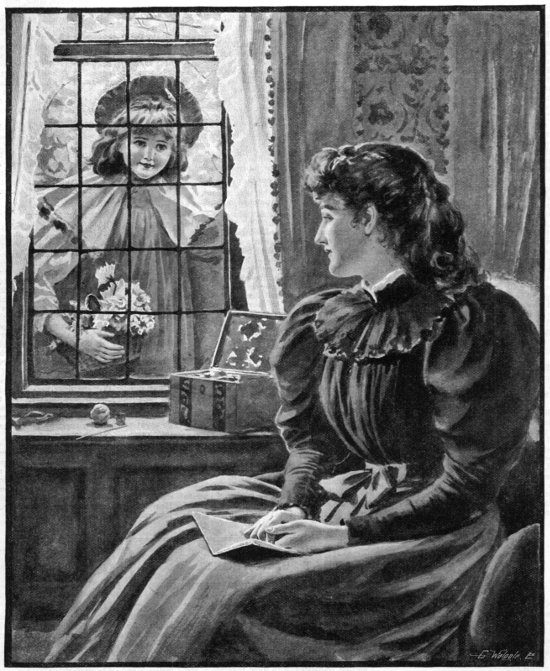
SPRING TROPHIES.
If charity and love for all who suffer life cannot be taught by the mother or by a good nurse, then never in this world can a child or girl be truly happy or truly healthy. For a sour and uncharitable soul always goes hand in hand with a nervous or puny body.
Keep your girls busy. Be busy yourself, mother. There is a dignity and grace about household duties that put to the blush all drawing-room airs and frivolities.
But I note that a real genuine young lady is invariably natural and never ashamed to do work that, a “wretched, unidea’d girl” would deem infra dignitatem. I think that this is lovely.
“’Pon honour,” as old military men used to say, I’ve had earls’ or baronets’ daughters in my caravan while gipsying, who have begged of me to permit them to do something for me, and they have hemmed my wind-ravelled curtains, stitched my blinds, filled my pin-cushions—ay, and some would have darned my socks for me, had I permitted them! Now, these were ladies, mind, in the truest sense of the word, good God-fearing girls with hearts full of sympathy and in perfect unison with all the world around them.
Again, as to what some call “menial work,” or household, the girl who learns to cook and serve a dinner, or knows how a meal should be served, or who is not ashamed even to bare her bonnie white arms and help to wash up the delf, the girl who knows even a little medicine and surgery, the girl to whom the gardener will come with a cut and bleeding finger to be tenderly washed and dressed, the girl who can get up betimes in the morning—she is the girl who will make the best wife, and the only wife really worth having.
And she will be healthy in body too, because pure in thoughts and kind in nature.
The Girl of Commerce.
You find her everywhere almost nowadays. She is not a natural production. She is got up. She is forced and artificial. She cannot be healthy, and has no more heart than a hen, no more stamina or staying power than a stalk of hemp. She is a resultant of the inflexible law of supply and demand. Made for the matrimonial market, grown to be sold, and if—like a choice standard rose—she is labelled with a title, she will go all the sooner. Money will purchase a wife like this, and, though marriage may change her and love may come after, the man who has her has speculated on the off-chance. And now that wax dolls can be manufactured that can both talk and walk, it seems to me that the man might have done better with his money. But, thank goodness, the majority of men prefer the genuine, well-reared, healthy girl, and the girl that has a heart.
But love is still a great factor—nay, the very greatest—in this life, and, if that love be real, oh, there is nothing it cannot do!
I must, as a medical man, go a little farther, and tell the mater something that no scientist will venture to deny. It is this: a loveless or commercial marriage is not only followed by a senseless and dreary monotonous life, but children born in such wedlock are never truly healthy in body, and very often they are defective in mental qualifications, that is, in brain power. Many a case of epilepsy is congenital, and a child that is nerveless is liable to future degeneracy, and apt to fall into any kind of temptation. Doctors have proofs of this every day.
But though ambitious parents may try to alter Nature’s law, she herself is inexorable and tells us sternly that the fittest shall survive.
But, harking back to our poet’s lines—
“From work she wins her spirits light, From busy day, the peaceful night,”
I must give my medical testimony to the truth herein conveyed. Work does give exhilaration of spirits and enables a girl truly to enjoy recreation and outdoor exercise, and, moreover, the busy day results in calm refreshing sleep at night.
Without sleep, without perfect exercise, ventilation of rooms and fresh air everywhere, no girl can grow up happy and healthful.
Coddling children and keeping them too warm causes them to become fragile and delicate, with no nerves worth mentioning, except when they give rise to the tortures of toothache and neuralgia, and no lungs good enough to last.
There is, mother, but a sad future for that girl who is ashamed to soil her fingers by doing honest work, or ashamed to wear a thimble and wield woman’s real weapon—the needle.
But it is not natural for girls to hate work. Do they not make the best of nurses, for instance, and the most gentle-handed? It is Scott who says—
“Oh, woman, in our hours of ease, Uncertain, coy, and hard to please, And variable as the shade By the light and quivering aspen made, When pain and anguish wring the brow, A ministering angel thou!”
And after many more years than I care to recall—for fear of making me feel old—of camp life and sea life, I can testify that girls make the best of all gipsy folks. Amateur, of course, I mean. But even in the management of a picnic their abilities shine forth; and in camp or on board ship, if one only gives them credit for common sense, they can do wonders.
The young lady who would not demean herself—there is really no demeanment about it—by doing cookery or kitchen work in her own house often comes out strong in wayside camp or caravan. She gets up to things as if guided by instinct, can light fires, cook plain nutritious meals, lay them out prettily, and clear up afterwards with most amiable and sweet-tempered dexterity, and, when all is over, will take guitar or mandoline and accompany your violin as if to the gipsy-manner born.
However, I have no doubt that a good deal of a girl’s willingness to work in this way, depends upon the novelty and romance of her surroundings, and very much also on the fact that she is breathing the purest air that can blow through dell or den, or balmy forest of pine, or from the mountains themselves that God built long before he made the poor puny microbe man.
The Value of Health.
The value of health to any of us, whether old or young, cannot well be over-estimated. It is not, mind you, mater, that a deviation from its paths may lead to death. Indeed, many times and oft it would be far better if it did so directly. Instead of that, however, it may be, in girlhood, but the prelude to a long life of untold misery and wretchedness. Indeed, an ailing girl can never be anything save an object of pity. It is spring-time with her, but alas! it is a sad one—a spring that brings not with it the promise of a gladsome happy summer. The sun may shine, but it shines not for her. She is unable thoroughly to enjoy anything. There are times when her very soul seems darkened, and when even spiritual comfort brings no season of relief or even forgetfulness. And at such moments is it any wonder that she finds herself envying her more happy sisters, and thinking that the world is not only dark but cruel? Her companions have health and happiness; they may go anywhere and enjoy anything, and perhaps they forget her entirely until their return.
What comfort shall I pen in these papers for girls such as these? I think I can give a little hope, and, with our Editor’s kind permission, I shall continue this subject in my next paper, and have something to say about ailments and departures from the normal standard of health, and hints for regaining Heaven’s greatest blessing, that may prove invaluable to many.