OUR LILY GARDEN.
Reading edition
PRACTICAL AIDS TO THE CULTURE OF LILIES.
By CHARLES PETERS.
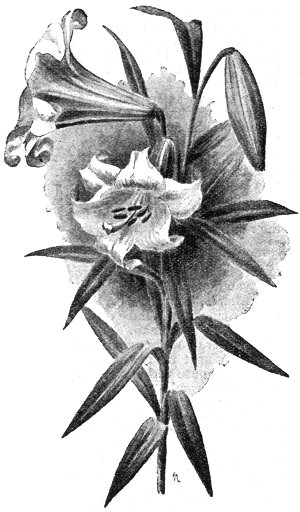
Lilium Brownii.
Japan is the home of lily culture. Not only are the Japanese Islands rich in native lilies, but their inhabitants, imbued with a love of flowers, which to our Western minds is almost incomprehensible, have introduced into their country all the prominent plants of Eastern Asia. And with a knowledge which we possess in but a small degree, they have modified and beautified both their own plants and those that they have introduced from foreign countries.
The culture of the lily in Japan has reached a high stage of development, and most of our best varieties of lilies owe their origin to Japanese gardeners.
Foremost among the lilies of Japan is the one which bears the name of its native place. Lilium Japonicum Odorum is one of the very finest of the lilies, and in the strength of its perfume it is absolutely without a rival.
The true L. Japonicum, or, as it is now more generally termed, L. Japonicum Odorum is but little known in England, but an allied species, L. Brownii, is well known, and though not grown so frequently as it should be, it is deservedly popular.
It has always been a question whether L. Japonicum and L. Brownii are but varieties of the same plant. Certainly there is a great similarity between them, but there are points in which the two plants differ and these differences are very constant.
In Dr. Wallace’s little book on lily culture the differences between these two lilies are detailed in tabular form, and for ourselves we are fully convinced that L. Brownii and L. Japonicum are distinct but very nearly allied species.
The bulb of L. Japonicum is white or yellowish, but never brown. The scales are narrow and are very loosely connected with the base. The bulb is always rather loose and the scales divergent, but good bulbs have a very firm centre. The bulb of L. Brownii is usually reddish and the scales are broad. The base is very small, and the whole bulb has a curious and very characteristic shape.
The shoot of L. Japonicum is greener and blunter than that of L. Brownii. The shoot of the latter lily very much resembles thick asparagus.
During growth it is easy to distinguish between these two lilies, for the stem of L. Japonicum is green, while that of L. Brownii is brown.
There is not very much difference in the flowers of these lilies. L. Brownii often bears three blossoms, and in one case, recorded in The Garden, five blossoms upon one stem. Two blossoms are very frequently present on the same stem. We have never known L. Japonicum to bear more than one blossom on each shoot.
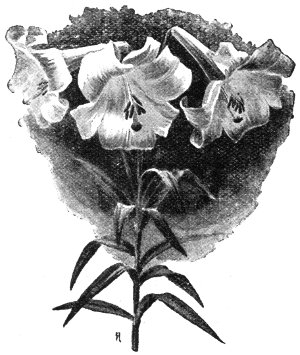
Lilium Longiflorum.
The flowers of L. Japonicum are a rich custard yellow while they are opening, but in the fully expanded blossom the colour of the interior is a rich creamy white. The pollen is reddish brown. The exterior of the perianth is thickly streaked with chocolate colour. The scent of this flower is very strong, resembling that of the Jasmine.
The flowers of L. Brownii never show the deep yellow colour which is present in the partially opened buds of L. Japonicum. The pollen is deep brown and the exterior of the blossoms is more streaked with brown than are those of L. Japonicum. We cannot recognise any difference in the smell of these two lilies, but Dr. Wallace contends that the smell of L. Brownii is only moderately strong, like that of L. Longiflorum; while other authors have denied to L. Brownii any scent whatever!
There is but little reason in the naming of any plant nowadays, and the foolish and unscientific methods of naming plants after some person who has discovered, or described, or who has often done nothing more than bought a specimen of the plant, is unfortunately very rife. Scientists have tried and are still trying to put down this absurd nomenclature, but they are thwarted in every way by gardeners and others. Mr. Jones, Nurseryman, has just flowered a lily. He does not know its name. What does he do? Does he trouble to find out if the plant is known to science? Not he! He labels it Lilium Jonesii. Mrs. Smith, a very aristocratic lady and a great patron of Mr. Jones, comes along, sees, admires and buys that lily. She asks Mr. Jones to send her the plant, and it arrives labelled, “Lilium Jonesii var. Smithii.” So much for gardeners’ floral nomenclature!
Can anyone tell us who is the Mr. Brown after whom L. Brownii is named? As far as we can find out that gentleman is quite unknown to science. Perhaps some wag might suggest that the name originated through ignorance. The man who discovered the lily—or rather who thought he had discovered it, for the plant has been cultivated in Japan for centuries—perceiving that the colour brown was very characteristic of the flower, wanted to name the lily with a Latinised version of “The Brown Lily,” but his classical education, having been somewhat neglected, he knew not the Latin for brown, so he named the plant Lilium Brownii or Browni to cloak his ignorance.
As no one is certain of the origin of the name Brownii, so no one knows the original habitat of this species. All our specimens come from Japan, but it is very doubtful whether it is a native of that land.
Have you ever seen a clump of L. Brownii in flower? Last July there was a bed of this lily at Kew in full blossom, and as the weather had been remarkably suitable to the plant, and its blossoms had not been injured by rain, the sight of that bed was one of the loveliest sights we can remember.
This lily has lately become more popular than formerly, but it is very far from enjoying that universal admiration which it amply deserves. One reason for its comparative scarcity is its tendency to degenerate, a tendency which we strongly suspect is due to improper culture.
It is usually stated that this lily should be grown in very light sandy soil. We have grown it in such a soil and also in a strong, well-manured, peaty loam—a soil as different from a light sandy soil as can be well imagined. Those lilies grown in the light soil became diseased and died without flowering. Those in the heavy soil grew strong and very tall, never showed any trace of disease, and each spike produced two perfect blossoms.
The depth of the colour of the exterior of the blossoms varies with the amount of light in which the lily is grown. Specimens grown indoors usually have a pure white exterior. The blossoms are very tender and are often cankered by rain at the flowering time.
Both L. Brownii and L. Japonicum make admirable pot plants, and their blossoms last a long time as cut flowers.
The variety of L. Brownii called Leucanthum lacks the brown coloration of the blossoms. We cannot distinguish it from the ordinary variety when grown indoors. There are several other so-called varieties.
All the lilies which we have described are natives of Asia, but now we come to one which inhabits our own continent.
Lilium Candidum, the white, or Madonna, or St. Joseph’s Lily, is unquestionably the lily. And when we mention the lily, this is the plant which is usually meant.
Common as this lily has been in English gardens for very many centuries, it is not a native plant, and has very rarely escaped from cultivation. We have only once seen this lily growing wild. This was in a wood in Surrey, and it was probably a garden escape. There was but one spike of blossoms in 1895 when we first saw it. Next year it produced one solitary flower, but since that period it has entirely disappeared.
Why this lily has never become wild in England is not very obvious, for though it never seeds in our Island, it very rapidly increases by off-sets formed round the bulbs, and hundreds of these must be thrown away yearly.
Perhaps it is that the lily is not really hardy in our climate, and though it will flourish when tended in the garden, it is unable to hold its own in the strife with our native plants.
Where the white lily will grow, it is one of the loveliest of garden plants. Always better where it has been long established and undisturbed for years, it is in old gardens that this lily is seen in perfection.
Unlike the lilies we have already considered, the Lilium Candidum bears from four to thirty blossoms on each stem. It is true that one very rarely sees an umbel of more than ten blossoms, but a plant bearing only this number is a very marked feature in a garden.
This lily differs from every one of its colleagues in many points. Its bulb which we figured in our first part is very characteristic. About the end of October the white lily begins to throw up an autumn crop of leaves. This alone marks it off from all other lilies, for though one or two species do sometimes send up a stray leaf or two in autumn, none of them do so regularly. But with L. Candidum the autumn leaves are never absent, and they remain green and fresh till long after the flower shoot has appeared.
The flowers of the white lily are very different from those of L. Longiflorum and its allies. They are very short, widely-expanded and very numerous. The pollen is yellow. The flowers have a pleasant though rather strong perfume.
Though this plant has been grown for centuries in gardens, there are but few varieties of it.
One variety named Aureo-Marginatis has its leaves bordered with golden-yellow and the autumn growth looks very striking in winter.
Three other varieties are recognised. Monstrosum or Flora-pleno, has double flowers. But the flowers themselves never develop, the bracts becoming a greenish-white. It is an ugly and worthless plant and is deservedly neglected. The two other varieties are called peregrinus and striatum. In the latter the flowers are streaked with purple. Neither variety is of any value.
The white lily is one of the oldest of all garden plants. It was certainly cultivated by the Romans, and is in all probability the origin of the “Fleur de Lys.”
If you turn up L. Candidum in any book of gardening, you will find something like this: “The Lilium Candidum will grow anywhere, provided the soil is of a light sandy nature.” If you follow this advice, you will probably lose every one of your plants.
We cannot, alas, tell you how to grow this lily to perfection, for the simple reason that we cannot do so ourselves. We can only tell you how not to grow it and how we have obtained moderate success.
The bulbs must be planted early in autumn. It is best to plant them in late August or early September. If you defer planting till December or later, the bulbs will not produce an autumn crop of leaves, they will not send up a flower spike next season, and will probably lie rotting in the ground.
Except in very exceptional circumstances this lily will not flower well the first year it is planted, for it needs several years to accustom itself to new surroundings.
When once this plant is established and flowers well, it should never be disturbed.
The bulbs should be planted about a foot deep. Often when the bulbs have been in the ground for some years, they will work their way to the surface. Even if this happens it is best to leave them alone, if they flower well. But if the blossoms begin to deteriorate, take up the bulbs and replant them.
Now about the soil. L. Candidum won’t grow in sand and does not like a sandy soil at all. It must have a rich moderately heavy loam of good depth. It is in the black heavy loam of the Thames valley that we have seen this lily at its best. It likes lime in the soil, but dislikes peat.
If this lily is grown in light sandy soil, it grows beautifully till about the middle of May. Disease then commences and kills all your lilies with rapid strides, so that out of one hundred spikes you may get perhaps three half-rotten flowers. This has been our experience of growing this lily in the orthodox way, and we have lost very many hundreds of flowers through following the generally received opinions.
Lilium Candidum makes a fairly good pot-plant, if the pot in which it is placed is very deep.
This plant is grown in nearly every cottage garden, and is very cheap to purchase. About ten shillings a hundred is the ordinary price of the bulbs.
Since we wrote our account of the diseases of lilies we have heard of a new method of treating the bulbs of Lilium Candidum, when year after year the spikes become diseased. The bulbs are washed and then baked in a cool oven. We have heard that though this method does, to a certain extent, check the disease, it very materially interferes with the growth and blossoming of the plant.
Resembling L. Candidum in the form and number of its flowers, but differing from it in almost every other particular, the next lily, “The Lily of Washington,” is a species which taxes the resources of the lily-growers to their utmost.
Lilium Washingtonianum is the first lily which we meet with from the great Western Continent. It inhabits California and the North West, growing upon the rocks and mountain slopes of its native home.
The bulb of this lily is different from that of any other. It is long, oblique, and rhizomatous. Its peculiar ovoid shape is due to the fact that it grows at one end only. The flower-spike always appears from near the growing end. The far end of the bulb gradually decays as the near end grows. Bulbs of this lily are often five or six inches long and two inches broad. The only other lily which bears a bulb in any way resembling this is L. Humboldti, a native of the same places.
The leaves of L. Washingtonianum are arranged in whorls, and are quite different from any other Eulirion except Lilium Parryi, the next species.
The flowers are borne in a dense raceme. Good specimens often bear as many as twenty or thirty blossoms, but only too commonly but one or two flowers are borne on each stem.
Individually the flowers are not much, being small, thin, and of a pale purple, fading to the deeper shades of purple. The pollen is yellow. There is a variety of this species, called Purpureum, in which the flowers are upright. In this type the upper flowers look upwards, the middle ones are horizontal and the lower flowers droop. Although the variety is called Purpureum, the flowers are by no means always purple, but vary from pure white to deep violet.
Beautiful as this lily is when seen in perfection, we cannot regard it otherwise than as a fraud. It is one of the most difficult to grow; it is very liable to disease; it rapidly degenerates, and it is expensive. The bed of these lilies at Kew was the least effective of all the groups of lilies.
If you wish to grow this lily, you must carefully study its native climate, and the habits of the plant when at home.
It is a moderately hardy lily, but will not stand excessive frosts. Neither will it stand great heat. For this reason the bulbs should be planted very deeply. In its native land the bulbs live at the depth of twelve to thirty inches below the surface, and though we do not recommend so great a length as the latter, twelve inches should be the minimum depth at which the bulbs are planted.
A very rich soil is required, but sharp drainage is essential. The latter may be obtained by mixing gravel with the soil.
Whatever you do, the lilies will probably fail, or if they do live, they will give you one or two poor blossoms to repay you for your trouble.
In pots the culture of this lily is rather more satisfactory. The pots must be of good depth and sharp drainage is essential.
The last group of the Eulirions contains three lilies which possess drooping bell-like flowers.
Lilium Parryi is an American species coming from the same place as L. Washingtonianum.
It is a little lily with citron-yellow coloured blossoms and deep orange pollen-grains. The blossoms, of which there are rarely more than three on each stem, are small but pretty and curious.
L. Parryi should be grown in the same way as L. Washingtonianum. It is a difficult plant to flower, but is more satisfactory than its showy ally.
It is rather a rare plant and has not been grown in England for very long.
The second of the drooping Eulirions is also yellow. It is a native of Nepaul and takes its name, L. Nepaulense, from its native place.
This lily in its growth resembles the other Himalayan lilies, especially Lilium Wallichianum. It is not very commonly grown in this country, but it is an interesting species and deserves more attention than it has received.
It grows at the height of five and ten thousand feet, and so should prove as hardy in our gardens as L. Giganteum has done. But its hardiness, as far as we are concerned, remains to be proved.
The flowers are about the size of those of L. Candidum, but are of a deep yellow colour, deeply striped and spotted on the interior with rich purple. The flowers are drooping and somewhat resemble those of L. Giganteum in form, but they are shorter, thicker and more revolute. We have never seen more than two flowers on one stem. It requires similar treatment to L. Wallichianum.
In The Garden for April 19th, 1890, was reproduced a plate of “Lilium Napaulense var. Ochroleuceum.” If this plate is accurate, this variety is indeed a fine lily, being yellowish-white on the exterior with a deep primrose inside. To our minds this plate recalls L. Brownii more than any other variety of lily that we are conversant with.
We must also go to a plate in The Garden for the last of the nodding Eulirions. This lily is L. Lowi, and hails from Burmah.
It resembles L. Nepaulense in shape and growth, but the flowers are white, densely spotted with rich claret-colour on the interior.
We have never seen the plant, and though we tried hard to obtain a bulb of this species we were unsuccessful in our quest. So of its culture we know nothing.
(To be continued.)