Part 2 — LACE-MAKING IN THE ERZGEBIRGE;[3] OR, THE RESULT OF A WOMAN’S HOSPITALITY.
Reading edition
LACE-MAKING IN THE ERZGEBIRGE;[3] OR, THE RESULT OF A WOMAN’S HOSPITALITY.
By EMMA BREWER.
Annaberg is a bright, thriving little town in Saxony, and, from its pleasant situation, is known to the people round about as the Queen of the Erz Mountains.
Its attractions are enhanced by the character of its population, whose kindness, cleanliness, and industry are known to all.
Like many another old town, it has a history, and boasts of chronicles which record many memorable facts concerning it, one of which is peculiarly interesting to us, viz., that a great service was rendered by a woman, in return for which a great benefit was received, and in its turn given out again to women, among whom it brought forth fruit a hundredfold; but this we will explain presently.
This cheery little town is surrounded by pine forests, to which many of the poor inhabitants of the upper mountains come in the hot summer months to pick berries and gather mushrooms, and so add to their scant means. The highest point of the Erzgebirge is only two hours distant, or about six miles, and it is quite worth while to climb to it, for from it you get a view which does your heart good. Not that the character of these mountains is either romantic or wild, like that of the rugged rocks in the Bavarian Highlands; on the contrary, it is soft and gently undulating, conveying rest and peace to the heart.
And what of the inhabitants? Are they as attractive as the mountains? I cannot be quite sure. Of one thing, however, I am certain, that they would interest you. They are simple-hearted and good tempered. By incessant industry they manage, as a rule, to gain a scant livelihood, although there are bad times when, in spite of constant toil, many suffer hunger.
Potatoes, and a suspicious kind of drink which these people call by the name of coffee, form the chief means of support. Those dwelling high up in the mountains consider themselves quite happy if they are able to place a dish of steaming potatoes on their well-scrubbed pinewood table. If, however, night frosts and long rains spoil these, they have little else to live on than the clear water from the spring and the fresh air of the mountains. The result of this is that about Christmas, which should be a happy time, the ghost of Typhus may be seen stalking abroad over the mountains, pausing here and there to knock at one or other of the little snowed-up huts of the weaver, the toy-maker, or the lace-worker, and the gravedigger finds more than enough to do digging graves down through the ice and snow.
Necessity has taught these simple people not only to live sparingly and to exercise self-denial, but it has given them a wonderful cleverness and readiness in taking up any new industry.
Just as in great towns the fashions are continually changing, so the demands of the markets of the world create new trades, and give a variety to the occupations of even these remote dwellers of the mountains. In the very poor huts, with shingle roofs scattered about in out-of-the-way corners of this mountain district, you would scarcely expect to see the inhabitants working a thousand various and tasteful patterns of glistening, sparkling pearl articles, which, when finished, go forth out of those poor huts to adorn the dresses of grand ladies in Berlin, Paris, and London; yet this is the fact.
In like manner and in like houses you may see the inhabitants busy with the beautiful art-industry of pillow lace-making, which brings us to the interesting fact recorded in the chronicles of Annaberg—interesting to us because it refers to woman and woman’s work.
The middle of the sixteenth century was a hard time for the people of the Erz Mountains. Yearly the population increased, and yearly the means of support grew less; for the productiveness of the mines, which up to that time had been great, fell off to such an extent that even the new tin industry failed to make up the loss.
It was just when the need was greatest that the good Frau Barbara Uttman, a rich patrician lady of Annaberg, came to the rescue of the inhabitants by teaching the poor women and girls[4] an entirely new industry—one that had never been known in Germany. It was the rare art of making exquisitely soft and costly texture with the hand by means of dexterously intertwining and knotting single threads of silk or cotton; in fact, to make what is known as bobbin or pillow lace.
Barbara Uttman (born in 1514, died in 1575), as the story goes, learnt it from a fugitive Brabantine whom she hospitably received into her house. If this be so, then was her hospitality rich in good fruit.
Although pillow lace does not hold so high a place in fashion at the present time as in the good old days, yet the memory of Frau Barbara is kept in affectionate and pious remembrance by the good and simple people of the Erz Mountains.
A venerable avenue of lime-trees leads to her tomb in the “Gottesacre” of Annaberg. It is one of the most simple in style and execution. It points her out as the founder of the bobbin art, seated at a lace cushion.
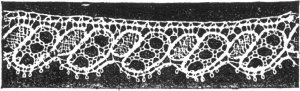
A good action is the most beautiful memorial, just as gratitude is the highest of virtues.
Past neglect has been in a manner atoned for by erecting a worthy memorial of her exactly opposite the ancient grey town-hall in the market-place of Annaberg.

There is a possibility that this memorial may be the means of reviving the industry which has been so good a friend to the inhabitants; and yet it is scarcely possible that it can ever compete with the machine-made lace of Nottingham, which is comparatively cheap, and, to the uneducated eye, scarcely to be distinguished from the hand-made cushion lace. During the last thirty years the poor bobbin villages would have starved on the ever-decreasing profits had not other industries sprung up to give them work.
Many attempts have been made to give the pillow lace a fresh start, a new life; but without any permanent good result. Standing out from among many noble ladies who have made the attempt, is the Queen Carola of Saxony, who has done her utmost to keep it going.
She maintains model bobbin schools, wherein children are taught the industry under skilful supervision. It was she who gave the order to the poor lace-makers for the bridal veil of the Princess Maria Josepha, as well as for the lace dress.
It is the object in all the schools to ward off the threatened downfall of the hand-made lace industry, by the production of patterns full of taste and style; but this only goes a short way, the markets of the world must do the rest.
Ladies might do much for the industry if they resolved to wear real lace instead of cheap machine lace.
A committee of ladies in Vienna have already determined to do this, which may be the beginning of better things.
Quite apart from its practical purpose of maintaining for the poor mountaineers a branch of business peculiarly theirs, we must remember that, should the cushion lace-making fail, an ancient and noble house industry will have its fall—an industry which is even now able to turn out beautiful works of art, worthy of high praise, one for whose success three centuries have laboured.
The effect of this industry among the people who earn their bread by it is to make them scrupulously clean; their huts have, as a rule, but one floor, but the boards are always freshly scrubbed, the walls are spotlessly whitewashed. The kitchen utensils, which are hung on the walls, are like looking-glasses, so bright are they, and you would look in vain for dust on the poor furniture of the little room.
The costly lace requires the most particular cleanliness, as well in the lace-maker herself as in her surroundings.
The manners of these people are those bequeathed them by their forefathers, and their work is carried on as in former days.
Even little children of four years old earn a few pence weekly at the cushion towards the housekeeping, by making common wool lace. To produce tasteful hand lace requires not only great patience, but also such a high perfection in the art that it must be regularly practised from childhood, and this explains the reason of such young children being placed at the cushion.
The bobbin lace-making industry has never brought even a moderate competency to the cleverest and most industrious worker. How could it, when, if she work from early morning till late at night, the highest she can possibly earn is 5s. a week, and in less busy times not more than two to three shillings?
In the hard winter days no morsel of meat is seen on the table; and if the potatoes are all consumed, then dry bread, and not much of it, is all the nourishment they get.
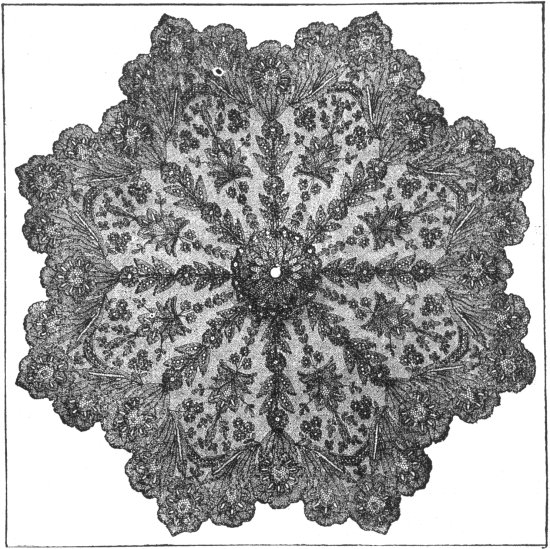
How does it happen that such valuable work fails to give a fair return? This, with a little knowledge, is easy to answer. It takes a very long time indeed to produce the most simple lace, and as to costly patterns of rich and tasteful designs, such as we give here as a cover to a lady’s sunshade—well, it would require for its production six to twelve months, or even longer, according to the pattern and the ability of the worker. This lace-cover is bought in the shops of our great towns for the ridiculously cheap sum of £5—perhaps £7 10s.—or, at the very highest, £15.
If you take into consideration the high duty on these articles, the worth of the raw material, which is generally the best silk, and the fee to the middle-man, you will see how much remains for the industrious artist at her cushion—never more than 2s. 1d. a day.
Supposing that a yard of pillow lace cost 7½d. in the shops, you must take off quite 2½d. for the purchase of material and the fee for the middle-man, which leaves the worker 5d. as the price of a day’s hard work, for she cannot make more than a yard a day.
The poverty of the pillow lace-maker is no doubt due also to the low market price of the lace, and this cannot be remedied, for lace being not an article of necessity, but only of luxury, the desire to buy will decrease with every rise in price, especially as the machine-made lace is produced so easily and in such perfection that it is difficult often to tell the true from the false.
For the last ten years it has seemed useless to think of bettering the position of the lace-maker, male or female. Any effort made is rather to prevent an excellent and artistic industry from dying out. The population has turned itself to other industries which pay somewhat better, merely taking up the lace-work when others fail.
For example, men who in summer seek their bread on the plains, either as bricklayers, labourers, or artisans, join the family circle in the winter in making lace, and it is wonderful to see what soft and delicate work is turned out by those hard hands. It is pleasant to see the wooden stools drawn round the table behind the glass globe filled with water, through which the lamplight falls sharp and clear on the spotless work, and watch the family, from the aged grandmother down to the toddling grandchild, take their places at their cushions or pillows. For those who have never seen pillow lace made, we will give a few words.
The pillow or cushion is of cylindrical form, and tightly stuffed. On this a number of pins are stuck, according to the pattern to be worked. The threads, fastened to small bobbins, are thrown across the cushion and placed round these pins; the threads, traversing from left to right, or vice versâ, often weave at once the pattern and the ground. There is a line in one of the Volkslied which runs—
“That bobbin lace may prosper ever.”
We echo the wish, but fear it will never be realised.