Part 1 — CHAPTER III. DAME HURSEY THE WOOLGATHERER.
Reading edition
"HE STRUCK ACROSS UNBEATEN PATHS."
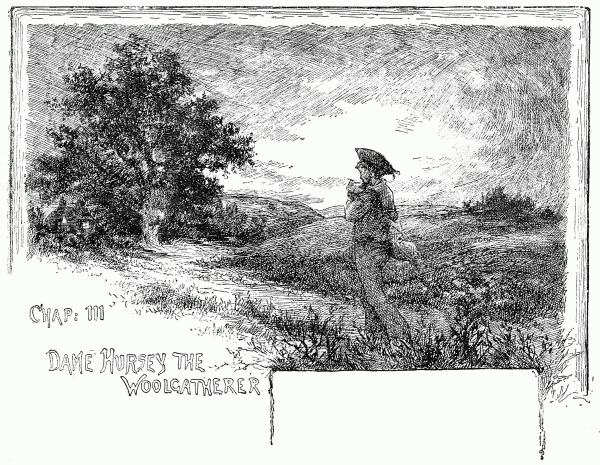
hen John Smith, as for reasons of his own he called himself, left Pierre, he pulled his hat well over his eyes and started off across the downs in the direction of Lewes. He knew the country well, and partly on this account, partly because he did not wish to be recognised, he struck across unbeaten paths, where he was not likely to meet anyone, avoiding the high roads as much as he could, and travelling as near as possible as the crow flies, over downs and meadows to the village he was seeking. It was a good six miles, and he had neither time nor inclination to pause and look at the scenery around him, so full of charm to those who live among it, so repellent at first to the stranger's eye, which has not been educated to notice the various tints and colours which sweep over the soft rounded outlines of those purple downs, but is at once caught by the grey hollows of the hills and the patches of white chalk which peep out every here and there on the steeps, and at a distance look like the perpetual snow of Alpine regions. The scenery of the Sussex Downs is like the Sussex people in this respect—it requires to be well known to be thoroughly appreciated; cold and reserved at first, it is only on better acquaintance you learn the sterling worth, the truth, the real kindness of heart, and the hospitality which characterise the Sussex people. And the downs themselves will not yield all their beauty at once; you must live among them to thoroughly know and love them; cold and grey and monotonous as they look at first, in the autumn especially, you will see what a variety of colours they can show when the fields are golden with corn, and the downs themselves richly dotted with wild flowers, and the clouds cast fleeting shadows over the slopes, and the purple and green of the nearer hills melt away into delicate blues and rosy greys in the distance. And then in winter the clouds play such tricks with the soft rounded hills and their white chalk sides, which chalk will reveal itself in all its nakedness every here and there, that it is often easy to imagine yourself in Switzerland, and difficult exceedingly to tell where the downs end and the clouds begin, so softly have they blended together, those grey clouds, those white and purple downs. No, the downs are not monotonous to those who look with careful eyes, at least, though the casual observer may see nothing in them but multitudes of sheep. Unique they may be, unlike the rest of England they certainly are, but not monotonous. And then the dales, with the villages nestling in the bottom, are so picturesque, and the green pastures, separated by dykes, have a homelike appearance, with the small black Sussex cattle with their long white horns, at least to a Sussex eye.
Over some of these meadows the carpenter, with the little French baby in his arms, now made his way. Hitherto he had been lucky and had met no one, but now he was approaching a village a few miles from Lewes, which, for the purposes of this story, we will call Bournemer, and though the sun had set, it was still too light for him to risk being recognised, so he still kept to the fields, which he could the more easily do, as the house he sought was nearly a mile from the village. At last he saw it standing in the next field with a clump of trees on one side of it; it was little more than a cottage, though from the sheds adjoining it might have been taken for a small farmhouse; it was sheltered from the north by the down at the foot of which it lay, its red roof telling well against the soft grey background in the evening light. It faced the field, the road at the foot of the down running at the back of it, and already there was a light in one of the lower rooms; the front door was closed, but the gate of the field was open, details which the carpenter took in at a glance, and interpreted to mean that the shepherd was gone to fold his sheep for the night, and his wife was at home awaiting his return to supper.
"He will be back soon. I must be quick; now is my time," said the carpenter to himself, making his way towards the house by the clump of trees, which afforded him a little shelter. Here he paused for a few minutes, and, after listening intently, put the baby on the ground while he took off his shoes. Then, picking it up, he crept quickly and noiselessly across the path towards the front door, on the step of which he laid his burden, and then crept back to the trees, where he put on his shoes, and with the purse which Léon had given him for the baby's maintenance in his pocket, he made his way back to the boat on the beach, congratulating himself on the success of his scheme. No one, he argued, was any the worse for it, while he was one thousand francs the better. He had wronged no one, as the baby was sure to be well taken care of. John Shelley was certain to take it in, and would probably think the Lord had sent it to him, and, with a chuckle over the shepherd's simplicity, he went his way.
The baby was asleep when he deposited it on the doorstep, but it woke shortly after, and began to cry lustily for food, but the doors and windows being all closed, its wailing did not penetrate to the inside of the house. But before the carpenter had been gone half an hour footsteps approached the house, and the shepherd and his dog entered the gate of the field in which it stood. A fine, big, handsome man looked this shepherd as he paused to fasten the gate; about thirty years old, fair, with a florid complexion, blue eyes, and a long, yellowish beard, a face more remarkable for its kindly good humour than for its intelligence. He was dressed in a long smock, and he carried a crook, so that there was no mistaking his occupation, of which, by the way, he was very proud; his father and his grandfather and their fathers and grandfathers had been shepherds before him for many generations, and that he should ever be anything else than a shepherd was the last idea likely to enter John Shelley's mind. A shepherd by birth and education, he followed his calling with an ardour which would have amounted to passion in a warmer temperament. His sheep were his first thought on waking, his last as he closed his eyes at night, and he understood them and their ways thoroughly. The life suited him exactly; it might be a lonely life, wandering for hours on the downs without meeting a living creature day after day, except, perhaps, occasionally a neighbouring shepherd, but he was used to it. It might be an anxious life, especially in lambing time, but he was lucky, and rarely lost any lambs. It might be a dangerous life sometimes in the winter fogs, rambling about on the hills with the risk of falling into a chalk pit and breaking his neck, but he was always too anxious about his sheep when overtaken by a fog to think of his own danger. Then the wages were good, and the same all the year round, with the chance of making some extra money in the shearing season, and so much a head on each lamb that he reared; and to all intents and purposes he was his own master, for the farmer to whom the sheep belonged entrusted the management of the flock entirely to him.
But while the shepherd was fastening the gate the dog ran to the baby, whose cry had reached his quick ears before it did his master's, and having sniffed all round it, he set up some short, quick barks, and ran back to the shepherd, calling his attention to the baby as plainly as his inability to speak would allow him.
"What is it, Rover? what is it? Down, sir, it is only the baby crying; the window must be open," said the shepherd, as he approached the house, but Rover, as if to contradict his master, ran up to the bundle on the doorstep, and barked louder than ever.
John Shelley took longer to take in the fact that an infant was lying crying on his doorstep than his dog had done. He stooped and looked, and took off his hat to rub his head thoughtfully and stimulate his brain that he might grasp the idea, and then he stooped again, and this time picked up the baby, and throwing open the door of the large kitchen, with its sanded floor of red bricks, stood on the threshold, holding out the wailing child, and saying—
"Look here, Polly, see what I have found on the doorstep."
Mrs. Shelley, who was sitting working, with her foot on a cradle which she was rocking gently to and fro, more from habit, since the baby was asleep, than for any real reason, looked up and saw in her husband's arms a bundle wrapped in a red shawl embroidered with gold.
"What is it, John?" she asked; but a cry from the bundle answered the question, and she sprang to her husband's side in astonishment.
She was a tall, good-looking woman, five or six years younger than the shepherd, with brown hair and eyes, and a rich colour in her cheeks, which came and went when she was excited; a bright intelligent face, not beautiful, scarcely handsome in repose, but which at times was so animated that she often passed for a very pretty woman.
"Give it to me. Oh, John! John! where can it have come from? The dear little creature! And see what lovely things it has? Only look at this satin quilt in which it is wrapped, and, see, John, a toy of coral with gold bells! My pretty one, hush! hush! hush!" And Mrs. Shelley rocked the child in her arms; but her astonishment and admiration got the better of her motherly instinct for a moment, and she proceeded with her examination of its clothes. "Its nightdress is the finest cambric and trimmed with real lace, and see this exquisite handkerchief tucked in for a feeder; look! there is a coronet on it, John. I verily believe the 'Pharisees,' as the children say, brought it. Do go and see if there is a fairy ring in the meadow, then I shall be sure they did!"
Now, Sussex peasants—shepherds, especially—were very superstitious in the days in which this baby was found, and both John Shelley and his wife half believed that the fungus rings, so often found on the downs, were made by the fairies, or "Pharisees," as they called them. So, partly to see if he could find any further clue to the child, partly to look for the fungus ring, John Shelley took a lantern and went out to explore the premises.
As soon as he was gone, Mrs. Shelley, who was an impulsive woman, gave the little stranger the supper that by right belonged to her own infant.
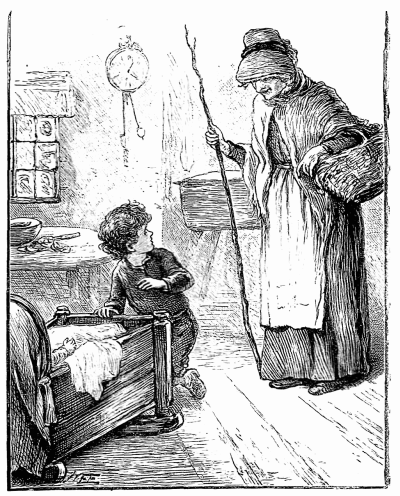
A VISIT FROM DAME HURSEY.
"My boy is stronger than this little fragile creature, and he must wait till I have fed it," she said to herself. "Poor little mite, I don't believe it has been undressed for days, its beautiful dress is so dirty. I shall have time to bathe it and put it on some of Charlie's clean things before John comes in to his supper."
And as John was very slow and deliberate in all his actions, and his wife very quick in all hers, by the time he came back the little stranger was washed and dressed, and fed, and sleeping quietly in the cradle, while Mrs. Shelley nursed her own boy.
"Well, John, have you found any fairy rings?"
"No, Polly; no, I can't make it out at all; it is very odd—very odd indeed. I can't think where the child came from," said John, shaking his head, slowly. "I don't believe the fairies brought it, though," he added, after a pause.
"Who do you think did, then?" asked Mrs. Shelley, quickly.
"I don't know who brought it, but I tell you what, Polly, I believe God sent it and means us to take care of it."
"Take care of it! Why, of course we must, John. You don't suppose I dreamt of sending it to the workhouse, do you? Little darling! Why, it is the very thing we have been longing for, a little girl; it shall be Charlie's foster-sister. All I hope is, whoever brought it will let us keep it. I love it already!"
"But, Polly, it isn't our child. We must take care of it, of course, for to-night, but you will have to go to Parson Leslie to-morrow and ask him what we ought to do to find out who it belongs to."
"Indeed, and I shall do no such thing," said Mrs. Shelley, hastily.
But the shepherd was master in his own home, and announced decidedly—
"Then I must go to-night, late as it is."
"And knock the parson up? It will be eleven o'clock before you get there. Sit down and get your supper, do, John, and we can talk about consulting him to-morrow."
"That won't do, Polly; either I must go to the rector to-night or you must promise to go to-morrow. Which is it to be?"
"There never was such a pig-headed man as you. If you set your mind on a thing there is no turning you. I suppose I shall have to go, or you'll be rushing off now, and I want my supper. One thing I am sure of, John, and that is, the baby belongs to rich people, and, I think, to some nobleman, for all the things have a coronet on them, and its clothes are all so fine."
"Is there no name on any of them?"
"No, nor anything to give us the least idea who the child is. It has evidently been accustomed to luxury, though, and somehow I fancy it is a foreign child. I never saw any baby's clothes made as these are," said Mrs. Shelley.
A foreign child was an idea John Shelley could not accept so suddenly. His slow phlegmatic mind could not travel beyond his own country—scarcely beyond the Sussex downs.
"More likely to be one of the quality's children. They don't make their clothes as we do, I expect; but if you show Mr. Leslie that coronet he may be able to make something of it."
And so it was arranged that Mrs. Shelley should go the next day and consult the rector about their new-found treasure; but she fully made up her mind to use all the eloquence in her power to persuade Mr. Leslie to convince John it was plainly their duty to keep the baby which had been so mysteriously brought to them until its rightful owners claimed it.
The next morning John Shelley was up betimes, as, indeed, he always was; but it was shearing time, and he was unusually busy, and it was, moreover, Saturday, and he hoped, with the help of the men who went round the country shearing in the month of June, to finish his flock that evening, so taking his breakfast and dinner with him, he told Mrs. Shelley not to expect him back till the evening. Across the dewy meadows in the fresh June morning, the loveliest part of the day, went John Shelley, startling a skylark every now and then from the ground, from whence it rose carolling forth its matin song, gently at first, but louder and louder as it sprang higher and higher, until lost to sight, its glorious song still audible, though John Shelley was too much occupied with his own thoughts, and, perhaps, too much accustomed to the singing of the lark, to pay much attention to it. Even his dogs, Rover and Snap, failed to wake him from his meditation, until he reached the meadow where he had folded his sheep for the night, and then every thought, except whether the sheep were all safe, vanished from his mind as he stood counting them. A few words to the dogs explained his wishes that the shorn sheep were to be driven out and the unshorn left in the fold for the present; and then, after a great deal of barking on the part of the dogs, and shouting from the shepherd, and rushing and scrambling on the part of the sheep, their bells jingling a not unmusical accompaniment to the thrushes and blackbirds, which were pouring out their morning song in the adjoining copse, this manœuvre was effected, and John led his shorn flock to the downs, walking in front with his crook in his hand, while the dogs brought up the rear, yelping and barking at the heels of any erring sheep that strayed outside the flock.
The shepherd was a man who concentrated all his thoughts on the business he had on hand, and as he led his sheep to the down on which he meant to leave them to the care of the dogs for the day, he was making a nice calculation of how long it would take him and his assistants to finish the shearing, when, just as he was about to leave the sheep, he was accosted by an old woman. She was tall, thin, with a slight stoop, a hooked nose, bright black eyes, and rough, crisp, grizzly hair, which gave her rather a witch-like appearance; nor did the bonnet perched on the top of her head, its crown in the air, tend to dispel this notion. She had a knotted stick in one hand, and a basket with some pieces of wool off the sheeps' backs which she had collected from the bushes in the other. It was Dame Hursey, the wool-gatherer, well known to John Shelley and every other shepherd in the neighbourhood, with all of whom she often had a gossip, and celebrated in the district as the mother of an unfortunate son, a fine, promising young sailor, who, having been convicted of robbery some years ago, and served a long sentence in Lewes gaol, had never been heard of since, unless his mother was in his confidence.
A great gossip was Dame Hursey; she always knew all that went on in the neighbourhood, for she led a wandering, restless life, never at home except at night, sticking and wool-gathering in the autumn and winter, haymaking and gleaning in the summer, gossiping, whenever she had a chance, at all seasons. If anyone were likely to know anything about this strange baby, always supposing the fairies had had nothing to do with it, it was Dame Hursey, and the shepherd, being relieved of any further anxiety about the sheep, walked with her and told her the story.
John Shelley was neither a quick-witted nor an observant man, except with regard to the weather, every sign of which he took in, or he would have noticed that Dame Hursey started perceptibly when he told her the time he found the baby, and that a glance of quick intelligence shot into her bright eyes as she heard the story; but when he had finished she gave it as her firm opinion that the "Pharisees," and no one else, must have brought the child, and she urged John on no account to part with it, as there was no telling what revenge the fairies might take if their wishes were set aside. And the old wool-gatherer proceeded to tell such wonderful stories of the terrible vengeance wrought by these mysterious little beings on people who had despised their gifts, that the shepherd was glad to put an end to such unpleasant suggestions by walking off at a rapid pace to his unshorn sheep.
"It is strange, very strange, that I should have met my George the very same night, coming from Shelley's place too. He has had something to do with this baby as sure as wool is wool. I'll go round by Mrs. Shelley's and have a look at this wonderful child; perhaps I may find out something. I doubt it will be a bad thing for George if he is found out this time, if, as I suspect, he knows a deal more about it than we do, and he was up to no good last night or he would not have made me swear not to say I had seen him as he did. Well, the child is safe enough with the Shelleys, and I'll do my best to frighten them into keeping it," muttered Dame Hursey to herself, as she bent her steps towards the shepherd's house.
(To be continued.)