Captain Mayne Reid (continued 5)
Reading edition
He was now more than a mile from the river, and his horse was tottering under him, nearly exhausted by its long exertions. What should he do?
Stop, give his horse a rest, and then return to his companions. This was the command of common sense; but he was not guided by that. For the time, he was insane with excitement, anxiety, and despair. He was mad, and acted like a madman. The hopes and aspirations he had been for months indulging in were concentrated into the hour; and in that hour he could not yield them up. He was too much exasperated to reason calmly or clearly. A little extra exertion on the part of his horse might place him in advance of the three giraffes; and he might drive them back to the river.
“Yes,” exclaimed he, nearly frantic with the fear of losing what seemed so nearly gained.
“If I cannot catch this young giraffe, I can drive it. I’ll drive it to Graaf Reinet. It shall not escape me!”
Plunging his spurs into the foam-covered flanks of his horse, he sprang forward in advance of the three giraffes; and as he expected, they came to a halt. Pulling up, he wheeled round facing them, while the two old giraffes turned at the same time and made off in the back direction.
As they did so, one of them came in contact with the tottering calf, that for a second or so, seemed to become entangled between its legs; and at their separation, the young one staggered a pace or two and fell heavily upon the earth.
Chapter Fifty Three.
A Weary Watch.
Throwing himself out of his saddle, Willem seized the fallen creature, and hindered it from rising, by keeping its head close pressed against the ground. This was easily done, for the long slender neck of the animal, without much muscular strength, gave him a good chance of holding it down. The weight of the huge hunter’s body was sufficient for that, without any exertion of his strength.
Meanwhile the old ones continued their flight, while Willem’s horse, relieved of his load, proceeded to refresh himself by browsing upon the dry herbage that grew near. Willem had obtained what he wanted, a young giraffe. It was actually in his possession. He was holding it under perfect control, and yet it appeared to him that he was as far as ever from the realisation of his hopes! Now that he had got the giraffe, all that he could do was to keep it on the spot where it had fallen. The instant its head might be released from his hold it would spring to its feet again and escape in spite of all his efforts to retain it.
He could not allow it to go thus. He had hoped too wildly, travelled too far, and waited too long, for that. The fear that he would still have to surrender his prize or destroy it, was to him a painful thought, and it was only relieved by the hope that in time he might be joined by his companions. They might discover the spoor of his horse, and come to him. In that case there would be no difficulty. The giraffe could then be secured with rheims and become their travelling companion for the rest of the journey to Graaf Reinet. About their coming there was much uncertainty,—at least, their coming in time. They would wait for his return perhaps, until the next morning, before starting out in search of him.
Before their arrival, the young giraffe would kill itself with the violent exertions it still continued to make. It was kicking and struggling as if it wanted to leap out of its skin. Such terrible throes could not fail to injure it. Willem was himself suffering from thirst. A long afternoon was before him. It would be followed by a long night,—one in which the lion, that prowling tyrant of the African plains, would be seeking his supper.
Would the hunter be allowed to retain possession of his prize? His steed, the faithful creature that had carried him through so many perils, was wandering away from his sight. The horse, too, might stray beyond the chance of being found again. He might be devoured by wild beasts. The horse could still be recovered. Would it not be better to abandon the giraffe and endeavour to get back to his companions? By remaining where he was, he might lose all three,—his horse, his prize, and his own life. What was best to be done? The young hunter was never more perplexed in his life. He was in an agony of doubt and uncertainty. Streams of perspiration were pouring down his cheeks, and his throat felt as if on fire. Slowly he saw the horse strolling away, until he was almost beyond the reach of his vision, and yet could not bring himself to a determination as to what should be done. He had travelled fifteen hundred miles to capture two such creatures as the one now underneath him. He had seized upon one, and, if his companions had done their duty, they might have taken another. This thought counselled him to hold on to the captured giraffe; and he saw the horse disappear over a swell of the plain, just as the sun sunk down below the horizon.
For a long time, the giraffe struggled wildly to release itself. Then it remained quiet for a while, not as if it had given up the intention to escape, but as if reflecting on some plan to free itself. Again it would recommence its struggles, and again rest awhile, as though gathering strength for a fresh effort. Gradually it grew resigned to its position, and seemed to breath more tranquilly, while its exertions were less frequent and more feeble. It had learnt that it could remain in the presence of man without meeting death. It had become familiar with his company, and conscious of its own inability to part from it, while man opposed its efforts.
Night came down and found Willem still seated by the side of the giraffe, with his arms around its neck. He had the satisfaction of thinking that his companions would now be uneasy at his absence. He felt sure that within a few hours Congo and Spoor’em would be upon his track, with the others following; and, when all should arrive, the young giraffe would be secured. The prospect of such a termination to his adventure did much to make him disregard the agony he was enduring. He soon discovered he was not to be left alone in his vigil; nor was his right to the prize to be left undisputed.
His first visitors were hyenas; but their laughter—apparently put forth at seeing him in his ludicrous position—did not induce him to abandon it; and the fierce brutes circled around him, smiling and showing their teeth to no purpose. They were too cowardly to attempt an attack; and their efforts to frighten him were more amusing than otherwise.
Soon after sunset the night became very dark,—so dark that although the hyenas approached within a few paces, nothing could be seen of them except their shining eyes. It was just such a night as lions select for going in search of prey,—so dark that the king of beasts can move about unseen, and, while thus protected by invisibility, will pounce upon a man with as much confidence as he will upon a springbok.
As Willem was trying to while away the time by hopeful thoughts, the air was shaken around him, by a voice which he knew to be the roar of the lion. One was abroad seeking blood.
The clouds that had been for some time rolling up from the south-west became blacker at the instant, and seemed separated by streams of fire, while the low murmurings of distant thunder could be heard far-off in the sky. They were signs that could not be mistaken. A tropical storm was approaching.
The voice of the lion told that he was doing the same. Every moment it could be heard, nearer, and more intensely terrifying.
Which of them would come first,—the storm or the beast of prey? It seemed a question between them. Already heavy rain-drops were plashing around him. Thirsting as he was, this would have been a welcome sound, but for that other that proceeded from the throat of the lion.
The hunter’s familiarity with the habits of the great cat gave him a good idea of how he might expect the latter to approach him. There would be a simultaneous bound and roar, followed by the mangling of a body and the crunching of bones, which he could hardly doubt would be his own.
Willem was not often tortured with fear, though at that moment he was not free from apprehension. Still, he awaited the event with calmness.
Most people, when frightened, feel an irresistible desire to make a sudden departure from the place where they have been seized with the malady; but this was not the case with Groot Willem. He had the sense to know that by making a move he might run into the jaws of the very danger he wished to avoid; for the roar of the lion gives no guide to the direction the animal may be in. Besides, he was not yet so badly scared as to think of abandoning the prize he had taken such trouble to retain.
The rain now came down, and for some time continued to fall in torrents. Brief periods of darkness were followed by gleams of electric light, dazzling in its brilliancy.
In a few minutes the fiercest of the storm appeared to be over, and then, as a wind-up to it, there came a long continued blaze of lightning, more brilliant than ever, and a peal of thunder louder than any that had preceded it.
By that flash Willem was nearly blinded. The electric shock seemed to strike every nerve in his body, and, had he been standing erect, he certainly would have fallen to the ground. The instant after, so intensely black was all around that he might well have thought for a moment or two that the flash had destroyed his power of vision; but there was another thought on his mind more terrible than this.
When the heavens and earth were illumed by that flash, he had obtained a momentary glimpse of an object that drove from his mind every thought but that of immediate death. There was a lion within ten feet of him, just crouching for a spring! Willem would have rushed out of the way, and, abandoning the giraffe, have fled far from the spot. This was his first instinct, but unfortunately he was unable to yield to it. Prostrated, body and soul, by the electric fluid, that had struck the earth within a few feet of him, for a time he was unable to stir.
The first distinct thought that came into his mind was astonishment at finding the minute after that the claws of the lion were not buried in his flesh! The blow that had stunned him was not from the paw of the lion, but the lightning. It had saved his life, as the king of beasts, scorched and terrified by the shock, had retreated on the same instant.
The storm soon passed over, and a small patch of clear sky appeared opening up on the western horizon. It was soon after occupied by the disk of a silvery moon, under whose soft light Willem continued his vigil, without further molestation from either lion or hyenas.
The giraffe was still alive and lying quietly upon the ground; but, from its long and laboured respiration, Willem began to fear that it might die before he would have the chance to release it from the irksome attitude in which he felt bound to retain it.
Chapter Fifty Four.
Chance better than Skill.
The camelopards followed by Hans, Hendrik, and Arend had continued up the bank of the stream; and, being the main body of the herd, were pursued without the hunters having noticed the defection of Willem.
With such noble game in view, and in hot pursuit of it, these three youths were as much excited as Groot Willem himself. Full of ardour they pressed on. Their horses were spurred to such a speed as soon brought them close upon the heels of the flying game.
It was only then that Willem was observed to have parted from them. He was seen half a mile off, and fast increasing the distance. He was heading northward.
This discovery scarce caused them a thought. Each was too much interested in his own chase to think of the others.
They soon closed in upon the giraffes, that had been driven into a sharp bend of the river.
The hunted animals, on perceiving the obstruction, turned back, but found their retreat cut off. The pursuers were coming on behind them.
Arend, who was to the right of the others, was just in time to prevent the giraffes from escaping with dry hoofs, by riding rapidly in advance of his companions.
The herd was again headed towards the river.
In forcing them round, Arend was placed within a few yards of the largest. The instinctive desire to bring down such a grand creature could not be resisted, and, without bringing his horse to a stand, he placed the barrel of his rifle on a line with the camelopard’s head and fired. Skill or chance favoured him, and the giraffe dropped to the shot.
Though a gigantic creature, standing sixteen feet in height the one small bullet, scarce bigger than a pea, was all that was necessary to bring its towering form to the earth. It had been hit on the side of the head, just behind the eye; and, as it received the shot, it raised its fore feet from the ground, spun around as on a pivot, and then fell heavily on its side. As though desirous of putting a period to its sufferings as soon as possible, as soon as it was down it commenced beating the ground violently with its shattered head.
The remaining giraffes were driven on toward the stream, where, seeing no other way of avoiding the enemy that pursued them, they plunged into the water.
The stream was neither broad nor deep, yet was it one that could not be conveniently crossed at that particular spot. The bank on both sides rose several feet above the water; and, from the way in which the animals were wading across, it was evident they were going upon a soft bottom. Not until several of them had reached the opposite shore and made an ineffectual attempt to get out of the channel, did our hunters have any hope of capturing one of the young giraffes. Hitherto they had not thought of being able to take them alive. They had entered upon the chase solely for its excitement, and for the destroying of animal life; but on seeing the camelopards struggling in the stream, they became animated with the same hope that was inspiring Groot Willem about the same time, but on a far distant part of the plain.
“They can’t get up the bank,” shouted Hendrik, “and there are two young ones among them. Let us try to get hold of them.”
To carry out Hendrik’s proposal, but little time was lost in arranging a plan. It was instantly decided that they should separate, and one try to reach the other side of the stream.
This task was assigned to Hendrik. Riding beyond the bend of the river, he reached a place where the bank was shelving and, dashing in, he soon gained the opposite shore.
A part of the equipment of each horse ridden by the hunters was a long rheim made of buffalo hide, and used for the purpose of tethering their animals when upon the grass. At one end of the rheim Hendrik had a loop, such as is used in the lazos of Spanish America. This was the means he intended to make use of for capturing the young giraffes.
On riding opposite to them he found them still in the water. Wearied by their late run, they were standing quietly, apparently too much exhausted to raise their feet out of the soft ooze in which they were sinking deeper and deeper. Two or three of the stronger ones alone continued their struggle to gain the shore, though not one of the drove seemed to think of making escape by moving up or down the stream. They were deterred from this by the presence of Hans and Arend, who had placed themselves on projecting points of the bank, above and below. The appearance of Hendrik directly in front of them caused a change in their attitude. Led by a large male, they commenced plunging about as if determined to make a break up stream. But Arend, who was in that quarter, had only a few paces to go before again appearing to be directly ahead of them, and this brought them a second time to a stand. After a short pause and a good deal of violent plunging, they now turned down stream, in hopes of escaping that way. So sharp was the bend of the river, that Hans, who guarded there, was able to show himself, as if right in front of them, and by loud shouts he once more brought them to bay. As a further encouragement to the hunters to continue the attempt at capturing the young giraffes, they noticed that these made but slight efforts to escape. The mud at the bottom was too tough for the strength of their slender limbs. In the narrow stream they were unable to get out of reach of the rheims, which all three of the hunters had now detached from their saddles, and were looking out for an opportunity to use.
In their efforts to avoid their enemies, the frightened camelopards now rushed to and fro, wearily dragging their feet from the mud, until they were hardly able to move. Hendrik, who was nearest, after two or three ineffectual trials, at length succeeded in throwing his snare over the head of one of the young ones. As soon as he had done so, he leaped out of his saddle, and made fast the other end of his rheim to a tree. There was no chance for the giraffe to break away after that. However strong it might be in the body, its long slender neck was too feeble to aid it in a violent effort; and it soon submitted to its confinement.
“Try and catch the other,” exclaimed Hendrik to his companions, pointing to the second of the young giraffes. “Make haste, and you will have it. See! it’s stuck in the mud. Quick with your rheim, Hans, quick!”
In a second or two, Hans, obeying the call, succeeded in throwing his snare, and the second of the young giraffes became a captive.
As this was all that was wanted, the rest of the herd received no further attention,—the hunters being wholly occupied with the two they had taken.
Left free, the crowd of camelopards once more made a break to get off down stream. In their struggles to escape, one of the young—that captured by Hendrik—was borne down and trampled under the water.
It was not carried off. The rope still retained it; but, although it remained in the hands of its captors, it was only in the shape of a carcass. It was partly drowned by its head being carried under water, and partly choked by the noose having tightened around its neck.
As soon as the herd had gone off, the three hunters turned their attention to the captive that was still alive. It was at first fairly secured, so as to prevent the noose from slipping, and then carefully led out of the stream.
For some time it struggled to get free, but, as if convinced that its efforts would be idle, it soon desisted.
Exhausted with the long race, as well as by its subsequent exertions in the water, it was the more easily subdued.
Our three hunters were in ecstasies. They had now obtained one young giraffe, and there was a possibility of their yet procuring another. The feat of capturing these creatures, that had baffled so many hunters, was proved not to be impossible. After all, Groot Willem had not been like a child crying for the moon. He had hoped for nothing more than might be accomplished. The welfare of their captive was now their greatest care; and, to give it an opportunity of recovering from its fright, as also to get it a little better acquainted with its new companions, they resolved to allow it an hour’s rest before returning to the camp.
The young giraffe was too much exhausted to make any further effort at freeing itself.
With the mild and gentle character of the camel, and nothing of the leopard in its nature, the giraffe soon becomes resigned to captivity.
Chapter Fifty Five.
A Reverse of Fortune.
Having given their captive the desired rest, during which it had displayed its good sense by remaining most of the time in quiet, the hunters prepared to drive it to their camp.
Mounted on their horses, Arend and Hans each took the end of a rheim, which was fastened midway to its neck. They intended to ride a little in advance of the captive, keeping also some distance apart from each other. This would hinder it from turning either to the right or left. Hendrik was to come on behind and urge the creature forward, should it show a disposition to try the strength of its neck by hanging back upon the rheims.
This plan worked extremely well. The young captive was compelled to follow the two horsemen in an undeviating line; and every attempt made to remain stationary or go backwards was rewarded by a blow from Hendrik’s jambok. Then the strain on the ropes would instantly be relieved by the animal springing forward. In this manner the creature was conducted along without the slightest trouble; and near the middle of the afternoon, they reached the place from whence they had started out on the hunt.
On the ground they discovered their pack-saddles, cooking utensils, and other impedimenta, but nothing was seen of Congo, Swartboy, the four Makololo, or the cattle! All were away! Moreover, they had hopes of meeting Groot Willem on their return, and were anticipating great pleasure from the encounter. They knew how rejoiced he would be at their success. But where were the camp followers? Where were Swartboy and Congo?
There was a mystery in their absence that none of the three hunters could solve.
Why had the property been left exposed by those placed in charge of it? Could the Makololo have robbed them of their cattle? Had Congo and Swartboy proved traitors? This was very improbable. But why were they not there?
For some time our adventurers could do nothing but wait, in the hope that time would explain all, and bring the absentees back.
Not an ox, horse, or dog was to be seen. The bundles of ivory, enveloped in grass matting, were lying where they had been left in the morning. If a robbery had been committed, why was this valuable property left untouched?
As no one could make answer, the solution had to be left to time.
Evening came on, and the three hunters were still distracted by conflicting hopes, fears, and doubts. The prolonged absence of Willem now began to cause them a serious apprehension. It was time something should be done towards finding him; but what were they to do? Where should they seek? They knew not; still, they should go somewhere.
As night approached, leaving Hans to take care of the young giraffe, Arend and Hendrik started off in the direction in which Willem had last been seen.
The twilight was fast disappearing before they had proceeded a mile from the camp, but under its dim light they perceived Congo and Swartboy coming towards them. They were only accompanied by the dogs.
The two hunters hastened forward, and soon came up with them. Hendrik commenced hastily questioning the Bushman, while Arend did the same to the Kaffir, in the endeavour to get some information of what had so much mystified them.
The questions “Where is Willem?” “Where are the cattle?” “Why did you leave the camp?” “Where are the Makololo?” were asked in rapid succession, and to all they received but one answer,—the word “Yaas.”
“Will you not tell me, you yellow demon?” shouted Hendrik, impatient at not getting the answer he wished.
“Yaas, baas Hendrik,” answered Swartboy; “what you want to know first?”
“Where is Willem?”
This was a question that, in the Bushman’s way of thinking, required some consideration before he could venture on a reply; but while he was hesitating, Congo answered, “We don’t know.”
“Ha, ha! Congo is a fool,” exclaimed Swartboy. “We saw baas Willem going away this morning with the ress of you, after the tootlas.”
It was not until the youths were driven nearly wild with impatience that they succeeded in learning what they wished. Willem had not returned, and the two Africans knew less about the cause of his absence than they did themselves. During the day, the cattle, in feeding, had strayed to some distance over the plain. The four Makololo had gone after them, and had not returned. Swartboy and Congo admitted that they had slept awhile in the afternoon, and only on awaking had discovered that the cattle and Makololo were missing. They had then started out in search of both. They had found the ambassadors of Macora in great trouble. A party of Bechuanas had chanced upon them, and taken from them the whole of the cattle!
The Makololo were in great distress about the affair, and, fearing they would be blamed for the loss of the cattle, were afraid to return to the camp of the hunters. They were then halted about two miles down the river, and were talking of going back to their home, quite certain that the white hunters would have nothing more to do with them.
The folly of having left their property unprotected, when in the neighbourhood of African tribes whose honesty could not be relied on, now, for the first time, occurred to our adventurers.
The Bechuanas, who will steal from each other, or from the people of any nation, in all probability would not have taken the cattle, had one of the whites been present to claim ownership in them.
The Bechuana robbers had found them in the possession of only four strange men, Africans, who belonged far north, and had no right to be within Bechuana territory. The opportunity was too good to be lost, and, so tempted, they had driven the animals away.
There could be no help for what had happened,—at all events, not for the present. To discover the whereabouts of Willem was the care that was most pressing, and they one more proceeded in search of him.
As the night had now come on they could have done nothing of themselves, but the presence of Congo, accompanied by his hound Spoor’em, inspired them with fresh hope, and they proceeded onward.
After a time it became so dark that Arend proposed a halt until morning. To this Hendrik objected, Congo taking sides with him.
“Do you remember the night you were under the baobab-tree, dodging the borelé?” asked Hendrik.
“Say no more,” answered Arend. “If you wish it I am willing to go on.”
Swartboy was sent back to the camp to join Hans, while the Kaffir and Spoor’em led the way. Under the direction of Hendrik they soon came to the place where Willem had been last seen. There were no signs of him anywhere.
The joy with which they had returned to their camp had now departed. Something unusual had happened to their companion,—something disastrous. Their cattle and pack-horses were lost, driven away they knew not whither, by a tribe that might be able to retain them, even should they be found.
Under these circumstances what cared they any longer for the captured giraffe.
Such were the reveries of Hendrik and Arend as they followed their Kaffir guide through the gloom of the night.
Chapter Fifty Six.
The Search for Willem.
To all appearance, Congo had some secret method of communicating to the dog Spoor’em what was required of him. The animal ran to the right and left, keeping a little in the advance, and with its muzzle close down to the surface, as if searching for a spoor. Most of the time it was out of sight, hidden by the darkness, but every now and then it would flit like a shadow across their track, and they could hear an occasional sniff as it lifted the scent from the ground.
They had not proceeded more than half a mile in this manner when Spoor’em expressed a more decided opinion of something that interested him, by giving utterance to a short, sharp bark.
“He’s found the spoor,” exclaimed Congo, hastening forward. “I told um do that, and I knowed he would.”
They were all soon up with the dog, which kept moving forward at a slow trot, occasionally lowering its snout to the grass, as though to make sure against going astray. Unlike most other hounds, Spoor’em would follow a track without rushing forward on the scent, and leaving the hunters behind.
Arend and Hendrik knew this, though still uncertain about being on the traces of Groot Willem.
The night was so dark they could not distinguish footmarks, and they had not the slightest evidence of their own for believing that they were on the tracks of Willem’s horse.
“How do you know that we are going right, Cong?” asked Hendrik.
“We follow Spoor’em; he know it,” answered the Kaffir. “He find anything that go over the grass.”
“But can you be sure that he is following the spoor of Willem’s horse?”
“Yaas, Master Hendrik, very sure of it. Spoor’em is no fool. He knows well what we want.”
With blind confidence in the sagacity both of the Kaffir and his dog, the two hunters rode on at a gentle trot, taking more than an hour to travel the same distance that Willem had gone over in a few minutes.
There was a prospect that the trail they were following might conduct them back to the camp, and that there would be found the man they were in search of. Willem would be certain not to return over the same ground where he had pursued the giraffes, and they might be spending the night upon his tracks, while he was waiting for them at the camp.
This thought suggested a return.
Another consideration might have counselled them to it. A thunder-storm was threatening, and the difficulties of their search would be greatly increased.
But all inclinations to go back were subdued by the reflection that possibly Willem might be in danger, and in need of their assistance, and with this thought they determined to go on.
The dog was now urged forward at a greater speed. The storm was rapidly approaching; and they knew that, after the ground had been saturated by a fall of rain, the scent would be less easily taken up, and their tracking might be brought to an end.
The elements soon after opened upon them, but still they kept on in the midst of the pelting rain, consoling themselves for what was disagreeable, by the reflection that they were performing their duty to their lost friend.
It was not until the thunder-shower had passed over, that Spoor’em began to show some doubt as to the course he was pursuing. The heavy rain had not only destroyed the scent but the traces of the footmarks, and the dog was no longer able to make them out. For the last half hour, they had been moving through an atmosphere dark as Erebus itself. They had been unable to see each other, except when the universe seemed illumed by the flashes of lightning.
The night had now become clear. The moon had made her appearance in the western sky; and the search might have been continued with less difficulty than before, but for the obliteration of the spoor. The dog seemed bewildered, and ran about in short broken circles, as though quite frantic at the thought of having lost the use of the most important of his senses.
“We shall have to return at last,” said Hendrik, despairingly. “We can do nothing more to-night.”
They were about to act according to this advice, when the loud roar of a lion was heard some half mile off, and in the direction from which they had just ridden. In going back that way they might encounter the fierce creature.
“I have kept the lock of my rifle as dry as possible,” said Arend, “but it may not be safe to trust it. I think I shall reload.”
Drawing the rifle out of the piece of leopard skin with which the lock had been covered, Arend pointed the muzzle upwards and pulled trigger. The gun went off.
As the report fainted away in the distance, the far-off sound of a human voice could be heard as if shouted back in answer to the shot. What they heard was the word “Hilloo.”
They hastened in the direction from whence the sound seemed to proceed. Even the dog appeared suddenly relieved from its perplexity, and led the way. In less than ten minutes they were standing around Willem, delighted at finding him in safety, and in the possession of a live giraffe.
“How long have you been here?” asked Hendrik, after the first moments of their joyful greeting had passed.
“Ever since noon,” was Willem’s reply.
“And how much longer would you have stayed, had we not found you?”
“Until either this giraffe or I should have died,” answered Willem. “I should not have abandoned it before.”
“But supposing you had died first, how would it have been then?” asked Arend.
“No doubt,” replied Willem, “something would very soon have taken me away. But why don’t you take my place here, one of you? I must stretch my legs, or I shall never be able to stand upright again.”
Hendrik placed his hands on the head of the giraffe, and Willem with some difficulty arose, and, after walking around the prostrate animal, declared that he had never been happy until that moment.
It was decided that they should not attempt to stir from the place until morning; and the rest of the night, with the exception of an hour or two devoted to sleep, was passed in asking questions and giving explanations. Willem was a little woeful about the loss of his riding-horse, and also on learning of the robbery of the cattle; but these misfortunes could not entirely counteract the joy he felt at having taken the young giraffe.
“This creature is quite tame now,” said he; “and if I cannot find my horse again, I shall ride it to Graaf Reinet. Before I do that, however, I shall use it in catching another. I must and shall have two, and we can easily find another chance. You and Hans ought to be ashamed of yourselves. The three of you have not done so well as I. You have allowed two or more young giraffes to escape, while I, single-handed, captured all the young that were in the herd I followed.”
Arend and Hendrik glanced significantly at one another while Congo stared at both of them. A shake of the head given by Hendrik was understood by the two who were in the secret, for Congo had been told of the capture of the second giraffe, and of course not a word was said to Willem of that affair. His companions preferred giving him a surprise.
Chapter Fifty Seven.
An Encounter between old Acquaintances.
When morning dawned, the first thought of the hunters was to contrive some plan for getting the young giraffe to the camp.
Willem expressed surprise at his companions having come out without their rheims. The reason given by Hendrik for their having done so was that they did not think they would require them; besides, they had left the camp in a hurry.
They did not anticipate much difficulty in taking back the giraffe. It appeared so weak and submissive that their only fear was of its not being able to make the journey.
For all that, without ropes or lines to lead it, there might be difficulty enough. It might take a notion to resist, or get clear out of their clutches.
“I must have a line of some kind,” said Willem, “even if I have to cut a thong from the hide of one of your horses. I have been standing, or rather sitting, sentry over this creature too long, and have travelled too far for the sake of finding it, to allow any chance of its escaping now. It is but half what we want; and if any of you had been worthy the name of hunter, you would have taken the other half.”
A few hundred yards from the spot grew a copse of young trees,—slender saplings they were, forming a miniature forest, such as one would like to see when in search of a fishing-rod.
Going to this grove, Willem selected out of it two long poles, each having a fork at the end.
One of these was placed on each side of the captive giraffe, in such a manner that the forked ends embraced its neck, and when so tied, by twisting the twigs together, formed a sort of neck halter.
By this means the creature could be led along, one going on each side of it.
Arend grasped the end of one of the poles and Hendrik the other.
So long had the young camelopard been kept in a prostrate position, that it was with some difficulty it managed to get to its feet; and, after doing so, its efforts to escape were feeble, and easily defeated.
At each attempt to turn to one side, its head was instantly hauled to the other, and it soon discovered that it was no less a captive on its feet than when fast confined in the recumbent attitude.
Finding its struggles ineffectual, it soon discontinued them, and resigned itself to the will of its captors.
Mounting their horses, Arend and Hendrik held the poles by which the giraffe was to be guided, while Willem and Congo walked on behind. In this manner the captive was conducted towards the camp.
More than once during their journey Willem reiterated the reproach already made to his companions. If they had only shown as much energy and determination as he had done, they might now have been ready to take the road for Graaf Reinet, with a triumphant prospect before them.
“I would have followed this giraffe,” said he, “until my horse dropped dead, and then I would have followed it on foot until it became mine. I had determined not to be defeated and survive the defeat. Ah! had any of you three shown a particle of the same resolution, we might have abandoned our cattle with pleasure, and started on a straight line for home by daybreak to-morrow morning.”
Arend and Hendrik allowed the elated hunter to continue his reproaches uninterrupted. They were quite satisfied with their own conduct; and each had the delicacy to refrain from telling Willem, that, without their assistance, his capture of the young giraffe would only have resulted in the misfortune of losing his horse, and suffering many other inconveniences.
They knew that Willem, when free from the intoxication caused by the partial fulfilment of a long-cherished design, would not claim any greater share in the credit of the expedition than he was really entitled to. Moreover, his joy at having captured the giraffe was somewhat damped by the fear that his horse had gone off for good.
He was confident that, should he again get possession of him, another giraffe could be taken. With the herd that had been hunted, he had seen two other young ones. They might be found a second time; but there would be a difficulty in running them down, unless he was once more on the back of his tried steed.
By noon the camp was reached, when about the first thing that came under the eyes of Groot Willem was a young giraffe standing tied to a tree! Beside it was his own horse!
The horse had been brought back by the Makololo, who found him straying over the plain as they were themselves returning to the camp. The presence both of the horse and the Makololo was at once explained. Their original intention to visit the country of the white men had been abandoned by them on account of the loss of their cattle. Without these, they had no means of making the long journey that still lay before them. There seemed nothing for them but to go back to their home to Macora. But they were unwilling to set off without taking leave of their late travelling-companions; and, as they were at the same time afraid of being blamed for the loss of the white hunters’ cattle, as well as their own, they passed the night in great distress, uncertain as to what they should do. Just as morning dawned, they descried Willem’s horse grazing close to the spot where they were encamped. They had last seen the great hunter on this horse’s back, going in pursuit of the giraffes; and they were anxious to learn why the animal was now separated from its rider. They knew that it was greatly prized by its owner, and they believed that, by taking it back to him, they would be forgiven for their neglect.
In this, they were not mistaken. About the other animal—the young giraffe that stood tied to a tree—Groot Willem neither asked nor received any explanation. He held his tongue about that. He had been over thirty hours without tasting food, and now without uttering another word, he set to work upon a dinner that Swartboy had cooked for him, and, after showing that his discomfiture had not robbed him of his appetite, he stretched himself along the grass and fell into a sound sleep.
The hunters had now but one more task to perform before taking the direct route towards Graaf Reinet. They must make an effort to recover the horses and cattle of which they had been despoiled. The sooner this work should be commenced, the better the prospect of success; but Groot Willem, on being awakened and consulted, declared that he would do nothing but sleep for the next twelve hours; and, saying this, he once more sank into a snoring slumber. As the others could take no important step without him, they were compelled to leave the matter over, till such time as the great hunter should awake, which was not before breakfast-time of the following day.
Chapter Fifty Eight.
The Lost are found.
After breakfast had been eaten, it was proposed to start off in search of the stolen property; and Groot Willem, not without reluctance, was prevailed upon to accompany the others. He was loath to part even for a few hours from the captives he prized so highly. His wildest dreams had been realised. Two young giraffes had been taken and were gradually getting tamed. He could caress them. They could be conducted with but little trouble to the colony of Graaf Reinet,—thence delivered to the Dutch consul, and both money and fame would be the reward.
Since returning to the camp and seeing the second giraffe, his companions had heard no more boasting about his own prowess, nor reproaches for their negligence. But now came the question of the ivory and other articles still lying in the camp. With such a large quantity of valuable property to transport to the settlements, the pack-horses and cattle were worth making an effort to recover; so, leaving Hans with Swartboy and two of the Makololo to guard the camp, the others started off with the intention to seek and, if possible, find them.
Believing that the tribe of Bechuanas that had taken them would be found living somewhere near a stream of water, they resolved to first proceed down the river on which they had their camp; and in this direction they set off.
For the first five miles nothing could be seen of the spoor of either horses or cattle. But the ground was hard and dry, and, even if cattle had been driven over it, it would have been impossible to take up their spoor. It had rained heavily, and that would do something to obliterate any tracks that might have been made. Soon they came to a place where the river-bank was low and marshy, and this they examined with care. They saw the hoof-marks of many animals that had quenched their thirst at the stream, all plainly impressed upon the soft earth. To their joy they perceived amongst them the tracks of horses and cattle, and easily recognised them as those of the animals they had lost. Beyond doubt they had been driven over the river at that point. Pleased at such a good beginning, they continued on, more hopefully. They were now sure that they had come in the right direction. The spoor still led down the bunks of the stream. Three or four miles farther on, they came within sight of a kraal, containing about forty huts. As they drew near, several men ran forward to meet them, and instantly demanded their business.
Swartboy informed them that they were looking after some stolen horses and cattle.
A tall, naked man, carrying a huge parasol of ostrich-feathers, acted as spokesman for the villagers. In reply to Swartboy, he stated that he knew what cattle were; that he had often seen such animals, but not lately. He had never seen any horses and knew not what sort of animals they were. As it chanced, the rain that had fallen upon the preceding night had so softened the ground that all footmarks made since could be distinguished without the slightest difficulty. It was evident the man with the parasol had not thought of this; for our adventurers at once saw that he was telling them a story. They had proofs that he was, by the sight of several horse-tracks with which the ground was indented around the spot where they had halted. They were so fresh as to show that horses must have been there but an hour ago; and it was not likely they could have been on that ground without being seen by the villagers and their chief.
Without saying another word to the natives, our party preceded on to the kraal. As they drew near, the first thing that fixed their attention was the skin of an ox freshly taken from the carcass, and hanging upon one of the huts. Swartboy, who was an acute observer, at once pronounced the hide to have belonged to one of the oxen he had lately assisted in driving; and the two Makololo were of the same opinion. They pointed out to the white hunters the marks of their own pack-saddle. None of the villagers who stood around could give any explanation of the presence of the hide. None of them had ever seen it before; and the features of all were painfully distorted into expressions of astonishment when it was shown them.
Passing out from the kraal the white hunters rode off over a plain that stretched northward. They did so because they saw something there that looked like a herd; and they conjectured it might turn out to belong to themselves. They were not astray. The herd consisted entirely of their own stolen animals. They were guarded only by some women and children, who fled wildly screaming at the approach of the white party.
Riding up to the cattle, Groot Willem and Hendrik galloped on after the frightened women, who, by the efforts they were making to escape, plainly showed that they expected nothing short of being killed if overtaken.
Too glad at recovering their property, the hunters had not the slightest desire to molest the helpless women, and yet, without intending it, they caused the death of one.
As they galloped after the affrighted crowd, one of the women was seen to lag a little behind, and then fall suddenly to the earth. The two horsemen pulled up, and then turned in the direction of the woman who had fallen. On getting near, they noticed that dim, glassy appearance of the eyes that denotes death.
Hendrik dismounted, and placed his hand over her heart. It had ceased to beat. There was no respiration. The woman was dead: she had been frightened to death.
By her side was a child not more than a few months old. And yet it gazed upon Hendrik with eyes flashing defiance. Its animal instinct had not been subdued by the fear of man, and its whole appearance gave evidence of the truth of an assertion often made, that an African child, like a lion’s cub, is born with its mental faculties wonderfully developed.
By this time the other women had gone far out of reach, and none of them could be recalled. Hendrik was not inclined to leave the child by the side of its dead mother. Undecided what to do, he appealed to Willem, who, by this, had come up.
“We have frightened the soul out of this woman,” said he, as the great hunter drew near. “She has left a child behind her. What shall we do with it? It won’t do to leave the poor thing here.”
“This is unfortunate, certainly,” said Willem; as he gazed at the dead body. “The blacks will think that we killed the woman, and will ever after have an opinion of white men they should not have. We must take the child to the kraal, and give it up to them. We can tell them that the woman died of her own folly, which is only the truth. Hand the piccaninny to me.”
As Hendrik attempted to obey this request, the child by loud screams protested against being taken away from its mother. Its resistance was not alone confined to cries. Like a young tiger, it scratched and bit at the hands that held it; thus exhibiting a strange contrast to the conduct of its adult kindred, the Bechuanas, who have an instinctive fear of white men as well as a distaste for hostilities in any way.
Holding the young black under one arm, Willem galloped after the cattle, that, with the aid of the others, in less than an hour, were driven up to the kraal. The only one missing was the ox whose hide had been seen upon the hut. The child was delivered over to the chief. Swartboy explained to him the circumstances under which it had been found; and at Willem’s request advised the Bechuanas never again to molest the property of other people. To the surprise of our adventurers, not only the chief but several of his elders loudly declared that they knew nothing whatever of the cattle, or the women found in charge of them; but, while they were thus talking, the two Makololo pointed out the men who were loudest in declaring their ignorance, as the very ones who had driven the animals away!
To escape from the discordant clamour of their tongues, the hunters turned hastily away, taking their cattle along with them.
Hendrik and Arend felt some inclination to punish the blacks for their treachery, as well as the loss of time and the trouble they had occasioned. This, however, was forbidden by the great-hearted Willem, who could no more blame the natives for what they had done than the bird that picks up a worm upon its path.
“These poor creatures,” said he, “know no better. They have never been taught the precepts of religion; and to them right and wrong are almost the same thing. Leave them to learn a lesson from our mercy.”
Chapter Fifty Nine.
A Lion Hunt.
Once more our adventurers turned their faces homeward.
Contrary to their expectations, the young camelopards caused them but little trouble. A single rheim attached to the neck of each was sufficient to lead them along.
The manner in which both had been captured, had taught them in their first lesson, that man’s will was superior to their own; and they were thenceforth either too cunning or too silly to resist it.
Before driving them far along the road, there would have been little danger of their straying, even if left free to do so. Like tame elephants, they knew neither their own strength nor swiftness, and soon became as easily managed as any of the horses or horned cattle.
For several days no incident worthy of notice occurred, nor did our adventurers much desire that any should. They had obtained all they required; and even Groot Willem, before so enthusiastically fond of hunting, would not have turned aside to kill the finest koodoo that ever trod the plains of Africa, unless its flesh had been absolutely wanted for food.
After a journey of two more weeks, Swartboy found himself in a land inhabited by many of his countrymen,—the Bushmen. It was a land he had long been looking forward to visit, and with pleasant anticipations,—not from any sunny memory of youthful joy, but merely from that prejudice in favour of native land, natural to all mankind. He had ever represented to his young masters that the Bushmen were a race of noble warriors and hunters,—that they were kind, hospitable, intelligent, and in every respect superior to the countrymen of his rival Congo.
They were now in a country inhabited by several wandering tribes of these people, and where opportunities might not be wanting to test the truth of Swartboy’s assertions.
One soon presented itself. Early one afternoon they arrived at a settlement of Bushmen,—a kraal of their kind, containing about fifty families. On learning that they would have a long distance to travel, before finding a place to encamp, our adventurers resolved to stay by the Bushmen’s village for the night.
The first exhibition given of the hospitality Swartboy had boasted of was by the whole tribe begging for tobacco, spirits, clothing, and everything else the travellers chanced to possess; while the only consideration they could give in return was the permission to draw water from a pool in the neighbourhood of their kraal.
During the night a young heifer, belonging to the headman of the village, was carried off by a lion; and in the morning two of the natives were ordered to follow the beast and destroy it. The hunters had often heard of the manner in which the Bushmen kill lions; and, anxious to see the feat performed, they obtained permission to accompany the two men on their expedition.
The only implements carried by the Bushmen for the destruction of the king of beasts were a buffalo robe, a small bow, and some poisoned arrows, with which each was provided.
The lion was traced to a grove of trees, about a mile and a half from the kraal. To this place our adventurers proceeded, curious to see a lion die under the effects of a wound given by a tiny arrow, as also to learn how the Bushmen would approach such a dangerous creature near enough to use such a weapon.
Gorged with its repast, there was no difficulty in getting near the lion. As the Bushmen anticipated, the fierce brute was enjoying a sound slumber.
Silently the two drew near—so near as almost to touch the sleeping monster.
The spectators, who had stopped at some distance off, dismounted from their horses, and, with rifles ready for instant use, at a few yards behind the Bushmen, followed the latter, whose courage they could not help admiring.
Only one of the Bushmen drew his bow. The other holding his buffalo robe spread out upon both hands, went nearer to the lion than the one who was to inflict the mortal wound.
There was a moment of intense interest. In one second the lion could have tossed the bodies of the two little men, crushed and mangled, to the earth.
In another moment the tiny arrow was seen sticking in the monster’s huge side between two of the ribs. Just as the fierce brute was springing to his feet with a loud growl,—just as he had caught a glimpse of the human face,—the buffalo skin was flung over its head.
He ran backwards, turned hastily around, and disengaged himself from the robe; and then, astonished at the incomprehensible encounter, fled without casting another glance behind!
So far as destroying him was concerned, the task of the Bushmen was accomplished. The poisoned arrow had entered the animal’s flesh, and they knew he was as sure to die as if a cannon-ball had carried off his head.
But the Bushmen had still something to do. They must carry back to their chief the paws of the lion, as proof that they had accomplished the errand on which they had been despatched. They must follow the lion until he fell; and, curious to witness the result, our adventurers followed them.
Slowly at first, and with an apparent show of unconcern, the lion had moved away, though gradually increasing his speed.
The arrow could not have done much more than penetrate his thick hide; and, fearing that he might not die, Willem expressed some regret that he had not given the brute a bullet from his roer.
“I am very glad you did not,” exclaimed Hans, on hearing Willem’s remark. “You would have spoilt all our interest in the pursuit. I want to see the effect of their poisoned arrow, and learn with my own eyes if a lion can be so easily killed.”
The wounded animal retreated for about a mile, then stopped and commenced roaring loudly. Something was evidently amiss with him, as he was seen turning as upon a pivot, and otherwise acting in a very eccentric manner.
The poison was beginning to do its work, and each moment the agony of the animal seemed to be on the increase. He laid himself down and rolled over and over; he then reared himself upon his hind legs, all the while roaring like mad. Once he appeared to stand upon his head. After a time he attacked a tree growing near, and, tearing the bark both with claws and teeth, left the branches stained with his blood. He seemed as if he wished to rend the whole world!
Never had our adventurers, in all their hunting experience, been witnesses to such terrific death-struggles.
The sufferings of the great beast were frightful to behold, and awakened within the spectators a feeling of pity. They would have released it from its misery by a shot, had they not been desirous to learn all they could of the effects of the poison.
From the time the lion ceased to retreat, till the moment when he ceased to live, about fifteen minutes elapsed. During that time the spectators saw a greater variety of acrobatic feats than they had ever witnessed in one scene before. As soon as the creature was declared dead, the Bushmen cut off its paws and carried them back to the kraal.
Chapter Sixty.
A Sudden Reverse of Fortune.
On the third morning after leaving the Bushmen’s kraal, our adventurers were awakened by the loud cries of a troop of black monkeys that appeared in a neighbouring grove.
Something was giving them trouble. This could be told by the cries, which were evidently those of distress.
As breakfast was being prepared, and the cattle laden for a start, Willem and Hendrik strolled towards the grove from whence the cries came. They were now more frightful than ever, and translated from the monkey language seemed to say “Murder!”
In a tree where there were between fifteen and twenty of those quadrumana, each about the size of an ordinary cat, was seen a young leopard, trying to capture a black monkey for his breakfast. To avoid this enemy, the apes had crawled out on the small slender branches, where the leopard dared not follow them, knowing that his weight would precipitate him to the ground.
For some time our adventurers amused themselves by watching the abortive efforts of the leopard to procure the means of breaking its fast. He would pursue a monkey along the limb until the branch became too small to be trusted any farther.
He would get within two or three feet of the screaming ape, and then stretch out one of his paws, while displaying his white teeth in a smile, as though desirous of shaking hands with the creature he was intending to destroy.
Finding his efforts to reach that particular monkey useless, he would then leave it, to go through the same game with another.
One of the apes was at length chased out upon a large dead limb that extended horizontally from the trunk. The top had been broken off, and there being no slender twigs on which the monkey could take refuge, there was nothing to prevent the leopard from following it to the extremity of the branch and seizing it at leisure. There was no other branch to which the monkey could spring; and it was fairly in a dilemma. On perceiving this, it turned to the hunters who stood below, and gazed at them with an expression that seemed to say, “Save me! save me!”
The leopard was so intent on obtaining his breakfast that he did not notice the arrival of the two hunters until they were within twenty yards of the tree, and until he was close pursuing the monkey along the dead limb.
At this point, however, he paused. He had caught sight of “the human face divine,” and instinct told him that danger was near. He gazed upon the intruders with flaming eyes, as if very little would induce him to change the nature of his intended repast.
“Reserve your fire, Hendrik!” exclaimed Willem as he brought the roer to his shoulder; “it may be needed.”
The leopard answered the report of the gun by making a somersault to the earth. There was no necessity for Hendrik to waste any ammunition upon him. He had fallen in the agonies of death; and, without even waiting for his last kick, Willem took hold of one of his hind legs and commenced dragging the carcass towards the camp.
The camp was not far-away, and they soon came within sight of it. To their surprise they saw that it was in a state of commotion. The horses and cattle were running in all directions, and so too were the men!
What could it mean?
The answer was obtained by their seeing a huge dark form standing in the middle of the camp. They recognised it as the body of a black rhinoceros, one of the largest kind. The fierce brute had taken his stand in the middle of the camping-ground, and seemed undecided as to which of the fugitives he should follow. His ill-humour had arisen from the circumstance that, on seeking the place where he was in the habit of quenching his thirst, he had found it occupied by strange intruders.
A black rhinoceros would not hesitate to charge upon a whole regiment of cavalry; and the manner in which the one in question had introduced himself to the camp was so impetuous as to cause a precipitate retreat both of man and beast,—in short, everything that was free to get off. One of the young giraffes had been too strongly secured to effect its escape. It was struggling on the ground, and by its side was an ox that the borelé had capsized in his first impetuous onset. The second of the giraffes was fleeing over the plain, and had already gone farther from the camp than any of the other animals. It seemed not only inspired by fear, but a renewed love of liberty.
The borelé soon selected an object for his pursuit, which was one of the pack-horses, and then charged right after him.
Meanwhile Willem and Hendrik hastened on to the camp, where they were joined by two of the Makololo. All the others had gone off after the cattle and horses. The giraffe, in its efforts to escape, had thrown itself upon the ground, and was fastened in such a way that it was in danger of being strangled in the rheims around its neck. As though to insure its death, the ox that had been gored by the borelé became entangled in the same fastenings, and tightened them by his violent struggles.
The first care of the returned hunters was to release the young giraffe. This could have been done immediately by setting it free from its fastenings; but then there was the danger of its following the example of its companion, and taking advantage of the liberty thus given to it.
As the ox, whose struggles were nearly breaking its neck, had been gored by the borelé and severely wounded, he saw it would be no use letting him live any longer, and without more ado he received his quietus from Hendrik’s rifle. The giraffe was now released, and restored to its proper fastenings. By this time the others had caught up with most of the horses and cattle.
None of them, except the one selected for especial pursuit by the borelé, had gone far, but, turning when out of danger, were easily caught. This was not the case with the camelopard that had got loose and fled among the foremost. Its flight had been continued until it was no longer seen!
It had entered the grove from which Willem and Hendrik had just come, and there were ten chances to one against their ever seeing it again.
Had Willem been on horseback at the time it ran off from the camp, he would have stood a chance of recapturing it, but, as it had now twenty minutes of start, the chances were very slight indeed. Not a moment was to be lost, however, before making the attempt, and, accompanied by Hendrik, Congo, and the dog Spoor’em, Willem started off for the forest, leaving the others to continue the task of collecting the animals still scattered over the plain.
But one brief hour before, Willem Van Wyk was the happiest hunter in existence, and now he was about the most miserable. One of the two captives, for which he had suffered so many hardships, had escaped, and in all probability would never be again seen by the eyes of a white man. The realisation of his fondest hopes was delayed for a time,—perhaps forever.
One camelopard was of but little value to him. He must have two; and fortune might never assist them in obtaining another. He was not sure of being able to keep the one that still remained. Death might take it out of their hands. It had been injured in the struggle; and, before leaving camp he had noticed that the efforts of the Makololo to get it to its feet had not succeeded. His great undertaking—the chief purpose of the expedition—was as far as ever from being accomplished.
Such were the thoughts that tortured him, as he urged Congo and the dog to greater haste, in following the spoor through the forest.
Chapter Sixty One.
The Lost Found.
The forest which Willem at first feared might be miles in extent, proved to be but a mere strip of timber, through which he soon passed, discovering an open plain on the other side. Nothing could be seen of the camelopard, though its tracks were found leading out upon the plain.
Willem’s wishes were very difficult to meet. At first he was afraid the giraffe would be lost in a dense forest, where he would be unable to gallop after it on horseback. Now, when contemplating the vast plain before him, he feared that the flight of the escaped captive might be continued for many miles, and he regretted that it had gone out of the timber.
The trees would have given it food and shelter, where it might have stayed until overtaken; but it was not likely to make halt on an open plain.
It must now be many miles off, since they could see nothing of it.
The tracks could be followed but very slowly,—not half so fast as the animal itself had made them, while going in search of the kindred from which it had been so rudely separated several days before. The longer they continued to take up the spoor, the farther they would be from the animal that had left it.
All this was fully understood by our adventurers.
“It’s no use going farther,” remarked Hendrik. “We have lost the creature beyond all hope of recovery. We may as well turn back to camp.”
“Not a bit of it,” answered Willem. “The giraffe is mine, and I sha’n’t part with it so cheaply. I’ll follow it as long as I have strength left me sufficient to sit upon my horse. It must stop sometime and somewhere; and, whenever that time comes, I shall be there not long after to have another look at it.”
Thinking that an hour or two more of what he considered a hopeless chase, would satisfy even Willem, Hendrik made no further objections, but continued on after Congo, who was leading along the spoor.
The sun had by this crossed the meridian, and commenced descending towards the western horizon.
They had started from camp without eating breakfast; and their sudden departure had prevented them from bringing any food along with them. Thirsty and feeble from the long fast, and the fatigue of tracking under a hot sun, they continued their course in anything but a lively fashion.
“Willem!” at length exclaimed Hendrik, suddenly pulling up his horse, “I am willing to do anything in reason, but I think we have already gone on this worse than wild-goose chase, a good many miles too far. We can scarce get back to the camp before nightfall, and I shall commence returning now.”
“All right,” answered Willem. “I can’t blame you. You are free to do as you please; but I shall go on. I need not expect others to act as foolishly as myself. This is my own affair, and you as well as Congo had better turn back. Leave me the dog, and I can track up the giraffe without you.”
“No! no!! baas Willem,” exclaimed the Kaffir. “I go with you and Spoor’em. We no leave you.”
Willem, Congo, and the dog moved on, leaving Hendrik gazing after them.
He remained on the spot where he had pulled up his horse. “Now this is interesting,” muttered the young cornet, as he saw them go off upon the spoor. “I have been acting without motives,—acting like a fool ever since we have been out on this expedition. Circumstances have driven me to it and will do so again. Yes. I must follow Willem. Why should I desert him when that poor Kaffir remains true? If his friendship worth more than mine?”
Spurring his horse into a gallop, Hendrik was soon once more by the side of his forsaken companion.
Willem had a strong suspicion that he was himself acting without reason, in seeking for an object he could hardly expect to find. This sage reflection did not prevent him from continuing the search. Half distracted by the loss of the camelopard, he was scarce capable of knowing whether he now acted sensibly, or like a fool!
To all appearance Hendrik had only followed him for the purpose of prevailing upon him to return.
Every argument that could be advanced against their proceeding farther was used by the young cornet,—all to no purpose. Willem was determined to proceed, and persisted in his determination.
Evening approached, and still was he unwilling to give up the search.
They could not return that night, for they were now nearly a day’s journey from the camp.
“Willem is mad,—hopelessly mad,” thought Hendrik, “and I must not leave him alone.”
They journey on together, and in silence, Hendrik fast approaching that state of mind in which he had just pronounced Willem to be.
But their journey was approaching its termination. It was nearer than either of them expected to a successful issue.
A clump of trees was seen rising up over the plain. They were willows, and indicated the proximity of water.
Towards these the tracks appeared to lead in a line almost direct. The giraffe, guided by its instinct, had scented water. The horses ridden by the trackers did the same, and hastened forward to the clump of trees.
There was a pool in the centre of the grove, and on its edge an animal, the sight of which drew an exclamation of joy from the lips of Groot Willem. It was the escaped camelopard. A second joyful shout was caused by their perceiving that it was again a captive.
The loose rheim, which it had carried away round its neck, had become entangled among the bushes, and it was now secured so that they had no difficulty in laying hold of it. Had they not come upon the spot, it would have perished either by the suicidal act of half-strangulation, from thirst, or by the teeth of some fierce predatory animal.
The rheim was now unwound from the saplings to which it had attached itself, and the giraffe released from its irksome attitude. No harm had yet befallen it.
“Now, Hendrik,” exclaimed Willem, as he gazed upon the captive with an expression of pride and pleasure, “is it not better that we have saved this poor creature than to have left it to die a horrible death?”
“Yes, certainly,” answered his companion. “Much good may sometimes result from what may appear a foolish course of conduct.”
Satisfied with the result of his perseverance, Willem was quite indifferent as to whether his conduct had been foolish or otherwise.
Congo did not seem the least surprised at the good fortune of his master; probably for the reason that he had the utmost confidence in his wisdom, and never for a moment had doubted that the giraffe would be discovered.
Willem never was without the means of lighting a fire,—he was too fond of a pipe for that,—and near a large blazing heap of wood they remained until the first appearance of day.
The journey back to the camp was a tedious one, but was made with much less heaviness of spirit than they had suffered when leaving it to go in search of the lost giraffe, which fortune had so favoured them in finding.
Chapter Sixty Two.
With the Hottentots.
On reaching the camp, Willem and Hendrik found their companions anxiously awaiting their return.
The horses and cattle had all been recovered, and the borelé that had caused their dispersion had been shot by Hans and Arend.
Its attack had caused a delay of two days, and the loss of an ox.
Again the journey towards Graaf Reinet was resumed, and day by day was prosecuted with all the speed that could be made in safety to their animals.
The return journey was not completed until they had suffered many hardships, and had more than once nearly lost the two young giraffes.
On passing through the Hottentot country, they saw many large plains from which the grass had lately been burnt; and not a morsel could be obtained for the subsistence of their animals. Amid the herbage charred by the fire, they frequently saw the remains of serpents and other reptiles, that had been scorched to death.
During the passage across these burnt tracts, the travellers suffered much from hunger and thirst, as did also their animals. Such hardships Groot Willem seemed not to heed. His only care was for the young giraffes; his only fear that they might not safely reach their destination. But each hour of the toilsome journey was cheered by the knowledge that they were drawing nearer home; and all that was disagreeable was endured with such patience as sprang from the prospect of a speedy termination to their toils.
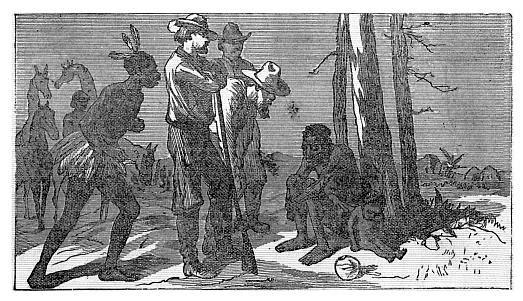
The latter part of their route lay through a part of Southern Africa, farther to the west than any they had yet visited. They passed through lands inhabited by certain tribes of natives, of whom they had often heard and read, but had never seen.
Of some of the customs of those unfortunate people classed amongst that variety of the genus homo known as the “Hottentot,” they one afternoon became fully and painfully acquainted.
Beneath the shade of some stunted trees they found an aged man and a child not more than eighteen months old. The man, who could not have been less than seventy years of age, was totally blind; and by his side was an empty calabash, that had evidently once contained water.
With the assistance of Swartboy, as interpreter, it was ascertained that he had lately lost by death an only son and protector. There was no one now to provide for his wants, and he had been carried far-away from the home of his tribe, and left in the desert to die!
The child had lost its mother, its only parent, and had been “exposed” to death at the same time and for the same reason,—because there was no one to provide for it.
Both old man and infant had been thus left exposed to a death which must certainly ensue, either by thirst, hunger, or hyenas.
This horrid custom of the Hottentots was not entirely unknown to our adventurers. They had heard that the act, of which they now had ocular evidence, was once common among the inhabitants of the country, through which they were passing, but, like thousands of others, they had believed that such a barbarous custom had long ago been discontinued, under the precept and example of European civilisation.
They saw that they were mistaken; and that they were in the neighbourhood of a tribe that had either never heard these precepts of humanity, or had turned a deaf ear to them.
Knowing that a Hottentot kraal could not be many miles away, and unwilling to leave two human beings to such a fearful fate, the travellers determined to take the helpless creatures back to the people who, as Swartboy worded it, had “throwed ’um away.”
Strange to say, the old man expressed himself not only willing to die where he sat, but showed a strong disinclination to being returned to his countrymen!
He had the philosophy to believe that he was old and helpless,—a child for the second time,—and that by dying he was but performing his duty to society! To be placed again in a position where he would be an incumbrance to those whom he could not call kindred was, in his opinion, a crime he should not commit!
Our adventurers resolved upon saving him in spite of himself.
It was not until late in the afternoon that they reached the kraal from which the outcasts had been ejected. Not a soul could be found in the whole community who would admit that the old man had ever been seen there before, and no one had the slightest knowledge of the child!
The white men were advised to take the objects of their solicitude to the place where they properly belonged.
“This is interesting,” said Hendrik. “We might wander over all Southern Africa without finding a creature that will acknowledge having seen these helpless beings before. They are ours now, and we must provide for them in some way or other.”
“I do not see how we can do it,” rejoined Arend; “I’m quite sure that they are now with their own tribe, and it is they who should provide for them.”
A second effort was made to persuade the villagers to acknowledge some complicity in the attempt to starve two human beings. But they had already learned that their conduct in such a custom was considered by white people as a crime, and, ashamed of what they had done, they stoutly stood to the story they had first told.
Strangest of all, the feeble old man confirmed all their statements, and, as some proof of the truth of what they had said, he informed the travellers that the chief and several others whom he called by name, were men incapable of practising a deception!
This he professed to know from a long acquaintance with them.
The hunters were now within the territory over which the Colonial Government claimed and sometimes enforced dominion, and the Hottentots were threatened with the vengeance of English justice in the event of their not taking care of the old man and child, or should they again expose him as they had already done.
They were told that a messenger should be sent to them within a few weeks, to learn if their orders had been obeyed; and, having delivered up the two helpless beings to the headman of the village, the travellers once more proceeded on their way.
Chapter Sixty Three.
“The Dutchman’s Fireside.”
A few more days’ journey brought them into a neighbourhood inhabited by several Dutch “boers.” They were now travelling upon a track dignified by the name of “road,” which only benefited them so far as between the rivers it conducted them without difficulty from one crossing-place to another.
For the first time in several months they saw fields under cultivation by white labour, and were able to procure a substance called “bread.”
One evening, as they were preparing to encamp near the habitation of a well-to-do appearing boer, they received an invitation from the proprietor to make his house their home for the night.
A heavy cold rain had been falling most part of the day, and to all appearance the weather would be no better during the night. The invitation was gladly accepted, and the travellers, grouped around the wide hearth of the boer’s kitchen fire, were enjoying that sense of happiness we all feel to a greater or less extent when perfectly secure from a storm heard raging without.
The horses and cattle had been driven under large sheds. The young giraffes were secured in a place by themselves. Congo, Swartboy, and the Makololo were in a hut near by, with some Hottentot servants of the baas boer.
Their host was a free-hearted, cheerful sort of fellow, only too thankful that circumstances had given him some guests to entertain him. His tobacco was of the best quality, and the supply of “Cape Smoke”—the native peach brandy—was apparently unlimited.
According to his own account, he had been a great hunter during his youth; and there was nothing he liked better than to relate incidents of his own adventures in the chase, or to listen to the tales of others. The only fault he had to find with our heroes was, that they were too moderate in the use of his “Cape Smoke.”
He was a convivial man,—one who knew of nothing better to do after a long day’s work than getting what is termed “jolly” in the company of friends. He did not care to imbibe alone, and he declared that nothing looked worse than that, except to see a man drinking too often in the presence of others, when they refused to do justice to his generosity.
According to his own account, he had been hard at work on his farm throughout all that day, and in the rain. Why, then, should he not cheer himself after such protracted exposure? The “smoke” was the very thing to do it. His guests were welcome to the best his house could afford, and all the compensation he would ask in return for his hospitality would be the satisfaction of seeing them make themselves at home.
On the part of the boer there was a strong determination to make his guests intoxicated; but this was not observed by them. They only believed that his hospitality was pushed a little too far,—so much so as to be rather annoying. But this was a fault they had observed in many, who were only trying to put on their best behaviour, and, considering its unselfishness, it could be readily excused.
Notwithstanding the many hardships Groot Willem and his companions had endured in their various excursions, they had never deemed it necessary to use ardent spirits to excess; and the frequent and earnest entreaties of the boer, backed by his fat and rather good-looking “vrow,” could not induce them to depart from their usual practice of abstemiousness. The boer pretended to be sorry at his inability to entertain his youthful guests.
Notwithstanding his assertions to the contrary, however, the hunters passed a long and pleasant evening by his fireside.
The supper provided for them, as well as everything else, except some of their host’s hunting stories, was very good. It was so seldom that the man had an opportunity of entertaining guests, that it seemed ingratitude on their part to deprive him of the pleasure he enjoyed; and, yielding to his solicitations, they did not retire until a late hour.
But there had been one chapter in the conversation of the evening to which none of our adventurers listened with much pleasure. It was a statement made by the boer, after he had partaken of several glasses of the “smoke.”
“Ish ver shorry you go get the money for the two cameels,” said he. “Mine two bruders and mine vrow’s bruder stand chance to lose it now. Ish ver shorry for them, you know.”
On further conversation it was discovered that his two brothers and a brother of his wife had left for the north seven months before, on a hunting excursion, their principal object being to procure the two young giraffes for which the reward of five hundred pounds had been offered. They were to visit the country of the Bakwains, and had taken with them a native servant who belonged to that tribe. Their return was hourly expected, and had been so for more than a month, though nothing had been heard of them since their departure.
It was but natural that the boer should prefer that his own kinsmen might obtain the reward, instead of a party of strangers; and his having so candidly expressed his regrets in that regard was rather a circumstance in his favour. His guests ascribed it to his open, straightforward manner, made a little more free by application of the “smoke.”
It was not until an old Dutch clock in a corner of the kitchen had struck two, that the young men—who pleaded their fatigue after a long day’s march—were allowed to retire to their beds.
They were shown into a large room, where a good soft couch had been prepared for each of them. Their arduous journeying seemed nearly over; for they had reached a place where people slept with their faces screened from the faint light of the stars, and without depending on the nature of the earth beneath them for the quality of their couch.
Chapter Sixty Four.
“Strayed or Stolen.”
It was not until ten o’clock next morning that Hans awoke and then aroused his companions.
“We should be ashamed of ourselves,” exclaimed Willem, as he hastily commenced making his toilet. “We have swallowed too much smoke and overslept ourselves!”
“No,” answered Hans, who was always anxious to prove himself the philosopher of the company. “We should rather feel pride in the circumstance that the small quantity we drank has produced so great an effect. It is proof that we have not been in the habit of indulging in the use of ardent spirits, and that pride we should ever strive to maintain.”
The travellers were soon in the presence of their host and hostess, whom they found waiting to do the honours of a well-appointed breakfast, to which each of the hunters except Willem sat down. Willem could not be contented to eat, until he had looked to the property in which he professed to have a much greater interest than his companions, and he would not sit down to the breakfast-table till he had paid a visit to his darling giraffes.
Walking out of the house he went toward the sheds where the cattle and native servants had been housed for the night. On entering the hut where he had left his black companion the evening before, he had before him a melancholy evidence of the evils of intemperance. The four Makololo were rolling about upon the floor, moaning heavily, as though in the last agonies of death.
Swartboy and Congo, more accustomed to the effects of strong drink, only showed by their heavy breathing that they were endeavouring to recover from their night’s debauch by indulging in a sound slumber.
They were quickly roused to consciousness by Willem, who used the toe of his boot for the purpose; though even this rude appliance had no effect on any of the four Makololo.
The Kaffir sprang to his feet, and, as though trying to carry his head in his hands, reeled out of the room. He was followed by his master, who saw that all efforts at inducing the Makololo to resume their journey would be for several hours unavailable.
On moving around to the shed where the two giraffes had been tied, Willem was somewhat alarmed by an indescribable expression seen on the features of Congo.
The eyes seemed as if about to start from the Kaffir’s head!
The distance between his chin and nose had alarmingly extended, and his whole appearance formed a frightful picture of astonishment and fear.
To Willem there needed no explanation. One glance was enough.
The camelopards were gone!
The Bushman and Kaffir had promised to watch over them in turns, and had both neglected their duty by getting drunk.
Willem uttered not one word of reproach. Hope, fear, and chagrin kept him for a moment silent.
Within his mind was struggling a faint idea that the giraffes had been removed by some servants of the boer to a place not far-away,—perhaps to a more secure shed.
This hope was dashed with the fear that they had been stolen, or had helped themselves to freedom, and might never again be found.
During the first moments of his agony and despair Groot Willem had the good sense to blame himself. He had been as negligent as either of the two terror-stricken men now standing before him.
He should not have left to others the sole care of what he prized so highly. For the sake of a few hours of better fare than that to which he had lately been accustomed, why had he neglected to look after a prize that had cost so many toils and so much time in obtaining? Why could he not have lived a few days longer, as he had done for so many months, watchful, thoughtful,—on the alert? All would then have been well.
A search of five minutes among the huts and sheds told him that the giraffes were certainly gone.
The task was to recover them. Directing Swartboy and Congo to make all the inquiries they could, as to the time and manner of their disappearance, the great hunter turned despairingly towards the house to communicate to his companions the misfortune that had befallen them.
The news took away every appetite. The grand breakfast prepared by the vrow and her dusky handmaidens was likely to remain uneaten; for all, starting up from their seats, hastened towards the shed where the giraffes had been confined.
The hospitable boer expressed a keen sympathy for their misfortune, and declared his willingness to spend a month, if need be, with all his servants, in the recovery of the lost camelopards.
“All dish comes of dranking do mush smokes,” said he. “Mine beoples last night all got more so drunk; put dey must do so no more. I shall spill all de smokes on the ground, and puy no more forever.”
One of the giraffes had been tied to a post forming part of the shed in which they had been shut up. The post had not only been torn out of the earth, but from its fastenings at the top, and was lying on the ground, six or eight paces from where it had formerly stood. Two other posts adjoining had been pushed down, making a breach in the enclosure sufficiently large for the giraffes to have made their exit.
Had they been tied to trees as usual, they could not have escaped. The rheims around their slender necks would have held them.
Perhaps by the weight and strength of their bodies they had pushed down the stockade, and the rheims had slipped over the ends of the posts after they had fallen. In this manner they might have escaped. But, though it seemed simple enough, still there was something strange in it, and our travellers thought so.
The captives had lately shown no disposition to get free, and it was odd they should do so now. Moreover there must have been a premeditated, jointly-contrived plan between them, and this could hardly be supposed to exist.
They were gone, however, and must be sought for and brought back.
For this duty Congo was already making preparations, though with very little prospect of success. Rain had been falling heavily all the night, and had destroyed any chance of the lost animals being tracked, even by Spoor’em.
Within a large enclosure, contiguous to the boer’s dwelling, more than five hundred cattle had been penned up during the eight. These had been turned out to graze that morning, and, in consequence, the ground was everywhere covered with the hoof-marks of horses and cattle.
A full hour was spent in finding a track that could, with any certainty, be pronounced that of a giraffe, and this had been made by the animal going in the direction of the sheds. Of course it was the spoor of the camelopards when first led up on the evening before.
“Hendrik,” exclaimed Willem, nearly frantic with despair; “what shall we do? Those giraffes are somewhere, and must be found.”
“They are just as likely to have gone in one direction as another,” answered Hendrik, “and suppose we look for them in the direction of Graaf Reinet.”
This remark but increased Willem’s despair, for it showed an unwillingness on the part of his comrade to make any farther delay on account of their misfortune.
The boer declared himself willing to furnish horses and men for a search, if the hunters could ascertain, with any certainty, the direction the runaways had taken.
Hans now volunteered a bit of advice, which was listened to by Willem, as being the most sensible yet given.
“Our late captives,” said that philosopher, “have made the most of a good opportunity for escaping. It was, no doubt, done under an instinct; and the same instinct will be likely to guide them back toward their native land. If we go in search of them, let the search be made in the direction from whence they came.”