Volume 20 / Act 5 — SCENE III
Reading edition
The garden of the rich merchant. The high wall runs from the right foreground backward toward the left. Steps lead to a small latticed gate in the wall. To the left a winding path is lost among the trees. It is early morning. The shrubs are laden with blossoms, and the meadows are full of flowers. In the foreground the gardener and his wife are engaged in taking delicate blooming shrubs from an open barrow and setting them in prepared holes.
Gardener. The rest are coming now. But no, that is A single man ... The master!
Wife. What? He's up Ere dawn, and yesterday his wedding-day? Alone he walks the garden—that's no man Like other men.
Gardener. Be still, he's coming hither.
Merchant (walks up slowly from the left). The hour of morn, before the sun is up, When all the branches in the lifeless light Hang dead and dull, is terrible. I feel As if I saw the whole world in a frightful And vacant glass, as dreary as my mind's eye. O would all flowers might wither! Would my garden Were poisonous morass, filled to the full With rotted corpses of these blooming trees, And my corpse in their midst.
[He is pulling to pieces a blossoming twig, stops short and drops it.]
Ah, what a fool! A gray-haired fool, as old as melancholy, Ridiculous as old! I'll sit me down And bind up wreaths and weep into the water.
[He walks on a few paces, lifts his hand as if involuntarily to his heart.]
O how like glass this is, and how the finger With which fate raps upon it, like to iron! Years form no rings on men as on the trees, Nor fashion breast-plates to protect the heart.
[Again he walks a few paces, and so comes upon the gardener, who takes off his straw hat; he starts up out of his revery, and looks inquiringly at the gardener.]
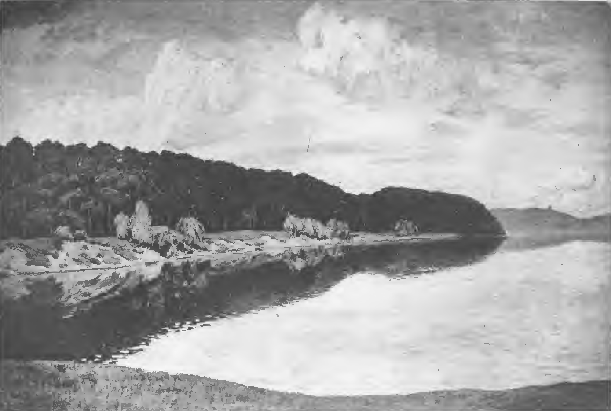
A BRANDENBURG LAKE
From the Painting by Walter Leistikow
Gardener. Thy servant Sheriar, lord; third gardener I.
Merchant. What? Sheriar, Oh yes. And this thy wife?
Gardener. Aye, lord.
Merchant. But she is younger far than thou, And once thou cam'st to me to make complaint That she and some young lad,—I can't recall ...
Gardener. It was the donkey-driver.
Merchant. So I chased Him from my service, and she ran away.
Gardener (bowing low). Thou know'st the sacred courses of the stars, Yet thou rememberest the worm as well, That in the dust once crawled beside thy feet. 'Tis so, my lord. But she returned to me, And lives with me thenceforth.
Merchant And lives with thee? The fellow beat her, doubtless! Thou dost not.
[He turns away, his tone becomes bitter.]
Why, let us seat ourselves here in the grass, And each will tell his story to the other. He lives with her thenceforth. Why yes, he has her! Possession is the end of all! And folly It were to scorn the common, when our life Is made up of the common through and through.
[Exit to the right with vigorous strides.]
Wife (to the gardener). What did he say to thee?
Gardener. Oh, nothing, nothing.
[Sobeide and the camel-driver appear at the latticed gate.]
Wife. I'll tell thee something.
[Draws near him.]
Look, look there! The bride! That is our master's bride! And see how pale and overwrought.
Gardener. Pay heed To thine affairs.
Wife. Look there, she has no veil, And see who's with her. Look. Why, that is none Of master's servants, is it?
Gardener. I don't know.
[Sobeide puts her arm, through the lattice, seeking the lock.]
Wife. She wants to enter. Hast thou not the key!
Gardener (looking up). Aye, that I have, and since she is the mistress, She must be served before she opes her lips.
[He goes to the gate and unlocks it. Sobeide enters, the old slave behind her. The gardener locks the gate. Sobeide walks forward with absent look, the old slave following. The gardener walks past her, takes off his straw hat, and is about to return to his work. The wife stands a few paces to the rear, parts the bushes curiously.]
Sobeide. Pray tell me, is the pond not here at hand, The big one, with the willows on its banks?
Gardener (pointing to the right). Down there it lies, my mistress, thou canst see it. But shall I guide thee?
Sobeide (with a vehement gesture). No, no, leave me, go!
[She is about to go off toward the right; the old slave catches her dress and holds her back. She turns. Old Slave holds out his hand like a beggar, but withdraws it at once in embarrassment.]
Sobeide. What?
Old Slave. Thou art at home, I'm going back again.
Sobeide. Oh yes, and I have robbed thee of thy sleep, And give thee naught for it. And thou art old And poor. But I have nothing, less than nothing! As poor as I no beggar ever was.
[Old Slave screws up his face to laugh, holds out his hand again.]
Sobeide (looks helplessly about her, puts her hand to her hair, feels her pearl pendants, takes them off, and gives them to him). Take this, and this, and go!
Old Slave (shakes his head). Oh no, not that!
Sobeide (in a torment of haste). I give them gladly, only go, I beg of thee!
[Starts away.]
Old Slave (holds them in his hand). No, take them back. Give me some little coin. I'm but a poor old fool. And they would come, Shalnassar and the others, down upon me, And take the pearls away. For I am old And such a beggar. This would be my ruin.
Sobeide. I have naught else. But come again tonight And bring them to the master here, my husband. He'll give thee money for them.
Old Slave. Thou'lt be here? Ask but for him; go now and let me go.
[Starts away.]
Old Slave (holds her back). If he is kind, oh do thou pray for me, That he may take me as a servant. He Is rich and has so many. I am eager, Need little sleep. But in Shalnassar's house I always have such hunger in the evening. I will—
Sobeide (frees herself). Just come tonight and speak to him, And say I wanted him to hear thy prayer. Now go, I beg thee, for I have no time.
[The old slave goes toward the gate, but stands still in the shrubbery. The gardener's wife has approached Sobeide from the left. Sobeide takes a few steps, then lets her vacant glance wander about, strikes her brow as if she had forgotten something. She suddenly stands still before the gardener's wife, looks at her absently, then inquires hastily:]
The pond is there, I hear? The pond?
[Points to the left.]
Wife. No, here.
[Points to the right.]
Here down this winding path. It turns right there. Wouldst overtake my lord? He's walking slowly: When thou art at the crossways, thou wilt see him. Thou canst not miss him.
Sobeide (more agitated). I, the master?
Wife. Why yes, dost thou not seek him?
Sobeide. Him?—Yes, yes, Then—I'll—go—there.
[Her glance roves anxiously, suddenly is fixed upon an invisible object at the left rear.]
The tower, is it locked?
Wife. The tower?
Sobeide. Yes, the steps to mount it.
Wife. No, The tower's never locked, by day or night. Dost thou not know?
Sobeide. Oh yes.
Wife. Wilt thou go up it?
Sobeide (smiling painfully). No, no, not now. Perhaps another time.
(Smiling with a friendly gesture.)
Go, then. Go, go.
(Alone.)
The tower, the tower! And quick. He comes from there. Soon 'tis too late.
[She looks searchingly about her, walks slowly at first to the left, then runs through the shrubbery. The old slave, who has watched her attentively, slowly follows her.]
Gardener (through with his work). Come here and help me, wife.
Wife. Yes, right away. [They take up the barrow and carry it along toward the right.]
Merchant (enters from the right.) I loved her so! Ah, how this life of ours Resembles dreams illusory. Today I might have had her, here and always, I! Possession is the whole: slow-growing power That sifts down through the soul's unseen and hidden Interstices, feeds thus the wondrous lamp Within the spirit, and soon from such eyes There bursts a mightier, sweeter gleam than moonlight. Oh, I have loved her so! I fain would see her, See her once more. My eye sees naught but death: The flowers wilt before my eyes like candles, When they begin to run: all, all is dying, And all dies to no purpose, for she is Not here—
[The old camel-driver comes running from the left across the stage to the gardener and shows him something that seems to be happening rather high in the air to the left; the gardener calls his wife's attention to it, and all look.]
Merchant (becomes aware of this, follows the direction of their glances, grows deathly pale). God, God! Give answer! There, there, there! The woman on the tower, bending forward, Why does she so bend forward? Look, look there! [Wife shrieks and covers her face.]
Gardener (runs to the left, looks, calls back). She lives and moves! Come, master, come this way.
[The merchant runs out, the gardener's wife following. Immediately thereafter the merchant, the gardener, and his wife come carrying Sobeide, and lay her down in the grass. The gardener takes off his outer garment and lays it under her head. The old camel-driver stands at some distance.]
Merchant (kneeling). Thou breathest, thou wilt live for me, thou must! Thou art too fair to die!
Sobeide (opens her eyes). Forbear, I'm dying; hush, I know it well. Dear husband, hush, I beg thee. Thee I had Not thought to see again— I need to crave thy pardon.
Merchant (tenderly). Thou!
Sobeide. Not this. This had to be.—No, what took place last night: I did to thee what should become no woman, And all my destiny I grasped and treated As I in dancing used to treat my veils. With fingers vain I tampered with my Self. Speak not, but understand.
Merchant. What happened—then?
Sobeide. Ask not what happened; ask me not, I beg thee. I had before been weary: 'twas the same Up to the end. But now 'tis easy. Thou Art good, I'll tell thee something else: my parents— Thou knowest how they are—I bid thee take them To live with thee.
Merchant. Yes, yes, but thou wilt live.
Sobeide. No, say not so; but mark, I fain would tell thee A many things. Oh yes, that graybeard man. He's very poor, take him into thy house At my request.
Merchant. Now thou shalt bide with me. I will thy every wish divine: breathe softly As e'er thou wilt, yet I will be the lyre To answer every breath with harmony, Until thou weary and bid it be still.
Sobeide. Say not such words, for I am dizzy and They flicker in my eyes. Lament not much, I beg of thee. If I remained alive, All mangled as I am, I never could Bring children into life for thee; my body Would be so ugly, whereas formerly I know I had some beauty. This would be So hard for thee to bear and hide from me. But I shall die at once, I know, my dear. This is so strange: our spirits dwell in us Like captive birds. And when the cage is shattered, It flies away. No, no, thou must not smile: I feel it is so. Look, the flowers know it, And shine the brighter since I know it too. Canst thou not understand? Mark well my words. [Pause.] Art thou still there, and I too, all this while? Oh, now I see thy face, and it is other Than e'er I saw till now. Art thou my husband?
Merchant. My child!
Sobeide. Thy spirit seems to bend and lean Out of thine eyes, and oh, the words thou speakest! They quiver in the air, because the heart So quivers, whence they come. Weep not, I can Not bear it, for I love thee so. O let Me see as last of all thine eyes. We should Have lived together long and had our children. But now 'tis fearful—for my parents.
[Dies.]
Merchant (half bowed). Thus noiseless falls a star. Meseems, her heart Was never close united with the world. And what have I of her, except this glance, Whose closing was involved in rigid Lethe, And in such words as by false breath of life Were made to sound so strong, e'en while they faded, Just as the wind, ere he lies down to sleep, Deceitful swells the sails as ne'er before.
[He rises.]
Aye, lift her up. So bitter is this life: A wish was granted her, and that one door At which she lay with longing and desire Was oped—and back she came in such distress, Death-stricken, that but issued forth the evening prior— As fishers, cheeks with sun and moon afire, Prepare their nets—in hopes of great success.
[They lift up the body to carry it in.]