Volume 19 — THE BALL OF CRYSTAL (1903)
Reading edition
THE BALL OF CRYSTAL (1903)
TRANSLATED BY A. I. DU P. COLEMAN, A. M. Professor of English Literature, College of the City of New York
On the long, bare slope of the Ettersberg lay the buildings that marked the centre of an estate, not far from the Sperber property, but not, like it, embedded in swelling fields on the side of the steep road where the land lay broader and less precipitous. It lay nearer to the wooded mountainside, so that the farm-buildings could look down a little haughtily on those of the Sperber place--although there was really no reason for it, since the latter was not at all inferior either in extent or in great straw-thatched barns and stables or the stately dwelling-house.
The estate that lay nearer the woods belonged to an old soldier, Captain Rauchfuss, who, after a busy life in war and peace, had retired and come back to his native town a little stiff in the legs, to find a corner where he could live on his little pension in quietness.
But after a few years of rest the querulous veteran had blossomed out into the likeness of a lively fellow in the prime of life, who enjoyed a special reputation among the Weimar townspeople as a jolly companion. And so it came to pass that he finally installed as his wife up at the Ettersberg the daughter of his housekeeper, a young widow, and thus became not only a landed proprietor but the husband of a nice little woman to boot. He sat perched like a falcon above the cramped little town, where so many strange and remarkable things were going on, things that seemed quite unnecessary to the old soldier.
Celebrities were going in and out down there in the narrow streets, who were neither princes, nor generals, nor even captains, and yet the people looked after them with respectful curiosity--mere quill-drivers! It was too absurd.
As for the widow and the estate, they were not too well off in the hands of the old soldier. He drove away from the Ettersberg oftener than was really necessary, down to the "Elephant," where he stopped and addressed forcible language to the hostler. He spent more there than was quite wise, in order to impress his importance upon the "Elephant."
The pleasant little widow had abandoned her comfortable widowhood without sufficient reflection: and now she had to put up as best she might with the difficulties of Herr Rauchfuss's disposition--sighing or complaining would do no good.
"You ought to have taken more time to think about it," was all the answer she got from her light-hearted husband. "What made you marry an old soldier? You know that isn't the same thing as a grandmother!" So she could only try and content herself, and go on looking after the considerable estate alone.
Frau Rauchfuss became the mother of a little daughter, a regular ruddy-golden fox's cub. That it was not a boy his wife had borne him annoyed Captain Rauchfuss.
"Thunder! This won't do--it's ridiculous! Me bringing women-creatures into the world! Really, my dear ... and such a little vixen as that!"
Yet he had himself a red brush of hair on top of his head and a thick, fair moustache.
"Oh, it's too absurd," he said. "To think that I've risked my skin all these years to come down to sitting at home within four walls and trotting about after a little brat of a girl! Don't come near me with it--I won't touch the creature!"
Captain Rauchfuss was angry and out of humor. To be a country gentleman and husband of the pretty widow was well enough; but father of a family--that didn't suit him at all; it was not in his line.
And oftener than before he had his trap hitched up and drove down into Weimar; or else he went shooting over his own ground, or to Sperber's to play bulldog with the old man and any one who happened in, or bézique with the pastor.
He was on specially good terms with old Sperber, because he too had a strong objection to the way things were going down in the town. "That's all silly impudence down there," he would say. "Well, we'll see how far they'll go with it--we'll see. Those fellows in the town might give over scribbling; no cock would crow the louder, nor would loaves of bread get any smaller. But we ...! Suppose we up there, and people like us up and down the country were to stop working, what do you think would happen then, my friend? Simply the end of the world--all up, done!
"And so I don't set foot down there, if I can help it. I don't let it irritate me any more--God forbid. I'm very well off up here, I'm bound to say--and I wouldn't change places with any of those frogs that have swelled to such unnatural proportions down there in the marsh."
Indeed, the old fellows up on the Ettersberg often held discourses over their bézique which were almost blasphemous, if you consider that they were talking about the greatest man of Germany; without whom Germany would not be Germany; the man to produce whom nature labored for thousands of years, tossed up millions and millions of stupid or average heads, more or less lacking in sense and reason.
That down there in Weimar at last the barren tree of humanity had borne a fruit seemed to the card-players of the Ettersberg a matter of no importance; but the tree went on producing its green leaves quite joyously. To them this fruit, indeed, seemed to be not a fruit at all but a blister, a perfectly unnecessary excrescence.
And they had nothing to complain of, heaven knew, up on their Ettersberg; their fine properties were prospering.
Herr and Frau Sperber worked together, getting through the day's business honestly and good-humoredly. Very early in the morning you might see brisk Frau Sperber in her pink print apron, with her keys jingling at her waist, cross the courtyard to hold a general inspection of the stables and stock-rooms; and Herr Sperber's huge rubber boots carried their fat little master through hedge and ditch, over ploughed field and meadow and woodland.
On the Rauchfuss place a brave woman was working beyond her strength; but she made it go--the two properties showed but little difference. To be sure, it would have been much easier for Frau Rauchfuss if her jewel of a husband had been of a less jovial disposition and had not considered it his principal duty to show the people down in Weimar that persons of importance lived up on the Ettersberg, and to prove to them that no one could tell, even when he had his heaviest load on, just how much he was carrying. He could rise from his accustomed table and march to the door just as straight as when he came in; and the exhibition of this faculty called for constant repetition.
If Frau Rauchfuss had not had her little daughter Beate, she might have looked a long time for the joys of life.
The time came, however, when the child was big enough to dance about in farm-yard and garden, looking like a flower with long golden stamina. She was simply brimming over with merriment and delight in being alive; and now Captain Rauchfuss condescended to take notice of his daughter. He brought her home all sorts of toys and trifles, and took great pleasure in seeing how quick and clever the little creature was, in watching her scramble about and in listening to the soft lips repeat in sweet tones the old soldier's expletives that she heard him use.
* * * * * * * * * * * * *
When Frau Rauchfuss's treasure grew to be a pretty little schoolgirl, it befell one day that the mother went down to the town with a heavy heart, to ask advice of her doctor about a trouble which for some time she had been silently carrying about with her, and which had made her work a heavy and oppressive burden. After long and anxious consideration she had finally made up her mind to the step, and gone off with a fervent prayer and a passionate kiss to her little girl.
And now, as she drove home again in her light carriage, it seemed to her as if, since she came down, the beautiful world had been transformed into a dark and unfamiliar place. She had set out with an anxious heart, and had had no one to speak an encouraging word to her; but still it was only down at the very bottom of her heart that there crouched, half hidden, the fear of what was so hard to realize--that her life might be wiped out.
Now she knew it was true. She was nearing the end of her days. The easy-going every-day life, that went about its business as if there were never to be an end, had been suddenly rent asunder; and through the gap the laboring soul stared out into empty darkness.
It was so that Frau Rauchfuss came home; the well-known road looked terrifying and strange to her, the golden grain in the fields by which she passed, as the wind went over it, bowed sadly to her because she must die ... she ... she alone of all the world. What was the death of others? An empty word. To her alone death meant something. Now for the first time it was a serious matter--the very first time on earth.
And no one had compassion on her. Her old coachman sat on the box with bent back and urged the horses to a trot. He was not going to die--no, only she. To herself, the poor unlearned woman that shrank back in her terror against the hard leather cushions was the world, the big splendid world; with her all its splendor would perish.
And this death-struggle of the world went on beneath her dotted blue Sunday dress, which she had put on for the difficult journey to the town. Was the seat of this bitter struggle in her breast? Was it in her flesh and bone--in her beating heart--in her poor aching head? Yes, where was the conflict going on? Could she point with her finger and say "Here?" O mystery of mysteries--where is the poor Ego with its cosmic suffering? Is it leaning against the hard cushions of the carriage? Is it flesh and bone--is it a living point, in which all this pain is now alive?
The woman's passive nature woke up, became sharply penetrating, was alive for the first time. Struck through by the certainty of death, she became conscious that she was alive--almost as it was when she had her first consciousness of her child's life, in the same mysterious and yet certain way.
Then she shut her troubled eyes; and before her mind rose up her little golden-haired child, her only treasure, her darling. Burning tears flowed from her eyes, and her own life, the sacred centre of life, was again shaken, this time by pure love and anxiety about her dearest. Who would care for the child--who in all the world? "Only a few more years," she sobbed, "so that they shan't spoil her!"
And as this torture grew overpowering, a ray of comfort stole into her darkened soul. Who knew whether it was as bad as they thought? And though she had seen her own mother die of the same disease, why might it not be different with her?
So she went on from one stage of suffering to another, broke down under her cross only to raise herself again, and again to fall, as once our Lord and Saviour did.
When she drove into the courtyard, her face was calm, her tears wiped away. This she had done automatically, of long habit. It was time now for her to be silent as to her suffering, and to live what must be wholly within herself.
"Where is Beate?" she asked the maid.
"With the master, in the garden."
The mother set out to find her, for she needed to fold her child in her arms, and went through the house into the garden.
When she drew near the great lime-tree, which was now in full bloom and looked like a fine golden net shot through with glimmering golden pearls, she heard the powerful laugh of her lord and master, and the sweet voice of her child like the twitter of birds answering it.
"Tubby," he cried in his mighty bass, "you're a little rogue!" The child laughed aloud.
With disquiet and emotion the mother drew nearer. On the wide bench under the tree sat the captain, a bottle of wine by his side. He was making the child drink from his glass.
"The youngster has a good capacity," he muttered with a grin. "Now dance some more, Tubby!" The child skipped and danced, her red-gold hair tumbling about her flushed face. "Confounded little witch! A regular soldier's girl!" the merry old fellow growled in his red beard. And the evening glow shone upon the red beard of the father and the red wealth of hair of the dancing child.
"They are of one blood," she said to herself; and she stood as if everything were over already, and she only a departed spirit watching.
Then anger, a deadly anger, rose up in her. She rushed at her husband. "What are you doing to her?" she cried in anguish. "Look--only look! You've let her drink too much! Oh ...!"
"Well, what of it?" said the captain with a thick tongue, taken aback by the sudden onslaught.
Little Beate stopped dancing, frightened, and looked at them with strange, doubtful eyes.
"Oh, you finicky creatures! What wishy-washy stuff! Women are fools! I should think a fellow might be allowed ..." growled Herr Rauchfuss.
The child made an odd movement, stretched out her arms to her mother, staggered and fell, her face hidden by her arms, sobbing. The mother bent anxiously over her.
"There, Tubby--don't be a baby!" stammered the old man. "You ought to be ashamed of yourself--a good stomach isn't upset by a couple of mouthfuls! You a soldier's daughter!"
The mother took the little girl in her arms and carried her to the house, paying no more attention to Herr Rauchfuss, who looked after her with a forced laugh.
In the room where she and the child slept, she laid Beate, still dressed, on the bed. The child kept on sobbing; her face was burning, and her eyes glowed as with fever. Frau Rauchfuss knelt by the bed in grief and fear. What was she to do? She simply did not know. To whom could she commend her poor little girl? Now that she had acquired certainty about herself, she felt for the first time her weakness and helplessness. At the physician's words a heavy burden had fallen upon her which she could not shake off.
As the darkness slowly crept into the room, she still knelt there, holding her child's hand and sadly racking her brains. Finally she undressed the child, who was now fast asleep, and herself lay down to rest.
She had the feeling that she was only a guest in her own house. Anguish came over her, and fear; the weight on her heart was as though she were buried for all eternity under a huge gloomy mountain. Plans of all sorts chased each other feverishly through her mind. What could she do? She thought of going to all the people she knew, whom she felt to be kind-hearted and begging them to watch over her child; to the Sperbers, her neighbors, to old Frau Kummerfelden who had a sewing-school in Weimar, to her pastor. She found few, as she passed them in review for qualities of heart and head, of whom she could be sure that they would not soon forget her prayer.
At last she grew weary of thinking and planning, and nestled down upon the bosom of her weariness as in her mother's arms. A mournful old hymn that she had been used to sing went through her head before she fell asleep:
A stranger and a pilgrim
On this terrestrial sphere,
Be peace, O Lord, my portion
While yet I tarry here.
Let me not fix my dwelling
Here on a foreign shore:
The heart to earth is fettered
That seeks of gain a store.
I'll wear but pilgrim's clothing,
O Lord, while here I stay;
For all our cherished treasures
The winds must bear away.
The sun of every mortal
Goes down at last in night,
And flown before you taste it
Is every dear delight.
The next day, in the bright summer evening light, Frau Rauchfuss took her child by the hand, and they went through the garden and passed out of a little gate to a narrow path that ran through swelling, sunny fields up to the wood; then they rambled slowly under the trees.
Little Beate clung close to her mother, for this was a rare treat to wander in such a holiday fashion with the busy, hard-working woman. "Look, look, mother!" she kept crying at every moment: "There comes something! There's something! Listen--a woodpecker! a deer!"
The arms of the sturdy ten-year-old quivered with joy. Frau Rauchfuss felt her child's delight in life. It went keenly to her heart, and she pressed the little girl closely to her. "Ah, if God would only grant, dear, that everything might go on just as it is!"
They came to the other side of the wood which lies like a broad band across the slope of the Ettersberg, where there was a very old wayside shrine without a saint. The saints had been too long exposed to the weather and to the onslaughts of Protestantism, and were worn away, broken, and vanished. Nothing was to be seen but a dilapidated low wall, on which the sorrowful Mother of God had once stood. Fran Rauchfuss sat down wearily on it and lifted her child to her lap. Together they looked out silently over the world which is closed to the people of Weimar, the world that lies behind the Ettersberg, a sunshiny, grain-bearing landscape, over which lay the last warm, lingering rays of the evening sun.
"What's the matter, mother? You're so quiet!"
"This time yesterday I had to carry you to bed because you had drunk too much." The child hid her face in her mother's neck. "Other children," she went on calmly, "while they are young, have a mother to watch over them. The time will come when you will have none. Other children have a father who helps them and advises them. That your father cannot do. Presently you will be quite alone, and will have to help yourself in every difficulty, and at the same time to look after your father and see that nothing happens to him."
The child raised her head and looked at her mother with astonishment. "You will be all alone; you must learn to think now what is right and wrong." Tears sprang to the eyes of the frightened child. The mother's eyes were as moist as the little girl's; and they gazed at each other with sad, uncertain faces. Frau Rauchfuss let her head fall on the soft, yielding shoulder of her child, and a mighty sob tore itself loose from her laden heart. The loving fair-haired child stroked her mother's face and pressed more closely to her.
"I am ill, my darling--I cannot live very much longer; and I'm so worried I don't know what to do, because I must leave you alone with your father. No one will look after you."
A sort of convulsion passed through the child's body, which the mother felt in the clinging arms. Then the little thing let go of her, and took the edge of her apron and passed it gently across her mother's eyes. "Don't cry," she said--"I shall be all right." Frau Rauchfuss looked down into a pair of earnest and determined eyes. "Put your head down on my shoulder again, and don't worry," said the child. The mother's heart was wonderfully lightened; she felt that she had with her a noble little being who could bring her comfort.
"If you die," said the child gravely, "will they put you in a coffin and carry you away and put you in the ground and cover you all up with earth?"
"Yes," said the mother.
"Won't you ever be able to come back?"
"No. Then I shall be with God."
"Is God good?" asked the child.
"Yes--God is good."
"Good ...?" the child said thoughtfully.
The mother looked at her with surprise. "Other mothers don't tell their children when they are going to die; but I had to--it was needful that you should know."
"That's all right," said the child; "tell me everything. Tell me all I must do at home, after you're dead. I'll look after father.... And when are you going to die?"
"I don't know yet."
"Well, then ..." said the child. They sat a while in silence on the low wall, on which in the times long ago the statue of the sorrowful Mother of God had stood. The child was not crying now, but gazing steadily and seriously before her. The mother also wept no longer; she had found comfort, and looked down wonderingly at the strong, grave little thing that sat by her side. From this day she felt herself no more alone or comfortless.
And when, a year later, the time to die really came, and she held the hand of Beate, now eleven years old, in hers, she felt confident that the child would know how to help herself and others. She commended her to God, but to no one else. In the last hard moments of the struggle she felt that she had some one noble and strong by her, comforting her with silent power.
* * * * * * * * * * * * *
And now Captain Rauchfuss was all alone with his little "Tubby."
His wife had often been an uncomfortable companion to him. He had imagined something quite different under the name of a wife; and now it was not so very different with his little "Tubby." He expected to find in her a pretty little plaything, and began to realize that instead he had got growing up in his house a small person whom he had to respect, a manager.
He went off to the town with just as uncomfortable a conscience as before, and growled in his red beard at womenfolks that put on airs, whom a man would have to show their place or send to the devil.
Frau Rauchfuss had taken care to provide a capable woman to look after the house and a bailiff for the estate, so that Beate's inheritance might be kept in good condition in spite of her light-headed father. In this plain and thrifty company Herr Rauchfuss was not at all at his ease. He went on drinking as before; and it was no longer requisite that it should be the "Elephant" where he washed down his worries and his ill-temper. Any tavern would do, even up behind the Ettersberg--he was not so particular. But he still remained a reputable member of society with his wits about him, behaving with perfect propriety in the tavern parlor and still proud of his ability to walk and talk straight after an indefinite number of glasses.
As Beate grew older, she went down every morning at five o'clock in the milk-wagon to the town, winter and summer, to go to school, and got down in the Entenfang at Madame Kummerfelden's. The child stayed with her until school began, had dinner with her at midday, took part in the famous sewing-class with the other girls under the kind, lively teacher, and then went home in the wagon when it brought the afternoon milk.
Good Frau Kummerfelden took a great deal of pleasure in the child's company--but she had some left over for the father also. When, arrayed in one of her flowered dresses and a cap tilted up over her still youthful face, she took her coffee comfortably on Sunday afternoons in the little house in the Entenfang, it was not at all disagreeable to her to have the old sinner pass an hour with her. He got two or three drinks of schnapps, some of the best snuff any nose could wish, and extra strong coffee, that even a throat as hardened as his could taste when it went down.
"It's good to see something like a man now and then," she said; "and Rauchfuss with his red beard and his giant stature and his mighty stride reminds an old woman like me that there are still men on earth, which one goes near to forgetting in these endless sewing-classes of wretched little girls!"
And, to tell the truth, she liked just such an old reprobate. "Yes," she said once to her friend, "if the good God were a woman, which isn't such an impossible thing to imagine, the men would get a pretty good deal up above. The worst scapegraces would be handled most graciously, as they are here on earth--where a man can do without any morals and be loved and run after because he's got a way with him." By such discourses the wise woman established herself in the captain's favor, and was able to make herself very much at home with him. Often she scolded him as if he were a schoolboy--but he took it in the friendliest fashion.
"With a man you must never come straight out with a thing. Spread plenty of honey about your mouth, and while they're licking it off they get the right thing with it, what they should get. That's the only way." So said the old woman often. And thus she gave it him roughly and merrily, like many another clever woman, and had a submissive friend for her pains.
The captain was foolishly vain of "Tubby's" beauty. The old friends were sitting together one Sunday afternoon in the little house in the Entenfang--the captain and the old actress turned sewing-teacher. "Well, Rauchfuss has got a pretty good-looking daughter, eh, my good Kummerfelden? Such plump, firm arms--and the walk of her! A well set up creature--and then her red-gold hair, and her confounded eyes! Eh, Kummerfelden, I didn't do a bad piece of work there, did I? Look at all the generation that's growing up--can you show me her like?"
"Now, now," said Frau Kummerfelden; "you needn't be stuck up about it, my good sir. She is more than half the daughter of her noble mother."
"Eh, what? Noble?" said the captain. "Deuce take it--beauty's the thing in a woman. There you are!"
"You old fool!" said Frau Kummerfelden. "What was it kept your property in such fine condition? Was it your wife's beauty, or her ability?"
"Ah, bah! Of course non-essentials have their use too. But the main thing ... Look--she might have gone down on her knees to me, and I'd never have married Frau Rauchfuss if she hadn't been such a fetching little thing."
"The Lord have mercy on you men!" said Frau Kummerfelden, stirring the sugar in her coffee. "You choose one that takes your fancy, and you call her beautiful as long as you care for her. What sort of a life did your wife have up there, lonely and deserted, as if she'd married a log of wood?"
"I say, Kummerfelden! Thunder--you're saying a good deal!"
"Because it's the truth!" said Frau Kummerfelden crossly. "And a rocking-horse would make as good a father as you are to that dear child. What kind of a way is that to do--to come home drunk at two o'clock in the morning, without a thought for the poor little thing that's waiting for you half asleep to help you to bed, you old rascal? And at that hour of the morning you make the good little thing get you a cup of coffee; and you take it like a thankless fool. Pooh, captain, I don't expect any man to be a pattern of morality and temperance. But even for a man there are some limits--and those limits you overstep, my good sir!"
On this particular day Frau Kummerfelden was more than usually put out with her old friend on account of something that had just come to her ears. But none the less she poured him out his third cup of strong coffee, and waited on him just as attentively as if he had been Saint Nicholas himself.
"And another thing," she said--"do you suppose the good child ever talks of the way you go on? Not a syllable! People might tear her in little pieces and they wouldn't get a word out of her that wasn't to your credit."
"A soldier's child--damn it all!" cried the captain, bringing down his fist on the table. "She gets that from me, the little rogue!"
Frau Kummerfelden put up both her busy hands to her big cap, as if to protect it from hearing impossible things. "Lord save us!" she said. "There's no use talking to people like you."
When Captain Rauchfuss's daughter had reached her seventeenth year, it came to pass that the old man got involved in a love-affair. On his Sunday visits to Frau Kummerfelden about this time he had often found there a neat little widow who professed a charming devotion to her old teacher. After her husband's death she had been left in poor circumstances. She came to consult Frau Kummerfelden very seriously about a project of settling down in Weimar as a nurse; and she made it all so touching and edifying that the captain, who happened to be present at some of these discussions, found his heart growing quite warm. Moreover, the little woman had a fascinating heart-shaped face, broad in the brow and pointed at the chin, and a pair of round, merry brown eyes.
"That'd be the kind of nurse for me," said the captain; "a lively creature, who'd make the whole business look less bad. It would be rather fun!"
"Shame on you, old simpleton!" said Frau Kummerfelden crossly.
"Well, but, Kummerfelden," said the captain, "you're a stately old frigate with that cap of yours. A light modern craft like our Marianne sails in different waters from such a venerable ship of virtue--eh, Frau Marianne?"
"Oh, really, captain," pouted the little woman. "Do you think I am not serious about all this?" And once more she paraded her virtues and her edifying design before the eyes of the good old woman and Herr Rauchfuss.
"A devil of a girl!" muttered the captain in his red beard.
"Oh yes," said the neat little woman, making a charming gesture with her little heart-shaped head, about which she had tied a snow-white three-cornered piece of linen to give herself a tidy and almost nunlike appearance--"oh yes, I like that! A devil of a girl.... Well, you'll find out what sort of a girl I am if you ever get into my hands! I'd take charge of the cooking as well--nobody knows how to get up tempting little dishes for an invalid's appetite, so that his spirits begin to come back to him at the very smell of the broth I make him. And another thing I may say--with me a patient can save on doctors' visits. I learned a great many things from my poor mother--all kinds of wonderful remedies, for gout and things like that ... the doctors' noses are out of joint.
"Haven't got it!" said the captain.
"Well, so much the better," said the little woman. "But I should be in demand, I think. For who is there now? A couple of old slow-coaches, that rattle at every move they make, and your friend the old raven-mother, Frau Kummerfelden, whose rough paws would kill anything at all delicate."
"Now, now," said Frau Kummerfelden, "you mustn't say anything about the raven-mother--she's a splendid old soul."
"Soul, perhaps ... but a little too much body with it!" said the little woman, spinning round to emphasize her dainty figure.
"Well, facts are facts," said Frau Kummerfelden. "The raven-mother is perhaps a trifle massively built. To be sure, last winter, when I was full of all kinds of pains, she picked me up out of bed and put me in again like a child. It's true she puffed and snorted over it as if she'd been Saint Christopher, which wouldn't suit everybody."
"No, no, no," said the little widow, "one must know how to move without making a noise."
One day the pretty little woman said, "It's time for me to be getting home now--my gentlemen will be waiting for me. One of them will need me to get his beer for him."
"Gentlemen?" said the captain, taken aback. "What kind of gentlemen have you got?"
"For board and lodging," she said; and her merry heart-shaped face with its round brown eyes looked up rather challengingly at the old soldier.
"The devil!" he cried.
"What's the matter with you?" said Frau Kummerfelden. "It's a very good thing that Providence has sent a couple of decent, sensible men into this part of the town, or how should the poor thing live?"
The captain laughed a little awkwardly. When she had gone, he got up stiffly from the table and walked about the room. "That boarder business doesn't please me at all," he said crossly.
"Look at the man!" laughed Frau Kummerfelden. "Captain, you needn't worry yourself. She's so clever that you have no thread fine enough to thread her needle."
From that day neither the captain nor the little widow was ever missing from Frau Kummerfelden's on Sunday afternoon, until it got too much for the old lady. It was some time before she began to notice that the captain and the young woman were getting to be on terms of courtship.
"Lord," she said within herself, "Thou hast chosen to ordain that my eyes should never see a man who couldn't get a woman, a man whom no woman would look at. Amen."
When she finally became aware of what was going on, she began to make excursions into the country on Sunday afternoons. She took her sewing- bag, put on a big hat over her cap, dressed herself in a becoming flowered dress, and locked the door of the house in the Entenfang behind her. Then she went off to contemplate God's free nature, picking up on the way a few rolls at the baker's, so that she might have something to dip in her coffee at Rödchen, Tröbsdorf, or Süssenborn.
"Well," she said to herself, "we've got 'Tubby' to the point where she doesn't need a stepmother; it's quite unnecessary that she should have one at all, least of all Frau Marianne. I believe in giving every one their due--but I wouldn't risk a penny on betting that her heart is even as big as an old hen's that you make soup out of. I really don't see any reason why we should provide her with a sinecure up on the Ettersberg."
The first Sunday or two that the captain found the door locked, he was very much annoyed with Frau Kummerfelden. "An old woman like that," he growled in front of the door, "steals God's days from him--and just when there's some use to be got out of her, she's off!"
So far the captain's love had been easy and comfortable to bear, a smooth and happy love. But now it began to trouble his bones like the gout. "Getting old ... getting old," he thought to himself; he went to the "Elephant" to refresh his forces, to dull his longing, to drown his discomfort--and yet he did not succeed. An unconquerable restlessness drove him hither and thither. Ten times in the day he marched with majestic steps through the little town, and could have wished it were ten times as big. At last he summoned up courage to pay a visit to the object of his adoration with due formality, but was scornfully repulsed by the lady herself. "Did he think she received visits from gentlemen?" That took him woefully aback. "When she's got the house full of men boarders!" he said to himself.
His astonishment was so plainly to be read in the old soldier's face that the pretty; little, woman quite understood it, and said to him in a friendly tone: "My dear Captain, people understand that a poor widow has to make a living; but if I were to let any one that chose come and visit me, I should soon be nicely talked about. So you mustn't mind, Captain." As she said this, she looked very charming, her face tinted by a sweet blush, for as a matter of fact she was not very much pleased to have her admirer standing in front of her door, in the tiny garden, for all the world to see. "But," she said, looking down modestly, "it might be all right for me to take a little walk some day and pay a visit to your daughter ..."
"To Tubby!" he laughed, surprised. "On a Sunday, then, when Tubby's at home," he said slyly, and made such a bow as he had had no occasion to make, in years. Her prudent behavior proved to him that she looked upon him without disfavor, and he was thus in an excellent temper.
That evening Tubby had a good deal of trouble with her father. He got out of the trap with decidedly unsteady steps. Up to that time he had always marched in a very stately manner through the courtyard, unnaturally straight, his moustache standing out stiffly, his hand behind him, like a man who is ready to face anybody's eyes with a "Well, look at me!"
The trouble had always begun after he got into the house; then he had collapsed and given poor Tubby a lot of trouble and distress; he had scolded her crossly and even struck her, and then passed to extravagant praises, staring at her with glassy eyes, until the poor child was terribly frightened.
But this evening he was queerer than ever before. He sat in his armchair, and seemed to be busy with something that was not there. "Go," he said, "or stay, if you like!" And then he began to stroke the cat, which was not there.
"Father," said the girl, "what's the matter with you? What kind of a joke is this? The cat isn't there."
"You goose," said Herr Rauchfuss, "have you got a hole in your eyes big enough for the cat to get through?" He stood up and pretended to be playing with the invisible cat. "There ... What? You'd bite, would you? That's something new! Like a dog ... the beast!" His face took on a dull red, and the veins in his temples stood out. He gave a kick. "There--that'll teach her a lesson! Such a brute was never nailed up to a barn door!"
He sat down again as if satisfied, breathing heavily. He looked ill. Now he had grown quite pale, with a bluish tint under the eyes, and his glance was expressionless. The child would have called the housekeeper, but she was afraid to stir from her place, and began to cry bitterly. Herr Rauchfuss broke out again: "There ...! It's back again--don't you see it?" he cried angrily. "Open your eyes!" He stared stonily in front of him. "There's no doing anything with a beast like that. Out you go!" And he made as if to thrust it away with his foot.
All at once a tender mood came over him. "Tubby," he said in a weary voice, "you've got to be a good girl ... What do you suppose it costs me to see to it that you are? To bring up a motherless child is no easy job for an old sinner. Go, child, brew me a grog, a fine one ... an infernally fine one ... that'll do me good!"
Such remarkable scenes as this took place now more frequently. In between there were calm days, on which Herr Rauchfuss did not seem to be feeling particularly well. Sometimes he would eat nothing all day, and was out of humor and dull.
On a fine summer afternoon Frau Marianne, the young widow, came wandering up to the Ettersberg through the swelling fields, and asked for Mamsell Beate Rauchfuss, whom she found in the garden. The child was lying asleep on the lawn that was used for bleaching, and did not wake when the stranger approached her.
"Queer," thought the young widow, "to lie and sleep like that! What does the girl do with herself, I wonder, the whole day long?" She looked at the auburn hair that was wound in a great coil around the head, the tender face, the small well-cut nose, the mouth that seemed to be a compound of strength and sorrow, the young body in a short pink dress; a pair of round childish arms; brown hands that attracted the eye. One of them was clenched as if to say, "What I hold, I hold; what I will, I will."
The young widow thought to herself, "The fine estate would be well enough, and the old man too. But the girl ...!" It was really too bad that a poor woman should have to go to so much trouble in order to have a place to slip into--that one might be good and clever and pretty, and yet all that didn't help. However you took it, it was always a difficult business ... She thought of her boarders, and of more than one pleasing possibility that had slipped through her fingers.
The young girl woke up, uneasily conscious of a stranger's gaze, and looked at her with astonishment and momentary alarm.
"I have come up to pay you and your father a visit," said Frau Marianne, a little embarrassed, for the unrecognizing, inquiring glance showed her that Beate knew nothing of her. "Your father asked me to come and look you up some day."
"My father ...?" said Beate slowly and thoughtfully.
"How is your father?"
The child answered with a short, hard monosyllable: "Well."
"What a charming, lively gentleman he is!"
The young girl was silent, and looked straight before her with a troubled face. She did not know how to take this dainty, friendly person; the sweet awkwardness of youth lay heavy upon her, she was not used to talking with strangers, and the wonderful deep summer sleep still held her eyelids.
"What a nice place you have here!" said the older woman, hoping at last to find some echo to her friendliness. Beate gave a slight nod. "Is it true that your father eats a rose before breakfast every day in summer, in order to keep so fresh and young?"
"A rose ...?" The girl seemed to start out of a reverie. "Yes, I think I remember hearing him say that he used to do that. Did he tell you so?"
"Yes," said the widow, "and it must be a good system. When one sees him going along with that stately tread of his, one can see that it is."
"Tubby!" cried a powerful voice from the house. "Where are you?" And as Tubby looked up, she saw her father approaching with that identical stately tread. He must indeed have consumed many roses, for he seemed to be transformed--she had never seen him look like that in all her recollection. Could it be true--only today, at table, so lowering and ill-humored and full of disgust for everything ... and now ...! The red beard seemed to glow, the eyes sparkled, and he walked on air. Beate opened her eyes wide.
"That's fine, Frau Marianne!" cried Herr Rauchfuss. "You've actually taken this long sunny walk in order to be a little company for my poor girl. I appreciate it, I can tell you!"
The young girl looked anxiously at her father and the guest. What was this new idea of providing company for her? She had long been used to loneliness in her upland home. It was true, she had often wished that the Kirsten girls and their friends whom she met at the sewing-school and now and then at the Sperbers' would come up and see her; but then the thought came ... suppose they were to see her father as she often saw him--and the desire for company went out.
But Beate's loneliness had been a wonderfully strenuous loneliness. Like a little wild animal she had lived in the shady garden, had slept under the trees or out in the full sunlight, and dug and planted and run about through field and wood without any one questioning her movements. When it was time to work, she had stoutly lent a hand, at sowing-time or harvest, in stable and dairy, in the orchard and the vegetable-garden. The men and maids all respected her, and said, "Just see how she takes hold of everything, as sensibly as a grown-up person!"
And in winter she scarcely missed companions of her own age and kind; in the big servants' hall there was always something interesting to listen to--things were called by their right names, and a rough world grew up before her mind in which even the ghosts were of a concrete and tangible nature. In the servants' hall the atmosphere was fairly clean as regards jokes and silly stories. Like a child of the people, she soon knew all about love, but without any desire to experience it. There was nothing mysterious and alluring about it for her; it was a thing that had to be, like sowing and reaping, like life and death. For her there was no veil over the phenomena of the world, not even death. All was as it was, and must be accepted.
And so the relation between her father and the guest struck her at once as peculiar. In the servants' hall they had more than once tried to tease her by telling her that her father would some day bring a stepmother home to her. And now she thought, "Is this the one?"
She found the newcomer beautiful: her daintiness, her pleasant smile, her dark, well-arranged locks, all charmed her. In fact, the young woman seemed a wonder to her by the side of her own bashful awkwardness.
It was a lively afternoon up at the old farm-house; not for years had the sound of such bright feminine laughter been heard there.
The housekeeper got up an excellent tea and spread it in the garden under the same tree where Frau Rauchfuss had once watched her child dance, feeling like a departed spirit. She laid a clean white cloth on the table, and brought out some special fresh-baked little cakes. Young Beate cut some flowers and put a bouquet on the tea-table. Frau Marianne almost drowned herself in the abundance of her own amiability, and the captain was like the ghost of his departed youth.
Beate sat very still and looked on, comparing this one fine summer day with all the summer, winter, spring and autumn days that she remembered. She clenched her firm little hands in an effort to keep back the tears, and stared at her father, from whom so much sorrow had come to her life, and thought of the joyless existence of her mother.
"No," thought the child, "she mustn't come here to us--I should be sorry for her. It doesn't matter about me--I know everything already."
When the pretty widow drove off in the little carriage, the captain kissed her hand tenderly and with assurance. She departed full of triumph; she had him now, the old fellow! And how comfortably the carriage rolled along. It was the same carriage in Which Frau Rauchfuss, crouching down against the leather cushions, had come back to her house in mortal sadness.
Frau Marianne was in a haughty mood, and thought lightly of her boarders. When she rolled up to her door--it was getting late--she was thinking, "Herr Leinhose ought to have had his beer some time ago, and Herr Oehmchen his sausage ... Oh, bother! It'll do them good to be kept waiting for once." They were both sitting in the living-room when she came in, and looked at her somewhat sourly. One of them took out his watch and looked at it, as an indignant creditor looks at his bill. "We're late--we're late!" he said significantly. The little widow answered with a light laugh. The hunger of her boarders seemed not to touch her--these same boarders who used to be so near her heart and whose welfare had been her greatest care; for no bachelor is better looked after than when a little woman who regards him as a possible suitor has charge of his affairs.
For a year and a day both of them had received this care from the little widow, and both of them were on such terms with her that she believed she had only to choose between them. One was waiting for an increase of salary, which might happen any day; the other had a nice little lawsuit on concerning an inheritance, and might at any moment be master of a few thousand thalers, enough at least to make a good start. They were, in short, both gentlemen of the fairest prospects; and a little widow who thought about marrying again could afford to go out of her way to feed them well and make them comfortable. They were both of the right age, neither too old nor too young.
So they looked up in considerable astonishment at their boarding-mistress, who seemed entirely unmoved by their ill-humor, and was very calmly putting away her hat and cape in the lavender-perfumed chest of drawers. What could have come to her?
They waited and waited. The little widow was positively dawdling over the preparations for supper. And when at last it came, she set it in front of them not with the charming manner to which they were accustomed, but quite indifferently. And the sausage was not as fresh and crisp as usual.
The young woman took her seat by the window and began to spin. This was the time when they had always been accustomed to discuss the program of the meals for the next day. At supper-time they had thus a double peaceful pleasure, by virtue of their imagination and its creative powers. But this also was missing tonight. She spun and smiled dreamily to herself; and the two boarders at their supper had ceased to exist for her. She was keeping house at the fine farm up on the hillside; she was wandering in spirit through stable and kitchen, she was changing the places of the furniture in the sitting-room to suit her taste, and feeling herself at last in her proper place.
Suddenly there resounded at the house-door a loud and peculiar knock. When the little widow reascended the stairs, the boarders heard hesitating footsteps following her. She came in showing some excitement, and after her came a visitor for whom the boarders were not prepared--a childish, red-haired girl. She wore a shawl over her head, half covering her hair; but it overflowed in ringlets and stray strands.
The soft figure, neither tall nor short, the tender, rosy countenance, the sharply-marked dark eyebrows, all these made the apparition which remained silently at the door so visionary and remarkable that Herr Oehmchen and Herr Leinhose stopped with their mouths full to stare. But the fair apparition did not move, and stared at the two men in helpless confusion.
"Why, Mamsell Rauchfuss," said the little woman with the heart-shaped face, "to what do I owe the pleasure ...?"
The strange creature did not answer, but kept on staring. Evidently she was struggling with something that she wanted to say and could not.
"Oh, but won't you sit down, Mamsell?" said Herr Leinhose, pulling up a chair to the table.
"Tell me, for heaven's sake, what has happened!" cried the widow in a faint voice.
Then the strange being sat down on the chair, threw her arms out desperately on the table, buried her face in them, and began to sob. The widow laid a soothing hand on her shoulder. "Oh, don't marry my father!" came out passionately and yet with a tender sound like a breath of spring from between the sobs. "It would be such a pity for you!" The girl now gave free rein to her tears.
"But who is thinking of any such thing?" asked the little widow, much annoyed.
"Yes, you are--you are! And so is my father--I know it! For heaven's sake, don't! You've no idea how wretched it is up there." Her sobs were so wild and unrestrained that it seemed she had been damming them up for years, and now it was like the breaking loose of a torrent in the spring. "I was so afraid that I ran all the way down--I just had to tell you! It would have been a great sin if I hadn't. If you only knew how sad my poor mother always was, and how sadly--how sadly--she died!"
The poor dear child, meaning so well in her anguish of heart and yet doing the widow such an ill turn, was still resting her head with its glorious crown of hair on her outstretched arms. She did not see how the two boarders were casting amused glances at the widow, or how pale her face was and full of woe at the thought of labor spent in vain and hope dispelled. Solitary in the midst of these three, who all had their own private thoughts, the lovely young creature wept.
"Ah ... ah ...!" said Herr Oehmchen at last--"Our beloved Frau Marianne!" His voice sounded rather poisonous. Heaven only knew whether he had ever taken any advantage of the kindness and readiness of his benefactress--but he wished to be the one to choose or to reject, not she. He was the injured one. Herr Leinhose's conduct was very similar; he also felt himself a lord of creation, and relieved himself by a grieved and unkind remark or two. The little widow was helpless against the two men so fully armed with injustice.
The picture of the four puppets which Fate had dancing on its thread now underwent a change which completely altered the situation. The eyes of the boarders were no longer directed in anger and injured dignity at the pretty widow, but fell with complacency and sympathy upon the weeping girl, who now found friends at the expense of another, as so often happens--if one loses, another must win.
"Really, can none of us do anything to help Mamsell Rauchfuss to compose herself?" Herr Leinhose shot out of the door, and returned with a glass of cold water. "Here, Mamsell," he said as gently as a child's nurse, "drink a mouthful of this!" Frau Marianne looked up in amazement; such a note in his voice she had never heard! The two men had always been well taken care of, only too well, by her, and they had absolutely no excuse for seeking revenge upon her for fancied wrongs. But when a man woos, he likes to see the woman in need of help, however much this characteristic alters after he has won her.
"Oh dear!" thought the pretty widow--"There it is!" She could do nothing but look on while both of them offered their services to the young girl. Their voices grew tenderer and tenderer--positively carried away by emotion. The poor lonely girl felt some good from these kind voices; she began to be more composed, and looked up.
The rosy face, slightly swollen from crying, under the crown of red hair, quite visibly inflamed the enthusiasm of the boarders. They simply poured forth kindness and amiability; and Frau Marianne could not be too far behind them for fear of making herself ridiculous; so she was forced to show a certain amount of motherly tenderness toward the disturber of her peace.
Poor thing, she was now learning by experience that love is not to be ensnared by correct deportment and just deserts. So she was obliged to put up with it while her two well-nourished boarders, on whom she had lavished so much conscientious labor, escorted the little brat home in the darkness to the Ettersberg. She was also obliged to endure it when the stupid girl, in her passionate anxiety, threw her arms around her once more, saying, "You would be sad and unhappy--and you're so pretty and nice! Oh, if I could only learn to be like you!"
It was hardly necessary for young Beate to have brought so much disturbance into the house of the unfortunate widow; for Captain Rauchfuss soon after grew very weak and showed signs of breaking up. The evil thing came upon him which attacks so many fine fellows that have drunk freely and stoutly all their days, and condemns them to see the light of life go out slowly amid pains and tortures. Captain Rauchfuss began to live in the midst of wonderful tormenting illusions. He saw things that other people could not see; and since the majority rules on this earth, and exceptions are penalized, Herr Rauchfuss was obliged to make a journey now and then to Jena, to a physician whose house offered a hospitable retreat for such peculiarly affected gentlemen, until such time as they had provisionally, at least, laid aside certain errors and misconceptions.
The less severe attacks he fought through on the Ettersberg, in his old home; and it was there that his last hour found him.
The Sperbers had come, and old Frau Kummerfelden also, when they heard that Herr Rauchfuss was about to depart. They wanted, in his last hour, to be near the old fellow who had led his life as foolishly and light-heartedly as most people, both for his own sake and for Beate's.
And so they sat in an adjoining room, while Herr Rauchfuss prepared himself amid great sufferings for his long journey; they sat and drank coffee, which the housekeeper was always making fresh, and ate ham sandwiches. That night the doctor stayed up at the Ettersberg and chatted with the three old people.
Tubby watched by her father's bedside through it all, like a brave soldier. It was a hard death, and the child looked into the horrors of life as into a blazing furnace. She herself had so much life and sunshine in her that it was as though Life itself were standing by the deathbed.
"You rascal, you!" cried Herr Rauchfuss angrily. "Just wait a bit--you see how it goes? Soldier's child ... soldier's child!"
After he had lain awhile in the night very quiet and indifferent, he said in a faint voice, "Let Sperber come." And when his old neighbor entered, he felt for his hand and held on to it as if in terror; but nothing could be done for him. He wanted to speak, and after a hard struggle he got out, "well--born--and dying--very ill--old friend--old friend!"
"Now, now," said Sperber, good-naturedly trying to soothe him, "we all have to come to it--all come to it ... Oh, my God!" So he held the old sinner's hand, with whom he had played so many games of bézique and had so many good drinks, while the poor foolish soul in mortal agony fluttered over the threshold of the door that leads from life to death.
The summer after her father's death seemed to bring a wonderful blossoming-time to the young girl. That was a summer! No long rainy spells--now and then a heavy storm bursting over the old Ettersberg; showers in the night, and fresh, dewy, sunny mornings--such a summer, in short, as one might have dreamed of.
The burden of life had fallen from the girl; she fairly bloomed and glowed. "There's one up here that'll turn many a head," said old Sperber. "God only knows what that girl will do before she's through. If she only hadn't that cursed red hair ... but she runs about like a blazing torch, and everybody that sees her takes after her, down to the very farmboy!"
She lived like a queen up on the hill, although the old Sperbers growled and blamed her for doing what she thought best and staying in her father's house, instead of moving over to theirs and letting the farm out.
Since that evening at the widow's, when the dry voices of the boarders had transformed themselves into the melting tones of tenderness and care, tones that they hardly recognized themselves, she had known that she was beautiful and possessed power over men. That night, when the two men had left her at her own door, the lonely girl had opened her window and gazed out into the huge darkness and silence. Her heart beat as if it would break; her warm blood glowed through her skin. A miracle had happened! Men were drunk with her beauty, drunk with joy of her. She thanked God, and pressed her clasped hands to her bosom, full of amazed happiness. She could not tear herself away from the peaceful stillness that filled her with its own splendor.
The fact that poor Frau Marianne's two boarders were after all but miserable specimens of manhood did not affect her. She had seen them grow drunk with joy. That filled her with emotion all day long and hallowed her in her own eyes. In this glorious summer, in which the burden of life had fallen from her, she expanded and grew increasingly beautiful through her own happiness. As a child she had envied the flowers for their beauty--and now she knew that she herself was beautiful. She possessed a sure and abiding joy. It was well for her that she was conscious of her beauty. Death she had known, and utter loneliness, and patient endurance. When she was a child, they had called her "little fox" and "red-head;" now she noticed that every man looked after her, that people stood still when she passed. And so again and again this great joy came to her, ran through all her veins and strengthened her.
During this summer she worked valiantly. She wanted to show the old Sperbers that she could be a good housewife and manager. Although the real responsibility lay upon the bailiff and the housekeeper, she would not altogether let go of the helm. She insisted on knowing everything that was to be done and giving her approval.
"The young rascal!" said old Sperber. She was often at their house, getting advice and meeting the young girls and their comrades, whom she had so long thought of and wished to know. Now that she was alone in the world, there was nothing any longer to keep her away from them.
There were two daughters of Councillor Kirsten from the Wünschengasse down in Weimar, who, with their friends Bundang, Ernst von Schiller, and Horny, came up to see the old Sperbers and made real festivities of their visits. The old people loved them very dearly, for they knew how to be merry and pleasant and were full of youthful audacity and exuberance that cheered the hearts of the aged couple.
Beate had never known how to make the good old people smile and laugh in the same way. That hurt her. From her childhood up, there had always been a heavy weight upon her; she had not known what it was to be quite carefree. To her the two girls, Röse and Marie, were something wonderful. Now that she knew she herself was beautiful, she drew nearer to them as one of their own kind, and they welcomed her joyfully.
The girl of the Ettersberg, who had always been in the habit of taking flight when they met her by chance at the Sperbers', had long attracted them, especially since their three friends seemed to have so high an opinion of her.
"Is it for her mop of red hair that you like her?" the girls asked the young men.
"She has something queenly about her," said Horny. "I watched her once, two years ago last autumn, when she lit a fire in the field after the men and women were gone, all by herself, to roast potatoes. I saw her gathering dry weeds and setting fire to them, and laying the potatoes in the hot embers, and then crouching down looking into the glowing fire, lonely and full of thoughts. I was hidden in the wood, and I had to press my hands over my mouth to keep from crying out, so much her loneliness affected me, and her making the fire all by herself and taking her ease there in the solitude of the woods. Then she ate some of the potatoes, quite simply, like a young animal that had been deserted; and, you may believe me or not as you please, but tears ran down my cheeks. The fields and all around were so big and wide and gray and cool. Her fire, and she herself, seemed to me the only tiny living point in all the gray mist. I knew, too, that she had no mother. Then I saw her go, gravely and silently, along the path toward her home. I shall never forget that picture."
The two girls looked at each other in amazement. When Horny recounted to them the experience about which he had so long been reticent, they were walking up and down in the evening on the Sperber farm.
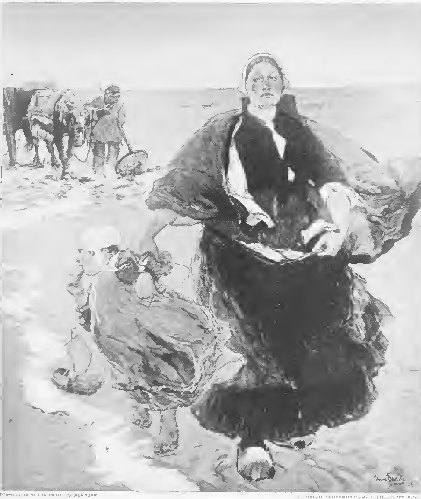
WIFE OF A CLAMDIGGER
"Why did he never tell us that before?" asked Röse, but she got no answer. "The Sperbers want us to take more notice of her," she continued; "and now it's really possible to do something with her. She's not so shy as she used to be, and one can talk quite sensibly with her. And she dislikes the same things we dislike. What pleases her best is to run about in the fields and work. Oh, but she's got a nice life of it!"
"I don't know," said Marie--"all alone like that!"
"Yes," said Horny again, "she has something about her that makes me think of a queen. She does what she pleases and thinks what she chooses. She lives her own life."
"As if queens did that!" said Röse.
"The kind of queens I mean," answered Horny, "may live in the Wünschgengasse or on the Ettersberg."
"Oh, that sort of queens!" laughed Marie.
"That's the only sort that's worth while! They must be young, and pure, and free, and joyous, and look every one straight and proudly in the eye."
Röse and Marie were delighted. "We're three queens!" they called to Ernst von Schiller and Budang. "Come, we'll go and pay a visit to the third."
So they all set off and went by a narrow path through a few fields and meadows, by a sand-pit, to the Rauchfuss farm, and found its young mistress sitting in the garden under the lime-tree, eating her supper. On the white-covered table was a bowl of sour milk from which she ladled some out every little while, and a loaf of fresh bread, and a plate of golden butter shining against the white cloth.
"Oh, how nice," said Röse, "the way she has her supper!" And they were asked to share it, and presently each of them was sitting in front of a bowl of sour milk and cutting bread and spreading butter on it. To themselves they thought, "There, Frau Sperber will be waiting supper for us!" But they saw in their minds the good-natured friendly face of the old woman who, they knew, would not begrudge them their pleasure, and they said to themselves, "Who knows? When we get back there, perhaps well be hungry enough again to eat what she's got for us."
When they had finished their supper, the most natural thing was to begin to dance under the blossom-laden lime-tree. It needed no long discussion to decide on this.
"Off you go!" cried Röse. The couples paired off; singing or humming a tune, they swung round on the firm gravel. Tubby ran into the house when it began to grow dark and brought out a stable-lantern; for under the trees the light had faded when it was still only twilight in the garden. Then came the glow-worms and crawled about among the perfumed branches. The young creatures caught each other's hands and danced in circles under the dark old tree, now to the right, now to the left, without tiring.
They were drawn to each other by the most delightful harmony. The still, peaceful garden around them, the fragrant, sheltering tree and the beaming lantern in whose rays young charms shone resplendent, all made for happiness. They spoke and laughed little. A great, sacred bliss spread through them all. The lonely maiden whom the merry friends had drawn into their circle was flooded with an almost unearthly joy.
That was her first dance, this silent, blissful circling under the trees, first right, then left, as long as their strength held out. It was a dance in praise of God's goodness, of beauty on earth and of the wonder of youth. It seemed they could never really tire of it; and they all knew that they had loved each other from childhood. "Oh, it's lovely!" said Röse.
Herr and Frau Sperber had come over to see what had become of the fugitives, and were standing at a little distance, not wishing to break in upon the sacred dance. Frau Kummerfelden, who now and then spent the week-end in summer with them--for the Sperbers' hospitality was boundless--had come with them.
The three old people stood motionless. "Ah ... yes!" said good Herr Sperber; and if he had made a long speech on all the joy and all the sorrow of this mysterious earth, it could not have been deeper or more expressive. The old Kummerfelden said to herself, "You dear good Sperber, I should like to shake hands with you for that--you've hit it exactly." And she repeated after him, "Ah ... yes!" But it went to Frau Sperber's heart, for Frau Kummerfelden had not been a famous tragic actress for nothing.
"Don't make a person's heart heavy, you foolish Suse!" she said to her good friend. "You must always go putting emotion into things."
"But," said Herr Sperber, "it can't go on like this--it would be a nice state of things. Tubby must marry."
"Marry!" said Frau Kummerfelden. "A beauty like her! That would be a shame!"
"Well, what do you intend to do with her?" asked Herr Sperber. "After all, that's what women are meant for."
"Yes, more's the pity."
"And old Rauchfuss's daughter especially ought to marry early--or we shall see things. She's a devil of a girl ... The pastor says he's got somebody for her."
"Well, why not? The pastor, he'll have somebody decent," said Frau Kummerfelden.
"And what about our nephew?" asked Frau Sperber. "Both the girl and the estate would be just the thing for him; and then we should have him near us."
"Oh, of course," said Frau Kummerfelden; "everything would be beautifully arranged then."
In the meantime the young people were still dancing under the trees, paying no attention to the old folks who have forgotten what real joy is, and with their hateful sensible theories based on experience can't help spoiling pure young human happiness, however well they mean. Without knowing that old eyes full of sorrowful memories and wisdom had rested on them, the happy young things danced on in silent bliss.
When at last they had had enough, they wandered into the darkening wood and sang and looked at the glow-worms, and talked as only very young men and maidens talk who are still afraid to speak of love.
It began to grow late. "I'm thirsty," said Röse, "and now we can't expect to get any supper at the Sperbers'--we'll be lucky if we get in without a scolding."
Beate had an idea: "Let's go into the cow-stable and drink fresh milk." Every one was agreeable. "But we shall have to be very quiet, because the men sleep quite near."
So they stole cautiously into the stable, Beate carrying the lantern. The courtyard lay dark and still; a strong perfume rose from the high manure-piles. The lovely girl opened the old, worn door, and they entered. A warm breath blew into their faces. From a niche in the wall an oil lamp threw down a faint glimmer of yellow on the white back of a cow.
"It'll soon begin to get light--the maid will be coming to milk before long." She threw the light of the lantern into a shelf on which stood all sorts of brightly-scoured bowls and porringers, and took down a snow-white wooden bowl.
Prom the swallows' nests up among the dark rafters sounded the chirping of the young birds, very sweet in the warm damp air. The little spring plashed in its trough.
Beate took the maid's milking-stool, stroked and patted a fine brown and white cow, and began to milk into the bowl. The girl's bright head stood out against the cow's great side. Horny held the lantern. Presently she had filled the bowl with foaming milk. The cow lowed a little at being disturbed so early and in such a peculiar manner.
"That is milk!" said the young mistress proudly. "And now all of you drink." She held out the bowl to them, and they drank long, long draughts.
"A queen she is!" said Horny again to Röse. "How fine all this is! It's great to have such a sea of white, fragrant milk rising in waves under your eyes and filling you with its warmth and strength."
"You've had as much as you want?" said Beate with blissful pride. They said good-by, reconducting their young hostess to the door of her lonely house.
But the three old folks had taken a very firm resolution to make some sort of settlement up at the Rauchfuss place. Tubby must not be left to herself--it would never do. "A girl like that all alone in the house!" said both the Sperbers very thoughtfully; and so it came about that they invited their nephew to come and see them.
He was a good, wholesome fellow. But all the neighbors in the country round, on the Ettersberg and behind the Ettersberg, in Weimar and the suburbs, thought as did the old Sperbers: It isn't the thing for a slip of a silly girl to be alone on the farm like that. Each thought of a nephew, a brother, a son or some other relative who might be launched, on the chase of the rare wild creature--all the while that the young girl was enjoying in fullest measure her freedom and her youth. In spite of them all, she lived very peacefully and properly, knowing how to make herself felt as mistress for all the bailiff and housekeeper were there; all she did was well and diligently done.
But presently there broke loose what the old people in their zeal had wished--a flood of suitors. The lovely youthful peace of the three queens and their good friends was disturbed. Such new, wonderful youth must first become conscious of itself before it can pass on to longings and desires. The three sensible elders would have better let the three queens go on quietly with their delightful dances--first to the right, then to the left, until they were weary. They will never have such dances again--never in their lives.
The first suitors who presented themselves were the two boarders of the pretty little widow with the heart-shaped face, Herr Oehmchen and Herr Leinhose. They paid a visit to the Sperbers, but not together; neither knew of the other's intention. They did not venture to go directly to the Rauchfuss farm; the thing was to be conducted with utmost propriety.
"Hallo!" thought Herr Sperber. "The thing must be getting serious when such settled gentlemen put themselves in motion." Herr Sperber did not fly too high in his ambitions for his protégée. "A plain fellow like that is the best for a woman of her sort," he thought to himself; "then there won't be any such business as there was with Herr Rauchfuss. Such a chap hasn't anything particular to show off before the world, no red beard, no giant's stature, no whimsies in the brain, no big heart, no wit--just an average fellow that'll settle down and keep quiet."
Herr Sperber received both the gentlemen in a very friendly fashion. The nephew, of course, would cut them out--but that was his affair.
Beate, who was invited one evening to meet the nephew and the other two at her old friends', enjoyed the astonished admiration of the three like a delicious confection--or rather like a sweet perfume that she breathed in. "Men are drunk with me," she thought again, and was proud and happy.
Although the two boarders and the nephew were quite sufficiently wearisome in their enamored state, she was not bored; she was only conscious of herself and of the incense of sacrifice which arose under her nostrils and seemed to invigorate her. The three men were alike indifferent to her; they were only the vessels in which the incense was burnt.
After such an evening she was gay and strong as a young goddess. The next day she was indefatigably at work, imposed even more respect than usual on her people, and felt exceedingly well.
On Saturday evenings the Kirsten girls had a way of strolling up with their friends; but it was not long before first one and then another came with them, whom they had met on the way and did not know how to shake off. This annoyed Röse and Marie very much. "These people are in the way," they said--"we like to be by ourselves." But Beate Rauchfuss said, "Oh, let them come--it doesn't make any difference."
"Of course they all run after you, because they think there's something to get," said Röse. "You'd better tell them you don't mean to have anything to say to them. What do you want of them? You've got us!"
The old Sperbers began to be overburdened by the multitude of young people who developed a desire to visit them; and the nephew in particular grew tired of it. So they decided to give Beate Frau Kummerfelden's old friend, the Raven-mother, as a chaperon. She was quite capable of keeping ten suitors in their proper place, and was useful for anything; she could watch the dead and the sick--then why not for once the beauty of a young girl?
She was the widow of the tinsmith Lange; she had married all her children, and so was ready to come to the service of her friends and acquaintances. She was even to be called upon for poetical effusions for special occasions; under the great Saint Christopher's cloak that she wore winter and summer alike beat a feeling heart, and a noble soul dwelt in the big strong body.
She was only too glad to go up to the Ettersberg as Beate's chaperon. It was the beginning of winter when they sent for her. For some time she had been wishing for something of the sort. Up there on the fine farm she would be very comfortable. When the snow lay on the ground, she would not have far to go to find her little pensioners, the ravens, whom she was accustomed to provide with food when the fields were snow-covered.
She came up to the Rauchfuss farm at the beginning of November. "By spring we'll be having a wedding," old Sperber had said to her. "I don't know why this girl, who ought for all reasons to choose a husband nicely and quietly, should be such a burning hay-rick! And the rascal likes it; just as a drinker enjoys his wine, so she enjoys the lovesighs of all these asses. Ah, there you are--the sins of the fathers upon the children, unto the third and fourth generation!" Old Sperber looked very black; he was displeased with Herr Rauchfuss's Tubby.
"What foolishness is this?" he said to her. "Down in the town a girl takes what she can get and is thankful--but you make everything that's got legs trudge all this long way up the hill. You know, you ought to be ashamed of yourself. A girl ought to have more discretion."
At this the girl laughed rather haughtily. Her heart was still free, and simply running over with the happiness of earth. No matter what was said to her, she heard only half of it. She seemed to have wrapped herself up in a sort of chrysalis. Her soul was round as a ball, without any angles on which cares could be hung, or cracks into which they could insinuate themselves--a fair ball of crystal, with light shining all about and through it.
It is a wonderful thing, the perfect egoism of early youth, the way it has no ears for the words of reason and wisdom, and only half an ear for anything else. Like a distant noise and bustle sound the world's doings amid the undisturbed content of self-centred youth and beauty.
But quite respectable personages came wandering all the long way up the hill. Herr Oehmchen and Herr Leinhose were indefatigable. With them came not seldom the young widow with the heart-shaped face, in the wise conviction that the dangerous maiden could at worst take only one of her well-nourished boarders from her, and that it would pay her to keep on good terms with both.
Besides these a courtier often came up, a man who had in the neighborhood of Weimar a rather heavily mortgaged estate. But he had also faultless manners, an extraordinarily small head and aristocratic hands. He could look back upon a long line of ancestors, who had all nibbled away something of his property and his personality; there was little of either left, and it was extremely sensible of him to think of supplementing them. He was superior to all the others when it came to a question of form, and so made a great impression on them. They considered him a dangerous rival, and rejoiced when he was obliged to stay in his town house--for he went to court--when they had anything on like a sleigh-ride or a dance; in fact, they arranged such things if possible on days when they knew he would have to be absent.
Dances, musical evenings, masked balls, sewing-circles were abundant that winter in Weimar, and the pretty Rauchfuss girl was asked to everything--now it was one paying attention to her, now another. She had plenty of cavaliers: all the marriageable merchants' sons of the town, young lawyers--in brief, the wooers recruited themselves from the entire circle of the townspeople, and even beyond it. The hunt was on, and every one joined it who could.
She loved dancing. It seemed to her the most glorious thing in the world to forget herself, to let herself dissolve in music and motion. She distinguished her suitors only by their ability as dancers; as to their intellectual capacity, which indeed was not specially noticeable in any of them, she easily confused them. She herself was without any instinct of the chase or desire for conquest, simply contented and happy in herself.
So the time passed on. The impatience of the aspirants might well have seemed to her like a flood rising to her very lips, threatening and terrifying her, or like a row of insistent creditors, with herself sitting in her little room in peace and letting them knock and call as loud as they would. She did not realize the impatience of the hunters; they seemed all so foreign, so far off to her.
To take one of these strangers into her house, to have him always about, to be obliged to see him every day, seemed a thing so distasteful and impossible that the thought did not even trouble her. But she dreamed of wonders--of one whom she would long to love. She felt something strong, great and good in herself, and realized at the same time her ignorance and her limitations. Her longing for freedom was also a longing for breadth, a desire to escape from all that was narrow, a will to grow.
Hitherto no one had offered her the bread of life; and she was hungry. Her beauty had in it something sleeping, something strong, that yearned to be active in this world and beyond; but no one offered to nourish this wonderful thing. What they offered her was no royal, soul-strengthening food; it was but ordinary, every-day diet, on which she would pine away and starve.
Yes ... she dreamed long, amidst all her suitors, of an awakening compared with which the life which these others called into being in her was but a deep, dull sleep.
The Raven-mother took delight in observing that the fortress she was set to guard showed no signs of surrendering; for so the comfortable existence up at the Rauchfuss farm might prolong itself a while longer.
On Sunday afternoons and evenings they had the most of their visitors. Then came the suitors, the Kirsten girls with their friends, the pretty young widow, and often the good Kummerfelden, who took great delight in listening to the irrational chatter of the amorous youths.
"These men-creatures are enough to drive one mad when they're in love," she said once to the Raven-mother. "The bird sings his prettiest songs to his mate and finds the nicest things to tell her; but men, with the exception of a few, who immediately print their pretty phrases, talk miserable rubbish. It positively makes my hair stand on end when I think that they used to do exactly the same in my day, and I didn't take it in ill part. They are only really clever when they're driven into a corner and can't help themselves; it must be a fearful strain on them."
"Yes," said the Raven-mother, "it's as if they thought that a fresh girl like that could only be caught by extraordinary nonsense--to be sure, she laughs at their foolishness; but I tell you she's a cool head all the same."
"And she's right," said Frau Kummerfelden.
But the talk of two old women is a dry affair. In the spring twilight they were sitting by the window in the great living-room; the young people were playing forfeits. In the next room the table was laid for supper.
They had passed a good many merry Sunday afternoons and evenings with the object of all this devotion, harmless, amusing hours, in which the suitors forgot what had brought them there and enjoyed themselves just like other people. But tonight there seemed to be a sort of spring fever in the air. Outside a cold, persistent rain could be heard falling, in spite of the new leaves on the trees. In the chicken-house the fowls were clucking in a Sunday afternoon ennui. The wretched rain had interfered with the usual Sunday occupations of the men and maids. Footsteps dragged across the yard in whose very sound discontent and boredom could be detected. The raindrops beat against the window-panes, or when the wind dropped, came down like a soft gray curtain.
The little town of Weimar, with all its distinguished men, lay hidden in mist and equally bored at the foot of the long slope of the Ettersberg, looking like any other little country town in the rain--comfortless and desolate'. In the midst of the loneliness and the spring rain, sounded now and then the note of a thrush, crying for the sun.
The Kirsten girls and their comrades had slipped up in spite of rain and mud, because they hoped that on such a day the amorous youths, the donkeys, as they called them, would stay at home. But the same thought had struck others. Each had hoped not to find the rest and to be able to show off his own personality; and all had been disappointed.
The object of their devotion was in anything but a good mood. A sort of disgust had seized her as all the dripping, commonplace figures divested themselves of their outer garments at the door with much noise and snorting. The stable-girl had to clean off their muddy boots, or, in case they had brought another pair to change, take the wet ones away to dry them at the stove.
Each one that came in seemed to make a great deal more noise than there was any need of. To the young girl they all seemed like blustering husbands; she too would rather have been alone with the Kirsten girls and their friends. Today all these strange men oppressed her, each of them coming with the hope of remaining at home there, master of all. They seemed positively shameless to her. A heavy sadness came upon her. She thought of her mother's marriage, of the quiet woman's hard-working life, of her loneliness, of the indifference she had to bear, of the warm, sorrowful embraces she had for her child.
"A pretty situation!" The young girl grew full of anger and disgust. "Has one of these men who come here given me anything that I didn't know all about? They are tiresome! If I were to take one of them, he'd soon forget to notice that I was beautiful. What is there left, then?"
They played at forfeits, the restless, discontented thoughts of them all making the very air of the room heavy. At supper, too, it was not so lively as at other times. The hostess was silent, not beaming as usual with the consciousness of her youth and beauty.
For the first time since she awoke to the carefree joy of budding youth, the ball of crystal that was her soul seemed stained and darkened; it no longer swam in the sunlight, shot through and through by the rays.
About nine o'clock, when the rain was coming down in torrents, and it had been proposed that the Kirsten girls should spend the night with Beate, their three comrades and Frau Kummerfelden at the Sperbers', while the suitors would have to accustom themselves gradually to the idea of going out into the wind and wet, there came a loud ring at the gate of the courtyard.
"For heaven's sake!" cried the Raven-mother. The rest sat in silent wonder; their number was complete--who could it be?
"Perhaps it's another one coming over from the Sperbers'," said Röse.
"Heaven forbid!" said Beate. She was thinking, "It will be no life at all if I marry one of these--it would be a hopeless business." And she felt again the strength of her longing, hungry young soul, which yearned to grow and yet no one would give it its food.
She was lost in these thoughts, in her new strange pain, when the stable-girl came in out of breath and said, "I've just let in a strange gentleman, who asks leave to wait a little while till the weather's not so bad. He's come across country, he says."
"Well," said the Raven-mother, "is he a proper sort of a person?"
"Oh yes!" The stable-girl brought her hand down on her thigh in emphatic assurance. "He's certainly a gentleman, even if he is wet through." All laughed loudly. The sudden burst of laughter rose up as unexpectedly as a covey of birds startled by a pedestrian in a quiet stubble-field.
Before it had died away, Beate said to the girl, "Bring him in and do what you can for him."
The Raven-mother also rose, saying, "We'll have a look at him. Didn't he give his name?"
"Engraver Kosch, he said three times--and how he said it!" answered the sturdy girl, grinning. "And he said other things too ... that he came from White of Egg, he said, and Ashes or ... I don't know what all else." The girl rubbed her arms and kept on grinning. "I was to tell you that, he said. He was brewed and baked, he said just the same way as the people up here."
The courtier jumped up, crying, "We can't have him in here--he's a lunatic! It's quite impossible, my dear Mamsell Rauchfuss."
Beate smiled. "If he's brewed and baked in the same way as all of us, why not?"
"Because that's foolishness," said the Sperbers' nephew.
"Foolish?" said the much-courted one, laughing. "Are we then from White of Egg?"
"But, my dear Mamsell," said Herr von Mengersen, "these are things ..."
"And he said more ... other kinds of things," said the maid, laughing.
"Be quiet!" commanded the courtier.
"No, no," said the girl, "I wasn't going to say anything. That was just for us."
"Go!" cried the courtier, stretching out his long, soft hands as if to ward off some danger. "Remember that there are young ladies present."
"Leave the room, you stupid creature!" growled the Sperbers' nephew. "Off with you!"
Still grinning, the maid disappeared. Beate laughed. It seemed as if fresh air had come into the room. She drew a long breath. How much merrier and more amusing were the farm men and maids among themselves than her suitors! What sort of things had she herself heard among them? They were not strong on ceremony, and said what they thought.
The Raven-mother came back into the room. "Quite a respectable man," she said with some excitement; "yes, really."
"Is he coming in, then?" cried the Kirsten girls.
And with that he came in, making so low a bow at the door that his long hair fell over his forehead. He stood there modestly--rather poorly dressed, thin, and not specially well cared for. When he raised his head again, he showed a pale, irregular face, looking on the company with sharp gray eyes. His mouth was large and sensible, partly covered by a somewhat bristling, colorless moustache.
He took his place at the table pleasantly enough. He was not a society man, but he seemed to have taken the resolution not to be put out of countenance. His whole person seemed to be permeated by a uniform will. He did not make the impression of having suffered too severely from the weather; he had simply emerged from the storm, like a pike from the water, in gray, unobtrusive apparel. In contrast to him the others all looked over-dressed, hung about with foreign stuffs and incongruous patches--all except the three queens, whose youth and beauty penetrated their clothes with a powerful and living harmony.
He took a seat by Beate. There was a general silence.
"Mr. Engraver," said the Raven-mother, "please help yourself."
"Mr. Engraver?" said the stranger with a peculiar intonation. "Why not, for example, Mr. Walker, Mr. Eater, Mr. Drinker, or Mr. Sleeper? Or ... no, that's enough!" He put the question with great calmness.
"Well ..." said the Raven-mother.
"Yes, of course," said the stranger, "but how do you know that I spend more time, or spend it more pleasantly in scratching on copper than in sleeping or feeding--pardon, eating?"