Front matter (continued 7)
E. N. (Ernest Nathaniel) Bennett translation
Among the persons brought forward there were many civilians who, when they became aware that I spoke French, called to me that they were innocent, and that the priests bore the whole guilt of what had taken place. They expressly pointed to the priests who had been brought forward. Amongst them was a Belgian civilian who, as a sign of his goodwill to the Germans, showed a document, according to which the King of Prussia had bestowed the Order of the Red Eagle upon him. I took the opportunity to remonstrate with this person that he, an educated man, and the other men of his station had not stopped the populace from making the attack; he replied, "It is quite impossible for us to prevail upon the people who are in the hands of the clergy."
I remained at Louvain until August 26th, 1914, 4 p.m. During August 26th I still heard and saw, now and again, firing from the houses; comrades of mine were wounded actually at my side; thus also the voluntary soldier Wuppermann. During the morning of August 26th I spoke in the station square, where there were many women prisoners, with two of them who evidently belonged to the educated classes. One of them, an American from St. Louis, addressed me in English and begged me to release her and another known lady from imprisonment, as they were innocent. She explained to me that the clergy were responsible for the events. She then called the other lady, a Belgian, with whom I also conversed in French. She also confirmed to me that the firing from the houses was due to the conduct of the clergy. She related the following: In the evening, Belgian soldiers dressed as civilians entered individual houses and forced the inhabitants by threats to receive them and to admit them to the windows in order to shoot from them; previous to that the clergy had gone into the houses and declared to the inhabitants that it was their duty to receive and support the Belgian soldiers because the German troops were making war upon the faith of the Belgians.
During the critical days, particularly violent firing on the German troops came from a convent outside Louvain, on the road from Louvain to Bueken. I have heard this repeatedly from soldiers, and on August 26th, 1914, in the afternoon, whilst going in my automobile to Bueken, I had to pass the street near the convent under special protective measures. In order to be safe from any firing from the convent we had to take with us several civilians, who were placed partly upon the footboard of the car, partly upon the cooler.
I wish to emphasise that even during the examinations in the station square we were fired at from houses there. I particularly remember the incident when about ten to twelve young people in sporting-caps—which was frequently the distinguishing mark of disguised Belgian soldiers—were brought up quite close to the station building, and that I was fired upon from a building opposite on my way to see these persons, and that the prisoners ran away, and that we Germans fired after them.
Read over, approved, signed.
Signed: Richard Gruner.
The witness was sworn.
Proceedings closed.
Signed: Pahl. Signed: Dr. Grasshoff.
D. App. 39.
Guiscard, March 1st, 1915.
Present: Member of the Military High Court, Riese. Secretary, Reisener.
There appeared as a witness Non-commissioned Officer Muesfeldt, and, after the importance of the oath had been pointed out to him, he was examined as follows:
As to Person: My name is Willy Muesfeldt, aged 33; Protestant; non-commissioned officer, IX. Reserve Corps.
As to Case: On August 25th I arrived with the first party of the General Command at Louvain. We unloaded and drove with the baggage to the market-place. Here we remained, as it was said that the English were near, and that we might have to go into action that day. In the evening, at about 9 o'clock, Captain von Esmarch, leader of our baggage, arrived in the automobile and said that matters had turned out differently, and that we could march off to quarters. The Captain mounted the horse and gave the order "Mount." He had hardly said this when firing commenced from all sides. I fetched my rifle from the cart, took cover, and fired. Then I noticed that the Captain lay on the ground, wounded; I brought him into safety beneath a cart, and continued firing. I cannot say exactly how long the firing continued. When it ceased, the order was given to search the houses from which the firing had taken place for francs-tireurs. I approached a house from which firing had taken place, battered the street door, and went down the cellar, from which shots had also been fired. I found there a man of about forty years of age, with dark pointed beard, who had a revolver in his hand. I immediately threw myself upon him, and in spite of his struggles I led him up the stairs, where I handed him over to gendarmes. I did not indeed see this man shoot, but I assume it with certainty, since I found him with the revolver in his hand; he struggled, and there was no one in the house except his wife. All this I related to Captain von Esmarch at Christmas when he was here on a visit to the General Command. There was a pharmacy in the house, which I mentioned above.
Read over, approved, signed.
Signed: Non-commissioned Officer Muesfeldt.
The witness was sworn.
Proceedings closed.
Signed: Riese. Signed: Reisener.
D. App. 40.
Altona, March 1st, 1915.
Court of the Commandant.
Present: President, Dr. Steengrafe. Secretary, Sergeant Meyer.
There appears as witness engineer Weiss, who, after the importance of the oath has been pointed out to him, he declares as follows:
As to Person: My name is Robert Weiss; engineer, in Altona; aged 31; Christian; motor-driver.
As to Case: After mobilisation I offered my services as a volunteer, and went into the field as motor-driver on the staff of the IX. Reserve Army Corps.
On the afternoon of August 25th, 1914, we arrived at Louvain. The inhabitants behaved at first more than kindly towards us.
Towards the evening I had driven a wounded man to the field hospital near the market-place. The field hospital was established in a monastery. About 9 o'clock I drove the car with Captain von Harnier in it from the monastery back to the market-place, when suddenly firing began on all sides from the houses. I stopped my car and remained unhurt; Captain von Harnier was wounded in the arm; he hurried to the market-place, and I sought cover beneath the car.
I may have remained there about half an hour when a platoon of German infantry came along the road. I called to the leader, and he had the surrounding houses, from which the shooting continued, covered by fire. I then took the car to safety in the yard of the monastery.
When, after a short time, I wished to leave, Captain von Esmarch was carried in, covered with blood. Whilst being carried to the field hospital, he was fired upon from the monastery. I went into the monastery with an infantryman; we found a revolver, but to save ourselves from being cut off we could not enter the vaults of the monastery into which the people had evidently retired.
The Belgian field hospital did not want to bandage Captain von Esmarch; I finally forced a Belgian surgeon, whom I caught by the arm, to apply the bandage.
Subsequently, on driving my car to the market-place, and from there to the station with the General Staff, I saw everywhere on the way burning houses; now and again isolated firing from the houses still took place.
At the station there were no burning houses, and strict orders had been given to set no houses on fire there. After half an hour the firing from the hotels opposite the station began. From that point right to the station there was firing with machine-guns; I could distinctly hear the regular "tak, tak."
It was only then that orders were given to raze the houses in front of the station; they were set on fire, but even from the burning houses, and finally from the ruins, the firing continued briskly. We suffered losses.
Later on, isolated shots were fired.
The citizens who had in any way taken part in the attack were brought to the station square, and, if found guilty, shot according to martial law.
The soldiers, who brought the citizens along, were exhorted—as I have myself heard—to bear witness carefully and conscientiously. The examinations were conducted by officers of the General Staff. Whoever carried loaded arms, in spite of the prohibition issued and announced, was shot at once.
In the town lay several men in clerical garb, shot; at the station, too, several men in clerical dress were shot; all were examined, but I was not present at the examinations.
On the following day, too, isolated shots fell upon us from houses.
Read over, approved, signed.
Signed: Weiss.
The witness was sworn in accordance with the regulations.
Signed: Dr. Steengrafe, President. Signed: Meyer.
D. App. 41.
Court of the Commander.
Present: President, Dr. Steengrafe. Secretary, Meyer.
Altona, March 3rd, 1915.
There appeared as witness merchant Dammann, who, after the importance of the oath had been pointed out to him, was examined as follows:
As to Person: My name is Carl Dammann, aged 31; Christian; merchant in Hamburg; soldier of the Reserve.
As to Case: After mobilisation I volunteered for duty as motor-driver, and as such I was assigned to the Staff of the IX. Reserve Army Corps.
On the evening of August 25th, 1914, we arrived in Louvain. At first the inhabitants were very obliging.
My motor-car was put in the market-place, a big square near which is the Hôtel Métropole. In the evening, towards 9 o'clock, we motor-drivers stood under the trees of the place and chatted together. Comrades told me they had seen a rocket go up.
Suddenly an awful firing commenced from the houses surrounding the place. The fire was first of all directed on the baggage-carts which were to be drawn up at the place. Each one of us sought cover, I on a baggage-cart, the horses of which had just been shot. My car showed later on a hole as large as a fist in the protective cover and in the body of the car; to judge by the way the tin was bent, the shot must have come from below, from a cellar. Whilst we sought cover, the firing continued, and some of us were wounded. In my opinion this was a well-prepared and planned attack of the civilian population.
After the firing had become less violent, we drivers went to the station. At the market-place and in its small side-streets the houses were burning. During our drive to the station, German patrols passed us everywhere. In the station square firing took place principally from the four large hotels there. The firing in the station square continued till the morning.
Those persons of the town who had participated in the attack upon the Germans were taken to the station square in the course of the evening and during the night. An officer then examined them; the soldiers who had brought up the people were examined. A number of men, nearly fifty, were shot in the station square after the examination was over.
As far as I remember, there were two persons in clerical garb amongst them; but there may have been more.
Read over, approved, signed.
Signed: Carl Dammann.
The witness was then sworn.
Signed: Dr. Steengrafe, President. Signed: Meyer.
D. App. 42.
Court of the Commander at Altona.
Present: President, Dr. Steengrafe. Secretary, Kahl.
Altona, December 28th, 1914.
On citation there appears as witness Captain of Landwehr II. Hermansen, who, after the sanctity of the oath had been pointed out to him, makes the following statement:
As to Person: My name is Richard, aged 37; Protestant; Public Prosecutor at Düsseldorf; at present in the Reserve Battalion, Infantry Regiment No. 76, Hamburg.
As to Case: I arrived at Louvain on August 25th at about 9 o'clock p.m. after a railway journey of 55 hours.
At the moment of alighting a violent fire was opened upon the station and its vicinity from the houses lying round the station. I also heard a mechanical noise, which I took to be machine-gun fire.
We took part in the searching and the burning down of houses from which firing had taken place.
Some of the houses were furnished with regular loopholes, among them also houses which, as I saw on the following morning, had flown white flags.
On September 1st, at Lombeek, St. Catharinen, near Ternath, west of Brussels, I made the acquaintance of a priest, to whom I expressed my approval of the quiet bearing of the inhabitants of Lombeek towards our company.
He said, "Yes, for weeks I have been preaching this from the pulpit, and my flock listens to me. I have told them that if they wished to fight, they should go to Antwerp, put on uniform, and obtain a rifle. The enemy is only doing his duty; his soldiers are children of the same heavenly Father."
I replied that, if all his colleagues in office had acted thus, much that was disagreeable would have been avoided both for the Belgians and for us. He did not contradict me; we remained talking a little while longer, and when I took my leave of him, he blessed me.
Read over, approved, signed.
Signed: Hermansen.
The witness was then sworn according to regulations.
Signed: Steengrafe, President. Signed: Kahl.
D. App. 43.
Present: President, Felgner. Secretary, Becker.
Flensburg, January 8th, 1915.
There appeared as witness Captain von Vethacke, who, after the importance of the oath had been pointed out to him, was examined as follows:
As to Person: My name is Moritz, aged 37; Protestant; Captain, Reserve Battalion, Reserve Infantry Regiment No. 86.
As to Case: I have just read Captain Hermansen's statement of December 28th, 1914, and I confirm it with the following remarks:
I know for certain that among the corpses lying in the station square there were several dressed in clerical garb. The examinations in the station square in Louvain were carried out very carefully. Each company had its portion of the town which it tried to clear of francs-tireurs. Persons found with a rifle in their hand were at once shot, but others who could not be at once convicted of the participation in the attack were led to the station building for a decision to be come to there regarding them. The witnesses accompanied them in order to give their testimony in the station square. Whatever priests were shot, were found guilty before the Court. I also made the acquaintance of the priest mentioned by Captain Hermansen at the end of his statement; he made an excellent impression on me also; he did not contradict me when I expressed my view that priests had stirred up the people and had taken part in the attacks. From my conversation with this priest I gained the impression that he did not approve of the behaviour of his colleagues in office.
Read over, approved, signed.
Signed: von Vethacke.
The witness was sworn according to regulations.
Proceedings closed.
Signed: Felgner. Signed: Becker.
D. App. 44.
Court of the Bavarian Landsturm Infantry Battalion Gunzenhausen.
Present: President, Captain Hahn. Secretary, Walz.
Vielsalen, February 4th, 1915.
On citation there appeared as witness Herr Karl Dörffer, born on December 25th, 1877, at Erda, district of Wetzlar; Protestant; 1st Lieutenant, Reserve of Prussian Railway Regiment No. 3, assigned to the Railway Constructing Company No. 17, at present commanded by the Bavarian Staff Officer of railway troops in Vielsalen.
The witness, to whom the importance of the oath was pointed out, was examined as follows:
As to Person: My personal description is correctly stated.
As to Case: On August 24th, 1914, I was commanded to effect the detraining at the station in Louvain. I was acting manager in the station as well as commandant over the station. On August 25th detraining took place almost continuously; I particularly mention the detraining of the IX. Reserve Corps and the General Staff of this corps. On the evening of August 25th, at nightfall, shots fell suddenly in front of and on both sides of the station area; in this area were detachment of troops and trains. At first I did not attach much importance to the firing; but as it became more violent I went to the front of the station building.
I now saw that violent firing was taking place, particularly from an hotel to the right of the station. From the long flash of fire from the individual shots I assumed that military rifles were not being used. I know for certain that firing took place from the upper floors of this hotel, but the windows from which firing took place were dark.
The following design will indicate the position of the hotel more clearly:
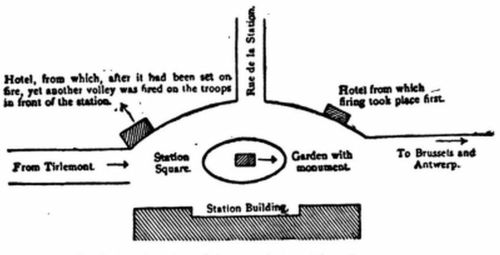
To judge by the violence of the firing I must assume that firing from other houses also took place.
Through officers of the Mecklenburg Dragoons belonging to the General Commando of the IX. Reserve Army Corps—if I remember right, through Captain von Alten and another officer—the news was received at the station that even the transport of the Army Corps had been fired on in the town. A high officer gave the command to search the hotel mentioned and other houses, and then to set them on fire. A number of persons, partly middle aged, partly older people, were taken out of these houses, and a great number of them—but only males—were immediately shot according to martial law. It was then quiet in the station square for a long time. I would point out that I could not stand in the station square continuously, because I had business to transact in the station itself. It was therefore impossible for me to watch all the events in front of the station. At about 11 or 11.30 p.m.—most of the houses in the station square were burning—a volley was fired on us from the roof of an hotel on the left of the station; the hotel was already burning at the bottom. I stood, as it happened, in the centre of the station square with several officers; there remained nothing for us but to throw ourselves upon the ground so as to offer the smallest possible target. Orders were then given to search this house once again; in spite of this, a few isolated shots were fired during the night from the houses in the station square, especially from the houses on the road to Tirlemont, opposite the loading ramp, upon which artillery and vehicles were unloaded even during the night.
I know that, after the volley had been fired from the house last mentioned, a high officer gave orders to clear the people from all the houses round the station; a number of women and children, also old and middle-aged men, were thereupon apprehended; a few of the men were shot according to martial law, but in a great number of cases it could not longer be ascertained whether they had taken part in the firing. These persons were first housed in the station; part of them were later on transported.
On August 26th a few isolated shots fell near the station. On my request, the commandant of a battalion—according to my notes it must have been Colonel von Treskow, 2nd Battalion, Reserve Regiment No. 76—had various houses on the road to Tirlemont cleared; this officer told me that in doing so he lost one of his reserve officers. I cannot say whether there were persons of the Garde Civique among the Belgians who fired on us.
As to the persons shot—I speak, of course, only of my own observations—it had been ascertained by witnesses that they were guilty.
Read over, approved, signed.
Signed: Karl Dörffer, 1st Lieutenant of the Reserve.
The witness was then sworn.
Signed: Hahn, Captain and Officer of the Court. Signed: Friedrich Walz, Secretary.
D. App. 45.
Court of the Mobile Commissary Commando, 1, VII. Army Corps.
Present: President, Elble. Secretary, Casser.
Péronne, December 29th, 1914.
There appears on citation as witness Paymaster Otto Rudolph, Reserve Railway Constructing Company No. 11, at present at Péronne, who, after the importance of the oath had been pointed out to him, was examined as follows:
As to Person: My name is Otto Rudolph, aged 34; Protestant; police officer at Worms.
As to Case: The Reserve Railway Constructing Company No. 11, of whom I am paymaster, marched into Louvain on August 24th, 1914. My Commandant instructed me to arrange for quarters for the officers and the horses of the company near the principal railway station. I first applied to the proprietors of the hotels in the station square, especially to the proprietor of the Hôtel "Maria Theresa." Everywhere I was received in the kindest way. As the rooms of the hotel were, however, already engaged by officers of other units of troops, I could not get the necessary rooms. I therefore tried to find quarters in the main road leading from the town hall direct to the station, but the name of which I have forgotten. Here the necessary rooms were put at my disposal in the kindest way. In the house No. 105 of this street I found quarters for three officers. In the house diagonally opposite, the apartments of a bank official, I was also well received.
The quarters were not occupied on this day, because the company was trench-digging at the station during the whole night.
On the following day I had requisitioned vegetables, straw, etc., at Linden and Kessel-Loo, the latter a suburb of Louvain. The various farmers fulfilled my requirements in the kindest way. In the evening I returned from the requisitioning. On the way, in the suburb Kessel-Loo, male civilians, who had assembled in imposing numbers, intimated to me that the English had succeeded in breaking through near Louvain. On inquiring for the messenger who had brought this news I heard that priests had related it. I also remember actually to have seen three priests at the eastern exit of the village at about 7 o'clock p.m. They went through the streets singly, and here and there made communications to the people. As I heard the firing of cannon at no very great distance, I hurried to reach the main station at Louvain. I arrived there at about 8 o'clock p.m. At about 9 o'clock I suddenly saw, near the station, a rocket go up. At the same moment I heard violent gun-fire. In order to inform myself regarding the firing, and to have a better view, I went to a "G"-car of the company transport, which was about 30 metres distant from the station square. From the open peep-hole of the "G"-car I obtained a good outlook over the station square and towards the road that connects Louvain with Kessel-Loo. I saw quite clearly firing upon the railway train from the roof of the third house of the street opposite to the train entering Louvain. I also remarked firing towards the station square from a window on the third floor of an hotel. From a window of the Hôtel "Maria Theresa" firing upon the station square took place. During the firing, the station square and the adjacent streets, which I was able to overlook, were filled with our troops. The firing could only be intended for our troops. Our men replied to the firing. I myself fired at a window of the second floor of the fifth house of the road that is parallel to the train, from which a civilian, whom I could clearly see, was firing.
After our side had received the signal to stop firing, I went to the station square; this may have been at about 10.30. A General there had instructed the field-gendarmes to search the houses from which firing had taken place for arms and ammunition. On my report of what I had seen, a search was also made in the third and fifth houses of the street parallel to the train. In both houses suspected persons with guns and suitable ammunition were found. One of these persons who was examined at the station had cartridges which fitted the guns in his pocket.
At about 12 o'clock p.m. several civilians, among them about six or seven priests, were shot in the station square. Suddenly a window was opened on the second floor of the Hôtel "Maria Theresa," where I had received information in such a trustworthy manner during my search for quarters on the previous day. I saw a male person who repeatedly fired upon the troops assembled in the station square. Firing also took place from houses whose inhabitants had wished to signify their friendliness by flying white flags.
On the following day, August 26th, at about 12 o'clock, I again went to the station square. A large number of male and female inhabitants of Louvain were there. Among the male inhabitants who were held as hostages I recognised the bank official who was the proprietor of the house in the Rue de la Station in Louvain. I entered into conversation with him; he told me that the Belgian Garde Civique had fired from his house, as well as from house No. 105 in which I had intended to engage quarters. When asked why he had permitted it, he told me that on August 25th, 1914, at about 3 o'clock in the afternoon, members of the Belgian Garde Civique had appeared and had forcibly seized the houses under threat of death; he said that the citizens of Louvain did not wish this treacherous firing, but had been forced by the Garde Civique to put up with the firing from the houses.
At about 2 o'clock p.m., when a few of the houses in the main street of Kessel-Loo, opposite the main railway station, had been set on fire, firing took place from the other houses of this street whose inhabitants had on the previous day conversed with me apparently in the kindest way.
In my opinion, supported by the foregoing personal observations, this treacherous firing was organised according to plan.
Read over, approved, signed.
Signed: Rudolph.
The witness was then sworn.
Signed: Elble, President. Signed: Casser, Secretary.
D. App. 46.
War Ministry.
Military Examination Office for Infringements of Laws of War.
Berlin, February 12th, 1915.
Before the President at the War Ministry in Berlin, Dr. Grasshoff and the Secretary Pahl, there appears to-day, without citation, Captain Karl Friedrich von Esmarch (permanently living at his country seat, Schönheim, Post Rinkenes, district of Apenrade, at present wounded in Berlin, Club Hospital, Wilhelmstrasse 30, landowner).
The witness requests to be heard as such with regard to his observation of the events at Louvain on August 25th, 1914.
The importance of the oath was pointed out to him, and he makes the following statement:
As to Person: My name is Karl Friedrich von Esmarch, aged 40; Protestant.
As to Case: On August 25th, 1914, I arrived at Louvain as Commandant of the Headquarters of the Corps, IX. Reserve Army Corps. We arrived in Louvain by train about 6 o'clock p.m. We detrained the horses and the 1st Division. We were to march to a Belgian hussar barrack, take in provisions, and move into quarters. On the way from the station to the barracks the adjutant brought me the order to turn back because the alarm was being raised as our troops were fighting about 10 km. outside the town. The horses and 1st Division were therefore to go to the Place du Peuple in Louvain, taking in provisions there, and the riding horses were to follow on a new order. We rode to the place designated, and drew up there. In the square stood a train column. The square was therefore rather fully occupied on all four sides with vehicles and horses. Gradually it became dark. Infantry regiments marched past us; on the south-west side of the square they went in the direction of the town hall. As I had only a few Staff guards to escort the hand-carts, I asked a passing infantry regiment for a company as reinforcement. I had become uneasy as to our safety for the following reason: At first the streets were full, very full of inhabitants; towards the evening all movement of the inhabitants suddenly stopped; the streets gave me the impression of being deserted; I also noticed that generally the roller shutters in the houses were down. I obtained the company and drew it up on the north-west side of the square; I then rode to the opposite (south-east) side of the square, where the forage master stood, in order to urge him to hasten matters.
I had hardly arrived there when I heard a clock strike. I did not count the strokes, there may have been eight or nine. It was already perfectly dark. At the same moment I saw a green rocket go up above the houses south-west of the place. Shortly afterwards the sound of gun-fire came from the direction south-west of the place. This first gun-fire was followed by general firing from all the houses round the square itself; the firing was directed upon the German troops in the square. The shots came from the closed shutters; one could clearly see their flashes; holes must therefore have been bored previously in the shutters. I now wanted to gallop to the company to make arrangements, and as I could not ride through the whole park of vehicles I had to ride round them, i.e. round the north-eastern part of the square. In doing so I was shot from my horse on the north-eastern side of the square. I heard distinctly the rattling of machine-guns, and the bullets flew in great quantities all round me. I was severely hit by five bullets; I also received a large number of grazing shots; my whole coat was in rags. When I had fallen from the horse I was run over by a baggage-cart, the horses of which bolted on account of the firing; I was dragged to the corner of the square which separates the north-east side from the north-west side. Here I remained lying under the cart for about half an hour. During this time I never lost consciousness and I accurately observed my surroundings. The bullets continually rebounded on the pavement all round me; I noticed clearly the cracking off of numerous splinters. I also heard repeatedly the explosion of apparently heavy projectiles all round me; I thought artillery was firing; but as there was none present there is only one explanation, that the inhabitants were throwing hand-grenades on us from the houses in the square. The firing was not answered to by our troops until some time had elapsed. The firing on both sides continued for about half an hour, during which time I lay under the cart; the chain of the brake-shoe had caught my belt so that I could not get free by myself. When the shooting ceased somewhat, my servant came and released me from my position. He brought me to the place where my company was drawn up on the north-west side of the square and laid me on the edge of the square, leaning my back against the wheel of a cart. From this position I could observe all the houses on the north-west side of the square and also the first houses on both sides contiguous to the square. I noticed the following:
The company continued firing into the houses. The firing of the inhabitants gradually ceased. The German soldiers then beat open the doors of the houses and set them on fire by throwing burning paraffin lamps into the houses or by knocking off the gas cocks, igniting the escaping gas and throwing tablecloths and curtains into the flames; now and again benzine was used as an incendiary means. Colonel von Stubenrauch gave the order to set the houses on fire, and I heard his voice. As soon as the smoke in the houses became stronger, the francs-tireurs came out of their houses down the stairs. In many cases they still held their arms in their hands; I saw clearly muskets, revolvers, military rifles, and other firearms. I was particularly struck by the great number of revolvers. The francs-tireurs were to a man evil-looking figures such as I have never in my life seen before; they were shot by the German sentries standing below. Our men took great care to spare women and children, who were allowed to leave the burning houses without interference. I have not seen a single case in which a woman or child were hurt. Some of the women and children even assembled in the square round us and were very well treated by the German soldiers. Near me stood a woman with a perambulator containing a small child. The soldiers standing round were consoling the weeping woman.
I watched the scenes of burning the houses and taking the francs-tireurs perhaps for half an hour. My servant then brought up a motor-car. Together with other wounded I was driven to a hospital, which we only reached after driving to and fro for some time. It was a Belgian military hospital; I took it to be a monastery at the time, because there were many monks there. I was handed over about 12 o'clock, midnight, August 25th, 1914. On the very next day, August 26th, 1914, I was again fetched in an automobile and taken to Louvain station to be transported to Liège.
Read over, approved, signed.
Signed: Karl Friedrich von Esmarch.
The witness was sworn.
Proceedings took place as above.
Signed: Grasshoff. Signed: Pahl.
D. App. 47.
Present: President, Dr. van Gember. Secretary, Lempfrid.
Wesel, January 8th, 1915.
There appeared as a witness Musketeer Schmidt, who, after the importance of the oath had been pointed out to him, was examined as follows:
As to Person: My name is Alfred Schmidt, aged 32; Protestant; butcher; musketeer, 9th Company, Landwehr Infantry Regiment No. 53.
As to Case: With regard to participation of civilians in the battle I know the following: I was attached to the Staff of the 2nd Battalion, Landwehr Regiment No. 53, as a butcher. On August 25th we had arrived at Louvain in the afternoon about 5 o'clock. At first we could not go to our quarters. In the evening at 9 o'clock I was near the baggage. A lieutenant, who was leader of the baggage, called us together and explained to us that we were to keep our eyes open, because things did not seem quite safe. We had hardly returned to our baggage, which stood in a somewhat narrow turning in the market, when I heard a loud shot. This was evidently not a rifle-shot, but rather a shot from a small gun, and evidently a signal; for its sound had hardly died away when we were fired on from all sides from the houses. The shots came from the cellars and from all floors; it was real rapid fire. The horses having shied and the carts having become interlocked, as I stood between two carts, I could not at first get out. After about five minutes I got free, looked about for my comrades, and could see none. I therefore ran to the market, but was fired at there too, also in two side-streets into which I wished to turn. At a third street I finally succeeded in finding cover inside a new building. After a time a few comrades assembled there. We then determined to advance together towards the gun-fire which we heard in the distance. Coming through a street in which firing went on continually, I stepped on an iron grate with which cellar holes are covered in Louvain; I fell through, fell on my arm, and broke my wrist. Immediately behind me two other comrades fell into the cellar. We had hardly fallen on the floor when we were fired at from the interior of the cellar. After some time a sergeant-major of artillery came who had evidently seen us fall down, and he asked from the road whether we were Germans. I then stepped up to the cellar opening, and was pulled up by him by my uninjured hand. The other two could not rise. I told this to the sergeant-major, who then said that help was coming immediately. I was taken to a barrack and bandaged. I cannot say from own knowledge what happened to my comrades who had fallen in with me. On the following day, however, I was told at our quarters that they had been severely wounded.
On August 26th, at about 1 o'clock in the afternoon, we were to be sent off by rail. The signal for starting had already been given when the train was heavily fired at from the houses near the station. One could hear the rattling of the bullets. Everybody who could do so had to load. Not till half an hour later were we able to proceed, the firing lasted so long. The train was only a hospital train, and was marked as such with the red cross.
Read over, approved, signed.
Signed: Schmidt.
The witness was sworn.
Signed: Dr. van Gember. Signed: Lempfrid.
D. App. 48.
Present: President, Dr. Czarnikow. Secretary, Thiele.
Allemant in France, December 18th, 1914.
There appeared as witness Lieutenant Brandt of the Reserve, Infantry Regiment von Alvensleben (6th Brandenburg) No. 52, who, after the importance of the oath had been pointed out to him, was examined as follows:
As to Person: My name is Kurt Brandt, aged 32; Protestant; book-keeper in the printing works of J. Schmidt at Markneukirchen, Saxony.
As to Case: I can only repeat the statements which I made in my report to my regiment on September 27th.
The report was then read to the witness, and he then declared the following: The report is the one just mentioned by me. I repeat its contents. The letter of the Belgian Government mentioned therein and the list of members of the Garde Civique found, I handed to the regiment on the following day. Lieutenant Dunkel of the Reserve will confirm the correctness of my statements; he was then also at Louvain, and led a train of the Army Telegraph Section 1.
During the firing, field gendarmes handed over to me about five civilians who bore no badge or uniform. The gendarmes reported that they had taken the persons with arms in their hands, and they also produced the arms. I did not examine the prisoners, but had them taken to the Commandant.
The owner of the hotel mentioned by me, who appeared in the morning from within the hotel when it was already quite burned down, was handed over by me to the General Staff Officer of the IX. Reserve Army Corps, a captain, whose name I do not know. It was the same officer who had given me instructions to destroy the two hotels. The civilian was examined by the officer and shot about half an hour later. At about the same time two priests were shot; when I saw them, they had already been apprehended. On inquiry, an orderly officer of the Commander General told me that they had distributed ammunition among the civilians.
Major Hildebrand, mentioned in my report, had expressly pointed out that he and his people had been fired on particularly from the houses opposite the station.
Read over, approved, signed.
Signed: Kurt Brandt.
The witness was sworn.
Proceedings closed.
Signed: Czarnikow. Signed: Thiele.
Sender: Brandt (Kurt), Lieutenant of Reserve.
Place of dispatch: Wood near Fort Condé.
Date: 27.9, 4 p.m.
Report.
To Infantry Regiment No. 52.
On the 24th ult. I arrived as protection to our Army Telegraph Section with a platoon of the 11th Company, Infantry Regiment No. 52, at Louvain, and took up our quarters in the Court of Justice; we were exceptionally well received by the inhabitants. On the following day troop trains arrived continually with troops of the IX. Reserve Army Corps who marched off in the direction of Antwerp, because a sortie was reported from that city. Only one company and my platoon remained behind with the baggage. This and the thunder of the cannon which could be heard in the town seemed to furnish an opportune moment for the inhabitants to carry out the attack upon our troops which they had no doubt planned and prepared. At about 9 o'clock there commenced a violent firing upon our soldiers from the houses, especially directed upon the newly arriving trains. Major Hildebrand, leader of a not yet detrained battalion, Reserve Infantry Regiment No. 31, an old regimental comrade of mine, also suffered from this fire.
The fire was opened in the whole town in so surprising and uniform a fashion that preparations for it must surely have been made. In my opinion, the Belgian Garde Civique took part in it. This assumption of mine was confirmed by a document of the Belgian Government taken on the 23rd of August from the Burgomaster of Winghe-St. Georges, from which can be seen that the Garde Civique was to be mobilised. The distinctive signs mentioned in the letter (band and rosette) could not be found, because ostensibly they were to be distributed from Louvain, as the place belonged to this district. Lists of members for the last three years were also found. It was impossible to make arrests because, according to the statement of the Burgomaster, almost the whole population had fled; I suspect, however, that the male population had been "drawn" into Louvain where these "troops" were to assemble. In the course of the evening, troops were brought back into the town, and at about 12 o'clock the firing ceased at last. On the command of the General Staff of the IX. Reserve Army Corps I then joined the other troops in the station square, and was suddenly ordered to destroy and set on fire two hotels from which firing had taken place during the whole time, and to fetch out the occupants. The principal culprits, however, evidently found an outlet in time over the roofs, for only the proprietor came out at about 5 a.m., and very soon he received his reward, as well as two priests who had distributed munition to the civilians. On the following morning we continued our march in the direction of Brussels, and on the way we were again violently fired at from different houses.
I reported by telegram what I had ascertained regarding the Garde Civique to the Commandant of the town of Louvain on the same day (the 23rd), so that he might be able to take counter-measures; I know nothing further of the result. But like all the others who have lived through the attack I am firmly convinced that the matter had been previously arranged by the authorities.
Signed: Kurt Brandt, Lieutenant of the Reserve, 9th Company, Infantry Regiment No. 52.
D. App. 49.
Court of the 18th Reserve Division.
Present: President, v. Kauffberg. Secretary, Rappe.
Avricourt, January 8th, 1915.
There appeared as witnesses the persons mentioned below, who, after the importance of the oath had been pointed out to them, were, in the absence of the witnesses to be heard subsequently, examined as follows:
1. Captain Schaefer, Reserve Field Artillery Regiment No. 18.
As to Person: My name is Walther Schaefer, aged 40; Protestant.
As to Case: I was leader of the light ammunition column, 2nd Reserve Field Artillery Regiment No. 18, and arrived with my column at the station in Louvain on August 25th, 1914, at about 8 p.m. The train was so long that only half of it could be brought up to the station platform. When the first half of the train had been unloaded, and I was remaining with about 100 horses in the goods station, a murderous gun-fire suddenly commenced. The firing evidently came from the roofs and windows of the rows of houses to the east and west of the station. It lasted from twenty minutes to half an hour. In the meantime, a train with infantry arrived. I heard subsequently that the infantry replied to this fire from the carriages.
When the firing had ceased I drew my horses under cover in a goods shed. We had barely arrived there when we were violently fired at from the direction of the church tower. I had the impression that the shots came from above; it was related generally that a machine-gun had been placed in position on the church tower. The firing lasted at first only for a short time, but was repeated at brief intervals, and continued intermittently for a few hours. I cannot state the period more accurately.
I was also in the sheds of the stations. A General Staff Officer of the IX. Reserve Corps was busy there and helped me to get the second half of my train unloaded; this was about 1 o'clock at night. At 2 o'clock I marched off in the direction of Herent-Bueken.
The General commanding the IX. Reserve Corps and Captain Vieregge were during the night in the square in front of the station.
Read over, approved, signed.
Signed: Schaefer.
The witness was sworn.
2. Lieutenant of the Reserve Duckwitz, Reserve Field Artillery Regiment No. 18.
As to Person: My name is Richard Duckwitz, aged 28; Protestant.
As to Case: I belonged to the light ammunition column, which arrived on August 25th, 1914, about 8 o'clock p.m., at the goods station of Louvain. Soon after my arrival I was commanded by the leader of the column to ride to Bueken and to report to the Commandant of the 18th Reserve Division the arrival of the column. I rode along a broad boulevard that leads along on the outer edge of Louvain. The street was perfectly quiet. When I subsequently came to smaller streets, I met infantry marching along rifle in hand. They called to me to dismount because firing from the houses was taking place. I met infantry who told me that I could not proceed because our infantry was firing with machine-guns into the town from the other side. One could hear the firing. When it became more quiet after a few minutes I rode on and reached Bueken, part of which was burning. After having made my report, I was told to ride back and to tell the column to come up at once. On the return journey I missed the boulevard and got into the town. I rode along a broad street and overtook a troop of twenty to thirty gendarmes on foot, revolver in hand. With them were several officers, a priest in white cassock, and a few civilians surrounded by a division of soldiers. The priest called out a few words in French now and again; I heard subsequently that he called out to the people to put lights in the houses. I also saw that light was burning in some houses; the street itself was dark. As I could not proceed I returned to Herent, where I remained during the night.
On the following morning, at about 4 o'clock, I rode back to Louvain. I found the boulevard, and arrived at the station at about 6 o'clock. The houses surrounding the station were partly burned down, partly still burning. In front of the station was the General in Command with several officers. After making my report to the leader of my column we soon marched off and left Louvain unmolested via the boulevard mentioned above.
Read over, approved, signed.
Signed: Duckwitz.
The witness was sworn.
Proceedings took place as above.
Signed: v. Kauffberg. Signed: Rappe.
HEADLEY BROS., ASHFORD, KENT & 18 DEVONSHIRE ST., E.C.2.