THE PRINCESS WHO COULD NOT SEE
Reading edition
“The Princess Gloriana, called for her beauty the Morning Star, was blind”
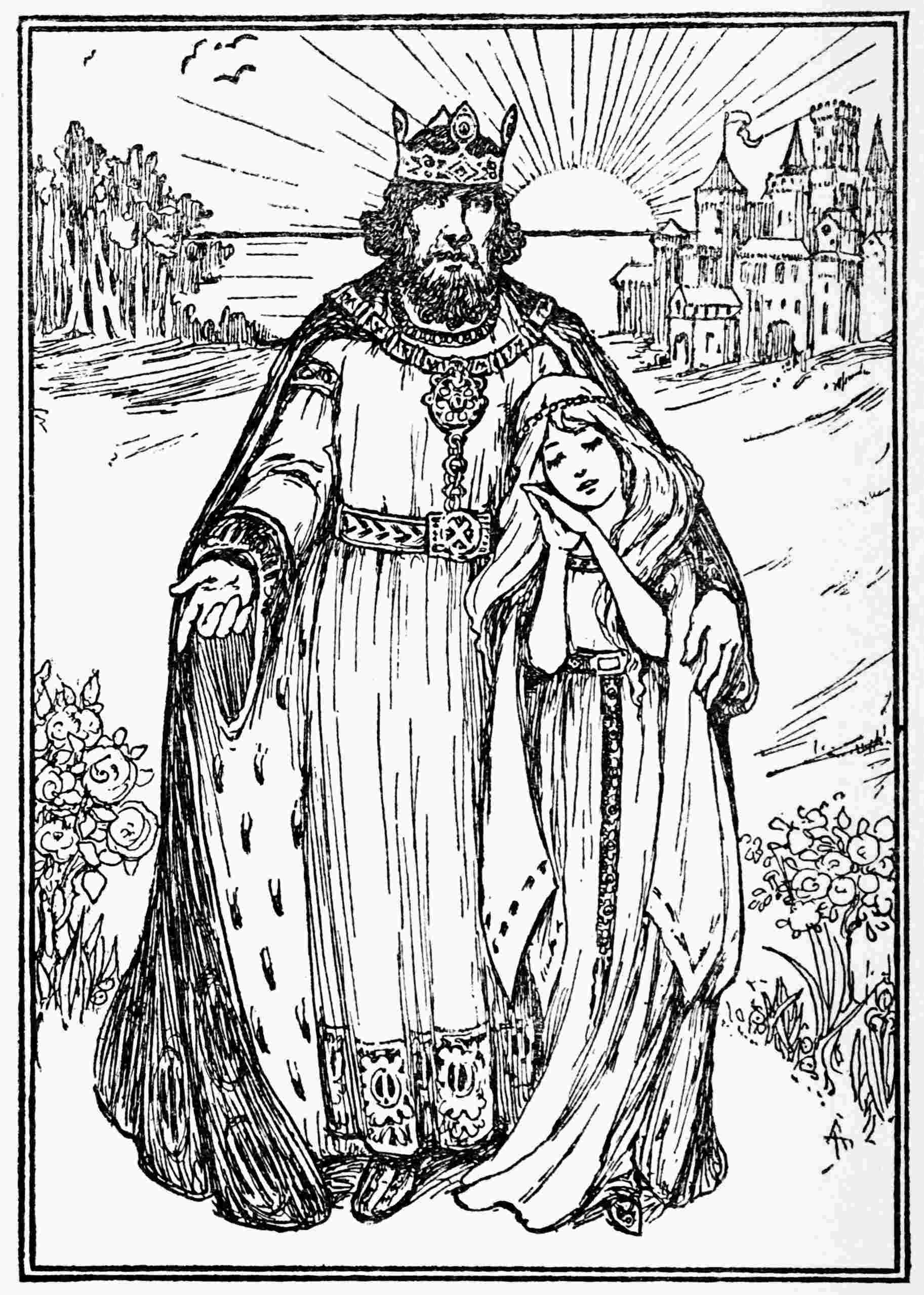
Away to the south, in the country where all the dead flowers go to grow again in winter time, an aged king reigned with his daughter over an outlying island, set like a green bouquet amid the tossing blue of the waves. Happy were the people over whom he ruled and King Hesperon might well have been happy, too, had it not been that one great sorrow brought trouble to his heart and soon silvered the hair beneath his gem-set crown. For the Princess Gloriana, called for her beauty the Morning Star, was blind. No vision had ever come to the deep eyes, blue as the larkspur that bent in the winds as they raced through her father’s gardens. When she looked out to the open spaces of the sea, there was nothing but a dark veil before her eyes, and when she listened to the screams of the birds, curving over her head, she could only picture them in her fancy. Strange pictures she made, perhaps not at all like the real birds, but to her they were very beautiful. Much indeed her father had told her about the pink petals of a rose and the soft curve of a baby’s cheek and of the slim fishes that shot noiselessly through the brooks. Still it was only natural that, with it all, the Princess had her own ideas, and, growing more and more to understand things by the sounds that they made, she grew to love them in her own way.
“But oh!” she cried one day to her father, “if I could only see the birds and the clouds but once and look just once on your face and at the great face of the sea, I could be happy.”
And the King, hearing, gave a deep sigh, while a tear like shining dew came to his eye. “If it takes half my kingdom you shall have your wish,” he told her, while she clung to him tightly, her own tears lying thick in her long lashes.
“Alas, Your Majesty,” she said, “it is not possible.”
“You shall see,” he told her.
Now it happened that in a nearby island there was a group of students who were learning to cure the world of its illness and trouble by the study of medicine and a knowledge of the human body. To these the King sent word in a message written upon fine parchment and embossed in many colors. “To him,” ran the message, “who shall bring sight to the eyes of the Princess Gloriana, shall be given half my kingdom and the hand of the Princess herself in marriage.”
So ran the message; and the people, hearing, hurried back and forth through the funny, crooked streets, spreading the news.
“What think you of this?” said one to his neighbor. “The Princess Gloriana, she whose beauty is greater than the dawn, she whom kings have loved, is promised in marriage to any comer who can make her see.”
“The Princess Gloriana?”
“Aye.”
“Have you seen her?” (A crowd began to gather in the streets.)
“I have seen her once,” came the reply, “and so lovely was she, with her white cloak flowing in the wind and her hair, like yellow flower-dust, falling beneath the band of sapphires, that I looked away and the tears came to my eyes at the thought that so lovely a creature should never behold herself in the deep waters of her father’s well.”
“Beautiful she is, indeed,” croaked the old Master-teacher, who, finding that no one had come to school, had joined the throng outside, “but there is only one to win her that I know of in all the world, and he—alas——!” He shook his old bald head on which his dirty black cap sat like a withered bug, and uttered a deep sigh, by which he meant that he feared some awful tragedy, some gloomy end for the Princess Gloriana.
“Who—who is it?” they asked him. “Of whom dost thou speak?”
“Not Stanley the Stalwart?” asked one.
“Perhaps Rupert the Wise,” wondered another.
“Why do you shake your old bald head?”
“And scowl so, Master?”
“Speak——!” “Speak!”
“And that I will if you but give me leave. Many there are that will go to the fair towers of King Hesperon’s castle; but none there be who can work the miracle—excepting one—Stepan, son of Pandor, the Cobbler.”
After he had spoken there was, for a moment, silence. Then a shout arose, full of laughter and jeerings.
“Stepan?” cried one.
“Not Stepan, the Awkward?”
“You can’t mean Stepan?”
“That ungainly fellow?”
“You are mocking us, Master!”
“Ho, ho, ho! Imagine the Princess Gloriana married to that clodhopper!”
“Why, he couldn’t make a proper bow at court. His doublet is worn threadbare!”
“His nose is so large that, when the sun shines, it casts a shadow over half his face!”
“Master!—Master!”
But the old Master, clapping his hands about his ears, ran down the cobbled streets to his house, his black sleeves flying to each side of him like the pointed wings of a bat.
* * * * * *
It was the last day of the contest. In the high throne room of King Hesperon all were agog with excitement. For weeks and weeks students and masters, kings and peasants, had been trying their cures. The poor Princess was very discouraged. The King sat in gloomy silence on his white rock throne, his head resting on his hand. Several times he had hoped that the cure might work. Once a fine-looking fellow with a velvet coat and lace ruffles and a perfumed handkerchief had shown great promise. Everyone had wanted him to win—everyone except perhaps the Princess herself, who had turned aside a little as he bent over her. It may have been that the perfume had offended her, used as her nostrils were only to the scent of roses and jasmine!
But today there was a larger throng than ever. Nobles from afar in gaily striped robes of blue and gold were there; young students in flame-colored brocades and silver buckles, masters in black robes and pointed shoes and common people in rough brown, all went whispering and laughing up and down the gray stone throne room. It sounded like a great council of bees. Many kings had come from strange countries, and fine ladies in silks and satins, among them two very young, very new queens who had never worn crowns before, and had made terrible mistakes in picking them out. One had bought a crown much too big for her which slipped down over her ears like a bandage, and the other had chosen one so much too tight that she kept pushing it off her head whenever she got excited, as she frequently did. They both were quite content with themselves however.
“I would that the nice young fellow in velvet had won the Princess,” said the First Queen. “I was so excited when he tried his cure that I felt cold even in my ermine coat.” You see, she had not had an ermine cloak very long and she wanted to talk about it, which was quite natural. A nearby student, hearing them, remarked that the fellow had known nothing of medicine or cures and so had failed.
“That doesn’t matter in the least,” snapped the First Queen, getting very angry and shoving her crown off her ears for it was scratching them terribly. “He was very handsome and dressed in perfect taste.”
“And his wonderful perfume, my dear,” cried the Other Queen. “I could smell it—even from here!” Suddenly she nudged the First Queen with her elbow. “Who is that?” she asked in a loud whisper, drawing her skirts aside lest they touch the cheap, dark garments of the man who passed them.
“That,” replied her companion, “is Stepan, the Cobbler. Watch him making his bow to the King. He looks as though he would break in two.” And she laughed so hard that her crown got altogether out of place and slipped around over one ear like a tam-o’-shanter.
Silence fell for a moment as the King’s Prime Minister rose to announce the newcomer.
“Stepan, son of Pandor, the Cobbler of Seristo,” read the Prime Minister in a loud voice, while a little ripple of laughter ran through the hall. But the King looked at the Cobbler so kindly that a gleam of hope sparked in the depths of Stepan’s gray eyes, and he made another bow, not quite so clumsy as the first.
“I also have come, Your Majesty,” he said, while his form seemed to gain dignity from his speech, “to cure your daughter’s malady.”
“You speak with great assurance,” said the King.
“And is it not right that he should speak so,” replied Stepan, “who has power to do all that he claims?”
Once again a little rivulet of laughter rose and died along the great stone walls of the throne room. Long the King looked at him, and sighed.
“We shall see,” he said. “In your turn, Stepan.”
“But it is his turn,” interrupted the Prime Minister rudely, “because everyone else has tried and failed.”
So the Princess was summoned, and, when she stood at the doorway, a hush fell like night over the people; for her beauty had a great radiance. In the narrow circlet that bound her long, gold hair, a yellow topaz shone like the morning star, and, as she moved, the gauze of her dress, soft as the peaceful, purple shadows over the hills, swept like a cloud about her ankles. But her eyes, blue as the larkspur, looked forth, unseeing. A little wearily, a little sadly, perhaps, she leaned on the arm of the Prime Minister who had come forward to help her to her throne.
Now so intent was Stepan upon the thing that he was about to do, that he almost forgot to make his third bow to the King, and started up the steps to the throne on which sat the Princess, giving only the jerkiest nod of the head toward the King’s throne. The remarks that flew from mouth to mouth were anything but complimentary!
Then an odd thing happened, very strange at Court where it is the custom for no one to speak unless commanded to do so by the King. Stepan, when he had almost reached the white ivory throne on which sat the Princess awaiting him, turned abruptly to the King. And what he said was so surprising and absurd, and Stepan looked so awkward standing there in his patched, brown clothes among all those gay colors, that the Prime Minister gave a little grunt right out loud and the two queens forgot altogether to whisper to each other and stood looking at Stepan with their mouths wide open.
“Your Majesty,” began Stepan in a quiet but very soft and mellow voice that brought a little smile to the lips of the Princess, “Your Majesty, before I shall apply my remedy to your daughter’s eyes, I have one request to make—in case I am successful.”
“Well!” exclaimed the queen with the big crown, that by this time had fallen down over one eye, “the greedy fellow! As if the King——! The rest of her remark was lost in the King’s reply.
“Speak, Stepan,” he said, “for I have sworn to restore my daughter’s sight if it takes all that I have.”
“Sire,” responded Stepan, and his tone was so kindly that the Princess leaned forward eagerly to catch all that he would say, “it is not of myself or of added riches that I would speak, but of the Princess Gloriana.”
It was very quiet in the throne room now. You could hear the great branches of the trees brushing against the window frettings, and the swish and gurgle of waves against the rocks.
“If I restore the sight of the Princess,” continued Stepan, “I would beg of Your Majesty that her hand be given to that man whom she herself shall choose.”
As he finished, no one spoke in all that vast room. The King himself sat there staring, and, as for the Prime Minister, he was so startled that he dropped the parchment roll of names and it went bumping down the steps like a jackstraw. Then arose the sound of voices in all pitches and keys. Each person wanted to tell his particular friend just what he thought of such a piece of impudence. For, you see, this was an unheard of thing at Court, or any other place, at that time. Princesses, as well as other girls, were supposed to be very contented with whatever husbands their fathers should choose for them. How could it be otherwise when such care was taken in the choice of husbands?
You can easily see that Stepan’s request was nothing short of a thunderbolt to them. All sorts of remarks were to be heard.
“The Princess pick out her own husband, indeed!”
“Why, what could she know about the matter?”
“Ridiculous!”
“It isn’t being done!”
In fact, it never had been done! Only the Princess, strange to say, unable to see the expressions of horror on so many faces, sat there smiling serenely and nodding her head in quite the most pleased and friendly manner in the world. To her it did not seem to be so very ridiculous a request and far—yes, really far from annoying or troublesome. Indeed, I really believe that at that moment she thought herself fully capable.
The King found his voice at last.
“Stepan,” he said gravely, “you have o’er-reached yourself. But there is nothing for me to do but to grant your request. Perhaps it is your natural modesty that makes you ask this.”
“Nay, Sire,” replied Stepan quickly, “’tis my pride.”
I do not need to tell you how it was that Stepan cured the Princess; how he worked over her until the long, weary afternoon drew to a close, and the sun hung like a huge, gold clock over the far hills. At last he approached her where she sat with her hands resting along the white arms of the throne, and her eyes covered with a large, black bandage.
“Princess Gloriana,” said Stepan, “are you ready to look out on the world with all that it holds of beauty and of ugliness?”
“He is a conceited fellow,” whispered the queen whose crown had grown so tight for her that she had a headache (though she wouldn’t for the world acknowledge it and go home).
The Princess, merely turning her head upward, smiled trustingly.
“I am ready,” she said softly and Stepan drew the big black bandage from her eyes.
It was a moment never to be forgotten in all the history of the island. Long afterwards would the students and the masters and the two queens in the uncomfortable crowns talk of this! For a moment the Princess sat there puzzled, a little scowl deepening on her forehead. Gradually it disappeared and very slowly she rose from her throne, her dress floating about her like mist. And all the while a little smile was touching her lips and growing. It was a lovely thing to behold that smile—such a smile of joy and wonder as no one had ever seen before or since. Suddenly she put her hands before her eyes as though to brush aside the fog and gave a little sob like the call of a wild bird.
“Oh!” she cried, “it is so wonderful and so strange and so funny! I can see! I can see!”
A very happy time followed for the Princess. She ran to the King, her father, stroking his long silky beard, touching the ruby crown, and laughing. She threw kisses to the crowd, utterly forgetting that she was a Princess and should have some dignity, and she laughed at the two queens in their badly fitting crowns until they got very red in the face and a little ashamed of themselves. It was strange, too, that many things that others had found beautiful, such as brilliant reds and oranges, she thought ugly because the glaring colors hurt her eyes, and many things that other people thought ugly, such as the over-grown walks in the gardens and the clovers that grew like weeds, she believed to be very beautiful. And much that was not usually noticed seemed very unusual to the Princess, such as the shadows over the hills and the quick, brown thrushes slipping through the bushes. So you can see that, during her long blindness, she had come to have ideas of her own on many things.
“It is now time,” said the Prime Minister sternly, thinking that she had played long enough, “for you to choose your husband.”
“Why!” exclaimed the Princess, “I had entirely forgotten.”
No one believed that but, since they all loved the little Princess, they merely smiled and said nothing. You can imagine, however, how exciting it was as the Princess passed among them, talking to each in turn, and how everybody held his breath when she came near Stanley, the Stalwart or when she laughed at some brilliant saying of Rupert, the Wise. It took her a long time; and, in fact, the Prime Minister, who was used to having things done with some speed, grew very impatient. It looked almost as if she would have no husband at all.
“It would serve her right if she didn’t,” remarked one of the new queens crossly.
“You speak sharply,” said Stepan who had come and stood near them, quite by accident.
At this moment the Princess paused and stood very still with her head just a little to one side. It was in this way that she used to stand in the garden when she first learned to tell the cries of the different birds. Across the huge stone throne room her eyes met those of Stepan and they gazed at each other in silence for a long time. Then the Princess, having, as I have said, no idea at all of beauty, and having during her childhood learned to judge by many signs of which we do not know, walked straight up to Stepan, the Cobbler, and put her hand in his.
“He it is that I choose,” she said gravely, “for to me he is the most beautiful of them all.”
Strange as it may seem, Stepan in his surprise and joy forgot altogether to be awkward and indeed the happiness in his eyes made him almost handsome, and the robe of blue that the Prime Minister threw over his shoulders (in spite of the cross looks of the two queens) gave him quite an air of elegance. At least so thought the Princess, who had ideas of her own on the subject.
Very happily lived the Princess with Stepan, the Cobbler, who ruled wisely, and so greatly was he beloved on the little island, it is said, that long before he died brown clothes and long noses had become very much the fashion and were thought beautiful by all. For who shall say what is beautiful and what is not? Perhaps if anything seems beautiful to us, that makes it so. So thought the Princess Gloriana, who made up her own mind about these things; and I daresay she was right.