"The Romance of the First Air Adventurers" (continued 3)
Reading edition
Slowly and painfully they made their way back to their camp, and for the first time Dick became conscious of the great weight of the double handful of shot which he had taken from the tank. He drew some of it out and examined it by the light of the fire. As he did so he gave a cry of surprise. For the “shot” was nothing more or less than tiny nuggets of virgin gold.
Here was an addition to the mystery. As Dick knew perfectly well, there was not an atom of gold-bearing rock within hundreds of miles of where they stood.
It was evident that one of the secrets of Gronvold’s invention was that it gave him the power of actually bringing about the transmutation of substances. There was some element in the rock which was susceptible of being changed into gold by a process at which they could not even guess. But if this were so, Gronvold had indeed, as they suspected, been able to solve the problem of loosing the incredible force contained in the atom. His discovery was, as Dick at once realised, on the lines of the latest development of scientific thought.
Dick was to see the problem solved in later years by more reputable investigators.
But he could never forget his strange encounter with the wonderful but misguided genius whose career had been so terribly brought to an end by the dread power he had himself evoked.
Chapter Six.
The Horror of Lockie.
Many readers will recall the tragedy of Renstoke Castle and the terrible death of young Lord Renstoke. The case aroused much sensation at the time. It would have aroused far more had the real facts been allowed to transpire.
They were known, however, to only a few people, and, for reasons which were at the time sufficient, they were kept secret. I am now able to lift the veil which shrouded one of the most perplexing mysteries which has ever puzzled the scientific world. Even now, the story is not complete; the great secret died with the amazing but perverted genius who discovered it.
Lord Renstoke, a young man only thirty, was one of those favoured individuals on whom Fortune seemed to have showered all her gifts. Born and brought up in Canada, he was connected only very remotely with the ancient family of Renstoke, and no one ever dreamed that he could by any possibility succeed to the title, which carried with it Renstoke Castle and a rent-roll of something like a hundred thousand pounds a year.
James Mitchell, as Lord Renstoke was before he succeeded to the title, had left a lumber camp in Upper Canada when the call of the Great War brought Britishers from all the wild places of the world to join the colours. He served as a private in one of the Canadian Regiments, rapidly winning his way upward, and finally being awarded the Victoria Cross for a piece of dare-devil folly—so his comrades declared—that had led to the capture of an important German position and had helped very materially to bring about one of the most brilliant of the many successes scored by the Canadians in the closing stages of the fighting.
That episode seemed to mark the turning-point in the fortunes of James Mitchell. From then onward it seemed as though Fate had no gifts that were too good to be showered upon him. It was only a few weeks later that the obscure Canadian private was summoned to headquarters to receive the astounding intelligence that through a series of deaths that in fiction would have been deemed fantastic, he was a peer of the United Kingdom with a vast fortune at his disposal.
Then James Mitchell, Baron Renstoke, went back to his trenches and the comrades he had learned to love to finish the work on hand.
It was during the latter half of the war that James Mitchell found himself swept by chance into the strange web of mystery and adventure that surrounded the doings of Yvette Pasquet and Dick Manton. He had been detailed, quite privately and “unofficially,” to help Yvette in one of her achievements, and the clever French girl had been quick to recognise in him an assistant of more than ordinary ability. Yvette was one of those rare people who never forget, and so there came about a gradual friendship which included Dick Manton and Jules Pasquet. Yvette rejoiced unfeignedly when, after the Armistice, she learned of Mitchell’s good fortune. The friendship continued and ripened, and Yvette, Jules, and Dick Manton were staying at Renstoke Castle when a terrible stroke of malign fate cut short a career of brilliant promise and brought an ancient lineage to an end.
Renstoke Castle was a wonderful old house in Argyllshire, and James Mitchell, now Lord Renstoke, was surely one of the favoured of the gods! Over six feet in height, strikingly handsome and of superb physique, wealthy and with great charm of manner, there seemed to be nothing to which he could not aspire. Despite the surroundings of his early years he had been well educated for his father, though only a Canadian farmer, had been a man of considerable culture and learning, and had seen that his son, who inherited his own intellectual gifts, had been well taught. Only the spirit of adventure had led him at twenty-one into the wild places of the world, where he saw existence from many angles, and in a rough outdoor life had brought to perfection physical powers which had been remarkable even in boyhood.
He was now the last of the Renstokes. But he was still young. No one dreamed but that he would marry and that the ancient line would be continued.
Then the blow fell!
Through the late summer a series of mysterious attacks had been made on live stock throughout the western portion of Argyllshire. Sheep, and even deer, had been attacked, evidently by some unusually powerful animal.
Sheep worrying, of course, is not an uncommon vice among dogs, and when the outbreak first started little was thought of the matter. The local farmers and shepherds merely began to watch their dogs more closely than usual. But the outbreaks continued, more and more sheep were killed, and at length the losses became so heavy that drastic steps were taken.
For thirty miles around, not a dog was permitted off the chain after dusk. Bands of men armed with guns, with instructions to shoot any dog on sight, patrolled the country-side by day and night. It was all in vain. Sheep continued to perish under the teeth of the mysterious prowler, and even the smaller deer, in spite of their speed, began to fall victims.
The farmers were at their wits’ ends when the mystery was suddenly lifted into the region of unadulterated horror.
Alan MacPherson, a young gamekeeper, had been one of a number of men who, stretched out into a line a couple of miles long, had set out at nightfall to search a lonely piece of moorland in which it was thought the strange animal might be hiding. The line of men had gone forward on a prearranged plan for five or six miles and then “pivoted” on the right hand man, swung round and marched homeward, concentrating finally at a big farm known as Kelsie, where the losses had been very serious.
The men, of course, knew the country thoroughly, and similar manoeuvres had been many times repeated without mishap. Always the last man of the line had turned up within a few minutes of the prearranged time.
On this occasion MacPherson was on the extreme left wheel and, having farthest to go, should have been the last man home. No one was uneasy when it was found he was a few minutes late; he was armed and knew the country like the palm of his hand.
But when the minutes slipped by without news his companions began to be anxious. Three hours passed, and, at length, a search party was hastily formed.
Two hours later MacPherson’s body was found lying terribly mangled beside a big rock on the slope of a small tor. His gun, still loaded, was only three feet away. Beside the body lay a filled pipe and a box of matches. Evidently the man had laid down his gun to light his pipe and had been suddenly attacked and killed before he could raise a hand to defend himself.
A few minutes later, Lord Renstoke, Yvette, Dick Manton, and Jules were on the scene. Though all were familiar with the ghastly sights of war, they found themselves in the presence of a horror which overbore all their previous experiences.
Renstoke, whose experience abroad had made him familiar with many wild animals quite unknown to the others, examined the body carefully. At length he rose from his knees with a horrified expression in his eyes, and gave brief orders for the removal of the body to the unfortunate man’s home to await the inquest.
But it was not until they had returned to the Castle that he spoke of what he had seen. And his first words gave his comrades a terrible shock.
“No dog did that!” he said quietly, but in a tone of intense conviction.
“Whatever do you mean, Renstoke?” asked Dick quickly. “What else could have done it? There are no lions or tigers about here, you know.”
“Are you sure?” replied Renstoke. “I think we shall have to see Erckmann about this.” Boris Erckmann, he went on to explain, was a famous zoologist who lived in a big lonely house on the Renstoke estate some ten miles away. He had spent many years in wandering explorations in tropical countries and was known in the inner circles of science as a man of brilliant attainments. He did not advertise himself, however, living the life of a recluse, and to the general public his name meant nothing. Among his Highland neighbours, a dour people who concerned themselves very little with the affairs of other folk, little notice was taken of him. He lived at Lockie, a big house surmounted by a high wall and perched on a gaunt hill-side overlooking a lonely glen. Among his neighbours, who guessed nothing of his wonderful abilities, Erckmann passed for a harmless scientist and was affable and good-natured to those he chanced to meet during his incessant pilgrimages over the wide moorland which stretched for many miles around Lockie.
“Erckmann is said to have a lot of wild animals at Lockie,” Renstoke went on to explain, “and it is possible that one of them may have broken loose. I am perfectly certain MacPherson was not killed by a dog.”
“But what makes you so certain?” Dick questioned. “So far as I could see any big dog could have done it.”
“Did you ever see a dog with hands, Dick?” asked Renstoke quietly.
His hearers started simultaneously with a gasp of horror.
“Whatever do you mean?” they asked.
“Just this,” Lord Renstoke replied. “He was not killed by a dog at all. As you saw, the front of his throat was badly torn. But on the back of his neck were two distinct bruises, one on each side and nearly meeting, which suggested the mark of two thumbs, as if he had been seized from behind by two hands which clasped his neck. Now, no dog could have done that. Moreover no dog could have killed him so quickly that he never had a chance either to fight for his life or to call for help. Remember, he was an extremely powerful man and his nearest neighbour in the line was scarcely more than a hundred yards away. He was killed so suddenly and so swiftly that he had no time even to shout. I have seen many men who had been killed by wolves, bears, and cougars, but never one who had not made a fight for his life.”
“But what could it have been?” asked Yvette in a horrified whisper.
“There is only one animal in the world that could have done it,” replied Renstoke, “and that is a gorilla. You know the strength of the gorilla compared with that of a man is enormous. It has enormously powerful hands and teeth. A man seized unawares, as MacPherson must have been, would be dead in a few seconds; he wouldn’t have the smallest chance either to defend himself or to shout. And I happen to know, though it is not generally known, that Erckmann actually has a gorilla at Lockie. I am going over to see him after the inquest and I mean to see the gorilla as well. Erckmann is a tenant of mine, though, as it happens, I have never seen him.
“But there is one thing that puzzles me,” Renstoke went on after a pause. “The sheep-killing has been going on for several months, and I don’t see where such an animal as a gorilla, assuming that it has been at large for so long, can have been hidden without being seen. But, of course, the country is very wild and there are some big woods that may have screened it during the daytime.”
“What are you going to say at the inquest?” Dick asked abruptly.
“Nothing at all until I know a lot more,” answered Renstoke deliberately. “Remember, we don’t know anything positively yet. I am only giving you my personal opinion.”
All agreed that Renstoke’s plan was best. But they had yet to learn how far the appalling reality outstripped the horror of their suppositions.
The inquest, held the following afternoon, was almost formal. There was no real evidence, of course, as to how the unfortunate man was killed, and what amounted to an open verdict was found. Neither the doctor who examined the body, nor the detectives from Glasgow who made every possible inquiry, struck the chain of reasoning which had led Renstoke to his strange theory, and it was generally assumed that MacPherson had been killed by some ferocious dog which had been lurking unseen for months in the wild country around Renstoke.
Next morning all four started for Lockie. Erckmann’s house, though only ten miles away in a direct line, was at least thirty by road, and as the day was fine they decided to motor for about five miles, leave the car, and walk across country for the remainder of the distance. It was this decision which led them to the first strange clue in the solution of the terrible mystery.
At the point where they left the car, the road, which had been leading westward, made an abrupt turn at the summit of a desolate hill, and stretched away southward as far as they could see. Their destination was further west, and as Dick ran the car on to the grass at the side of the road, they prepared for their tramp.
They had walked some four miles over rough heather-clad country when Renstoke pointed to a big building a mile away and facing the top of the steep rise they had just breasted.
“That is Lockie?” he said.
For the most part, the country was dry. Below them, however, was a shallow valley, along the bottom of which a rippling burn wound its way. Descending the hill they crossed the brook and soon found themselves at a tiny bridge beside the only gateway they could see in the high stone wall, surmounted by a formidable barrier of barbed iron, which surrounded the building.
In response to Renstoke’s knock the door was opened by an ill-favoured individual, evidently a foreigner, who stared at them in blank surprise.
“I want to see Mr Erckmann; is he at home?” Renstoke demanded.
The man made some reply in a language which neither of them understood. Renstoke repeated his question.
Turning to a telephone which stood on a small table in the lodge the man spoke a few words. A moment later he signed to them to enter and conducted them to the entrance door of the big house.
As they approached a big, powerfully built man, heavily bearded and wearing round horn spectacles, met them on the steps of the front door.
Renstoke bowed courteously. “Mr Erckmann?” he inquired.
“Yes, I am Mr Erckmann,” was the reply. “What can I do for you?”
Renstoke as briefly as possible explained what had happened. Erckmann listened patiently and carefully. Only at the end of the story, when Renstoke told him quite frankly his suspicions, the man’s eyes hardened ominously and his lips tightened under his heavy grey moustache.
“Yes, I have a gorilla,” he admitted. “But if you suggest that it has escaped you are quite wrong. It has never left its cage since it was brought here, quite young, six years ago. It would be a bad thing for some one if it did,” he added.
“May we see it?” asked Renstoke quietly.
“Yes—if you doubt my word,” snapped the scientist. He was evidently, for some reason, much annoyed and was controlling himself with obvious difficulty.
During the conversation Dick had once or twice glanced at Yvette and was surprised at the fixity of the gaze she directed at Erckmann. She was regarding him almost as if fascinated, with every sign of horror and apprehension.
Without further words Erckmann led the way through a small paddock to a row of cages, heavily barred with iron, which stood at the rear of the house. Before one of the strongest he halted.
“There you are,” he said grimly.
Inside the cage, erect on its hind legs, stood an enormous ape, shackled by a huge chain round its neck to a heavy stake driven into the ground. Nearly seven feet high, it was so horribly repulsive in its perverted likeness to humanity, that Yvette, Dick, and Jules turned away sick with disgust and horror. It snarled and chattered at the sight of the strangers.
Renstoke, however, carefully examined the monster. But he soon realised that this creature had certainly not been at large, at any rate for some considerable time.
The clue had failed. Whatever the truth might be it was clear the gorilla could have had no part in the terrible tragedy of Alan MacPherson.
“A wonderful specimen,” said Renstoke, turning to Erckmann. “Have you had him long?”
“About six years,” the scientist replied. “Would you like to see what it can do?” Without waiting for a reply, he spoke softly to the raging beast in some language the others did not understand.
Instantly the brute calmed down, shuffled to the bars of the cage and laid its head on the ground close to where Erckmann was standing. It was just as though a dog were fawning on its master. Erckmann fearlessly thrust a hand between the bars and scratched the repulsive head while the great ape lay with closed eyes evidently in keen enjoyment of the sensation.
Still talking quietly in the strange language, Erckmann put the beast through a number of tricks which it performed, clumsily, of course, but with obvious understanding of what was required of it. It was, as Renstoke realised, a wonderful example of animal training, for the gorilla is perhaps the most intractable of all living animals.
“Perhaps as you are here you would like to see the rest of my menagerie,” said Erckmann, as he led the way to a series of cages adjoining.
They gazed in astonishment at what they saw. There was a superb tiger, several leopards of different species, and at least a dozen wolves. The animals were all clean and well cared for and it was obvious at a glance that none of them could have been wandering for an indefinite period about the country.
“I hope you are satisfied, Lord Renstoke,” said Erckmann at last, “that none of my pets is responsible for what has happened?”
“Quite,” replied Renstoke. “And I am sorry we had to trouble you. But I am sure you will understand why I came. The affair is so mysterious that I could not leave any possibility unexplored.” Erckmann had puzzled them all. The man was perfectly courteous and apparently quite open in his replies to their questions. None the less all sensed that he was ill at ease and that he quite certainly resented their intrusion.
Yvette, more sensitive and keenly strung than the others, shuddered violently as they left the house.
“That man is bad, all bad,” she declared vehemently. “He has the eyes of the snake.” She had put into words what all had felt, yet had been half ashamed to confess. There was something repulsively snake-like in the steady glare of Erckmann’s eyes behind the thick round glasses.
“I confess I feel like Yvette,” said Dick, “the man gave me the creeps.”
Renstoke looked grave.
“He didn’t strike me as being quite aboveboard,” he admitted. “At the same time, I don’t see what he has to conceal. All the cages were occupied and it is certain none of the animals had been loose recently, and if one had broken out there is no reason why he should not say so. But he may have another ape which he has not shown us?”
They walked a few hundred yards in silence until they had got to the bottom of the hill and approached the little burn that ran down the valley. There was no path, and as chance would have it, they deviated a few yards from the way along which they had come. They were crossing the brook when Yvette gave a slight exclamation.
“Oh, look here,” she said.
The bed of the burn was stony throughout, but at one point, at the very edge of the water was a tiny patch of sand, smooth and firm and hardly larger than a handkerchief. Yvette pointed to it.
There, sharply and clearly defined, was the unmistakable imprint of a naked, misshapen foot! It was human beyond all question. It pointed in the direction of the house they had just left, and it was dear that the barefooted walker, whoever he may have been, had stepped from the heather just on to the patch of firm sand and been carried by his next stride through and beyond the rivulet on to the heather and stones where no footprints would remain. By some strange chance that one tell-tale footprint had been left in perhaps the only square foot of ground for miles where an impression could be left!
They examined the footprint with eager curiosity. Evidently the walker, or rather runner, had come fast down the hill, for the front part of the foot was driven deeply into the sand while the heel was only just showing.
“He must have been running,” said Renstoke, “and what kind of man could run over such a country as this?”
The question was natural, for the heather grew thick and deep round there and they had found walking difficult enough; running would have been out of the question for any of them.
They were puzzled by the strange footprint, but how little they guessed that it held the key to the terrible tragedy of Renstoke!
Late that night, Renstoke, Dick, and Jules sat yarning in the great old drawing-room at the Castle. The night was close and sultry, with a threat of thunder in the air, and the big French windows which opened on to the spreading lawn were flung wide.
They were discussing Erckmann.
“I didn’t like him,” said Renstoke, “though it is recognised that he possesses genius in a marked degree.”
“Oh! You’ve heard something then?” asked Dick quickly.
“Yes. The general public know nothing of him, but I hear that he has an amazing theory that it is possible, by an operation on the brain, to abolish almost entirely the ordinary characteristics of a man or an animal, and by the injection of an appropriate serum to substitute the mental, and to some extent the physical, characteristics of another species. He believes that you can, for instance, take a puppy-dog, operate on its brain, inject a serum prepared in some way from the brain of a monkey, and the puppy will grow up with the mentality and habits of a monkey and with its bodily characteristics so transformed that it can do many things—such, for instance, as climb a tree—which no dog could do. I believe he has actually succeeded in doing this!”
“How weird and extraordinary!” remarked Yvette.
“More than this, he believes you could do the same with a human being—destroy its human attributes and give it, for example, the ferocity, and something of the speed, of a wolf or a tiger.”
“How on earth did you learn this, Renstoke?” asked Dick.
“From perhaps the only person who ever knew Erckmann really well,” was the reply. “Some years ago Erckmann was the resident doctor at a lunatic asylum in Prague. He made a particular crony of his chief assistant, a young doctor named Chatry, who afterwards went to Canada, where I met him. Chatry told me something of Erckmann’s views and experiments. I was, of course, tremendously interested, but I little thought I should ever run against the man in the flesh. Erckmann was undoubtedly a very able man, but there was a scandal. On some pretext or other he performed a remarkable operation on an insane person. The patient, who had previously been quite tractable, developed extraordinary characteristics. He growled and snapped at all who approached him, insisted on eating his food on the floor instead of at table, barked like a dog, and finally would only sleep curled up on a rug. In fact, he developed strikingly dog-like habits. How much of anything Erckmann let out generally Chatry never knew. But he was asked to resign, and he left Prague.”
“A very curious story!” Dick remarked.
“Now Chatry had no doubt whatever on the subject,” said his host. “Amazing as it may seem, he was firmly convinced that Erckmann had deliberately made this extraordinary experiment and that it had succeeded. Chatry died just before I left Canada, but before he died, he gave me a little manuscript book in which he has related the whole story. I’ll show it to you to-morrow.”
They said good-night and went to bed, leaving Renstoke, who sometimes suffered from insomnia, to read himself sleepy.
It was about two o’clock when Dick, who was a light sleeper, was roused by a shout for help, apparently from the drawing-room which was directly below his bedroom. Instantly he sprang out of bed, and snatching up a revolver, rushed downstairs.
But he was just too late.
As he entered the brilliantly lighted drawing-room he caught sight through the open window of a heavy misshapen body disappearing into the gloom beyond the bright patch of light cast by the electric lamps on the lawn outside.
Renstoke lay on his back on the floor, dying beside his favourite chair. Close by was the book he had been reading and on the carpet near it was his pipe, the tobacco still smouldering.
Dick knelt hastily by the side of his friend and sought frantically to revive him. But it was in vain. The young peer died in his arms. It was evident that he had been attacked without the slightest warning, and mercilessly strangled.
And in the side of his throat, just above the jugular vein, was a deep wound, horribly lacerated, from which the blood flowed in a heavy stream.
The Castle was speedily aroused, and in a few minutes half a dozen men were busily searching the surrounding country. But it was in vain—the mysterious assailant of the unfortunate Lord Renstoke had vanished completely.
The following day Dick, Jules, and Yvette, almost overcome with grief, were discussing the loss of their friend.
“There is some devilry at work,” Dick declared. “And I shall never rest till it is cleared up, if I spend the rest of my life here.”
Yvette burst into a furious philippic against Erckmann. “That man is at the bottom of it all,” she insisted.
“But, Yvette,” Dick remonstrated, “we have no kind of evidence of that.”
“I don’t care,” she replied vehemently, “Erckmann knows all about it. I should like to choke it out of him,” she ended viciously in French.
“Well,” said Jules, “we can’t go to Lockie and accuse him. How about trying a trap of some kind?”
“We might do it in that way,” Dick admitted. “But what kind of trap?”
Long and eagerly they discussed the matter, and at length a plan was evolved.
The next morning brought them a visit from Inspector Buckman, one of the ablest men of the Special Branch at Scotland Yard, to whom, utterly baffled, the police had very wisely applied for help. He was well known to all of them as a keen, capable man of infinite resource and undaunted courage.
Buckman listened closely while Dick ran over the story, putting in a keen question here and there.
“We have got to keep the real facts quiet,” he said at length. “Erckmann must not suspect that we have the smallest inkling of the evidence of Lord Renstoke’s death. I will fix that up with the coroner.”
It was an easy matter. Renstoke Castle was a remote spot, and while the affair, of course, could not be entirely concealed, it was a simple matter to keep the exact details secret. All the public learned was that Lord Renstoke had been attacked and murdered presumably by a burglar for whom a close search was being made.
But behind all and working in secret the keen brains of Dick, Yvette, Jules, and Buckman were busy.
Two or three nights later the word went round to the scattered farms that every single head of stock was to be driven in to the farms and rigidly confined in the buildings from dusk to daybreak. So far as they could ensure it not a single living thing was at large.
Dick’s trap was arranged on the hill-side a mile from Renstoke.
Four inches above the ground, in a circle fifty yards in diameter, ran a thin electric wire supported at intervals on small insulated posts. Just inside the circle, on the side away from Renstoke, a sheep was tethered to a strong stake. In the centre of the circle from a tall pole hung a powerful magnesium flash, electrically connected so that it would be at once exploded by any pressure on the encircling wire, and momentarily light up with day-time brilliance a large patch of the surrounding country.
As dusk fell, Dick, Yvette, Jules, and Buckman carefully crossed the wire and took up their positions in the centre of the circle, lying full length in the sheltering heather, and each with a revolver ready to hand. In a leash beside Dick lay Spot, his favourite Airedale, who could be trusted to give warning of the approach of any intruder, and afterwards to track him remorselessly.
As the leaden moments dragged by it grew darker and darker until the country-side was plunged in pitch blackness. The strain on the watchers was terrific. They could not smoke or talk, they hardly dared to move.
Hour after hour dragged by. Midnight passed. Dick, half asleep, was gently stroking the back of the Airedale.
Suddenly he felt the animal stiffen, and the hair along its back bristled ominously. A moment later the dog gave a low, half-audible growl and rose to its feet. Instantly the party were keenly alert.
Dick clapped his hand over the dog’s muzzle, and the well-trained animal subsided into silence. But Dick could feel that it was strainingly alert; obviously it sensed an intruder.
Keenly at attention, with every faculty strained to the utmost, the silent watchers heard not a sound. But a few moments later there was a vicious snap in the air above them as the magnesium flash exploded, turning the inky blackness for a fraction of a second into a blaze of dazzling light.
In that brief outburst of radiance the four caught a glimpse of a horror that photographed itself indelibly on their memories.
Twenty-five yards away a bestial, hideous face loomed out in the glare of light. It was the epitome of all things evil, with wild matted hair, staring eyes and a horrible misshapen mouth drawn back in a snarl which showed two rows of monstrous teeth. The body they could not see. Apparently the creature was crouching in the heather so that only its ghastly head was visible.
Had it been a wild animal not one of the four, their nerves steel-hardened by the war, would have felt a tremor. But that ghastly face, vile and brutal as it was, was unmistakably human, and for an instant the watchers were paralysed with uncontrollable terror.
But it was only for a moment.
Four revolver shots rang out almost simultaneously, fired in the darkness at the spot where the apparition had appeared. A crackling volley followed as the four automatics were emptied. Almost with the last shot came a howl of mingled rage and pain from the darkness. Evidently a bullet had got home.
A few moments later Dick, with Spot barking madly and tugging wildly at his leash, had plunged into the blackness in hot pursuit at the fiendish intruder. Close behind him came Yvette, Jules, and Buckman.
The hunt had begun!
Of that wild dash across country in the darkness Dick afterwards remembered but little. Spot plunged ahead without hesitation and Dick followed, intent only on making the best speed possible and careless of constant falls as he stumbled blindly along. He dared not loose the dog, for without it he would have been helpless, and he plunged blindly forward, his reloaded pistol grasped in his right hand, careless of himself and intent only on overtaking the horror which he knew lay somewhere ahead of him. Behind him toiled the others, guided by Spot’s frantic barks.
Progress, of course, was slow; falls and stumbles every few moments checked the pace; the darkness was baffling. It was with feelings of intense relief that Dick at length saw the silvery edge of the moon lifting itself above the hills behind him. He had lost all sense of direction, but the moon rising behind him told him he was travelling westward.
Half an hour later the country was bathed in soft light and Dick was able to pick up his bearings. Suddenly he realised with a shock that he was heading straight for Lockie!
Dick halted to let the others come up. Without being afraid he felt instinctively that something terrible lay ahead of them and that for safety’s sake it were best that they should be together.
They were a sorry-looking party—hatless, their clothes torn, their faces and hands bruised and scratched by constant falls, almost exhausted by their tremendous efforts. But none of them thought of giving up the chase.
For another mile they pushed onward, making better progress in the growing moonlight.
Suddenly Buckman gave a tremendous shout. “Look there!” he roared, pointing to a low hill which ran across their path.
Not five hundred yards away, on the top of the rise and clearly silhouetted against the sky, they caught a glimpse of a monstrous figure which, even as they looked, vanished over the crest and was gone. It was, unmistakably, a man of giant stature! It moved stiffly as though in pain; evidently one of the shots fired in the trap had got home.
They hurried on. When they reached the crest of the rise Lockie lay before them, and they could see the monstrous figure crossing a tiny stream in the valley below.
They were gaining rapidly now. Dawn was breaking and the cold pale light allowed them a dear view.
The creature ahead of them was toiling painfully up the slope which led to Lockie. Suddenly a man issued from the house. It was Erckmann and in his hand he carried a formidable whip.
Less than two hundred yards away Dick and his companions halted spellbound. In some mysterious fashion they realised that they were to witness the last act in the terrible drama.
The end came swiftly. More and more slowly, almost crawling at last, the strange creature approached Erckmann and at length, evidently utterly exhausted, collapsed at his feet in a heap.
They heard the scientist shout something unintelligible. Then he raised his heavy whip and struck with fearful force at the unfortunate thing which lay before him.
It was a fatal mistake. With the speed of lightning the misshapen heap on the ground flashed into furious activity. All the horrified spectators saw was an instantaneous leap and a brief struggle, and Erckmann and the Thing locked in a deadly grapple and then drop motionless.
Dick covered the last hundred yards in a furious dash. But he was too late. Erckmann lay dead, with his adversary dead on top of him. The zoologist had been killed almost instantly by the grip of two large hands that still encircled his neck in a vice-like clutch, and in his throat the misshapen fangs of the creature were still buried deeply. Only with infinite trouble was the body of the scientist freed from that deadly grapple, and they were able to examine the monster that had spread terror and death through Argyllshire.
Unmistakably the body was that of a man, but incredibly dehumanised and ape-like. The muscular development was tremendous; the hands and arms were knotted masses of titanic muscle. But the crowning horror was the face—low-browed, flat-nosed, with a tremendous jaw and long pointed teeth, utterly unlike anything human. The body, stark naked, was covered thickly with hair and in the side was a terrible wound evidently made by the impact of a soft-nosed bullet from one of the automatic pistols. No normal human being could have survived it for more than a few minutes.
It was only later, when they searched Lockie, that they realised fully that Erckmann had fallen a victim to a monster he had himself created. His diaries proved that Chatry had spoken the truth. They were a repellent but horribly fascinating account of his experiments. Of the results he had written in a wealth of detail, but of the process he employed there was not even a hint. That awful secret he had kept to himself, and had taken with him to his grave.
They found that he had, as Chatry had said, taken a human being, obviously of low mental development—possibly an asylum patient—and practically, by some devilish discovery, converted it into a human ape, endowed with the blood-lust of the tiger. But whether the fearful creature was capable of receiving and acting upon instructions, or whether Erckmann simply let it loose to follow its terrible instincts until the “homing” instinct brought it back they never learned.
Of Lockie, the police decided to make a clean sweep. The animals were shot and the half-dozen evil-looking foreign servants were paid off and sent to their homes, mostly in the wilder parts of Transylvania. They one and all refused to say a word. Whatever they were, they were at least faithful to their dead master.
Then, in the magnificent chemical laboratory with which the house was equipped, Dick, who found himself Renstoke’s sole executor, easily arranged an “accident.” Fire broke out, there was no help for miles around and in a couple of hours the ill-omened house was a heap of ashes. The Spectre of Lockie had been finally laid.
Chapter Seven.
The Peril of the Préfet.
It was a mystery of the City of Paris which engaged the trio—a secret that has never been told, though many enterprising newspapers have tried to fathom it. Here it is related for the first time.
On a gloomy mid-December morning the sensation-loving Parisians awoke to a new and eminently agreeable thrill. It was only last year and the occasion will be well remembered.
There had been trouble enough in the City of Light, which for once at any rate belied its name. A series of strikes had half-paralysed the capital. Coal and light were almost unobtainable; the public lamps remained unlit; at night the City of Pleasure was plunged in profound gloom. There were misery and wretchedness in the haunts of squalor and poverty which flanked the wealthier districts where, at a price, all things agreeable were as usual obtainable.
But the dumb underworld was becoming vocal!
“À Mort L’Assassin!” At daybreak the startling legend suddenly, and without warning, revealed itself from a thousand vantage-points to the awakening city. In crude, blazing red it flared from the hoardings—sinister, ill-omened and, above all, full of significance. Parisians alone knew.
There could be no possibility of doubt as to the individual referred to. It was, beyond question, Raoul Gregoire, the Prefect of Police, whose cold, ruthless vendetta against the dark, turbulent forces which flowed beneath the effervescent gaiety of the gay life of Paris, had earned for him the vindictive hatred of the criminal world, and had gained him his unenviable sobriquet of “Assassin!”
For months Raoul Gregoire’s life had hung by a thread. Before his appointment he had been Prefect of Finisterre. A series of efforts to “remove” him had been defeated only in the nick of time. Twice he had been badly wounded. Once a bomb had wrecked his car just after he had left it. A less courageous man would have given up the unequal contest and sought a pretext for retirement—back to the quiet, sea-beaten coast of Finisterre.
But Monsieur le Préfet was of a different mould. Stern and ruthless he was, but his courage was invincible. He remained calm and imperturbed—far more so, indeed, than many of his subordinates, who feared that the vengeance of the underworld might fall, by accident or design, upon themselves.
“Gregoire has pushed things a bit too far,” was Yvette’s verdict, as she talked over with Dick Manton and Jules the latest and most blatant challenge to the forces of the law and order. “They mean to make certain this time. I’m sure of it?”
“It certainly seems so,” Dick agreed. “But I wonder when and how it will be? That’s the point. Gregoire doesn’t show himself much in public now; he is practically living in the Prefecture, and surrounded by his agents he is far too well guarded for any attempt to be made there.”
“They will have a good chance at the Sultan’s reception,” remarked Jules reflectively. “Monsieur le Préfet will have to be in the procession—he can hardly stay away even if he wanted to. It would show the white feather.”
It was a day to which the gaiety-loving Parisians were looking forward with special interest. France’s age-long quarrel with the wild tribes of the Morocco hinterland had at length been amicably settled, and their Sultan, Ahmed Mohassib, a picturesque figure whose eccentric doings provided the gossip-loving boulevard with hundreds of good stories, was “doing” Paris as the guest of the Quai d’Orsay. It was expedient to show the barbaric ruler all the honour possible, and the following Friday was the day on which he was to pay a ceremonial visit to the Elysée. There was to be a great procession, and the Government had let the Press understand that a skilfully worked-up popular demonstration was desirable. The papers had responded nobly, and it was certain that “tout Paris” would be out to see the show.
On the occasion, at any rate, Monsieur le Préfet must be greatly in evidence. He was responsible for public order and must ride in the procession whatever the risk to himself, a plain target, for once, for the bullet or bomb of the assassin.
“To-day is Saturday,” Yvette remarked. “We really have not much time to spare between now and the twenty-second. I think I will make a few inquiries to-night. Jules had better go with me.”
Dick’s heart sank. He knew what Yvette’s “inquiries” meant—hours, perhaps days, spent in the lowest quarters of Paris, surrounded by such horrible riff-raff that if her purpose were even suspected her life would be worth hardly a moment’s purchase.
But he knew it was useless to remonstrate. Yvette had a perfect genius for “make-up,” and what was far more important, a perfect knowledge of the strange argot which served the underworld of Paris. Jules was almost as clever as Yvette. But in this particular, of course, Dick was far behind. He could not hope to sustain his part in surroundings where a single wrong word would mean instant suspicion, and probably a swift and violent death for all three.
“I wish I could go with you, Yvette,” he said wistfully, “but, alas! I know it is quite impossible.”
Yvette had many friends in the lower quarters of the Montmartre. The proprietors of many of the low buvettes of the slums—places where one could get absinthe and drugs—were secretly in her pay, and so far as they were concerned she had no fears; the traffickers trusted her because they knew their secrets were safe. And by an ingenious code system which depended upon a mere vocal inflexion of certain common words she could reveal her identity, no matter what her disguise, to those who were in her secret.
Darkness had fallen upon the city when two appalling specimens of the worst vagabondage of Paris—a man and a woman—crept silently through the market quarter towards one of Paris’s vilest haunts of villainy. They were such woebegone specimens of humanity as might have served for figures in some new “Inferno.” Bedraggled and unkempt, their hands and faces besmirched with grime, their clothes hanging in tatters, it would have been impossible for even the keenest eye to have detected the smart French girl and her usually debonair brother. So far as appearances went they were safe enough. The risk would come when they began to talk, and especially when they began to ask questions. Here a slip of the tongue might betray them. But the risk had to be taken.
The Préfet himself, quite as anxious as Dick for the safety of Yvette and Jules, had taken precautions to protect them as far as possible. Actual escort, of course, was out of the question. Both Yvette and Jules carried revolvers, but in addition Jules had concealed in the ample pockets of his villainous clothing, a tiny but delicate wireless telegraph apparatus, powerful enough upon a dry battery to send out a wireless wave which would carry a thousand yards or so.
This dainty little bit of electrical work was the invention of Dick Manton. Hardly larger than an old-fashioned watch it was operated by a hundred-volt battery which fitted into a specially made pocket, and the tiny transmitting key could be operated with one finger without arousing the slightest suspicion. Gregoire’s agents were dotted thickly around the unsavoury neighbourhood, each in touch, by means of the wireless, with every movement Yvette and Jules might make. Dick himself was not far away. How amply these precautions were justified the events of the night were to show.
For hour after hour Yvette and Jules slunk from one haunt of vice to another, always keenly on the alert, frequently helped by one or another of Yvette’s disreputable friends, but yet unable to pick up the slightest vestige of the trail of which they were in such active search.
At length their patient vigil culminated.
Plunging deeper and deeper into the labyrinth of the slums, they had penetrated at length to a tiny bar in the very lowest and most dangerous portion of the market section. The place was crowded with a mass of riff-raff at which even Yvette and Jules, accustomed as they were to such sights and sounds, could not repress a shudder.
The proprietor, as it happened, was a beetle-browed Provençal whose one redeeming feature was gratitude to Yvette. His character was utterly bad and he had been mixed up in dozens of affairs more or less disreputable. A year or two before a serious charge of which he happened to be innocent had been brought against him. Yvette had managed, with considerable trouble, to lay the real culprit by the heels, and Jules Charetier, Apache though he was, would now go through fire and water to serve her. Yvette knew that in his house she was personally far safer than she would have been in many more pretentious establishments.
Charetier raised his eyebrows when he caught the slight inflexion that instantly revealed to him Yvette’s identity. But he took no further notice beyond serving the drinks for which she had asked.
A moment later, with a significant look, he quitted the room. Yvette, with a slang caution to look after her drink for a moment, slipped into the filthy street and round the corner to the side entrance of the house. Charetier was waiting for her, and a few moments later they were seated in the man’s dingy room on the floor above the bar.
“Whatever are you doing here, mademoiselle?” Jules burst out impulsively. “This is no place, even for you!”
“Listen, Charetier,” replied the girl rapidly. “Something is brewing for next Friday. Something serious! You have seen the posters. I must find out about it. Can you tell me where any of the ‘Seven’ are to-night?”
Jules Charetier paled at the mention of “The Seven,” the powerful camarilla whose hidden influence was felt throughout the criminal underworld of Paris, London, and New York. The men who, practically without risk to themselves, were responsible for half the anarchist crimes of the three great capitals. Who they were, and their real names, not even Yvette knew. Never appearing directly themselves, they worked entirely through agents, and fighting against them, the police found themselves in a stifling fog of mystery. But, as Yvette knew, Charetier was deep in the councils of Continental Anarchism, and she knew, too, that in his hands the life of the ordinary police agent would have been worth nothing. Even for herself she was not very confident, but she had decided on a bold stroke, trusting Charetier with everything on the ground of the service she had done him.
At first the man was obdurate.
“Not even for you, my dear mademoiselle,” he said sullenly. “But, mademoiselle,” he went on earnestly, “we have been friends, therefore I implore you for your own sake to drop the matter and get away as speedily as possible. I cannot tell you anything.”
Yvette’s revolver flashed out and in an instant she had the innkeeper covered.
“Listen, Jules!” she cried imperiously. “My brother is below, and the house is surrounded. If I stamp upon the floor you will be raided instantly. And you know there are things here you would not like the police to see—they don’t know it, but you and I do! Suppose Demidoff learned that his papers had fallen into Raoul Gregoire’s hands—eh?”
For a moment Yvette thought Charetier would have risked everything and sprung at her. But it was only for a moment. Then he collapsed. It was evident he feared Demidoff, the notorious Bolshevik agent, even more than he feared the police.
“Very well, mademoiselle,” he replied, beads of perspiration standing out upon his wide white forehead and, despite his bravado, a hunted look crept into his eyes. “You might try the ‘Chat Mort.’ There will be a meeting there at three o’clock this morning. But again I implore you not to go. You cannot get in and if you did you would never come out alive.”
“In which room do they meet?” was Yvette’s only reply.
“The one at the back, looking out upon the old courtyard,” was Charetier’s reply. “I know no more than that.”
“Thanks, Charetier,” said Yvette as she rose to go.
“But, my dear mademoiselle,” implored the innkeeper, “you will not breathe—”
Yvette cut him short.
“That’s enough, Charetier,” she said in a freezing tone. “You surely know you are safe so far as I am concerned. You have done me a great service to-night and I shall not forget.” Five minutes later Yvette and Jules were hastening to the “Chat Mort,” a tavern of a gayer night-life than the one they had just quitted. It stood on the corner of two filthy slums in the Villette Quarter and at the rear was one of those tiny courtyards which so often go with old French houses—a place given over to the storage of odds and ends of flotsam and jetsam which are hardly worth the trouble of keeping, or even stealing. Only a rickety wooden fence divided it from the horrible alley deep in mud and refuse.
They realised at once that to enter the house would be impossible. It was now long past two o’clock and the street was deserted; everything was silent as the grave, and from the closely shuttered “Chat Mort” there was not a glimmer of light. To all appearances the inhabitants were soundly asleep.
But Yvette placed implicit trust in Charetier. She was sure that the mysterious meeting would be held at the appointed hour.
They crept silently to the rear of the building, cautiously forced a way through the crazy fence, and a moment later were outside the window of the room which Charetier had indicated as the meeting-place.
Crouching beneath the window they listened intently. They were safe enough except for some unforeseeable accident.
There was no sound in the room; no glimmer of light through the shutters.
Jules took from his pocket a tiny drill which speedily and silently bit a half-inch hole through the rotting woodwork of the window. Into this he thrust a plug which at the end bore an extremely delicate microphone receiver. With telephones at their ears they listened intently. Not a word would be uttered in the room without their knowledge. They could see nothing, but if anything was whispered they would certainly hear it.
The minutes dragged slowly past until just before three o’clock a slight sound caught Jules’ attention. Some one had entered the room. A moment later came the rasp of a match being struck.
Three o’clock boomed from a distant church dock. Footsteps echoed inside. The meeting was assembling!
How they longed to see into that room of mystery! But that was impossible; they must rely upon the microphone alone for all the information they could obtain. Jules’ hand sought Yvette’s wrist, and in the Morse code he tapped out with his fingers—he dared not speak—a caution to listen acutely. Their only hope of identifying the criminals was by their voices.
They could see nothing. They could not even tell how many people there were in the room. But the mutter of conversation in varying tones came dearly to their ears. It consisted mainly, as they expected, of fierce denunciation of Monsieur le Préfet of Police, whom they named “the Assassin.”
Soon it became clear that the meeting had been called solely to settle the time and place of the attack; evidently the method had been decided upon earlier. Not a single word could the listeners catch of how the attack was to be carried out, whether by bomb, or bullet, or knife. Little did they guess the secret and deadly swiftness of the anarchists’ plan.
For some time the discussion continued. Place after place was suggested and rejected upon one ground or another.
Suddenly a hard masterful voice cut across the talking.
“The Place d’Italie will be the best,” it declared. “Half the road is up there and the procession must go along the Avenue des Gobelins, close to the old villa. At that distance it will be impossible to miss. And there will be no noise and no fuss till the job is done.”
The Old Villa! Jules knew the place well—an ancient building dating back to Louis XV, solidly built, and with all the quaint architectural features of the time. Quite unsuitable for any modern purposes, its vast apartments had by degrees been turned into a queer medley of rooms which served partly as flats and partly as offices to a heterogeneous mass of tenants, many of them of more than doubtful reputation. But how any attack on Raoul Gregoire could be projected from a building which it was certain would, on the day of the procession, be packed with sightseers, Jules was at a loss to conceive.
That, however, remained to be discovered. For the moment the important thing was to capture the band of conspirators before they could make their escape.
Jules withdrew, and adjusting his portable instrument—a marvel of compactness—placed his foot against an iron lamp-post to make an earth contact, and swiftly called the Prefecture of Police by Morse.
The telephones were on his ears, and almost next second he heard the answering signal. Then he tapped out on his wireless transmitter an urgent message. A moment later he and Yvette had slipped clear of the place, and ran swiftly away. It was no part of their plan to risk recognition by any of the prisoners.
At the head of the alley they waited for about six or seven minutes, when they met Roquet, the inspector of the Sûreté, who was in charge of the detectives who were rapidly converging on the inn. To him Jules briefly explained the situation.
“We have them safely enough,” declared Roquet with a strong accent of the Midi. “Every approach has been guarded for the last hour, and no one has been allowed to pass in or out. You can now leave it to us, m’sieur.”
Yvette and Jules were glad enough to say au revoir and to hurry home for a much-needed rest. They could examine the prisoners at their leisure at the Prefecture and, if possible, identify them by their voices.
But a startling surprise awaited the detectives.
Their imperious knocking at the door of the frowsy Chat Mort at first brought no reply. A few minutes later the proprietor appeared, half-dressed and yawning drowsily as though just awakened from profound sleep. He was instantly arrested and handcuffed and the police poured into the house, revolvers drawn and ready for what they expected would be a furious combat with reckless and desperate men.
To their utter amazement the house was empty!
The room looking on to the courtyard, in which, according to Jules and Yvette, the conspirators had held their meeting, was in perfect order, apparently as it had been left the night before when the place was shut up. There was not a sign that anyone had been there for hours, not even a whiff of fresh tobacco smoke to suggest that the room had been recently occupied.
Roquet was utterly mystified. He had, with very good reason, dreamed any escape impossible. Could Jules and Yvette have been mistaken?
That, he felt, was out of the question. None the less the problem remained—where were the men? The house was speedily searched from attic to cellars, but in vain. There was not the smallest indication that any meeting had been held there!
Roquet naturally felt intensely foolish, and his embarrassment was in no way lessened by the voluble protestations of the proprietor who demanded, with every show of righteous indignation, the reason of what he was pleased to term “an outrageous domiciliary visit.” There was, of course, no charge against him, and ultimately the baffled police were compelled to release him and retire, furious and puzzled at the utter failure of what had promised to be a brilliant coup.
Three days later the mystery was solved.
From the cellar of the “Chat Mort” a narrow tunnel had been driven to an equally disreputable establishment a short distance away, and when the police had raided the house the plotters had swiftly bolted, leaving the innkeeper to drop behind them the stone slab in the cellar floor which covered the entrance to the tunnel.
The position now was grave enough, and Yvette, Jules, and Dick discussed it at length with the Préfet and his lieutenants. To all entreaties that he should stay out of the procession the Chief resolutely turned a deaf ear, and they found it impossible to shake his resolve.
Would the conspirators stick to the arrangement made at the “Chat Mort,” or would they, alarmed by the raid on the house, make an eleventh-hour change in their plans? That was the problem to be solved.
Monsieur le Préfet was living on the edge of a volcano, and all his precautions would, he feared, be of no avail against them.
Dick felt convinced they would carry out the plan arranged. It could not be imagined, he argued, that they would dream they had been overheard, and it was evident that the plan had been very carefully considered. Ultimately it was decided to relax none of the ordinary precautions, but to keep a specially close watch on the old villa in the Place d’Italie. Dick decided that, whatever the police did, he would make his own arrangements for that purpose. The sequel proved that it was well he did so.
On the night prior to the procession the police carried out a very drastic coup. Every known anarchist in Paris was arrested on some pretext or another and locked up. One by one they were briefly interrogated, while Jules and Yvette, concealed in the room behind a screen, tried to recognise any of the voices they had heard in the Chat Mort.
Fifty or sixty prisoners had been interviewed before Jules and his sister standing behind a screen heard a voice they recognised. It was that of the man who had suggested the old villa in the Place d’Italie as a suitable base for the attempt on the Préfet. None of the others could be identified, and it was evident that the worst of the miscreants were still at large.
The man whom they recognised proved to be Anton Kapok, a Hungarian of whom nothing was known except that he was in the habit of delivering violent harangues at Socialist and Anarchist meetings. But it was evident now that he was far more dangerous than the police had hitherto supposed.
Closely interrogated, he denied everything. He knew nothing, he declared, of the “Chat Mort” and had not been mixed up in any conspiracy. His Anarchist proclivities, however, he boldly admitted and declared that the police knew all there was to know about him.
To the police a search of Kapok’s room in Bellville revealed nothing more incriminating than a mass of Anarchist literature. But Dick made a discovery which they had overlooked.
Close to the ceiling, immediately above the fireplace, was suspended on two hooks what looked like a rod from which pictures might be hung. The police had, in fact, so regarded it. Dick never knew what aroused his suspicions, but something impelled him to mount a ladder and fetch the rod down. Then he made a startling discovery.
The supposed rod was nothing less than one of the wonderful blow-pipes used by some of the aboriginal tribes of South America and elsewhere to shoot their poisoned darts with which they either fought their enemies or killed dangerous animals. One of the darts, a tiny affair fashioned out of a sharp thorn with a tuft of cotton which just filled the tube, was actually in position.
Instantly Dick’s mind travelled back to the strange deaths nearly a year before of two police officials who had been specially astute in the anti-anarchist campaign. Both had been found dead in lonely streets, and in each case the only mark on the body was a tiny scratch on the cheek which no one had dreamed of connecting with their inexplicable death. As Dick gazed at the deadly blow-pipe those scratches assumed a new and sinister significance.
Carefully removing the dart, Dick hurried with it to the laboratory of Doctor Lepine, the well-known toxicologist.
Doctor Lepine smiled.
“Lucky you didn’t scratch yourself with it, Monsieur Manton,” he said in French. “It would mean almost instant death!”
He listened gravely as Dick described the death of the two police agents. The doctor had been away in England at the time and had not even heard of the circumstances. But he hurried round to the Prefecture with Dick and carefully examined the documents which dealt with the two cases and described minutely the appearance of the bodies.
“I have not the slightest doubt,” he declared, “that both men were killed with one of these darts. Every indication points to it. But as the darts were not found we must presume they were removed after death to avoid arousing suspicion. The victim would be paralysed almost instantly, and would fall and die almost on the spot where he was standing when the dart infected him. If there are any more of these accursed things in Paris it will, I fear, be a difficult matter to protect Monsieur le Préfet, for a favourable opportunity must come in the long run.”
Dick hurried back to Kapok’s room, meaning to secure the blow-pipe. To his amazement the deadly weapon had disappeared! The police agents on duty outside the room asserted that no one had entered. But an open window told its tale; some one had crept along the ledge outside, entered the room and possessed himself of the weapon.
Dick spent several anxious hours with the Préfet, Raoul Gregoire, and Inspector Roquet, arranging a plan of campaign.
Next morning found him crouched in an upper window of a locked room in a house facing the old villa in the Place d’Italie. Close at hand lay a powerful pneumatic gun, a weapon perfected by Jules and almost as deadly and efficient as a rifle. He was haunted by a sickening sense of foreboding. Against every evidence of his reason and senses he felt convinced that it was from that old villa that danger threatened Gregoire.
Yet he was bound to admit that his fears seemed absurd. The old house opposite was packed with sightseers, but there was a detective in every room close to the window. Even the garrets had been searched. It was obvious that they had not been entered for months.
Yet Dick could not shake off the uncanny feeling which haunted him.
At last the head of the procession came in sight, with the blare of military bands and a crash of cheers from the thousands of spectators lining the streets. But Dick had no eyes for the show. His whole attention was riveted on the building before him.
The Sultan Ahmed Mohassib, of Morocco, in his white burnous with many decorations, passed amid a hurricane of cheers. Glancing along the procession Dick saw the Préfet—a soldierly figure sitting erect in his car. In a few moments he would be abreast of the villa.
Suddenly Dick’s eye was caught by a flash of light. Glancing quickly upward he saw to his amazement that the window of a garret facing him—a room which had already been searched—had suddenly opened. Only the chance reflection of the sun upon the glass had attracted his attention to the swift movement.
As Raoul Gregoire passed, a dark rod, clutched in a hand which rested on the grimy windowsill, projected itself from the window. It wavered for a moment, then steadied itself and pointed downward.
Instantly Dick fired.
The hand disappeared with a jerk, while the rod slid forward and fell over to the ground!
Wild with excitement Dick dashed down into the street. It was utterly impossible to force his way through the cheering crowd and he could only watch Monsieur le Préfet in a fever of anxiety.
It was soon dear that Raoul Gregoire was untouched. Evidently the would-be assassin, if he had indeed dispatched one of the poisoned darts, had missed his aim.
Five minutes later Dick and half a dozen detectives were in the garret of the old villa. But they were too late. The bird had flown, badly hurt to judge by the blood which stained the floor. But on the window-sill lay three little poisoned darts ready for use.
A glance at the open skylight in the low roof was enough. In a moment they were out on the roof of the adjoining house.
A few yards away was a rope ladder hooked over the parapet and dangling to the exterior fire-escape leading from the roof of a big drapery store only ten feet below. The miscreant himself had vanished.
The would-be murderer, it was clear, must have climbed the fire-escape during the darkness of the previous night, and lain hidden on the roofs till the procession came along. After the garret had been searched, he had slipped down with impunity while every one was excitedly watching the procession.
They never caught him. But when Gregoire returned to the Prefecture a poisoned dart was found sticking in the upholstery of his car, close to his head. Had it been a bare half-inch lower down it would, no doubt, have struck him with fatal result. Dick’s lightning shot had spoilt the miscreant’s aim and saved the Préfet’s life.
The incident is one of the secrets of the life of official Paris and led to the Préfet’s resignation a month later, an occurrence which filled all France with dismay and was the cause of much conjecture and speculation.
Raoul Gregoire has returned to the provinces and is now Préfet of the Department of the Alpes-Maritimes an appointment which he much prefers.
Chapter Eight.
The Message for One Eye Only.
The heat was stifling in the Gran Ancora at Barcelona, an obscure but grandiloquently named café of more than doubtful reputation. At dilapidated tables in the long apartment which served as a saloon groups of rough-looking men were drinking steadily. The fumes of strong tobacco poisoned the heavy atmosphere, flies swarmed over everything, the air was full of the reek of stale drink and unwashed humanity.
Though it was but early evening the ill-omened place was already filling up. It was a notorious haunt of betting men and some of the worst characters of the town, frequented by desperadoes who were ready to undertake any deed of violence if it offered the promise of plunder. The swarms of anarchists, who are the curse of Spain, found there a ready welcome and congenial companionship.
At a table at one end of the long room, sat a solitary individual who was reading the “Diario,” an anarchist journal devoted to the preaching of doctrine of the most revolutionary type. He spoke to no one, and no one spoke to him, though now and again curious glances were directed towards him. He took no notice of the hubbub around him, but went on calmly reading his paper and sipping slowly at a glass of the villainous wine which seemed to be the favourite beverage of the habitués of the house.
The stranger was no other than Dick Manton. He had come to Barcelona on the trail of a gang of international crooks who had got away with a hundred thousand francs by a clever bank swindle in Paris. Had his identity been suspected his life in that haunt of depravity would not have been worth five minutes’ purchase.
But he sat there undisturbed, apparently oblivious of what was going on around him, but in reality keenly on the alert and with one hand close to the butt of the heavy revolver which, as he well knew, he might be called upon to use at any moment in the deadliest earnest.
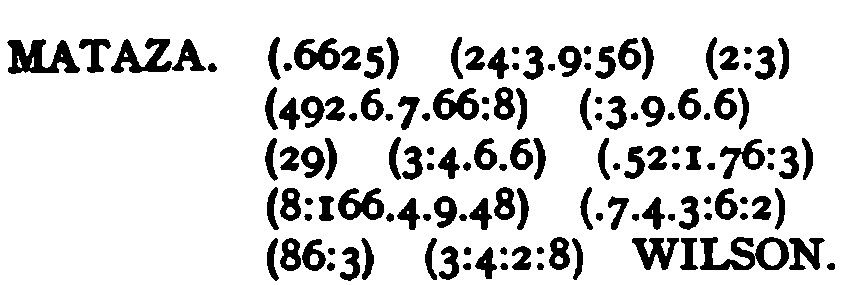
Manton stiffened suddenly as his eye fell on the queer jumble of figures quoted above. They were buried away in a mass of advertisements and might well be overlooked by the casual reader. As Dick well knew, the “Diario” was used for all kinds of queer communications to all kinds of queer people, and he was attracted by the hint of mystery, a lure which he could never resist. The jumble of figures fascinated him. He had a strange feeling that it would be well worth while to try to decipher the weird cryptogram. But he knew better than to try to do so there. It was not healthy to try in public to pry into the secrets of the underworld of Barcelona.
Dick Manton had had a strange and adventurous career. But as he gazed at the odd announcement, he had a premonition that he was on the edge of a mystery stranger than anything that he had so far encountered.
Having read the queer cryptogram over and over again, Dick slipped the paper into his pocket.
Presently he finished his wine and sauntered out, with an uneasy feeling that made him wonder whether he would reach the door without a bullet in his back. He got out in safety, however, and once clear of the doubtful neighbourhood of the café, made his way swiftly to his rooms at the “Hôtel Falcon.”
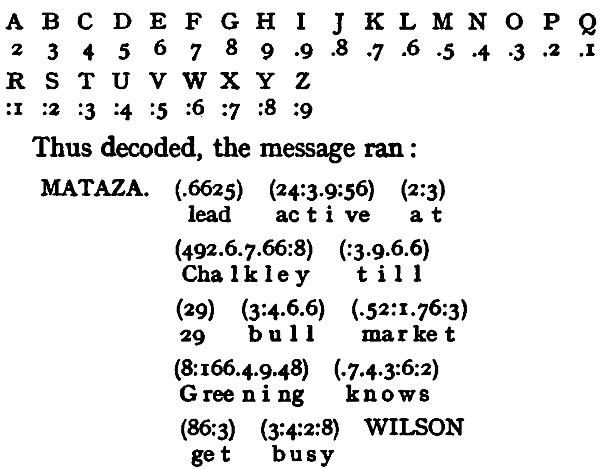
It took several hours of hard work before he could obtain the key of the cipher. Then he realised with a gasp that it was in one of the simplest of British signal codes. The key read:
At first Dick was completely mystified. The message conveyed nothing to him. Who were Mataza, Wilson, and Greening? Where was Chalkley? And, above all, why should such a message appear in an English code in an obscure paper published in Barcelona?
It was the last point which worried him most.
He felt instinctively that the message must conceal a meaning of which he was necessarily ignorant, and that it must be related to some affair which was pending in England. The more he thought about it the more uneasy he grew. He had the premonition which so often comes to the help of the detective, and at length, though he was almost ashamed of acting on such slender grounds, he decided to consult his chief. An hour later he was on his way to Paris, leaving the affair of the bank swindlers in the hands of a capable subordinate.
Arriving in Paris he drove straight to Regnier’s private apartment, just off the Place de la Concorde.
“Why, Manton, what brings you here?” asked Regnier in surprise. “Have you finished at Barcelona already?”
For answer Dick laid the deciphered cryptogram before the Chief.
“What do you make of that?” he asked abruptly.
Regnier read the slip of paper with knitted brows.
“Queer,” he commented. “Why should it be published in the ‘Diario’? I think it means mischief. Do you know Chalkley?”
Dick shook his head.
“No,” he replied, “but it sounds like an English name. And yet I have a feeling that I must have heard it somewhere. It sounds familiar, but I cannot place it. In the meantime I will run home and see if the English papers will tell me anything.”
Dick found Jules and Yvette eager for news; he had telegraphed them that he was returning. Dick, Jules, and Yvette had become the most formidable combination in the French Secret Service. They always insisted on working together, they would accept no assistance except that which they chose themselves, and they would work only under the direction of Regnier, who was astute enough to realise their abilities. Yvette had been prevented by a slight illness from accompanying Dick to Barcelona, and both she and Jules, who had stayed with her, hated inaction. There had been a slump in international crime of the kind in which they specialised, and they were suffering from ennui. Anything which promised excitement and adventure was welcome.
They listened eagerly while Dick told his story.
“And now,” said Dick, half ruefully, as he concluded, “I don’t know whether we are on the track of something or whether I have been an idiot.”
Yvette’s eyes were dancing with merriment.
“Well, Dick,” she said, “you are certainly a pretty Englishman not to know one of the most famous places in your own country. Don’t you really know Chalkley?”
“No,” replied Dick in bewilderment. “What do you know about it?”
For answer Yvette rummaged among a pile of newspapers and produced a copy of the “Times” dated a week before.
“There?” she said. “Read that.”
“That” was a closely printed column which Dick proceeded to scan with attention. It was an article describing the wonderful deposits of pitchblende, the ore from which radium is extracted, which had been discovered in the Ural region in the neighbourhood of Zlatoust. An English combine had secured the monopoly of the working for fifteen years, and already a supply of radium valued at one hundred and fifty thousand pounds had been brought home by the famous Professor Fortescue for the use of British chemists and medical men.
The discovery and acquisition of the monopoly by British interests, the article pointed out, had put England far ahead in the field of radium research, for she had now a big supply of the precious commodity at her disposal, while other nations were struggling along with the tiny quantities obtained from other and far less rich deposits. And, as was fully explained, it was not in medicine alone that the radium would be valuable; there was hardly a department of commerce, to say nothing of the arts of warfare, in which radium was not playing a considerable and constantly increasing part. So many new discoveries were being made by the band of experts, of whom Professor Fortescue was the acknowledged head, that it was beginning to be realised that radium in the future was likely to be as valuable as coal and oil had been in the past.
But—and here was the fact of most significance to Dick—the radium was at Chalkley, Professor Fortescue’s home in the wilds of the Durham moors. He had taken it there on his return from Zlatoust for use in some critical experiments he had in hand before it was sent on to the young but growing school of Medicine at Durham University.
They had at least approached the heart of the mystery! It was evident that some band of international desperadoes had designs on the precious radium. In spite of their enormous value, the two tubes containing the salt could easily be carried in a man’s pocket, and in Germany there would be a ready market for it among the great chemical firms, whose business consciences were sufficiently elastic to permit them to pay a big price and ask no awkward questions.
Dick was reading the report carefully, when he suddenly gave a startled exclamation.
“Why, look here,” he said, “the radium is only to be kept at Chalkley till the twenty-ninth. That explains the twenty-nine in the advertisement. And to-day is the twenty-seventh. If anything is to happen it must be at once or they will be too late. I must ring up Regnier.” Regnier was with them in half an hour. He was filled with excitement when he learned the facts which Yvette had discovered.
“That,” he said, “puts an entirely new complexion on the affair. There can now be very little doubt about the matter. Clearly ‘lead’ means radium, and I think we can interpret ‘bull market’ as an intimation that it is a big prize. They are evidently well informed, whoever they are. We must tell London at once.”
But before anything could be done a messenger for Regnier arrived post haste from the bureau of the Secret Service in the Quai d’Orsay with strange news.
A big aeroplane, flying at a tremendous speed, had crossed the Franco-Spanish frontier near Bagnères de Luchon having apparently come right across the Pyrenees. It had ignored all the signals of the French frontier guards, whose aeroplanes had, in consequence, gone up in pursuit. Only one of them was fast enough to approach the stranger, and a fight had followed in which the French machine was crippled and forced to descend. Thereupon the strange machine had proceeded, flying in the direction of Bordeaux. Telephone messages had brought warning of its approach, and several attempts had been made to stop it, but without success. It had been reported, chased by French aeroplanes over Bordeaux, Nantes, and St. Malo, and at the latter place, just as dusk was falling, it had left the French coast and laid a course apparently for England. No further news of it had been received.
Regnier looked grave.
“Of course,” he said, “we have absolutely no reason to couple this machine with the advertisement in the ‘Diario,’ but I confess I am uneasy. There is at Chalkley radium worth a fortune, easily carried if anyone can get hold of it, and readily convertible into cash. What better device could be employed than a fast aeroplane which could get to Durham and away before anyone could hope to stop it? In any case, I am going to telephone Scotland Yard at once.”
Half an hour later he was in communication with Inspector Cummings, the senior officer on duty at the Yard. To him he explained his suspicions, half afraid, with the Frenchman’s dread of ridicule, that the other would laugh at his story as an old woman’s tale.
But Inspector Cummings was too experienced to be neglectful or sceptical of anything which could disturb Regnier, whom he well knew to be one of the most astute and level-headed of men. He took the matter seriously enough.
“We have heard nothing yet,” he said. “But I will ’phone Durham at once and let you know in the course of an hour.”
They waited anxiously for the reply. It came at last.
“Cummings speaking,” said the voice on the ’phone. “I have spoken to Durham. They have heard nothing there, but they are unable to obtain any reply from Professor Fortescue. The telephone exchange reports his line out of order.
“But here is a queer thing. A big aeroplane, evidently a foreigner, was reported this morning to have been seen over the Midlands flying north. There was a lot of mist about, and we have not been able to trace the machine yet. But it was certainly not one of ours.”
“Well,” said Regnier, “will you keep me posted? I fancy you will have more news before long. In any case, you will have Durham warned?”
“I have warned them myself,” replied Cummings, “and they are sending a couple of men out in a motor to make inquiries. You know Chalkley is about twenty-five miles from Durham and quite in the wilds. Professor Fortescue was, a couple of years ago, carrying out some experiments in which it was absolutely necessary he should be away from anything like traffic vibrations, and he chose this place for the purpose because it was remote from any railway or heavy traffic. He has stayed there ever since; he said it suited him to be ‘out of the world,’ as he called it.”
Three hours later came still more startling news.
The police officers who had gone from Durham to Chalkley had found that two armed men had made a raid on Professor Fortescue’s house. They had gagged the servants, who were found lying bound and helpless, and the Professor himself was found lying unconscious in his laboratory, having apparently been sandbagged. The raiders had leisurely helped themselves to food, and, having cut the telephone wires, had departed without any particular haste.
But the great leaden safe, weighing several hundredweights, in which the precious radium had been brought to England, was found to have been broken open. The radium was gone!
Nothing in the meantime had been heard of the strange aeroplane. But a few hours later an old shepherd walked into one of the local police-stations and told a queer story.
His sheep the previous evening, he reported, had been disturbed by the passing of an aeroplane which, flying very low, had landed on the moors a few miles away from the Professor’s house. It had stayed there all night and, so far as he knew, was still there. He had been unable to approach it closely as it was separated from where he had been by a deep gorge and a stream which he could not cross without making a détour of several miles. He had seen two men near the machine who had walked away and disappeared in the folds of the moor.
A strong party of police, Cummings added, had left at once for the spot where the aeroplane had been seen, taking the shepherd with them as guide. The place was remote from any road, and it would be an hour or two before they could get there. But the Air Ministry had been warned, and already aeroplanes were going up in the hope of locating the strange machine.
“I must be in this,” said Dick. “Ask him if I can come over. I cannot, of course, go unasked.”
“Of course,” said Cummings in reply to Regnier’s request. “We shall be only too glad to have Mr Manton. Miss Pasquet can come too, if she likes. But I’m afraid he won’t be able to get here in time. We shall either have got these fellows or lost them hopelessly in a few hours.”
Dick turned to Jules.
“Ring up the British Air Ministry,” he said, “and ask them if the strange machine gets off the ground to send us every movement as it is reported. Keep the telephone on all the time. I am going to try to cut these chaps off with the Mohawk. You will have to report to me by wireless every movement as it comes through. From what we have heard I fancy there are very few machines in England fast enough to catch those fellows if they once get started. Of course you will come, Yvette?”
An hour later, Dick and Yvette, seated in the helicopter, were in full flight for England. Yvette was at the controls; Dick, in view of the work that might be before them, crouched over the tiny machine gun which peered from the bow of the machine.
Professor Fortescue was in a terrible state of distress. He had been working in his laboratory, when a slight noise had caused him to turn round. A man, apparently a foreigner as the Professor judged from the hasty glance he got at him, was standing close behind him. Before the Professor could speak or move he received a violent blow on the head, and remembered nothing more till he recovered consciousness some time later under the care of the police.
His chief concern was for the radium, and his distress at its loss was pitiful. It was a disaster from which he seemed unable to recover. But he appeared to derive a strange satisfaction from the danger in which the thieves would find themselves.
“I don’t know how they will get it away,” he declared to the police inspector. “It was dangerous to stay very near the safe for long owing to the terrible power of the radium rays. If the thieves try to carry the tubes in their pocket they will not get very far. Surely they cannot realise the terrible risk they are running. However, that need not distress us; all we want is to get the radium back.”
In the meantime a strong party of police had arrived from Durham at the Professor’s house, and, under the guidance of the old shepherd, started across the moors for the spot at which the strange aeroplane had been seen. It was slow going over rough and difficult ground which tested the endurance even of the younger men. The only unconcerned person was the old shepherd who trudged stolidly on at a pace with which they found it difficult to keep up.
They had gone eight or nine miles before the old man spoke.
“Not far now,” he said.
A mile farther on he halted.
“It’s just over yon hill,” he said, pointing to a small eminence a few hundred yards away. “You will see it as soon as you get at the top.”
Breasting the rise, the police cautiously approached the ridge and glanced over. There in the valley, only five or six hundred yards away, was the aeroplane. Two men in air kit stood beside it.
Scattering into a thin line the police rushed down the slope, every man with a revolver ready in his hand.
But they were just too late. They had only gone a few yards when the men hastily took their places in the machine, there was a loud whirr as the engine broke into action, and while the policemen were still a hundred yards away, the strange machine rose into the air and was gone. A furious volley rattled out from the revolvers, but the range was too great and the breathless policemen had the mortification of seeing the machine disappear rapidly to the south.
Immediately the fastest runner of the party started at a trot for the Professor’s house to send out a warning. But it was not necessary. The aerodromes all over the kingdom had been warned by wireless from the Air Ministry, and already a host of machines were scouting in every direction.
The stranger, flying due south, had reached Bradford before he was signalled. Instantly there was a rush of aeroplanes from all parts of the Midlands to cut him off. But he slipped through the cordon, flying very high and at a tremendous speed. Outside Birmingham a fast scout picked him up and reported by wireless, and from the huge aerodrome at Cheltenham over twenty fighting planes leaped into the air to stop the career of the marauder.
There was now no chance, at least, of his getting away unobserved. He was under constant observation, alike from the air and the ground, and every moment wireless messages were pouring into the Air Ministry reporting his progress. But to catch him proved impossible. Only two of the pursuing machines were fast enough to keep up with the stranger, and even they could not overtake him. So the headlong flight went on, drawing ever nearer to the southern coast. If the stranger could get out to sea all chance of stopping him would vanish.
But, unknown to the furious British airmen, help was close at hand.
Warned by Jules’ wireless messages of the direction the strange machine was taking, Yvette had steered a course to intercept him somewhere in the neighbourhood of Bournemouth, and the Mohawk, with its wireless chattering incessantly, was now swinging lazily at half speed in a big circle between Salisbury and the Hampshire watering-place.
“Over Salisbury now,” called Yvette to Dick, her voice ringing out clearly above the muffled hum of the propeller, the only sound which came from the helicopter, with its beautifully silenced engines.
A few minutes later Dick pointed to the north. “Here he comes,” he shouted.
Far away were three tiny specks in the sky.
Through his glasses Dick could make them out clearly enough. The leader was a machine of a type he had never seen before; a mile behind it were a couple of planes which he at once recognised as the Bristol fighters which had been so familiar to him in France.
The pace of the three machines was terrific. It was clear the English airmen were going all out in a desperate effort to catch the stranger before he reached the water, and they were expending every ounce of energy. But a moment or two later it was quite clear they were falling behind. Presently a puff of smoke from the leader signalled “petrol exhausted,” and he dropped in a long slant to the ground.
The second machine, however, held on grimly, though slowly losing ground. Evidently his predicament was the same as that of his colleague, and a moment later he, too, dipped earthward and was out of the fight.
Only the Mohawk stood between the stranger and safety!
But it was a Mohawk very different from the comparatively crude machine of a year before, wonderful though that was. Dick and Jules had worked out a revolutionary improvement in the lifting screws, with the result that a small supplementary engine, using comparatively little power, was now sufficient to keep the machine suspended in the air. As a result the full power of the big twin driving engines was now available for propulsion, and the speed of the Mohawk, when pushed to the limit, was something of which Dick had hardly dreamed in his earlier days. So far as he knew the Mohawk was easily the fastest craft in existence.
But what of the stranger? Had the men of the mystery craft a still greater secret up their sleeve? That they had something big Dick could plainly see by the way the fastest craft of the British Air Service, the best in the world, had dropped astern of the stranger. Was the Mohawk fast enough to beat the pirate? They would soon know.
As the big machine came on, Yvette set the elevating propellers of the Mohawk to work, and the helicopter shot upward. The stranger saw the manoeuvre and at once followed suit. But here he was at a disadvantage. Yvette’s object, of course, was to get above him. He would then be at their mercy, for he could not fire vertically, while the gun of the Mohawk was specially constructed so as to be able to fire downwards through a trap which opened in the flooring. If they could get what in the air corresponded to the “weather gauge” at sea, they would have the marauder at their mercy if the Mohawk had speed enough to hold him. Could they do it?
Plainly the fugitive saw his danger. As Yvette shot upward he must have realised that in speed of climbing he was no match for his antagonist. He decided to trust to his heels.
Yvette, climbing rapidly, had got a couple of thousand feet above the stranger and was heading to meet him. They were now twelve thousand feet in the air.
Suddenly, with a tremendous nose dive, the foreign aeroplane slipped below them. The manoeuvre was so smartly carried out that Yvette was completely taken by surprise, and before she could recover herself the chance of bringing the stranger to battle had gone. He had passed five thousand feet below them, and the issue now depended upon speed and endurance.
With a cry of disappointment, Yvette swung the Mohawk round in pursuit. Their quarry, by his daring manoeuvre, had gained a couple of miles before she could turn, and was fast disappearing towards the sea.
Dick shook his head. He had seen the speed of which the fugitive was capable, and he had the gravest doubts whether the Mohawk could equal it.
Waiting for the strange aeroplane, Yvette had set the Mohawk to a comparatively slow pace. She had misjudged the distance and her error had enabled the raider to get a more than useful—possibly a decisive—lead.
But even as she swung round she had pressed the accelerator and the Mohawk quivered as the big twin engines began to work up to their maximum. Watching keenly, Dick saw the apparent rush away of the foreigner slacken and finally stop. They were at least holding their own. He signalled Yvette for more speed. She shook her head.
Dick was in despair. The pace at which they were going was not enough. He thought it was their best. But he had not calculated on Yvette’s resourcefulness.
The French girl had swiftly made up her mind. She knew they had plenty of petrol for several hours’ flight. They were holding their own already in the matter of speed, and the Mohawk, though Dick did not know it, had still some knots in reserve. Yvette would not jeopardise the engines by instantly pushing them to the limit.