THE GAMBLER (continued 2)
Reading edition
This erroneous impression remained with him until the time arrived for Clodagh to pilot him to Carrigmore; and filled with the knowledge of having a sympathetic listener, he harked back to his earliest experiences while he covered the two miles of firm yellow sand with his young hostess walking sedately beside him and half a dozen dogs—setters, retrievers, and sharp-nosed terriers—careering about him in a joyous band. He entered upon minute and technical details of every archæological discovery of the past decade; he recounted his personal opinion of each; he even unbent to the extent of relating a dry anecdote or two during that delightful walk in the mellow warmth of the afternoon. It was only when the long curve of the strand had at last been traversed and the rocks of Orristown left far behind, that discoveries, opinions, and stories alike faded from his mind in the nearer interest of the Carrigmore ruins.
Even to the pleasure-seeker there is something symbolic and imposing in the tall, grey, symmetrical tower that tops the hill above Carrigmore and faces the great sweep of the Atlantic Ocean; something infinitely ancient and impressive in the crumbling ruins of the church from whose walls the rudely carved figures look down to-day as they looked down in primitive Christian times, when Carrigmore was a centre of learning, and its tower a beacon to the world of Faith. To Milbanke—a student of such things—they were a revelation.
He scarcely spoke as he climbed the steep hill and entered the grass-grown churchyard; and once within the precincts of the ruin all considerations save the consideration of the moment faded from his thoughts. With the mild enthusiasm that his hobby always awoke in him, he set about a minute examination of the place, hurriedly unstrapping the satchel in which he carried his antiquarian's paraphernalia.
During the first half-hour Clodagh sat dutifully on one of the graves, alternately plaiting grasses and admonishing or petting her dogs; then her long-tried patience gave out. With a sudden imperative need of action she rose, shook the grasses from her skirt, and, picking her way between the half-buried headstones, reached Milbanke's side.
"Mr. Milbanke," she said frankly, "would you mind very much if I went away and came back for you in an hour? You see, the ruins aren't quite so new to me as they are to you—people say they've been here since the fourth century."
She laughed, and called to the dogs.
But Milbanke scarcely heard the laugh. There was a flush of delight on his thin cheeks as he peered through his magnifying-glass into one of the carved stones. He waited a moment before replying; then he answered with bent head.
"Certainly, Miss Clodagh," he said abstractedly—"certainly! But make it two hours, I beg of you, instead of one."
And with another amused laugh Clodagh took advantage of her dismissal.
Milbanke's absorption was so unfeigned that when Clodagh came running back nearly three hours later, full of remorse for her long desertion, he greeted her with something amounting to regret.
Twice she had to remind him that the afternoon was all but spent and the long walk to Orristown still to be reckoned with, before he could desist from the fascinating task of completing the notes he had made. At last, with a little sigh of amiable regret, he shut up his book, returned the magnifying-glass to his satchel, and slowly followed her out of the churchyard.
They had covered half a mile of the smooth strand, across which the first long shadows of evening had begun to fall, before the glamour of the past centuries had faded from his consideration, permitting the more material present to obtrude itself.
Then at last, with a little start of compunction, he realised how silent and uninteresting a companion he must seem to the girl walking so staidly beside him; and with something of guilt in the movement, he withdrew his eyes from the long, wet line of sand where the incoming tide was stealthily encroaching.
"Miss Clodagh," he said abruptly, "what are you thinking of?"
With frank spontaneity, she turned and met his gaze.
"I was wondering," she said candidly, "when you'd forget the Round Tower and remember about father."
He started, roused to a fresh sense of guilt.
"You—you mustn't think——" he began stammeringly.
But Clodagh laughed.
"Oh, don't bother about it!" she said easily. "I wasn't really thinking."
For a while he remained silent, watching the noisy dogs as they ineffectually chased the seagulls that wheeled above the unruffled waves; then, at last, urged by his awakened conscience, he half paused and looked again at the girl's bright face.
"Miss Clodagh," he began, "I feel very guilty—I am very guilty."
Clodagh glanced back at him.
"How?" she said simply.
"Because last night I unconsciously did what you disapprove of. I played with your father for high stakes, and I am ashamed to say that I won a large sum of money."
For an instant the brightness left her glance; she looked at him with the serious eyes of the night before.
"Much?" she asked impulsively.
"Twenty pounds." Milbanke felt himself colour. Then he rallied his courage. "But that isn't all," he added quickly. "I have something worse to confess. When I came down to breakfast this morning I found a cheque lying on my plate. I felt intensely remorseful, as you can imagine; and determined to make reparation. After breakfast I broached the subject to Denis; I begged him to allow me to cancel our play by tearing up the cheque. He was furiously angry; and I, instead of showing the courage of my opinion, was actually weak enough to succumb. Now, what punishment do you think I deserve?" He paused, looking at her anxiously.
For a while she looked steadily ahead, absorbed in her own thoughts; then slowly she looked back at him with interested, incredulous eyes.
"Don't English people pay when they lose?" she asked after a long pause.
Again he coloured.
"Why, yes," he said hurriedly. "Yes, of course, only——"
"Only what?"
"Nothing—nothing. It was only that I thought you wanted——"
"I wanted you not to encourage him. I never wanted you to think that he isn't a gentleman."
She made the statement with perfect naturalness, as though the subject was one of common, everyday discussion. According to her code of honour, she was justified in putting every possible bar to her father's weakness; but where the bar had proved useless, where the weakness had conquered and the deed she disapproved of had been accomplished, then the matter, to her thinking, had passed out of her hands. Her judgment ceased to be individual and became the judgment of her race.
As she looked at Milbanke's perplexed, concerned face, her expression changed, and she smiled. The smile was gracious and reassuring, but below the graciousness lay a tinge of tolerant indulgence.
"We won't talk about it any more," she said. "I don't suppose you can be expected to understand." And suddenly raising her head, she whistled to the dogs.
During the remainder of the walk Milbanke was very silent. Perplexed and yet fascinated by the problem, his mind dwelt unceasingly upon this strange position into which the chances of a day or two had thrown him. The bonds that drew him to his entertainers, and the gulf that separated him from them, were so tangible and yet so illusive. In every outward respect they were his fellow beings; they spoke the same language, wore the same dress, ate the same food, and yet unquestionably they were creatures of different fibre. He felt curiously daunted and curiously attracted by the peculiar fact.
To appreciate the difference between the Englishman and the Irishman one must see the latter in his native atmosphere. It is there that his faults and his virtues take on their proper values; there that his innate poetry, his reckless generosity, his prodigal hospitality have fullest scope; there that his primitive narrowness of outlook, his antiquated sense of honour and his absurdly sensitive self-esteem are most vividly backgrounded. Outside his own country, he is merely a subject of a great Empire, possessing, perhaps, a sharper wit and a more ingratiating manner than his fellow-subjects of colder temperament; but in his natural environment he stands out pre-eminently as a peculiar development—the product of a warm-blooded, intelligent, imaginative race that by some oversight of Nature has been pushed aside in the march of the nations.
Milbanke made no attempt to formulate this idea or any portion of it, as he paced steadily forward across the darkening sands; but incontinently it did flash across his mind that the girl beside him claimed more attention in this unsophisticated atmosphere than he might have given her in conventional surroundings. She was so much part of the picture—so undeniably a child of the sweeping cliffs, the magnificent sea, and the hundred traditions that encircled the primitive land. In her buoyant, youthful figure he seemed, by a curious retrograde process of the mind, to find the solution to his own early worship of Asshlin. Asshlin had attracted him, ruled him, domineered over him by right of superiority—the hereditary, half-barbaric superiority of the natural aristocrat; the man of ancient lineage in a country where yesterday—and the glories of yesterday—stand for everything, where to-day is unreckoned with, and to-morrow does not exist. Reaching the end of the strand, he turned to her quickly with a strange sensation of sympathy—almost of apprehension.
"Miss Clodagh," he said gently, as she began to ascend the heaped-up boulders that separated the road from the beach, "Miss Clodagh, I grant that I don't quite understand, as you put it; but I knew your father many years before you were born, and I think that gives me some privilege. On one point I have quite made up my mind. I shall not play cards again while I am in your house."
As he spoke, Clodagh paused in her ascent of the boulders and looked at him. In the softly deepening twilight her eyes again held the mysterious promise of great beauty; and in their depths a shade of respect, of surprised admiration had suddenly become visible. As she gazed at him, her lips parted involuntarily.
"I didn't think you were so plucky," she said; then abruptly she stopped, glancing over her shoulder.
From the road behind them came the clicking thud of a horse's hoofs, and a moment later the voice of Asshlin hailed them out of the dusk.
CHAPTER VIII
It would be futile to deny that the unexpected sound of Asshlin's voice brought a tremor to the mind of his guest. It is disconcerting to the most valiant to be confronted with his antagonist in the very moment that he has laid down his challenge; and at best Milbanke was no hero. Nevertheless he recovered his equanimity with creditable speed, and exchanging a quick glance with Clodagh, scrambled hastily over the remaining stones and reached the road.
As he gained it, Asshlin pulled up sharply and dismounted from his big, bony horse with all the dexterity of a young man. With a loud laugh of greeting, he slipped the bridle over one hand and linked the other in Milbanke's arm.
"Hullo!" he cried. "Now who'd have dreamt that I'd meet you like this? I'm ashamed of you, James. 'Pon my word I am. Philandering across the strand in the fall of the evening as if you were still in the twenties. It's with me you should have been. We had the deuce of a fine run!"
He paused to push his hat from his hot forehead and to rearrange the bridle.
Clodagh, who had followed Milbanke slowly, stepped eagerly forward as she caught the last words.
"Oh, father," she cried, "tell us about it! Who was there? Was the sport good? Did the bay carry you well?"
In her suddenly awakened interest it was clear to Milbanke that the vital question she had been discussing with him—the opinions he had expressed upon it—his very existence even, were obliterated from her mind, her natural, youthful exuberance responding to the idea of any physical action as unfailingly as the needle answers to the magnet. And again the faintly poignant sense of aloofness and age fell upon him as he listened uncomprehendingly to Asshlin's excited flow of words, and watched the bright, ardent face of the girl glowing out of the shadows.
They made a curious trio as they covered the stretch of road that led to Orristown and passed between the heavy moss-grown piers of the big gate, entering the deep shade of the avenue. With an instinctive care for his horse, Asshlin went first, cautiously guiding the animal over the ruts that time and the heavy rains had ploughed in the soft ground. Behind him came Clodagh, Milbanke, and their following of dogs.
Once again the thought of what the evening held came unpleasantly to Milbanke's mind as the shadow of the gaunt beech trees and the outline of the great square house brought the position home to him afresh. Lack imagination as he might, he realised that it was no light task to thwart a man whose faults had been cultivated and whose peculiarities—racial and personal—had been accentuated by a quarter of a century of comparative isolation. But instinctively as the thought came to him, he turned to the girl, whose erect figure had grown indistinct in the gathering gloom.
"Miss Clodagh," he whispered, "though I may not understand, are you satisfied to trust me?"
There was a pause; then, with one of the sudden impulses that formed so large a part of her individuality, Clodagh put out her hand; and for an instant her fingers and Milbanke's touched.
To every one but Asshlin, the dinner that evening was a strain. But the silence or the uneasiness of the others was powerless to damp his enthusiasm. His appetite was tremendous; and as he ate plentifully and swallowed glass after glass of sherry, his excitement and his spirits rose. With the ardour of the born sportsman, he recounted again and again the details of the day's hunt—dwelling lovingly on the behaviour of the dogs and horses, and the prowess of his own mount in particular. Finally, he rose from the table with a flushed face, though a perfectly steady gait, and, crossing the room, pulled the long bell-rope that hung beside the fireplace.
"Now for our night, James!" he cried. "Now for my revenge!
"Clear the table, Burke," he added, as the old man appeared in answer to the summons. "Get out the cards, and bring enough candles to light us all to glory!" He gave a boisterous laugh; and, turning with a touch of bravado, stood facing the picture of his great-grandfather.
Instinctively, as he turned his back upon the party, little Nance drew nearer to her sister, and Clodagh glanced at Milbanke.
As their eyes met, he involuntarily stiffened his small, spare figure, and with a quick, nervous manner nodded towards the door.
For a moment Clodagh hesitated, her fear for her father's self-control dominated by her native interest in an encounter; then Nance decided the matter by plucking hurriedly at her sleeve.
"Don't stop, Clo!" she whispered almost inaudibly, her small, expressive face puckered with anxiety—"don't stop! I'm frightened."
The appeal was instantly effective. Clodagh rose at once, and with one arm passed reassuringly round the child's shoulder, slipped silently from the room.
For some moments after the two had departed, Asshlin retained his position: and Milbanke, intently watchful of his tall figure, held himself nervously in hand for the coming encounter. At last, when the cloth had been removed, the candles renewed, and the cards placed upon the table, Asshlin turned—his face flushed with anticipation.
"That's good!" he exclaimed. "That's good! With a bottle of port and a pack of cards a man could be happy in Hades! Not that I'm forgetting the good comrade that gives a flavour to the combination, James. Not that I'm forgetting that."
His smile had much of the charm, his voice much of the warmth that had marked them long ago, as he drew his chair to the table and picked up the cards.
Milbanke straightened himself in his seat.
"Come along, man! Draw up!—draw up to the table! What shall it be? Euchre again? Are you agreeable to the same stakes?" Asshlin talked on, heedless of the strangely unresponsive demeanour of his guest.
As he ceased to speak, however, Milbanke took the plunge he had been contemplating all day. In the silence of the room, broken only by the faint, comfortable hissing of the peat in the fireplace and the rustling of the cards as Asshlin mechanically shuffled them, he pulled his chair forward and laid his clasped hands on the table.
"Denis," he said in his thin, quiet voice, "I am sorry—very sorry to disappoint you, but I cannot play."
Asshlin paused in the act of shuffling and laid the cards down.
"What in the name of fortune are you talking about?" he asked. His tone was indulgent and amused; it was evident that the meaning in the other's words had not definitely reached him.
"It is not a joke," Milbanke interposed quickly. "I cannot—I do not intend to play."
Then for the first time a shadow of comprehension crossed Asshlin's face—but it was only a shadow. With a boisterous laugh, he leant forward and filled the empty glasses that stood upon the table, pushing one across to Milbanke.
"Have a drop of port, man!" he cried. "Twill give you courage to cut."
He lifted and drained his own glass, and setting it back upon the table, refilled it.
But Milbanke remained immovable. His thin hands were still clasped, his pale face looked anxious.
"Go on, James! You're not afraid of a drop of wine?" Again Asshlin laughed, but this time there was an unpleasant ring audible in his voice.
Mechanically Milbanke lifted his glass to his lips.
"No," he said with embarrassed deprecation, "no, I'm more afraid of your displeasure. I—I'm exceedingly sorry to disappoint you."
But once more his host laughed.
"Nonsense, man! I know your little scruples and your little conscience, and I'm not scared of either. Never meet the devil half way! He covers the ground too quickly as it is." He caught up the cards again, and forming them into a pack, held them out. "Cut!" he said laconically.
Milbanke drew back, and his lips came together, in a thin line.
"Come on! Cut!"
The colour of Asshlin's face became a shade deeper.
Still the other sat rigidly still.
For a moment their eyes held each other; then suddenly the blood surged into Asshlin's neck and face.
"Do you mean to say that you refuse to play?" he asked slowly. "That you refuse to give me my revenge?"
Milbanke met the attack unsteadily.
"My dear Denis——"
But before the words had left his lips, Asshlin flung the cards upon the table with a force that sent a score of them flying across the room.
"And may I ask you for your reasons?" he demanded with alarming calm.
Milbanke fenced.
"I do not wish to play."
"And I don't wish to be treated as a fool."
The other altered his attitude.
"My dear Denis, you surely acknowledge the right of free will? I do not wish to play cards, and therefore beg to be excused. What could be simpler?"
His manner was slightly perturbed, his speech hasty. There was the suggestion of a sleeping volcano in his host's unnatural calm.
In the silence that followed, Asshlin lifted his glass and emptied it slowly.
"I don't know about that," he said as he set it down. "There are unwritten codes that all the free will in the world won't dispose of. One of them is that a gentleman who wins at cards cannot refuse his opponent the satisfaction of his revenge. But perhaps the etiquette has changed since my time."
His manner was still controlled, but his eyes glittered.
Milbanke cleared his throat.
"My dear Asshlin," he said, "we are surely friends of too long standing to split hairs in this fashion. What is this revenge that you talk of? Nothing—a myth—an imaginary justification of honour."
A quick sound of contempt escaped Asshlin.
"And what is every code and every sentiment in the world but an outcome of imagination?" he cried. "What is it but imagination that herds us off from the beasts? I'm satisfied to call it imagination. It tells me that I was worsted last night, and that I'm capable of better things if I try my luck again. I'm satisfied to follow its promptings—and demand my revenge!"
For a while Milbanke sat miserable and undecided; then under the goad of the other's eyes, he did an ill-judged thing. Fumbling nervously for his letter-case, he rose from his seat and walked across to the fireplace.
"There is nothing for you to revenge," he said agitatedly. "There was no play last night. It's cancelled. I cancel it."
With tremulous haste, he pulled out the letter-case, extricated Asshlin's cheque, and dropped it into the fire.
There was a pause—a pause of tremendous moment—in which he stood aghast at his own deed. Then Asshlin turned on him, his face purple and convulsed with rage.
"You dare to insult me? You dare to insult me in my own house? You dare to imply that it was the money—the damned money, that I wanted to win back?"
Milbanke looked up sharply.
"Good God, no!" he exclaimed with unwonted vehemence. "Such a thought never entered my mind."
"Then what's the meaning of all this? What is it all driving at?"
Asshlin's hard, handsome face was contorted by passion and his hands shook.
"Nothing. It's driving at nothing. It is simply that I do not wish to play."
"And why not?" He suddenly rose, his great body towering above the other's. "Why not? By God, I'll have an answer!"
"There is no answer."
"No answer? We'll see about that. Who's been lying to you about me? Who's been carrying scandals about me? Out with it!—out with it!"
Then unexpectedly Milbanke's trepidation forsook him. He suddenly straightened himself.
"No one," he answered.
"No one? Are you quite sure?"
"No-one!"
"Then what do you mean by this? What do you mean by meddling in my affairs?"
He took a menacing step forward.
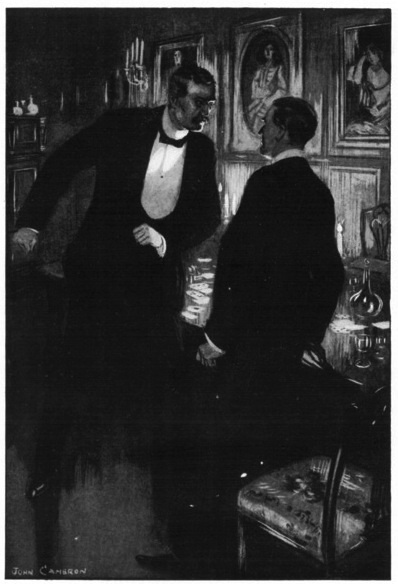
With a fierce gesture he took another step forward.
Milbanke stood firm.
"I have my reasons," he said quietly.
"Your reasons, have you?" Asshlin laughed harshly. "Then I'll have my answer. What do you mean by it?"
For a second the older man remained silent and unmoved; then a light gleamed in his colourless eyes.
"All right!" he said. "You shall have it. Perhaps it is as well. I came here expecting to see the boy I had known grown into a genial, hospitable, honourable gentleman; instead, I find him an undisciplined, tyrannical egotist."
He said it quickly in a rush of unusual vehemence. All his anticipations, all his suspicions, and their subsequent justification—coupled with the new sense of protection towards the children of his early friend—found voice in these words.
"You are an egotist, Denis," he repeated distinctly. "A weak, worthless egotist—not fit to have children—not fit to have a friend——"
Asshlin stared at him for a moment in speechless surprise; then indignation surmounted every other feeling. With a fierce gesture he took another step forward, his eyes blazing, his hand menacingly clenched.
"How—how dare you?" he stammered. "How dare you? By God, if you were a bigger man I'd—I'd——"
He paused, choked by his fury.
"I know—I know. But I'm not afraid of you. I'm not to be bullied into subjection."
Milbanke's temper, difficult to rouse, was stirred at last. He gave his host glance for glance.
"You realise what you have said?" Asshlin's dark face was distorted, his voice came unsteadily.
"Yes. I regret that I have to say it, but I do not regret saying it. It is wholesome for a man to hear the truth."
"Oh, it's wholesome to hear the truth, is it?"
"Yes; and I won't see you go to pieces for want of a word. You are a man with obligations, and you are neglecting your obligations. There are other things in life besides cards and horses——"
Asshlin suddenly threw back his head.
"By God, you're right!" he cried. "And the other things are a damn sight worse. I'd put a good horse before a self-righteous preacher any day."
Milbanke's usually pallid face flushed.
"You mean that for me?" he asked quietly.
Asshlin shrugged his shoulders.
"If you like," he said. "If the cap fits——" For a moment Milbanke said nothing; then once again he straightened his small, thin figure.
"Very well, Denis," he said, "I quite understand. With your permission I will say good-bye to you now, and to-morrow morning I will catch the earliest train from Muskeere."
He looked at his host steadily. Then, through the temper that still mastered him, a twinge of regret, a sense of parting and loss obtruded themselves. With all his intolerable faults, Asshlin still stood within the halo and glamour of the past.
"Denis!" he exclaimed suddenly.
But the appeal was made too late. Uncontrollable fury—the one power which could efface his sense of hospitality—possessed Asshlin. His pulses pounded; his senses were blurred. With a seething consciousness of insult and injury, he turned again upon his guest.
"You can go to hell for all I care!" he cried savagely.
For a second Milbanke continued to look at him; then without a word he turned, crossed the room, and passed into the hall.
PART II
CHAPTER I
It was on a windy March morning three years after his summarily ended visit to Ireland, that James Milbanke stood in the bedroom of his London flat. A perturbed frown puckered his forehead and he held an open letter in his hand.
Outside, the dark sky and cold searching breeze proclaimed the raw English spring; inside, the partly dismantled walls of the room, the emptied drawers and wardrobe, the trunks, bags, and rugs standing ready strapped, all suggested another and more inviting climate. Milbanke was bound for the south.
Three months earlier he had come to the momentous conclusion that a solitary life in London—spent no matter how comfortably—becomes a colourless and somewhat empty thing after a thirty-three years' experience. He had his club and his friends, but he was not a clubman born, and friends must be very intimate to be all-sufficing. The restlessness that sometimes unexpectedly attacks the middle-aged bachelor had fallen upon him. The suggestion that he craved new surroundings and new fields of interest had been slow in coming, and his acceptance of it had been slow. But steadily and inevitably it had grown into his consciousness, maturing almost against his will, until at last the day had dawned on which he had admitted to himself that a change was indispensable. The subsequent events had followed in natural order. His hobby had urged him to leave his own country for one richer in association; the damp cold of the English winter, coupled with the chilled blood of advancing age, had inclined him to the idea of Southern Europe. The result of his triple suggestion was that he stood in his room on that spring morning in the last stages of preparation for a journey to Italy.
He stood there, with the discomfort of packing pleasantly accomplished, and his belongings neatly surrounding him; yet his attitude and expression were those of a man who is faced by an unlooked-for difficulty. With a nervous gesture, he shook out the letter that he held, and began to read it hastily for the fourth time. It was a long letter, written in a careless, almost boyish hand on thin paper, and bore the address of "Orristown, Ireland." It was dated two days earlier, and began:
"Dear Mr. Milbanke,—
"You will be very much surprised to get this, but I write for father, not for myself. He had a bad accident yesterday while out riding, and is terribly hurt and ill. The doctor from Carrigmore is with him all the time, and my aunt—as well as Nance and I; so he is well cared for. But he seems to get worse instead of better, and we are dreadfully frightened about him.
"There is one thing he constantly craves for—and that is to see you. Ever since that night, three years ago, when you and he quarrelled and you went away, I think he has been fretting about you. Of course, he has never spoken of it, but I don't think he has ever forgotten that he treated you badly.
"This morning he talked a great deal about the time when you and he were young together; so much so, that I asked him if he would like to see you. The moment I spoke his face lighted up, but then at once it clouded over again, and he muttered something about never giving any man the chance of refusing him a favour.
"Dear Mr. Milbanke asking you to come here, but I feel differently. I would risk anything a hundred times over on the chance of bringing you to him. And if you are in London, please do come, if only for one night. Don't refuse, for he is very, very bad. Any time you send me a telegram, the trap can meet you either at Muskeere or Dunhaven.
"This is a dreadful letter, but I have been up all night, and scarcely know what I am writing.
"Answer as soon as possible,
"Yours,
"Clodagh Asshlin."
Milbanke scanned the letter to the last line; then, as he reached the signature, the inertia that had pervaded his mind was suddenly dispersed. His own shock of sorrow and dismay, his own interrupted plans faded from his consideration; and in their place rose the picture of a great white house on the lonely Irish coast; of a sick—perhaps a dying—man; of two frightened children and a couple of faithful, inefficient servants. With an energy he had not evinced for years he crossed the room, stumbling over straps and parcels, and rang the bell with imperative haste.
When a surprised maid appeared at the door he turned to her with unwonted excitement.
"I have a telegram to send," he said; "one that must go at once."
The rest of that day, with its suddenly altered plans, its long railway journey from Paddington to New Milford, and its stormy night crossing from the latter point to the town of Waterford, was too beset with haste and confusion to contain any definite recollections for Milbanke. It was not until he had taken his seat at eight o'clock next morning in the small and leisurely train that transports passengers from Waterford to the seaport of Dunhaven that he found time to realise the significance of his journey; and not until he descended from his carriage at this latter station and was greeted by old Burke, the Orristown retainer, that he fully appreciated the gravity of the incident that had occasioned it.
There was no change apparent in Burke's familiar face save the gloom that overhung his expression. But this was obvious to Milbanke at a first glance.
"You're welcome, sir!" were his opening words; then the underlying bent of his thoughts found vent. "'Tis a sorrowful house you'll be findin'," he added in a subdued voice.
Milbanke glanced up sharply from the rug he was unstrapping.
"How is he?" he asked. "Not worse?"
Burke shook his head.
"'Twouldn't be wishin' for me to give you the bad word——" he began deprecatingly.
"Then he is bad?"
The old man pursed up his lips.
"Ah, I'm in dread 'tis for his long home he's bound," he said reluctantly. "Glory be to God an' His Holy Ways! But 'tis of thim two poor children that I do be thinkin'."
But Milbanke's mind was occupied with his first words.
"But how is he?" he demanded. "What is the injury? Has he an efficient doctor?"
Again Burke shook his head.
"Docthors?" he said dubiously. "Wisha, I don't put much pass on docthors! not but what they say Docthor Gallagher from Carrigmore is a fine hand wid the knife. But, sure, when the Almighty takes the notion to break every bone in a man's body, 'tisn't for the like of docthors to be settin' up to mend them."
With this piece of pessimistic philosophy, he picked up Milbanke's bags and rug, and guided him through the small station into the open, where the Orristown trap stood waiting in a downpour of rain.
He imparted little more information during the long drive, and Milbanke had to sit under his dripping umbrella with as much patience as he could muster while they ploughed forward over an execrable road.
The gateway of Orristown, when at last it was reached, looked mouldy and forlorn in the chilly damp of the atmosphere; and as they plunged up the avenue at the usual reckless pace, a perfect torrent of rain-drops deluged them from the intersecting branches of the trees. Yet despite the gloom and the discomfort, a thrill of something like pleasure filled Milbanke as a whiff of pure, cold air brought the scent of the sea to his nostrils, and the turn of the avenue showed the square house, white and massive against the grey sky.
But he was given little time to indulge in the pleasure of reminiscence, for instantly the trap drew up, the hall door was thrown open, showing a face and figure that sent everything but the moment and the business in hand far from his mind.
It was Clodagh who stood there waiting to greet him—Clodagh, curiously changed and grown in the three years that had passed since their last meeting. In place of the spirited, unformed child that he remembered, Milbanke saw a very young girl, whose boyishness of figure had disappeared in slight feminine curves, whose bright, fearless eyes had softened into uncommon beauty.
With a glow of relief lighting up her face, she stepped forward as the horse halted, and, heedless of the rain that fell on her uncovered head, laid one hand on the shaft of the trap.
"Oh, it's good of you!—it's good of you!" she exclaimed. "We can never forget it."
Then the colour flooded her cheeks, and her eyes filled.
"Oh, he's so bad!" she added. "It's so terrible to see him—so terrible."
She looked up with alarm and impotence into Milbanke's face.
But it was not the guest, but old Burke who found words to calm her fear and grief. Leaning down from his seat, he laid a rough hand on her shoulder.
"Whist now, Miss Clodagh!" he said softly—"whist now! Sure God is good. While there's life there's hope. Don't be believin' anythin' else. Sure, what is he but a young man yet?"
"That's true, Burke—that's true!" Clodagh exclaimed quickly. "Won't you come in, Mr. Milbanke?" she added. "You know how welcome you are."
Once inside the hall, she turned to him quickly and confidingly.
"I can never forget that you've done this," she said. "It's a really, really generous thing. But all my mind is full of father. You can understand, can't you?"
Her agitation, her alarm, her evident helplessness in presence of a contingency never previously faced, all touched him deeply. His tone was low and gentle as he responded.
"I understand perfectly—perfectly," he said. "Poor Denis! Poor Denis! How did the thing occur?"
"Oh, just an accident—just an accident. About six months ago he took a fancy for riding late at night. He used to ride for miles along the most dangerous paths of the cliff. I knew it wasn't safe; I said so over and over again. But you know father!" She gave a little hopeless shake of her head. "On Monday night he saddled one of the young horses at about ten o'clock, and went out by himself. It came to twelve and he hadn't returned. Then we began to get uneasy, and at one o'clock we started to look for him. After a search all along the cliff, we found him wedged between two of the upper ledges of the rocks, terribly—terribly hurt." She shuddered palpably at the recollection. "We didn't know—we don't know even now—quite how it happened. But we think the horse must have lost his footing and fallen over the cliff, throwing father; for the poor thing was found dead on the shingle next morning. 'Twas a miracle that father escaped with his life, but he's terribly injured."
She paused again, as though the subject was too painful to be pursued.
Milbanke looked at her compassionately.
"Has he had proper medical advice?" he asked.
"Oh yes! Doctor Gallagher from Carrigmore has done everything, and we have a trained nurse from Waterford."
"That's right. I must have a talk with the doctor. But how is Denis now? Will he know me, do you think?"
"Oh yes! Ever since the first night he has been quite conscious. He expects you. He's longing to see you."
"Then may I go to him?"
Clodagh nodded; and, turning, led the way silently up the remembered staircase. On the landing, the recollection of their curious interview on his first night at Orristown recurred forcibly to Milbanke. He glanced at his guide to see if it had any place in her mind; but her thoughts were evidently full of other things. With a quick gesture that enjoined silence, she led him down the corridor, upon which rough fibre mats had been strewn to deaden sound.
With that peculiar sensation of awe that serious illness always engenders, he tip-toed after her, a sense of apprehensive depression growing upon him with every step. As they neared the end of the passage, a door opened noiselessly, and two figures emerged from a darkened room. The taller of the two—a pale, emaciated woman, dressed in mourning—was unknown to him; but a glance told him that the latter was little Nance, grown to pretty, immature girlhood.
On catching sight of him, she drew back with a passing touch of the old shyness; but, conquering it almost directly, she came forward and shook hands in silence. In the momentary greeting, he saw that her vivacious little face was red and marred by tears; but before he had time for further observation Clodagh touched his arm.
"My aunt, Mrs. Asshlin!" she whispered.
Milbanke bowed, and Mrs. Asshlin extended her hand.
"We meet on a sad occasion, Mr. Milbanke," she murmured in a low, querulous voice. "My poor brother-in-law was always such a rash man. But with some people, you know, there is no such thing as remonstrating. Even this morning when Mr. Curry, our rector from Carrigmore, came to have a little talk with him, he was barely polite; and it was only yesterday that we dared to tell him that Doctor Gallagher insisted on having a nurse. Now, what can you do with a patient like that?"
Milbanke murmured something vaguely unintelligible; and Clodagh stirred impatiently.
"Did you give him the medicine, Aunt Fan?" she asked.
"I did; but with great difficulty. My brother-in-law has always been averse to medical aid," she explained to Milbanke.
"He's never had any need of it," Clodagh whispered sharply. "Will you come, Mr. Milbanke? He's quite alone. The nurse is resting."
With great dignity Mrs. Asshlin moved away.
"I shall ask Hannah to get me a cup of tea, Clodagh," she murmured. "I get such a headache from a sick-room."
Without replying, Clodagh turned again to Milbanke.
"He's not to get excited," she whispered. "And mind—mind—don't say that you think him looking badly."
She paused and laid her fingers lightly on his arm; then with a swift movement, she stepped forward, drawing him with her into the big, darkened room with its sense of preternatural quiet, and its pungent, suggestive smell of drugs and antiseptic dressings.
CHAPTER II
With a strange blending of curiosity and shrinking, Milbanke obeyed the pressure of Clodagh's hand, and moved forward into the room. The cold March daylight was partly excluded by drawn blinds, but a glow from the fire played upon the walls and the high four-post bedstead.
With the same mingling of curiosity and dread, his eyes fell at once upon this prominent article of furniture and remained fixed there in doubt and incredulity. For the moment his senses refused to acknowledge that the feverish, haggard face that stared at him from the pillows was the face of Asshlin—Asshlin, tyrannical, passionate, greedy of life.
In the hours of agony that he had passed through, the sick man's features had become shrunken, causing his eyes to stare forth preternaturally large and restless; his hair had been cropped close, to allow of the dressing of a wound over the temple, and the tight white bandages lent a strange and unfamiliar appearance to his finely shaped head. With a sick sensation, Milbanke went slowly forward.
The patient made no attempt to move as he drew near the bed, but his feverishly bright glance seemed to devour his face.
"Here he is, father!" Clodagh exclaimed softly and eagerly. "Here's Mr. Milbanke! Now, aren't you happy? He's not able to move," she explained, turning to the guest. "It gives him terrible agony to stir."
Milbanke had reached the bed; and with a sensation of awkwardness and impotence impossible to describe, he stood looking down upon Asshlin.
"My poor Denis!" he said. "My poor, poor friend! This is a bad business; I had no idea——"
Then he paused confusedly, remembering Clodagh's warning.
"But we'll see you laughing at it all before we're much older," he added, in awkward haste to make amends.
A gleam of something like irony crossed Asshlin's watchful eyes.
"I'm done for this time, James!" he said feebly. "I suppose I've had my day, and, like every other dog, must answer to the whistle. I don't complain! I'm getting more than my deserts in seeing you again. You're as welcome as the flowers in——"
His voice failed.
"I know—I know! Don't trouble! Don't try to speak!" Milbanke bent over him anxiously.
But Asshlin glanced back.
"Ah, but that's what I must do, James!" he said sharply. "That's what I want you for. I have something that must be said."
Milbanke turned to Clodagh.
"Is it right of him to excite himself?" he asked in distress. "If it's anything that you reproach yourself with, Denis——"
But Asshlin interrupted with a weak echo of his old intolerance.
"Send Clo away!" he said. "There's something I want to say."
Again Milbanke looked helplessly at Clodagh, but her eyes were fixed passionately on her father's face.
"He'll excite himself more if we cross him," she said hesitatingly. "I think I'd better go."
Still Milbanke hesitated.
"But the doctor?" he hazarded. "If the doctor insists on quiet——"
She glanced at him quickly, her clear eyes brimming.
"Oh, I don't know!" she exclaimed; "I can't cross him—I can't cross him! He's wanted you so badly."
She turned quickly towards the bed.
"Father," she said tenderly, "won't you promise not to talk much? Won't you promise to take care?"
For answer, Asshlin looked up, meeting her glance.
"I'll promise, child—I'll promise. Run away now—and God bless you!" He added the expressive native phrase in a suddenly lowered voice.
Clodagh bent quickly and kissed his hot, drawn face with passionate affection; then, as if fearing to trust herself, she turned hastily and passed out of the room.
Instantly the two men were alone, Asshlin turned to his guest.
"James," he said agitatedly, "I haven't thought much about the Almighty in these last years; but I give you my word, I have prayed that I might see you before I die."
"My dear Denis, don't! I beg you not to excite yourself. I implore you——"
Asshlin made a harsh sound of impatience.
"Don't waste breath over a dying man," he said roughly. Then, seeing the distress in the other's face, he altered his tone. "Don't take it to heart, James! It's the road we must all travel. They think there's life in me yet, but I know better. You may blindfold a sheep as much as you like, but 'twill know that you're dragging it to the slaughter. I tell you I'm done for—as done for as if the undertaker had measured me for the coffin."
He moved his head slightly and painfully, his feverish glance brightening.
"James," he exclaimed suddenly, "I'm in a terrible position! But 'tisn't death that's troubling me."
"Denis!"
"'Tis true! I'm not frightened of death—I hope I'm man enough to face a natural law. 'Twould have been better if I'd had to face it thirty years ago."
"Denis, don't! I beg you to keep quiet——"
"Quiet? I tell you there's not much quiet for a man like me. 'Tisn't what I'm going to that's troubling me, but what I'm leaving behind. I'll be paying me own score on the other side; but here 'tis others will be paying it for me."
His burning eyes fixed themselves on Milbanke's.
"But, my dear old friend——"
"Don't talk to me, James! Don't waste words on me. I'm broke inside and out. I'm smashed. I'm done for." A spasm of pain, mental and physical, twisted his features. "The weak, worthless egotist has come to the end of his rope!" He tried to laugh.
Milbanke, in deep apprehension, laid his hand lightly on his shoulder.
"Denis," he pleaded, "don't talk like this! Don't torture yourself like this!"
Asshlin groaned.
"'Tis involuntary!" he cried. "'Tis wrung from me. Every time they come into the room—every time I see the tears in their eyes—every time they kiss me, I tell you I taste hell."
"Who?"
"The children. My children." Another spasm crossed his face. "You once told me I was not fit to have children, James—and you were right. By God, you were right!"
"Denis, I refuse to listen. I insist—I——"
"Don't bother yourself! 'Tisn't of my damned health I'm thinking."
"Then what is it? What is troubling you?"
"The children—the children. I've been a blackguard, James—a blackguard." He moved his head sharply, regardless of the agony the movement caused. "I tell you I don't care what's before myself. I've always been a reckless fool. But 'tis the children—the children."
"What of the children?"
A sound of mockery and despair escaped Asshlin.
"Ah, you may well ask!" he said—"you may well ask! 'Tis the question I've been putting to myself every hour since they laid me here. You know the world, James. You know what the world will be to two pretty, penniless girls. And they're so unconscious of it all! That's the sting of it. They're so unconscious of it all! They care for me; they cling to me as if I were a good man, and in five years' time they may be cursing the hour they were born." A fresh groan was wrung from him.
A look of apprehension crossed Milbanke's face.
"Oh no, Denis!" he exclaimed quickly. "No. Things can't be as bad as that. Your suffering has told upon your nerves. Things can't be as bad as that."
"They are worse. I tell you these two children will face life without a penny."
"No, no! You exaggerate. Why, even if you were to die they would still have the place. The place must be worth something."
"Ah, if I could only drug my conscience with that thought! But I can't—I can't! Before I'm cold in my grave my creditors will be down on the property like a swarm of rats."
"No, no!"
"Yes! I tell you yes! The children will be homeless as well as penniless."
Milbanke glanced about him in deep perplexity.
"There's your sister-in-law," he hazarded at length.
"Fan?" Asshlin made a contemptuous grimace. "Fan is as poor as a church mouse already. Laurence had nothing to leave her: the Navy beggared him. No, Fan could do nothing for them. And, anyway, she and Clodagh couldn't stand each other for a twelvemonth. You might as well try to blend fire and water. No, there's no way out of it. I'm reaping the whirlwind, James. I'm reaping it with a vengeance."
The fever of his suffering and the excitement of his remorse were burning in his eyes. In the three days of his illness his natural exuberance of mind had been directed towards one point—the tardily aroused knowledge of the future that awaited his children. And the consequence had been a piteous intermingling of realisation and partial delirium. His agony and helplessness were pitiable as he turned to his friend.
"What am I to do, James?" he asked—"what am I to do?"
Milbanke bent over him.
"Denis! Denis!" he pleaded.
"But what am I to do? Advise me while there's time. 'Tis for that I've wanted you. You've always been a good man. What must I do?"
Milbanke tightened his lips.
"You have friends," he said.
"Ah! but how many? And where?"
There was no response for a moment, as Milbanke slowly straightened himself and glanced across the room towards the fire. Then very quietly he turned towards the bed.
"You have one—here," he said in a low voice.
For an instant Asshlin answered nothing; then an odd sound—something between a laugh and a sob—shook him.
"James!" he cried. "James!"
But Milbanke leant forward hastily.
"Not a word!" he said. "Not one word! If thanks are due, it is from me to you. It is not every day that human responsibilities fall to an old bachelor of my age."
Asshlin remained silent. Dissipated, blunted, degenerate though he might be, his native intuition was unimpaired; and in a flash of illumination he saw the grade of nobility, the high point of honour to which this prosaic, unimaginative man had attained in that moment of need. With a pang of acute pain, he freed his uninjured arm and shakingly held out his hand.
"There are no friends like the old friends, James!" he said in a broken voice.
CHAPTER III
Asshlin scarcely spoke again during the early portion of that day. The immense effort of his explanation to Milbanke left him correspondingly weak; though through all his exhaustion, a look of peace and satisfaction was visible in his eyes.
During the whole morning Milbanke remained at his bedside, only leaving the room to partake—at Clodagh's urgent request—of a hurried meal in the deserted dining-room. At twelve o'clock the nurse resumed her duties, and soon afterwards the dispensary doctor from Carrigmore drove over to see his patient. Before he came into the sick-room Milbanke left it; but when—his examination over—he departed with a whispered injunction to the nurse, he found the stranger waiting for him in the corridor.
Milbanke stepped forward as he appeared, and silently motioned him down the passage to his own room, inviting him to enter with a punctilious gesture.
"Doctor Gallagher, I believe?" he said. "Allow me to introduce myself. My name is Milbanke. I am a very old friend of your patient."
With a slow but friendly gesture, the young man held out his hand.
"Oh, I know all about you!" he said. "I'm glad to make your acquaintance."
His voice, with its marked Irish accent, was soft and pleasant, and his glance was good-natured; but his tanned skin and rough shooting-suit suggested the sportsman rather than the medical practitioner.
Milbanke eyed him quickly.
"Then you won't misunderstand anything I may say?"
Gallagher smiled.
"Not a bit of it!" he answered nonchalantly. "And what's more, I think I know what it's going to be."
A shade of confusion passed over the Englishman's face. His understanding was still unattuned to the half-shrewd, half-inquisitive tendencies of the Irish mind. With a shadowy suspicion that he was being unobtrusively ridiculed, he became a degree colder.
"I am grieved beyond measure at Mr. Asshlin's condition, Doctor Gallagher," he said, "and it has struck me—it has been suggested to my mind that possibly——" He stopped uncertainly. "That possibly——"
"That perhaps there ought to be another opinion?" Gallagher looked at him complacently. "Well, maybe you're right. 'Tisn't because I condemn him that he shouldn't appeal to a higher court."
Milbanke started.
"Then you think poorly of his chances?"
Gallagher shook his head expressively.
"You despair of him?"
A pang of unexpected grief touched Milbanke. He realised suddenly how distant, vague, and yet how real a part the ideal of his youth had played in his life and thoughts; how deep a niche, unknown to them both, Asshlin had carved for himself. With a sense of loss altogether disproportionate to circumstances, he turned again to the doctor.
"Yes, I should like another opinion," he said quickly. "The best we can get—the best in Ireland. We can't get a man from town sooner than to-morrow, and time is everything. I suppose Dublin is the place to wire to? Not that I am disparaging you," he added. "I feel confident you have done everything."
Gallagher smiled.
"Oh, I'm not taking offence. It's only human nature to think what you do. I'll meet any one you like to name. But he'll say the same as me."
"And that is?"
"That he's done for." Gallagher lowered his voice. "He hasn't the stamina to pull through, even if we could patch him up. He's been undermining that big frame of his for the last ten years. No man nowadays can sit up half the night drinking port without paying heavily for it. Many a time, driving home from a late call, I've seen the light in these windows at three in the morning."
Milbanke pulled out his watch.
"But these Dublin doctors," he said. "Tell me their names."
Gallagher pondered a moment.
"Well, there's Dowden-Gregg and Merrick," he said. "And of course there's Molyneaux. Molyneaux is a magnificent surgeon. If any man in Ireland can make a suggestion, he will. But of course his fee——"
Milbanke interrupted sharply.
"Molyneaux let it be," he said decisively. "Wire for him when you get back to Carrigmore. Wire urgently. The expenses will be my affair. What they may amount to is of no consideration."
A look of involuntary respect crossed Gallagher's face.
"I understand," he said. "I'll wire at once. And you can comfort yourself that you'll have the best opinion in the country."
He nodded genially, the new considerations for Milbanke tinging his usually careless manner; and with an inaudible word of farewell, turned on his heel.
Once alone, Milbanke went in search of Clodagh. He suffered no small trepidation at the thought of communicating his action to her, and he bestowed much silent consideration upon the manner in which he should couch his information. Failing to find her in the house, he wandered out into the grounds. The rain had ceased, and a watery gleam of sunshine was falling on the wet gravel of the drive. Picking his way carefully, he turned in the direction of the yard; but he had scarcely reached it, when Clodagh's clear voice reached him, directing Burke as to some provisions required from Muskeere.
On seeing her guest, she came forward at once. Her face looked brighter and happier than he had seen it since his arrival. Her mercurial nature had responded instantly to the apparent change in Asshlin.
"Oh, isn't it lovely that he's so much better?" she cried. "You must have the gift of healing; it's like as if you had set a charm."
Milbanke made no response.
"Why don't you say something?" she asked quickly. "Don't you think he's better? Doesn't the doctor think he's better?"
Her quick mind sprang like lightning from one conclusion to another.
"Mr. Milbanke," she added, "you're keeping something back! There's something you don't like to say!"
Then at last Milbanke found voice.
"Indeed no, Miss Clodagh. You are wrong—quite wrong, believe me. There is nothing to be alarmed at—nothing. It is only——"
"Only what?"
"Now don't be alarmed! I beg you not to be alarmed!" The sudden whiteness that had overspread her face unnerved him. "It is only that I, as a Londoner, am a little doubtful of your village doctor. A mere prejudice, I know. But Gallagher is broadminded and willing to humour me. And he—I—that is, we both think that another opinion will do no harm. It's nothing to be alarmed at. Nothing, believe me! A mere formality."
But Clodagh's lips had paled. She stood looking at him silently, her large, questioning eyes reminding him disconcertingly of Asshlin's.
"Miss Clodagh," he said again, "don't be alarmed!—don't be alarmed! It's only to satisfy an old sceptic——"
"Oh no, it isn't!" she said suddenly. "Oh no, it isn't! I know—I know quite well. It means that he's going to die."
Her voice caught; and, with a swift movement, she turned and fled out of the yard, leaving Milbanke pained, bewildered, and alarmed.
The afternoon passed in weary, monotonous waiting. Half an hour after the conversation in the yard, Clodagh appeared in her father's room. She was pale and subdued, and her eyelids looked suspiciously red, but she took her place quietly at the foot of the bed. She sat very still, her eyes fixed on Asshlin's face, apparently heedless of both the nurse's deft movements and Milbanke's silent, unobtrusive presence. At three o'clock the acute pains that had tormented the patient at intervals ever since the accident had occurred, returned with a violence that seemed accentuated by the respite he had obtained during the morning. For an hour or more he writhed and groaned in unspeakable agony, while those about him suffered a reflected torment, and chafed impotently at the distance that cut off Carrigmore and the possibility of any fresh medical relief. The nurse was unceasingly vigilant; but the mild and cautious remedies ordered by Gallagher were powerless to soothe the violent pain. At last Nature mercifully intervened, and the exhausted sufferer fell into a sleep that lasted for several hours.
At seven o'clock there was a stir of excitement through the house, as the whisper passed from one to another that the Dublin surgeon had arrived. When the news reached the sick-room, Milbanke drew a breath of intense relief; but Clodagh's pale face went a shade whiter.
The great man arrived attended by Gallagher, and was shown directly to the patient's room. There was a confused moment of introduction; then Milbanke and Clodagh slipped quietly into the passage, leaving the doctors and nurse to their work.
During a long interval of indescribable suspense Molyneaux made his examination. Then, without a word, he and Gallagher emerged from the room and descended solemnly into the dining-room.
While this final conference lasted Clodagh—who had returned to her vigil immediately the doctors had left the sick-room—sat silent and motionless beside the bed; outside in the corridor, Mrs. Asshlin wandered to and fro, weakly tearful and agitated, while Nance stood beside her father's door, afraid to enter and yet reluctant to remain outside. Downstairs in the hall, Milbanke paced up and down in nervous perturbation, awaiting his summons to the conclave.
At last the door opened, and Gallagher looked out.
"Mr. Milbanke," he said, "Doctor Molyneaux would like to see you."
With a little start of agitation Milbanke went forward.
In the dining-room a great peat fire was burning as usual, lighting up the faces of Asshlin's ancestors; but the candles in the silver sconces were unlighted and the window curtains had not been drawn. In the dull light from the three long windows the large, placid face of Molyneaux looked preternaturally long and solemn. Milbanke felt his heart sink.
In formal silence the great man rose and motioned him forward, and the three sat down at the centre table.
"Mr. Milbanke," he began in slow and unctuous tones, "I suppose you would like me to come to the point with as little delay as possible? Professional details will not interest you."
Milbanke nodded mechanically.
Molyneaux hesitated, studying his well-kept hands; then he looked up with the decorous reserve proper to the occasion.
"I regret to inform you, Mr. Milbanke," he said softly, "that my visit is of little—I might say of no—avail. Doctor—er—Gallagher's diagnosis of the case is satisfactory—perfectly satisfactory. Beyond mitigating his sufferings, I fear we can do nothing for our poor friend."
"Nothing!" Milbanke felt a sudden dryness in his throat.
Molyneaux shook his head with becoming gravity.
"Nothing, Mr. Milbanke. The injuries to the ribs and hip we might have coped with, but the seat of the trouble lies deeper. The internal——"
But Milbanke held up his hand.
"I beg you to give me no details," he said weakly. "This—this is a great shock to me."
He covered his face with his hands and sat silent for a few seconds.
Molyneaux tapped lightly upon the table with his finger-tips.
"It was merely that your mind might be fully satisfied, Mr. Milbanke——" he said a trifle pompously.
Milbanke started.
"Forgive me! I understand—I fully understand. It is only the thought of what lies before us—the thought of his children's grief——"
Molyneaux made a gracious gesture of comprehension.
"Ah, yes," he murmured. "Very distressing! Most distressing!"
He looked vaguely round the room; and Gallagher, as if anticipating his thought, pulled out his watch.
Milbanke rose quickly.
"I thank you very much, Doctor Molyneaux," he said, "for your—your valuable opinion. I think Miss Asshlin wishes to know if your train will permit you to partake of some dinner before you leave us?"
Molyneaux smiled with the air of a man who has put an unpleasant duty aside.
"Ah, thank you!" he said suavely. "Thank you! If Doctor—Gallagher gives me permission I shall be charmed. He understands your local time-tables, and has promised that I shall catch the night mail to Dublin."
He smiled again and glanced genially round the firelit room.
"What interesting family portraits our poor friend possesses!" he added with pleasant affability.
But Milbanke did not seem to hear.
"If you will excuse me for a moment," he said hastily, "I will see that you are caused no unnecessary delay. You can understand that we—that we are a somewhat demoralised household."
His voice was agitated, his step uneven as he crossed the room and passed into the hall.
Molyneaux followed him with a conventional glance of sympathy; then his eyes turned again to the pictures with the gratified glance of a dilettante.
"Do you happen to know if this is a Reynolds?" he said to Gallagher, rising and crossing the room.
CHAPTER IV
To the last day of his life, that evening, with its horde of harassing and unfamiliar sensations, remained stamped upon Milbanke's mind; and not least among the unpleasant recollections was the visit of Molyneaux, and the dinner at which he himself unwillingly played host.
It may have been that his usually placid susceptibilities had undergone a strain that rendered him over sensitive; but whatever the cause, the atmosphere diffused by the great man jarred upon him. In his eyes, it seemed little short of callous that one who had just passed sentence of death upon his patient could so far remain unmoved as to partake with relish of the dinner set before him, and comment with affable appreciation upon the quality of the patient's wines.
Milbanke spoke little during the course of that meal. Try as he might to enact the part entrusted to him, his thoughts persistently wandered to the room upstairs, with its doomed sufferer and its anxious watchers, as yet mercifully ignorant of the verdict that had been pronounced. But if the host was silent, the guests made conversation. Gallagher was assiduous in his attentions to the man who, in his eyes, stood for the attainment of all ambition; and Molyneaux—under the unlooked-for stimulus of good, if homely food and wines that even as an epicure he admitted to be remarkable—was graciously pleased to accept the homage of his humble colleague, and to display a suave glimpse of the polished wit for which he was noted in society.
His expressions of regret were perfectly genuine when at last the sound of wheels on the gravel of the drive broke in upon his discourse, and Gallagher deprecatingly drew out his watch.
"The way of the world, Mr. Milbanke!" he murmured as he rose. "Our pleasantest acquaintances end the soonest. I must wish you good-bye—with many thanks for your delightful hospitality. So far as our poor friend is concerned," he added, in a correctly altered tone, "Doctor Gallagher may be relied upon to do everything. In a case like this, where physical pain is recurrent and violent, we can only have recourse to narcotics. We have already allayed the suffering consequent on my examination and you may rely upon some hours of calm; for any subsequent contingency Doctor Gallagher has my instructions. Of course, if you wish me to have one more glimpse at him before I go——"
But Milbanke, who had also risen, held out his hand mechanically.
"Oh no," he said quietly. "No, thank you! I don't think we will trouble you any further. It has been a great satisfaction to have obtained your—your opinion."
Molyneaux waved his hand magnanimously.
"Do not mention it!" he murmured. "My regret is deep that I have been of so little avail. Good-bye again, Mr. Milbanke! It has been an honour as well as a pleasure to meet you."
He smiled blandly, and added the last remark as Gallagher solicitously helped him into his furlined travelling coat. Then, still suavely genial, he passed out of the dining-room towards the hall door.
Gallagher hurried after him, but, in passing Milbanke, he paused.
"I'll be back in an hour, Mr. Milbanke," he said. "I'm just going as far as Carrigmore with Doctor Molyneaux to get an additional supply of morphia."
Milbanke nodded silently, and in his turn stepped into the hall.
When the two men had entered the waiting vehicle, when Molyneaux had waved a courtly farewell and the coachman had gathered up the reins, he turned and slowly began to mount the stairs.
Instantly his foot touched the landing, Mrs. Asshlin darted from the shadowy corridor.
"What news?" she asked agitatedly. "Oh, Mr. Milbanke, what news? The suspense has been dreadful."
Her voice trembled. Tears came very easily to Mrs. Asshlin, and her habitual attitude of mourning had heretofore irritated Milbanke. But now her thin face and faded black garments came as a curiously welcome contrast to the bland affluence, the genial, complacent superiority of Molyneaux. He turned to her with a feeling of warmth.
"Forgive my delay, Mrs. Asshlin!" he said gently. "One is never in a hurry to impart bad news. Doctor Molyneaux holds out no hope—not a shadow of hope."
There was a pause; then Mrs. Asshlin made a tragic gesture.
"Oh, the children!" she murmured. "The poor, poor children! What will become of them?"
"The children will be provided for," Milbanke said hastily. Then, without giving her time for question or astonishment, he went on again:
"Don't say anything of this to Clodagh," he enjoined. "She must have these last hours in peace."
"Certainly—certainly! Poor Denis! Poor Denis! I always said he would have an unfortunate end. But go in and see him, Mr. Milbanke. Clodagh is in the room."
Milbanke silently acquiesced, and moved slowly down the corridor.
At the door of her father's room, he found Nance still patiently watchful. He paused, arrested by his new sense of obligation, and looked down into the upturned, wistful little face.
"What are you doing here, Nance?" he asked kindly.
She made a valiant attempt to conjure up her pretty, winning smile, but her lips began to tremble.
"I don't know!" she said shyly and softly; then in a sudden burst of confidence she stepped close to him. "Clo doesn't like me to go in," she murmured. "She thinks it makes me sad to see father; and I don't know where to go. I'd be in Hannah's way in the kitchen, and I don't like being with Aunt Fan, and—and I'm frightened to be by myself. There's a horrid sort of feel in the house."
Her dark blue eyes searched Milbanke's face appealingly; and with a sensation of pity and protection, he stooped and took one of her cold, limp hands.
"You may come in," he said gently. "It is very lonely out here. I think we can make Clodagh understand."
Without hesitation her fingers closed round his in a movement of confidence and gratitude, and together they passed into the room where Asshlin lay peacefully under the influence of the narcotic administered by Molyneaux. By Gallagher's orders the nurse—who had been deprived of her necessary rest in the morning—had retired to her room again in preparation for the night, and only Clodagh was in attendance. Having quietly closed the door, Milbanke halted hesitatingly, expecting a flood of questions. But to his intense surprise she did not even glance in his direction. She sat motionless and pale, her eyes on her father's face, her attitude stiff and almost defiant. He wondered for a moment whether, by the power of instinct, she had divined Molyneaux's verdict, or whether, through some source unknown to him, the news of it had already reached her. With a sense of trepidation, he tightened his fingers round Nance's small hand, and drew her silently into a corner of the room.
For more than an hour the three watchers sat regarding their patient. No one attempted to speak—no one appeared to have anything to say. Once or twice Mrs. Asshlin flitted agitatedly in and out of the room, but none of them took heed of her presence. Occasionally a clock struck in the silent house or a cinder fell from the fire, causing them all to start nervously. But, except for these interruptions, the quiet was preternatural.
It was with a throb of relief at his heart that Milbanke at last caught the sound of Gallagher's horse trotting up the avenue, and knew by the shutting of the hall door that the doctor had entered the house.
He walked into the sick-room a few minutes later, and with a casual nod to all present, moved at once to the bed.
Bending over Asshlin, he felt his pulse, then glanced significantly at Milbanke, who had risen on his entrance.
"I think we must inject a stimulant," he said. "The pulse is a little weak."
With a faint sound of consternation Clodagh stood up.
"Oh, he's not worse?" she said. "Doctor Gallagher, he's not worse?"
Gallagher looked at her, and his expression changed. The distress of a pretty girl is always difficult to resist.
"No, Miss Asshlin," he said kindly. "No. You see, he has gone through a lot. We must expect him to be weak."
Clodagh looked relieved, though the alarm still lingered in her eyes.
"Of course," she said. "Yes, of course. Is there anything I can do?"
Gallagher glanced at her again.
"Well," he said quietly, "perhaps you will call the nurse for me? There's no real need for her, but it is just as well we should have her on the spot."
Again Clodagh's eyes darkened with apprehension, but she made no remark. Signalling to Nance to follow her, she left the room.
As the two girls disappeared, Gallagher bent again over Asshlin, making another rapid examination; then once more he glanced up at Milbanke.
"He may not last the night," he said below his breath. "Molyneaux expected that it wouldn't be a long business, but we didn't look for the change so soon as this."
Milbanke did not alter his position.
"You'll stay on, of course?" he said mechanically.
"Yes. Oh yes, I'll stay on!"
As he said the last word Clodagh reappeared.
"The nurse will be here in a minute," she said in a steady voice.
The unrelaxed, monotonous vigil lasted until two o'clock; then, as Asshlin showed a disposition to rally, the doctor asserted his authority, and dismissed Mrs. Asshlin, Nance, and Milbanke for a much-needed rest—Clodagh alone refusing to leave the room.
Though he would not have admitted it, the command came as a boon to Milbanke. His long and arduous journey, coupled with the strain and excitement of the day and evening, had culminated in intense weariness; and when Gallagher's order came, it would have been a superhuman effort to offer any protest.
Reaching his room, he took off his boots, and, partially undressing, threw himself upon his bed.
How many hours he slept the deep sleep of utter exhaustion he did not know. His first effort at awaking consciousness was a thrill of nervous fright that made him sit up in bed, aware with a sudden shock that some one was knocking imperatively on his door and calling him by name in low, agitated tones.
"Mr. Milbanke! Mr. Milbanke! Wake, please! Quick! Mr. Milbanke!"
He stared into the darkness for an instant in dazed apprehension; then he slid out of bed, fumbling blindly for his dressing-gown.
"Coming!" he called. "Coming!"
Having found the garment, he crossed the room stumblingly, thrusting his arms into the sleeves as he went.
Opening the door, he realised the situation with a sick sinking of the heart. Clodagh stood in the corridor with a blanched face, holding a candle in her shaking hand.
"Oh, come, please!" she exclaimed. "Come quick!"
Without a word he stepped forward, and the two hurried down the passage.
In the sick-room the fire was glowing and additional candles had been lighted. For a second Milbanke paused at the door; then, as his eyes grew accustomed to the access of light, the scene became clear to him. On the bed lay Asshlin, his head partly propped up by pillows, his eyes wide, his breath coming in slow, difficult gasps; Gallagher was moving about the room with more quickness and deftness than the Englishman could have believed possible; Mrs. Asshlin, unnerved, and yet fascinated, leaned upon the end of the bed; while Nance—crying silently—followed the nurse to and fro in dazed, half-comprehending fear; and Hannah, the household factotum, crouched behind the door, weeping and murmuring inarticulate prayers.
The picture turned Milbanke cold. With an instinctive gesture he paused, with the intention of shielding it from Clodagh's sight. But at the very moment that he turned towards her, a convulsion shook the dying man. He half-lifted himself in bed, his eyes staring wildly; as Gallagher rushed forward, a faint sound escaped him, his head fell forward, and his body collapsed in the doctor's arms.
There was a breathless, appalled silence—a silence that seemed to extend over years. At last Gallagher looked up.
"It's all over," he said in a hushed voice.
For a minute no one spoke, no one moved. It seemed as if the whole room was petrified. Then Gallagher quietly laid the body back upon the pillows, and as though the action broke the spell, Clodagh gave a sudden sharp cry and ran forward to the bed.
CHAPTER V
The three days that followed Asshlin's death resolved themselves into so many hours of gloom and confusion, that found their culmination in the funeral ceremony.
To Irishmen of every class, a funeral is invested with an almost symbolic importance, and a solemn consideration is bestowed upon its most minute details. And Milbanke, deeply imbued with the horror and suddenness of the whole disaster, was filled with a growing astonishment at the numberless preliminaries—the amount of precedence and prestige requiring consideration—before one poor human body could be hidden away. But he rose dutifully to the occasion and proved himself unfailingly patient and conscientious in every emergency, from the first repugnant interview with the undertaker to the woeful breakfast, partaken of in the early hours of the funeral morning, with the curtains drawn across the dining-room windows and the candles in the massive silver sconces shedding an unnatural light upon the table laden with eatables.
The guests who partook of this meal were men of varied and interesting types; but whatever their characteristic differences, it was remarkable that the same air of responsibility and solemnity inspired them all. It did not matter that many of them had been personal enemies of the dead man; that many, with that jealous distrust of unconventionality that reigns in Ireland, had markedly drawn away from him in the last ten years of his life; death had obliterated everything. Asshlin's eccentricities, his lawlessness, his contempt for the little world in which he lived were all forgotten. He was one of themselves—deserving, in death at least, the same consideration that the county had bestowed upon his father, his grandfather, and those who had gone before them.
The faces of these men were unfamiliar to Milbanke, though each on entering the dining-room shook him cordially and sympathetically by the hand. The meal was partaken of almost in silence; and it was with obvious relief that, one after another, the members of the party rose from table and passed into the darkened hall, and from thence to the sweep of gravelled drive that fronted the house, where the less privileged of those who had come to do Asshlin honour lounged singly or in groups.
The funeral was timed to start at nine; but the concourse of mourners—well accustomed to the delays inevitable on such an occasion—evinced no sigh of impatience when half-past nine, and then ten arrived, and no move had yet been made.
But all things come to those who understand the art of patience. At a quarter past ten a thrill galvanised the lethargic crowd; and with the recognition of the great moment for which they waited, the men began to jostle each other and push forward towards the house, while all hats were respectively removed.
A faint murmur of admiration and awe went up from the gathering as the great brass-bound coffin was borne solemnly through the door and laid upon the open bier. In silence Milbanke and young Laurence Asshlin took their places as chief mourners, and with the inevitable confusion and uncertainty of such a moment, the crowd of men and vehicles formed up behind them, the horses under the bier moved slowly forward, and the body of Denis Asshlin passed for the last time down the avenue and through the gates of Orristown.
The funeral over, Milbanke walked back from Carrigmore alone. The servants, who had followed their master to his resting-place in the old graveyard, had remained in the village to enjoy the importance that the occasion lent them; young Asshlin had disappeared at the conclusion of the burial service; while the daughters and sister-in-law of the dead man—in accordance with the custom of the country—had remained secluded in their own rooms at Orristown, appearing neither at the breakfast nor the funeral.
In a house of death, the hours that succeed the burial are, if possible, even more melancholy than those that precede it. The sensations of awe and responsibility have been dispersed, but as yet it is impossible to resume the commonplace routine of life. As Milbanke passed through the gateway and walked up the drive, ploughed into new furrows by the long procession of cars that had followed the coffin, he was deeply sensitive to this impression; and it fell upon him afresh with a chill of desolation as he entered the door, still standing open, and moved slowly across the deserted hall.
In the dining-room the curtains had been drawn back and the candles extinguished; but the daylight seemed to fall tardily and unnaturally upon the room after its three days' exclusion. He stood for a moment looking at the débris of the breakfast that had not yet been removed, at the disarray of the chairs that had been hurriedly vacated; then, with a fresh and poignant sense of loss and loneliness, he turned hastily and walked out of the room.
In the hall he attempted to pause afresh; but the sound of muffled sobbing from the upper portion of the house sent him incontinently forth into the open. With an overwhelming desire for human fellowship—for any companionship in this abode of desolation, he passed without consideration of his dignity round the corner of the house in the direction of the stable-yard.
He walked calmly, but there was a pucker of anxiety on his usually placid brow—an expression of concern, apart from actual sorrow, in his tightly set lips. To the most casual observer it would have been obvious that something weighed upon his mind.
Still moving with his habitual precision, he entered the yard by the arched gateway, picking his way between the scattered array of rubbish, food, and implements that encumbered the ground.
When he appeared, a dozen rough or glossy heads were thrust out of kennels or outhouses, as the dogs accorded him a noisy welcome; but paying only partial heed to their demonstrations, he passed on to the vast coach-house, with the vague hope that some labourer connected with the farm or stables might possibly have been left behind in the general exodus. But here again he was doomed to disappointment. The coach-house, with its walls festooned with rotting harness, its ghostly row of cumbersome antiquated vehicles, was as empty of human presence as the yard itself.
Conscious of the isolation that hung over the place—disproportionately aware of his own aimlessness, he stood uncertain in what direction to turn. For the moment, the household had no need of him; there were no legal formalities to succeed the funeral, Asshlin having left no will; and of personal duties he had none to claim his attention.
He stood by the coach-house door woefully undecided as to his next move, when all at once relief came to him from the most unexpected quarter of the outbuildings. One of the dairy windows was opened sharply, and a head was thrust through the aperture.
"Wisha, what is it you're doin' there, sir?" a voice demanded kindly. "Sure that ould yard is no fit place for you!"
Turning hastily, Milbanke saw the broad, plain face of Hannah; her small eyes red, her rough cheeks stained with weeping.
"Why, Hannah!" he exclaimed, "what are you doing here? I thought you were at the funeral."
Hannah passed the back of her hand across her eyes.
"Wisha, what would I be doin' at it?" she demanded huskily. "Sure I don't know what they do be seein' in funerals at all."
Milbanke glanced up with interest, recognising the originality of the remark.
"Why, you and I are of the same opinion," he said. "The Celtic delight in the obsequies of a friend has been puzzling me for the last three days——" Then he paused suddenly, conscious of Hannah's fixed regard. "That is," he substituted quickly—"that is, I have been wondering, like you, what they see in it."
Hannah's small, observant eyes did not waver in their scrutiny.
"You've been wonderin' about somethin', sure enough!" she said. "I seen it meself every time I'd be carryin' in the dinner or doin' a turn for the poor corpse. God be good to him this holy and blessed day!" Again she wiped her eyes. "But 'tisn't wonderin' alone that's at you," she added more briskly. "'Tis some other thing that's lyin' heavy on your mind. I seen it meself at every hand's turn."
Milbanke started. This sympathetic onslaught was as disconcerting as it was unexpected.
"I—I won't contradict you, Hannah," he said waveringly. "No doubt you are right."
For the space of a minute Hannah was profoundly silent; then she broached the subject that had been filling her mind for a day and a half.
"Wisha, now, is it thrue what they do be tellin' me?" she asked softly and warily—"that you're goin' to be father and mother an' all to thim two poor children?"
Again Milbanke started almost guiltily; then the personal anxiety that mingled with and almost dominated his grief for Asshlin rose irrepressibly in response to the persuasive tones, the kindly human interest and curiosity.
"Yes, Hannah," he said quickly. "Yes, it is my intention to try and fill my poor friend's place."
The tears welled suddenly into Hannah's eyes, and with an awkward movement she wiped her rough hand in her apron and held it out.
"God Almighty will give it back to you, sir!" she exclaimed, with impulsive fervour.
Strangely touched by the expression of understanding and appreciation, he responded to the gesture and took her hand.
But instantly she withdrew it.
"Don't be mindin' an ould woman like me, sir," she said deprecatingly. "'Twas the thought of the children that come over me. I couldn't help it. I had the both of thim in me arms before they could cry. Small wonder me heart would be in thim! Many's the sad day I put over me, thinkin' what would become of them, wid the poor masther goin' to the bad. God forgive me for sayin' it! And sure now 'tis all settled and done for—and the heavth of it off of our minds. Praise be to God!"
She paused to dry her tears.
"And what would you be thinkin' to do wid thim?" she asked presently in a new and more personal tone.
Milbanke did not answer at once. His eyes strayed uneasily from one object in the yard to another, while the frown of perplexity that had puckered his brow since Asshlin's death reappeared more prominently than before. At last, with a certain expression of puzzled resolution, he looked up and met Hannah's attentive gaze.
"To tell you the truth, Hannah," he said, "that is the precise question I have been asking myself ever since your poor master died."
There was a wait of some seconds while his listener digested the information; then she nodded her head with slow impressiveness.
"I seen it meself," she said again. "Sure, I seen it as plain as daylight. 'There's somethin' on his mind,' I says to meself. An' if it isn't the poor masther's death,' I says, 'thin it's nothin' more nor less than the natural feelin's of a single gentleman that finds himself wid two grown daughters.'"
It was characteristic of Milbanke that he did not smile. He recognised only one fact in the old servant's words—the fact that the state of affairs over which he had been worrying in lonely perplexity had suddenly been accurately, if roughly, voiced by some one else. He glanced up with quick relief into the round, red face framed in the dairy window.
"Hannah," he said honestly, "your surmise was perfectly correct."
For the first time a smile broke over her tear-stained face.
"I was right thin? 'Tis the children was troublin' you?"
A sharp gleam of inquiry shot from her eyes.
"Yes," he answered simply.
"An' why, now?" Again her tone changed, the irrepressible undercurrent of native humour, native inquisitiveness and familiarity welling out unconsciously. "Sure, they're good children."
"I do not doubt it. I do not doubt it for one moment."
"But they're troublin' you all the same?"
"Well, yes. Yes, I confess they are troubling me."
"Both of thim?" she asked innocently.
He hesitated.
"Well, no," he replied artlessly. "No, not both of them."
"Ah, I thought that same!" Hannah gave a nod of understanding. "Sure, 'twas to be tormentin' men she was brought into the world for. I said so meself the first day I took her into me arms."
"But—but I haven't said anything. How do you know that it is——?"
"How do I know that it's Miss Clodagh that's botherin' you? Sure, how do I know that you're standin' before me? Faith, by the use of me eyesight! Haven't I seen you lookin' at her and ponderin'—and lookin' at her agin?"
Milbanke's lips tightened, and he drew himself up.
"I should be sorry if any thought I have bestowed on your young mistress——" he began coldly; then suddenly the intense need of help and sympathetic counsel over-balanced dignity. "Hannah," he said abruptly, "I'm in a terribly awkward position, and that is the simple truth. My mind is quite at rest about the younger girl. She is a child—and will be a child for years. A good school is all she needs. But with the other it's different—with Clodagh it's different. Clodagh is no longer a child."
Hannah remained discreetly silent.
"If I had a sister," he went on, "or any friend to whom I could entrust her. But I have none."
Again Hannah shook her head.
"Why, thin, that's a pity!" she murmured. "Sure, 'tis lonesome for a gintleman to be by himself."
"It is a pity—a great pity. You do not know how it is weighing upon me. Of course, there is her aunt——"
Hannah made an exclamation of horror.
"Is it Mrs. Laurence?" she cried. "Is it tie her to Mrs. Laurence you would? Sure, you may as well put her in the grave and be done wid it."
Milbanke's harassed face grew more perplexed.
"No," he said hurriedly—"no; I understand that that arrangement is impossible. I was merely wondering whether there is any other—any more distant relative with whom she might be happy——"
He looked anxiously into her broad, shrewd face.
For a moment the small eyes met his seriously, then involuntarily they twinkled.
"Faith, when I was a young woman, sir," she said slowly, "men wasn't so sat on findin' relations for a girl like Miss Clodagh—unless maybe 'twas a relation of their own makin'!"
Milbanke suddenly looked away.
"What—what do you mean?" he asked confusedly.
"Why, that 'tisn't aunts and cousins that a girl like Miss Clodagh wants, but a good husband."
"A—a husband?"
"Why, thin, what else? Instid of throublin' yourself and frettin' yourself till your heart is scalded out of you, why don't you marry her? That's what I've been askin' meself ever since the poor masther died. It's out now, if I'm to be killed for it!"
She eyed him almost defiantly.
But Milbanke stood stammering and confused, his gaze fixed nervously on the ground, an unaccustomed flush on his worn cheeks.
"But—but, Hannah, I—I am an old man!"
His tone was deprecating and meant to be ironic; but unconsciously it had an undernote of question; unconsciously, as he raised his eyes to his mentor's face, he straightened the shoulders that age and study had combined to bend.
"I am an old man!" he said again. "Why—why, I am five years older than her father——"
Hannah continued to search his face.
"An' sure what harm is that?" she said. "Wasn't me own poor man as ould as me grandfather?—an' no woman ever buried a finer husband—God rest him!"
Milbanke's lack of humorous imagination stood him in good stead.
"But she's a child," he stammered—"a child——"
For answer, Hannah leant out of the window until her face was close to his.
"Listen here to me!" she said softly. "Child or no child, you thought about marryin' her before ever I said it. But you'd never riz the courage to do it. You're not like the Asshlins, that would tear down the walls of hell if they wanted to be gettin' at the divil; you'd like somebody to take him be the hand and draw him out nice and aisy for you——
"There she is up in that lonesome house, frettin' her heart an' cryin' her eyes out. Why can't you go up an' take her, before somebody else does?"
As she came to the last words her rough voice dropped. Her loyalty to her dead master, her anxiety to see his child in a place of safety poured from her in crude eloquence. To her primitive mind Milbanke appeared as the ideal husband—a man of dependable years, of wealth, of good social position; and all her affections, all her energies yearned to make the marriage. She could not have framed the fear that possessed her; but her instinct, her acute native intuition warned her unanswerably that the daughter of Denis Asshlin would need protection, and would need it before long. With an impulsive gesture she stretched out her hand, and, touching Milbanke's shoulder, pushed him gently forward into the yard.
"Go on, sir!" she urged softly. "Go on up an' take her, before somebody else does!"
CHAPTER VI
It may be surmised without fear of misconception that never during the smooth course of his uneventful existence had Milbanke been so rudely shaken into self-comprehension as by Hannah's unlooked-for onslaught. Left to the placid guidance of unaided instinct, it is almost certain that he would have left Orristown whenever the hour of departure arrived, innocently unconscious that any parting pangs could be attributed to a personal cause. It is possible that, with the passage of time, he might have acknowledged that somewhere in the inner recesses of his mind there was a shrine where one face, more changeful and alluring than any other he had known, reigned in solitary state; but beyond that tardy acknowledgment he would not have dared to venture. Later still, perhaps, if circumstances had compelled him to resign his guardianship over Clodagh in favour of some possible husband, it is within the bounds of reason to conjecture that understanding of his feelings might have come to him when, having said good-bye to the young girl just crossing the threshold of life, he returned to his home, newly and bitterly alive to his age and loneliness. But now, in the light of present events, all such suppositions had become valueless. As if by some powerful outside pressure, his eyes had been opened, and he stood dazed and elated before the new road that opened upon his vision.
His brain felt light and unsteady, his limbs were imbued with a sensation of unaccustomed buoyancy as he turned, impelled by Hannah's words, and moved across the yard towards the arched gateway. A half-admitted, intoxicating sense of imminent action possessed him; and as he walked forward it seemed that he scarcely felt the ground beneath his feet.
Almost without volition, he passed from the stone-paved courtyard into the sweep of gravelled pathway that fronted the house. For the first time in his existence he was conscious of being borne forward on the tide of his emotions; and the knowledge had an exhilarating, unbalanced daring that suggested youth.
As though he feared the evaporation of his mood, he made no pause on gaining the pathway, but went straight forward towards the house with a haste and impetuosity very foreign to his formal nature. On his second entry into the hall, he paid no heed to the chill desolation of the place, but crossing the intervening space, began immediately to mount the stairs.
Scarcely had he reached the highest step, however, than he halted incontinently. For, as though in direct response to the thoughts that were filling his mind, a door on the corridor opened, and Clodagh appeared.
Seeing him, she too paused; and in the moment of mutual hesitation he had opportunity to study her.
In her new black dress, she looked slighter and more immature than he had expected; and the pathetic effect of her appearance was enhanced by the paleness of her face and the heavy, purple shadows that sleeplessness and tears had traced below her eyes. As the impression obtruded itself upon him, his own nervous excitement dropped from him suddenly.
"My poor child!" he said involuntarily.
At the words and the tone, she turned to him impulsively.
"Oh! Mr. Milbanke——" she began.
Then her loneliness, her sense of bereavement and desolation, inundated her mind. With a short sob, she moved abruptly away, and turning her face to the wall, broke into a passion of tears.
The action was the action of a child; and without hesitation Milbanke responded to it. Stepping across the corridor, he put his arm about her shoulder and drew her gently towards the stairs.