Chapter IV · The Rebels and Their Grievances.
Reading edition
We cannot view without grave misgivings the unexpected turn that affairs have taken since the war, and the second war which has broken out between the rebels and the Americans. It is now plain that it was entire independence from all control that the promoters of the rebellion were looking for from the very beginning; this being well known to the Friars all along, and clearly indicated in their memorial to the Spanish Government. Aguinaldo and his companions have unlimited confidence in themselves, and aspire to form a civilized republic. The character of this pure-souled patriot may be judged from a transaction he had with the Spanish Government. After the armistice of Biac-na-Bato, he was bought out by them, and took thousands of dollars as his price for leaving the country for aye, never to return. He pocketed the money, and went off to Hongkong; but when the Americans came to Manila, and destroyed the Spanish fleet, this worthy returned to the Philippines, and once more raised the standard of rebellion. As a result the Americans are apt to find themselves burdened with a war expenditure, even heavier than that borne by Spain in her effort to prevent a repetition in the Philippines of the gruesome story of San Domingo and Hayti. All colored and tropical races have a tendency to revert to their original type and the barbarous customs of their ancestors. The blacks got possession of Hayti nearly a century ago, at which time they were at least domesticated, and partially civilized, having been in contact with the white man for the two previous centuries. They have gone back, and not forward, ever since. The history of the black republic is a bloody revolution every two or three years, distinguished by acts of barbarous ferocity. Life there at the present day is a hideous caricature of civilization and Christianity. Incredible as it may seem, there has been a revival in the remote villages of the old African serpent-worship, and child sacrifices, followed by cannibalism.
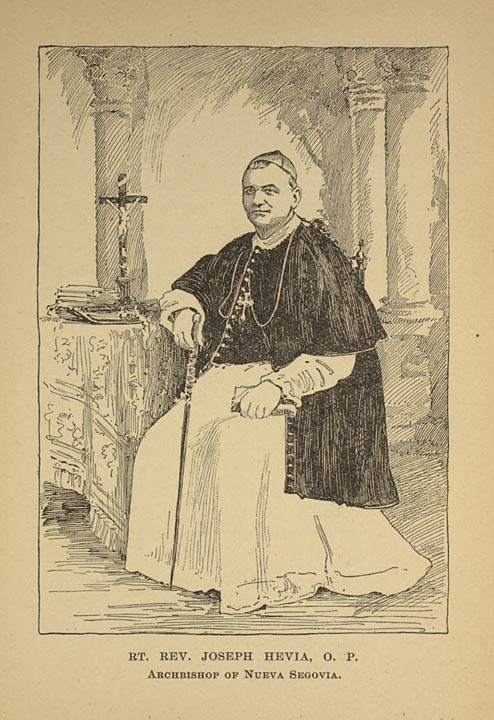
Rt. Rev. Joseph Hevia, O. P.
Archbishop of Nueva Segovia.
The Filipinos have already shown proof how far removed they are from civilized ideals, and how dangerous it would be to leave them to themselves, by their inhuman treatment of their Spanish prisoners. Besides ordinary Spanish civilians, they have kept in captivity for several months hundreds of Friars, including one hundred Dominicans, and the Dominican Bishop of Neuva Segovia, Mgr. Joseph Hevia, whose portrait we give. Numbers of the Friars have lately died of the hardships to which they were subjected. A letter, received some time ago from one of them by a friend in Manila, describes the ferocious and satanic hatred shown towards them by the rebel chiefs. They were stripped of their clothes, hats, and shoes, robbed of their money, spat upon, tied to trees, and flogged several times. Daily they were forced to work on the public roads from morning to evening, under a broiling sun, receiving food and drink barely sufficient to support life. The leaders mocked at and jested over their sufferings. Though violent threats were held out against all who succored them, their parishioners seized opportunities of coming to visit them, and alleviate their miseries. From other sources we learn that the noses of some of the prisoners were slit, and a cord passed through the aperture, to be used as a leading-string by their guards. The venerable Bishop was subjected to the grossest indignities. One aged Friar was placed on a saddle, and jumped upon till blood flowed from his mouth and nose. Another, it is said, clothed only in a rain-coat, was carried in triumph for two hundred yards, and then cudgelled to death amid savage cries. Some were crushed to death between boards. Nuns in the convents were subjected to shameful treatment. In the name of common sense, we ask if men who encourage or permit such atrocities are fit to control and guide the destinies of eight millions of people. (See Appendix V.)
Of course the policy of the Press in general has been to keep these atrocities from the eyes of the public. As it did not suit political purposes to publish them, they have been kept concealed. Owing to this careful management, the sympathies of the world have been enlisted on the side of the “poor downtrodden Filipinos.” An impartial examination of the grievances of the latter, and of the catch-cries by which the leaders have seduced a considerable portion of the simple natives, will not reveal very much against either the civil or the ecclesiastical rule of the Spaniard. As in everything human, we may suppose that neither was absolute perfection; but, all things considered, there was less to justify rebellion in the Philippines than in most parts of the world where the black is ruled by the white man.
One of the grievances of the rebels is that nearly all the ecclesiastics in the Archipelago have been Spaniards, and they demand an entirely native clergy. Now, the Catholic Church has been always most anxious to form a native clergy in missionary countries, but insuperable difficulties have often prevented the realization of this idea. Among colored races there is a paucity of real vocations; it is hard enough to get the people to live up to the Christian ideal without adding thereto the grave responsibilities and life of self-sacrifice of the priesthood. An example in point is the Black Republic of Hayti. It is a Catholic country, nominally at least. The people have retained the Faith taught them by the white man, though preserving such a dislike to him that no white man can own a yard of land in the country. Yet such is their inability to provide themselves with priests of their own blood that they are forced to fall back on the services of a French Bishop and French missionary priests, who do all the spiritual work of the island. Another case in point is that of Cuba, an island containing a million and a half of inhabitants, Cubans and Spaniards, of which only forty-three of the former are to be found in the ranks of the priesthood. There has never been any distinction made between Cubans and Spaniards in the two Seminaries of Havana and Santiago de Cuba; all are received alike, and treated alike if they have a vocation; of the forty-three priests, twenty-eight hold parishes, and the rest have other positions of trust, which shows that it is simply owing to lack of vocations and not to any other cause that we must ascribe their fewness in number. In the Philippines, as far back as two centuries ago, the experiment was made of forming a native priesthood, with doubtful success, however, as Dampier informs us that the natives generally held the native priests in contempt, while holding the Spanish clergy in the greatest esteem. We must, perforce, conclude that in the Philippines, as in other countries, it is simply lack of vocations that keeps the number of the native clergy at such a low ebb.
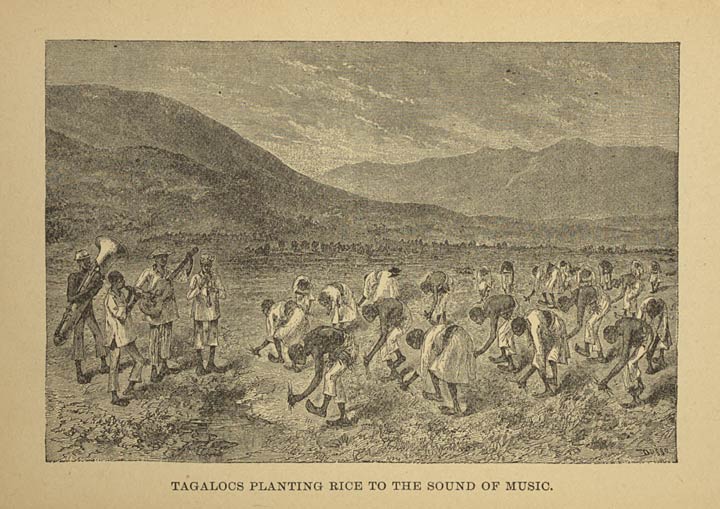
Tagalogs planting rice to the sound of music.
It is quite evident from the words and acts of the rebels that they have been casting envious eyes on the large landed estates of the Friars, hoping, on their expulsion, to have a division of the spoils among themselves. Already, before the war, an iniquitous plan of confiscation was boldly advocated in Spain itself. We now learn to our surprise, from the Church News (Washington, D.C.), that this cry has found an echo across the Atlantic from Protestant pulpits in the States. Besides the fact that confiscation would be robbery pure and simple, as the estates are not national property, and have not been given by the Government, but have been acquired in the usual way by purchase, and in the course of three centuries have naturally grown large, confiscation of the estates would mean a great calamity to the country, even if the Friars were allowed to go back quietly to their parishes, and resume their spiritual ministrations among the people. For it was by means of the estates that the Friars introduced agriculture and settled habits of life among tribes originally nomadic; it was by means of the estates that they got them to live in villages, and introduced amongst them the arts of civilized life; it was by means of the estates that they acquired the power of inducing them to labor with a certain amount of regularity and method, the great safeguard against a relapse into a state of savagery. Giraudier, who was director of the “Diario” of Manila, and spent thirty years in the Archipelago, says something very much to the point: “The natives, with some rare exceptions, are in need of tutelage, without which they would fall back to the customs of their ancestors, a tutelage that no one can exercise better than the Friars.” The latter, in truth, made themselves all in all to the people. Within the precincts of the monasteries were to be found workshops for teaching carpentry, forges for teaching the natives the working of iron, brick and tileyards,—in fact, most of the mechanical arts were fostered and encouraged by the Friars. The villages they formed around them presented a pleasing picture of happiness and content, in startling contrast to the homes of those who were still pagan and uncivilized.
A former British consul thus describes them: “Orderly children, respected parents, women subject but not oppressed, men ruling but not despotic, reverence with kindness, obedience with affection—these form a lovable picture by no means rare in the villages of the Eastern Isles.” Will such a happy state of things exist under new conditions? We are very much inclined to doubt it. The experiment tried in some of the islands of the West Indies of making the blacks small freeholders, and planting them on the bankrupt planters’ estates, has not been attended by such beneficial results to the land as to justify our hoping that a similar experiment in the Philippines will prove a success. The natives of the tropics in general are like overgrown children, blessed with the virtues and cursed with the faults of children, rejoicing in present abundance, and destitute of that measure of forethought for the morrow, without which there can be no human progress. What a contrast at the present day do the civilized villages under the paternal care, and, if you will, government, of Friars present to the wild nomadic life still led by the natives of Mindanao, whom the Jesuit fathers are trying to bring under civilizing influences. We find, from letters written lately by some of the fathers there, that human sacrifice is still in vogue, and murder, pillage, and slave-catching extremely common. We fear that self-government, bringing in internal conflicts between the various parts of the Archipelago, would gradually reduce most of it to this deplorable state of things, and that the Philippine Republic would be as great a travesty on civilization as Hayti.