PART SECOND.
Reading edition
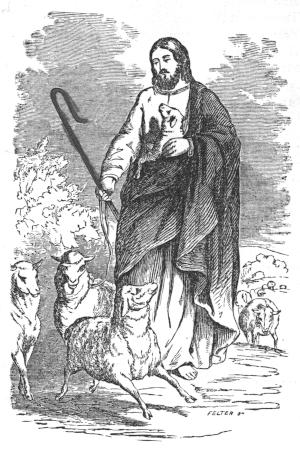
I.—TEACHING AND CHARACTER OF JESUS CHRIST.
CHATEAUBRIAND.
Among the French writers of the nineteenth century, Chateaubriand has been one of the most distinguished. His “Genius of Christianity” is a remarkably brilliant and eloquent work.
1. Jesus Christ appears among men full of grace and truth; the authority and the mildness of His precepts[6] are irresistible. He comes to heal the most unhappy of mortals, and all His wonders are for the wretched. In order to inculcate[7] His doctrine, He chooses the apologue,[8] or parable, which is easily impressed[9] on the minds of the people. While walking in the fields, He gives His divine lessons.
2. When surveying the flowers that adorn the mead, He exhorts His disciples to put their trust in Providence, who supports the feeble plants, and feeds the birds of the air; when He beholds the fruits of the earth, He teaches them to judge of men by their works; an infant is brought to Him, and He recommends innocence; being among shepherds, He gives Himself the appellation of the Good Shepherd, and represents Himself as bringing back the lost sheep to the fold.
3. In Spring He takes His seat upon the mountain, and draws from the surrounding objects instruction for the multitude sitting at His feet. From the very sight of this multitude, composed of the poor and the unfortunate, He deduces His beatitudes. Blessed are those that weep—blessed are they that hunger and thirst. Such as observe His precepts, and those that slight them, are compared to two men who build houses, the one upon a rock, and the other upon the sand. When He asks the woman of Samaria for drink, He expounds unto her His heavenly doctrine, under the beautiful image of a well of living water.
4. His character was amiable, open, and tender, and His charity unbounded. The evangelist gives us a complete and admirable idea of it in these few words: He went about doing good. His resignation to the will of God is conspicuous[10] in every moment of His life; He loved and felt the sentiment of friendship: the man whom He raised from the tomb, Lazarus, was His friend; it was for the sake of the noblest sentiment of life that He performed the greatest of His miracles.
5. In Him the love of country may find a model. “O, Jerusalem, Jerusalem,” He exclaimed, at the idea of the judgments which threatened that guilty city, “how often would I have gathered thy children together, even as a hen gathereth her chickens under her wings, and ye would not!” Casting His sorrowful eyes from the top of a hill over this city, doomed for her crimes to a signal destruction, He was unable to restrain His tears: “He beheld the city,” says the evangelist, “and wept over it.” His tolerance[11] was not less remarkable: when His disciples begged him to command fire to come down from heaven on a village of Samaria, which had denied Him hospitality, He replied with indignation, “Ye know not what manner of spirit ye are of.”
II.—LITTLE AT FIRST, BUT GREAT AT LAST
1. A traveler through a dusty road, Strewed[12] acorns on the lea,[13] And one took root, and sprouted up, And grew into a tree. Love sought its shade at evening time, To breathe its early vows, And Age was pleased, in heat of noon, To bask[14] beneath its boughs. The dormouse loved its dangling twigs; The birds sweet music bore; It stood a glory in its place— A blessing evermore. 2. A little spring had lost its way Amid the grass and fern: A passing stranger scooped a well, Where weary men might turn; He walled it in, and hung with care A ladle at the brink; He thought not of the deed he did, But judged that Toil might drink. He passed again—and lo! the well, By summers never dried, Had cooled ten thousand parching tongues, And saved a life beside. 3. A dreamer dropped a random[15] thought; ’Twas old, and yet ’twas new— A simple fancy of the brain, But strong in being true: It shone upon a genial[16] mind, And lo! its light became A lamp of life, a beacon[17] ray, A monitory[18] flame. The thought was small—its issue[19] great; A watch-fire on the hill, It sheds its radiance[20] far adown, And cheers the valley still! 4. A nameless man, amid a crowd That thronged the daily mart,[21] Let fall a word of hope and love, Unstudied, from the heart; A whisper on the tumult thrown— A transitory[22] breath— It raised a brother from the dust; It saved a soul from death. Oh germ! oh fount! oh word of love! Oh thought at random cast! Ye were but little at the first, But mighty at the last!
III.—THE DEVOTED SON AND THE GENEROUS STRANGER.
BROTHER PHILIPPE.
Brother Philippe is the present (1871) Superior General of the Brothers of the Christian Schools. He is the author of several very meritorious works. He resides in France, where during the late war he was remarkable, though a very old man, for his energy, courage and holy zeal in providing for the wants of the wounded and dying upon the battle fields.
1. A young man, named Robert, was waiting on the coast at Marseilles for some one to hire his boat. A stranger entered, and was on the point of stepping out again, notwithstanding the presence of Robert, whom he did not suppose to be the owner. “As the boat-man is not coming,” said he, “I shall pass into another boat.” “Sir,” said Robert, “this is my own boat, do you wish to get out of port?” “No; I merely thought of enjoying a row on the river before night closed in, but you don’t look like a sailor.” “True, Sir, I am not a sailor; but the want of money forces me to seek employment during my leisure hours.”
2. “What! avaricious[23] at your age? This is a shame which mars your youth, and lessens the interest inspired by your pleasing appearance.” “Ah! Sir, if you knew why I wish to make money, you would not, indeed, add to my sorrow by believing me guilty of such a low vice.” “I may have wronged you; but you have not explained yourself. Let us have a row; meantime you can tell me all your troubles, for your looks have disposed me in your favor.”
3. “I have but one trouble,” said the young man; “it is that of having a dear father bound in chains; and this may last I know not how long! My father was a broker in this city, and had obtained, by means of his own and my mother’s earnings, an interest in a merchant vessel bound to Smyrna. He took charge of the buying and the selling of the stock. The vessel was seized by a pirate ship, and taken to Tetuan, where my father remains prisoner, with the greater part of the ship’s crew. They demand ten thousand francs for his ransom;[24] but, as he had made large outlays so as to increase the business, we are far from possessing that sum. However, my mother and my sisters work day and night, and I contrive to do my part as a clerk in a jeweler’s shop, and I seek besides, as you perceive, to fill up my leisure hours. We have retrenched our mode of living in every possible way, and one room forms our lodging. At first I thought of going to take my father’s place, and thus release him from his cruel chains. I was about putting this idea into execution, when my mother assured me that such an undertaking was as rash as it was impracticable;[25] and she forbade all the captains of the Levant to take me on board.”
4. “Do you ever hear from your father? Do you know the name of his master in Tetuan, and in what manner is he treated?” “His master is the intendant of the king’s gardens; they treat him with humanity, and the labor to which he is subjected is not above his strength. But he is our father; he is so good, and we are not there to comfort him; he is far from us, from his dear wife and his three children, whom he loves tenderly.”
5. “What name does he bear in Tetuan?” “It is not changed; they call him Robert.” “Robert? in Tetuan? with the intendant[26] of the gardens?” “Yes, Sir.”
6. “I am touched at your sorrow, my good friend; and, in consequence of your noble sentiments, I predict[27] for you the accomplishment of your wishes, which, indeed, you richly merit. Meanwhile, let me now enjoy a few moments’ solitude in this spot.”
7. When it was night, Robert had orders to put him ashore. Then the stranger, slipping a purse into the young man’s hands, disappeared without allowing him time to express his thanks. The purse contained four hundred francs, mostly in gold coins. Such generosity gave Robert the highest opinion of the stranger, who had listened with so much interest to his sad tale. In vain did Robert seek him, to assure him of his lasting gratitude.
8. Six weeks elapsed since this extraordinary occurrence, and those good people worked on indefatigably,[28] to complete the sum mentioned. One day they were partaking of a frugal meal of bread and dried almonds, in the narrow room which was their home, when a man entered, and surprised them in the midst of their trouble and their misery. He was cleanly clad. Heavens! ... it is Robert, their father. What astonishment! What exclamations of joy! What tears were shed, in their happiness. Robert embraced his wife and his children, and told them how thankful he felt for the twelve thousand francs which he received at the moment he embarked on the vessel, where his passage had been already paid; clothes also were furnished him, and he knew not, he said, how to acknowledge so much solicitude[29] and attention.
9. The surprise of the mother and the children increased at every word spoken; they could not comprehend this mysterious language, and they looked at each other in their bewilderment. At length, the mother broke silence: she supposed that her son had done all this without consulting her; she told her husband how zealously he had labored since the beginning of his captivity; how he had endeavored to go and replace him, and how she had prevented him from so doing. “Ten thousand francs,” added she, “were necessary for the ransom; we had but a little more than the half, most part of which was acquired[30] by his attention to business; for the rest, friends must have aided him.”
11. All at once the disheartened father grew thoughtful and gloomy, and thus addressed his son: “Unhappy boy, can I owe you my liberty without regret? How could it have remained a secret to your mother, and not be bought at the price of virtue? At your age, unhappy son of a slave, one cannot easily obtain so much money. I shudder to think that filial piety may have made you culpable.[31] Confide in me, be sincere, do not conceal the truth; have you been guilty of dishonesty?”
12. “Banish your fears, dear father,” cried the virtuous son, as he embraced him tenderly; “your child is not unworthy of this title, nor lucky enough to have effected your freedom, which, in truth, you do not owe to me; I know your benefactor—oh, yes, I know him. Do you remember, dear mother, the stranger who gave me his purse—how he questioned me thus: ‘Where is your father? What is his name? Who is his master?’ Were I to spend my whole life, I shall find him again, and he shall admire the fruits of his generosity.”
Then his dutiful son related the incident which had taken place, restoring, meanwhile, the peace and the happiness which had, for a moment, given place to fear.
13. Restored to his family, the honest Robert found friends and means. Success surpassed his hopes. After ten years, he had acquired a little fortune; and his children, who were all settled in life, shared the happiness of their father and mother.
IV.—THE CHRISTIAN MOTHER.
MARY I. HOFFMAN.
Miss Hoffman is an American authoress of very marked ability. Her “Agnes Hilton,” “Alice Murray,” and “Felix Kent” are works of fiction of great and deserved popularity.
1. It was a poor, dilapidated[32] house in a narrow lane; no curtains shaded the small windows through which the glaring sun came mockingly in. A table stood in the middle of the room, with—we cannot say the remains of the last meal, for the meal had been too scant to have any remains—but with the soiled cups and plates still unremoved; the cold stove looked as if it had never known what it was to have a good fire blazing and burning within it; back by the wall was an old scuttle, in which were a few coals, evidently placed there away from the stove, lest too close proximity[33] might tempt to using them before the time to heat the teakettle for the next meal came round.
2. On a little bench sat a pale, thin-faced child of seven or eight years. An old, threadbare coat, very much too large, was wrapped around him, completely covering, or rather burying him in its ample folds. After one or two ineffectual attempts he succeeded in disengaging[34] his little hands, and then smoothed back the golden locks from his broad, handsome brow.
3. On the floor were two little girls, one five, the other three. They were playing with bits of cloth and shreds of ribbons, ever and anon pausing to look up in the face of a middle-aged woman sitting by the window, sewing on a jacket as fast as her hand could fly. She had on a faded dress of mourning, and her countenance looked sorrow-stricken and worn.
4. On a bed in one corner was lying a boy of fifteen or sixteen years. He was very pale, and with the sunken eyes closed, the chin slightly fallen, the ashen lips parted, displaying the large even teeth, a looker-on might have congratulated himself that the vital[35] spark had fled—that the spirit had found a happier home. But his languid eyes opened, and a groan escaped his lips.
5. His mother started and exclaimed:
“Oh, Alfred, that pain has again awakened you!”
“No, mother, no, I was not asleep,” he sorrowfully replied.
“Not asleep, Alfred! I thought you were, you lay so quiet.”
“I know it, but I only had my eyes closed, thinking of the time we lived in Stanton, and it all came back so plain, that I thought this poor, cold room was only a dream, but I opened my eyes, and oh, mother, it wasn’t, it wasn’t!” Clasping his hands, he cried: “What a change since father died, what a change!” and sobs choked the further utterance of the poor, sick boy.
6. “Oh, Alfred, dear Alfred,” said his mother, while unbidden tears came into her eyes; “your father was too good to be left here to suffer. He was called home to heaven—to heaven,” she slowly repeated, dropping her needle and pressing her hand upon her heart to keep down its tumultuous[36] throbbings. Then, after a moment’s pause, she added:
“But, Alfred, be patient; God will not forget us.”
“Forget us!” he exclaimed, starting up and looking wildly around, “why, mother, it seems we are already forgotten.”
“No, Alfred, don’t say that; God is so good and merciful, He sends us these trials to disengage our minds from the world, and prepare us for heaven; His beautiful heaven, child. You remember when, in Stanton, we used to read of it, and think we could even suffer martyrdom to show our love and gratitude to our dear Lord, who came on earth and died that we might enjoy it. And now, when pain and suffering come upon us, shall we murmur and repine?”
7. “Oh, mother, I don’t want to murmur,[37] but—oh, it is so much easier to talk of pain than it is to suffer it.”
“But, Alfred, dear, any pain or trial sent by God, if we only bear it with patience and resignation, will be showing the same love as if we died for Him.”
“Why, mother!” he exclaimed, forgetting, in his surprise, the great weakness that a moment before had gathered around his heart; “your words seem so strange, I will not say irreverent—but, mother, to compare our trials to martyrdom seems—seems so presumptuous.”[38]
8. Pausing an instant in her sewing, she fixed a steadfast gaze upon him; perceiving the conversation was not wearying him, she said:
“Alfred, I have often wished in this sickness to tell you my thoughts on this subject, for it seems they were suggested by my good angel, to strengthen and comfort me. You have been so weak, that I have not dared to dwell on any subject, or use more words than were absolutely necessary. But now I see you are able to hear me, and I will speak.”
9. “Yes, do, mother, do tell me something that will comfort me too; for, oh, how sad, how stricken I feel!” His large eyes looked haggard and wild. The little boy on the bench moved nearer, and, bending over with his elbows on his knees and his chin resting on his tiny palms, fixed his blue eyes wonderingly upon her, listening intently to what she was about to say. Newly threading her needle, she commenced;
“Alfred, a martyr suffers death through love of God, and rather than consent to an act displeasing to Him; in other words, rather than do any thing that would offend Him.”
“Yes, mother, but—”
“Wait, my child, wait. If now, through the same love of God, and through fear of offending Him, we suffer our trials and afflictions with patience and resignation, is it not the same spirit which leads one to martyrdom? is it not, my child, the same?”
10. He paused a moment before replying, and then slowly said: “In the way in which you present it to my view, it really does seem so, mother; but—” placing his hand upon his heart, “I wish I could make it seem so here.” He raised himself on his elbow and gazed round the desolate room; a wintry smile lit up his wan countenance.
“Oh, mother,” he bitterly exclaimed, “to talk of glorious martyrdom and joyous heaven in this wretched, wretched home of poverty!”
11. “Why not, my child?” she asked, in her kindest and most soothing tones. “Is it not the very place to talk of them? Has Alfred forgotten the cold little stable of Bethlehem, and the poor, comfortless home of Egypt? No, no, Alfred, poverty itself can never exclude[39] us from heaven. One single sin may forever close its gates, but, let us be ever so poor and wretched, we still have just as great a claim to heaven as the richest; perhaps even greater; remember Lazarus.”
11. Clasping her thin hands, while a smile played over her worn features, she continued:
“It may come upon us—poverty may—with such crushing force that we will have to lie down and die; but then it will be our path to heaven, our road home. Home! Oh, Alfred, what comfort in that word! There we will meet father, mother, sisters, brothers, and all will be joy and happiness. Every tear will be wiped away, and all the sorrow and wretchedness of the way-side forgotten. Yes, Alfred, from this very room, so poor and cold, we may go to a home all beautiful and bright.” With a hurried hand she resumed her sewing. Alfred was silent, but the cloud had passed from his brow.
V.—WOODMAN, SPARE THAT TREE.
MORRIS.
George P. Morris, an American writer, was born October 10, 1802, and died July 6, 1864. He was the author of many popular songs.
1. Woodman, spare that tree; Touch not a single bough; In youth it sheltered me, And I’ll protect it now. ’Twas my forefather’s[40] hand That placed it near his cot; Then, woodman, let it stand; Thy axe shall harm it not. 2. That old, familiar[41] tree, Whose glory and renown[42] Are spread o’er land and sea, And wouldst thou hew it down? Woodman, forbear thy stroke: Cut not its earth-bound ties; O, spare that aged oak, Now towering[43] to the skies. 3. When but an idle boy, I sought its grateful shade; In all their gushing[44] joy. Here, too, my sisters played. My mother kissed me here; My father pressed my hand: Forgive this foolish tear, But let that old oak stand. 4. My heartstrings round thee cling, Close as thy bark, old friend! Here shall the wild bird sing, And still thy branches bend. Old tree, the storm still brave! And, woodman, leave the spot; While I’ve a hand to save, Thy axe shall harm it not.
VI.—THE TWO ROADS.
1. It was New Year’s night. An aged man was standing at a window. He raised his mournful eyes towards the deep blue sky, where the stars were floating, like white lilies, on the surface of a clear, calm lake. Then he cast them on the earth, where few more hopeless beings than himself now moved towards their certain goal[45]—the tomb.
2. Already he had passed sixty of the stages[46] which lead to it, and he had brought from his journey nothing but errors and remorse. His health was destroyed, his mind vacant, his heart sorrowful, and his old age devoid of comfort.
3. The days of his youth rose up in a vision[47] before him, and he recalled the solemn moment when his father had placed him at the entrance of two roads—one leading into a peaceful, sunny land, covered with a fertile harvest, and resounding with soft, sweet songs; the other leading the wanderer into a deep, dark cave, whence there was no issue[48], where poison flowed instead of water, and where serpents hissed and crawled.
4. He looked towards the sky, and cried out in his agony, “O youth, return! O my father, place me once more at the entrance to life, that I may choose the better way!” But his father and the days of his youth had both passed away.
5. He saw wondering lights floating away over dark marshes, and then disappear. These were the days of his wasted life. He saw a star fall from heaven, and vanish in darkness. This was an emblem[49] of himself, and the sharp arrows of unavailing remorse[50] struck home to his heart. Then he remembered his early companions, who entered on life with him, but who, having trod the paths of virtue and of labor, were now honored and happy on this New Year’s night.
6. The clock, in the high church tower, struck, and the sound, falling on his ear, recalled his parents’ early love for him, their erring son; the lessons they had taught him; the prayers they had offered up in his behalf. Overwhelmed with shame and grief, he dared no longer look towards that heaven where his father dwelt; his darkened eyes dropped tears, and with one despairing effort, he cried aloud, “Come back, my early days! come back!”
7. And his youth did return; for all this was but a dream which visited his slumbers on New Year’s night. He was still young; his faults alone were real. He thanked God fervently that time was still his own; that he had not yet entered the deep, dark cavern, but that he was free to tread the road leading to the peaceful land where sunny harvests wave.
8. Ye who still linger on the threshold[51] of life, doubting which path to choose, remember that, when years are passed, and your feet stumble on the dark mountain, you will cry bitterly[52], but cry in vain, “O youth, return! O, give me back my early days!”
VII.—THE LABORERS.
1. You can not pay with money The million sons of toil— The sailor on the ocean, The peasant on the soil, The laborer in the quarry, The hewer of the coal; Your money pays the hand, But it can not pay the soul. 2. You gaze on the cathedral[53] Whose turrets[54] meet the sky: Remember the foundations That in earth and darkness lie: For, were not those foundations So darkly resting there, Yon towers up could never soar So proudly in the air. 3. The workshop must be crowded, That the palace may be bright; If the plowman did not plow, Then the poet could not write. Then let every toil be hallowed[55] That man performs for man, And have its share of honor As part of one great plan. 4. See, light darts down from heaven, And enters where it may; The eyes of all earth’s people Are cheered with one bright day. And let the mind’s true sunshine Be spread o’er earth as free, And fill the souls of men, As the waters fill the sea. 5. The man who turns the soil Need not have an earthly mind; The digger ’mid the coal Need not be in spirit blind: The mind can shed a light On each worthy labor done, As lowliest things are bright In the radiance[56] of the sun. 6. What cheers the musing[57] student? The poet, the divine? The thought that, for his followers, A brighter day will shine. Let every human laborer Enjoy the vision bright— Let the thought that comes from heaven. Be spread like heaven’s own light! 7. Ye men who hold the pen, Rise like a band inspired;[58] And, poets, let your lyrics[59] With hope for man be fired;[60] Till the earth becomes a temple, And every human heart Shall join in one great service, Each happy in his part.
VIII.—THE BOY.
WILLIS.
1. There’s something in a noble boy, A brave, free-hearted, careless one, With his unchecked, unbidden joy, His dread of books and love of fun, And in his clear and ready smile, Unshaded by a thought of guile, And unrepressed[61] by sadness,— Which brings me to my childhood back, As if I trod its very track, And felt its very gladness. 2. And yet, it is not in his play, When every trace of thought is lost, And not when you would call him gay, That his bright presence thrills me most: His shout may ring upon the hill, His voice be echoed in the hall, His merry laugh like music trill, And I in sadness hear it all,— For, like the wrinkles on my brow, I scarcely notice such things now,— 3. But when, amid the earnest game, He stops, as if he music heard, And, heedless of his shouted name As of the carol[62] of a bird, Stands gazing on the empty air, As if some dream were passing there;— ’Tis then that on his face I look— His beautiful but thoughtful face— And like a long-forgotten book, Its sweet familiar meanings trace,— 4. Remembering a thousand things Which passed me on those golden wings, Which time has fettered now; Things that came o’er me with a thrill, And left me silent, sad, and still, And threw upon my brow A holier and a gentler cast, That was too innocent to last. 5. ’Tis strange how thoughts upon a child Will, like a presence, sometimes press, And when his pulse is beating wild, And life itself is in excess[63]— When foot and hand, and ear and eye, Are all with ardor[64] straining high— How in his heart will spring A feeling whose mysterious[65] thrall[66] Is stronger, sweeter far than all! And on its silent wing, How, with the clouds, he’ll float away, As wandering and as lost as they!
IX.—THE YOUNG SHEPHERD.
FENELON.
The illustrious Fenelon, archbishop of Cambray, in France, was born in 1651 and died, at Cambray, in 1715. He was as remarkable for sanctity as for genius. His purity, meekness and amiability, won the hearts of all—even of his enemies, if it can be said that he had any.
1. Sha-Abbas, king of Persia, being on his travels, withdrew from his retinue,[67] in order to visit the country, and there, without being known, to behold mankind in all their native freedom. He took with him only one of his officers, as an attendant.
2. “I am weary,” said he, “of living among sycophants,[68] who take all occasions to over-reach, while they flatter me. I am determined to visit husbandmen and shepherds, who know nothing of me.”
3. He traveled, with his confidant, through several villages where the peasants were dancing, and was overjoyed to see that his subjects, though at such a distance from court, had their diversions, and those so innocent and unexpensive.
4. After refreshing himself in a cottage, he crossed a meadow, enameled[69] with flowers, which decked the borders of a limpid[70] stream. Here he spied a young shepherd, playing on his pipe beneath a shady elm, while his flocks were grazing around him.
5. The king accosts him, surveys him closely, finds his aspect agreeable, and his air, though easy and natural, yet graceful and majestic. The simple habit[71] in which the shepherd was clad, did not in the least diminish the agreeableness of his person. The king supposed him at first to be a youth of illustrious birth, who had disguised himself; but he learned from the shepherd that his parents dwelt in an adjacent[72] village, and that his name was Alibeg.
6. The more questions the king put to him, the more he admired the strength and solidity of his genius. His eyes were lively, and beaming[73] with intelligence; his voice was sweet and melodious; his features were not rude, neither were they soft and effeminate.[74] The shepherd, though sixteen years of age, did not seem conscious of those perfections which were conspicuous to others. He imagined that his thoughts, his conversation, and his person, were not unlike those of his neighbors.
7. The king frequently smiled at the innocent freedom of the youth, who gave him much information about the state of the people. He gave the officer who accompanied him a private signal not to discover that he was the king, for fear that Alibeg, if he once knew with whom he conversed, would lose in an instant, his wonted[75] freedom, and all his native graces.
8. “I am now convinced,” said the prince to his attendant, “that nature is as beautiful in the lowest state as in the highest. No monarch’s son was ever born with nobler faculties than this young shepherd. I should think myself infinitely happy, had I a son equally handsome, intelligent, and ingenuous.[76] I will have him educated at my own court.”
9. The king accordingly took Alibeg away with him; and the youthful shepherd was much surprised to find that a prince should be so pleased with his conversation. Taken to court, he was instructed by proper tutors in all the graces which add to manly beauty, and in all the arts and sciences which adorn the mind.
10. The grandeur of the court, and a sudden change of fortune, in some measure influenced the temper of Alibeg. His crook, his pipe, and shepherd’s dress, were now forsaken; and, instead of them, he appeared in a purple robe embroidered with gold, and a turban enriched with jewels. Alibeg was handsomer than any other man at court. He was qualified to transact the most important affairs, and his master, placing the utmost confidence in his integrity,[77] soon conferred on him the post of jewel-keeper and treasurer of his household.
11. During the whole reign of the great Sha-Abbas, Alibeg’s reputation daily increased. But, as he advanced in years, he frequently recalled to mind his former state of life, and always with regret. “Oh, happy days!” would he whisper to himself; “oh, innocent days! days, wherein I tasted true joys without danger; days, since which I never saw one so pleasant, shall I not see you any more? He who has deprived me of you, by making me thus great, has utterly undone me.”
X. THE YOUNG SHEPHERD—Continued.
1. Alibeg, after a long absence, revisited his native village. Here he gazed with fondness on those places where he had formerly danced, sung, and tuned his pipe with his fellow-swains.[78] He made presents to all his friends and relations; but advised them, as they valued their peace of mind, never to resign their rural pleasures, never to expose themselves to the anxieties and misfortunes of a court. Alibeg felt the weight of those misfortunes, soon after the death of his good master Sha-Abbas.
2. Sha-Sephi succeeded his father. Some envious, artful courtiers[79] found means to prejudice the young prince against him. “He has,” said they, “betrayed the trust reposed in him by the late king. He has hoarded up immense treasures, and embezzled[80] valuable effects.”
3. Sha-Sephi was young, and a monarch; which was more than sufficient to make him credulous[81] and inconsiderate. He had, besides, the vanity to think himself qualified to reform his fathers acts, and to judge of things better than the latter had done. To have some plea for removing Alibeg from his post, he commanded him to produce the cimeter,[82] set with diamonds of an immense value, which his royal grandsire used to wear in battle. Sha-Abbas had formerly ordered these to be taken off; and Alibeg brought witnesses to prove that they were so removed long before his promotion.
4. When Alibeg’s enemies found this scheme too weak to effect his ruin, they prevailed on Sha-Sephi to give him strict orders to produce an exact inventory[83] of all the rich furniture intrusted to his care. Alibeg opened the doors, and showed every thing committed to his charge. No one article was missing: each was in its proper place, and preserved with great care.
5. The king, surprised to see such order every where observed, began to entertain a favorable opinion of Alibeg, till he espied, at the end of a long gallery, an iron door, with three strong locks. “There it is,” whispered the envious courtiers in his ear, “that Alibeg has concealed all the valuable effects which he has purloined.”[84] The king now angrily exclaimed, “I will see what is in that room. What have you concealed there? Show it me.” Alibeg fell prostrate at his feet, beseeching him not to take from him all that he now held valuable upon earth.
6. Sha-Sephi now took it for granted that Alibeg’s ill-gotten treasure lay concealed within. He commanded the door to be opened. Alibeg, who had the keys in his pocket, unlocked the door. Nothing, however, was found there, but his crook, his pipe, and the shepherd’s dress which he wore in his youth.
7. “Behold great sir,” said he, “the remains of my former felicity,[85] which neither fortune nor your majesty have taken from me. Behold my treasure, which I reserve to make me rich, when you shall think proper to make me poor. Take back every thing besides; but leave me these dear pledges of my rural[86] station. These are my substantial riches which will never fail me.
8. “These, O king! are the precious, yet innocent possessions of those who can live contented with the necessaries of life, without tormenting themselves about superfluous[87] enjoyments. These are riches which are possessed with liberty and safety; riches which never give me one moment’s disquiet. Oh, ye dear implements of a plain, but happy life! I value none but you; with you I will live, and with you die. I here resign, great sir, the many favors which your royal bounty[88] has bestowed upon me.”
9. The king, convinced of Alibeg’s innocence, instantly banished his accusers from court. Alibeg became his prime minister, and was intrusted with the most important secrets. He visited, however, every day, his crook, his pipe, and rural habit, that he might remember them, should fickle fortune deprive him of a monarchˊs favor. He died in a good old age, without wishing to have his enemies punished, or to increase his possessions; and left his relations no more than what would maintain them in the station of shepherds, which he always thought the safest and most happy.
XI.—OLD TIMES.
GERALD GRIFFIN.
Gerald Griffin was born in Ireland in 1803. He was a distinguished novelist and dramatist. He has also written some short poems remarkable for their tenderness of feeling and beauty of expression.
While still a young man he withdrew from the pursuits of literature and joined the Brothers of the Christian Schools. He died in 1840 at the early age of thirty-seven.
1. Old times! old times! the gay old times! When I was young and free, And heard the merry Easter chimes, Under the sally tree; My Sunday palm beside me placed, My cross upon my hand, A heart at rest within my breast, And sunshine on the land! Old times! old times! 2. It is not that my fortunes flee, Nor that my cheek is pale, I mourn whene’er I think of thee, My darling native vale! A wiser head I have, I know, Than when I loitered there; But in my wisdom there is woe, And in my knowledge care, Old times! old times! 3. I’ve lived to know my share of joy, To feel my share of pain, To learn that friendship’s self can cloy, To love and love in vain— To feel a pang and wear a smile, To tire of other climes, To like my own unhappy isle, And sing the gay old times! Old times! old times! 4. And sure the land is nothing changed, The birds are singing still; The flowers are springing where we ranged, There’s sunshine on the hill; The sally waving o’er my head, Still sweetly shades my frame, But ah, those happy days are fled, And I am not the same! Old times! old times! 5. Oh, come again, ye merry times! Sweet, sunny, fresh, and calm; And let me hear those Easter chimes, And wear my Sunday palm. If I could cry away mine eyes, My tears would flow in vain; If I could waste my heart in sighs, They’ll never come again! Old times! old times!
XII.—THE BROKEN HEART.
IRVING.
Washington Irving was born in the City of New York, in 1783 and died in 1859. His writings are deservedly popular. His “Sketch Book,” “Life of Goldsmith,” “Life of Columbus,” “Conquest of Granada,” and other works, have made him as well known to European as to American readers.
1. Every one must recollect the tragical[89] story of young Emmet, the Irish patriot; it was too touching to be soon forgotten. His fate made a deep impression on public sympathy. During the troubles in Ireland he was tried, condemned, and executed[90] on a charge of treason. He was so young, so intelligent, so generous, so brave, so everything that we are apt to like in a young man. His conduct under trial, too, was so lofty and intrepid. The noble indignation with which he repelled[91] the charge of treason against his country, the eloquent vindication of his name, and his pathetic appeal to posterity, in the hopeless hour of condemnation, all these entered deeply into every generous bosom, and even his enemies lamented the stern policy that dictated his execution.
2. But there was one heart whose anguish it would be impossible to describe. In happier days and fairer fortunes, he had won the affections of a beautiful and interesting girl, the daughter of a late celebrated Irish barrister. She loved him with the disinterested fervor[92] of a woman’s first and early love. When every worldly maxim arrayed itself against him; when blasted in fortune, and disgrace and danger darkened around his name, she loved him the more ardently for his sufferings. If, then, his fate could awaken the sympathy even of his foes, what must have been the agony of her whose whole soul was occupied by his image! Let those tell who have had the portals[93] of the tomb suddenly closed between them and the being they most loved on earth, who have sat at its threshold, as one shut out in a cold and lonely world, whence all that was most lovely and loving had departed.
3. But then the horrors of such a grave! so frightful, so dishonored! there was nothing for memory to dwell on, that could soothe the pangs of separation, none of those tender, though melancholy circumstances, which endear the parting scene, nothing to melt sorrow into those blessed tears, sent like the dews of heaven to revive the heart in the parting hour of anguish.
4. To render her widowed situation more desolate, she had incurred her fathers displeasure by her unfortunate attachment, and was an exile from the paternal roof. But could the sympathy and kind offices of friends have reached a spirit so shocked and driven in by horror, she would have experienced no want of consolation, for the Irish are a people of quick and generous sensibilities.[94] The most delicate and cherishing attentions were paid her by families of wealth and distinction. She was led into society, and they tried by all kinds of occupation and amusement to dissipate[95] her grief, and wean her from the tragical story of her love.
5. But it was all in vain. There are some strokes of calamity which scathe and scorch the soul, which penetrate to the vital seat of happiness, and blast it, never again to put forth bud or blossom. She never objected to frequent the haunts of pleasure, but was as much alone there as in the depths of solitude[96] walking about in a sad reverie, apparently unconscious of the world around her. She carried with her an inward woe, that mocked at all the blandishments[97] of friendship, and “heeded not the song of the charmer, charm he never so wisely”.
6. The person who told me her story had seen her at a masquerade[98]. There can be no exhibition of far-gone wretchedness more striking and painful than to meet it in such a scene; to find it wandering like a specter, lone and joyless, where all around is gay, to see it dressed out in the trappings of mirth, and looking so wan and woe-begone, as if it had tried in vain to cheat the poor heart into a momentary forgetfulness of sorrow.
7. After strolling through the splendid rooms and giddy crowd with an air of utter abstraction,[99] she sat herself down on the steps of an orchestra,[100] and, looking about for some time with a vacant air, that showed her insensibility to the garish[101] scene, she began with the capriciousness[102] of a sickly heart, to warble a little plaintive air. She had an exquisite voice; but on this occasion it was so simple, so touching, it breathed forth such a soul of wretchedness, that she drew a crowd mute and silent around her, and melted every one into tears.
8. The story of one so true and tender, could not but excite great interest in a country remarkable for enthusiasm. It completely won the heart of a brave officer, who paid his address to her, and thought that one so true to the dead could not but prove affectionate to the living. She declined his attentions, for her thoughts were irrevocably engrossed by the memory of her former lover. He, however, persisted in his suit. He solicited not her tenderness, but her esteem. He was assisted by her conviction of his worth, and her sense of her own destitute and dependent situation, for she was existing on the kindness of friends. In a word, he at length succeeded in gaining her hand, though with the solemn assurance that her heart was unalterably another’s.
9. He took her with him to Sicily, hoping that a change of scene might wear out the remembrance of her early woes. She was an amiable and exemplary wife, and made an effort to be a happy one; but nothing could cure the silent and devouring melancholy that had entered into her very soul. She wasted away in a slow but hopeless decline, and, at length, sank into the grave, the victim of a broken heart.
10. She is far from the land where her young hero sleeps, And lovers are around her, sighing; But coldly she turns from their gaze, and weeps, For her heart in his grave is lying! 11. She sings the wild song of her dear native plains, Every note which he loved awaking; Ah! little they think who delight in her strains, How the heart of the Minstrel is breaking! 12. He had lived for his love, for his country he died, They were all that to life had entwined him; Nor soon shall the tears of his country be dried, Nor long will his love stay behind him. 13. O! make her a grave where the sunbeams rest, When they promise a glorious morrow; They’ll shine o’er her sleep, like a smile from the West, From her own loved island of sorrow!
XIII.—LITTLE VICTORIES.
Remark.—In conversational pieces like the following, the manner of each speaker should be imitated, as in a dialogue.
1. “Oh, mother, now that I have lost my limb, I can never be a soldier or a sailor; I can never go round the world!” And Hugh burst into tears, now more really afflicted than he had ever been yet. His mother sat on the bed beside him, and wiped away his tears as they flowed, while he told her, as well as his sobs would let him, how long and how much he had reckoned on going round the world, and how little he cared for anything else in future; and now this was the very thing he should never be able to do!
2. He had practiced climbing ever since he could remember, and now this was of no use; he had practiced marching, and now he should never march again. When he had finished his complaint, there was a pause, and his mother said, “Hugh, you have heard of Huber.”
“The man who found out so much about bees?” said Hugh.
“Bees and ants. When Huber had discovered[103] more than had ever been known about these, and when he was sure that he could learn still more, and was more and more anxious to peep into their tiny[104] homes, and curious ways, he became blind.”
3. Hugh sighed, and his mother went on.
“Did you ever hear of Beethoven? He was one of the greatest musical composers[105] that ever lived. His great, his sole delight, was in music. It was the passion of his life. When all his time and all his mind were given to music, he suddenly became deaf, perfectly deaf; so that he never more heard one single note from the loudest orchestra[106]. While crowds were moved and delighted with his compositions[107] it was all silence to him.” Hugh said nothing.
4. “Now do you think,” asked his mother—and Hugh saw that a mild and gentle smile beamed from her countenance—“do you think that these people were without a heavenly Parent?”
“Oh no! but were they patient?” asked Hugh.
“Yes, in their different ways and degrees. Would you suppose that they were hardly treated? Or would you not rather suppose, that their Father gave them something better to do, than they had planned for themselves?”
5. “He must know best, of course; but it does seem very hard, that that very thing should happen to them. Huber would not have so much minded being deaf, perhaps; or that musical man being blind.”
“No doubt their hearts often swelled within them, at their disappointments; but I fully believe that they very soon found God’s will to be wiser than their wishes. They found, if they bore their trial well, that there was work for their hearts to do, far nobler than any the head could do through the eye, or the ear. And they soon felt a new and delicious pleasure, which none but the bitterly disappointed can feel.”
“What is that?”
6. “The pleasure of rousing the soul to bear pain, and of agreeing with God silently, when nobody knows what is in the breast. There is no pleasure like that of exercising one’s soul in bearing pain, and of finding one’s heart glow with the hope that one is pleasing God.”
“Shall I feel that pleasure?”
“Often and often, I have no doubt; every time you can willingly give up your wish to be a soldier, or a sailor, or any thing else you have set your mind upon, you will feel that pleasure. But I do not expect it of you yet. I dare say, it was long a bitter thing to Beethoven to see hundreds of people in raptures[108] with his music when he could not hear a note of it.”
7. “But did he ever smile again?” asked Hugh.
“If he did, he was happier than all the fine music in the world could have made him,” replied his mother.
“I wonder, oh, I wonder if I shall ever feel so!”
“We will pray to God that you may. Shall we ask him now?”
Hugh clasped his hand. His mother kneeled beside the bed, and, in a very few words, prayed that Hugh might be able to bear his misfortune[109] well, and that his friends might give him such help and comfort as God should approve.
XIV.—LITTLE VICTORIES.—Continued.
8. Hugh found himself subject to very painful feelings sometimes, such as no one quite understood, and such as he feared no one was able to pity as they deserved. On one occasion, when he had been quite merry for a while, and his mother and sister Agnes were chatting[110] they thought they heard a sob from the sofa. They spoke to Hugh, and found that he was indeed crying bitterly.
“What is it, my dear,” said his mother. “Agnes, have we said anything that could hurt his feelings?”
“No, no,” sobbed Hugh. “I will tell you presently.”
9. And presently he told them, that he was so busy listening to what they said, that he forgot every thing else, when he felt as if something got between two of his toes; unconsciously he put down his hand, as if his foot was there! Nothing could be plainer than the feeling in his toes; and, then, when he put out his hand, and found nothing, it was so terrible! it startled him so! It was a comfort to find that his mother knew about this. She came, and kneeled by his sofa, and told him that many persons who had lost a limb, considered this the most painful thing they had to bear, for some time; but that, though the feeling would return occasionally through life, it would cease to be painful.
10. Hugh was very much dejected[111], and when he thought of the months and years, to the end of his life, and that he should never run and play, and never be like other people, he almost wished that he was dead.
Agnes thought that he must be miserable indeed, if he could venture to say this to his mother. She glanced at her mother’s face, but there was no displeasure there. On the contrary, she said this feeling was very natural. She had felt it herself, under smaller misfortunes than Hugh’s; but she had found, though the prospect appears all strewn[112] with troubles, that they come singly, and are not so hard to bear, after all.
11. She told Hugh, that when she was a little girl, she was very lazy, fond of her bed, and not at all fond of dressing or washing.
“Why, mother! you?” exclaimed Hugh.
“Yes; that was the sort of little girl I was. Well, I was in despair, one day, at the thought that I should have to wash and clean my teeth, and brush my hair, and put on every article of dress, every morning as long as I lived.”
“Did you tell any body?” asked Hugh.
12. “No; I was ashamed to do that; but I remember I cried. You see how it turns out. When we have become accustomed to any thing, we do it without ever thinking of the trouble, and, as the old fable tells us, the clock, that has to tick so many millions of times, has exactly the same number of seconds to do it in. So will you find, that you can move about on each separate occasion, as you wish, and practise will enable you to do it without any trouble or thought.”
“But this is not all, nor half what I mean,” said Hugh.
13. “No, my dear, nor half what you will have to bear. You resolved to bear it all patiently, I remember. But what is it you dread the most?”
“Oh! all manner of things. I can never do like other people.”
“Some things,” replied his mother. “You can never play cricket, as every Crofton boy would like to do. You can never dance at your sister’s Christmas parties.”
14. “Oh! mamma!” cried Agnes, with tears in her eyes, and with the thought in her mind, that it was cruel to talk so.
“Go on! go on!” cried Hugh, brightening. “You know what I feel, mother; and you don’t keep telling me, as others do, and even sister Agnes, sometimes, that it will not signify much, and that I shall not care, and all that; making out that it is no misfortune, hardly, when I know what it is, and they don’t. Now then, go on, mother! What else?”
15. “There will be little checks and mortifications continually, when you see little boys leaping over this, and climbing that, and playing at the other, while you must stand out, and can only look on. And some people will pity you, in a way you will not like; and some may even laugh at you.”
“Oh mamma!” exclaimed Agnes.
“Well, and what else?” said Hugh.
16. “Sooner or later, you will have to follow some way of life determined by this accident, instead of one that you would have liked better.”
“Well, what else?”
“I must ask you, now. I can think of nothing more; and I hope there is not much else; for, indeed, I think here is quite enough for a boy, or any one else, to bear.”
“I will bear it, though; you will see.”
17. “You will find great helps. These misfortunes, of themselves strengthen one’s mind. They have some advantages, too. You will be a better scholar for your lameness, I have no doubt. You will read more books, and have a mind richer in thoughts. You will be more beloved by us all, and you yourself will love God more for having given you something to bear for His sake. God Himself will help you to bear your trials. You will conquer your trials one by one, and by a succession of little victories, will, at last, completely triumph over all.”
XV.—OUR TITLES.
1. Are we not Nobles? we who trace Our Pedigree[113] so high, That God for us and for our race Created Earth and Sky, And Light, and Air, and Time, and Space, To serve us, and then die. 2. Are we not Princes? we who stand As heirs beside the Throne; We who can call the promised land Our Heritage,[114] our own; And answer to no less command Than God’s, and His alone. 3. Are we not Kings? both night and day, From early until late, About our bed, about our way, A guard of Angels wait; And so we watch, and work, and pray In more than royal state. 4. Are we not holy? do not start; It is God’s sacred will To call us Temples set apart His Holy Ghost may fill; Our very food.... Oh hush, my heart, Adore It and be still! 5. Are we not more? Our life shall be Immortal[115] and divine; The nature Mary gave to Thee, Dear Jesus, still is Thine; Adoring in Thy Heart I see Such blood as beats in mine. 6. O God! that we can dare to fail, And dare to say we must! O God, that we can ever trail Such banners in the dust, Can let such starry honors pale, And such a Blazon[116] rust! 7. Shall we upon such Titles bring The taint of sin and shame? Shall we, the children of the King Who hold so grand a claim, Tarnish, by any meaner thing, The glory of our name?
XVI.—THE WIDOW OF THE PINE COTTAGE.
1. It was Saturday night, and the widow of the Pine Cottage sat by her blazing fagots,[117] with her five tattered children at her side, endeavoring, by listening to the artlessness, of their prattle,[118] to dissipate[119] the heavy gloom that pressed upon her mind. For a year, her own feeble hand had provided for her helpless family, for she had no supporter: she thought of no friend in all the wide, unfriendly world around.
2. But that mysterious Providence, the wisdom of whose ways is above human comprehension, had visited her with wasting sickness, and her little means had become exhausted. It was now, too, mid-winter, and the snow lay heavy and deep through all the surrounding forests, while storms still seemed gathering in the heavens, and the driving wind roared among the neighboring pines, and rocked her puny[120] mansion.
3. The last herring smoked upon the coals before her; it was the only article of food she possessed, and no wonder her forlorn, desolate state brought up in her lone bosom all the anxieties of a mother, when she looked upon her children; and no wonder, forlorn as she was, if she suffered the heart-swellings of despair to rise, even though she knew that He, whose promise is to the widow and to the orphan, can not forget his word.
4. Providence had, many years before, taken from her her eldest son, who went from his forest home to try his fortune on the high seas, since which she had heard no tidings of him; and, later still, the hand of death deprived her of the companion and staff of her earthly pilgrimage,[121] in the person of her husband. Yet to this hour she had upborne; she had not only been able to provide for her little flock, but had never lost an opportunity of ministering to the wants of the miserable and destitute.
5. The indolent may well bear with poverty, while the ability to gain sustenance remains. The individual who has but his own wants to supply, may suffer with fortitude the winter of want; his affections are not wounded, his heart not wrung. The most desolate in populous cities may hope, for charity has not quite closed her hand and heart, and shut her eyes on misery.
6. But the industrious mother of helpless and depending children, far from the reach of human charity, has none of these to console her. And such a one was the widow of the Pine Cottage; but as she bent over the fire, and took up the last scanty remnant of food, to spread before her children, her spirits seemed to brighten up, as by some sudden and mysterious impulse, and Cowper’s beautiful lines came uncalled across her mind:
Judge not the Lord by feeble sense, But trust Him for His grace; Behind a frowning Providence He hides a smiling face.
7. The smoked herring was scarcely laid upon the table, when a gentle rap at the door, and loud barking of a dog, attracted the attention of the family. The children flew to open it, and a weary traveler, in tattered garments, and apparently indifferent health, entered and begged a lodging, and a mouthful of food. Said he, “It is now twenty-four hours since I tasted bread.” The widow’s heart bled anew as under a fresh complication[122] of distresses; for her sympathies[123] lingered not around her fireside. She hesitated not even now; rest and a share of all she had she proffered to the stranger. “We shall not be forsaken,” said she, “or suffer deeper for an act of charity.”
8. The traveler drew near the board, but when he saw the scanty fare, he raised his eyes toward heaven with astonishment: “And is this all your store?” said he, “and a share of this do you offer to one you know not? then never saw I charity before! but, madam,” said he, continuing, “do you not wrong your children by giving a part of your last mouthful to a stranger?”
9. “Ah,” said the poor widow, and the tear-drops gushed[124] into her eyes as she said it, “I have a boy, a darling son, somewhere on the face of the wide world, unless heaven has taken him away, and I only act toward you, as I would that others should act toward him. God, who sent manna[125] from heaven, can provide for us as He did for Israel; and how should I this night offend Him, if my son should be a wanderer, destitute as you, and He should have provided for him a home, even poor as this, were I to turn you unrelieved away.”
10. The widow ended, and the stranger, springing from his seat, clasped her in his arms: “God, indeed, has provided your son a home, and has given him wealth to reward the goodness of his benefactress: my mother! oh, my mother!” It was her long-lost son, returned to her bosom from the Indies. He had chosen that disguise that he might the more completely surprise his family; and never was surprise more perfect, or followed by a sweeter cup of joy.
11. That humble residence in the forest was exchanged for one comfortable, and indeed beautiful, in the valley; and the widow lived long with her dutiful son, in the enjoyment of worldly plenty, and in the delightful employments of virtue; and, at this day, the passer-by is pointed to the willow that spreads its branches above her grave.
XVII.—A PSALM OF LIFE.
LONGFELLOW.
Henry Wadsworth Longfellow was born at Portland, Maine, in 1807. He is one of the most popular of living poets.
1. Tell me not, in mournful numbers, Life is but an empty dream! For the soul is dead that slumbers, And things are not what they seem. 2. Life is real! Life is earnest! And the grave is not its goal; Dust thou art, to dust returnest, Was not spoken of the soul. 3. Not enjoyment, and not sorrow, Is our destined[126] end or way, But to act, that each to-morrow Find us farther than to-day. 4. Art is long, and time is fleeting; And our hearts, though stout and brave, Still, like muffled[127] drums, are beating Funeral marches to the grave. 5. In the world’s broad field of battle, In the bivouac[128] of life, Be not like dumb, driven cattle! Be a hero in the strife! 6. Trust no Future, howe’er pleasant, Let the dead past bury its dead! Act—act in the living Present! Heart within, and God o’erhead. 7. Lives of great men all remind us, We can make our lives sublime;[129] And, departing, leave behind us Foot-prints[130] on the sands of time;— 8. Foot-prints, that, perhaps, another, Sailing over life’s solemn[131] main,[132] A forlorn[133] and shipwrecked brother, Seeing, shall take heart again. 9. Let us, then, be up and doing, With a heart for any fate; Still achieving,[134] still pursuing,[135] Learn to labor, and to wait.
XVIII.—LET VIRTUE BE YOUR AIM.
1. Whatever be thy lot on earth, Thy mission[136] here below, Though Fame may wreathe[137] her laurels[138] fair, Around your youthful brow,— If you would rise from earthly things, And win a deathless name, Let all your ways be just and right— Let virtue be your aim.[139] 2. Though cherished[140] friends may traitors[141] prove. Their kindness all depart, And leave a mournful spell around Thy sad and bleeding heart; Though you may oft be scorned[142] by men, Or those who bear the name, Let all your ways be just and right— Let virtue be your aim. 3. Oh! ye who dwell in stately[143] halls, Where wealth and fame[144] are known, Remember you may yet be poor, Neglected and alone! But, oh! remember this broad truth, Ere others’ faults you scan,[145] Your wealth may make a thousand fools— But virtue makes the man.
XIX. -THE BOBOLINK.
W. IRVING.
1. The happiest bird of our spring, and one that rivals[146] the European lark, in my estimation,[147] is the Bobolink. He arrives at that choice portion of the year, which, in this latitude, answers to the description[148] of the month of May, so often given by the poets. With us, it begins about the middle of May, and lasts until nearly the middle of June.
2. Earlier than this, winter is apt to return on its traces, and to blight[149] the opening beauties of the year; and later than this, begin the parching, and panting, and dissolving[150] heats of summer. But, in this genial[151] interval,[152] Nature is in all her freshness and fragrance; “the rain is over and gone, the flowers appear on the earth, the time of the singing of birds is come, and the voice of the turtle[153] is heard in our land.”
3. The trees are now in their fullest foliage[154] and the brightest verdure; the woods are gay with the clustered[155] flowers of the laurel; the air is perfumed by the sweet-brier and the wild rose; the meadows are enameled[156] with clover-blossoms; while the young apple, the peach, and the plum, begin to swell, and the cherry to glow among the green leaves.
4. This is the chosen season of revelry[157] of the Bobolink. He comes amidst the pomp and fragrance of the season; his life seems all sensibility[158] and enjoyment, all song and sunshine. He is to be found in the soft bosoms of the freshet and sweetest meadows; and is most in song when the clover is in blossom.
5. He perches[159] on the topmost twig of a tree, or on some flaunting weed, and, as he rises and sinks with the breeze, pours forth a succession[160] of rich, tinkling notes, crowding one upon another, like the outpouring melody of the sky-lark, and possessing the same rapturous[161] character.
6. Sometimes he pitches from the summit of a tree, begins his song as soon as he gets upon the wing, and flutters tremulously[162] down to the earth, as if overcome with ecstasy[163] at his own music. Sometimes he is in pursuit of his paramour;[164] always in full song, as if he would win her by his melody; and always with the same appearance of intoxication[165] and delight.
7. Of all the birds of our groves and meadows, the Bobolink was the envy of my boyhood. He crossed my path in the sweetest weather, and the sweetest season of the year, when all Nature called to the fields, and the rural[166] feeling throbbed in every bosom; but, when I, luckless urchin, was doomed to be mewed[167] up, during the livelong day, in a school-room, it seemed as if the little varlet[168] mocked at me, as he flew by in full song, and sought to taunt me with his happier lot. O, how I envied him! No lessons, no tasks, no schools; nothing but holiday, frolic, green fields, and fine weather.
XX.—THE BOBOLINK.—Continued.
1. Farther observation and experience have given me a different idea of this little feathered voluptuary,[169] which I will venture to impart, for the benefit of my school-boy readers, who may regard him with the same unqualified envy and admiration which I once indulged.
2. I have shown him only as I saw him at first, in what I may call the poetical part of his career, when he, in a manner, devoted himself to elegant pursuits and enjoyments, and was a bird of music, and song, and taste, and sensibility, and refinement. While this lasted, he was sacred from injury; the very school-boy would not fling a stone at him, and the merest rustic[170] would pause to listen to his strain.
3. But mark the difference. As the year advances, as the clover-blossoms disappear, and the spring fades into summer, his notes cease to vibrate[171] on the ear. He gradually gives up his elegant tastes and habits, doffs his poetical and professional suit of black, assumes a russet,[172] or rather a dusky garb, and enters into the gross enjoyments of common, vulgar birds.
4. He becomes a bon vivant, a mere gormand;[173] thinking of nothing but good cheer, and gormandizing on the seeds of the long grasses, on which he lately swung and chanted so musically. He begins to think there is nothing like “the joys of the table,” if I may be allowed to apply that convivial[174] phrase to his indulgences. He now grows discontented with plain, every-day fare, and sets out on a gastronomical[175] tour, in search of foreign luxuries.[176]
5. He is to be found in myriads[177] among the reeds of the Delaware, banquetting[178] on their seeds; grows corpulent[179] with good feeding, and soon acquires the unlucky renown of the Ortolan.[180] Wherever he goes, pop! pop! pop! the rusty firelocks of the country are cracking on every side; he sees his companions falling by thousands around him; he is the reed-bird, the much-sought for tit-bit of the Pennsylvanian epicure.[181]
6. Does he take warning and reform? Not he! He wings his flight still farther south in search of other luxuries. We hear of him gorging[182] himself in the rice swamps; filling himself with rice almost to bursting; he can hardly fly for corpulency. Last stage of his career, we hear of him spitted by dozens, and served up on the table of the gormand, the most vaunted[183] of southern dainties, the rice-bird of the Carolinas.
7. Such is the story of the once musical and admired, but finally sensual[184] and persecuted[185] Bobolink. It contains a moral, worthy the attention of all little birds and little boys, warning them to keep to those refined and intellectual[186] pursuits, which raised him to such a pitch of popularity, during the early part of his career; but to eschew[187] all tendency to that gross and dissipated[188] indulgence, which brought this mistaken little bird to an untimely end.
XXI.—WHO IS MY NEIGHBOR?
1. Thy neighbor? It is he whom thou Hast power to aid[189] and bless, Whose aching heart, or burning brow Thy soothing[190] hand may press. 2. Thy neighbor? ’Tis the fainting poor, Whose eye with want is dim, Whom hunger sends from door to door— Go thou, and succor[191] him. 3. Thy neighbor? ’Tis that weary[192] man, Whose years are at their brim, Bent low with sickness, cares and pain— Go thou, and comfort him. 4. Thy neighbor? ’Tis the heart bereft[193] Of every earthly gem: Widow[194] and orphan helpless left— Go thou, and shelter them. 5. Whene’er thou meet’st a human form Less favored[195] than thine own, Remember ’tis thy neighbor worm, Thy brother or thy son. 6. Oh! pass not, pass not heedless by; Perhaps, thou canst redeem The breaking heart from misery— Go, share thy lot with him.
XXII.—PORTRAIT OF A VIRTUOUS AND ACCOMPLISHED WOMAN.
FENELON.
1. Antiope is mild, simple, and wise; her hands despise not labor; she foresees things at a distance; she provides against contingencies[196] she knows when it is proper to be silent; she acts regularly and without hurry; she is continually employed, but never embarrassed,[197] because she does every thing in its proper season.
2. The good order of her father’s house is her glory, it adds greater luster[198] to her than beauty. Though the care of all lies upon her, and she is charged with the burden of reproving,[199] refusing, retrenching[200] (things which make almost all women hated), yet she has acquired the love of all the household; and this, because they do not find in her either passion, or conceitedness,[201] or levity, or humors as in other women. By a single glance of her eye, they know her meaning, and are afraid to displease her.
3. The orders she gives are precise; she commands nothing but what can be performed; she reproves with kindness, and in reproving encourages. Her father’s heart reposes upon her as a traveler, fainting beneath the sun’s sultry rays, reposes himself upon the tender grass under a shady tree.
4. Antiope is a treasure worth seeking in the most remote corners of the earth. Neither her person nor her mind is set off with vain ornaments; and her imagination, though lively, is restrained by her discretion. She never speaks but through necessity; and when she opens her mouth, soft persuasion and simple graces flow from her lips. When she speaks, every one is silent; and she is heard with such attention, that she blushes, and is almost inclined to suppress[202] what she intended to say; so that she is rarely ever heard to speak at any length.
XXIII.—THE WORK OF TO-DAY.
CHARLES MACKAY.
1. If Fortune with a smiling face, Strew roses on our way, When shall we stoop to pick them up? To-day, my friend, to-day. But should she frown with face of care. And talk of coming sorrow, When shall we grieve if grieve[203] we must? To-morrow, friend, to-morrow. 2. If those who’ve wronged us, own their fault, And kindly pity pray, When shall we listen, and forgive? To-day, my friend, to-day. But, if stern[204] Justice urge[205] rebuke,[206] And warmth from Memory borrow, When shall we chide,[207] if chide we dare? To-morrow, friend, to-morrow. 3. If those to whom we owe a debt, Are harmed unless we pay, When shall we struggle to be just? To-day, my friend, to-day. But, if our debtor[208] fail our hope, And plead his ruin thorough,[209] When shall we weigh his breach[210] of faith? To-morrow, friend, to-morrow. 4. For virtuous[211] acts, and harmless joys, The minutes will not stay; We’ve always time to welcome them, To-day, my friend, to-day. But care, resentment,[212] angry words, And unavailing sorrow, Come far too soon, if they appear To-morrow, friend, to-morrow.
XXIV.—THE AVARICIOUS MILLER.
GOLDSMITH.
Oliver Goldsmith was born in 1731, at Pallasmore, County of Longford, Ireland, and died in 1774. The works of Goldsmith are more popular to-day than those of any English author of the Eighteenth Century. He was equally successful as a novelist and a poet. His “Vicar of Wakefield”, “Traveller,” and “Deserted Village” are each models of excellence in their way. His essays, also, have rare merit.
1. Whang, the miller, was naturally avaricious;[213] nobody loved money better than he, or more respected those that had it. When people would talk of a rich man in company, Whang would say, “I know him very well; he and I have been very long acquainted; he and I are intimate.”[214]
2. But, if a poor man was mentioned, he had not the least knowledge of the man; he might be very well, for aught he knew; but he was not fond of making many acquaintances, and loved to choose his company.
3. Whang, however, with all his eagerness[215] for riches, was poor. He had nothing but the profits of his mill to support him; but, though these were small, they were certain: while it stood and went, he was sure of eating; and his frugality[216] was such, that he, every day, laid some money by; which he would, at intervals, count and contemplate with much satisfaction.
4. Yet still his acquisitions[217] were not equal to his desires; he only found himself above want, whereas he desired to be possessed of affluence.[218] One day, as he was indulging these wishes, he was informed that a neighbor of his had found a pan of money under ground, having dreamed of it three nights in succession.[219]
5. These tidings were daggers to the heart of poor Whang. “Here am I,” said he, “toiling and moiling[220] from morning till night for a few paltry farthings, while neighbor Thanks only goes quietly to bed, and dreams himself into thousands before morning. Oh, that I could dream like him! With what pleasure would I dig round the pan! How slyly would I carry it home! Not even my wife should see me! And then, oh the pleasure of thrusting one’s hands into a heap of gold up to the elbows!”
6. Such reflections only served to make the miller unhappy. He discontinued[221] his former assiduity;[222] he was quite disgusted[223] with small gains, and his customers began to forsake him. Every day he repeated the wish, and every night laid himself down in order to dream. Fortune, that was for a long time unkind, at last, however, seemed to smile upon his distress, and indulged[224] him with the wished-for vision.
7. He dreamed that under a certain part of the foundation of his mill, there was concealed a monstrous[225] pan of gold and diamonds, buried deep in the ground, and covered with a large flat stone. He concealed his good luck from every person, as is usual in money-dreams, in order to have the vision repeated the two succeeding[226] nights, by which he should be certain of its truth. His wishes in this, also, were answered; he still dreamed of the same pan of money, in the very same place.
8. Now, therefore, it was past a doubt; so, getting up early the third morning, he repaired, alone, with a mattock[227] in his hand, to the mill, and began to undermine[228] that part of the wall to which the vision directed. The first omen[229] of success that he met with was a broken ring; digging still deeper, he turned up a house-tile, quite new and entire.
9. At last, after much digging, he came to a broad, flat stone; but, then, it was so large, that it was beyond his strength to remove it. “There,” cried he in raptures to himself, “there it is! under this stone, there is room for a very large pan of diamonds, indeed. I must even go home to my wife, and tell her the whole affair, and get her to assist me in turning it up.” Away, therefore, he goes, and acquaints his wife with every circumstance of their good fortune.
10. Her raptures, on this occasion, may easily be imagined;[230] she flew round his neck, and embraced him in an agony of joy. But these transports, however, did not allay their eagerness to know the exact sum; returning together to the place where Whang had been digging, there they found—not, indeed, the expected treasure—but the mill, their only support, undermined and fallen!
XXV.—THE DEATH OF THE LITTLE SCHOLAR.
DICKENS.
Charles Dickens died in 1870. He was the most popular English novelist of our day.
1. Without further preface, he conducted them into his little school-room, which was parlor and kitchen likewise, and told them they were welcome to remain under his roof till morning. The child looked round the room as she took her seat. The chief ornaments of the walls were certain moral sentences, fairly copied in good round text, and well-worked sums in simple addition and multiplication, evidently achieved[231] by the same hand, which were plentifully pasted around the room; for the double purpose, as it seemed, of bearing testimony to the excellence of the school, and kindling a worthy emulation in the bosoms of the scholars.
2. “Yes,” said the schoolmaster, observing that her attention was caught by these specimens, “that’s beautiful writing, my dear.” “Very sir,” replied the child, modestly; “is it yours?” “Mine!” he returned, taking out his spectacles, and putting them on, to have a better view of the triumphs so dear to his heart; “I couldn’t write like that nowadays. No: they are all done by one hand; a little hand it is; not so old as yours, but a very clever[232] one.”
3. As the schoolmaster said this, he saw that a small blot of ink had been thrown upon one of the copies; so he took a penknife from his pocket, and going up to the wall carefully scratched it out. When he had finished, he walked slowly backward from the writing, admiring it as one might contemplate[233] a beautiful picture, but with something of sadness in his voice and manner, which quite touched the child, though she was unacquainted with its cause.
4. “A little hand, indeed,” said the poor schoolmaster. “Far beyond all his companions, in his learning and his sports too. How did he ever come to be so fond of me! That I should love him is no wonder, but that he should love me—” And there the schoolmaster stopped, and took off his spectacles to wipe them, as though they had grown dim. “I hope there is nothing the matter, sir,” said Nell, anxiously.
5. “Not much, my dear,” returned the schoolmaster; “I hoped to have seen him on the green to-night. He was always foremost among them. But he’ll be there to-morrow.” “Has he been ill?” asked the child with a child’s quick sympathy.
6. “Not very. They said he was wandering in his head yesterday, dear boy, and so they said the day before. But that’s a part of that kind of disorder; it’s not a bad sign—not at all a bad sign.” The child was silent. He walked to the door, and looked wistfully out. The shadows of night were gathering, and all was still.
7. “If he could lean on somebody’s arm, he would come to me, I know,” he said, returning into the room.
“He always came into the garden to say good night. But perhaps his illness has only just taken a favorable turn, and it’s too late for him to come out, for it’s very damp, and there’s a heavy dew. It’s much better he shouldn’t come to-night.”
8. The next day, towards night, an old woman came tottering up the garden as speedily as she could, and meeting the schoolmaster at the door, said he was to go to Dame West’s directly, and had best run on before her. He and the child were on the point of going out together for a walk, and without relinquishing her hand, the schoolmaster hurried away, leaving the messenger to follow as she might.
9. They stopped at a cottage door, and the schoolmaster knocked softly at it with his hand. It was opened without loss of time. They passed into an inner room, where his infant friend, half-dressed, lay stretched upon a bed.
10. He was a very young boy; quite a little child. His hair still hung in curls about his face, and his eyes were very bright; but their light was of heaven, not earth. The schoolmaster took a seat beside him, and stooping over the pillow, whispered his name. The boy sprang up, threw his wasted arms around his neck, crying out that he was his dear, kind friend.
11. “I hope I always was. I meant to be, God knows,” said the poor schoolmaster. “Who is that?” said the boy, seeing Nell. “I am afraid to kiss her, lest I should make her ill. Ask her to shake hands with me.”
12. The sobbing child came closer up, and took the little languid hand in hers. Releasing his again after a time, the sick boy laid him gently down.
13. “You remember the garden, Harry,” whispered the schoolmaster, anxious to rouse him, for a dulness seemed gathering upon the child, “and how pleasant it used to be in the evening? You must make haste to visit it again, for I think the very flowers have missed you, and are less gay than they used to be. You will come soon, my dear, very soon now, won’t you?”
14. The boy smiled faintly—so very, very faintly—and put his hand upon his friend’s gray head. He moved his lips, too, but no voice came from them, no, not a sound. In the silence that ensued, the hum of distant voices, borne upon the evening air, came floating through the open window.
15. “What’s that?” said the sick child, opening his eyes. “The boys at play upon the green.” He took a handkerchief from his pillow, and tried to wave it above his head. But the feeble arm dropped powerless down. “Shall I do it?” said the schoolmaster.
16. “Please wave it at the window,” was the faint reply. “Tie it to the lattice.[234] Some of them may see it there. Perhaps they’ll think of me, and look this way.”
17. He raised his head, and glanced from the fluttering signal to his idle bat, that lay, with slate and book, and other boyish property, upon a table in the room. And then he laid him down softly once more, and asked if the little girl were there, for he could not see her.
18. She stepped forward and pressed the passive hand that lay upon the coverlet. The two old friends and companions—for such they were, though they were man and child—held each other in a long embrace, and then the little scholar turned his face towards the wall, and fell asleep.
19. The poor schoolmaster sat in the same place, holding the small, cold hand in his, and chafing it. It was but the hand of a dead child. He felt that; and yet he chafed it still, and could not lay it down.
XXVI.—GOD, THE TRUE SOURCE OF CONSOLATION.
MOORE.
Thomas Moore was born in Dublin, Ireland, in 1779, and died in 1852. He was the sweetest and most brilliant lyric poet of his time. Many of his Irish melodies are unequaled for their sparkling gems of wit and fancy, and for deep and tender sentiment.
1. O Thou, who dry’st the mourner’s tear, How dark this world would be, If, when deceived and wounded here, We could not fly to Thee! 2. The friends, who in our sunshine live, When winter comes, are flown; And he who has but tears to give, Must weep those tears alone. 3. But Thou wilt heal the broken heart Which like the plants that throw Their fragrance from the wounded part, Breathes sweetness out of woe. 4. When joy no longer soothes or cheers, And e’en the hope that threw A moment’s sparkle o’er our tears, Is dimm’d and vanish’d too! 5. Oh! who could bear life’s stormy doom, Did not Thy wing of love Come brightly wafting through the gloom Our peace-branch from above! 6. Then, sorrow, touch’d by Thee, grows bright With more than rapture’s ray, As darkness shows us worlds of light, We never saw by day.
XXVII.—THE MARTYRDOM OF ST. AGNES.
DE VERE.
Aubrey De Vere is one of the most gifted and accomplished of living poets.
ANGELS. 1. Bearing lilies in our bosom, Holy Agnes, we have flown Missioned from the Heaven of Heavens Unto thee, and thee alone. We are coming, we are flying, To behold thy happy dying. AGNES. 2. Bearing lilies far before you, Whose fresh odors, backward blown, Light those smiles upon your faces, Mingling sweet breath with your own, Ye are coming smoothly, slowly, To the lowliest of the lowly. ANGELS. 3. Unto us the boon was given; One glad message, holy maid, On the lips of two blest spirits, Like an incense-grain was laid. As it bears us on like lightning, Cloudy skies are round us brightening. AGNES. 4. I am here, a mortal maiden: If our father aught hath said, Let me hear His words and do them. Ought I not to feel afraid, As ye come, your shadows flinging O’er a breast, to meet them springing? ANGELS. 5. Agnes, there is joy in Heaven; Gladness, like the day, is flung O’er the spaces never measured, And from every angel’s tongue Swell those songs of impulse vernal, All whose echoes are eternal. 6. Agnes, from the depth of Heaven Joy is rising, like a spring Borne above its grassy margin, Borne in many a crystal ring; Each o’er beds of wild flowers gliding, Over each low murmurs sliding. 7. When a Christian lies expiring, Angel choirs, with plumes outspread, Bend above his death-bed, singing: That, when Death’s mild sleep is fled, There may be no harsh transition While he greets the Heavenly Vision. AGNES. 8. Am I dreaming, blessed angels? Late ye floated two in one; Now, a thousand radiant spirits Round me weave a glistening zone. Lilies, as they wind extending, Roses with those lilies blending. 9. See! th’ horizon’s ring they circle; Now they gird the zenith blue; And now, o’er every brake and billow Float like mist and flash like dew. All the earth, with life o’erflowing, Into heavenly shapes is growing! 10. They are rising! they are rising! As they rise, the veil is riven! They are rising! I am rising— Rising with them into Heaven!— Rising with those shining legions Into life’s eternal regions!
XXVIII.—THE MONK OF ST. FRANCIS.
STERNE.
1. A poor monk, of the Order of St. Francis, came into the room to beg something for his convent. The moment I cast my eyes upon him, I was determined not to give him a single sous; and accordingly I put my purse into my pocket—buttoned it up—set myself a little more upon my center, and advanced up gravely to him: there was something, I fear, forbidding[235] in my look: I have his figure[236] this moment before my eyes, and think there was that in it which deserved better.
2. The monk, as I judged from the break in his tonsure, a few scattered white hairs upon his temples being all that remained of it, might be about seventy; but from his eyes and that sort of fire which was in them, which seemed more tempered[237] by courtesy than years, he could be no more than sixty—truth might lie between—he was certainly sixty-five; and the general air of his countenance, notwithstanding something seemed to have been planting wrinkles in it before their time, agreed to the account.
3. It was one of those heads which Guido has often painted—mild, pale, penetrating; free from all commonplace ideas of fat contented ignorance, looking downwards upon the earth. It looked forwards; but looked as if it looked at something beyond this world.... It would have suited a Brahmin;[238] and had I met it upon the plains of Hindostan, I had reverenced it.
4. The rest of his outline may be given in a few strokes: one might put it into the hands of any one to design; for it was neither elegant nor otherwise, but as character and expression made it so. It was a thin, spare form, something above the common size, if it lost not the distinction by a bend forwards in the figure—but it was the attitude[239] of entreaty; and, as it now stands present to my imagination, it gained more than it lost by it.
5. When he had entered the room three paces, he stood still; and, laying his left hand upon his breast (a slender white staff with which he journeyed being in his right), when I had got close up to him, he introduced himself with the little story of the wants of his convent, and the poverty of his order—and did it with so simple a grace—and such an air of deprecation[240] was there in the whole cast of his look and figure—I was bewitched not to have been struck with it. A better reason was, I had predetermined not to give him a single sous.
6. “’Tis very true,” said I, replying to a cast upwards with his eyes, with which he had concluded his address—“’tis very true—and heaven be their resource[241] who have no other but the charity of the world; the stock of which, I fear, is no way sufficient for the many great claims which are hourly made upon it.”
7. As I pronounced the words “great claims,” he gave a slight glance with his eye downwards upon the sleeve of his tunic.[242] I felt the full force of the appeal. “I acknowledge it,” said I—“a coarse habit, and that but once in three years, with meagre diet, are no great matters: and the true point of pity is, as they can be earned in the world with so little industry, that your order should wish to procure them by pressing upon a fund which is the property of the lame, the blind, the aged, and the infirm.
8. “The captive who lies down counting over and over again the days of his afflictions, languishes also for his share of it; and had you been of the order of mercy, instead of the order of St. Francis, poor as I am,” continued I, pointing at my portmanteau,[243] “full cheerfully should it have been opened to you for the ransom of the unfortunate.” The monk made me a bow.
9. “But,” resumed I, “the unfortunate of our own country, surely, have the first right; and I have left thousands in distress upon the English shore.” The monk gave a cordial wave with his head, as much as to say, no doubt, there is misery enough in every corner of the world, as well as within our convent. “But we distinguish,” said I, laying my hand upon the sleeve of his tunic, in return for his appeal—“we distinguish, my good father, betwixt those who wish only to eat the bread of their own labor, and those who eat the bread of other people’s, and have no other plan in life, but to get through it in sloth and ignorance for the love of God.”
10. The poor Franciscan made no reply: a hectic of a moment passed across his cheek, but could not tarry. Nature seemed to have done with her resentments in him; he showed none—but, letting his staff fall within his arm, he pressed both his hands with resignation upon his breast, and retired.
11. My heart smote me the moment he shut the door. “Pshaw!” said I, with an air of carelessness, three several times; but it would not do: every ungracious syllable I had uttered, crowded back into my imagination; I reflected I had no right over the poor Franciscan, but to deny him; and that the punishment of that was enough to the disappointed, without the addition of unkind language. I considered his gray hairs—his courteous figure seemed to re-enter, and gently ask me what injury he had done me, and why I could use him thus. I would have given twenty livres[244] for an advocate. “I have behaved very ill,” said I within myself; “but I have only just set out upon my travels, and shall learn better manners as I get along.”
XXIX.—MY MOTHER’S GRAVE.
DR. BROWNSON.
Dr. Brownson is a writer of very great ability. His “Review,” which he conducted for several years, and for which he wrote nearly every article, was marked by unrivaled logical power and great boldness and independence. Since the discontinuance of his “Review,” he has published the “American Republic” a very able and elaborate work.
1. I lingered several weeks around the grave of my mother, and in the neighborhood where she had lived. It was the place where I had passed my own childhood and youth. It was the scene of those early associations which become the dearer to us as we leave them the farther behind. I stood where I had sported in the freedom of early childhood; but I stood alone, for no one was there with whom I could speak of its frolics.[245] One feels singularly desolate[246] when he sees only strange faces, and hears only strange voices in what was the home of his early life.