Introductory material
Reading edition
NOTE
I am indebted to the editors of the “Century”, the “Saturday Evening Post,” “ Harper’s Bazaar,” “Puck,” the “Critic,” the “Criterion,” and the S. S. McClure Syndicate for permission to use the articles which first met printers’ ink in their columns.
C. B. L.
A FEW IDIOTISMS
I THE FOUR-MASTED CAT-BOAT
AN ETCHING OF THE SEA, BY A LANDLUBBER

The sea lay low in the offing, and as far as the eye could reach, immense white-caps rode upon it as quietly as pond-lilies on the bosom of a lake.
Fleecy clouds dotted the sky, and far off toward the horizon a full-rigged four-masted cat-boat lugged and luffed in the calm evening breezes. Her sails were piped to larboard, starboard, and port; and as she rolled steadily along in the heavy wash and undertow, her companion-light, already kindled, shed a delicate ray across the bay to where the dull red disk of the sun was dipping its colors.
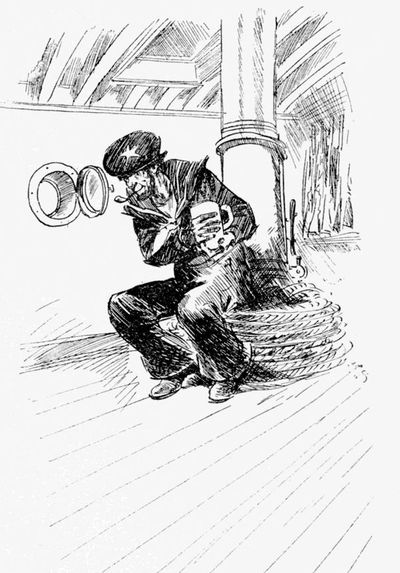
Her cordage lay astern, in the neat coils that seamen know so well how to make. The anchor had been weighed this half-hour, and the figures put down in the log; for Captain Bliffton was not a man to put off doing anything that lay in the day’s watch.
Away to eastward, two tiny black clouds stole along as if they were diffident strangers in the sky, and were anxious to be gone. Now and again came the report of some sunset gun from the forts that lined the coast, and sea-robins flew with harsh cries athwart the sloop of fishing-boats that were beating to windward with gaffed topsails.
“Davy Jones’ll have a busy day to-morrow,” growled Tom Bowsline, the first boatswain’s mate.
“Meaning them clouds is windy?” answered the steward, with a glance to leeward.
“The same,” answered the other, shaking out a reef, and preparing to batten the tarpaulins. “What dinged fools them fellers on the sloop of fishin’-ships is! They’ve got their studdin’sails gaffed and the mizzentops aft of the gangway; an’ if I know a marlinspike from a martingale, we’re goin’ to have as pretty a blow as ever came out of the south.”
And, indeed, it did look to be flying in the face of Providence, for the mackerel-ships, to the last one, were tugging and straining to catch the slightest zephyr, with their yard-arms close-hauled and their poop-decks flush with the fo’c’sle.
The form of the captain of the cat-boat was now visible on the stairs leading to the upper deck. It needed but one keen glance in the direction of the black clouds—no longer strangers, but now perfectly at home and getting ugly—to determine his course. “Unship the spinnaker-boom, you dogs, and be quick about it! Luff, you idiot, luff!” The boatswain’s first mate loved nothing better than to luff, and he luffed; and the good ship, true to her keel, bore away to northward, her back scuppers oozing at every joint.
“That was ez neat a bit of seamanship ez I ever see,” said Tom Bowsline, taking a huge bite of oakum. “Shiver my timbers! if my rivets don’t tremble with joy when I see good work.”
“Douse your gab, and man the taff-rail!” yelled the captain; and Tom flew to obey him. “Light the top-lights!”
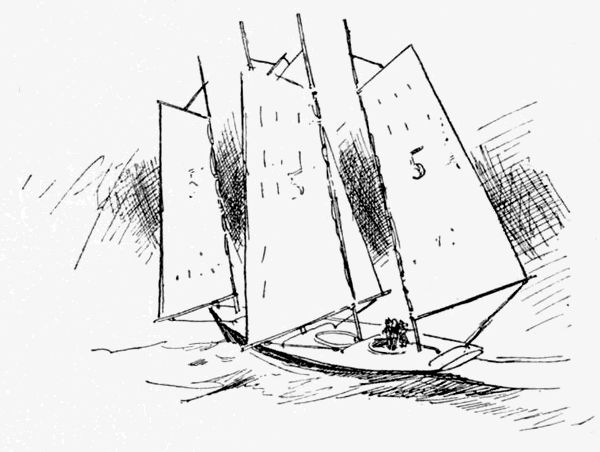
A couple of sailors to whom the trick is a mere bagatelle run nimbly out on the stern-sprit and execute his order; and none too soon, for darkness is closing in over the face of the waters, and the clouds come on apace.
A rumble of thunder, followed by a blinding flash, betokens that the squall is at hand. The captain springs adown the poop, and in a hoarse voice yells out: “Lower the maintop; loosen the shrouds; luff a little—steady! Cut the main-brace, and clear away the halyards. If we don’t look alive, we’ll look pretty durn dead in two shakes of a capstan-bar. All hands abaft for a glass of grog.”
The wild rush of sailors’ feet, the creaking of ropes, the curses of those in the rear, together with the hoarse cries of the gulls and the booming of the thunder, made up a scene that beggars description. Every trough of the sea was followed by a crest as formidable, and the salt spray had an indescribable brackish taste like bilge-water and ginger-ale.
After the crew had finished their grog they had time to look to starboard of the port watch, and there they beheld what filled them with pity. The entire sloop of mackerel-ships lay with their keels up.
“I knowed they’d catch it if they gaffed their studdin’sails,” said Tom, as he shifted the quid of oakum.
The full moon rose suddenly at the exact spot where the sun had set. The thunder made off, muttering. The cat-boat, close-rigged from hand-rail to taff-rail, scudded under bare poles, with the churning motion peculiar to pinnaces, and the crew involuntarily broke into the chorus of that good old sea-song:
The wind blows fresh, and our scuppers are astern.
II THE POOR WAS MAD
A FAIRY SHTORY FOR LITTLE CHILDHER

Wance upon a toime the poor was virry poor indade, an’ so they wint to a rich leddy that was that rich that she had goold finger-nails, an’ was that beautifil that it ’u’d mek you dopey to luke at her. An’ the poor asht her would she give thim the parin’s of her goold finger-nails fer to sell. An’ she said she would that, an’ that ivery Chuesdeh she did be afther a-parin’ her nails. So of a Chuesdeh the poor kem an’ they tuke the goold parin’s to a jewel-ery man, an’ he gev thim good money fer thim. Wasn’t she the koind leddy, childher? Well, wan day she forgot to pare her nails, an’ so they had nothin’ to sell. An’ the poor was mad, an’ they wint an’ kilt the leddy intoirely. An’ whin she was kilt, sorra bit would the nails grow upon her, an’ they saw they was silly to kill her. So they wint out to sairch fer a leddy wid silver finger-nails. An’ they found her, an’ she was that beautifil that her face was all the colors of the rainbow an’ two more besides. An’ the poor asht her would she give thim the parin’s of her silver finger-nails fer to sell. An’ she said that she would that, an’ that ivery Chuesdeh she did be afther a-parin’ her nails. So of a Chuesdeh the poor kem an’ they tuke the silver parin’s to the jewel-ery man, an’ he gev thim pretty good money fer thim, but not nair as good as fer the goold. But he was the cute jewel-ery man, wasn’t he, childher? Well, wan day she forgot to pare her nails, an’ so they had nothin’ to sell. An’ the poor was mad, an’ they wint an’ kilt the leddy intoirely. An’ whin she was kilt, sorra bit would the nails grow upon her, an’ they saw they was silly to kill her. So they wint out to sairch for a leddy wid tin finger-nails. An’ they found her, an’ she was that beautifil that she would mek you ristless. An’ the poor asht her would she give thim the parin’s of her tin finger-nails fer to sell. An’ she said she would that, an’ that ivery Chuesdeh she did be afther a-parin’ her nails. So of a Chuesdeh the poor kem. An’ did they git the tin nails, childher? Sure, that’s where y’ are out. They did not, fer the leddy had lost a finger in a mowin’-machine, an’ she didn’t have tin finger-nails at arl, at arl—only noine.
III A PECULIAR INDUSTRY
The sign in front of the dingy little office on a side-street, through which I was walking, read:
JO COSE AND JOCK EWLAH FUNSMITHS
Being of an inquisitive turn of mind, I went in. A little dried-up man, who introduced himself as Mr. Cose, greeted me cheerily. He said that Mr. Ewlah was out at lunch, but he’d be pleased to do what he could for me.
“What is the nature of your calling?” asked I.
“It is you who are calling,” said he, averting his eyes. Then he assumed the voice and manner of a “lecturer” in a dime museum, and rattled along as follows:
“We are in the joke business. Original and second-hand jokes bought and sold. Old jokes made over as good as new. Good old stand-bys altered to suit the times. Jokes cleaned and made ready for the press. We do not press them ourselves. Joke expanders for sale cheap. Also patent padders for stories—”
I interrupted the flow of his talk to ask him if there was much demand for the padders.
“Young man,” said he, “do you keep up with current literature?”
Then he went over to a shelf on which stood a long line of bottles of the size of cod-liver-oil bottles, and taking one down, he said: “Now, here is Jokoleine, of which we are the sole agents. This will make a poor joke salable, and is in pretty general use in the city, although some editors will not buy a joke that smells of it.”
I noticed a tall, black-haired, Svengalic-looking person in an inner room, and I asked Mr. Cose who he was.
“That is our hypnotizer. The most callous editors succumb to his gaze. Take him with you when you have anything to sell. We rent him at a low figure, considering how useful he is. He has had a busy season, and is tired out, but that is what we pay him for. If he were to die you’d notice a difference in many of the periodicals. The poorer the material, the better pleased he is to place it. It flatters his vanity.”
I assured him that I was something of a hypnotist myself, and, thanking him for his courtesy, was about to come away, when he picked up what looked like a box of tacks and said:
“Here are points for pointless jokes. We don’t have much sale for them. Most persons prefer an application of Jokoleine. A recent issue of a comic weekly had sixty jokes and but one point, showing conclusively that points are out of fashion in some editorial rooms.
“A man came in yesterday,” rattled on the senior member, “and asked if we bought hand-made jokes, and before we could stop him he said that by hand-made jokes he meant jokes about servant-girls. We gave him the address of ‘Punch.’”
At this point I shook hands with Mr. Cose, and as I left he was saying: “For a suitable consideration we will guarantee to call anything a joke that you may bring in, and we will place it without hypnotic aid or the use of Jokoleine. It has been done before.”
And as I came away from the sound of his voice, I reflected that it had.
IV GRIGGS’S MIND
The other day I met Griggs on the cars. Griggs is the man with the mind. Other people have minds, but they’re not like Griggs’s. He lives in Rutherford, New Jersey, and is, like me, a commuter, and as neither of us plays cards nor is interested in politics, and as we have tabooed the weather as a topic, it almost always happens that when we meet, we, or rather he, falls back on his mind as subject for conversation. For my part, my daily newspaper would be all-sufficient for my needs on the way to town; but it pleases Griggs to talk, and it’s bad for my eyes to read on the cars, so I shut them up and cultivate the air of listening, the while Griggs discourses.
I had recently read in the Contributors’ Club of the “Atlantic,” an article by a woman, who said that the letters of the alphabet seemed to be variously colored in her mind; that is, her mental picture gave to one letter a green hue, to another red, and so on. I spoke of this to Griggs, and he was much interested. He said that the sound of a cornet was always red to him. I asked him whether it made any difference who blew it, but Griggs scorns to notice puns, and he answered: “Not a particle. I don’t pretend to explain it, but it is so. Likewise, to me the color of scarlet tastes salt, while crimson is sweet.”
I opened my eyes and looked at him in amazement. It sounded like a bit out of “Alice in Wonderland.” Then I remembered that it was Griggs who was talking, and that he has a mind. When I don’t understand something about Griggs, I lay it to his mind and think no more about it. So I shut my eyes again and listened.
“By the way,” said he, “how does time run in your mind?”
“Why, I never thought of its running at all, although it passes quickly enough, for the most part!”
“But hasn’t it some general direction? Up or down, north or south, east or west?”
“Griggs,” said I, “is this your mind?”
“Yes,” said he.
“Well, go ahead; fire it off; unfold your kinks!” said I, leaning back in my seat; “but kindly remember that I have no mind, and if you can’t put it in words of one syllable, talk slowly so that I can follow you.”
He promised to put it as plainly as though he were talking to his youngest, aged three; and, with this assurance, my cerebrum braced itself, so to speak, and awaited the onslaught.
“My idea of the direction of time in all its divisions and subdivisions is as follows—”
“Say, Griggs,” said I, “let’s go into the smoker. A little oil of nicotine always makes my brain work easier.”
When we were seated in the smoker, and had each lighted a cigar, he went on:
“Assuming that I am facing the north, far in the southwest is the Garden of Eden and the early years of recorded time. Moving eastward run the centuries, and the years to come and the end of the world are in the far east.”
I felt slightly bewizzled, but I gripped the seat in front of me and said nothing.
“My mental picture of the months of the year is that January is far to the north. The months follow in a more or less zigzag, easterly movement, until we find that July and August have strayed far south. But the autumn months zigzag back, so that by the time December sweeps coldly by she is twelve months east of January, and then the new January starts on a road of similar direction. You still observe that the current of time sets toward me instead of away from me.”
What could I do but observe that it did? I had the inside seat, and Griggs has an insistent way about him, so I generally observe just when he asks me to, and thus avoid friction. Then, too, I always feel flattered when Griggs condescends to talk at me and reveal the wonders of his mind. So I observed heartily, and puffed away at my cigar, while he continued:
“The direction of the week-days is rather hazy in my mind—”
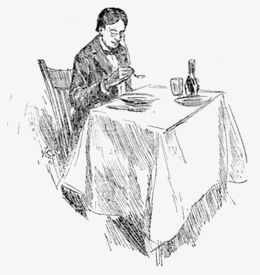
I begged him not to feel low-spirited about it—that it would probably seem clear to him before long; but I don’t think he heard me, for he went right on: “But it is a somewhat undulatory movement from west to east, Sundays being on the crest of each wave. Coming to the hours, I picture them as running, like the famous mouse, ‘down the clock,’ the early day-light being highest. The minutes and seconds refuse to be marshaled into line, but go ticking on to eternity helter-skelter, yet none the less inevitably.”
I rather admired the independence of the minutes and seconds in refusing to be ordered about even by his mind; but, of course, I didn’t tell him so. On the contrary, I congratulated him on the highly poetic way in which he was voicing his sentiments.
Just then we came into the station, and an acquaintance of his buttonholed him and lugged him off, for Griggs is quite a favorite, in spite of his mind. I was sorry, for I had wanted to ask him where the moments and instants seem bound for in his brain. I did manage, just as we were leaving the boat at Chambers Street, to tell him that I was going to be in the Augustan part of the city at noon, and would be pleased to take him out to lunch, if he ran across me; but he must have mistaken the month, as I ate my luncheon alone. I dare say he understood me to say January, and wandered all over Harlem looking for me. How unpleasant it must be to have a mind!
V THE SIGNALS OF GRIGGS

You may remember Griggs as the man who had a mind. At the time that I wrote about that useful member of his make-up he was living out in New Jersey; but he was finally brought to see the error of his ways, and took the top flat in a nine-story house without an elevator, ’way up-town.
The other evening I went to call on the Griggses. He had not yet come home, but his wife let me in and helped me to a sofa to recover from the effects of my climb. I have been up the Matterhorn, Mont Blanc, and Popocatepetl, but I never felt so exhausted as I did after walking up those nine frightful flights. And Mrs. Griggs told me that she thought nothing of running up- and down-stairs a dozen times a day, which was a sad commentary on her truthfulness.
After I was there a few minutes, trying to get used to the notes of two lusty and country-bred children (offspring of Mr. and Mrs. Griggs), there came a feeble and dejected ring at the front-door bell. Mrs. Griggs hastened to the kitchen,—they do not keep a servant (that was their trouble in New Jersey, but now they don’t want to),—and after pressing the electric button that opened the front door, she said: “That’s poor Mr. Griggs. He must be feeling bad to-night, and I must put the children to bed before he gets up, as he is too nervous to stand their noise.”
I was somewhat astonished, but she ripped the clothes off of her buds of promise and popped them into bed with a skill and rapidity that would have secured her a position on the vaudeville stage. After they were covered up she returned to me. Of course Mr. Griggs had not yet arrived, and I asked her how she knew he was tired.
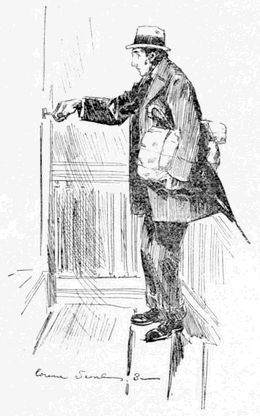
“Why, we have a code of signals. Mr. Griggs invented them. When he has done well down-town, he taps out a merry peal on the bell, and then I tell the children to greet him at the hall door and prepare for a romp. When the bell rings sharply I know that he is in no humor for fun, but will tolerate the children if they are quiet. But when he rings slowly and faintly, as he did to-night, I always put the dears to bed, as I know he has had bad luck and is worn out.”
As she spoke, Griggs opened the hall door and staggered in, weak from his superhuman climb and worn out from his day’s work. I said: “Good-by, old man; I’ll call some day when you’re going to give the bell the glad hand. You seem cozily situated.” And then I came down in the dumb-waiter, although I suppose it was risky.
What a great thing is an electric bell! But how much greater is an inventive mind like that of Griggs.
VI À LA SHERLOCK HOLMES

Jones and I recently had occasion to take a drive of four or five miles in upper Connecticut. We were met at the station by Farmer Phelps, who soon had us snugly wrapped in robes and speeding over the frozen highway in a sleigh. It was bitter cold weather—the thermometer reading 3° above zero. We had come up from Philadelphia, and to us such extreme cold was a novelty, which is all we could say for it.
As we rode along, Jones fell to talking about Conan Doyle’s detective stories, of which we were both great admirers—the more so as Doyle has declared Philadelphia to be the greatest American city. It turned out that Mr. Phelps was familiar with the “‘Meemoirs’ of Sherlock Holmes,” and he thought there was some “pretty slick reasonin’” in it. “My girl,” said he, “got the book out er the library an’ read it aout laoud to my woman an’ me. But of course this Doyle had it all cut an’ dried afore he writ it. He worked backwards an’ kivered up his tracks, an’ then started afresh, an’ it seems more wonderful to the reader than it reely is.”
“I don’t know,” said Jones; “I’ve done a little in the observation line since I began to read him, and it’s astonishing how much a man can learn from inanimate objects, if he uses his eyes and his brain to good purpose. I rarely make a mistake.”
Just then we drove past an outbuilding. The door of it was shut. In front of it, in a straight row and equidistant from each other, lay seven cakes of ice, thawed out of a water-pan.
“There,” said Jones; “what do we gather from those seven cakes of ice and that closed door?”
I gave it up.
Mr. Phelps said nothing.
Jones waited impressively a moment, and then said quite glibly: “The man who lives there keeps a flock of twelve hens—not Leghorns, but probably Plymouth Rocks or some Asiatic variety. He attends to them himself, and has good success with them, although this is the seventh day of extremely cold weather.”
I gazed at him in admiration.
Mr. Phelps said nothing.
“How do you make it all out, Jones?” said I.
“Well, those cakes of ice were evidently formed in a hens’ drinking-pan. They are solid. The water froze a little all day long, and froze solid in the night. It was thawed out in the morning and left lying there, and the pan was refilled. There are seven cakes of ice; therefore there has been a week of very cold weather. They are side by side: from this we gather that it was a methodical man who attended to them; evidently no hireling, but the goodman himself. Methodical in little things, methodical in greater ones; and method spells success with hens. The thickness of the ice also proves that comparatively little water was drunk; consequently he keeps a small flock. Twelve is the model number among advanced poultrymen, and he is evidently one. Then, the clearness of the ice shows that the hens are not excitable Leghorns, but fowl of a more sluggish kind, although whether Plymouth Rocks or Brahmas or Langshans, I can’t say. Leghorns are so wild that they are apt to stampede through the water and roil it. The closed door shows he has the good sense to keep them shut up in cold weather.
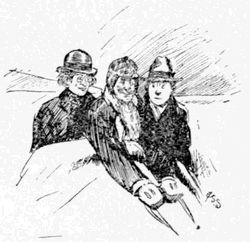
“To sum up, then, this wide-awake poultryman has had wonderful success, in spite of a week of exceptionally cold weather, from his flock of a dozen hens of some large breed. How’s that, Mr. Phelps? Isn’t it almost equal to Doyle?”
“Yes; but not accordin’ to Hoyle, ez ye might say,” said he. “Your reasonin’ is good, but it ain’t quite borne aout by the fac’s. In the fust place, this is the fust reel cold day we’ve hed this winter. Secon’ly, they ain’t no boss to the place, fer she’s a woman. Thirdly, my haouse is the nex’ one to this, an’ my boy an’ hers hez be’n makin’ those ice-cakes fer fun in some old cream-pans. Don’t take long to freeze solid in this weather. An’, las’ly, it ain’t a hen-haouse, but an ice-haouse.”
The sun rode with unusual quietness through the heavens. We heard no song of bird. The winds were whist. All nature was silent.
So was Jones.
VII MY SPANISH PARROT

I have two maiden aunts living down in Maine, on the edge of the woods. Their father was a deaf-and-dumb woodsman, and their mother died when they were small, and they hardly see a soul from one year’s end to the other. The consequence is, they’re the simplest, dearest old creatures one ever saw. They don’t know what evil means. They pass their days knitting and working in their garden. The quarterly visits of the itinerant preacher who deals out the gospel in that region, and my occasional trips up there, constitute the only chances they have of mingling with the outside world, and they’re as happy and unsophisticated as birds.
A year ago I took up a parrot that I’d bought of a sailor. The bird had a cold when I got it, and wasn’t saying a word; but the sailor vouched for its character, and I thought it would be a novelty and company for the old ladies, so I took it along. They’d never seen a parrot before, and they couldn’t thank me enough. I told them that when it got over its cold it would talk; and then it occurred to me that as the sailor of which I bought it was a Spaniard, the bird would be likely to speak that tongue. “So you’ll be able to learn Spanish,” said I; and they were mightily pleased at the notion.
In about two months I received a letter from Aunt Linda, saying that the bird was the greatest company in the world, and they didn’t know what they’d do without him. “And,” wrote my aunt, “the bird is a great talker of Spanish, and we have learned much of that strange tongue.”
I was amused at the idea of those maiden aunts of mine talking Spanish, and the next week, being in the vicinity, I took the stage over to where they live, about fifteen miles from any railroad.
They saw me alight, and came out to meet me—two pretty, sweet, prim-looking old ladies. I kissed them both heartily, and then Aunt Linda said, in her gentle voice: “I’m so glad you’ve come, you dear old blankety-blank blank blank boy. That’s Spanish.”
I nearly fell off my perch, but I managed to keep a straight face, and then dear Aunt Jane said softly and proudly: “Why the blankety-blank blank don’t you come to see us oftener, you blankety-blank blank boy?”
It made my blood run cold to hear the oaths those innocent creatures poured out on me all day. The parrot followed me around, and perked his head on one side, as much as to say, “Aren’t they apt pupils?” but he never opened his mouth to talk—and there really wasn’t any need. They kept me supplied with conversation on their quiet doings, all interlarded with their new-found “Spanish,” until it was time to go to bed.
I hadn’t the heart to tell them that the tongue in which they were so fluent was not Spanish; and as their hearts were as pure as a baby’s, and they saw no one, I said nothing; but when I left, early next morning, I was careful to bid them good-by out of ear-shot of the stage-coach, and it’s lucky I did, for the torrent of billingsgate that they poured fondly over me would have caused the occupants of the coach to think entirely unwarranted things of the old ladies.
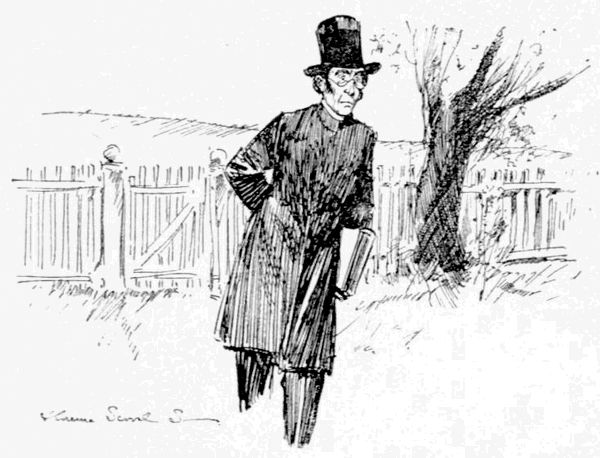
As I climbed up to the seat by the driver, a man got out of the stage and walked up to the house.
“Good heavens! who’s that?” I asked of the driver.
“Thet,” said he, “is the Methody preacher makin’ his quarterly visit to th’ old ladies.”
VIII “TO MEET MR. CAVENDISH”
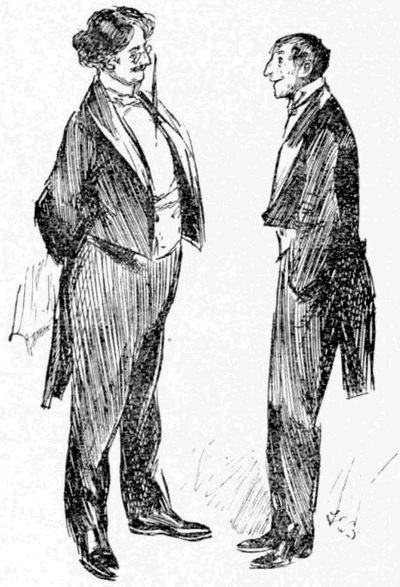
The card read, “To meet Mr. Cavendish.” I had not been in Boston long, and I must confess to a poor head for names, so I had no idea who Mr. Cavendish was or what he had done, but as he was to be at Mrs. Emerson’s, I knew he had done something.
There were only five guests there, besides Mr. Cavendish, when I arrived, and after we were introduced it so happened that Cavendish and I found ourselves talking together.
He looked tired, so I said as a starter: “Don’t you find your work exhausting?” I thought I’d play “twenty questions” with him, and determine what he had done.
“Sometimes it is, very. The expenditure of force fairly makes my throat ache.”
It was easy. He was probably a Wagnerian singer.
“I suppose you have to be very careful about your throat.”
“Why, no,” he said; “I never think about my throat.”
He wasn’t a singer.
“Well, you’re in love with your art.”
He smiled. “Yes, I’m in love with it.”
I was in despair. What was he?
But now I would nail him. “What are your methods of work, Mr. Cavendish?”
“Oh, I don’t spend much time in over-elaboration. My brush-strokes are very broad.”
Ah, a painter! “Exactly,” I said. “You like a free hand.”
He said: “After all, the words are everything.”
Ah, a writer! “Yes,” said I; “your words are everything to the public.”
“I hope so. I try to make them so,” he said modestly.
Now I felt easier, and proceeded to praise him specifically.
“Which do you like best—to make your public laugh or cry? or do you aim to instruct it?”
“It is easy to make persons laugh, so I suppose I like rather to bring them to tears. As for instruction, there are those who say it is not our province to instruct.”
“But you do all three, Mr. Cavendish.”
He bowed as if he thought I had hit it.
I said: “To those who are familiar with your work there is something that makes you just the man to pick up for a quarter of an hour.”
His blank expression showed that I had made some mistake. He is a tall, portly man, and he seemed alarmed at the prospect of being picked up. A fall would be serious.
“I don’t quite get your meaning, but I suppose you refer to the men about town who stray in for a few minutes.”
It seemed a queer way to express it, but I replied: “Oh, yes; just to browse. You repay browsing, Mr. Cavendish.”
He smiled reminiscently. “Speaking of browsing, when I was told to go ahead on Richelieu, I browsed a long time in the British Museum getting up data.”
What, a painter, after all? I forgot all else he had said, and told him I thought he was as happy as Sargent or Whistler.
“Yes; I don’t let little things worry me much. Sometimes the paint gives out at a critical time in a small town.”
Good heaven! Why should the paint give out in a small town at a critical time? Was he a painter, after all? Could he be a traveling sign-painter?
“Does it bother you to work up in the air?”
“That’s an original way of putting it,” said he, with a genial laugh. “To play to the grand stand, as it were. Oh, no; a man must do more or less of that to succeed.”
I was shocked. “You surely don’t believe in desecrating nature! Sermons in stones, if you will, but not sermons on stones. You wouldn’t letter the Palisades if you had a chance, would you?”
He edged away from me, and said:
“Oh, no, I wouldn’t letter the Palisades, although I dare say my man of affairs would be glad to.”
Then I gave up. His man of affairs! He must be a gentleman of leisure to have a man of affairs.
And then up came Ticknor Fields, the dramatic critic, and said: “How do you do, Mr. Cavendish? Let me congratulate you upon your success as Richelieu. At last a successor to Booth has been found.”
I went and drank a glass of iced water. My throat was dry.
IX INSTINCT SUPPLIED TO HENS

A company has just been formed in New Jersey for the purpose of supplying instinct to hens. Such well-known farmers as Frank R. Stockton, Russell Sage, and Bishop Potter are stockholders in it, and if filling a long-felt want is all that is needed, the success of the company is already assured.
No one who has ever dabbled in hens needs to be told that the gallinaceous birds have no instinct whatever. Some have blind luck, but a hen with instincts in good working order would be an anomaly.
I visited Mr. Stockton at his extensive farm in New Jersey in order to find out what I could about the project. I found him in a frock-coat and overalls, training a squash-vine up a maple-tree. He greeted me cordially, and asked me to come and see his tomato-trenches. He also showed me quite an extensive area covered with birch poles for his radishes to climb on. He was very urbane, and willingly told me all about the company.
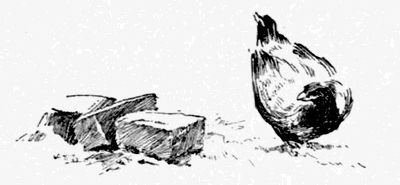
“No man,” said he, sitting down on one of his largest cucumbers and motioning me to a seat on another, “who has ever kept hens but has wondered why they were not provided with a good commonsense brand of instinct. No animal needs instinct more than a hen. It was to supply this need that our company was formed. You know that if you put a hen on cobblestones, she will brood over them with all the devotion possible, and if at the end of three weeks you put a baby chicken under her, her—what you might term false instinct—will cause her to cluck and call to the cobble to come forth and follow her.”
I admitted the force of his remark, because when a boy I had once set a hen on some green apples, and she had covered them without a murmur for a week, when I took pity on her and replaced them with real eggs. The following day, not liking the feeling of the eggs, she left them, and gathering together the apples that I had left scattered upon the barn floor, she sat on them again.
I told this experience to Mr. Stockton, and he said: “If she’d had a few of our instinct-powders before sitting she would have repudiated the fraud at once. Is it instinct, or the lack of it,” he continued, “that makes a heavy Light Brahma plant a ponderous and feathered foot upon her offspring and listen calmly to their expiring peeps? It’s lack of it; she needs one of our powders.”
I made a mental calculation of the number of chickens that I had seen sacrificed in that way by motherly and good-natured hens who would have felt hurt if you had told them that they did not know how to bring up their young.
We had risen, and were now walking as we talked, and we soon came to Mr. Stockton’s corn-trellises. He is a great believer in climbing, and it was a pretty sight to see his corn waving in the breeze that blew through the trellis netting.
“Poultry-raising would be an unmixed joy,” said he, as he picked a turnip and offered it to me, “if a fellow wasn’t constantly running up against this lack of instinct on the part of the fowls. If a hen had instinct she’d know enough to keep her mouth shut when she laid an egg; but as it is, she cackles away like a woman with a secret, and before she knows it her egg is on the way to the table. But the aim of our company will be to furnish each hen with a sufficient amount of instinct to render her profitable to her master. When she has that instinct she will not sit on her nest long after her eggs have been removed; she will not walk off through the long grass, calling to her brood to follow her, when the chicks have all been swallowed by the treacherous domestic cat; and she will not do the thousand and one things that any hen, no matter what her breed or breeding, will do, as it is.”
I told Mr. Stockton, as I shook hands with him in parting, that there was not a farmer, either amateur or professional, in the whole Union, who would not be glad to purchase a package of his instinct-powders; and as I left the genial granger, he was putting cushions under his watermelons so that they would not get bruised by contact with the earth.
X A SPRING IDYL
It was a bright morning in early spring—one of the delightful, languorous days that take the sap out of one and make the life of the tramp seem blissful. The maples were just putting forth their delicate crimson leaves, and a warm south wind bore into the city the smell of fresh earth. Ah, what longings were stirred up in the breast of Key, Pattit & Company’s office-boy, country-bred, but pent up in the city for a twelvemonth past! Oh, for one day in the country! He would follow the winding trout-stream from its source in Perkins’s meadow until it emptied into the Naugatuck, and with angleworms dug from the famous spot north of the barn he would lure the coy trout from their shaded lurking-places.
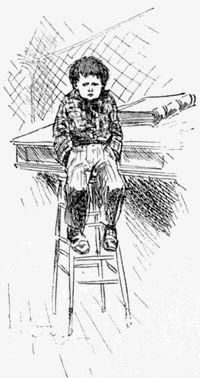
Hark! what was that? The “drowsy tinkling” of a cow-bell—of cow-bells. What sweet music! It drove him wild with longing, as louder and ever louder, and nearer and yet nearer, came the sound of bells. Ah, he could see Jerry, the hired man, driving the cows up the grassy lane. As usual, Betty, the Jersey, was in the lead. And there was greedy Daisy, lingering to crop the rich grass that grew along the lane until Jerry’s “Whe-e-y, whe-e-y!” should bid her hurry on. And there were the twin heifers, Nanny and Fanny, perfectly matched Holsteins. And in the rear, plodding on with dignity and fatness, was Diana, the great Devon.
How the bells jangled! Surely it was not seeming, but actuality. They were right outside on the street.
Impulsively he ran to the office window and looked down with boyish anticipation.
“Jingle-jangle!” went the bells. “Rha-ags, rha-ags, any ol’ rha-ags!” shouted the ragman.
XI AN INVERTED SPRING IDYL
It was a bright morning in the early spring, a time to call forth poetic fancies in the mind of the most prosaic; and Jack was more imaginative than many boys. He had been spending the winter at his uncle’s in the country, and these warm, languorous days had made him long for New York once more. He sat astride of a maple-branch, on which the crimson leaves were just peeping out. Ah me, what would he not give to be back in the city! He leaned back against the tree-trunk and gave himself over to day-dreams.
The boys on his block were spinning tops. Oh, for a good hard city pavement for just five minutes, that he might do the same. Through the hazy air came the anything but drowsy tinklings of the grip-men’s gongs; a scissors-grinder blew his horn; and the exciting clang of an ambulance-gong split the air as the ambulance rattled over the Belgian blocks. Oh, for an hour of the dear city in the happy springtime! To hear once more the piano-organ and the harp, and the thousand delightful sounds that were so lamentably absent from the country!
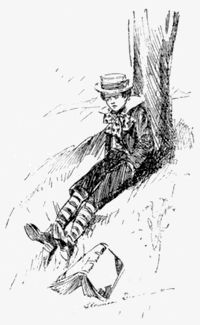
What was that? Did he hear bells? Yes, surely it was the ragman. He had never realized how he loved him. He could see the fellow, lean and ragged and bent, pushing his cart, while from his lips came the cry of “Rha-ags! rha-ags!” and from the sagging cord the sweet bells jingled. Yes, surely it was the bells. All thought of the lonely country faded away, and he was once more home; the boys were just around the corner, and the bells were coming nearer.
Their tintinnabulations grew so loud that he waked from his day-dream and saw—not a familiar and beloved city sight, but a tiresome herd of cows coming home to be milked, their harsh bells jangling out of tune.
XII AT THE CHESTNUTS’ DINNER
The Hoary Chestnuts were assembling for their annual Christmas dinner. Sweet music was discoursed by the chestnut bell, and, despite their age and many infirmities, the members wore a look of gaiety suitable to so festive an occasion. There was not a young joke among them, excepting a very few special jokes like the Trolley variety and the Cuban War joke, and these, from overwork, were as superannuated-looking as the oldest there. Not a well-known joke but would come. Of course they would all live until the next dinner, for an old joke is immortal; but this yearly gathering was their only chance to meet and shake hands generally, as during the rest of the year they would be scattered through the columns of the dailies and the comic weeklies, and their meetings would be chance ones.
The hearty old Mother-in-law joke chatted gaily with that venerable old lady, I-will-be-a-sister-to-you. The adorable twins, Ballet-girl’s-age and Ballet-girl’s-scant-raiment, were the center of a group made up of the haughty Rich-plumber, the Rejected-manuscript, the Slow-messenger-boy, the Sleeping-watchman, and a good score of Boarding-house jokes. The one called Boarding-house-coffee felt a little stirred up at the false report that he was losing ground, and he had an unsettled look upon his swarthy and senile features. The idea was absurd on the face of it, for undoubtedly he would be printed in every section of the country before the month was out, as he had been any month for decades past. The Summer jokes, including, of course, the star jest, the Summer-girl, looked comparatively fresh, as they were not in use the year round, like Her-father’s-foot, for instance, or that other member of the same family, the Chicago-girl’s-foot, that year in and year out is used as a laugh-producer.
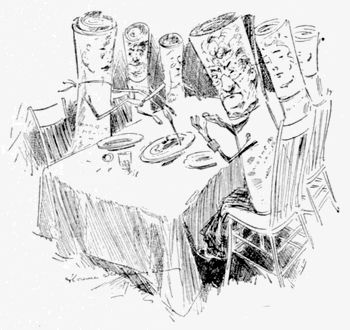
The Boston jokes, icy and reserved, sat apart from the rest, and glared at each other in a near-sighted way. The Freak jokes, on the contrary, were hail-fellow-well-met with every one, and their vulgar laughter could be heard everywhere.
A good deal of sympathy was expressed for Actor-walking-home, for he was so feeble that he had to be helped across the room by Weary Wraggles. The Tramps were out in force. Tickets to the dinner were five dollars, and it was rumored that Dusty Rhodes had worked his way in, but upon reflection the idea will be seen to be preposterous.
There was a strong smell of cloves in the air when the door opened for the entrance of old Between-the-acts. He came arm in arm with that other favorite, Detained-at-the-lodge.
The Farmer jokes came in a little late. Their chores had detained them. But their entrance was hailed with delight by a body of paragraphers who sat in the gallery as representatives of the press, and who had paid many a bill, thanks to the Farmers.
A joke, rather square-cut and with wheels in his head, came in with a “Where is she?” look on his dial, and as soon as he said, “I expected to meter here,” he was recognized as Big-gas-bill. The Wheel jokes were conspicuous by their absence. This was explained on the ground that they were not yet old enough to become Hoary Chestnuts, and, as a relentless paragrapher remarked, “They were tired, anyhow.”
The last ones to arrive were the Cannibal and Tough-missionary; and the chairman of the reception committee having assigned them seats at opposite ends of the table, all sat down, and the annual balloting to determine what had been the most popular joke of the year was begun.
Many voted for themselves, notably the Boston-bean joke and the Rich-plumber; but when the votes were counted, the successful person proved to be neither of these, but a hideously homely woman with a perpetual smirk upon her face.
“Who’s she?” asked one paragrapher of another.
“You don’t know her? Why, that’s My-face-is-my-fortune-then-you-must-be-dead-broke.”
And they crowned her with laurel as unquestionably the most perennially popular joke.
XIII THE ROUGH WORDS SOCIETY
The other day I passed a house on which there was a sign that read, “The Rough Words Society.” Curious to know what it could mean, I retraced my steps, and met a millionaire whom I had long admired from a distance—he was so rich—just leaving the door. It was a presumptuous thing to do, but I said, “How do you do, sir?” in my best manner. He bowed with some urbanity, and I ventured to ask him whether he could tell me anything about the society whose rooms he had just left. “I thought maybe you were president, sir, or one of the directors.”
“No; I am a subscriber. If you care to hear about it, come down-town with me, as I am in a hurry,” he replied.
A minute later I was actually in a cab with a millionaire! My heart beat hard, but I kept my ears open, and he said:
“You see, a multi-millionaire like myself seldom meets the frank side of people. They are afraid of offending me,” he observed, as we went on our way. “My pastor hangs on my words, my clerks speak in subdued tones, my servants hardly dare address me; and yet, I was once a barefoot boy, and was considered a scapegrace by the village people who to-day bow ceremoniously when I chance to go back to my native place. Well, such sycophancy becomes wearing, and I often used to wish that some one would tell me I lied, or some other wholesome truth.”
I shook my head deprecatingly, whereat he seemed annoyed, but went on: “One day I was passing through the street where you met me, and I saw the sign, and, like yours, my curiosity was excited, and I went in. I found a room somewhat like a telegraph-office in appearance. A very downright, uncompromising-looking man sat at a roll-top desk, while ranged against the wall were several men of exceedingly bluff appearance. ‘Can you tell me what the aims of your society are?’ I asked the man. ‘Certainly I can,’ said he. ‘I wouldn’t be here if I couldn’t.’ Not a cringe, you see. It was refreshing. ‘Well, will you?’ ‘It depends,’ he said. ‘What do you want to know for? Are you a reporter, or do you want to subscribe?’
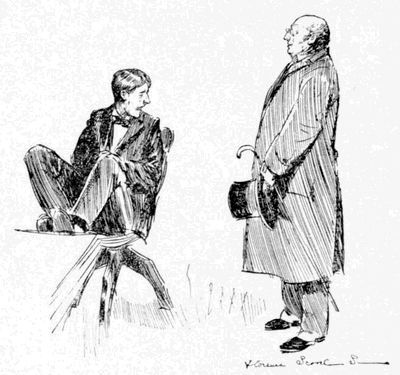
“I suddenly divined the purpose of the society, and I said: ‘I want to subscribe. What are your terms?’ ‘A hundred dollars for a fifteen-minute séance, one hundred and fifty dollars for a half-hour, and two hundred dollars for a full hour.’ I handed him a hundred-dollar bill and said: ‘Explain.’ ‘Jack,’ said he, addressing a bullet-headed man who was sitting with his feet up on the railing that divided the room into two parts, ‘give this man a piece of your mind.’ Jack ran through a directory of millionaires containing photographs and short biographical sketches, and when he had found mine he sailed in and talked as plainly as any one could. Didn’t say a word that wasn’t true; but he didn’t mince his language, and he was no more abashed by my position in the world than if I’d still been a barefoot boy. It did me good. He overhauled many of my acts during the last twenty years, and talked to me like a Dutch uncle. Refreshed? Why, a Turkish bath is not in it for comfort! After he’d finished, the manager said I could have an extra in the way of a little billingsgate if I cared to; but, if I was born poor, I have always had gentlemanly instincts, and so I told him I guessed not.
“As I came away, he said: ‘Glad to have you call any time that you feel the need of a few plain truths. We have a minister who says what he thinks in a very trenchant way, and I’m sure you’d be glad to let him give you a raking over. Here’s one of our cards. Drop in any time you’re passing. If, for any reason, you are not able to come, we can send a man to take up his abode in your house, or to give you half-hour talks from the shoulder, and you can have a monthly account with us. Say a good word for us to any of your plutocratic friends who are tired of sycophancy. Good day, old man.’”
I was aghast at what he had told me, and I said: “I wonder at his temerity!”
“Why,” said the millionaire, “I love him for it! After a directors’ meeting, when I have been kotowed to until my gorge rises, I just drop in there, and they tell me unpleasant truths about myself with the utmost freedom,—you see, they keep posted about me,—and I come out feeling a hundred per cent. better. Well, here’s my office. Good day, young man.”
“Good day, sir, and thank you for letting me ride with you.”
He slammed the door as if vexed, and as he approached the door of his office a negro ran to open it, and two office-boys took his coat and hat, and I envied the great man from the bottom of my heart.
XIV A NEW USE FOR HORSES
I met Scott Bindley the other day. Scott is a great schemer. I think he must be related on his mother’s side to Colonel Sellers. At any rate, there isn’t a day in the year that he doesn’t think of some idea that should interest capital, although capital, somehow, fails to become interested. As soon as he saw me he said:
“Got a great scheme. Small fortune in it for the right parties.”
“What is it?” I asked.
“Come into some cheap lunch-place, and I’ll blow myself off to a meal and give you the particulars.”
So it came to pass that we were soon seated in a restaurant which, if cheap, is clean—a combination rarer than need be.
“You’ve probably noticed that the more automobiles there are in use, the more breakdowns there are.”
I could but admit that it was so.
“Well, what is more useless than a broken-down motor-wagon?”
I would have suggested “Two,” but Bindley hates warmed-up jokes, so I refrained and told him that I gave it up.
“It isn’t a conundrum,” said he, irritably. “Nothing in the world is more useless than a broken-down motor. There are some vehicles of a box-like pattern that can be used as hen-houses when they have outlived their initial usefulness, but who wants a hen-house on Fifth Avenue, corner of Twenty-fifth Street, or any other place where a motor vehicle gives out? The more I thought this over, the more I felt that something was needed to make a disabled automobile of some use, and I saw that the man who would supply that something could make money hand over fist. So I devoted a great deal of time to the subject, and at last I hit it. Horses.”
“Horses what?” said I.
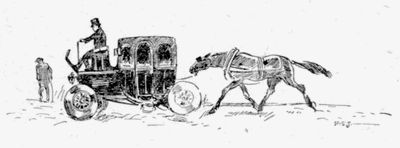
“Why, horses to supply the motive power. Horses are getting to be a drug in the market, and can be bought dirt-cheap. That being the case, I am going to interest capitalists in the scheme, and then we will buy up a lot of horses and distribute them at different points in the city. Then, when a man is out in his automobile and breaks down, he will telephone to the nearest station and get a horse. This can easily be hitched to the motor by a contrivance that I intend to patent, and then the horse can drag the wagon to the nearest power-house, where it can be restocked with electricity, or gas, or naphtha, or whatever is wanted. Isn’t it a great scheme? Why, sir, I can see in the future the plan enlarged so that people will always take a horse along with them when they go a-motoring, and, if anything happens, there they are with the good old horse handy. Talk about the horseless age! Why, horses are just entering upon a new sphere of usefulness.”
I opened my mouth to speak, but he went on: “I tell you that if I can get the holders of automobile stock to coöperate with me I’ll stop eating at places like this.”
A look of such sweet content overspread his features that I told him to put me down for ten shares as soon as his company was organized. That was a month ago, and I haven’t gotten my stock yet. But motors are becoming stalled every day.
XV A CALCULATING BORE

My friend Bings is one of those habitual calculators—one of the kind that says if all the teeth that have been extracted since the first dentist began business were to be used for paving purposes in Hades, the good-resolutions contractor would be out of a job for ten thousand years. He thinks in numbers, and if he were a minister he would get all his texts from the same source.
The other day he saw me first on a ferry-boat, and immediately buttonholed me. Said he: “How sad it is to think that so much labor goes for naught!”
I knew that I was in for one of his calculations; but I also knew that it would be useless to try to head him off.
He stroked his beard, and said, with an imitation of thoughtfulness:
“Every day in this Empire State one million human beings go to bed tired because you and I and the rest leave butter on our plates and don’t eat our crusts.”
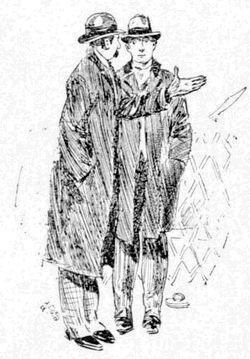
I told him that I was astonished, but that he would have to elucidate.
“The farmers sow 8,000,000 bushels of useless grain,—grain that eventually goes out to sea on the refuse-scows,—they milk 50,000 cows to no other purpose than to produce sour or spilled milk, they allow their valuable hens to lay 1,654,800,001 eggs that will serve no better purpose than to spatter some would-be Booth or lie neglected in some out-of-the-way corner, while their wives are making 1,008,983 pounds of butter that will be left on the edges of plates and thrown into the refuse-pail. If they didn’t sow the useless grain, or fuss over the hens that lay the unused eggs, or draw the milk that is destined to sour, or make the butter that is to ornament the edges of the china disks, they would be able to go to bed merely healthily tired instead of overworked, and fewer farmers would commit suicide, and fewer farmers’ wives would go insane.”
His eyes gleamed, and I knew that, as he would put it, his pulse was going so fast that if it were revolutions of a locomotive-wheel it would take only so long to go somewhere.
“And what is your remedy for all this?” asked I, with becoming, if mock, interest.
“Let us help ourselves to no more than we want at table, buy our eggs a week earlier, drink our milk the day before, eat our bread before it is too dry, and in six months’ time there will be a reduced State death-rate, more vacancies in the insane asylums, 1,456,608 rosy cheeks where to-day there are that many pale ones—”
Just then the ferry-boat’s gates were lifted, and as we went our several ways, in the hurry that is characteristic of 7,098,111 Americans out of eight millions, I thought that, if all the brains of all the arithmetical cranks were used in place of wood-pulp to make into paper, we writers would get our pads for nothing.
XVI AN URBAN GAME
A game that is much played in hot weather by persons who are addicted to the department-store habit is called “Where can I find it?” It is played by means of counters, and its duration is often a whole morning in length. To the looker-on it is much like golf, it seems so aimless; and it is aimless, but it has the advantages over golf that it can be played in the city and does not necessitate the services of a caddy. Over a score take a hand in it from first to last, but only one is “it,” and she or he displays the only activity necessary to the game. Only those who are of tough build should undertake to play it on a hot day, as it is extremely debilitating.
To make the game long and interesting, you should enter the store and ask for something a little unusual that you may have seen advertised somewhere. For instance, you go to the glove counter and ask for a preparation for making soup, called “Soupina.” I am not advertising anything, as the name is fictitious, but it will serve to illustrate my meaning. The particular embodiment of haughtiness at the glove counter will think that you mean some kind of soap, and will frigidly direct you to the perfumery department, “pillar No. 8.” You go there simply because it is your move, and you repeat your inquiry, adding that you think it’s put up in bottles.
“Bottled goods,” is the quick rejoinder, “fourth floor.”
The elevator bears you to the grocery department, and you ask for “bottled goods.”
“Pillar 20.”
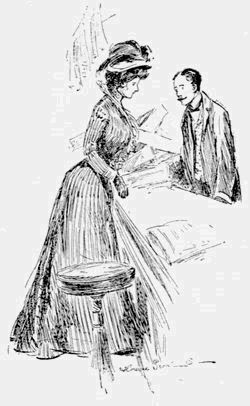
At pillar No. 20 you are made to realize what a poor worm you are, and you turn to pillar 10, as requested, that being the canned-goods department. That clerk will undoubtedly misunderstand your order and will direct you to the basement, “pillar 15.” You hurry down in the elevator, and come face to face with the mouse-trap counter. How you go from ladies’ underwear to carpets, to furniture, to the telegraph-office, to the dental parlors, to the menagerie, to the restaurant, to the lace goods, to every department known to a modern city under one roof, you can best find out for yourself, but of one thing you may be sure—you will never find “Soupina.”
At last, dazed and heated and leg-weary, you find yourself in the oath-registering room. This is a little room that is in every well-equipped department-store, and fills a long-felt want, for all shoppers, at one time or another, wish to register an oath. Whether you register or not, the game is now over, and you have lost; there is no possibility of winning. And yet, so fascinating is the sport that as soon as you have recovered the use of your muscles you will be eager to play again.
XVII “DE GUSTIBUS”
It was on one of the cannibal islands, and a family of cannibals were discussing the pleasures of the table on their front piazza while they waited for dinner to be announced. Their eldest daughter, a slim, acidulous-looking girl, just home from boarding-school, and full of fads and “isms,” had said that, for her part, she did not care for human flesh at all, and was of the opinion that pigs or lambs, or even cows, would make just as good eating as the tenderest enemy ever captured or the juiciest missionary ever broiled.
“How disgusting!” said her brother, a lusty young cannibal who had once eaten two Salvation Army lassies at a sitting. “Really, if you get such unpleasant notions at school, it would be better for you to stay at home. My gorge rises at the idea. Ugh!”
“Papa,” said dear little kinky-haired E. Taman, the peacemaker of the family, changing the subject, “why are missionaries better eating than our neighbors and enemies?”
“Probably because they are apt to be cereal-eaters,” said her father, the cannibal chief; “although one of the most delicious missionaries I ever tasted was a Boston lady who had been raised on beans. She was a Unitarian. Your Unitarians generally make good eating. There’s a good deal of the milk of human kindness in them, and that makes them excellent roasters. Now, you take a hard-shell Baptist, and you might as well eat a ‘shore dinner’ at once. They need a heap of steaming, and they’re apt to be watery when all’s said and done. But it must be confessed they have more taste than a wishy-washy agnostic.”
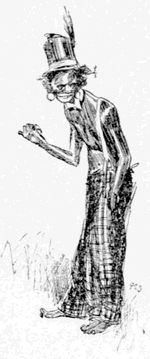
“I think the most unsatisfactory of the lot,” said his wife, “is your Presbyterian. He’s pretty sure to be dry and gnarly, and good for nothing but fricasseeing. But I think that for all-round use, although they haven’t the delicacy of the Unitarian, the Methodist is what you might call the Plymouth Rock of missionaries. He’s generally fat, and he hasn’t danced himself dry, and he’s good for a pot-roast or any old thing. By the way, we’re going to have one to-day. I must go and tell the cook to baste him well.”
The old grandfather, who had hitherto taken no part in the conversation, said at this point: “Well, as you know, in my day I have been something of an epicure, and I have tasted every variety of dish known to cannibals. I don’t care for fresh-killed meat, no matter of what denomination it is, and while I don’t wish to be considered a sectarian, yet I do think that if you want a dish that is capable of a good deal of trimming and fancy fixings’ get hold of an Episcopal missionary; and, to me, the chief beauty of the Episcopalian is that he’s apt to be a little high.”
XVIII “BUFFUM’S BUSTLESS BUFFERS”
I was looking at a rather startling picture in the morning paper of a man who had fallen from a seventh-story window and had been instantly killed. The man in the seat next to me—we were on the elevated—said: “I’ll do away with all those accidents soon.”
I turned and looked at him. He was a lean-faced, hollow-eyed man, full of nervous starts, and quick of speech.
“What do you mean?” asked I, somewhat puzzled.
“Oh, nothing; oh, nothing at all,” he replied, as if sorry he had spoken. “I do not wish to be laughed at. I am no Keely motor man to be laughed at. I spoke without thought.”
I fancied there was a story in him, and so I drew him out, and he said in short, quick sentences, but in so low a tone that I had to strain my ears to hear him:
“I am Burgess Buffum, the inventor of Buffum’s Bustless Buffers.”
He paused with rhetorical effect, and nodded and blinked his eyes; and I, duly impressed, asked him what the buffers were supposed to buff.
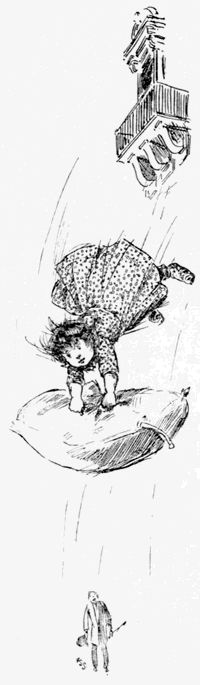
“Children at open windows. Painters on scaffolds. Panic-stricken flyers from fires. Mountain-climbers. In fact, all persons whose business or duty or pleasure carries them to unsafe heights. My buffers are filled with air, and you can’t bust ’em. Child can fill ’em. Foot-pump, puff, puff, puff, and there you are. They are made of rubber and weigh next to nothing. Painter at work on scaffold; hears rope breaking; seizes one of my patent buffers; holds it carelessly in his right hand until within five feet of the pavement; then catches it with both hands, holds it in front of him as a shield, and falls with it under him. Merely pleasant titillation. Up at once; mends rope; resumes painting; undertaker foiled; no funeral; money saved; put in bank, or invested in stock in my company—”
“But,” said I, interrupting him, “suppose the buffer isn’t handy?”
“Ah, that’s his lookout. It must be handy. No business to take chances when safeguard is on scaffolding with him. Or child playing on fire-escape; careful mother puts two of my buffers out there; warns child not to fall without one; goes about her work care-free; child feels that it is about to fall; clutches buffer; goes down like painter; pleasant ride; child enjoys it; perfect confidence in my buffer; holds it under him; arrives seated; no deleterious effect; continues play in street. Object-lesson in favor of my invention. Child takes orders for my buffers; gets commission from me. Sells dozens—”
Just then the guard called out, “Forty-second Street!” and a man whom I had not noticed before, but who wore an air of authority, and who sat next to Buffum, rose and, touching him on the arm, said, “Come.”
And before I could get the inventor’s address he had left the train.
But I fancy that
Burgess Buffum, Esq., Bloomingdale,
will reach him.
AT THE LITERARY COUNTER
XIX “THE FATHER OF SANTA CLAUS”
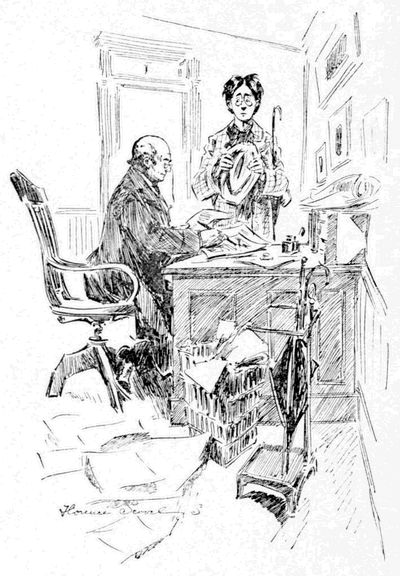
The Successful Author dropped in at the club and looked around for some one to whom he might talk shop. He spied the Timid Aspirant in the corner, and asked him to sit down. The Timid Aspirant blushed all over, and felt that better days were dawning for him, because the Successful Author’s name was in every one’s mouth.
“Have much trouble to sell your stuff, my boy?”
“Oh, I suppose I oughtn’t to complain.”
“Never destroy a manuscript, my boy. You don’t, do you?”
“Sometimes, sir.”
“Ah, don’t. You never know when it will become valuable. Anything written has its niche somewhere.”
Then the Successful Author sank back in his arm-chair and continued reminiscently: “I’ll never forget how one of my articles fared. It was the fourth or fifth thing that I had written, and it was called ‘The Father of Santa Claus.’ I liked it better than any editor has ever liked anything of mine.”
The Timid Aspirant nodded sympathetically, and the Successful Author continued: “I sent it to the ‘Prospect,’ and it came back promptly. Did I destroy it? Not at all. I pigeonholed it, and next year I sent it to them again. Again it came back, and once more I laid it to rest for a twelvemonth, and then bombarded the ‘Prospect’ with it. This sort of thing went on for several years, until at last, to save time, the editor had a special form of rejection printed for it that ran about as follows:
“Dear Sir: The time of year has come once more when we reject your story, ‘The Father of Santa Claus.’ It would not seem like the sweet Christmas season if we did not have a chance to turn it down.
“Yours respectfully,
“Editor the Prospect.”
“Let you down easy each year, didn’t he?”
“Yes. Well, in course of time my price went up. At the start I’d have been tickled to death to get five dollars for the thing, but now I knew that if the editor ever did change his mind I’d get at least fifty, so I kept at it. Well, it was last year that my collection of stories made such a hit, and since then I’ve been so busy filling orders for short stories that I forgot to send my dear old mossback out this year. But day before yesterday I received a note from the editor of the ‘Prospect’ asking for a Christmas sketch. Now was my opportunity. I wrote back:
“Sorry I haven’t anything new, but it struck me that you might like to look at an old thing of mine called ‘The Father of Santa Claus,’ and if you care to consider its publication I’ll let it go for a couple of hundred, just for the sake of old times.
I inclosed the story, and just before coming here I received a check for two hundred dollars.”
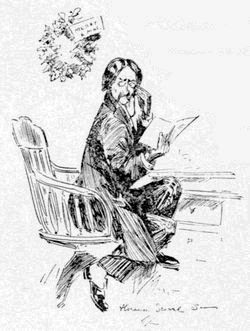
“What moral do you deduce from this, sir?”
“Don’t ever sell anything until you’ve gotten a big reputation.”
“Do you mind talking a little more shop?” asked the Timid Aspirant. Somehow he lost his timidity when talking to his renowned friend.
“Of course not. No one really does, though some affect to. Most talk is shop talk. It may relate to plumbing, or to dry-goods, or to painting, or to babies, but it is of the shop shoppy, as a rule, only ‘literary shop talk,’ as Ford calls it, is more interesting to an outsider than the other kinds. What particular department of our shop did you want me to handle?”
“I wanted to ask you if you believed in cutting a man’s work—in other words, do you believe in blue-penciling?”
“Ah, my boy, I see that they have been coloring your manuscript with the hateful crayon. No, I don’t believe in it. I dislike it now because it mars my work, and I used to hate it because it took money from my purse. Let me tell you a little incident.
“One time, years ago, I wrote an article, and after it was done I figured on what I would get for it and with it. If I sold it to a certain monthly I had in mind I should receive enough to buy a new hat, a new suit, a pair of shoes, ditto of socks, and a necktie, for all of which I stood in sore need. I hied me forth in all the exuberance of youth and bore my manuscript to the editor. As he was feeling pretty good, he said he’d read it while I waited. At last he laid it down and said: ‘That’s a pretty good story.’ My heart leaped like an athlete. ‘But’—my heart stopped leaping and listened—‘it will need a little cutting, and I’ll do it now, if you wish.’”
“Poor fellow!” said the Timid Aspirant, sympathetically.
“Well, the first thing that editor did was to cut the socks off of it; then he made a deep incision in the hat; then he slashed away at the trousers and did some scattered cutting, and at last handed the manuscript to me that I might see the havoc he had wrought in my prospective wardrobe. Dear man, I had a vest and a necktie left, and that was all. And it would have been the same if it had been a dinner.”
The Timid Aspirant shuddered.
“Many a young author has seen the soup and the vegetables, and at last the steak, fade away under the terrible obliterating power of the indigo crayon, and lucky is he if a sandwich and a glass of water remain after the editor’s fell work. Blessed is that editor who does not care to work in pastel,—to whom the blue pencil is taboo,—for he shall be held in honored remembrance of all writers, and his end shall be peace.”
“Amen!” said the Timid Aspirant.
XX THE DIALECT STORE
“I suppose I dreamed it; but if there isn’t such a store, there might be, and it would help quill-drivers a lot,” said the newspaper man, as he and his friend were waiting to give their order in a down-town restaurant yesterday noon.
“What store are you talking about, and what dream? Don’t be so vague, old man,” said his friend the magazine-writer.
“Why, a dialect store. Just the thing for you. I was walking down Fifth Avenue, near Twenty-first Street, and I saw the sign, ‘Dialect shop. All kinds of dialects sold by the yard, the piece, or in quantities to suit.’ I thought that maybe I might be able to get some Swedish dialect to help me out on a little story I want to write about Wisconsin, so I walked in. The place looked a good deal like a dry-goods store, with counters down each side, presided over by some twenty or thirty clerks, men and women.
“The floor-walker stepped up to me and said, ‘What can I do for you?’ ‘I want to buy some dialect,’ said I. ‘Oh, yes; what kind do you want to look at? We have a very large assortment of all kinds. There’s quite a run on Scotch just now; perhaps you’d like to look at some of that.’ ‘No; Swedish is what I’m after,’ I replied. ‘Oh, yes; Miss Jonson, show this gentleman some Swedish dialect.’
“I walked over to Miss Jonson’s department, and she turned and opened a drawer that proved to be empty. ‘Are you all out of it?’ I asked. ‘Ja; but I skall have some to-morrer. A faller from St. Paul he baen haer an’ bought seventy jards.’
“I was disappointed, but as long as I was there I thought I’d look around; so I stepped to the next counter, behind which stood a man who looked as if he had just stepped out of one of Barrie’s novels. ‘Have you Scotch?’ said I. ‘I hae joost that. What’ll ye hae? Hielan’ or lowlan’, reeleegious or profane? I’ve a lairge stock o’ gude auld Scotch wi’ the smell o’ the heather on it; or if ye’re wantin’ some a wee bit shop-worn, I’ll let ye hae that at a lower price. There’s a quantity that Ian Maclaren left oot o’ his last buke.’ I expressed surprise that he had let any escape him, and he said: ‘Hech, mon, dinna ye ken there’s no end to the Scots?’ I felt like telling him that I was sorry there had been a beginning, but I refrained, and he went on: ‘We’re gettin’ airders fra the whole English-sp’akin’ warld for the gude auld tongue. Our manager has airdered a fu’ line of a’ soorts in anticipation of a brisk business, now that McKinley—gude Scotch name, that—is President.’
“I should have liked to stay and see a lot of the Scotch, as it seemed to please the man to talk about his goods; but I wanted to have a look at all the dialects, so I bade him good morning, and stepped to the next department—the negro.
“Here an unctuous voice called out: ‘Fo’ de Lawd! Ah don’ b’lieve you’ll pass me widout buyin’. Got ’em all hyah, boss—Sou’ Ca’lina an’ Ten’see an’ Virginny. Tawmas Nelson Page buys a heap er stuff right yer. Dat man sut’n’y got a great haid. He was de fustes’ one ter see how much folks was dyin’ ter git a leetle di’lect er de ra’ht sawt, an’ Ah reckon Ah sol’ him de fus’ yard he evah bo’t.’
“‘Do you sell it by the yard?’ I asked, just to bring him out. ‘Shuah!’ and pulling down a roll of black goods, he unrolled enough dialect to color ‘Uncle Tom’s Cabin.’ But I said, ‘I don’t want to buy, uncle; but I’m obliged to you for showing it to me.’ ‘Oh, dat’s all right, boss. No trouble to show goods. Ah reckon yo’ nev’ saw sech a heap er local col’in’ as dat. Hyah! hyah! hyah! We got de goods, an’ any tahm you want to fix up a tale, an’ put in de Queen’s English in black, come yer an’ as’ fer me. Good day, sah.’ And I passed on to the next—Western dialect.
“Here I found that James Whitcomb Riley had just engaged the whole output of the plant. The clerk had an assistant in his little son,—a Hoosier boy,—and he piped up: ‘We got ’ist a littul bit er chile’s di’lec’, an’ my popper says ’at ef Mist’ Riley don’t come an’ git it soon ’at I can sell it all my own se’f. ’At ’d be the mostest fun!’ and his childish treble caused all the other clerks in the store to look around and smile kindly at him.
“In the German department the clerk told me he was not taking orders for dialect in bulk. ‘Zome off dose tayatree-kalers dey buy it, aber I zell not de best to dem. I zell imitation kints “made in Chairmany.” Aber I haf der best eef you vant it.’
“I told him I did not care to buy, and passed on to the French-Canadian department. The clerk was just going out to lunch; but although I told him I merely wished to look, and not to buy, he said politely: ‘I try hall I can for get di’lect, but hup in Mon’réal dat McLennan he use hall dere is; but bymby I speak for some dat a frien’ have, an’ he sen’ me some. An’ ’e tell me I’ll get hit las’ summer.’
“I expressed a polite wish that he might get his goods even sooner than ‘las’ summer,’ and walked to the Jew-dialect counter, over which I was nearly pulled by the Hebrew clerk. ‘You’re chust in time,’ he said. ‘Say, veepin’ Rachel! but I sell you a parkain. Some goots on’y been ust vun veek on der staich; unt so hellep me cracious! you look so like mein prudder Imre dat I let dem go’—here he lowered his voice to a whisper—‘I let dem go fer a qvarter uf a darler.’
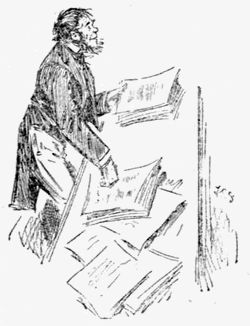
“I resisted him, and hurried to the Yankee department. There was tall hustling going on there, and a perfect mob of buyers of all sorts and conditions of writers; and it took half a dozen men, women, and children, including three typical farmers, to wait on them; and they were selling it by the inch and by the carload. ‘Wall, I’m plumb tired. Wisht they’d let up so ’st I could git a snack er somep’n’ inside me,’ said one; and he looked so worn out that I passed on to the Irish counter. A twinkling-eyed young Irishman, not long over, in answer to my question, said: ‘Sure, there’s not much carl fer larrge quantities av ut. Jane Barlow do be havin’ a good dale, an’ the funny papers do be usin’ ut in smarl lots, but ’t is an aisy toime I have, an’ that’s a good thing, fer toimes is harrd.’
“I paused a moment at the English-dialect counter, and the rosy-cheeked clerk said: ‘Cawn’t I show you the very litest thing in Coster?’ I told him no, and he offered me Lancashire and Yorkshire at ‘gritely reduced rites’; but I was proof against his pleading, and having now visited all the departments but one, went to that.”
“What was it?” asked the writer for the magazines.
“The tough-dialect counter.”
“Tough is not a dialect,” said he.
“Maybe not, but it sounds all right, all right. Well, whatever it is, the fellow in charge was a regular Ninth-Warder, and when I got abreast of him he hailed me with, ‘Soy, cully, wot sort d’ yer want? I got a chim-dandy Sunny-school line er samples fer use in dose joints, or I c’n gi’ yer hot stuff up ter de limit an’ beyon’. See? Here’s a lot of damaged “wot t’ ’ells” dat I’ll trun down fer a fiver, an’ no questions ast. Soy, burn me fer a dead farmer if I ever sol’ dem at dat figger before; but dey’s some dat Townsen’ did n’ use, an’ yet dey’s dead-sure winners wit’ de right gang. See?’
“And then I woke up, if I was asleep; and if I wasn’t, I wish I could find the store again, for I’d be the greatest dialect-writer of the age if I could get goods on credit there. Say, waiter, we came for lunch, not supper.”
XXI “FROM THE FRENCH”
When a Frenchman sets out to write a tale that shall be wholly innocuous, he succeeds—and thereby drives his readers to seek in De Maupassant and Zola the antidote for his poisoning puerility.
He generally lays the scene in London, that he may air his ignorance of things foreign; and when the tale is done it contains absolutely nothing that would bring the blush of shame to any cheek in Christendom, seek said cheek where you might.
The following is a fair sample of the unharmful French story. I trust that if it had been printed without preamble or credit, the discerning reader would have exclaimed, upon reading it, “From the French!” I have called it—
IT IS GOOD TO BE GOOD
In the great city of London, which, as you may know, is in England, there is a bridge, famous throughout the whole town as London Bridge. One dark night, many years ago, two men started to cross it in opposite directions, and running into each other, their heads crashed together in the fog which day and night envelops the city.
“Parbleu!” cried one, a fellow of infinite wealth; “but have you, then, no better use for your head than to make of it a battering-ram?”
“Sapristi!” replied the other, speaking in the coarse tones of an English mechanic out of work. “What matters it what I do with it? A moment more and I shall be in the Thames” (a large river corresponding to our Seine, and in equal demand by suicides). “To-night, for the first time in my life, I commit suicide!”
“Why, then,” said the other, “we will jump together, for it is for that purpose that I have come to this great bridge.”
“But,” said the mechanic, “why should you commit suicide? I can tell by the feeling of your garments that you are rich, and by the softness of your head that you are noble.”
“True, I am both of those things, but, also, I have exhausted every pleasure in life but the pleasure of suicide, and would now try that. But you, you are a mechanic out of work, as I can tell by your speech. Why should you seek pleasure instead of employment?”
“Alas, sir! I have at home one wife and seventeen children, all flaxen-haired, and all as poor as I. I cannot bear to go home to them without even the price of a biftek or a rosbif.”
“Come,” said the nobleman; “I will defer my sport for the night. I have never seen a starving family. It will furnish me with a new sensation.”
“Ah! but you have a kind heart, and I will not refuse you. The river will keep. Follow me.”
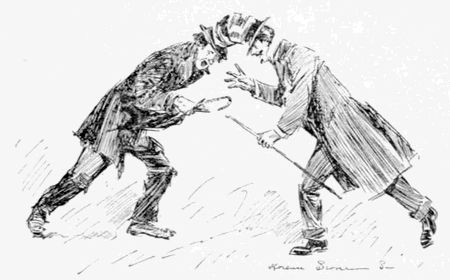
They followed each other through the region of the Seven Clocks, and through Blanc Chapel, afterward the scene of the murders of “Jean the Rapper,” until they came to the wretched apartment of the poor artisan. There, huddled in the corner of the room, were sixteen of the starving but still flaxen-haired children. The mother sat near the fireplace, so that she might be near the warmth when it came. In the other corner of the room—for they were so poor, these people, that they could not afford four corners—sat a vision of beauty, aged seventeen and a girl, ma foi! At sight of her the count’s eyes filled with tears of compassion, and he handed his purse to the wretched father and said: “My good man, do not stir from here. I will return in an hour with furniture!”
Tears of gratitude coursed down the thirty-eight cheeks of the poor family, and they no longer felt hungry, for they knew that in a short time they would be sitting upon real sofas and rocking in chairs like those they had seen through the windows of the rich on Holy Innocents’ Day.
The count, whose full title was Sir Lord Ernold Cicil Judas GeorgeS Herold Wallington, grandson of the great Lord of Wallington, was as good as his word, and in an hour he returned with six of his servants, bearing sofas and cushions and tables and tête-à-têtes, and what not.
The family seated themselves on the furniture, and, clasping his knees, overwhelmed him with thanks.
“Dame! Sacré!” cried he. “It is nothing, this thing I have done. What is it that it is? Know, then, that for the first time in my life I have the happiness.” Then, turning to the father: “Give me the purse. I left it as a collateral. Now that you have the furniture, you will not need it. But that angelic being there, she shall never weep again. I will take her with me.”
“Ah!” said the mother; “but that is like you, Count Wallington. You mean that she is to be a maid in your father’s house? Ah! what prosperity!”
“Ah! do not insult the most beautiful being who ever went about in a London fog. She a servant? Never! I will make her my wife. She shall be Miledi Comptesse Ernold Cicil Judas GeorgeS Herold Wallington!”
In Southwark-on-Trent, a suburb of London, is the hospital for those about to commit suicide. Ring the bell at the gate, and you will be admitted by sixteen flaxen-haired ones who will conduct you to the governor and matron. Need I say who they are, or whose money built the institution?
And when you read in London Ponch, among the court news, that a great beauty has been presented to the Queen of England, London, and Ireland, you will know that it is the Comptesse Wallington. She is presented at all the levees, and, with her husband, the handsome and philanthropic Lord Wallington, is the cynosure of all English eyes.
It is good to be good.
XXII ON THE VALUE OF DOGMATIC UTTERANCE
FROM MY “GUIDE TO YOUNG AUTHORS”
My dear young reader, if you are thinking of launching a little craft upon the troublous sea of literature, see that it is well ballasted with dogmatic assertions. (I should like to continue this nautical metaphor further, but I am such a landlubber that I doubt if I should be able to mix it properly, and what interest has a metaphor if it be not well mixed?) But to continue in plain English: A dogmatic assertion carries conviction to the minds of most unthinking people—in other words, to most people. (You and I don’t think, dear reader, and is it likely that we are worse than the rest of mankind?)
If you purpose becoming a novelist of character, follow my directions, and your first book will nail your reputation to the mast of public opinion. Fill your story full of such utterances as these: “Chaplain Dole always nodded his head a great many times to express affirmation. This is a common practice with persons who are a little hard of hearing.” (It isn’t, and yet it may be, for all I know to the contrary; but it will carry weight. Nine persons out of ten will say, “Why, that’s so, isn’t it? Haven’t you noticed it?”)
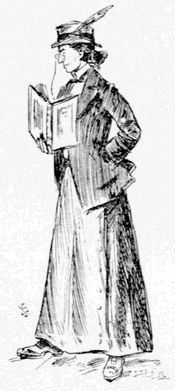
It doesn’t matter what you say; if you say it dogmatically it will go. Thus: “She walked with the slow, timid step that is so characteristic of English spinsters.” That’s a fine one, for it may excite contradiction, and contradiction is advertisement. Here are half a dozen examples: “He tapped his forehead with his left little finger, a gesture peculiar to people who have great concentration of mind.” “His half-closed eyes proclaimed him a shrewd business man. Why is it that your keen man of affairs should always look out at the world through a slit?” “The child spoke in that raucous tone of voice that always presages cerebral trouble.” “Miss de Mure waved her fan languidly, with a scarcely perceptible wrist motion, a sure indication that she was about to capitulate, but Mr. Wroxhaemme, not being a keen observer, took no note of it.” And, “He spoke but three words, yet you sensed that he was an advocate. Why is it that a lawyer cannot conceal his profession? A doctor may talk all day, and if he bar shop his vocation will not be detected; but a lawyer tunes up his vocal chords, as it were, and the secret is out.”
If all the above specimens of “observation” were introduced into your story the critics would unite in praising your keenness of vision.
Perhaps you would like to figure as a musical author. Few authors know anything about music, and you don’t have to; dogmatism and alliteration in equal parts will take the trick. Please step this way (as they say in the stores) and I will show you.
“She played Chopin divinely—but she did not care to clean dishes. Chopin and care of a house do not coalesce. A girl may love Beethoven and yet busy herself with baking; Bach and the Beatitudes are not antagonistic; Haydn, Handel, and housekeeping hunt together; Schumann and Schubert are not incompatible with sweetness and serenity of demeanor and a love for sewing; Mozart and Mendelssohn may be admired and the girl will also love to mend stockings; Weber and work may be twins: but Chopin and cooking, Wagner and washing, Berlioz or Brahms and basting, Dvořák and vulgar employment—or Dvořák and darning (according as you pronounce Dvořák)—are eternally at war. So, when I have said that Carlotta was a devotee of Chopin, I have implied that her poor old mother did most of the housework, while the sentimental maiden coquetted with the keys continually.”
Fill your stories with such bits of false observation, and ninety-nine persons out of a hundred will accept them at their face-value; which remark, being in itself a dogmatic assertion, will doubtless carry weight and conviction with it.
XXIII THE SAD CASE OF DEACON PERKINS
It is now some fifteen years since the dialect story assumed undue prominence in the literary output of the time, and about eight since it became a “craze.” There is no craze without its attendant disease or ailment: thus roller-skating developed “roller’s heel”; gum-chewing, “chewer’s jaw”; bicycling, the “bicycle face,” and later the “leg”; housekeeping, “housemaid’s knee”; golf-playing, “idiocy”; and so on, every craze having a damaging effect upon some portion of the anatomy. It is only within the last year, however, that it has been discovered that an over-indulgence in dialect stories is liable to bring on an affection of the tongue.
A peculiarly sad case and the most notable that has thus far been brought to the attention of the public is that of Deacon Azariah Perkins of West Hartford, Connecticut.
Far from deploring the spread of the dialect story, he reveled in it, reading all the tales that he could get hold of in magazines or circulating library. But his was not a healthy, catholic taste; he had ears and eyes for one dialect alone—the negro. For him Ian Maclaren and Barrie spread their most tempting Scotch jaw-breakers in vain; he had no desire for them. After fifteen years of negro dialect in every form in which Southern and Northern writers can serve it, any specialist in nervous disorders could have told the deacon that he was liable to have “negromania”; but West Hartford does not employ specialists, and so the stroke came unheralded, with all the suddenness of apoplexy.
Deacon Perkins has always been able to think standing; indeed, he has been called the Chauncey Depew of West Hartford, and no revival meeting or strawberry festival or canned clam-bake was considered a success unless the deacon’s ready tongue took part in the exercises.
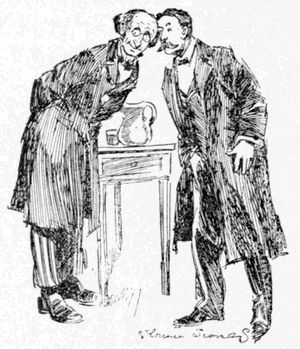
Last Sunday they had a children’s festival in the Congregational Church, and after the children had made an end of reciting and singing, the deacon was called upon for a few remarks. He is a favorite with young and old, and a man of great purity and simplicity of character. He arose with alacrity and walked down the isle with the lumbering gait peculiar to New-Englanders who have struggled with rocky farms the best part of their lives. He ascended the platform steps, inclined his head to the audience, and spoke as follows:
“Mah deah li’l’ chillun! Yo’ kahnd sup’inten’ent has ast me to mek a few remahks.” (Subdued titters on the part of the scholars.) “Ah don’ s’pose you-all’ll b’lieve me w’en Ah say dat Ah too was once a li’l’ piccaninny same as yo’, but Ah was, an’ Ah ’membeh how mah ol’ mammy use teh tek me to Sunny-school.” (Consternation on the part of the superintendent and teachers.)
“Now, ef you-all wan’ to go to heb’n w’en yo’ die, be ci’cumspectious ’bout de obsarvence ob de eighth c’man’ment. Hit ain’t so awful wicked ter steal—dat ain’t hit, but hit’s jes nach’ly tryin’ to a man’s self-respec’ ter git cotched. Don’ steal jes fer deviltry, but ef yo’ is ’bleeged ter steal, study de wedder repohts, ac’ accordin’, an’—don’ git foun’ out—or in, eiver.”
During the delivery of this remarkable speech the deacon’s face wore his habitual expression; a kindly light shone in his eye, a smile of ineffable sweetness played about his lips, and he evidently imagined that he was begging them to turn from their evil ways and seek the narrow path.
But at this juncture Dr. Pulcifer of New York, the eminent neurologist, who happened to be spending Sunday in West Hartford, whispered to the superintendent, and on receiving an affirmative nod to his interrogation, went up to the platform. He held out his hand to Deacon Perkins, who was making a rhetorical pause, and said kindly, “Good morning, uncle.”
“Mornin’, sah,” said the deacon, bowing awkwardly and scratching his head.
“Can you direct me to a good melon-patch?”
Deacon Perkins gave vent to an unctuous negro chuckle. Then, holding up his forefinger to enjoin caution, he tiptoed off the platform, closely followed by the doctor; and before nightfall he was on his way to a private hospital for nervous diseases, where rest and a total abstention from negro-dialect stories is expected to restore him to his usual sane condition of mind in a short time.
XXIV THE MISSING-WORD BORE
Then, there’s that bore whose thoughts come by freight, and the freight is always late. You know what’s coming, that is, you can imagine the way-bill, but he won’t let you help him to make better time, and runs his train of thought as if it were on a heavy grade.
He starts to tell a story, blinking his red eyes, meanwhile, as if he thought that they supplied the motive power for his tongue. To make listening to him the harder, he generally tells a very old story.
“One day, William Makepeace—er-er—”
“Thackeray,” you say, intending to help him. Of course it is Thackeray, and he was going to tell about the novelist and the Bowery boy; but he is so pig-headed that he shifts on to another track.
“No; Dickens, Charles Dickens. One day, when Charles Dickens was at work on ‘Bleak’—er—er—”
“‘Bleak House’?” you say.
“No!” he snaps; “‘Dombey and Son.’ One day, when Charles Dickens was at work on ‘Dombey and Son,’ he was approached by his biographer, John—er—er—”
“Forster?”
“No; it wasn’t his biographer, either; it was Edmund Yates.”
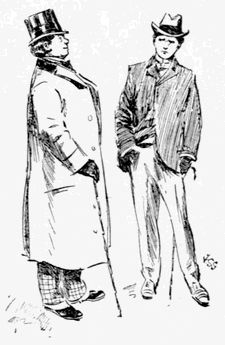
You now take a gleeful pleasure in seeing how hopelessly you can make him tangle himself up by the refusal of your help, but he doesn’t care. He’ll tell it in his own words, though the heavens fall and though he starts a hundred stories.
“Charles Dickens had a very loud way of—er—er—”
“Dressing?”
“No, no! He had a loud way of talking, and he and Edmund—er—er—”
“Yates?”
“No, sir; Edmund Spenser.”
Of course this is arrant nonsense on the face of it, but he won’t admit that he’s made pi of his story, and he goes on:
“Edmund said that Charles—”
“Dickens?”
“No, sir; Charles Reade. Edmund said that Charles Reade thought George—er—”
“Meredith?”
“No; hang it all! George Eliot. He thought that George Eliot never wrote a better book than ‘Silas’—er—”
“‘Marner’?”
“Not at all! ‘Silas Lapham.’”
Now, if you are merciful, or if you are refinedly cruel, either one, you will allow him to finish his story in peace, and, like as not, he will start all over again by saying: “I guess I inadvertently got hold of the wrong name at the beginning. It was not Dickens, as you said, but Thackeray. Thackeray was one day walking along the Bowery when he met a typical—” And so on to the bitter end.