Chapter VIII · THE GROWTH OF A FRONTIER
Reading edition
In the first chapter we called attention to the importance of the Appalachian barrier in long confining the process of colonizing within bounds, and preventing that wide dispersion which rendered so precarious the hold of France upon its far larger American empire. The relation of area to barrier, in that section chosen by the English, was, indeed, almost ideal for the formation of colonies, and, subsequently, of a nation through their union. While the mountains kept the original settlements within bounds until their population and institutions had both had opportunity to develop and take strong root, the extent of the continental mass behind, simple in its physiographic features, was sufficient for the growth of almost unlimited numbers and a unified state, and, so, for the effective influence upon the world of whatever form of culture might there arise. The West Indian colonies, on the other hand, in spite of their rapid growth, could not fail, eventually, to become politically unimportant, merely from their limited area and resulting limited population. Barbadoes, for example, comprised only one hundred and sixty-six square miles, the equivalent of one seventh of the land-surface of Rhode Island, or one fiftieth of that of Massachusetts. Within a century from its settlement, it contained no ungranted or uncultivated land—a condition which must have been approximated long before.[423] The possibility of growth, beyond a certain point, was, therefore, lacking in the islands, and, from the same cause, their development was to a great extent uninfluenced by another factor, which was of marked importance in the continental colonies and the nation for two centuries and a half. 176This factor was the constantly advancing frontier, with its radical reactions upon the thought and institutions of the also constantly expanding older settlements.
American political thought has been moulded, to a very great extent, by the two ideals, of unrestricted competition in exploiting the resources of the continent, and of a democracy fostered by the semi-isolated and self-reliant life of the frontier, with its comparative equality of opportunity and of economic status. Both these ideals, until a recent period, were developed by the presence of free land, in which they had largely had their origin.[424] As we have already pointed out, land in New England, in the earliest period, was to be obtained without either purchase price or rent, to which fact, perhaps, had been due the large non-Puritan immigration that mingled with the religious stream from 1630 to 1640.
It is also to the influence of the frontier that the American intellect owes some of its most marked characteristics: its restlessness, its preoccupation with the practical, its lack of interest in the æsthetic and philosophical, its desire for ends and neglect of means, its preference of cleverness to training, its self-confidence, its individualism, and its extreme provinciality. The influence, moreover, has been a continuing one, for almost every decade in American history, until 1890, witnessed the creation of a new frontier, which lay just a little beyond the settled regions, and reacted upon them.[425]
In describing the first expansion of the New England frontier, therefore, we are concerned with the earliest manifestation of one of the most potent forces in American history. The fringe of little settlements along the coast had been, indeed, the frontier of Europe; but with the planting of settlements farther inland, an American frontier came into existence, to react upon what, with the rapid movement of time characteristic of a new country, soon became the conservative, older 177East. That frontier has always been the refuge of the restless and the discontented, of those who have desired a freer, if not greater, economic opportunity, as well as of those who have been unable to adjust themselves to the prosaic life of a settled community, with its penalties of one sort or another for such as will not yield at least lip-service to its social, religious, or political beliefs. In Massachusetts there was no more room—if, indeed, there were as much—for those who disagreed with the authorities in any particular, than there had been at home; and those who came to that colony in the hope of enjoying any larger degree of religious toleration or civil liberty than in England were promptly disillusioned. About the time of the last events described in the preceding chapter, the prospects for freedom of thought or action must have looked as dark to the dwellers in Massachusetts not wholly in sympathy with the rulers' policy, as it had looked to those same rulers in the old country, when they met at the Earl of Lincoln's, and decided to remove to the wilderness. The opposition having become the government, it was now forcing a new opposition to follow the same course, involuntarily by banishment or voluntarily by free migration. Before continuing the story of that movement, however, we must allude briefly to that portion of the European frontier which lay northward of the Puritan settlements, and which, like them, had been formed by immigration from the Old World.
During the period we are now discussing, the history of Maine was the story of confused grants of territory and of the planting of small isolated farming, fishing, and trading communities. The existence led by the inhabitants, in their solitary shacks or little villages, was that of a rough border life in which the monotony of the hard, bitter winters, and the routine of planting, fishing, or bargaining for furs, was punctuated by an occasional murder among themselves, and by quarrels, sometimes bloody, with the Indians and the French.
In 1629, the Province of Maine, as granted to Mason and Gorges seven years previously, was divided between them, Mason accepting as his share that portion lying between the 178Merrimac and the Piscataqua,—which received the name of New Hampshire,—while Gorges retained the balance, extending from the Piscataqua to the Kennebec.[426] Mention has previously been made of the small beginnings at Pemaquid, Sheepscot, and Monhegan to the eastward, and of Portsmouth and Dover in what now became Mason's particular province. The settlements next planted, at Richmond's Island, Pejebscot, around Casco Bay, and elsewhere, were the work of servants for English merchants or of individual emigrants, and were hampered by the conflicting claims arising from the carelessly drawn patents.[427] Gorges himself became interested in a new attempt to colonize, and his nephew, William, was sent over as governor of a little colony planted at York, which later was to become the subject of one of those grandiose schemes of government to which the old knight was so uncontrollably addicted.[428] All of these early plantings, however, were of slight historical importance.
Although settlement was proceeding slowly and painfully, the vast forests and many rivers of the province offered a rich field for the exploitation of the fur trade, which was the main object of the French in the north, and one of the principal resources of the English settlements as well. The traffic, indeed, had been the means by which the Plymouth Pilgrims had bought their freedom from their merchant partners, and we have already noted that colony's activities on the Kennebec. A tragic incident that occurred at their little post on that stream, located at what is now Augusta, is of interest mainly as revealing the aggressive attitude which was later to become the settled policy of the Massachusetts colony in relation to its neighbors. Early in 1634, one Hocking, a fellow 179employed in an enterprise of Lords Say, Brook, and others, on the Piscataqua, tried to poach upon the Pilgrims' patented lands, and even to pass the trading station, in order to intercept the Indians carrying their furs. The Pilgrims' agents acted with restraint; but in the course of the dispute, Hocking wantonly killed one of their men; whereupon a companion of the slain man, “that loved him well,” as Bradford records, shot Hocking dead.[429]
Although the Plymouth men had been entirely in the right, a garbled version of the affair was sent to England and also to Massachusetts. Needless to point out, that colony had absolutely no jurisdiction whatever in the quarrel, which had occurred far outside its bounds, and not even in the unclaimed wilderness, but within the legal limits of its older neighbor. Nevertheless, the authorities at Boston arrested John Alden, one of the Plymouth magistrates, who happened to be there at the moment, and who had been at the Kennebec when the affray occurred.[430] This was naturally resented, even by the peace-loving Pilgrims, and letters requesting Alden's release were dispatched by the Plymouth government to Dudley. One of these, at least, that governor tried to suppress, but “Captaine Standish requiring an answer thereof publickly in the courte,” he was forced to produce it.[431] Alden was released, but Standish, who had been the bearer of the letter, was bound over to appear at the next Massachusetts court, to testify to the Pilgrims' patent. Finally, after Winslow and Bradford themselves had gone to Boston and conferred with Winthrop, the matter was adjusted, and Dudley and Winthrop wrote to the Lords in England the true version of the murder; but it was not likely that the other settlements would soon forget the high-handed proceedings of the Bay Colony in an affair so obviously beyond its jurisdiction.[432]
But the trading post on the Kennebec was not the sole concern of the Pilgrims in Maine, nor was that province the scene 180merely of contentions arising from conflicting English land-grants, or from rival colonial jurisdictions. It had been the stage on which the curtain had first risen in the struggle for empire between England and France, and was now to witness new episodes in that long drama. Still farther north the contest had recently become acute. Sir William Alexander, by virtue of an English grant, had claimed a large portion of French America, and Sir William Kirk had seized Port Royal and Quebec. By the treaty of St. Germain, however, in 1632, England agreed to restore “all places occupied in New France, Acadia, and Canada by the subjects of the King of Great Britain,” although the boundaries of those vaguely localized regions were not specified, and remained matters for contention, which meant raiding and Indian warfare, for over a century to come.[433]
Meanwhile, several more places had been occupied by the Pilgrims and those associated with the Plymouth colony. In 1630, a “very profane young man,” Edward Ashley by name, had started a trading post on the Penobscot, which the Pilgrims feared might injure their fur business on the Kennebec.[434] In spite of scruples, therefore, they joined with Ashley, and that person having been drowned at sea, after being released from the Fleet prison in London, they came into sole possession.[435] They did not long enjoy it in peace, however, for the following year the French descended upon them and carried away all their goods, valued at nearly £500, leaving word with the agents that “some of the Isle of Rey gentlemen had been there.” Allerton, who had broken with the Pilgrims, had also begun to trade, at Machias; and, a couple of years later, suffered in like manner from the French, who killed two of his men, and carried off all the others, as well as the whole stock of goods, which, as Bradford says “was the end of that projecte.”[436]
In spite of their own heavy loss, the Pilgrims had clung 181to the Penobscot until, in 1635, d'Aulnay, acting under orders from the French King to clear the coast of the English as far as Pemaquid, seized the post, and shipped the local agents back to Plymouth. The Pilgrims hired a vessel, and dispatched an armed force to try to regain possession; but, owing to the conduct of the man whom they had engaged to effect the enterprise, it failed miserably, and they merely entailed upon themselves a heavy additional loss. Massachusetts, when called upon for help, though she realized the danger to herself from the increasing aggressiveness of the French, refused aid unless the infinitely poorer Plymouth colony would bear the entire expense. That colony was, therefore, obliged to desist, and Bradford bitterly complained that not only did the Bay people thus do nothing to defend the common frontier, but that, owing to their cupidity, they even sold food and ammunition to the French, and so increased the menace both from them and their Indian allies.[437]
In Mason's province of New Hampshire, settlement, though more peaceful, was also proceeding but slowly beyond the Dover and Portsmouth plantations already noted. As the settlers of those two places were Episcopalians, and as an opportunity was offered to buy out the Hilton interest in the former, the Massachusetts leaders urged some of their friends in England to acquire it, with the result that Lords Say and Brook, Sir Richard Saltonstall, and others came into possession, and sent out additional colonists.[438] This pouring of new wine into the old Dover bottle produced a series of explosions, which subsequently prepared the way for annexation by Massachusetts. Mason died in 1635, and bequeathed his province to his family.[439] Two years later occurred the Antinomian controversy in Massachusetts, and the expulsion of Wheelwright, whom, when discussing that episode, we left on 182his way to New Hampshire. He succeeded in making the winter trip to the settlements on the Piscataqua, and the following spring, with a few associates and the help of his new hosts, he founded the town of Exeter, the inhabitants entering into a written compact for their self-government.[440] That the Massachusetts authorities would have preferred that he should die alone in the winter's snow is hardly a charitable supposition; but just what they did wish for is uncertain; for they wrote a letter of remonstrance to the New Hampshire people, saying that they “looked at it as an unneighborly part” that they should help any one expelled by themselves.[441]
One of these northern towns, from its first settlement, had been considered by Massachusetts as under its own jurisdiction. In March, 1637, the General Court had ordered that a plantation should be started at Wenicunnett,—the name being later changed to Hampton,—a little more than three miles north of the Merrimac.[442] It was thus slightly outside of the bounds of the patent, if that were construed, as it had been construed to that time, to include only such land north of the river as lay within three miles of it.[443] The project may mark, however, the first tentative step toward the colony's later, and wholly unwarranted, interpretation of that instrument, so as to include all the territory lying south of a line drawn due east from a point three miles north of the most northerly part of that stream, to the ocean, thus including practically all of New Hampshire and a large part of Maine. About a year and a half after the “bound house” was built, a group of colonists went to take possession of the new site. The Exeter men at once objected to this encroachment of Massachusetts on their neighborhood; but the General Court 183replied that the new settlement was within their patent, and that they looked upon the protest as “against good neighborhood, religion and common honesty.” They did, however, quietly send out a surveying party, and having found that the part above Pennacook was north of the line of 43½ degrees, they phrased a new answer to Exeter's renewed protest, saying that, while they relinquished none of their rights, nevertheless, as the Exeter men did not profess to claim anything which might fall within the Massachusetts patent, the matter would be allowed to rest. The way was thus left open for future aggression, and the Court immediately proceeded to erect the new settlement into a legal town.[444]
The frontier north of Massachusetts had thus, for the most part, come into being without any action on her part, except in the two settlements last noted. Owing to the location between the French and English, and the uncompromising geographic factors of soil and climate, the vast forested area, comprising over two thirds of all New England, increased but little in population throughout the century; and by 1700 New Hampshire had but six thousand souls, or less than that of the Bay Colony at the time that Wheelwright left it. The northern provinces, unhappily for themselves, were destined to play the part of buffer states between the French, with their savage allies, and the more safely located colonies in the south.
In tracing the foundations of the latter, we find the influence of Massachusetts far more potent, for they were being laid mainly by men who found scant room in that increasingly reactionary commonwealth. The founders of Rhode Island and Connecticut alike condemned the religious and political policy that the Bay Colony had now definitely made its own; and the more democratic and tolerant forms of government, which developed in the two former, “represented more nearly the principles which underlie the government of the United States to-day than any other of the British colonies.”[445] The seeds of both political and religious liberty had been brought 184to America by the Massachusetts colonists; but the leaders, partly from a dread of losing their own influence, and partly from a genuine fear of noxious weeds, had done their best to interfere with their growth. The founders of Rhode Island and Connecticut, with less desire for personal power, and greater courage as to tares in the wheat, watered and nursed the seeds of liberty, which bore an abundant harvest. In Rhode Island, indeed, the weeds flourished riotously; but the faith of the founders was justified in both colonies, and their commonwealths marched with Holland at the head of those struggling for human freedom, while England and Massachusetts yet lagged and nagged.
The lands around NarragansettNarragansett Bay had been known for some time to be attractive as sites for colonizing, when Williams made his way thither after his banishment, in the winter of 1636. In spite of frequent trading with the Indians, however, only one settler had as yet located there permanently. William Blackstone, who had left England because he disliked the tyranny of the Lord-bishops, and who had, as we have seen, an equal aversion for that of the Lord-brethren, had quietly left his plantation in Massachusetts, and betaken himself to the wilderness north of Providence.[446] A lover at once of peace, of books, and of freedom, there is something singularly attractive in his little known personality. He called his new home “Study Hill”; and there in his orchard grew the first “yellow sweetings” ever known, which, later, when he occasionally preached to the newcomers, he handed around, “to encourage his younger hearers.”
Thus, while, owing to the great services Williams was to render the colony, he is entitled to the name of its founder, he was not its first settler, nor was the little band that planted Providence with him in 1636 the only one to lay the foundations of the future commonwealth. Nor had he himself, apparently, any intention of doing so. “It pleased the most 185high,” he wrote, many years afterward, “to direct my steps into this Bay, by the loving private advice of that very honored soul Mr. John Winthrop the Grandfather, who, though he was carried with the stream for my banishment, yet he personally and tenderly loved me to his last breath. It is not true, that I was imployed by any, made covenant with any, was supplied by any, or desired any to come with me into these parts.”[447] The others came, however, and the leading idea of the settlement was reiterated four years later in the proposals for a form of government, when the “arbitrators” noted that they agreed “as formerly hath bin the liberties of the town, so still, to hould forth liberty of conscience.”[448]
In 1638, another group, of eighteen persons, including William Coddington, settled the town of Portsmouth; and in the following year, that little hamlet planted an offshoot at Newport, while a few individuals from both Providence and Portsmouth organized Warwick.[449] These four towns were absolutely independent of each other, and of any superior government of any sort, except England. Although Newport and Portsmouth partially combined in 1640, it was not until seven years later, when the charter of 1644 finally went into effect, that there was any colony of Rhode Island, or a united government over the several settlements.[450] It thus offered a great contrast to the Massachusetts colony, in which the towns were the creatures of the General Court; and it was this extreme looseness of organization, combined with religious toleration, which formed the leading characteristic of the Rhode Island political experiment. Although the settlers at Providence had signed an agreement to unite for purposes of government, there were no town officers, and practically no organization, until four years later. The agreement was merely to yield obedience to such orders “as shall be made for public good of the body in an orderly way, by the major consent of the present 186inhabitants, masters of families, incorporated together in a Towne fellowship, and others whom they shall admit unto them only in civil things.” These masters of families met once a fortnight, discussed their common affairs, and decided them by majority vote.[451] The government was thus almost a pure democracy, only women, minors, and bachelors being excluded. Even when the towns were united, and a more elaborate governmental machinery was set up, the extremely democratic trend of thought was evidenced in the remarkable provision that the General Assembly could not initiate legislation, but that laws were first to be considered in each town, and that only after all four had considered them, were they to be sent to be acted upon by the Assembly, all legislative initiative thus being retained in the hands of the people.[452]
With such looseness of organization, and extreme individuality of thought and action, another characteristic was bound to be lack of harmony, with frequent bickerings and disputes. These were soon in evidence, and it was found also that a pure democracy and absence of restraint were not compatible with orderly living. As the commonwealth grew, the difficulties were met in the spirit of men who, believing in liberty and toleration, were yet forced to make concessions to human nature; while, on the other hand, the Massachusetts authorities met their difficulties in the spirit of men who honestly disbelieved in democracy and toleration, and whose concessions were forced by a growing demand for things in which they had no faith. In Connecticut, also, the leaders were, happily, on the side of that part of the people, important in all the colonies, who were struggling upward toward a larger liberty, and who, even in Massachusetts, were slowly bringing it into being.
Knowledge of the existence of the Connecticut River, and of the advantages of its rich bottoms as sites both for trading and for planting, seems to have been first acquired by the English through information given to the Pilgrims by the 187Dutch. Friendly intercourse between Plymouth and New Amsterdam had been opened by the latter as early as 1626; and the Dutch not only taught the Pilgrims the value of wampum in the Indian trade, but, seeing how barren a site they had chosen for their settlement, told them of the Connecticut, and “wished them to make use of it.” However, “their hands being full otherwise, they let it pass” until, having been solicited by Indians who had been driven from their homes there by invading Pequots from the West, they dispatched several exploring and trading expeditions in 1633.[453] The same Indians had also earlier requested the Massachusetts people to make a settlement, but they had declined.[454] The Pilgrims, having made up their minds to erect a permanent trading post on the river, also asked the Bay people to join them; and when the latter refused, alleging their poverty, they even offered to provide the capital for both if Massachusetts would assume half the responsibility. This, likewise, being refused, the Pilgrims went on with the project alone, after telling the Bay authorities that they could have no cause to complain, as they had now had ample opportunity to join; to which they assented.[455] This was in the middle of July, and although the Massachusetts leaders had done their best to discourage the Pilgrims, by telling them the place was “not fit for plantation,” and by picking other flaws in the project, nevertheless, four weeks later, they had themselves dispatched a bark to Connecticut to trade, and John Oldham, going overland, had also spied out the resources of the place, and trafficked with the Indians there.[456] In view of all their actions, then and subsequently, it would seem difficult to avoid the conclusion that the Massachusetts authorities, 188having been offered by their neighbors a chance to share in a profitable opportunity, deliberately tried, by fraud and force, not only to obtain all the profits for themselves, but to prevent the very people whose enterprise it was from retaining any share in it. Not possessing the interpretative advantages of a New England ancestry, one is, perhaps, limited to remarking that the business dealings of ultra-religious people are often peculiar.
The Dutch, meanwhile, seem to have repented of their former hospitality, probably because of the warnings that the English had early sent them of their encroachment upon English territory, and of the rapid growth of the eastern colonies, which might threaten even their occupation of the Hudson.[457] Hearing of the projected settlement by Plymouth, a party was sent from New Amsterdam in January to buy land from the Indians,[458] and some of the Dutch were already ensconced in a little fort, on the present site of Hartford, when the English arrived in the late summer. In spite of Dutch protests, however, the Pilgrims, in their “great new barke,” sailed past the fort, and, passing north of the bounds of the Hollanders' Indian purchase, settled at what is now Windsor, buying the soil from its savage occupants. A later attempt by the Dutch to dislodge them by threatened violence proved unavailing.[459]
189Meanwhile, on the same day on which Winthrop recorded in his Journal the results of the Massachusetts expedition to Connecticut, he also entered the arrival of the ship Griffin, eight weeks from England, with John Cotton, Thomas Hooker, Samuel Stone, and John Haynes among her passengers. Cotton, as we have seen, remained in Boston, but the others immediately went on to Newtown, where a body of Hooker's English congregation had preceded him by a year.[460] Of this transplanted body, Hooker and Stone now became pastor and teacher. It is not likely that Hooker, with the political views he possessed, could have found the Massachusetts atmosphere congenial; and a year later, he and his congregation applied to the General Court for permission to remove to Connecticut. The reasons they gave were the lack of land for expansion at Newtown, the fear that otherwise Connecticut might fall into the hands of other English or the Dutch, and, lastly, “the strong bent of their spirits to remove thither.” The Court, however, refused the petition, alleging many reasons, which, in the main, came to the fear that such a defection would weaken the colony, and tend to draw away future emigrants from it.[461] In the debates on the subject, a majority of the deputies were in favor of allowing Hooker and his party to leave if they wished, while a majority of the magistrates opposed it. This raised the question whether the magistrates could veto a vote of the more numerous body of deputies, which was the more popular and democratic of the two. As the result of a sermon preached by Cotton the contest, which had promised to become bitter, was postponed, and the Newtown settlers were granted additional land in their present neighborhood.[462] The incident is interesting, not only as marking the beginning of the political struggle between the two elements in the legislature, which we shall have occasion to follow later, but also as an early example of that fear which the East has always had of the growth of its western frontier and its desire to check it.
Owing to continued pressure, however, the legislature withdrew 190its opposition the following year, and in 1635 permission was granted the towns of Watertown, Roxbury, and Dorchester to move anywhere, provided that they would continue subordinate to the Massachusetts government—a condition which that government had no legal right to impose. A few months later it went further, indeed, and passed a law that no one could leave the colony without permission of a majority of the magistrates.[463] As, under a previous law, no one could settle in Massachusetts without the consent of the half-dozen or more men mainly in control, so now no one, however uncongenial his surroundings or urgent his need, could leave without permission from the same little group.
Parties from Dorchester at once availed themselves of the Court's consent to leave, and by July were arriving daily on the Connecticut. On that river no spot would suit them except that already bought and occupied by the Pilgrims, from which the Massachusetts people now tried to oust them. In reply to a protest from Governor Bradford, the Dorchester men had the effrontery to answer that, as to the land settled by the Pilgrims, God “in a faire way of providence tendered it to us.” Upon this bit of fraud and hypocritical cant, Bradford caustically commented that they should “abuse not Gods providence in such allegations.” Massachusetts, however, was strong, and the Plymouth people were weak; and although the latter did finally wring a reluctant acknowledgment that the right was on their side, nevertheless they were forced to yield fifteen sixteenths of their land, and were allowed only one sixteenth and a little money, in an enterprise which was wholly theirs, in which they had courteously tendered Massachusetts a half interest, and which was located entirely outside any territory to which that colony had any legal title. There was good reason for Bradford's note in his diary, that the controversy was ended, “but the unkindness not so soone forgotten.”
The winter was very severe, and many of the new settlers were obliged to return to Boston; but in the spring, Hooker, with most of his congregation, emigrated to the river, traveling 191overland, with their herds of cattle, the precursors of an endless western stream. These newcomers, Bradford carefully notes, as we also are glad to do, treated the Pilgrims more fairly. By the end of 1636, there may have been eight hundred people in Connecticut, settled mainly at Hartford, Windsor, and Wethersfield, while the little settlement of Springfield, within the legal limits of Massachusetts, had also been planted.[464]
These settlements, at first, were merely plantations and not organized towns. They apparently had no officers, except constables,—who, Massachusetts tried to require, should be sworn by one of her own magistrates,—and the body politic consisted of the inhabitants, who met together, as we have found them doing in Rhode Island, to decide upon their common interests. The territory, however, in which they were located, was also claimed at the time by a group of patentees, including Lords Say, Brook, and others, who had been granted the lands by the Earl of Warwick in 1632, but who had made no attempt to enter upon them until three years later, when they sent John Winthrop, Jr., to act as governor, and took other action looking toward settlement. Winthrop, who had come to Boston in the ship with young Vane, was there at the time that the emigration from Massachusetts took place, and Hooker and the other emigrants consulted him concerning such rights as his principals might claim. As a result, an agreement, to last one year, was entered into between Winthrop, acting for Say, Brook, and their associates, and Hooker and his, which provided that a court of eight magistrates should be created, with power to summon a General Court, until further advices could be received from England. This agreement, for purposes of record, was ratified in the Massachusetts General Court, but was not a “commission” from that colony, as often stated.[465]
192On May 31, 1638, when a new form of government was under consideration, Hooker preached his famous sermon, in which he laid down the doctrines that “the choice of public magistrates belongs unto the people by Gods own allowance,” and that “they who have the power to appoint officers and magistrates, it is in their power, also, to set bounds and limitations of the power and place unto which they call them,” because “the foundation of authority is laid, firstly, in the free consent of the people.”[466] Neither to Hooker, nor to his fellow colonists of Connecticut, was this last principle new, either in theory or in practice. He was arguing, not for a democratic government, which they already possessed, but for a fixed code of laws to rule the magistrates in their actions. The following year, the constitution of the new government was adopted by the residents of the plantations of Hartford, Wethersfield, and Windsor.[467] That constitution provided for a General Court, in which each of the three original plantations should be represented by four deputies, and which should have the authority to incorporate towns. It was only subsequent to the creation of this general government by the inhabitants of the commonwealth, that the towns, as political entities, came into being. Freemen were merely required to be passed upon by the General Court, no religious qualification being attached to the franchise. It is noteworthy that the governor was not allowed to serve for two successive terms, and that no reference was made to any external authority, not even to that of the king.
While the descent of the “Fundamental Orders” of Connecticut can be traced in every step from the earliest charters of the trading companies, the transition was now complete. From such as we saw Tudor monarchs granting to merchants in the fifteenth century, past all those which we have noted as milestones by the way, the progress had been as steady as it 193was unperceived, from the privileges possessed by a few expatriated English traders and their clerks, dwelling among foreigners, to the self-governed commonwealth of a people in a land which they had made their own. While the charters, however, served as the framework of their government, the foundation of their political philosophy was found in the church covenant, which the Separatists had used in Europe for forty years before the Mayflower sailed; and the constitution of Connecticut was thus equally descended from religious theory and from the practice of trade.
Although there was little in the Fundamental Orders, as settled in 1639, which cannot be found in previous custom or legislation in Massachusetts or Plymouth, nevertheless, only those elements which were of a democratic tendency were put into the new constitution, and there was distinctly a more democratic attitude on the part of the leaders and people than in the Bay Colony. Such provisions as that making the governor ineligible for immediate reëlection, and the franchise independent of religious qualification, probably show a reaction from the rule of Massachusetts.
The contrasted influences which the new colony and its parent were bringing to bear upon the development of American thought at this time may best be illustrated by the theories of their several leaders. Perhaps the two most influential men in New England in 1640, and the two who most deserved the positions assigned them, were John Winthrop, the leader in Massachusetts, and Thomas Hooker, the leader in Connecticut. Winthrop's opinion of democracy as “the worst of all forms of government,” we have already noted, and may contrast with Hooker's belief that the complete control of their rulers “belongs unto the people by Gods own allowance.” In the important question whether judges should render arbitrary decisions wholly according to their personal views, or be limited by a fundamental body of laws, the two leaders were equally far apart. “Whatsoever sentence the magistrate gives,” wrote Winthrop, who opposed any such limitation, “the judgment is the Lord's, though he do it not by any 194rule prescribed by civil authority.”[468] “That in the matter which is referred to the judge,” asserted Hooker, on the other hand, “the sentence should lie in his breast, or be left to his discretion, according to which he should go, I am afraid it is a course which wants both safety and warrant. I must confess, I ever looked at it as a way which leads directly to tyranny, and so to confusion, and must plainly profess, if it was in my liberty, I should choose neither to live nor leave my posterity under such a government.”[469]
The aristocratic and oligarchical tendencies at work in Massachusetts there received enormous additional strength from the fact that the clergy were almost a unit in their support of reactionary ideas. This was a defect which was, to a certain extent, inherent in the Calvinistic ministry; and the failure of the contemporary Puritan colony in the Caribbean was, in considerable measure, due to the outrageous claims of the Puritan ministers there upon the civil power.[470] The influence of the Puritan clergyman upon his more devout followers could be equaled only by that of the Catholics, and it is difficult for the modern layman to realize its full extent. It came about in part from the Puritan doctrine already noted, that nothing in life was untinged with a religious aspect. If no one dreams now of any necessity of consulting the clergy, as such, with reference to the fashion in clothes or the economic and social policy of the nation, it is partly because those matters are no longer considered as religious, but purely temporal. The opinion of a clergyman, therefore, is of no more value than that of the well-informed layman, with his broader practical experience of life, if, indeed, of as much. One does, however, have recourse to a specialist, and a banker's opinion is sought on finance, and a doctor's on health. As, according to Puritan theory, there was no act which was not of a religious or moral character, the clergyman was, so say, a specialist on 195one aspect of everything, and from that standpoint his advice must be sought in every detail of life, and his influence was correspondingly great.
The individuals who emigrated to Rhode Island and Connecticut were mainly those who were dissatisfied with the restrictions imposed by Massachusetts. That process of secondary selection had now begun which was to continue to winnow out from every new community the most adventurous and independent, and to plant them again to the westward in still newer settlements, where, in turn, the process would again be repeated. In the colonies now forming, therefore, there was a freer opportunity for the seeds of liberty to grow than in the old Bay. The new commonwealths had, in addition, the great advantage that in them, at least at their beginning, the influence of the clergy was wholly upon the side of freedom; and in estimating the results of priestly power in New England, it is only just to recall that Roger Williams and Thomas Hooker were clergymen, as well as the narrower divines of Boston and her sister towns.
The westward movement of New England was to continue until her sons and her institutions were to be found in a continuous chain of communities from Portland on the Atlantic to Portland on the Pacific, and the influence of New England thought upon the life of the nation cannot be overestimated. In so far as the origins of that thought can be traced back to any definite leaders, or individual colonies, it was evidently the ideas of Williams and Hooker, rather than those of Winthrop, with all his high qualities, which were to dominate the American people, and to be absorbed into their very being.
At the same time that these new communities and influences were coming into existence, there was the possibility of another experiment being tried, in colonial matters, of a radically different sort.
The group of Puritan leaders, Warwick, Say, Brook, and others, whom we noted earlier as being interested in promoting Puritan colonization both in New England and in the CaribbeanCaribbean, had continued to be actively engaged in colonizing the 196latter; while by their acquisition of the Hilton patent in New Hampshire, and the grant in Connecticut, they were still in possession of large tracts in the former. Since the emigration of Winthrop in 1630, affairs in England had not improved politically, though they had distinctly done so economically. About 1634 or 1635, nearly all of the group of leaders with whom we are particularly concerned suffered in one way and another from the influence of the Court party. Warwick, who had been forced out of the Council for New England three years earlier, was attacked under the forest laws, and also made to divide his lord-lieutenancy of Essex. Pym was sued by the Attorney-General, and Barrington, Say, and Brook suffered in their estates.[471] In July, Humphrey, the Earl of Lincoln's brother-in-law, arrived in Massachusetts with “propositions from some persons of great quality and estate,” who were thinking of emigrating if satisfactory arrangements could be made.[472] In October, the younger Winthrop went to England, returning a year later with his commission as governor of a projected colony at the mouth of the Connecticut.[473] At the end of November, 1635, twenty men arrived there, and under the direction of Lyon Gardiner, a fort was erected at Saybrook. Saltonstall, one of the patentees, had also, a few months earlier, attempted to plant some men higher up the river; but they had been driven out by the same lawless Dorchester party that had fallen on the Pilgrims, causing Saltonstall a loss of £1000.[474]
Among the proposals made by Say, Brook, and the others to Massachusetts, as conditions of their emigrating to New England, it was stipulated that there should be two ranks in the commonwealth—gentlemen and freeholders; that the power of making and repealing laws should belong to both ranks, but that the governor should always be chosen from the higher. To these and the other proposals the authorities in 197the colony wholly agreed, but with the proviso that the church-membership qualification for the franchise must be retained.[475] The theocracy of Massachusetts, under the guidance of its ministers, had drifted far from the current of English life. Englishmen have always had a thoroughly healthy hatred of ecclesiastical rule in civil affairs, and, whatever country squires, noblemen's factors, or tradesmen and mechanics, might be willing to do, it could not be possible that such men as Warwick, Say, Brook, and Pym could place their political rights and careers wholly in the hands of the narrow-minded ministers and congregations of the little Massachusetts town churches. On that account, and because of the turn of affairs in England, the project was given up, and when, three years later, Warwick, Brook, Say, and Darley announced definitely that they were going to emigrate, it was not to New England but to their island in the Caribbean. Although they were not permitted to do so, the fact marks the distinct breach which had now taken place between the rulers of Massachusetts and the leaders of the Puritan party in England. The mistaken policy of the colony, which earlier had brought alarmed protests from her less powerful friends at home, had now definitely alienated her most influential ones. The selfish attitude toward her neighbors, already shown upon the Penobscot, the Piscataqua, and the Connecticut, and which, unfortunately, was to become more aggressive and unscrupulous, also lost her the friendship of her sister colonies. The result was that, when the real struggle came with the English government, a generation later, Massachusetts, although, thanks to her geographical position and aggressive acquisitiveness, she had become the most powerful of the New England group, found herself with hardly a friend in the old country or the new.
The work of extending the frontier was not a mere matter of discussions or of peaceful penetration into an untenanted wilderness. Owing to the great plague, which had so nearly annihilated the natives in the regions where the settlers had first planted, the Indian danger had never been a serious one, 198and no such massacre as almost wiped out the Virginia colony need have been apprehended. The savage, however, had been an important element in the life of the settlements. As friend or spying enemy, he was as constantly in and out of the little villages as he is of the pages of the early records. Although there was, unluckily, little that the white man could teach him that was of any service, he, on the contrary, taught the colonists many a useful lesson. He showed them how and where to plant, trapped their game and gathered in their stock of furs, guided them through the almost trackless forests, and, in a multitude of ways, gave them knowledge of the land which they had entered and of the products it might yield. In the background, nevertheless, always lurked the danger that the natives might grow tired of being slowly dispossessed, that they might decide to make an end of a situation which the more far-sighted among them could not fail to see would inevitably more and more narrow the free range for their savage life. In the fifteen years since Bradford and his little band had landed in an almost deserted spot, the white population had grown alarmingly. Moreover, their increasing numbers and desire for expansion would naturally lead the settlers to adopt a more aggressive attitude toward the natives in any dispute occurring between them. There was more and more probability of trouble, arising from individual outrage on the part of an unscrupulous or ruffianly white, or of some aggrieved or drunken Indian, of which the organized power of the former would but too likely take full advantage. The Old Testament texts on dealing with those outside the pale of God's chosen people offered little comfort to the Indian, should the Puritan divines ever start on the war-path.
At the beginning of 1633 word was received in Boston that a certain Captain Stone had been murdered by the Pequots, or Indians allied to them, after having landed at the mouth of the Connecticut. The exact truth of what occurred is not known. Stone, who was a trader from Virginia, was a drunken, dissolute, and thoroughly worthless character, and very likely provoked the natives by some act. On the other hand, 199their stories of what happened did not agree, and were not above suspicion.[476] The Massachusetts authorities reported the matter to Virginia, and no further action was taken until the following year, when an embassy from the Pequots arrived at Boston. That tribe had become embroiled in a quarrel with the Narragansetts on the east, and the Dutch on the west, and were, therefore, anxious to smooth their relations with the English. They agreed to deliver up the two men who had killed Stone, to surrender their rights to Connecticut, and to pay damages in furs and wampum. A few days later a number of Narragansetts appeared, who had come to waylay the Pequots on their way home; but the Massachusetts authorities purchased the safety of the savages and promise of peace between the two tribes, by offering the Narragansetts some of the Pequot wampum. Although the Bay Colony had thus bought the Pequot title to Connecticut with the blood of the slain Virginian, the natives had no idea, apparently, of observing the terms of the bargain, nor did the English take further steps in the matter until two years later, when the younger Winthrop, then at Saybrook, was commissioned to treat with the savages regarding rumors of recent outrages, and to declare war if he could not obtain satisfaction.[477]
A fortnight later news came of the murder of John Oldham, and the capture of two boys, in his small boat, while off Block Island on a trading voyage. The natives of that island, who were subordinate to the Narragansetts, were the guilty parties, but the crime seems to have been committed with the connivance of the Narraganset sachems, except Canonicus and Miantanomo. Through the intercession of Roger Williams, the latter sachem secured the release of the two youngsters, while emissaries of Massachusetts, who went to treat with Canonicus, returned home fully satisfied. So far, matters had been conducted reasonably and patiently. Suddenly, however, on the advice of the Massachusetts magistrates and 200ministers, the policy was completely changed, and a course of blundering stupidity and criminal folly was entered upon. John Endicott, with about a hundred volunteers, was ordered to proceed to Block Island, where he was instructed to put all the men to death, without making any effort to distinguish between guilty and innocent. The women and children were to be carried off, and possession taken of the island. Thence he was to go on to the Pequots, demand the murderers of Stone and Oldham, and a thousand fathoms of wampum, and to secure, by consent or force, some of the children as hostages.[478]
Endicott possessed none of the qualities of a military leader, and although his lack of knowledge prevented this bloody decree from being carried out, he managed to do just enough to enrage the savages without intimidating them. The party, after two days' searching, failed to find the island Indians, who were in hiding in the underbrush, but burned their wigwams, mats, and provisions, staved their canoes, and valiantly slew their dogs. They next proceeded to Saybrook, where Lyon Gardiner, who, in his little outpost, was responsible for the lives of twenty-four men, women, and children, did his best to warn Endicott of his folly. The corn-fields of the Saybrook people were two miles from the fort, and if the Indians, who had shown themselves suspiciously unfriendly of late, should be stung to revenge by Endicott, starvation and massacre would confront the settlement. “You come hither to raise these wasps about my ears,” said Gardiner, “and then you will take wings and flee away.” In spite of the dictates of common sense and humanity, Endicott proceeded to do just that. At Pequot Harbor he killed two Indians, burned many wigwams, staved the canoes, and then sailed away to the safety of Boston, leaving Saybrook and the towns on the Connecticut at the mercy of the savages, whom Massachusetts had now roused to fury.[479]
The Pequots immediately made peace with the Narragansetts, 201urging them to a common war against the English. Such a combination, under the circumstances, would have meant a disaster of the first magnitude, and Massachusetts was now forced to ask the help of the only man who could avert it, but whom she had already driven from her company—Roger Williams. In response to most urgent appeals sent from the Governor and Council, he at once started, “all alone in a poore canow, and to cut through a stormie wind with great seas, every minute in hazard of life, to the Sachem's house.” There he remained three days, and by means of his friendship with Miantanomo, he won the Narragansetts back to the side of the English, and broke up the proposed alliance between the savages. In consequence of this inestimable service, Winthrop and some of the Massachusetts council, Williams wrote, “debated whether or no I had not merited, not only to be recalled from banishment, but also to be honored with some mark of favor”; but neither the authorities nor the contemporary historians, except Winthrop, had the generosity to say a word of the man who had saved New England.[480] In the fall, Miantanomo and other Narragansett sachems went to Boston, and signed a treaty with the English, which included an offensive alliance against the Pequots.
Meanwhile, the results of the folly that Massachusetts had perpetrated, and against which Plymouth as well as Saybrook had formally protested, now made themselves felt.[481] Three men were killed at Saybrook, another was roasted alive, a trader was murdered at Six-mile Island, then two more at Saybrook, and another on his way up the river. At Wethersfield, nine men were slaughtered, and two young girls carried into captivity.[482] The horrors of Indian warfare became the hourly dread of every inhabitant along the frontier, thanks to the Massachusetts magistrates and ministers. Having, as Gardiner predicted, raised the wasps about his ears and those of all 202the English along the river, Massachusetts now asked help of Plymouth, as she had before turned to Williams. That colony agreed to lend aid, but in doing so, recalled to her stronger neighbor how she had refused help against the French when the Pilgrims were the petitioners; how she had interfered with their trade on the Kennebec; and how she had deprived their Connecticut pioneers of their lands.[483]
But the settlers on the latter river could not await the slow movements of the Bay Colony, if the lives of their wives and children were to be saved. At the Connecticut General Court of May 1, 1637, war was declared against the Pequots, and ninety men, from the three plantations, were levied for immediate service.[484] The expedition, under command of Captain John Mason, with some Indian auxiliaries under Uncas, immediately proceeded to Saybrook, where they were joined by Underhill, who happened to be there, and a few additional men.[485] A skirmish, in which the Indians, whose fidelity had been doubted, acquitted themselves loyally, encouraged them not a little. The original plan had been to sail down the coast to the Pequot River and to attack the enemy directly, but this was wisely changed at the suggestion of Mason. According to the new plans, the party set sail for Narragansett Bay, with the design of then returning overland, and making a surprise attack on the Pequots, who were expecting it from the water. After landing on the shore of the Bay, and being reinforced by several hundred Narragansetts, Mason marched his band from eight in the morning until an hour after dark, when they camped about two miles from the Pequot fort. It had been decided to attack only the larger of the two villages, a palisadoed enclosure of an acre or two.[486] About one o'clock, the English were on the march again, but were deserted by all the Indians, Narragansetts and Mohegans alike, before reaching 203the fort. The palisade having two entrances, opposite one another, it was agreed that two parties, led respectively, by Mason and Underhill, should make simultaneous attacks upon them. In spite of the fact that the Indians had been warned, by the barking of their dogs, of the approach of the enemy, Mason boldly jumped over the brush piled at the entrance, and was followed by his men. The other party also entered at the opposite side, and the slaughter of the dazed and half-awakened savages began. Seeing, however, that the resistance might prove too much for his men, Mason snatched a torch from a wigwam and set fire to the village, which, owing to the strong wind blowing, was soon ablaze. The English now had only to withdraw, and to shoot any wretched savage who attempted to climb over the palisade. In the early dawn of that May morning, as the New England men stood guard over the flames, five hundred men, women, and children were slowly burned alive.[487] Not over eight escaped, and there were but seven captives. The English lost two killed and twenty wounded. It is difficult to imagine what thoughts must have been in the minds of the Puritans as they slowly roasted the Indian women and children. Mason merely notes that, by the providence of God, there were one hundred and fifty more savages than usual in the village that night.
The English, carrying their wounded, retreated to the ships,—which fortunately had come into Pequot Harbor,—as the savages from the smaller village were hampering their movements. With the vessels had also arrived Captain Patrick and forty men from Massachusetts, that colony having voted one hundred and sixty, and Plymouth sixty, although too late to take part in the expedition. The bulk of the Pequot nation was now destroyed, and it remained only to make an end of the few hundred who had thus far escaped. Sassacus, the sachem, being repudiated by his own followers, fled with seventy warriors to the Mohawks, and the English indefatigably 204ran down detached parties. In a swamp twenty miles from the Dutch line, eighty of the Pequots' “stoutest men,” with two hundred old people, women, and children, made a last stand. After being subjected to the fire of the English for some hours, the two hundred non-combatants surrendered, while the warriors fought to the last man, twenty finally escaping through the surrounding lines. The other savages turned against the all but annihilated Pequots, and “happy were they,” wrote Mason, “that could bring in their heads to the English: Of which there came almost daily to Windsor or Hartford.” In all, during the campaign, over seven hundred were killed or made captive.[488]
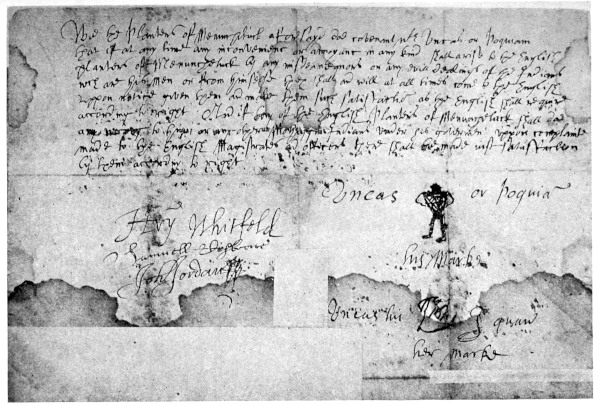
Document signed by Uncas and his Squaw Original in Massachusetts Historical Society
Of the prisoners some were divided between Uncas and the Narragansetts, while the rest were kept by the English, or sold into bondage in the West Indies.[489] In the division of this human spoil, the clergy took its part. “Sir,” wrote the Reverend Mr. Peter to Governor Winthrop, “Mr. Endecot and myself salute you in the Lord Jesus. Wee have heard of a dividence of women and children in the bay and would bee glad of a share viz: a young woman or girle and a boy if you thinke good. I wrote to you for some boyes for Bermudas, which I thinke is considerable.”[490] Fifteen boys and two women were sent thither as slaves, but whether for the profit of the Reverend Peter, Winthrop does not say. Roger Williams pleaded over and over again, but in vain, with the Massachusetts authorities for a more lenient course. “Since the Most High delights in mercy, and great revenge hath bene allready taken,” he advised incorporating the survivors among the friendly Indians; but though, only a short time before, the Massachusetts authorities had been pleading with Williams to save themselves, they now turned a deaf ear to his intercession for the natives.[491] The Narragansetts and Mohegans 205were both anxious to adopt the few survivors of their powerful enemies, according to Indian custom, so that Williams's suggestions were as practicable as they were merciful. Two hundred were finally so allotted by Connecticut, when the last remnants of the Pequots submitted and the River plantations entered into a treaty with Uncas and Miantanomo.[492] From the end of the Pequot war, all the New England colonies adopted not only Indian but negro slavery, and it was wholly due to economic, and not ethical, causes that the institution did not take root. In the one small locality in all New England where it proved profitable, it did so root itself, and the importing of slaves for use in the other colonies long constituted an important part of Puritan trade.[493]
The contest between the English and the Indians had been inevitable from the start. The murders of the two traders were but the sparks that touched off the explosive material which had long been accumulating. The struggle, with varying details and proximate causes, but based upon the unchanging fundamental conflict of the natures and economic interests of the two races, was to be repeated over and over again as the American frontier advanced. Endicott's stupid campaign, and, perhaps the too thorough absorption of Old Testament examples, had made the struggle almost inhumanly bloody in the first advance of that frontier in New England. The effect, however, was complete. It was to be nearly forty years before the savages regained sufficient strength, and found a leader to attempt again to dispute the relentless advance of the Puritan planters.planters.
206CHAPTER IX | | ATTEMPTS TO UNIFY NEW ENGLAND
As a result of the complete crushing of the power of the Pequots their whole country was opened to peaceful settlement, and the extension of the frontier in that direction became rapid. Within about two years from the signing of the treaty with the savages, the foundations were laid of Guilford, New Haven, Milford, Stratford, Fairfield, Norwalk, and Stamford along the Sound, and of Southampton and Southold on the eastern end of Long Island, thus making a continuous line of English settlement up to the Dutch boundary, if not, indeed, within it.[494]
For its size, New Haven was undoubtedly the wealthiest colony in New England, its assessed valuation, the year after it was planted, having been £33,000, or the present equivalent of, perhaps, $700,000.[495] Its founders, under the leadership of the Reverend John Davenport, a Nonconformist London clergyman, and Theophilus Eaton, a schoolmate of his, had arrived in the early summer of 1637, just in time to take part in the Antinomian controversy and the taxes for the Pequot war. Mr. Davenport was requested to contribute to the former, and Mr. Eaton to the latter.[496] Their company was a distinguished one, including several other wealthy London merchants besides Eaton; five ministers; four school-teachers, among whom was the first president of Harvard; the father of Elihu Yale, the founder of Yale University; and Michael Wigglesworth, the “lurid morning star” of New England 207verse.[497] Both Davenport and Eaton had been, for some years, members of the Massachusetts Bay Company, and that company's colony made great efforts to retain the new body of settlers within its own bounds. While the leaders took under consideration the various offers made to them, they either found them unsatisfactory, or had already determined to establish an independent colony of their own.[498] After Eaton had examined the country around Quinnipiack, it was decided to plant there, and seven men were left to guard the site during the winter, the whole company following in the spring. Not only were the resources of the colonists unusually ample, but their preparations seem to have been exceptionally complete, and the little town soon contained the most stately dwellings in all New England. Some idea of their scale may be gained from the reputed presence in Davenport's of thirteen fireplaces, and of nineteen in Eaton's.[499] The intention, apparently, was not only to found a Puritan state, but to have it become the chief mercantile centre of the New World, which accounts for their having built, as one of their Massachusetts critics wrote, “as if trade and merchandize had been as inseparably annexed to them as the shadow is to the body, in the shining of the sun.”[500] One disaster followed another in their business ventures, however, and the dreams of the merchant-founders were never realized.
Davenport and most of his company were not only Puritans, but of the strictest sect, and the Bible Commonwealth which they proceeded to form was of the most extreme type. Like the Connecticut and Rhode Island people, they were without a charter, and were mere squatters upon the soil; but in June, 1639, a meeting was held of the “free planters,” to discuss a frame of government to replace a previously signed plantation covenant, now lost. We have no knowledge of what constituted a “free planter,” but the term undoubtedly excluded 208a large number of males in the settlement. The proceedings took the form of queries put by Mr. Davenport, upon which those present voted by raising hands. As a result of unanimous votes at this meeting, the fundamental agreement provided that the franchise should be restricted to church members, and that the free planters should choose twelve men, to whom should be intrusted the sole right of selecting from among the rest of the colonists those who should become church members and freemen, and who were to have the power of appointing magistrates from among themselves, of making and repealing laws, and, in fact, of performing all public duties.[501] This was legalizing the most extreme claims of the Massachusetts oligarchy. Only one voice, apparently that of Eaton, was raised to protest “that free planters ought not to give this power out of their hands”; but he was, of course, overruled. Four months later, at the October court, it was further voted that “the worde of God shall be the only rule to be attended unto in ordering the affayres of government in this plantation.”[502] As had been the case in Connecticut, no mention had been made of allegiance to England; but in this additional step, the new colony swept away all obligation to observe the common and statute laws of the mother-country. The conflicting texts of the Bible, as arbitrarily chosen and interpreted by the small self-perpetuating group of rulers, became the only laws that might safeguard, or hazard, the rights of dwellers in New Haven and the affiliated church-towns which soon sprang up. The reactionary thought of the framers of these fundamental orders, however, was to be without appreciable influence upon the growth of colonial political theory as then developing; for New Haven was to have only a quarter of a century of independent but unimportant life before being absorbed by Connecticut, while a more and more democratic tendency was manifesting itself in all the colonies, even in Massachusetts.
The effects of the frontier life, and of the distance separating England from her colonies, were already beginning to 209show themselves strongly. The semi-independent communities which had been established in Rhode Island, Connecticut, and New Haven were entirely without legal authority; and the two latter, in their “constitutions,” had utterly ignored the existence of any power outside of themselves. The situation was not wholly overlooked in England, but as the crisis in public affairs there was rapidly drawing near, the authorities were helpless to interfere. A new demand for the return of the Massachusetts charter, when flatly refused by that colony in 1638,[503] could not be followed by any show of force; and during the next twenty-two years—which were those of the Civil War, the fall of the Stuart monarchy, and the reign of Cromwell—the New England colonies pursued their way almost wholly without reference to the power of England.
The influence of the frontier was being felt in their domestic concerns as well. Although the most aggressively radical of the inhabitants of Massachusetts had, perhaps, gone to the other colonies, there to establish themselves in greater freedom, the struggle of the citizens continued, nevertheless, against the arbitrary power of their government. From the first, the body of magistrates had acted in a judicial, as well as an executive, capacity. The only rule by which they were guided is indicated by a resolution in the General Court of 1636, which provided that they should “determine all causes according to the lawes nowe established, and where there is noe law, then as neere the lawe of God as they can.”[504] As English law, in many cases, was not justly applicable, and as, in others, it was largely neglected, this really meant the comparatively few laws already enacted in the colony, and the same arbitrary selection and interpretation of Old Testament texts that we have just noted in New Haven. As the magistrates acted as both attorneys and judges, and as no appeals were permitted from their decisions, no accused person had any protection 210against them. Anyone, therefore, who might be obnoxious to the ruling powers on account of his views, could not hope for justice; and the so-called trials of Mrs. Hutchinson, Wheelwright, and other notable offenders, were, in reality, not trials at all, but “relentless inquisitions used by the government for the purpose of crushing opposition.”[505] That condition was not, indeed, peculiar to Massachusetts, and was probably just as true of contemporary England. It was Hooker's glory in Connecticut to have raised his voice, as the leader of that colony, to plead for a legal restraint upon this arbitrary exercise of the judicial power of government, and for the creation of a body of fundamental law. In 1639, a committee was appointed in that colony for the purpose of drawing up such a code. The same had been formally demanded in Massachusetts even earlier, but there the wishes of the people had been steadily opposed by their leaders.
While the Massachusetts trials of the type just noted were exceptional, and in general, when passions were not aroused, the ordinary course of justice was fairly equitable, nevertheless, the entire absence of any restraint upon the unbridled will of the magistrates was a source of apprehension to the more serious thinking and liberty-loving residents of Massachusetts, outside the ring of authority. Not only was any opposition to the course pursued by the government liable to result in banishment, with the complete uprooting of a man's life, and perhaps the financial ruin of himself and his family, but in trivial matters all the inhabitants, and more particularly, of course, the four fifths who were not church members, were liable to constant interference by the authorities. Such a law, for example, as that declaring that whosoever should “spend his time idlely or unproffitably” should suffer such penalty “as the court shall thinke meete to inflicte”[506] was typical, both in its utter lack of definition of the nature of the crime, and in its failure to specify the penalty to be incurred by the criminal.
211In spite of the demands of the people in Massachusetts, however, it was not until 1640 that a draft of a fundamental law seems to have really been considered. The clergy and most of the magistrates had been opposed to any limitation of arbitrary authority, and had fought the requests with what their modern defender has called the weapon of “a good-natured procrastination,” but which may have worn another aspect to some at the time.[507] Finally, in 1641, an Abstract of Laws, or Body of Liberties, was passed, which marked a distinct step forward, though by no means assuring full protection. One draft, which was not, however, accepted, was based entirely upon Bible texts, of which, characteristically, but two were drawn from the New Testament and forty-six from the Old.[508] Additional safeguards were required, and four years later, the whole discussion as to specific penalties for specific offenses was again reopened. The clergy and Winthrop still opposed any limitation upon judicial authority, the Governor, indeed, going so far as to say that God had made specific penalties only in certain cases, and as “judges are Gods upon earth,” their power should not be more limited than his—which might be denominated strong doctrine.[509] In spite of all opposition, however, a new code, based in part upon the Body of Liberties, was finally secured and printed in 1648, twenty years after the first demand, and ten after Hooker's famous sermon at Hartford.[510]
The antagonism to the power of the magistrates was manifested also by new episodes in the struggle between them and the more democratic deputies, which we noted as beginning at the time of the Connecticut emigration. A dispute over the ownership of a sow, between a poor widow and a rich man 212notorious for his unjust business dealings, was finally brought to the General Court for decision. The evidence was by no means convincing, and the Court was divided, with a majority of the magistrates in favor of a verdict for the rich Keaynes, and a majority of the deputies in favor of the poor widow. The point was thus raised again as to whether the small number of magistrates, by a negative vote, could block the will of the much larger body of deputies.[511] Winthrop wrote a treatise on the question, appealing to certain English precedents and the Old Testament, and stated that, if the magistrates were not allowed to veto the action of the deputies, the colony would be a democracy and “there was no such government in Israel.”[512] So implacably did the grim shades of Moses and Aaron block the paths of Boston Common. The magistrates, in view of the strong opposition that developed, offered to leave the matter to the clergy, and to give way if the decision were adverse. They knew, of course, that it would not be so, and Winthrop records that it was “their only care to gain time,” until the people could be brought to the heel of their clerical leaders as usual. As part of the plan, the members of the Court were asked to take advice before the next meeting; and it is interesting as showing the normal danger for the ordinary citizen in discussing public matters, that a special act should be thought necessary making it “no offence for any, either publicly or privately, to declare their opinion in the case, so it were modestly.”[513] The following year, a compromise was effected, which, however, was distinctly in favor of the magistrates; and thereafter the deputies and the magistrates sat as two separate houses, each with a negative vote on the other.[514]
Another incident in the struggle, which soon occurred, involved both the question of the power of the local government over the colonists, and the relations of the colony to the home government in England. In 1644, it was suggested to the General Court that the condition of the large number of unrepresented 213inhabitants be improved by increasing the civil privileges that a citizen might possess without being a church member, such privileges then being limited, apparently, to a small share in local town business.[515] Nothing, however, was done, and two years later, a petition signed by a Dr. Robert Child, Samuel Maverick, and five others was presented, reciting that there were many thousands in the colony who were debarred from all participation in government, although they paid taxes and were subject to military and other duties. Child was a newcomer, “a gentleman and a scholar,” and a graduate of the University of Padua. Maverick was the richest of the “old planters,” and the only freeman who was not a church member—a privilege which he owed to the circumstances connected with the first planting of the colony, as already related. Thomas Fowle, another of the signers, was a merchant; while yet another, David Yale, was a man of property, and both a stepson of Theophilus Eaton of New Haven and a brother-in-law of Governor Hopkins of Connecticut. At this very time, he was acting as attorney for the Earl of Warwick.[516] The motives of the signers may not have been wholly disinterested, but the effort to make out that they were persons of no importance in the colony has been overdone.[517]
The petitioners desired that “members of the church of England, not scandalous in their lives and conversations,” be admitted to the churches, and that “civil liberty and freedom be forthwith granted to all truly English, equall to the rest of their countrymen, as in all plantations is accustomed to be done, and as all freeborne enjoy in our native country.”[518] Other reforms were demanded, and although some of the charges were overdrawn, nevertheless, the main point was not fairly met in the lengthy reply prepared by Winthrop, Dudley, 214and others of the court.[519] That point was that in an English colony, and upon English soil, the great majority of the inhabitants were debarred from a share in the government because of beliefs which would not have so disfranchised them in the home country. No amount of legal casuistry expended upon the charter, and no amount of sophistry employed in explaining the relations between the colony and England, could alter that fact, nor the additional one that Massachusetts was a colony and not an independent nation. As the request of the petitioners was for such liberties only as they would have possessed at home, and not for general religious toleration, an appeal to England was natural, and was set on foot as soon as the reply of the magistrates was received. Winthrop, however, declared that he would not tolerate such an appeal, and the petitioners were heavily fined by the court, and two of them imprisoned.[520] Child, and some of the others insisting upon going to England, they were seized just before the ship sailed, their baggage and houses were searched, and they themselves imprisoned. As some of the magistrates had not agreed to the earlier proceedings, they were not consulted in the present one, which was distinctly of a Star-Chamber sort. Among the papers of Dand, another signer, was found one suggesting the appointment of a royal governor, for which he also was promptly put in jail. Vassall and Fowle finally reached England; but the political situation there by 1647 had become such as to preclude any consideration of colonial matters.
215The tide of popular rights in the colonies was rising, however, and “all the troubles of New England” were “not at the Massachusetts,” as Winslow wrote to Winthrop, nor were high-handed proceedings wholly limited to that commonwealth. In Plymouth, a written proposal, favored by many of the inhabitants and of the deputies, was presented to the General Court, “to allow and maintaine full and free tollerance of religion to all men that would preserve the civill peace and submit unto government.” “You would have admired [wondered] to have seen,” wrote Winslow, “how sweet this carrion relished to the pallate of most of the deputies.” “Notwithstanding it was required, according to order, to be voted,” the Governor would not permit any vote to be taken; and the effort thus to extend to others the same freedom that the leading founders of the colony had availed themselves of for twelve years in Holland was summarily suppressed.[521]
During the decade we have been considering, the struggle of Englishmen at home for the preservation of their liberties against the incompetent and reactionary rule of the second Stuart, had left that ruler but little leisure to consider the American colonies. Except for occasional and ineffectual efforts to retain some control over them by the home government, they had been left free to work out their own theories, untrammeled by any higher power. By 1640, the scattered settlements in Maine, the towns in New Hampshire, the Bay Colony, Plymouth, the four separate towns in what is now Rhode Island, Saybrook, the affiliated towns of New Haven, and the river settlements of Connecticut, were pursuing their several ways virtually as independent states, preëmpting lands, erecting governments, treating with the natives, with each other, and with the French and Dutch, as if they were sovereign powers. Nor was there anything to prevent innumerable other petty states, each with its few square miles of territory, and ruling according to its own ideas, from arising over all New England, save as restrained by the jealousy of those already in existence. If this tendency had not been restrained, 216New England might have come in time to be a checker-board of tiny republics, engaged in constant disputes over boundaries and other relations at home, and, should the shield of England cease to protect them, the prey of foreign foes abroad.
There were three possible methods of preventing this development of a Puritan Balkans. England might assert her rights legitimately, and endeavor to bring some sort of uniformity and order out of what might otherwise become an impossible situation; one or another of the colonies might, by force of greater strength, subdue its weaker neighbors, and thus create one or several greater states; or, finally, a confederation might be formed of all of them. Under the circumstances, the legal and logical method would have been some sort of imperial control by the mother-country, but that was out of the question unless the English government was strong and united enough to enforce her will, and wise and experienced enough to make it acceptable to the colonists. For the present, that solution was impossible. Of the other two, the first would naturally appeal to a strong and aggressive colony like Massachusetts, while a confederacy would be favored by her weaker but no less independent neighbors. Both the latter plans were tried, and the intercolonial relations of the next quarter of a century were largely the result of these two conflicting methods of unifying New England being pursued simultaneously.
Owing to the death of Mason, and the failure of Gorges's plans for Maine, the settlements north of Massachusetts were without a settled government, and the inhabitants do not seem to have had the ability to create a stable one for themselves, which was so marked a characteristic of those in Massachusetts and Plymouth, Connecticut and New Haven. We have already seen how Massachusetts, by an unwarrantable construction of her charter, had begun to lay claim to all the land of New Hampshire and Maine lying eastward of the most northerly source of the Merrimack, although the whole course of the Crown and Council for New England at the time of the grant showed that such a claim was absolutely untenable. 217Nor, in the beginning, had the Massachusetts leaders dreamed of making it,[522] and it was, in fact, as Professor Osgood says, “more clearly an usurpation than was any later act of the crown which affected New England.”[523] The decision, otherwise favorable to Massachusetts, of the English Chief Justices in 1677, declaring the interpretation claimed to be utterly without warrant, and reassigning the lands to the heirs of the two original patentees, seems entirely just.[524]
Early in 1641, a dispute between church factions in Dover, headed by two contending clergymen, gave Massachusetts a chance to intervene. Captain Underhill, who had been banished from that colony at the time of the Hutchinson controversy, was then on the Piscataqua, and, perhaps with an idea of once more ingratiating himself with the home authorities, sent a petition to the Massachusetts Court, asking aid for himself and his party. Massachusetts at once dispatched a magistrate and two clergymen, and the Underhill party were victorious, the clergyman heading the opposing faction having opportunely turned out to be a personally immoral character.[525] The Dover patentees, Warwick, Say, and the others, who had purchased the patent in the interests of Massachusetts some years before, now passed the grant, with slight reservations, to that colony, which at once annexed the town.[526] A temporary government was installed, and, two years later, it was agreed that the inhabitants should have the privilege of freemen to manage their local affairs, and to elect deputies, even though they were not church members.[527] Thus a right not yielded to four fifths of her own citizens was granted to 218those in her new possessions, and imperial ambition seems to have won the first victory over Israelitish polity. This provision not only disproved her former claim that civil order could not be maintained without forced religious conformity, but, combined with the further provision that the settlers in the newly annexed territory should be subject only to local, and not to general, taxation, it tended to show that she herself did not believe the claims she made as to the interpretation of the charter.[528] If she really considered that the territory now being seized under pretext of ownership was as indubitably hers as that south of the Merrimack, why did she thus deprive herself of the right of religious and fiscal control?
She next claimed and absorbed the town of Exeter, and her new claims, extending to Maine, there came into conflict with those of Gorges and the Pilgrims. The latter, indeed, had lately heard her state that she was entitled to a part of the town of Plymouth itself, and she did encroach upon the Plymouth territory.[529] A further enlargement of her power to the south, and one obviously outside her jurisdiction, was next made within the present limits of Rhode Island.
Samuel Gorton, from his heretical notions in religion, according to the Gospel of New England, and his somewhat explosive efforts to defend persons he thought oppressed by the colonial authorities, had led a troubled and troubling life in Massachusetts, Plymouth, Portsmouth, and Providence. Indeed, in his wandering course through the Puritan heavens, he seems to have been as fatally followed by trouble as a comet by its luminous tail. As he punctuated his career by denominating the Massachusetts magistrates “a generation of vipers,” the Governor of Plymouth, “Satan,” and the justice of Portsmouth, “a just-ass,” he can hardly be said to have had an ingratiating way with the authorities, although no crime could be laid at his door. The people of that day had an insatiable passion for ploughing in the theological field, which was always proving as full of unexploded shells as any 219on the modern battle-front of France, and Gorton seems to have had a fatal facility for turning these up. He had already been blown out of three colonies, when, after some experience with him, the men of Providence decided that he or they must leave. Finally banished, he made an Indian purchase, and settled some miles to the south.
This, however, was not far enough for his former neighbors, who, in 1641, asked assistance from Massachusetts in ridding them of Gorton. That colony refused to consider the request, unless Providence would place herself under her jurisdiction.[530] The matter became complicated by a dispute between Miantanomo and two other sachems, arising out of Gorton's purchase, and the sachems also applied to Massachusetts. Both they and the Providence men were received under her jurisdiction, and the next move was to send a force of forty armed men to take Gorton and his party into custody.[531] Even those opposed to him in Providence suggested arbitration; but the Massachusetts clergy advised the magistrates that this was not an “honorable” course, as the Gorton party “were no state, but a few fugitives living without law or government,” and “their blasphemous and reviling writings” could be “purged away only by repentence and public satisfaction.”[532] The case was, therefore, prejudged without a hearing, and the more summary method was taken of trying to set fire to the log fort in which Gorton and his company had taken refuge.
It must be presumed that the ministers of Christ considered this as a more “honorable” course than arbitration with “a few fugitives” from their vindictiveness. The attack was made on a Sabbath morning, and even the heretical Gorton was naturally surprised.[533] In receiving the Indians under their jurisdiction, Massachusetts had required that the savages should not profane that day by doing any work upon it, and that they should not kill any man but upon just cause and 220authority.[534] The attempt, immediately following, on the part of that colony's expedition, to burn their fellow white men alive during church hours, because they were too impatient to wait, may have struck their new savage subjects as a little incongruous. Nine of the Gortonists were captured, taken to Boston, and imprisoned. The clergy called for blood, and gave their written opinion that all nine of the prisoners “deserved death by the law of God.” In this unjust and inhuman decision, all the magistrates but three concurred, and it was prevented from passing only by the people's representatives among the deputies. Finally, the prisoners were condemned to be distributed among seven towns, there to be “kept to worke for their living, and wear irons upon one leg, and not to depart the limits of the town, nor by word or writing maintain any of their blasphemous or wicked errors upon pain of death.”[535] The sentence was executed and the prisoners were kept in irons until the following year; when the growing popular disapproval of the clergy's actions caused their victims to be suddenly released and banished.[536]
The Massachusetts authorities had thus utilized the request of one faction in a settlement wholly outside their own limits, to extend their jurisdiction. They had attempted, upon a charge of heresy directed against persons living in another colony, to murder the entire body of the opposing faction, after refusing the arbitration proposed by that faction's own enemies. When the decree was finally softened to banishment, this was held to include exclusion of the prisoners from their former homes, now considered as part of the Bay Colony. They had seized and sold the cattle and goods of the unfortunate people, to pay the expenses of their so-called trial and illegal detention. In all this, there had not been even the fallacious plea, as in the case of Williams and Mrs. Hutchinson, that the civil peace of Massachusetts had been endangered.
221The outcome showed, however, that the cruel and immoral power of the clergy and magistrates was coming to be opposed by a growing body of healthy and liberal opinion. The bloody sentence demanded by them had been refused by the people's leaders, and public opinion had finally secured the reversal, within a year, of the milder one that had been executed. The confusion of Gorton's own religious views, and his incoherence in expressing them, could in themselves have won him little popular support.[537] What the people were groping after was the right of the individual to think and act for himself, so long as the state was not endangered, as had been clearly expressed in the Plymouth petition. The road was to be long and bloodstained, but there was now no doubt that the people of Massachusetts intended to travel it, and that their feet were at last set in the right direction.
By 1640, although new arrivals had not been coming in so rapidly of late, the population of the New England settlements had grown to about eighteen thousand. Moreover, they had, on the whole, been prosperous. We have already seen how even Plymouth, with its slender resources, its poor soil, and its ill-chosen site, had yet achieved more than economic independence, and we have noted the financial resources of New Haven. The capital and numbers of Massachusetts were, of course, far larger than those of either of the others, and it was estimated that that colony had spent, in its first dozen years, nearly £200,000, or in our day, perhaps, five million dollars, in making its settlement.[538] Possessed of the unrestricted resources of a continent, and having suffered no losses from Indians or foreign foe, New England was apparently in a sound economic condition, when suddenly the crash came. “Merchants would sell no wares but for ready money,” Winthrop wrote in 1640; “men could not pay their debts though they had enough, prices of lands and cattle fell soon to the one-half, 222yea to a third, and after one-fourth part.”[539] The Massachusetts General Court was soon called upon to pass special legislation to assist debtors, as the suffering became general.
In spite of their enormous natural resources, the colonies, like all new countries, lacked capital in the form of money. They borrowed heavily from England and imported from her still more heavily in food, clothes, and manufactured goods, without as yet having developed sufficient export trade to enable them to meet their foreign bills.[540] The inherent unsoundness of the position had been concealed, temporarily, by the effects of the continued influx of new settlers on a large scale, which had created a demand for all the colonists' surplus in the shape of everything required by a planter during his first years. Prices of both goods and lands advanced steadily, as a fire is blown into flame by a forced draught. Suddenly the tide of immigration stopped entirely; the exceptional demand, which had come to be regarded as normal, ceased; English merchants naturally required payment on overdue accounts; and all the familiar phenomena of an economic crisis became evident.
It is usually stated that emigration from England stopped because the prospect there had become so much brighter for the Puritans that there was no longer reason for leaving home.[541] This, however, by no means meets all the requirements of the case. We have already seen that the great majority of the people who had been coming to New England had not joined the churches there, although in the main of Puritan stock. Nor, at the time in question, did the Puritan leaders in England, in spite of altered conditions, by any means relax their efforts to plant Puritan colonies. In fact, such men as Say and Pym were more enthusiastic than ever in their plans. These efforts, however, were no longer directed toward New England, but in quite other directions.[542] By her religious persecutions 223and peculiar church-membership requirement for the franchise, Massachusetts had, little by little, antagonized all her old friends at home, from the Earl of Warwick down, who had been constantly calling the attention of her leaders to the fact that no more people, not even Puritans, would go to her if she did not discontinue her career of persecution. By that course she had already virtually excluded from her portion of the English Empire all Englishmen not acceptable to her clergy and a dozen of her leading laymen. This closed her ports to almost the entire stream of English emigration, which continued large, although somewhat changed in character, while the labor of her former friends was now expended in diverting what remained of the Puritan element itself in that stream away from, instead of toward, Massachusetts.
In this connection, Winthrop wrote bitterly to Lord Say, complaining of his efforts to induce settlers to go out from England to the Caribbean instead of to New England. To this, Say made a long reply, rebuking the authorities in the colony for their misuse of Scripture texts to further their own views, and ended with the admonition that “for what you say of the church not compatable with another frame of government, I pray putt away that error ... the church beinge wholly spirritual, can subsist with any forme of outward government.”[543]
Not only, however, did immigration to Massachusetts stop, but there threatened to be an emigration from that colony to the English leaders' Caribbean settlement. John Humphrey, one of the most influential of the original planters, who had not prospered in the Bay, was made Governor of the West Indian Puritan settlements, and, in 1641, sailed thither with several hundred Massachusetts people.[544] Many others removed to other colonies, and Winthrop relates, with evident relish, the misfortunes which befell them as God's judgment 224upon them for leaving.[545] That the influences checking the growth of Massachusetts were not wholly due to general conditions is indicated also by the fact that, while her population, in the next two decades, was considerably less than doubled, that of New Hampshire was nearly tripled, Rhode Island increased five-fold, and Connecticut four-fold.[546] The actual numbers are even more striking than the percentages. Massachusetts, starting the period with fourteen thousand, added less than ten thousand, while the other three, beginning with but three thousand, added nearly nine thousand. Connecticut's growth, moreover, was made in spite of the fact that apparently Massachusetts made even greater efforts to divert emigrants from that colony than were being made in England to divert them from herself; so that Hooker, in complaining of the methods employed by her citizens, was forced to write to Winthrop, that “such impudent forgery is scant found in hell.”[547]
In the absence of any attempt by England to unify these scattered settlements, the only tendency toward unification, as against the centrifugal forces at work, had been the process of annexation and attempted domination by Massachusetts. The growth of the frontier, however, with the resultant Pequot war, had fostered a sense of unity in the face of a common danger among those exposed to it. As Professor Turner points out, in speaking of the colonies in general, particularism was always strongest in those not so exposed, and the Indian frontier “stretched along the western border like a cord of union.”[548] The extension, northward and westward, had also brought the English into immediate and hostile contact with both French and Dutch. Apparently as a result of the somewhat inefficient joint action in the Pequot war, a confederation between the colonies was informally discussed at Boston in 1637, and a draft prepared by Massachusetts the following 225year.[549] Connecticut objected to one of the terms, the ground of her dislike, Winthrop wrote, being her “shyness of coming under our government.”[550] The smaller colony, however, had, within a few years, so far got over her shyness as to be ready to “entertain a firm combination for a defensive and offensive war, and all other mutual offices of love,” as the records somewhat quaintly word it.[551] The decrease in immigration, and the business panic throughout the colonies, may have helped to bring them to a more realizing sense of their isolation from England, and of the need of mutual dependence, which was greatly increased by a threatened renewal of Indian hostilities in 1642. The latter is the sole reason given by Bradford for the remarkable effort now made to combine the colonies into a confederation, in regard to which all our contemporary authorities are singularly silent.[552]