Introductory material (continued 4)
Reading edition
"Miss Graham..."
"Yes?" she asked, wondering.
"Could you get a party dress for thirty-four dollars?"
"Thirty-four dollars!" she faltered.
He discovered what small change he had in his pocket: it was like him to be extravagant, even extreme. "And fifty-three cents?" he pursued, with a nervous laugh.
"Heavens!" the girl gasped. "I should think so!"
"Then go ahead!" He offered her the money, but she could only stare, incredulous. "I'll stake you."
"Oh...no, Mr. Duncan," she managed to say.
"Oh, yes!" He tried to catch one of the hands that involuntarily had risen toward her face in a gesture of wonder. "Please do," he begged, his tone persuasive, "as a favour to me."
But she evaded him, stepping back. "I couldn't take it; I couldn't really."
"Yes, you can. Just try it once, and see how easy it is," he persisted, pursuing.
"No, I can't." She looked up shyly and shook her head, that smile of her mother's for the moment illuminating her face almost with the radiance of beauty. "But I—I thank you very much—just the same."
"But I want you to go to that party..."
"You're awful' kind," she said softly, still smiling, "but I don't care to go, now. I—"
"Don't care to! Why, you were insisting on going, a little while ago."
"Yes," she admitted simply, "I know I was. But ... I've been thinking over what you said, since then, and I ... I've made up my mind I'd be out of place there."
"Out of place!" he echoed, thunderstruck.
"Yes. I've concluded I belong here in the store with father." She half turned away. "And I guess folks is better off if they stay where they belong...."
She went slowly from the room, and he remained staring, stupefied.
"You never can tell about a woman," he concluded with all the gravity of an original philosopher.
XV
MANOEUVRES OF JOSIE
Nat didn't go to the Lockwood lawn fête, and did excuse himself on the plea of being unable to leave the store. I'm afraid the young man had a faint, fond hope that Josie would be offended; but his excuse was accepted without remonstrance. And, indeed, it was at that time quite a reasonable one. Tracey had not been added to the staff, although business was booming, and Saturday night is, as everyone who has lived in a Radville knows, the busiest of the week; all the stores keep open late on Saturday—some as late as eleven—and frequently take in half the week's income between noon and the closing hour. Duncan really couldn't be spared; so it's probable that Josie cloaked her disappointment and comforted herself with the assurance that her selection of the day had been an error in judgment, of which she would not again be guilty.
But the party came off, without fail, and that on a wonderful, still, moonlit night; and everybody voted it a splendid success. The Citizen in its next issue recorded the event to the extent of a column and a half of reading matter, called it a social function, and described the gowns of the leading ladies of society present in bewildering phrases. I was not invited, but the owner of the paper was, and his wife wrote the description with the assistance of the entire editorial and reportorial force, a dictionary and some evil if suppressed language from the foreman of the composing-room. I read the proofs with an admiration strongly tinctured with awe, and found it lacking in one particular only: no mention was made of Roland Barnette's first open-faced suit.
Roland had ordered it from a clothing-house in Chicago, and it arrived just in time. Having heard all about it from Roland's own lips (they dilated upon the matter to Watty the tailor, just beneath my window), I sort of hung round downtown Saturday evening in the hope of catching a glimpse of it, and was not disappointed. I was loitering in Graham's when Roland sauntered nonchalantly in at about a quarter to eight and called for a pack of "Sweets." Sam served him, and Duncan, happily for him disengaged at the moment, after one look at Roland retired precipitately behind the prescription counter—overcome, I judged from Roland's triumphant smirk, by deepest chagrin. Well, thought I, might he have been: he could never, by whatever wildest endeavour, have approximated Roland's splendour.
The coat was bob-tailed (at least, so Watty described it within my hearing) and curiously double-breasted, caught together at the waist with a single button, thus revealing a shining expanse of very stiff shirt-bosom; which creaked, for some reason. With this Roland wore a ribbed white-silk waistcoat, very brilliant low-cut patent leather shoes, and white-silk socks. The trousers were strikingly cut, as to each leg, after the physical configuration of the domestic pear, and the effect of the whole was measurably enhanced by an opera-hat—one of those tall and striking contraptions that you can shut up by pressing gently but firmly upon the human midriff and looking unconscious, but which is apt to open with a resounding report if you're not careful... I am glad to be able to report that Roland failed to commit the solecism of wearing a red string tie; his tie was a sober black, firmly knotted at the factory. I'm glad too, for the sartorial honour of Radville, that Roland knew how to wear such fixin's: that is to say, with an expression of proud defiance.
After he had departed, stepping high, Sam called me behind the counter to assist in reviving Duncan. We found him leaning upon the counter, his forehead resting upon a mortar, very red in the face and breathing stertorously; and when Sam addressed him, to learn what was the matter, he seemed unable to speak, but choked and beat the air feebly with his hands. Sam concluded he had swallowed something, and was, I think, right; he was plainly half strangled, and only recovered after we had beaten his back severely. Then he refused any explanation, beyond saying that he was subject to such seizures.
After the party the town's excitement simmered down and subsided; we had become moderately accustomed to the presence of Duncan in our midst (strange as this may sound), and for some time nothing happened germane to the fate of the Fortune Hunter.
On his part, he fell into a routine without the least evidence of discontent. He was early to rise and early to work, and rarely left the store save at meal hours and closing-up time. And in the course of our serene days, I began to notice in him an increasing interest in the affairs of the church; he seemed to look forward with a not uneager anticipation to the fixtures of its calendar. He attended with admirable regularity both morning and evening services, on Sunday, the mid-weekly prayer-meeting, and Friday evening choir practice. For in the course of time he had been won over to join the choir, and modestly discovered to our edification a barytone voice, wholly untrained but not unpleasing. Mrs. Rogers, our organist, averred his superiority to Packy Soule, whom he superseded, and was supported in this estimate by the remainder of the choir, with the exception of Roland Barnette, who helped with his reedy tenor. Josie Lockwood sang contralto and Bess Gabriel what we were informed was soprano—only Radville called it a treble. Tracey Tanner pumped the organ and puffed audibly in the pauses—a singular testimony to his devotion to Angie Tuthill, who "just sang" with the others, chiefly because she was Josie's nearest friend.
I remember that, one Sunday night after evening service, Duncan confided to me, quite seriously, "that the church thing was getting to him." He seemed somewhat surprised, to a degree indignant, as if he suspected religion of having taken an advantage of him in some roundabout, underhand way.... He wondered audibly what Harry would think if he could see him now.
He had settled down to a pretty steady correspondence with Kellogg, chiefly on business matters. Kellogg was investigating old Sam's burner, and seemed quite impressed with its possibilities. He had quarrelled with Roland's friend, Burnham, on Duncan's representations, and ordered him out of the offices of L. J. Bartlett & Company, it seemed. Later he opened up negotiations with a corporation known as the Modern Gas Company, I believe, a competitor of Consolidated Petroleum, and in due course representatives of both concerns came to Radville, examined the burner, and retired, non-committal. Then Bartlett sent a requisition for a model, and supplied the funds for making it—thus demonstrating his confidence. Sam never had such a good time in his life as when occupied with that model, and in his elation was inspired to invent two notable improvements on the machine—which were promptly patented. Then the model was despatched, receipt acknowledged, and nothing ensued for three or four months. Radville, which had been watching and wondering with open incredulity and dissatisfaction (this latter because neither Graham nor Duncan would talk about the matter), concluded that the whole business had gone up in smoke, said "I told ye so," and forgot it completely. Roland Barnette, I believe, drove the last nail in the coffin of our expectations that anything would ever come of it, by writing to Burnham that Duncan's negotiations had failed, and inviting him to renew his offer if he thought it worth while. Presumably he didn't, for Roland received no reply, and told the town so....
I don't remember just how soon it was, but it was shortly after the formation of the firm of Graham and Duncan that the young man received his first invitation to dinner at the Lockwoods'. He accepted, of course, whether he wanted to or not, for there could be no excuse for his refusing a Sunday bid, and the Lockwoods made quite an event of it. The Soules were invited, because they were Araminta Lockwood's brother and sister-in-law, and the Godfreys came over from Westerly to grace the board as representatives of the Lockwood strain. Also Ben Lockwood attended—Blinky's first cousin and senior.
Duncan described the function in a letter to Kellogg as the time of his young life. Undoubtedly it was in certain respects singular in his experience. The entire party walked home from church through a hot August noon, with that air of chastened joy common to a gathering of relations—an atmosphere of festive gloom and funeral baked meats painfully enlivened by exhilarating jests from old Ben, who was a connoisseur of vintages when it came to jokes. Duncan wished fervently, first that he might expire; secondly, and with greater intensity of feeling, that they all might die. Minta Lockwood, he felt, was slowly but expertly greasing him with adulation—as a python prepares its prey before dining (or is it a python?)—and he knew he was presently to be swallowed alive.
They dined protractedly. The meal, consisting of baked chicken, mashed potatoes, boiled onions with cream sauce, boiled beets and green corn, followed by rhubarb pie and ice cream, was served by an independent, bony and red-faced specimen of the "help" genus. The atmosphere was stifling, with the heat of the day thickened by the steam and odour of cooked food. Duncan was seated consciously beside Josie—a circumstance of which, in fact, everyone else seemed tolerantly aware. He writhed in impotent agony, confronted alone by the consciousness he had brought this thing upon himself: it was a part of his punishment.
At the conclusion of the meal, which endured throughout two interminable hours, the elder menfolk withdrew to the garden and the lawn, where they strolled about, sleepy eyes glistening with repletion, until finally they disappeared, to each his doze. The ladies foregathered in the parlour, conversing in undertones, with significant glances and liftings of their eyebrows. Nat was left to Josie, who conducted him to the side porch, out of sight of everybody, and planted herself in the baggy hammock there. She was gay, even brilliant within her limitations, arch, naïve, coquettish, shy, petulant, by turns: animated by a sense of conquest. She supplied the major part of the conversation, chatting volubly on the thousand subjects she didn't understand, the dozen she did. In the most ingenuous manner imaginable she laid herself open to advances, not once, but a score of times; and when he failed to respond according to the code of Radville, had the wit to mask her chagrin, did she feel any: very probably she laid his lack of responsiveness at the door of his shyness (a quality he was wholly without) and liked him the better for it.
It was on this day that she extracted from him his promise to join the choir; he acceded through apathy alone.
"I don't care whether you can sing or not," she confessed, with a look. "But I do want somebody to walk home with me that ... I like."
"That's a nice way of putting it," Duncan considered without emphasis.
"Roland Barnette's always walked home with me, but I think he's just tiresome."
"Why?" inquired the young man, with some interest.
She averted her head, plucking at the strands of the hammock. "Oh, you know," she said diffidently.
"Oh?" Nat was enlightened. "Then I'm sorry for Roland."
"Why?"
"I can't blame him, you know." He couldn't help this: the time, the place, the girl inspired, indeed incited, one to banality.
"Why?" she persisted.
"Oh, you know." He caught the intonation of her previous words precisely.
She had the grace to blush and hang her head; but he received a thrilling sidelong glance.
"Ah... aren't you awful to talk that way, Mr. Duncan?"
"Yes," he admitted meekly.
"Then you will join the choir?" she pursued, failing to fathom the meaning of that humble acquiescence. Any other boy or man of her acquaintance would have taken her remark as openly provocative.
"Oh, yes," he agreed listlessly.
"I'm so glad..."
He thanked her, but avoided her eye.
"We might's well begin to-night," she suggested presently, with diffident, downcast eyes.
"What—the choir?" He was startled. "Oh, I couldn't without a rehearsal—"
"No, I didn't mean that..."
"No?"
"I mean about Roland." She was paying minute attention to the lace insertion of her skirt. From this circumstance he divined that he was on dangerous ground, but could not, in his stupidity, understand just what made it dangerous.
"About Roland—?"
"Yes; I mean... You know what I mean, Mr. Duncan?"
"I assure you I do not, Miss Lockwood."
"About not walking home with him any more. I don't want to. I wish you'd commence to-night, instead of choir practice night. I'd much rather walk home with you."
"After evening service, you mean?" She nodded. "It'll be a great pleasure."
"Really?" She gave him her eyes now.
"Really," he assured her.
"Ah, I don't believe you mean that!"
"But indeed I do...."
It was not until nearly five o'clock that he was given a chance to escape. He had, even then, to refuse inflexibly an invitation to stay to supper.
Minta Lockwood—an expansive woman, generously convex—almost smothered him with appreciation of his thanks. She held his hand in a large, moist palm and beamed upon him, saying: "Now't you know the way, Mr. Duncan...."
"Yes," Blinky insisted, blinking roguishly, "drop in any time. Take pot luck. We're plain people, Mr. Duncan, but allus glad to see our friends. Drop in any time."
Josie accompanied him to the front gate, where etiquette required him to linger for a parting chat....
"Good-bye." The girl gave him her hand. "I'm real glad you came—at last."
"The pleasure has been all mine," insisted the gallant bromide, fishing the trite phrase desperately from the grey vacuity of his thoughts. "You won't forget?"
"Forget what?"
"About to-night?"
"Do you imagine I could?..."
Josie returned to the family conclave, to interrupt a symposium on Duncan's qualities. He was unanimously approved, on every point. She took no part in the conversation, but listened, aglow with the pride of triumph, until old Ben chose to observe:
"He seems to've taken a right smart set for Josie."
Then she rose, blushing, and tossed her pretty, pert head. "How you all do talk!" she cried. "I'm not thinking about Mr. Duncan that way." And she left the gathering.
"You might's well begin now as later," pursued her, accompanied by chucklings; and she tossed her head, but wasn't at all displeased, be sure.
Duncan wrote to Kellogg in his room that night after church: "I don't want to sound immodest, but it looks as if you were right, old man: apparently there's nothing to it...
"Probably I should have stayed on for supper, but I couldn't; I should have choked. As it was, my soul was curdling. Another ten minutes and I should have jumped down on the lawn and run round the house on all fours, yapping and foaming at the mouth, and have wound up by biting old Blinky..
"The worst of it all is, I know I'm ungrateful: I know they mean well. But why is it that people who mean well almost invariably grate upon your sensibilities like the screeching of a slate-pencil?
"In this case, I suspect it's a case of when Snob meets Snob. A snob, I take it, is a fellow who holds himself your superior because he looks at things in a different way. That counts me a snob in my mental attitude toward the Lockwoods. I don't understand their conception of life—wasn't brought up to understand it. And yet I know they're not a bad sort, though they bore me to death what time I'm not laughing in my sleeve at them. Blinky, for instance, is an old screw, but he can't help that; he was born that way; and aside from the fact that money has made him snobbish toward his neighbours, he's a simple, honest, square-dealing (according to his lights) old Jasper. He's not snobbish toward me, because I've got something he admires but can't understand and never can acquire; but he's a snob of the first water when it comes to somebody like this old prince I'm working for—Graham—and his daughter. And so is Josie....
"But I mustn't say mean things about my future spouse, I presume.... That is the great trouble with your infernal scheme, Harry: it seems to be working like a charm, and now that I've got something to do I'm not so strong for it as I was. But I gave you my word. ... Only, mind this: if the rules prescribe a perpetual course of Sunday dinners, en famille, it's going to break down and turn out a natural-born flivver. There are limits to human endurance, and I'm human, whatever else I am not...."
XVI
WHERE RADVILLE FEARED TO TREAD
Summer slumbered to its close, a drowsy autumn settled upon our valley, in which its traditional peace seemed but the more profound. The skies darkened to an ineffable intensity of blue; the livery of the fields was changed, green giving place to gold; the woodlands and lower slopes of our hills flamed with the scarlet of dying sumach, with the russet and orange and crimson of a foliage making merry against its moribund to-morrows; a drought parched the land, and our little river lessened to a mere trickle of water. The daylight hours became sensibly abbreviated; while they endured they were golden and warm and hazy: faint veils of purple shrouded the distances. Twilight fell early, its air sweet with the tang of dead leaves raked into heaping bonfires by the children of the town. The nights were long and cool, with a hint of frosts to come. Day dissolved into day almost imperceptibly. ...
Josie Lockwood announced that she was going away to school in New York for the winter. Pete Willing took the pledge and kept it almost a month. Will Bigelow secured time-tables and laboriously mapped out his semi-annually contemplated trip to the East: like the others destined never to come off. Tracey Tanner went to work for Graham and Duncan. The Citizen gained eighteen subscribers; four old ones paid up their accounts. Babies were born, people married and died, loved and hated, lived in striving or sloth, accomplished or failed. Roland Barnette paid ostentatious attentions to Bess Gabriel, who tolerated him simply because she didn't much like Josie; but, blighted by Josie's supreme indifference, this budding passion drooped and failed by mutual consent of both parties concerned. Angie Tuthill became more conspicuously than ever the orb of Tracey's universe. Duncan walked home with Josie on two weekday evenings and twice on Sundays, and learned how to play Halma and Parcheesi, as well as how long to linger at the front gate in the gloaming, saying good-night. Eight young women of the town set their caps for him, at one time or another and... set them back again, because he was too blind to see. As a body they united with the female element in Radville in condemning Josie for a heartless flirt, and sympathising with Nat, behind his back, for being so nice and at the same time so easily taken in. Mrs. Lockwood gave a Bridge party which failed as such because Radville knew not Bridge; but everybody went and played progressive euchre, instead. The drug-store prospered in moderation, Sothern and Lee vainly contesting its conquering campaign. And Duncan grew thoughtful.
One has more time to think unselfishly in Radville than in a great city, where there's rarely more time than enough to think of one's own concerns. And Duncan was making time to think about others—notably, Betty Graham. The girl was, as usual, shy, reticent, reserved; she kept her thoughts to herself, sharing the most intimate not even with old Sam, who would talk; but Duncan divined that she was unhappy. The easier circumstances of the family had provided her with a few simple frocks, adequate clothing which she had gone without for years, and with a sufficiency of wholesome and appetising food: with these, peace of mind should likewise have come to her, and content. But Duncan thought they hadn't. Relieved, on Tracey's engagement, of any share in the store service, she had only the housework for herself and father to occupy her; her associations with the girls of her age were distant and constrained. Usage wears into tradition in the Radvilles of our land; even with the young folks this is so; and in Betty's case, the girl had for so long been "out of it," debarred by her unfortunate circumstances from participation in the pastimes, pleasures and duties of her generation, that by common consent, unspoken but none the less absolute, she remained an outsider. You might say that she relied on her father alone for companionship. Duncan she avoided, unobtrusively but with pains; he consorted with those with whom she had nothing in common, and she would not thrust herself upon him or seem to seek his notice. Her early suspicion and sullen resentment of his intrusion into their affairs had vanished; there remained only a gnawing consciousness that to him she was little or nothing, that his vision ranged above her humble head. She was not the sort to take this ill; she was reasonable enough to believe it natural. But she would not willingly intrude upon his thoughts—who little knew how much she did occupy his leisure moments.
He saw her go and come, a wistful shadow on the borders of his occupations, self-contained, a little timid, but at the same time brave in her own quiet, uncomplaining fashion. And the distant look in those soft eyes he divined to be one of longing for that which she might not possess—the advantages that other girls had, socially and educationally, the pleasures they contrived, the attentions they received, the thousand and one slight things that make existence life for a woman. He saw her drooping insensibly day by day, growing a little paler, a shade more aloof and listless. And he became infinitely concerned for her.
He told himself he had solved the problem of her disease, but its remedy remained beyond his reach. The business was doing very well indeed, but it was still young and must be subjected to as few financial drains as possible; as it ran, there was an income sufficient to board, lodge and clothe the three of them, maintain the credit of the partnership, and now and again admit of a slight but advantageous addition to the stock or fixtures. Things would certainly be better in the course of time, but... Kellogg he would not beg another dollar of, the bank was an equally impossible resource; there wasn't a chance in a hundred that Lockwood would refuse to accommodate the growing concern with money in reason, but the concern, individually and collectively, would never ask it of him. There remained—?
It came to pass that he left the store early one evening, excusing himself on the plea of some slight indisposition, and lost himself for the space of two hours. I mean to say, that no one knew where he went until long after. When he came home some time after ten he told me he had been for a walk....
He found himself shortly after eight at pause by the gate to the Bohun place. The night was dark and murmurous with a sibilant wind that sent the leaves drifting, softly clashing one with another. At the far end of the straight brick walk, up through the formal grounds, he could just see the glimmer of the stately columns, and, between them, to one side, a little twinkling light. The gate was closed, but he tried it and found it on the latch. He entered and scuffled up the walk, ankle deep in fallen leaves. His footfalls as he crossed the porch sounded startlingly loud by contrast; he even fancied a note of indignation in the cavernous echoes of the knocker on the front door. He waited with a thumping heart, aware that he was venturing where even fools would fear to tread.
An aged negro butler, one of the freed slaves brought from Virginia by the Bohuns, admitted him to the hall and took his card, smothering his own wonderment. For in those days nobody disturbed the silence and the peace of decay of the Bohun mansion save its master. And Duncan had long to wait in the wide, gloomy, musty hall before the servant returned.
"Cunnul Bohun will see yo', suh," he said, and ushered him into the library—a great, high-ceiled, shadowy room illuminated by a single lamp, tenanted by the old colonel alone.
Bohun received the young man standing: he was as courteous beneath his own roof as he was impossible away from it. A quaint old figure, with his grey hair tousled and his dressing-gown draped grotesquely from his shoulders, he stood by the fireplace, Duncan's card between his fingers, and bowed ceremoniously.
"Mr. Duncan, I believe?"
Nat returned the bow. "Yes, sir," he said. "Will you be good enough to pardon this intrusion, Colonel Bohun, and spare me five minutes of your time?"
The colonel nodded. "At your service, sir," he replied, and waited grimly—perhaps not unsuspicious of the nature of his visitor's errand, since he could not have been ignorant of his place in Radville.
Duncan had his own way of getting at things—generally more circuitous than now, though he struck on a tangent sufficiently acute momentarily to puzzle Bohun.
"May I inquire, sir, if you are acquainted with the firm of L.J. Bartlett & Company of New York?"
"I have heard of it, Mr. Duncan, through the newspapers."
"You know that it ranks pretty high, then, I presume?"
"I understand that such is the case."
"Then would you mind doing me the favour of writing to Mr. Henry Kellogg, the junior partner, and asking him about me?"
The colonel stiffened. "May I ask why I should do anything so uncalled-for?"
"Because it isn't uncalled-for, sir. I mean, you won't think so after I've explained."
Bohun inclined his head, searching Nat's face with his keen, bright eyes.
"You see, sir, it's this way: I want you to entrust me with a considerable sum of money, and naturally you wouldn't do that without knowing something about me."
"I incline very much to doubt that I should do it in any event, Mr. Duncan."
"Oh, don't say that. You don't know the circumstances, as yet." Nat jerked his head earnestly at the colonel. "You see, you're said to be one of the richest men in town, and I'm certainly one of the poorest, so of course I turn to you in a case like this."
"In a case like what, Mr. Duncan?" Something in the young man's manner seemed to tickle the colonel; Duncan could have sworn that the eyes were twinkling beneath the savagely knitted brows.
"Well, you must understand I'm in business here in Radville—a partner in a growing and prospering concern—ah—doing—very well, in point of fact."
"Yes?"
"But we haven't any spare capital; in fact, we haven't got any capital worth mentioning. But the business is entirely sound and solvent."
"I congratulate you, sir."
"Thank you very much.... Now I'm interested in a rather singular case: that of a young woman—a girl, I should say—daughter of my partner. She's a good girl and wonderfully sweet and fine, sir. She comes of one of the best families in these parts—"
"On her mother's side," suggested the colonel drily.
"So I'm told, sir. But she's been neglected. Circumstances have been against her. She hasn't had a real chance in life, but she ought to have it, and I'm going to see that she gets it, one way or another."
"You haven't finished?" said the colonel coldly, as he paused for breath and thought.
"Not quite, sir," said Duncan. "Good sign!" he told himself: "he hasn't ordered me thrown out yet." And he hurried on, speaking quickly in the semi-humorous style he had, more arresting to the attention than absolute gravity would have been.
"To come down to cases, sir, she ought to be sent to a good boarding-school for a few years. It'll make a new woman of her—a woman to be proud of. She's got that in her—it only needs to be brought out."
"And before you leave, sir," said the colonel with significant precision, "will you be so kind as to inform me why you think this should interest me?"
"No," said Duncan candidly; "I haven't got the nerve to. But what I wanted to propose was this: that you lend me five hundred dollars to cover the expense of the first year, on condition that I represent the money as coming from the profits of the business and, in short, keep the transaction between ourselves absolutely quiet. If you'll inquire of Mr. Kellogg he'll tell you I can be trusted to keep my word. Furthermore"—he galloped, suspecting that his time was perilously short and desiring to get it all out of his system—"I'll guarantee you repayment within a year, and that you shan't be annoyed this way a second time."
Bohun looked him over from head to foot, bowed in silence, and turning—both had stood throughout this passage—grasped a bell-rope by the chimney, and pulled it violently.
Duncan turned to the door, hat in hand, realising that he had his answer and was lucky to get away with one so mild. Only the emergency could have spurred him to the point of so outrageous an impertinence.
In the desolate fastnesses of that dreary house somewhere a bell tinkled discordantly. A moment later the white-headed darky butler opened the door.
"Suh?" he said.
Colonel Bohun essayed to speak, cleared his throat angrily, and indicated Duncan with a courteous gesture.
"Scipio," said he, "this gentleman will have a glass of wine with me."
"Yassuh!" stammered the negro, overcome with astonishment.
Bohun turned to his guest. "Won't you be seated, Mr. Duncan?" he said. "You have interested me considerably, sir, and I should be glad to discuss the matter with you."
Speechless, Duncan gasped incoherently and moved toward a chair as the servant reappeared with a tray on which was a decanter of sherry and two old-fashioned, thin-stemmed crystal glasses. He placed this on the library table, filled the glasses, and at a sign from Bohun retired.
"Sir," said the colonel, indicating the tray, "to you."
"I—I thank you, sir." Duncan lifted one of the glasses. Bohun took up the one remaining, and held it toward his guest with the gracious gesture of a bygone day.
"I hold it a privilege, sir," he said, "to drink to the only gentleman of spirit it's been my good fortune to meet this many a year."
By way of an aside, it should be mentioned that this was the first and only drink Duncan took while he lived in Radville.
XVII
TRACEY'S TROUBLES
Probably nothing ever gave rise to more comment in Radville than Betty Graham's departure to spend the winter at a boarding-school near Philadelphia. Hardly anyone knew anything about it—in fact, the rumour of it was just being noised about and contemptuously discredited on all hands—when Tracey galloped down Main Street Monday morning with the news that she had left on the early train. He himself had remained in ignorance of the impending event until requested to carry Betty's bag down to the station....
She left under convoy of a certain Mrs. Hamilton, who lived in Philadelphia and had been visiting her cousin, Mrs. Will Bigelow. Duncan had met this lady at a church sociable and, apparently, taken a liking to her; for he prevailed upon her, via Sam Graham and Will Bigelow, to see the girl safely to her school, after superintending the purchase of a suitable wardrobe in Philadelphia.
So Betty was gone—herself, I believe, no less surprised and incredulous than the rest of us.
Radville was at first stupefied, then clamorous; but there was little information to be got out of old Sam. I found him busy working on his new model and much preoccupied with that. When interrogated and given to understand that I would not be put off, he roused a bit, but beyond being unquestionably a very happy man, seemed himself slightly dazed by the amazing circumstances. I learned from him that Nat had evidently made all his plans in advance, but had withheld his announcement of them until the Saturday prior to that Monday; and then he had fairly whirled Betty and her father off their feet and left them no time to think or to raise objections.
"There's no use at all arguing with that boy," Sam told me, with the fond smile that I was beginning to recognise as the invariable accompaniment of his thoughts about Nat; "when he says a thing must be, it must. When he first came here I told him he was a wonderful business man, and he laughed at me, but now I know he is. Why, he gave Betty a hundred dollars to buy clothes with in Philadelphia, and said he'd have more for her by Christmas, besides paying all the expenses of that school—which must be considerable. I don't see how the store's going to stand the strain—though it's doing splendidly since he came in, splendidly!—but he says it's all right, and so it must be...."
Duncan himself refused to be interviewed. He told everybody who had the impudence to mention the matter to him, that it was Mr. Graham's affair: Mr. Graham was a substantial business man, he said, and if he chose to send his daughter away to school he had a perfect right to do so. I don't believe even Josie Lockwood got more than that out of him, for if she had we would have heard of it; and Josie was unmistakably a little jealous, and undoubtedly questioned Nat.
One direct result of it all was to hasten Josie's own leave-taking. It would never do to let the Grahams eclipse the Lockwoods, you see. Josie had been talking of going to a school in Maryland, but Betty's move to a fashionable centre like Philadelphia made her change her mind; and arrangements were made by which Josie was able to go Betty one better: a young ladies' seminary in New York City itself received Josie. She left us bereaved about a week after Betty vanished from our ken, but promised to be back for the Christmas holidays—an announcement which Duncan received with expressions of chastened joy, as he did her promise to write to him regularly, in return for his covenant to respond promptly.... Betty, by the way, had made no such arrangement; but she wrote twice a week to old Sam, and I understand she never failed to include a message to Nat.
Betty was happy, she protested in every communication, and wholly content. She was getting along. The other girls liked her and she liked them (these statements being made in the order of their relative importance). Lots of them, of course, were frightfully swell (Betty annexed "frightfully" at school, by the by) and had all sorts of clothes; but Betty was perfectly content with her modest outfit, and none of the other girls seemed to mind how she dressed. They were all kind and nice, and she'd never had such a good time.... I quote these expressions from memory of Sam's digest of her letters.
Of Josie I heard less; I know that Graham and Duncan's mail seldom lacked a personal communication to Duncan, postmarked at New York; our postmaster told me so. But Duncan was reticent, and the Lockwoods said little. I gathered an impression that Josie was not altogether happy in her new surroundings.... One inferred there was a difference between New York and Philadelphia, that one was less friendly and sociable than the other.
Josie kept her promise and came home for Christmas. She was reticent as to her impressions of the New York seminary, but seemed extremely glad to be home, notwithstanding the fact that Nat had apparently contracted no disturbing alliances with the other belles of our village. And Roland remained true—a reliable second string to Josie's bow. Roland was working hard at the bank, with an application that earned Blinky Lockwood's regard and outspoken approbation; and his Christmas raiment proved the sensation of the season. But none of us believed he had any chance against Duncan: Josie's attitude toward the latter was such that we confidently anticipated the announcement of their engagement before she went away again. But it didn't come, for some reason. We bore up under the disappointment bravely, all things considered, sustained by a very secure feeling that the proclamation couldn't be long deferred.
In passing, I should mention that Betty didn't come home once throughout the entire school term. The Christmas and Easter holidays she spent with a girl friend at her Philadelphia home.
Meanwhile, life in our town simmered gently. Things went on much as they might have been expected to. I don't recall much essential to this narrative, in the way of events; and part of the ground I've covered on earlier pages. Duncan continued to make progress: for one thing, I recall that he put in hot soda with whipped cream, which helped a lot to hold the trade regained in the summer from Sothern and Lee. And he bought a new soda fountain, a very magnificent affair, installing it in the early spring. Graham and Duncan's, in short, became a town institution: to it Radville pointed with pride....
He remained reserved, retiring, inconspicuous, and puzzling to our understanding. In his effort (never very successful) to strike off the shackles of modern slang, he fell into a way of speech that bewildered those unable to realise what an abiding sense of humour underlay it—as water runs beneath ice—more, I think, a matter of intonation and significant silences, than a mere play upon words and phrases; which, coupled with an unshakable sobriety of demeanour, furnished us with wonder and some admiration, but no resentment. We liked him pretty well and mostly unanimously: he was a good fellow, if queer; entitled to his idiosyncrasy, if he chose to keep one....
There was a certain night, by way of illustration—a bitter night, along toward the first of January—when trade was dull, as it always is after Christmas, and there was nobody in the store save Nat and Tracey. Each had their task, whatever it may have been, and each was busied with it, but of the two Tracey seemed the more restless. His ample, if low, forehead was decidedly corrugated; his always rosy face owned an added trace of scarlet—a flush of perturbation; his chubby hands were inexpert, clumsy. He stumbled, fumbled, forgot and (in our homely phrase) flummoxed generally; his mind was elsewhere, and his hands and feet went anywhere but where they should have gone: a condition which eventually excited Duncan's attention.
He broke a long silence in the store. "What's the trouble, Tracey?"
Tracey pulled up with a stare of confusion. "I—I dunno, Mr. Duncan; I was thinkin', I guess."
"Anything gone wrong?"
"Not yet." Niobe would have made the response with a greater show of cheer.
Duncan looked up curiously, struck by the boy's tone. "Somebody been demonstrating that your doll's stuffed with sawdust, Tracey?"
"No-o, but..."
"Well?"
"Say, Mr. Duncan—" Tracey's confusion became terrific.
"Say on, Mr. Tanner."
The interjection diverted Tracey's train of thought to an inconsiderable siding. "I only called you Mr. Duncan," he said, aggrieved, "'cause you're my boss."
"That's a poor excuse, Tracey. You call Mr. Graham 'Sam,' and he's likewise your boss."
"I know. But it's diff'runt."
"I don't see it. Even Nats have their place in the cosmic system, Tracey."
"I dunno what that is, but you ain't like Sam."
"The loss is mine, Tracey. Proceed."
"But, Mr. Duncan..."
"I beg of you, speak to me as to a friend."
Tracey struggled perceptibly. The words, when they came, were blurted. "Ah... I was only thinkin' 'bout Angie."
"Do you ever think about anything else?"
"No," Tracey admitted honestly, "not much. But I was wonderin'—"
"Well?"
"Are you stuck on Angie, Mr. Duncan?" demanded Tracey desperately.
"Great snakes! I hope not!" Duncan cast an anxious glance about him, and discovered the poster depicting the gentleman in strange attire vainly endeavouring to free his overcoat (I believe it's his overcoat) from the bench upon which a pot of glue has been spilled. He lifted a reverent hand to the card. "Tracey," he said solemnly, "I swear to you that not even that indispensable article of commerce could stick me on Angie."
The boy sighed. "Thank you, Mr. Duncan. I was only worryin' because you and Angie is singin' together in the choir, now Josie Lockwood's gone to school, an'—an' Angie's the purtiest girl in town—and I was 'fraid 't you might like her best, when Josie's away. An' I wanted to ask you to pick out s'mother girl."
Duncan chuckled silently. "Tracey," he said presently, "it strikes me you must be in love with Angie."
The boy gulped. "I—I am."
"And I think she's rather partial to you."
"Do you, really, Mr. Duncan?"
"I do. Do you want to marry her?"
"Gee! I can't hardly wait!... Only," Tracey continued, disconsolate, "it ain't no use, really. She's so purty and swell and old man Tuthill's so rich—not like the Lockwoods, but rich, all the same—an' I'm only the son of the livery-stable man, an' fat an'—all that—an'—"
"Nonsense, Tracey!" Nat interrupted firmly. "If you really want her and will follow the rules I give you, it's a cinch."
"Honest, Mr. Duncan?"
"I guarantee it, Tracey. Listen to me...." And Duncan expounded Kellogg's rules at length, adapting them to Tracey's circumstances, of course; and throughout maintained the gravity of a graven image. "You try, and you'll see if I'm not right," he concluded.
"Gosh! I b'lieve you are!" Tracey cried admiringly. "I'm just going to see how it works."
"Do, if you'd favour me, Tracey."
Tracey was quiet for a time, working with the regularity of a mind relieved. But presently he felt unable to contain himself. Gratitude surged in his bosom, and he had to speak.
"Sa-y, lis'en...."
"Proceed, Tracey."
"Say, Mist—Nat, you've treated me somethin' immense."
"Your mistake, Tracey. I haven't treated anybody since I've been here: I'm on the wagon."
"I mean just now, when we was talkin' 'bout me an' Angie. I'd—I'd like to help you the same way, if I could."
"You would?" Duncan eyed the boy apprehensively, wondering what was coming.
"Yes, indeedy, I would. An' p'rhaps I kin tell you somethin' that will."
"Speak, I beg."
"You—er—you're tryin' to court Josie Lockwood, ain't you?"
"Oh!" said Nat. "So that was it! That's a secret, Tracey," he averred.
"All right. Only, if you are, she's your'n."
"Just how do you figure that out?"
"Oh, I kin tell. She was in here to-night with Roland."
"To-night?"
"Yes, just afore you come home from prayer-meetin'. She was lookin' for you, and when she seen you wasn't here, she wouldn't wait for no soda nor nothin'. Said she had a headache an' was goin' home. Roland went with her, but she didn't want him to. You just missed seein' her."
"Heavens, what a blow!"
"But Roland's takin' her home needn't upset you none."
"Thank you for those kind words, Tracey." Nat sighed and passed a troubled hand across his brow. "You're a true friend."
"I'm tryin' to be, Nat, same's you are to me." Tracey thought this over. "But you ain't foolin' me, are you?" he asked presently. "I mean 'bout bein' a true friend?"
"Why should I?"
"Ah, I dunno. You're so cur'us, sometimes. I ain't never sure whether you mean what you're sayin' or not."
"Oh, don't say that."
"Well, I ain't the only one. Everybody in town says they don't understand you, half the time."
Duncan left his counter and moved over to that at which Tracey was occupied. His face was entirely serious, his manner deeply sympathetic. "Tracey," he said, dropping a hand on the boy's shoulder, "do you know, nothing in life is harder to bear than not to be understood?"
Tracey wrestled with this for a moment, but it was beyond him.
"Then why the hell don't you talk so's folks'll know what it's about?" he demanded heatedly.
"Because... Hm." Duncan hesitated, with his enigmatic smile. "Well, because the rules don't require it."
"What d'you mean by that?" Tracey exploded.
Nat couldn't explain, so he countered neatly. "This is one of your Angie... evenings, isn't it, Tracey?"
"Yep, but—"
"Well, you hurry along. I'll close up the shop."
Tracey had slammed on his hat and was struggling into his overcoat almost as soon as the words were out of Nat's mouth.
"Kin I?" he cried excitedly.
"Yes," said Nat, watching the boy turn up his collar and button his overcoat to the throat, "I haven't got the heart to keep you."
"Ah, thanks, Mr. Duncan."
"But, Tracey..."
The boy paused at the door. "What?"
"Remember what I told you. Don't you make too much love. Let Angie do that."
"Gosh, that'll be the hardest rule of all for me!" A shadow clouded Tracey's honest eyes. "But I got to do it that way, anyway. I can't ask her to marry me yit. I can't afford to get married."
"It's a contrary world, Tracey, a contrary world!" sighed Nat in a tone of deepest melancholy.
"What makes you say that? You kin git married's soon's you want to."
"You think so, Tracey?"
"All you got to do's ask Josie—"
"I'm almost afraid you're right."
"Why? Don't you want to git married?"
"Well"—Nat smiled—"no. Don't believe I do. Not just now, at any rate."
"Well, you don't have to if you don't want to.... G'd-night."
"Yes, I do," Nat told Tracey's back. "The rules say so. If the girl asks me, I must."
He grimaced ruefully beneath his wisp of a moustache. "Anyhow, I've got a few months left...."
XVIII
A BARGAIN IS A BARGAIN
So the winter wore away.... And as spring drew nigh upon our valley, Duncan seemed to grow perturbed, even as he had been in the autumn before Betty went away. He was pondering another scheme for the betterment of the condition of those he cared for, and gave it ample consideration before he broached it to old Sam, after swearing him to secrecy.
He had to propose nothing more or less than an abandonment of the old Graham housekeeping quarters above the store and a removal of the ménage bodily to a vacant house on Beech Street, near the store, which could be rented, partly furnished, at a moderate rate.
To begin with (thus ran his argument) the store itself was growing too small for the volume of business it commanded. More room was needed, both for storage and laboratory purposes, to say nothing of accommodation for Sam's models and work-bench. The latter had already been moved upstairs for the winter, the shed in the backyard being too cold to work in; and the laboratory end of the business was growing at such a rate that it was crowding the prescription counter to the wall—so to speak. You see, there really wasn't a more clever analytical chemist in the northern part of the State than Sam Graham, and now that the drug-store was becoming an influence in the neighbourhood he was receiving commissions from physicians operating in districts as far as fifty miles away. So a room was needed for that branch of the business alone.
Moreover, a separate residence distinctly befitted the dignity of a man who was at once a prominent inventor and one of Radville's leading merchants (vide a "Personal" in the late issue of the Radville Citizen), to say nothing of the social position of his daughter—meaning Betty. And the house Duncan had his metaphorical eye upon was large enough to shelter Nat himself in addition to the Graham family. Thus they might pool their living expenses to the economical advantage of each.
Finally, it would be a great and glad surprise for Betty on her homecoming.
Graham fell in with the scheme without a murmur of dubiety or dissent. Whatever Nat proposed in Sam's understanding was right and feasible; and even if it wasn't really so, Nat would make it so.... They engaged the house and moved. Miss Ann Sophronsiba Whitmarsh, a maiden lady of forty-five or thereabouts, popularly known as "Phrony," had been coming in by the day to "do for" old Sam in the rooms above the shop. She was engaged as resident housekeeper for the new establishment, and entered upon her duties with all the discreet joy of one whose maternal instincts have been suppressed throughout her life. She mothered Sam and she mothered Nat and she panted in expectation of the day when she would have Betty to mother. Incidentally, she was one of the best housekeepers in Radville, and cooperated with all her heart with Nat in the task of making a home out of the new house. They arranged and disarranged and rearranged and discarded old furniture and bought new with almost the abandon of a newly married couple fitting out their first home.... It was surprising what they managed to accomplish with it; when they were finished, there wasn't a prettier nor a more home-like residence in all Radville—and Phrony Whitmarsh was Nat's slave, even as Miss Carpenter had been. She gave him all the credit for everything praiseworthy about the place: and with some reason; for, as a matter of fact, he had spared himself not at all in the business of scheming and contriving to make the new home suitable for the reception of Betty Graham....
It's interesting when one has come to my time of life, to sit and speculate on the singular mental blindness of mortal man, such as that which kept Nat unaware of the real, rock-bottom reason why he was working so hard on the Beech Street house. I daresay the young idiot thought his motives as much selfish as anything else—told himself that he wanted a comfortable home—and this was his way of securing one—and all that rot. At all events, he told me as much, quite seriously— seemed to believe it himself; and this, in spite of the fact that Miss Carpenter had done everything imaginable to make him comfortable....
Josie Lockwood came home again for the Easter holidays, but didn't return to finish her term in the New York school. Just why, we never discovered: the Lockwoods furnished us with no really satisfying explanation; they said that Josie didn't like New York, but I've always doubted that, especially since Josie married and insisted on moving straightway to that metropolis. I suspect she didn't get along with the class of young women with whom she was thrown at school, and I'm pretty certain she was uneasy about Nat all the time she was so far away from him. Anyway, she elected to remain in Radville and keep the young man dancing attendance on her day in and out. Which he did, as in duty bound; he liked the game less and less all the time, but Kellogg held his promise....
It was during this period, between the Easter vacation and the end of the spring school term, that Roland Barnette's animosity toward Duncan became virulent. Looking back, I can recall the symptoms of his waxing hostility—as, for instance, the evening he spent in the Citizen office, poring over back files of our exchanges. That seemed innocent enough at the time, a harmless freak on the part of the young man, and no one paid much attention to it; but it led to great things, in the end, and incidentally did Duncan a service which probably could have been accomplished through no other agency. This, however, is something that Roland doesn't realise to this day; and I'm inclined to doubt if you could ever make him understand it.
Josie, of course, was prompt to oust Angie Tuthill from her place in the choir. After that she sang with Nat on Friday nights as well as Wednesdays and twice per Sunday. Between whiles she was a pretty constant patron of the store. There was no longer the least doubt in the collective mind of the town as to the inclination of Josie's affections. Nat himself gave evidence of his appreciation of the gravity of the situation, managing by some admirable diplomacy to evade the issue until the very last moment. But with the three—Roland, Nat, and Josie—so involved, we sensed a storm below the horizon, and awaited its breaking, if not with avidity, at least with quickened apprehension.
The culmination came the day before Betty was to return—a day late in May, I remember, and a Friday at that.
It began along toward evening. Duncan, alone in the store, was busy behind the prescription counter. The day had been humid, warm and sultry, and the doors and windows were open. The air was bland and still, and sound travelled easily. He could hear the musical clanking of hammers in Badger's smithy, on the next block, the deep-throated hoot-toot of the late afternoon train as it rushed down the valley, sounds of fierce altercation from the home of Pete Willing near by, a boy rattling a stick along palings down on Main Street.... But he did not hear anybody enter the store: absorbed with his task, he thought himself quite alone until a well-kenned voice reached his ear.
"Well!" it said, unctuous with appreciation of the sight of him. "Old Doctor Duncan!"
He let the pestle fall from his hand and jumped as if he had been stuck with a pin. His jaw dropped and his eyes bulged. "Great Scott!" he cried; and in a twinkling was round the counter, throwing himself into the arms of a man whom he hailed ecstatically: "Harry, by all that's wonderful!" He fairly danced with delight. "Henry Kellogg, Esquire!" he cried, holding him at arms' length and looking him over. "What in thunderation are you doing here?"
Kellogg freed himself, only to seize both Nat's hands and squeeze them violently. "Wanted to see you," he replied, beaming. "On my way to Cincinnati on business—thought I'd drop off for a night and size you up. My, but it's good to get a look at you! How are you?"
"Me? Look at me—picture of health. Harry, you've made a new man of me." Duncan pranced round his friend in a mild frenzy. "No booze—no smokes—no swears—work! I feel like a two-year-old: I could do a Marathon without turning a hair. Watch me kick up my heels and neigh!" He paused for breath. "And you?"
"Fine as silk—but you've got it on me, Nat, physically. You're a sight to heal the blind."
"And listen!" Nat crowed: "I'm a business man. Didn't you believe it? Pipe my shop!"
Kellogg checked to obey the admonition of Duncan's gesticulations, and took a long look round the store. "Gad!" said he. "I'm blowed if it isn't true! It was hard to credit your letters. But it's great, old man. I congratulate you, with all my heart."
"Just wait and I'll tell you all about it. But first tell me how long you're going to be here."
"Well, I plan to hang around with you a couple of days. My business in the West isn't pressing."
"Good!"
"Which is the least worst hotel?"
"There ain't no such thing in the whole giddy town.... No, none of that hotel stuff, now I I'm going to put you up—and I'll do it in style, too. I wrote you about taking a new place for the Grahams?"
"Yes, and I'm mighty keen to meet 'em. The girl here?"
"Betty? No; she's coming home to-morrow. But Graham himself is upstairs in the laboratory. Take you up in a minute, but not before I've had a good look at you."
Kellogg found himself a chair. "Well," he inquired, twinkling, "how's the scheme working out? Are you really living up to all the rules?"
"Every singletary one."
"You have got a strong constitution.... Even prayer-meetings?"
"The church thing? Honest, Harry, I own it."
"Bully for you, Nat. But how does it work? Was I right?"
"I should say you were. It's so easy it's a shame to do it. If this thing ever should get into the papers there'd be a swarm of city men lighting out for the Rube centres so thick you wouldn't be able to see the sky."
"I knew it! Trust your Uncle Harry." Kellogg waited a time for further particulars, but Duncan seemed stuck; his transports of the few minutes just gone were sensibly abated; and the sidelong look he gave Kellogg was both uneasy and rueful—apprehensive, indeed. So Kellogg had to pump for news. "And you've made a strong play for the fond affections of Lockwood's daughter?"
"Certainly not!"
"Not—?"
"You forget your rules." Nat grinned, whimsical. "I let her to make a play for me."
"Of course. My mistake.... But how has it worked?"
"Oh! immense." Duncan's tone, however, was wholly destitute of enthusiasm. He stuck his hands in his trousers' pockets and half turned away from his friend, looking out of the window.
Kellogg smiled secretly. "You mean you've won her already?"
"Oh, there's nothing to it," said Duncan, shaking his head and meaning just the exact opposite of what his words conveyed, for of such is our modern slang.
"Then you're engaged?" Kellogg had understood perfectly, you see.
"No, not yet. I've got two months left—almost."
"So you have. And since she's so strong for you, there's no hurry: let her take her time."
"I only wish she would." Duncan removed one hand from the pocket the better to tug at his moustache. "It's got beyond that—to the point where I have to keep dodging her."
"You don't mean it! That's splendid." Kellogg got up and slapped Nat's shoulder heartily. "But don't overdo the dodging. She might get her back up."
"Not she. She'd eat out of my hand, if I'd let her. You don't understand."
"What's the matter, then? Aren't you strong for her?"
"I wish I were."
"But why? Is there another——?"
"No." Nat shook his head, honestly believing he was telling the truth. "Only ... I don't look at things the way I did once."
"Just what do you mean by that?"
Nat, squaring himself to face Kellogg, was very serious, now, and troubled. "See here, Harry," he said: "do you really want me to carry out the rest of the agreement?"
"Most certainly I do. Why not?"
"Because I'm pretty well fixed here. The business is making good—and so am I. It won't be long before I can pay you back, with interest, as we agreed, without having to marry that poor girl and ... and draw on her money to make good to you."
"You want to go back on our agreement?" demanded Kellogg, with a show of disappointment and disgust.
"Yes and no. I won't break faith with you, if you insist, but I'd give a lot if you'd let me off—let me pay back what you advanced and cry quits.... When you outlined this scheme I was down and three times out—willing to take a chance at anything, no matter how contemptible. Now... well, it's different."
"Good heavens! You don't mean you'd be willing to live here?"
Nat smiled, but not mirthfully. "I don't know," he hesitated; "I'm afraid I'm beginning to like it."
"You, Nat?" Kellogg's amazement was unfeigned. "You, ready to spend your life here slaving away in this measly store?"
Duncan grunted indignantly. "Hold on, now. Don't you call this a measly store. There isn't a more complete drug-store in the State!"
"Do you hear that?" Kellogg appealed vehemently to the universe at large. "Is it possible that this is Nat Duncan, the fellow who hated work so hard he couldn't earn a living?... Gad, I believe I've arrived just in time!"
"In time for what?"
"To save you from yourself, old man. Here's the heiress you came here to cop out, ready and anxious, everything else coming your way and ... and you're more than half inclined to back out.... You make me tired."
"I suppose I must. But I can't help it. I can't make you see how the thing looks to me. You know—I've written you all about everything— what this place has meant to me. Until I came here I never realised it was in me to make good at anything. But here I have; I'm doing so well that I'd actually have some self-respect if I wasn't bound to play this low-down trick on Josie Lockwood. I've worked and succeeded and been of some service to people who were worth it——"
"Who? Sam Graham?"
"He and his daughter——"
"Oh, his daughter!"
"Now get that foolish idea out of your head; there's nothing in it. Betty's just a simple, sweet little girl, who's had a pretty hard time and never a real chance in life—until I managed to give it to her. And I'd feel pretty good about that if ... Oh, there's no use talking to you!"
"No; go on; you're very entertaining." Kellogg laughed mockingly.
"Well, I have tried to keep to the terms of our understanding; I singled out this Lockwood girl and worked all the degrees—didn't say much, you know—no love-making—just let her catch me looking sadly at her once in a while..."
"That's the way to work it."
"Yes, that's the way," Nat assented gloomily. "But the longer I keep it up the meaner I feel and... I wish you'd agree to call it off. ... These Rubes at first struck me as being nothing but a lot of jay freaks, but when I got to know them I realised they were just as human as we are. I like them now and... on the level, I'm getting kind of stuck on church.... As for work, why, I eat it up!"
Kellogg laughed with delight "Nat," he cried, "my poor crazy friend, listen to me: This working and church-going and helping old Graham is all very noble and fine, and I'm glad you've done it. This drug-store is a monument to the business ability that I always knew was latent in you. And clean living hasn't done you any harm.... But now you're due to come down to earth. This place pays you a neat profit. Well and good! That's all it'll ever do. It's new to you now and you like the novelty and you're having the time of your life finding out you're good for something. But pretty soon it'll begin to stale on you, and before long you'll find yourself hating it and the town—and then you'll be back where you started. Now, I'm going to hold you to our bargain for your own sake. If you're stuck on the town and the work you can keep right on just as well after you're married; but when you do begin to tire of it, you'll want that fortune to fall back on and do what you like with. Don't let this chance slip—not on your life!"
"But," Nat argued feebly, "think of the injustice to the girl. From the way I've behaved since I struck this burg she thinks I'm closely related to the saints."
"Very well, then; I'll concede a point. If you really think you're taking a mean advantage of her, when she proposes to you tell her all about yourself—just the sort of a chap you've been. You needn't mention our agreement, however. Then if she wants to drop you, I'll have nothing to say."
"Thank you for nothing," said Duncan bitterly. "A bargain's a bargain. I gave you my word of honour I'd go through with this thing, and I'll stick to it. But I tell you now, I don't like it."
"Oh, I know how you feel, Nat. But I know that some day you'll come to me and say: 'Harry, if you had let me back out, I'd never have forgiven you.'"
"All right," said Nat impatiently. "I presume you know best."
"You can bet I do. And now I'd like to meet old Graham."
"I'll take you right up—no, I can't. Here comes a customer. But you just go through that door and upstairs; he'll be in the laboratory—the front room—and he knows all about you. I'll join you just as soon as Tracey gets back."
XIX
PROVING THE PERSPICUITY OF MR. KELLOGG
A customer came and went, and then Nat noticed that twilight was beginning to darken the store. Though the hour wasn't late and the evenings were long at that season, the windows faced the east, and there were huge, overshadowing elms outside—just then heavy with luxuriant foliage; so dusk was always early in the room.
It was one of Nat's axioms that a store, to be successful, should be always brilliantly lighted. It was a bit expensive, perhaps, but in the long run it paid. For that reason he installed electric light as soon as he felt the business could afford it.
Now he moved to the windows and switched on the bulbs behind the huge glass jars filled with tinted water. Returning, he was about to connect up the remainder of the illuminating system, when Josie, entering, stayed him. Later he was glad of this.
"Nat..."
He knew that voice. "Why, Josie!" he exclaimed in surprise, swinging about to discover her standing on the threshold—very dainty and fetching, indeed, in one of the summery frocks she had brought back from New York.
She moved over to him, holding out her hand. He took it with disguised reluctance. "Where's Tracey?" she asked with a look that first held his eyes, then reviewed the store.
"This is his afternoon off," Nat reminded her.
"Then you're all alone?" she deduced archly.
"Oh, quite...."
"I'm so glad." She sighed and dropped into a chair by the soda-water counter. "I wanted to see you—to talk to you alone."
He bit his lip in his annoyance, shivering with a presentiment. "What about, Josie?"
"About Wednesday night—after prayer meeting. Why didn't you wait for me?"
"Why—ah—I had to get back to the store, you know—there were some cheques to be made out and sent off, and I'd forgotten them. Besides," he added on inspiration, "you were talking with Roland and I didn't want to interrupt you."
"So you left me to go home with him?"
"Why, what else—"
"You're making me awful' unhappy." Her voice trembled.
"I, Josie?"
"Yes. You knew I didn't want to walk home with Roland."
"How could I know that?"
"I should think you ought to know it, Nat, unless you're blind. Besides, I told you once."
"True," he fenced desperately, "but that was a long time ago; and how could I be sure you hadn't changed your mind? Besides, you know, I mustn't monopolise you. If I do...."
"Well?" she inquired sweetly as he paused on the lip of a break.
"Why, if I do—ah—"
"If you're afraid people will talk about us, seeing us so much together, you needn't worry. They're doing that now."
"Why, Josie!"
"Yes, they are. We've been going together so long, and then suddenly you don't seem to care about—care to be alone with me at all. This is the first chance I've had to talk to you, when there wasn't somebody else round, for I don't know how long. And even now you don't seem glad to see me."
"You should know I am...."
"You don't act like it."
"It's so unexpected," he muttered wretchedly.
"You didn't really think I wanted Roland Barnette to go home with me Wednesday night, did you, Nat?"
"It seemed so, but ... that's all right. Why shouldn't you?"
She turned to him, trembling a little. "Must I tell you, Nat?"
"O, no!" he cried in dismay. "Please don't——!"
"I see I must," she persisted. "You're so blind. It——"
"Josie, don't say anything you'll be sorry for," he entreated wildly.
"I can't help it: I've got to. It was—it was because I wanted to be with you.... There!" she gasped, frightened by her own forwardness.
"Now I've said it!"
Duncan grasped frantically at straws. "But you don't really mean it, Josie: you know you don't," he floundered. "You're just saying that because you—you have such a kind heart and—ah—don't want to hurt me—ah—because——"
She stemmed the flood of his protestations with a hand on his arm. "Nat," she said gently, looking up into his face, "would it make you happy to know I really meant it?"
"Why—ah—why shouldn't it, Josie?"
"Then please believe me, when I say it."
"But I do believe it. I..." He stammered and fell still.
"Because I do like you, Nat, very much, and—and it's very hard for me to know that folks think I'm pursuing you and that you're trying to avoid me."
"Josie!" he exclaimed reproachfully.
"Well, that's the way it looks," she affirmed plaintively. "You don't want it to, do you?"
"Why, no; of course I don't."
"Then why don't you stop it?" She watched his face, her manner coy and yielding. "Nat," she said in a softer voice, "if you like me as well as I like you——"
He moved away a pace or two. "Ah, child!" he said, with a feeling that the term was not misapplied, somehow, "you don't know what you're saying."
"Yes, I do." She pouted. "I don't believe you... care anything about me."
"Oh, Josie, please——"
"Well, anyway, you've never told me so." She turned an indignant shoulder to him.
"How could I?"
"Why couldn't you?"
"But don't you see that I shouldn't, Josie?" He turned back to her side, looked down at her, pleaded his defence with the fire of desperation.
"Just think: you are an only daughter." Just what this had to do with the case was not plain even to him. "An only daughter," he repeated— "ah—not only your father's only daughter, but your mother's only daughter. Your father—ah—is my friend. How unfair it would be to him."
But the girl interrupted with decision. "But papa wants you to... He told me so."
He could only pretend not to understand. "But consider, Josie: you are rich, an heiress: I'm a poor man. Would you like it to be said I was after your money?"
"No one would dare say such a thing," she asserted with profound conviction.
"Oh, yes, they would. You don't know the world as I do. And for all you know, they might be right. How do you know that———"
"Nat!" A catch in her voice stopped him. "Don't say such horrid things! I could tell: a woman always can. I know you would be incapable of such a thing. Papa knows it, too. No one has ever got ahead of papa, and he says you are a fine, steady, Christian man, and he would rather see me your wife than any———"'
"Josie!"
The interjection was so imperative that she was silenced. "Why, what, Nat?" she asked, rising.
"The time has come," he declared; "you must know the truth."
"Oh, Nat!"
"I'm not what you think me," he continued, dramatic.
"Oh, Nat!"
"Nor what your father thinks me, nor what anybody else in this town thinks me. I'm not a regular Christian—it's all a bluff: I didn't know anything about a church till I came here. I smoke and I drink and I swear and I gamble, and I only cut them all out in order to trick you into caring for me!"
"Oh, Nat, I don't believe it."
"Alas, Josie!" he protested violently, "it's true, only too true!"
"But you did it to win my love, Nat?"
"Ye-es." He saw suddenly that he had made a fatal mistake.
"Then, Nat, I will be your wife in spite of all!"
He found himself suddenly caught about the neck by the girl's arms. His head was drawn down until her cheek caressed his and he felt her lips warm upon his own.
"Josie!" he gasped.
"Nat, my darling!"
With a supreme effort he pulled himself together and embraced the girl. "Josie," he said earnestly, "I—I'm going to try to be a good husband to you.... And that," he concluded, sotto voce, "wasn't in the agreement!"
She held him to her passionately. "Dearest, I'm so glad!"
"It makes me very happy to know you are, Josie," he murmured miserably. And to himself, while still she trembled in his embrace: "What a cur you are!... But I won't renege now; I'll play my hand out on the square, with her...."
Upon this tableau there came a sudden intrusion. The back door opened and Graham came in, Kellogg at his heels. It was the voice of the latter that told the two they were discovered: a hearty "Hello! What's this?" that rang in Nat's ears like the trump of doom.
In a flash the girl disengaged herself, and they were a yard apart by the time that Graham, blundering in his surprise, managed to turn on the lights at the switchboard. But even in the full glare of them he seemed unable to credit his sight.
"Why, Nat!" he quavered, coming out toward the guilty pair. "Why, Nat...!"
Duncan took a long breath and Josie's hand at one and the same time. "Mr. Graham," he said coolly, "I'm glad you're the first to know it. Josie has just ask—agreed to be my wife."
Old Sam recovered sufficiently to take the girl's hand and pat it. "I'm mighty glad, my dear," he told her. "I congratulate you both with all my heart."
"And so will I, when I have the right," Kellogg added, smiling.
"Oh, I forgot." Nat hastened to remedy his oversight. "Josie, this is my dearest friend, Mr. Kellogg; Harry, this is Miss Lockwood."
Josie gave Kellogg her hand. "I—I," she giggled—"I'm pleased to meet you, I'm sure."
"I'm charmed. I've heard a great deal of you, Miss Lockwood, from Nat's letters, and I shall hope to know you much better before long."
"It's awful' nice of you to say so, Mr. Kellogg."
"And, Nat, old man!" Kellogg threw an arm round Duncan's shoulder. "I congratulate you! You're a lucky dog!"
"I'm a dog, all right," said Nat glumly.
"But we mustn't disturb these young people, Mr. Kellogg," Graham broke in nervously.
"They'll—they'll have a lot to say to one another, I'm sure; so we'll just run along. I'm taking Mr. Kellogg up to the house, Nat. You'll follow us as soon as you can, won't you?"
"Yes—sure."
"I've got some news for you, too, that'll make you happy."
"Never mind about that; it'll keep till supper, Mr. Graham." Kellogg laughed, taking the old man's arm. "Good-bye, both of you—good-bye for a little while."
"Good-bye..."
"Wasn't that terrible!" Josie turned back to Nat when they were alone. "I think it was real mean of Mr. Graham to turn on all the lights that way," she simpered. "Somebody else might've seen."
"Yes," agreed the young man, half distracted; "but of course I daren't turn them off again."
"Never mind. We can wait." Josie blushed.
"I'll just sit here and wait—we can talk till Tracey comes, and then you can walk home with me."
"Yes, that'll be nice," he agreed, but without absolute ecstasy.
Fortunately for him, in his temper of that moment, Pete Willing reeled into the shop, two-thirds drunk, with his face smeared with blood from a cut on his forehead.
"'Scuse me," he muttered huskily. "Kin I see you a minute, Doc?"
He reeled and almost fell—would have fallen had not Duncan caught his arm and guided him to a chair. "Great Scott, Pete!" he cried. "What's happened to you?"
"M' wife..." Pete explained thickly.
XX
ROLAND SHOWS HIS HAND
"Perhaps I'd better go." Josie, fluttering with alarm and a little pale, went quickly to the door.
Duncan followed her a pace or two. "I can't leave just now," he stammered.
"I don't mind one bit. I don't want to be in the way. I'll telephone from home.... Good-night, dearest!" On tiptoes she drew his face down to hers and kissed him. "I'm so happy..."
Half dazed, Nat stared after her until her lightly moving figure merged with the shadows beneath the trees and was lost. Then, with a sigh, he turned back to Pete.
The sheriff had undoubtedly suffered at the hands of that militant person, Mrs. Willing. "Great Scott!" Duncan exclaimed as he examined the two-inch gash in his head. "That's a bird, Pete."
"M' wife done it," Willing muttered huskily. "Sh' threw side 'r th' house at me, I think."
"Wife, eh?" The coincidence smote Duncan with redoubled force. He shivered "Well, she certainly gave it to you good." He went behind the counter to prepare a dressing for the wound, which, if wide, was neither deep nor serious and gave him little concern for Pete.
The latter ruminated on the event, breathing stertorously, while Duncan was fixing up a wash of peroxide. "She'll kill me some day," he announced suddenly, with intense conviction in his tone.
"Oh, don't say that...."
Opposition roused Pete to a fury of assertion. "Yes, she will, sure!" he bawled. Then his emotion quieted. "But I'd 'bout as soon be dead's live with her, anyway."
"Um." Nat got some absorbent cotton and adhesive plaster. "Been drinking again, hadn't you?"
"Yesh," Pete admitted with a leer of drunken cunning. "But she druv me to it." He was quiet for a moment. "Mish'r Duncan," he volunteered cheerfully, "you ain't got no idee how lucky y'are y'aint married."
"Is that so?" Nat returned with the dressings.
"No idee'tall." Pete surrendered his head to Nat's ministrations. "'Nd I hope y' won't never have."
"But I'm going to be married, Pete."
The sheriff assimilated this information and became abruptly intractable. He jerked his head away and swung round in his chair to argue the matter.
"Oh, no!" he expostulated. "Don't, Mish'r Duncan. Don't never do it. Take warnin' from me."
"But I'm engaged, Pete."
"Maksh no diff'runsh—break it off." His voice rose to a howl of alarm. "F'r Gaw's sake, break it off!—now, before it's too late! Do anythin' rather'n that: drink—lie—steal—murder—c'mit suicide—don't care what—only keep single!" "Here," said Duncan, laughing, "sit back there and let me'tend to your head." He began to wash the wound with the peroxide. "There: that'll sting a bit, but not long.... But suppose, Pete, I'd get a lot of money by marrying?"
"No matter how mush y'get, 'tain't enough!"
"I'm inclined to think you're about right, Pete."
"You bet I'm right. I'm married 'nd I know."
Nat finished dressing the cut, smoothed down the ends of the adhesive tape, and stood back. "That's all right, now. Go home, wash your face, and sleep it off. Let me see you sober in the morning."
"Huh!" Pete chuckled derisively. "Ain't goin' home t'night."
"You've got to get some sleep: that's the only way for you to straighten up."
"Well," agreed Pete, rising, "then I'll go over to the barn 'nd sleep with the horse."
"Aren't you afraid he'll step on you?" asked Nat, amused.
"Maybe he will," Pete replied fairly, "but I'd ruther risk that 'n m' wife."
He swerved and lurched toward the door. "Thanks, doc, 'nd g'night," he mumbled, and incontinently collided with Roland Barnette.
Roland was working under a full head of steam, apparently; his naturally sanguine complexion was several shades darker than the normal, and he was seething with repressed emotion—excitement, anticipated triumph, jealousy, envy and hatred: all centring upon the hapless head of Nat Duncan. Plunging along with his head down, his thoughts wholly preoccupied with his grievance and its remedy, he bumped into Willing and cannoned off, recognising him with an angry growl. The result of this was to stay Pete's departure; he grasped the frame of the door and steadied himself, glaring round at the aggressor.
"'Lo, Roland," he said, focussing his vision. "Whash masser?"
Roland disregarded him entirely. "Say, you!" he snorted, catching sight of Nat. "I want to see you."
"Oh?" Nat drawled exasperatingly. He had never had much use for Roland, and now with hidden joy he read the signs of passion on the boy's inflamed countenance. Happy he would be, thought Nat, if Roland were to be delivered into his hands that night. He owed the world a grudge, just then, and needed nothing more than an object to wreak his vengeance upon. "Well, I'll stake you to a good long look," he added sweetly.
"Ah-h! don't you try to be so funny; you might get hurt."
Pete seemed to be suddenly electrified by Ro-land's matter. "Here!" he interposed. "Whajuh mean by that?" And relinquishing his grasp on the door, he reeled between the two and thrust his face close to Roland's. "Who're you talkin' to, an'way?" he demanded, truculent.
Nat stepped forward quickly and grabbed Pete's arm. "That's all right, Pete," he soothed him. "Don't get nervous. Roly won't hurt anybody."
The diminutive stung Roland to exasperation. "Why, damn you——!" he screamed, and promptly became inarticulate with rage.
"Ah! ah! ah!" Nat wagged a reproving forefinger. "Naughty word, Roly! Careful, or you'll sour your chewing gum."
"Now, say! Do you think——"
At this juncture Pete drowned his words with an incoherent roar, having apparently reached the conclusion that the time had now arrived when it would be his duty and pleasure to eat Roland alive. Nat saved the young man by the barest inch; he grappled with Pete and drew himself aside just in time.
"Steady, Pete!" he said quietly. "Steady, old man. Let Roland alone."
"Awrh, I ain't 'fraid of him!" spluttered Pete.
"Neither am I. Get out, won't you, and leave him to me."
"Aw'right." Pete became more calm. "I'll leave him 'lone, but all the same I wan' it 'stinctly un'erstood I kin lick any man in town 'ceptin' m' wife. G'night, everybody."
He gathered himself together and by a supreme effort lunged through the door and into the deepening dusk.
"Well, Roly?" Nat asked, turning back.
His ironic calm gave Roland pause. For a moment he lost his bearings and stammered in confusion. "I come in to tell you that me and you's apt to have trouble," he concluded.
"Oh? And are you thinking of starting it?"
"You bet I'll start it, and I'll start it damn' quick if you don't leave Josie Lockwood alone."
"So that's the trouble, is it?" commented Nat thoughtfully.
"Yes, that's the trouble. From now on I want you to let her alone, and you'll do it, too, if you know what's best for you."
A suggestion of menace in his manner, unconnected with any hint of physical correction, caught Nat's attention. He frowned over it.
"Just what do you mean by this line of talk?" he inquired blandly, stepping nearer.
"I'll tell you what I mean." Roland clenched both fists and thrust his chin out pugnaciously. "I'd been a-goin' steady with Josie Lockwood for more'n a year before you come here and thought that, on account of her money, you could sneak in and cut me out...."
"Was her money the reason you were after her, Roly?"
"What——?" The question brought Roland momentarily up in the wind. "'Tain't none of your business if it was!" he snapped, recovering. "But here's what I'm gettin' at." He tapped his breast-pocket with a sneer of bucolic triumph. "Just about ten months ago," he continued meaningly, "they was a cashier skipped out of the Longacre National Bank in Noo Yawk, and they ain't got no track of him yet."
So this was why Roland had been so assiduous a student of the back files in the Citizen office!
"Indeed?"
"Yes, indeed. I had my suspicions all along, but didn't say nothin', but just to-day I got a description of him, and the description just fits, Mr. Mortimer Henry."
"Just fits Mr. Mortimer Henry? But what has that——?"
"Ah, don't you try to seem too darn' innocent," Roland snarled. "You can't fool me!"
A light dawned upon Nat, and laughter flooded his being, although outwardly he remained imperturbable—merely mildly curious. But his fingers were itching.
"So you think I'm the absconding cashier, eh, Roly?"
"You keep away from Josie 'r you'll find out what I think." Nat's placidity deceived Roland, who drew the wholly erroneous conclusion that he had succeeded in frightening his rival, and consequently dared a few lengths further in his tirade. "Why, if I was to go to Mr. Lockwood and tell him you're Mortimer Henry, alias Nat Duncan——"
Duncan's temper suddenly snapped like a taut violin string.
"That will do," he said icily. "That will be all for this evening, thanks."
"Ah... Are you going to quit chasin' after Josie?"
"I'll begin chasing after you if you don't clear out of here."
"You better agree——"
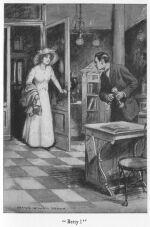
Just there the storm burst. Ten seconds later Roland, with a confused impression of having been kicked by a mule, picked himself up out of the dust in the middle of the street and stared stupidly back at the store. Nat was waiting in the doorway for a renewal of hostilities, if any such there were to be. Seeing, however, that Roland had apparently sated his appetite for personal conflict, he picked up a dark object at his feet and held it out.
"Here's your hat, Roly," he called.
Roland spat out a mouthful of dust and swore beneath his breath. "Throw it out here," he replied prudently.
Tossing him the hat, Nat turned contemptuously. "Come in again, any time you want to apologise," he shouted over his shoulder, as an afterthought.
He paused in the middle of the store and felt of his necktie. It proved to be a little out of place, but otherwise he was as immaculate as was his wont. He reviewed the encounter and laughed quietly.
"There's no cure for a fool," he mused....
The telephone bell roused him from his reverie. He went over to the instrument, sat down, and put the receiver to his ear.
"Hello?" he said.... "Oh, hello, Josie! ... What's that?... That's right, but I'm not used to it yet, you know.... Well, I'll try again. Now—ready?"
He schooled his voice to a key of heartrending sentiment: "Hello, darling.... How's that? ... Told your father? Told him what?... Oh, about the engagement! Was he angry? ... Oh, he wasn't, eh? What did he say? ... Wasn't that nice of him!..."
Conscious of a slight noise in the store he looked up. A young woman had just entered. She paused just inside the door, smiling at him a little timidly.
Without another word to his fiancee Nat put down the telephone and hooked up the receiver.
"Betty!" he cried wonderingly.
XXI
AS OTHERS SAW HIM
If Nat's cry of recognition had been wondering, it was no less one of delight. The surprise he felt was perfectly natural; Betty wasn't to have returned until the morrow, and was therefore the last person he had expected to see when he looked up from the telephone desk. But it was the change in the girl that most stirred him: the change he had prophesied, planned for, anticipated eagerly throughout the long seven months of her absence; to have his expectations so wonderfully fulfilled, and more than fulfilled, pleased him beyond expression. And it's curious to speculate upon the fact that he fancied his greatest pleasure came from the knowledge that old Sam would be so overjoyed....
It was really only a paraphrase of the old story of the grub and the butterfly. The little, starveling drudge who had found him in the store, that first day, had completely vanished; it was as if she had never been. In her place he discovered a girl all grace and loveliness, her slender figure ripening into gracious womanhood; a girl of mind and heart and understanding, all fire and tenderness; demure, intelligent, with a pretty pose of independence and sureness of herself moderated by modesty and reserve. Her travelling dress of sober colouring and severe lines became her bewitchingly. Beneath the brim of her dainty hat, with veil thrown back, her dark hair waved back, glossy with the sheen of perfect well-being, from a face serenely charming—the more so for her slightly deepened flush; and the eyes that shone into Nat's danced with the light of enjoyment, bred of his supreme astonishment....
"Nat, I'm so glad to see you again!"
He was speechless.
She laughed, put down her suit-case, and moved toward him, offering him both her hands. He took them, stammering.
"It's such a surprise, Betty——!"
"I knew it would be. I just couldn't wait, Nat, when I found I could get here by the night train instead of tomorrow morning. I haven't been home, you know, but I couldn't resist the temptation to stop in here and see—what the store looked like after all these months. Besides, I thought that you or father——" Her eyes fell and she faltered, withdrawing her hands.
By now he had himself in hand. "Why," he laughed, "you nearly took my breath away. Even now I can hardly believe it..."
"Believe what, Nat?" she asked quickly.
"That you're the same little Betty Graham. I never saw such a change."
"It's a change for the better, isn't it, Nat?" she asked with a smile half wistful.
"I should think it was. It's just marvellous!"
"Did I seem so very awful, then?"
"Nonsense. You know you didn't, only, now..."
"Then you think father will be pleased?"
"If he isn't, I'm blind!"
She looked away, embarrassed, and touched by his interest and his feeling. "And does it make you a little proud, Nat?"
"Proud!" he exclaimed blankly.
"Because you know you've done it all. If there's any improvement in Betty Graham to-day, it's because of you. If it hadn't been for you——"
"Never in the world; you don't know what you're talking about, Betty. Nobody but yourself could have brought about this change. It had to be in you before it could come out. You know that."
She shook her head very decidedly, seating herself on one of the chairs by the soda-fountain. "Oh, no," she contradicted calmly and sincerely. "Why, Nat, don't you suppose I have any memory? You began making me a better girl the very first day we met here in the store, by the things you said to me. And ever since I've been watching you, while you were making life a Heaven for father and me, and thinking that if I were a man I'd try to be as near like you as I could."
"Oh, don't say that," he pleaded wretchedly.
"It's true.... And when you sent me away to school I promised myself I'd try to repay you for the sacrifice you must be making for me; that I'd follow your example as nearly as ever I could; that I'd work hard and try to treat people the way you do—kindly, Nat, and considerately, and bravely and tenderly and honestly——"
He dropped into a chair near her and buried his head in his hands. "Don't!" he begged huskily. "Please, Betty, don't!"
But she wouldn't stop, little guessing how she was racking his heart in her innocent desire to make him understand how deeply she appreciated all he had done for her. "And, O Nat, it's worked so wonderfully! It's made all the girls at school like me, and it's made me understand and like everybody else better; and now, what's ten thousand times the best of all, you notice an improvement the minute you see me! And I—I never was so happy in all my life." She bent forward and took one of his hands, patting it softly. "Nat, I think you're the very best man in the whole world!"
"Don't!" he groaned. "Don't, for Heaven's sake!"
"Oh, I know, Nat—I know you don't like me to say this, but I must, just the same, tell you the truth about yourself. It's so splendid to live the life you do. You're all unconscious of it, but I want you to realise it and know that I do, too. You've made everybody love you and..."
But confusion silenced her, and she gently replaced his hand. For several moments neither spoke. Then Nat broke the tension with a short, hard laugh.
"That's right," he said inscrutably; "that was the idea...."
"Nat, what do you mean?"
He turned to her. "Betty, does it make you—feel that way toward me?"
She coloured divinely. "Why, Nat, of course ... Why, everyone..."
"That's why I came here, Betty," he pursued, blind to her embarrassment. "I came here with the idea... of getting married...."
He was staring gloomily at the floor and could not see the light that dawned upon the girl's face. Absorbed in the struggle with his conscience he had no least suspicion of how his words were affecting her. He knew only that he must somehow make a confession to her, that to own her regard and gratitude on the terms that then existed between them was utterly intolerable.
"You never guessed that, did you?"
"No," she breathed brokenly. "No, Nat, I—"
"Well, it's the truth and...." He rose and moved away. "But I can't tell you just now—not now...."
"No, not now, Nat." Betty, too, got up. "I think I'd better go home and see father—I mustn't forget—" she faltered, half blinded by the mist of the happiness before her eyes.
"No—wait." She stopped to find his gaze full upon her; for the first time he comprehended that she had not understood, that, worst of all, she had misunderstood. "I must tell you," he blurted desperately, "I must."